New Semester
Started
Get
50% OFF
Study Help!
--h --m --s
Claim Now
Question Answers
Textbooks
Find textbooks, questions and answers
Oops, something went wrong!
Change your search query and then try again
S
Books
FREE
Study Help
Expert Questions
Accounting
General Management
Mathematics
Finance
Organizational Behaviour
Law
Physics
Operating System
Management Leadership
Sociology
Programming
Marketing
Database
Computer Network
Economics
Textbooks Solutions
Accounting
Managerial Accounting
Management Leadership
Cost Accounting
Statistics
Business Law
Corporate Finance
Finance
Economics
Auditing
Tutors
Online Tutors
Find a Tutor
Hire a Tutor
Become a Tutor
AI Tutor
AI Study Planner
NEW
Sell Books
Search
Search
Sign In
Register
study help
sciences
college physics reasoning
College Physics A Strategic Approach 3rd Edition Randall D. Knight, Brian Jones, Stuart Field - Solutions
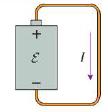
A battery produces a current in a wire. As the current continues, which of the following quantities (perhaps more than one) decreases?A. The positive charge in the battery B. The emf of the battery C. The chemical energy in the battery +
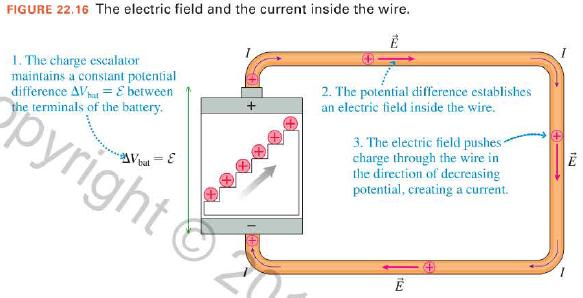
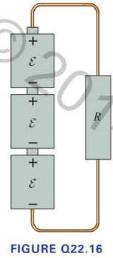
In Figure 22.16 the wire is changed to a new one, leading to an increased current in the wire. Compared to the original wire, the potential difference across the ends of this new wire is A. Larger. B. Smaller. C. The same. FIGURE 22.16 The electric field and the current inside the wire. 1. The
A wire connected between the terminals of a battery carries a current. The wire is removed and stretched, decreasing its cross-section area and increasing its length. When the wire is reconnected to the battery, the new current isA. Larger than the original current.B. The same as the original
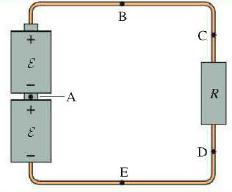
Two identical batteries are connected in series in a circuit with a single resistor. V = 0 V at the negative terminal of the lower battery. Rank in order, from highest to lowest, the potentials VA to VE at the labeled points, noting any ties. Assume the wires are ideal. + E B C A R + E D
Rank in order, from largest to smallest, the powers PA to PDdissipated in resistors A to D. AV 2AV R R A. B. ucati AV R D.
An electrolyte contains equal numbers of positive and negative ions in solution. When an electric field is applied, the positive ions move in the direction of the field and the negative ions move opposite the field. If the negative ions move faster than the positive ions, is the net current in the
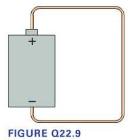
a. Which direction-clockwise or counterclockwise-does an electron travel through the wire in Figure Q22.9? Explain.b. Does an electron's electric potential energy increase, decrease, or stay the same as it moves through the wire? Explain.c. If you answered "decrease" in part \(b\), where does the
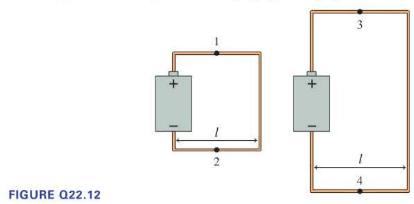
The two circuits in Figure Q22.12 use identical batteries and wires made of the same material and of equal diameters. Rank in order, from largest to smallest, the currents \(I_{1}, I_{2}, I_{3}\), and \(I_{4}\) at points 1 to 4. FIGURE Q22.12 + 2 3 4
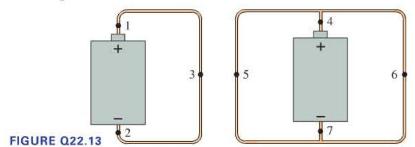
The two circuits in Figure Q22.13 use identical batteries and wires made of the same material and of equal diameters. Rank in order, from largest to smallest, the currents \(I_{1}\) to \(I_{7}\) at points 1 to 7. Explain. FIGURE Q22.13 2 5 7 6
The circuit in Figure Q22.16 has three batteries of emf \(\mathcal{E}\) in series. Assuming the wires are ideal, sketch a graph of the potential as a function of distance traveled around the circuit, starting from \(V=0 \mathrm{~V}\) at the negative terminal of the bottom battery. Note all
A \(100 \mathrm{~W}\) lightbulb is brighter than a \(60 \mathrm{~W}\) lightbulb when both operate at the same voltage of \(120 \mathrm{~V}\). If, instead, they were both operated at the same current of \(0.5 \mathrm{~A}\), which would be brighter? Explain.
A copper wire is stretched so that its length increases and its diameter decreases. As a result, A. The wire's resistance decreases, but its resistivity stays the same.B. The wire's resistivity decreases, but its resistance stays the same.C. The wire's resistance increases, but its resistivity
The potential difference across a length of wire is increased. Which of the following does not increase as well?A. The electric field in the wire B. The power dissipated in the wire C. The resistance of the wire D. The current in the wire
A resistor connected to a \(3.0 \mathrm{~V}\) battery dissipates \(1.0 \mathrm{~W}\). If the battery is replaced by a \(6.0 \mathrm{~V}\) battery, the power dissipated by the resistor will be A. \(1.0 \mathrm{~W}\)B. \(2.0 \mathrm{~W}\)C. \(3.0 \mathrm{~W}\)D. \(4.0 \mathrm{~W}\)
Three wires meet at a junction. Wire 1 has a current of \(0.40 \mathrm{~A}\) into the junction. The current of wire 2 is \(0.65 \mathrm{~A}\) out of the junction.(a) How many electrons per second move past a point in wire 3 ?(b) In which direction do the electrons move-into or out of the junction?
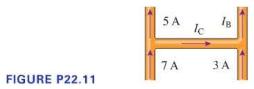
What are the values of currents \(I_{\mathrm{B}}\) and \(I_{\mathrm{C}}\) in Figure P22.11? The directions of the currents are as noted. 5A Ic 7 A 3 A FIGURE P22.11
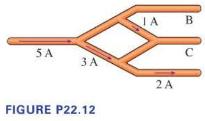
The currents through several segments of a wire object are shown in Figure P22.12. What are the magnitudes and directions of the currents \(I_{\mathrm{B}}\) and \(I_{\mathrm{C}}\) in segments \(\mathrm{B}\) and \(\mathrm{C}\) ? JA B C 5A 3 A 2A FIGURE P22.12
How much electric potential energy does \(1.0 \mu \mathrm{C}\) of charge gain as it moves from the negative terminal to the positive terminal of a \(1.5 \mathrm{~V}\) battery?
What is the emf of a battery that increases the electric potential energy of \(0.050 \mathrm{C}\) of charge by \(0.60 \mathrm{~J}\) as it moves it from the negative to the positive terminal?
A wire with resistance \(R\) is connected to the terminals of a \(6.0 \mathrm{~V}\) battery. What is the potential difference \(\Delta V_{\text {ends }}\) between the ends of the wire and the current \(I\) through it if the wire has the following resistances?(a) \(1.0 \Omega\)(b) \(2.0 \Omega\)(c)
A wire has a resistance of \(0.010 \Omega\). What will the wire's resistance be if it is stretched to twice its original length without changing the volume of the wire?
Resistivity measurements on the leaves of corn plants are a good way to assess stress and overall health. The leaf of a corn plant has a resistance of \(2.0 \mathrm{M} \Omega\) measured between two electrodes placed \(20 \mathrm{~cm}\) apart along the leaf. The leaf has a width of \(2.5
The femoral artery is the large artery that carries blood to the leg. A person's femoral artery has an inner diameter of \(1.0 \mathrm{~cm}\). What is the resistance of a 20-cm-long column of blood in this artery?
A 1.0-mm-diameter, 20-cm-long copper wire carries a \(3.0 \mathrm{~A}\) current. What is the potential difference between the ends of the wire?
The relatively high resistivity of dry skin, about\(1 \times 10^{6} \Omega \cdot \mathrm{m}\), can safely limit the flow of current into deeper tissues of the body. Suppose an electrical worker places his palm on an instrument whose metal case is accidentally connected to a high voltage. The skin
The aluminum wire in a high-voltage transmission line is \(2.7 \mathrm{~cm}\) in diameter. It is designed to carry a current of \(1100 \mathrm{~A}\). What is the voltage drop across a \(37-\mathrm{km}\)-long segment of this power line?
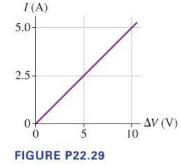
Figure P22.29 shows the current-versus-potential-difference graph for a resistor.a. What is the resistance of this resistor?b. Suppose the length of the resistor is doubled while keeping its cross section the same. (This requires doubling the amount of material the resistor is made of.) Copy the
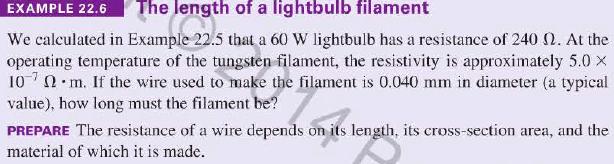
In Example 22.6 the length of a \(60 \mathrm{~W}, 240 \Omega\) lightbulb filament was calculated to be \(60 \mathrm{~cm}\).a. If the potential difference across the filament is \(120 \mathrm{~V}\), what is the strength of the electric field inside the filament?b. Suppose the length of the bulb's
A copper wire is \(1.0 \mathrm{~mm}\) in diameter and carries a current of \(20 \mathrm{~A}\). What is the electric field strength inside this wire?
A \(1.5 \mathrm{~V}\) battery moves \(2000 \mathrm{C}\) of charge around a circuit. By how much does the chemical energy of the battery decrease?
Every second, a battery increases the electric potential energy of the \(1.2 \mathrm{C}\) of charge passing through it by \(7.2 \mathrm{~J}\). What is the battery's emf?
A \(70 \mathrm{~W}\) electric blanket runs at \(18 \mathrm{~V}\).a. What is the resistance of the wire in the blanket?b. How much current does the wire carry?
An electric eel develops a potential difference of \(450 \mathrm{~V}\), driving a current of \(0.80 \mathrm{~A}\) for a \(1.0 \mathrm{~ms}\) pulse. For this pulse, find(a) the power,(b) the total energy, and(c) the total charge that flows.
The total charge a household battery can supply is given in units of \(\mathrm{mA} \cdot \mathrm{h}\). For example, a \(9.0 \mathrm{~V}\) alkaline battery is rated \(450 \mathrm{~mA} \cdot \mathrm{h}\), meaning that such a battery could supply a \(1 \mathrm{~mA}\) current for \(450 \mathrm{~h}\), a
A \(3.0 \mathrm{~V}\) battery powers a flashlight bulb that has a resistance of \(6.0 \Omega\). How much charge moves through the battery in \(10 \mathrm{~min}\) ?
A heating element in a toaster dissipates \(900 \mathrm{~W}\) when run at \(120 \mathrm{~V}\). How much charge passes through the heating element in 1 minute?
Older freezers developed a coating of ice inside that had to be melted periodically; an electric heater could speed this defrosting process. Suppose you're melting ice from your freezer using a heating wire that carries a current of \(5.0 \mathrm{~A}\) when connected to \(120 \mathrm{~V}\).a. What
The hot dog cooker described in the chapter heats hot dogs by connecting them to \(120 \mathrm{~V}\) household electricity. A typical hot dog has a mass of \(60 \mathrm{~g}\) and a resistance of \(150 \Omega\). How long will it take for the cooker to raise the temperature of the hot dog from
Air isn't a perfect electric insulator, but it has a very high resistivity. Dry air has a resistivity of approximately \(3 \times 10^{13} \Omega \cdot \mathrm{m}\). A capacitor has square plates \(10 \mathrm{~cm}\) on a side separated by \(1.2 \mathrm{~mm}\) of dry air. If the capacitor is charged
High-resolution measurements have shown that an ion channel is a 0.30-nm-diameter cylinder with length of \(5.0 \mathrm{~nm}\). The intracellular fluid filling the ion channel has resistivity \(0.60 \Omega \cdot \mathrm{m}\). What is the resistance of the ion channel?
When an ion channel opens in a cell wall, monovalent (charge \(e\) ) ions flow through the channel at a rate of \(1.0 \times 10^{7} \mathrm{ions} / \mathrm{s}\).a. What is the current through the channel?b. The potential difference across the ion channel is \(70 \mathrm{mV}\). What is the power
The total charge a battery can supply is rated in \(\mathrm{mA} \cdot \mathrm{h}\), the product of the current (in \(\mathrm{mA}\) ) and the time (in \(\mathrm{h}\) ) that the battery can provide this current, A battery rated at \(1000 \mathrm{~mA} \cdot \mathrm{h}\) can supply a current of \(1000
The heating element of a simple heater consists of a \(2.0-\mathrm{m}-\) long, 0.60 -mm-diameter nichrome wire. When plugged into a \(120 \mathrm{~V}\) outlet, the heater draws \(8.0 \mathrm{~A}\) of current when hot.a. What is the wire's resistance when it is hot?b. Use your answer to part a to
Variations in the resistivity of blood can give valuable clues to changes in the blood's viscosity and other properties. The resistivity is measured by applying a small potential difference and measuring the current. Suppose a medical device attaches electrodes into a \(1.5-\mathrm{mm}\)-diameter
It Wires aren't really ideal. The voltage drop across a currentcarrying wire can be significant unless the resistance of the wire is quite low. Suppose a \(50 \mathrm{ft}\) extension cord is being used to provide power to an electric lawn mower. The cord carries a \(10 \mathrm{~A}\) current. The
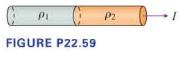
The two segments of the wire in Figure P22.59 have equal diameters and equal lengths but different resistivities \(ho_{1}\) and \(ho_{2}\) Current \(I\) passes through this wire. If the resistivities have the ratio \(ho_{2} / ho_{1}=2\), what is the ratio \(\Delta V_{1} / \Delta V_{2}\) of the
A long wire used as a heating element carries a current of \(0.80 \mathrm{~A}\). It dissipates \(6.0 \mathrm{~W}\) for every meter of length. What is the electric field strength inside this wire?
The filament of a \(100 \mathrm{~W}(120 \mathrm{~V})\) lightbulb is a tungsten wire \(0.035 \mathrm{~mm}\) in diameter. At the filament's operating temperature, the resistivity is \(5.0 \times 10^{-7} \Omega \cdot \mathrm{m}\). How long is the filament?
If resistors 1 and 2 are connected to identical batteries, resistor 1 dissipates 3.0 times more power than resistor 2 . What is the ratio \(P_{1} / P_{2}\) of their power dissipations if the same current passes through each resistor?
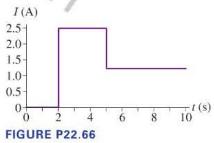
The graph in Figure P22.66 shows the current through a \(1.0 \Omega\) resistor as a function of time.a. How much charge flowed \(I(\mathrm{~A})\)through the resistor during the \(10 \mathrm{~s}\) interval shown?b. What was the total energy dissipated by the resistor during this time? I(A) 2.5- 2.0-
It's possible to estimate the percentage of fat in the body by measuring the resistance of the upper leg rather than the upper arm; the calculation is similar. A person's leg measures \(40 \mathrm{~cm}\) between the knee and the hip, with an average leg diameter (ignoring bone and other poorly
If you touch the two terminals of a power supply with your two fingertips on opposite hands, the potential difference will produce a current through your torso. The maximum safe current is approximately \(5 \mathrm{~mA}\).a. If your hands are completely dry, the resistance of your body from
The average resistivity of the human body (apart from surface resistance of the skin) is about \(5.0 \Omega \cdot \mathrm{m}\). The conducting path between the right and left hands can be approximated as a cylinder \(1.6 \mathrm{~m}\) long and \(0.10 \mathrm{~m}\) in diameter. The skin resistance
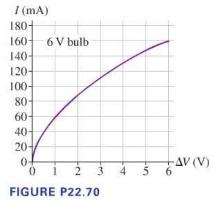
For the bulb in Figure P22.70, what is the approximate resistance of the bulb at a potential difference of \(6.0 \mathrm{~V}\) ?A. \(7.0 \Omega\)B. \(17 \Omega\)C. \(27 \Omega\)D. \(37 \Omega\)You've probably observed that the most common time for an incandescent lightbulb to fail is the moment
As the bulb ages, the resistance of the filamentA. Increases.B. Decreases.C. Stays the same.You've probably observed that the most common time for an incandescent lightbulb to fail is the moment when it is turned on. Let's look at the properties of the bulb's filament to see why this happens.The
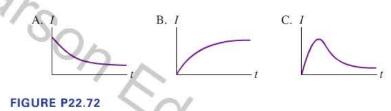
Which of the curves in Figure P22.72 best represents the expected variation in current as a function of time in the short time interval immediately after the bulb is turned on?You've probably observed that the most common time for an incandescent lightbulb to fail is the moment when it is turned
There are devices to put in a light socket that control the current through a lightbulb, thereby increasing its lifetime. Which of the following strategies would increase the lifetime of a bulb without making it dimmer?A. Reducing the average current through the bulbB. Limiting the maximum current
Rank in order, from smallest to largest, the resistances R1 to R4 of the four resistors. 2 V 2 V IV IV IA 2 A IA 2A R R R3 R
Which of these diagrams represent the same circuit? ww A. C. www ww D. B. ww HH
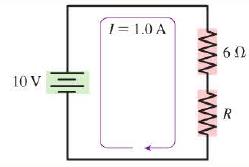
What is the potential difference across resistor R?A. - 3.0V B. - 4.0Vc. - 5.0 v D. - 6.0V E. - 10V 10 V 1=1.0 A www-ww 602 R
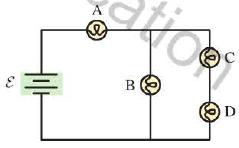
Rank in order from brightest to dimmest, the identical bulbs A to D. A B D
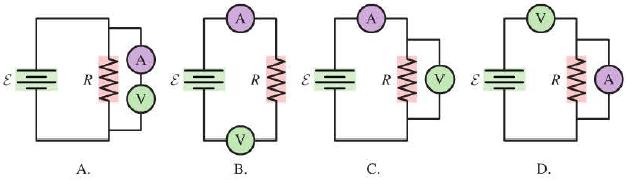
Which is the right way to connect the meters to measure the potential difference across and the current through the resistor? ww R ww R ww R ww 3 R A. B. C. D.
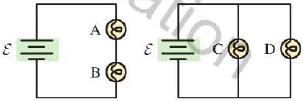
Rank in order, from brightest to dimmest, the identical bulbs A to D. A E B c e D
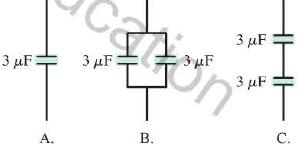
Rank in order, from largest to smallest, the equivalent capacitance (Ceq)A to (Ceq)c of circuits A to C. 3 F 3 F 3 F 3F 3 F A. B. C.
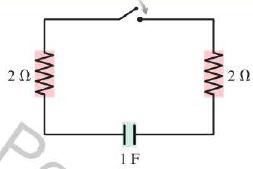
The time constant for the discharge of this capacitor is.A. 5 s B. 4 s C. 2 s D. 1 s ww 202 20 ww HH 1 F
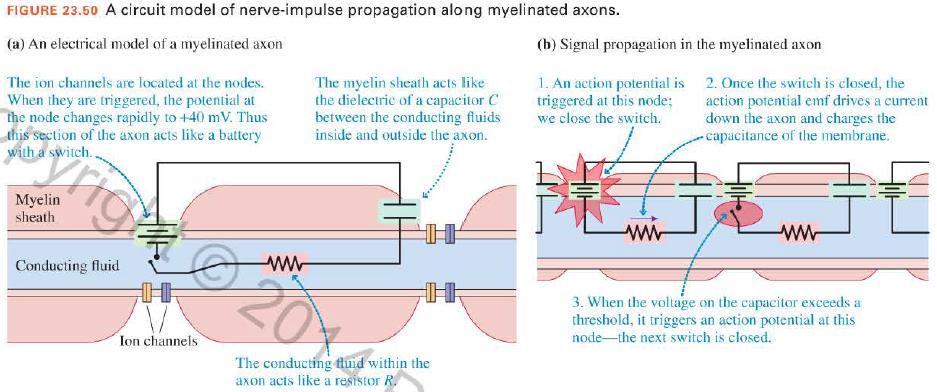
In the axon model of Figure 23.50, if the thickness of the myelin sheath were increased, the propagation speed of nerve impulses would A. Increase. B. Decrease. C. Remain the same. FIGURE 23.50 A circuit model of nerve-impulse propagation along myelinated axons. (a) An electrical model of a
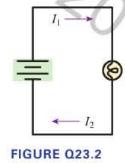
A flashlight bulb is connected to a battery and is glowing; the circuit is shown in Figure Q23.2. Is current \(I_{2}\) greater than, less than, or equal to current \(I_{1}\) ? Explain. 12 FIGURE Q23.2
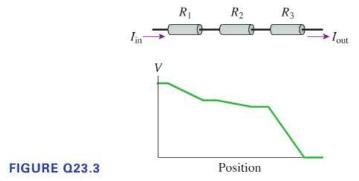
Current \(I_{\text {in }}\) flows into three resistors connected together one after the other as shown in Figure Q23.3. The accompanying graph shows the value of the potential as a function of position.a. Is \(I_{\text {out }}\) greater than, less than, or equal to \(I_{\text {in }}\) ? Explain.b.
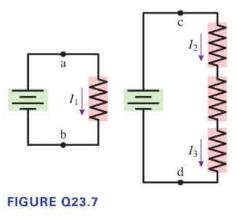
Figure Q23.7 shows two circuits. The two batteries are identical and the four resistors all have exactly the same resistance.a. Is \(\Delta V_{\mathrm{ab}}\) larger than, smaller than, or equal to \(\Delta V_{\mathrm{cd}}\) ? Explain.b. Rank in order, from largest to smallest, the currents \(I_{1},
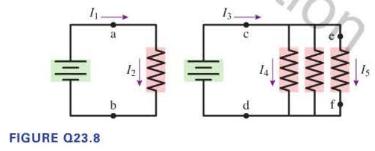
Figure Q23.8 shows two circuits. The two batteries are identical and the four resistors all have exactly the same resistance.a. Compare \(\Delta V_{\mathrm{ab}}, \Delta V_{\mathrm{cd}}\), and \(\Delta V_{\mathrm{ef}}\). Are they all the same? If not, rank them in order from largest to smallest.
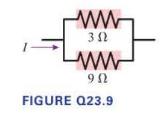
a. In Figure Q23.9, what fraction of current \(I\) goes through the \(3 \Omega\) resistor?b. If the \(9 \Omega\) resistor is replaced with a larger resistor, will the fraction of current going through the \(3 \Omega\) resistor increase, decrease, or stay the same? ww 352 ww 902 FIGURE Q23.9
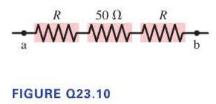
Two of the three resistors in Figure Q23.10 are unknown but equal. Is the total resistance between points \(a\) and \(b\) less than, greater than, or equal to \(50 \Omega\) ? Explain. a R 500 R wwww ww WWW-WW b FIGURE Q23.10
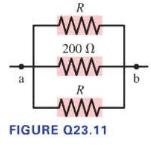
Two of the three resistors in Figure Q23.11 are unknown but equal. Is the total resistance between points a and b less than, greater than, or equal to \(200 \Omega\) ? Explain. R ww 200 ww R ww FIGURE Q23.11 b
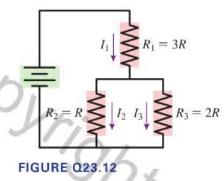
Rank in order, from largest to smallest, the currents \(I_{1}, I_{2}\), and \(I_{3}\) in the circuit diagram in Figure Q23.12. R = 3R www R = 2R ww ww T FIGURE Q23.12
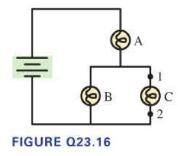
a. The three bulbs in Figure Q23.16 are identical. Rank the bulbs from brightest to dimmest. Explain.b. Suppose a wire is connected between points 1 and 2 . What happens to each bulb? Does it get brighter, stay the same, get dimmer, or go out? Explain. B FIGURE Q23.16 A
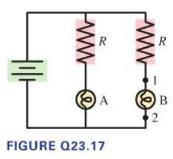
Initially, bulbs A and B in Figure Q23.17 are both glowing. Bulb B is then removed from its socket. Does removing bulb B cause the potential difference \(\Delta V_{12}\) between points 1 and 2 to increase, decrease, stay the same, or become zero? Explain. R R ww Hilt A FIGURE Q23.17 B
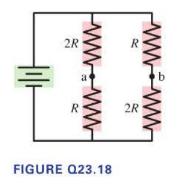
a. Consider the points \(\mathrm{a}\) and \(\mathrm{b}\) in Figure Q23.18. Is the potential difference \(\Delta V_{\mathrm{ab}}\) between points a and \(\mathrm{b}\) zero? If so, why? If not, which point is more positive?b. If a wire is connected between points a andb, does it carry a current? If
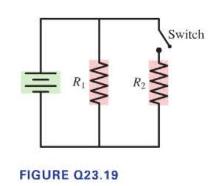
When the switch in Figure Q23.19 is closed,a. Does the current through the battery increase, decrease, or stay the same? Explain.b. Does the current through \(R_{1}\) increase, decrease, or stay the same? Explain. ww R Switch ww R FIGURE Q23.19
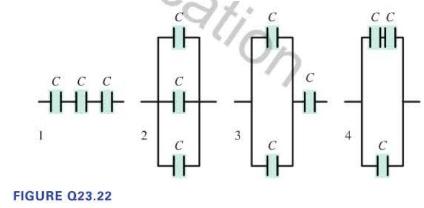
Rank in order, from largest to smallest, the equivalent capacitances \(\left(C_{\mathrm{eq}}\right)_{1}\) to \(\left(C_{\mathrm{eq}}\right)_{4}\) of the four groups of capacitors shown in Figure Q23.22. C C C HHHT CC 600 3 FIGURE Q23.22
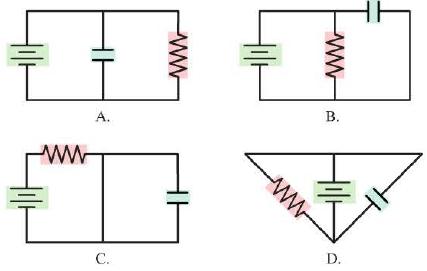
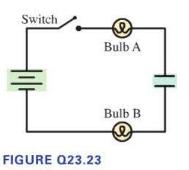
Figure Q23.23 shows a circuit consisting of a battery, a switch, two identical lightbulbs, and a capacitor that is initially uncharged.a. Immediately after the switch is closed, are either or both bulbs glowing? Explain.b. If both bulbs are glowing, which FIGURE 023.23 is brighter? Or are they
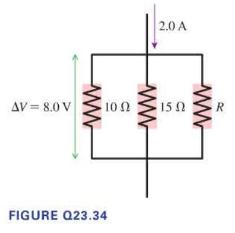
What is the value of resistor \(R\) in Figure Q23.34?A. \(4.0 \Omega\)B. \(12 \Omega\)C. \(36 \Omega\)D. \(72 \Omega\)E. \(96 \Omega\) ww AV=8.0 V 2.0 A R ww 15 ww 1002 FIGURE Q23.34
Two capacitors are connected in series. They are then reconnected to be in parallel. The eapacitance of the parallel combinationA. Is less than that of the series combination.B. Is more than that of the series combination.C. Is the same as that of the series combination.D. Could be more or less
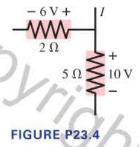
In Figure P23.4, what is the current in the wire above the junction? Does charge flow toward or away from the junction? -6V+ ww 20 50 pyri ww FIGURE P23.4 + 10 V h
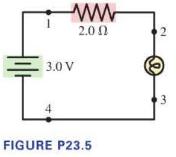
The lightbulb in the circuit diagram of Figure P23.5 has a resistance of \(1.0 \Omega\). Consider the potential difference between pairs of points in the figure.a. What are the magnitudes of \(\Delta V_{12}, \Delta V_{23}\), and \(\Delta V_{34}\) ?b. What are the magnitudes if the bulb is removed?
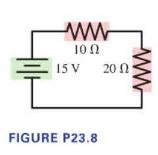
a. What is the potential difference across each resistor in Figure P23.8?b. Draw a graph of the potential as a function of the distance traveled through the circuit, traveling clockwise from \(V=0 \mathrm{~V}\) at the lower left corner. See Figure P23.9 for an example of such a graph. ww 102 ww 15
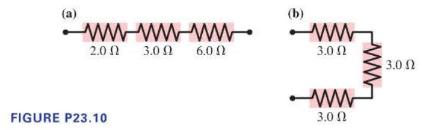
I What is the equivalent resistance of each group of resistors shown in Figure P23.10? (a) wwwwww 2.00 3.00 6.0 (b) ww FIGURE P23.10 3.00 3.0 2 ww 3.0
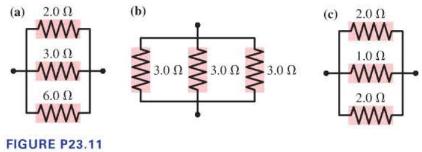
What is the equivalent resistance of each group of resistors shown in Figure P23.11? (a) 2.00 ww 3.00 www. 6.00 www FIGURE P23.11 (b) (c) 2.00 ww 1.0 3.0 3.0.2 3.00 ww 2.0 01 www
Three resistors in parallel have an equivalent resistance of \(5.0 \Omega\). Two of the resistors have resistances of \(10 \Omega\) and \(30 \Omega\). What is the resistance of the third resistor?
Three identical resistors have an equivalent resistance of \(30 \Omega\) when connected in parallel. What is their equivalent resistance when connected in series?
You have a collection of \(1.0 \mathrm{k} \Omega\) resistors. How can you connect four of them to produce an equivalent resistance of \(0.25 \mathrm{k} \Omega\) ?
You have a collection of six \(1.0 \mathrm{k} \Omega\) resistors. What is the smallest resistance you can make by combining them?
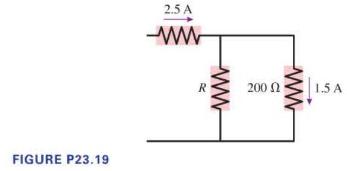
The currents in two resistors in a circuit are shown in Figure P23.19. What is the value of resistor \(R\) ? FIGURE P23.19 2.5 A ww R ww 200 ww 1.5 A
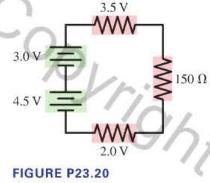
Two batteries supply current to the circuit in Figure P23.20. The figure shows the potential difference across two of the resistors and the value of the third resistor. What current is supplied by the batteries? 3.0 V H 3.5 V ww ww 150 yright 4.5 V ww 2.0 V FIGURE P23.20
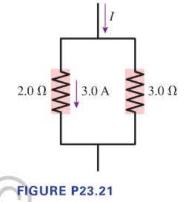
Part of a circuit is shown in Figure P23.21.a. What is the current through the \(3.0 \Omega\) resistor?b. What is the value of the current \(I\) ? 2.00 ww 3.0 A 3.0 ww FIGURE P23.21
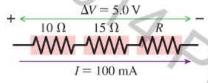
What is the value of resistor \(R\) in Figure P23.22?Figure P23.22 1002 AV = 5.0 V 1532 R wwwwwww I= 100 mA
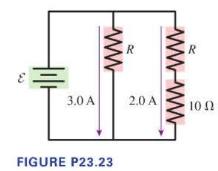
What are the resistances \(R\) and the emf of the battery in Figure P23.23? E ww R 3.0 A 2.0 A FIGURE P23.23 wwww R 102
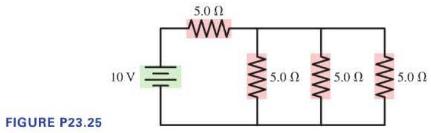
Find the current through and the potential difference across each resistor in Figure P23.25. FIGURE P23.25 10 V 5.02 ww ww 15.0 ww $5.00 ww $5.00
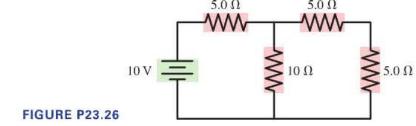
Find the current through and the potential difference across each resistor in Figure P23.26. FIGURE P23.26 10 V 5.00 5.02 ww www ww 10 ww 5.0 0
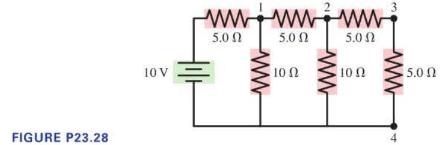
Consider the potential differences between pairs of points in Figure P23.28. What are the magnitudes of the potential differences \(\Delta V_{14}, \Delta V_{24}\), and \(\Delta V_{34}\) ? 10 V wwwwww 5.00 www 5.00 1002 ww 5.00 1002 FIGURE P23.28 5.00 ww 4
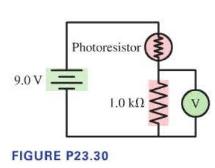
A photoresistor, whose resistance decreases with light intensity, is connected in the circuit of Figure P23.30. On a sunny day, the photoresistor has a resistance of \(0.56 \mathrm{k} \Omega\). On a cloudy day, the resistance rises to \(4.0 \mathrm{k} \Omega\). At night, the resistance is \(20
Showing 1200 - 1300
of 4913
First
6
7
8
9
10
11
12
13
14
15
16
17
18
19
20
Last
Step by Step Answers

 Get 50% OFF
Claim Now
Get 50% OFF
Claim Now