New Semester
Started
Get
50% OFF
Study Help!
--h --m --s
Claim Now
Question Answers
Textbooks
Find textbooks, questions and answers
Oops, something went wrong!
Change your search query and then try again
S
Books
FREE
Study Help
Expert Questions
Accounting
General Management
Mathematics
Finance
Organizational Behaviour
Law
Physics
Operating System
Management Leadership
Sociology
Programming
Marketing
Database
Computer Network
Economics
Textbooks Solutions
Accounting
Managerial Accounting
Management Leadership
Cost Accounting
Statistics
Business Law
Corporate Finance
Finance
Economics
Auditing
Tutors
Online Tutors
Find a Tutor
Hire a Tutor
Become a Tutor
AI Tutor
AI Study Planner
NEW
Sell Books
Search
Search
Sign In
Register
study help
sciences
college physics reasoning
College Physics A Strategic Approach 3rd Edition Randall D. Knight, Brian Jones, Stuart Field - Solutions
Two 10.0-cm-diameter electrodes \(0.50 \mathrm{~cm}\) apart form a parallel-plate capacitor. The electrodes are attached by metal wires to the terminals of a \(15 \mathrm{~V}\) battery. After a long time, the capacitor is disconnected from the battery but is not discharged. What are the charge on
Two 10.0 -cm-diameter electrodes \(0.50 \mathrm{~cm}\) apart form a parallel-plate capacitor. The electrodes are attached by metal wires to the terminals of a \(15 \mathrm{~V}\) battery. What are the charge on each electrode, the electric field strength inside the capacitor, and the potential
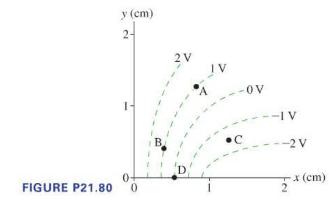
Figure P21.80 shows a series of equipotential curves.a. Is the electric field strength at point A larger than, smaller than, or equal to the field strength at point B? Explain.b. Is the electric field strength at point \(\mathrm{C}\) larger than, smaller than, or equal to the field strength at
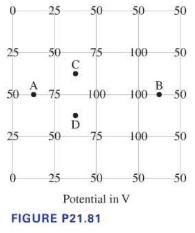
Figure P21.81 shows the electric potential on a grid whose squares are \(5.0 \mathrm{~cm}\) on a side.a. Reproduce this figure on your paper, then draw the \(50 \mathrm{~V}, 75 \mathrm{~V}\), and \(100 \mathrm{~V}\) equipotential surfaces.b. Estimate the electric field (strength and direction) at
A capacitor consists of two 6.0-cm-diameter circular plates separated by \(1.0 \mathrm{~mm}\). The plates are charged to \(150 \mathrm{~V}\), then the battery is removed.a. How much energy is stored in the capacitor?b. How much work must be done to pull the plates apart to where the distance
The highest magnetic fields in the world are generated when large arrays, or "banks," of capacitors are discharged through the copper coils of an electromagnet. At the National High Magnetic Field Laboratory, the total capacitance of the capacitor bank is \(32 \mathrm{mF}\). These capacitors can be
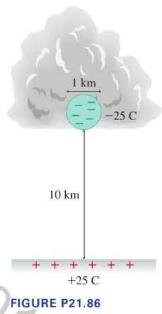
What is the approximate magnitude of the electric field between the charge center and the ground?A. \(4 \times 10^{4} \mathrm{~V} / \mathrm{m}\)B. \(4 \times 10^{5} \mathrm{~V} / \mathrm{m}\)C. \(4 \times 10^{6} \mathrm{~V} / \mathrm{m}\)D. \(4 \times 10^{7} \mathrm{~V} / \mathrm{m}\)Storm clouds
Which of the curves sketched in Figure P21.87 best approximates the shape of an equipotential drawn halfway between the charge center and the ground?Storm clouds build up large negative charges, as described in the chapter. The charges dwell in charge centers, regions of concentrated charge.
What is the approximate capacitance of the charge center + ground system?A. \(6 \times 10^{-8} \mathrm{~F}\)B. \(2 \times 10^{7} \mathrm{~F}\)C. \(4 \times 10^{6} \mathrm{~F}\)D. \(8 \times 10^{6} \mathrm{~F}\)Storm clouds build up large negative charges, as described in the chapter. The charges
If \(12.5 \mathrm{C}\) of charge is transferred from the cloud to the ground in a lightning strike, what fraction of the stored energy is dissipated?A. \(12 \%\)B. \(25 \%\)C. \(50 \%\)D. \(75 \%\)Storm clouds build up large negative charges, as described in the chapter. The charges dwell in charge
If the cloud transfers all of its charge to the ground via several rapid lightning flashes lasting a total of \(1 \mathrm{~s}\), what is the average power?A. \(1 \mathrm{GW}\)B. \(2 \mathrm{GW}\)C. \(5 \mathrm{GW}\)D. \(10 \mathrm{GW}\)Storm clouds build up large negative charges, as described in
An older camera has a lens with a focal length of \(50 \mathrm{~mm}\) and uses 36-mm-wide film to record its images. Using this camera, a photographer takes a picture of the Golden Gate Bridge that completely spans the width of the film. Now he wants to take a picture of the bridge using his
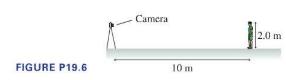
In Figure P19.6 the camera lens has a \(50 \mathrm{~mm}\) focal length. How high is the man's well-focused image on the CCD detector? Camera FIGURE P19.6 10 m 2.0 m
Martin has severe myopia, with a far point of only \(17 \mathrm{~cm}\). He wants to get glasses that he'll wear while using his computer, whose screen is \(65 \mathrm{~cm}\) away. What refractive power will these glasses require?
Mary, like many older people, has lost all ability to accommodate and can focus only on distant objects. She'd like to get reading glasses so that she can read a book held at a comfortable distance of \(50 \mathrm{~cm}\). What strength lenses, in diopters, does Mary need?
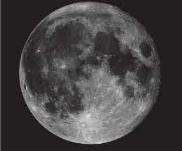
The diameter of a penny is \(19 \mathrm{~mm}\). How far from your eye must it be held so that it has the same apparent size as the moon? (Use the astronomical data inside the back cover.)
A magnifier has a magnification of \(4 \times\) for someone with a normal near-point distance of \(25 \mathrm{~cm}\). What is the magnification of this lens when used by a person with a near-point distance of \(15 \mathrm{~cm}\) ?
A forensic scientist is using a standard biological microscope with a \(15 \times\) objective and a \(5 \times\) eyepiece to examine a hair from a crime scene. How far from the objective is the hair?
A microscope with an 8.0 -mm-focal-length objective has a tube length of \(16.0 \mathrm{~cm}\). For the microscope to be in focus, how far should the objective lens be from the specimen?
Your telescope has a 700-mmfocal-length objective and a 26-mm-focal-length eyepiece. One evening you decide to look at the full moon, which has an angular size of \(0.52^{\circ}\) when viewed with the naked eye.a. What angle (in degrees) does the image of the moon subtend when you look at it
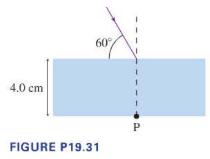
A ray of white light strikes the surface of a 4.0 -cm-thick slab of flint glass as shown in Figure P19.31. As the ray enters the glass, it is dispersed into its constituent colors. Estimate how far apart the rays of deepest red and deepest violet light are as they exit the bottom surface. Which
A ray of red light, for which \(n=1.54\), and a ray of violet light, for which \(n=1.59\), travel through a piece of glass. They meet right at the boundary between the glass and the air, and emerge into the air as one ray with an angle of refraction of \(22.5^{\circ}\). What is the angle between
A 1.0-cm-diameter microscope objective has a focal length of \(2.8 \mathrm{~mm}\). \(\mathrm{t}\) is used in visible light with a wavelength of \(550 \mathrm{~nm}\).a. What is the objective's resolving power if used in air?b. What is the resolving power of the objective if it is used in an
A microscope with an objective of focal length \(1.6 \mathrm{~mm}\) is used to inspect the tiny features of a computer chip. It is desired to resolve two objects only \(400 \mathrm{~nm}\) apart. What diameter objective is needed if the microscope is used in air with light of wavelength \(550
Suppose you point a pinhole camera at a \(15-\mathrm{m}\)-tall tree that is \(75 \mathrm{~m}\) away.a. If the detector is \(22 \mathrm{~cm}\) behind the pinhole, what will be the size of the tree's image on the detector?b. If you would like the image to be larger, should you get closer to the tree
Martha is viewing a distant mountain with a telescope that has a \(120-\mathrm{cm}\)-focal-length objective lens and an eyepiece with a \(2.0 \mathrm{~cm}\) focal length. She sees a bird that's \(60 \mathrm{~m}\) distant and wants to observe it. To do so, she has to refocus the telescope. By how
Susan is quite nearsighted; without her glasses, her far point is \(35 \mathrm{~cm}\) and her near point is \(15 \mathrm{~cm}\). Her glasses allow her to view distant objects with her eye relaxed. With her glasses on, what is the closest object on which she can focus?
A spy satellite uses a telescope with a 2.0-m-diameter mirror. It orbits the earth at a height of \(220 \mathrm{~km}\). What minimum spacing must there be between two objects on the earth's surface if they are to be resolved as distinct objects by this telescope? Assume the telescope's resolution
Frank is nearsighted and his glasses require a prescription of -1.5 D. One day he can't find his glasses, but he does find an older pair with a prescription of \(-1.0 \mathrm{D}\). What is the most distant object that Frank can focus on while wearing this older pair of glasses?
The Hubble Space Telescope has a mirror diameter of \(2.4 \mathrm{~m}\). Suppose the telescope was used to photograph the surface of the moon from a distance of \(3.8 \times 10^{8} \mathrm{~m}\). What is the distance between two objects that the telescope can barely resolve? Assume the wavelength
Microtubules are filamentous structures in cells that maintain cell shape and facilitate the movement of molecules within the cell. They are long, hollow cylinders with a diameter of about \(25 \mathrm{~nm}\). It is possible to incorporate fluorescent molecules into microtubules; when illuminated
Flattening the cornea would be a good solution for someone who was A. Nearsighted B. Farsighted.C. Either nearsighted or farsighted.
Suppose a woman has a far point of \(50 \mathrm{~cm}\). How much should the refractive power of her cornea be changed to correct her vision?A. \(-2.0 \mathrm{D}\)B. \(-1.0 \mathrm{D}\)C. +1.0 D D. \(+2.0 \mathrm{D}\)
A cataract is a clouding or opacity that develops in the eye's lens, often in older people. In extreme cases, the lens of the eye may need to be removed. This would have the effect of leaving a person A. Nearsighted. B. Farsighted.C. Neither nearsighted nor farsighted.
The length of your eye decreases slightly as you age, making the lens a bit closer to the retina. Suppose a man had his vision surgically corrected at age 30 . At age 70 , once his eyes had decreased slightly in length, he would be A. Nearsighted. B. Farsighted.C. Neither nearsighted nor farsighted.
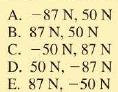
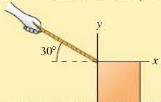
The tension in the rope is 100 N. Given that sin 30° = 0.50 and cos 30° = 0.87, the x- and y-components of the tension are A. -87 N, 50 N B. 87 N, 50 N C. -50 N, 87 N D. 50 N, E. 87 N, 87 N 50 N
An electroscope is charged by touching it with a positive glass rod. The electroscope leaves spread apart and the glass rod is removed. Then a negatively charged plastic rod is brought close to the top of the electroscope, but it doesn't touch. ~hat happens to the leaves?A. The leaves move closer
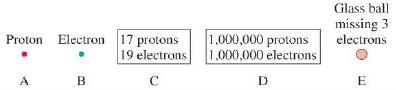
Rank in order, from most positive to most negative, the charges qA to qE of these five systems. Proton Electron 17 protons 19 electrons A B C 1,000,000 protons 1,000,000 electrons D Glass ball missing 3 electrons E
Charges l and 2 exert repulsive forces on each other. q1 = 4q2• Which statement is true? A. Fion2> F2on I B. Flon 2 on C. Flon2
Rank in order, from largest to smallest, the electric field strengths EA to ED at points A to D. < 29 BB 2r 29 2r D
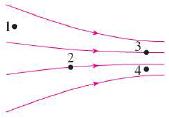
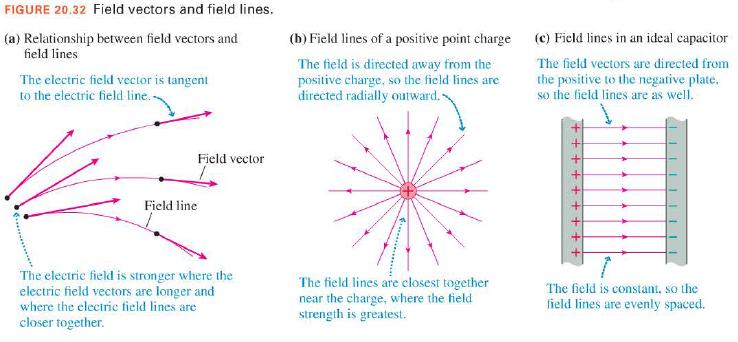
Using what you learned in Figure 20.32, rank in order, from largest to smallest, noting any ties, the electric field strengths E1 to E4 at points 1 to 4. 2
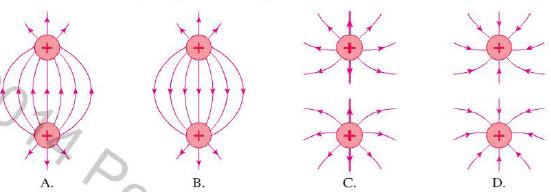
Which of the following is the correct representation of the electric field created by two positive charges? B. C. D.
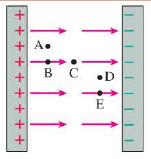
Rank in order, from largest to smallest, the forces FA to FE a proton would experience if placed at points A to E in this parallel plate capacitor. A. B C +++++++++ D E
The positive charge in Figure Q20.5 is \(+Q\). What is the negative charge if the electric field at the dot is zero? FIGURE Q20.5
Each part of Figure Q20.12 shows two points near two charges. Compare the electric field strengths \(E_{1}\) and \(E_{2}\) at these two points. Is \(E_{1}>E_{2}, E_{1}=E_{2}\), or \(E_{1}
A \(10 \mathrm{nC}\) charge sits at a point in space where the magnitude of the electric field is \(1200 \mathrm{~N} / \mathrm{C}\). What will the magnitude of the field be if the \(10 \mathrm{nC}\) charge is replaced by a \(20 \mathrm{nC}\) charge?
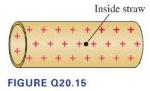
A hollow soda straw is uniformly charged, as shown in Figure Q20.15. What is the electric field at the center (inside) of the straw? Explain. + Inside straw ++ + FIGURE Q20.15
A positively charged particle is in the center of a parallel-plate capacitor that has charge \(\pm Q\) on its plates. Suppose the distance between the plates is doubled, with the charged particle remaining in the center. Does the force on this particle increase, decrease, or stay the same? Explain.
Two charged particles are separated by \(10 \mathrm{~cm}\). Suppose the charge on each particle is doubled. By what factor does the electric force between the particles change?
A small positive charge \(q\) experi- \(\quad \vec{E}_{1} \quad \vec{E}_{2}=2 \vec{E}_{1} \quad \vec{E}_{3}=3 \vec{E}_{1}\) ences a force of magnitude \(F_{1}\) when placed at point 1 in Figure Q20.18. In terms of \(F_{1}\) :a. What is the magnitude of the force on charge \(q\) at point 3 ?b. What
A typical commercial airplane is struck by lightning about once per year. When this happens, the external metal skin of the airplane might be burned, but the people and equipment inside the aircraft experience no ill effects. Explain why this is so.
Microbes such as bacteria have small positive charges when in solution. Public health agencies are exploring a new way to measure the presence of small numbers of microbes in drinking water by using electric forces to concentrate the microbes. Water is sent between the two oppositely charged
A \(+7.5 \mathrm{nC}\) point charge and a \(-2.0 \mathrm{nC}\) point charge are \(3.0 \mathrm{~cm}\) apart. What is the electric field strength at the midpoint between the two charges?A. \(3.3 \times 10^{3} \mathrm{~N} / \mathrm{C}\)B. \(5.7 \times 10^{3} \mathrm{~N} / \mathrm{C}\)C. \(2.2 \times
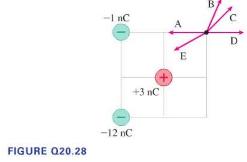
Three point charges are arranged as shown in Figure Q20.28 Which arrow best represents the direction of the electric field vector at the position of the dot? -InC A FIGURE Q20.28 -12 C E + +3 nC B D
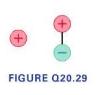
A positive charge is brought near to a dipole, as shown in Figure Q20.29. If the dipole is free to rotate, it A. Begins to rotate in a clockwise direction.B. Begins to rotate in a counterclockwise direction.C. Remains stationary. (+ -0 FIGURE 20.29
If two identical conducting spheres are in contact, any excess charge will be evenly distributed between the two. Three identical metal spheres are labeled A, B, and C. Initially, A has charge \(q\), \(\mathrm{B}\) has charge \(-q / 2\), and \(\mathrm{C}\) is uncharged.a. What is the final charge
A small metal sphere has a mass of \(0.15 \mathrm{~g}\) and a charge of INT \(-23.0 \mathrm{nC}\). It is \(10.0 \mathrm{~cm}\) directly above an identical sphere with the same charge. This lower sphere is fixed and cannot move.a. What is the magnitude of the force between the spheres?b. If the
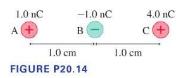
What are the magnitude and direction of the electric force on charge A in Figure P20.14? -1.0 C 4.0 nC c+ 1.0 cm 1.0 nC A+ 1.0 cm B FIGURE P20.14
A \(30 \mathrm{nC}\) charge experiences a \(0.035 \mathrm{~N}\) electric force. What is the magnitude of electric field at the position of this charge?
What are the strength and direction of an electric field that INf will balance the weight of (a) a proton and (b) an electron?
A parallel-plate capacitor is constructed of two square plates, size \(L \times L\), separated by distance \(d\). The plates are given charge \(\pm Q\). What is the ratio \(E_{\mathrm{f}} / E_{\mathrm{i}}\) of the final electric field strength \(E_{\mathrm{f}}\) to the initial electric field
A parallel-plate capacitor is formed from two \(4.0 \mathrm{~cm} \times\) \(4.0 \mathrm{~cm}\) electrodes spaced \(2.0 \mathrm{~mm}\) apart. The electric field strength inside the capacitor is \(1.0 \times 10^{6} \mathrm{~N} / \mathrm{C}\). What is the charge (in \(\mathrm{nC}\) ) on each electrode?
Two identical closely spaced circular disks form a parallelplate capacitor. Transferring \(1.5 \times 10^{9}\) electrons from one disk to the other causes the electric field strength between them to be \(1.0 \times 10^{5} \mathrm{~N} / \mathrm{C}\). What are the diameters of the disks?
A parallel-plate capacitor is constructed of two horizontal 12.0-cm-diameter circular plates. A \(1.0 \mathrm{~g}\) plastic bead, with a charge of \(-6.0 \mathrm{nC}\), is suspended between the two plates by the force of the electric field between them.a. Which plate, the upper or the lower, is
One kind of e-book display consists of millions of very small spheres that float in a thin fluid layer between two conducting, transparent plates. Each sphere is black on one side and white on the other, and possesses an electric dipole moment directed from the white side to the black. When an
Large electric fields in cell membranes cause ions to move through the cell wall. The field strength in a typical membrane is \(1.0 \times 10^{7} \mathrm{~N} / \mathrm{C}\). What is the magnitude of the force on a calcium ion with charge \(+e\) ?
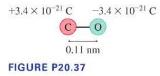
Molecules of carbon monoxide are permanent electric dipoles due to unequal sharing of electrons between the carbon and oxygen atoms. Figure P20.37 shows the distance and charges. Suppose a carbon monoxide molecule with a horizontal axis is in a vertical electric field of strength \(15,000
Objects A and B are both positively charged. Both have a mass of \(100 \mathrm{~g}\), but A has twice the charge of B. When A and B are placed with \(10 \mathrm{~cm}\) between their centers, B experiences an electric force of \(0.45 \mathrm{~N}\).a. How large is the force on \(\mathrm{A}\) ?b. What
An electric dipole is formed from \(\pm 1.0 \mathrm{nC}\) point charges spaced \(2.0 \mathrm{~mm}\) apart The dipole is centered at the origin, oriented along the \(y\)-axis. What is the electric field strength at the points (a) \((x, y)=(10 \mathrm{~mm}, 0 \mathrm{~mm})\) and (b) \((x, y)=\) \((0
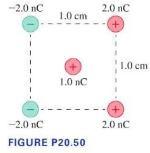
What are the magnitude and direction of the force on the \(1.0 \mathrm{nC}\) charge in the middle of Figure P20.50 due to the four other charges? -2.0 nC 2.0 nC 1.0 cm 1.0 nC -2.0 nC FIGURE P20.50 1.0 cm 2.0 nC
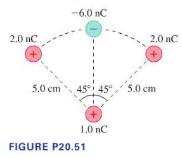
What are the magnitude and direction of the force on the \(1.0 \mathrm{nC}\) charge at the bottom of Figure P20.51? 2.0 C -6.0 nC 2.0 nC 5.0 cm 45 45 5.0 cm 1.0 nC FIGURE P20.51
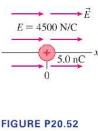
As shown in Figure P20.52, a \(5.0 \mathrm{nC}\) charge sits at \(x=0\) in a uniform 4500 N/C electric field directed to the right. At what point along the \(x\)-axis would (a) a proton and (b) an electron experience no net force? E-4500 N/C E 0 5.0 nC FIGURE P20.52
Two particles have positive charges \(q\) and \(Q\). A third charged particle is placed halfway between them. What must this particle's charge be so that the net force on charge \(Q\) is zero?
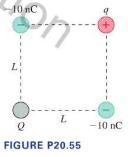
Figure P20.55 shows four charges at \(-10 \mathrm{nC}\) the corners of a square of side \(L\). What magnitude and sign of charge \(Q\) will make the force on charge \(q\) zero? 10 nC L 2 -10 nC FIGURE P20.55
Model a pollen grain as a sphere of carbon \(0.10 \mathrm{~mm}\) in diameter. If two such grains, spaced \(1.0 \mathrm{~m}\) apart, were somehow stripped of all their electrons, leaving only the protons, what would be the force between them? Compare this force to the weight of an aircraft carrier,
A \(+10 \mathrm{nC}\) charge is located at \((x, y)=(0 \mathrm{~cm}, 10 \mathrm{~cm})\) and a \(-5.0 \mathrm{nC}\) charge is located at \((x, y)=(5.0 \mathrm{~cm}, 0 \mathrm{~cm})\). Where would a \(-10 \mathrm{nC}\) charge need to be located in order that the electric field at the origin be zero?
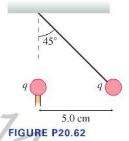
A \(4.0 \mathrm{mg}\) bead with a charge of \(7.0 \mathrm{~cm}\) \(2.5 \mathrm{nC}\) rests on a table. A second bead, FIGURE P20.62 with a charge of \(-5.6 \mathrm{nC}\), is directly above the first bead and is slowly lowered toward it. What is the closest the centers of the two beads can be
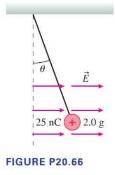
An electric field \(\vec{E}=(200,000 \mathrm{~N} / \mathrm{C}\), right \()\) causes the \(2.0 \mathrm{~g}\) ball in Figure P20.66 to hang at an angle. What is \(\theta\) ? 25 nC ( 2.0 g FIGURE P20.66
A small charged bead has a mass of \(1.0 \mathrm{~g}\). It is held in a INT uniform electric field \(\vec{E}=(200,000 \mathrm{~N} / \mathrm{C}\), up \()\). When the bead is released, it accelerates upward with an acceleration of \(20 \mathrm{~m} / \mathrm{s}^{2}\). What is the charge on the bead?
A parallel-plate capacitor consists of two plates, each with an area of \(28 \mathrm{~cm}^{2}\), separated by \(3.0 \mathrm{~mm}\). The charge on the capacitor is \(8.3 \mathrm{nC}\). A proton is released from rest next to the positive plate. How long does it take for the proton to reach the
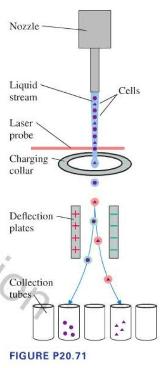
If the charging collar has a positive charge, the net charge on a droplet separating from the stream will be A. Positive.B. Negative.C. Neutral.D. The charge will depend on the type of cell.Flow cytometry, illustrated in Figure P20.71, is a technique used to sort cells by type. The cells are placed
Which of the following describes the charges on the droplets that end up in the five tubes, moving from left to right?A. \(+2 q,+q, 0,-q,-2 q\)B. \(+q,+2 q, 0,-2 q,-q\)C. \(-q,-2 q, 0,+2 q,+q\)D. \(-2 q,-q, 0,+q,+2 q\)Flow cytometry, illustrated in Figure P20.71, is a technique used to sort cells
Because the droplets are conductors, a droplet's positive and negative charges will separate while the droplet is in the region between the deflection plates. Suppose a neutral droplet passes between the plates. The droplet's dipole moment will pointA. Up.B. Down.C. Left.D. Right.Flow cytometry,
Another way to sort the droplets would be to give each droplet the same charge, then vary the electric field between the deflection plates. For the apparatus as sketched, this technique will not work becauseA. Several droplets are between the plates at one time, and they would all feel the same
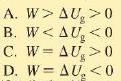
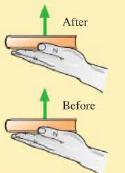
You lift a book at a constant speed. Which statement is true about the work W done by your hand and the change in the book's gravitational potential energy ΔUg? A. W> AU>0 B. W < AU 0 D. WAU,
A positively charged particle moves from point I to point 2. As it does, its electric potential energy? A. Increases. B. Decreases. C. Stays the same. 102
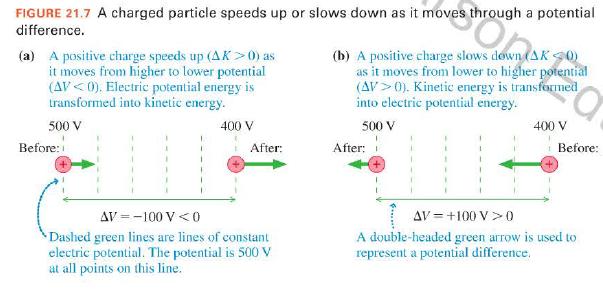
At a point where the electric potential is 400 V, a positive charge is moving to the left. As the charge continues to move, it slows down, stops, and then begins to move back to the right. Using what you learned in Figure 21.7, its speed as it passes its initial position is A. Greater than its
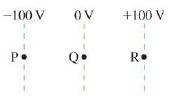
A proton is released from rest at point Q, where the potential is 0 V. Afterward, the proton.A. Remains at rest at Q.B. Moves toward P with a steady speed.C. Moves toward P with an increasing speed.D. Moves toward R with a steady speed.E. Moves toward R with an increasing speed. -100 V OV +100 V Pe
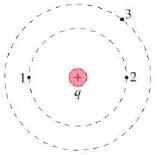
Rank in order, from largest to smallest, the potential differencesΔV12, ΔV13 , and ΔV23 between points 1 and 2, points l and 3, and points 2 and 3.
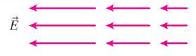
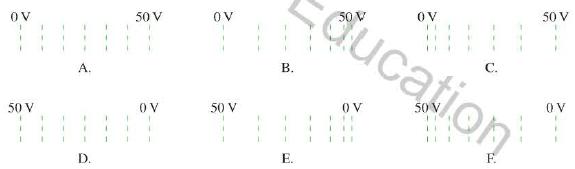
Which set of equipotential surfaces matches this electric field? 111
If the potential difference across a capacitor is doubled, its capacitance.A. Doubles.B. Halves.C. Remains the same.
The plates of a parallel plate capacitor are connected to a battery. If the distance between the plates is halved, the energy of the capacitorA. Increases by a factor of 4.B. Doubles.C. Remains the same.D. Is halved.E. Decreases by a factor of 4.
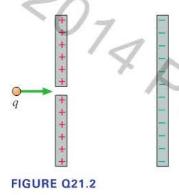
Charge \(q\) is fired through a small hole in the positive plate of a capacitor, as shown in Figure Q21.2.a. If \(q\) is a positive charge, does it speed up or slow down inside the capacitor? Answer this question twice: (i) Using the concept of force. (ii) Using the concept of energy.b. Repeat part
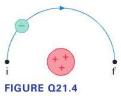
An electron \((q=-e)\) completes half of a circular orbit of radius \(r\) around a nucleus with \(Q=+3 e\), as shown in Figure Q21.4.a. How much work is done on the electron as it moves from \(\mathrm{i}\) to \(\mathrm{f}\) ? Give either a numerical value or an expression from which you could
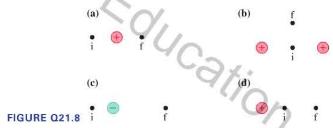
Each part of Figure Q21.8 shows one or more point charges. The charges have equal magnitudes. If a positive charge is moved from position \(i\) to position \(f\), does the electric potential energy increase, decrease, or stay the same? Explain. (a) FIGURE Q21.8 (c) (b) ducation
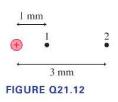
Figure Q21.12 shows two points near a positive point charge.a. What is the ratio \(V_{1} / V_{2}\) of the electric potentials at these two points? Explain.b. What is the ratio \(E_{1} / E_{2}\) of the electric field strengths at these two points? Explain. Imm 3 mm FIGURE Q21.12
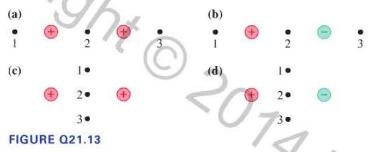
Each part of Figure Q21.13 shows three points in the vicinity of two point charges. The charges have equal magnitudes. Rank in order, from largest to smallest, the potentials \(V_{1}, V_{2}\), and \(V_{3}\). (a) (b) (e) 3. FIGURE Q21.13 (d) 20 2 3 2.
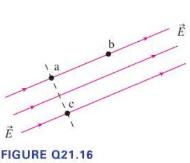
Figure Q21.16 shows an electric field diagram. Rank in order, from highest to lowest, the electric potentials at points \(\mathrm{a}, \mathrm{b}\), and \(\mathrm{c}\). ya FIGURE Q21.16 b
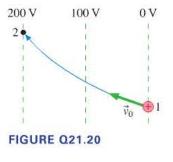
A proton is launched from point 1 in Figure Q21.20 with an initial velocity of \(3.9 \times 10^{5} \mathrm{~m} / \mathrm{s}\). By how much has its kinetic energy changed, in \(\mathrm{eV}\), by the time it passes through point 2 ? 200 V 100 V OV FIGURE Q21.20 Vo
A \(100 \mathrm{~V}\) battery is connected across the plates of a parallel-plate capacitor. If a sheet of Teflon is slid between the plates, without disconnecting the battery, the electric field between the plates\(\begin{array}{ll}\text { A. Increases. } & \text { B. Decreases. }\end{array}\)C.
Showing 1500 - 1600
of 4913
First
9
10
11
12
13
14
15
16
17
18
19
20
21
22
23
Last
Step by Step Answers

 Get 50% OFF
Claim Now
Get 50% OFF
Claim Now