New Semester
Started
Get
50% OFF
Study Help!
--h --m --s
Claim Now
Question Answers
Textbooks
Find textbooks, questions and answers
Oops, something went wrong!
Change your search query and then try again
S
Books
FREE
Study Help
Expert Questions
Accounting
General Management
Mathematics
Finance
Organizational Behaviour
Law
Physics
Operating System
Management Leadership
Sociology
Programming
Marketing
Database
Computer Network
Economics
Textbooks Solutions
Accounting
Managerial Accounting
Management Leadership
Cost Accounting
Statistics
Business Law
Corporate Finance
Finance
Economics
Auditing
Tutors
Online Tutors
Find a Tutor
Hire a Tutor
Become a Tutor
AI Tutor
AI Study Planner
NEW
Sell Books
Search
Search
Sign In
Register
study help
sciences
college physics reasoning
College Physics A Strategic Approach 3rd Edition Randall D. Knight, Brian Jones, Stuart Field - Solutions
Imagine a square column of the atmosphere, \(1 \mathrm{~m}\) on a side, that extends all the way to the top of the atmosphere. How much does this column of air weigh in newtons?
A beaker of water rests on a scale. A metal ball is then lowered into the beaker using a string tied to the ball. The ball doesn't touch the sides or bottom of the beaker, and no water spills from the beaker. Does the scale reading decrease, increase, or stay the same? Explain.
A heavy lead block and a light aluminum block of equal size sit at rest at the bottom of a pool of water. Is the buoyant force on the lead block greater than, less than, or equal to the buoyant force on the aluminum block? Explain.
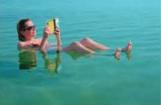
The water of the Dead Sea is extremely salty, which gives it a very high density of \(1240 \mathrm{~kg} / \mathrm{m}^{3}\). Explain why a person floats much higher in the Dead Sea than in ordinary water.
Fish can adjust their buoyancy with an organ called the swim bladder. The swim bladder is a flexible gas-filled sac; the fish can increase or decrease the amount of gas in the swim bladder so that it stays neutrally buoyant-neither sinking nor floating. Suppose the fish is neutrally buoyant at some
A tub of water, filled to the brim, sits on a scale. Then a floating block of wood is placed in the tub, pushing some water over the rim. The water that overflows immediately runs off the scale. What happens to the reading of the scale?
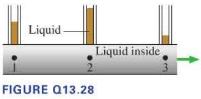
Liquid flows through a pipe as shown in Figure Q13.28. The pipe's constant outer diameter is shown; you can't see into the pipe to know how the inner diameter changes. Rank in order, from largest to smallest, the flow speeds \(v_{1}\) to \(v_{3}\) at points 1,2 , and 3 . Explain. Liquid- FIGURE
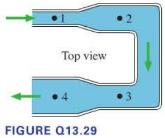
A liquid with negligible viscosity flows through the pipe shown in Figure Q13.29. This is an overhead view.a. Rank in order, from largest to smallest, the flow speeds \(v_{1}\) to \(v_{4}\) at points 1 to 4 . Explain.b. Rank in order, from largest to smallest, the pressures \(p_{1}\) to \(p_{4}\)
Is it possible for a fluid in a tube to flow in the direction from low pressure to high pressure? If so, give an example. If not, why not?
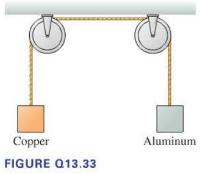
Figure Q13.33 shows a \(100 \mathrm{~g}\) block of copper \((ho=\) \(8900 \mathrm{~kg} / \mathrm{m}^{3}\) ) and a \(100 \mathrm{~g}\) block of aluminum \(\left(ho=2700 \mathrm{~kg} / \mathrm{m}^{3}\right)\) connected by a massless string that runs over two massless, frictionless pulleys. The two
If you dive underwater, you notice an uncomfortable pressure on your eardrums due to the increased pressure. The human eardrum has an area of about \(70 \mathrm{~mm}^{2}\left(7 \times 10^{-5} \mathrm{~m}^{2}\right)\), and it can sustain a force of about \(7 \mathrm{~N}\) without rupturing. If your
An \(8.0 \mathrm{lb}\) bowling ball has a diameter of 8.5 inches. When lowered into water, this ball will A. Float.B. Sink.C. Have neutral buoyancy.
A large beaker of water is filled to its rim with water. A block of wood is then carefully lowered into the beaker until the block is floating. In this process, some water is pushed over the edge and collects in a tray. The weight of the water in the tray isA. Greater than the weight of the
An object floats in water, with \(75 \%\) of its volume submerged. What is its approximate density?A. \(250 \mathrm{~kg} / \mathrm{m}^{3}\)B. \(750 \mathrm{~kg} / \mathrm{m}^{3}\)C. \(1000 \mathrm{~kg} / \mathrm{m}^{3}\)D. \(1250 \mathrm{~kg} / \mathrm{m}^{3}\)
Water flows through a 4.0 -cm-diameter horizontal pipe at a speed of \(1.3 \mathrm{~m} / \mathrm{s}\). The pipe then narrows down to a diameter of \(2.0 \mathrm{~cm}\). Ignoring viscosity, what is the pressure difference between the wide and narrow sections of the pipe?A. \(850 \mathrm{~Pa}\)B.
A 15-m-long garden hose has an inner diameter of \(2.5 \mathrm{~cm}\). One end is connected to a spigot; \(20^{\circ} \mathrm{C}\) water flows from the other end at a rate of \(1.2 \mathrm{~L} / \mathrm{s}\). What is the gauge pressure at the spigot end of the hose?A. \(1900 \mathrm{~Pa}\)B. \(2700
Christina throws a javelin into the air. As she propels it forward from rest, she does 270 J of work on it. At its highest point, its gravitational potential energy has increased by 70 J. What is the javelin's kinetic energy at this point?A. 270 JB. 340 JC. 200 JD. -200 JE. -340 J
Crane l uses 10 kJ of energy to lift a 50 kg box to the roof of a building. Crane 2 uses 20 kl to lift a 100 kg box the same distance. Which crane is more efficient?A. Crane 1B. Crane 2C. Both cranes have the same efficiency.
A runner is moving at a constant speed on level ground.Chemical energy in the runner's body is being transformed into other forms of energy.Most of the chemical energy is transformed intoA. Kinetic energy.B. Potential energy.C. Thermal energy.
Two samples of ideal gas, sample 1 and sample 2, have the same thermal energy. Sample l has twice as many atoms as sample 2. What can we say about the temperatures of the two samples? A. T>T B. T = T C. TT2
You have driven your car for a while and now turn off the engine.Your car's radiator is at a higher temperature than the air around it. Considering the radiator as the system, as the radiator cools down we can say thatA . Q > 0B. Q = 0C. Q < 0
Which of the following changes (there may be more than one)would increase the maximum theoretical efficiency of a heat engine?A. Increase THB. Increase TcC. Decrease THD. Decrease Tc
Which of the following changes would allow your refrigerator to use less energy to run? (There may be more than one correct answer.)A. Increasing the temperature inside the refrigeratorB. Increasing the temperature of the kitchenC. Decreasing the temperature inside the refrigeratorD. Decreasing the
Which of the following processes does not involve a change in entropy?A. An electric heater raises the temperature of a cup of water by 20°C.B. A ball rolls up a ramp, decreasing in speed as it rolls higher.C. A basketball is dropped from 2 m and bounces until it comes to rest.D. The sun shines on
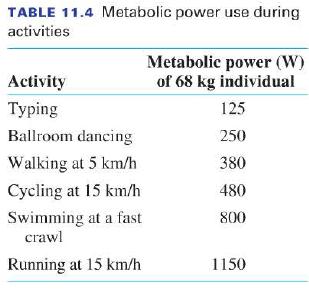
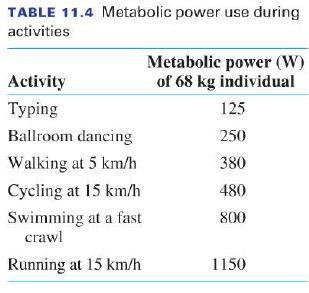
According to Table 11.4 , cycling at \(15 \mathrm{~km} / \mathrm{h}\) requires less metabolic energy than running at \(15 \mathrm{~km} / \mathrm{h}\). Suggest reasons why this is the case. TABLE 11.4 Metabolic power use during activities Metabolic power (W) of 68 kg individual Activity Typing 125
A glassblower heats up a blob of glass in a furnace, increasing its temperature by \(1000^{\circ} \mathrm{C}\). By how many kelvins does its temperature increase?
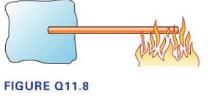
One end of a short aluminum rod is in a campfire and the other end is in a block of ice, as shown in Figure Q11.8. If \(100 \mathrm{~J}\) of energy are transferred from the fire to the rod, and if the temperature at every point in the rod has reached a steady value, how much energy goes from the
Two blocks of copper, one of mass \(1 \mathrm{~kg}\) and the second of mass \(3 \mathrm{~kg}\), are at the same temperature. Which block has more thermal energy? If the blocks are placed in thermal contact, will the thermal energy of the blocks change? If so, how?
A \(20 \mathrm{~kg}\) block of steel at \(23^{\circ} \mathrm{C}\) and a \(150 \mathrm{~g}\) piece of brass at \(520^{\circ} \mathrm{C}\) are placed in contact inside an insulated container and allowed to come to thermal equilibrium. Which metal, if either, has the greater change of thermal energy?
If a process removes heat from a system, must the system's temperature decrease in this process? Explain.
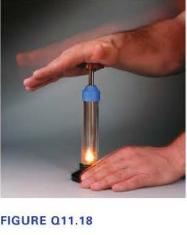
A fire piston-an impressive physics demonstration-ignites a fire without matches. The operation is shown in Figure Q11.18. A wad of cotton is placed at the bottom of a sealed syringe with a tight-fitting plunger. When the plunger is rapidly depressed, the air temperature in the syringe rises enough
According to the second law of thermodynamics, it is impossible for a heat engine to convert thermal energy solely into work without exhausting some thermal energy to a cold reservoir. Is it possible to do the opposite - to convert work into thermal energy with \(100 \%\) efficiency? If not, why
Assuming improved materials and better processes, can engineers ever design a heat engine that exceeds the maximum efficiency indicated by Equation 11.10? If not, why not? Maximum efficiency. of a heat engine -Temperature of cold reservoir Tc e max 1 Temperature of hot reservoir (11.10) TH Both To
Electric vehicles increase speed by using an electric motor that draws energy from a battery. When the vehicle slows, the motor runs as a generator, recharging the battery. Explain why this means that an electric vehicle can be more efficient than a gasoline-fueled vehicle.
A person walks \(1 \mathrm{~km}\), turns around, and runs back to where he started. Compare the energy used and the power during the two segments.A. The energy used and the power are the same for both.B. The energy used while walking is greater, the power while running is greater.C. The energy used
The temperature of the air in a basketball increases as it is pumped up. This means thatA. The total kinetic energy of the air is increasing and the average kinetic energy of the molecules is decreasing.B. The total kinetic energy of the air is increasing and the average kinetic energy of the
\(200 \mathrm{~J}\) of heat is added to two gases, each in a sealed container. Gas 1 is in a rigid container that does not change volume. Gas 2 expands as it is heated, pushing out a piston that lifts a small weight. Which gas has the greater increase in its thermal energy?A. Gas 1 B. Gas 2 C. Both
While keeping your food cold, your refrigerator transfers energy from the inside to the surroundings. Thus thermal energy goes from a colder object to a warmer one. What can you say about this?A. It is a violation of the second law of thermodynamics.B. It is not a violation of the second law of
An electric power plant uses energy from burning coal to generate steam at \(450^{\circ} \mathrm{C}\). The plant is cooled by \(20^{\circ} \mathrm{C}\) water from a nearby river. If burning coal provides \(100 \mathrm{MJ}\) of heat, what is the theoretical minimum amount of heat that must be
A refrigerator's freezer compartment is set at \(-10^{\circ} \mathrm{C}\); the kitchen is \(24^{\circ} \mathrm{C}\). What is the theoretical minimum amount of electric energy necessary to pump \(1.0 \mathrm{~J}\) of energy out of the freezer compartment?A. \(0.89 \mathrm{~J}\)B. \(0.87
A sleeping \(68 \mathrm{~kg}\) man has a metabolic power of \(71 \mathrm{~W}\). How many Calories does he burn during an 8.0 hour sleep?
Helium has the lowest boiling point of any substance, at 4.2 K. What is this temperature in \({ }^{\circ} \mathrm{C}\) and \({ }^{\circ} \mathrm{F}\) ?
A piece of metal at \(100^{\circ} \mathrm{C}\) has its Celsius temperature doubled. By what factor does its kelvin temperature increase?
At what temperature does the temperature in kelvin have the same numerical value as the temperature in \({ }^{\circ} \mathrm{F}\) ?
\(300 \mathrm{~J}\) of energy are transferred to a system in the form of heat while the thermal energy increases by \(150 \mathrm{~J}\). How much work is done on or by the system?
A heat engine extracts \(55 \mathrm{~kJ}\) from the hot reservoir and exhausts \(40 \mathrm{~kJ}\) into the cold reservoir. What are (a) the work done and (b) the efficiency?
A heat engine does \(200 \mathrm{~J}\) of work while exhausting \(600 \mathrm{~J}\) of heat to the cold reservoir. What is the engine's efficiency?
A power plant running at \(35 \%\) efficiency generates \(300 \mathrm{MW}\) of electric power. At what rate (in MW) is heat energy exhausted to the river that cools the plant?
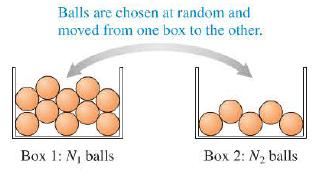
Draw all possible distinct arrangements in which three balls (labeled A, B, C) are placed into two different boxes ( 1 and 2), as in Figure 11.25. If all arrangements are equally likely, what is the probability that all three will be in box 1 ?Figure 11.25 Balls are chosen at random and moved from
How many slices of pizza must you eat to walk for \(1.0 \mathrm{~h}\) at a speed of \(5.0 \mathrm{~km} / \mathrm{h}\) ? (Assume your mass is \(68 \mathrm{~kg}\).)
A \(68 \mathrm{~kg}\) runner runs a marathon \((42.2 \mathrm{~km})\) at a pace of \(15 \mathrm{~km} / \mathrm{h}\). To expend the same number of Calories as she did in running this race, how many \(2.7-\mathrm{m}\)-high flights of stairs would she need to climb?
For how long would a \(68 \mathrm{~kg}\) athlete have to swim at a fast crawl to use all the energy available in a typical fast-food meal of burger, fries, and a drink?
The record time for a Tour de France cyclist to ascend the famed 1100-m-high Alpe d'Huez was \(37.5 \mathrm{~min}\), set by Marco Pantani in 1997. Pantani and his bike had a mass of \(65 \mathrm{~kg}\).a. How many Calories did he expend during this climb?b. What was his average metabolic power
Championship swimmers take about \(22 \mathrm{~s}\) and about 30 arm strokes to move through the water in a \(50 \mathrm{~m}\) freestyle NT race.a. From Table 11.4, a swimmer's metabolic power is \(800 \mathrm{~W}\). If the efficiency for swimming is \(25 \%\), how much energy is expended moving
A \(68 \mathrm{~kg}\) hiker walks at \(5.0 \mathrm{~km} / \mathrm{h}\) up a \(7 \%\) slope. What is BIO the necessary metabolic power? Hint: You can model her power needs as the sum of the power to walk on level ground plus the power needed to raise her body by the appropriate amount.
The heat exhausted to the cold reservoir of an engine operating at maximum theoretical efficiency is two-thirds the heat extracted from the hot reservoir. What is the temperature ratio \(T_{\mathrm{C}} / T_{\mathrm{H}}\) ?
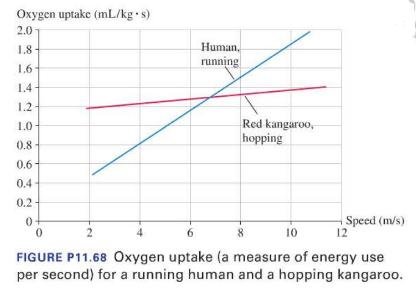
A person runs \(1 \mathrm{~km}\). How does his speed affect the total energy needed to cover this distance?A. A faster speed requires less total energy.B. A faster speed requires more total energy.C. The total energy is about the same for a fast speed and a slow speed.Kangaroos have very stout
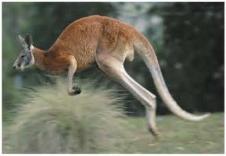
A kangaroo hops \(1 \mathrm{~km}\). How does its speed affect the total energy needed to cover this distance?A. A faster speed requires less total energy.B. A faster speed requires more total energy.C. The total energy is about the same for a fast speed and a slow speed.Kangaroos have very stout
At a speed of \(4 \mathrm{~m} / \mathrm{s}\), A. A running human is more efficient than an equal-mass hopping kangaroo.B. A running human is less efficient than an equal-mass hopping kangaroo.C. A running human and an equal-mass hopping kangaroo have about the same efficiency.Kangaroos have very
At approximately what speed would a human use half the power of an equal-mass kangaroo moving at the same speed?A. \(3 \mathrm{~m} / \mathrm{s}\)B. \(4 \mathrm{~m} / \mathrm{s} \quad\) C. \(5 \mathrm{~m} / \mathrm{s}\)D. \(6 \mathrm{~m} / \mathrm{s}\)Kangaroos have very stout tendons in their legs
At what speed does the hopping motion of the kangaroo become more efficient than the running gait of a human?A. \(3 \mathrm{~m} / \mathrm{s}\)B. \(5 \mathrm{~m} / \mathrm{s}\)C. \(7 \mathrm{~m} / \mathrm{s}\)Kangaroos have very stout tendons in their legs that can be used to store energy. When a
When water freezes to make a snowflake crystal, the entropy of the water A. Decreases.B. Increases.C. Does not change.
When thermal energy is transferred from a hot object to a cold object, the overall entropy A. Decreases B. Increases.C. Does not change.
Do convection cells represent a reversible process?A. Yes, because they are orderly.B. No, because they transfer thermal energy from hot to cold.C. It depends on the type of convection cell.
In an isolated system far from thermal equilibrium, as time passes, A. The total energy stays the same; the total entropy stays the same.B. The total energy decreases; the total entropy increases.C. The total energy stays the same; the total entropy increases.D. The total energy decreases; the
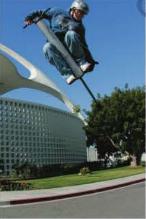
If you were to jump to the ground from a height of 2 meters, you'd likely injure yourself. But a pogo rider can do this repeatedly, bounce after bounce. How does the pogo stick make this possible?A. The elastic bands absorb the energy of the bounce, keeping it from hurting the rider.B. The elastic
Assuming that the elastic bands stretch and store energy like a spring, how high would the \(80 \mathrm{~kg}\) pogo and rider go for a stretch of \(0.20 \mathrm{~m}\) ?A. \(2.0 \mathrm{~m}\)B. \(1.5 \mathrm{~m}\)C. \(1.0 \mathrm{~m}\)D. \(0.50 \mathrm{~m}\)A new generation of pogo sticks lets a
Suppose a much smaller rider (total mass of rider plus pogo of \(40 \mathrm{~kg}\) ) mechanically stretched the elastic bands of the pogo by \(0.40 \mathrm{~m}\), then got on the pogo and released the bands. How high would this unwise rider go?A. \(8.0 \mathrm{~m}\)B. \(6.0 \mathrm{~m}\)C. \(4.0
A pogo and rider of \(80 \mathrm{~kg}\) total mass at the high point of a \(2.0 \mathrm{~m}\) jump will drop \(1.6 \mathrm{~m}\) before the pogo plunger touches the ground, slowing to a stop over an additional \(0.40 \mathrm{~m}\) as the elastic bands stretch. What approximate average force does
Riders can use fewer elastic bands, reducing the effective spring constant of the pogo. The maximum stretch of the bands is still \(0.40 \mathrm{~m}\). Reducing the number of bands will A. Reduce the force on the rider and give a lower jump height.B. Not change the force on the rider but give a
Consider the sequence of energy transformations in the bounce. When the dropped ball is motionless on the floor, compressed, and ready to rebound, most of the energy is in the form of A. Kinetic energy.B. Gravitational potential energy.C. Thermal energy.D. Elastic potential energy.Tennis balls are
If a ball is "soft," it will spend more time in contact with the floor and won't rebound as high as it is supposed to. The force on the floor of the "soft" ball is the force on the floor of a "normal" ball.A. Greater than B. The same as C. Less than Tennis balls are tested by being dropped from a
Suppose a ball is dropped from \(2.5 \mathrm{~m}\) and rebounds to \(1.4 \mathrm{~m}\).a. How fast is the ball moving just before it hits the floor?b. What is the ball's speed just after leaving the floor?c. What happens to the "lost" energy?d. If the time of the collision with the floor is \(6.0
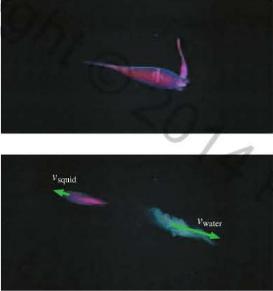
What is the speed of the squid immediately after the water is ejected?A. \(10 \mathrm{~m} / \mathrm{s}\)B. \(7.5 \mathrm{~m} / \mathrm{s}\)C. \(1.3 \mathrm{~m} / \mathrm{s}\)D. \(0.75 \mathrm{~m} / \mathrm{s}\)Squid usually move by using their fins, but they can utilize a form of "jet propulsion,"
What is the squid's approximate acceleration in \(g\) ?A. \(10 \mathrm{~g}\)B. \(7.5 \mathrm{~g}\)C. \(1.0 \mathrm{~g}\)D. \(0.75 \mathrm{~g}\)Squid usually move by using their fins, but they can utilize a form of "jet propulsion," ejecting water at high speed to rocket them backward, as shown in
What is the average force on the water during the jet?A. \(100 \mathrm{~N}\)B. \(30 \mathrm{~N}\)C. \(10 \mathrm{~N}\)D. \(3.0 \mathrm{~N}\)Squid usually move by using their fins, but they can utilize a form of "jet propulsion," ejecting water at high speed to rocket them backward, as shown in
This form of locomotion is speedy, but is it efficient? The energy that the squid expends goes two places: the kinetic energy of the squid and the kinetic energy of the water. Think about how to define "what you get" and "what you had to pay"; then calculate an efficiency for this particular form
What is the change in momentum of the ball during the collision?A. \(1.4 \mathrm{~kg} \cdot \mathrm{m} / \mathrm{s}\)B. \(1.8 \mathrm{~kg} \cdot \mathrm{m} / \mathrm{s}\)C. \(2.9 \mathrm{~kg} \cdot \mathrm{m} / \mathrm{s}\)D. \(5.1 \mathrm{~kg} \cdot \mathrm{m} / \mathrm{s}\)A golf club has a
What is the speed of the club head immediately after the collision?A. \(30 \mathrm{~m} / \mathrm{s}\)B. \(25 \mathrm{~m} / \mathrm{s}\)C. \(19 \mathrm{~m} / \mathrm{s}\)D. \(11 \mathrm{~m} / \mathrm{s}\)A golf club has a lightweight flexible shaft with a heavy block of wood or metal (called the
Is this a perfectly elastic collision?A. Yes B. No C. There is insufficient information to make this determination.A golf club has a lightweight flexible shaft with a heavy block of wood or metal (called the head of the club) at the end. A golfer making a long shot off the tee uses a driver, a club
If we define the kinetic energy of the club head before the collision as "what you had to pay" and the kinetic energy of the ball immediately after as "what you get," what is the efficiency of this energy transfer?A. 0.54 B. 0.46 C. 0.38 D. 0.27 A golf club has a lightweight flexible shaft with a
Football players measure their acceleration by seeing how fast they can sprint 40 yards \((37 \mathrm{~m})\). A zippy player can, from a standing start, run 40 yards in \(4.1 \mathrm{~s}\), reaching a top speed of about \(11 \mathrm{~m} / \mathrm{s}\). For an \(80 \mathrm{~kg}\) player, what is the
The unit of horsepower was defined by considering the power output of a typical horse. Working-horse guidelines in the \(1900 \mathrm{~s}\) called for them to pull with a force equal to \(10 \%\) of their body weight at a speed of \(3.0 \mathrm{mph}\). For a typical working horse of \(1200
A \(100 \mathrm{~kg}\) football player is moving at \(6.0 \mathrm{~m} / \mathrm{s}\) to the east; a \(130 \mathrm{~kg}\) player is moving at \(5.0 \mathrm{~m} / \mathrm{s}\) to the west. They meet, each jumping into the air and grabbing the other player. While they are still in the air, which way
A swift blow with the hand can break a pine board. As the hand hits the board, the kinetic energy of the hand is transformed into elastic potential energy of the bending board; if the board bends far enough, it breaks. Applying a force to the center of a particular pine board deflects the center of
A child's sled has rails that slide with little friction across the snow. Logan has an old wooden sled with heavy iron rails that has a mass of \(10 \mathrm{~kg}\)-quite a bit for a \(30 \mathrm{~kg}\) child! Logan runs at \(4.0 \mathrm{~m} / \mathrm{s}\) and leaps onto the stationary sled and
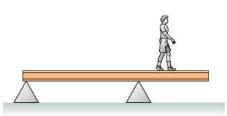
In Figure P8.4, a \(70 \mathrm{~kg}\) man walks out on a \(10 \mathrm{~kg}\) beam that rests on, but is not attached to, two supports. When the beam just starts to tip, what is the force exerted on the beam by the right support?Figure P8.4
You're carrying a \(3.6-\mathrm{m}\)-long, \(25 \mathrm{~kg}\) pole to a construction site when you decide to stop for a rest. You place one end of the pole on a fence post and hold the other end of the pole \(35 \mathrm{~cm}\) from its tip. How much force must you exert to keep the pole motionless
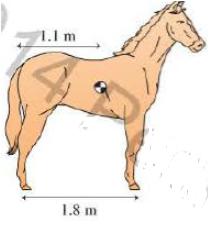
A typical horse weighs \(5000 \mathrm{~N}\). The distance between the front and rear hooves and the distance from the rear hooves to the center of mass for a typical horse are shown in Figure P8.6. What fraction of the horse's weight is borne by the front hooves?Figure P8.6 1.1 m 1.8 m
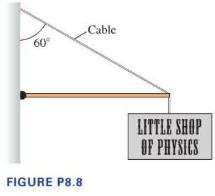
A vendor hangs an \(8.0 \mathrm{~kg}\) sign in front of his shop with a cable held away from the building by a lightweight pole. The pole is free to pivot about the end where it touches the wall, as shown in Figure P8.8. What is the tension in the cable? Cable 60 FIGURE P8.8 LITTLE SHOP OF PHYSICS
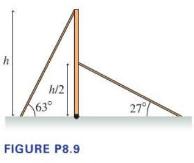
Figure P8.9 shows a vertical pole of height \(h\) that can rotate about a hinge at the bottom. The pole is held in position by two wires under tension. What is the ratio of the tension in the left wire to the tension in the right wire? h 63 h/2 FIGURE P8.9 27
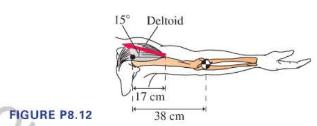
If you hold your arm outstretched with palm upward, as in Figure P8.12, the force to keep your arm from falling comes from your deltoid muscle. The arm of a typical person has mass \(4.0 \mathrm{~kg}\) and the distances and angles shown in the figure.a. What force must the deltoid muscle provide to
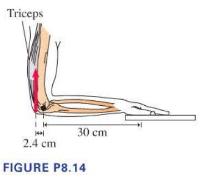
It Hold your upper arm vertical and your lower arm horizontal with your hand palm-down on a table, as shown in Figure P8.14. If you now push down on the table, you'll feel that your triceps muscle has contracted and is trying to pivot your lower arm about the elbow joint. If a person with the arm
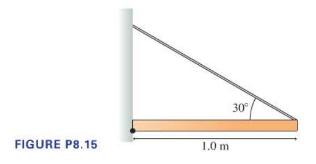
If A uniform beam of length \(1.0 \mathrm{~m}\) and mass \(10 \mathrm{~kg}\) is attached to a wall by a cable, as shown in Figure P8.15. The beam is free to pivot at the point where it attaches to the wall. What is the tension in the cable? FIGURE P8.15 1.0 m 30
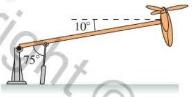
The towers holding small wind turbines are often raised and lowered for easy servicing of the turbine. Figure P8.16 shows a \(1000 \mathrm{~kg}\) wind turbine mounted on the end of a 24-m-long, \(700 \mathrm{~kg}\) tower that connects to a support column at a pivot. A piston connected \(3.0
A standard four-drawer filing cabinet is 52 inches high and 15 inches wide. If it is evenly loaded, the center of gravity is at the center of the cabinet. A worker is tilting a filing cabinet to the side to clean under it. To what angle can he tilt the cabinet before it tips over?
The stability of a vehicle is often rated by the static stability factor, which is one-half the track width divided by the height of the center of gravity above the road. A typical SUV has a static stability factor of 1.2. What is the critical angle?
You want to slowly push a stiff board across a \(20 \mathrm{~cm}\) gap between two tabletops that are at the same height. If you apply only a horizontal force, what is the minimum-length board that won't tilt down into the gap before reaching the other side?
An orthodontic spring, connected between the upper and lower jaws, is adjusted to provide no force with the mouth open. When the patient closes her mouth, however, the spring compresses by \(6.0 \mathrm{~mm}\). What force is exerted if the spring constant is \(160 \mathrm{~N} / \mathrm{m}\) ?
I Experiments using "optical tweezers" measure the elasticity BIO of individual DNA molecules. For small enough changes in length, the elasticity has the same form as that of a spring. A DNA molecule is anchored at one end, then a force of \(1.5 \mathrm{nN}\) \(\left(1.5 \times 10^{-9}
Showing 2000 - 2100
of 4913
First
14
15
16
17
18
19
20
21
22
23
24
25
26
27
28
Last
Step by Step Answers

 Get 50% OFF
Claim Now
Get 50% OFF
Claim Now