New Semester
Started
Get
50% OFF
Study Help!
--h --m --s
Claim Now
Question Answers
Textbooks
Find textbooks, questions and answers
Oops, something went wrong!
Change your search query and then try again
S
Books
FREE
Study Help
Expert Questions
Accounting
General Management
Mathematics
Finance
Organizational Behaviour
Law
Physics
Operating System
Management Leadership
Sociology
Programming
Marketing
Database
Computer Network
Economics
Textbooks Solutions
Accounting
Managerial Accounting
Management Leadership
Cost Accounting
Statistics
Business Law
Corporate Finance
Finance
Economics
Auditing
Tutors
Online Tutors
Find a Tutor
Hire a Tutor
Become a Tutor
AI Tutor
AI Study Planner
NEW
Sell Books
Search
Search
Sign In
Register
study help
sciences
college physics reasoning
College Physics A Strategic Approach 3rd Edition Randall D. Knight, Brian Jones, Stuart Field - Solutions
Two balls undergo a perfectly elastic head-on collision, with one ball initially at rest. If the incoming ball has a speed of \(200 \mathrm{~m} / \mathrm{s}\), what are the final speed and direction of each ball ifa. The incoming ball is much more massive than the stationary ball?b. The stationary
a. How much work must you do to push a \(10 \mathrm{~kg}\) block of steel across a steel table at a steady speed of \(1.0 \mathrm{~m} / \mathrm{s}\) for \(3.0 \mathrm{~s}\) ? The coefficient of kinetic friction for steel on steel is 0.60 .b. What is your power output while doing so?
A \(1000 \mathrm{~kg}\) sports car accelerates from 0 to \(30 \mathrm{~m} / \mathrm{s}\) in \(10 \mathrm{~s}\). What is the average power of the engine?
An elite Tour de France cyclist can maintain an output power of \(450 \mathrm{~W}\) during a sustained climb. At this output power, how long would it take an \(85 \mathrm{~kg}\) cyclist (including the mass of his bike) to climb the famed 1100 -m-high Alpe d'Huez mountain stage?
How much work does Scott do to push a \(80 \mathrm{~kg}\) sofa \(2.0 \mathrm{~m}\) INT across the floor at a constant speed? The coefficient of kinetic friction between the sofa and the floor is 0.23 .
A \(550 \mathrm{~kg}\) elevator accelerates upward at \(1.2 \mathrm{~m} / \mathrm{s}^{2}\) for the first \(15 \mathrm{~m}\) of its motion. How much work is done during this part of its motion by the cable that lifts the elevator?
A \(2.3 \mathrm{~kg}\) box, starting from rest, is pushed up a ramp by a \(10 \mathrm{~N}\) force parallel to the ramp. The ramp is \(2.0 \mathrm{~m}\) long and tilted at \(17^{\circ}\). The speed of the box at the top of the ramp is \(0.80 \mathrm{~m} / \mathrm{s}\). Consider the system to be the
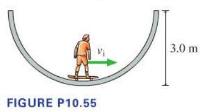
A \(55 \mathrm{~kg}\) skateboarder wants to just make it to the upper edge of a "half-pipe" with a radius of \(3.0 \mathrm{~m}\), as shown in Figure P10.55. What speed \(v_{\mathrm{i}}\) does he need at the bottom if FIGURE P10.55 he is to coast all the way up?a. First do the calculation treating
Fleas have remarkable jumping ability. A \(0.50 \mathrm{mg}\) flea, jump-\(\mathrm{BlO}\) ing straight up, would reach a height of \(40 \mathrm{~cm}\) if there were no air resistance. In reality, air resistance limits the height to \(20 \mathrm{~cm}\).a. What is the flea's kinetic energy as it
You are driving your \(1500 \mathrm{~kg}\) car at \(20 \mathrm{~m} / \mathrm{s}\) down a hill with a \(5.0^{\circ}\) slope when a deer suddenly jumps out onto the roadway. You slam on your brakes, skidding to a stop. How far do you skid before stopping if the kinetic friction force between your
A cannon tilted up at a \(30^{\circ}\) angle fires a cannon ball at \(80 \mathrm{~m} / \mathrm{s}\) from atop a 10-m-high fortress wall. What is the ball's impact speed on the ground below? Ignore air resistance.
A \(50 \mathrm{~g}\) ice cube can slide without friction up and down a \(30^{\circ}\) slope. The ice cube is pressed against a spring at the bottom of the slope, compressing the spring \(10 \mathrm{~cm}\). The spring constant is \(25 \mathrm{~N} / \mathrm{m}\). When the ice cube is released, what
The maximum energy a bone can absorb without breaking is surprisingly small. For a healthy human of mass \(60 \mathrm{~kg}\), experimental data show that the leg bones of both legs can absorb about \(200 \mathrm{~J}\).a. From what maximum height could a person jump and land rigidly upright on both
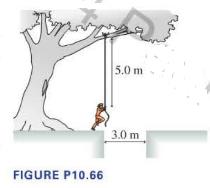
The 5.0-m-long rope in Figure P10.66 hangs vertically from a tree right at the edge of a ravine. A woman wants to use the rope to swing to the other side of the ravine. She runs as fast as she can, grabs the rope, and swings out over the ravine.a. As she swings, what energy conversion is taking
You have been asked to design a "ballistic spring system" to INT measure the speed of bullets. A bullet of mass \(m\) is fired into a block of mass \(M\). The block, with the embedded bullet, then slides across a frictionless table and collides with a horizontal spring whose spring constant is
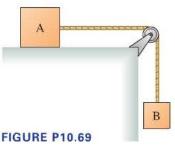
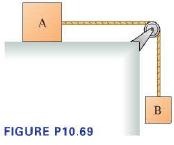
Boxes A and B in Figure P10.69 have masses of \(12.0 \mathrm{~kg}\) and \(4.0 \mathrm{~kg}\), respectively. The two boxes are released from rest. Use conservation of energy to find the boxes' speed when box \(\mathrm{B}\) has fallen a distance of \(0.50 \mathrm{~m}\). Assume a frictionless upper
What would be the speed of the boxes in Problem 69 if the coefficient of kinetic friction between box AA and the surface it slides on were 0.20 ? Use conservation of energy.Problem 69Boxes A and Bin Figure P10.69 have masses of 12.0 kg and 4.0 kg, respectively. The two boxes are released from rest.
A \(20 \mathrm{~g}\) ball is fired horizontally with initial speed \(v_{\mathrm{i}}\) toward a \(100 \mathrm{~g}\) ball that is hanging motionless from a \(1.0-\mathrm{m}\)-long string. The balls undergo a head-on, perfectly elastic collision, after which the \(100 \mathrm{~g}\) ball swings out to
A fish scale, consisting of a spring with spring constant \(k=200 \mathrm{~N} / \mathrm{m}\), is hung vertically from the ceiling. A \(5.0 \mathrm{~kg}\) fish is attached to the end of the unstretched spring and then released. The fish moves downward until the spring is fully stretched, then starts
A \(70 \mathrm{~kg}\) human sprinter can accelerate from rest to \(10 \mathrm{~m} / \mathrm{s}\) in \(3.0 \mathrm{~s}\). During the same time interval, a \(30 \mathrm{~kg}\) greyhound can accelerate from rest to \(20 \mathrm{~m} / \mathrm{s}\). Compute (a) the change in kinetic energy and (b) the
A \(50 \mathrm{~kg}\) sprinter, starting from rest, runs \(50 \mathrm{~m}\) in \(7.0 \mathrm{~s}\) at constant acceleration.a. What is the magnitude of the horizontal force acting on the sprinter?b. What is the sprinter's average power output during the first \(2.0 \mathrm{~s}\) of his run?c. What
Bob can throw a \(500 \mathrm{~g}\) rock with a speed of \(30 \mathrm{~m} / \mathrm{s}\). During the INT time the rock is in his hand, his hand moves forward by \(1.0 \mathrm{~m}\).a. How much force, assumed to be constant, does Bob apply to the rock?b. How much work does Bob do on the rock?
The mass of an elevator and its occupants is \(1200 \mathrm{~kg}\). The electric motor that lifts the elevator can provide a maximum power of \(15 \mathrm{~kW}\). What is the maximum constant speed at which this motor can lift the elevator?
How fast is the ball moving when it hits the concrete surface? (Ignore air resistance.)A. \(5 \mathrm{~m} / \mathrm{s}\)B. \(7 \mathrm{~m} / \mathrm{s}\)C. \(25 \mathrm{~m} / \mathrm{s}\)D. \(50 \mathrm{~m} / \mathrm{s}\)A tennis ball bouncing on a hard surface compresses and then rebounds. The
If the ball accelerates uniformly when it hits the floor, what is its approximate acceleration as it comes to rest before rebounding?A. \(1000 \mathrm{~m} / \mathrm{s}^{2}\)B. \(2000 \mathrm{~m} / \mathrm{s}^{2}\)C. \(3000 \mathrm{~m} / \mathrm{s}^{2}\)D. \(4000 \mathrm{~m} / \mathrm{s}^{2}\)A
The ball's kinetic energy just after the bounce is less than just before the bounce. In what form does this lost energy end up?A. Elastic potential energyB. Gravitational potential energyC. Thermal energyD. Rotational kinetic energy A tennis ball bouncing on a hard surface compresses and then
By approximately what percent does the kinetic energy decrease?A. \(35 \%\)B. \(45 \%\)C. \(55 \%\)D. \(65 \%\)A tennis ball bouncing on a hard surface compresses and then rebounds. The details of the rebound are specified in tennis regulations. Tennis balls, to be acceptable for tournament play,
When a tennis ball bounces from a racket, the ball loses approximately \(30 \%\) of its kinetic energy to thermal energy. A ball that hits a racket at a speed of \(10 \mathrm{~m} / \mathrm{s}\) will rebound with approximately what speed?A. \(8.5 \mathrm{~m} / \mathrm{s}\)B. \(7.0 \mathrm{~m} /
If the drag force on the cyclist is \(10 \mathrm{~N}\), how much energy does she use in cycling \(1 \mathrm{~km}\) ?A. \(6 \mathrm{~kJ}\)B. \(10 \mathrm{~kJ}\)C. \(50 \mathrm{~kJ}\)D. \(100 \mathrm{~kJ}\)When you ride a bicycle at constant speed, almost all of the energy you expend goes into the
Under these conditions, how much power does she expend as she cycles?A. \(10 \mathrm{~W}\)B. \(50 \mathrm{~W}\)C. \(100 \mathrm{~W}\)D. \(200 \mathrm{~W}\)When you ride a bicycle at constant speed, almost all of the energy you expend goes into the work you do against the drag force of the air. In
If she doubles her speed to \(10 \mathrm{~m} / \mathrm{s}\), how much energy does she use in cycling \(1 \mathrm{~km}\) ?A. \(20 \mathrm{~kJ}\)B. \(40 \mathrm{~kJ}\)C. \(200 \mathrm{~kJ}\)D. \(400 \mathrm{~kJ}\)When you ride a bicycle at constant speed, almost all of the energy you expend goes into
How much power does she expend when cycling at that speed?A. \(100 \mathrm{~W}\)B. \(200 \mathrm{~W}\)C. \(400 \mathrm{~W}\)D. \(1000 \mathrm{~W}\)When you ride a bicycle at constant speed, almost all of the energy you expend goes into the work you do against the drag force of the air. In this
Upon reducing her speed back down to \(5 \mathrm{~m} / \mathrm{s}\), she hits a headwind of \(5 \mathrm{~m} / \mathrm{s}\). How much power is she expending now?A. \(100 \mathrm{~W}\)B. \(200 \mathrm{~W}\)C. \(500 \mathrm{~W}\)D. \(1000 \mathrm{~W}\)When you ride a bicycle at constant speed, almost
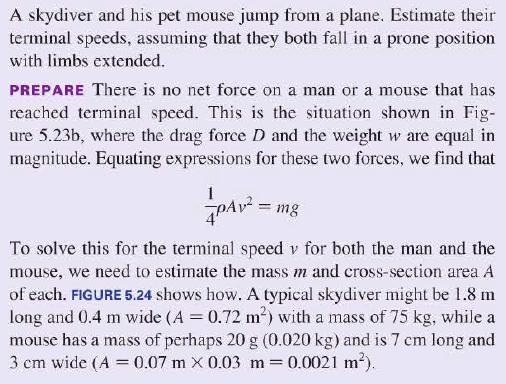
The air is less dense at higher elevations, so skydivers reach a high terminal speed. The highest recorded speed for a skydiver was achieved in a jump from a height of \(39,000 \mathrm{~m}\). At this elevation, the density of the air is only \(4.3 \%\) of the surface density. Use the data from
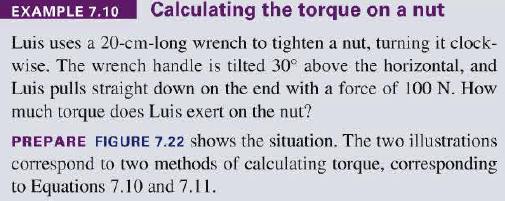
Reconsider the situation in Example 7.10. If Luis pulls straight down on the end of a wrench that is in the same orientation but is \(35 \mathrm{~cm}\) long, rather than \(20 \mathrm{~cm}\), what force must he apply to exert the same torque? EXAMPLE 7.10 Calculating the torque on a nut Luis uses a
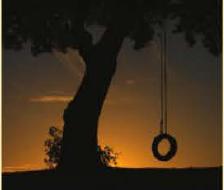
An old-fashioned tire swing exerts a force on the branch and a torque about the point where the branch meets the trunk. If you hang the swing closer to the trunk, this will --the force and-- the torque.A. increase, increase B. not change, increase C. not change, not change D. not change, decrease
Which of these objects is in static equilibrium? A. B. C. D.
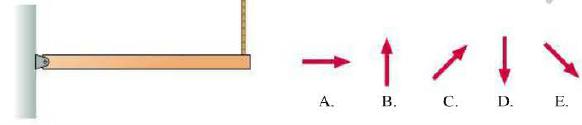
A beam with a pivot on its le ft end is suspended from a rope.Tn which direction is the force of the pivot on the beam? A. B. C. D. E.
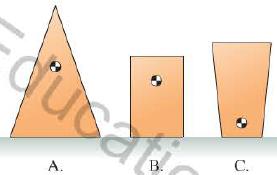
Rank in order, from least stable to most stable, the three objects shown in the figure. The positions of their centers of gravity are marked. (For the centers of gravity to be positioned like thi s, the objects must have a nonuniform composition.) ducat A. B. C.
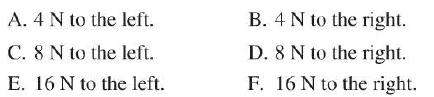
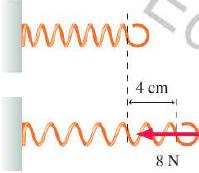
The end of a spring is pulled to the right by 4 cm; the restoring force is 8 N to the left.Given the relationships shown in Figure 8.14c, if the spring is returned to equilibrium and then pushed to the left by 2 cm, the restoring force is A. 4 N to the left. C. 8 N to the left. E. 16 N to the left.
A 1.0 kg weight is suspended from a spring, stretching it by 5.0 cm. How much does the spring stretch if the 1.0 kg weight is replaced by a 3.0 kg weight?A. 5.0cm B. 10.0cm C. 15.0cm D. 20.0cm
A 10 kg mass is hung from a 1-m-long cable, causing the cable to stretch by 2 mm. Suppose a 10 kg mass is hung from a 2 m length of the same cable. By how much does the cable stretch?A. 0.5 mm B. l mm C. 2mm D.3mm E.4mm
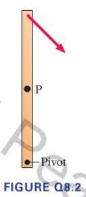
Sketch a force acting at point \(\mathrm{P}\) in Figure Q8.2 that would make the rod be in static equilibrium. Is there only one such force? P - FIGURE Q8.2
Could a ladder on a level floor lean against a wall in static equilibrium if there were no friction forces? Explain
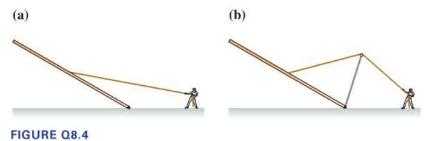
If you are using a rope to raise a tall mast, attaching the rope to the middle of the mast as in Figure Q8.4a gives a very small torque about the base of the mast when the mast is at a shallow angle. You can get a larger torque by adding a pole with a pulley on top, as in Figure Q8.4b. Draw a
A typical mattress has a network of springs that provide support. If you sit on a mattress, the springs compress. A heavier person compresses the springs more than a lighter person. Use the properties of springs and spring forces to explain why this is so.
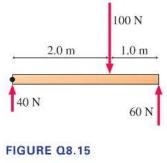
The rod in Figure Q8.15 pivots around an axle at the left end. With forces applied as noted, the objectA. Will rotate counterclockwise.B. Is in static equilibrium.C. Will rotate clockwise. 40 N 100 N 2.0 m 1.0 m FIGURE Q8.15 60 N
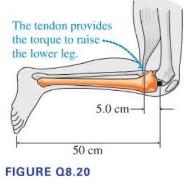
How much force must the tendon exert to keep the leg in this BIO position?A. \(40 \mathrm{~N}\)B. \(200 \mathrm{~N}\)C. \(400 \mathrm{~N}\)D. \(1000 \mathrm{~N}\)Use the information in the following paragraph and figure.Suppose you stand on one foot while holding your other leg up behind you. Your
As you hold your leg in this position, the upper leg exerts a force on the lower leg at the knee joint. What is the direction of this force?A. Up B. Down C. Right D. Left Use the information in the following paragraph and figure.Suppose you stand on one foot while holding your other leg up behind
What is the magnitude of the force of the upper leg on the\(\mathrm{BlO}\) lower leg at the knee joint?A. \(40 \mathrm{~N}\)B. \(160 \mathrm{~N}\)C. \(200 \mathrm{~N}\)D. \(240 \mathrm{~N}\)Use the information in the following paragraph and figure.Suppose you stand on one foot while holding your
A \(20 \mathrm{~kg}\) block resting on the floor is to be raised by a \(5.0-\mathrm{mm}-\) diameter rope with Young's modulus \(1.5 \times 10^{9} \mathrm{~N} / \mathrm{m}^{2}\). The rope goes up and over a pulley that is \(2.5 \mathrm{~m}\) above the floor. You hold the rope at a point \(1.5
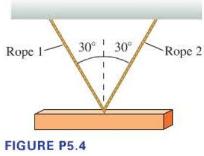
A construction crew would like to support a \(1000 \mathrm{~kg}\) steel beam with two angled ropes as shown in Figure P5.4. Their rope can support a maximum tension of \(5600 \mathrm{~N}\). Is this rope strong enough to do the job? 30 30 Rope Rope 2 FIGURE P5.4
II An early submersible craft for deep-sea exploration was raised and lowered by a cable from a ship. When the craft was stationary, the tension in the cable was \(6000 \mathrm{~N}\). When the craft was lowered or raised at a steady rate, the motion through the water added an \(1800 \mathrm{~N}\)
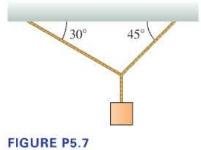
The two angled ropes are used to support the crate in Figure P5.7. The tension in the ropes can have any value up to \(1500 \mathrm{~N}\). When the tension exceeds this value, the ropes will break. What is the largest mass the ropes can support? 30 45 FIGURE P5.7
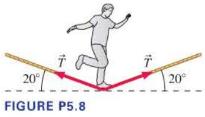
A \(65 \mathrm{~kg}\) student is walking on a slackline, a length of webbing stretched between two trees. The line stretches and so has a noticeable sag, as shown in Figure P5.8. At the point where his foot touches the line, the rope applies a tension force in each direction, as shown. What is the
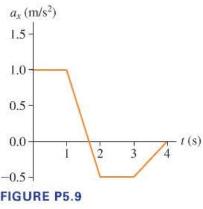
A force with \(x\)-component \(F_{x}\) acts on a \(500 \mathrm{~g}\) object as it moves along the \(x\)-axis. The object's acceleration graph \(\left(a_{x}\right.\) versus \(\left.t\right)\) is shown in Figure P5.9. Draw a graph of \(F_{x}\) versus \(t\). a, (m/s) 1.5 1.0- 0.5- 0.0- 1(S) 2 3 4
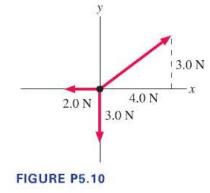
The forces in Figure P5.10 are acting on a \(2.0 \mathrm{~kg}\) object. What is \(a_{x}\), the \(x\)-component of the object's acceleration? 4.0 N 2.0 N 3.0 N FIGURE P5.10 13.0 N
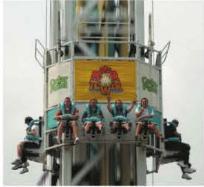
III A \(75 \mathrm{~kg}\) passenger is seated in a cage in the Sling Shot, a carnival ride. Giant bungee cords are stretched as the cage is pulled down, and then they rebound to launch the cage straight up. After the rapid launch, the cords go slack and the cage moves under the influence of gravity
Riders on the Power Tower are launched skyward with an acceleration of \(4 g\), after which they experience a period of free fall. What is a \(60 \mathrm{~kg}\) rider's apparent weighta. During the launch?b. During the period of free fall?
A kangaroo carries her \(0.51 \mathrm{~kg}\) baby in her pouch as she \(\mathrm{BlO}\) bounds across the ground. As she pushes off the ground, she is accelerating upward at \(30 \mathrm{~m} / \mathrm{s}^{2}\). What is the apparent weight of her baby at this instant? By what factor does this exceed
Two workers are sliding a \(300 \mathrm{~kg}\) crate across the floor. One worker pushes forward on the crate with a force of \(380 \mathrm{~N}\) while the other pulls in the same direction with a force of \(350 \mathrm{~N}\) using a rope connected to the crate. Both forces are horizontal, and the
A \(4000 \mathrm{~kg}\) truck is parked on a \(7.0^{\circ}\) slope. How big is the friction force on the truck?
It is friction that provides the force for a car to accelerate, so for high-performance cars the factor that limits acceleration isn't the engine; it's the tires. For typical rubber-on-concrete friction, what is the shortest time in which a car could accelerate from 0 to \(60 \mathrm{mph}\) ?
A \(10 \mathrm{~kg}\) crate is placed on a horizontal conveyor belt. The materials are such that \(\mu_{\mathrm{s}}=0.50\) and \(\mu_{\mathrm{k}}=0.30\).a. Draw a free-body diagram showing all the forces on the crate if the conveyer belt runs at constant speed.b. Draw a free-body diagram showing
The rolling resistance for steel on steel is quite low; the coefficient of rolling friction is typically \(\mu_{\mathrm{r}}=0.002\). Suppose a \(180,000 \mathrm{~kg}\) locomotive is rolling at \(10 \mathrm{~m} / \mathrm{s}\) (just over \(20 \mathrm{mph}\) ) on level rails. If the engineer
What is the drag force on a 1.6-m-wide, 1.4-m-high car traveling ata. \(10 \mathrm{~m} / \mathrm{s}(\approx 22 \mathrm{mph}) ? \quad\)b. \(30 \mathrm{~m} / \mathrm{s}(\approx 65 \mathrm{mph})\) ?
A \(75 \mathrm{~kg}\) skydiver can be modeled as a rectangular "box" with dimensions \(20 \mathrm{~cm} \times 40 \mathrm{~cm} \times 1.8 \mathrm{~m}\). What is his terminal speed if he falls feet first?
A \(2200 \mathrm{~kg}\) truck has put its front bumper against the rear bumper of a \(2400 \mathrm{~kg}\) SUV to give it a push. With the engine at full power and good tires on good pavement, the maximum forward force on the truck is \(18,000 \mathrm{~N}\).a. What is the maximum possible
Blocks with masses of \(1.0 \mathrm{~kg}, 2.0 \mathrm{~kg}\), and \(3.0 \mathrm{~kg}\) are lined up in a row on a frictionless table. All three are pushed forward by a \(12 \mathrm{~N}\) force applied to the \(1.0 \mathrm{~kg}\) block. How much force does the \(2.0 \mathrm{~kg}\) block exert on (a)
A \(2.0-\mathrm{m}\)-long, \(500 \mathrm{~g}\) rope pulls a \(10 \mathrm{~kg}\) block of ice across a horizontal, frictionless surface. The block accelerates at \(2.0 \mathrm{~m} / \mathrm{s}^{2}\). How much force pulls forward on (a) the block of ice, (b) the rope?
Two blocks on a frictionless table, A and B, are connected by a massless string. When block \(A\) is pulled with a certain force, dragging block B, the tension in the string is \(24 \mathrm{~N}\). When block B is pulled by the same force, dragging block A, the tension is \(18 \mathrm{~N}\). What is
A fisherman has caught a very large, \(5.0 \mathrm{~kg}\) fish from a dock that is \(2.0 \mathrm{~m}\) above the water. He is using lightweight fishing line that will break under a tension of \(54 \mathrm{~N}\) or more. He is eager to get the fish to the dock in the shortest possible time. If the
Riders on the Tower of Doom, an amusement park ride, experience \(2.0 \mathrm{~s}\) of free fall, after which they are slowed to a stop in \(0.50 \mathrm{~s}\). What is a \(65 \mathrm{~kg}\) rider's apparent weight as the ride is coming to rest? By what factor does this exceed her actual weight?
Elite quarterbacks can throw a football \(70 \mathrm{~m}\). To achieve such a throw, a quarterback accelerates the \(0.42 \mathrm{~kg}\) ball over a distance of approximately \(1.0 \mathrm{~m}\).a. If you assume that the quarterback throws the ball at the optimal angle, at what speed does he throw
An impala is an African antelope capable of a remarkable vertical leap. In one recorded leap, a \(45 \mathrm{~kg}\) impala went into a deep crouch, pushed straight up for \(0.21 \mathrm{~s}\), and reached a height of \(2.5 \mathrm{~m}\) above the ground. To achieve this vertical leap, with what
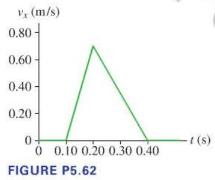
The drag force is an important fact of life for the small marine crustaceans called copepods. The drag force for small objects in water is very different from the drag force in air, so the drag equations of this chapter don't apply. However, we can estimate the drag force from data. The velocity
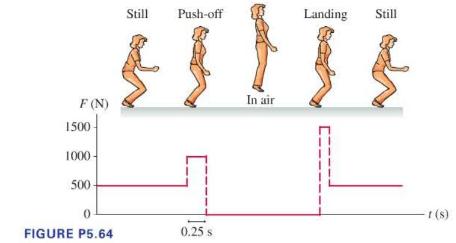
Researchers often use force plates to measure the forces that \(\mathrm{BIO}\) people exert against the floor during movement. A force plate INT works like a bathroom scale, but it keeps a record of how the reading changes with time. Figure P5.64 shows the data from a force plate as a woman jumps
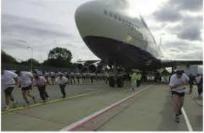
It's possible for a determined \(\mathbb{N T}\) group of people to pull an aircraft. Drag is negligible at low speeds, and the only force impeding motion is the rolling friction of the rubber tires on the concrete runway. In 2000, a team of 60 British police officers set a world record by pulling a
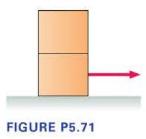
Two identical \(2.0 \mathrm{~kg}\) blocks are stacked as shown in Figure P5.71. The bottom block is free to slide on a frictionless surface. The coefficient of static friction between the blocks is 0.35 . What is the maximum horizontal force that can be applied to the lower block without the upper
A wood block is sliding up a wood ramp. If the angle of the ramp is very steep, the block will reverse direction at some point and slide back down. If the angle of the ramp is shallow, the block will stop when it reaches the highest point of its motion. What is the smallest ramp angle, measured
A \(2.7 \mathrm{~g}\) Ping-Pong ball has a diameter of \(4.0 \mathrm{~cm}\).a. The ball is shot straight up at twice its terminal speed. What is its acceleration immediately after launch?b. The ball is shot straight down at twice its terminal speed. What is its acceleration immediately after launch?
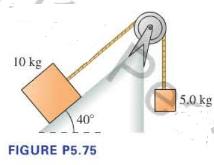
The ramp in Figure P5.75 is frictionless. If the blocks are released from rest, which way does the \(10 \mathrm{~kg}\) block slide, and what is the magnitude of its acceleration? 10 kg 40 FIGURE P5.75 5.0 kg
A curler pushes a stone to a speed of \(3.0 \mathrm{~m} / \mathrm{s}\) over a time of \(2.0 \mathrm{~s}\). Ignoring the force of friction, how much force must the curler apply to the stone to bring it up to speed?A. \(3.0 \mathrm{~N}\)B. \(15 \mathrm{~N}\)C. \(30 \mathrm{~N}\)D. \(150
The sweepers in a curling competition adjust the trajectory of the stone by In the winter sport of curling, players give a \(20 \mathrm{~kg}\) stone a push across a sheet of ice. The stone moves approximately \(40 \mathrm{~m}\) before coming to rest. The final position of the stone, in principle,
Suppose the stone is launched with a speed of \(3 \mathrm{~m} / \mathrm{s}\) and travels \(40 \mathrm{~m}\) before coming to rest. What is the approximate magnitude of the friction force on the stone?A. \(0 \mathrm{~N}\)B. \(2 \mathrm{~N}\)C. \(20 \mathrm{~N}\)D. \(200 \mathrm{~N}\)In the winter
Suppose the stone's mass is increased to \(40 \mathrm{~kg}\), but it is launched at the same \(3 \mathrm{~m} / \mathrm{s}\). Which one of the following is true?A. The stone would now travel a longer distance before coming to rest.B. The stone would now travel a shorter distance before coming to
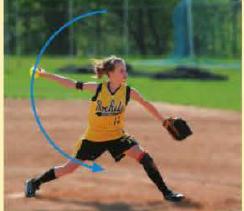
A softball pitcher is throwing a pitch. At the instant shown, the ball is moving in a circular arc at a steady speed. At this instant, the acceleration is A. Directed up. B. Directed down. C. Directed left. D. Directed right. E. Zero.
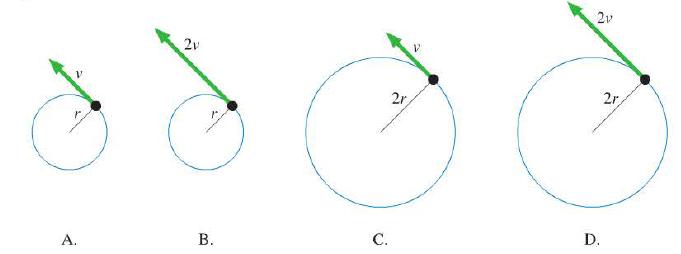
Rank in order, from largest to smallest, the period of the motion of particles A to D. 2v 2r 2v 2r 77 A. B. C. D.
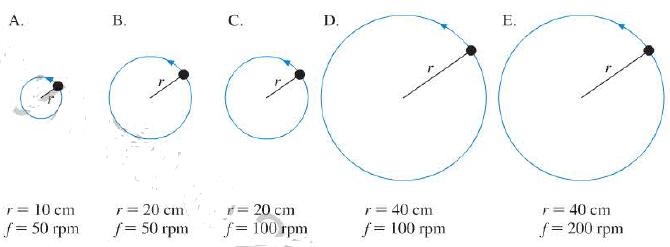
A block on a string spins in a horizontal circle on a frictionless table. Rank in order, from largest to smallest, the tensions TA to TE acting on the blocks A to E. A. B. C. D. E. r = 10 cm f= 50 rpm r = 20 cm f = 50 rpm =20 cm f= 100 rpm r = 40 cm f= 100 rpm F= 40 cm f=200 rpm
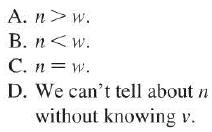
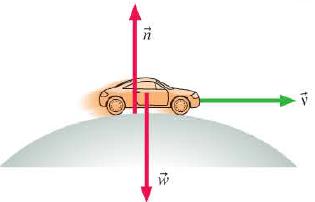
A car is rolling over the top of a hill at constant speed v. At this instant, A. nw. B. n
A satellite is in a low earth orbit. Which of the following changes would increase the orbital period?A. Increasing the mass of the satellite.B. Increasing the height of the satellite about the surface.C. Increasing the value of g.
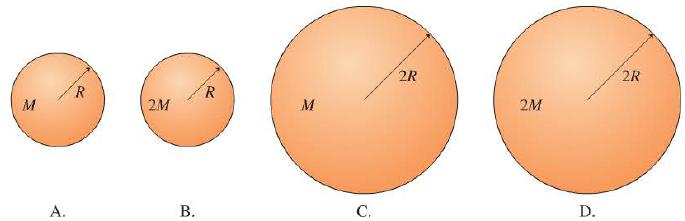
Rank in order, from largest to smallest, the free-fall accelerations on the surfaces of the following planets. R R M 2M M 2R 2R 2M A. B. C. D.
Each year, the moon gets a little bit farther away from the earth, increasing the radius of its orbit. How does this change affect the length of a month?A. A month gets longer.B. A month gets shorter.C. The length of a month stays the same.
In uniform circular motion, which of the following quantities are constant: speed, instantaneous velocity, centripetal acceleration, the magnitude of the net force?
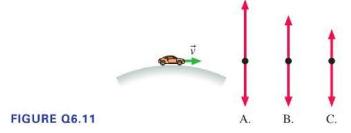
A car coasts at a constant speed over a circular hill. Which of the free-body diagrams in Figure Q6.11 is correct? Explain. FIGURE Q6.11 A. B. C.
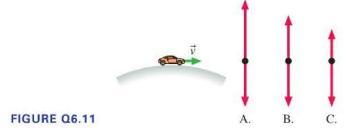
In Figure Q6.11, at the instant shown, is the apparent weight of the car's driver greater than, less than, or equal to his true weight? Explain. FIGURE Q6.11 A. B. C.
Riding in the back of a pickup truck can be very dangerous. If the truck turns suddenly, the riders can be thrown from the truck bed. Why are the riders ejected from the bed?
Playground swings move through an arc of a circle. When you are on a swing, and at the lowest point of your motion, is your apparent weight greater than, less than, or equal to your true weight? Explain.
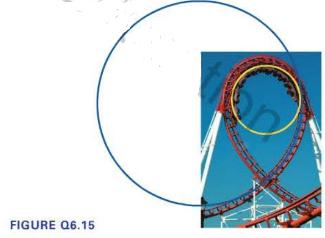
Variation in your apparent weight is desirable when you ride a roller coaster; it makes the ride fun. However, too much variation over a short period of time can be painful. For this reason, the loops of real roller coasters are not simply circles like Figure 6.16a. A typical loop is shown in
As we saw in the chapter, wings on race cars push them into the track. The increased normal force makes large friction forces possible. At one Formula One racetrack, cars turn around a halfcircle with diameter \(190 \mathrm{~m}\) at \(68 \mathrm{~m} / \mathrm{s}\). For a \(610 \mathrm{~kg}\)
Showing 2200 - 2300
of 4913
First
16
17
18
19
20
21
22
23
24
25
26
27
28
29
30
Last
Step by Step Answers

 Get 50% OFF
Claim Now
Get 50% OFF
Claim Now