New Semester
Started
Get
50% OFF
Study Help!
--h --m --s
Claim Now
Question Answers
Textbooks
Find textbooks, questions and answers
Oops, something went wrong!
Change your search query and then try again
S
Books
FREE
Study Help
Expert Questions
Accounting
General Management
Mathematics
Finance
Organizational Behaviour
Law
Physics
Operating System
Management Leadership
Sociology
Programming
Marketing
Database
Computer Network
Economics
Textbooks Solutions
Accounting
Managerial Accounting
Management Leadership
Cost Accounting
Statistics
Business Law
Corporate Finance
Finance
Economics
Auditing
Tutors
Online Tutors
Find a Tutor
Hire a Tutor
Become a Tutor
AI Tutor
AI Study Planner
NEW
Sell Books
Search
Search
Sign In
Register
study help
sciences
college physics reasoning
College Physics A Strategic Approach 3rd Edition Randall D. Knight, Brian Jones, Stuart Field - Solutions
A spring stretches \(5.0 \mathrm{~cm}\) when a \(0.20 \mathrm{~kg}\) block is hung from it. If a \(0.70 \mathrm{~kg}\) block replaces the \(0.20 \mathrm{~kg}\) block, how far does the spring stretch?
A student is testing a \(1.0 \mathrm{~m}\) length of 2.5 - \(\mathrm{mm}\)-diameter steel wire.a. How much force is required to stretch this wire by \(1.0 \mathrm{~mm}\) ?b. What length of \(5.0-\mathrm{mm}\)-diameter wire would be stretched by \(1.0 \mathrm{~mm}\) by this force?
A three-legged wooden bar stool made out of solid Douglas fir has legs that are \(2.0 \mathrm{~cm}\) in diameter. When a \(75 \mathrm{~kg}\) man sits on the stool, by what percent does the length of the legs decrease? Assume, for simplicity, that the stool's legs are vertical and that each bears
A glass optical fiber in a communications system has a diameter of \(9.0 \mu \mathrm{m}\).a. What maximum force could this fiber support without breaking?b. Assume that the fiber stretches in a linear fashion until the instant it breaks. By how much will a 10-m-long fiber have stretched when it is
The Achilles tendon connects the muscles in your calf to the back of your foot. When you are sprinting, your Achilles tendon alternately stretches, as you bring your weight down onto your forward foot, and contracts to push you off the ground. A \(70 \mathrm{~kg}\) runner has an Achilles tendon
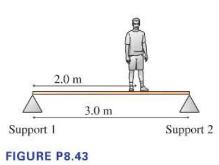
A \(3.0-\mathrm{m}\)-long rigid beam with a mass of \(100 \mathrm{~kg}\) is supported at each end, as shown in Figure P8.43. An \(80 \mathrm{~kg}\) student stands \(2.0 \mathrm{~m}\) from support 1 . How much upward force does each support exert on the beam? Support 1 2.0 m 3.0 m FIGURE P8.43
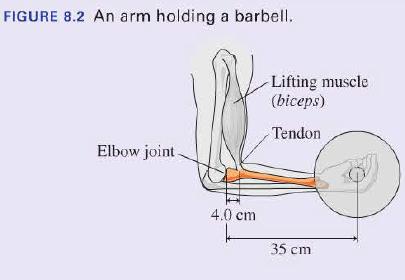
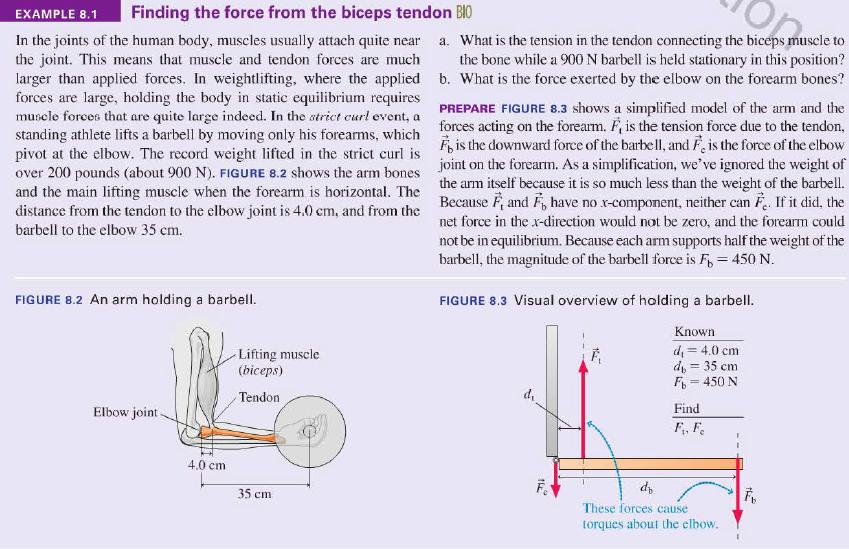
IIII Using the information in Figure 8.2, calculate the tension in\(\mathrm{B} / \mathrm{O}\) the biceps tendon if the hand is holding a \(10 \mathrm{~kg}\) ball while the forearm is held \(45^{\circ}\) below horizontal.Figure 8.2 FIGURE 8.2 An arm holding a barbell. Elbow joint Lifting muscle
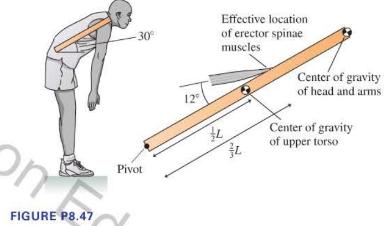
When you bend over, a series of large muscles, the erector spinae, pull on your spine to hold you up. Figure P8.47 shows a simplified model of the spine as a rod of length \(L\) that pivots at its lower end. In this model, the center of gravity of the \(320 \mathrm{~N}\) weight of the upper torso
Two identical, side-by-side springs with spring constant \(240 \mathrm{~N} / \mathrm{m}\) support a \(2.00 \mathrm{~kg}\) hanging box. Each spring supports the same weight. By how much is each spring stretched?
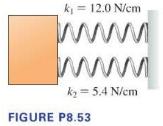
Two springs have the same equilibrium length but different spring constants. They are arranged as shown in Figure P8.53, then a block is pushed against them, compressing both by \(4.00 \mathrm{~cm}\). With what net force do they push back on the block? k = 12.0 N/cm M wwwww www k = 5.4 N/cm FIGURE
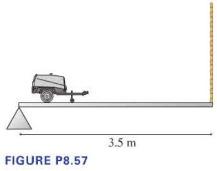
Figure P8.57 shows a lightweight plank supported at its right end by a 7.0 -mm-diameter rope with a tensile strength of \(6.0 \times 10^{7} \mathrm{~N} / \mathrm{m}^{2}\).a. What is the maximum force that the rope can support?b. What is the greatest distance, measured from the pivot, that the
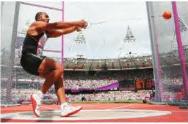
In the hammer throw, an\(\mathbb{N T}\) athlete spins a heavy mass in a circle at the end of a cable before releasing it for distance. For male athletes, the "hammer" is a mass of \(7.3 \mathrm{~kg}\) at the end of a \(1.2 \mathrm{~m}\) cable, which is typically a 3.0 -mm-diameter steel cable. A
There is a disk of cartilage between each pair of vertebrae in your spine. Suppose a disk is \(0.50 \mathrm{~cm}\) thick and \(4.0 \mathrm{~cm}\) in diameter. If this disk supports half the weight of a \(65 \mathrm{~kg}\) person, by what fraction of its thickness does the disk compress?
In Example 8.1, the tension in the biceps tendon for a person doing a strict curl of a \(900 \mathrm{~N}\) barbell was found to be \(3900 \mathrm{~N}\). What fraction does this represent of the maximum possible tension the biceps tendon can support? You can assume a typical cross-section area of
Larger animals have sturdier bones than smaller animals. A mouse's skeleton is only a few percent of its body weight, compared to \(16 \%\) for an elephant. To see why this must be so, recall, from Example 8.10, that the stress on the femur for a man standing on one leg is \(1.4 \%\) of the bone's
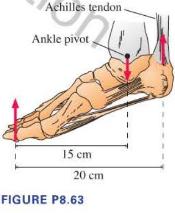
What is the upward force of the floor on the toes of one foot?A. \(140 \mathrm{~N}\)B. \(290 \mathrm{~N}\)C. \(420 \mathrm{~N}\)D. \(590 \mathrm{~N}\)When you stand on your tiptoes, your feet pivot about your ankle. As shown in Figure P8.63, the forces on your foot are an upward force on your toes
What upward force does the Achilles tendon exert on the heel of her foot?A. \(290 \mathrm{~N}\)B. \(420 \mathrm{~N}\)C. \(590 \mathrm{~N}\)D. \(880 \mathrm{~N}\)When you stand on your tiptoes, your feet pivot about your ankle. As shown in Figure P8.63, the forces on your foot are an upward force on
The tension in the Achilles tendon will cause it to stretch. If the Achilles tendon is \(15 \mathrm{~cm}\) long and has a cross-section area of \(110 \mathrm{~mm}^{2}\), by how much will it stretch under this force?A. \(0.2 \mathrm{~mm}\)B. \(0.8 \mathrm{~mm}\)C. \(2.3 \mathrm{~mm}\)D. \(5.2
A hammer hits a nail. The force of the nail on the hammer is A. Greater than the force of the hammer on the nail.B. Less than the force of the hammer on the nail.C. Equal to the force of the hammer on the nail.
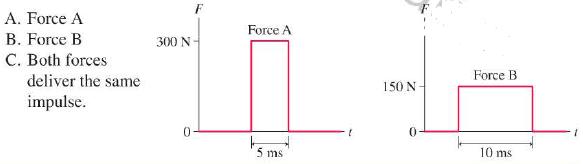
Graph A is the force-versus-time graph for a hockey stick hitting a 160 g puck. Graph Bis the force-versus-time graph for a golf club hitting a 46 g golf ball. Which force delivers the greater impulse? A. Force A B. Force B C. Both forces deliver the same impulse. Force A 300 N- Force B. 150 N 0 10
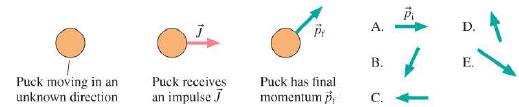
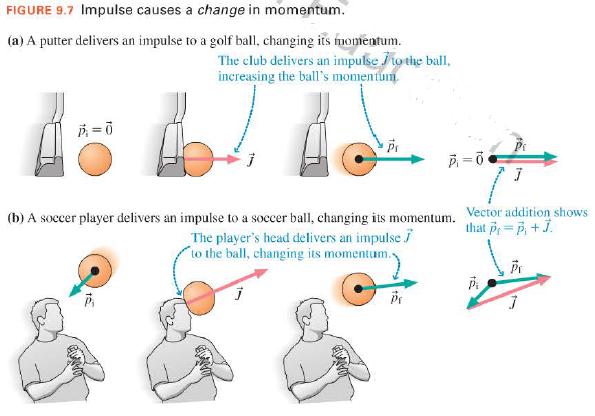
A puck, seen from above, was moving with an initial momentum when it received an impulse J from a hockey stick, giving it the final momentum shown. Using the ideas of Figure 9.7, which arrow best represents the puck's initial momentum? Pr A. D. B. E. Puck moving in an unknown direction Puck
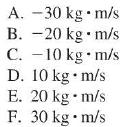
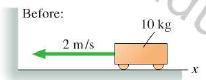
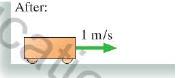
The cart's change of momentum is A. -30 kg m/s B. -20 kg. m/s C. -10 kg. m/s D. 10 kg. m/s E. 20 kg. m/s F. 30 kg m/s
A 10 g rubber ball and a 10 g clay ball are each thrown at a wall with equal speeds. The rubber ball bounces; the clay ball sticks. Which ball receives the greater impulse from the wall?A. The clay ball receives a greater impulse because it sticks.B. The rubber ball receives a greater impulse
An explosion in a rigid pipe shoots three balls out of its ends. A 6 g ball comes out the right end. A 4 g ball comes out the left end with twice the speed of the 6 g ball. From which end, left or right, does the third ball emerge?
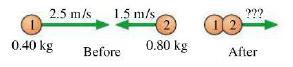
The two particles shown collide and stick together. After the collision, the combined particles A. Move to the right as shown.B. Move to the left.C. Are at rest. 2.5 m/s 1.5 m/s, ??? 0.40 kg 0.80 kg Before After
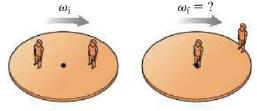
The left figure shows two boys of equa l mass standing ha lfway to the edge on a turntable that is freely rotating at angular speed w;. They then walk to the positions shown in the right figure. The final angular speed ωf is A. Greater than ωi. B. Less than ωi. C. Equal to ωi. (1) w = ?
A \(2 \mathrm{~kg}\) cart rolling to the right at \(3 \mathrm{~m} / \mathrm{s}\) runs into a \(3 \mathrm{~kg}\) cart rolling to the left. After the collision, both carts are stationary. What was the original speed of the \(3 \mathrm{~kg}\) cart?
Monica stands at the edge of a circular platform that is slowly rotating on a frictionless axle. She then walks toward the opposite edge, passing through the platform's center. Describe the motion of the platform as Monica makes her trip.
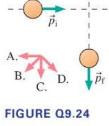
A small puck is sliding to the right with momentum \(\vec{p}_{\mathrm{i}}\) on a horizontal, frictionless surface, as shown in Figure Q9.24. A force is applied to the puck for a short time and its momentum afterward is \(\vec{p}_{\mathrm{f}}\). Which lettered arrow shows the direction of the
A 4.0-m-diameter playground merry-go-round, with a moment of inertia of \(400 \mathrm{~kg} \cdot \mathrm{m}^{2}\), is freely rotating with an angular velocity of \(2.0 \mathrm{rad} / \mathrm{s}\). Ryan, whose mass is \(80 \mathrm{~kg}\), runs on the ground around the outer edge of the
A disk rotates freely on a vertical axis with an angular velocity of \(30 \mathrm{rpm}\). An identical disk rotates above it in the same direction about the same axis, but without touching the lower disk, at \(20 \mathrm{rpm}\). The upper disk then drops onto the lower disk. After a short time,
At what speed do a bicycle and its rider, with a combined mass of \(100 \mathrm{~kg}\), have the same momentum as a \(1500 \mathrm{~kg}\) car traveling at \(1.0 \mathrm{~m} / \mathrm{s}\) ?
Use the impulse-momentum theorem to find how long a stone falling straight down takes to increase its speed from \(5.5 \mathrm{~m} / \mathrm{s}\) to \(10.4 \mathrm{~m} / \mathrm{s}\).
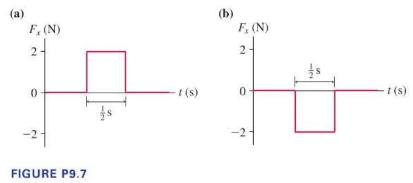
a. A \(2.0 \mathrm{~kg}\) object is moving to the right with a speed of \(1.0 \mathrm{~m} / \mathrm{s}\) when it experiences the force shown in Figure P9.7a. What are the object's speed and direction after the force ends?b. Answer this question for the force shown in Figure P9.7b. (a) (b) F, (N) 2
A \(55 \mathrm{~kg}\) hunter, standing on frictionless ice, shoots a \(42 \mathrm{~g}\) bullet at a speed of \(620 \mathrm{~m} / \mathrm{s}\). What is the recoil speed of the hunter?
Erica ( \(36 \mathrm{~kg}\) ) and Danny ( \(47 \mathrm{~kg})\) are bouncing on a trampoline. Just as Erica reaches the high point of her bounce, Danny is moving upward past her at \(4.1 \mathrm{~m} / \mathrm{s}\). At that instant he grabs hold of her. What is their speed just after he grabs her?
At a wild-west show, a marksman fires a bullet at a \(12 \mathrm{~g}\) coin that's thrown straight up into the air. The marksman points his rifle at a \(45^{\circ}\) angle above the ground, then fires a \(15 \mathrm{~g}\) bullet at a speed of \(550 \mathrm{~m} / \mathrm{s}\). Just as the coin
A \(20 \mathrm{~g}\) ball of clay traveling east at \(3.0 \mathrm{~m} / \mathrm{s}\) collides with a \(30 \mathrm{~g}\) ball of clay traveling north at \(2.0 \mathrm{~m} / \mathrm{s}\). What are the speed and the direction of the resulting \(50 \mathrm{~g}\) blob of clay?
A firecracker in a coconut blows the coconut into three pieces. Two pieces of equal mass fly off south and west, perpendicular to each other, at \(20 \mathrm{~m} / \mathrm{s}\). The third piece has twice the mass of the other two. What are the speed and direction of the third piece?
A little girl is going on the merry-go-round for the first time, and wants her \(47 \mathrm{~kg}\) mother to stand next to her on the ride, \(2.6 \mathrm{~m}\) from the merry-go-round's center. If her mother's speed is \(4.2 \mathrm{~m} / \mathrm{s}\) when the ride is in motion, what is her angular
Ice skaters often end their performances with spin turns, where they spin very fast about their center of mass with their arms folded in and legs together. Upon ending, their arms extend outward, proclaiming their finish. Not quite as noticeably, one leg goes out as well. Suppose that the moment of
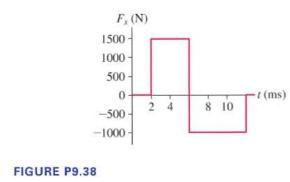
What is the impulse on a \(3.0 \mathrm{~kg}\) particle that experiences the force described by the graph in Figure P9.38? F, (N) 1500 1000 500 0 (ms) 24 8 10 -500 -1000 FIGURE P9.38
A sled slides along a horizontal surface for which the coefficient of kinetic friction is 0.25 . Its velocity at point \(A\) is \(8.0 \mathrm{~m} / \mathrm{s}\) and at point \(B\) is \(5.0 \mathrm{~m} / \mathrm{s}\). Use the impulse-momentum theorem to find how long the sled takes to travel from
a. With what speed are pollen grains ejected from a bunch berry flower? See Problem 47 for information.b. Suppose that 1000 ejected pollen grains slam into the abdomen of a 5.0 g5.0 g bee that is hovering just above the flower. If the collision is perfectly inelastic, what is the bee's
A \(20 \mathrm{~g}\) ball of clay is thrown horizontally at \(30 \mathrm{~m} / \mathrm{s}\) toward a \(1.0 \mathrm{~kg}\) block sitting at rest on a frictionless surface. The clay hits and sticks to the block,a. What is the speed of the block and clay right after the collision?b. Use the block's
A small cart rolls freely along the floor. As it rolls, balls of clay, each having one-fourth the mass of the cart, are dropped straight down onto the cart and stick to it. How many balls must be dropped until the cart is moving at less than one-third its initial speed?
Three identical train cars, coupled together, are rolling east at \(2.0 \mathrm{~m} / \mathrm{s}\). A fourth car traveling east at \(4.0 \mathrm{~m} / \mathrm{s}\) catches up with the three and couples to make a four-car train. A moment later, the train cars hit a fifth car that was at rest on the
A \(110 \mathrm{~kg}\) linebacker running at \(2.0 \mathrm{~m} / \mathrm{s}\) and an \(82 \mathrm{~kg}\) quarterback running at \(3.0 \mathrm{~m} / \mathrm{s}\) have a head-on collision in midair. The linebacker grabs and holds onto the quarterback. Who ends up moving forward after they hit?
Most geologists believe that the dinosaurs became extinct 65 million years ago when a large comet or asteroid struck the earth, throwing up so much dust that the sun was blocked out for a period of many months. Suppose an asteroid with a diameter of \(2.0 \mathrm{~km}\) and a mass of \(1.0 \times
Two ice skaters, with masses of \(75 \mathrm{~kg}\) and \(55 \mathrm{~kg}\), stand facing\(\mathbb{N T}\) each other on a \(15-\mathrm{m}\)-wide frozen river. The skaters push off against each other, glide backward straight toward the river's edges, and reach the edges at exactly the same time. How
A \(10 \mathrm{~g}\) bullet is fired into a \(10 \mathrm{~kg}\) wood block that is at rest\(\mathbb{N T}\) on a wood table. The block, with the bullet embedded, slides \(5.0 \mathrm{~cm}\) across the table. What was the speed of the bullet?
A typical raindrop is much more massive than a mosquito and\(\mathrm{BO}\) falling much faster than a mosquito flies. How does a mosquito survive the impact? Recent research has found that the collision of a falling raindrop with a mosquito is a perfectly inelastic collision. That is, the mosquito
A \(15 \mathrm{~g}\) bullet is fired at \(610 \mathrm{~m} / \mathrm{s}\) into a \(4.0 \mathrm{~kg}\) block that sits at the edge of a \(75-\mathrm{cm}\)-high table. The bullet embeds itself in the block and carries it off the table. How far from the point directly below the table's edge does the
A \(495 \mathrm{~kg}\) cannon fires a \(10.0 \mathrm{~kg}\) cannonball with a speed of \(211 \mathrm{~m} / \mathrm{s}\) relative to the muzzle. The cannon is on wheels that roll without friction. When the cannon fires, what is the speed of the cannonball relative to the ground?
At the county fair, Chris throws a \(0.15 \mathrm{~kg}\) baseball at a \(2.0 \mathrm{~kg}\) wooden milk bottle, hoping to knock it off its stand and win a prize. The ball bounces straight back at \(20 \%\) of its incoming speed, knocking the bottle straight forward. What is the bottle's speed, as a
A \(1.0-\mathrm{m}\)-long massless rod is pivoted at one end and swings around in a circle on a frictionless table. A block with a hole through the center can slide in and out along the rod. Initially, a small piece of wax holds the block \(30 \mathrm{~cm}\) from the pivot. The block is spun at
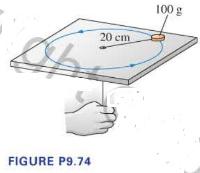
Figure P9.74 shows a \(100 \mathrm{~g}\) puck revolving at \(100 \mathrm{rpm}\) on a 20-cm-radius circle on a frictionless table. A string attached to the puck passes through a hole in the middle of the table. The end of the string below the table is then slowly pulled down until the puck is
A 3.0-m-diameter merry-go-round with a mass of \(250 \mathrm{~kg}\) is spinning at \(20 \mathrm{rpm}\). John runs around the merry-go-round at \(5.0 \mathrm{~m} / \mathrm{s}\), in the same direction that it is turning, and jumps onto the outer edge. John's mass is \(30 \mathrm{~kg}\). What is the
I What is the momentum of the club + ball system right before the collision?A. \(1.8 \mathrm{~kg} \cdot \mathrm{m} / \mathrm{s}\)B. \(8.0 \mathrm{~kg} \cdot \mathrm{m} / \mathrm{s}\)C. \(3220 \mathrm{~kg} \cdot \mathrm{m} / \mathrm{s}\)D. \(8000 \mathrm{~kg} \cdot \mathrm{m} / \mathrm{s}\)
Immediately after the collision, the momentum of the club + ball system will be A. Less than before the collision.B. The same as before the collision.C. Greater than before the collision.
A manufacturer makes a golf ball that compresses more than a traditional golf ball when struck by a club. How will this affect the average force during the collision?A. The force will decrease.B. The force will not be affected.C. The force will increase.
By approximately how much does the club head slow down as a result of hitting the ball?A. \(4 \mathrm{~m} / \mathrm{s}\)B. \(6 \mathrm{~m} / \mathrm{s}\)C. \(14 \mathrm{~m} / \mathrm{s}\)D. \(26 \mathrm{~m} / \mathrm{s}\)
A car pulls away from a stop sign with a constant acceleration. After traveling 10 m, its speed is 5 m/s. What will its speed be after traveling 40 m?A. 10 m/s B. 20 m/s C. 30 m/s D. 40 m/s
A child slides down a playground slide at constant speed.The energy transformation is A. U K B. K Ug C. W K D. Ug Eth - E. K Eth
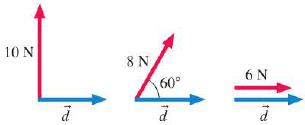
Which force does the most work?A. The 10 N force B. The 8 N force C. The 6 N force D. They all do the same amount of work. 10 N d 8 N 60 6 N P P
Rank in order, from greatest to least, the kinetic energies of the sliding pucks. 1 kg 2 m/s 1 kg 3 m/s A. B. -2 m/s 1 kg 2 kg 2 m/s C. D.
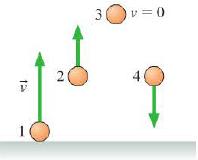
Rank in order, from largest to smallest, the gravitational potential energies of ide ntical balls 1 through 4. 3v=0 12
When a spring is stretched by 5 cm, its elastic potential energy is 1 J. What will its elastic potential energy be if it is compressed by 10 cm?A. - 4 J B. - 2 J C. 2 J D. 4J
A block with an initial kinetic energy of 4.0 J comes to rest after sliding 1.0 m. How far would the block slide if it had 8.0 J of initial kinetic energy?A. 1.4 m B. 2.0m C. 3.0m D. 4.0m.
At the water park, Katie slides down each of the frictionless slides shown. At the top, she is given a push so that she has the same initial speed each time. At the bottom of which slide is she moving the fastest?A. Slide A B. Slide B C. Slide C D. Her speed is the same at the bottom of all three
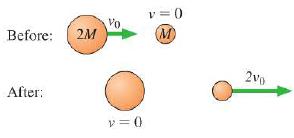
A small ball with mass M is at rest. It is then struck by a ball with twice the mass, moving at speed v0. The situation after the collision is shown in the figure. Is this possible?A. Yes B. No, because momentum is not conservedc. No, because energy is not conserved D. No, because neither momentum
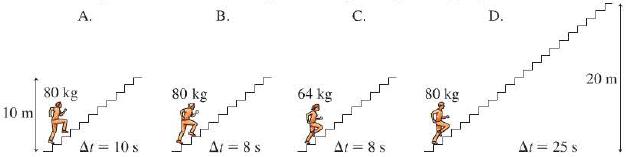
Four students run up the stairs in the times shown. Rank in order, from largest to smallest, their power outputs PA through PD• 80 kg A. B. C. D. 80 kg 64 kg 10 m Ar = 10 s At = 8 s At = 8 s 80 kg Ar=25 s 20 m
Give a specific example of a system with the energy transformation shown. In these questions, \(W\) is the work done on the system, and \(K, U\), and \(E_{\mathrm{th}}\) are the kinetic, potential, and thermal energies of the system, respectively. Any energy not mentioned in the transformation is
\(K \rightarrow U\)Give a specific example of a system with the energy transformation shown. In these questions, \(W\) is the work done on the system, and \(K, U\), and \(E_{\mathrm{th}}\) are the kinetic, potential, and thermal energies of the system, respectively. Any energy not mentioned in the
Puck B has twice the mass of puck A. Starting from rest, both pucks are pulled the same distance across frictionless ice by strings with the same tension.a. Compare the final kinetic energies of pucks A and B.b. Compare the final speeds of pucks A and B.
Jason slides a large crate down a ramp from a truck to the ground. To control the crate and keep it sliding at constant speed, Jason backs down the ramp in front of the crate while pushing upward on it. During its trip to the bottom, is the thermal energy created in the ramp and the crate greater
A roller coaster starts from rest at its highest point and then descends on its (frictionless) track. Its speed is \(30 \mathrm{~m} / \mathrm{s}\) when it reaches ground level. What was its speed when its height was half that of its starting point?A. \(11 \mathrm{~m} / \mathrm{s}\)B. \(15
You and a friend each carry a \(15 \mathrm{~kg}\) suitcase up two flights of stairs, walking at a constant speed. Take each suitcase to be the system. Suppose you carry your suitcase up the stairs in \(30 \mathrm{~s}\) while your friend takes \(60 \mathrm{~s}\). Which of the following is true? A.
A \(2.0 \mathrm{~kg}\) book is lying on a \(0.75-\mathrm{m}\)-high table. You pick it up and place it on a bookshelf \(2.3 \mathrm{~m}\) above the floor. During this process,a. How much work does gravity do on the book?b. How much work does your hand do on the book?
a. An escalator carries you from one level to the next in an airport terminal. The upper level is \(4.5 \mathrm{~m}\) above the lower level, and the length of the escalator is \(7.0 \mathrm{~m}\). How much work does the up escalator do on you when you ride it from the lower level to the upper
A crate slides down a ramp that makes a \(20^{\circ}\) angle with the ground. To keep the crate from sliding too fast, Paige pushes back on it with a \(68 \mathrm{~N}\) horizontal force. How much work does Paige do on the crate as it slides \(3.5 \mathrm{~m}\) down the ramp?
Which has the larger kinetic energy, a \(10 \mathrm{~g}\) bullet fired at \(500 \mathrm{~m} / \mathrm{s}\) or a \(10 \mathrm{~kg}\) bowling ball sliding at \(10 \mathrm{~m} / \mathrm{s}\) ?
The cheetah is the fastest land animal, reaching speeds as high as \(33 \mathrm{~m} / \mathrm{s}\), or roughly \(75 \mathrm{mph}\). What is the kinetic energy of a \(60 \mathrm{~kg}\) cheetah running at top speed?
How fast would an \(80 \mathrm{~kg}\) man need to run in order to have the same kinetic energy as an \(8.0 \mathrm{~g}\) bullet fired at \(400 \mathrm{~m} / \mathrm{s}\) ?
A \(20 \mathrm{~g}\) plastic ball is moving to the left at \(30 \mathrm{~m} / \mathrm{s}\). How much work must be done on the ball to cause it to move to the right at \(30 \mathrm{~m} / \mathrm{s}\) ?
The turntable in a microwave oven has a moment of inertia of \(0.040 \mathrm{~kg} \cdot \mathrm{m}^{2}\) and rotates continuously, making a complete revolution every \(4.0 \mathrm{~s}\). What is its kinetic energy?
a. What is the kinetic energy of a \(1500 \mathrm{~kg}\) car traveling at a speed of \(30 \mathrm{~m} / \mathrm{s}(\approx 65 \mathrm{mph})\) ?b. From what height should the car be dropped to have this same amount of kinetic energy just before impact?c. Does your answer to part b depend on the
Marissa drags a \(23 \mathrm{~kg}\) duffel bag \(14 \mathrm{~m}\) across the gym floor. If the coefficient of kinetic friction between the floor and bag is 0.15 , how much thermal energy does Marissa create?
Mark pushes his broken car \(150 \mathrm{~m}\) down the block to his friend's house. He has to exert a \(110 \mathrm{~N}\) horizontal force to push the car at a constant speed. How much thermal energy is created in the tires and road during this short trip?
A \(900 \mathrm{~N}\) crate slides \(12 \mathrm{~m}\) down a ramp that makes an angle of \(35^{\circ}\) with the horizontal. If the crate slides at a constant speed, how much thermal energy is created?
A \(25 \mathrm{~kg}\) child slides down a playground slide at a constant speed. The slide has a height of \(3.0 \mathrm{~m}\) and is \(7.0 \mathrm{~m}\) long. Using the law of conservation of energy, find the magnitude of the kinetic friction force acting on the child.
a. With what minimum speed must you toss a \(100 \mathrm{~g}\) ball straight up to just barely hit the \(10-\mathrm{m}\)-high ceiling of the gymnasium if you release the ball \(1.5 \mathrm{~m}\) above the floor? Solve this problem using energy.b. With what speed does the ball hit the floor?
What minimum speed does a \(100 \mathrm{~g}\) puck need to make it to the top of a frictionless ramp that is \(3.0 \mathrm{~m}\) long and inclined at \(20^{\circ}\) ?
A car is parked at the top of a \(50-\mathrm{m}\)-high hill. Its brakes fail and it rolls down the hill. How fast will it be going at the bottom? (Ignore friction.)
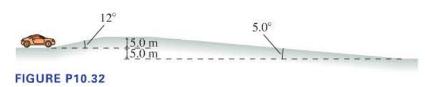
A \(1500 \mathrm{~kg}\) car is approaching the hill shown in Figure P10.32 at \(10 \mathrm{~m} / \mathrm{s}\) when it suddenly runs out of gas.a. Can the car make it to the top of the hill by coasting?b. If your answer to part a is yes, what is the car's speed after coasting down the other side?
A \(20 \mathrm{~kg}\) child slides down a 3.0 -m-high playground slide. She starts from rest, and her speed at the bottom is \(2.0 \mathrm{~m} / \mathrm{s}\).a. What energy transfers and transformations occur during the slide?b. What is the total change in the thermal energy of the slide and the
In the winter activity of tubing, riders slide down snowcovered slopes while sitting on large inflated rubber tubes. To get to the top of the slope, a rider and his tube, with a total mass of \(80 \mathrm{~kg}\), are pulled at a constant speed by a tow rope that maintains a constant tension of
A cyclist is coasting at \(12 \mathrm{~m} / \mathrm{s}\) when she starts down a \(450-\mathrm{m}\)-long slope that is \(30 \mathrm{~m}\) high. The cyclist and her bicycle have a combined mass of \(70 \mathrm{~kg}\). A steady \(12 \mathrm{~N}\) drag force due to air resistance acts on her as she
If A \(50 \mathrm{~g}\) marble moving at \(2.0 \mathrm{~m} / \mathrm{s}\) strikes a \(20 \mathrm{~g}\) marble at rest. What is the speed of each marble immediately after the collision? Assume the collision is perfectly elastic and the marbles collide head-on.
An air-track glider undergoes a perfectly inelastic collision with an identical glider that is initially at rest. What fraction of the first glider's initial kinetic energy is transformed into thermal energy in this collision?
Showing 2100 - 2200
of 4913
First
15
16
17
18
19
20
21
22
23
24
25
26
27
28
29
Last
Step by Step Answers

 Get 50% OFF
Claim Now
Get 50% OFF
Claim Now