New Semester
Started
Get
50% OFF
Study Help!
--h --m --s
Claim Now
Question Answers
Textbooks
Find textbooks, questions and answers
Oops, something went wrong!
Change your search query and then try again
S
Books
FREE
Study Help
Expert Questions
Accounting
General Management
Mathematics
Finance
Organizational Behaviour
Law
Physics
Operating System
Management Leadership
Sociology
Programming
Marketing
Database
Computer Network
Economics
Textbooks Solutions
Accounting
Managerial Accounting
Management Leadership
Cost Accounting
Statistics
Business Law
Corporate Finance
Finance
Economics
Auditing
Tutors
Online Tutors
Find a Tutor
Hire a Tutor
Become a Tutor
AI Tutor
AI Study Planner
NEW
Sell Books
Search
Search
Sign In
Register
study help
sciences
college physics reasoning
College Physics A Strategic Approach 3rd Edition Randall D. Knight, Brian Jones, Stuart Field - Solutions
Suppose you and a friend, each of mass \(60 \mathrm{~kg}\), go to the park and get on a 4.0-m-diameter merry-go-round. You stand on the outside edge of the merry-go-round, while your friend pushes so that it rotates once every \(6.0 \mathrm{~s}\). What is the magnitude of the (apparent) outward
The radius of Jupiter is 11 times that of earth, and the freefall acceleration near its surface is 2.5 times that on earth. If we someday put a spacecraft in low Jupiter orbit, its orbital speed will beA. Greater than that for an earth satellite.B. The same as that for an earth satellite.C. Less
Currently, the moon goes around the earth once every 27.3 days. If the moon could be brought into a new circular orbit with a smaller radius, its orbital period would be A. More than 27.3 days.B. 27.3 days.C. Less than 27.3 days
Two planets orbit a star. You can ignore the gravitational interactions between the planets. Planet 1 has orbital radius \(r_{1}\) and planet 2 has \(r_{2}=4 r_{1}\). Planet 1 orbits with period \(T_{1}\). Planet 2 orbits with periodA. \(T_{2}=\frac{1}{2} T_{1}\)B. \(T_{2}=2
An old-fashioned LP record rotates at \(33 \frac{1}{3} \mathrm{rpm}\).a. What is its frequency, in rev/s?b. What is its period, in seconds?
A typical hard disk in a computer spins at \(5400 \mathrm{rpm}\).a. What is the frequency, in rev/s?b. What is the period, in seconds?
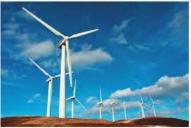
Modern wind turbines are larger than they appear, and despite their apparently lazy motion, the speed of the blades tips can be quite high-many times higher than the wind speed. A typical modern turbine has blades \(56 \mathrm{~m}\) long that spin at \(13 \mathrm{rpm}\). At the tip of a blade, what
Wind turbines designed for offshore installations are much larger than ones designed for use on land. One company makes a turbine for use on land with blades \(40 \mathrm{~m}\) long that spin at \(17 \mathrm{rpm}\), and a turbine for use offshore with blades that are twice as long. At what rate
A typical running track is an oval with 74-m-diameter half circles at each end. A runner going once around the track covers a distance of \(400 \mathrm{~m}\). Suppose a runner, moving at a constant speed, goes once around the track in \(1 \mathrm{~min} 40 \mathrm{~s}\). What is her centripetal
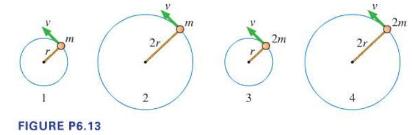
Figure P6.13 is a bird's-eye view of particles on a string moving in horizontal circles on a tabletop. All are moving at the same speed. Rank in order, from largest to smallest, the tensions \(T_{1}\) to \(T_{4}\). FIGURE P6.13 2 3 2m 2r 2m
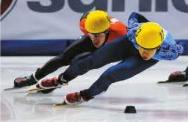
In short-track speed skating, the track has straight sections and semicircles \(16 \mathrm{~m}\) in diameter. Assume that a \(65 \mathrm{~kg}\) skater goes around the turn at a constant \(12 \mathrm{~m} / \mathrm{s}\).a. What is the horizontal forceb. What is the ratio of this force to the skater's
A cyclist is rounding a \(20-\mathrm{m}\)-radius curve at \(12 \mathrm{~m} / \mathrm{s}\). What is the minimum possible coefficient of static friction between the bike tires and the ground?
A wind turbine has \(12,000 \mathrm{~kg}\) blades that are \(38 \mathrm{~m}\) long. The blades spin at \(22 \mathrm{rpm}\). If we model a blade as a point mass at the midpoint of the blade, what is the inward force necessary to provide each blade's centripetal acceleration?
You have seen dogs shake to shed water from their fur. The motion is complicated, but the fur on a dog's torso rotates back and forth along a roughly circular arc. Water droplets are held to the fur by contact forces, and these forces provide the centripetal acceleration that keeps the droplets
Gibbons, small Asian apes, move by brachiation, swinging below a handhold to move forward to the next handhold. A \(9.0 \mathrm{~kg}\) gibbon has an arm length (hand to shoulder) of \(0.60 \mathrm{~m}\). We can model its motion as that of a point mass swinging at the end of a
A roller coaster car is going over the top of a 15-m-radius circular rise. At the top of the hill, the passengers "feel light," with an apparent weight only \(50 \%\) of their true weight. How fast is the coaster moving?
As a roller coaster car crosses the top of a 40-m-diameter loop-the-loop, its apparent weight is the same as its true weight. What is the car's speed at the top?
An 80-ft-diameter Ferris wheel rotates once every \(24 \mathrm{~s}\). What is the apparent weight of a \(70 \mathrm{~kg}\) passenger at (a) the lowest point of the circle and (b) at the highest point?
A satellite orbiting the moon very near the surface has a period of \(110 \mathrm{~min}\). Use this information, together with the radius of the moon from the table on the inside of the back cover, to calculate the free-fall acceleration on the moon's surface.
Spacecraft have been sent to Mars in recent years. Mars is smaller than Earth and has correspondingly weaker surface gravity. On Mars, the free-fall acceleration is only \(3.8 \mathrm{~m} / \mathrm{s}^{2}\). What is the orbital period of a spacecraft in a low orbit near the surface of Mars?
Suppose the free-fall acceleration at some location on earth was exactly \(9.8000 \mathrm{~m} / \mathrm{s}^{2}\). What would it be at the top of a \(1000-\mathrm{m}-\) tall tower at this location? (Give your answer to five significant figures.)
In recent years, astronomers have found planets orbiting nearby stars that are quite different from planets in our solar system. Kepler-12b, has a diameter that is 1.7 times that of Jupiter, but a mass that is only 0.43 that of Jupiter. What is the value of \(g\) on this large, but low-density,
In recent years, astronomers have found planets orbiting nearby stars that are quite different from planets in our solar system. Kepler-39b, has a diameter that is 1.2 times that of Jupiter, but a mass that is 18 times that of Jupiter. What would be the period of a satellite in a low orbit around
a. What is the gravitational force of the sun on the earth?b. What is the gravitational force of the moon on the earth?c. The moon's force is what percent of the sun's force?
What is the value of \(g\) on the surface of Saturn? Explain how such a low value is possible given Saturn's large mass100 times that of Earth.
The International Space Station is in a 250-mile-high orbit. What are the station's orbital period, in minutes, and speed?
WASP-32b orbits with a period of only 2.7 days a star with a mass that is 1.1 times that of the sun. How many au from the star is this planet?In recent years, scientists have discovered hundreds of planets orbiting other stars. Some of these planets are in orbits that are similar to that of earth,
HD \(10180 \mathrm{~g}\) orbits with a period of 600 days at a distance of 1.4 au from its star. What is the ratio of the star's mass to our sun's mass?In recent years, scientists have discovered hundreds of planets orbiting other stars. Some of these planets are in orbits that are similar to that
Kepler-42c orbits at a very close 0.0058 au from a small star with a mass that is 0.13 that of the sun. How long is a "year" on this world?In recent years, scientists have discovered hundreds of planets orbiting other stars. Some of these planets are in orbits that are similar to that of earth,
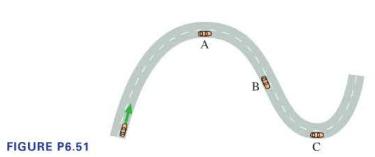
The car in Figure P6.51 travels at a constant speed along the road shown. Draw vectors showing its acceleration at the three points \(\mathrm{A}, \mathrm{B}\), and \(\mathrm{C}\), or write \(\vec{a}=\overrightarrow{0}\). The lengths of your vectors should correspond to the magnitudes of the
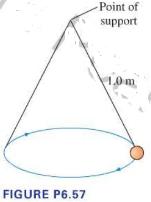
A conical pendulum is formed by attaching a \(500 \mathrm{~g}\) ball to a \(1.0-\mathrm{m}\)-long string, then allowing the mass to move in a horizontal circle of radius \(20 \mathrm{~cm}\). Figure P 6.57 shows that the string traces out the surface of a cone, hence the name.a. What is the tension
A car drives over the top of a hill that has a radius of \(50 \mathrm{~m}\). What maximum speed can the car have without flying off the road at the top of the hill?
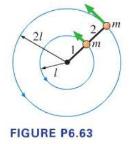
The two identical pucks in Figure P6.63 rotate together on a frictionless, horizontal table. They are tied together by strings 1 and 2 , each of length \(l\). If they rotate together at a frequency \(f\), what are the tensions in the two strings? 21 m FIGURE P6.63 m
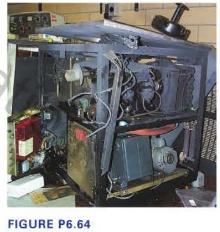
The ultracentrifuge is an important tool for separating and analyzing proteins in biological research. Because of the enormous centripetal accelerations that can be achieved, the apparatus must be carefully balanced so that each sample is matched by another on the opposite side of the rotor shaft.
The direction of the net force on the craft is A. Away from the surface of the moon.B. In the direction of motion.C. Toward the center of the moon.D. Nonexistent, because the net force is zero.
How fast is this spacecraft moving?A. \(53 \mathrm{~m} / \mathrm{s}\)B. \(75 \mathrm{~m} / \mathrm{s}\)C. \(1700 \mathrm{~m} / \mathrm{s}\)D. \(2400 \mathrm{~m} / \mathrm{s}\)
How much time does it take for the spacecraft to complete one orbit?A. \(38 \mathrm{~min}\)B. \(76 \mathrm{~min}\)C. \(110 \mathrm{~min}\)D. \(220 \mathrm{~min}\)
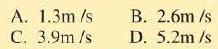
As an audio CD plays, the frequency atwhich the disk spins changes. At 2 10 rpm,the speed of a point on the outside edge ofthe disk is 1.3 mis. At 420 rpm, the speed of a point on the outside edge is A. 1.3m/s C. 3.9m/s B. 2.6m /s D. 5.2m/s
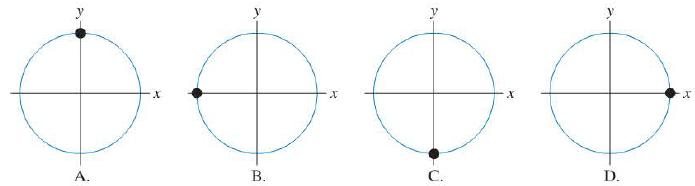
Which particle has angular position 5π/2? A. x. B. x C. X D. x
A ball on the end of a string swings in a horizontal circle onceevery second. State whether the magnitude of each of the following quantities is zero,constant (but not zero), or changing. a. Velocity Centripetal acceleration Tangential acceleration b. Angular velocity d. Angular acceleration
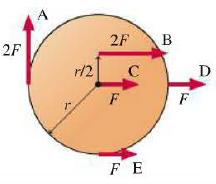
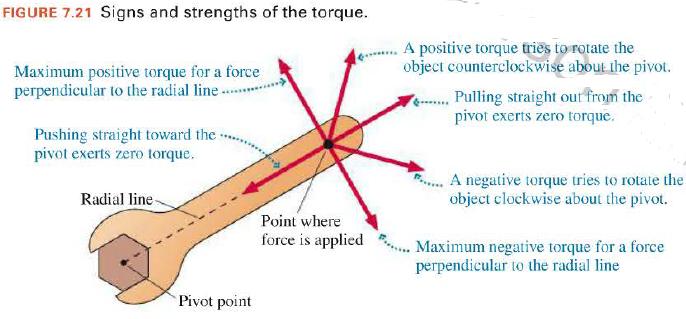
A wheel turns freely on an axle atthe center. Given the details noted in Figure 7.21,which one of the forces shown in the figure willprovide the largest positive torque on the wheel? A 2F B 2F r/2 C D F F FE
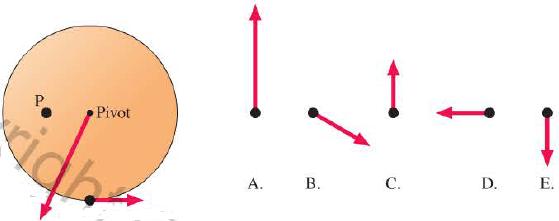
Two forces act on the wheel shown. What third force, acting atpoint P, will make the net torque on the wheel zero? Pivot A. B. C. D. E.
The ball s are connected by very lightweight rods pivoted at thepoint indicated by a dot. The rod lengths are all equal except for A, which is twice aslong. Rank in order, from least to greatest, the magnitudes of the net gravitationaltorques about the pivots for arrangements A to D. A. m C. 2m m
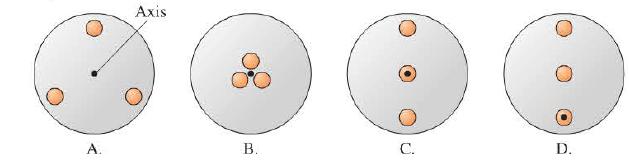
Four very lightweight disks of equal radii each have threeidentical heavy marbles glued to them as shown. Rank in order, from largest tosmallest, the moments of inertia of the disks about the indicated axis. Axis A. B. C. D.
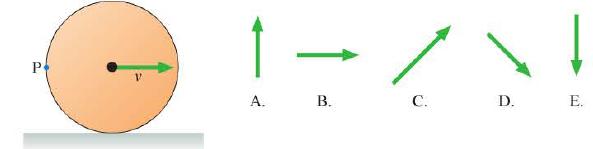
A wheel rolls without slipping. Which is the correct velocityvector for point P on the wheel? A. B. C. D. E.
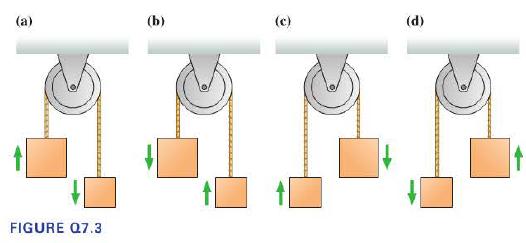
Figure Q7.3 shows four pulleys, each with a heavy and a light block strung over it. The blocks' velocities are shown. What are the signs ( + or - ) of the angular velocity and angular acceleration of the pulley in each case? FIGURE Q7.3 (a) (b) (c) (d) -
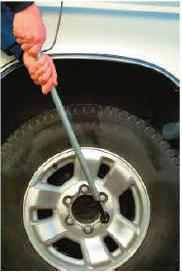
If you are using a wrench to loosen a very stubborn nut, you can make the job easier by using a "cheater pipe." This is a piece of pipe that slides over the handle of the wrench, as shown in Figure Q7.4, making it effectively much longer. Explain why this would help you loosen the nut.Figure Q7.4
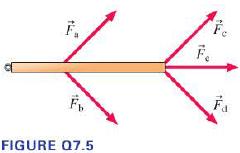
Five forces are applied to a door, as seen from above in Figure Q7.5. For each force, is the torque about the hinge positive, negative, or zero? Fe F Fe Fa Fb FIGURE Q7.5
A screwdriver with a very thick handle requires less force to operate than one with a very skinny handle. Explain why this is so.
If you have ever driven a truck, you likely found that it had a steering wheel with a larger diameter than that of a passenger car. Why is this?
A common type of door stop is a wedge made of rubber. Is such a stop more effective when jammed under the door near or far from the hinges? Why?
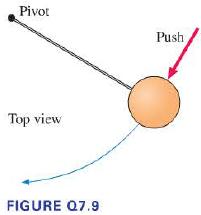
A student gives a steady push to a ball at the end of a massless, rigid rod for I s, causing the ball to rotate clockwise in a horizontal circle as shown in Figure Q7.9. The rod's pivot is friction less.Sketch a graph of the ball's angular velocity as a function of time for the first 3 s of the
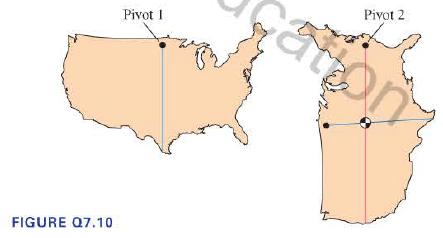
You can use a simple technique to find the center of gravity of an irregular shape. Figure Q7. 10 shows a cardboard cutout of the outline of the continental United States. The map is suspended from pivot I and allowed to hang freely; then a blue vertical li ne is drawn. The map is then suspended
If you grasp a hammer by its lightweight handle and wave it back and forth, and then grasp it by its much heavier head and wave it back and forth, as in the figure, you' II find that you can wave the hammer much more rapidly in the second case, when you grasp it by the head.Explain why this is so.
Suppose you have two identical-looking metal spheres of the same size and the same mass. One of them is solid; the other is hollow.Describe a simple test that you could do to determine which is which.
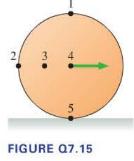
The wheel in Figure Q7.15 is rolling to the right without slipping. Rank in order, from fastest to slowest, the speeds of the points labeled 1 through 5 . Explain your reasoning. FIGURE Q7.15
With care, it's possible to walk on top of a barrel as it rolls. It is much easier to do this if the barrel is full than if it is empty. Explain why this is so.
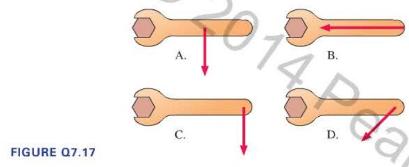
A nut needs to be fightened with a wrench. Which force shown in Figure Q7.17 will apply the greatest torque to the nut? FIGURE Q7.17 A. C. B. APA
Suppose a bolt on your car engine needs to be tightened to a torque of \(20 \mathrm{~N} \cdot \mathrm{m}\). You are using a \(15-\mathrm{cm}-\) long wrench, and you apply a force at the very end in the direction that produces maximum torque. What force should you apply?A. \(1300 \mathrm{~N}\)B.
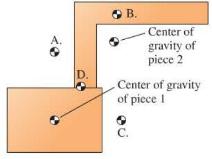
A machine part is made up of two pieces, with centers of gravity shown in Figure Q7.19. Which point could be the center of gravity of the entire part?Figure Q7.19 A. D B. Center of gravity of piece 2 Center of gravity of piece 1 C.
A typical compact disk has a mass of \(15 \mathrm{~g}\) and a diameter of \(120 \mathrm{~mm}\). What is its moment of inertia about an axis through its center, perpendicular to the disk?A. \(2.7 \times 10^{-5} \mathrm{~kg} \cdot \mathrm{m}^{2}\)B. \(5.4 \times 10^{-5} \mathrm{~kg} \cdot
Suppose manufacturers increase the size of compact disks so that they are made of the same material and have the same thickness as a current disk but have twice the diameter. By what factor will the moment of inertia increase?A. 2B. 4C. 8D. 16
Two horizontal rods are each held up by vertical strings tied to their ends. Rod 1 has length \(L\) and mass \(M\); rod 2 has length \(2 L\) and mass \(2 M\). Each rod then has one of its supporting strings cut, causing the rod to begin pivoting about the end that is still tied up. Which rod has a
A baseball bat has a thick, heavy barrel and a thin, light handle. If you want to hold a baseball bat on your palm so that it balances vertically, you shouldA. Put the end of the handle in your palm, with the barrel up.B. Put the end of the barrel in your palm, with the handle up.C. The bat will be
A particle undergoing circular motion in the \(x y\)-plane stops on the positive \(y\)-axis. Which of the following does not describe its angular position?A. \(\pi / 2 \mathrm{rad}\)B. \(\pi \mathrm{rad}\)C. \(5 \pi / 2 \mathrm{rad}\)D. \(-3 \pi / 2 \mathrm{rad}\)
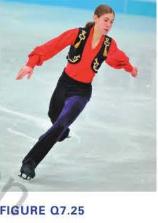
What is the approximate angular speed of the skater during the leap?A. \(2 \mathrm{rad} / \mathrm{s}\)B. \(6 \mathrm{rad} / \mathrm{s}\)C. \(9 \mathrm{rad} / \mathrm{s}\)D. \(20 \mathrm{rad} / \mathrm{s}\)Concern a classic figure-skating jump called the axel. A skater starts the jump moving forward
The skater's arms are fully extended during the jump. What is the approximate centripetal acceleration of the skater's hand?A. \(10 \mathrm{~m} / \mathrm{s}^{2}\)B. \(30 \mathrm{~m} / \mathrm{s}^{2}\)C. \(300 \mathrm{~m} / \mathrm{s}^{2}\)D. \(450 \mathrm{~m} / \mathrm{s}^{2}\)Concern a classic
The earth's radius is about 4000 miles. Kampala, the capital of Uganda, and Singapore are both nearly on the equator. The distance between them is 5000 miles.a. Through what angle do you turn, relative to the earth, if you fly from Kampala to Singapore? Give your answer in both radians and
The \(1.00-\mathrm{cm}-\) long second hand on a watch rotates smoothly.a. What is its angular velocity?b. What is the speed of the tip of the hand?
The earth's radius is \(6.37 \times 10^{6} \mathrm{~m}\); it rotates once every 24 hours.a. What is the earth's angular speed?b. Viewed from a point above the north pole, is the angular velocity positive or negative?c. What is the speed of a point on the equator?d. What is the speed of a point on
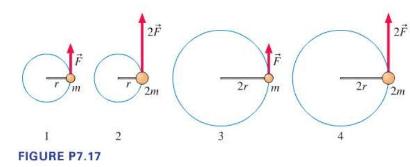
Balls are attached to light rods and can move in horizontal circles as shown in Figure P7.17. Rank in order, from smallest to largest, the torques \(\tau_{1}\) to \(\tau_{4}\) about the centers of the circles. Explain. FIGURE P7.17 2 2P 2r 2r m 2m 2m 3 2F
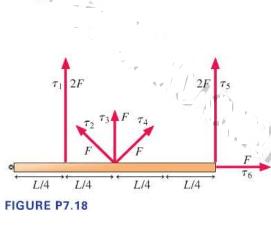
Six forces, each of magnitude either \(F\) or \(2 F\), are applied to a door as seen from above in Figure P7.18. Rank in order, from smallest to largest, the six torques \(\tau_{1}\) to \(\tau_{6}\) about the hinge. T2F 74 F F 2FTS L/4 L/4 L/4 L/4 FIGURE P7.18
The tune-up specifications of a car call for the spark plugs to be tightened to a torque of \(38 \mathrm{~N} \cdot \mathrm{m}\). You plan to tighten the plugs by pulling on the end of a \(25-\mathrm{cm}-\) long wrench. Because of the cramped space under the hood, you'll need to pull at an angle of
A professor's office door is \(0.91 \mathrm{~m}\) wide, \(2.0 \mathrm{~m}\) high, and \(4.0 \mathrm{~cm}\) thick; has a mass of \(25 \mathrm{~kg}\); and pivots on frictionless hinges. A "door closer" is attached to the door and the top of the door frame. When the door is open and at rest, the door
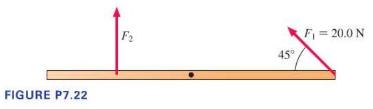
In Figure P7.22, force \(\vec{F}_{2}\) acts half as far from the pivot as \(\vec{F}_{1}\). What magnitude of \(\vec{F}_{2}\) causes the net torque on the rod to be zero? FIGURE P7.22 F2 45 F = 20.0 N
An athlete at the gym holds a \(3.0 \mathrm{~kg}\) steel ball in his hand. His\(B 10 \mathrm{arm}\) is \(70 \mathrm{~cm}\) long and has a mass of \(4.0 \mathrm{~kg}\). What is the magnitude of the gravitational torque about his shoulder if he holds his arma. Straight out to his side, parallel to
A regulation table tennis ball is a thin spherical shell \(40 \mathrm{~mm}\) in diameter with a mass of \(2.7 \mathrm{~g}\). What is its moment of inertia about an axis that passes through its center?
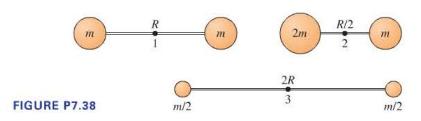
Three pairs of balls are connected by very light rods as shown in Figure P7.38. Rank in order, from smallest to largest, the moments of inertia \(I_{1}, I_{2}\), and \(I_{3}\) about axes through the centers of the rods. m R m 2R 2m R/2 m 2 FIGURE P7.38 3 m/2 m/2
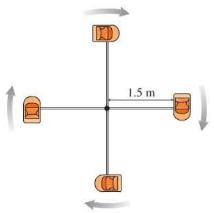
A playground toy has four seats, each \(5.0 \mathrm{~kg}\), attached to very light, \(1.5-\mathrm{m}\)-long rods, as seen from above in Figure P7.39. If two children, with masses of \(15 \mathrm{~kg}\) and \(20 \mathrm{~kg}\), sit in seats opposite one another, what is the moment of inertia about
a. What is the moment of inertia of the door in Problem 21?b. If you let go of the open door, what is its angular acceleration immediately afterward?Problem 21A professor's office door is \(0.91 \mathrm{~m}\) wide, \(2.0 \mathrm{~m}\) high, and \(4.0 \mathrm{~cm}\) thick; has a mass of \(25
There is a photograph of a girl pushing on a large stone sphere. The sphere has a mass of \(8200 \mathrm{~kg}\) and a radius of \(90 \mathrm{~cm}\). Suppose that she pushes on the sphere tangent to its surface with a steady force of \(50 \mathrm{~N}\) and that the pressured water provides a
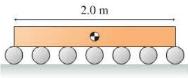
A \(2.0-\mathrm{m}-\) long slab of concrete is supported by rollers, as shown in Figure P7.54. If the slab is pushed to the right, it will move off the supporting rollers, one by one, on the left side. How far can the slab be moved before its center of gravity is to the right of the contact point
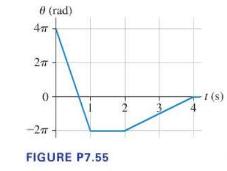
Figure P7.55 shows the angular position-versus-time graph INT for a particle moving in a circle.a. Write a description of the particle's motion.b. Draw the angular velocity-versus-time graph. e (rad) 4 2 0 -2 FIGURE P7.55 -1(s)
A car with 58-cm-diameter tires accelerates uniformly from NTT rest to \(20 \mathrm{~m} / \mathrm{s}\) in \(10 \mathrm{~s}\). How many times does each tire rotate?
The cable lifting an elevator is wrapped around a \(1.0-\mathrm{m}-\) diameter cylinder that is turned by the elevator's motor. The elevator is moving upward at a speed of \(1.6 \mathrm{~m} / \mathrm{s}\). It then slows to a stop as the cylinder makes one complete turn at constant angular
A combination lock has a 1.0 -cm-diameter knob that is part of the dial you turn to unlock the lock. To turn that knob, you grip it between your thumb and forefinger with a force of \(0.60 \mathrm{~N}\) as you twist your wrist. Suppose the coefficient of static friction between the knob and your
A \(70 \mathrm{~kg}\) man's arm, including the hand, can be modeled as a \(75-\mathrm{cm}\)-long uniform cylinder with a mass of \(3.5 \mathrm{~kg}\). In raising both his arms, from hanging down to straight up, by how much does he raise his center of gravity?
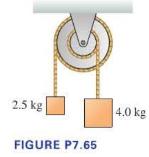
The ropes in Figure P7.65 are each wrapped around a cylinder, and the two cylinders are fastened together. The smaller cylinder has a diameter of \(10 \mathrm{~cm}\) and a mass of \(5.0 \mathrm{~kg}\); the larger cylinder has a diameter of \(20 \mathrm{~cm}\) and a mass of \(20 \mathrm{~kg}\). What
Flywheels are large, massive wheels used to store energy. They can be spun up slowly, then the wheel's energy can be released quickly to accomplish a task that demands high power. An industrial flywheel has a \(1.5 \mathrm{~m}\) diameter and a mass of \(250 \mathrm{~kg}\). A motor spins up the
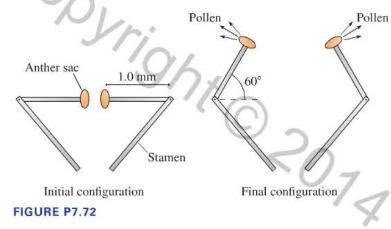
What is the angular acceleration of the anther sac during the motion?A. \(3.5 \times 10^{3} \mathrm{rad} / \mathrm{s}^{2}\)B. \(7.0 \times 10^{3} \mathrm{rad} / \mathrm{s}^{2}\)C. \(1.2 \times 10^{7} \mathrm{rad} / \mathrm{s}^{2}\)D. \(2.3 \times 10^{7} \mathrm{rad} / \mathrm{s}^{2}\)The bunchberry
What is the speed of the anther sac as it releases its pollen?A. \(3.5 \mathrm{~m} / \mathrm{s}\)B. \(7.0 \mathrm{~m} / \mathrm{s}\)C. \(10 \mathrm{~m} / \mathrm{s}\)D. \(14 \mathrm{~m} / \mathrm{s}\)The bunchberry flower has the fastest-moving parts ever seen in a plant. Initially, the stamens are
How large is the "straightening torque"? (You can omit gravitational forces from your calculation; the gravitational torque is much less than this.)A. \(2.3 \times 10^{-7} \mathrm{~N} \cdot \mathrm{m}\)B. \(3.1 \times 10^{-7} \mathrm{~N} \cdot \mathrm{m}\)C. \(2.3 \times 10^{-5} \mathrm{~N} \cdot
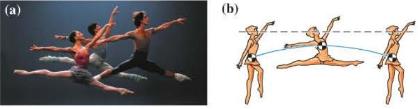
To perform this maneuver, the dancer relies on the fact that the position of her center of gravityA. Is near the center of the torso.B. Is determined by the positions of her arms and legs.C. Moves in a horizontal path.D. Is outside of her body.The grand jeté is a classic ballet maneuver in which a
Suppose you wish to make a vertical leap with the goal of getting your head as high as possible above the ground. At the top of your leap, your arms should be A. Held at your sides.B. Raised above your head.C. Outstretched, away from your body.The grand jeté is a classic ballet maneuver in which a
When the dancer is in the air, is there a gravitational torque on her? Take the dancer's rotation axis to be through her center of gravity.A. Yes, there is a gravitational torque.B. No, there is not a gravitational torque.C. It depends on the positions of her arms and legs.The grand jeté is a
In addition to changing her center of gravity, a dancer may change her moment of inertia. Consider her moment of inertia about a vertical axis through the center of her body. When she raises her arms and legs, this A. Increases her moment of inertia.B. Decreases her moment of inertia.C. Does not
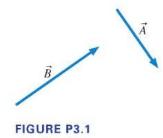
Trace the vectors in Figure P3.1 onto your paper. Then use graphical methods to draw the vectors (a) \(\vec{A}+\vec{B}\) and (b) \(\vec{A}-\vec{B}\). B FIGURE P3.1
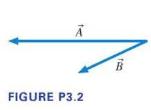
Trace the vectors in Figure P3.2 onto your paper. Then use graphical methods to draw the vectors (a) \(\vec{A}+\vec{B}\) and (b) \(\vec{A}-\vec{B}\). A FIGURE P3.2 B
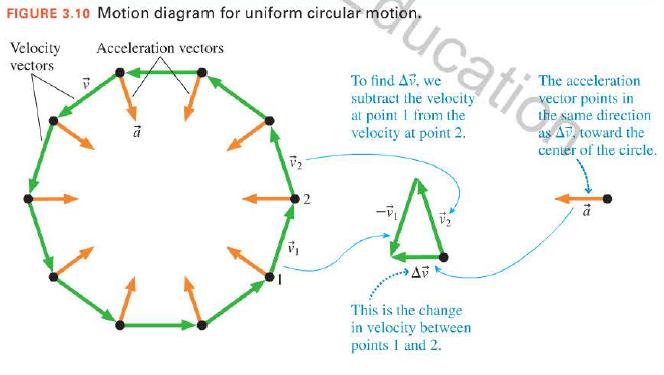
Figure 3.10 showed the motion diagram for a rider on a Ferris wheel that was turning at a constant speed. The inset to the figure showed how to find the acceleration vector at the rightmost point/ Use a similar analysis to find the rider's acceleration vector at the leftmost position of the motion
A velocity vector \(40^{\circ}\) above the positive \(x\)-axis has a \(y\)-component of \(10 \mathrm{~m} / \mathrm{s}\). What is the value of its \(x\)-component?
Showing 2300 - 2400
of 4913
First
17
18
19
20
21
22
23
24
25
26
27
28
29
30
31
Last
Step by Step Answers

 Get 50% OFF
Claim Now
Get 50% OFF
Claim Now