New Semester
Started
Get
50% OFF
Study Help!
--h --m --s
Claim Now
Question Answers
Textbooks
Find textbooks, questions and answers
Oops, something went wrong!
Change your search query and then try again
S
Books
FREE
Study Help
Expert Questions
Accounting
General Management
Mathematics
Finance
Organizational Behaviour
Law
Physics
Operating System
Management Leadership
Sociology
Programming
Marketing
Database
Computer Network
Economics
Textbooks Solutions
Accounting
Managerial Accounting
Management Leadership
Cost Accounting
Statistics
Business Law
Corporate Finance
Finance
Economics
Auditing
Tutors
Online Tutors
Find a Tutor
Hire a Tutor
Become a Tutor
AI Tutor
AI Study Planner
NEW
Sell Books
Search
Search
Sign In
Register
study help
sciences
college physics reasoning
College Physics A Strategic Approach 3rd Edition Randall D. Knight, Brian Jones, Stuart Field - Solutions
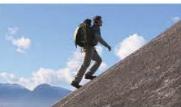
Josh is climbing up a steep \(34^{\circ}\) slope, moving at a steady \(0.75 \mathrm{~m} / \mathrm{s}\) along the ground. How many meters of elevation does he gain in one minute of this climb?
Each of the following vectors is given in terms of its \(x\) - and \(y\)-components. Draw the vector, label an angle that specifies the vector's direction, then find the vector's magnitude and direction.a. \(v_{x}=20 \mathrm{~m} / \mathrm{s}, v_{y}=40 \mathrm{~m} / \mathrm{s}\)b. \(a_{x}=2.0
A wildlife researcher is tracking a flock of geese. The geese fly \(4.0 \mathrm{~km}\) due west, then turn toward the north by \(40^{\circ}\) and fly another \(4.0 \mathrm{~km}\). How far west are they of their initial position? What is the magnitude of their displacement?
A car turns into a driveway that slopes upward at a \(9.0^{\circ}\) angle. The car is moving at \(6.5 \mathrm{~m} / \mathrm{s}\). If the driver lets the car coast, how far along the slope will the car roll before being instantaneously at rest and then starting to roll back?
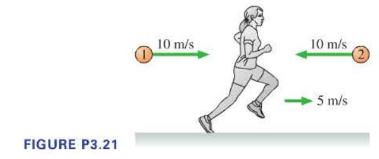
Anita is running to the right at \(5 \mathrm{~m} / \mathrm{s}\), as shown in Figure P3.21. Balls 1 and 2 are thrown toward her at \(10 \mathrm{~m} / \mathrm{s}\) by friends standing on the ground. According to Anita, what is the speed of each ball? FIGURE P3.21 10 m/s 10 m/s 2) 5 m/s
An airplane cruises at \(880 \mathrm{~km} / \mathrm{h}\) relative to the air. It is flying from Denver, Colorado, due west to Reno, Nevada, a distance of \(1200 \mathrm{~km}\), and will then return. There is a steady \(90 \mathrm{~km} / \mathrm{h}\) wind blowing to the east. What is the difference
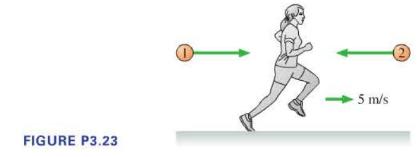
Anita is running to the right at \(5 \mathrm{~m} / \mathrm{s}\), as shown in Figure P3.23. Balls 1 and 2 are thrown toward her by friends standing on the ground. According to Anita, both balls are approaching her at \(10 \mathrm{~m} / \mathrm{s}\). According to her friends, with what speeds were
Raindrops are falling straight down at \(12 \mathrm{~m} / \mathrm{s}\) when suddenly the wind starts blowing horizontally at a brisk \(4.0 \mathrm{~m} / \mathrm{s}\). From your point of view, the rain is now coming down at an angle. What is the angle?
A pipe discharges storm water into a creek. Water flows horizontally out of the pipe at \(1.5 \mathrm{~m} / \mathrm{s}\), and the end of the pipe is \(2.5 \mathrm{~m}\) above the creek. How far out from the end of the pipe is the point where the stream of water meets the creek?
On a day when the water is flowing relatively gently, water in the Niagara River is moving horizontally at \(4.5 \mathrm{~m} / \mathrm{s}\) before shooting over Niagara Falls. After moving over the edge, the water drops \(53 \mathrm{~m}\) to the water below. If we ignore air resistance, how much
A gray kangaroo can bound across a flat stretch of ground with each jump carrying it \(10 \mathrm{~m}\) from the takeoff point. If the kangaroo leaves the ground at a \(20^{\circ}\) angle, what are its (a) takeoff speed and (b) horizontal speed?
On the Apollo 14 mission to the moon, astronaut Alan Shepard hit a golf ball with a golf club improvised from a tool. The free-fall acceleration on the moon is \(1 / 6\) of its value on earth. Suppose he hit the ball with a speed of \(25 \mathrm{~m} / \mathrm{s}\) at an angle \(30^{\circ}\) above
A sprinkler mounted on the ground sends out a jet of water at a \(30^{\circ}\) angle to the horizontal. The water leaves the nozzle at a speed of \(12 \mathrm{~m} / \mathrm{s}\). How far does the water travel before it hits the ground?
A good quarterback can throw a football at \(27 \mathrm{~m} / \mathrm{s}\) (about \(60 \mathrm{mph}\) ). If we assume that the ball is caught at the same height from which it is thrown, and if we ignore air resistance, what is the maximum range in meters (which is approximately the same as the
The Scion iQ is a compact car that is capable of very tight turns-it can spin around in a circle \(8.0 \mathrm{~m}\) in diameter. If a driver goes around such a circle at \(5 \mathrm{~m} / \mathrm{s}\) (a bit faster than \(10 \mathrm{mph}\) ), what is the magnitude of his acceleration?
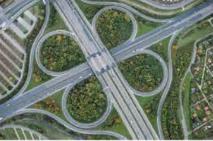
In a roundabout (or traffic circle), cars go around a 25-m-diameter circle. If a car's tires will skid when the car experiences a centripetal acceleration greater than \(0.60 \mathrm{~g}\), what is the maximum speed of the car in this roundabout?
A particle rotates in a circle with centripetal acceleration \(a=8.0 \mathrm{~m} / \mathrm{s}^{2}\). What is \(a\) ifa. The radius is doubled without changing the particle's speed?b. The speed is doubled without changing the circle's radius?
Entrance and exit ramps for freeways are often circular stretches of road. As you go around one at a constant speed, you will experience a constant acceleration. Suppose you drive through an entrance ramp at a modest speed and your acceleration is \(3.0 \mathrm{~m} / \mathrm{s}^{2}\). What will be
A peregrine falcon in a tight, circular turn can attain a centripetal acceleration 1.5 times the free-fall acceleration. If the falcon is flying at \(20 \mathrm{~m} / \mathrm{s}\), what is the radius of the turn?
Suppose \(\vec{C}=\vec{A}+\vec{B}\) where vector \(\vec{A}\) has components \(A_{x}=5\), \(A_{y}=2\) and vector \(\vec{B}\) has components \(B_{x}=-3, B_{y}=-5\).a. What are the \(x\) - and \(y\)-components of vector \(\vec{C}\) ?b. Draw a coordinate system and on it show vectors \(\vec{A},
Suppose \(\vec{D}=\vec{A}-\vec{B}\) where vector \(\vec{A}\) has components \(A_{x}=5\),\(A_{y}=2\) and vector \(\vec{B}\) has components \(B_{x}=-3, B_{y}=-5\).a. What are the \(x\) - and \(y\)-components of vector \(\vec{D}\) ?b. Draw a coordinate system and on it show vectors \(\vec{A},
Suppose \(\vec{E}=2 \vec{A}+3 \vec{B}\) where vector \(\vec{A}\) has components\(A_{x}=5, A_{y}=2\) and vector \(\vec{B}\) has components \(B_{x}=-3, B_{y}=-5\).a. What are the \(x\) - and \(y\)-components of vector \(\vec{E}\) ?b. Draw a coordinate system and on it show vectors \(\vec{A},
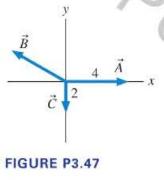
For the three vectors shown in Figure P3.47, the vector sum \(\vec{D}=\) \(\vec{A}+\vec{B}+\vec{C}\) has components \(D_{x}=2\) and \(D_{y}=0\).a. What are the \(x\) - and \(y\)-components of vector \(\vec{B}\) ?b. Write \(\vec{B}\) as a magnitude and a direction. B y 2 2 A FIGURE P3.47
Let \(\vec{A}=\left(3.0 \mathrm{~m}, 20^{\circ}\right.\) south of east \()\), \(\vec{B}=(2.0 \mathrm{~m}\), north \()\), and \(\vec{C}=\left(5.0 \mathrm{~m}, 70^{\circ}\right.\) south of west \()\).a. Draw and label \(\vec{A}, \vec{B}\), and \(\vec{C}\) with their tails at the origin. Use a
A pilot in a small plane encounters shifting winds. He flies \(26.0 \mathrm{~km}\) northeast, then \(45.0 \mathrm{~km}\) due north. From this point, he flies an additional distance in an unknown direction, only to find himself at a small airstrip that his map shows to be \(70.0 \mathrm{~km}\)
A small plane, \(100 \mathrm{~km}\) due south of the equator, is flying at \(150 \mathrm{~km} / \mathrm{h}\) with respect to the ground along a straight line \(30^{\circ}\) to the west of north. In how many minutes will the plane cross the equator?
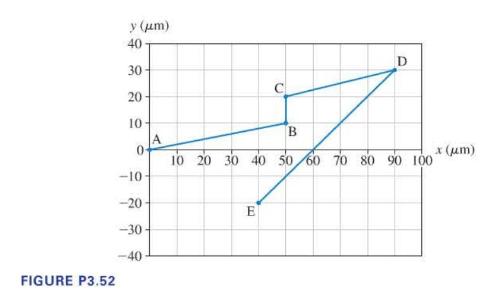
The bacterium Escherichia coli (or E. coli) is a single-celled organism that lives in the gut of healthy humans and animals. When grown in a uniform medium rich in salts and amino acids, these bacteria swim along zig-zag paths at a constant speed of \(20 \mu \mathrm{m} / \mathrm{s}\). Figure P3.52
A skier gliding across the snow at \(3.0 \mathrm{~m} / \mathrm{s}\) suddenly starts down a \(10^{\circ}\) incline, reaching a speed of \(15 \mathrm{~m} / \mathrm{s}\) at the bottom. Friction between the snow and her freshly waxed skies is negligible.a. What is the length of the incline?b. How long
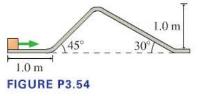
A block slides along the frictionless track shown in Figure P3.54 with an initial speed of \(5.0 \mathrm{~m} / \mathrm{s}\). Assume it turns all the corners smoothly, 1.0 m. 45 30 1.0 m FIGURE P3.54
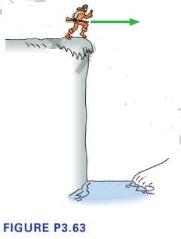
In 1780, in what is now referred to as "Brady's Leap," Captain Sam Brady of the U.S. Continental Army escaped certain death from his enemies by running horizontally off the edge of the cliff above Ohio's Cuyahoga River, which is confined at that spot to a gorge. He landed safely on the far side of
The longest recorded pass in an NFL game traveled 83 yards in the air from the quarterback to the receiver. Assuming that the pass was thrown at the optimal \(45^{\circ}\) angle, what was the speed at which the ball left the quarterback's hand?
Small-plane pilots regularly compete in "message drop" competitions, dropping heavy weights (for which air resistance can be ignored) from their low-flying planes and scoring points for having the weights land close to a target. A plane \(60 \mathrm{~m}\) above the ground is flying directly toward
Trained dolphins are capable of a vertical leap of \(7.0 \mathrm{~m}\) straight up from the surface of the water-an impressive feat.Suppose you could train a dolphin to launch itself out of the water at this same speed but at an angle. What maximum horizontal range could the dolphin achieve?
The shot put is a track-and-field event in which athletes throw a heavy ballthe shot-as far as possible. The best athletes can throw the shot as far as \(23 \mathrm{~m}\). Athletes who use the "glide" technique push the shot outward in a reasonably straight line, accelerating it over a distance of
A child slides down a frictionless 3.0-m-long playground slide tilted upward at an angle of \(40^{\circ}\). At the end of the slide, there is an additional section that curves so that the child is launched off the end of the slide horizontally.a. How fast is the child moving at the bottom of the
A sports car is advertised as capable of "reaching \(60 \mathrm{mph}\) in 5 seconds flat, cornering at \(0.85 \mathrm{~g}\), and stopping from \(70 \mathrm{mph}\) in only 168 feet." In which of those three situations is the magnitude of the car's acceleration the largest? In which is it the
A Ford Mustang can accelerate from 0 to \(60 \mathrm{mph}\) in a time of 5.6 s. A Mini Cooper isn't capable of such a rapid start, but it can turn in a very small circle \(34 \mathrm{ft}\) in diameter. How fast would you need to drive the Mini Cooper in this tight circle to match the magnitude of
The "Screaming Swing" is a carnival ride that is-not surprisingly—a giant swing. It's actually two swings moving in opposite directions. At the bottom of its arc, a rider in one swing is moving at \(30 \mathrm{~m} / \mathrm{s}\) with respect to the ground in a \(50-\mathrm{m}\)-diameter circle.
On an otherwise straight stretch of road near Moffat, Colorado, the road suddenly turns. This bend in the road is a segment of a circle with radius \(110 \mathrm{~m}\). Drivers are cautioned to slow down to \(40 \mathrm{mph}\) as they navigate the curve.a. If you heed the sign and slow to \(40
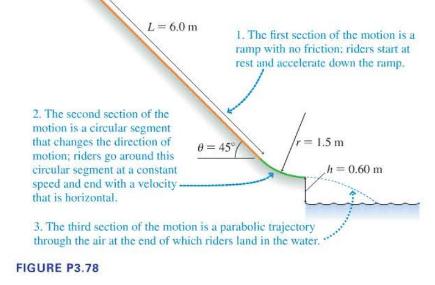
At the end of the first section of the motion, riders are moving at what approximate speed?A. \(3 \mathrm{~m} / \mathrm{s}\)B. \(6 \mathrm{~m} / \mathrm{s}\)C. \(9 \mathrm{~m} / \mathrm{s}\)D. \(12 \mathrm{~m} / \mathrm{s}\)A rider on a water slide goes through three different kinds of motion, as
Suppose the acceleration during the second section of the motion is too large to be comfortable for riders. What change could be made to decrease the acceleration during this section?A. Reduce the radius of the circular segment.B. Increase the radius of the circular segment.C. Increase the angle of
What is the vertical component of the velocity of a rider as he or she hits the water?A. \(2.4 \mathrm{~m} / \mathrm{s}\)B. \(3.4 \mathrm{~m} / \mathrm{s}\)C. \(5.2 \mathrm{~m} / \mathrm{s}\)D. \(9.1 \mathrm{~m} / \mathrm{s}\)A rider on a water slide goes through three different kinds of motion, as
Suppose the designers of the water slide want to adjust the height \(h\) above the water so that riders land twice as far away from the bottom of the slide. What would be the necessary height above the water?A. \(1.2 \mathrm{~m}\)B. \(1.8 \mathrm{~m}\)C. \(2.4 \mathrm{~m}\)D. \(3.0 \mathrm{~m}\)A
During which section of the motion is the magnitude of the acceleration experienced by a rider the greatest?A. The first.B. The second.C. The third.D. It is the same in all sections.A rider on a water slide goes through three different kinds of motion, as illustrated in Figure P3.78. Use the data
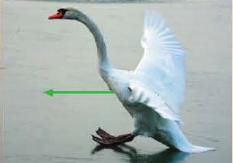
A swan is landing on an icy lake, sliding across the ice and gradually coming to a stop. As the swan slides, the direction of the acceleration is A. To the left.B. To the right.C. Upward.D. Downward.
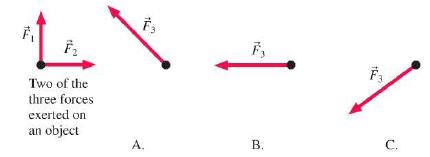
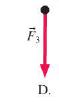
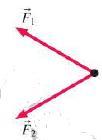
Two of the three fo rces exerted on an object are shown. The net fo rce poi nts directly to the left. Which is the missing third force? Two of the three forces exerted on an object the F F3 A. B. C.
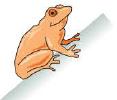
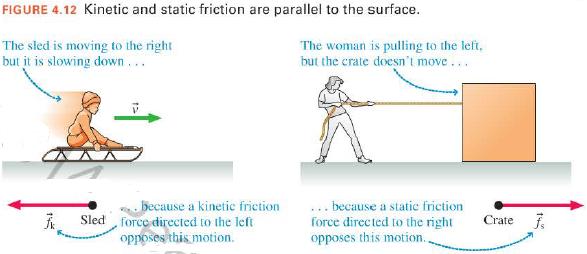
A frog is resting on a slope. Given what you learned in Figure 4.12, what can you say about the friction force acting on the frog?A. There is no friction force.B. There is a kinetic fri ction force directed up the slope.C. There is a static friction force directed up the slope.D. There is a kinetic
A boy is using a rope to pull a sled to the right. What are the directions of the tension force and the friction force on the sled, respectively?A. Right, right B. Right, left C. Left, right D. Left, left
You've just kicked a rock, and it is now sliding across the ground about 2 meters in front of you. Which of these are forces acting on the rock?List all that apply.A. Gravity, acting downward B. The normal force, acting upward C. The fo rce of the kick, acting in the direction of motion D.
Two rubber bands stretched to the standard length cause an object to accelerate at 2 m/s2• Suppose another object with twice the mass is pulled by four rubber bands stretched to the standard length. What is the acceleration of this second object? A. 1 m/s B. 2 m/s C. 4 m/s D. 8 m/s E. 16 m/s
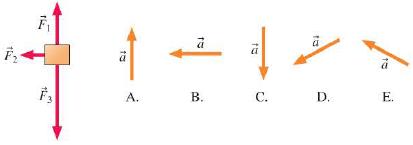
Three forces act on an object. In which direction does the object accelerate? F F T F3 A. B. C. D. E.
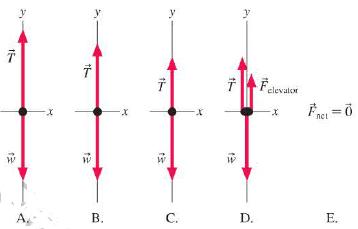
An elevator suspended by a cable is moving upward and slowing to a stop. Which free-body diagram is correct? 15 T 7 W W Felevator x net A. B. C. D. E.
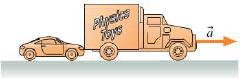
A small car is pushing a larger truck that has a dead battery.The mass of the truck is greater than the mass of the car. The car and the truck are moving to the right and are speeding up.Which of the following statements is true?A. The car exerts a force on the truck, but the truck doesn' t exert a
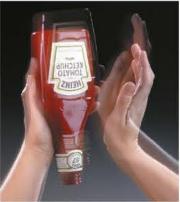
Here's a great everyday use of the physics described in this chapter. If you are trying to get ketchup out of the bottle, the best way to do it is to turn the bottle upside down and give the bottle a sharp upward smack, forcing the bottle rapidly upward. Think about what subsequently happens to the
Normally, jet engines push air out the back of the engine, resulting in forward thrust, but commercial aircraft often have thrust reversers that can change the direction of the ejected air, sending it forward. How does this affect the direction of thrust? When might these thrust reversers be useful
If you are standing still, the upward normal force on you from the floor is equal in magnitude to the weight force that acts on you. But it's possible to move so that the normal force is greater than your weight. Explain how this could be done.
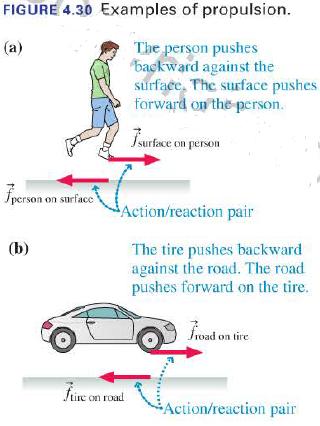
Figure 4.30 b showed a situation in which the force of the road on the car's tire points forward. In other situations, the force points backward. Give an example of such a situation. FIGURE 4.30 Examples of propulsion. (a) The person pushes backward against the surface. The surface pushes forward
Alyssa pushes to the right on a filing cabinet; the friction force from the floor pushes on it to the left. Because the cabinet doesn't move, these forces have the same magnitude. Do they form an action/reaction pair? Explain.
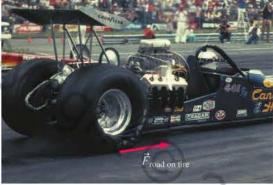
The tire on this drag racer is severely twisted: The force of the road on the tire is quite large (most likely several times the weight of the car) and is directed forward as shown. Is the car speeding up or slowing down? Explain. road on tire 40 Can
Suppose that, while in a squatting position, you stand on your hands, and then you pull up on your feet with a great deal of force. You are applying a large force to the bottoms of your feet, but no matter how strong you are, you will never be able to lift yourself off the ground. Use your
A group of students is making model cars that will be propelled by model rocket engines. These engines provide a nearly constant thrust force. The cars are light-most of the weight comes from the rocket engine-and friction and drag are very small. As the engine fires, it uses fuel, so it is much
As shown in the chapter, scallops use jet propulsion to move from one place to another. Their shells make them denser than INT water, so they normally rest on the ocean floor. If a scallop wishes to remain stationary, hovering a fixed distance above the ocean floor, it must eject water so that the
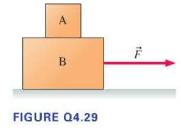
Figure Q4.29 shows block A sitting on top of block B. A constant force \(\vec{F}\) is exerted on block B, causing block B to accelerate to the right. Block A rides on block B without slipping. Which statement is true?A. Block B exerts a friction force on block A, directed to the left.B. Block B
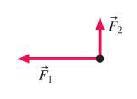
Show two forces acting on an object at rest. Redraw the diagram, then add a third force that will allow the object to remain at rest. Label the new force
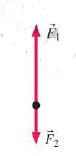
Show two forces acting on an object at rest.Redraw the diagram, then add a third force that will allow the object to remain at rest. Label the new force
Show two forces acting on an object at rest.Redraw the diagram, then add a third force that will allow the object to remain at rest. Label the new force
A mountain climber is hanging from a vertical rope, far above the ground and far from the rock face. ldentify the forces on the mountain climber.
You look up from your textbook and observe a spider, motionless above you, suspended from a strand of spider silk attached to the ceiling. You distract yourself by identifying the forces acting on the spider. What are they?
A falcon is hovering above the ground, then suddenly pulls in its wings and begins to fall toward the ground. Air resistance is not negligible. Identify the forces on the falcon.
A constant force applied to object A causes it to accelerate at 5 m/s2. The same force applied to object B causes an acceleration of 3 m/s2. Applied to object C, it causes an acceleration of 8 m/s2a. Which object has the largest mass?b. Which object has the smallest mass?c. What is the ratio of
A compact car has a maximum acceleration of 4.0 m/s2 when it carries only the driver and has a total mass of 1200 kg. What is its maximum acceleration after picking up four passengers and their luggage, adding an additional 400 kg of mass?
A man pulling an empty wagon causes it to accelerate at 1.4 m/s2. What will the acceleration be if he pulls with the same force when the wagon contains a child whose mass is three times that of the wagon?
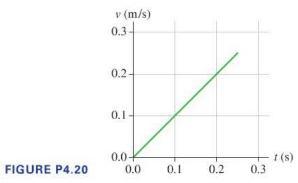
Scallops eject water from their shells to provide a thrust force. The graph shows a smoothed graph of actual data for the initial motion of a 25 g25 g scallop speeding up to escape a predator. What is the magnitude of the net force needed to achieve this motion? How does this force compare to the
In t-ball, young players use a bat to hit a stationary ball off a stand. The 140 g ball has about the same mass as a baseball, but it is larger and softer. In one hit, the ball leaves the bat at 12 m/s after being in contact with the bat for 2.0 ms2. Assume constant acceleration during the hit.a.
The motion of a very massive object can be minimally affected by what would seem to be a substantial force. Consider an oil supertanker with mass 3.0×10⁸ kg. Suppose you strapped two jet engines onto the sides of the tanker. Ignoring the drag of the water (which, in reality, is not a very good
Very small forces can have tremendous effects on the motion of very small objects. This is particularly apparent at the scale of the atom. An electron, mass 9.1×10⁻³¹ kg, experiences a force of 1.6×10⁻¹⁷N in a typical electric field at the earth's surface. From rest, how much time would it
Your car is sitting in the parking lot. Describe a situation. For each problem, identify all the forces acting on the object and draw a free-body diagram of the object.
Your car is accelerating from a stop.Describe a situation. For each problem, identify all the forces acting on the object and draw a free-body diagram of the object.
Your car is skidding to a stop from a high speed.Describe a situation. For each problem, identify all the forces acting on the object and draw a free-body diagram of the object.
Your physics textbook is sliding across the table.Describe a situation. For each problem, identify all the forces acting on the object and draw a free-body diagram of the object.
An ascending elevator, hanging from a cable, is coming to a stop.Describe a situation. For each problem, identify all the forces acting on the object and draw a free-body diagram of the object.
You are driving on the highway, and you come to a steep downhill section. As you roll down the hill, you take your foot off the gas pedal. You can ignore friction, but you can' t ignore air resistance.Describe a situation. For each problem, identify all the forces acting on the object and draw a
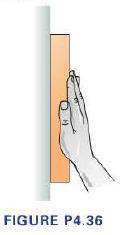
You hold a picture motionless against a wall by pressing on it, as shown in Figure P4.36.Describe a situation. For each problem, identify all the forces acting on the object and draw a free-body diagram of the object. M FIGURE P4.36
A box is being dragged across the floor at a constant speed by a rope pulling horizontally on it. Friction is not negligible.Describe a situation. For each problem, identify all the forces acting on the object and draw a free-body diagram of the object.
A skydiver has his parachute open and is floating downward through the air at a constant speed.Describe a situation. For each problem, identify all the forces acting on the object and draw a free-body diagram of the object.
A car is skidding to a stop on a level stretch of road. Identify all the action/reaction pairs of forces between the car and the road surface. Then draw a free-body diagram for the car.
Squid use jet propulsion for rapid escapes. A squid pulls water into its body and then rapidly ejects the water backward to propel itself forward. 1.5 kg squid (not including water mass) can accelerate at 20 m/s2 by ejecting 0.15 kg of water.a. What is the magnitude of the thrust force on the
An elevator, suspended by a single cable, has just left the tenth floor and is speeding up as it descends toward the ground floor.Describe a situation. For each problem, draw a motion diagram, a force identification diagram, and a free body diagram.
A rocket is being launched straight up. Air resistance is not negligible.Describe a situation. For each problem, draw a motion diagram, a force identification diagram, and a free body diagram.
A jet plane is speeding down the runway during takeoff. Air resistance is not negligible.Describe a situation. For each problem, draw a motion diagram, a force identification diagram, and a free body diagram.
You've slammed on the brakes and your car is skidding to a stop while going down a 20∘ hill.Describe a situation. For each problem, draw a motion diagram, a force identification diagram, and a free body diagram.
A sprinter has just started a race and is speeding up as she runs down the track.Describe a situation. For each problem, draw a motion diagram, a force identification diagram, and a free body diagram.
A basketball player is getting ready to jump, pushing off the ground and accelerating upward.Describe a situation. For each problem, draw a motion diagram, a force identification diagram, and a free body diagram.
A bale of hay sits on the bed of a trailer. The trailer is starting to accelerate forward, and the bale is slipping toward the back of the trailer.Describe a situation. For each problem, draw a motion diagram, a force identification diagram, and a free body diagram.
A Styrofoam ball has just been shot straight up. Air resistance is not negligible.Describe a situation. For each problem, draw a motion diagram, a force identification diagram, and a free body diagram.
A spring-loaded gun shoots a plastic ball. The trigger has just been pulled and the ball is starting to move down the barrel. The barrel is horizontal.Describe a situation. For each problem, draw a motion diagram, a force identification diagram, and a free body diagram.
A person on a bridge throws a rock straight down toward the water. The rock has just been released.Describe a situation. For each problem, draw a motion diagram, a force identification diagram, and a free body diagram.
A gymnast has just landed on a trampoline. She's still moving downward as the trampoline stretches.Describe a situation. For each problem, draw a motion diagram, a force identification diagram, and a free body diagram.
A heavy box is in the back of a truck. The truck is accelerating to the right. Apply your analysis to the box.Describe a situation. For each problem, draw a motion diagram, a force identification diagram, and a free body diagram.
A bag of groceries is on the back seat of your car as you stop for a stop light. The bag does not slide. Apply your analysis to the bag.Describe a situation. For each problem, draw a motion diagram, a force identification diagram, and a free body diagram.
Showing 2400 - 2500
of 4913
First
18
19
20
21
22
23
24
25
26
27
28
29
30
31
32
Last
Step by Step Answers

 Get 50% OFF
Claim Now
Get 50% OFF
Claim Now