New Semester
Started
Get
50% OFF
Study Help!
--h --m --s
Claim Now
Question Answers
Textbooks
Find textbooks, questions and answers
Oops, something went wrong!
Change your search query and then try again
S
Books
FREE
Study Help
Expert Questions
Accounting
General Management
Mathematics
Finance
Organizational Behaviour
Law
Physics
Operating System
Management Leadership
Sociology
Programming
Marketing
Database
Computer Network
Economics
Textbooks Solutions
Accounting
Managerial Accounting
Management Leadership
Cost Accounting
Statistics
Business Law
Corporate Finance
Finance
Economics
Auditing
Tutors
Online Tutors
Find a Tutor
Hire a Tutor
Become a Tutor
AI Tutor
AI Study Planner
NEW
Sell Books
Search
Search
Sign In
Register
study help
sciences
introductory chemistry atoms first
Introductory Chemistry Atoms First 5th Edition Steve Russo And Michael Silver - Solutions
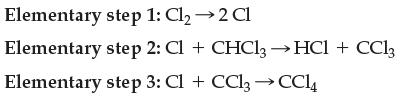
Write the overall balanced chemical equation that goes along with the mechanism: Elementary step 1: Cl₂ →2 Cl Elementary step 2: Cl + CHCl3→ HCl + CC13 Elementary step 3: Cl + CCl₂ → CC14
Suppose the first step in the reaction of Problem 13.155 was the rate-determining step. Would the rate law be k[Cl2][CHCl3], k[Cl2], k[CHCl3], or k[Cl2]2? Explain.Data from Problem 13.155Write the overall balanced chemical equation that goes along with the mechanism: Elementary step 1: Cl₂ → 2
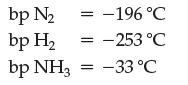
The process to make ammonia (NH3) gas is called the Haber process. The chemical reaction is shown below. To make it go fast enough to be useful, it has to be run at high temperatures (400 °C) and over the surface of a catalyst.As you can see, the equilibrium lies far to the right, but chemical
Consider a point during a chemical reaction at which the rate of the forward reaction is less than the rate of the reverse reaction.(a) Is the reaction at equilibrium at that point?(b) Which way does the overall reaction appear to be running?
Equilibrium for a chemical reaction is often called dynamic equilibrium because:(a) A chemical reaction only truly stops when all reactants have been turned into products.(b) A chemical reaction only seems to stop when it reaches equilibrium.(c) Reactants have changed into products, and dynamic
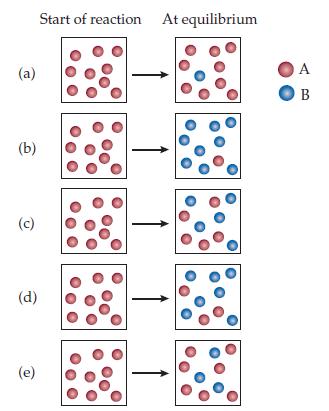
Here are five possibilities for the hypothetical reaction A → B:Which sentence best describes each possibility:1. The equilibrium lies to the left.2. The equilibrium lies to the right.3. The equilibrium lies in the middle.4. The reaction essentially doesn’t occur.5. The reaction essentially
From a practical point of view, why would you want a reaction equilibrium to lie very far to the right?
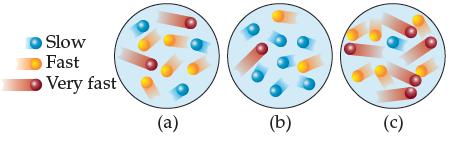
Consider a gas-phase chemical reaction. The three situations depicted represent the reaction being run at different temperatures.(a) Which of the depictions represents the reaction being run at the lowest temperature?(b) Which of the depictions would lead to the reaction proceeding at the slowest
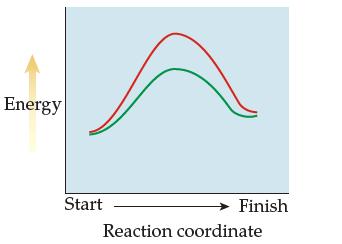
Two reaction-energy profiles are shown below.(a) At a given temperature, which reaction is faster, the one depicted in red or the one depicted in green? Explain.(b) Which reaction is exothermic? Energy Start Finish Reaction coordinate
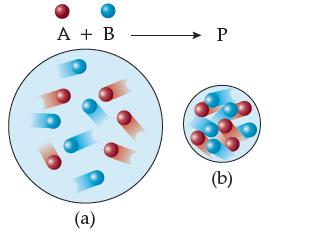
In which vessel is the gas phase reaction A + B → P being run at a higher concentration, and in which vessel is the reaction rate greatest?Explain why. (Both vessels are at the same temperature.) A + B (a) P (b)
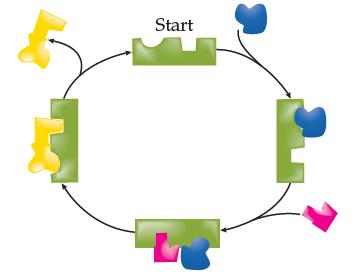
Consider the following diagram.(a) Which shape is meant to represent the enzyme?(b) Which shape is meant to represent the catalyst?(c) Which shape is meant to represent reactant?(d) Which shape is meant to represent product?(e) Why do enzymes assist only certain molecules to react and not
Write the equilibrium constant expression for the reaction H2(g) + I2(g) ⇆ 2HI(g)
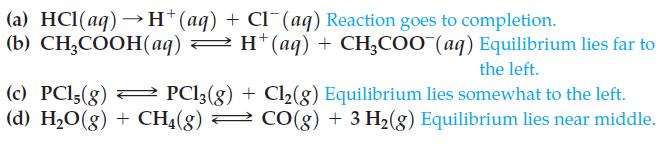
For each reaction, write the Keq expression.Then decide which of the following equilibrium constants goes with each reaction: (a) HCl(aq)→ H+(aq) + Cl¯(aq) Reaction goes to completion. (b) CH₂COOH(aq) → H* (aq) + CH₂COO (aq) Equilibrium lies far to the left. = (c) PC15(g) PC13(g) +
The equilibrium constant expression Keq for chemical reaction can be written as kf/kr because:(a) The k’s are constants.(b) At equilibrium, kf[reactants] = kr[products], (the forward and reverse rates are equal).(c) At equilibrium, the forward and reverse reactions are no longer occurring.(d) All
Write the equilibrium constant expression for the reaction Fe3+ (aq) + SCN– (aq) ⇆ Fe(SCN)2+ (aq)
A reaction with a very large value for its equilibrium constant:(a) Will never reach equilibrium.(b) Will reach equilibrium rapidly.(c) Will yield mostly products at equilibrium.(d) Can be said to have an equilibrium that lies far to the left.
At the start of the reactionthe concentrations are [H2] = 0.100 M, [I2] = 0.100 M, [HI] = 0.000 M. At 427°C, the equilibrium concentrations are [HI] = 0.158 M, [H2] = 0.021 M, [I2] = 0.021 M. Calculate Keq for this reaction. H₂(8) + I2(8) 2 HI(g)
If we reverse the reaction for making NO, we have a reaction for the decomposition of NO: 2NO ⇆ N2 + O2(a) Write the Keq expression for this reaction and for the reaction to form NO(N2 + O2 ⇄ 2NO).(b) How is the Keq expression for the NO formation reaction related to the Keq expression for the
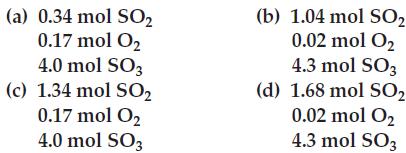
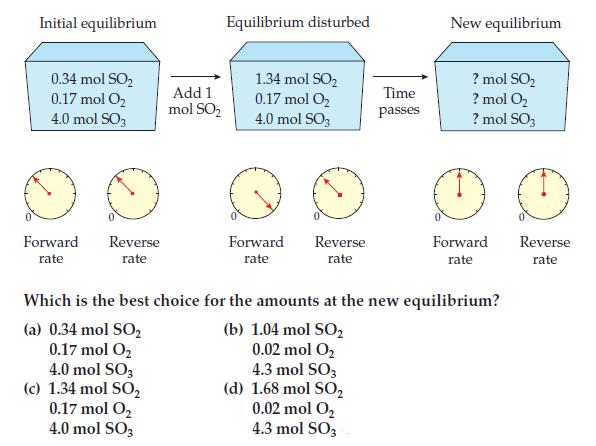
Which is the best choice for the amounts at the new equilibrium? (a) 0.34 mol SO₂ 0.17 mol O₂ 4.0 mol SO3 (c) 1.34 mol SO2 0.17 mol O₂ 4.0 mol SO3 (b) 1.04 mol SO₂ 0.02 mol O₂ 4.3 mol SO3 (d) 1.68 mol SO₂ 0.02 mol O₂ 4.3 mol SO3
When writing an equilibrium constant expression for a chemical reaction:(a) It is important that the chemical equation be balanced.(b) The stoichiometric coefficients are used as exponents.(c) Products are in the numerator and reactants are in the denominator.(d) All of the above are true
Given the concentrations in Practice Problem 14.7, does the equilibrium for the HI reaction lie to the left or to the right? Explain your choice.Data from Problem 14.7At the start of the reactionthe concentrations are [H2] = 0.100 M, [I2] = 0.100 M, [HI] = 0.000 M. At 427°C, the equilibrium
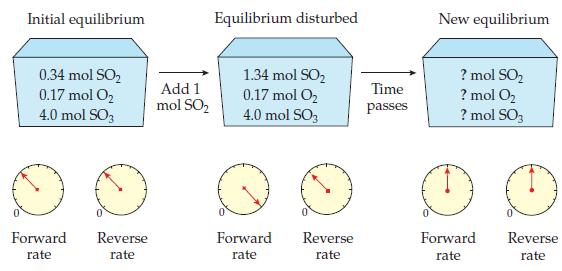
Calculate Keq for both SO3 equilibrium situations (before and after the disturbance). Remember that the box volume is 1L.
The equilibrium concentrations for the reactionare [CS2] = 6.10 × 10⁻³ M, [H2] = 1.17 × 10⁻³ M, [CH4] = 2.35 × 10⁻³ M, [H2S] = 2.93 × 10⁻³ M. Calculate Keq for this reaction. CH4(8) + 2 H₂S(8) CS2(g) + 4H₂(g)
Consider the reactionThe equilibrium constant expression for this reaction is: P4010(s) 4P(s) + 50₂(g).
Suppose you have a vessel containing an endothermic reaction at equilibrium:When you put the vessel in a freezer, which way does the reaction shift? Why? Heat + Reactants Products Endothermic reaction
In WorkPatch 14.8, why are the rates of the forward and reverse reactions greater at the new equilibrium than at the initial equilibrium?Data from WorkPatch 14.8 Initial equilibrium 0.34 mol SO₂ 0.17 mol O₂ 4,0 mol SO3 Forward rate Reverse rate Add 1 mol SO₂ 4.0 mol SO3 (c) 1.34 mol
Suppose the reactionhas come to equilibrium. Which of the following are true?(a) Adding C(s) will shift the reaction to the right.(b) Adding CO(g) will shift the reaction to the right.(c) Adding CO2(g) will shift the reaction to the left.(d) None of the above are true. CO₂(8) + C(s) 2 CO(g)
If you added SO3 to a vessel in which the reaction 2SO2 + O2H2 ⇄ 2SO3 is at equilibrium, which way would the reaction shift?
Ethyl acetate, a solvent used as nail polish remover, is produced by the reaction(a) Rewrite this reaction with the word heat in it.(b) Does the amount of ethyl acetate in the equilibrium mixture increase or decrease when the temperature is raised? CH3COOH + C₂H5OH CH3COOC₂H5 + H₂O AE Ethyl
Suppose you added N2 rather than SO3 to the vessel in Practice Problem 14.11. Which way would the reaction shift?Data from Problem 14.11If you added SO3 to a vessel in which the reaction 2SO2 + O2H2 ⇄ 2SO3 is at equilibrium, which way would the reaction shift?
(a) Rewrite this reaction with the word heat in it:(b) Which way does the reaction shift when the temperature is raised? Explain your answer. 2 CO(g) + 0₂ (8) 2 CO₂(g) AE = AE-563.5 kJ
The process of photosynthesis in plants converts carbon dioxide and water to glucose and oxygen:(a) Write the equilibrium constant expression for this conversion.(b) How would the equilibrium be affected if CO2(g) were added?(c) How would the equilibrium be affected if H2O(l) were added?(d) How
Write the equilibrium constant expression for the reaction CaCO3(s) ⇆ CaO(s) + CO2(g).
(a) Write the equilibrium constant expression for the reaction(b) How would the equilibrium be affected if PbI2(s) were added?(c) How would the equilibrium be affected if Pb(NO3)2(s) were added? Pbl₂(s) Pb²+ (aq) + 21 (aq)
Sparingly soluble PbCl2 dissolves in water to yield an equilibrium Pb2+ (aq) concentration of 0.039 M.(a) Write the balanced equilibrium equation for PbCl2(s) dissolving in water.(b) Write the Ksp expression for PbCl2.(c) What is the equilibrium concentration of chloride ion?(d) Calculate the value
Sparingly soluble calcium phosphate dissolves in water to yield an equilibrium calcium ion concentration of 7.8 × 10⁻⁶ M.(a) Write the balanced equilibrium equation for calcium phosphate dissolving in water.(b) Write the Ksp expression for calcium phosphate.(c) What is the equilibrium
Sparingly soluble magnesium hydroxide dissolves in water to yield an equilibrium magnesium ion concentration of 1.44 × 10– 4 M.(a) Write the balanced equilibrium equation for magnesium hydroxide dissolving in water.(b) Write the Ksp expression for magnesium hydroxide.(c) What is the equilibrium
Sparingly soluble aluminum hydroxide dissolves in water to yield an equilibrium hydroxide ion concentration of 8.58 × 10⁻⁹ M.(a) Write the balanced equilibrium equation for aluminum hydroxide dissolving in water.(b) Write the Ksp expression for aluminum hydroxide.(c) What is the equilibrium
What is the maximum solubility of PbS in water at 25°C? What are the individual ion concentrations?
How can you quickly determine the saturation solubility of a sparingly soluble 1:1 salt at 25 °C?
The saturation solubility of Ag2S at 25 °C is 1.14 × 10⁻¹⁷ M. What are the equilibrium concentrations of the cation and anion?
What does the “equi” portion of the word equilibrium refer to?
What do we call a reaction when we say that it can proceed in both the forward and reverse directions? In principle, which chemical reactions can proceed in both directions?
When we said that your SO3 reaction was “stuck,” we meant that it had stopped. Did it really stop, and how does your answer help explain why we can also describe the reaction as being in a state of dynamic equilibrium?
What do we mean by the position of a reaction’s equilibrium, and what practical consequence can it have?
Where on the reaction coordinate is the equilibrium point for a reaction that goes to completion?
Where on the reaction coordinate is the equilibrium point for a reaction that appears not to occur?
Sometimes reactions are written with two arrows pointing in opposite directions instead of a single arrow going from reactants to products. What do the two arrows mean?
A chemist runs a reaction that is known to proceed very rapidly and keeps isolating product that is contaminated with starting material, even though he is following the stoichiometry of the reaction and giving the reaction enough time to run. How might this be explained?
A reaction occurs inside of a flask. At first, the forward reaction rate is slow, but with time it speeds up. Simultaneously, the reverse reaction rate starts out fast but slows down as time proceeds. From this information, describe what was initially in the reaction flask in terms of reactants and
When a reaction vessel is loaded with just reactants, the reverse reaction initially has a rate of zero. Explain why this is so.
Once a reaction begins, the rate of the reverse reaction gradually speeds up. Explain why this is so.
Suppose a reaction vessel is loaded only with the products of a reaction. Which would be faster at the moment after loading, the forward reaction or the reverse reaction? Explain your answer.
Is it possible for the reaction in Problem 14.37 to attain equilibrium? Explain your answer.Data from Problem 14.37Suppose a reaction vessel is loaded only with the products of a reaction. Which would be faster at the moment after loading, the forward reaction or the reverse reaction? Explain your
Write the definition of equilibrium in terms of the general rate laws Rate forward rxn = kforward rxn [Reactants]order and Rate reverse rxn = Kreverse rxn[Products Jorder
The water in a beaker of water left in a room will slowly evaporate until the beaker is dry. However, place that same beaker in a sealed box and the water level in the beaker will drop a bit but then remain constant. Is the latter case an example of equilibrium? Explain your answer.
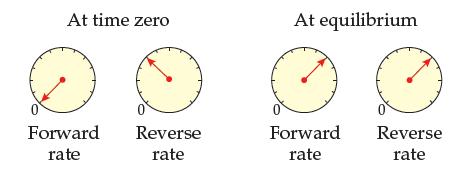
Is the following behavior possible for a reaction run at constant temperature? Explain your answer. At time zero Forward Reverse rate rate At equilibrium Forward Reverse rate rate
Adjust the “At equilibrium” rate meters of Problem 14.41 to make them show a reaction behavior that is possible. Explain why it is possible.Data from Problem 14.41Is the following behavior possible for a reaction run at constant temperature? Explain your answer. At time zero Forward
Using the definition of equilibrium, show how kf/kr for the one-step reaction R ⇆ P is equal to the ratio [P]/[R].
At a given temperature, why is the ratio kf/kr constant for a given reaction?
What symbol and name are used to replace the ratio kf/krr for a reaction?
If kf > kr, will Keq be less than 1 or greater than 1? Explain your answer.
Suppose you have a reaction with many reactants. When you write the equilibrium expression for the reaction, do the reactant concentrations all go in the numerator or in the denominator? What mathematical operation(s) should be used for these concentrations?
Consider the gas-state reaction(a) Write the equilibrium constant expression for the reaction.(b) Write the reaction in reverse.(c) Write the equilibrium constant expression for the reverse reaction that you wrote for part (b).(d) Compare your answers to (a) and (c). What conclusion can you draw
Take the chemical reaction in Problem 14.48 and multiply it through by 2 (this is essentially like doubling a recipe). Write the new chemical reaction and the equilibrium constant expression for the doubled reaction.Problem 14.48Consider the gas-state reactionWrite the equilibrium constant
Compare your equilibrium constant expressions from Problem 14.48(a) and Problem 14.49.(a) Explain how the value of Keq changes for a reaction when you double the reaction (when you multiply it through by 2).(b) Suppose Keq = 10.0 for a reaction. What will the value of Keq be for the “doubled”
Write the expression for Keq for the reaction N2O4(g) ⇄ 2NO2(g).
Write the expression for Keq for the reaction 4NH3(g) + 5O2(g) ⇄ 4NO(g) + 6 H2O(g).
Suppose you wanted to determine the value of Keq for the reaction of Problem 14.51. What would you measure in the laboratory to obtain it?Data from Problem 14.51Write the expression for Keq for the reaction N2O4(g) ⇄ 2NO2(g).
Would the value you obtain for Keq for a reaction depend on the initial concentrations of reactants and products you use? Explain your answer.
The equilibrium concentrations for the reaction N2(g) + O2(g) ⇄ 2NO(g) at 2000°C are [N2] = 0.25 M; [O2] = 1.2 M; [NO] = 0.011 M. What is the value of Keq for this reaction?
At 25°C, Keq for the reaction in Problem 14.55 equals 2.3 × 10⁻⁹. What can you say about the position of this equilibrium compared with its position at 2000°C?Data from Problem 14.55The equilibrium concentrations for the reaction N2(g) + O2(g) ⇄ 2 NO(g) at 2000°C are [N2] = 0.25 M; [O2] =
What does a value of Keq greater than 103 imply? Prove that your answer is correct by using the general expression Keq = [Products]/[Reactants].
Suppose a reaction has a Keq value of 2.05. When we write the reaction, can we use a single arrow to the right instead of a double set of equilibrium arrows? Explain your answer.
A certain reaction has a Keq value of 1.5 × 10⁻⁶.(a) Would this be a practical reaction from which to isolate pure product? Explain your answer.(b) Based on what you learned from doing Problem 14.48, would the reverse reaction be a practical one from which to isolate pure product? Explain.Data
What does a value of Keq less than 10–3 imply? Prove that your answer is correct by using the general expression Keq = [Products]/[Reactants].
The reactionis run in a 10.0-L vessel. The vessel is loaded with 1 mole of CO and 3 moles of H2. At equilibrium, the amounts are 0.613 mole of CO, 1.839 moles of H2, 0.387 mole of CH4, and 0.387 mole of H2O. What is the value of the equilibrium constant for this reaction? Describe the position of
The reaction in Problem 14.61 is run in the same vessel and at the same temperature, but this time the vessel is loaded with 2 moles of CO and 3 moles of H2. When the reaction reaches equilibrium, what is the value of Keq?Data from Problem 14.61The reactionis run in a 10.0-L vessel. The vessel is
For the reactionKeq = 3.59 at 900°C. After the reaction has run for 10 min at 900 °C, the concentrations are [CH4] = 1.15 M; [H2S] = 1.20 M; [CS2] = 1.51 M; [H2] = 1.08 M. Is this reaction at equilibrium? CH4(g) + 2 H₂S(g) CS₂(g) + 4 H₂(g)
One way to calculate the value of a reaction’s equilibrium constant is to perform the reaction, let it come to equilibrium, measure the concentration of all the reactants and products, and then plug those concentrations into the equilibrium constant expression and calculate its value.(a) A
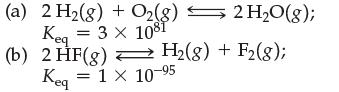
On the basis of Keq values, which reaction goes essentially to completion? How would you describe the other reaction? (a) 2 H₂(g) + O₂(g) Keq = 3 x 1081 (b) 2 H₂O(g); 2 HF(g) → H₂(8) + F₂(g); Keq = 1 × 10-⁹5
Write the balanced chemical equation for the reaction that goes with the equilibrium constant Kec req _[H₂O1²x [C1₂1² [HC] x [0₂]
An 8.00-L reaction vessel at 491°C contains 0.650 mole of H2, 0.275 mole of I2, and 3.00 moles of HI. Assuming that the reaction is at equilibrium, determine the value of Keq and comment on where the equilibrium lies. The reaction is: H₂(g) + I₂(8) 2 HI(g)
How would the value of the equilibrium constant for a one-step reaction calculated as kf/kr compare with the value calculated from the concentrations of all substances present at equilibrium?
Suppose a reaction is at equilibrium and you then disturb the equilibrium by adding reactants. What happens to the value of Keq? Explain your answer.
Suppose we have an equilibrium mixture of reactants and products for the reaction Predict the direction in which the reaction will shift when:(a) Chlorine (Cl2) gas is added.(b) Chlorine gas is removed.(c) PCl5 is added.(d) PCl3 is removed.(e) H2 gas is added. (Assume the H2 does not react with
State Le Châtelier’s principle using the words undo and partially.
Consider the gas-phase reaction 3O2(g) ⇆ 2O3(g). Suppose Keq for this reaction is –1 (it is not, but assume it is for this problem). Suppose you want pure ozone (O3) that is uncontaminated with oxygen (O2).(a) Why can’t you simply remove the oxygen from the reaction vessel once the reaction
Consider the reactionUse forward and reverse rate meters to represent the forward and reverse reaction rates for:(a) The initial equilibrium (b) Moments after you disturb the equilibrium by adding PCl5(c) The restored equilibrium (d) Which way did the reaction shift to get from the initial
When a reaction at equilibrium is disturbed by the addition of products, (a) Which way will the reaction shift?(b) After the reaction is done shifting, will the product concentration be the same as before the disturbance, greater than before the disturbance, or less than before the disturbance?
One way of preparing hydrogen is by decomposition of water:(a) Would you expect the decomposition to be more complete at equilibrium when it is run at high temperature or when it is run at low temperature? Explain.(b) According to your answer to (a), would the reaction speed up, slow down, or occur
Suppose you are making ammonia (NH3) by the Haber reaction, at 472 °C:(a) Describe qualitatively where the equilibrium lies for this reaction.(b) On the face of it, would this reaction be a good one for isolating pure ammonia?(c) What would happen if you could keep feeding H2 and N2 into the
The equilibrium constant for the synthesis of methanol,is 4.3 at 250°C and 1.8 at 275°C.(a) Does this reaction shift to the left or to the right when the reaction mixture is heated? Explain how you know.(b) Is this reaction endothermic or exothermic? Explain how you know.(c) Rewrite the equation
The amount of nitrogen dioxide formed by dissociation of dinitrogen tetroxide,increases as the temperature rises.(a) Is the reaction exothermic or endothermic? Explain how you know.(b) Does Keq increase or decrease as the temperature rises?(c) Rewrite the equation for the reaction, including heat
Diamond and graphite are two forms of elemental carbon. Under the appropriate conditions they will be in equilibrium with each other:If graphite is subjected to very high pressure and temperature, it will convert into the diamond form.(a) Is the above equilibrium reaction exothermic or endothermic?
Suppose you have an endothermic reaction with Keq approximately equal to 1 × 10³. How could you adjust the temperature of this reaction to drive it to completion? Explain your answer.
Will Keq for an exothermic reaction increase or decrease when the reaction mixture is (a) Heated (b) Cooled? Explain your answer.
Will Keq for an endothermic reaction increase or decrease when the reaction mixture is (a) Heated (b) Cooled? Explain your answer.
Cooling an exothermic reaction for which Keq is very low shifts the reaction to the right, so that more product is formed, but there is a trade-off. What is the downside of cooling such a reaction, as far as forming product is concerned?
What effect does a catalyst have on:(a) The position of equilibrium for a reaction?(b) The value of the equilibrium constant?(c) The ratio of kf/kr?
Showing 1000 - 1100
of 3073
First
4
5
6
7
8
9
10
11
12
13
14
15
16
17
18
Last
Step by Step Answers

 Get 50% OFF
Claim Now
Get 50% OFF
Claim Now


![3H(8)+N(8) Keq 2 NH3(8) [NH3) [H][N] = 0.00016 (at 400C)](https://dsd5zvtm8ll6.cloudfront.net/images/question_images/1701/9/4/0/52465718d2cec50a1701940526224.jpg)




![(a) K = [P][0]/[P4010] (b) K = 1/[0] (c) K = [0]5 (d) K = [P]/[P4O10]](https://dsd5zvtm8ll6.cloudfront.net/images/question_images/1701/9/4/0/09065718b7a4c5531701940090532.jpg)






![Rate forward rxn kforward rxn [Reactants]order and Rate reverse rxn = Kreverse rxn[Products Jorder](https://dsd5zvtm8ll6.cloudfront.net/images/question_images/1701/8/7/0/22965707a9515c7e1701870227603.jpg)




![Kec req _[HO1x [C11 [HC] x[0]](https://dsd5zvtm8ll6.cloudfront.net/images/question_images/1701/9/2/6/483657156535f4d71701926482927.jpg)










