New Semester
Started
Get
50% OFF
Study Help!
--h --m --s
Claim Now
Question Answers
Textbooks
Find textbooks, questions and answers
Oops, something went wrong!
Change your search query and then try again
S
Books
FREE
Study Help
Expert Questions
Accounting
General Management
Mathematics
Finance
Organizational Behaviour
Law
Physics
Operating System
Management Leadership
Sociology
Programming
Marketing
Database
Computer Network
Economics
Textbooks Solutions
Accounting
Managerial Accounting
Management Leadership
Cost Accounting
Statistics
Business Law
Corporate Finance
Finance
Economics
Auditing
Tutors
Online Tutors
Find a Tutor
Hire a Tutor
Become a Tutor
AI Tutor
AI Study Planner
NEW
Sell Books
Search
Search
Sign In
Register
study help
sciences
introductory chemistry atoms first
Introductory Chemistry Atoms First 5th Edition Steve Russo And Michael Silver - Solutions
The compound NaCl is an electrolyte.(a) Is it incorrect to call NaCl a molecular compound? Explain.(b) Why is NaCl expected to be an electrolyte?
Explain why this statement is true: Water-soluble compounds that consist of one or more metal atoms combined with one or more nonmetal atoms are electrolytes.
Characterize the following as electrolytes or nonelectrolytes:(a) Calcium bromide, CaBr2(b) Bromine, Br2(c) Hydrogen, H2(d) Hydrogen bromide, HBr(e) Ammonium fluoride, NH4F (f) Potassium chlorate, KClO3 (g) Sucrose, C12H22O11
Write a balanced equation to show what happens to Na2SO4 when it dissolves in water. Use the (aq) symbol when necessary.
Consider the ammonium ion.(a) Write the chemical formula for this ion, complete with its charge.(b) Write the formula for ammonium chloride.(c) Ammonium chloride is an electrolyte. Explain why this is so.
Write a balanced equation to show what happens when CaBr2 dissolves in water. Use the (aq) symbol when necessary.
What is wrong with this instruction: Write a balanced equation showing the sugar glucose, C6H12O6, dissociating in water.
What do we mean by saying that some molecular compounds dissolve in water and also dissociate? Give an example of such a compound.
Two beakers each contain 1 L of water. Then 0.1 mole of HCl gas is dissolved in one beaker, and 0.1 mole of HF gas is dissolved in the other beaker. The HCl solution causes a light bulb to glow intensely, and the HF solution causes the same bulb to glow dimly. Explain these observations.
In which solution of Problem 15.61 is the halide ion concentration 0.1 M, and in which solution is the halide ion concentration much less than 0.1 M? Explain how you know.Data from Problem 15.61Two beakers each contain 1 L of water. Then 0.1 mole of HCl gas is dissolved in one beaker, and 0.1 mole
To which side does the dissociation equilibrium lie for a strong electrolyte? For a weak electrolyte?
What do we mean by the term partially dissociates? Give an example of a compound that partially dissociates in water, and draw a picture of the solution showing relative amounts of the various species in the solution.
Consider the three molecular compounds HCl, CH3COOH, and H2SO4.(a) When they dissolve in water they all produce a common ion. What is it?(b) Why is it proper to call all three compounds electrolytes?(c) CH3COOH is the only weak electrolyte among the three compounds above. Write an equilibrium to
Consider H+(aq) and H3O+(aq) ions.(a) Which is a more correct representation of what actually exists in water?(b) Draw a dot diagram for the hydronium (H3O+) ion that also shows its charge and correct shape.
A particular molecular electrolyte has a dissociation equilibrium constant of 8.2 × 10⁶. Is this electrolyte strong or weak? Explain.
A particular molecular electrolyte has a dissociation equilibrium constant of approximately 108. Is it appropriate to ignore equilibrium for this electrolyte? Explain.
Write the formulas and names of two strong molecular electrolytes and two weak molecular electrolytes. For all four, write a balanced dissociation equation.
Name the acids:(a) HCl (b) HNO3(c) H2SO4 (d) HF(e) CH3COOH (f) NH4Cl.
Which of the compounds in Problem 15.70 are molecular and which are ionic? Explain how you know.Data from Problem 15.70Name the acids:HCl HNO3H2SO4HFCH3COOH NH4Cl.
Which of the acids in Problem 15.70 are molecular electrolytes, and what common ion do they produce in water?Data from Problem 15.70Name the acids:HCl HNO3H2SO4HFCH3COOH NH4Cl.
According to the Arrhenius definition, why are all the compounds in Problem 15.70 acids?Data from Problem 15.70Name the acids:HCl HNO3H2SO4HFCH3COOH NH4Cl.
True or false? The acidity of a given volume of 1.0 M hydrofluoric acid is the same as that of the same volume of 1.0 M hydrochloric acid. Explain your answer.
Consider the acids in Problem 15.70. [Additional information: Keq for the dissociation of ammonium ion is 5.6 × 10⁻¹⁰].(a) Which of the acids are weak?(b) Which of the acids are strong?(c) Suppose you have six beakers, each containing 1.0 M solutions of the acids in Problem 15.70. Which
What does diprotic mean when applied to an acid? Give an example, and show both dissociation equilibrium equations.
Go back in the chapter and examine the values of the equilibrium constants for the three dissociations of the triprotic phosphoric acid. Give a reason for why each successive dissociation yields a weaker acid.
Other than water, which species would you expect to find in the highest concentration in an aqueous solution of CH3COOH? Explain.
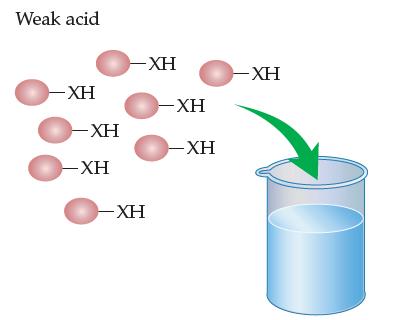
Imagine that the eight identical molecules shown below are of a weak molecular acid. Draw a picture showing all the expected ions and/or molecules present after the molecules dissolve in the water in the beaker and equilibrium is reached. HX- HX- HX- HX- HX- HX HX- HX- рре урам
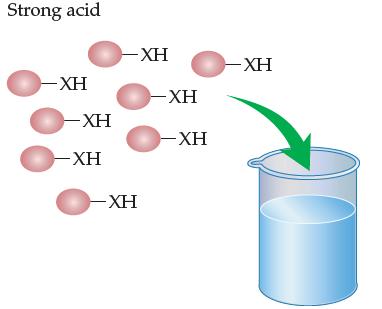
Answer Problem 15.80 for the case where the eight molecules are of a strong acid. Strong acid HX- HX- HX- -XH -XH -XH -XH HX-
HNO3 is a strong acid, whereas HNO2 is a weak acid. Likewise, H2SO4 is a strong acid, whereas H2SO3 is a weak acid. Likewise, HClO3 is a strong acid, whereas HClO2 and HClO are weak acids.(a) After water, what would be the predominant species present in a solution of HNO3?(b) After water, what
Draw a dot diagram for acetic acid, and indicate which proton is the one that dissociates.
What is the value of the equilibrium constant for the dissociation of acetic acid’s proton? What does this value tell you?
What is the value of the equilibrium constant for the dissociation of the first proton of sulfuric acid? What does this value tell you?
True or false? Because carbonic acid, H2CO3, is diprotic, it is a stronger acid than HCl, which is only monoprotic. Explain your answer.
What is meant by acid–base neutralization? Write a net ionic equation to go along with your answer
What kinds of compounds are typically strong bases?
When aqueous calcium hydroxide reacts with aqueous hydrochloric acid in a neutralization reaction to yield a neutral solution, the resulting solution is found to conduct electricity very well.(a) Explain why the neutral solution conducts electricity.(b) Write a complete ionic equation that goes
Consider the neutralization reaction that occurs upon the reaction of aqueous potassium hydroxide with aqueous hydrochloric acid.(a) Write a complete ionic equation for this neutralization reaction.(b) Write a net ionic equation for this neutralization reaction.
How many moles of Ba(OH)2 does it take to neutralize 0.50 mole of H2SO4? Why does the resulting solution after the neutralization no longer conduct electricity? Why does the solution then conduct electricity after an excess of Ba(OH)2 is added?
How many moles of Ba(OH)2 does it take to neutralize 2.5 moles of HNO3?
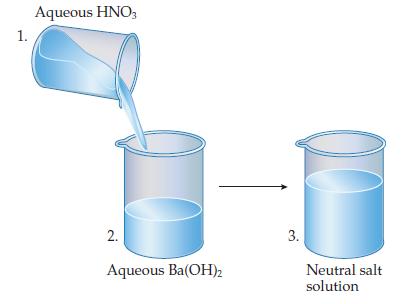
Draw three-beaker sets similar to those in WorkPatch 15.3 for Problems 15.91 and 15.92. Fill in the species present in each beaker. Assume the H2SO4 dissociates completely to give two H3O+ ions (although it actually doesn’t do this).Workpatch 15.3What species are present in each beaker?Ionic
What salts are formed in the neutralization reactions of Problems 15.91 and 15.92?Data from Problem 15.91How many moles of Ba(OH)2 does it take to neutralize 0.50 mole of H2SO4? Why does the resulting solution after the neutralization no longer conduct electricity? Why does the solution then
Write a balanced equation for what happens when gaseous NH3 is dissolved in water.
The equilibrium constant for the balanced equation in Problem 15.95 is 1.8 × 10⁻⁵. What does this indicate about which way the equilibrium lies? What are the predominant species in solution?Data from Problem 15.95Write a balanced equation for what happens when gaseous NH3 is dissolved in water.
Why would Arrhenius have a problem explaining why NH3 is a base?
Use the Brønsted–Lowry definition to explain why NH3 is a base in water.
When ammonia gas is dissolved in water, is the water behaving as an acid, as a base, or neither? Explain.
The equilibrium constant for the reaction(a) Is a solution of ammonium ion very acidic or only slightly acidic?(b) Is water acting as an acid or a base according to the Brønsted–Lowry definition? Explain. NH,*(aq) + H,O(1) is 5.6 x 10⁻¹⁰ NH3(aq) + H3O+ (aq)
Solid ammonium chloride, NH4Cl, reacts with solid sodium hydroxide to produce ammonia gas, water, and sodium chloride, NaCl.(a) Write a balanced equation for this reaction.(b) According to the Brønsted–Lowry definition, which species is the acid and which species is the base? Explain.
The carbonate ion, CO32–, is a weak base.(a) Write the equilibrium equation that shows how this ion makes water basic.(b) Which species is the acid and which species is the base according to the Brønsted–Lowry definition?(c) The equilibrium constant for the reaction between CO32– and water
Hydride ion, H–, is an exceptionally strong base, reacting with water to produce lots of hydroxide ion and H2 gas. The Keq for this reaction is huge.(a) Write the balanced equation for the reaction between hydride and water.(b) Explain why H2 gas forms.
Rewrite the equation of Problem 15.103 using dot diagrams, and show with an arrow the proton being transferred. Note that H– is an H with a lone pair of electrons on it.Data from Problem 15.103Hydride ion, H–, is an exceptionally strong base, reacting with water to produce lots of hydroxide ion
The oxide ion, O2–, present in sodium oxide (Na2O) reacts violently with water to produce a highly basic solution. The hydride ion, H–, in sodium hydride (NaH) does the same.(a) Write a balanced total ionic equation for the reaction of sodium oxide with water.(b) In terms of the
Ammonia (NH3) can act as a base in water.(a) Suppose methane (CH4) could also act as a base in water. Write a chemical equation to show this.(b) In fact, methane cannot act as a base. Why not?(c) By comparing NH3 to CH4, what can you say must exist on a species for it to serve as a
Ethanol, C2H5OH, and hydride ion, H–, react to produce H2 gas and the C2H5O– anion. Arrhenius could not tell you what is going on, but Brønsted and Lowry would have no trouble. How would they explain this reaction?
How would the Brønsted–Lowry theory explain that ammonia is a weak base?
Acetic acid is a weak acid. Upon losing a proton, acetic acid yields the acetate anion.(a) Draw a dot diagram for the acetate anion.(b) Hydrogen atoms that are bound to carbon atoms are not acidic. Knowing this, is it possible for the acetate anion to serve as an acid? Explain.(c) In fact, acetate
Why aren’t ionic compounds like NaOH and Mg(OH)2 weak bases?
Draw a set of beakers similar to those in WorkPatch 15.3 for the solutions in Problem 15.111. Fill in the species present in each beaker.Data from Problem 15.111Are a 1 M solution of ammonia, NH3, and a 1 M solution of lithium hydroxide, LiOH, equally basic, or is one solution more basic than the
Are a 1 M solution of ammonia, NH3, and a 1 M solution of lithium hydroxide, LiOH, equally basic, or is one solution more basic than the other? Explain.
In water, the hydrogen phosphate ion, HPO42–, can act both as a weak base and as a weak acid.(a) Write an equilibrium equation that shows hydrogen phosphate acting as a weak acid in water.(b) Write an equilibrium equation that shows bisulfate acting as a weak base in water.(c) What information
Amines are organic compounds that contain an NH2 group, and water-soluble amines are weak bases in water. For example, the compound methylamine, H3C—NH2, is a weak base.(a) Draw a dot diagram for methylamine.(b) Using dot diagrams, show the equilibrium reaction between methylamine and water.(c)
To be a weak base in water, a molecular compound must also be a weak electrolyte. What must be one of the ions it produces in water?
(a) List all the weak bases phosphoric acid, H3PO4, can produce via successive losses of its protons.(b) Of the bases you listed, which has no ability to serve as a weak acid?(c) Phosphorous acid, H3PO3, is a diprotic acid, even though there are three H atoms in the formula. Draw a Lewis dot
Consider the autoionization of water.(a) What do we mean by autoionization of water?(b) Write a balanced equation to go along with your explanation.(c) An alternate name for autoionization of water is autodissociation. Exactly how is water dissociating?
When water undergoes autoionization, is it serving as an acid, a base, or neither? Explain.
Does the equilibrium for water autoionization lie to the left or to the right? What constant verifies your answer?
Write the mathematical expression that allows you to solve for the OH– concentration in water when you know only the H3O+ concentration.
Is it possible to obtain water at 25°C that contains absolutely no ions of any sort? Explain.
What is the molar concentration of hydronium ion and hydroxide ion in pure water at 25°C?
If pure water has both hydronium ions (acid) and hydroxide ions (base) in it, how can it be neutral?
Based solely on concentrations, when is an aqueous solution judged to be acidic? Give two answers to this question.
Based solely on concentrations, when is an aqueous solution judged to be basic? Give two answers to this question.
True or false? Even in a very basic aqueous solution, there are some H3O+ ions present. Explain your answer.
Consider the following statement: “As the H3O+ concentration in an aqueous solution increases, the OH- concentration must decrease.”(a) Why is this true?(b) Is there any way to stop the OH concentration from decreasing as you increase the H3O+ concentration?
True or false? In an aqueous solution at 25°C, you will always get the same number when you multiply the equilibrium H3O+ concentration by the equilibrium OH– concentration. Explain your answer.
An aqueous solution has an H3O+ concentration of 1.0 M. What is the OH– concentration? Is this solution acidic or basic? Justify your answer.
An aqueous solution has an OH– concentration of 1.0 × 10⁻¹¹ M. What is the H3O+ concentration? Is this solution acidic or basic? Justify your answer.
A solution is prepared by dissolving 2.50 moles of LiOH in enough water to get 4.00 L of solution. What are the OH– and the H3O+ molar concentrations?
A solution is prepared by dissolving 0.250 mole of Ba(OH)2 in enough water to get 4.00 L of solution. What are the OH– and H3O+ molar concentrations?
A solution is prepared by dissolving 2.40 g of Mg(OH)2 in enough water to get 4.00 L of solution. What are the OH- and H3O+ molar concentrations?
A solution is prepared by dissolving 2.00 moles of HNO3 in enough water to get 800.0 mL of solution. What are the H3O+ and the OH– molar concentrations?
A solution has an OH– concentration of 10–11 M.(a) Is this solution basic or acidic? Explain how you know.(b) Without using a calculator, explain how you could quickly determine the H3O+ concentration of this solution. What is that concentration?
What is a base-10 logarithm?
Without using a calculator, what is the base-10 logarithm of 10–34?
Without using a calculator, what is the base-10 logarithm of 1013?
Without using a calculator, what is the base-10 logarithm of 100? Of 1?
The base-10 logarithm of 60 is a number:(a) Between –2 and –1(b) Between –1 and 0(c) Between 0 and 1(d) Between 1 and 2(e) Between 2 and 3
Explain how you arrived at your answer to Problem 15.140.Data from Problem 15-140The base-10 logarithm of 60 is a number:Between –2 and –1Between –1 and 0Between 0 and 1Between 1 and 2Between 2 and 3
The base-10 logarithm of 0.73 is a number:(a) Between –2 and –1(b) Between –1 and 0(c) Between 0 and 1(d) Between 1 and 2(e) Between 2 and 3
Explain how you arrived at your answer to Problem 15.142.Data from Problem 15.142The base-10 logarithm of 0.73 is a number:Between –2 and –1Between –1 and 0Between 0 and 1Between 1 and 2Between 2 and 3
True or false? As a solution’s acidity increases, its pH decreases.
Write the mathematical definition of pH, and explain what fundamental change there would be in the pH scale if you left the negative out.
Why is a pH of 7 equal to neutrality?
What is the pH of a solution whose hydronium ion concentration is 0.0010 M? Is the solution acidic or basic?
What is the pH of a solution whose H3O+ concentration is 10–6 M? Is the solution acidic or basic?
What is the pH of a solution whose H3O+ concentration is 6.40 × 10⁻⁹ M? Is the solution acidic or basic?
What is the pH of a solution whose OH concentration is 10–14 M? Is the solution acidic or basic?
What is the pH of a solution whose OH concentration is 2.0 × 10⁻³ M? Is the solution acidic or basic?
Solution A has a pH of 3. Solution B has a pH of 6. Which solution is more acidic, and by how much?
What is the pH of a solution whose H3O+ concentration is 10.0 M? Is this solution acidic or basic?
Showing 1200 - 1300
of 3073
First
6
7
8
9
10
11
12
13
14
15
16
17
18
19
20
Last
Step by Step Answers

 Get 50% OFF
Claim Now
Get 50% OFF
Claim Now