New Semester
Started
Get
50% OFF
Study Help!
--h --m --s
Claim Now
Question Answers
Textbooks
Find textbooks, questions and answers
Oops, something went wrong!
Change your search query and then try again
S
Books
FREE
Study Help
Expert Questions
Accounting
General Management
Mathematics
Finance
Organizational Behaviour
Law
Physics
Operating System
Management Leadership
Sociology
Programming
Marketing
Database
Computer Network
Economics
Textbooks Solutions
Accounting
Managerial Accounting
Management Leadership
Cost Accounting
Statistics
Business Law
Corporate Finance
Finance
Economics
Auditing
Tutors
Online Tutors
Find a Tutor
Hire a Tutor
Become a Tutor
AI Tutor
AI Study Planner
NEW
Sell Books
Search
Search
Sign In
Register
study help
business
marketing strategy planning
Basic Marketing A Marketing Strategy Planning Approach 19th edition William D. Perreault Jr., Joseph P. Cannon, E. Jerome McCarthy - Solutions
Go to the library (or get on the Internet) and find (in some government publication or website) three marketing-oriented “facts” on international markets that you did not know existed or were available. Record on one page and show sources.
CompuTech, Inc., makes circuit boards for microcomputers. It is evaluating two possible suppliers of electronic memory chips. The chips do the same job. Although manufacturing quality has been improving, some chips are always defective. Both suppliers will replace defective chips. But the only
Submag, Inc., uses direct-mail promotion to sell magazine subscriptions. Magazine publishers pay Submag $3.12 for each new subscription. Submag’s costs include the expenses of printing, addressing, and mailing each direct-mail advertisement plus the cost of using a mailing list. There are many
Explain what is meant by a hierarchy of needs and provide examples of one or more products that enable you to satisfy each of the four levels of need.
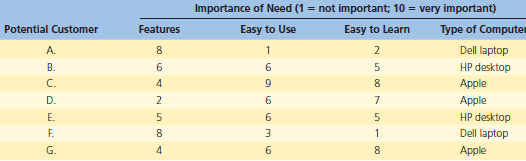
The marketing manager for Audiotronics Software Company is seeking new market opportunities. He is focusing on the voice recognition market and has narrowed down to three segments: the Fearful Typists, the Power Users, and the Professional Specialists. The Fearful Typists don€™t know much
A marketing manager is considering opportunities to export her firm’s current consumer products to several different countries. She is interested in getting secondary data that will help her narrow down choices to countries that offer the best potential. The manager then plans to do more detailed
Marketing research involves expense—sometimes considerable expense. Why does the text recommend the use of marketing research even though a highly experienced marketing executive is available?
Explain how you might use different types of research (focus groups, observation, survey, and experiment) to forecast market reaction to a new kind of disposable baby diaper, which is to receive no promotion other than what the retailer will give it. Further, assume that the new diaper’s name
Would a firm want to subscribe to a shared cost data service if the same data were going to be available to competitors? Discuss your reasoning.
Prepare a table that summarizes some of the key advantages and limitations of mail, e-mail, telephone, and personal interview approaches for administering questionnaires.
Define response rate and discuss why a marketing manager might be concerned about the response rate achieved in a particular survey. Give an example.
Distinguish between qualitative and quantitative approaches to research—and give some of the key advantages and limitations of each approach.
Explain why a company might want to do focus group interviews rather than individual interviews with the same people.
If a firm were interested in estimating sand and clay production in Georgia, how could it proceed? Be specific.
If a firm were interested in estimating the distribution of income in the state of California, how could it proceed? Be specific.
With so much secondary information now available free or at low cost over the Internet, why would a firm ever want to spend the money to do primary research?
Distinguish between primary data and secondary data and illustrate your answer.
How is the situation analysis different from the data collection step? Can both these steps be done at the same time to obtain answers sooner? Is this wise?
Explain the key characteristics of the scientific method and show why these are important to managers concerned with research.
Discuss some of the likely problems facing the marketing manager in a small firm who plans to search the Internet for information on competitors’ marketing plans.
Discuss how output from a marketing information system (MIS) might differ from the output of a typical marketing research department.
In your own words, explain why a decision support system (DSS) can add to the value of a marketing information system. Give an example of how a decision support system might help.
Discuss the concept of a marketing information system and why it is important for marketing managers to be involved in planning the system.
Some critics argue that the Foreign Corrupt Practices Act puts U.S. businesses at a disa d vantage when competing in foreign markets with suppliers from other countries that do not have similar laws. Do you think that this is a reasonable criticism? Explain your answer.
The government market is obviously an extremely large one, yet it is often slighted or even ignored by many firms. Red tape is certainly one reason, but there are others. Discuss the situ a tion and be sure to include the possibility of segmenting in your analysis. Discuss.
The government market is obviously an extremely large one, yet it is often slighted or even ignored by many firms. Red tape is certainly one reason, but there are others. Discuss the situ a tion and be sure to include the possibility of segmenting in your analysis.
Considering the nature of retail buying, outline the basic ingredients of promotion to retail buyers. Does it make any difference what kinds of products are involved? Are any other factors relevant?
Explain how NAICS codes might be helpful in evaluating and understanding business ma r kets. Give an example.
Discuss the importance of target marketing when analyzing organizational markets. How easy is it to isolate homogeneous market segments in these markets?
How do you think a furniture manufacturer’s buying habits and practices would be affected by the specific type of product to be purchased? Consider fabric for upholstered furniture, a lathe for the production line, cardboard for shipping cartons, and lubricants for production machinery.
Would a tool manufacturer need a different marketing strategy for a big retail chain like Home Depot than for a single hardware store run by its owner? Discuss your answer.
Explain why a customer might be willing to work more cooperatively with a small number of suppliers rather than pitting suppliers in a competition against each other. Give an example that illustrates your points.
Discuss the advantages and disadvantages of just-intime supply relationships from an o r ganizational buyer’s point of view. Are the advantages and disadvantages merely reversed from the seller’s point of view?
How likely would each of the following be to use competitive bids? ( a ) a small town that needed a road resurfaced, ( b ) a scouting organization that needed a printer to print its scouting handbook, ( c ) a hardware retailer that wants to add a new lawn mower line, ( d ) a grocery store chain
Why would an organizational buyer want to get competitive bids? What are some of the situations when competitive bidding can’t be used?
Describe the situations that would lead to the use of the three different buying processes for a particular product—lightweight bumpers for a pickup truck.
If a nonprofit hospital were planning to buy expensive MRI scanning equipment (to detect tumors), who might be involved in the buying center? Explain your answer and describe the types of influence that different people might have.
Briefly discuss why a marketing manager should think about who is likely to be involved in the buying center for a particular purchase. Is the buying center idea useful in consumer buying? Explain your answer.
Compare and contrast the buying behavior of final consumers and organizational buyers. In what ways are they most similar and in what ways are they most different?
In your own words, explain how buying behavior of business customers in different countries may have been a factor in speeding the spread of international marketing.
Interview a friend or family member about two recent purchase decisions. One decision should be an important purchase, perhaps the choice of an automobile, a place to live, or a college. The second purchase should be more routine, such as a meal from a fast-food restaurant or a regularly purchased
Review the model in Exhibit 5-2 and then reread the Apple case at the beginning of this chapter. List and briefly describe specific points in the case that illustrate the model.
On the basis of the data and analysis presented in Chapter 5, what kind of buying behavior would you expect to find for the following products: ( a ) a haircut, ( b ) a shampoo, ( c ) a digital camera, ( d ) a tennis racket, ( e ) a dress belt, ( f ) a cell phone, ( g ) life insurance, ( h ) an ice
Give an example of a recent purchase in which you used extensive problem solving. What sources of information did you use in making the decision?
Give two examples of recent purchases where the specific purchase situation influenced your purchase decision. Briefly explain how your decision was affected.
Illustrate how the reference group concept may apply in practice by explaining how you personally are influenced by some reference group for some product. What are the implications of such behavior for marketing managers?
How should social class influences affect the planning of a new restaurant in a large city? How might the four Ps be adjusted?
A supermarket chain is planning to open a number of new stores to appeal to Hispanics in southern California. Give some examples that indicate how the four Ps might be adjusted to appeal to the Hispanic subculture.
Explain psychographics and lifestyle analysis. Explain how they might be useful for planning marketing strategies to reach college students, as opposed to average consumers.
Give an example of a recent purchase experience in which you were dissatisfied because a firm’s marketing mix did not meet your expectations. Indicate how the purchase fell short of your expectations— and also explain whether your expectations were formed based on the firm’s promotion or on
Briefly describe your own beliefs about the potential value of low-energy compact fluorescent lightbulbs, your attitude toward them, and your intention about buying one the next time you need to replace a bulb.
Explain how an understanding of consumers’ learning processes might affect marketing strategy planning. Give an example.
Cut out or photocopy two recent advertisements: one full-page color ad from a magazine and one large display ad from a newspaper. In each case, indicate to which needs the ads appeal.
In your own words, explain economic needs and how they relate to the economic-buyer model of consumer behavior. Give an example of a purchase you recently made that is consistent with the economic buyer model. Give another that is not explained by the economic-buyer model. Explain your thinking.
Explain how positioning analysis can help a marketing manager identify target market opportunities.
Consider the market for off-campus apartments in your city. Identify some submarkets that have different needs and determining dimensions. Then evaluate how well the needs in these market segments are being met in your geographic area. Is there an obvious breakthrough opportunity waiting for
Illustrate the concept that segmenting is an aggregating process by referring to the admissions policies of your own college and a nearby college or university.
Explain why segmentation efforts based on attempts to divide the mass market using a few demographic dimensions may be very disappointing.
List the types of potential segmenting dimensions, and explain which you would try to apply first, second, and third in a particular situation. If the nature of the situation would affect your answer, explain how.
Explain what market segmentation is.
Distinguish between a generic market and a product market . Illustrate your answer.
Explain General Electric’s strategic planning grid approach to evaluating opportunities
Explain the product-market screening criteria that can be used to evaluate opportunities.
Name three specific examples of firms that developed a marketing mix to appeal to senior citizens.
Discuss the impact of changes in the size and use of technology in the 18–29 age group on marketing strategy planning in the United States.
Discuss how slower population growth will affect businesses in your local community.
Discuss how the worldwide trend toward urbanization is affecting opportunities for international marketing.
Discuss the value of gross domestic product and gross national income per capita as measures of market potential in international consumer markets. Refer to specific data in your answer.
Drawing on data in Exhibit 3-4, do you think that Romania would be an attractive market for a firm that produces home appliances? What about Finland? Discuss your reasons.
For each of the major laws discussed in the text, indicate whether in the long run the law will promote or restrict competition. As a consumer without any financial interest in business, what is your reaction to each of these laws?
What and who is the U.S. government attempting to protect in its effort to preserve and regulate competition?
Will the elimination of trade barriers between countries in Europe eliminate the need to consider submarkets of European consumers? Why or why not?
Discuss the probable impact on your hometown if a major breakthrough in air transportation allowed foreign producers to ship into any U.S. market for about the same transportation cost that domestic producers incur.
The owner of a small hardware store—the only one in a medium-sized town in the mountains—has just learned that a large home improvement chain plans to open a new store nearby. How difficult will it be for the owner to plan for this new competitive threat? Explain your answer.
In your own words, explain how a marketing manager might use a competitor analysis to avoid situations that involve head-on competition.
Explain how a firm’s resources may limit its search for opportunities. Cite a specific example for a specific resource.
Specifically, how would various company objectives affect the development of a marketing mix for a new type of Internet browser software? If this company were just being formed by a former programmer with limited financial resources, list the objectives the programmer might have. Then discuss how
Explain how a firm’s objectives may affect its search for opportunities.
Do you think it makes sense for a firm to base its mission statement on the type of product it produces? For example, would it be good for a division that produces electric motors to have as its mission: “We want to make the best (from our customers’ point of view) electric motors available
ko, Inc.’s managers are comparing the profitability of a target marketing strategy with a mass marketing “strategy.” The spreadsheet gives information about both approaches. The mass marketing strategy is aiming at a much bigger market. But a smaller percent of the consumers in the market
Give an example of a foreign-made product (other than an automobile) that you pe r sonally have purchased. Give some reasons why you purchased that product. Do you think that there was a good opportunity for a domestic firm to get your business? Explain why or why not.
In your own words, explain several reasons why a marketing manager should co n sider international markets when evaluating possible opportunities.
Explain why a firm may want to pursue a market penetration opportunity before pu r suing one involving product development or diversification.
Explain the major differences among the four basic types of growth opportunities discussed in the text and cite examples for two of these types of opportunities.
In your own words, explain why the book suggests that you should think of marketing strategy planning as a narrowing-down process.
Explain how new opportunities may be seen by defining a firm’s markets more pr e cisely. Illustrate for a situation where you feel there is an opportunity— namely, an unsatisfied ma r ket segment—even if it is not very large.
Distinguish between an attractive opportunity and a breakthrough opportunity. Give an example.
Research has shown that only about three out of every four customers are, on ave r age, satisfied by a firm’s marketing programs. Give an example of a purchase you made where you were not satisfied and what the firm could have changed to satisfy you. If customer satisfa c tion is so important to
Provide a specific illustration of why marketing strategy planning is important for all businesspeople, not just for those in the marketing department.
Outline a marketing strategy for each of the following new products: ( a ) a radically new design for a toothbrush, ( b ) a new fishing reel, ( c ) a new wonder drug, and ( d ) a new indu s trial stapling machine.
Distinguish between a strategy, a marketing plan, and a marketing program, illustra t ing for a local retailer.
In your own words, explain what customer equity means and why it is important.
Distinguish between strategy decisions and operational decisions, illustrating for a local retailer.
Evaluate the text’s statement, “A marketing strategy sets the details of implement a tion.”
Explain, in your own words, what each of the four Ps involves.
If a company sells its products only from a website, which is accessible over the Internet to customers from all over the world, does it still need to worry about having a specific ta r get market? Explain your thinking.
Why is the target market placed in the center of the four Ps in the text diagram of a marketing strategy (Exhibit 2-4)? Explain, using a specific example from your own experience.
Distinguish clearly between mass marketing and target marketing. Use an example.
Distinguish clearly between a marketing strategy and a marketing mix. Use an e x ample.
s problem introduces you to the computer-aided prob lem (CAP) software—which is at the O n line Learning Center for this text—and gets you started with the use of spreadsheet analysis for marketing decision making. This problem is simple. In fact, you could work it without the software. But by
Showing 4200 - 4300
of 4319
First
30
31
32
33
34
35
36
37
38
39
40
41
42
43
44
Step by Step Answers

 Get 50% OFF
Claim Now
Get 50% OFF
Claim Now