New Semester
Started
Get
50% OFF
Study Help!
--h --m --s
Claim Now
Question Answers
Textbooks
Find textbooks, questions and answers
Oops, something went wrong!
Change your search query and then try again
S
Books
FREE
Study Help
Expert Questions
Accounting
General Management
Mathematics
Finance
Organizational Behaviour
Law
Physics
Operating System
Management Leadership
Sociology
Programming
Marketing
Database
Computer Network
Economics
Textbooks Solutions
Accounting
Managerial Accounting
Management Leadership
Cost Accounting
Statistics
Business Law
Corporate Finance
Finance
Economics
Auditing
Tutors
Online Tutors
Find a Tutor
Hire a Tutor
Become a Tutor
AI Tutor
AI Study Planner
NEW
Sell Books
Search
Search
Sign In
Register
study help
engineering
chemical engineering
Separation Process Engineering Includes Mass Transfer Analysis 5th Edition Phillip Wankat - Solutions
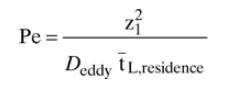
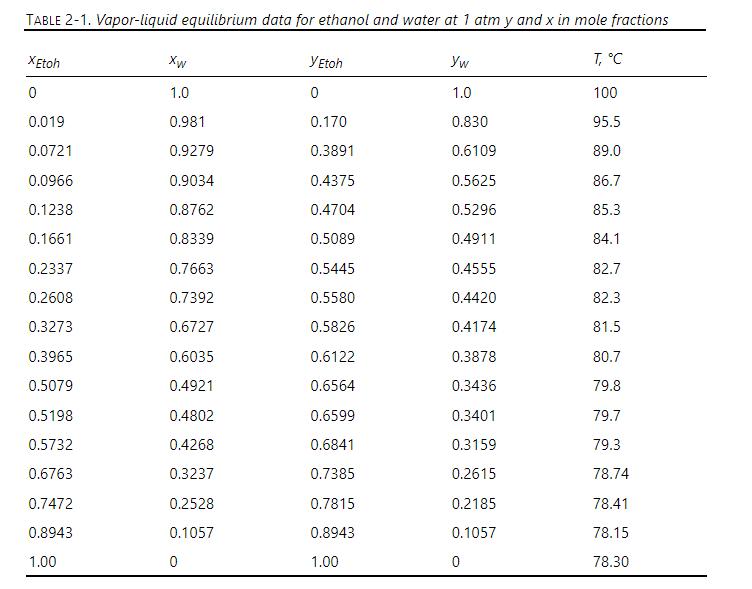
Use the Peclet number [Eq. (16-111a)] to determine which model (completely mixed or plug flow) is appropriate for the distillation column calculation at \(\mathrm{x}_{\mathrm{W}}=0.48\) in Problems 16.D21 and 16.D22. To determine \(\mathrm{z}_{1}\), use the tray geometry discussed in Section
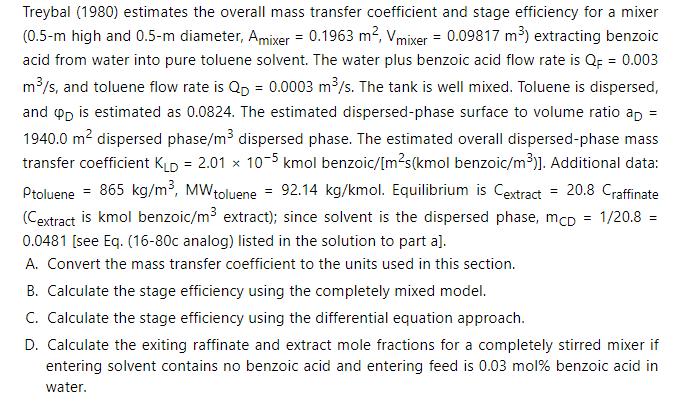
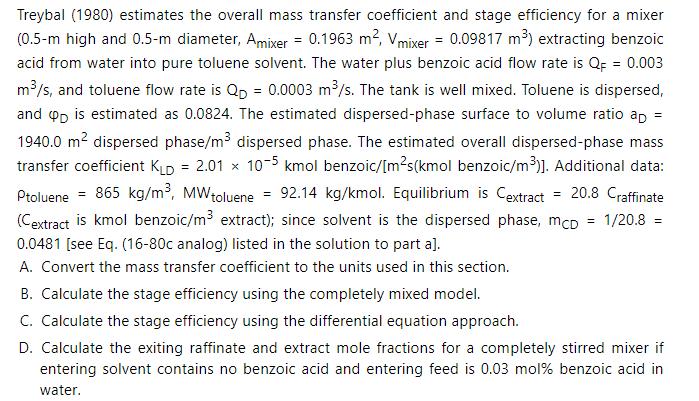
The value of \(\mathrm{E}_{\mathrm{MD}}=0.927\) in Example 16-5 is lower than the 0.95 value your supervisor expects. You are tasked to see if the current mixer with the current feed rate can be coaxed into operating at \(\mathrm{E}_{\mathrm{MD}}=0.95\) by reducing solvent flow rate \(\mathrm{S}\).
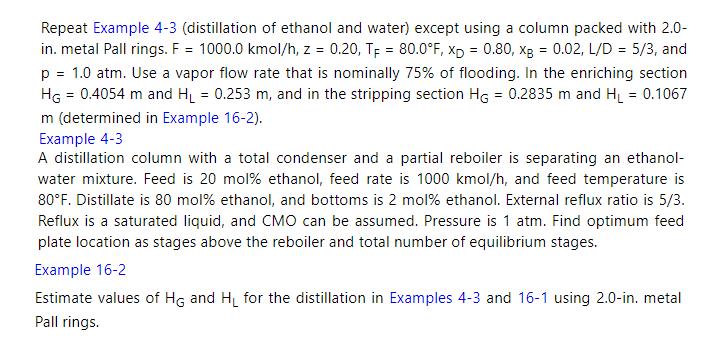
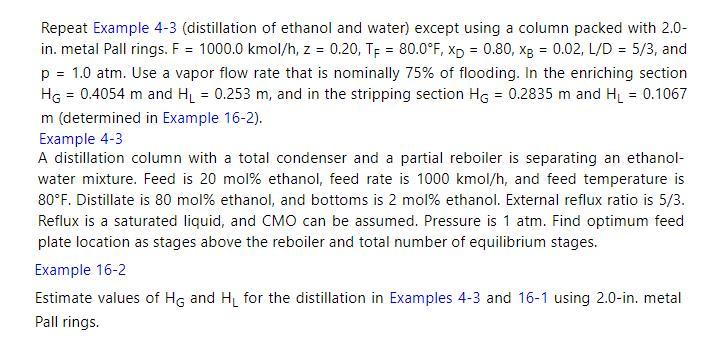
For Example 16-1, estimate an average \(\mathrm{H}_{\mathrm{OG}}\) in the stripping section. Then calculate \(\mathrm{n}_{\mathrm{OG}}\) and \(\mathrm{h}_{\mathrm{E}}=\mathrm{H}_{\mathrm{OG}, \text { avg }} \mathrm{n}_{\mathrm{OG}}\).Example 16-1 Repeat Example 4-3 (distillation of ethanol and
If 1.0 -in. metal Pall rings are used instead of 2.0 -in. rings in Example \(16-2\) :a. Recalculate flooding velocity and required diameter.b. Recalculate \(\mathrm{H}_{\mathrm{G}}\) and \(\mathrm{H}_{\mathrm{L}}\) in the enriching section.Example 16-2Example 4-3Example 16-1 Estimate values of HG
In part E of Example 16-2, a HETP value of \(2.15 \mathrm{ft}\) is calculated for the top of the enriching section. Since the average error in individual mass transfer coefficients \(\mathrm{k}_{\mathrm{y}}\) and \(\mathrm{k}_{\mathrm{x}}\) can be \(\pm 24.4 \%\) (Wankat and Knaebel, 2019),
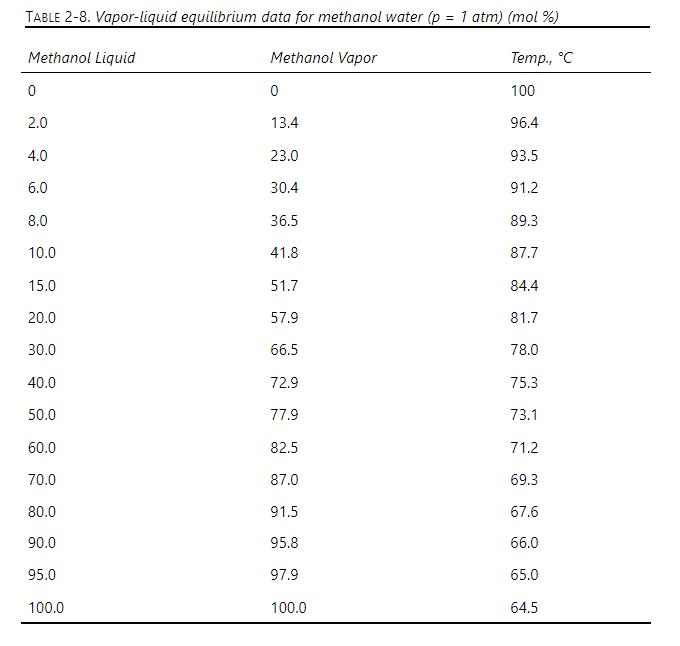
A distillation column at \(101.3 \mathrm{kPa}\) is separating a two-phase feed that is \(60.0 \%\) liquid, \(40.0 \mathrm{~mol} \%\) methanol, and \(60.0 \mathrm{~mol} \%\) water. Distillate product is \(92.0 \mathrm{~mol} \%\) methanol, and bottoms is \(4.0 \mathrm{~mol} \%\) methanol. A total
A distillation column with \(6.0 \mathrm{ft}\) of packing can be operated as a stripper with liquid feed, as an enricher with vapor feed, or at total reflux. We are separating methanol from isopropanol at \(101.3 \mathrm{kPa}\). Equilibrium can be represented by constant relative volatility,
A distillation column with \(8.01 \mathrm{~m}\) of packing operating at total reflux separates methanol from ethanol at \(101.3 \mathrm{kPa}\). Average relative volatility is 1.69 . Methanol mole fractions are \(\mathrm{y}_{\text {out }}=0.982\) and \(\mathrm{y}_{\text {in }}=\) 0.016 .a. Determine
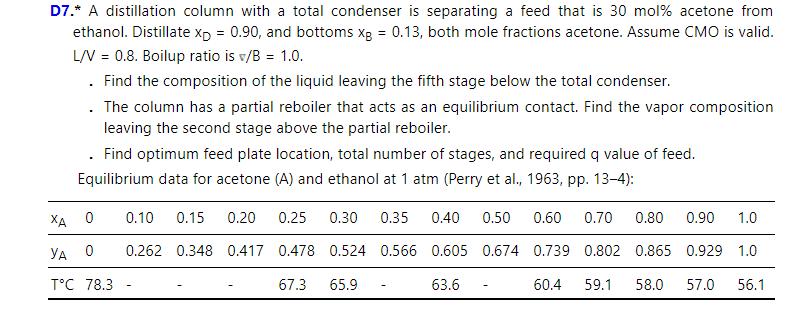
A distillation column operating at total reflux is separating acetone and ethanol at \(1.0 \mathrm{~atm}\). The height of packing is \(2.0 \mathrm{~m}\). The column has a partial reboiler and a total condenser. The bottoms composition is \(\mathrm{x}=\) 0.10 , and distillate composition is 0.90 .
We wish to strip \(\mathrm{SO}_{2}\) from water using pure air at \(20.0^{\circ} \mathrm{C}\). Outlet water contains \(0.0060 \mathrm{~mol} \% \mathrm{SO}_{2}\), and inlet water contains \(0.112 \mathrm{~mol} \% \mathrm{SO}_{2}\). Operation is at 0.72 bar, and \(\mathrm{V}=1.2 \times
If 1-in. metal Raschig rings are used instead of 2-in. rings in Example \(16-2\) :Example 16-2Example 4-3Example 16-1a. Recalculate the flooding velocity and the required diameter.b. Recalculate \(\mathrm{H}_{\mathrm{G}}\) and \(\mathrm{H}_{\mathrm{L}}\) in the enriching section. Estimate values of
A packed tower is used to absorb ammonia from air using aqueous sulfuric acid. Gas enters the tower at \(31.0 \mathrm{lbmol} /\left(\mathrm{h}-\mathrm{ft}^{2}\right)\) and is 1.0 \(\mathrm{mol} \%\) ammonia. Aqueous \(10.0 \mathrm{~mol} \%\) sulfuric acid is fed at a rate of \(24.0 \mathrm{lbmol}
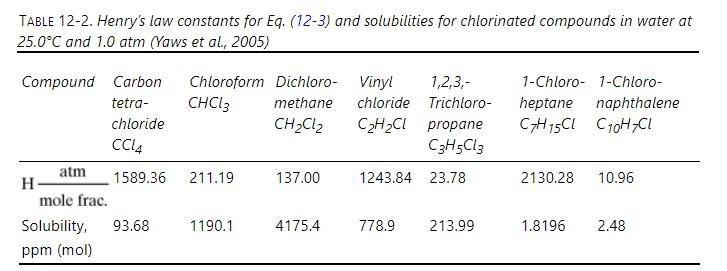
Water originally saturated with carbon tetrachloride \(\left(\mathrm{CCl}_{4}\right)\) at \(25.0^{\circ} \mathrm{C}\) and \(1.0 \mathrm{~atm}\) is stripped with pure air at \(25.0^{\circ} \mathrm{C}\) and \(745 \mathrm{~mm} \mathrm{Hg}\). Exit water has \(1.0 \mathrm{ppm}\) (mole) of
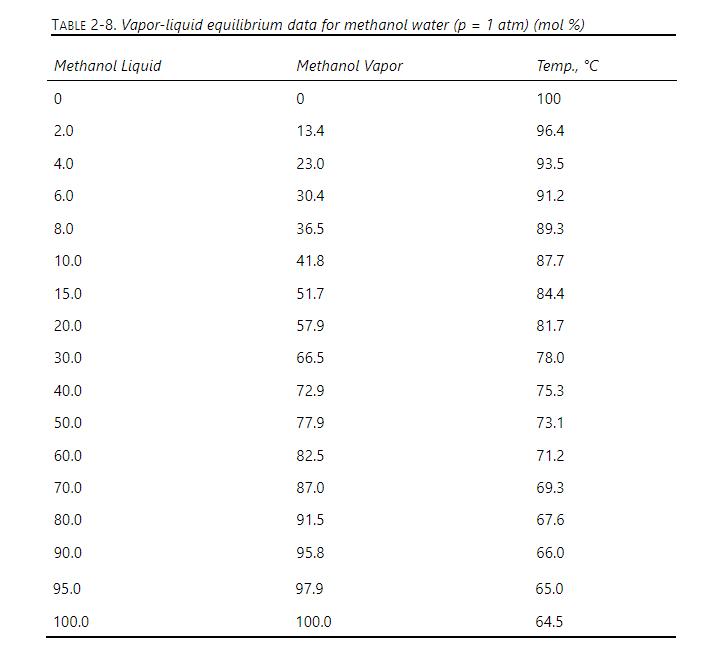
We are separating methanol and water in a staged distillation column at total reflux to determine Murphree efficiency. Pressure is \(101.3 \mathrm{kPa}\). The column has a 2.0 -in. head of liquid on each plug-flow stage. Molar vapor flux is \(30.0 \mathrm{lbmol}
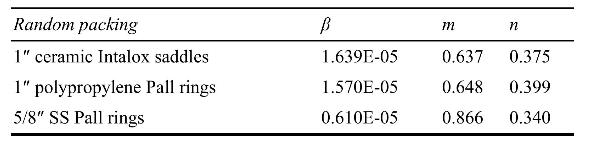
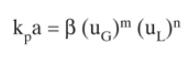
The constants obtained by Shende and Sharma (1974) for use in Eq. (16-72) are given in the following table. Assume their experiments with \(\mathrm{NaOH}-\mathrm{SO}_{2}\) were done at \(1.0 \mathrm{~atm}\) and \(303 \mathrm{~K}\), and the gas is ideal.a. Calculate \(\mathrm{k}_{\mathrm{p}}\) for
We are separating methanol and water in a staged distillation column at total reflux to determine Murphree efficiency. Pressure is \(101.3 \mathrm{kPa}\). The column has a 2.0 -in. head of liquid on each plug-flow stage. Molar vapor flux is \(30.0 \mathrm{lbmol}
The large-scale column in Example 16-4 is fed a saturated liquid with mole fraction \(\mathrm{z}=0.5\), and separation is essentially complete ( \(\mathrm{x}_{\text {dist }} \sim 1.0\) and \(\left.\mathrm{x}_{\text {bot }} \sim 0\right)\). Assume the Murphree vapor efficiency calculated in Example
Although the largest errors in calculating the height of a packed column are errors in (1) mass transfer coefficients and (2) VLE data, calculation errors can also be significant because calculation of \(n_{G}\) and \(\mathrm{n}_{\mathrm{OG}}\) both require subtracting \(\mathrm{y}\) values that
Errors in mass transfer coefficients obviously affect the value of \(\mathrm{H}_{\mathrm{G}}\) and hence the height of the packed section. These errors also affect calculation of \(\mathrm{y}_{\mathrm{AI}}\) and thus calculation of \(\mathrm{n}_{\mathrm{G}}\) and the height of the packed section.
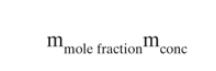
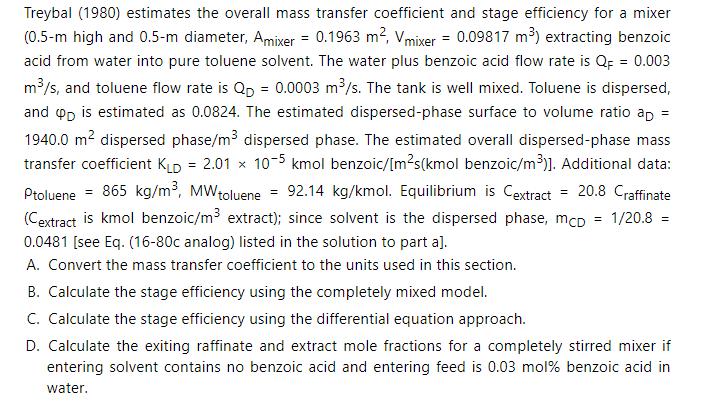
For extraction of benzoic acid from water into toluene with toluene the dispersed phase, we measure the following mole fractions of benzoic acid: \(\mathrm{x}_{\mathrm{D}, \text { in }}=0, \mathrm{x}_{\mathrm{D}, \text { out }}=0.00023\), and \(\mathrm{x}_{\mathrm{C}, \text { out }}=1.99 \times
For extraction of benzoic acid from water into toluene with toluene the dispersed phase, we measure the following concentrations of benzoic acid: \(\mathrm{C}_{\mathrm{D}, \text { in }}=0, \mathrm{C}_{\mathrm{D}, \text { out }}=0.00023\), and \(\mathrm{C}_{\mathrm{C}, \text { out }}=0.00536\) with
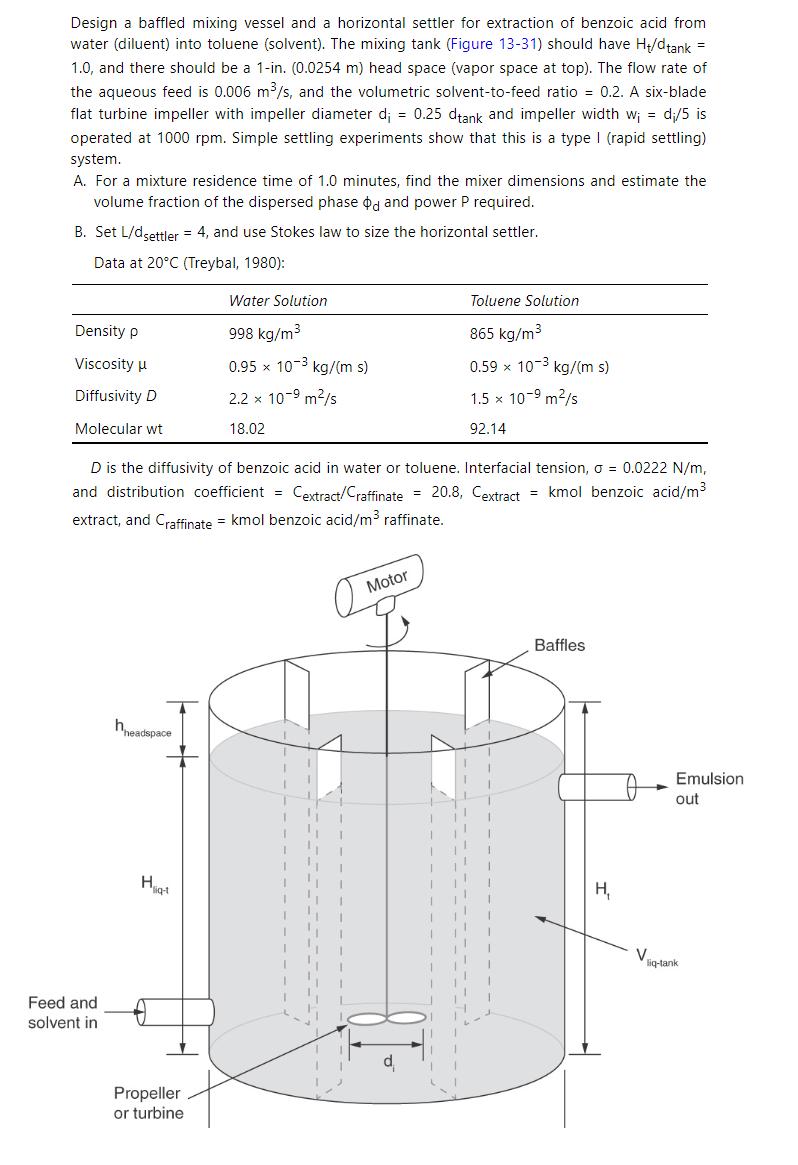
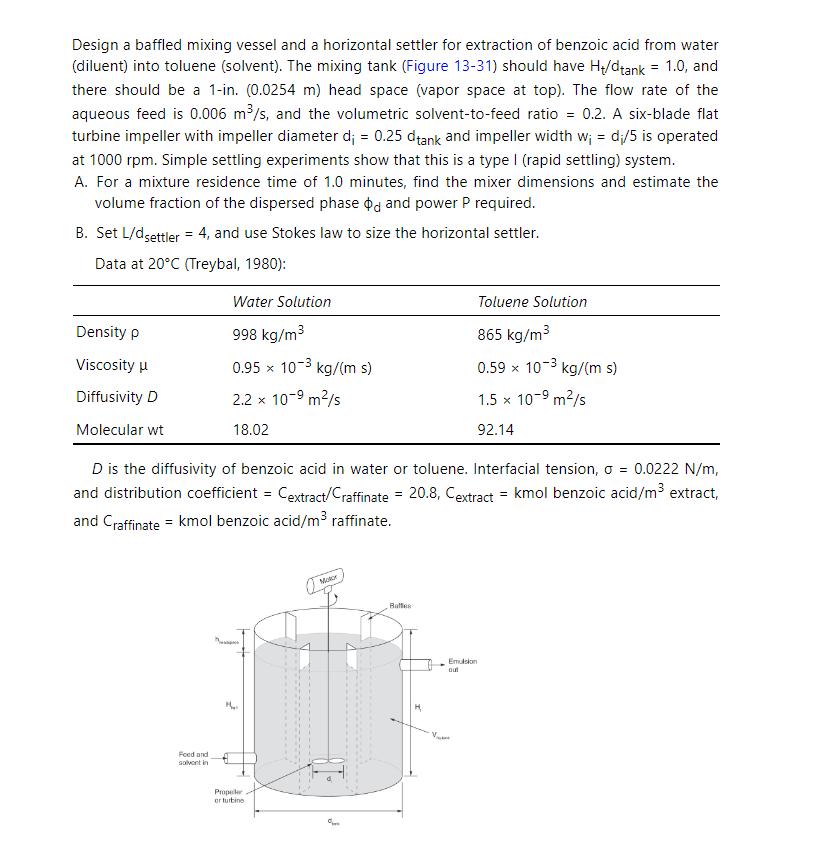
Estimate average particle diameter, mass transfer coefficients, and mixer stage efficiency for extraction of benzoic acid from water into toluene for Example 13-7.Example 13-7 Design a baffled mixing vessel and a horizontal settler for extraction of benzoic acid from water (diluent) into toluene
A small distillation column with a partial reboiler, a total condenser, and a liquid-liquid separator is separating \(100.0 \mathrm{kmol} / \mathrm{h}\) of saturated liquid feed that is \(19.0 \mathrm{~mol} \%\) water and \(81.0 \mathrm{~mol} \% \mathrm{n}\)-butanol. Operation is at \(1.0
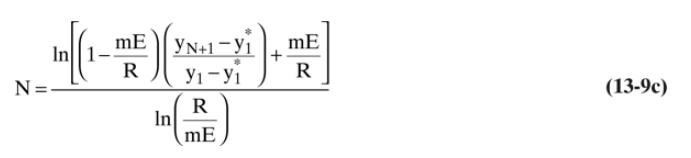
Compare Colburn Eq. (16-81d) to the equivalent Kremser Eq. (13-9c), and compare Eq. (16-81e) to \((13-9 b)\). If we relate \(\mathrm{n}_{\mathrm{O}-\mathrm{Ey}}\) to \(\mathrm{N}\) and set \(\mathrm{S}\) \(=\mathrm{E}, \mathrm{y}_{\mathrm{N}+1}=\mathrm{y}_{\text {in }},
Mass transfer models include transfer in only the packed region. Mass transfer also occurs in the column ends where liquid and vapor are separated. Discuss how these end effects affect a design. How could one experimentally measure end effects?
Are stages with well-mixed liquids less or more efficient than stages with plug flow of liquid (assume \(\mathrm{K}_{\mathrm{G}} \mathrm{a}\) are the same)? Explain your result with a physical argument.
a. The Bolles and Fair (1982) correlation indicates that \(\mathrm{H}_{\mathrm{G}}\) is more dependent on liquid flux than on gas flux. Explain this on the basis of a simple physical model.b. Why do \(\mathrm{H}_{\mathrm{G}}\) and \(\mathrm{H}_{\mathrm{L}}\) depend on the packing depth?c. Does
The following statement occurs after Eq. (16-50):"The variation in \(\mathrm{H}_{\mathrm{G}}\) over the column section is usually less than \(10 \%\). ." Explain why this statement is true. h=- YA,out S YA.in V (1-YA)1mdyA kyaA (1-YA)(YA-YA,I) (16-50)
Construct your key relations chart for this chapter.
While designing a mixer-settler extraction system, you obtain a mass transfer correlation from a book. Unfortunately, the book does not explain which model was used. Which model would you use to determine the stage efficiency? Why?
Explain why mass transfer correlations for co-flow cannot be used for countercurrent flow.
Why are mass transfer coefficients from clean drops higher than mass transfer coefficients in dirty systems? What is the practical significance of this?
The rate design method for distillation columns is less likely to converge, takes more time to set up, and requires more data than the equilibrium model. When would you decide you should use the rate design model?
How do we determine the height of packing required for a concentrated absorber or stripper if \(\mathrm{H}_{\mathrm{G}}\) is not constant?
Why do \(\mathrm{H}_{\mathrm{OG}}\) and \(\mathrm{H}_{\mathrm{OL}}\) vary more than \(\mathrm{H}_{\mathrm{L}}\) and \(\mathrm{H}_{\mathrm{G}}\), which often vary by about \(10 \%\) ?
Develop contactor designs that combine advantages of cocurrent, crossflow, and countercurrent cascades.
Derive the relationships among the different NTU terms for binary distillation.
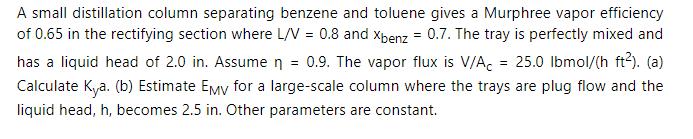
Derive the following expression for determining \(\mathrm{K}_{\mathrm{y}} \mathrm{a}\) from the measurement of \(\mathrm{E}_{\mathrm{MV}}\) in a distillation column if the flow pattern is plug flow.\[ \begin{equation*} \mathrm{K}_{\mathrm{y}} \mathrm{a}=-\left[\mathrm{V} /\left(\mathrm{h}
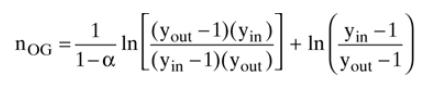
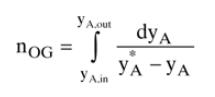
Derive the following equation to determine \(\mathrm{n}_{\mathrm{OG}}\) for distillation at total reflux for systems with constant relative volatility:\[ \begin{equation*} \mathrm{n}_{\mathrm{OG}}=\frac{1}{1-\alpha} \ln \left[\frac{\left(\mathrm{y}_{\text {out }}-1\right)\left(\mathrm{y}_{\text {in
Extraction is almost invariably a ternary mass transfer problem instead of binary because of partial miscibility of diluent and solvent. Typically, as solute is removed from diluent, solvent is less soluble in diluent and must also be transferred to the extract phase. As the extract phase gains
Both the Kremser and Colburn equations have special forms when \(\mathrm{mV} / \mathrm{L}=1.0\). The results of comparing these equations are Eqs. (16-33) and (16-36a), which relate HETP to \(\mathrm{H}_{\mathrm{OG}}\), and (16-36c), which relates HETP to \(\mathrm{H}_{\mathrm{OL}}\). Equate Eqs.
A short connecting pipe between two tanks is clogged with a plug of \(\mathrm{NaCl}\) crystals. The plug formed as a cylinder of circular cross-sectional area with a constant diameter \(D=2.0 \mathrm{~cm}\) and an initial length of \(1.0 \mathrm{~cm}\). The pipe is \(2.0 \mathrm{~cm}\) in diameter
Repeat Example \(15-7\) except with a forced flow with a velocity of \(1.05 \mathrm{~cm} / \mathrm{s}\) past the sphere. Use Eq. (15-60b) to determine \(\mathrm{k}_{\mathrm{c}}\). The viscosity of air at \(1.0 \mathrm{~atm}\) and the effect of pressure on viscosity are available at
Two identical large glass bulbs are filled with gases and connected by a capillary tube that is \(\delta=0.0100 \mathrm{~m}\) long. Bulb 1 at \(\mathrm{z}=0\) contains the following mole fractions: \(\mathrm{y}_{\text {air }}=\) \(0.520, \mathrm{y}_{\mathrm{H} 2}=0.480\), and
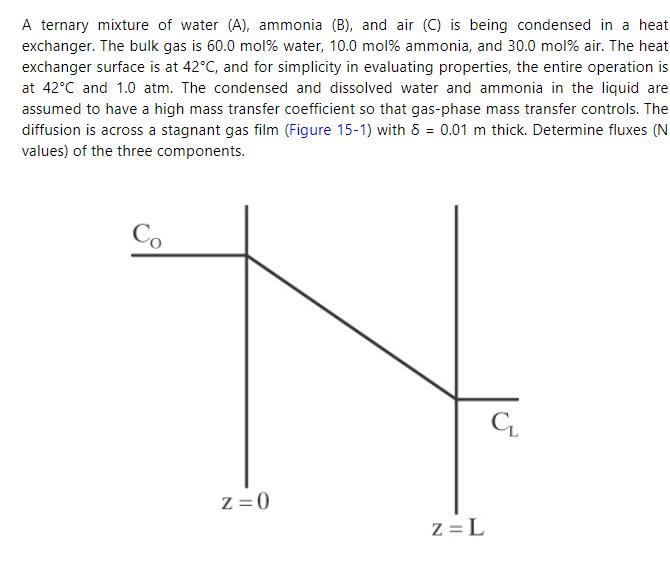
Repeat Example \(15-10\) but for a bulk gas that is \(40 \mathrm{~mol} \%\) air, \(15 \mathrm{~mol} \% \mathrm{NH}_{3}\), and 45 \(\mathrm{mol} \%\) water. Report \(\mathrm{x}_{\mathrm{NH} 3}, \mathrm{y}_{\mathrm{NH} 3 \text {,surface }}, \mathrm{N}_{\text {water }}\), and \(\mathrm{N}_{\mathrm{NH}
a. Repeat Problem 15.H1 (use the Maxwell-Stefan equations), but bulb 1 at \(\mathrm{z}=0\) contains the following mole fractions: \(\mathrm{y}_{\text {air }}=0.500, \mathrm{y}_{\mathrm{H} 2}=0.500\), and \(\mathrm{y}_{\mathrm{NH} 3}=0.000\). Bulb 2 at \(\mathrm{z}=\delta\) contains
Repeat Problem 15.H1, but bulb 1 at \(\mathrm{z}=0\) contains the following mole fractions: \(\mathrm{y}_{\text {air }}\) \(=0.520, \mathrm{y}_{\mathrm{H} 2}=0.480\), and \(\mathrm{y}_{\mathrm{NH} 3}=0.000\). Bulb 2 at \(\mathrm{z}=\delta\) contains \(\mathrm{y}_{\text {air }}=0.520,
Repeat Example \(15-8\) but for a pressure of \(1.1 \mathrm{~atm}\). Note that the diffusivities depend on pressure. Also answer Problem 15.A6.Example 15-8Problem 15.A6In Problem \(15 . \mathrm{H} 5\) changing the pressure changes the diffusivities but does not change the Henry's law constant of
A pipeline containing \(99.0 \mathrm{~mol} \%\) ammonia and \(1.0 \mathrm{~mol} \%\) hydrogen gas is vented to ambient air via a \(15 \mathrm{~m}\) long, \(3.5 \mathrm{~mm}\) diameter tube. Temperature and pressure everywhere are \(0^{\circ} \mathrm{C}\) and \(101,325 \mathrm{~Pa}\), respectively.
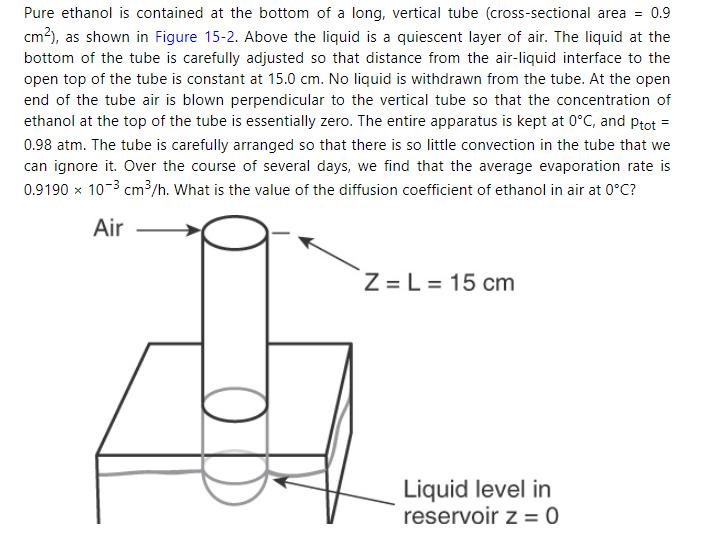
In Example 15-2, operation is at a pseudo-steady state. Brainstorm alternative designs for this diffusion measurement.Example 15-2 Pure ethanol is contained at the bottom of a long, vertical tube (cross-sectional area = 0.9 cm), as shown in Figure 15-2. Above the liquid is a quiescent layer of air.
Although the additive approach traditionally used for coupling Fickian diffusion with convection appears logical and works for calculating total fluxes of \(A\) and \(B\), this is not the only way one could tackle the problem. For binary systems this approach has the advantages of forcing
Think of an experiment to measure diffusion coefficients that you could set up at home or in your apartment. Detail the equipment list. Estimate the amount of change you will observe. Will you be able to make accurate measurements? What could go wrong that will skew results?
You have been invited to give a talk on mass transfer at the local high school. You want to show a live demonstration. Brainstorm at least five different demonstrations that you can develop with very simple apparatus-preferably made from standard cooking equipment.
Develop roleplays to illustrate:a. The difference between ordinary and Knudsen diffusion.b. The difference between Fickian and Maxwell-Stefan diffusion.
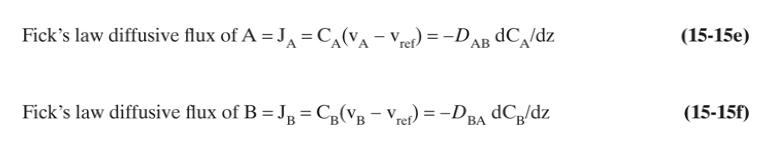
For binary diffusion with convection, use Eqs. (15-15e), (15-15f), (15-17a), (15-17b), and sum of mole fractions equals 1.0 to show that \(D_{\mathrm{AB}}=D_{\mathrm{BA}}\). Fick's law diffusive flux of A =JA = CA (VA - Vref) = -DAB dc/dz Fick's law diffusive flux of B = JB = CB(VB - Vref) = -DBA
For binary distillation with \(\mathrm{CMO}, \mathrm{v}_{\text {ref,mol }}=0\). If \(\mathrm{CMO}\) is valid, show that \(\mathrm{v}_{\text {ref,mass }} eq 0\) if \(\mathrm{MW}_{\mathrm{A}} eq \mathrm{MWB}_{\mathrm{A}}\), and calculate the functional form for \(\mathrm{v}_{\text {reff,mass }}\)
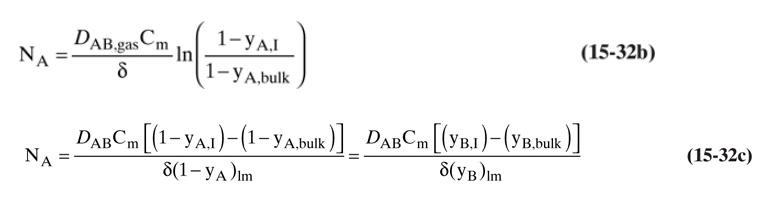
Derive the equation that is equivalent to Eqs. (15-32b) and (15-32c) in terms of a partial pressure driving force and a \(\log\) mean partial pressure difference:\[ \begin{equation*} \left(\mathrm{p}_{\mathrm{B}}\right)_{\operatorname{lm}}=\frac{\left(\mathrm{p}_{\mathrm{B},
Derive Eq. (15-40a).Equation (15-40a) KPL.mol 1-C3XA.I.mol PL.mol NA,mol In C3=1+ C3 1-C3XA.bulk,mol. PS,mol
Use the general solution in Perry's Chemical Engineers' Handbook (Wankat and Knaebel, 2019, p. 5-47) to solve the problem of a dissolving solid in a concentrated fluid using the known ratio of \(\mathrm{N}_{\mathrm{A}} / \mathrm{N}_{\mathrm{B}}\).
Starting with Eqs. (15-74a) and (15-74b), derive Eq. (15-74c). Note: Because \(\mathrm{x}_{\mathrm{W}}=1\) \(-\mathrm{x}_{\mathrm{E}}, \mathrm{x}_{\mathrm{W}}\) is not a constant. B A and In Yw (15-74a, b) In YE= AXE BXW 1+ 1+ AXE BXW
For the dissolution of platelets in dilute solution with independent dissolution mass transfer coefficients for the flat and growth sides,a. Show that\[ \begin{aligned} & h=-2 k_{\text {flat }} ho_{\text {liquid }}\left(x_{A, \text { solubility,mass }}-x_{A, \text { bulk,mass }}\right) t /
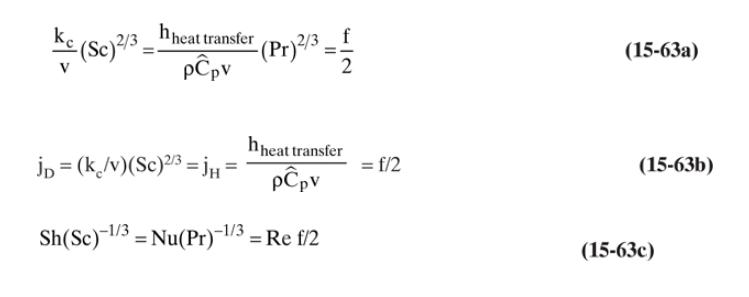
Derive Eq. (15-63c) from Eq. (15-63a). kc (Sc) 2/3 hheat transfer pcpv (Pr)2/3 = hheat transfer JD = (k/v)(Sc)2/3=j = Sh(Sc) 1/3=Nu(Pr)-1/3 = Re f/2 = f/2 pcpv (15-63a) (15-63b) (15-63c)
Repeat the numerical integration in Example 15-5, except use the quadrature formula, Eq. \((9-12)\)Example 5-5Equation (9-12) A steady-state system of ethanol and water has equimolar counterdiffusion across a liquid film of thickness 1.2 10-5m. At z = 0, the ethanol mole fraction is 0.010, and at
For the same system as in Problem 15.D1, the high concentration \(\mathrm{C}_{\mathrm{A}, 0}=1.2 \mathrm{~kg} / \mathrm{m}^{3}\) and \(\mathrm{C}_{\mathrm{A}, \mathrm{L}}=0.9701 \mathrm{~kg} / \mathrm{m}^{3}\), which is same as in Problem 15.D1, but we want a flux rate \(=0.35 \times 10^{-5}
A column arrangement similar to Figure \(15-2\) is used for organic liquids. A large reservoir of water is under the column. The water is stirred and solute concentration in the water is constant. The organic liquid is immiscible in water and floats on the water surface at \(\mathrm{z}=0\). Mole
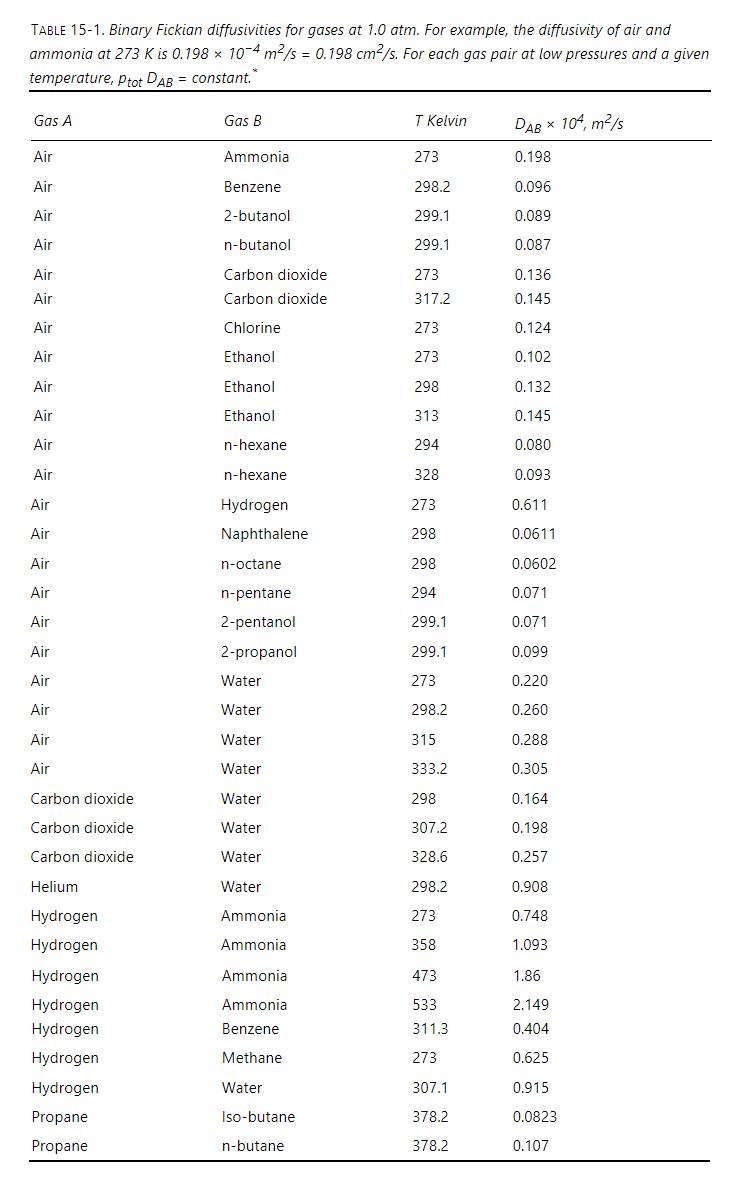
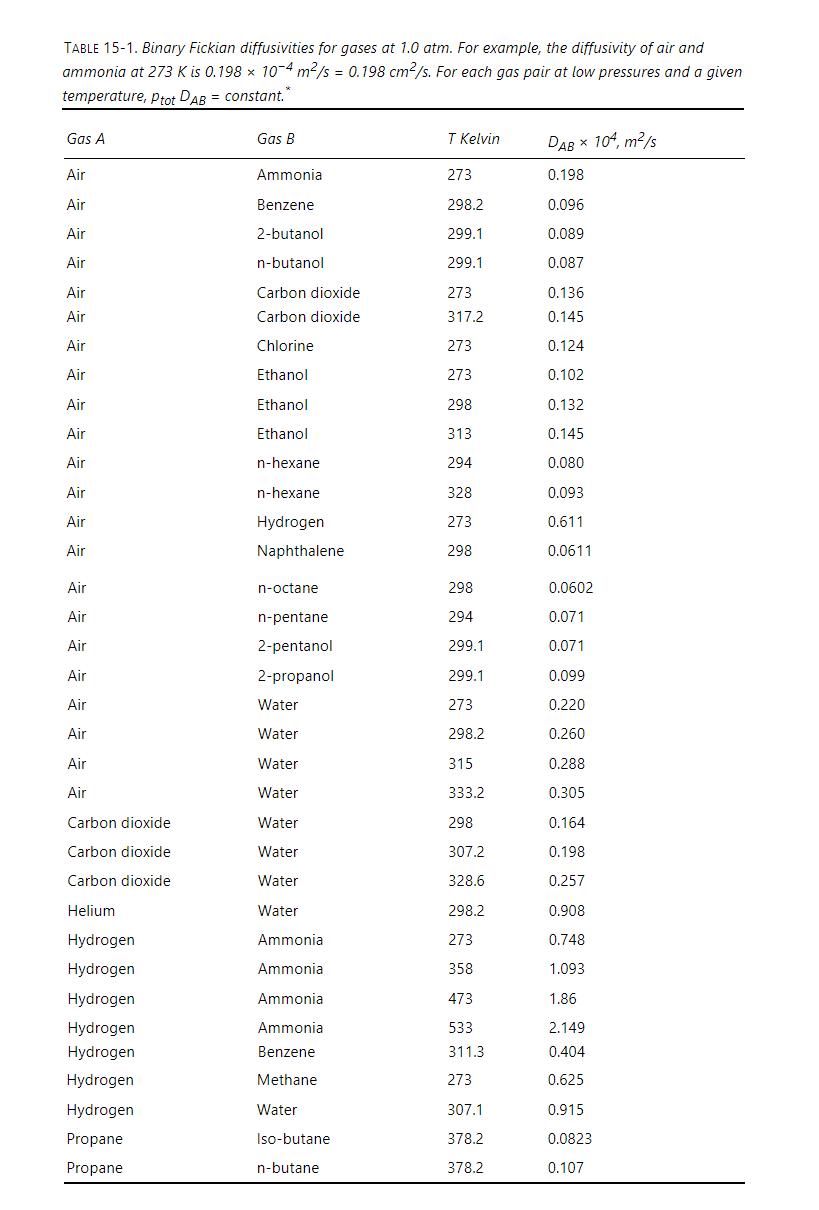
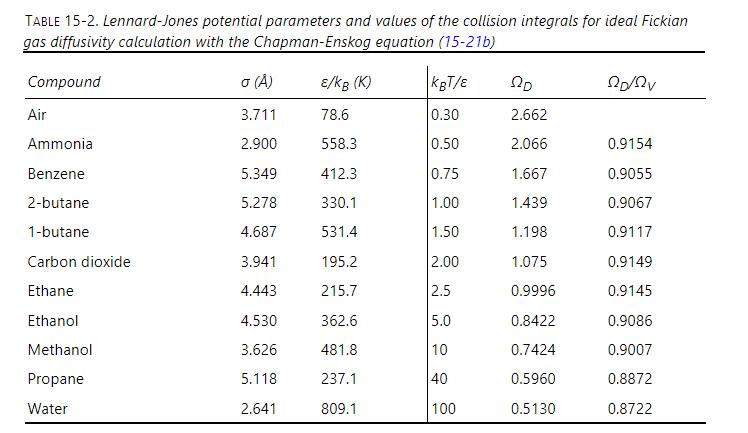
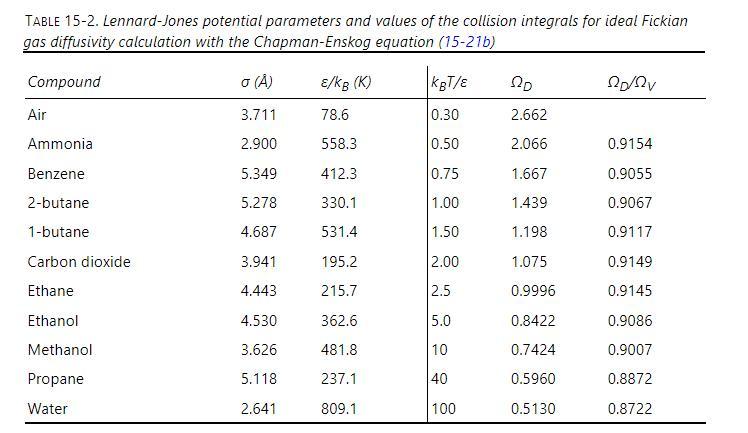
a. Estimate the Fickian diffusivity of a binary mixture of benzene and air at \(298.2 \mathrm{~K}\) and \(1.0 \mathrm{~atm}\) pressure using Chapman-Enskog theory and Table 15-2.b. Compare your result with the experimental value in Table 15-1.c. Estimate the Fickian diffusivity at \(273
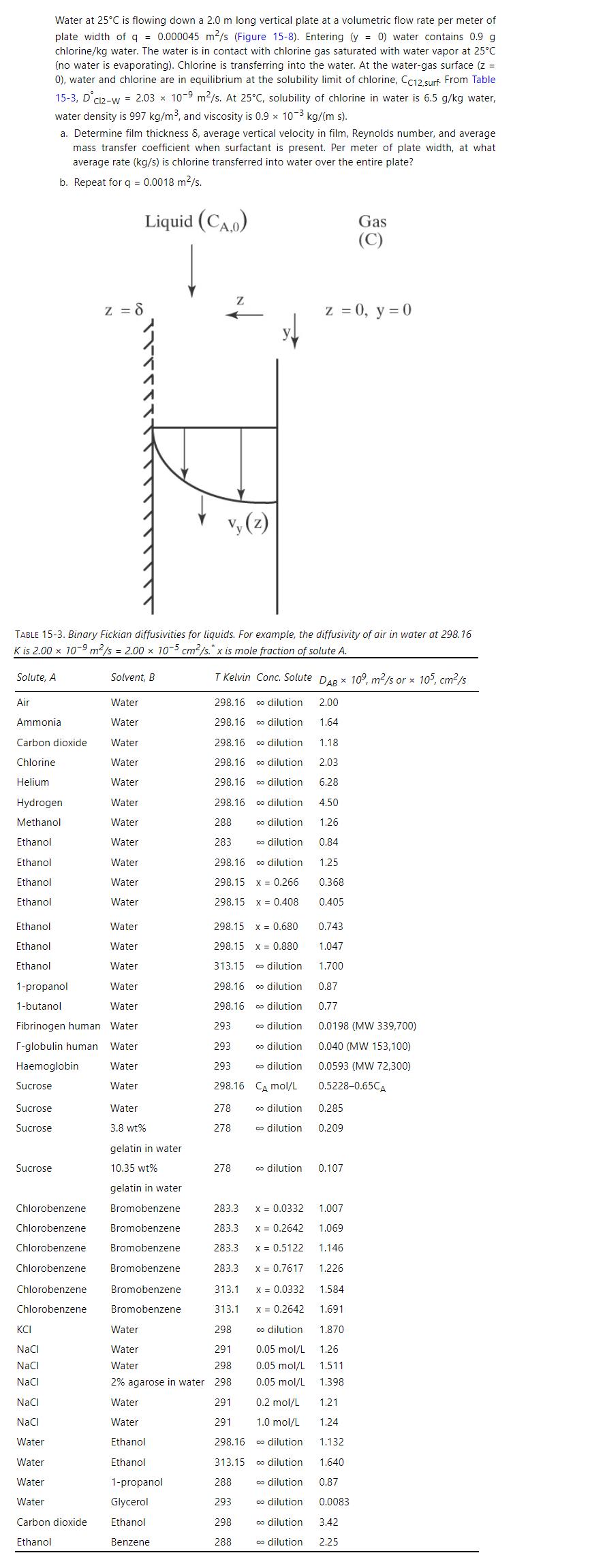
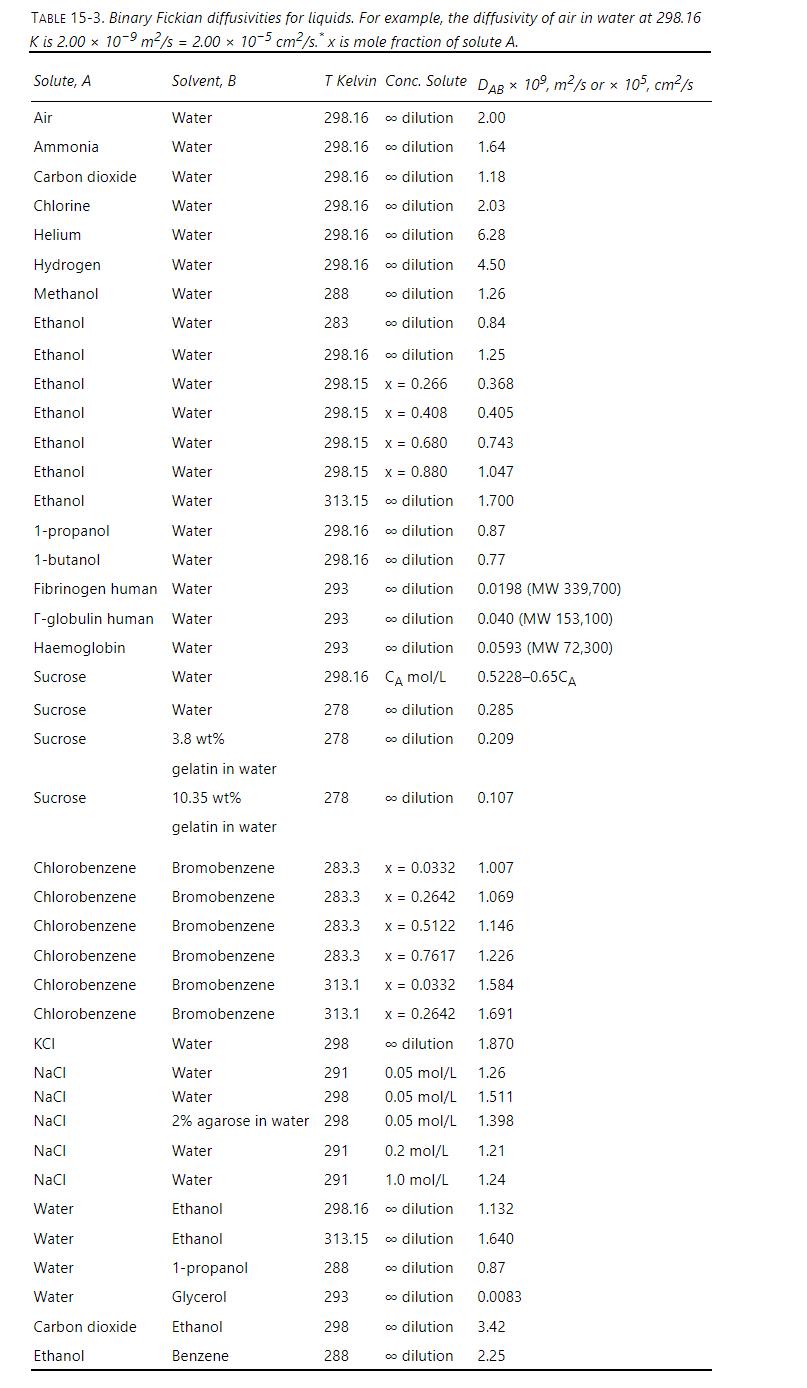
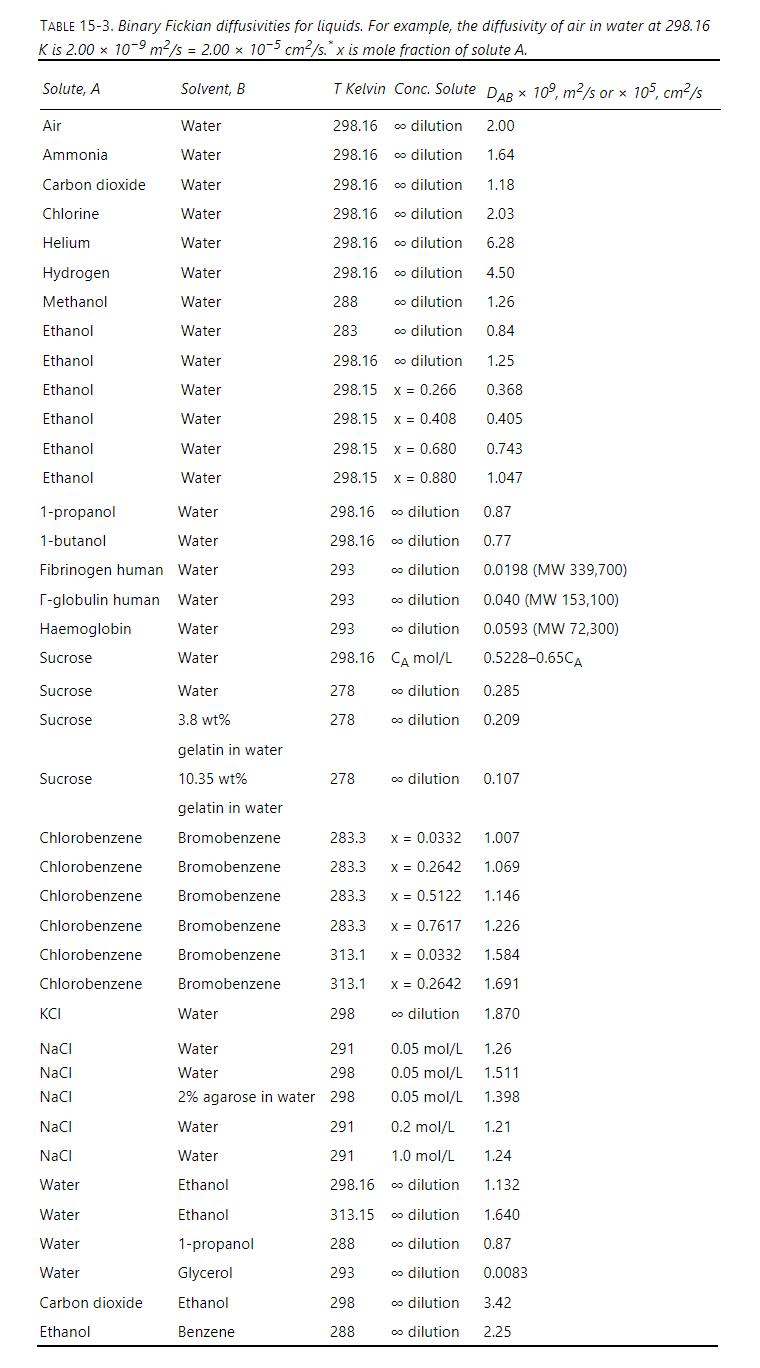
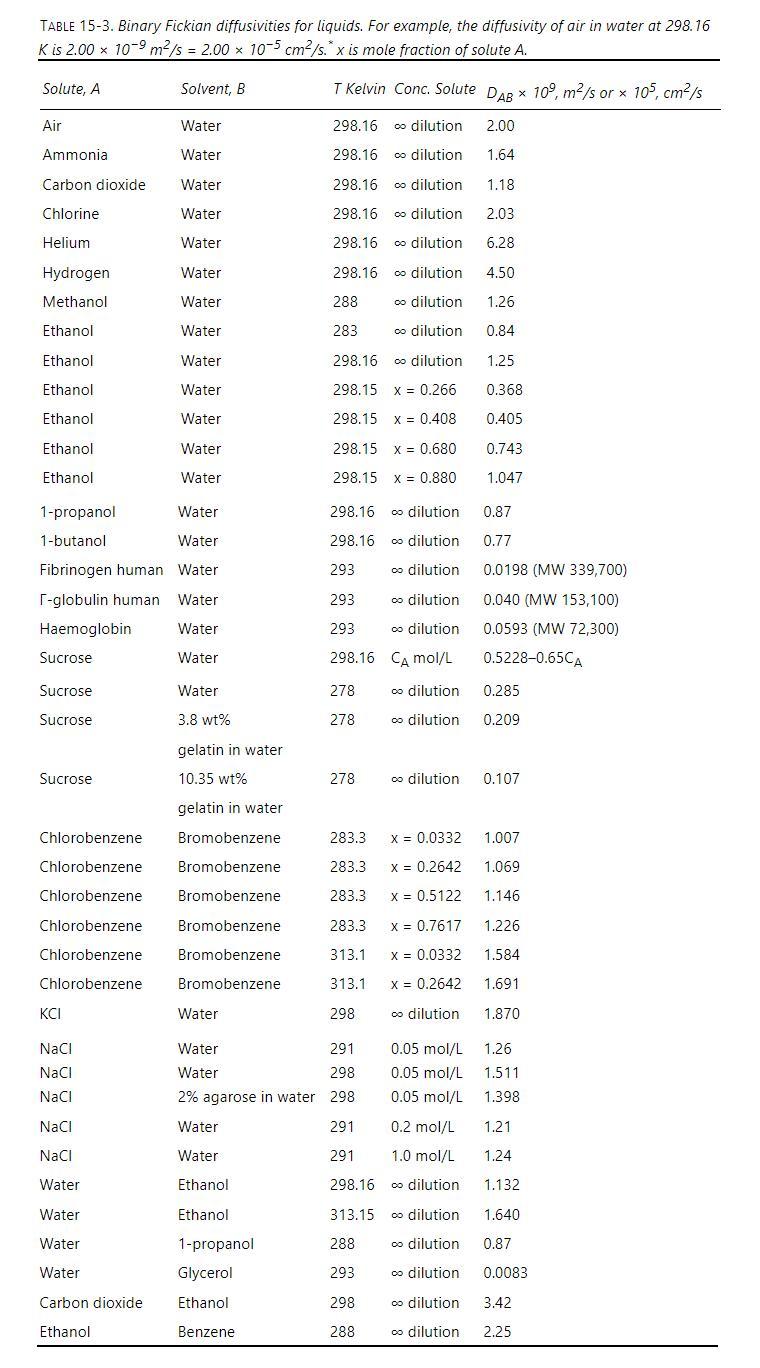
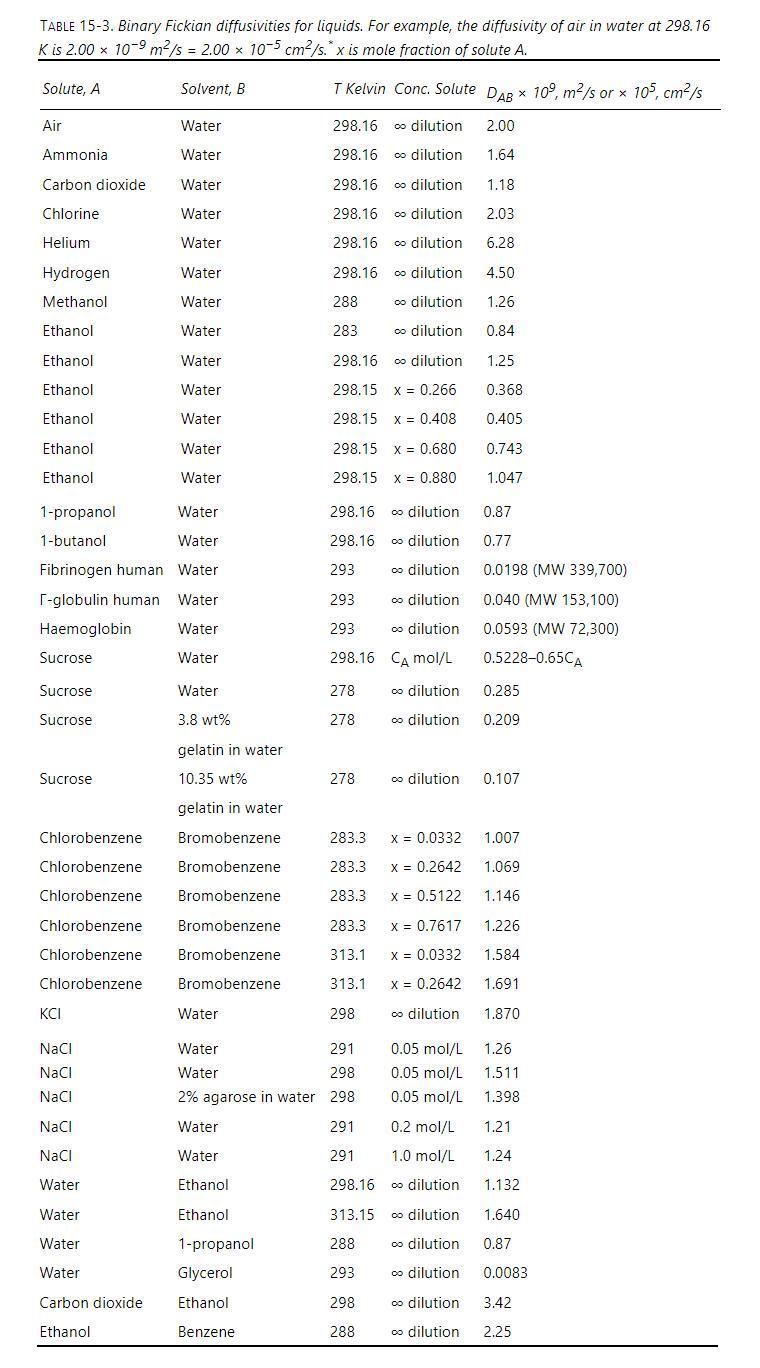
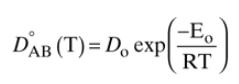
What is the Fickian diffusivity of chlorobenzene in liquid bromobenzene at \(300 \mathrm{~K}\) when the mole fraction of chlorobenzene is 0.0332 ? Assume that the diffusivity follows an Arrhenius form and use the data in Table 15-3 to determine \(\mathrm{E}_{\mathrm{o}}\). Also report the value of
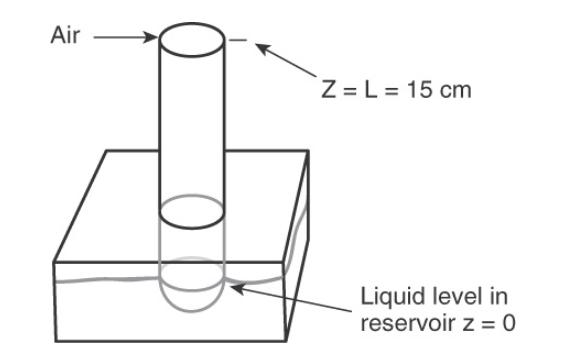
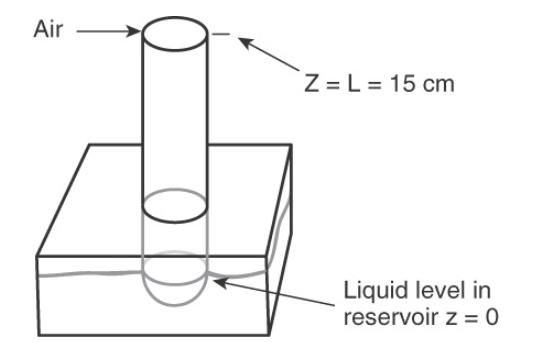
Water at \(60^{\circ} \mathrm{C}\) and 0.95 bar is evaporating into a \(12.0 \mathrm{~cm}-1\) ong tube (also at \(60^{\circ} \mathrm{C}\) ) and diffusing through a stagnant layer of air. The device is illustrated in Figure 15-2.a. Calculate the flux of water vapor if convection is included.b.
Assuming that the mixture is ideal, estimate infinite dilution Fickian diffusivities at 283.3 \(\mathrm{K}\) for chlorobenzene in liquid bromobenzene and for bromobenzene in liquid chlorobenzene from data in Table 15-3. TABLE 15-3. Binary Fickian diffusivities for liquids. For example, the
Use the Wilke-Chang theory to estimate infinite dilution Fickian diffusivity of ethanol in liquid water at \(293.16 \mathrm{~K}\) and of water in liquid ethanol. Data are available at www.engineeringtoolbox.com and https://www.cheric.org/research/kdb/ (click on Pure Component Properties and search
Determine the modified Sherwood number \(\mathrm{Sh}_{\text {gas,partial_pressure }}=\frac{\mathrm{k}_{\mathrm{p}} \mathrm{d}_{\text {tube }}\left(\mathrm{p}_{\mathrm{B}}\right)_{\mathrm{lm}}}{D_{\mathrm{AB}} \mathrm{p}_{\text {tot }}}\) for gas-side-controlled mass transfer for distillation of
A pipeline containing ammonia gas is vented to ambient air via a \(20-\mathrm{m}\) long, \(3-\mathrm{mm}\) diameter tube. What is the mass flow ( \(\mathrm{g} /\) day) of ammonia into the atmosphere? What is the mass flow of air into the pipeline (g/day)? Temperature and pressure everywhere are
We have steady-state diffusion of ammonia in air across a \(0.033 \mathrm{~mm}\) thick film. On one side of the film ammonia concentration is \(0.000180 \mathrm{kmol} / \mathrm{m}^{3}\), and on the other side it is \(0.000257 \mathrm{kmol} / \mathrm{m}^{3}\). What operating temperature is required
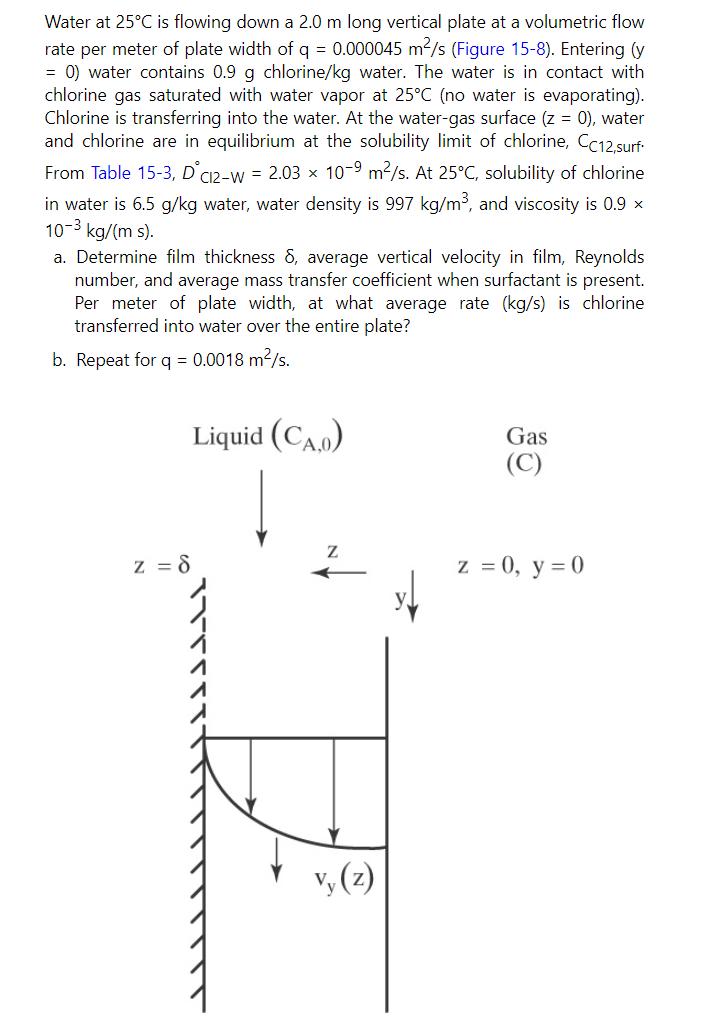
Water at \(20^{\circ} \mathrm{C}\) is flowing down a \(3.0 \mathrm{~m}\) long vertical plate at a volumetric flow rate per meter of plate width of \(q=0.000005 \mathrm{~m}^{2} / \mathrm{s}\). Entering \((y=0)\) water is pure. The water is in contact with carbon dioxide gas that is saturated with
Repeat all parts of Problem 15.D12 but with a water rate of \(q=0.000015 \mathrm{~m}^{2} / \mathrm{s}\).Problem 15.D12Water at \(20^{\circ} \mathrm{C}\) is flowing down a \(3.0 \mathrm{~m}\) long vertical plate at a volumetric flow rate per meter of plate width of \(q=0.000005 \mathrm{~m}^{2} /
Repeat Problem 15.D12 but for \(\mathrm{q}=0.0015 \mathrm{~m}^{2} / \mathrm{s}\).a. Determine film thickness \(\delta\), average vertical velocity of film, and Reynolds number.b. Determine average mass transfer coefficient and average Sherwood number.c. Per meter of plate width, at what rate
We are measuring the diffusivity of water in air at \(42^{\circ} \mathrm{C}\). A tube is placed with one end in the water and the other end in a stream of dry air. The air column in the tube is 22\(\mathrm{cm}\) long, and we assume mole fraction of water is zero at the end in the air stream,
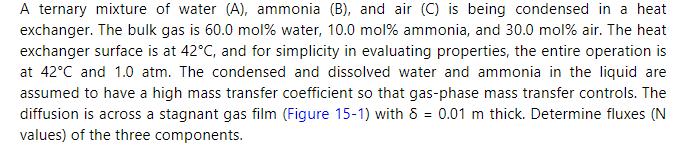
Repeat Example 15-10 but with a mass transfer coefficient that is 10 times larger (use \(\delta=0.001 \mathrm{~m})\). Report \(\mathrm{x}_{\mathrm{NH} 3}, \mathrm{y}_{\mathrm{NH} 3, \text { surface }}, \mathrm{N}_{\text {water }}\), and \(\mathrm{N}_{\mathrm{NH} 3}\).Example 15-10 A ternary mixture
A particle of pure \(\mathrm{NaCl}\) is dissolving in an aqueous liquid solution at \(18^{\circ} \mathrm{C}\). The dissolution of the particle is controlled by mass transfer. The system is vigorously stirred, and the mass transfer coefficient \(\mathrm{k}=7.2 \times 10^{-5} \mathrm{~m} /
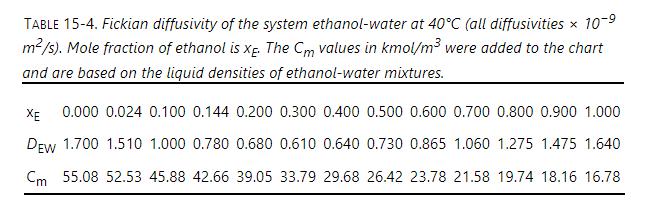
Calculate the value of Maxwell-Stefan diffusivity for ethanol water at \(40^{\circ} \mathrm{C}\) for ethanol mole fractions of \(0.0,0.2,0.3,0.4,0.7\), and 1.0 . The Fickian diffusivities are available in Table 15-4. Which set of diffusivities are closer to linear?Table 15-4 TABLE 15-4. Fickian
\(\mathrm{NaCl}\) is crystallizing from an aqueous (water) liquid solution onto a crystal particle of pure \(\mathrm{NaCl}\) at \(18^{\circ} \mathrm{C}\). Assume particle growth is controlled by mass transfer, and the particle is spherical. The aqueous solution is supersaturated at a mass fraction
A \(2 \mathrm{~cm}\)-diameter, \(19 \mathrm{~cm}\)-long tube is placed touching a pool of liquid. The end away from the liquid pool \((\mathrm{z}=0.19 \mathrm{~m})\) is in an air stream (component C) so that it is pure air, \(\mathrm{y}_{\mathrm{C}}(\mathrm{z}=0.19 \mathrm{~m})=1.0\). The liquid is
A crystal particle of pure \(\mathrm{NaCl}\) is dissolving in an aqueous liquid (water) solution at \(18^{\circ} \mathrm{C}\). The dissolution of the particle is controlled by mass transfer. The aqueous solution is at a mass fraction of \(\mathrm{NaCl}=0.25\).Data: Solubility of \(\mathrm{NaCl}\)
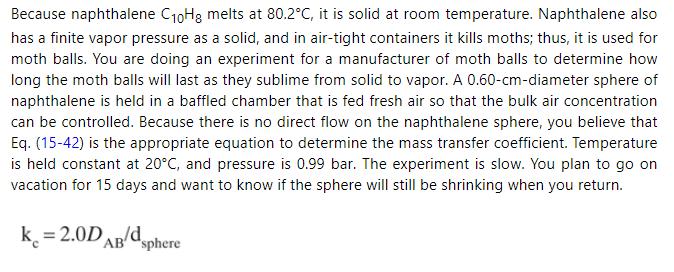
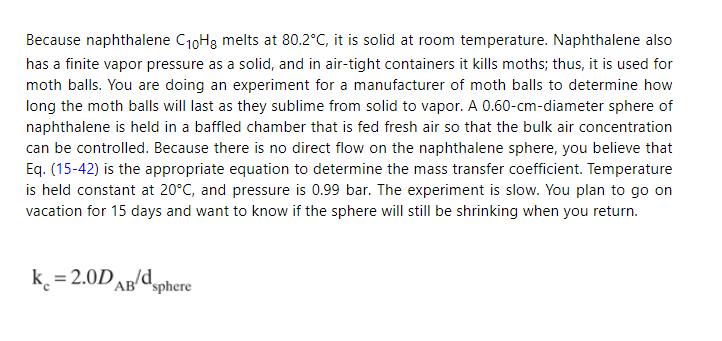
Solve Example 15-7 using the difference equation form of the Maxwell-Stefan equations.Example 15-7 Because naphthalene C10Hg melts at 80.2C, it is solid at room temperature. Naphthalene also has a finite vapor pressure as a solid, and in air-tight containers it kills moths; thus, it is used for
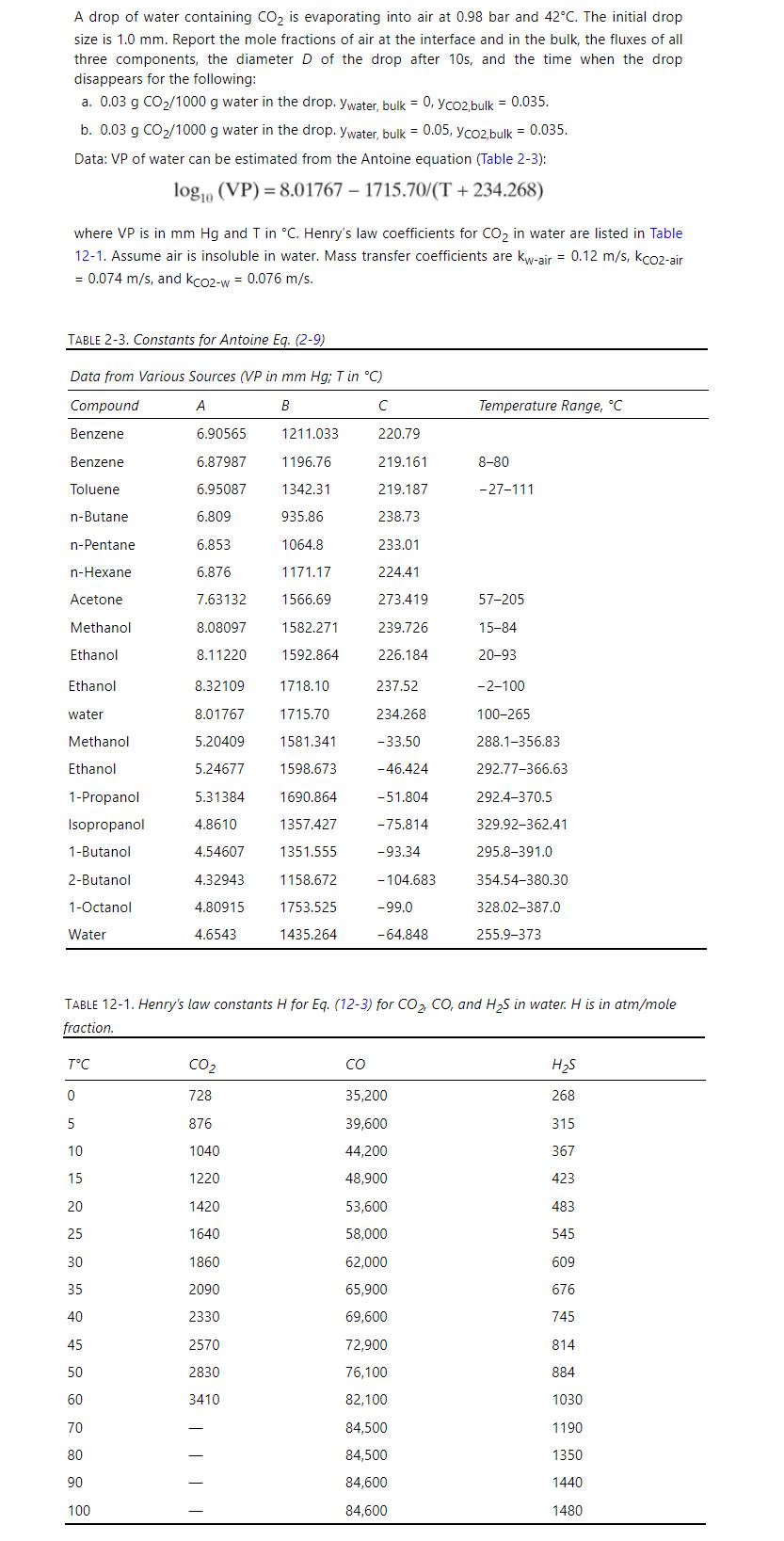
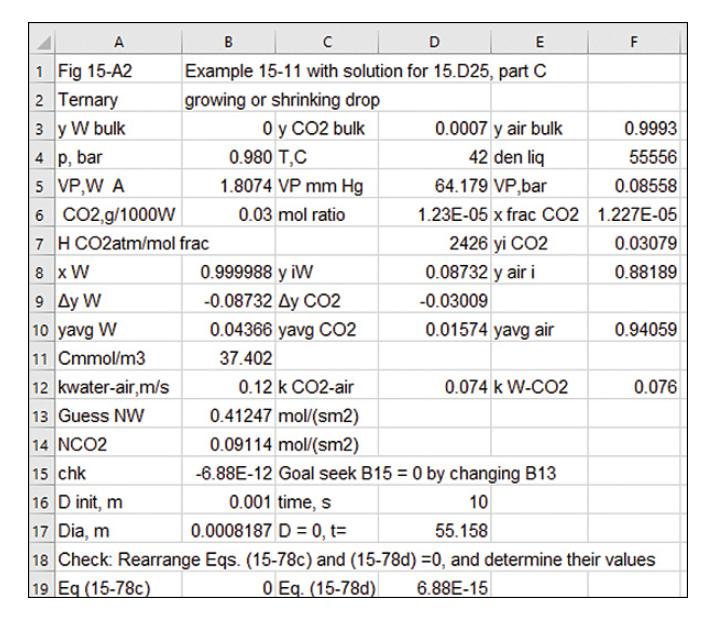
Repeat Example 15-11 for the following conditions:a. \(0.03 \mathrm{~g} \mathrm{CO}_{2} / 1000 \mathrm{~g}\) water in the drop. \(\mathrm{y}_{\text {water, bulk }}=0, \mathrm{y}_{\mathrm{CO} 2, \text { bulk }}=0.05\).b. \(0.00 \mathrm{~g} \mathrm{CO}_{2} / 1000 \mathrm{~g}\) water in the drop.
Estimate \(\mathrm{Sc}_{\mathrm{V}}\) for a saturated vapor mixture that is \(80 \mathrm{~mol} \%\) ethanol and \(20 \mathrm{~mol} \%\) water at \(1.0 \mathrm{~atm}\).
This problem can be solved analytically or with a spreadsheet. Two identical large glass bulbs are filled with gases and connected by a capillary tube that is \(\delta=0.0090\) \(\mathrm{m}\) long. Bulb 1 at \(\mathrm{z}=0\) contains the following mole fractions: \(\mathrm{y}_{\mathrm{air}}=0.620,
Repeat Problem 15.D27, but bulb 2 at \(\mathrm{z}=\delta\) contains \(\mathrm{y}_{\mathrm{air}}=0.610, \mathrm{y}_{\mathrm{H} 2}=0.010\), and \(\mathrm{y}_{\mathrm{NH} 3}=0.380\).Problem 15.D27This problem can be solved analytically or with a spreadsheet. Two identical large glass bulbs are filled
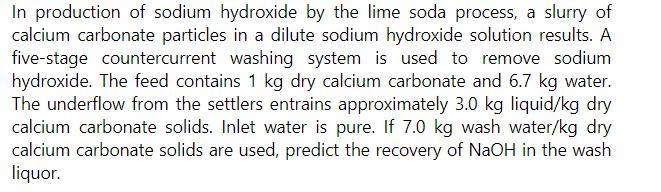
Check the solution to Example 14-1 with a McCabe-Thiele calculation.Example 1 In production of sodium hydroxide by the lime soda process, a slurry of calcium carbonate particles in a dilute sodium hydroxide solution results. A five-stage countercurrent washing system is used to remove sodium
Alumina solids are being washed to remove \(\mathrm{NaOH}\) from liquid entrained with solids. The wet feed is a mixture of \(5.0 \mathrm{vol} \%\) solids (dry basis) and \(95.0 \mathrm{vol} \%\) liquid. Underflow streams from settlers maintain \(20.0 \mathrm{vol} \%\) of solids and \(80.0
Repeat Problem 14.D2 except for countercurrent process witha. Three stages.b. Eight stages.Data From Problem 14.D2Alumina solids are being washed to remove \(\mathrm{NaOH}\) from liquid entrained with solids. The wet feed is a mixture of \(5.0 \mathrm{vol} \%\) solids (dry basis) and \(95.0
Wash alumina solids to remove \(\mathrm{NaOH}\) from the entrained liquid. Underflow from the settler tank is \(20.0 \mathrm{vol} \%\) solid and \(80.0 \mathrm{vol} \%\) liquid. Two feeds to the system are also \(20.0 \mathrm{vol} \%\) solids. In one of these feeds, the \(\mathrm{NaOH}\)
Your boss thinks it will be just as good to combine the two feeds in Problem 14.D4 than to keep them separate. Calculate the number of equilibrium stages required to achieve the same outlet concentrations with the same flow rates if two feeds are combined before being fed to the washing cascade.
Your company is interested in purchasing a small company that produces barium that they sell to superconductor and electroceramic manufacturers. They have asked you to do some lab scale batch-washing experiments with barium sulfide \((\mathrm{BaS})\).a. First, you obtain some dry solids from the
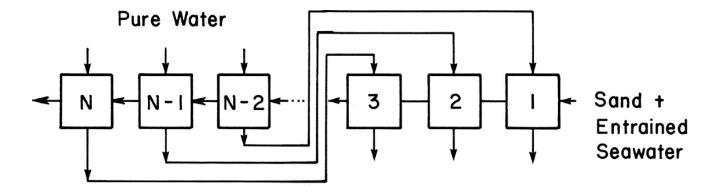
You are designing a new glass factory near the ocean. Sand is to be mined wet from the beach. However, wet sand carries with it seawater entrained between sand grains. Salt must be removed by a washing process. A crossflow process will be employed with \(0.2 \mathrm{~kg}\) of wash water added to
We plan to remove dilute sulphuric acid and dilute \(\mathrm{HCl}\) from crushed rock by washing it with water in a continuous countercurrent process with five equilibrium stages. The feed is \(1000.0 \mathrm{~kg} / \mathrm{h}\) (dry, crushed) rock that entrains the same amount of underflow liquid
Experimental data for leaching sugar from sugarcane with water show that a reasonable value for effective equilibrium constant \(y / x=m_{E}\) is 1.18 where \(\mathrm{y}\) and \(\mathrm{x}\) are the solute weight fractions in liquid and solid, respectively. Batch leaching is similar to batch
Use of slurry adsorbents has received some industrial attention because it allows for countercurrent movement of the solid and fluid phases. Your manager wants you to design a slurry adsorbent system for removing methane from a hydrogen gas stream. The actual separation process is a complex
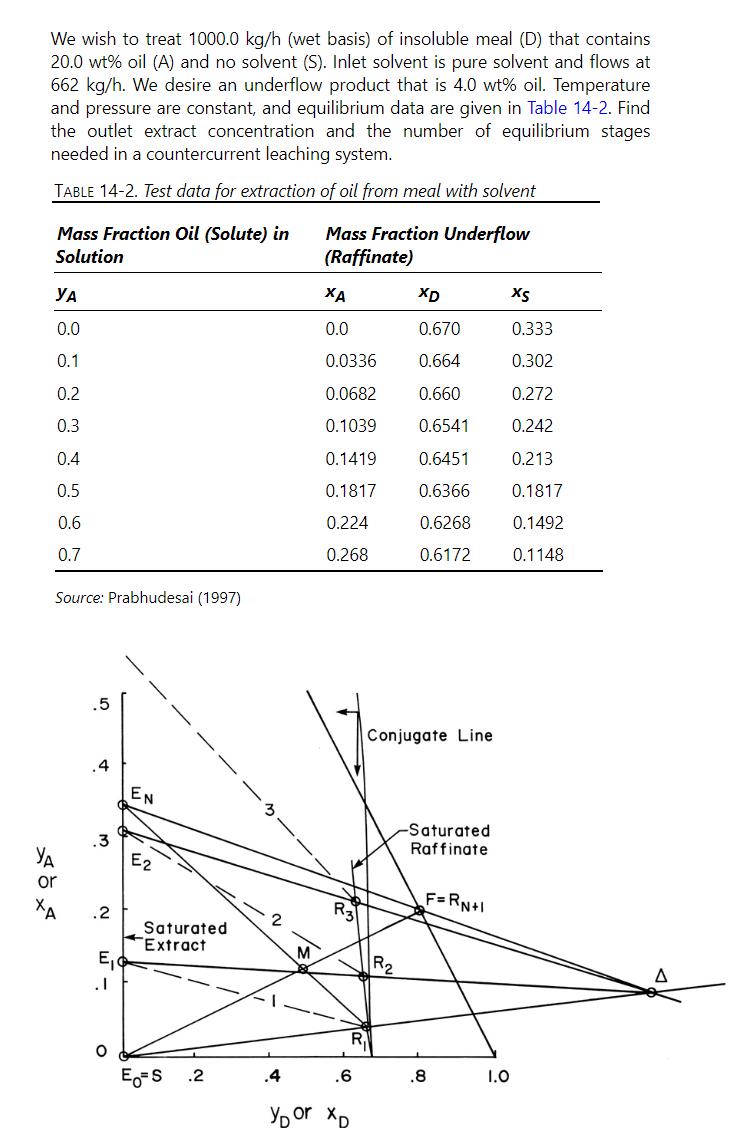
To provide a simplified calculation method for the variable flow rate leaching problem solved in Example 14-2, your boss asks you to force-fit the problem so that a Kremser equation solution can be obtained. To do this, define a constant flow rate of the meal, \(\mathrm{F}_{\mathrm{M}}=800.0
A countercurrent leaching system is recovering oil from soybeans with five stages. On a volumetric basis, liquid flow rate/solids flow rate \(=1.36\). Recovery of oil in the solvent is \(97.5 \%\). The solvent is pure. Determine the effective equilibrium constant, \(m_{E}\), where \(m_{E}\) is
Showing 200 - 300
of 1819
1
2
3
4
5
6
7
8
9
10
11
12
13
14
15
Last
Step by Step Answers

 Get 50% OFF
Claim Now
Get 50% OFF
Claim Now