New Semester
Started
Get
50% OFF
Study Help!
--h --m --s
Claim Now
Question Answers
Textbooks
Find textbooks, questions and answers
Oops, something went wrong!
Change your search query and then try again
S
Books
FREE
Study Help
Expert Questions
Accounting
General Management
Mathematics
Finance
Organizational Behaviour
Law
Physics
Operating System
Management Leadership
Sociology
Programming
Marketing
Database
Computer Network
Economics
Textbooks Solutions
Accounting
Managerial Accounting
Management Leadership
Cost Accounting
Statistics
Business Law
Corporate Finance
Finance
Economics
Auditing
Tutors
Online Tutors
Find a Tutor
Hire a Tutor
Become a Tutor
AI Tutor
AI Study Planner
NEW
Sell Books
Search
Search
Sign In
Register
study help
sciences
college physics reasoning
College Physics A Strategic Approach 3rd Edition Randall D. Knight, Brian Jones, Stuart Field - Solutions
A car has a mass of 1500 kg. If the driver applies the brakes while on a gravel road, the maximum friction force that the tires can provide without skidding is about 7000. If the car is moving at 20 m/s, what is the shortest distance in which the car can stop safely?
The fastest pitched baseball was clocked at 46 m/s. If the pitcher exerted his force (assumed to be horizontal and constant) over a distance of 1.0 m, and a baseball has a mass of 145 g,a. Draw a free-body diagram of the ball during the pitch.b. What force did the pitcher exert on the ball during
The froghopper, champion leaper of the insect world, can jump straight up at 4.0 m/s. The jump itself lasts a mere 1.0 ms before the insect is clear of the ground.a. Draw a free-body diagram of this mighty leaper while the jump is taking place.b. While the jump is taking place, is the force that
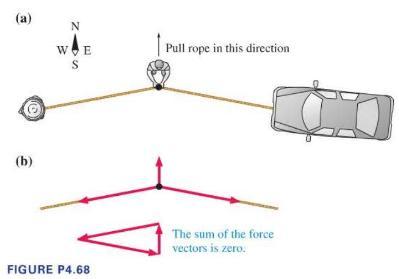
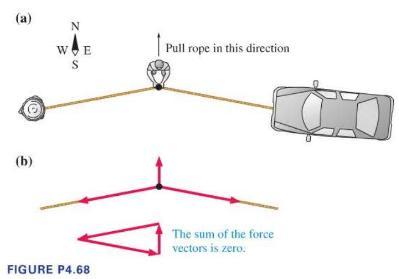
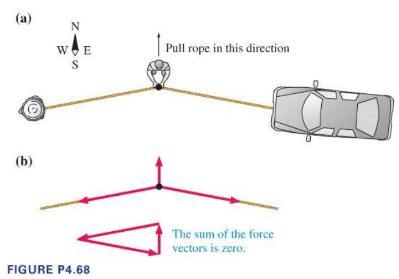
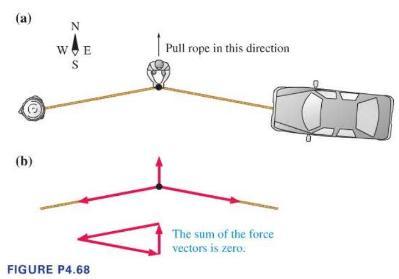
The sum of the three forces acting on the center point of the rope is assumed to be zero becauseA. This point has a very small mass.B. Tension forces in a rope always cancel.C. This point is not accelerating.D. The angle of deflection is very small.If your car is stuck in the mud and you don't have
When you are pulling on the rope as shown, what is the approximate direction of the tension force on the tree?A. NorthB. SouthC. EastD. West If your car is stuck in the mud and you don't have a winch to pull it out, you can use a piece of rope and a tree to do the trick. First, you tie one end of
Assume that you are pulling on the rope but the car is not moving. What is the approximate direction of the force of the mud on the car?A. North B. South C. East D. West If your car is stuck in the mud and you don't have a winch to pull it out, you can use a piece of rope and a tree to do the
Suppose your efforts work, and the car begins to move forward out of the mud. As it does so, the force of the car on the rope isA. Zero.B. Less than the force of the rope on the car.C. Equal to the force of the rope on the car.D. Greater than the force of the rope on the car.If your car is stuck in
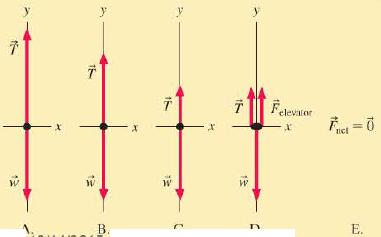
An elevator is suspended from a cable. It is moving upward at a steady speed.Which is the correct free body diagram for this situation? 17- T W W B. T W T Felevator I W 13 =0 ticl E.
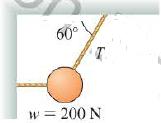
A ball of weight 200 N is suspended from two cables, one horizontal and one at a 60° angle, as shown. Which of the following must be true of the tension in the angled cable? A. T 200 N B. T=200 N C. T200 N
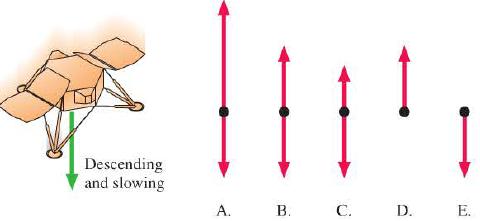
A Martian lander is approaching the surface. It is slowing its descent by firing its rocket motor.Which is the correct free-body diagram for the lander? Descending and slowing A. B. C. D. E.
You're bouncing up and down on a trampoline. After you have left the trampoline and are moving upward, your apparent weight is A. More than your true weight.B. Less than your true weight.C. Equal to your true weight.D. Zero.
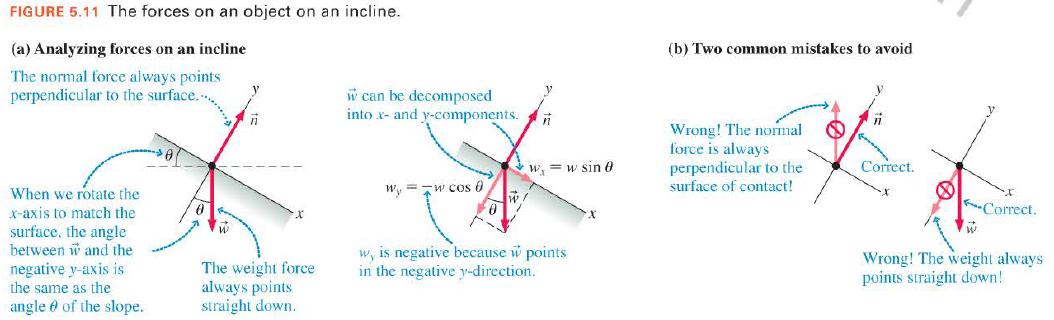
A mountain biker is climbing a steep 20° slope at a constant speed. The cyclist and bike have a combined weight of800 N. Referring to Figure 5.11 for guidance, what can you say about the magnitude of the normal force of the ground on the bike?A. n> SOON B. n = 800 N C. n FIGURE 5.11 The forces
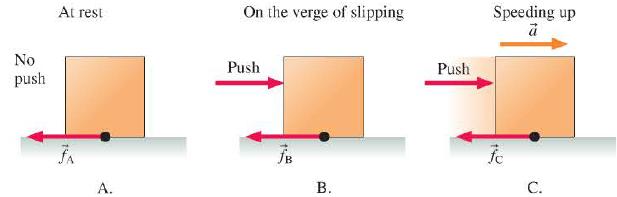
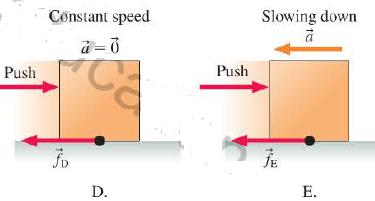
Rank in order, from largest to smallest, the size of the friction forces in the five different situations (one or more friction forces could be zero). The box and the floor are made of the same materials in all situations. A to FE
The terminal speed of a Styrofoam ball is 15 m/s. Suppose a Styrofoam ball is shot straight down with an initial speed of 30 m/s. Which velocity graph is correct? Vy (m/s) Vy (m/s) v, (m/s) vy (m/s) 0 -15 0 0 1 0 Vy (m/s) 0 1 -15 -15 -15 -15 -30 -30 A. -30 -30 -30 B. C. D. E.
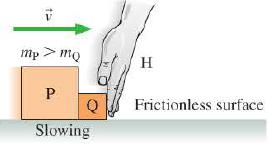
Boxes P and Q are sliding to the right across a frictionless table. The hand His slowing them down. The mass of P is larger than the mass of Q.Rank in order, from largest to smallest, the horizontal forces on P, Q, and H. = A. FQonH FHonQ = FronQ = FQon P = C. FQonH FHonQ FronQ = FQonP = D. FHonQ
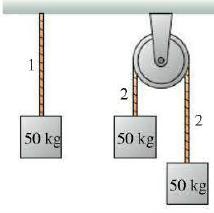
All three 50 kg blocks are at rest. Is the tension in rope 2 greater than, less than, or equal to the tension in rope 1? 50 kg 2 50 kg 2 50 kg
a. Can the normal force on an object be directed horizontally? If not, why not? If so, provide an example.b. Can the normal force on an object be directed downward? If not, why not? If so, provide an example.
You are going sledding with your friends, sliding down a snowy hill. Friction can't be ignored. Riding solo on your sled, you have a certain acceleration. Would the acceleration change if you let a friend ride with you, increasing the mass? Explain.
You are walking up an icy slope. Suddenly your feet slip, and you start to slide backward. Will you slide at a constant speed, or will you accelerate?
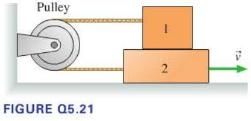
In Figure Q5.21, block 2 is moving to the right. There is no friction between the floor and block 2, but there is a friction force between blocks 1 and 2 . Pulley FIGURE Q5.21 2
Suppose \(\vec{C}=\vec{A}+\vec{B}\).a. Under what circumstances does \(C=A+B\) ?b. Could \(C=A-B\) ? If so, how? If not, why not?
A baseball player throws a ball at a \(40^{\circ}\) angle to the ground. The ball lands on the ground some distance away.a. Is there any point on the trajectory where \(\vec{v}\) and \(\vec{a}\) are parallel to each other? If so, where?b. Is there any point where \(\vec{v}\) and \(\vec{a}\) are
If you kick a football, at what angle to the ground should you kick the ball for the maximum range-that is, the greatest distance down the field? At what angle to the ground should you kick the ball for the maximum "hang time"- that is, the maximum time in the air?
You are cycling around a circular track at a constant speed. Does the magnitude of your acceleration change? The direction?
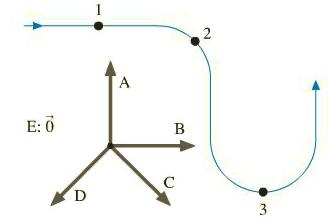
A car travels at constant speed along the curved path shown from above in Figure Q3.21. Five possible vectors are also shown in the figure; the letter \(\mathrm{E}\) represents the zero vector. Which vector best representsa. The car's velocity at position 1 ?b. The car's acceleration at position 1
I A football is kicked at an angle of \(30^{\circ}\) with a speed of \(20 \mathrm{~m} / \mathrm{s}\). To the nearest \(5 \mathrm{~m}\), how far will the ball travel?A. \(15 \mathrm{~m}\)B. \(25 \mathrm{~m}\)C. \(35 \mathrm{~m}\)D. \(45 \mathrm{~m}\)
I Formula One race cars are capable of remarkable accelerations when speeding up, slowing down, and turning corners. At one track, cars round a corner that is a segment of a circle of radius \(95 \mathrm{~m}\) at a speed of \(68 \mathrm{~m} / \mathrm{s}\). What is the approximate magnitude of the
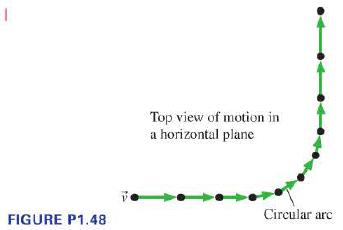
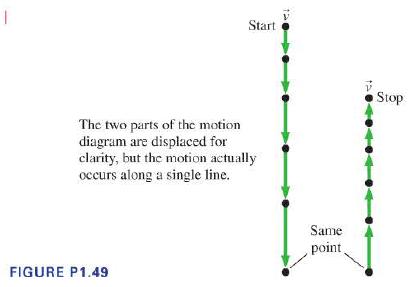
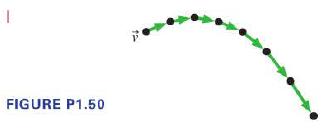
Show a motion diagram. For each of these problems, write a one or two sentence "story" about a real objec1 that has this motion diagram. Your stories should talk about people or objects by name and say what they are doing. Problems 39 through 45 are examples of motion short stories.Problem 39
Show a motion diagram. For each of these problems, write a one or two sentence "story" about a real objec1 that has this motion diagram. Your stories should talk about people or objects by name and say what they are doing. Problems 39 through 45 are examples of motion short stories.Problem 39
Show a motion diagram. For each of these problems, write a one or two sentence "story" about a real objec1 that has this motion diagram. Your stories should talk about people or objects by name and say what they are doing. Problems 39 through 45 are examples of motion short stories.Problem 39
Show a motion diagram. For each of these problems, write a one or two sentence "story" about a real objec1 that has this motion diagram. Your stories should talk about people or objects by name and say what they are doing. Problems 39 through 45 are examples of motion short stories.Problem 39
Show a motion diagram. For each of these problems, write a one or two sentence "story" about a real objec1 that has this motion diagram. Your stories should talk about people or objects by name and say what they are doing. Problems 39 through 45 are examples of motion short stories.Problem 39
How many inches does light travel in one nanosecond? The speed of light is 3.0 x 10⁸ m/s.
The Nardo ring is a circular test track for cars. It has a circumference of 12.5 km. Cars travel around the track at a constant speed of I 00 km/h. A car starts at the easternmost point of the ring and drives for 15 minutes at this speed.a. What distance, in km, does the car travel?b. What is the
The bacterium Escherichia coli (or E. coli) is a single celled organism that lives in the gut of healthy humans and animals. Its body shape can be modeled as a 2-μm-long cylinder with a 1 μm diameter, and it has a mass of 1 × 10-12 g.Tts chromosome consists of a single double-stranded chain of
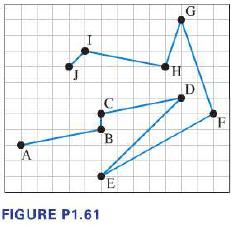
The bacterium Escherichia coli (or E. coli) is a single celled organism that lives in the gut of healthy humans and animals. When grown in a uniform medium rich in salts and amino acids, it swims along zig-zag paths at a constant speed changing direction at varying time intervals. Figure P 1.61
Weddell seals foraging in open water dive toward the ocean BIO bottom by swimming forward in a straight-line path tipped below the horizontal. The tracking data for one seal showed it taking 4.0 min to descend 360 m below the surface while moving 920 m horizontally.a. What was the angle of the
Whale sharks swim forward while ascending or descending. They swim a long a straight-line path at a shallow angle as they move from the surface to deep water or from the depths to the surface. In one recorded dive, a shark started 50 m below the surface and swam at 0.85 m/s along a path tipped at a
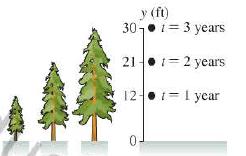
What is the tree's speed of growth, in feet per year, from t = 1 yr to t = 3 yr?A. 12 ft/yr B. 9 ft/yr The images of trees in Figure Pl.68 come from a catalog advertising fast-growing trees. If we mark the position of the top of the tree in the successive years, as shown in the graph in the figure,
What is this speed in m/s?The images of trees in Figure Pl.68 come from a catalog advertising fast-growing trees. If we mark the position of the top of the tree in the successive years, as shown in the graph in the figure, we obtain a motion diagram much like ones we have seen for other kinds of
At the end of year 3, a rope is tied to the very top of the tree to steady it. This rope is staked into the ground 15 feet away from the tree. What angle does the rope make with the ground?A. 63° B. 60° C. 30° D. 27°The images of trees in Figure Pl.68 come from a catalog advertising
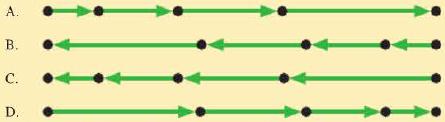
A bicycle is moving to the left with increasing speed. Which of the following motion diagrams illustrates this motion? A. B. C. D.
Which position versus time graph best describes the motion diagram at left? A. B. C. D.
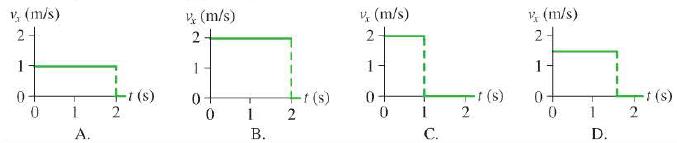
Four objects move with the velocity-versus time graphs shown.Which object has the largest displacement between t = 0 s and t = 2 s? V (m/s) 2 V (m/s) 2 v, (m/s) v (m/s) 2 2 1 1 1 0 +1(s) 0 +t(s) 0 t(s) 0 (s) 0 1 2 0 1 2 2 2 A. B. C. D.
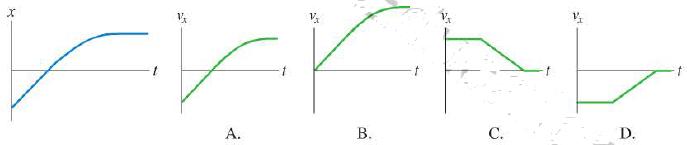
Which velocity-versus-time graph goes with the position versus time graph on the left? x V A. B. C. D.
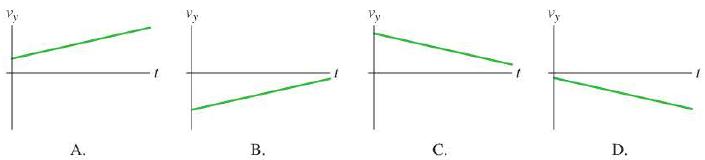
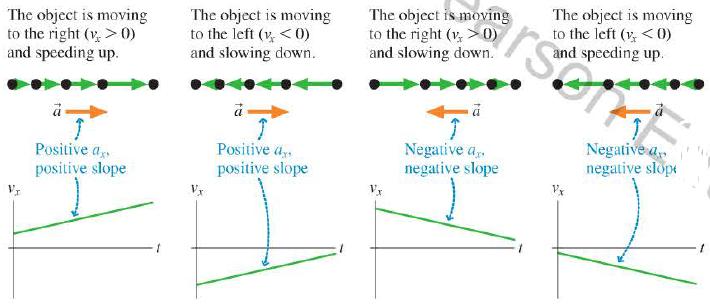
An elevator is moving downward. It is slowing down as it approaches the ground floor. Adapt the information in Figure 2.25 to determine which of the following velocity graphs best represents the motion of the elevator.Ultimately, whether or not an object that is slowing down has a negative
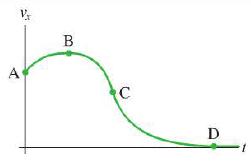
A particle moves with the velocity-versus-time graph shown here.At which labeled point is the magnitude of the acceleration the greatest? A Vx B C D
A cyclist is atJeSt ata traffic light. When the light turns green, he begins accelerating at 1.2 m/s2. How many seconds after the light turns green does he reach his cruising speed of 6.0 m/s?A. LO s B. 2.0sc. 3.0 s D. 4.0s E. 5.0 s
A volcano ejects a chunk of rock straight up at a velocity of Vy = 30 m is. Ignoring air resistance, what will be the velocity Vy of the rock when it falls back into the volcano's crater?A. > 30 m/s B. 30 m/s C. 0 m/s D. - 30 m/s E. < - 30 m/s
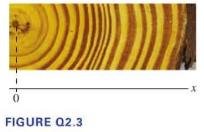
Figure Q2.3 shows growth rings in the trunk of a pine tree.You can clearly see the wide and the narrow rings that correspond to years of fast and slow growth. You can think of these rings as a motion diagram for the growth of the tree. If we define an axis as shown, with \(x\) measured out from the
Sketch a velocity-versus-time graph for a rock that is thrown straight upward, from the instant it leaves the hand until the instant it hits the ground.
A ball is thrown straight up into the air. At each of the following instants, is the ball's acceleration \(a_{y}\) equal to \(g,-g, 0,g\) ?a. Just after leaving your hand?b. At the very top (maximum height)?c. Just before hitting the ground?
A rock is thrown (not dropped) straight down from a bridge into the river below.a. Immediately after being released, is the magnitude of the rock's acceleration greater than \(g\), less than \(g\), or equal to \(g\) ? Explain.b. Immediately before hitting the water, is the magnitude of the the
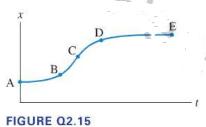
Figure Q2.15 shows the position graph of a car traveling on a straight road. At which labeled instant is the speed of the car greatest? A B. C D FIGURE Q2.15
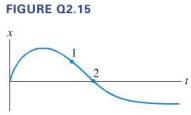
Figure Q2.16 shows the position graph of a car traveling on a straight road. The velocity at instant 1 is \(\overline{\text { at instant } 2}\) is and the velocity A. positive, negative B. positive, positive C. negative, negative D. negative, zero E. positive, zero FIGURE Q2.15
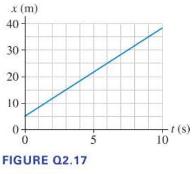
Figure Q2.17 shows an object's position-versus-time graph. What is the velocity of the object at \(t=6 \mathrm{~s}\) ?A. \(0.67 \mathrm{~m} / \mathrm{s}\)B. \(0.83 \mathrm{~m} / \mathrm{s}\)C. \(3.3 \mathrm{~m} / \mathrm{s}\)D. \(4.2 \mathrm{~m} / \mathrm{s}\)E. \(25 \mathrm{~m} / \mathrm{s}\) x
The following options describe the motion of four cars A-D. Which car has the largest acceleration?A. Goes from \(0 \mathrm{~m} / \mathrm{s}\) to \(10 \mathrm{~m} / \mathrm{s}\) in \(5.0 \mathrm{~s}\)B. Goes from \(0 \mathrm{~m} / \mathrm{s}\) to \(5.0 \mathrm{~m} / \mathrm{s}\) in \(2.0
Which of the three drag racers in Question 20 had the greatest acceleration at \(t=0 \mathrm{~s}\) ?A. Andy B. Betty C. Carl D. All had the same acceleration
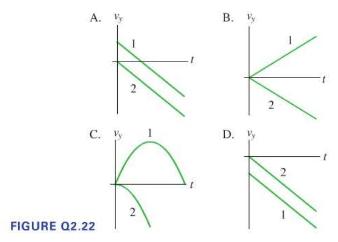
Chris is holding two softballs while standing on a balcony. She throws ball 1 straight up in the air and, at the same instant, releases her grip on ball 2, letting it drop over the side of the building. Which velocity graph in Figure Q2.22 best represents the motion of the two balls? A. Vy B. Vy 2
Suppose a plane accelerates from rest for \(30 \mathrm{~s}\), achieving a takeoff speed of \(80 \mathrm{~m} / \mathrm{s}\) after traveling a distance of \(1200 \mathrm{~m}\) down the runway. A smaller plane with the same acceleration has a takeoff speed of \(40 \mathrm{~m} / \mathrm{s}\). Starting
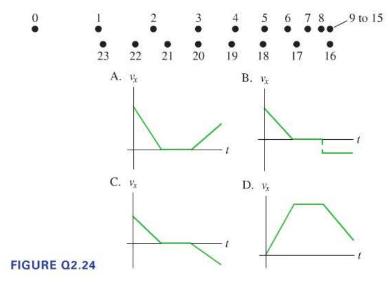
Figure Q2.24 shows a motion diagram with the clock reading (in seconds) shown at each position. From \(t=9 \mathrm{~s}\) to \(t=15 \mathrm{~s}\) the object is at the same position. After that, it returns along the same track. The positions of the dots for \(t \geq 16 \mathrm{~s}\) are offset for
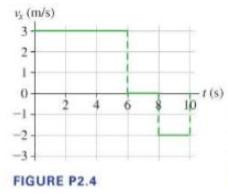
A rural mail carrier is driving slowly, putting mail in mailboxes near the road. He overshoots one mailbox, stops, shifts into reverse, and then backs up until he is at the right spot. The velocity graph of Figure P2.4 represents his motion.a. Draw the mail carrier's position-versus-time graph.
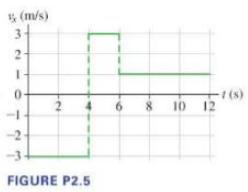
For the velocity-versus-time graph of Figure P2.5:a. Draw the corresponding position-versus-time graph. Assume that \(x=0 \mathrm{~m}\) at \(t=0 \mathrm{~s}\).b. What is the object's position at \(t=12 \mathrm{~s}\) ?c. Describe a moving object that could have these graphs. % (m/s) 3 2 1 0 -1 (s) 2
In major league baseball, the pitcher's mound is 60 feet from the batter. If a pitcher throws a \(95 \mathrm{mph}\) fastball, how much time elapses from when the ball leaves the pitcher's hand until the ball reaches the batter?
Richard is driving home to visit his parents. \(125 \mathrm{mi}\) of the trip are on the interstate highway where the speed limit is \(65 \mathrm{mph}\). Normally Richard drives at the speed limit; but today he is running late and decides to take his chances by driving at \(70 \mathrm{mph}\). How
In a \(5.00 \mathrm{~km}\) race, one runner runs at a steady \(12.0 \mathrm{~km} / \mathrm{h}\) and another runs at \(14.5 \mathrm{~km} / \mathrm{h}\). How long does the faster runner have to wait at the finish line to see the slower runner cross?
In an \(8.00 \mathrm{~km}\) race, one runner runs at a steady \(11.0 \mathrm{~km} / \mathrm{h}\) and another runs at \(14.0 \mathrm{~km} / \mathrm{h}\). How far from the finish line is the slower runner when the faster runner finishes the race?
A car moves with constant velocity along a straight road. Its position is \(x_{1}=0 \mathrm{~m}\) at \(t_{1}=0 \mathrm{~s}\) and is \(x_{2}=30 \mathrm{~m}\) at \(t_{2}=3.0 \mathrm{~s}\). Answer the following by considering ratios, without computing the car's velocity.a. What is the car's position
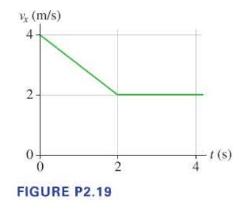
Figure P2.19 shows the velocity graph of a bicycle. Draw the bicycle's acceleration graph for the interval \(0 \mathrm{~s} \leq t \leq 4 \mathrm{~s}\). Give both axes an appropriate numerical scale. 2 0- (m/s) FIGURE P2.19 t(s) 2
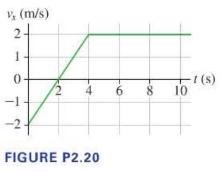
We set the origin of a coordinate system so that the position of a train is \(x=0 \mathrm{~m}\) at \(t=0 \mathrm{~s}\). Figure P2.20 shows the train's velocity graph.a. Draw position and acceleration graphs for the train.b. Find the acceleration of the train at \(t=3.0 \mathrm{~s}\). v, (m/s) 2+ 1
Small frogs that are good jumpers are capable of remarkable\(\mathrm{BIO}\) accelerations. One species reaches a takeoff speed of \(3.7 \mathrm{~m} / \mathrm{s}\) in \(60 \mathrm{~ms}\). What is the frog's acceleration during the jump?
When jumping, a flea rapidly extends its legs, reaching a takeoff speed of \(1.0 \mathrm{~m} / \mathrm{s}\) over a distance of \(0.50 \mathrm{~mm}\).a. What is the flea's acceleration as it extends its legs?b. How long does it take the flea to leave the ground after it begins pushing off?
A cross-country skier is skiing along at a zippy \(8.0 \mathrm{~m} / \mathrm{s}\). She stops pushing and simply glides along, slowing to a reduced speed of \(6.0 \mathrm{~m} / \mathrm{s}\) after gliding for \(5.0 \mathrm{~m}\). What is the magnitude of her acceleration as she slows?
Formula One racers speed up much more quickly than normal passenger vehicles, and they also can stop in a much shorter distance. A Formula One racer traveling at \(90 \mathrm{~m} / \mathrm{s}\) can stop in a distance of \(110 \mathrm{~m}\). What is the magnitude of the car's acceleration as it
A car is traveling at a steady \(80 \mathrm{~km} / \mathrm{h}\) in a \(50 \mathrm{~km} / \mathrm{h}\) zone. A police motorcycle takes off at the instant the car passes it, accelerating at a steady \(8.0 \mathrm{~m} / \mathrm{s}^{2}\).a. How much time elapses before the motorcycle is moving as fast
When a jet lands on an aircraft carrier, a hook on the tail of the plane grabs a wire that quickly brings the plane to a halt before it overshoots the deck. In a typical landing, a jet touching down at \(240 \mathrm{~km} / \mathrm{h}\) is stopped in a distance of \(95 \mathrm{~m}\).a. What is the
Here's an interesting chal-lenge you can give to a friend. Hold a \$1 (or larger!) bill by an upper corner. Have a friend prepare to pinch a lower corner, putting her fingers near but not touching the bill. Tell her to try to catch the bill when you drop it by simply closing her fingers. This seems
In the preceding problem we saw that a person's reactiontime is generally not quick enough to allow the person to catch a \(\$ 1\) bill dropped between the fingers. The \(16 \mathrm{~cm}\) length of the bill passes through a student's fingers before she can grab it if she has a typical \(0.25
A gannet is a seabird that fishes by diving from a great height.If a gannet hits the water at \(32 \mathrm{~m} / \mathrm{s}\) (which they do), what height did it dive from? Assume that the gannet was motionless before starting its dive.
Spud Webb was, at \(5 \mathrm{ft} 8\) in, one of the shortest basketball players to play in the NBA. But he had an amazing vertical leap; he could jump to a height of \(1.1 \mathrm{~m}\) off the ground, so he could easily dunk a basketball. For such a leap, what was his "hang time"- the time spent
III Actual velocity data for a lion pursuing prey are shown in Figure P2.52. Estimate:a. The initial acceleration of the lion.b. The acceleration of the lion at \(2 \mathrm{~s}\) and at \(4 \mathrm{~s}\).c. The distance traveled by the lion between \(0 \mathrm{~s}\) and \(8 \mathrm{~s}\).
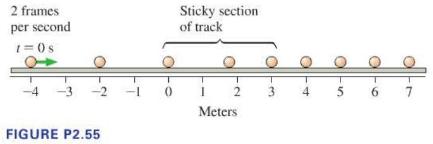
Figure P2.55 shows the motion diagram, made at two frames of film per second, of a ball rolling along a track. The track has a \(3.0-\mathrm{m}\)-long sticky section.a. Use the scale to determine the positions of the center of the ball. Place your data in a table, similar to Table 2.1 , showing
Julie drives \(100 \mathrm{mi}\) to Grandmother's house. On the way to Grandmother's, Julie drives half the distance at \(40 \mathrm{mph}\) and half the distance at \(60 \mathrm{mph}\). On her return trip, she drives half the time at \(40 \mathrm{mph}\) and half the time at \(60 \mathrm{mph}\).a.
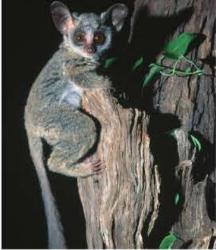
A bush baby, an African primate, is capable of a remarkable vertical leap. The bush baby goes into a crouch and extends its legs, pushing upward for a distance of \(0.16 \mathrm{~m}\). After this upward acceleration, the bush baby leaves the ground and travels upward for \(2.3 \mathrm{~m}\). What
A Thomson's gazelle can run at very high speeds, but its acceleration is relatively modest. A reasonable model for the sprint of a gazelle assumes an acceleration of \(4.2 \mathrm{~m} / \mathrm{s}^{2}\) for \(6.5 \mathrm{~s}\), after which the gazelle continues at a steady speed.a. What is the
We've seen that a man's higher initial acceleration means that a man can outrun a horse over a very short race. A simple-but plausible - model for a sprint by a man and a horse uses the following assumptions: The man accelerates at \(6.0 \mathrm{~m} / \mathrm{s}^{2}\) for \(1.8 \mathrm{~s}\) and
A pole-vaulter is nearly motionless as he clears the bar, set \(4.2 \mathrm{~m}\) above the ground. He then falls onto a thick pad. The top of the pad is \(80 \mathrm{~cm}\) above the ground, and it compresses by \(50 \mathrm{~cm}\) as he comes to rest. What is his acceleration as he comes to rest
A Porsche challenges a Honda to a \(400 \mathrm{~m}\) race. Because the Porsche's acceleration of \(3.5 \mathrm{~m} / \mathrm{s}^{2}\) is larger than the Honda's \(3.0 \mathrm{~m} / \mathrm{s}^{2}\), the Honda gets a \(100-\mathrm{m}\) head start-it is only \(300 \mathrm{~m}\) from the finish line.
The minimum stopping distance for a car traveling at a speed of \(30 \mathrm{~m} / \mathrm{s}\) is \(60 \mathrm{~m}\), including the distance traveled during the driver's reaction time of \(0.50 \mathrm{~s}\).a. Draw a position-versus-time graph for the motion of the car. Assume the car is at
I On the earth, an astronaut can safely jump to the ground from a height of \(1.0 \mathrm{~m}\); her velocity when reaching the ground is slow enough to not cause injury. From what height could the astronaut safely jump to the ground on the moon?A. \(2.4 \mathrm{~m}\)B. \(6.0
On the earth, an astronaut throws a ball straight upward; it stays in the air for a total time of \(3.0 \mathrm{~s}\) before reaching the ground again. If a ball were to be thrown upward with the same initial speed on the moon, how much time would pass before it hit the ground?A. \(7.3
A player kicks a football straight up into the air. The ball takes 2.0 s to reach its highest point. Approximately how fast was the ball moving when it left the player's foot?A. 5 m/s B. 10 m/s C. 15 m/s D. 20 m/s
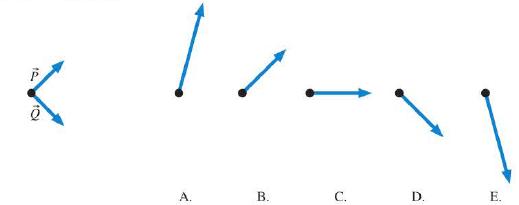
Which figure shows 2P-Q?
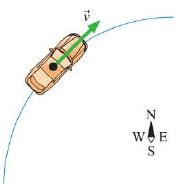
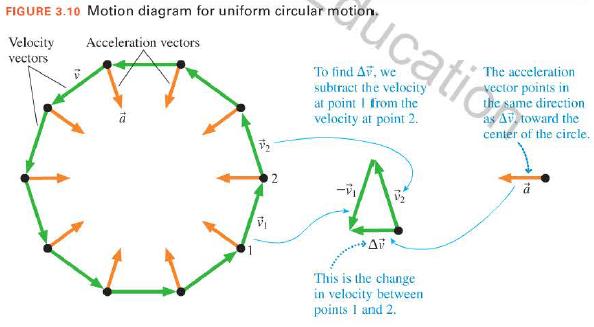
The figure shows a car rounding a corner. Using what you've learned in Figure 3.10, what is the direction of the car's acceleration at the instant shown in the figure?A. Northeast B. Southeast C. Southwest D. Northwest N W E S
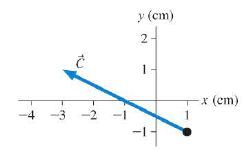
What are the x- and y-components ex and Cy of vector C?
AngleΦ that specifies the direction of is computed as C?
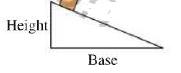
A block of ice slides down a ramp. For which height and base length is the acceleration the greatest?A. Height 4 m, base 12 m B. Height 3 m, base 6 m C. Height 2 m, base 5 m D. Height l m, base 3 m Height Base
The water in a river flows downstream at 3.0 m/s. A boat is motoring upstream against the flow at 5.0 m/s relative to the water. What is the boat's speed relative to the riverbank?A. 8.0 m/s B. 5.0 m/s C. 3.0 m/s D. 2.0 m/s
A 100 g ball rolls off a table and lands 2 m from the base of the table. A 200 g ball rolls off the same table with the same speed. How far does it land from the base of the table? A.
A baseball player is taking batting practice. He hi ts two successive pitches at differe nt angles but at exactly the same speed. Ball 1 and ball 2 fo llow the paths shown. Which ball is in the air for a longer time? Assume that you can ignore air resistance for this problem.A. Ball 1 B. Ball 2 C.
Showing 2500 - 2600
of 4913
First
19
20
21
22
23
24
25
26
27
28
29
30
31
32
33
Last
Step by Step Answers

 Get 50% OFF
Claim Now
Get 50% OFF
Claim Now