New Semester
Started
Get
50% OFF
Study Help!
--h --m --s
Claim Now
Question Answers
Textbooks
Find textbooks, questions and answers
Oops, something went wrong!
Change your search query and then try again
S
Books
FREE
Study Help
Expert Questions
Accounting
General Management
Mathematics
Finance
Organizational Behaviour
Law
Physics
Operating System
Management Leadership
Sociology
Programming
Marketing
Database
Computer Network
Economics
Textbooks Solutions
Accounting
Managerial Accounting
Management Leadership
Cost Accounting
Statistics
Business Law
Corporate Finance
Finance
Economics
Auditing
Tutors
Online Tutors
Find a Tutor
Hire a Tutor
Become a Tutor
AI Tutor
AI Study Planner
NEW
Sell Books
Search
Search
Sign In
Register
study help
sciences
college physics reasoning
College Physics Reasoning and Relationships 2nd edition Nicholas Giordano - Solutions
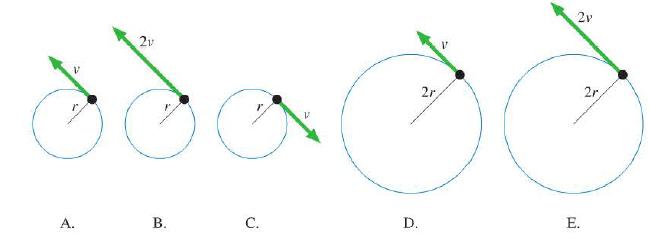
Which of the following particles has the greatest centripetal acceleration? 2v 2v 2r 2r A. B. C. D. E.
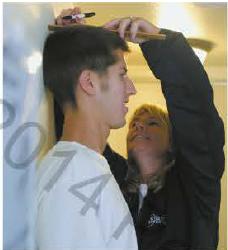
If you make multiple measurements of your height, you are likely to find that the results vary by nearly half an inch in either direction due to measurement error and actual variations in he ight. You are slightly shorter in the evening, after gravity has compressed and reshaped your spine over the
Blades of grass grow from the bottom, so, as growth occurs, the top of the blade moves upward. During the summer, when your lawn is growing quickly, estimate this speed, in m/s. Make this estimate from your experience noting, for instance, how often you mow the lawn and what length you trim.
Estimate the average speed, in m/s, with which the hair on your head grows. Make this estimate from your own experience noting, for instance, how often you cut your hair and how much you trim. Express your result in scientific notation.
Loveland, Colorado, is 18 km due south of Fort Collins and 3 1 km due west of Greeley. What is the distance between Fort Collins and Greeley?
A circular test track for cars in England has a circumference of 3.2 km. A car travels around the track from the southernmost point to the northernmost point.a. What distance does the car travel?b. What is the car's displacement from its original position?
Migrating geese tend to travel at approximately constant speed, flying in segments that are straight lines. A goose flies 32 km south, then turns to fly 20 km west. Afterward, how far is the goose from its original position?
Black vultures excel at gliding flight; they can move long distances through the air without flapping their wings while undergoing only a modest drop in height. A vulture in a typical glide in still air moves along a path tipped 3.5° below the horizontal. If the vulture moves a horizontal distance
A hiker walks 25° north of east for 200 m. How far north and how far east is he from his starting position?
A hiker is climbing a steep 10° slope. Her pedometer shows that she has walked 1500 m along the slope. How much elevation has she gained?
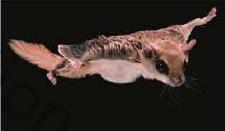
A squirrel completing a short glide travels in a straight line tipped 40° below the horizontal. The squirrel starts 9.0 m above the ground on one tree and glides to a second tree that is a horizontal distance of 3.5 m away.a. What is the length of the squirrel's glide path?b. What is the
A squirrel in a typical long glide covers a horizontal distance of 16 m while losing 8.0 m of elevation. During this glide,a. What is the angle of the squirrel's path below the horizontal?b. What is the total distance covered by the squirrel?Problem relate to the gliding flight of flying
In a typical greyhound race, a dog accelerates to a speed of 20 m/s over a distance of 30 m. It then maintains this speed.What would be a greyhound's time in the 100 m dash?Problem are motion problems similar to those you will learn to solve in Chapter 2. For now, simply interpret the problem by
The giant e land, an African antelope, is an exceptional jumper, able to leap 1.5 m off the ground. To jump this high, with what speed must the eland leave the ground?Problem are motion problems similar to those you will learn to solve in Chapter 2. For now, simply interpret the problem by drawing
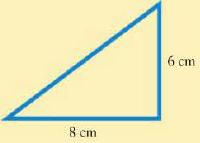
What is the length of the hypotenuse of this triangle?A. 6cm B. 8 cm C. 1Ocm D. 12cm E. 14cm 8 cm 6 cm
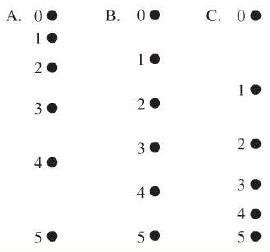
Which car is going faster, A or B? Assume there are equal intervals of time between the frames of both videos. Car A Car B
Three motion diagrams A are shown. Which is a dust particle settling to the floor at constant speed, which is a ball dropped from the roof of a building, and which is a descending rocket slowing to make a soft landing on Mars? A. 06 B. 0 C. O 20 30 20 30 2 4 5 5 4. 45 3
Sarah starts at a positive position along the x-axis. She then undergoes a negative displacement. Her final position.A. Is positive. B. Is negative. C. Could be either positive or negative.
Jane starts from her house to take a stroll in her neighborhood.After walking for 2 hours at a steady pace, she has walked 4 miles and is 2 miles from home. For this time interval, what was her speed?A. 4 mph B. 3 mph C. 2 mph D. I mph.
Rank in order, from the most to the fewest, the number of significant figures in the following numbers. For example, if B has more than C, C has the same number as A, and A has more than D, give your answer as B > C = A > D.A.0.43 B. 0.0052c. 0.430 D. 4.32 x 10⁻¹⁰
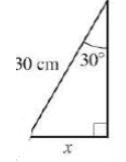
Using the information in Figure 1.23, what is the distance x, to the nearest cm, in the triangle at the right?A. 26cm B. 20cm C. 17cm D. 15 cm 30 cm 30 I
A softball player slides into second base. Use the particle model to draw a motion diagram of the player from the time he begins to slide until he reaches the base. Number the dots in order, starting with zero.
A car travels to the left at a steady speed for a few seconds, then brakes for a stop sign. Use the particle model to draw a motion diagram of the car for the entire motion described here. Number the dots in order, starting with zero.
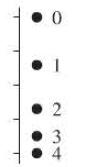
A ball is dropped from the roof of a tall building and students in a physics class are asked to sketch a motion diagram for this situation. A student submits the diagram shown in Figure Q 1.4. Is the diagram correct?Explain.Figure Q 1.4 0 1 2 3 4
You are standing on a straight stretch of road and watching the motion of a bicycle; you choose your position as the origin. At one instant, the position of the bicycle is negative and its velocity is positive. Is the bicycle getting closer to you or farther away?Explain.
Your roommate drops a tennis ball from a third-story balcony. It hits the sidewalk and bounces as high as the second story. Draw a motion diagram, using the particle model, showing the ball 's velocity vectors from the time it is released until it reaches the maximum height on its bounce.
A student walks 1.0 mi west and then 1.0 mi north. Afterward, how far is she from her starting point?A. 1.0 mi B. 1.4 mi C. 1.6 mi D. 2.0 mi
You throw a rock upward. The rock is moving upward, but it is slowing down. If we define the ground as the origi n, the position of the rock is __ and the velocity of the rock is __ .A. positive, positive B. positive, negative C. negative, positive D. negative, negative
Which of the following motions could be described by the motion diagram of Figure Q 1.20?A. A hockey puck sliding across smooth ice.B. A cyclist braking to a stop.C. A sprinter starting a race.D. A ball bouncing off a wall. 54 3 2 0 FIGURE Q1.20
Which of the following motions is described by the motion diagram of Figure QI .21?A. An ice skater gliding across the ice.B. An airplane braking to a stop after landing.C. A car pulling away from a stop sign.D. A pool ball bouncing off a cushion and reversing direction. 01 2 3 5 FIGURE Q1.21
A bird flies 3.0 km due west and then 2.0 km due north. What is the magnitude of the bird's displacement?A. 2.0 km B. 3.0 km C. 3.6 km D. 5.0 km
II Weddell seals make holes in sea ice so that they can swim BIO down to forage on the ocean floor below. Measurements for one seal showed that it dived straight down from such an opening, reaching a depth of 0.30 km in a time of 5.0 min. What was the speed of the diving seal?A. 0.60 m/s B. 1.0 m/s
A bird flies 3.0 knJ due west and then 2.0 km due north.Another bird flies 2.0 km due west and 3.0 km due nmth. What is the angle between the net displacement vectors for the two birds?A. 23° B. 34° C. 56° D. 90°
I A woman walks briskly at 2.00 mis. How much time will it take her to walk one mile?A. 8.30 min B. 13.4 min C. 2 1.7 min D. 30.0 min.
I A rectangle has length 3.24 m and height 0.532 m. To the correct number of significant figures, what is its area?A. 1.72 m2 B. 1.723 m2C. 1.7236 m2 D. 1.72368 m2
The each formed 4.57 × 10⁹ years ago. What is this time in seconds?A. 1.67 × 10¹² sB. 4.01 × 10¹³ s C. 2.40 × 10¹⁵ s D. 1.44 × 10¹⁷ s
An object's average density p is defined as the ratio of its mass to its volume: p = M/V. The earth's mass is 5.94 × 1024 kg, and its volume is 1.08 × 10¹² km3. What is the earth's average density? A. 5.50 103 kg/m C. 5.50 10 kg/m B. 5.50 X 10 kg/m D. 5.50 X 10¹² kg/m
A pot contains 250 g of water at 100°C. If this water is heated and all evaporates to form steam at 100°C, what is the change in the entropy of the H2O?
A large piece of steel (initial temperature 400 K) is placed into a large bucket of ice water. If 4.0 J of heat flow from the steel into the ice water, what are the entropy changes of the steel, the ice water, and the universe? Assume this small amount of heat flow does not change the temperatures
Suppose 5000 J of heat flow from a reservoir at 400 K to a colder reservoir. If the total entropy change of the universe is 200 J/K, what is the temperature of the cold reservoir? Because the reservoirs are assumed to be very large, their temperatures do not change during this process.
Suppose 7000 J of heat flow out of a house that is at 293 K to the outside environment at 273 K. Find the change in entropy of the house, the change in the entropy of the environment, and the total change in entropy of the universe. Is this process reversible or irreversible?
Consider a reversible heat engine that employs a hot reservoir at a temperature of 750 K and a cold reservoir at 230 K. (a) What is the entropy change of the hot reservoir during a period in which 5000 J are extracted from the hot reservoir? (b) What is the change in the entropy of the
Suppose the refrigerator in your house is a reversible refrigerator. Estimate how much heat is extracted from the fresh-food compartment when 1000 J of work are done.
A heat engine absorbs 8000 J of heat from a hot reservoir and produces 5500 J of work. What is the efficiency of the engine?
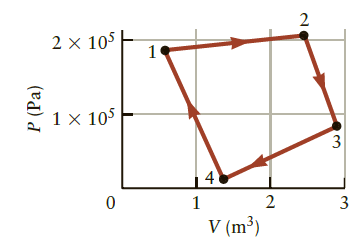
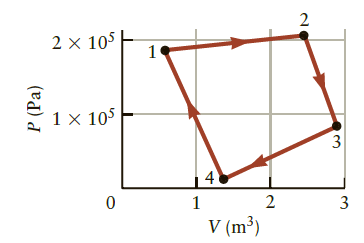
For the heat engine in Figure P16.42, during which portion(s) of the cycle does the engine do positive work on its environment and during which portion(s) does the environment do work on the system? Figure P16.42 2 x 10⁵ 1 x 10⁵ 4 1 2 3 V (m³) 3. 2. P (Pa)
A heat engine operates using the P?V cycle shown in Figure P16.42. Approximately how much work is done by the system during each cycle? Figure P16.42 2 x 10⁵ 1 x 10⁵ 4 1 2 3 V (m³) 3. 2. P (Pa)
A Carnot engine extracts 2000 J of heat from a hot reservoir and does 1200 J of mechanical work. Suppose the cold reservoir is a very large block of ice at 0°C. What mass of ice would melt during this time?
Suppose the heat engine in Problem 39 is operated “in reverse” as a refrigerator. What is its refrigeration efficiency?Data From Problem 39A reversible heat engine operates between thermal reservoirs at 600 K and 150 K. What is the efficiency of this engine?
A reversible heat engine operates between thermal reservoirs at 600 K and 150 K. What is the efficiency of this engine?
A heat pump operates between reservoirs at 293 K (inside the house) and 265 K (outside). It is not a reversible heat pump; it only pumps 75% of the maximum possible heat into the house. How much work must be done to “pump” 6000 J of heat energy into the house?
A reversible heat pump operating between thermal reservoirs at 25°C and 10°C consumes 500 J of energy each second. How much heat energy is “pumped” into the house each second?
It is a cold winter day in the author’s neighborhood. One of the houses is heated with a reversible heat pump that uses the outside air as the cold reservoir. Suppose 40,000 J of energy are lost from the house due to heat conduction through the walls, windows, and one broken window. Estimate how
A container filled with 1.0 L of water that is initially at 0°C is placed in a reversible refrigerator. Suppose the hot reservoir for this refrigerator is the room air at 30°C. How much work must be done on the refrigerator to turn all this water into ice at 0°C? Assume the only thing that is
Consider a heat engine that operates between thermal reservoirs at 500 K and 250 K. Suppose the engine does 5000 J of work while it expels 1000 J of energy to the cold reservoir. Is this engine allowed by the second law of thermodynamics?
A reversible heat engine consumes five times more heat QH from its hot reservoir than it expels to its cold reservoir, QC. What is the ratio TH/TC?
Consider two heat engines: Engine 1 operates between thermal reservoirs at 450 K and 170 K, and engine 2 operates between reservoirs at 50 K and 10 K. Which engine has a greater maximum theoretical efficiency?
Assume the gasoline engine in your car is a heat engine operating between a hot reservoir at 800 K and a cold reservoir at 280 K and that your engine produces a peak power output of 250 hp (horsepower). If the temperature of the hot reservoir is increased to 900 K, what is the theoretical peak
A reversible heat engine operates between a hot reservoir at 580 K and a cold reservoir of unknown temperature. After 5 min, the engine has absorbed 1000 J of energy from the hot reservoir and expelled 500 J of energy to the cold reservoir. What is the temperature of the cold reservoir?
Consider a reversible heat engine that operates between a hot reservoir at 550 K and a cold reservoir at 150 K. If this engine has a power rating of 750 W, how much heat is expelled to the cold reservoir in 10 min?
A gasoline engine absorbs 4000 J of heat and performs 3000 J of mechanical work for each turn of the engine shaft. How much heat is expelled from the engine after 500 turns of the shaft?
An engine absorbs 3500 J of heat energy each cycle and expels 1200 J. (a) How much work does it do in one cycle? (b) If it is a reversible heat engine and the hot reservoir is at 750 K, what is the temperature of the cold reservoir?
A reversible heat engine operates between thermal reservoirs at 900 K and 200 K. If 9000 J are extracted from the hot reservoir, how much work is done by the heat engine?
You have 2.0 moles of helium gas initially at a temperature of 340 K and a pressure of 0.20 × Patm. The gas is compressed isothermally to a pressure of 0.50 × Patm. (a) Find the final volume of the gas. Assume it behaves as an ideal gas. (b) Find the work done by the gas. (c) How
An ideal monatomic gas expands adiabatically from an initial temperature of 400 K and volume of 4.5 m3 to a final volume of 12 m3. If the initial pressure is 1.5 × Patm, how much work is done on the gas?
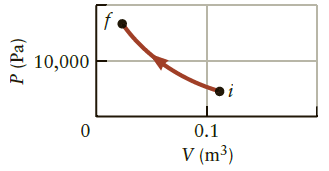
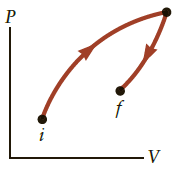
Figure P16.23 shows a system that is compressed from an initial state i to a final state f. If the internal energy of the system decreases by 5000 J, approximately how much heat was added to the system?Figure P16.23 10,000 0.1 V (m³) P (Pa)
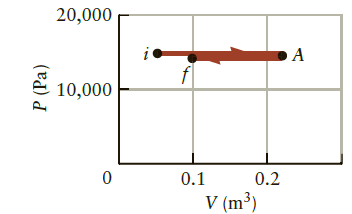
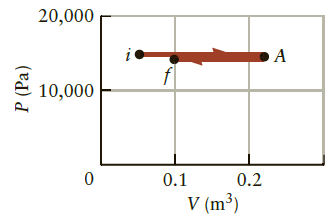
Consider the process described by Figure P16.21. If 500 J of heat are added to the system during the second step, what is the change in the internal energy of the system during this step?Figure 16.21 20,000 10,000 0.1 0.2 V (m³) P (Pa)
A system undergoes a two-step process as sketched in Figure P16.21. The system first expands at constant pressure from state I to state A and then it is compressed with the pressure again held fixed, ending with the system in state f. What is the approximate amount of work done by the system during
You have 3.2 moles of a monatomic ideal gas that are compressed isothermally. (a) If the pressure changes from 4.5 × 10⁵ Pa to 8.5 × 10⁵ Pa and the initial volume was 0.50 m3, what is the final volume of the system? (b) For the compression in this problem, what are the initial and final
Water vapor (n = 1.0 mole) is heated in a pressure cooker so that the volume is held constant. If the temperature increases from 500 K to 600 K, what is the change in the internal energy of the water vapor?
A container holds 1.5 kg of water that is initially at 320 K and is converted to steam at 400 K. Assuming the volume of the system does not change, what is the change in the internal energy of the system?
Consider a balloon of volume 2.0 m3 that contains 3.5 moles of helium gas at a temperature of 300 K. If the gas is compressed adiabatically so as to have a final temperature of 400 K, what is the work done by the gas?
A system is compressed adiabatically, during which time the environment does 3500 J of work on the system. What is the change in the internal energy of the system?
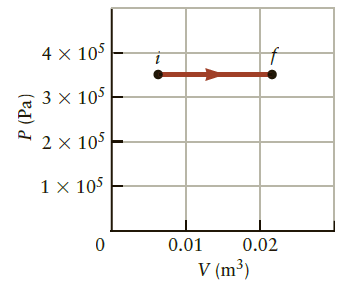
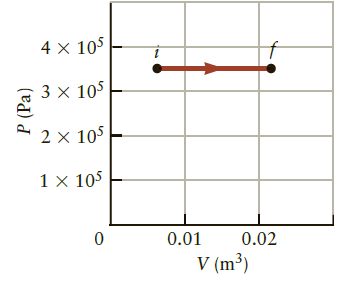
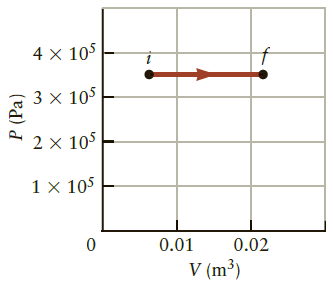
For the expansion in Figure P16.12, if the internal energy of the system decreases by 4500 J, what is the heat added to the system?Figure P16.12 4 x 10⁵ 3 × 10⁵ 2 x 10⁵ 1 x 10⁵ 0.02 0.01 V (m³) P (Pa)
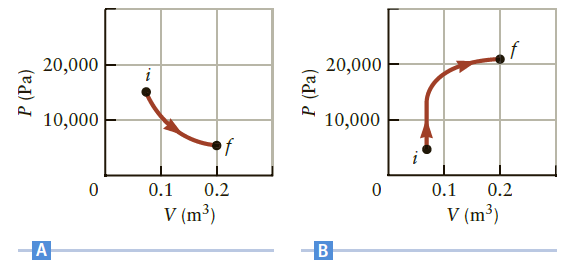
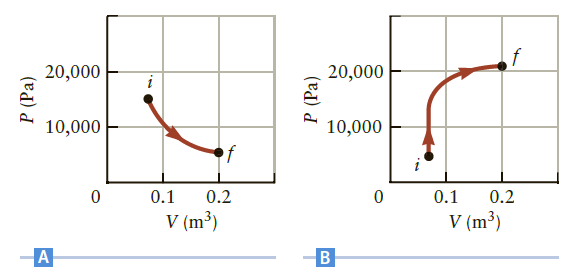
For the thermodynamic processes in Figures P16.12 and P16.13, what is the approximate value of the work done on the system?Figure P16.12 Figure P16.13 4 × 10⁵ 3 × 10⁵ 2 x 10⁵ 1 x 10⁵ 0.01 0.02 V (m³) P (Pa) 20,000 20,000 10,000 10,000 0.1 0.2 0.1 0.2 V (m³) V (m³) P (Pa) P (Pa)
Approximately how much work is done by the system in the thermodynamic processes in the two parts of Figure P16.13? Are they expansions or contractions? Figure P16.13 20,000 20,000 10,000 10,000 of 0.2 0.1 0.2 0.1 V (m³) V (m³) P (Pa) P (Pa)
Consider a system that undergoes an expansion from an initial state (i) to a final state (f) in Figure P16.12. Approximately how much work is done by the system in this process?Figure P16.12 4 x 10⁵ 3х 105 2 x 10⁵ 1 x 10⁵ 0.01 0.02 V (m³) P (Pa)
A gas expands in an isobaric (constant pressure) process, with P = 4.5 × 10⁵ Pa. If the volume changes from 4.5 m3 to 7.8 m3, how much work is done by the gas?
In which of these processes does the internal energy of an ideal gas not change?(a) An isothermal process(b) An adiabatic process(c) An isobaric process(d) A process at constant volume
Match the following processes (at left) with the descriptions (at right).(a) Isobaric (i) The volume remains constant.(b) Isothermal (ii) The pressure remains constant.(c) Adiabatic (iii) No heat
An ideal gas absorbs 400 J of heat from its environment and does 800 J of work on the environment. Find the change in the internal energy of the gas and the change in the internal energy of the environment.
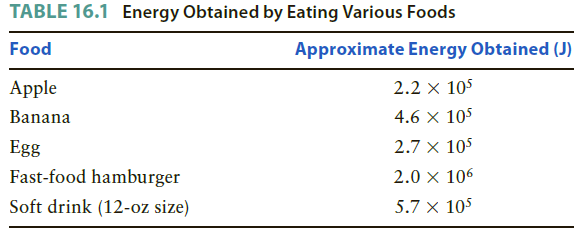
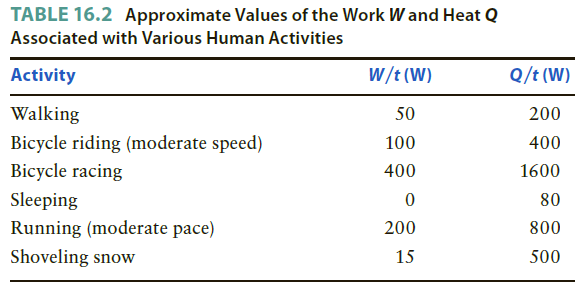
Table 16.1 lists the energy that can be extracted from various foods, and Table 16.2 gives the rate at which work is done and heat is generated by a person engaged in various activities.Use these data to analyze the following cases.(a) How much heat energy is generated during a normal night (8 h)
A doughnut contains about 300 Calories. (These are “food” Calories.) After eating this doughnut, you decide to compensate by taking the stairs instead of using the elevator. If each stair has a height of 20 cm, how many stairs must you climb to compensate for the doughnut? Assume all the energy
One gallon of gasoline releases approximately 1.2 × 10⁸ J when it is “burned” (i.e., undergoes combustion) in a car engine. If the engine releases 4.0 × 10⁷ J of heat during this time, what is the mechanical work done by the engine?
The temperature of a sample of dilute argon gas with n = 7.5 moles decreases by 200 K during a thermodynamic process. If 35,000 J of heat are extracted from the gas, what is the work done by the gas on its surroundings?
The temperature of an ideal monatomic gas increases by 100 K while 3000 J of heat are added to the gas. If the gas contains 4.0 moles, how much work does it do on its surroundings?
A system takes in 5000 J of heat and does 4000 J of work on its surroundings. What is the change in the internal energy of the system?
What is the total internal energy of a monatomic ideal gas that contains 4.0 moles at a temperature of 400 K?
A hydroelectric power plant converts potential energy of water stored behind a dam to electrical energy with an efficiency close to 100%. A coal-burning (or nuclear) power plant only approaches 40% for conversion of the chemical (or fission) energy to electricity. Why?
Consider the common expressions (a) “There’s no such thing as a free lunch” and (b) “You can’t even break even.” Which of the laws of thermodynamics might these expressions refer to? Explain.
Two ideal heat engines A and B operate using the same hot reservoir. It is found that engine B is more efficient than engine A. Explain how that can be.
In Example 16.10, we found that for typical temperatures of the hot and cold reservoirs, the theoretical efficiency of a home heat pump can be quite large. Investigate the efficiency obtained with real heat pumps (i.e., do some research on the Internet). How does the efficiency of a real heat pump
Explain why heat pumps that use air as the cold reservoir are most efficient in mild climates. (They are called “air-to-air” heat pumps.) Why does a heat pump that uses water from deep underground as the cold reservoir have a thermodynamic advantage over air-to-air heat pumps when the weather
If an ideal gas is compressed adiabatically, does the internal energy of the gas increase or decrease?
Under what conditions will the efficiency of a Carnot engine approach 100%?
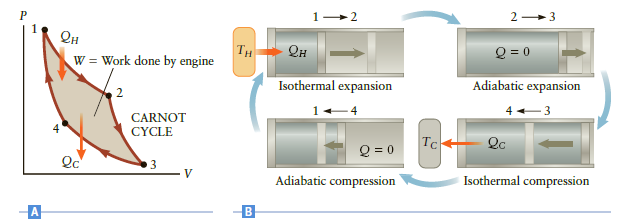
Consider the entropy changes that occur during the Carnot cycle sketched in Figure 16.31. For each stage of the cycle, is the entropy change of the engine positive, negative, or zero? What is the total entropy change of the engine, and of the environment, during one complete cycle? Is there
Suppose the second law of thermodynamics is not true and it is possible for heat to flow spontaneously from a cold object to a warmer one. Show that this process would allow one to construct a perpetual motion machine. Hint: Consider a machine that functions in two or more separate steps, with one
Give an example of a mechanical process that is irreversible.
Give an example of a mechanical process that is reversible.
In Section 16.4, we asserted that the work done in any cyclic process is equal to the area enclosed by the path on a P–V plot. In Example 16.6, weproved this assertion for a cyclic process described by a rectangular path. Prove this result for a path of any shape. Hint: Use a graphical argument
Figure Q16.10 shows a thermodynamic process in which a system first expands and is then compressed. Indicate the area on the P–V diagram that corresponds to the work done by the system.Figure Q16.10 - V
Showing 2600 - 2700
of 4913
First
20
21
22
23
24
25
26
27
28
29
30
31
32
33
34
Last
Step by Step Answers

 Get 50% OFF
Claim Now
Get 50% OFF
Claim Now