New Semester
Started
Get
50% OFF
Study Help!
--h --m --s
Claim Now
Question Answers
Textbooks
Find textbooks, questions and answers
Oops, something went wrong!
Change your search query and then try again
S
Books
FREE
Study Help
Expert Questions
Accounting
General Management
Mathematics
Finance
Organizational Behaviour
Law
Physics
Operating System
Management Leadership
Sociology
Programming
Marketing
Database
Computer Network
Economics
Textbooks Solutions
Accounting
Managerial Accounting
Management Leadership
Cost Accounting
Statistics
Business Law
Corporate Finance
Finance
Economics
Auditing
Tutors
Online Tutors
Find a Tutor
Hire a Tutor
Become a Tutor
AI Tutor
AI Study Planner
NEW
Sell Books
Search
Search
Sign In
Register
study help
sciences
inorganic chemistry
Inorganic Chemistry 5th Edition Catherine Housecroft - Solutions
Give an explanation for the following observations: AlF3 has only a low solubility in liquid HF, but a combination of NaF and AlF3 leads to dissolution of the reagents; when BF3 is added to the solution, a precipitate forms.
Write equations to show what happens when each of the following dissolves in liquid HF:(a) ClF3; (b) MeOH; (c) Et2O; (d) CsF; (e) SrF2;(f) HClO4.
H2S2O7 functions as a monobasic acid in H2SO4.(a) Write an equation to show what happens when H2S2O7 dissolves in H2SO4. (b) Assess the strength of H2S2O7 as an acid given that the ionization constant is 1:4 × 10⁻².
Give equations to show how the following compounds behave in H2SO4: (a) H2O; (b) NH3; (c) HCO2H given that it decomposes; (d) H3PO4 given that only one H+ is transferred between one molecule of H3PO4 and one molecule of H2SO4; (e) HCl given that HCl acts as an acid and one
Compare the behaviour of nitric acid in aqueous and sulfuric acid solutions, giving examples from both inorganic and organic chemistries of the uses of HNO3 in these two media.
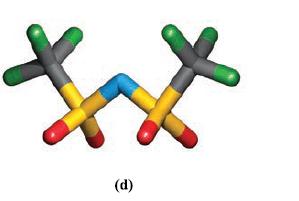
Ionic liquids show potential for applications in lithium-ion batteries. A combination of Li[N(SO2CF3)2] and [EMIm][N(SO2CF3)2] (EMim = 1-ethyl-3 methylimidazolium ion) has been used as a model for a room temperature ionic liquid electrolyte. From this mixture, crystals of Li2[EMIm][N(SO2CF3)2]3
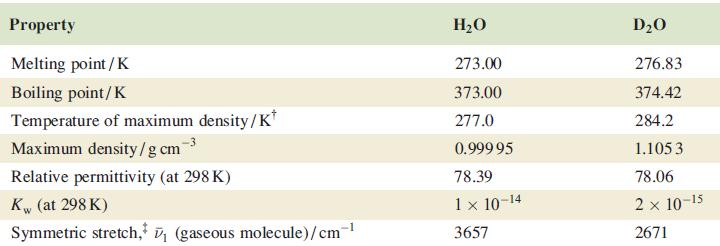
Confirm that the difference in values of ν̅(O—H) and ν̅(O—D) given in Table 10.2 is consistent with the isotopic masses of H and D.Table 10.2 Property Melting point / K Boiling point/K Temperature of maximum density/K* Maximum density/gcm Relative permittivity (at 298 K) Kw (at 298
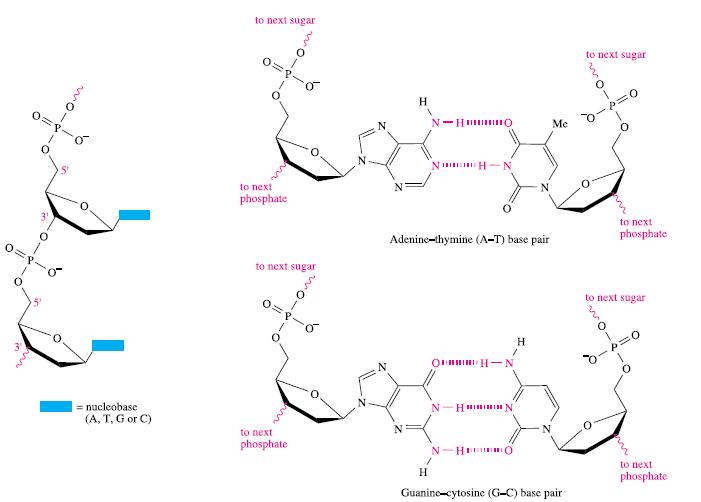
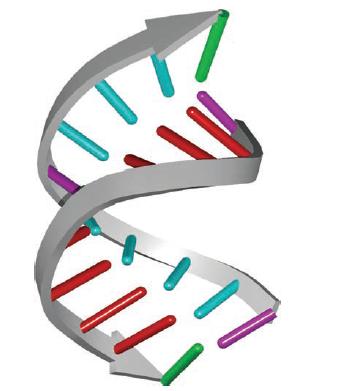
Using the information in Figs. 10.14 and 10.18, explain how the two oligonucleotidesassemble into a double helical structure (see Fig. 10.14 for the 3' and 5' numbering, and definitions of C, A, G and T).Figure 10.14.Figure 10.18. 5'-CAAAGAAAAG-3' and 5'-CTTTTCTTTG-3'
An ionic liquid can be formed by adding ZnCl2 to (2-chloroethyl)trimethylammonium chloride, XCl. When the ratio of ZnCl2 : XCl = 2 : 1, fast atom bombardment mass spectrometry shows the presence of [ZnxCly]z− ions with m/z = 171, 307 and 443. Suggest identities for these ions and write a series
Solutions of H2O2 are used as bleaching agents. For the decomposition of H2O2 to H2O and O2,Why can H2O2 be stored for periods of time without significant decomposition? AG -116.7kJ mol™
Confirm that the 3D structure of aluminium hydride shown in Fig. 10.17 is consistent with a 1 : 3 (Al : H) stoichiometry.Figure 10.17
(a) SbCl3 may be used as a non-aqueous solvent above its melting point. Suggest a possible self-ionization process for this solvent.(b) Explain why the reaction of NOCl with AgNO3 in liquid N2O4 can be classed as a neutralization process. Write an equation for the reaction and compare it with that
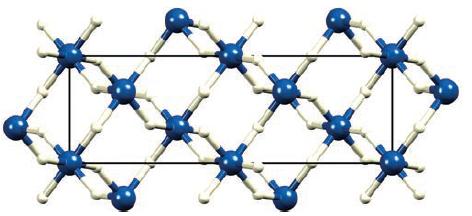
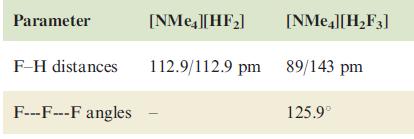
The structures of [NMe4][HF2] and [NMe4][H2F3] have been determined by X-ray diffraction. The table on the next page shows selected structural data; all F–H–F angles are between 175 and 178°.From the data given, draw the structures of the anions in [NMe4][HF2] and [NMe4][H2F3], and say what
In the pharmaceutical industry, the active ingredients in drugs are usually manufactured as crystalline solids, and a recurring problem is that of polymorphism. It has been suggested that producing the active pharma ingredients as room temperature ionic liquids could be advantageous. (a) What
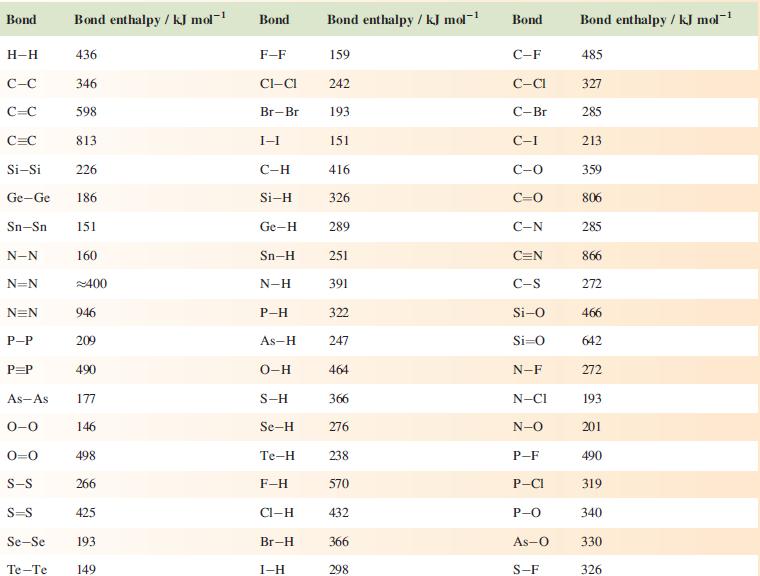
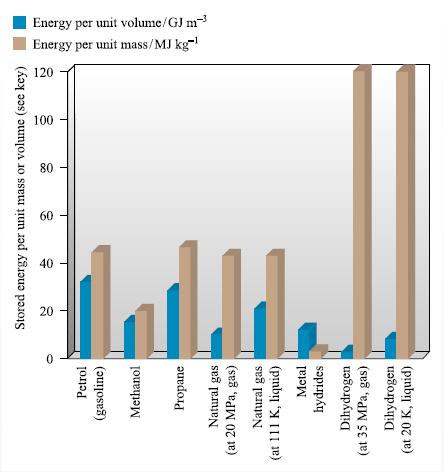
In vehicles, the combustion of H2 rather than a hydrocarbon-based fuel reduces both CO2 emissions and a dependence on fossil fuels. (a) Using data from Appendix 12, show that the combustion of H2 releases 120 kJ g−1. (b) The chart in Box 10.2 shows that the stored energy per unit mass of
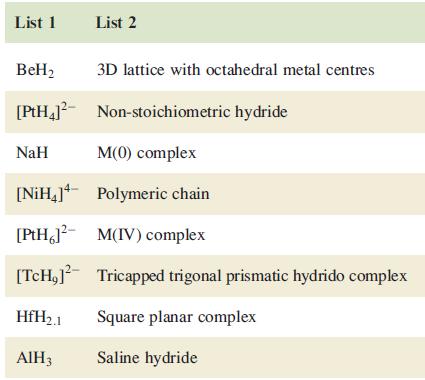
The first list below contains the formula of a hydride. Each has a ‘partner’ in the second list of phrases. Match the ‘partners’; there is only one match for each pair. Structural descriptions refer to the solid state. List 1 BeH₂ [PtH4] NaH [NiH4] [PtH] [TcH₂] HfHz.1 AIH 3 List 2 3D
(a) Sr2RuH6 crystallizes in a lattice that can be described in terms of the CaF2 structure type with octahedral [RuH6]4− ions replacing Ca2+ ions, and Sr2+ ions replacing F− ions. Sketch a unit cell of CaF2. Show that in Sr2RuH6, each [RuH6]4− ion is surrounded by eight Sr2+ ions in a cubic
(a) Why is it necessary to use deuterated solvents in 1H NMR spectroscopy? (b) Draw the structures of THF-d8 and DMF-d7.
For deuterium, I = 1. In a fully deuterated sample of CDCl3, what is observed in the 13CNMRspectrum?
How would you attempt to prepare a sample of pure HD and to establish the purity of the product?
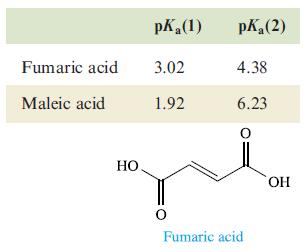
Suggest explanations for the following observations.(a) Ammonium fluoride forms solid solutions with ice.(b) The viscosity decreases along the series of liquids H3PO4 > H2SO4 > HClO4.(c) Formic (methanoic) acid has a Trouton constant of 60.7 JK−1 mol−1.(d) pKa values for fumaric acid and
The IR spectrum of a 0.01 mol dm−3 solution of tertbutanol in CCl4 shows a sharp peak at 3610 cm−1; in the IR spectrum of a similar 1.0 mol dm−3 solution, this absorption is much diminished in intensity, but a very strong, broad peak at 3330 cm−1 is observed. Rationalize these observations.
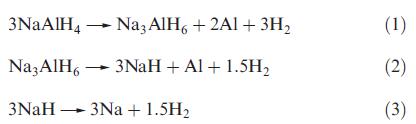
NaAlH4 is among lightweight metal hydrides being investigated as a means of storing hydrogen, e.g. for fuel cell applications. Decomposition occurs in three steps upon heating:(a) Calculate the H content of NaAlH4 as a wt %. (b) Step (3) occurs above 670K and this limits the practical
Suggest an explanation for the fact that solid CsCl, but not LiCl, absorbs HCl at low temperatures.
Write a brief, but critical, account of ‘the hydrogen bond’.
(a) Write equations for the reactions of KH with NH3 and with ethanol. (b) Identify the conjugate acid–base pairs in each reaction.
Write equations for the following processes, noting appropriate conditions:(a) Electrolysis of water;(b) Electrolysis of molten LiH;(c) CaH2 reacting with water;(d) Mg treated with dilute nitric acid;(e) Combustion of H2;(f ) Reaction of H2 with CuO.
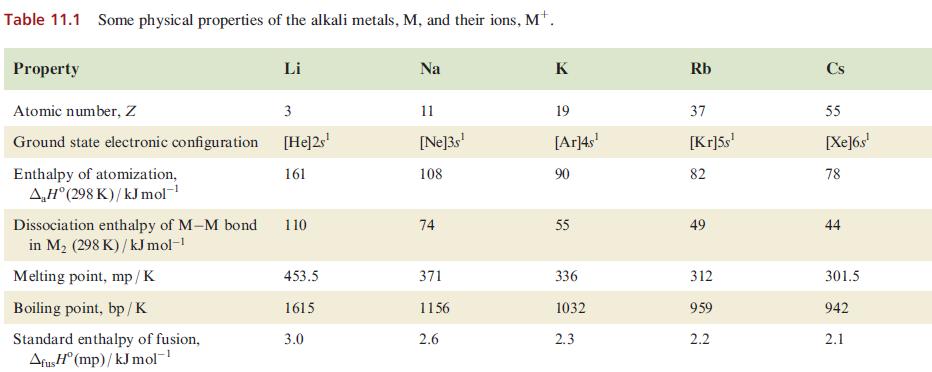
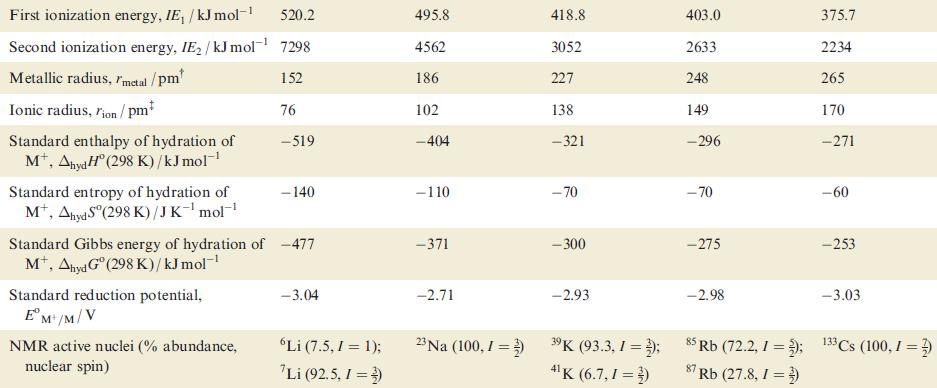
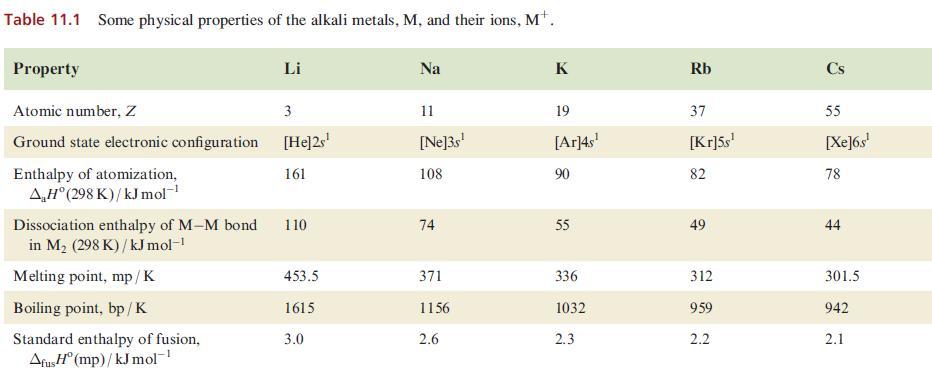
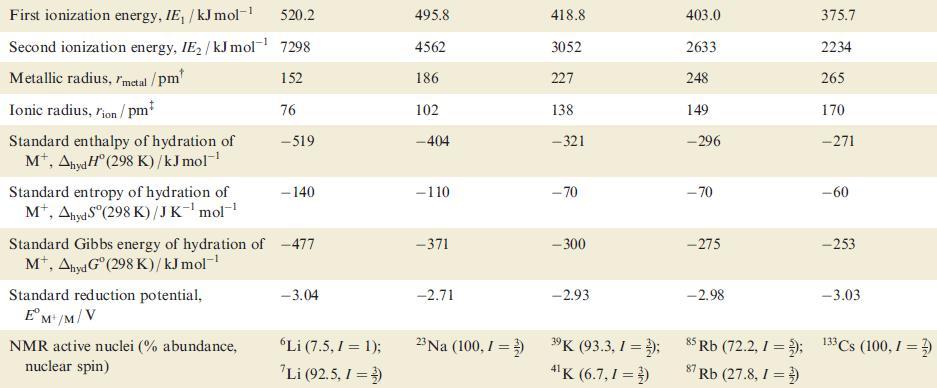
(a) Describe the bonding in the M2 diatomics (M = Li, Na, K, Rb, Cs) in terms of valence bond and molecular orbital theories. (b) Account for the trend in metal–metal bond dissociation energies given in Table 11.1. Table 11.1 Some physical properties of the alkali metals, M, and their ions,
Magnesium hydride possesses a rutile lattice. (a) Sketch a unit cell of rutile. (b) What are the coordination numbers and geometries of the Mg and H centres in this structure?
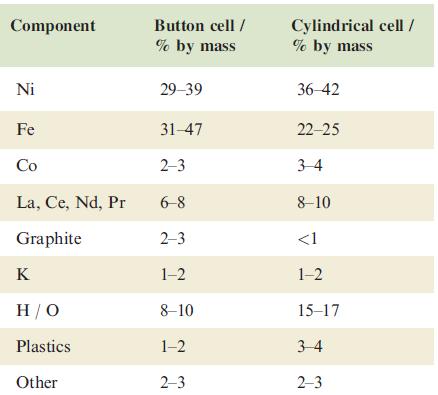
Typical compositions of nickel–metal hydride (NiMH) batteries are shown below:(a) Write equations to show the processes at the anode and cathode during charging and discharging a NiMH cell. (b) What is the overall cell reaction? Confirm that the changes in oxidation states for reduction and
Discuss the bonding in BeH2 in terms of a suitable hybridization scheme. Relate this to a bonding description for Ga2H6.
(a) KMgH3 crystallizes with a CaTiO3-type structure. Draw a diagram to show a unit cell of KMgH3. What is the coordination number of each atom?(b) Calculate a value of ΔlatticeH°(KMgH3, 298 K) given that the standard enthalpy of formation of KMgH3(s) (298 K) is –278 kJ mol−1.
(a) Given that the enthalpy change associated with the addition of H+(g) to H2O(g) is –690 kJmol−1, and ΔhydHo(H+, g) = −1091 kJmol−1, calculate the enthalpy change associated with the solvation of [H3O]+(g) in water.(b) Outline how the nickel–metal hydride battery works, giving
(a) Describe the structure of the ordinary phase of ice.(b) Cow’s milk is composed of >85% water. Explain why a carton of milk expands when it is frozen, but returns to its original size when allowed to warm to room temperature.
(a) Write down, in order, the names and symbols of the metals in group 1; check your answer by reference to the first page of this chapter. (b) Give a general notation that shows the ground state electronic configuration of each metal.
Explain why, for a given alkali metal, the second ionization energy is very much higher than the first.
Describe the solid state structures of (a) The alkali metals (b) The alkali metal chlorides, and comment on trends down the group.
Discuss trends in (a) Melting points, (b) Ionic radii, r+ for the metals on descending group 1.
(a) Write an equation for the decay of 40K by electron capture. (b) Determine the volume of gas produced when 1 g of 40K decays according to this equation. (c) The decay of 40K is the basis of a method for dating rock samples. Suggest how this method works.
Comment on the following observations:(a) Li is the alkali metal that forms the group 1 nitride most stable with respect to decomposition into its elements.(b) The mobilities of the alkali metal ions in aqueous solution follow the sequence Li++ + + +.(c)is nearly constant (see Table 11.1) for the
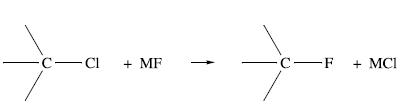
Suggest why KF is a better reagent than NaF for replacement of chlorine in organic compounds by fluorine by the autoclave reaction: -C-Cl + MF -C-F + MCI
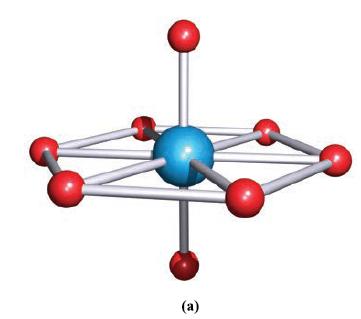
By considering Fig. 11.4a and the packing of the units shown into an infinite lattice, show that (a) The ratio of Li+ :N3− ions in layer 2 is 2:1,(b) The stoichiometry of the compound is Li3N.Figure 11.4a (a)
What general type of reaction is equilibrium 11.21? Confirm your answer by considering the oxidation state changes involved. Give two other examples of this general type of reaction. 2Na Na + Na (11.21)
Suggest what will happen when a mixture of LiI and NaF is heated.
Samples for IR spectroscopy may be prepared as solid state discs by grinding the compound for analysis with an alkali metal halide. Suggest why the IR spectra of K2[PtCl4] in KBr and KI discs might be different.
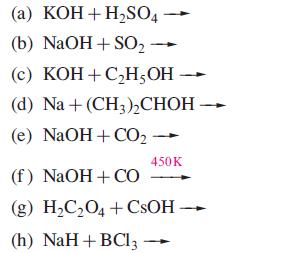
Suggest products and write balanced equations for each of the following reactions; these are not necessarily balanced on the left-hand side. (a) KOH + H₂SO4 (b) NaOH + SO₂ (c) KOH + C₂H5OH (d) Na + (CH3)₂CHOH (e) NaOH + CO₂ 450K (f) NaOH + CO (g) H₂C₂O4 +CsOH → (h) NaH+ BC13
Suggest why the solubility of sodium sulfate in water increases to 305K and then decreases.
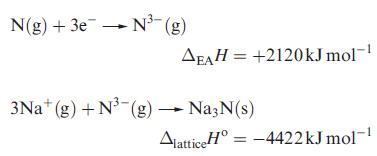
(a) Na3N remained an elusive compound until 2002. Calculate a value for ΔfHo(Na3N, s) using data from Appendices 8 and 10, and the following estimated values of ΔH(298 K):Comment on whether the value obtained is sufficient to indicate whether Na3N is thermodynamically stable.(b) The
Construct approximate MO diagrams for [O2]− and [O2]2− and confirm that [O2]− is paramagnetic, while [O2]2− is diamagnetic.
(a) The crystalline product from reaction 11.22 contains [Na2]2− units. Construct an MO diagram for [Na2]2− and determine the bond order in this species. Comment on the result in the light of the text discussion of this species, explaining differences between the MO model and the experimental
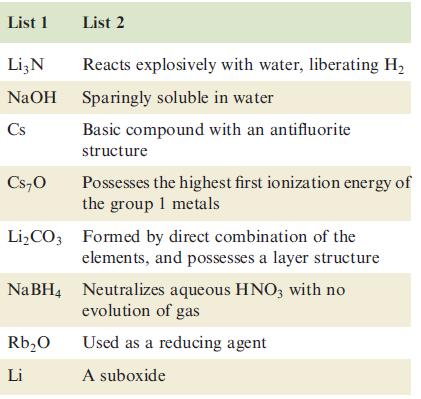
The first list opposite contains the formula of a group 1 metal or metal compound. Match these to the descriptions given in the second column. List 1 LigN NaOH Cs Cs70 List 2 Reacts explosively with water, liberating H₂ Sparingly soluble in water Basic compound with an
(a) Stability constants for the formation of [M(18-crown-6)]+ complexes in acetone are given below. Comment critically on these data.(b) Of the salts NaNO3, RbNO3, Cs2CO3, Na2SO4, Li2CO3, LiCl and LiF, which are soluble in water? Using LiCl and LiF as examples, discuss factors that contribute to
Write down the formulae of the following ions:(a) Superoxide; (b) Peroxide; (c) Ozonide; (d) Azide;(e) Nitride; (f) Sodide.
Write a brief account of the uses of the alkali metals and their compounds, with reference to relevant industrial processes.
Alkali metal cyanides, MCN, are described as pseudohalides. (a) Draw the structure of the cyanide ion, and give a description of its bonding.(b) Interpret the structure of NaCN if it possesses an NaCl-type structure.
Give an account of what happens when Na dissolves in liquid NH3.
Write balanced equations for the following reactions:(a) Sodium hydride with water;(b) Potassium hydroxide with acetic acid;(c) Thermal decomposition of sodium azide;(d) Potassium peroxide with water;(e) Sodium fluoride with boron trifluoride;(f ) Electrolysis of molten KBr;(g) Electrolysis of
Suggest explanations for the following observations.(a) Although Na2O2 is described as being colourless, samples of Na2O2 often appear to be very pale yellow.(b) NaO2 is paramagnetic.
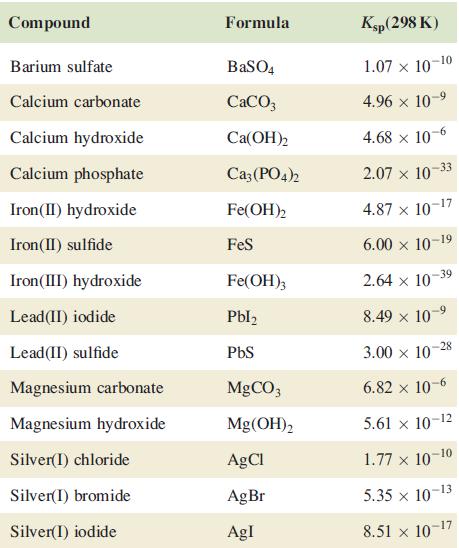
Using data in Table 7.5, determine the relative solubilities of Ca(OH)2 and Mg(OH)2 and explain the relevance of your answer to the extraction of magnesium from seawater.Table 7.5. Compound Barium sulfate Calcium carbonate Calcium hydroxide Calcium phosphate Iron (II) hydroxide Iron (II)
(a) Explain how face-sharing between M6O octahedra leads to compounds with stoichiometries of M9O2 for M = Rb, and M11O3 for M = Cs.(b) The suboxide Cs7O contains Cs11O3 clusters. Explain how this arises.
(a) Suggest products for the reaction of Li3N with water. Write a balanced equation for the reaction.(b) A compound A was isolated from the reaction between a group 1 metal M and O2. A reacts with water to give only MOH, while M reacts in a controlled manner with water giving MOH and another
Mercedes-Benz launched the first mass-produced hybrid electric vehicle containing a lithium-ion battery in 2009. (a) Explain how this battery works and show how both LiCoO2 and LiFePO4 function as positive electrode materials. (b) How does a plug-in electric vehicle differ from a hybrid
Sodium carbonate is a vital component of the glass manufacturing industry. (a) Explain the role that Na+ plays in sodalime glass. (b) Commercial Na2CO3 is categorized into ‘natural’ and ‘synthetic’. Distinguish between these and detail the process whereby synthetic Na2CO3 is
(a) Write down, in order, the names and symbols of the metals in group 2; check your answer by reference to the first page of this chapter. (b) Give a general notation that shows the ground state electronic configuration of each metal.
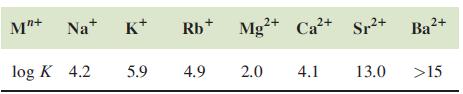
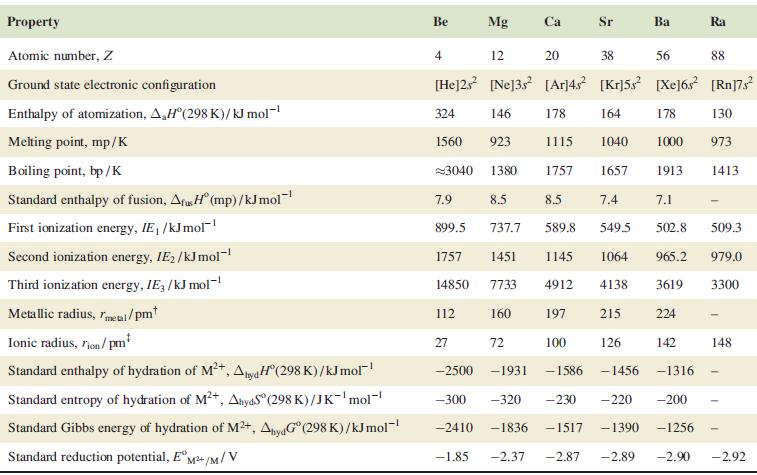
Discuss the data presented in Table 12.5.Data from Table 12.5 M"+Na+ log K 4.2 K+ 5.9 Rb+ 4.9 2+ Mg²+ Ca²+ Sr²+ Ba²+ 2.0 4.1 13.0 >15
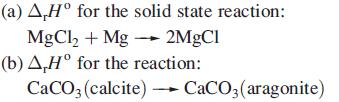
How would you attempt to estimate the following? (a) A,Hº for the solid state reaction: MgCl₂ + Mg 2MgCl (b) A,Hº for the reaction: CaCO3 (calcite) →→ CaCO3(aragonite)
(a) Identify the conjugate acid–base pairs in reaction 12.24. (b) Suggest how BaO2 will react with water. SrO₂ + 2HCl → SrCl₂ + H₂O₂ (12.24)
(a) Determine ΔrHº for the reactions of SrO and BaO with water, given that values of ΔfHº(298 K) for SrO(s), BaO(s), Sr(OH)2(s), Ba(OH)2(s) and H2O(l) are −592.0, −553.5, −959.0, −944.7 and −285.5 kJ mol−1 respectively. (b) Compare the values of ΔrHº with that for the reaction of
(a) Write an equation to show how Mg reacts with N2 when heated. (b) Suggest how the product reacts with water.
The structure of magnesium carbide, MgC2, is of the NaCl type, elongated along one axis. (a) Explain how this elongation arises. (b) What do you infer from the fact that there is no similar elongation in NaCN which also crystallizes with a NaCl-type structure?
Write balanced equations for the following reactions:(a) The thermal decomposition of [NH4]2[BeF4];(b) The reaction between NaCl and BeCl2;(c) The dissolution of BeF2 in water.
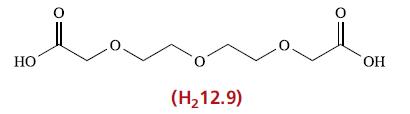
The reaction between Ca(OH)2 and H212.9 in aqueous solution leads to the formation of the complex [Ca(OH2)2(12.9)]. This crystallizes as a centrosymmetric dimer in which each Ca2+ centre is 8-coordinate. This contains a central Ca2(μ-O)2 unit in which each bridging O-donor involves a carboxylate
(a) Suggest a likely structure for the dimer of BeCl2, present in the vapour phase below 1020 K. What hybridization scheme is appropriate for the Be centres? (b) BeCl2 dissolves in diethyl ether to form monomeric BeCl2 · 2Et2O; suggest a structure for this compound and give a description of
MgF2 has a TiO2-type structure. (a) Sketch a unit cell of MgF2, (b) Confirm the stoichiometry of MgF2 using the solid state structure.
(a) How do anhydrous CaCl2 and CaH2 function as drying agents?(b) Compare the solid state structures and properties of BeCl2 and CaCl2.
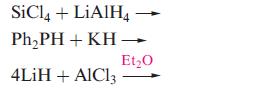
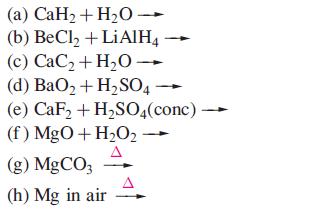
Suggest products for the following reactions, and write balanced equations for the reactions. Comment on any of these reactions that are important in chemical manufacturing processes. (a) CaH₂ + H₂O → (b) BeCl₂ + LiAlH4 (c) CaC₂ + H₂O → (d) BaO₂ + H₂SO4 - (e) CaF₂ +
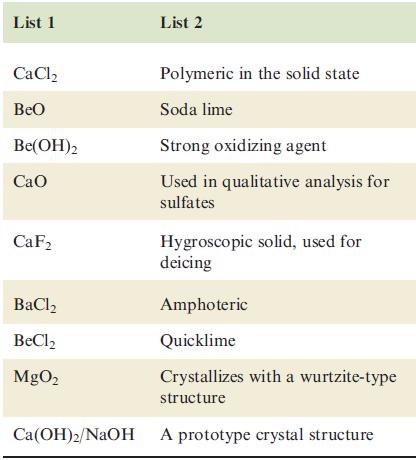
Each compound in List 1 has a matching description in List 2. Correctly match the partners. There is only one correct statement for each compound. List 1 CaCl₂ BeO Be(OH)2 Cao CaF2 List 2 BaCl, BeCl₂ MgO₂ Polymeric in the solid state Soda lime Strong oxidizing agent Used in qualitative
(a) What qualitative test is used for CO2? (b) What reaction takes place (c) What is observed in a positive test?
Write a short account that justifies the so-called diagonal relationship between Li and Mg.
Suggest why MgO is more soluble in aqueous MgCl2 solution than in pure water.
Suggest why Be2+ forms the tetrahedral ion [Be(OH2)4]2+, while Mg2+ forms octahedral [Mg(OH2)6]2+.
Suggest explanations for the following observations.(a) The energy released when a mole of crystalline BaO is formed from its constituent ions is less than that released when a mole of MgO forms from its ions. (Each compound possesses an NaCl-structure.)(b) Despite being a covalent solid, BeF2 is
Comment on the following statements.(a) Na2S adopts a solid state structure that is related to that of CaF2.(b) [C3]4–, CO2 and [CN2]2– are isoelectronic species.(c) Be(OH)2 is virtually insoluble in water, but is soluble in aqueous solutions containing excess hydroxide ions.(d) MgO is used as
(a) A group 2 metal, M, dissolves in liquid NH3, and from the solution, compound A can be isolated. A slowly decomposes to B with liberation of NH3 and a gas C. Metal M gives a crimson flame test; through blue glass, the flame appears pale purple. Suggest identities for M, A, B and C.(b) The group
(a) A 6-coordinate complex may be obtained by crystallizing anhydrous CaI2 from THF solution at 253 K. In contrast, when anhydrous BaI2 is crystallized from THF at 253 K, a 7-coordinate complex is isolated. Suggest structures for the two complexes, and comment on possible isomerism and factors that
Magnesium peroxide is used as a slow O2 release agent in agriculture, ponds and lakes. It is manufactured by treating magnesium oxide or carbonate with H2O2. (a) Write equations for these reactions. (b) Suggest how the decomposition of magnesium peroxide depends upon pH by considering
Describe how sulfur-containing emissions from coal-fired power stations (a) Arise, (b) Are controlled. (c) What are the products of standard desulfurization processes and how are they utilized?
Discuss how the properties of Mg lead to the following applications. (a) Professional camera bodies are made from magnesium alloys (>90% Mg). (b) Mg is used for cathodic protection of steel structures exposed to seawater. (c) Mg is used in fireworks. (d) Aluminium alloys used
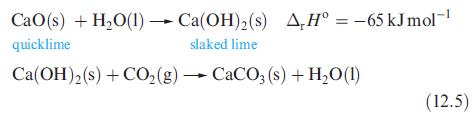
World production of lime in 2014 was 360 Mt. The term ‘lime’ may refer to CaO (quicklime) and/or slaked lime (Ca(OH)2), but is also used to include CaO, Ca(OH)2, CaO·MgO, Ca(OH)2·MgO and Ca(OH)2·Mg(OH)2. (a) How are CaO and CaO·MgO manufactured? (b) Describe the role of CaO in the
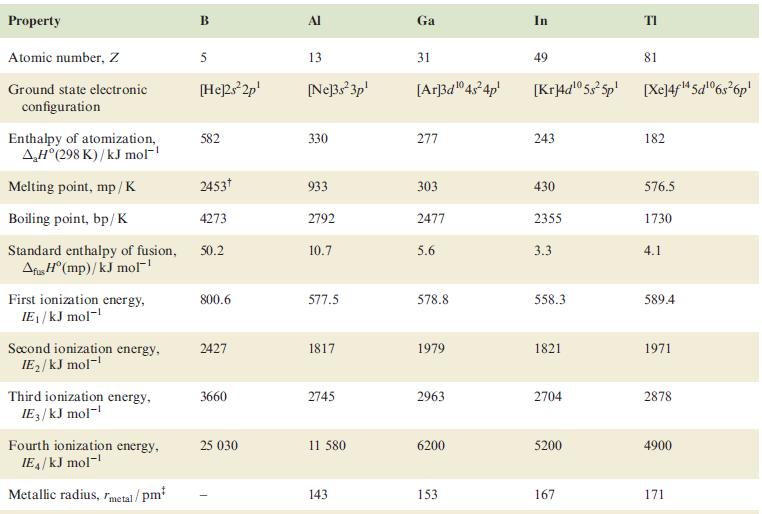
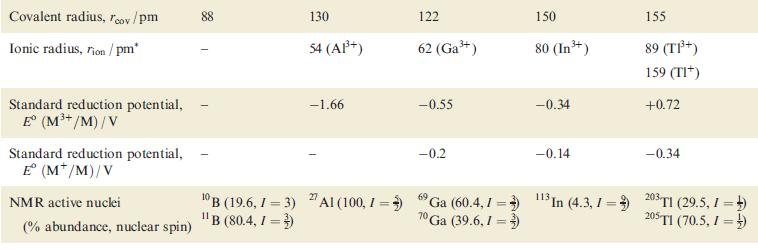
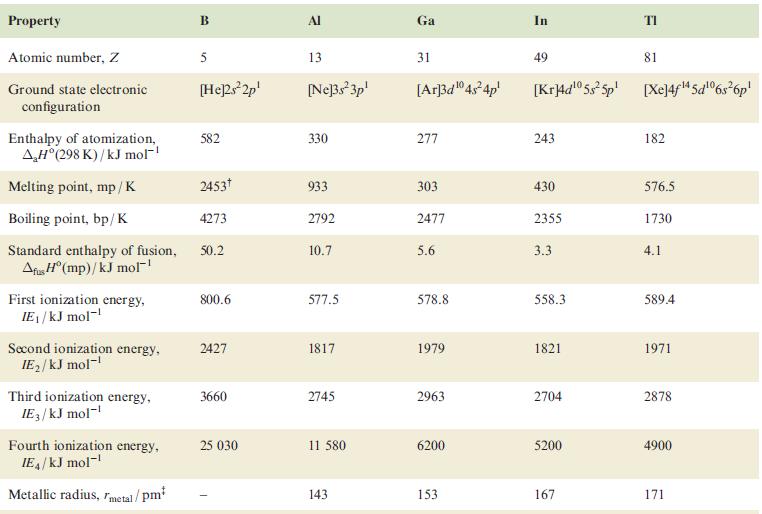
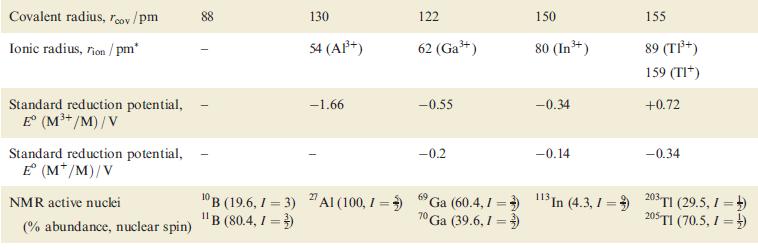
Using the data in Table 13.1, draw a potential diagram for Tl and determine the value of Eº(Tl3+/Tl+).Table 13.1 Property Atomic number, Z Ground state electronic configuration Enthalpy of atomization, AH°(298 K)/kJ mol-¹ Melting point, mp/K Boiling point, bp/K Standard enthalpy of fusion, Afus
Plot a graph to show the variation in values of IE1, IE2 and IE3 for the group 13 elements (Table 13.1), and plot a similar graph to show the variation in values of IE1 and IE2 for the group 2 metals (Table 12.1). Account for differences in trends of IE2 for the group 2 and 13 elements.Table
The thermite process is shown in eq. 13.5. Determine ΔrH° for this reaction if ΔfH°(Al2O3, s, 298K) and ΔfH°(Fe2O3, s, 298K) = −1675:7 and −824.2 kJ mol−1, and comment on the relevance of this value to that of ΔfusH(Fe; s) = 13:8 kJ mol−1. 2A1+ Fe₂O3 Al₂O3 + 2Fe (13.5)
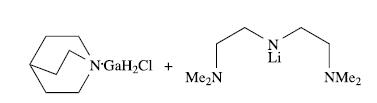
(a) One gallium-containing product, A, was obtained from the following reaction, carried out in Et2O solvent:The room temperature, solution 1H NMR spectrum of A showed the following signals: δ 4.90 (s, 2H), 3.10 (t, 4H), 2.36 (t, 4H), 2.08 (s, 12H) ppm, and the 13C NMR spectrum exhibited three
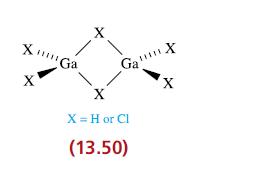
Describe the bonding in Ga2H6 and Ga2Cl6, both of which have structures of the type shown in 13.50. XmGa X Ga X X = H or Cl (13.50) X
Suggest explanations for the following facts.(a) Na[BH4] is very much less rapidly hydrolysed by H2O than is Na[AlH4].(b) The rate of hydrolysis of B2H6 by water vapour is given by the equation:(c) A saturated aqueous solution of boric acid is neutral to the indicator bromocresol green (pH range
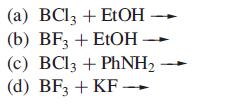
Suggest likely products for the following reactions: (a) BCl3 + EtOH (b) BF3 + EtOH (c) BCl3 + PhNH₂ (d) BF3 +KF-
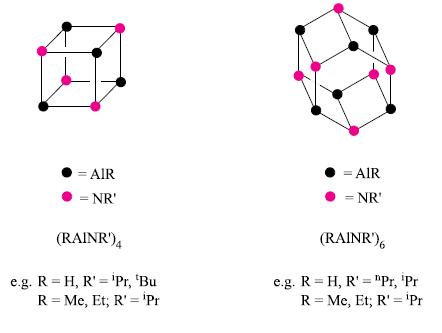
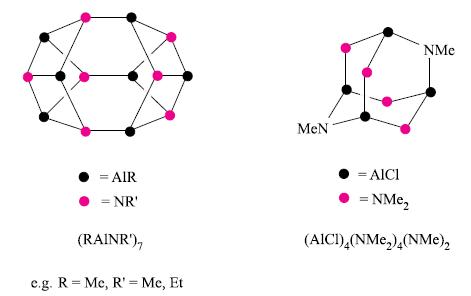
Give appropriate bonding descriptions for the aluminium–nitrogen compounds depicted in Fig. 13.26.Figure 13.26. = AIR = NR' (RAINR') 4 e.g. R= H, R' = 'Pr, 'Bu R = Me, Et; R' = 'Pr = AIR = NR' (RAINR')6 e.g. R= H, R' = "Pr, 'Pr R = Me, Et; R' = 'Pr
(a) Write down, in order, the names and symbols of the elements in group 13; check your answer by reference to the first page of this chapter.(b) Classify the elements in terms of metallic and non-metallic behaviour. (c) Give a general notation showing the ground state electronic configuration
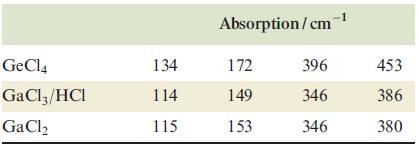
Comment on each of the following observations.(a) AlF3 is almost insoluble in anhydrous HF, but dissolves if KF is present. Passage of BF3 through the resulting solution causes AlF3 to reprecipitate.(b) The Raman spectra of germanium tetrachloride, a solution of gallium trichloride in concentrated
Write equations for the following processes, involved in the extraction of the elements from their ores:(a) The reduction of boron oxide by Mg;(b) The result of the addition of hot aqueous NaOH to a mixture of solid Al2O3 and Fe2O3;(c) The reaction of CO2 with aqueous Na[Al(OH)4].
Showing 1500 - 1600
of 1950
First
6
7
8
9
10
11
12
13
14
15
16
17
18
19
20
Step by Step Answers

 Get 50% OFF
Claim Now
Get 50% OFF
Claim Now