New Semester
Started
Get
50% OFF
Study Help!
--h --m --s
Claim Now
Question Answers
Textbooks
Find textbooks, questions and answers
Oops, something went wrong!
Change your search query and then try again
S
Books
FREE
Study Help
Expert Questions
Accounting
General Management
Mathematics
Finance
Organizational Behaviour
Law
Physics
Operating System
Management Leadership
Sociology
Programming
Marketing
Database
Computer Network
Economics
Textbooks Solutions
Accounting
Managerial Accounting
Management Leadership
Cost Accounting
Statistics
Business Law
Corporate Finance
Finance
Economics
Auditing
Tutors
Online Tutors
Find a Tutor
Hire a Tutor
Become a Tutor
AI Tutor
AI Study Planner
NEW
Sell Books
Search
Search
Sign In
Register
study help
sciences
inorganic chemistry
Inorganic Chemistry 5th Edition Catherine Housecroft - Solutions
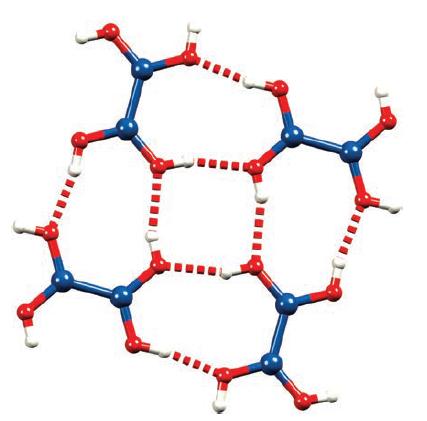
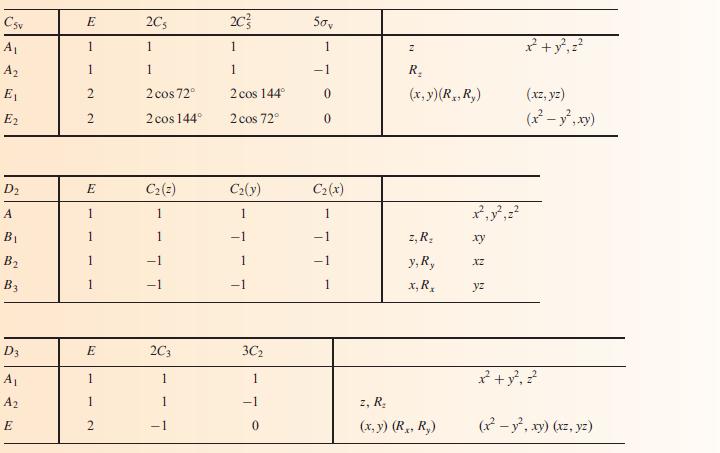
Figure 13.21 shows four hydrogen-bonded molecules of B2(OH)4. To what point group does a single molecule of B2(OH)4 belong?Figure 13.21. .....
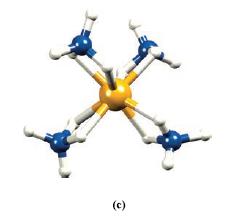
Figure 13.11c shows the solid state structure of the [Al(BH4)4]‾ ion, present in [Ph3MeP][Al(BH4)4]. In the light of these structural data, account for the following observations, recorded for the compound in solution. (a) At 298 K, the 1H NMR spectrum of [Ph3MeP][Al9BH4)4] shows one broad
Explain how, during dimerization, each BH3 molecule acts as both a Lewis base and a Lewis acid.
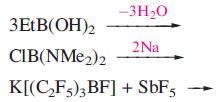
(a) Suggest products for the following reactions.(b) PhB(OH)2 forms dimers in the solid state. Dimers further associate into a 3-dimensional network. Describe how this assembly is likely to arise. -3H₂O 3EtB(OH)2 CIB(NMe 2)2 K[(C₂F5)3BF] + SbF5 2Na
The ordering of the relative stabilities of adducts L · BH3 for some common adducts is, according to L: Me2O < THF < Me2S < Me3N < Me3P < H‾. In addition to answering each of the following, indicate how you could use NMR spectroscopy to confirm your proposals.(a) What happens when
The reaction ofK[B(CN)4] withClF3 in liquid HF leads to the formation of K[B(CF3)4]. Explain why, in the 11B NMR spectrum of this salt, a 13-line pattern is observed. What will be the relative intensities of the middle and outside lines of this multiplet?
The solvolysis of K[B(CF3)4] in concentrated H2SO4 generates (F3C)3BCO. (a) Write a balanced equation for the solvolysis process. (b) In the gas phase, (F3C)3BCO possesses C3 rather than C3v symmetry. Rationalize this observation, and draw a structure for the molecule which is consistent
(a) Write down the formula of cryolite. (b) Write down the formula of perovskite. (c) Cryolite is described as possessing a 3-dimensional structure closely related to that of perovskite. Suggest how this is possible when the stoichiometries of the two compounds do not appear to be
(a) The behaviour of H3BO3 in aqueous solution is not typical of a mineral acid such as HCl or H2SO4. Illustrate, using appropriate examples, these differing behaviours. (b) The formula of borax is sometimes written as Na2B4O7·10H2O. Comment critically on this representation.
Compare the physical and chemical properties of α- and γ-alumina, choosing examples that highlight why it is important not to call Al2O3 simply ‘alumina’.
Write a brief account of the bonding and reactivity of borazine which emphasizes the ways in which this compound is similar or dissimilar to benzene.
GaCl3 reacts with KP(H)SitBu3 (equimolar amounts) to give KCl and two isomers of a 4-membered, cyclic compound which contains 38.74% C, 7.59% H and 19.06% Cl. Suggest the identity of the product, and draw structural diagrams to illustrate the isomerism.
Use Wade’s rules to suggest likely structures for B5H9, [B8H8]2−, C2B10H12 and [B6H9]−. Are any cage-isomers possible?
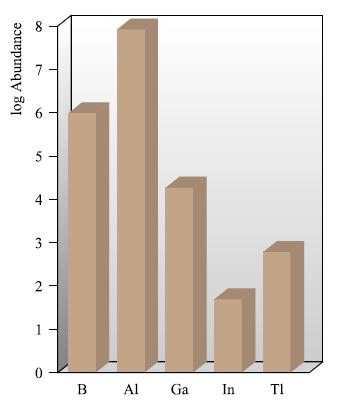
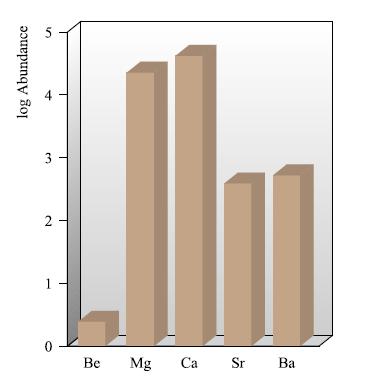
(a) Comment why, in Fig. 13.1, the data are presented on a logarithmic scale. What are the relative abundances of Al (Fig. 13.1) and Mg (Fig. 12.2) in the Earth’s crust?(b) Show that the changes in oxidation states for elements undergoing redox changes in reaction 13.18 balance.(c) The ion
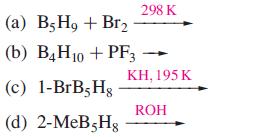
Suggest likely products for the following reactions, with the stoichiometries stated: (a) B5 H₂ + Br₂ (b) B4 H10 + PF3 (c) 1-BrB5H8 (d) 2-MeB5Hg 298 K KH, 195 K ROH
(a) Write balanced equations for the reactions of aqueous Ga+ with [I3]‾ , Br2, [Fe(CN)6]3+ and [Fe(bpy)3]3+.(b) The 205Tl NMR spectrum of an acidic solution that contains Tl3+ and 13C-enriched [CN]– ionsin concentrations of 0.05 and 0.31 mol dm–3 respectively shows a binomial quintet (δ
(a) What type of semiconductors are formed by doping silicon with boron or gallium? Using simple band theory, explain how the semiconducting properties of Si are altered by doping with B or Ga.(b) An active area of research within the field of Ga3+ and In3+ coordination chemistry is the search for
Crystalline Ag2[B12Cl12] may be described as having a structure based on an anti-fluorite-type arrangement. By approximating each [B12Cl12]2− ion to a sphere, draw a diagram to represent a unit cell of Ag2[B12Cl12]. What type of interstitial hole does each Ag+ ion occupy in this idealized
(a) NMR spectroscopic data for [HAl(BH4)2]n are consistent with the compound existing in two forms in solution. One form is probably a dimer and the other, a higher oligomer. Each species possesses one boron environment, and in the 11B NMR spectrum, each species exhibits a binomial quintet. The
(a) At 297 K, the 11B NMR spectrum of a CD2Cl2 solution of [Ph4As][B6H7] shows one doublet (δ–18.0 ppm, J = 147 Hz). In the 1H NMR spectrum, two signals are observed (δ–5.5 ppm, broad; δ +1.1 ppm, 1:1:1:1 quartet). At 223 K, the 11B NMR spectrum exhibits signals at δ–14.1 and –21.7 ppm
Comment on the following statements:(a) World gallium production increased from 37 t in 1990 to 435 t in 2013.(b) Rubies are composed of α-Al2O3 (corundum) but are red in colour.(c) The adduct H3N·BH3 has possible potential as a hydrogen storage material.
Glass is manufactured by cooling a melt to produce a rigid structure without crystallization. The binary oxides B2O3 and SiO2 are the primary components of borosilicate glass. Possible structural units include B(μ-O)4, B(μ-O)3, B(Ot)3, Si(μ-O)4 and Si(Ot)4 where μ-O and Ot are bridging O atoms
The commercial applications of boron nitride include those as an electrical insulator, a lubricant, an abrasive, a material for making crucibles for high temperature work (e.g. moulds for molten steel) and in cutting tools. Explain why BN has such diverse applications.
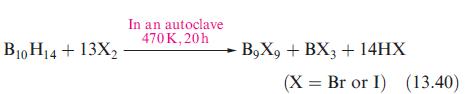
(a) Two-electron reduction of B5H9 followed by protonation is a convenient route to B5H11. What structural change (and why) do you expect the B5 cage to undergo during this reaction?(b) Account for the fact that the solution 11B NMR spectrum of [B3H8]‾ (13.40) exhibits one signal which is a
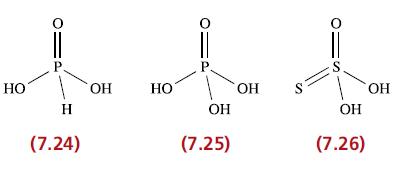
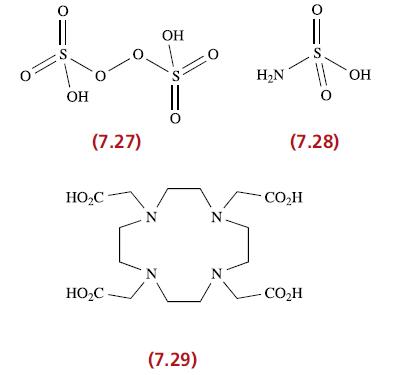
(a) Write equations to show how you expect compounds 7.24 to 7.28 to dissociate in aqueous solution. (b) Suggest how compound 7.29 will react with NaOH in aqueous solution. What salts would it be possible to isolate? (c) While it is convenient to draw the structures of compounds .24 to 7.28 as
The values of pKa(1) and pKa(2) for chromic acid (H2CrO4) are 0.74 and 6.49 respectively.(a) Determine values of Ka for each dissociation step. (b) Write equations to represent the dissociation steps of chromic acid in aqueous solution.
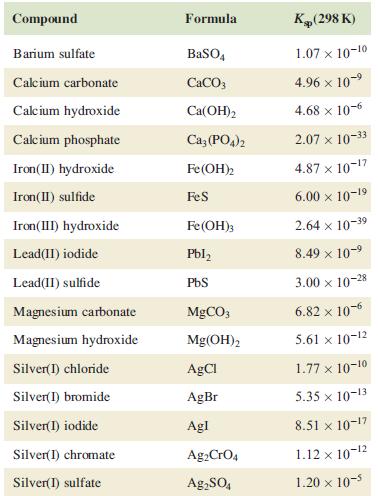
The values of log K for the following two equilibria are 7.23 and 12.27, respectively:Determine (a) Ksp for AgBr,(b) K for the reaction: Ag+ (aq) + 2NH3(aq) [Ag(NH3)2]+ (aq) Ag*(aq) + Br (aq) = AgBr(s)
In aqueous solution, boric acid behaves as a weak acid (pKa = 9:1) and the following equilibrium is established:(a) Draw the structures of B(OH)3 and [B(OH)4]‾.(b) How would you classify the acidic behaviour of B(OH)3? (c) The formula of boric acid may also be written as H3BO3; compare the
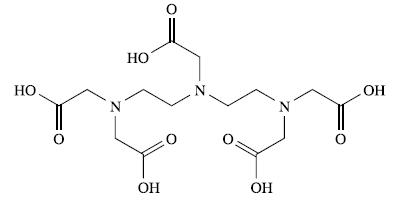
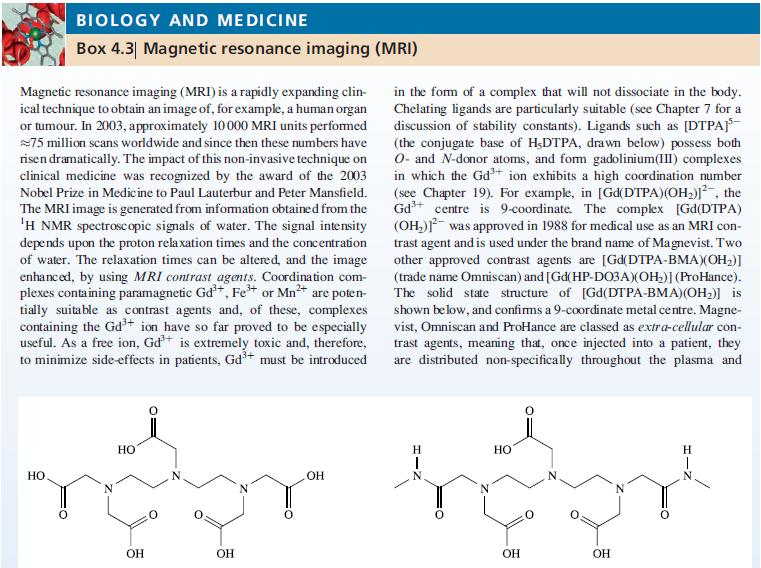
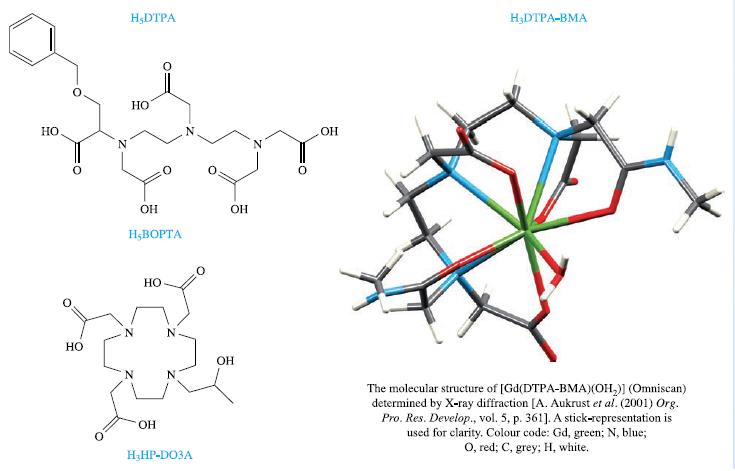
The structure of H5DTPA (see Box 4.3) is shown below:(a) Write equilibria to show the stepwise acid dissociation of H5DTPA. Which step do you expect to have the largest value of Ka?(b) In the complex [Gd(DTPA)(OH2)]2−, the Gd3+ ion is 9-coordinate. Draw a diagram that illustrates how the DTPA5−
Four pKa values (1.0, 2.0, 7.0, 9.0) are tabulated for the acid H4P2O7. Write equations to show the dissociation steps in aqueous solution and assign, with reasoning, a pKa value to each step.
The values of pKa for CH3CO2H and CF3CO2H are 4.75 and 0.23, both of which are very nearly independent of temperature. Suggest reasons for this difference.
(a) To what equilibria do the values of pKa(1) = 10:71 and pKa(2) = 7:56 for the conjugate acid of H2NCH2CH2NH2 refer? (b) Calculate the corresponding values of pKb and write equations to show the equilibria to which these values refer.
Potassium chromate is used as an indicator in titrations for the determination of chloride ion. At the end-point of a titration of an aqueous solution of a metal chloride salt (e.g. NaCl) against silver nitrate solution in the presence of potassium chromate, red Ag2CrO4 precipitates. Give equations
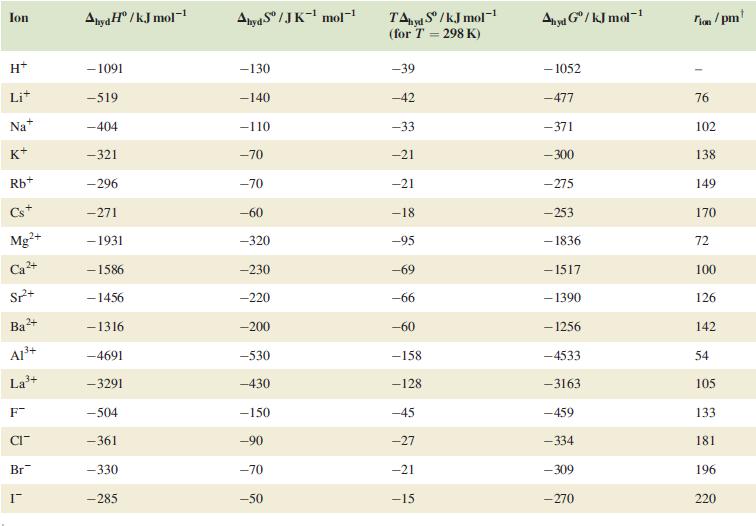
(a) Discuss the factors that contribute towards KCl being a readily soluble salt (35 g per 100 g H2O at 298 K). (b) Develop your answer to part (a) by using the following data: ΔhydHº(K+, g) = −330 kJ mol−1; AhydH° (CI, g) = -370kJmol-¹; Alattice H (KCl, s) = -715kJ mol
When NaCN dissolves in water, the resulting solution is basic. Account for this observation given that pKa for HCN is 9.31.
Construct a thermochemical cycle for the decomposition of the phosphonium halides according to the equation:and use it to account for the fact that the most stable phosphonium halide is the iodide. PH4X(s) PH3(g) + HX(g) =
Write equations to illustrate the amphoteric behaviour of [HCO3]‾ in aqueous solution.
Which of the following oxides are likely to be acidic, basic or amphoteric in aqueous solution: (a) MgO;(b) SnO; (c) CO2; (d) P2O5; (e) Sb2O3; (f) SO2;(g) Al2O3; (h) BeO
Explain what is meant by the terms (a) Saturated solution; (b) Solubility; (c) Sparingly soluble salt;(d) Solubility product (solubility constant).
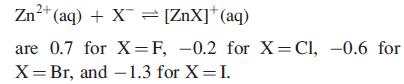
Comment on the following observations.(a) In its complexes, Co(III) forms strong bonds to O- and N-donor ligands, moderately strong bonds to P-donor ligands, but only weak bonds to As-donor ligands.(b) The values of log K for the reaction:(c) Phosphine adducts of Cr(III) halides can be prepared,
Write down expressions for Ksp for the following ionic salts: (a) AgCl; (b) CaCO3; (c) CaF2.
Calculate the solubility of BaSO4 at 298K in g per 100 g of water given that Ksp = 1:07 × 10−10.
Outline the changes that occur (a) To the salt, (b) To the water molecules, when solid NaF dissolves in water. How do these changes affect (qualitatively) the entropy of the system?
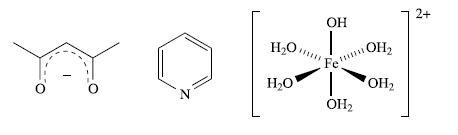
(a) Explain why water is described as being amphoteric.(b) Draw the structures of the conjugate acid of each of the following:(c) The value of Ksp(298 K) for Ag2CrO4 is 1:12 × 10–12. What mass of Ag2CrO4 dissolves in 100 g of water? H₂O. H2O ОН Femm OH₂ OH₂ он2 2+
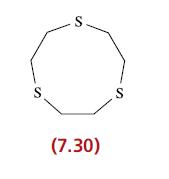
(a) Comment on the fact that, of the group 1 cations, Li+ is the most strongly solvated in aqueous solution, even though the first coordination shell only contains four H2O molecules compared with six for each of the later members of the group.(b) Suggest how ligand 7.30 coordinates to Ru2+ in the
(a) What are the conjugate bases of the acids HF, [HSO4]‾, [Fe(OH2)6]3+ and [NH4]+? (b) What are the conjugate acids of the bases [HSO4]‾, PH3, [NH2]‾ and [OBr]‾? (c) What is the conjugate acid of [VO(OH)]+? (d) [Ti(OH2)6]3+ has a pKa value of 2.5. Comment on the fact that
The formation of a buffer solution is an example of the common-ion effect. Explain how a buffer works with reference to a solution containing acetic acid and sodium acetate.
Calculate the solubility of AgBr (Ksp = 5:35 × 10−13)(a) In aqueous solution and (b) In 0.5M KBr solution.
Magnesium oxide is more soluble in aqueous magnesium chloride than in pure water. Discuss this observation.
Soda-water is made by saturating H2O with CO2. If you titrate soda-water with alkali using phenolphthalein as indicator, you obtain a fading end-point. What does this suggest?
What explanation can you give for the decrease in solubility of the alkaline earth metal sulfates in the sequence CaSO4 > SrSO4 > BaSO4?
(a) Give expressions to define the stepwise stability constants for equilibria 7.66 and 7.68. (b) For each of the complex ions formed in steps 7.66 and 7.68, gives expressions to define the overall stability constants, β2 and β4.
How many chelate rings are present in each of the following complexes? Assume that all the donor atoms are involved in coordination. (a) [Cu(trien)]2+;(b) [Fe(ox)3]3−; (c) [Ru(bpy)3]2+; (d) [Co(dien)2]3+;(e) [K(18-crown-6)]+.
Suggest reasons for the following observations. (a) Although Pd(II) complexes with monodentate O-donor ligands are not as plentiful as those with P-, S- and As-donor ligands, Pd(II) forms many stable complexes with bidentate 0,0'-donor ligands. (b) [EDTA]4‾ forms very stable complexes
(a) For [Pd(CN)4]2‾, a value of log β4 of 62.3 (at 298K in aqueous medium) has been determined. To what equilibrium process does this value refer?(b) For the equilibrium:the value of log K is 20.8. Use this value and the data in part (a) to determine Ksp for Pd(CN)2. Pd (CN)₂ (s) + 2CN- (aq) =
(a) Aqueous solutions of copper(II) sulfate contain the [Cu(OH2)6]2+ ion. The pH of a 0.10moldm−3 aqueous CuSO4 solution is 4.17. Explain the reason why the solution is acidic, and determine Ka for the [Cu(OH2)6]2+ ion.(b) When NH3 is added to aqueous CuSO4, the complex [Cu(OH2)2(NH3)4]2+ is
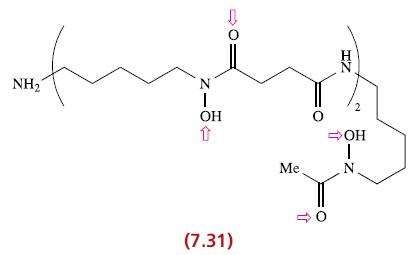
Iron overload is a medical condition where the body cannot cope with abnormally high levels of iron in the system. Chelation therapy by administering desferrioxamine, 7.31, is used to treat the problem. Suggest the origin of the name chelation therapy. What form should the iron be in for the
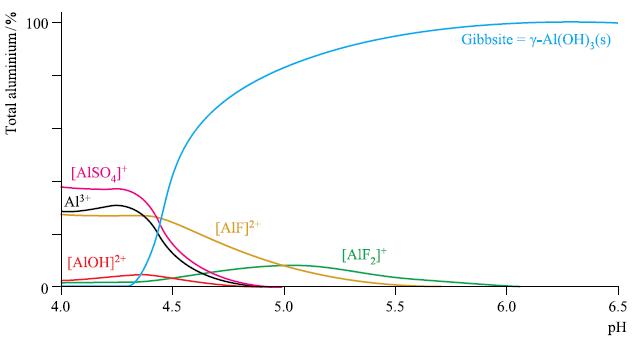
Among the naturally occurring minerals of Al are diaspore (α-AlO(OH)), boehmite (γ-AlO(OH)) and gibbsite (γ-Al(OH)3). At low pH, reactions with H+ give rise to water-soluble [Al(OH2)6]3+, abbreviated to Al3+ (aq). Thus, Al becomes mobile in rivers and other water courses, but the species present
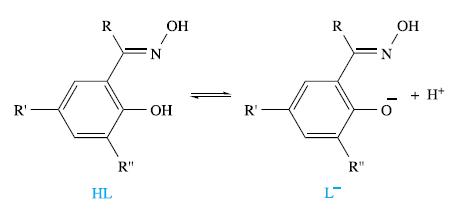
The extraction of metals from primary (naturally occurring ores) and secondary (recycled materials) sources is of huge industrial importance. The manipulation of equilibria in, for example, solvent extraction processes is critically important. The family of bidentate ligands shown below is used to
The natural sulfur cycle involves many sulfur reducing and sulfur-oxidizing bacteria. For example, S2‾ is oxidized to elemental sulfur and to [SO4]2–, and the reverse processes convert mobile [SO4]2− to immobilized S2−. (a) At the end of the sulfur reduction sequence, HS− may be
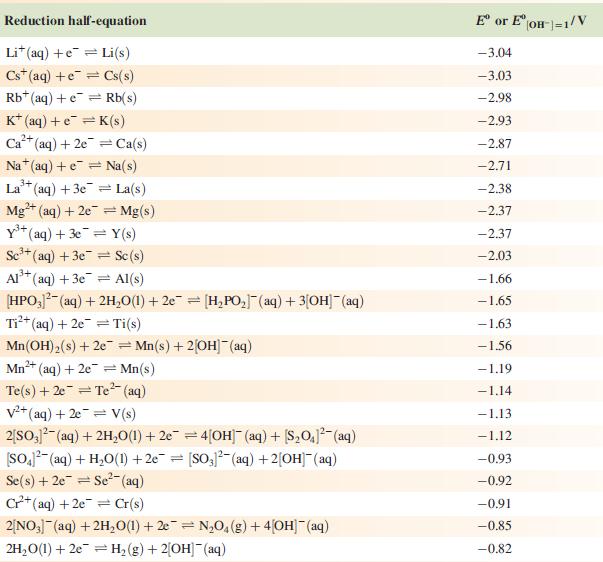
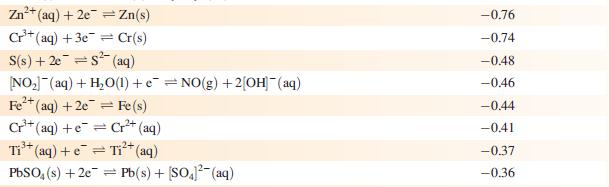
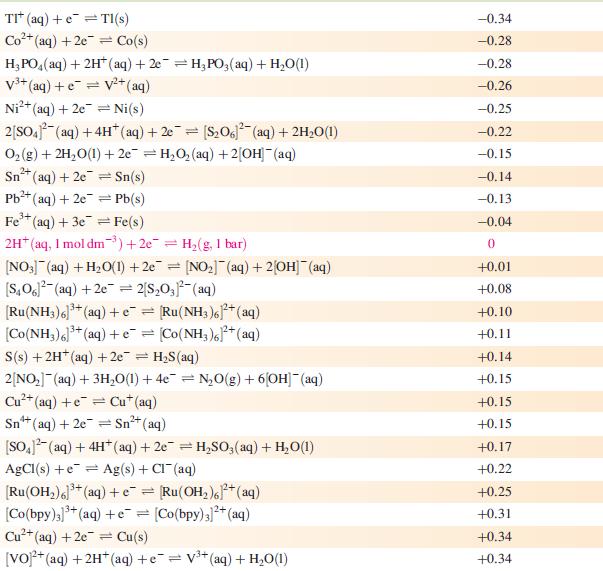
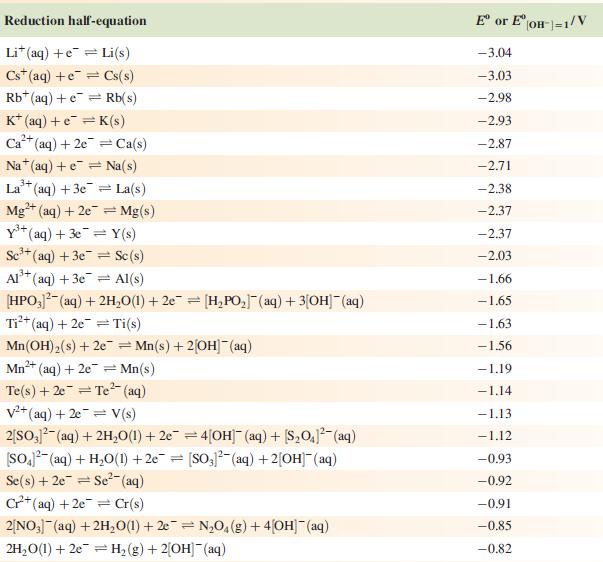
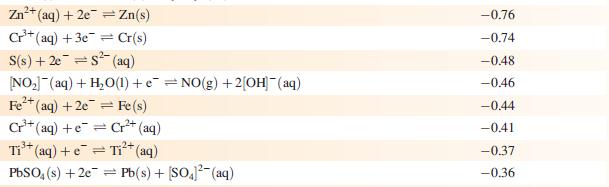
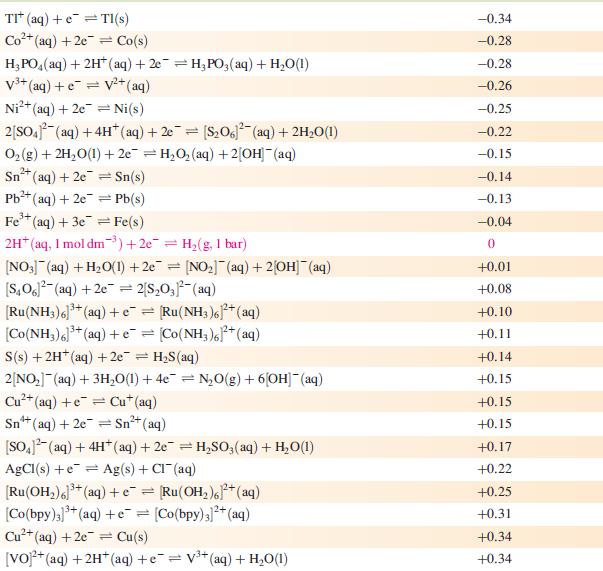
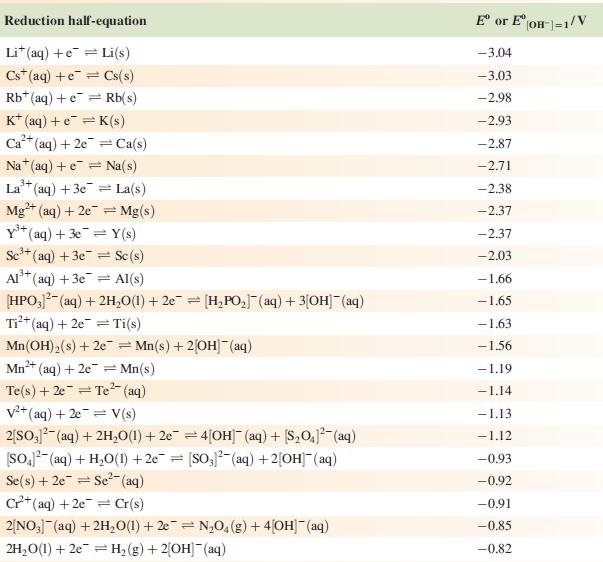
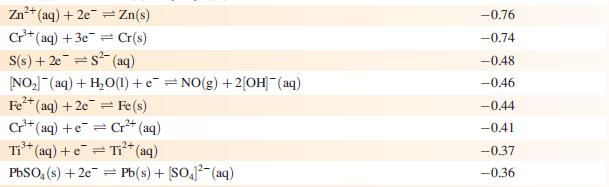
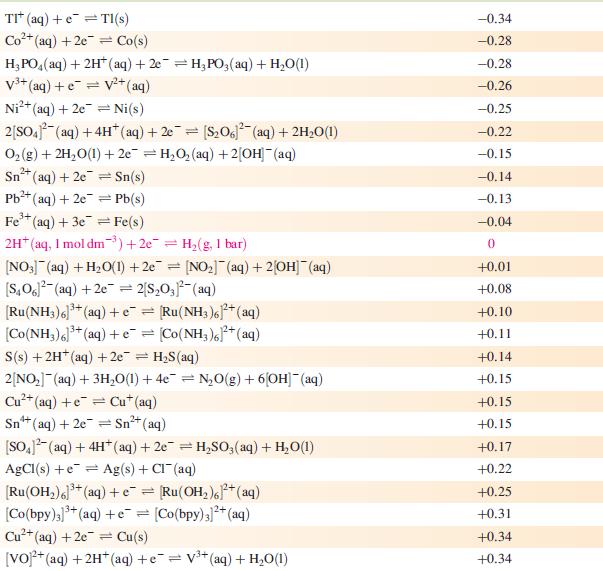
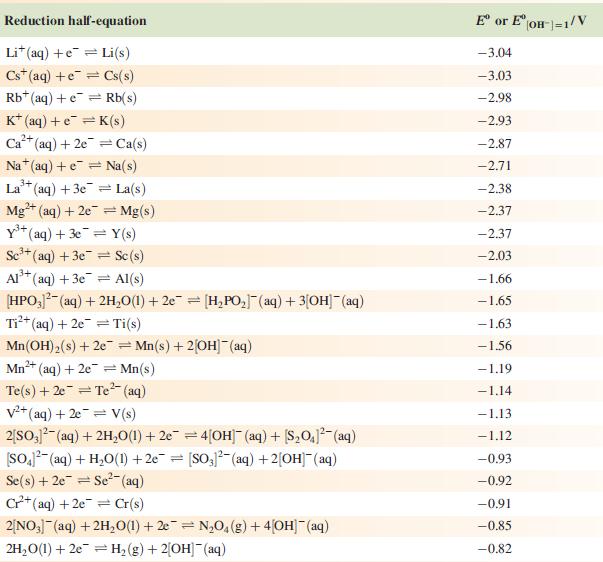
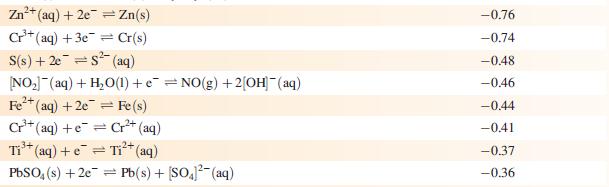
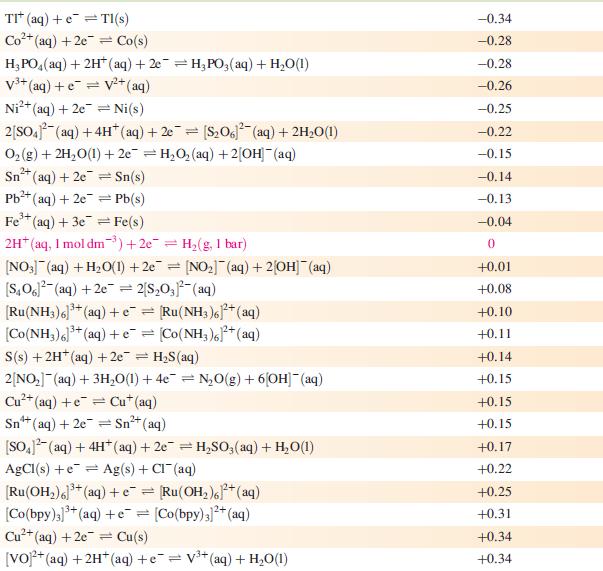
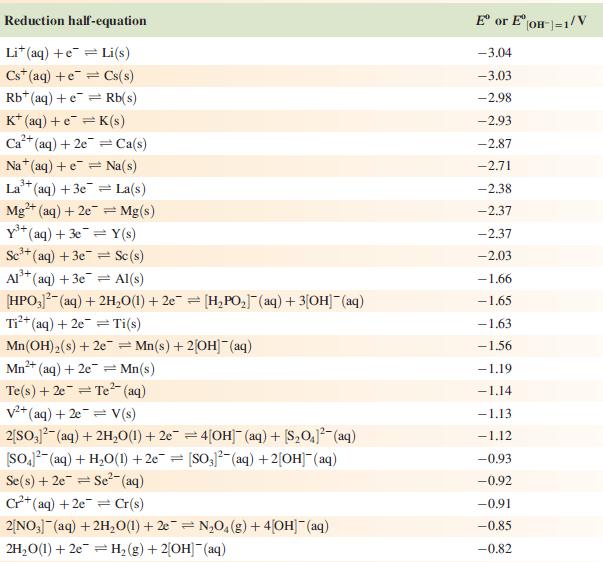
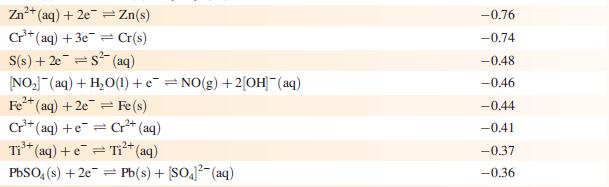
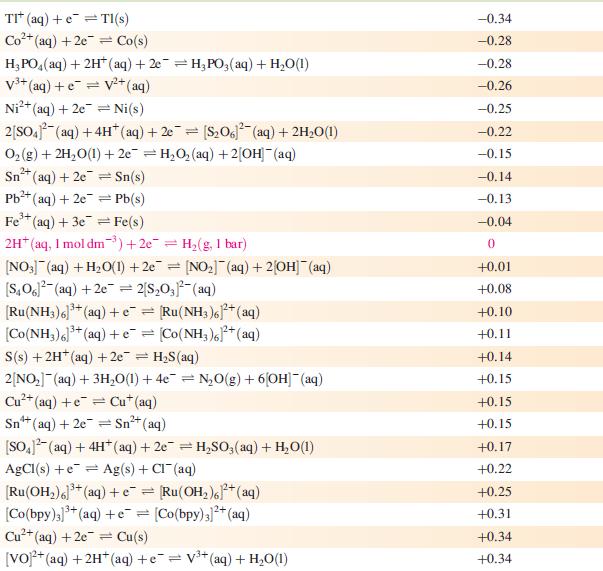
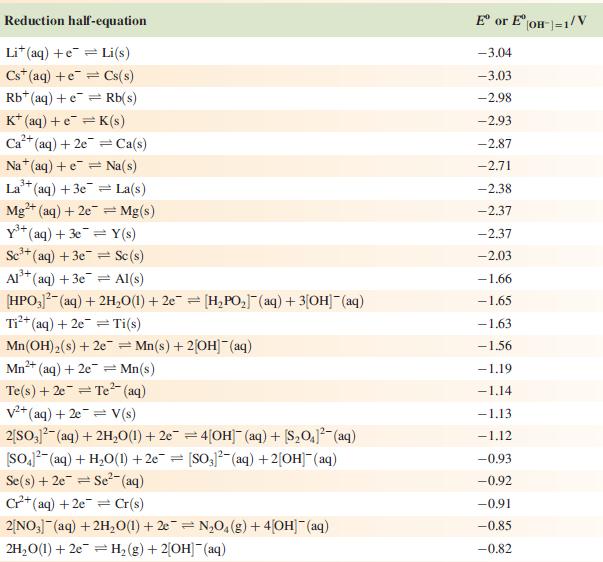
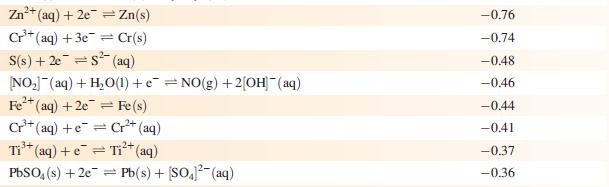
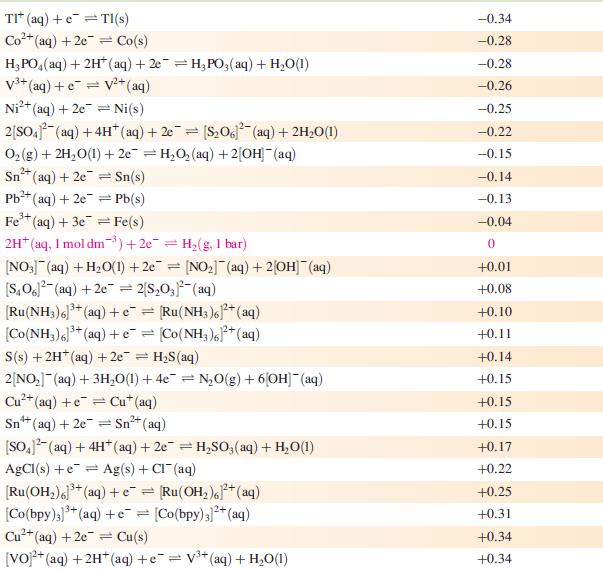
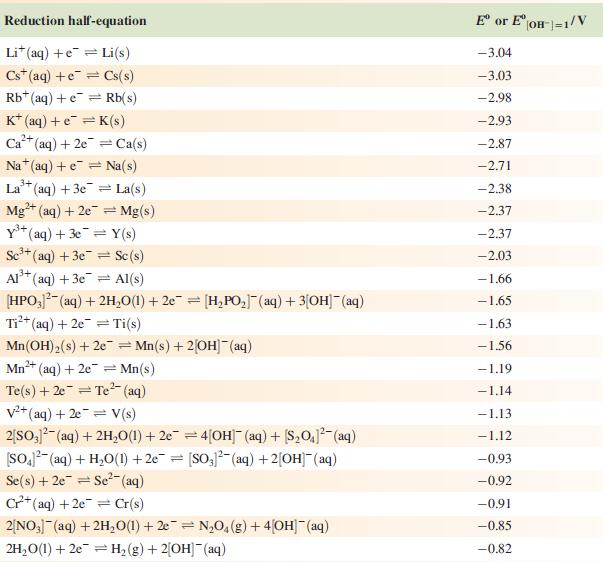
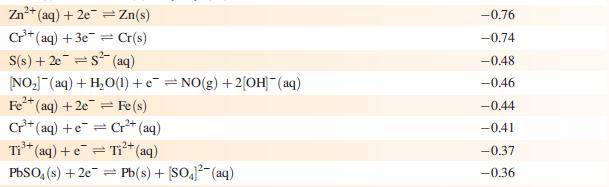
Using data in Appendix 11, determine which of the following species is thermodynamically unstable with respect to disproportionation (and under what conditions) in aqueous solution: (a) Fe2+; (b) Sn2+;(c) [ClO3]−Data from Appendix 11The concentration of each aqueous solution is 1 mol dm−3 and
(a) Using appropriate data from Appendix 11, determine E°cell for the disproportionation of H2O2.(b) Calculate ΔGo for this process. (c) Comment on the fact that H2O2 can be stored without significant decomposition, unless, for example, traces of MnO2, [OH]‾ or iron metal are added.Data from
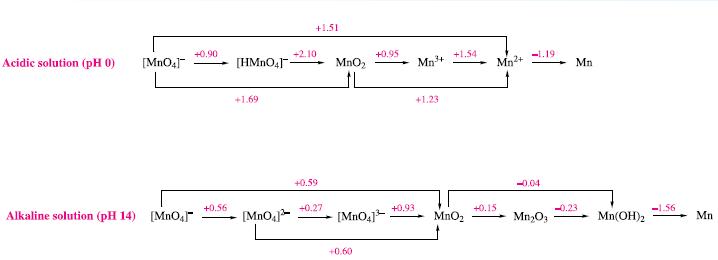
Write balanced half-equations corresponding to the steps shown in the potential diagrams in Fig. 8.2.Figure 8.2 Acidic solution (pH 0) [MnO4] Alkaline solution (pH 14)
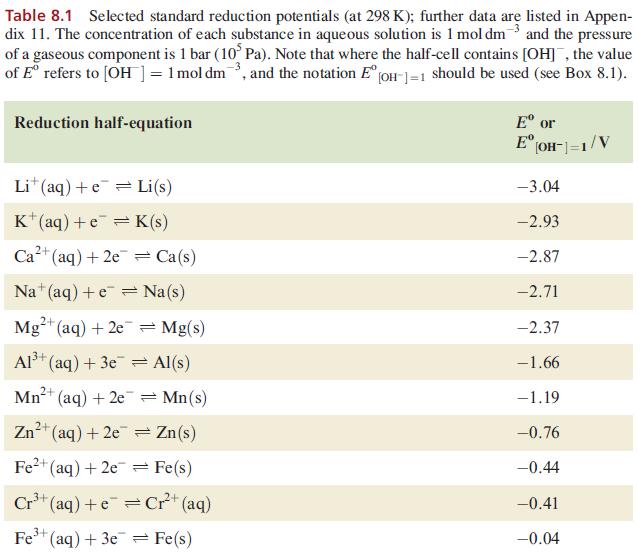
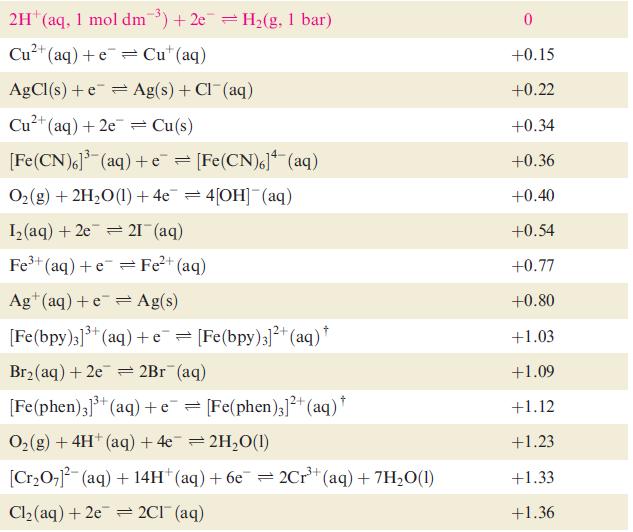
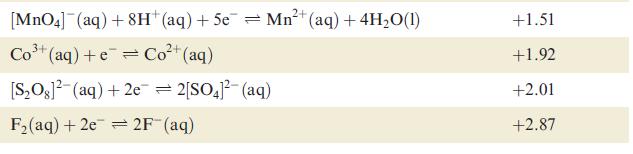
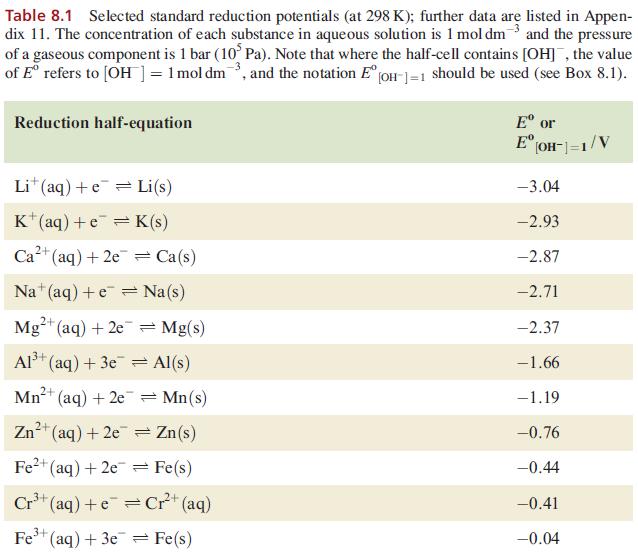
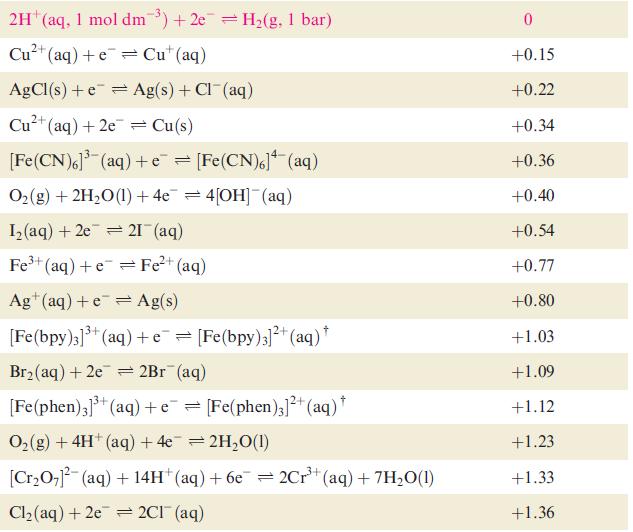
Using data from Table 8.1 and from Section 8.3, explain why H2 is evolved when powdered Ag is heated with a concentrated solution of HI.Data from Table 8.1 Table 8.1 Selected standard reduction potentials (at 298 K); further data are listed in Appen- dix 11. The concentration of each substance in
Determine ΔGo(298 K) for the reaction:given the following data:What does the value of ΔGo tell you about the tendency of precipitated CuCl to disproportionate? 2+ 2CuCl(s) Cu²+ (aq) + 2Cl(aq) + Cu(s)
Give the oxidation state of each element in the following compounds and ions; Pauling electronegativity values in Appendix 7 may be useful:(a) CaO; (b) H2O; (c) HF; (d) FeCl2; (e) XeF6;(f) OsO4; (g) Na2SO4; (h) [PO4]3−; (i) [PdCl4]2−;(j) [ClO4]−; (k) [Cr(OH2)6]3+Data from Appendix
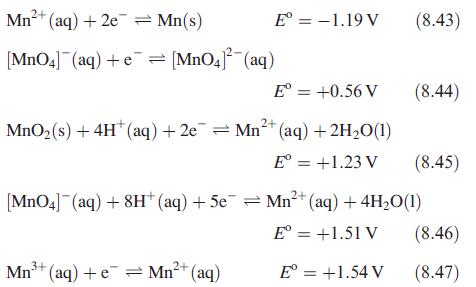
Using appropriate data from eqs. 8.43 to 8.47, confirm the value of Eo given for eq. 8.48.Equations 12+ (aq) + 2e Mn(s) Mn²+ [MnO4] (aq) + e[MnO4)² E = -1.19 V (aq) E = +0.56 V 2+ MnO₂ (s) + 4H+ (aq) + 2e = Mn²+ (aq) + 2H₂O(1) E = +1.23 V 3+ 2+ Mn³+ (aq) + e Mn²+ (aq) (8.43) E = +1.54
Calculate the overall formation constant for [Fe(CN)6]3−, given that the overall formation constant for [Fe(CN)6]4− is ≈ 1032, and that: Fe³+ (aq) + e Fe²+ (aq) [Fe(CN)6]³(aq) E = +0.77 V + e[Fe(CN)6] (aq) E° = +0.36 V
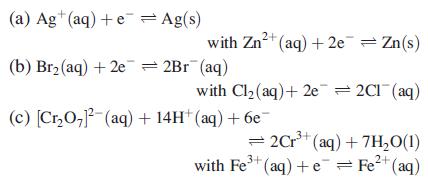
Using data from Table 8.1, write down the spontaneous cell process, and calculate Eocell and ΔGo for the following combinations of half-cells:Data from Table 8.1 (a) Ag+ (aq) +e=Ag(s) (b) Br₂ (aq) + 2e = 2Br (aq) 2+ with Zn²+ (aq) + 2e = Zn(s) with Cl₂(aq) + 2e = 2Cl(aq) (c) [Cr₂O₂ (aq) +
Given that Ksp for AgI is 8:51 × 10−17, and EoAg+/Ag = +0:80 V, calculate Eo for the reduction step:Hence confirm the statement in Section 8.3 that reduction of silver(I) when in the form of solid AgI is thermodynamically less favourable than reduction of AgCl. AgI (s) +eAg(s) + I¯ (aq)
Use the following experimental data to determine EoCu2+/Cu, and comment on the need (or not) to make use of all the data given. [Cu²+]/mol dm E/V 0.001 0.005 0.010 0.252 0.272 0.281 0.050 0.302
Consider the half-reaction:If the ratio of concentrations of [MnO4]− : Mn2+ is 100:1, determine E at pH values of (a) 0.5; (b) 2.0;(c) 3.5 (T = 298 K). Over this pH range, how does the ability of permanganate(VII) (when being reduced to Mn2+) to oxidize aqueous chloride, bromide or iodide ions
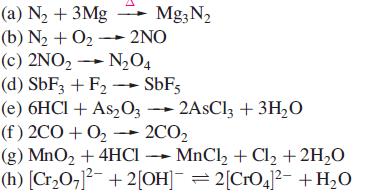
In each redox reaction in problem 8.3, confirm that the net increases and decreases in oxidation states balance each other.Data from Problem 8.3Which of the following reactions are redox reactions? In those that are, identify the oxidation and reduction processes. (a) N₂ + 3Mg Mg3N₂ (b) N₂ +
(a) Calculate EAg+/Ag for a half-cell in which the concentration of silver(I) ions is 0.1moldm−3 (T = 298 K). (b) Are silver(I) ions more or less easily reduced by zinc in this solution than under standard conditions? Quantify your answer in thermodynamic terms.
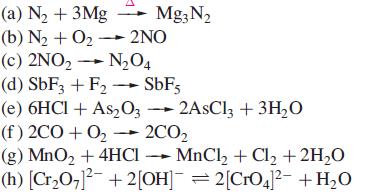
Which of the following reactions are redox reactions? In those that are, identify the oxidation and reduction processes. (a) N₂ + 3Mg Mg3N₂ (b) N₂ + O₂- 2NO (c) 2NO₂ → N₂04 (d) SbF3 + F₂ → SbF5 (e) 6HCl + As2O32AsCl3 + 3H₂O (f) 2CO+O₂ → 2CO₂ (g) MnO₂ + 4HCI MnCl₂ +
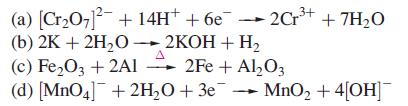
What oxidation state change does each metal undergo in the following reactions or half-reactions? (a) [Cr₂O7²- + 14H+ +6e2Cr³+ (b) 2K + 2H₂O2KOH + H₂ (c) Fe₂O3 + 2A1 2Fe + Al₂O3 A (d) [MnO4] + 2H₂O + 3e MnO₂ + 4[OH] -2Cr³+ + 7H₂O
(a) Use data from Appendix 11 to construct a potential diagram showing the redox chemistry of vanadium in aqueous solution at pH0. (b) Use your diagram to establish whether any vanadium species is unstable with respect to disproportionation.Data from Appendix 11The concentration of each aqueous
Use the data in the potential diagram shown in Fig. 8.7 to construct a Frost–Ebsworth diagram for chlorine. Hence show that Cl− is the most thermodynamically favoured species of those in the diagram. Which species in the diagram is (a) The best oxidizing agent (b) The best reducing
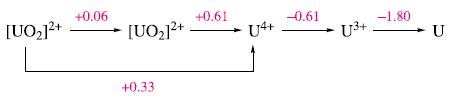
The following potential diagram summarizes the results of electrochemical studies of the aqueous solution (pH 0) chemistry of uranium:Use the information to deduce as much as possible about the chemistry of uranium under these conditions. [UO₂]²+ +0.06 [UO₂]2+ +0.33 +0.61 U4+ -0.61 U3+ -1.80 -
Use the data in Appendix 11 to rationalize the following observations in a quantitative manner. What assumption(s) have you made in answering this question?(a) The dithionate ion, [S2O6]2−, can be prepared by controlled oxidation of [SO3]2− using MnO2.(b) In the presence of acid, KI and KIO3
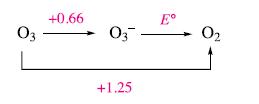
(a) Using the potential diagram below (at pH 14), calculate E°O3−2/O2(b) Comment on the following data:(c) How valid is Fig. 8.4a for aqueous solutions at pH 2?Figure 8.4a. 03 +0.66 03- +1.25 Eº 0₂
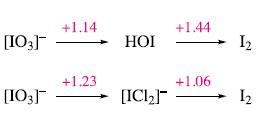
In hydrochloric acid, HOI reacts to give [ICl2]−. Use the potential diagrams below to explain why HOI disproportionates in aqueous acidic solution, but does not when the acid is aqueous HCl. [03] [03] +1.14 +1.23 НОЇ [ICI2] +1.44 +1.06 Iz Iz
Using data from Appendix 11, and the value for the standard Gibbs energy of formation for PbS of −99 kJ mol–1, determine a value for Ksp for this salt.Data from Appendix 11The concentration of each aqueous solution is 1 mol dm−3 and the pressure of a gaseous component is 1 bar (105 Pa).
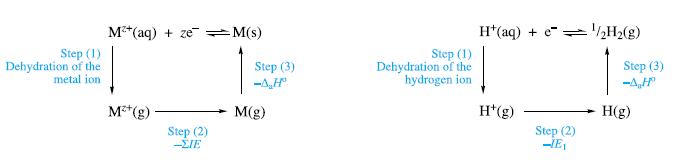
By constructing thermodynamic cycles analogous to those shown in Fig. 8.5, discuss the factors that contribute to the trend in values of Eo for the group 1 metals Li to Cs. Figure 8.5Table 7.7 Step (1) Dehydration of the metal ion M²+ (aq) + zeM(s) M² (g) Step (2) -ΣΙΕ Step (3) M(g) Step
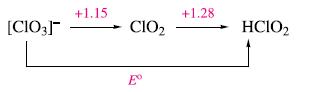
The following potential diagram is part of that illustrating the redox chemistry of chlorine in aqueous solution at pH0. (a) Calculate the value of E° for the reduction of [ClO3]‾ to HClO2. (b) Justify why, in this case, the value of E° can simply be taken to be the mean of +1.15 and +1.28 V.
A tarnished silver knife is placed in a beaker containing hot aqueous NaHCO3. A piece of Al foil is placed in the solution so that it touches the knife. The deposit of Ag2S disappears and the clean knife is recovered from the solution. (a) Using Appendix 11 and the data given below, write an
Zinc/silver oxide button batteries are used in calculators and watches. Although the silver component makes them expensive, this is outweighed by their high performance. The battery uses KOH as the electrolyte, and the overall cell reaction is:(a) What are the two half-reactions that make up the
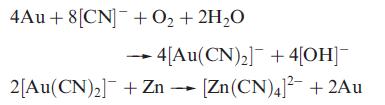
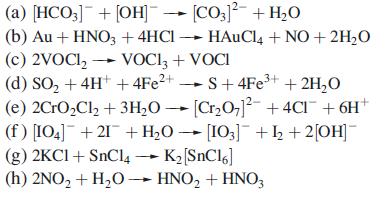
In each of the following reactions, relate starting materials and products by the processes of reduction, oxidation, disproportionation or no redox change. In some reactions, more than one process is taking place. (a) [HCO3] + [OH] → [CO3)² + H₂O (b) Au + HNO3 + 4HC1 →→ HAuCl4 + NO +
The commercial purification of copper metal is carried out in electrolytic cells. The anode is composed of impure (‘blister’) copper, and the electrolyte is a mixture of aqueous CuSO4 and H2SO4. During purification, copper is effectively transferred from the anode to the cathode, and pure
Consider the following two scenarios: (i) Aluminium rivets used to connect two steel plates, (ii) Steel rivets used to connect two Aluminium plates.Discuss whether these choices would be sensible.
A plumber directly connects a galvanized steel pipe to a copper pipe in a system that carries running water. Suggest what will happen over a period of time.
Provide explanations for the following observations.(a) In moist air, corrosion of iron is spontaneous. However, under anaerobic (O2 free), wet conditions, corrosion of iron is only marginally favoured.(b) If iron is exposed to dry, gaseous O2, surface oxidation occurs but afterwards, the bulk iron
The industrial manufacture of NH3 from N2 and H2 is carried out on a huge scale using heterogeneous catalysis, i.e. the reaction between gaseous N2 and H2 is carried out over a solid catalyst. (a) Construct an MO diagram for N2 and use the diagram to explain why N2 is a chemically inert
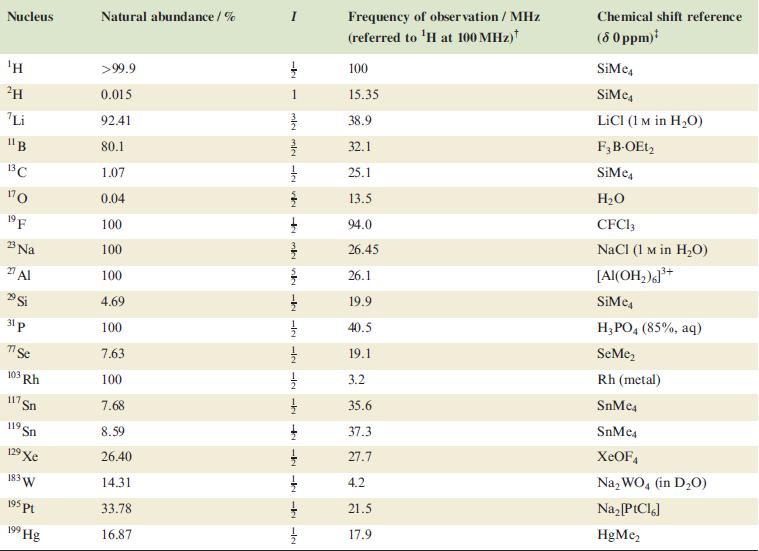
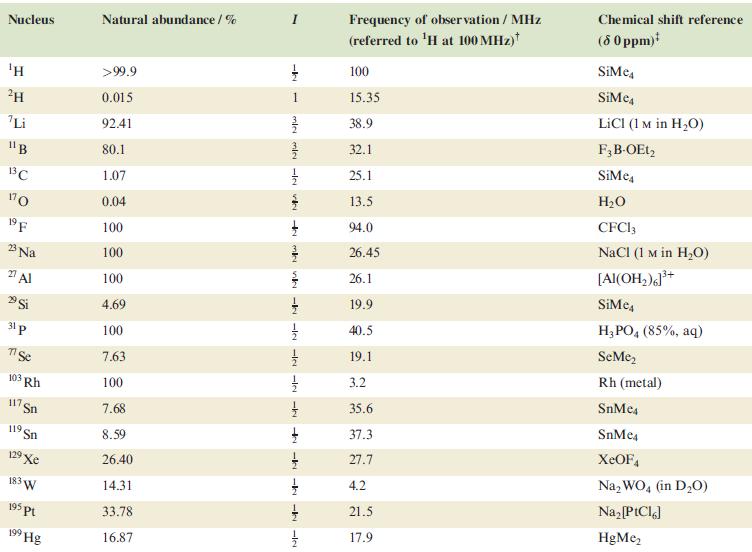
In problems 4.28 to 4.51, refer to Table 4.3 for isotopic abundances where needed.NaBH4 contains the tetrahedral [BH4]– ion. Although NaBH4 hydrolyses slowly in water, it is possible to obtain a clean 1H NMR spectrum of the compound in D2O. Naturally occurring boron consists of two isotopes: 11B,
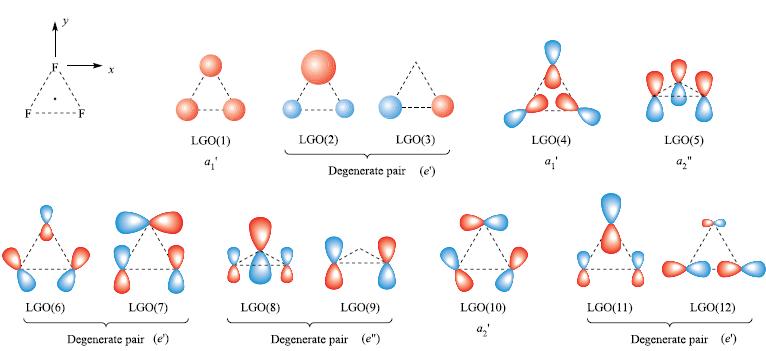
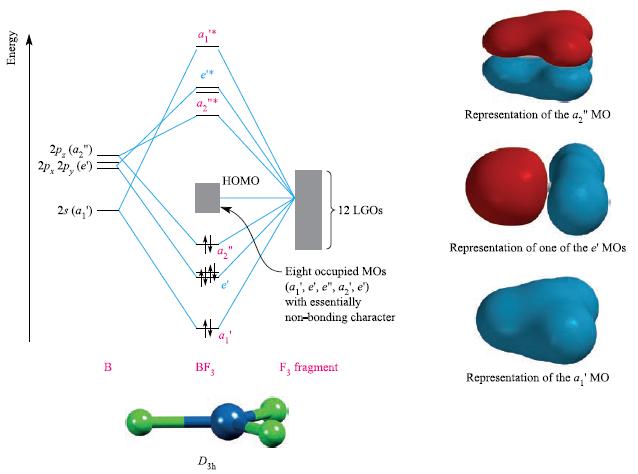
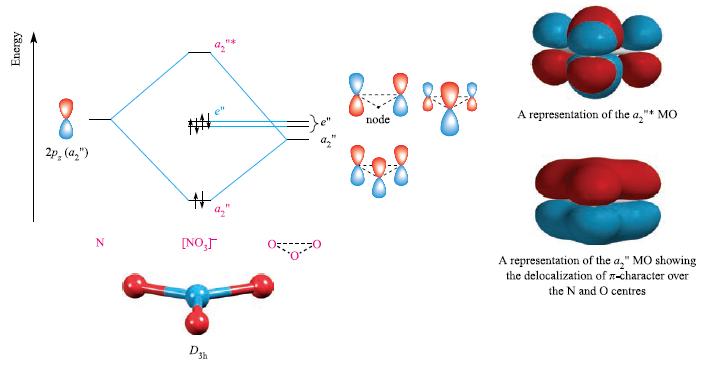
Using Figs. 5.22, 5.23 and 5.25 to help you, compare the MO pictures of the bonding in BF3 and [NO3]‾. What approximations have you made in your bonding analyses?Figure 5.22.Figure 5.23Figure 5.25. LGO(1) LGO(2) Degenerate pair (e) LGO(3) * * LGO(10) 4 Eg 1 2 88 888
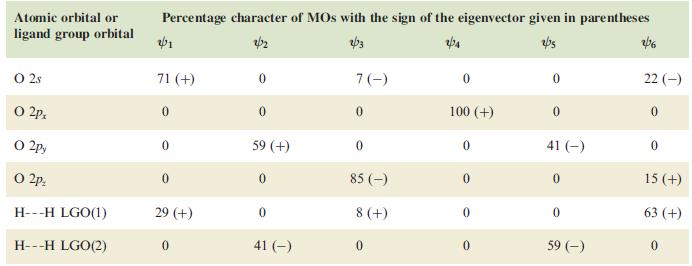
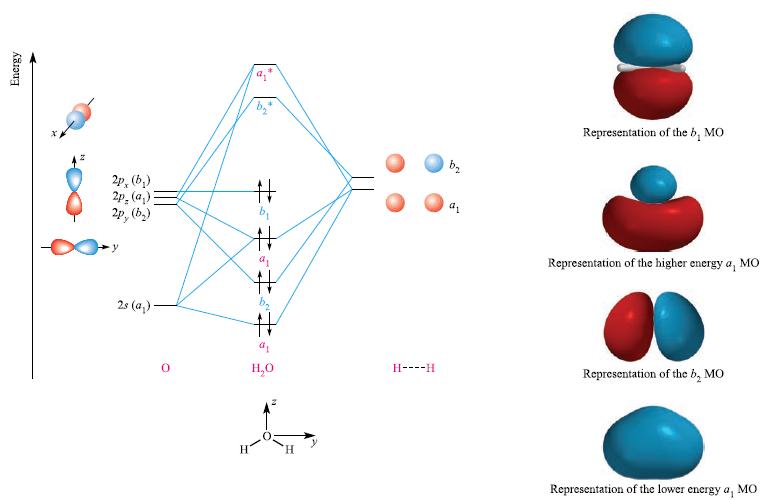
Table 5.6 gives the results of a self-consistent field (SCF) quantum chemical calculation for H2O using an orbital basis set of the atomic orbitals of O and the LGOs of an H---H fragment. The axis set is as defined in Fig. 5.15. (a) Use the data to construct pictorial representations of the MOs of
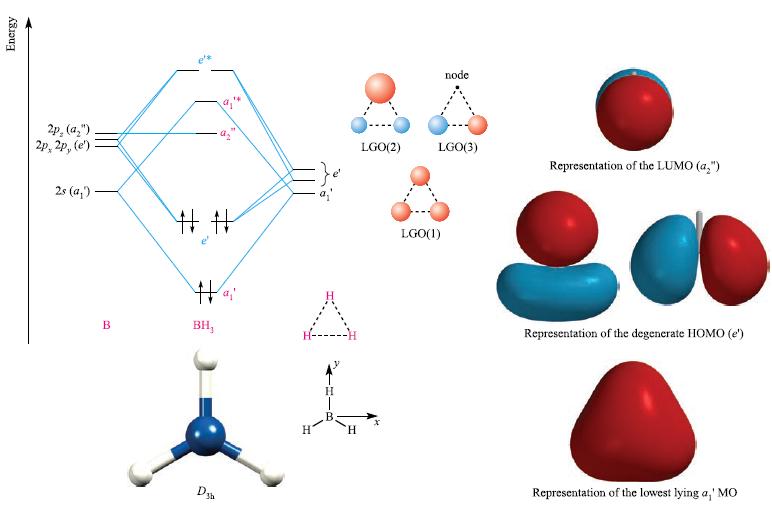
Refer to Fig. 5.17 and the accompanying discussion.(a) Why does the B 2pz atomic orbital become a non-bonding MO in BH3? (b) Draw schematic representations of each bonding and antibonding MO in BH3.Figure 5.17. Energy 2p, (a₂") 2p, 2p, (e) 2s (a₂) B #
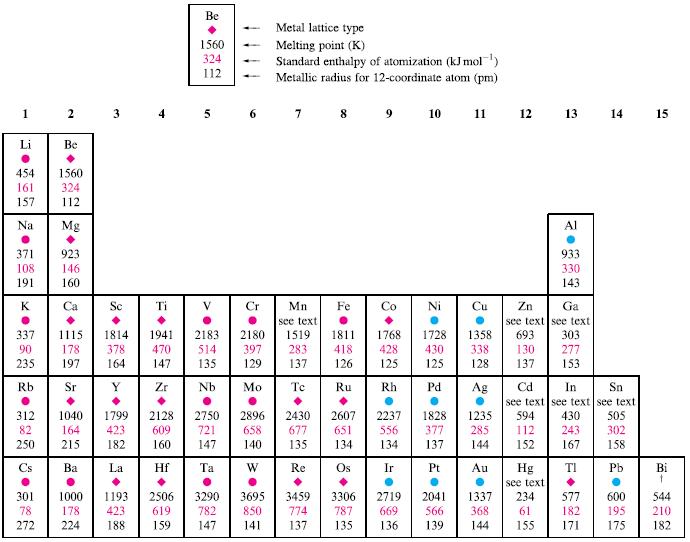
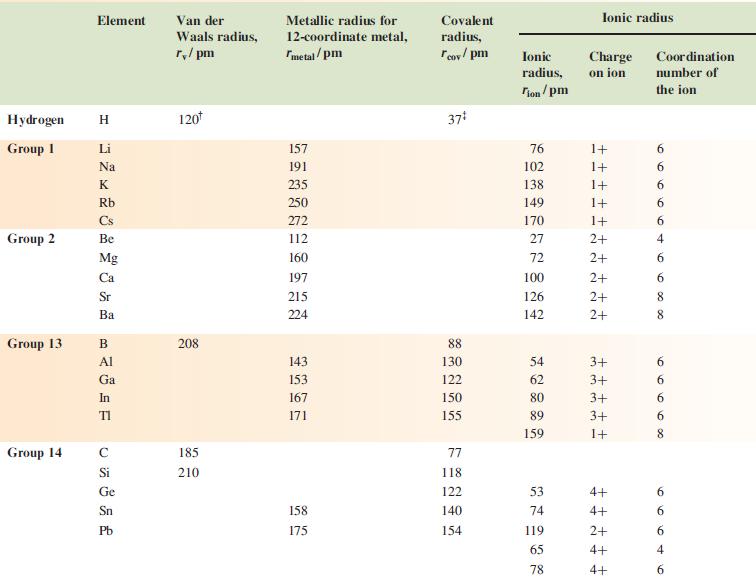
‘Titanium dissolves nitrogen to give a solid solution of composition TiN0.2; the metal lattice defines an hcp arrangement.’ Explain what is meant by this statement, and suggest whether, on the basis of this evidence, TiN0.2 is likely to be an interstitial or substitutional alloy. Relevant data
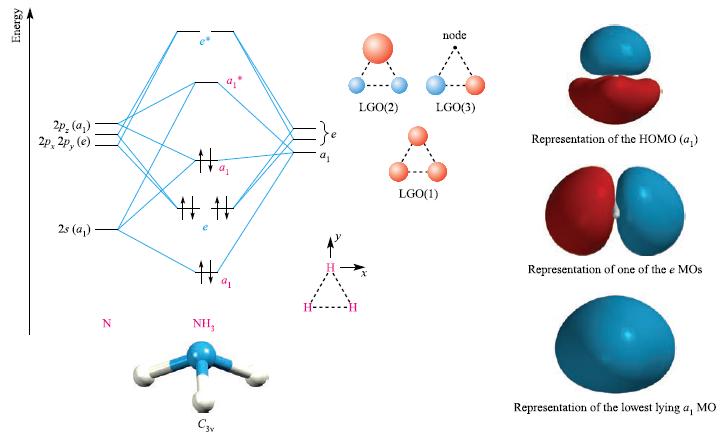
The diagrams at the right-hand side of Fig. 5.19 show three of the MOs in NH3. Sketch representations of the other four MOs.Figure 5.19. Energy 2p₂(a₂) 2p, 2p, (e) 2s (a₁) N e ta₂ ## #₁₂ NH₂ C3v LGO(2) node LGO(3) LGO(1) Representation of the HOMO (a₂) Representation of one of the e
By referring to Section 10.6, suggest how the following solid state structures (i.e. the organization of the molecules in the solid state) may be affected by hydrogen bonding: (a) PhB(OH)2, (b) H2SO4, (c) MeCO2H.
Showing 1600 - 1700
of 1950
First
6
7
8
9
10
11
12
13
14
15
16
17
18
19
20
Step by Step Answers

 Get 50% OFF
Claim Now
Get 50% OFF
Claim Now