New Semester
Started
Get
50% OFF
Study Help!
--h --m --s
Claim Now
Question Answers
Textbooks
Find textbooks, questions and answers
Oops, something went wrong!
Change your search query and then try again
S
Books
FREE
Study Help
Expert Questions
Accounting
General Management
Mathematics
Finance
Organizational Behaviour
Law
Physics
Operating System
Management Leadership
Sociology
Programming
Marketing
Database
Computer Network
Economics
Textbooks Solutions
Accounting
Managerial Accounting
Management Leadership
Cost Accounting
Statistics
Business Law
Corporate Finance
Finance
Economics
Auditing
Tutors
Online Tutors
Find a Tutor
Hire a Tutor
Become a Tutor
AI Tutor
AI Study Planner
NEW
Sell Books
Search
Search
Sign In
Register
study help
sciences
introductory chemistry atoms first
Introductory Chemistry Atoms First 5th Edition Steve Russo And Michael Silver - Solutions
An important determiner of the rate of a chemical reaction is:(a) The size of ΔErxn.(b) The sign of ΔErxn (is it negative and exothermic, or positive and endothermic?).(c) The size of the activation energy Ea for the reaction (if it’s small, the reaction is fast).(d) The size of the activation
As the reaction A → B proceeds, the container in which it is run feels cold to the touch. Measurements show a net energy change of 250 kJ/mol.(a) What is ΔEforward rxn? (b) What is ΔEreverse rxn?
Why is the CH3+ cation in mechanism I properly considered a reaction intermediate?
In a gas-phase reaction, the energy required to break bonds in reactants comes from:(a) ΔErxn.(b) Collisions of reactants with the transition state.(c) Collisions between molecules.(d) Bonds that are breaking in the transition state.
Prove that when you add up the steps in mechanism I, you arrive at the proper balanced equation: OH + CH3Br→→ CH₂OH + Br
As the reaction A → B proceeds, the container in which it is run feels hot to the touch. Measurements show a net energy change of 250 kJ/mol.(a) What is ΔEforward rxn? (b) What is ΔEreverse rxn?
Rate data for the reaction CH3Br + OH– → CH3OH + Br–:Use these data to find the experimental rate law. In other words, determine the values of x and y in the rate equation:Then decide whether mechanism I or mechanism II can possibly be the correct mechanism for the reaction. You should have
All gas-phase reactions will speed up heating unless:(a) ΔErxn is negative.(b) Ea is too large.(c) Heating causes the gas-phase molecules to move slower.(d) There is no unless. All gas-phase reactions speed up upon heating, always.
Consider the hydrogen combustion reaction, where ΔErxn = –479 kJ. If the energy absorbed in breaking the reactant bonds is 1370 kJ, how much energy is released as the product bonds form?
Catalysts speed up reactions by:(a) Providing an alternative mechanism for a reaction.(b) Lowering the Ea for the reaction.(c) Remaining active throughout the chemical reaction.(d) All of the above are correct.
Consider the reaction A2 + B2 → 2 AB. Breaking 1 mole of A—A bonds and 1 mole of B—B bonds requires 2200 kJ. Forming 1 mole of A—B bonds releases 1000 kJ.(a) Is this reaction exothermic or endothermic? Explain.(b) What is the value of ΔErxn? (Get the sign right.) How is it to be
Why is mechanism I wrong?
For the reaction 2 NO(g) + O2(g) → 2 NO2(g), the rate law is:(a) Rate = k[NO]2[O2], the orders coming from the stoichiometric coefficients of the balanced reaction.(b) Rate = k[NO]x[O2]y, where orders x and y must be determined by doing kinetics experiments.(c) Rate = k[NO]x + [O2]y, where orders
Consider the reaction A2 + B2 → 2 AB, for which ΔErxn = –100 kJ. Forming 1 mole of A—B bonds releases 150 kJ. How much energy does it take to break the reactant bonds?
Why is mechanism II still in the running?
Suppose you are told the rate law for the reaction 2A + B → C is Rate = k[A][B]2. What would be a true statement?(a) That is impossible because the reaction is 2A + B, not A + 2B.(b) If you double the concentration of A, the rate will quadruple.(c) If you double the concentration of B, the rate
Draw reaction-energy profiles for the reactions in Practice Problems 13.8 and 13.9. For both, label the gap that is ΔErxn.Data from Problem 13.8Consider the reaction A2 + B2 → 2 AB. Breaking 1 mole of A—A bonds and 1 mole of B—B bonds requires 2200 kJ. Forming 1 mole of A—B bonds releases
Draw two reaction-energy profiles, one for an endothermic reaction A and one for an exothermic reaction B. Make the profile for reaction A represent a faster reaction than reaction B by drawing the two Ea barriers to scale.
Draw two reaction-energy profiles, one for an endothermic reaction A and one for an exothermic reaction B. Make the profile for B represent the faster reaction by drawing the two Ea barriers to scale.
True or false? If reaction X is more exothermic than reaction Y, reaction X must be faster than reaction Y. Whatever your answer, back it up with reaction-energy profiles.
Consider our substitution reaction between OH– and CH3Br. Imagine it is occurring in a solution where there are 1000 collisions every second between OH- ions and CH3Br molecules. Suppose only 10% of these collisions are sufficiently energetic to lead to products. Also, assume that the orientation
Suppose the temperature of the reaction analyzed in Practice Problem 13.14 is increased by 10°C.(a) What should happen to the number of effective collisions per second? Estimate the new value based on the rule of thumb given in the text.(b) Why does the number of effective collisions per second
Repeat Practice Problem 13.14 for an orientation factor of 0.1.Data from Problem 13.14Consider our substitution reaction between OH– and CH3Br. Imagine it is occurring in a solution where there are 1000 collisions every second between OH- ions and CH3Br molecules. Suppose only 10% of these
Write a general rate law for the reactionusing x, y and z as orders. H,Oz(aq)+3I(aq)+2H*(aq)→I (aq)+2H,O(l)
Write a general rate law for the reaction 2NO + O2 → 2 NO2 using x and y as orders.
Suppose that when the two reactions described in Practice Problems 13.17 and 13.18 are run at the same temperature and the same concentrations, the NO reaction goes much, much faster than the H2O2 reaction.(a) What can you say about the relative sizes of the k values for the reactions?(b) What can
For the reactionthe experimentally determined rate law is:(a) What is the order of this reaction with respect to Br–?(b) What is the order of this reaction with respect to H+?(c) What is the overall order of the reaction?(d) What happens to the rate of this reaction when you double the H+
Use the given kinetics data to write the rate law for the reaction 2NO + O2 → 2NO2 Experiment 1 2 3 4 Initial [NO] 0.015 M 0.030 M 0.015 M 0.030 M Initial [0₂] Rate of NO₂ formation (M/s) 0.015 M 0.015 M 0.030 M 0.030 M 0.048 0.192 0.096 0.384
Suppose the experimental rate law for the reaction X2 + Y2 → 2 XY is: Rate = k[X2][Y2] A student postulates a multistep mechanism in which the first step is the rate-determining step. For this step, he postulates 2Y2 → Y3 + Y. Is it possible for this to be the rate-determining step?
Suppose the experimental rate law for the reaction in Practice Problem 13.24 is: Rate = k[Y2]2Use the step postulated in Practice Problem 13.24 as the first step in a possibly correct mechanism for the reaction. Don’t be afraid to be creative with your steps, but keep your collisions to two
Describe the following reaction in terms of which bonds must be broken and which bonds must be formed: H₂C=CH₂ + 30₂ 2 COz+2 H,O
Suppose the experimental rate law for the reaction in Practice Problem 13.24 is: Rate = k[Y2] Suppose also that the first step in the mechanism is the rate-determining step. What might this first step look like?Data from Problem 13.24Suppose the experimental rate law for the reaction X2 + Y2 →
Is it likely that a single collision leads to the breaking of all the bonds that you named in Problem 13.27? Explain your answer.Data from Problem 13.27Describe the following reaction in terms of which bonds must be broken and which bonds must be formed: H₂C=CH₂ + 30₂ 2 COz+2 H,O
Indicate if the following reactions are examples of a substitution reaction. Explain for each. (a) CH₂I+ Cl¯ →CH3Cl + I¯ (b) NH3 + CHI→[(CH3)NH]*I
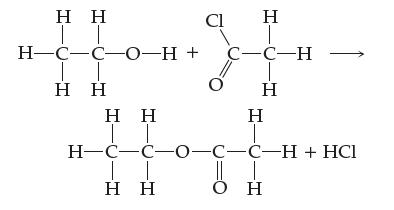
Consider the following reaction. Use labeled arrows to indicate which bonds must be broken and which bonds must be formed. Η Η ΤΤ H-CC-0-H + Η Η Η Cl Η Τ H¬C-C-0-C-C-H + HCl Η Η H C-C-H Η Η Ο Η
What is meant by the mechanism of a chemical reaction?
Which branch of chemistry concerns itself with the study of reaction rates and the factors that affect rates?
Regarding a chemical reaction’s mechanism:(a) Suppose we could see individual molecules as they undergo a chemical reaction. Why might it still be difficult to directly observe the reaction’s mechanism?(b) What do chemist typically do to indirectly “see” a reaction mechanism?
What is one benefit of understanding a reaction’s mechanism?
Compound A converts to compound B; ΔErxn is –100 kJ/mol. Is compound B at a higher or lower energy level than compound A? By how much?
Compound A has half as much energy in it as compound B. If compound A converts to B, will this reaction release energy into the surroundings or absorb energy from the surroundings? Explain your answer.
In a chemical reaction, compound A is converted to compound B. In the process, energy is absorbed from the surroundings. Which compound is at a higher energy level? Explain your answer.
Which is a better reducing agent, Zn or Pb?
When is an oxidizing agent also the species that gets oxidized? Explain.
In a chemical reaction, compound C is converted to compound D. In the process, energy is released into the surroundings. Which compound is at a higher energy level? Explain your answer.
Referring to Problems 13.37 and 13.38, which reaction is exothermic and which is endothermic? Justify your answer, and describe which reaction could be used to supply heat and which could be used to “supply cold” (which actually means to remove heat).Data from Problem 13.37In a chemical
A reaction occurs in which 1 mole of A is converted to 1 mole of B. If 1 mole of A has an energy content of 20 kJ and 1 mole of B has an energy content of 60 kJ, is this reaction exothermic or endothermic? Calculate ΔErxn.
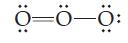
WorkPatch 10.2 had you assign oxidation states to the oxygen atoms in ozone. The answer was –1 and 0 for the terminal (end) oxygen atoms and +1 for the central oxygen atom. But now, a student claims the oxidation states are +1 for the central oxygen atom and –1/2 for the terminal oxygen atoms.
Consider ClO– and AlCl3. For one of these substances, the halide shortcut rule works.For the other, it does not.(a) Which one does it work for, and why?(b) Why doesn’t it work for the other?(c) Assign oxidation states to all the atoms in both substances.
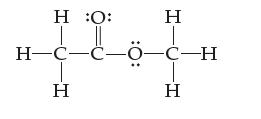
Consider the organic compound C3H6O2, methyl acetate.(a) What is the problem with using the shortcut method to assign oxidation numbers to the atoms in methyl acetate?(b) The dot diagram of methyl acetate is shown below. Assign an oxidation state to every atom. Η :Ο: H¬C-C-0-C-H ά Η Η Η
What do the terms oxidation and reduction mean with regard to valence electrons?
How are oxidation states useful in determining whether a reaction is a redox reaction?
What happens to an atom’s oxidation state when the atom is reduced?
What happens to an atom’s oxidation state when the atom is oxidized?
What does the word transfer imply about an electron-transfer reaction?
Why can we always call an electron-transfer reaction a redox reaction?
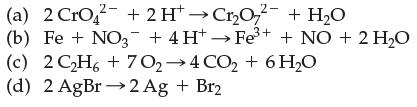
Which of the following are electron-transfer reactions? (a) 2 CrO2 + 2 H→Cr₂O72 + H₂O (b) Fe + NO3+ 4H+→Fe³+ + NO + 2 H₂O (c) (d) 2AgBr→2Ag + Br2 2C2H6+7O,→4CO,+6H,O
Which of the following are redox reactions?(a) 2Na + 2H2O → 2NaOH + H2(b) MgBr2 + 2NaF → MgF2 + 2NaBr(c) 2CO + O2 → 2CO2(d) SO2 + H2O → H2SO3
For those reactions in Problem 10.56 that are redox reactions:(a) Indicate which atoms get oxidized and which atoms get reduced.(b) Indicate which reactant is the oxidizing agent.(c) Indicate which reactant is the reducing agent.Data from Problem 10.56Which of the following are redox reactions?2Na
For those reactions in Problem 10.58 that are electron-transfer reactions:(a) Indicate which atoms get oxidized and which atoms get reduced.(b) Indicate which reactant is the oxidizing agent.(c) Indicate which reactant is the reducing agent.Data from Problem 10.58Which of the following are
The following reaction is responsible for producing electricity in your car battery (often called a lead storage battery):(a) Assign an oxidation state to each atom.(b) Identify the atom that gets oxidized and the atom that gets reduced.(c) Identify the reactant that is the oxidizing agent and the
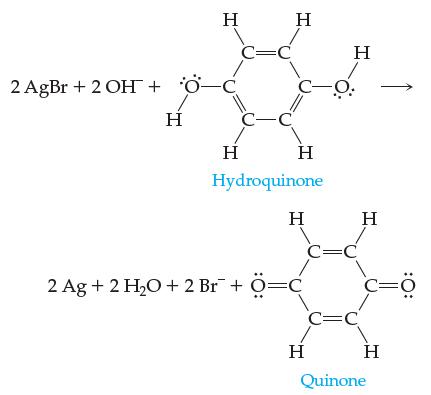
The hydroquinone molecule can be converted to the quinone molecule as shown below:You may want to use a combination of shortcut rules and dot diagrams to assign oxidation numbers before answering the following questions:(a) Which atom or atoms are oxidized?(b) Which atom or atoms are reduced?(c)
Hydrogen gas burns very well in the presence of oxygen to give water: 2H2 + O2 → 2H2O In principle, should it be possible to use this chemical reaction to produce electricity? Explain.
You will be given the spontaneous redox reaction (or enough information regarding it) so that you can construct and label a battery.Include a salt bridge filled with NaCl(aq) and indicate which way the Na+(aq) and Cl–(aq) ions flow.Cr + 3Ag+ → Cr3+ + 3AgDraw a battery similar to the one you
If you put a piece of iron in an aqueous solution of blue Cu2+ ions, the spontaneous redox reaction Fe + Cu2+ → Fe2+ + Cu will occur. An aqueous solution of Fe2+ ions is red-brown.(a) What is oxidized?(b) What is reduced?(c) What is the oxidizing agent?(d) What is the reducing agent?(e) What
You will be given the spontaneous redox reaction (or enough information regarding it) so that you can construct and label a battery. Include a salt bridge filled with NaCl(aq) and indicate which way the Na+(aq) and Cl– (aq) ions flow.Mg + Ni2+ → Mg2+ + NiDraw a battery similar to the one you
You will be given the spontaneous redox reaction (or enough information regarding it) so that you can construct and label a battery.For the chromium–silver battery of Problem 10.65:(a) What is the oxidizing agent?(b) What is the reducing agent?(c) Which electrode gains mass with time?(d) Which
You will be given the spontaneous redox reaction (or enough information regarding it) so that you can construct and label a battery. For the magnesium–nickel battery of Problem 10.67:(a) What is the oxidizing agent?(b) What is the reducing agent?(c) Which electrode gains mass with time?(d) Which
A battery is constructed from tin and copper by dipping strips of each metal into a solution of its ions (Sn2+ and Cu2+, respectively). As the battery operates, the Sn2+ concentration increases and the Cu2+ concentration decreases.(a) What is getting oxidized?(b) What is getting reduced?(c) Draw a
A student claims that in his battery, the electrons flow from the positive to the negative electrode. In fact, this is not true for any battery. Explain why electrons would never flow in this direction and how the direction of electron flow tells you that the cathode is where reduction occurs.
How can the words cation and anion help you remember if + or – is associated with the cathode and anode of a battery?
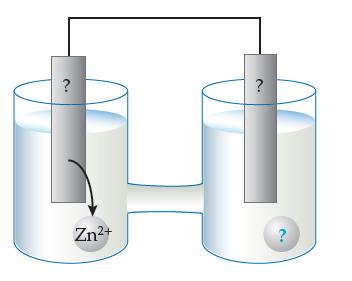
A zinc electrode and a copper electrode are used to make a battery, as shown below:(a) Replace the three question marks with appropriate labels.(b) Indicate which way the electrons flow.(c) Write the spontaneous redox reaction.(d) Add the labels +, –, anode, and cathode to the drawing.(e) Write
Suppose you have two metals, A and B, and solutions of their ions, A+ and B+. Metal B is more active than metal A.(a) Write the spontaneous redox reaction for this situation.(b) What is the oxidizing agent?(c) What is the reducing agent?(d) Describe which way the electrons flow.
Suppose you have three different metals, X, Y, and Z, each of which also exists as a +2 ion. Design an experiment to place them properly in order of their activity (a mini-EMF series).
You are trapped on an island with lots of different metals, chemicals, and supplies but no EMF series table. How would you go about deriving an EMF series, and how would it be useful?
What happens when you place an active metal in a solution of ions of a less active metal?
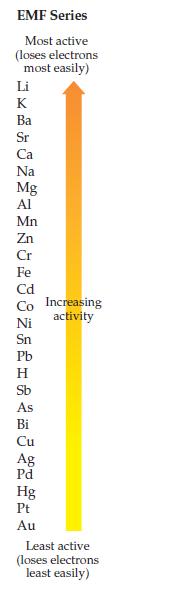
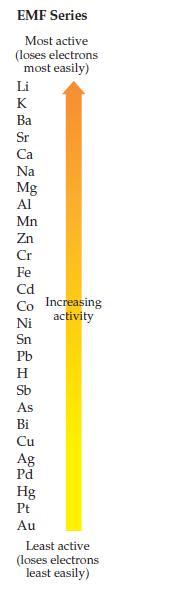
Using the EMF series on page 391, decide which of the following redox reactions is spontaneous. Explain your answer.(a) 3K + Al3 + → Al + 3K+(b) Al + 3K+ → 3 K + Al3 + EMF Series Most active (loses electrons most easily) Li HKkxGMSIMAGRGOMADHA &斑Q8HHH加 Ba Sr Ca Na Mg Al Mn Zn Cr Fe Cd Co
What happens when you place a less active metal in a solution of ions of a more active metal?
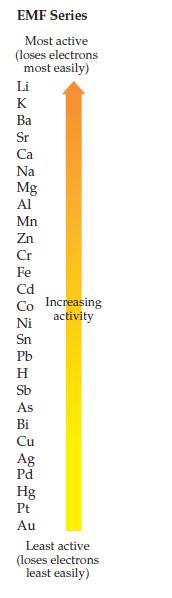
Using the EMF series on page 391, decide which of the following redox reactions is spontaneous. Explain your answer.(a) 3Ag + Au3+ → Au + 3 Ag+(b) Au + 3Ag+ → 3Ag + Au3+ EMF Series Most active (loses electrons most easily) Li HKkxQMSA MAGRGOMADHA &斑Q8HL加 Ba Sr Ca Na Mg Al Mn Zn Cr Fe Cd Co
You are trapped on a desert island with plenty of water (both fresh and salt), a drinking glass, some wire, a radio, and no batteries. You do have a tin cup, a tube of toothpaste containing stannous fluoride (SnF2, a source of Sn2+ ions), a silver pendant, and undeveloped black-and-white film (such
Show with a diagram how you would construct a copper–nickel battery. Label the direction of flow of electrons, cathode, +, and anode, –. Also, indicate in which beaker oxidation occurs and in which beaker reduction occurs.
Recharging a battery means forcing a spontaneous redox reaction to run backwards—in the nonspontaneous direction—once all the reactants have been used up. In Practice Problem 10.24, you considered a battery made from lead and copper.(a) Write the spontaneous redox reaction for this battery.(b)
Lithium is a very active metal, so active that it reacts with water to make flammable hydrogen gas.Li(s) + H2O(l) → LiOH(s) + 1/2H2(g)(a) What metal would you use in combination with Li to make a battery having the highest voltage? (Consult the EMF series.)(b) Too rapid a discharge of a lithium
There are two definitions of oxidation, one involving oxygen, the other not.(a) State the two definitions of oxidation.(b) Are they compatible? Explain.(c) When we speak of corrosion of metals, what chemical reaction are we usually talking about? Use Fe as an example.
Suppose gold were not available for a wedding ring, but you still wanted a ring that would last “forever” and not corrode. According to the EMF series on page 391, what would be a good alternative metal to use? EMF Series Most active (loses electrons most easily) Li HKkxQMSA MAGRGOMADHA
A piece of magnesium can be attached to the iron hull of a boat to prevent it from rusting.(a) Why is the magnesium called a sacrificial metal?(b) How does the Mg keep the iron hull from rusting?(c) Which can be thought of as the positive cathode, the Mg or the steel hull? Explain.(d) Putting a
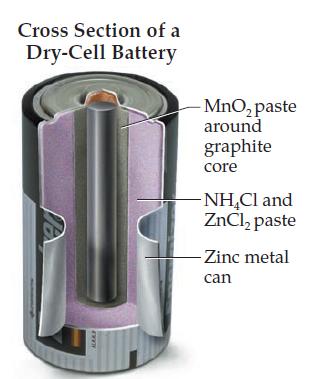
What problem might develop with the casing of the dry-cell battery shown on page 385 if it is not made thick enough? Explain. Cross Section of a Dry-Cell Battery wwwww - MnO₂ paste around graphite core -NH₂Cl and ZnCl₂ paste -Zinc metal can
Explain what almost brought down the Statue of Liberty and what was done to keep the problem from happening again.
Identify the oxidizing and reducing agents in the reaction (NH4)2Cr₂O7 → N₂ + Cr₂O3 + 4 H₂O
What is the oxidation state of the iodine atom in H2IO63–?
Burning octane, C8H18, in your car engine forms water and carbon dioxide:What gets oxidized and what gets reduced? 2 CgH18+ 25 O₂ 18 H₂O + 16 CO₂
Which metal is most easily oxidized: Pt, Hg, Fe, Mg, Zn?
Metal strips are immersed in aqueous solutions of various salts. In which combinations do you expect a spontaneous redox reaction:(a) Silver strip in CuBr2(aq)(b) Copper strip in ZnSO4(aq)(c) Zinc strip in AgNO3(aq)(d) Gold strip in FeCl2(aq)(e) Copper strip in Hg(NO3)2(aq)
Can you protect a steel (predominantly iron) structure from corrosion by connecting it by wire to a small plate made of nickel? What elements (if any) would make better sacrificial metals?
The blood alcohol level of a person can be detected by reacting a sample of blood plasma with dichromate ion, Cr2O72–, which takes part in an electron-transfer reaction with ethanol, C2H5OH, in the blood:Assign an oxidation state to each atom in this reaction and indicate the oxidizing agent and
Which ion is most difficult to reduce: Mn2+ , Hg2+ , Fe3+ , Mg2+ , Li+?
A battery was produced using copper metal in a solution of Cu2+ ions connected to rhodium metal in a solution of Rh3+ ions. Copper is the anode and rhodium is the cathode. Is rhodium higher or lower than copper in the EMF series?
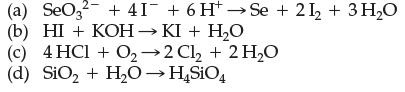
Which of the following are electron-transfer reactions? For those that are, indicate which reactant is the reducing agent and which reactant is the oxidizing agent. (a) SeO3² +41 + 6 H→Se +21₂ + 3H₂O (b) HI + KOH → KI + H₂O (c) 4 HCl + O2-2 Cl₂ + 2 H₂O (d) SiO₂ + H₂O → H₂SiO4
Assign an oxidation state for each nitrogen atom in N3–.
Tin cans are actually iron plated with tin. What is the advantage of the tin coating?
Showing 600 - 700
of 3073
1
2
3
4
5
6
7
8
9
10
11
12
13
14
15
Last
Step by Step Answers

 Get 50% OFF
Claim Now
Get 50% OFF
Claim Now



![Initial Experiment [CHBr] 1 0.200 M 2 0.400 M 3 0.400 M Initial [OH-] 0.200 M 0.200 M 0.400 M Rate of CH3OH](https://dsd5zvtm8ll6.cloudfront.net/images/question_images/1701/8/6/8/224657072c08f6631701868223119.jpg)
![Rate = k[CH3Br][OH-]'](https://dsd5zvtm8ll6.cloudfront.net/images/question_images/1701/8/6/8/247657072d77dbcc1701868246009.jpg)


![Rate = k [BrO3][Br][H+]](https://dsd5zvtm8ll6.cloudfront.net/images/question_images/1701/8/5/2/114657033d21540e1701852111520.jpg)
![Experiment 1 2 3 4 Initial [NO] 0.015 M 0.030 M 0.015 M 0.030 M Initial [0] Rate of NO formation (M/s) 0.015](https://dsd5zvtm8ll6.cloudfront.net/images/question_images/1701/8/5/2/4786570353ee570b1701852476166.jpg)

![(a) CHI+ Cl CH3Cl + I (b) NH3 + CHI[(CH3)NH]*I](https://dsd5zvtm8ll6.cloudfront.net/images/question_images/1701/8/5/3/4706570391e8df931701853467001.jpg)