New Semester
Started
Get
50% OFF
Study Help!
--h --m --s
Claim Now
Question Answers
Textbooks
Find textbooks, questions and answers
Oops, something went wrong!
Change your search query and then try again
S
Books
FREE
Study Help
Expert Questions
Accounting
General Management
Mathematics
Finance
Organizational Behaviour
Law
Physics
Operating System
Management Leadership
Sociology
Programming
Marketing
Database
Computer Network
Economics
Textbooks Solutions
Accounting
Managerial Accounting
Management Leadership
Cost Accounting
Statistics
Business Law
Corporate Finance
Finance
Economics
Auditing
Tutors
Online Tutors
Find a Tutor
Hire a Tutor
Become a Tutor
AI Tutor
AI Study Planner
NEW
Sell Books
Search
Search
Sign In
Register
study help
engineering
chemical engineering
Elementary Principles of Chemical Processes 3rd Edition Richard M. Felder, Ronald W. Rousseau - Solutions
Convert the temperatures in parts (a) and (b) and temperature intervals in parts (c) and (d):(a) T = 85◦F to ◦R, ◦C, K(b) T = – 10◦C to K, ◦F, ◦R(c) ΔT = 85◦C to K, ◦F, ◦R(d) ΔT = 150◦R to ◦F, ◦C, K
A temperature scale that never quite caught on was formulated by the Austrian chemist Johann Sebastian Farblunget. The reference points on this scale were 0˚FB, the temperature below which Farblunget’s postnasal drip began to bother him, and 1000oFB, the boiling point of beer. Conversions
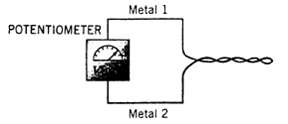
A Thermocouple is a temperature-measurement device that consists of two dissimilar metal wires joined at one end. An oversimplified diagram follows. A voltage generated at the metal junctions is read on a potentiometer or mill voltmeter. When certain metals are used, the voltage varies linearly
A thermostat control with dial markings from 0 to 100 is used to regulate the temperature of an oil bath. A calibration plot on logarithmic coordinates of the temperature, T(?F) versus the dial setting, R, is a straight line that passes through the points (R1 = 20.0, T1 = 110.0?F) and (R2 = 40.0,
As will be discussed in detail in Chapter 5, the ideal gas equation of state relates absolute pressure, P(atm); gas volume, V(liters); number of moles of gas, n(mol); and absolute temperature, T(K); PV = 0.08206nT(a) Convert the equation to one relating P(psig), V(ft3), n (lb-mole), and T(˚F).(b)
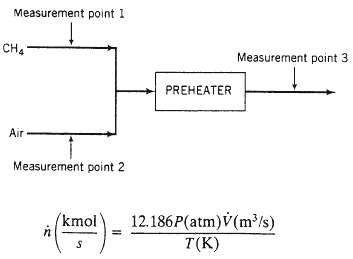
Streams of methane and air (79 mole % N2, the balance O2) are combined at the inlet of a combustion furnace pre-heater. The pressures of each stream are measured with open-end mercury manometers, the temperatures are measured with resistance thermometers, and the volumetric flow rates are measured
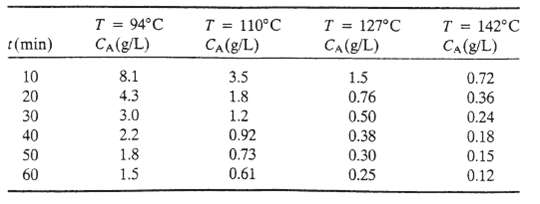
You are performing an experiment in which the concentration, CA, of a reactive species is measured as a function of time, t, at several temperatures, T. At a fixed temperature, CA varies with t according to the relation 1/CA = 1/CA0 + kt where CA (mol/liter) is the concentration of A at time t
Water enters a 2.00-m3 tank at a rate of 6.00 kg/s and is withdrawn at a rate of 3.00 kg/s. The tank initially half full.(a) Is this process continuous, batch, or semi batch? Is it transient or steady state?(b) Write a mass balance for the process (see Example 4.2-1). Identify the terms of the
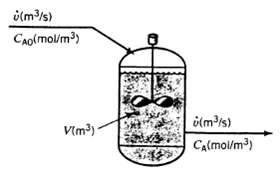
A liquid-phase chemical reaction A ? B takes place in a well-stirred tank. The concentration of A in the feed is CA0 (mol/m3), and that in the tank and outlet stream is CA (mol/m3). Neither concentration varies with time. The volume of the tank contents is V(m3) and the volumetric flow rate of the
A liquid mixture of benzene and toluene contains 55.0% benzene by mass. The mixture is to be partially evaporated to yield a vapor containing 85.0% benzene and a residual liquid containing 10.6% benzene by mass.(a) Suppose the process is to be carried out continuously and at steady state, with a
Draw and label the given streams and derive expressions for the indicated quantities in terms of labeled variables. The solution of part (a) is given as an illustration.(b) The feed to a batch process contains equimolar quantities of nitrogen and methane. Write an expression for the kilograms of
(a) Draw a flowchart for the catalytic dehydrogenation of propane from the description of this process that begins Section 4.3a. Label all feed, product and connecting streams between units.(b) Write clear statements of the overall objective of the process and the functions of each of the process
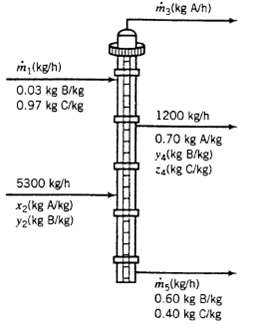
A distillation column is a process unit in which a feed mixture is separated by multiple partial vaporizations and condensations to form two or more product streams. The overhead product stream is rich in the most volatile components of the feed mixture (the ones that vaporize most readily), and
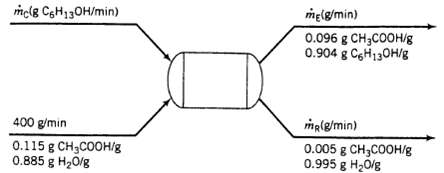
Liquid extraction is an operation used to separate the components of a liquid mixture of two or more species. In the simplest case, the mixture contains two components: a solute (A) and a Liquid solvent (B). The mixture is contacted in an agitated vessel with a second liquid solvent (C) that has
Eggs are sorted into two sizes (large and extra large) at the Cheerful Chicken Dairy. Unfortunately, business has not been good lately, and since the Cheerful Chicken’s 40-year-old egg-sorting machine finally gave up the ghost there have been no funds available to replace it. Instead, Old Fred,
Strawberries contain about 15 wt% solids and 85 wt% water. To make strawberry jam, crushed strawberries and sugar are mixed in a 45:55 mass ratio, and the mixture is heated to evaporate water until the residue contains one-third water by mass.(a) Draw and label a flowchart of this process.(b) Do
Three hundred gallons of a mixture containing 75.0 wt% ethanol (ethyl alcohol) and 25% water (mixture specific gravity = 0.877) and a quantity of a 40.0 wt% ethanol—60% water mixture (SG = 0.952) are blended to produce a mixture containing 60.0 wt% ethanol. The object of this problem is to
If the percentage of fuel in a fuel—air mixture falls below a certain value called the lower flammability limit (LFL), the mixture cannot be ignited. For example, the LFL of propane in air is 2.05 mole% C3H8. If the percentage of propane in a propane—air mixture is greater than 2.05 mole%, the
One thousand kilograms per hour of a mixture containing equal parts by mass of methanol and water is distilled. Product streams leave the top and the bottom of the distillation column. The flow rate of the bottom stream is measured and found to be 673 kg/h. and the overhead stream is analyzed and
A pharmaceutical product P. is made in a batch reactor. The reactor effluent goes through a purification process to yield a final product stream and a waste stream. The initial charge (feed) to the reactor and the final product are each weighed, and the reactor effluent, final product and waste
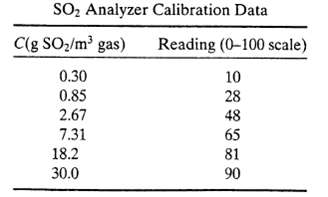
A stream of humid air containing 1.00 mole% H2O (v) and the balance dry air is to be humidified to a water content of 10.0 mole% H2O. For this purpose, liquid water is fed through a flow meter and evaporated into the air stream. The flow meter reading, R, is 95. The only available calibration data
A liquid mixture contains 600 wt% ethanol (E), 5.0 wt% of a dissolved solute (S), and the balance water. A stream of this mixture is fed to a continuous distillation column operating at steady state. Product streams emerge at the top and bottom of the column. The column design calls for the product
Two aqueous sulfuric acid solutions containing 20.0 wt% H2SO4 (SG = 1.139) and 60.0 wt% H2SO4 (SG = 1.498) are mixed to form a 4.00 molar solution (SG = 1.213).(a) Calculate the mass fraction of sulfuric acid in the product solution.(b) Taking 100 kg of the 20% feed solution as a basis, draw
A paint mixture containing 25.0% of a pigment and the balance water sells for $18.00/kg, and a mixture containing 12.0% pigment sells for $10.00/kg, if a paint retailer produces a blend containing 17.0% pigment, for how much ($/kg) should it be sold to yield a 10% profit
Wet sugar that contains one-fifth water by mass is conveyed through an evaporator in which 85.0% of the entering water is vaporized. (a) Taking a basis of 100 kg feed, calculate (i) XW, the mass fraction of water in the wet sugar leaving the evaporator, and (ii) the ratio (kg H2O vaporized/kg wet
A sedimentation process is to be used to separate pulverized coal from slate. A suspension of finely divided particles of galena (lead sulfide SG = 7.44) in water is prepared. The overall specific gravity of the suspension is 1.48.(a) Four hundred kilograms of galena and a quantity of water are
Wet air containing 4.0mole% water vapor is passed through a column of calcium chloride pellets. The pellets adsorb 97.0% of the water and none of the other constituents of the air. The column packing was initially dry and had a mass of 3.40kg, following 5.0 hours of operation the pellets are
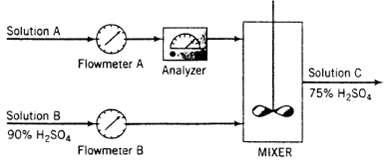
A dilute aqueous solution of H2SO4 (Solution A) is to be mixed with a solution containing 90.0 wt% H2SO4 (Solution B) to produce a 75.0 wt% solution (Solution C). The flow rate and concentration of Solution A change periodically, so that it is necessary to adjust the flow rate of Solution B to
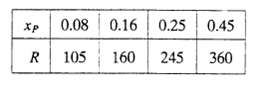
Gas streams containing hydrogen and nitrogen in different proportions are produced on request by blending gases from two feed tanks: Tank A (hydrogen mole fraction = xA) and Tank B (hydrogen mole fraction = xB). The requests specify the desired hydrogen mole fraction, xp, and mass flow rate of the
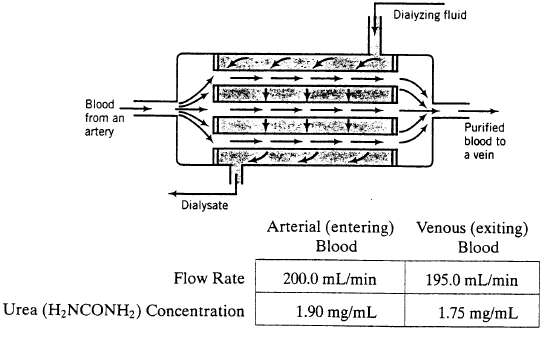
An artificial kidney is a device that removes water and waste metabolites from blood. In one such device, the hollow fiber hemodialyzer, blood flows from an artery through the insides of a bundle of hollow cellulose acetate fibers, and dialyzing fluid, which consists of water and various dissolved
The indicator dilution method is a technique used to determine flow rates of fluids in channels for which devices like rotameters and orifice meters cannot be used (e.g., rivers, blood vessels, and large- diameter pipelines). A stream of an easily measured substance (the tracer) is injected into
A variation of the indicator dilution method (see preceding problem) is used to measure total blood volume. A known amount of a tracer is injected into the bloodstream and disperses uniformly throughout the circulatory system. A blood sample is then withdrawn, the tracer concentration in the sample
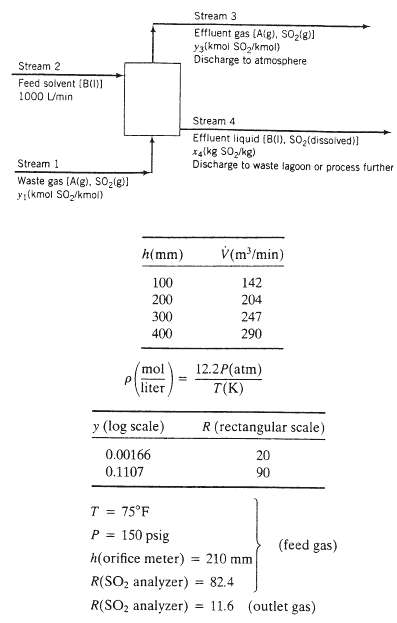
Gas absorption or gas scrubbing is a commonly used method for removing environmentally undesirable species from waste gases in chemical manufacturing and combustion processes. The waste gas is contacted with a liquid solvent in which the potential pollutants are highly soluble and the other species
The SO2 scrubbing tower described in Problem 4.26 is to be used to reduce the SO2 mole fraction in the waste gas to a level that meets air quality control regulations. The solvent feed rate must be large enough to keep the SO2 mass fraction in the exit liquid below a specified maximum value.(a)
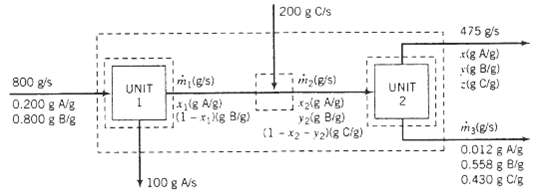
Following is a labeled flowchart for a steady-state two-unit process with boundaries shown to denote subsystems about which balances can be taken. State the maximum number of balances that can be written for each subsystem and the order in which you would write balances to determine the unknown
A liquid mixture containing 30.0mole% benzene (B) 25.0% toluene (T) and the balance xylene (X) is fed to a distillation column. The bottoms product contains 98.0 mole% X and no B. and 96.0% of the X in the feed is recovered in this stream. The overhead product is fed to a second column. The
Seawater containing 3.50 wt % salts passes through a series of 10 evaporators. Roughly equal quantities of water are vaporized in each of the 10 units and then condensed and combined to obtain a product stream of fresh water. The brine leaving each evaporator but the tenth is fed to the next
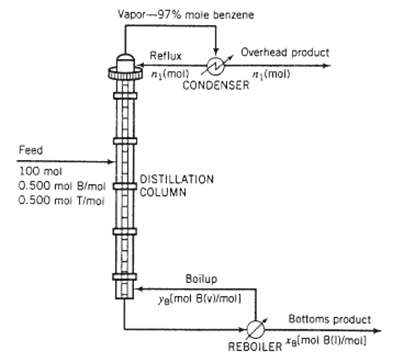
An equimolar liquid mixture of benzene and toluene is separated into two product streams by distillation. A process flowchart and a somewhat oversimplified description of what happens in the process follow: Inside the column a liquid stream flows downward and a vapor stream rises. At each point in
Fresh orange juice contains 12.0 wt% solids and the balance water, and concentrated orange juice contains 42.0 wt% solids. Initially a single evaporation process was used for the concentration, but volatile constituents of the juice escaped with the water, leaving the concentrate with a flat taste.
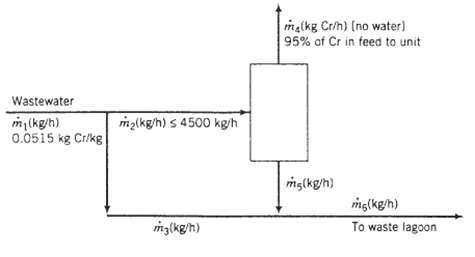
A stream containing 5.15wt% chromium Cr is contained in the wastewater from a metal finishing plant. The wastewater stream is fed to a treatment unit that removes 95% of the chromium in the feed and recycles it to the plant. The residual liquid stream leaving the treatment unit is sent to a waste
An evaporation—crystallization process of the type described in Example 4.5.2 is used to obtain solid potassium sulfate from an aqueous solution of this salt. The fresh feed to the process contains 19.6 wt% K2SO4. The wet filter cake consists of solid K2SO4 crystals and a 40.0 wt% K2SO4 solution
In an absorption tower (or absorber), a gas is contacted with a liquid under conditions such that one or more species in the gas dissolve in the liquid. A stripping tower (or stripper) also involves a gas contacting a liquid, but under conditions such that one or more components of the feed liquid
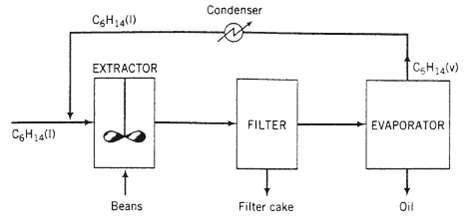
In the production of a bean oil beans containing 13.0 wt% oil and 87.0% solids are ground and fed to a stirred tank (the extractor) along with a recycled stream of liquid n-hexane. The feed ratio is 3kg hexane/kg beans. The ground beans are suspended in the liquid, and essentially all of the oil in
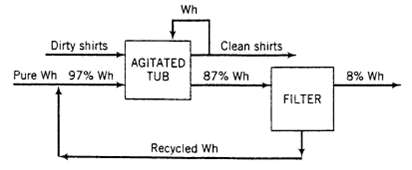
Following is a diagram of the shirt-cleaning process used by the Floods of Suds One-Day Laundry Services, Inc. The shirts are soaked in an agitated tub containing Whizzo the Wonder Detergent, and are then wrung out and sent to a rinse stage. The dirty Whizzo is sent to a filter in which most of the
A drug (D) is produced in a three-stage extraction from the leaves of a tropical plant. About 1000 kg of leaf is required to produce 1 kg of the drug. The extraction solvent (S) is a mixture containing 16.5 wt% ethanol (E) and the balance water (W). The following process is carried out to extract
Acetylene is hydrogenated to form ethane. The feed to the reactor contains 1.50mol H2/mol C2H2.(a) Calculate the stoichiometric reactant ratio (mol H2 react/mol C2H2 react) and the yield ratio (k mol C2H6 formed/k mol H2 react).(b) Determine the limiting reactant and calculate the percentage by
Ammonia is burned to form nitric oxide in the following reaction: 4NH3 + 5O2 → 4N0 + 6H20(a) Calculate the ratio (lb-mole O2 react/lb-mole NO formed).(b) If ammonia is fed to a continuous reactor at a rate of 100.0k mol NH3/h, what oxygen feed rate (k mol/h) would correspond to 40.0% excess
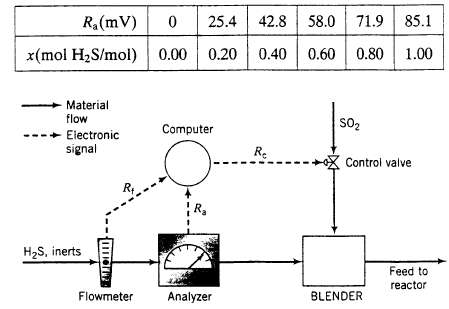
A stream containing H2S and inert gases and a second stream of pure SO2 are fed to a sulfur recovery reactor, where the reaction 2H2S + SO2 ? 3S + 2H20 takes place. The feed rates are adjusted so that the ratio of H2S to SO2 in the combined feed is always stoichiometric. In the normal operation of
The reaction between ethylene and hydrogen bromide to form ethyl bromide is carried out in a continuous reactor. The product stream is analyzed and found to contain 51.7 mole% C2H5Br and 17.3%HBr. The feed to the reactor contains only ethylene and hydrogen bromide. Calculate the fractional
In the Deacon process for the manufacture of chlorine, HC1 and O2 react to form Cl2 and H20. Sufficient air (21 mole% 02, 79% N2) is fed to provide 35% excess oxygen and the fractional conversion of HCI is 85%.(a) Calculate the mole fractions of the product stream components using atomic species
Titanium dioxide (TiO2) is used extensively as a white pigment. It is produced from an ore that contains ilmenite (FeTiO3) and ferric oxide (Fe2O3). The ore is digested with an aqueous sulfuric acid solution to produce an aqueous solution of titanyl sulfate [(TiO) SO4] and ferrous sulfate (FeSO4).
Coal containing 5.0 wt% S is burned at a rate of 1250lbm/mm in a boiler furnace. All of the sulfur in the coal is oxidized to SO2. The product gas is sent to a scrubber in which most of the SO2 is removed, and the scrubbed gas then passes out of a stack. An Environmental Protection Agency
The gas-phase reaction between methanol and acetic acid to form methyl acetate and water CH3OH + CH3COOH = CH3COOCH3 + H2O (A) (B) (C) (D)Takes place in a batch
At low to moderate pressures the equilibrium state of the water—gas shift reaction CO + H2O = CO2 + H2 is approximately described by the relation where T is the reactor temperature. Ke is the reaction equilibrium constant, and y, is the mole fraction of species I in the reactor contents at
Methanol is formed from carbon monoxide and hydrogen in the gas-phase reaction The mole fractions of the reactive species at equilibrium satisfy the relation where P is the total pressure (atm). Ke the reaction equilibrium constant (atm-2) and T the temperature (K) The equilibrium constant Ke
Methane and oxygen react in the presence of a catalyst to form formaldehyde. In a parallel reaction methane is oxidized to carbon dioxide and water: CH4 + 02 → HCHO + H2OCH4 + 2O2 → CO2 + 2 H2OThe feed to the reactor contains equimolar amounts of methane and oxygen. Assume a basis of 100
Ethane is chlorinated in a continuous reactor: C2H6÷C12—C2H5Cl + HCI some of the product monochloroethane is further chlorinated in an undesired side reaction: C2H5Cl + Cl2 → C2H4C12 + HCI(a) Suppose your principal objective is to maximize the selectivity of monochloroethane production
Ethanol is produced commercially by the hydration o ethylene: C2H + H20 → C2H5OH some of the product is converted to diethyl ether in the side reaction 2C2H5OH → (C2H5)2O + H2O the feed to the reactor contains ethylene steam and an inert gas. A sample of the reactor effluent gas is analyzed and
Solid calcium fluoride (CaF2) reacts with sulfuric acid to form solid calcium sulfate and gaseous hydrogen fluoride. The HF is then dissolved in water to form hydrofluoric acid. A source of calcium fluoride is fluorite ore containing 96.0 wt% CaF2 and 4.0% SiO2.In a typical hydrofluoric acid
Chlorobenzene (C6H5C1), an important solvent and intermediate in the production of many other chemicals, is produced by bubbling chlorine gas through liquid benzene in the presence of ferric chloride catalyst. In an undesired side reaction, the product is further chlorinated to dichlorobenzene and
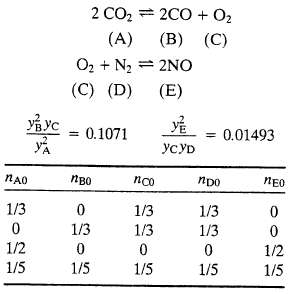
The following two reactions take place in a gas-phase reactor: If the system comes to equilibrium at 3000 K and 1 atm, the product gas mole fractions satisfy the relations (a) Let nA0 . . . nE0 be the initial number of gram-moles of each species and ?1 and ?2?be the extents of reactions 1 and 2
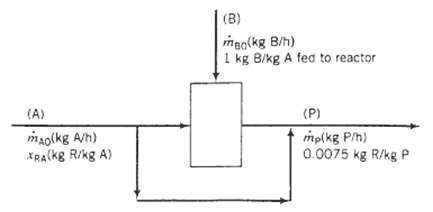
A mixture (A) in a continuous pharmaceutical manufacturing process Contains up to 10 wt% of an ingredient R [mass fraction xRA (g R/g A)1. The mixture is subjected to a reaction step in which the conversion of R is 99%. The final product (P) must contain 0.75 wt% R. To achieve this goal, a fraction
A catalytic reactor is used to produce formaldehyde from methanol in the reaction CH3OH — HCHO + H2 A single-pass conversion of 60.0% is achieved in the reactor. The methanol in the reactor product is separated from the formaldehyde and hydrogen in a multiple unit process. The production
Methanol is produced by reacting carbon monoxide and hydrogen. A fresh feed stream containing CO and H2 joins a recycle stream and the combined stream is fed to a reactor. The reactor outlet stream flows at a rate of 350mol/min and contains 10.6 wt% H2, 64.0 wt% CO. and 25.4 wt% CH3OH. (Notice that
Methane reacts with chlorine to produce methyl chloride and hydrogen chloride. Once formed, the methyl chloride may undergo further chlorination to form methylenc chloride (CH2CI2), chloroform, and carbon tetrachloride. A methyl chloride production process consists of a reactor, a condenser, a
Ethylene oxide is produced by the catalytic oxidation of ethylene: 2C2H4 +02 — 2C2H40 an undesired competing reaction is the combustion of ethylene: C2H4 + 3O2 — 2C02 + 2H20 the feed to the reactor (not the fresh feed to the process) contains 3 moles of ethylene per mole of oxygen. The
Methanol is synthesized from carbon monoxide and hydrogen in a catalytic reactor. The fresh feed to the process contains 32.0 mole% CO. 64.0% H2 and 4.0% N2. This stream is mixed with a recycle stream in a ratio 5mol recycle/i mol fresh feed to produce the feed to the reactor, which contains 13.0
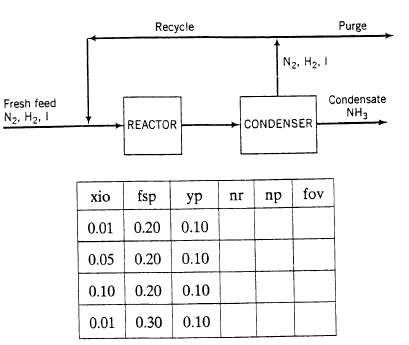
The fresh feed to an ammonia production process contains nitrogen and hydrogen in stoichiometric proportion, along with an inert gas (I). The feed is combined with a recycle stream containing the same three species, and the combined stream is fed to a reactor in which a low single-pass conversion
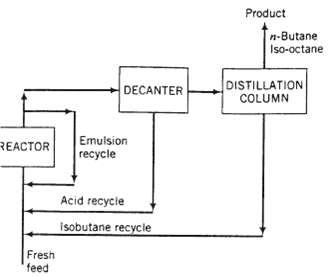
Isooctane is produced in the reaction of isobutene and butylene in an emulsion with concentrated sulfuric acid: i-C4H10 + C4H8?? i-C8H18 The fresh feed to the process flows at a rate of 60,000 kg/h and contains 25.0 mole% isobutene. 25.0% butylene, and 50.0% n-butane, which is chemically inert in
A gas contains 80.0wt% propane. 15.0 wt% n-butane and the balance water(a) Calculate the molar composition of this gas on both a wet and a dry basis and the ratio (mol H2O/mol dry gas).(b) If 100 kg/h of this fuel is to be burned with 30% excess air, what is the required air feed rate (k mol/h)?
Five liters of liquid n-hexane and 4 liters of liquid n-heptanes are mixed and burned with 4000 gram- moles of air. Not all of the hydrocarbons are burned in the furnace, and both CO and CO2 are formed. If it is possible to do so without additional information, calculate the percent excess air
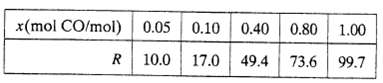
A fuel gas produced by gasifying coal is to be burned with 20% excess air. The gas contains 50.0 mole% nitrogen and the balance carbon monoxide and hydrogen. A sample of the gas is passed through an infrared spectrometer, which registers a signal R that depends on the mole fraction of carbon
Natural gas containing a mixture of methane ethane propane and butane is burned in a furnace with excess air. (a) One hundred k mol/h of a gas containing 94.4 mole% methane, 3.40% ethane 0.60% propane, and 0.50% butane is to be burned with 17% excess air. Calculate the required molar flow rates of
Butane is burned with air, No carbon monoxide is present in the combustion products.(a) Use a degree-of-freedom analysis to prove that if the percentage excess air and the percentage conversion of butane are specified, the molar composition of the product gas can be determined.(b) Calculate the
A mixture of 75 mole% propane and 25 mole% hydrogen is burned with 25% excess air. Fractional conversions of 90% of the propane and 85% of the hydrogen are achieved: of the propane that reacts. 95% reacts to form CO2 and the balance reacts to form CO. The hot combustion product gas passes through a
N-Pentane is burned with excess air in a continuous combustion chamber.(a) A technician runs an analysis and reports that the product gas contains 0.270 mole% pentane. 5.3% oxygen, 9.1% carbon dioxide, and the balance nitrogen on a dry basis Assume 100 mol of dry product gas as a basis of
Liquid methanol is fed to a space heater at a rate of 12.0 L/h and burned with excess air. The product gas is analyzed and the following dry-basis mole percentages are determined: CH3OH 0.45%. CO2 9.03%, and CO = 1.81%.(a) Draw and label a flowchart and verify that the system has zero degrees of
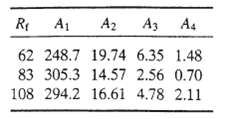
A gas containing methane, ethane, and carbon dioxide is analyzed with a gas chromatograph (GC) and flame ionization detector (FID): the GC separates the components of the gas and the FID registers signals proportional to the amount of each hydrocarbon (but not CO2) in its sample chamber factor
A liquid mixture containing 40.0 wt% n-octane and the balance n-decane flows into a tank mounted on a balance. The mass in kg indicated by the scale is plotted against time. The data fall on a straight line that passes through the points (t = 3 mm, m = 150 kg) and (t = 10 mm, m = 250 kg).(a)
When a liquid or a gas occupies a volume, it may be assumed to fill the volume completely. On the other hand, when solid particles occupy a volume, there are always spaces (voids) among the particles. The porosity or void fraction of a bed of particles is the ratio (void volume)/(total bed volume).
Two liquid streams are flowing at constant rates into a blender. One is benzene, which flows at a measured rate of 20.0 L/min, and the other is toluene. The blended mixture enters a storage tank (inner diameter = 5.5 m) equipped with a sight gauge. During an interval in which no liquid leaves the
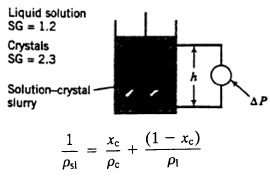
A slurry contains crystals of copper sulfate pentahydrate [CuSO4 ∙ 5H2O(s), specific gravity = 2.3] suspended in an aqueous copper sulfate solution (liquid SG = 1.2). A sensitive transducer is used to measure the pressure difference, ΔP (Pa), between two points in the sample container
Use the ideal gas equation of state to estimate the molar volume in m3tmol and the density of air in kg/m3 at 40°C and a gauge pressure of 3.0atm.
One gram-mole of methyl chloride vapor is contained in a vessel at 100°C and 10atm.(a) Use the ideal gas equation of state to estimate the system volume.(b) Suppose the actual volume of the vessel is 2.8 liters. What percentage error results from assuming ideal gas behavior?
The pressure gauge on a 20.0 m3 tank of nitrogen at 25°C reads 10bar. Estimate the mass of nitrogen in the tank by(a) Direct solution of the ideal gas equation of state and(b) Conversion from standard conditions.
From the standard conditions given in Table 5.2-1, calculate the value of the gas constant R in(a) Atm∙m3 / (k mol ∙ K) and(b) Torr∙ft3 / (lb-mole ∙ °R).
The volume of a dry box (a closed chamber with dry nitrogen flowing through it) is 2.0 m3. The dry box is maintained at a slight positive gauge pressure of 10 cm H2O and room temperature (25°C). If the contents of the box are to be replaced every five minutes, calculate the required mass flow rate
A stream of air enters a 7.50-cm ID pipe at a velocity of 60.0 m/s at 27°C and 1.80 bar (gauge). At a point downstream, the air flows through a 5.00 cm ID pipe at 60°C and 1.53bar (gauge). What is the velocity of the gas at this point?
The label has come off a cylinder of gas in your laboratory. You know only that one species of gas is contained in the cylinder, but you do not know whether it is hydrogen oxygen, or nitrogen. To find out, you evacuate a 5-liter flask, seal it and weigh it, then let gas from the cylinder flow into
A gas cylinder filled with nitrogen at standard temperature and pressure has a mass of 37.289 g. The same container filled with carbon dioxide at STP has a mass of 37.440 g. When filled with an unknown gas at STP, the container mass is 37.062 g. Calculate the molecular weight of the unknown gas and
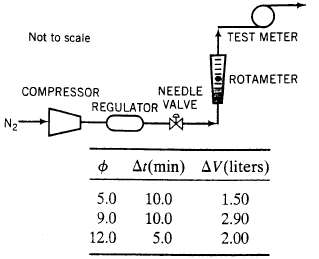
A nitrogen rotameter is calibrated by feeding N2 from a compressor through a pressure regulator, a needle valve, the rotameter, and a dry test meter, a device that measures the total volume of gas that passes through it. A water manometer is used to measure the gas pressure at the rotameter outlet.
The flow rate required to yield a specified reading on an orifice meter varies inversely as the square root of the fluid density; that is, if a fluid with density p1(gfcm3) flowing at a rate V (cm3/s) yields a meter reading then the flow rate of a fluid with density p required to yield the same
A device has been designed to measure the flow rate of carbon dioxide evolved from a fermentation reactor. The reactor is sealed except for a tube that allows the generated carbon dioxide to bubble through a soap solution and into a vertical glass tube with an internal diameter of 1.2 cm. On
A stream of air (21 mole% O2, the rest N2) flowing at a rate of 10.0 kg/h is mixed with a stream of CO2. The CO2 enters the mixer at a rate of 20.0m3/h at 150°C and 1.5 bar what is the mole percent of CO2 in the product stream?
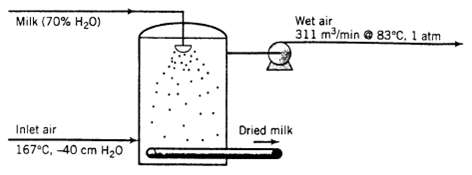
Spray drying is a process in which a liquid containing dissolved or suspended solids is injected into a chamber through a spray nozzle or centrifugal disk atomizer. The resulting mist is contacted with hot air, which evaporates most or all of the liquid, leaving the dried solids to fall to a
Many references give the specific gravity of gases with reference to air. For example, the specific gravity of carbon dioxide is 1.52 relative to air at the same temperature and pressure. Show that this value is correct as long as the ideal gas equation of state applies.
Sax and Lewis12 describe the hazards of breathing air containing appreciable amounts of an asphyxiant (a gas that has no specific toxicity but, when inhaled, excludes oxygen from the lungs). When the mole percent of the asphyxiant in the air reaches 50% marked symptoms of distress appear and at 75%
A tank in a room at 19°C is initially open to the atmosphere on a day when the barometric pressure is 102 kPa. A block of dry ice (solid CO2) with a mass of 15.7 kg is dropped into the tank, which is then sealed. The reading on the tank pressure gauge initially rises very quickly then much more
In froth flotation, air is bubbled through an aqueous solution or slurry to which a foaming agent (soap) has been added. The air bubbles carry finely dispersed solids and hydrophobic materials such as grease and oil to the surface where they can be skimmed off in the foam an ore-containing slurry
Several decades ago benzene was thought to be a harmless chemical with a somewhat pleasant odor and was widely used as a cleaning solvent. It has since been found that chronic exposure to benzene can cause health problems such as anemia and possibly leukemia. Benzene has a permissible exposure
Showing 500 - 600
of 6778
1
2
3
4
5
6
7
8
9
10
11
12
13
14
15
Last
Step by Step Answers

 Get 50% OFF
Claim Now
Get 50% OFF
Claim Now