New Semester
Started
Get
50% OFF
Study Help!
--h --m --s
Claim Now
Question Answers
Textbooks
Find textbooks, questions and answers
Oops, something went wrong!
Change your search query and then try again
S
Books
FREE
Study Help
Expert Questions
Accounting
General Management
Mathematics
Finance
Organizational Behaviour
Law
Physics
Operating System
Management Leadership
Sociology
Programming
Marketing
Database
Computer Network
Economics
Textbooks Solutions
Accounting
Managerial Accounting
Management Leadership
Cost Accounting
Statistics
Business Law
Corporate Finance
Finance
Economics
Auditing
Tutors
Online Tutors
Find a Tutor
Hire a Tutor
Become a Tutor
AI Tutor
AI Study Planner
NEW
Sell Books
Search
Search
Sign In
Register
study help
engineering
chemical engineering
Elementary Principles of Chemical Processes 3rd Edition Richard M. Felder, Ronald W. Rousseau - Solutions
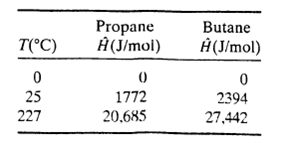
Three hundred L/h of a 20 mole% C3H8?80% n-C4H10 gas mixture at 0oC and 1.1 atm and 200 L/h of a 40 mole% C3H8?60% n-C4H10 mixture at 25?C and 1.1 atm are mixed and heated to 227?C at constant pressure. Calculate the heat requirement in kJ/h. Enthalpies of propane and n-butane are listed below.
Air at 38°C and 97% relative humidity is to be cooled to 18°C and fed into a plant area at a race of 510m3/min.(a) Calculate the rate (kg/mm) at which water condenses.(b) Calculate the cooling requirement in tons (1 ton of cooling = 12,000 Btu/h), assuming that the enthalpy of water vapor is that
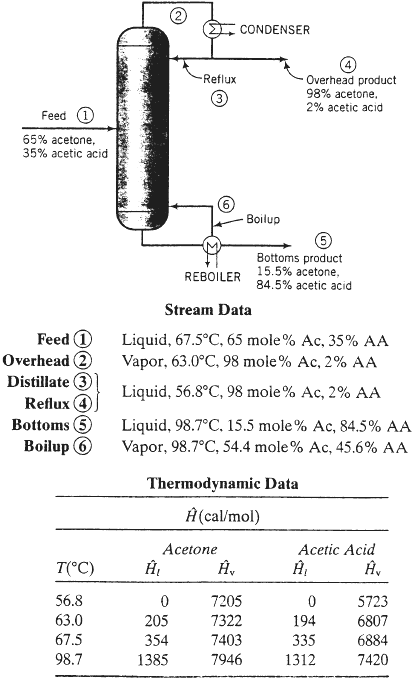
A mixture containing 65.0 mole% acetone (Ac) and the balance acetic acid (AA) is separated in a continuous distillation column at 1 atm. A flowchart for the operation is as follows: The overhead stream from the column is a vapor that passes though a condenser. The condensed liquid is divided into
Superheated steam at T1 (°C) and 10.0 bar is combined with saturated steam at T2 (°C) and 7.0 bar in a ratio (1.96 kg of steam at 10 bar) / (1.0 kg of steam at 7 bar). The product stream is at 250°C and 70bar. The process operates a steady state.(a) Calculate T1 and T2, assuming that the blender
A 2000-liter water tank can withstand pressures up to 20.0bar absolute before rupturing. At a particular time the tank contains 165.0 kg of liquid water, the fill and exit valves are closed, and the absolute pressure in the vapor head space above the liquid (which may be assumed to contain only
A wet steam at 20bar with a quality of 0.97 (see Problem 7.32) leaks through a defective steam trap and expands to a pressure of 1 atm. The process can be considered to take place in two stages: a rapid adiabatic expansion to 1 atm accompanied by complete evaporation of the liquid droplets in the
Eight fluid ounces (1 qt = 32 oz) of a beverage in a glass at 18.0°C is to be cooled by adding ice and stirring. The properties of the beverage may be taken to be those of Liquid water. The enthalpy of the ice relative to liquid water at the triple point is – 348kJ/kg. Estimate the mass of ice
A 25-g block of iron at 175°C is dropped into a liter of water in an insulated flask at 20°C and 1 atm.The specific enthalpy of iron is given by the expression H (J/g) = 17.3T (°C).(a) What reference temperature was used as the basis for the enthalpy formula?(b) Calculate the final temperature
Horatio Meshuggeneh has his own ideas of how to do things. For instance, when given the task of determining an oven temperature, most people would use a thermometer. Being allergic to doing anything most people would do, however, Meshuggeneh instead performs the following experiment. He puts a
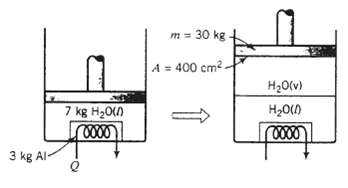
A perfectly insulated cylinder fitted with a leak proof friction less piston with a mass of 30.0 kg and a face area of 400.0 cm2 contains 7.0 kg of liquid water and a 3.0-kg bar o1 aluminum. The aluminum bar has an electrical coil imbedded in it, so that known amounts of heat can be transferred to
A rigid 5.00-liter vessel contains 4.00 L of liquid water in equilibrium with 1.00 L of water vapor at 25°C. Heat is transferred to the water by means of an immersed electrical coil. The volume of the coil is negligible. Use the steam tables to calculate the final temperature and pressure (bar) of
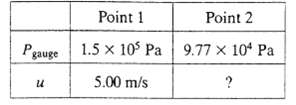
An aqueous solution with a specific gravity of 1.12 flows through a channel with a variable cross section, data taken at two axial positions in the channel are shown here. Point 2 is 6.00 meters higher than point 1. (a) Neglecting friction, calculate the velocity at point 2.? (b) If the pipe
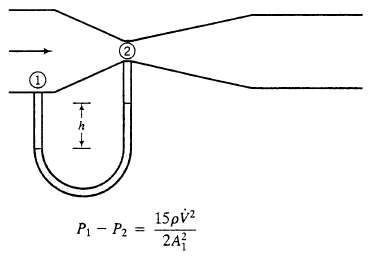
A venturi meter is a device to measure fluid flow rates, which in its operation resembles the orifice meter (Section 3.2b). It consists of a tapered Constriction in a line, with pressure taps leading to a differential manometer at points upstream of the constriction and at the point of maximum
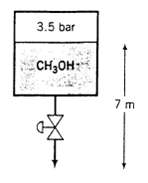
Methanol is contained in a large tank under a pressure of 3.1bar absolute. When a valve on the bottom of the tank is opened, the methanol drains freely though a 1-cm ID tube whose outlet is 7.00 m below the surface of the methanol. The pressure at the outlet of the discharge pipe is 1 atm. (a) Use
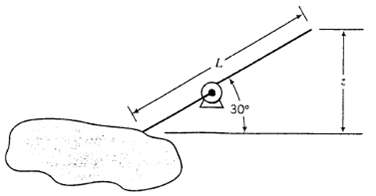
Water is to be pumped from a lake to a ranger station on the side of a mountain (see figure). The flow rate is to be 95gal/mm, and the flow channel is a standard 1-in. Schedule 40 steel pipe (ID = 1.049 in.). A pump capable of delivering 8 hp (= ? Ws) is available. The friction loss P (ft ?
Water from a reservoir passes over a dam through a turbine and discharges from a 70-cm ID pipe at a point 65 m below the reservoir surface. The turbine delivers 0.80 MW. Calculate the required flow rate of water in m3/min if friction is neglected. If friction were included would a higher or lower
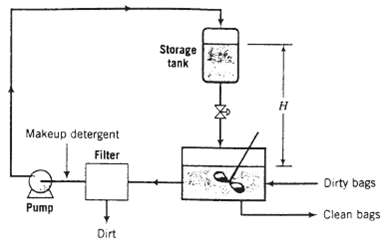
Cloth bag filters are used to remove particulate matter from the gases passing out through several process and boiler stacks in a large industrial plant. The bags become clogged and must be replaced frequently. Since they are quite expensive, rather than being discarded they are emptied washed, and
One thousand liters of a 95 wt% glycerol—5% water solution is to be diluted to 60% glycerol by adding a 35% solution pumped from a large storage tank through a 5-cm ID pipe at a steady rate. The pipe discharges at a point 23 m higher than the liquid surface in the storage tank. The operation is
The specific internal energy of formaldehyde (HCHO) vapor at 1 atm and moderate temperatures is given by the formula U(J/mol) = 25.96T + O.02134T2 where T is in °C.(a) Calculate the specific internal energies of formaldehyde vapor at 0°C and 100°C. What reference temperature was used to
The heat capacity at constant pressure of hydrogen cyanide is given by the expression Cp[J/(mol ∙°C)] = 35.3 + 0.0291T(°C)(a) Write an expression for the heat capacity at constant volume for HCN, assuming ideal gas behavior.(b) Calculate ΔU (J/mol) for the constant-pressure process HCN (v,
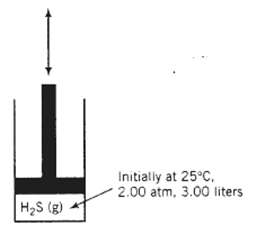
The heat capacity at constant volume of hydrogen sulfide at low pressures is Cv [kJ/ (mol??C)] = 0.0252 + 1.547 x 10?5?T ? 3.012 X 10?9T2?where T is in ?C. A quantity of H2S is kept in a piston-fitted cylinder with initial temperature, pressure, and volume equal to 25?C, 2.00 atm, and 3.00 liters,
Use data in Table B.2 to calculate the following:(a) The heat capacity (Cp) of liquid benzene at 40°C.(b) The heat capacity at constant pressure of benzene vapor at 40°C.(c) The heat capacity at constant pressure of solid carbon at 40°C.(d) ΔH (kJ/mol) for benzene vapor going from 40°C to
Estimate the specific enthalpy of steam (kJ/kg) at 350°C and 100 bar relative to steam at 100°C and 1 atm using:(a) The steam tables.(b) Table B.2 and assuming ideal gas behavior.What is the physical significance of the difference between the values of H calculated by the two methods?
Calculate ΔH for each of the following processes. In each case, restate your result as a specific enthalpy relative to a reference state. [The solution—which you should verify—and the restatement for part (a) are given as an illustration.] Assume that the process pressures are low enough for
Two formulas for the heat capacity of CO are given here: Cp [cal/(mol ∙ °C)] = 6.890 + 0.001436T (°C) Cp (Btu/(lb-mole∙°F)] = 6.864 + 0.0007978T (°F) Starting with the first formula, derive the second. (Recall Section 2.5, and remember that the temperature unit in the denominator of Cp
Table B.2 lists values of the heat capacity of liquid ethanol at two temperatures. Use the tabulated values to derive a linear expression for Cp (T); then use the derived expression and data in Table B.1 to calculate the heat transfer rate (kW) required to bring a stream of liquid ethanol flowing
Chlorine gas is to be heated from 100°C and 1 atm to 200°C.(a) Calculate the heat input (kW) required to heat a stream of the gas flowing at 5.0 k mol/s at constant pressure.(b) Calculate the heat input (kJ) required to raise the temperature of 5.0 k mol of chlorine in a closed rigid vessel from
The heat required to raise the temperature of m (kg) of a liquid from T1 to T2 at constant pressure is in high school and in first-year college physics courses, the formula is usually given as(a) What assumption about Cp is required to go from Equation 1 to Equation 2?(b) The heat capacity (Cp) of
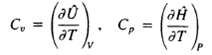
The heat capacities of a substance have been defined as use the defining relationship between H and U and the fact that H and U for ideal gases are functions only of temperature to prove that Cp = Cv + R for an idealgas.
Ralph Rack straw your next-door neighbor, surprised his wife last January by having a hot tub installed in their back yard while she was away on a business trip. It surprised her, all right, but instead of being pleased she was horrified. “Have you lost your mind, Ralph?” she sputtered. “It
Use tabulated specific enthalpies from Tables B.8 and 8.9 to calculate A for the following processes, all taking place at low pressures:(a) N2 (25°C) —b N2 (700°C) (c) CO2 (300°C) → CO2 (1250°C)(b) H2 (800°F) —. H2 (77°F) (d) O2 (970°F) – O2 (0°F)
Calculate the rate of cooling (kW) required to bring 300 kg/mm of carbon monoxide from 450°C to 50°C, performing the calculation(a) Using Table B.2 and(b) Using Table B.8. Considering how much simpler the second calculation is, why would you ever use the polynomial formulas of Table B.2 as
A stream of water vapor flowing at a rate of 250mol/h is brought from 600°C and 10bar to 100°C and 1 atm.(a) Estimate the required cooling rate (kW) three ways: (I) from the steam tables (ii) using heat capacity data in Table B.2, and (iii) using specific enthalpy data in Table B.8.(b) Which of
A stream of air at 77°F and 1.2 atm absolute flowing at a rate of 200 ft’/h is blown through ducts that pass through the interior of a large industrial motor. The air emerges at 500°F. Using tabulated specific enthalpy data, calculate the rate at which the air is removing heat generated by the
Calculate the heat required to raise 50 kg of solid sodium carbonate (Na2CO3) from 10°C to 50°C at 1atm using(a) The true heat capacity of Na2CO3, which is 1.14 kJ / (kg ∙°C).(b) A heat capacity estimated by Kopp’s rule. Calculate the percentage error in the latter calculation.
A liquid mixture of 30 wt% acetone and 70wt% 2-methyl-l-pentanol (C6H14O) is cooled from 45°C to 20°C. Calculate the associated specific enthalpy change in J/g, using Kopp’s rule to estimate any heat capacity for which a tabulated value cannot be found. State all assumptions you make.
A gas mixture contains one-third methane by volume (recall what that means in terms of mole %) and the balance oxygen at 350°C and 3.0 bar. Calculate the specific enthalpy of this stream in kJ/kg (not per k mol) relative to the pure components at 25°C and 1 atm. Stare clearly all assumptions.
The radiant energy incident on the earth’s surface on a sunny day is roughly 900 W/m2. Collecting and focusing sunlight and using the focused beam to heat a fluid is an old idea, and as the environmental costs of fossil fuel combustion mount, solar heating becomes an increasingly attractive
Propane is to be burned with 15.0% excess air. Before entering the furnace, the air is preheated from 32°F to 575°F. At what rate (Btu/h) must heat be transferred to the air if the feed rate of propane is 1.35 x 10⁵ SCFH [ft3 (STP)/h]?
A fuel gas containing 95 mole% methane and the balance ethane is burned completely with 25% excess air. The stack gas leaves the furnace at 900°C and is cooled to 450°C in a waste heat boiler, a heat exchanger in which heat lost by cooling gases is used to produce steam from liquid water for
Twenty liters of liquid n-propyl benzoate (C6H5CO2C3H7, SG = 1021) and 15 liters of liquid benzene are mixed and heated from 25°C to 75°C. Calculate the required heat input (kJ), using Kopp’s rule when necessary. State all assumptions you make.
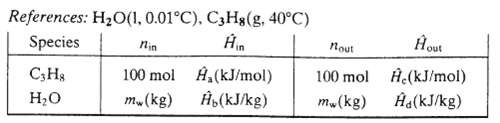
Propane gas enters a continuous adiabatic heat exchanger? at 40?C and 250 kPa and exits at 240?C superheated steam at 300?C and 5.0 bar enters the exchanger flowing counter currently to the propane and exits as a saturated liquid at the same pressure. (a) Taking as a basis 100 mol of propane fed to
Saturated steam at 300°C is used to heat a counter currently flowing stream of methanol vapor from 65°C to 260°C in an adiabatic heat exchanger. The flow rate of the methanol is 5500 standard liters per minute, and the steam condenses and Leaves the heat exchanger as liquid water at 90°C.(a)
An adiabatic membrane separation unit is used to dry (remove water vapor from) a gas mixture containing 10.0 mole% H2O (v), 10.0 mole% CO. and the balance CO2. The gas enters the unit at 30°C and flows past a semi permeable membrane. Water vapor permeates through the membrane into an air stream.
A gas containing water vapor has a dry-basis composition of 8.5 mole% CO. 10.5% CO2, 0.5% O2, and 80.5% N2. The gas leaves a catalyst regeneration unit at 620°C and 1 atm with a dew point of 57°C at a flow rate of 28.5 SCMH [m3(STP)/h]. Valuable solid catalyst particles entrained in the gas are
On a cold winter day the temperature is 2°C and the relative humidity is 15%. You inhale air at an average rate of 5500mL/min and exhale a gas saturated with water at body temperature, roughly 37°C. If the mass flow rates of the inhaled and exhaled air (excluding water) are the same, the heat
Seventy-five liters of liquid ethanol at 70.0°C and 55 L of liquid water at 20.0°C are to be mixed in a well-insulated flask. The energy balance for this constant pressure process is Q = ΔH.(a) Neglecting evaporation and the heat of mixing, estimate the final mixture temperature. (As part of the
A stream of air at 500°C and 835torr with a dew point of 30°C flowing at a rate of 1515 L/s is to be cooled in a spray cooler. A fine mist of liquid water at 25°C is sprayed into the hot air at a rate of 110.0 g/s and evaporates completely. The cooled air emerges at 1 atm.(a) Calculate the final
In the manufacture of nitric acid, ammonia and preheated air are mixed to form a gas containing 10.0 mole% NH3 at 600°C. The ammonia is then catalytically oxidized to form NO2, which is absorbed in water to form HNO3. If ammonia enters the gas blending unit at 25°C at a rate of 520 kg/h and heat
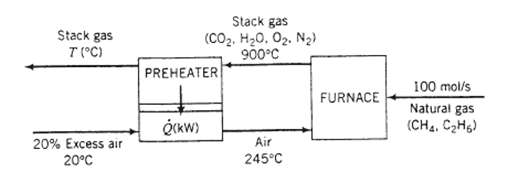
A natural gas containing 95 mole% methane and the balance ethane is burned with 20.0% excess air. The stack gas which contains no unburned hydrocarbons or carbon monoxide leaves the furnace at 900?C and 1.2 atm and passes through a heat exchanger. The air on its way to the furnace also passes
The heat capacity at constant pressure of a gas is determined experimentally at several temperatures, with the following results: (a) Calculate the heat (kW) required to raise 150 molls of the gas from 0?C to 600?C, using Simpson?s rule (Appendix A.3) to integrate the tabulated heat capacities. (b)
As part of a design calculation, you must evaluate an enthalpy change for an obscure organic vapor that is to be cooled from 1800°C to 150°C in a heat exchanger. You search through all the standard references for tabulated enthalpy or heat capacity data for the vapor but have no luck at all,
A stream of ethylene glycol vapor at its normal boiling point and 1 atm flowing at a rate of 175 kg/mm is to be condensed at constant pressure. The product stream from the condenser is liquid glycol at the condensation temperature.(a) Using data in Table B.1, calculate the rate (kW) at which heat
(a) Determine the specific enthalpy (kJ/mol) of n-hexane vapor at 200°C and 2.0 atm relative to n-hexane liquid at 20°C and 1.0 atm, assuming ideal gas behavior for the vapor. Show clearly the process path you construct for this calculation and give the enthalpy changes for each step. State where
Calculate the heat of vaporization of water (kJ/mol) at 50°C and low pressures from the tabulated heat of vaporization in Table B.1 and data in Table B.2 and Table B.8. Show clearly the process path you construct for the calculation. Compare your answer with the value of ΔHv (50°C) given in
Benzene vapor at 580°C is cooled and converted to a liquid at 25°C in a continuous condenser. The condensate is drained into 1.75-rn3 drums, each of which takes 2.0 minutes to fill. Calculate the rate (kW) at which heat is transferred from the benzene in the condenser.
In gas adsorption a vapor is transferred from a gas mixture to the surface of a solid. (See Section 6.7) An approximate but useful way of analyzing adsorption is to treat it simply as condensation of vapor on a solid surface. Suppose a nitrogen stream at 35°C and I atm containing carbon tetra
If carbon dioxide is cooled at I atm. it condenses directly to a solid (dry ice) at —78.4°C. The heat of sublimation at this temperature is ΔH sub (–78.4°C) = 6030 cal/mol.(a) Calculate the heat removal rate (kW) required to produce 300 kg/h of dry ice at 1 atm and —78.4°C if CO2 (v) at
Molten sodium chloride is to be used as a constant-temperature bath for a high-temperature chemical reactor. Two hundred kilograms of solid NaC1 at 300 K is charged into an insulated vessel, and a 3000 kW electrical heater is turned on, raising the salt to its melting point of 1073 K and melting it
Estimate the heat of vaporization of ethyl benzene at its normal boiling point using Trouton’s rule and Chen’s rule and compare the results with a tabulated value of this quantity. Then estimate ΔHv at 100°C using Watson’s correlation.
You are writing energy balances for a compound for which you cannot find heat capacity or latent heat data. All you know about the material are its molecular formula (C7H12N) and that it is a liquid at room temperature and has a normal boiling point of 200°C. Use this information to estimate the
Estimate the heat of vaporization (kJ/mol) of benzene at a pressure of 100 mm Hg, using each of the following correlations and data:(a) The heat of vaporization at the normal boiling point given in Table B.1, the boiling point at 100 mm Hg as determined from the Antoine equation, and Watson’s
A stream of pure cyclopentane vapor flowing at a rate of 1550 L/s at 150°C and 1 atm enters a cooler in which 55% of the feed is condensed at constant pressure.(a) What is the temperature at the condenser outlet? Explain how you know (a single sentence should suffice).(b) Prepare and fill in an
Humid air at 50°C and 1.0 atm with 2°C of super heat is fed to a condenser. Gas and liquid streams leave the condenser in equilibrium at 20°C and 1 atm.(a) Assume a basis of calculation of 100 mol inlet air, draw and label a flowchart (including Q in the labeling), and carry out a
An air conditioner cools 226m3/min of humid air at 36°C and 98% relative humidity to 10°C.(a) Do a degree-of-freedom analysis to prove that enough information is available to determine the required cooling duty (rate of heat transfer).(b) Calculate the rate of condensation of water in the unit
A gas stream containing n-hexane in nitrogen with a relative saturation of 90% is fed to a condenser at 75°C and 3.0 atm absolute. The product gas emerges at 0°C and 3.0 atm at a rate of 746.7m3/h. Calculate the percentage condensation of hexane (moles condensed/mole fed) and the rate (kW) at
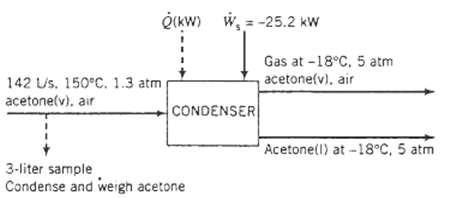
A gas stream containing acetone in air flows from a solvent recovery unit at a rate of 142L/s at 150?C and 1.3 atm. The stream flows into a condenser which liquefies most of the acetone, and the liquid and gas outlet streams are in equilibrium at ? 18?C and 5.0 atm. Shaft work is delivered to the
A mixture of n-hexane vapor and air leaves a solvent recovery unit and flows through a 70-cm diameter duct at a velocity of 3.00 m/s. At a sampling point in the duct the temperature is 40°C, the pressure is 850 mm Hg, and the dew point of the sampled gas is 25°C. The gas is fed to a condenser in
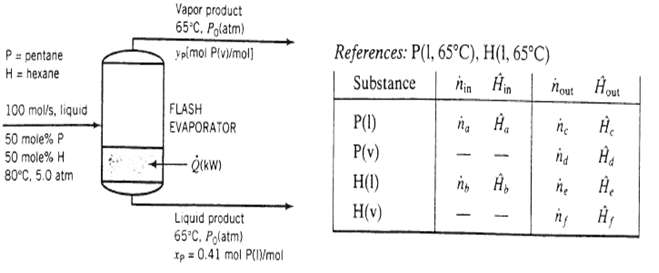
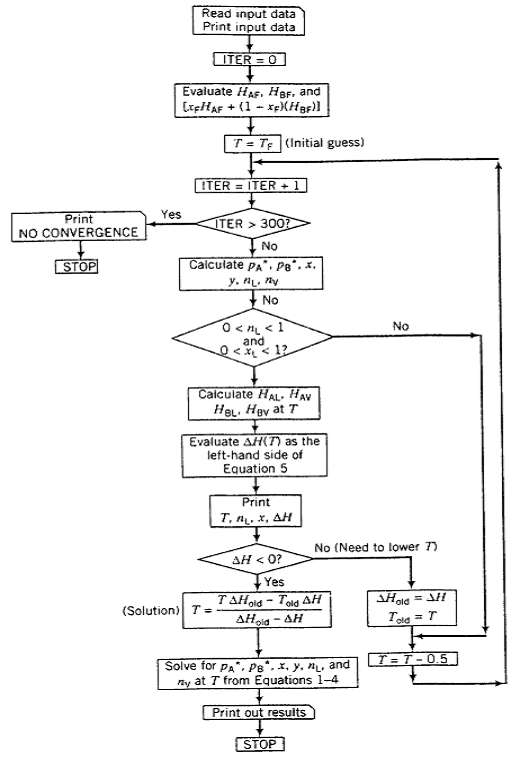
An Equimolar liquid mixture of n-pentane and n-hexane at 80?C and 5.00 atm is fed into a flash evaporator at a rate of 100.0mol/s. When the feed is exposed to the reduced pressure in the evaporators a substantial amount is vaporized. The temperature in the tank is maintained at 65?C by adding heat.
A liquid stream containing 50.0mole% benzene and the balance toluene at 25°C is fed to a continuous single-stage evaporator at a rate of 1320 mol/s. The liquid and vapor streams leaving the evaporator are both at 95.0°C. The liquid contains 42.5mole% benzene and the vapor contains 73.5mole%
The off-gas from a reactor in a process plant in the heart of an obscure banana republic has been condensing and plugging up the vent line, causing a dangerous pressure buildup in the reactor. Plans have been made to pass the gas directly from the reactor into a cooling condenser in which the gas
A sheet of cellulose acetate film containing 5.00wt% liquid acetone enters an adiabatic dryer where 90% of the acetone evaporates into a stream of dry air flowing over the film. The film enters the dryer at Tf1 = 35°C and leaves at Tf2 (°C). The air enters the dryer at Ta1 (°C) and 1.01 atm and
Saturated propane vapor at 2.00 x 10²psia is fed to a well-insulated heat exchanger at a rate of 3.00 x 10³ SCFH (standard cubic feet per hour). The propane leaves the exchanger as a saturated liquid (i.e., a liquid at its boiling point) at the same pressure. Cooling water enters the exchanger at
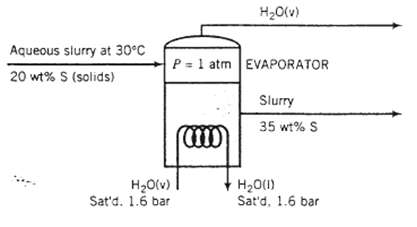
An aqueous slum? at 30?C containing 20.0 wt% solids is fed to an evaporator in which enough water is vaporized at 1 atm to produce a product slurry containing 35.0 wt% solids. Heat is supplied to the evaporator by feeding saturated steam at 1.6bar absolute into a coil immersed in the liquid. The
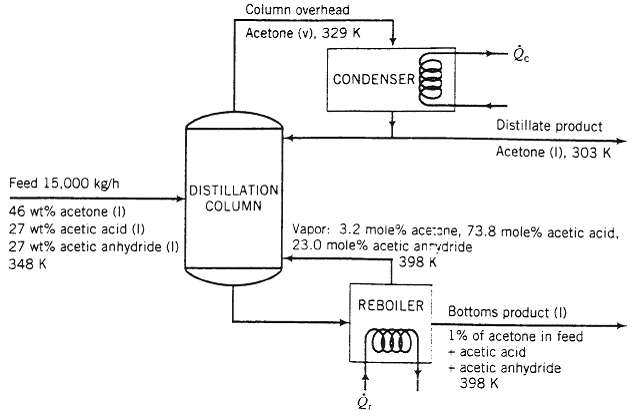
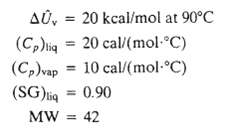
A mixture that contains 46 wt% acetone (CH3COCH3), 27% acetic acid (CH3COOH), and 27% acetic anhydride [(CH3CO) 2O] is distilled at P = 1 atm. The feed enters the distillation column at T = 348 K at a rate of 15,000 kg/h. The distillate (overhead product) is essentially pure acetone, and the
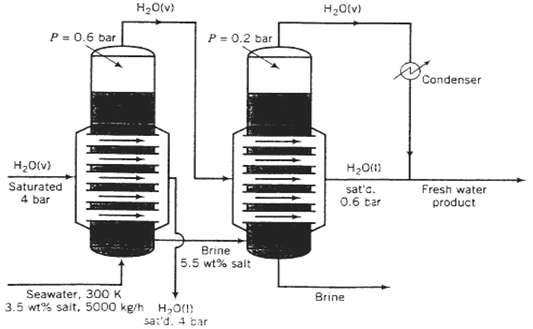
A double-effect evaporator (two evaporators in series) is used to produce fresh water from seawater containing 3.5 wt% dissolved salts. A flowchart for the process is shown here. Seawater enters the first effect at 300 K at a rate of 5000kg/h, and saturated steam at 4.00bar absolute is fed into a
A liquid is placed in a well-insulated container, which is then sealed. Initially, the container and its contents (the Liquid and pure nitrogen) are at 93?C and 1 atm: the liquid volume is 70cm3, and the gas volume is 3.00 L. The liquid partially evaporates, and the system cools down and eventually
A small pharmaceutical firm plans to manufacture a new drug and has hired you as a consultant to design a condenser to remove the drug from a gas—vapor mixture. The mixture, which contains 20 mole% of the drug and the balance nitrogen, will be fed to the condenser at 510 K and 1 atm at a rate of
Freeze drying is a technique for dehydrating substances at low temperatures, thereby avoiding the degradation that may accompany heating. The material to be dried is cooled to a temperature at which all of the water present turns to ice. The frozen substance is then placed in a vacuum chamber and
Freeze concentration is used to produce a fruit-juice concentrate. A stream of fresh juice containing 12 wt% soluble solids in water at 20°C is combined with a recycle stream to form a pre-concentrate, which is fed to a crystallizer. The mixture is cooled in the crystallizer to —7°C, thereby
A mixture containing 35.0 mole% n-butane and the balance isobutene at 10°C enters a he3t exchanger at a rate of 24.5k mol/h and a pressure high enough for the mixture to be a liquid. The exchanger has been designed to heat and vaporize the liquid and heat the vapor mixture to 180oC. The heating
A liquid mixture of benzene and toluene containing 50.0 wt% benzene at 90°C and pressure P0 is fed at a rate of 32.5 m3!h into a flash evaporator, a heated tank maintained at a pressure P 4 P0. When the feed is exposed to the reduced pressure in this unit, a portion of it evaporates. The liquid
A saturated vapor stream containing 10.9 mole% propane, 75.2% isobutene, and 13.9% n-butane passes from the top of a distillation column to a total condenser seventy-five percent of the condensate is returned to the column as reflux, and the remainder is removed as the overhead column product at a
Formaldehyde is produced from methanol in a catalytic oxidation reactor. The following reactions take place: CH3OH HCHO + H2 2H2 + O2 —2H2OA stream of methanol is joined by a recycle stream, also methanol, and the combined stream is fed to the conversion reactor. Also entering the reactor are air
The latest weather report states that the temperature is 24°C and the relative humidity is 50%.(a) Use the psychometric chart to estimate the absolute humidity, humid volume, specific enthalpy, wet-bulb temperature, and dew-point temperature of the air.(b) A thermometer is mounted on the back
An open vessel containing 0.205lbm of liquid water is placed in an empty room 5 ft wide. 4 ft deep and 7 ft high which initially contains dry air at 90°F all the water evaporates without changing the room temperature. Use the psychometric chart to estimate the final relative humidity, wet-bulb
A sling psychomotor is a device to measure the humidity of air. A porous cloth (the wick) is wrapped around the bulb of a mercury thermometer, which is then whirled around in the air. As the water in the wick evaporates, the temperature of the thermometer bulb drops, and finally stabilizes at the
Humid air is enclosed in a 2.00-liter flask at 40°C. The flask is slowly cooled. When the temperature reaches 20°C, drops of moisture become visible on the flask wall. Although the pressure in the flask changes when the temperature drops, it remains close enough to 1 atm for the psychometric
Wet solids pass through a continuous dryer. Hot dry air enters the dryer at a rate of 400 kg/min and picks up the water that evaporates from the solids. Humid air leaves the dryer at 50°C containing 2.44wt% water vapor and passes through a condenser in which it is cooled to 10°C. The pressure is
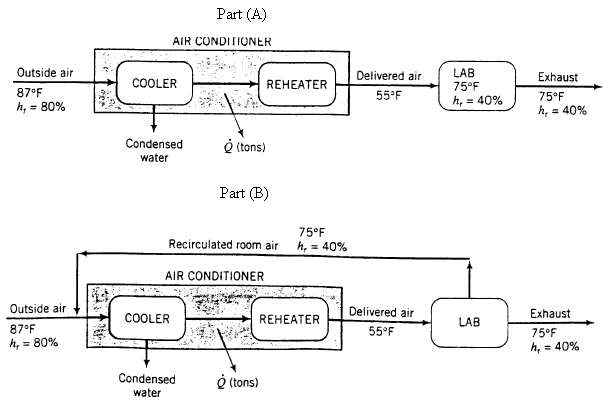
On an uncomfortable summer day, the air is at 87?F and 80% relative humidity. A laboratory air conditioner is to deliver 1.00 x 103 ft3/min of air at 55?F in order to maintain the interior air at an average temperature of 75?F and a relative humidity of 40%. (a) If the vent switch on the air
Wet wood chips are dried in a continues rotary dryer that operates at atmospheric pressure. The chips enter at 19°C with a water content of 40 wt% and must leave with a moisture content of less than 15%. Hot air is fed to the dryer at a rate of 11.6 m3 (STP)/kg wet chips. To monitor the
Air at 45°C (dry bulb) and 10% relative humidity is to be humidified adiabatically to 60% relative humidity.(a) Use the psychometric chart to estimate the adiabatic saturation temperature of the air.(b) Estimate the final temperature of the air and the rate at which water must be added to humidify
Air at 50°C with a dew point of 4°C enters a textile dryer at a rate of 11.3m3/min and leaves saturated. The dryer operates adiabatically. Use the psychometric chart to determine the absolute humidity and humid volume of the entering air, and then use the results to determine the flow rate of dry
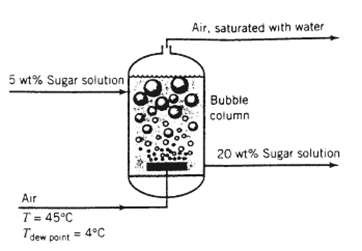
A solution of sugar in water is to be concentrated from 5 wt% sugar to 20% sugar. The solution is at about 45?C when it is fed continuously to a bubble column. Air at 45?C with a dew point of 4?C is bubbled through the column and emerges saturated. The humidification of the air may be considered
Cold air at 20°F, 760 mm Hg pressure and 70% relative humidity is conditioned by being passed through a bank of heatin2 coils, then through a water spray and finally through a second set of heating coils. In passing through the first coil bank, the air is heated to 75°F. The temperature of the
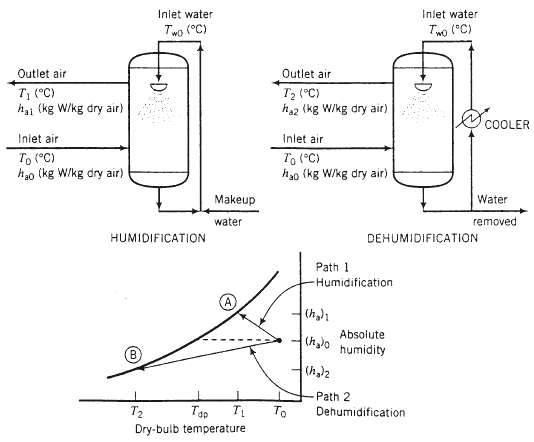
Spray cooling is a technique for cooling and either humidifying or dehumidifying air by contacting it with a liquid water spray. The liquid water leaving the tower is re-circulated and, in the case of dehumidification, cooled before reentering the tower. Two possible paths on the psychometric chart
The heat of solution of ammonia in water at 1 atm is ΔHs (25°C, r = 2 mol H2O/mol NH3) = —78.2 kJ/mol Calculate the enthalpy change that accompanies the dissolution of 400 mol of NH3 in 800 mol of water at 25°C and 1 atm.
Use Table B.11 to determine the specific enthalpy (kJ/mol HCI) of hydrochloric acid containing 1 mol HC1/5 mol H2O at 25°C relative to:(a). HCI (g) and H2O (l) at 25°C.(b). H2O (1) and an infinitely dilute HCI (Hydro chloric acid) solution at 25°C.
Sodium hydroxide is dissolved in enough water to make up a 20.0 mole% solution. If the NaOH and water are initially at 77°F (25°C), how much heat (Btu/lb product solution) must be removed for the solution also to be at 77°F. Assume the process is carried out at constant pressure, so that Q =
A sulfuric acid solution is labeled 8N (where IN = 1 g-equivalent /L, and I mol of H2SO4 contains two g-equivalents). The specific gravity of the solution is 1.230, and its heat capacity is 3.00 J/ (g∙°C). Calculate the specific enthalpy of this solution (in kJ/mol H2SO4) at 60°C relative to
Showing 800 - 900
of 6778
First
2
3
4
5
6
7
8
9
10
11
12
13
14
15
16
Last
Step by Step Answers

 Get 50% OFF
Claim Now
Get 50% OFF
Claim Now