New Semester
Started
Get
50% OFF
Study Help!
--h --m --s
Claim Now
Question Answers
Textbooks
Find textbooks, questions and answers
Oops, something went wrong!
Change your search query and then try again
S
Books
FREE
Study Help
Expert Questions
Accounting
General Management
Mathematics
Finance
Organizational Behaviour
Law
Physics
Operating System
Management Leadership
Sociology
Programming
Marketing
Database
Computer Network
Economics
Textbooks Solutions
Accounting
Managerial Accounting
Management Leadership
Cost Accounting
Statistics
Business Law
Corporate Finance
Finance
Economics
Auditing
Tutors
Online Tutors
Find a Tutor
Hire a Tutor
Become a Tutor
AI Tutor
AI Study Planner
NEW
Sell Books
Search
Search
Sign In
Register
study help
engineering
chemical engineering
Elementary Principles of Chemical Processes 3rd Edition Richard M. Felder, Ronald W. Rousseau - Solutions
Use Table B.11 to determine the specific enthalpy (kJ/mol HCI) of hydrochloric acid containing 1 mol HC1/5 mol H2O at 25°C relative to:(a) HCI (g) and H2O (l) at 25°C.(b) H2O (1) and an infinitely dilute HCI solution at 25°C. (Note Equation 8.5-2)
An 8-molar hydrochloric acid solution [SG = 1.12, Cp = 2.76 J/ (g∙°C)] is produced by absorbing hydrogen chloride [HC1 (g)] in water. Liquid water enters the absorber at 25°C and gaseous HCJ is fed at 20°C and 790torr (absolute). Essentially all of the HC1 fed to the column is absorbed. Take
A 0.1 mole% caustic soda (NaOH) solution is to be concentrated in a continuous evaporator. The solution enters the unit at 25°C at a rate of 150mol/min and is concentrated to 5 mole% at 50°C. Hot dry air at 200°C and 1.1 bar absolute is bubbled through the evaporator and leaves saturated with
Water is added to pure sulfuric acid in a well-insulated flask initially at 25°C and 1 atm to produce a 4.00-molar sulfuric acid solution (SG = 1.23 1). The final temperature of the product solution is to be 25°C, so that the water added must be chilled liquid (T < 25°C), or a mixture of
Ortho-phosphoric acid (H3PO4) is produced as a dilute aqueous solution that must be concentrated before further use. In one facility, 100 tons/day of a 28 wt% P2O5 solution [see part (a) of this problem] at 125°F is to be concentrated in a single evaporator to 42 wt% P2O5. Heat is supplied to the
Two hundred kilograms per hour of an aqueous solution containing 20.0mole% sodium acetate (NaC2H3O2) enters an evaporative crystallizer at 60°C. When the solution is exposed to the low pressure in the evaporator 16.9% of the water evaporates, concentrating the remaining solution and causing
Fifty milliliters of 100% H2SO4 at 25°C and 84.2 mL of liquid water at 15°C are mixed. The heat capacity of the product solution is 2.43 J/ (g∙°C). Estimate the maximum temperature attainable by the product solution and state the conditions under which this temperature would be attained. Using
Suppose mA (g) of species A {molecular weight MA, heat capacity CpA [J/ (g∙°C)]} at temperature TA0 (°C) and mB (g) of species B (MB, CpB) at temperature TB0 are mixed adiabatically. The heat of mixing of A and B at 25°C is ΔHm (r) (J/mol A in solution), where r = (mB/MB)/ (mA/MA). The heat
One g-mole of pure liquid sulfuric acid at temperature T0 (°C) is mixed with r g-moles of liquid water, also at temperature T0 (°C), in an adiabatic container. The final solution temperature is Ts (°C). The mass heat capacities of the pure acid, pure water, and the product solution [J/(g?°C)I
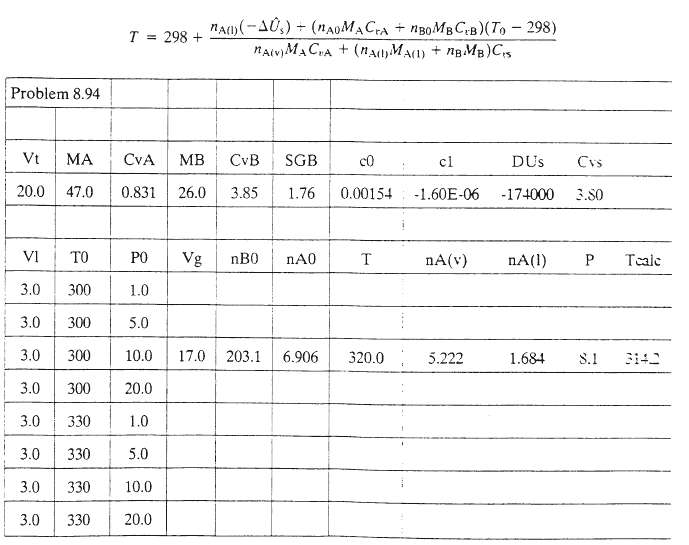
A stirred tank with volume Vt?(L) is charged with V1 (L) of a liquid. B. The space above the liquid (volume Vg = Vt ? V1) is filled with a pure gas, A, at an initial pressure P0 (atm). The initial system temperature is T0 (K). The stirrer in the tank is turned on, and A begins to dissolve in B. The
An aqueous solution containing 85.0 wt% H2SO4 at 60°F (specific gravity = 1.78) is diluted with pure liquid water at the same temperature. The feed solution volume is 350 mL. The mixing may be considered adiabatic, and the pressure is constant at 1 atm.(a) The product solution is to contain 30.0
Aqueous sulfuric acid solutions containing 15.0 wt% H2SO4 and 80.0 wt% H2SO4 are mixed to form 60.0 wt% product solutions the 15% solution was in a laboratory in which the temperature was 77°F. The 80% solution had just been taken from a storage cabinet in an air-conditioned stockroom and was at a
You have analyzed an aqueous ammonia solution and find that it contains 30 wt% NH3.(a) Use Figure 8.5-2 to determine the mass fraction of NH3 in the vapor that would be in equilibrium with this solution in a closed flask at 1 atm and the corresponding system temperature.(b) If the Liquid phase in
An NH3 – H2O mixture containing 60 wt% NH3 is brought to equilibrium in a closed container at 140°F. The total mass of the mixture is 250 g. Use Figure 8.5-2 to determine the masses of ammonia and of water in each phase of the system.
An ammonia solution at a high pressure is flash-vaporized at a rate of 200lbm/h. The solution contains 0.70lbm NH3/lbm, and its enthalpy relative to H2O (1, 32°F) and NH3 (1, —40°F) is —50 Btu/lbm. Liquid and gas streams emerge from the unit at 1 atm and 80°F. Use Figure 8.5-2 to determine
The standard heat of the reaction 4 NH3 (g) + 5O2 (g) → 4 NO (g) + 6 H2O (g) is ΔH˚t = – 904.7 kJ/mol(a) Briefly explain what that means. Your explanation may take the form “When ______ (specify quantities of reactant species and their physical states) react to form (quantities of
The standard heat of reaction for the combustion of liquid n-nonane to form CO2 and liquid water at 25°C and 1 atm is ΔH˚г = —6124 kJ/mol.(a) Briefly explain what that means. Your explanation may take the form “When ______ (specify quantities of reactant species and their physical states)
The standard heat of the combustion reaction of Liquid n-hexane to form CO2 (g) and H2O (l), with all reactants and products at 77°F and I atm, is ΔH˚г = —1.791 x 10⁶ Btu/lb-mole. The heat of vaporization of hexane at 77°F is 13,550 Btu/lb-mole and that of water is 18,934 Btu/lb-mole.(a) Is
The standard heat of the reaction CaC2 (s) + 5 H2O (l) → CaO (s) + 2 CO2 (g) + 5 H2 (g) is ΔH˚г = + 69.36 kJ/mol.(a) Is the reaction exothermic or endothermic at 25°C? Would you have to heat or cool the reactor to keep the temperature constant? What would the temperature do if the reactor ran
Use Hess’s law to calculate the standard heat of the water-gas shift reaction CO (g) + H2O (v) → CO2 (g) + H2 (g) from each of the two sets of data given here.(a) CO (g) + H2O (l) → CO2 (g) + H2 (g): ΔH˚г = + 1226 Btu/lb-mole H2O (l) → H2O (v): ΔHv =
Formaldehyde may be produced in the reaction between methanol and oxygen: 2 CH3OH (l) + O2 (g) → 2 HCHO (g) + 2 H2O (l): ΔH˚г = —326.2 kJ/mol. The standard heat of combustion of hydrogen isH2 (g) + ½ o2 (g) → H2O (l): ΔH˚г = —285.8 kJ/mol(a) Use these heats of reaction and
Use tabulated heats of formation (Table B.1) to determine the standard heats of the following reactions in kJ/mol, letting the stoichiometric coefficient of the first reactant in each reaction equal one.(a) Nitrogen + oxygen react to form nitric oxide (NO).(b) Gaseous n-pentane + oxygen react to
Trichloroethylene, a widely used degreasing solvent for machine parts is produced in a two-step reaction sequence. Ethylene is first chlorinated to yield tetrachloroethane, which is dehydrochlorinated to form trichloroethylene. C2H4 (g) + Cl2 (g) → C2H2C14 (1) + H2 (g): ΔH˚г = —385.76 kJ/mol
The standard heat of combustion of gaseous acetylene is listed in Table B.I as —1299.6kJ/mol.(a) In your own words, briefly explain what that means. (Your explanation should mention the reference states used to define the tabulated heats of combustion.)(b) Use tabulated heats of formation to
The standard heat of combustion (ΔH˚c) of liquid 2.3,3-trimethylpentane [C8H18] is reported in a table of physical properties to be —4850 kJ/mol. A footnote indicates that the reference temperature for the reported value is 25°C and the presumed combustion products are CO2 (g) and H2O (g).(a)
N-Butane is converted to isobutene in a continuous isomerization reactor that operates isothermally at 149°C. The feed to the reactor contains 93 mole% n-butane, 5% isobutene, and 2% HC1 at 149°C, and a 40% conversion of n-butane is achieved.(a) Taking a basis of 1 mol of feed gas calculate the
In the production of many microelectronic devices, continuous chemical vapor deposition (CVD) processes are used to deposit thin and exceptionally uniform silicon dioxide films on silicon wafers. One CVD process involves the reaction between saline and oxygen at a very low pressure SiH4 (g) + O2
The production of most of the steel manufactured in the United States begins with the reduction of hematite ore (mostly ferric oxide) with coke (carbon) in a blast furnace to obtain pig iron. The basic reaction is Fe2O3 (s) + 3 C (s) →2 Fe (s) + 3 CO (g): ΔHг (77°F) = 2.111 x 10⁵ Btu/lb-mole
Normal heptane is dehydrocyclicized to toluene and hydrogen in a continuous vapor-phase reaction: C7H16 → C6H5CH3 +4 H2 Pure heptanes at 400°C is fed to the reactor. The reactor operates isothermally at 400°C and the reaction goes to completion. Data: The average heat capacity of n-heptanes
The thermal decomposition of dimethyl ether (CH3) 2O (g) → CH4 (g) + H2 (g) + CO (g) is to be carried out in an isothermal 2.00-liter laboratory reactor at 600°C. The reactor is charged with pure dimethyl ether at a pressure of 350 torr. After about two hours, the reactor pressure is 875
Sulfur dioxide is oxidized to sulfur trioxide in a small pilot-plant reactor. SO2 and 100% excess air are fed to the reactor at 450°C. The reaction proceeds to a 65% SO2 conversion, and the products emerge from the reactor at 550°C. The production rate of SO3 is 1.00 x 10² kg/min. The reactor is
Carbon monoxide at 25°C and steam at 150°C are fed to a continuous water-gas shift reactor. The product gas, which contains 40.0 mole% H2, 40.0% CO2, and the balance H2O (v), emerges at 500°C at a rate of 2.50 SCMH (standard cubic meters per hour) and goes to a condenser. The gas and liquid
Metallic iron is produced in the reaction between ferrous oxide and carbon monoxide: FeO (s) + CO (g) → Fe (s) + CO2 (g), ΔH˚г = —16.480 kJ/mol the flowchart shown below depicts this process for a basis of 1 mol FeO fed at 298 K.(a) Following is an inlet-outlet enthalpy table for the
Ethyl alcohol (ethanol) can be produced by the fermentation of sugars derived from trains and other agricultural products. Some countries without large petroleum and natural as reserves—such as Brazil—have found it profitable to convert a portion of their abundant grains to ethanol for
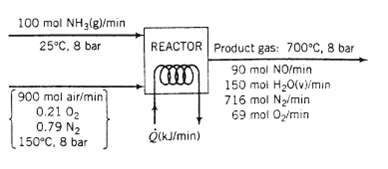
Ammonia is oxidized with air to form nitric oxide in the first step of the production of nitric acid. Two principal reactions occur: 4 NH3 + 5O2 ? 4NO + 6H2O 2 NH3?+ 3/2 O2?? N2?+ 3H2O A flowchart of the reactor follows. (a) Taking elemental species [N2 (g), H2?(g), O2?(g)] at 25?C as references,
Ethanol is produced commercially by the hydration of ethylene: C2H4 (g) + H2O (v) C2H5OH (V) some of the product is converted to diethyl ether in the undesired side reaction 2 C2H5OH (v) = (C2H5)2O (v) + H2O (v) the combined feed to the reactor contains 53.7 mole% C2H4, 36.7% H2O and the balance
Benzaldehyde is produced from toluene in the catalytic reaction C6H5CH3 + O2 → C6HCH0 + H2O Dry air and toluene vapor are mixed and fed to the reactor at 350°F and I atm. Air is supplied in 100% excess. Of the toluene fed to the reactor. 13% reacts to form Benzaldehyde and 0.5% reacts with
Lime (calcium oxide) is widely used in the production of cement, steel, medicines, insecticides, plant and animal food, soap, rubber, and many other familiar materials. It is usually produced by heating and decomposing limestone (CaCO3), a cheap and abundant mineral, in a calcinations process:
A gas mixture containing 85mole% methane and the balance oxygen is to be charged into an evacuated well-insulated 10-liter reaction vessel at 25°C and 200 kPa. An electrical coil in the reactor which delivers heat at a rate of 100 watts, will be turned on for 85 seconds and then turned oft
Ethylene oxide is produced by the catalytic oxidation of ethylene: C2H4 (g) + ½ O2 (g) C2H4O (g) an undesired competing reaction is the combustion of ethylene to CO2. The feed to a reactor contains 2 mol C2H4/mol 02 the conversion and yield in the reactor are respectively 25% and 0.70 mol C2H4O
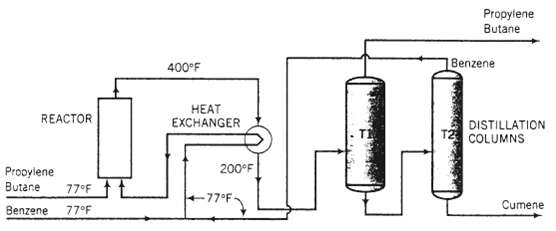
Cumene (C6H5C3H7) is produced by reacting benzene with propylene [?H?r (77?F) = ? 39.520 Btu/lb-mole]. A liquid feed containing 75 mole% propylene and 25% n-butane and a second liquid stream containing essentially pure benzene are fed to the reactor. Fresh benzene and recycled benzene, both at
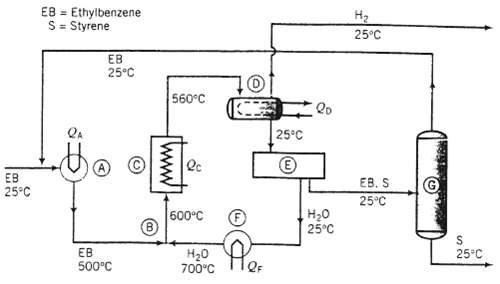
Ethylbenzene is converted to styrene in the catalytic dehydrogenation reaction C8H10 (g) ? C8H8 (g) + H2: ?H?r (600?C) = +124.5 kJ/mol A flowchart of a simplified version of the commercial process is shown here. Fresh and recycled liquid ethylbenzene combine and are heated from 25?C to 500?C (A),
Formaldehyde is produced by decomposing methanol over a silver catalyst: CH3OH → HCHO + H2 To provide heat for this endothermic reaction, some oxygen is included in the feed to the reactor leading to the partial combustion of the hydrogen produced in the methanol decomposition. The feed to an
The synthesis of ethyl chloride is accomplished by reacting ethylene with hydrogen chloride in the presence of an aluminum chloride catalyst: C2H4 (g) + HC1 (g) catalyst ? C2H5C1 (g): ?H? (0?C) = 1 ? 64.5 kJ/mol Process data and a simplified schematic flowchart are given here. The reaction is
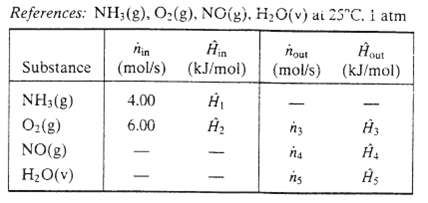
Ammonia is oxidized in a well-insulated continuous reactor: 4 NH3 (g) + 5 O2 (g) ? 4 NO (g) + 6 H2O (v): ?H?? = ? 904.7 kJ/mol The feed stream enters at 200?C and the products leave at temperature T out?(?C). The inlet?outlet enthalpy table for the reactor appears as follows: (a) Draw and label a
The synthesis of methanol from carbon monoxide and hydrogen is carried out in a continuous vapor-phase reactor at 5.00 atm absolute. The feed contains CO and H2 in stoichiometric proportion and enters the reactor at 25°C and 5.00 atm at a rate of 17.1m3/h. The product stream emerges from the
Coke can be converted into CO—a fuel gas—in the reaction CO2 (g) + C (s) → 2 CO (g)A coke that contains 84% carbon by mass and the balance noncombustible ash is fed to a reactor with a stoichiometric amount of CO2. The coke is fed at 77°F, and the CO2 enters at 400°F. Heat is
Carbon disulfide, a key component in the manufacture of rayon fibers, is produced in the reaction between methane and sulfur vapor over a metal oxide catalyst: CH4 (g) + 4 S (v) → CS2 (g) + 2 H2S (g) ΔHг (700°C) = – 274 kJ/mol Methane and molten sulfur, each at 150°C, are fed to a heat
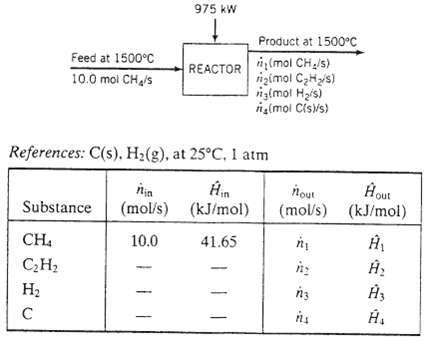
You are checking the performance of a reactor in which acetylene is produced from methane in the reaction 2 CH4 (g) ? C2H2 (g) + 3 H2 (g) an undesired side reaction is the decomposition of acetylene: C2H2 (g) ? 2 C (s) + H2 (g) methane is fed to the reactor at 1500CC at a rate of 10.0 mol CH4/s.
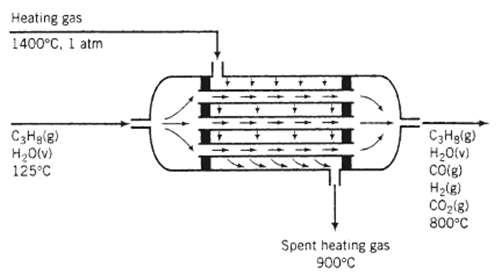
Hydrogen is produced in the steam reforming of propane: C3H8 (g) + 3 H2O (v) ? 3 CO2 (g) + 7 H2 (g) the water?gas shift reaction also takes place in the reactor, leading to the formation of additional hydrogen: CO (g) + H2O (v) ? CO2 (g) + H2 (g) the reaction is carried out over a nickel catalyst
In a coal gasification process, carbon (the primary constituent of coal) reacts with steam to produce carbon monoxide and hydrogen (synthesis gas). The gas may either be burned or subjected to further processing to produce any of a variety of chemicals. A coal contains 10.5 wt% moisture (water) and
Three cubic meters of a 1.00-molar aqueous sulfuric acid solution (SG = 1.064) is stored at 25C. Use data in Tables B.1 and B.11 to calculate the standard heat of formation of the solution in kJ/mol H2SO4 relative to the solute elements and water, and the total enthalpy of the solution relative to
Calculate the standard heat (kJ/mol) of the neutralization reaction between dilute hydrochloric acid and dilute sodium hydroxide solutions, taking the heat of solution of NaC1 to be + 4.87kJ/mol.Then calculate the standard heat of the reaction between hydrogen chloride gas and solid sodium
A 10.0 mole% aqueous sulfuric acid solution (SG = 1.27) is to be titrated to neutrality at 25°C with a 3.00-molar caustic soda (sodium hydroxide) solution (SG = 1.13): H2SO4 (aq) + 2 NaOH (aq) Na2SO4 (aq) + 2 H2O (l)(a) Calculate the required volume ratio (cm3 caustic solution lcm3 acid
Most of the world’s chlorine and sodium hydroxide are obtained through the electrolysis of brine: NaC1 (aq) + H2O (1) → ½ H2 (g) + ½ C12 (g) + NaOH (aq)(a) Determine the standard heats of formation of NaC1 (aq) and NaOH (aq) and then the standard heat of the brine electrolysis reaction. The
You have been given the task of determining the standard heat of the reaction in which calcium chloride hexahydrate is formed from anhydrous calcium chloride: CaCl2 (s) + 6 H2O (l) → CaCl2 ∙ 6H2O(s): ΔH˚г (kJ/mol) = ? By definition, the desired quantity is the heat of hydration of calcium
A dilute aqueous solution of sulfuric acid at 25°C is used to absorb ammonia in a Continuous reactor, thereby producing ammonium sulfate, a fertilizer: 2 NH3 (g) + H2SO4 (aq) → (NH4) 2SO4 (aq)(a) If the ammonia enters the absorber at 75°C, the sulfuric acid enters at 25°C, and the product
A 2.00 mole% sulfuric acid solution is neutralized with a 5.00 mole% sodium hydroxide solution in a continuous reactor. All reactants enter at 25°C. The standard heat of solution of sodium sulfate is – 1.17 kJ/mol Na2SO4, and the heat capacities of all solutions may be taken to be that of pure
A 12.0-molar solution of sodium hydroxide (SG = 1.37) is neutralized with 75.0mL of a 4.0 molar solution of sulfuric acid (SG = 1.23) in a well-insulated container.(a) Estimate the volume of the sodium hydroxide solution and the final solution temperature if both feed solutions are at 25°C. The
Ammonia scrubbing is one of many processes for removing sulfur dioxide from flue gases. The gases are bubbled through an aqueous solution of ammonium sulfite, and the SO2 reacts to form ammonium bisulfate: (NH4)2SO3 (aq) + SO2 (g) + H2O (l) → 2NH4HSO3 (aq) Subsequent process steps yield
A natural gas is analyzed and found to consist of 87.5% v/v (volume percent) methane, 7.0% ethane, 2.0% propane, and 3.5% N2 (noncombustible).(a) Calculate the higher heating value and the lower heating value of this fuel in kJ/mol, using the heats of combustion in Table B.1.(b) Calculate the lower
An ultimate analysis of a coal is a series of operations that yields the percentages by mass of carbon, hydrogen nitrogen, oxygen and sulfur in the coal. The heating value of a coal is best determined in a calorimeter, but it may be estimated with reasonable accuracy from the ultimate analysis
A fuel gas is known to contain methane ethane, and carbon monoxide. A sample of the gas is charged into an initially evacuated 2.000-liter vessel at 25°C and 2323 mm Hg absolute. The vessel is weighed before and after being charged and the mass difference is found to be 4.929 g. Next, the higher
A fuel gas containing 85.0 mole% methane and the balance ethane is burned completely with pure oxygen at 25°C and the products are brought back down to 25°C.(a) Suppose the reactor is continuous. Take a basis of calculation of 1 molls of the fuel gas assume some value for the percent excess
A mixture of air and a fine spray of gasoline at ambient (outside air) temperature are fed to a set of piston-fitted cylinders in an automobile engine. Sparks ignite the combustible mixtures in one cylinder after another, and the consequent rapid increase in temperature in the cylinders causes the
The heating value of a fuel oil is to he measured in a constant-volume bomb calorimeter. The bomb is charged with oxygen and 0.00215lbm of the fuel and is then sealed and immersed in an insulated container of water. The initial temperature of the system is 77.00°F. The fuel–oxygen mixture is
Methanol vapor is burned with excess air in a catalytic combustion chamber. Liquid methanol initially at 25°C is vaporized at 1.1 atm and heated to 100°C; the vapor is mixed with air that has been preheated to 100°C, and the combined stream is fed to the reactor at 100°C and 1 atm. The reactor
Methane at 25°C is burned in a boiler furnace with 10.0% excess air preheated to 100°C, Ninety percent of the methane led is consumed, the product gas contains 10.0mol CO2/mol CO and the combustion products leave the furnace at 400°C.(a) Calculate the heat transferred from the furnace – Q
A gaseous fuel containing methane and ethane is burned with excess air. The fuel enters the furnace at 25°C and 1 atm, and the air enters at 200°C and 1 atm. The stack gas leaves the furnace at 800°C and 1 atm and contains 5.32 mole% CO2, 1.60% CO. 7.32% O2, 12.24% H2O, and the balance N2.(a)
A coal contains 73.0 wt% C, 4.7% H (not including the hydrogen in the coal moisture) 3.7% S 6.8% H2O, and 11.8% ash. The coal is burned at a rate of 50,000lbm/h in a power plant boiler with air 50% in excess of that needed to oxidize all the carbon in the coal to CO2. The air and coal are both fed
A mixture of methane, ethane, and argon at 25°C is burned with excess air in a power plant boiler. The hydrocarbons in the fuel are completely consumed. The following variable definitions will be used throughout this problem:xm mole fraction of methane in the fuelxa mole fraction of argon in the
A gas stream consisting of n-hexane in methane is fed to a condenser at 60°C and 1.2 atm. The dew point of the gas (considering hexane as the only condensable component) is 55°C. The gas is cooled to 5°C in the condenser recovering pure hexane as a liquid. The effluent gas leaves the condenser
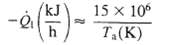
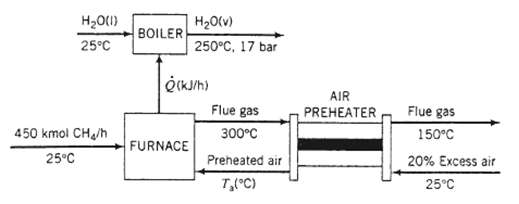
In the preliminary design of a furnace for industrial boiler, methane at 25?C is burned completely with 20% excess air, also at 25?C. The feed rate of methane is 450k mol/h. The hot combustion gases leave the furnace at 300?C and are discharged to the atmosphere. The heat transferred from the
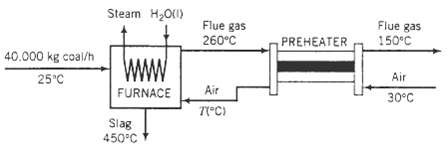
A bituminous coal is burned with air in a boiler furnace, The coal is fed at a rate of 40,000 kg/h and has an ultimate analysis of 76 wt% C, 5% H, 8% 0, negligible amounts of N and S. and 11% noncombustible ash (see Problem 9.49), and a higher heating value of 25,700 kJ/kg. Air enters a pre-heater
Carbon monoxide is burned with excess air at 1 atm in an adiabatic reactor. The reactants are fed at 25°C and the final temperature (i.e., the adiabatic flame temperature) is 1400°C.(a) Calculate the percentage excess air fed to the reactor,(b) If the percentage excess air were increased, how
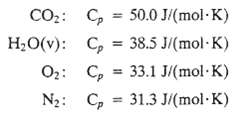
A natural gas containing 82.0 mole% CH4 and the balance C2H6 is burned with 20% excess air in a boiler furnace. The fuel gas enters the furnace at 298 K, and the air is preheated to 423 K. The heat capacities of the stack gas components may be assumed to have the following constant values: (a)
In a surface coating operation, a polymer (plastic) dissolved in liquid acetone is sprayed on a solid surface and a stream of hot air is then blown over the surface, vaporizing the acetone and leaving a residual polymer film of uniform thickness. Because environmental standards do not allow
Liquid n-pentane at 25°C is burned with 30% excess oxygen (not air) fed at 75°C. The adiabatic flame temperature is Tad (°C).(a) Take as a basis of calculation 1.00 mol C5H12 (l) burned and use an energy balance on the adiabatic reactor to derive an equation of the form f(Tad) = 0 where f(Tad)
Methane is burned with 25% excess air in a continuous adiabatic reactor. The methane enters the reactor at 25°C and 1.10 atm at a rate of 5.50 Us and the entering air is at 150°C and 1.1 atm. Combustion in the reactor is complete, and the reactor effluent gas emerges at 1.05 atm. Calculate (a)
Methane and 30% excess air are to be fed to a combustion reactor. An inexperienced technician mistakes his instructions and charges the gases together in the required proportion into an evacuated closed tank. (The gases were supposed to be fed directly into the reactor.) The contents of the charged
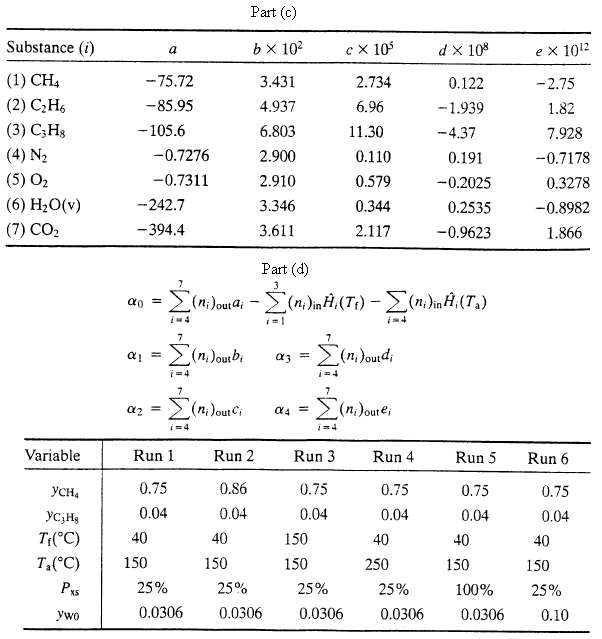
Natural gas that contains methane, ethane, and propane is to be burned with humid air. The adiabatic flame temperature is to be calculated from specified values of the following quantities: ycH4, yc2H6, yc3Hg = mole fractions of fuel components Tf, Ta = inlet temperatures of fuel and air, ?C Pxs =
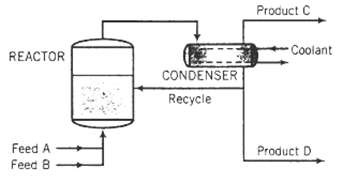
The cooled effluent passes through a carbon filter in which the soot is removed. The clean gas is then compressed and fed to an absorption column, where it is contacted with a recycled liquid solvent dimethyl form amide or DMF (MW = 73, 09). The off-gas leaving the absorber contains all of the
Draw and label a flowchart arid determine the number of degrees of freedom for each of the given systems. Give a feasible set of design variables and, if possible, an infeasible set. The solution to part (a) is given as an example. (b) A natural gas containing methane, ethane, and propane at
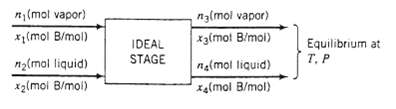
Benzene (B) and chlorobenzene (C) are being separated in a distillation column. Vapor and liquid streams, each containing both species, are fed to one of the trays of the column, and liquid and vapor streams are taken off the tray. The tray functions as an ideal stage (see Problem 6.63): the
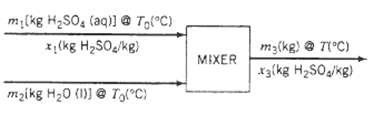
Barium sulfate is reduced with carbon as part of the manufacture of lithopone, a white pigment: 2 BaSO4 (s) + 4 C (s) — 2BaS (s) + 4 CO2 (g) A mixture of crushed barite (an ore containing xB kg BaSO4/kg barite) and coal (containing xC kg C/kg coal) at temperature T0 (K) is fed to a furnace.
Ethyl alcohol can be bacterially oxidized to acetic acid in the following two-step fermentation sequence:2 C2H5OH + O2 → 2 CH3CHO + 2 H2O2 CH3CHO + O2 → 2 CH3COOHIf the alcohol-containing feedstock is wine, cider, or a malt solution, the resulting solution is vinegar. An aqueous solution
Propylene is converted to butyraldehyde and n-butanol in the following reaction sequence:C3H6 + CO + H2 → C3H7CHO (butyraldehyde)C3H7CHO + H2 → C4H9OH (n-butanol)Liquid propylene, gaseous carbon monoxide and hydrogen, and a soluble cobalt catalyst are fed to a high-pressure catalytic reactor.
Normal butane is catalytically isomerized to isobutene. A fresh feed stream containing pure n-butane at temperature T1 [(°C) is mixed adiabatically with a recycle stream containing n-butane and isobutene, and the combined stream is fed to the reactor, where some but not all of the n-butane in the
Simulate a module called SPLIT, which takes a feed stream (SF) and splits it into two streams (S1 and S2), each having the composition and temperature of the feed stream. A fraction Xi of the feed stream becomes stream S1 and a fraction (1 – X1) becomes S2. Up to four components may be present in
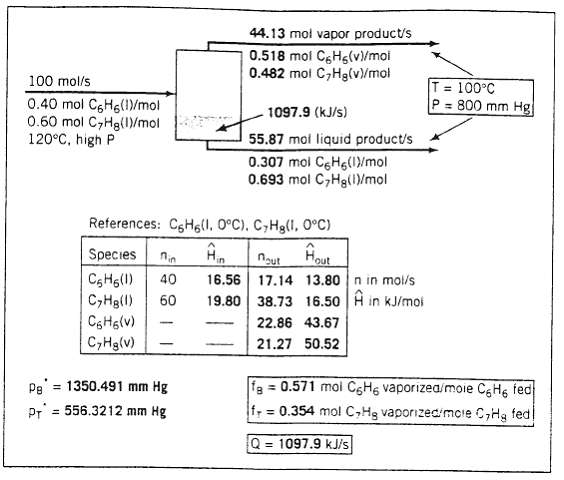
You have been assigned to simulate a flash evaporator that separates a Liquid feed stream containing benzene and toluene at temperature TF (?C) into liquid and vapor product streams in equilibrium at temperature T(?C) and pressure P(mm Hg). The compositions of the product streams are related by
You are to simulate a flash evaporator that converts a liquid feed stream (SF) containing V species at a high pressure to liquid and vapor product streams (SL. SV) in equilibrium at temperature T(˚C) and pressure P(mm Hg). The Compositions of the liquid and vapor product streams are related by
You are to simulate a partial condenser module that converts a vapor feed stream (SF) containing a single condensable species at temperature TF(K) to liquid and vapor product streams (SL, SV) in equilibrium at a temperature T(K). The process takes place at a constant pressure P(atm). The
The following two reactions occur in an ethylene oxide production process: 2C2H4 + O2 ? 2C2H4O C2H4 + 3O2 ? 2C02 + 2H2O A stream containing Equimolar amounts of ethylene and oxygen is joined by a recycle stream containing pure ethylene, and the combined stream is fed to the reactor. The single-pass
A solution containing hydrogen peroxide with a mass fraction xp0 (kg H2 O2/kg solution) is added to a storage tank at a steady rate m0 (kg/h). During this process the liquid level reaches a corroded spot in the tank wall and a leak develops. As the filling continues, the leak rate m1 (kg/h) becomes
One hundred fifty k mol of an aqueous phosphoric acid solution contains 5.00 mole% H3PO4. The solution is concentrated by adding pure phosphoric acid at a rate of 20.0 L/min.(a) Write a differential mole balance on phosphoric acid and provide an initial condition. [Start by defining np (k mol) to
Methanol is added to a storage tank at a rate of 1200 kg/h and is simultaneously withdrawn at a rate mw (t) (kg/h) that increases linearly with time. At t = 0 the tank contains 750 kg of the liquid and mw = 750 kg/h. Five hours later m equals mw 1000 kg/h.(a) Calculate an expression for mw (t),
A 10.0-ft3 compressed-air tank is being filled. Before the filling begins, the tank is open to the atmosphere. The reading on a Bourdon gauge mounted on the tank increases linearly from an initial value of 0.0 to 100 psi after 15 seconds. The temperature is constant at 72°F, and atmospheric
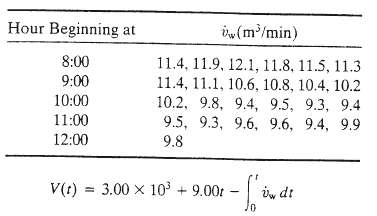
A gas storage tank with a floating roof receives a steady input of 540 m3/h of a natural gas. The rate of withdrawal of gas from the tank, vw, varies more or less randomly during the day and is recorded at 10-mm intervals. At 8:00 a.m. one morning the volume of stored gas is 3.00 x 10³ m3. The
Water is added at varying rates to a 300-liter holding tank. When a valve in a discharge line is opened, water flows out at a rate proportional to the height and hence to the volume V of water in the tank. The flow of water into the tank is slowly increased and the level rises in consequence, until
The production supervisor of a small pharmaceutical firm has observed a decreasing demand for potassium regurgitol (PRG) over a two-month period, and since the plant manager has been throwing up the low sales of this product at the weekly staff meetings, the supervisor decides to discontinue its
Showing 900 - 1000
of 6778
First
3
4
5
6
7
8
9
10
11
12
13
14
15
16
17
Last
Step by Step Answers

 Get 50% OFF
Claim Now
Get 50% OFF
Claim Now