New Semester
Started
Get
50% OFF
Study Help!
--h --m --s
Claim Now
Question Answers
Textbooks
Find textbooks, questions and answers
Oops, something went wrong!
Change your search query and then try again
S
Books
FREE
Study Help
Expert Questions
Accounting
General Management
Mathematics
Finance
Organizational Behaviour
Law
Physics
Operating System
Management Leadership
Sociology
Programming
Marketing
Database
Computer Network
Economics
Textbooks Solutions
Accounting
Managerial Accounting
Management Leadership
Cost Accounting
Statistics
Business Law
Corporate Finance
Finance
Economics
Auditing
Tutors
Online Tutors
Find a Tutor
Hire a Tutor
Become a Tutor
AI Tutor
AI Study Planner
NEW
Sell Books
Search
Search
Sign In
Register
study help
engineering
chemical engineering
Elementary Principles of Chemical Processes 3rd Edition Richard M. Felder, Ronald W. Rousseau - Solutions
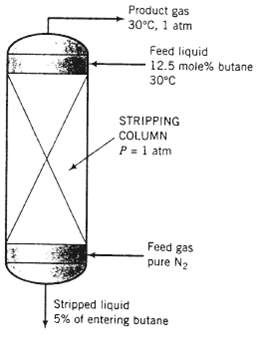
A liquid stream consisting of 12.5 mole% n-butane and the balance a heavy nonvolatile hydrocarbon is fed to the top of a stripping column, where it is contacted with an upward-flowing stream of nitrogen. The residual liquid leaves the bottom of the column containing all of the heavy hydrocarbon. 5%
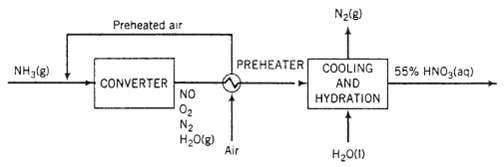
Nitric acid is used extensively for the production of inorganic and organic nitrates, for metal treatments of various kinds, and for photoengraving. It is produced by oxidizing ammonia to nitric oxide over a platinum?rhodium catalyst, oxidizing the nitric oxide to nitrogen dioxide, and dissolving
A dry gas containing 10.0% NH3 by volume is contacted with water at 10°C and 1 atm in a single-stage bubble contactor. The effluent liquid and gas streams may be considered to be in equilibrium with each other. A small slip stream taken from the effluent liquid is fed to a continuous densitometer,
Sulfur trioxide (SO3) dissolves in and reacts with water to form an aqueous solution of sulfuric acid (H2SO4). The vapor in equilibrium with the solution contains both SO and H2O. If enough SO3 is added, all of the water reacts and the solution becomes pure H2S04. If still more SO3 is added, it
State whether you would use Raoult’s law or Henry’s law to perform vapor—liquid equilibrium calculations for each component in the following liquid mixtures: (a) Water and dissolved nitrogen; (b) Hexane, octane, and decane: and (c) Club soda or any other carbonated beverage.
A gas containing nitrogen, benzene, and toluene is in equilibrium with a 40 mole% benzene— 60 mole% toluene liquid mixture at 100°C and 10 atm. Estimate the gas-phase composition (mole fractions) using Raoutt’s law.
Using Raoult’s law or Henry’s law for each substance (whichever one you think appropriate), calculate the pressure and gas-phase composition (mole fractions) in a system containing a liquid that is 0.3 mole% N2 and 99.7 mole% water in equilibrium with nitrogen gas and water vapor at 80°C.
The pressure in a vessel containing methane and water at 70°C is 10 atm. At the given temperature the Henry’s law constant for methane is 6.66 x 10⁴ atm/mole fraction. Estimate the mole fraction of methane in the liquid.
When air (≈ 21 mole% O2, 79 mole% N2) is placed in contact with 1000 cm3 of liquid water at body temperature, 36.9°C, and 1 atm absolute, approximately 14.1 standard cubic centimeters [cm3(STP)j of gas are absorbed in the water at equilibrium. Subsequent analysis of the liquid reveals that 33.4
The solubility coefficient of a gas may be defined as the number of cubic centimeters (STP) of the gas that dissolves in 1 cm3 of a solvent under a partial pressure of 1 atm. The solubility coefficient of CO2 in water at 20°C is 0.0901 cm3 CO2 (STP)/cm’ H2O (l).(a). Calculate the Henry’s law
The sulfur dioxide content of a stack gas is monitored by passing a sample stream of the gas through an SO2 analyzer. The analyzer reading is 1000 ppm 5O2 (parts per million on a molar basis). The sample gas leaves the analyzer at a rate of 1.50L/min at 30°C and 10.0 mm Hg gauge and is bubbled
A vapor stream that is 65 mole% styrene and 35 mole% toluene is in equilibrium with a Liquid mixture of the same two species. The pressure in the system is 150 mm Hg absolute. Use Raoult’s law to estimate the composition of the liquid and the system temperature.
A gas containing nitrogen, benzene, and toluene is in equilibrium with a liquid consisting of 35 mole% benzene and 65 mole% toluene at 85°C and 10 atm. Estimate the gas composition (mole fractions) using Raoult’s law and assuming ideal gas behavior.
A liquid mixture containing 50 mole% propane, 30% n-butane, and 20% isobutene is stored in a rigid container at 77°F. The container has a maximum allowable working pressure of 200 psig. The head space above the liquid contains only vapors of the three hydrocarbons.(a) Show that the container is
A closed system contains an equimolar mixture of n-pentane and isopentane.(a) Suppose the system is initially all liquid at 120°C and a high pressure, and the pressure is gradually reduced at a constant temperature. Estimate the pressures at which the first bubble of vapor forms and at which the
Nitrogen is bubbled through a liquid mixture that initially contains Equimolar amounts of benzene and toluene. The system pressure is 3 atm and the temperature is 80°C. The nitrogen flow rate is 10.0 standard liters per minute. The gas leaving the bubbler is saturated with benzene and toluene
Calculate the following:(a) The bubble-point temperature of an Equimolar mixture of liquid n-hexane and n-heptanes at 1.0 atm and the composition (mole fractions) of the vapor in equilibrium with this mixture.(b) The dew-point temperature of a gas mixture with a molar composition of 30% n-hexane.
A liquid mixture contains N components (N may be any number from 2 to 10) at pressure P(mm Hg). The mole fraction of the ith component is xi (i = 1. 2...., N), and the vapor pressure of that component is given by the Antoine equation (see Table B.4) with constants A,, B,, and Ci. Raoults law may be
A vapor mixture of n-butane (B) and n-hexane (H) contains 50.0 mole% butane at 120°C and 1.0 atm, A stream of this mixture flowing at a rate of 150.0 L/s is cooled and compressed, causing some but not all of the vapor to condense. (Treat this process as a single-unit operation.) Liquid and vapor
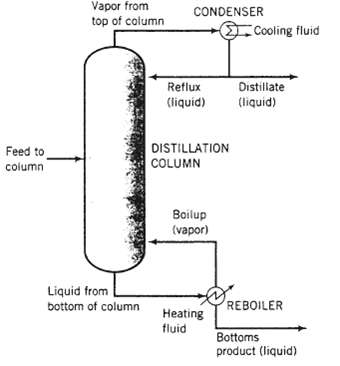
The feed to a distillation column is a 45.0 mole% n-pentane.-55.0 mole% n-hexane liquid mixture. The vapor stream leaving the top of the column, which contains 98.0 mole% pentane and the balance hexane, goes to a total condenser (in which all the vapor is condensed). Half of the liquid condensate
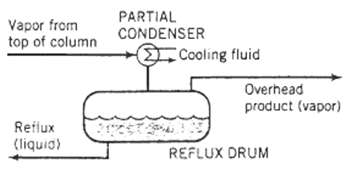
The vapor leaving the top of a distillation column goes to a condenser in which either total or partial condensation takes place. If a total condenser is used, a portion of the condensate is returned to the top of the column as reflux and the remaining liquid is taken off as the overhead product
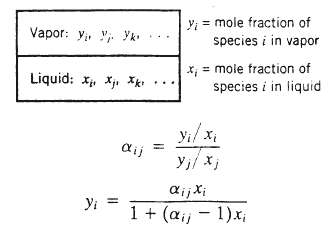
Vapor?liquid equilibrium calculations can sometimes be simplified through the use of a quantity called the relative volatility, which may be defined to terms of the following depiction of vapor and liquid phases in equilibrium: The relative volatility of species i to species j is. If aij is much
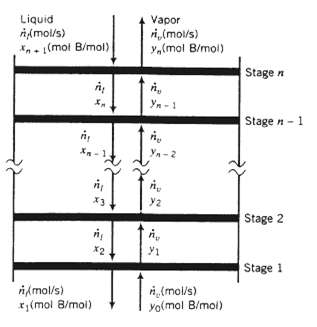
A stage of a separation process is defined as an operation in which components of one or more feed streams divide themselves between two phases, and the phases are taken off separately. In an ideal stage or equilibrium stage, the effluent (exiting) streams are in equilibrium with each other.
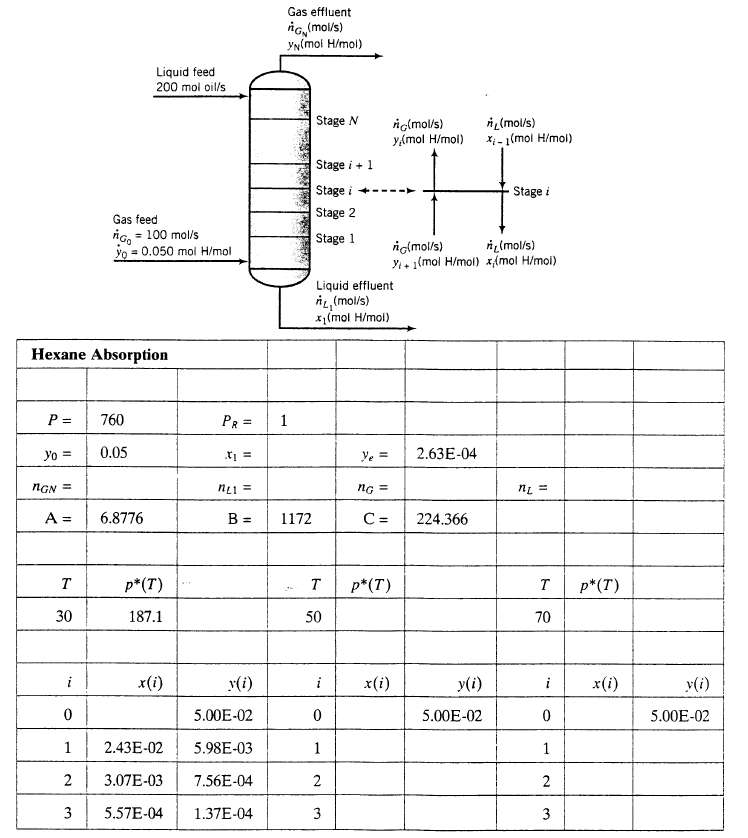
The following diagram shows a staged absorption column in which n-hexane (H) is absorbed from a gas into a heavy oil. A gas feed stream containing 5.0 mole% hexane vapor and the balance nitrogen enters at the bottom of an absorption column at a basis rate of 100 mol/s. and a nonvolatile oil enters
A vapor mixture containing 30 mole% benzene and 70% toluene at 1 atm is cooled isobarically j, a closed container from an initial temperature of 115°C. Use the Txy diagram of Figure 6.4-1 to answer the following questions.(a) At what temperature does the first drop of condensate form? What is its
Three gram-moles of benzene and 7 gram-moles of toluene are placed in a closed cylinder equipped with a piston. The cylinder is immersed in a boiling-water bath that maintains the temperature at 100°C. The force exerted on the piston can be varied to adjust the cylinder pressure to any desired
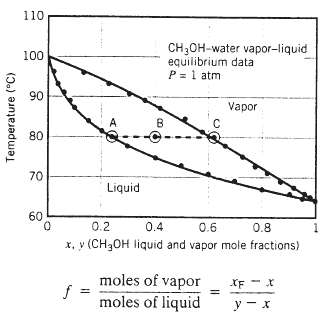
A methanol?water feed stream is introduced to a vaporizer in which a molar fraction f of the feed is vaporized. The feed has a methanol mole fraction of xF = 0.4, and the vaporizer operates at a pressure of I atm absolute and 80?C. Vapor and liquid leaving the device are in equilibrium at the
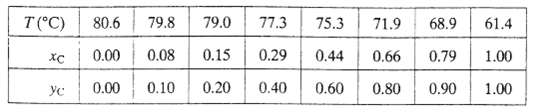
Vapor?liquid equilibrium data for mixtures of acetone (A) and ethanol at 1 atm are given in the following table: (a) Use the given data to construct a Txy diagram for this system. (b) A thermocouple inserted into a two-phase mixture of acetone and ethanol at equilibrium reads 62.1?C. The system
Your task in this problem will be to use a spreadsheet to generate a Txy diagram for a two-component system, using Raoult?s law to express the vapor?liquid equilibrium distribution of each species. The spreadsheet will be constructed for the chloroform?benzene system at I atm (for which Raoult?s
A liquid mixture containing 40.0 mole% methanol and 60.0 mole% 1-propanol is placed in an open vessel and heated slowly. Estimate the temperature at which the mixture begins to boil. List assumptions made in your calculations. If heat is supplied continuously, how will the liquid temperature and
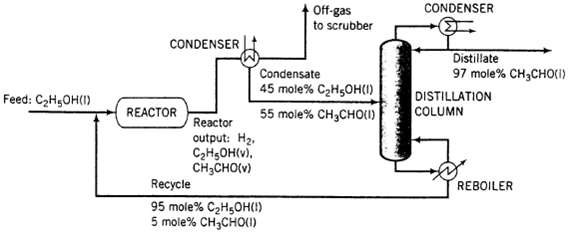
Acetaldehyde is synthesized by the catalytic dehydrogenization of ethanol: C2H5OH ? CH3CHO + H2?Fresh feed (pure ethanol) is blended with a recycle stream (95 mole% ethanol and 5% acetaldehyde), and the combined stream is heated and vaporized, entering the reactor at 280?C. Gases leaving the
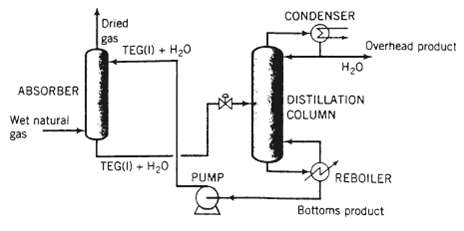
Dehydration of natural gas is necessary to prevent the formation of gas hydrates, which can plug valves and other components of a gas pipeline, and also to reduce potential corrosion problems. Water removal can be accomplished as shown in the following schematic diagram: Natural gas containing
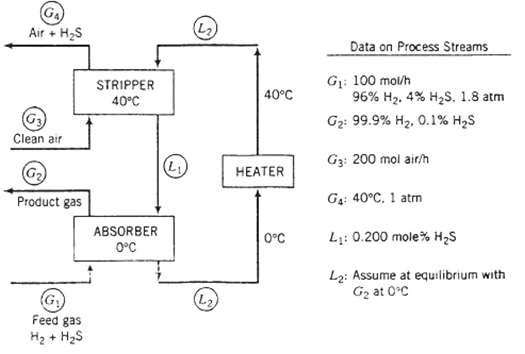
A two-stage process is used to separate H2S from a gas containing 96% H and 4?? H2S by volume. ?The H2S is absorbed in a solvent, which is then regenerated by air in a stripping column. The Henry?s law constant for the absorption of H2S in the solvent at 0?C is 22 atm/mole fractions (a) Briefly
The solubility of sodium bicarbonate in water is 11.1 g NaHCO3/l0O g H2O at 30°C and 16.4 g NaHCO3/100 g H20 at 60°C. If a saturated solution of NaHCO3 at 60°C is cooled and comes to equilibrium at 30°C, what percentage of the dissolved salt crystallizes?
An aqueous solution of potassium hydroxide is fed at a rate of 875 kg/h to an evaporative crystallizer operating at 10°C, producing crystals of KOH∙2H2O. A 5 g aliquot of the feed solution is titrated to neutrality with 22.4 mL of 0.85 molar H2SO4. The solubility of KOH at 10°C is 103 kg
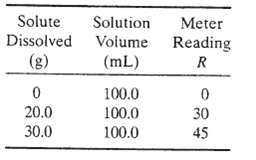
A salt A is soluble in a solvent S. A conductivity meter used to measure the solute concentration in A?S solutions is calibrated by dissolving a known quantity of A in S. adding more S to bring the solution volume to a fixed value, and noting the conductivity meter reading. The data given below are
A saturated MgSO4 solution at 130°F is fed to a crystallizer operating at 50°F. The solution leaving the crystallizer is saturated. Magnesium sulfate solubilities are 35 wt% MgSO4 at 130°F and 23 wt% MgSO4 at 50°F.(a) Write the molecular formula for the crystalline product that forms. (See
A solution containing 100lbm KNO3/100lbm H2O at 80°C is fed to a cooling crystallizer operated at 25°C. Slurry from the crystallizer (KNO3 crystals suspended in saturated solution) is fed to a filter, where the crystals are separated from the solution. Use the solubility data in Figure 65-1 to
A 10.0 wt% aqueous solution of sodium chloride is fed to an evaporative crystallizer operated under a partial vacuum. Evaporation of water concentrates the remaining solution beyond its saturation point at the crystallizer temperature and causes crystallization of NaC1. The crystallizer product is
Potassium dichromate (K2Cr2O7) is to be recovered from a 21 wt% aqueous solution in a continuous crystallization operation. The solution is joined by a recycle stream and fed to a vacuum evaporator where water is removed and the remaining solution is cooled to 30°C, at which temperature the
Sodium bicarbonate is synthesized by reacting sodium carbonate with carbon dioxide and water at 70°C and 2.0 atm gauge: Na2CO3 + CO2 + H20 → 2 NaHCO3 an aqueous solution containing 7.00 wt% sodium carbonate and a gas stream containing 70.0 mole% CO2 and the balance air are fed to the
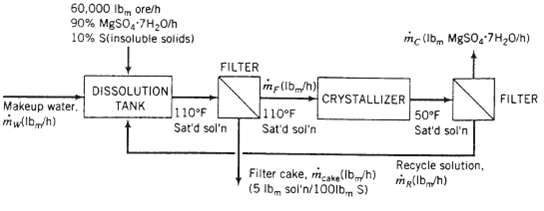
An ore containing 90 wt% MgSO4 ? 7H2O and the balance insoluble minerals is fed to a dissolution tank at a rate of 60,000lbm/h along with fresh water and a recycle stream. The tank contents are heated to 110?F, causing all of the magnesium sulfate heptahydrate in the ore to dissolve, forming a
An aqueous waste stream leaving a process contains 10.0 wt% sulfuric acid and 1 kg nitric acid per kg sulfuric acid. The flow rate of sulfuric acid in the waste stream is 1000 kg/h. The acids are neutralized before being sent to a wastewater treatment facility by combining the waste stream with an
A solution of diphenyl (MW = 154.2) in benzene is formed by mixing 56.0 g diphenyl with 550.0 mL of benzene. Estimate the effective vapor pressure of the solution at 30°C and the melting and boiling points of the solution at 1 atm.
An aqueous solution of urea (MW = 60.06) freezes at —4.6°C and 1 atm. Estimate the normal boiling point of the solution: then calculate the mass of urea (grams) that would have to be added to 1.00 kg of water to raise the normal boiling point by 3°C.
A solution is prepared by dissolving 0.5150 g of a solute (MW = 110.1) in 100.0 g of an organic solvent (MW = 94.10). The solution is observed to have a freezing point 0.41°C below that of the pure solvent. A second solution is prepared by dissolving 0.4460 g of a solute having an unknown
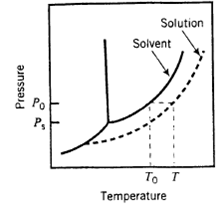
Derive Equation 6.5-4 for the boiling-point elevation of a dilute solution of a nonvolatile solute with mole fraction x in a solvent that has a pure-component vapor pressure ps (T). To do so, suppose that when the pressure is P0, the pure solvent boils at temperature Tb0 (so that P0 = ps (Tb0)] and
The distribution coefficient of styrene distributed between ethylbenzene and ethylene glycol at 25°C is 0.19mass fraction in the ethylene glycol phase per mass fraction in the ethylbenzene phase. One hundred grams of pure ethylene glycol is added to 120 g of a mixture containing 75 wt%
A stream of 5.00 wt% oleic acid in cottonseed oil enters an extraction unit at a rate of 100.0 kg/h. The unit operates as an equilibrium stage (the streams leaving the unit are in equilibrium) at 85°C. At this temperature, propane and cottonseed oil are essentially immiscible, and the distribution
Benzene and hexane are being considered as solvents to extract acetic acid from aqueous mixtures. At 30°C, distribution coefficients for the two solvents are KB = 0.098 mass fraction acetic acid in benzene/mass fraction acetic acid in water and KH = 0.017 mass fraction acetic acid in hexane/mass
Acetone is to be extracted with n-hexane from a 40.0 wt% acetone—60.0 wt% water mixtures at 25°C The acetone distribution coefficient (mass fraction acetone in the hexane-rich phase/mass fraction acetone in the water-rich phase) is 0343.13 water and hexane may be considered immiscible. Three
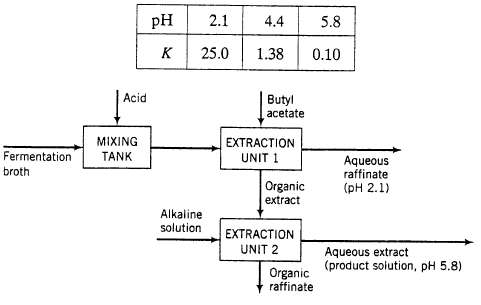
Penicillin is produced by fermentation and recovered from the resulting aqueous broth by extraction with butyl acetate. The penicillin distribution coefficient K (mass fraction of penicillin in the butyl acetate phase/mass fraction of penicillin in the water phase) depends strongly on the pH in the
A mixture of 20 wt% water 33% acetone and the remainder methyl isobutyl ketone is brought to equilibrium at 25°C. If the total mass of the system is 1.2 kg, use the data in Figure 6.6.1 to estimate the composition and mass of each phase of the mixture.
Five kilograms of a 30 wt% acetone—70% water mixture is added to 3.5 kg of a 20 wt% ace tone—80% MIBK mixture at 25° C. Use Figure 6.6-1 to estimate the mass and composition of each phase of the resulting mixture.
An aqueous acetone solution is fed at a rate of 32.0lbm /h to a stirred tank. A stream of pure methyl isobutyl ketone is also fed to the tank, and the resulting mixture is sent to a settler operating at 25°C.One of the phases formed has a flow rate of 41.0lbm/h and contains 70 wt% MIBK. Use Figure
Two systems contain water, acetone, and methyl isobutyl ketone in equilibrium at 25°C. The first system contains equal masses of the three species, and the second one contains 9.0% acetone, 21.0% water, and 70.0% MIBK by mass Let xa.aq and xa.org respectively, denote the mass fractions of acetone
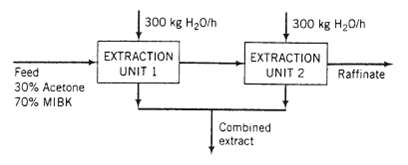
Water is used to extract acetone from a 30 wt% acetone?70% MIBK mixture flowing at a rate of 200 kg/h. Two equilibrium stages at 25C are used as shown in the following diagram. If 300 kg H2O/h is fed to each extraction unit, what fraction of the acetone in the feed solution would be removed and
Air at 25?C and 1 atm with a relative humidity of 25% is to be dehumidified in an adsorption column packed with silica gel. The equilibrium adsorptivity of water on silica gel is given by the expression14?where pH2O is the partial pressure of water in the gas contacting the silica gel and P.2o is
A 50.0-L tank contains an air?carbon tetrachloride gas mixture at an absolute pressure of 1 atm, a temperature of 34?C, and a relative saturation of 30%. Activated carbon is added to the tank to remove the CCl4 from the gas by adsorption and the tank is then sealed. The volume of added activated
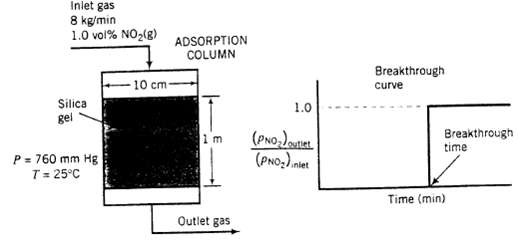
The following equilibrium data15 have been obtained for the adsorption of nitrogen dioxide, NO2, on silica gel at 25?C and 1 atm: (a) Confirm that these data are reasonably correlated by the Freund lich isotherm X* = KFP?NO2, and determine the values of KF and 3 that provide the best correlation.
Various amounts of activated carbon were added to a fixed amount of raw cane sugar solution (48 wt% sucrose in water) at 80?C. A colorimeter was used to measure the color of the solutions. R, which is proportional to the concentration of trace unknown impurities in the solution. The following data
A certain gasoline engine has an efficiency of 30%; that is, it converts into useful work 30% of the heat generated by burning a fuel. If the engine consumes 0.80 L/h of a gasoline with a heating value of 3.5 X 10⁴ kJ/L. how much power does it provide? Express the answer both in kW and horsepower.
Consider an automobile with a mass of 5500lbm braking to a stop from a speed of 55 miles/h.(a) How much energy (Btu) is dissipated as heat by the friction of the braking process?(b) Suppose that throughout the United States, 300,000,000 such braking processes occur in the course of a given day.
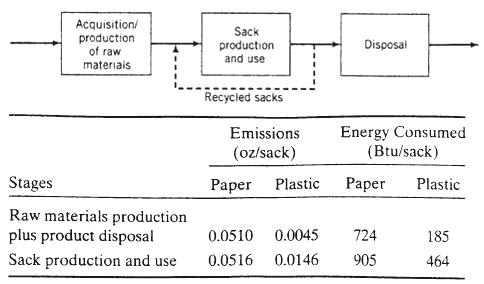
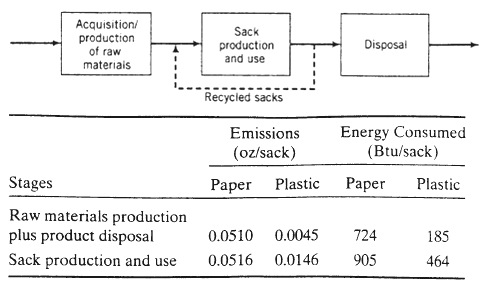
A simplified version of the life cycle of grocery sacks is shown below.4 In the late 1970s, supermarkets began to replace paper sacks with polyethylene (plastic) sacks. In the 1980s, a movement to go back to paper arose, primarily inspired by environmental considerations. In the 1990s, a counter
Liquid methanol is pumped from a large storage tank through a 1-in.ID pipe at a rate of 3.00gal/mm.(a) At what rate in (i) ft ∙ lbf/s and (ii) hp is kinetic energy being transported by the methanol in the pipe?(b) The electrical power input to the pump transporting the methanol must be greater
Air at 300°C and 130 kPa flows through a horizontal 7-cm ID pipe at a velocity of 42.0m/s(a) Calculate Ek (W), assuming ideal gas behavior.(b) If the air is heated to 400°C at constant pressure, what is ΔEk Ek (400°C) — Ek (300°C)?(c) Why would it be incorrect to say that the rate of
Suppose you pour a gallon of water on a yowling cat 10 ft below your bedroom window.(a) How much potential energy (ft ∙ 1bf) does the water lose?(b) How fast is the water traveling (ft/s) just before impact?(c) True or false: Energy must be conserved therefore the kinetic energy of the water
Methane enters a 3-cm ID pipe at 30°C and 10bar with an average velocity of 5.00m/s and emerges at a point 200 m lower than the inlet at 30°C and 9bar.(a) Without doing any calculations, predict the signs (+ or –) of ΔEk and ΔEp, where signifies (outlet – inlet). Briefly explain your
You recently purchased a large plot of land in the Amazon jungle at an extremely low cost. You are quite pleased with yourself until you arrive there and find that the nearest source of electricity is 1500 miles away. a fact that your brother-in-law, the real estate agent, somehow forgot to
Write and simplify the closed-system energy balance (Equation 7.3-4) for each of the following processes, and state whether nonzero heat and work terms are positive or negative. Begin by defining the system. The solution of part (a) is given as an illustration. (a) The contents of a closed flask
A cylinder with a movable piston contains 4.00liters of a gas at 30°C and 5.00bar. The piston is slowly moved to compress the gas to 8.00bar.(a) Considering the system to be the gas in the cylinder and neglecting ΔEp, write and simplify the closed-system energy balance. Do not assume that the
A cylinder with a movable piston contains 4.00liters of a gas at 30°C and 5.00bar. The piston is slowly moved to compress the gas to 8.00bar.(a) Considering the system to be the gas in the cylinder and neglecting ΔEp, write and simplify the closed-system energy balance. Do not assume that the
Oxygen at 150 K and 41.64 atm has a tabulated specific volume of 4.684cm3/g and a specific internal energy of 1706J/mol. Compute the specific enthalpy of O2 in this state.
Values of the specific internal energy of bromine at three conditions are listed here.(a) What reference(b) Calculate ΔU (kJ/mol) for a process in which bromine vapor at 300 K is condensed at constant pressure. Then calculate ΔH (kJ/mol) for the same process. Finally, calculate ΔH (kJ) for 5.00
Prove that for an ideal gas. U and ii are related as H = U + RT, where R is the gas constant. Then:(a) Taking as given that the specific internal energy of an ideal gas is independent of the gas pressure, justify the claim that .A for a process in which an ideal gas goes from (T1, P1) to (T2 ∙
If a system expands in volume by an amount ΔV (m3) against a constant restraining pressure P(N/m2), a quantity PΔV(J) of energy is transferred as expansion work from the system to its surroundings. Suppose that the following four conditions are satisfied for a closed system: (a) the system
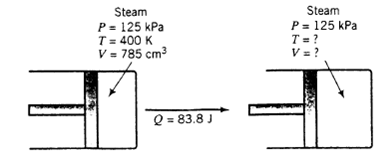
A horizontal cylinder equipped with a friction less piston contains 785 cm3 of steam at 300 K and 125 kPa. A total of 83.8 joules of heat is transferred to the steam, causing the steam temperature to rise and the cylinder volume to increase. A constant restraining force is maintained on the piston
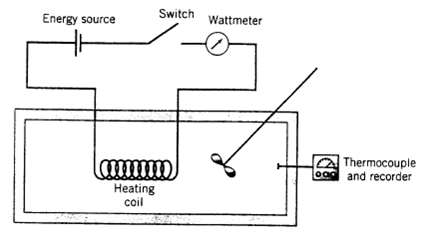
You are performing an experiment to measure the specific internal energy of a gas relative to a reference state of 25?C and 1 atm (at which conditions U is arbitrarily set equal to 0). The gas is placed in a closed insulated 2.10-liter container at 25?C and 1 atm. A switch is alternately closed and
Define a system and simplify the open-system energy balance (Equation 7.4-15) for each of the following cases. State when possible whether nonzero heat and shaft work terms are positive or negative. The solution of part (a) is given as an illustration.(a) Steam enters a rotary turbine and turns a
Air is heated from 25°C to 150°C prior to entering a combustion furnace. The change in specific enthalpy associated with this transition is 3640 J/mol. The flow rate of air at the heater outlet is 1.25m3/min and the air pressure at this point is 122 kPa absolute.(a) Calculate the heat requirement
A Thomas flow meter is a device in which heat is transferred at a measured rate from an electric coil to a flowing fluid, and the flow rate of the stream is calculated from the measured temperature increase of the fluid. Suppose a device of this sort is inserted in a stream of nitrogen, the current
The specific enthalpy of liquid n-hexane at 1 atm vanes linearly with temperature and equals 25.8 kJ/kg at 30°C and 129.8 kJ/kg at 50°C.(a) Determine the equation that relates H (kJ/kg) to T(°C) and calculate the reference temperature on which the given enthalpies are based. Then derive an
Steam at 260°C and 7.00bar absolute is expanded through a nozzle to 200°C and 4.00bar. Negligible heat is transferred from the nozzle to its surroundings. The approach velocity of the steam is negligible. The specific enthalpy of steam is 2974J/kg at 260°C and 7bar and 2860kJ/kg at 200°C and
The heart pumps blood at an average rate of 5 L/min. The gauge pressure on the venous (intake) side is 0 mm Hg and that on the arterial (discharge) side is 100 mm Hg. Energy is supplied to the heart as heat released by the absorption of oxygen in the cardiac muscles: 5 mL (STP) O2/min is absorbed,
Saturated steam at 100°C is heated to 400°C. Use the steam tables to determine(a) The required heat input (J/s) if a continuous stream flowing at 100 kg/s undergoes the process at constant pressure and(b) The required heat input (J) if 100 kg undergoes the process in a constant-volume container.
A fuel oil is burned with air in a boiler furnace. The combustion produces 813kW of thermal energy; of which 65% is transferred as heat to boiler tubes that pass through the furnace. The combustion products pass from the furnace to a stack at 650°C. Water enters the boiler tubes as a liquid at
Liquid water is fed to a boiler at 24°C and 10bar and is converted at constant pressure to saturated steam. Use the steam tables to calculate ΔH (kJ/kg) for this process, and then calculate the heat input required to produce 15,000 m3/h of steam at the exiting conditions. Assume that the kinetic
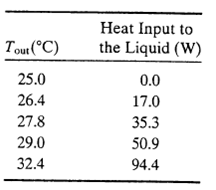
You have been assigned to collect thermodynamic data for a new liquid product your company is about to begin manufacturing and you decide to use a continuous-flow technique to generate a correlation of H versus T. You wrap an electrical heating tape around a pipe, cover the tape with a thick layer
Saturated steam at a gauge pressure of 2.0bar is to be used to heat a stream of ethane. The ethane enters a heat exchanger at 16?C and 1.5 bar gauge at a rate of 795m3/min and is heated at constant pressure to 93?C. The steam condenses and leaves the exchanger as a liquid at 27?C. The specific
Superheated steam at 40 bar absolute and 500°C flows at a rate of 250 kg/mm to an adiabatic turbine, where it expands to 5bar. The turbine develops 1500kW. From the turbine the steam flows to a heater, where it is reheated isobarically to its initial temperature. Neglect kinetic energy changes.(a)
During a period of relative inactivity, the average rate of transport of enthalpy by the metabolic and digestive waste products leaving the body minus the rate of enthalpy transport by the raw materials ingested and breathed into the body is approximately ΔH = —300 kJ/h. Heat is transferred from
Liquid water at 30.0°C and liquid water at 90.0°C are combined in a ratio (1 kg cold water/2 kg hot water).(a) Use a simple calculation to estimate the final water temperature. For this part, pretend you never heard of energy balances.(b) Now assume a basis of calculation and write a closed
Steam produced in a boiler is frequently ‘wet”—that is. it is a mist composed of saturated water vapor and entrained liquid droplets. The quality of a wet steam is defined as the fraction of the mixture by mass that is vapor.A wet steam at a pressure of 5.0bar with a quality of 0.85 is
Steam produced in a boiler is frequently ‘wet”—that is. it is a mist composed of saturated water vapor and entrained liquid droplets. The quality of a wet steam is defined as the fraction of the mixture by mass that is vapor.A wet steam at a pressure of 5.0 bar with a quality of 0.85 is
A steam trap is a device to purge steam condensate from a system without venting uncondensed steam. In one of the crudest trap types, the condensate collects and raises a float attached to a drain plug. When the float reaches a certain level, it “pulls the plug,” opening the drain valve and
A turbine discharges 200 kg/h of saturated steam at 10.0bar absolute. It is desired to generate steam at 250°C and 10.0 bar by mixing the turbine discharge with a second stream of superheated steam of 300°C and 10.0bar(a) If 300 kg/h of the product steam is to be generated, how much heat must be
Liquid water at 60bar and 250°C passes through an adiabatic expansion valve, emerging at a pressure P and temperature T1. If P is low enough, some of the liquid evaporates.(a) If Pf = 1.0 bar, determine the temperature of the final mixture (Tf) and the fraction of the Liquid feed that evaporates
A 10.0-m3 tank contains steam at 275°C and 15.0bar. The tank and its contents are cooled until the pressure drops to 1.2bar. Some of the steam condenses in the process.(a) How much heat was transferred from the tank?(b) What is the final temperature of the tank contents?(c) How much steam
Jets of high-speed steam are used in spray cleaning. Steam at 15.0bar with 150°C of superheat is fed to a well-insulated valve at a rate of 1.00 kg/s. As the steam passes through the valve, its pressure drops to 1.0 bar. The outlet stream may be totally vapor or a mixture of vapor and liquid.
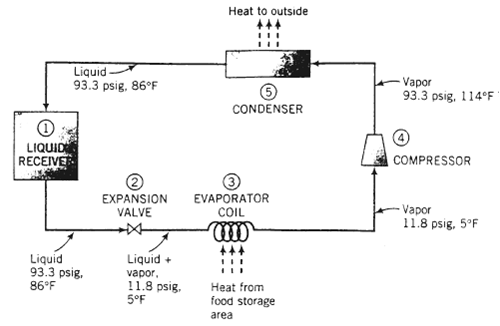
The following diagram shows a simplified version of how a refrigerator works: In a liquid receiver (1), a liquid refrigerant (any one of a number of halogenated hydrocarbons such as CC12F2) is contained at high pressure and temperature. The liquid passes through an expansion valve (2), where it
Showing 700 - 800
of 6778
1
2
3
4
5
6
7
8
9
10
11
12
13
14
15
Last
Step by Step Answers

 Get 50% OFF
Claim Now
Get 50% OFF
Claim Now