New Semester
Started
Get
50% OFF
Study Help!
--h --m --s
Claim Now
Question Answers
Textbooks
Find textbooks, questions and answers
Oops, something went wrong!
Change your search query and then try again
S
Books
FREE
Study Help
Expert Questions
Accounting
General Management
Mathematics
Finance
Organizational Behaviour
Law
Physics
Operating System
Management Leadership
Sociology
Programming
Marketing
Database
Computer Network
Economics
Textbooks Solutions
Accounting
Managerial Accounting
Management Leadership
Cost Accounting
Statistics
Business Law
Corporate Finance
Finance
Economics
Auditing
Tutors
Online Tutors
Find a Tutor
Hire a Tutor
Become a Tutor
AI Tutor
AI Study Planner
NEW
Sell Books
Search
Search
Sign In
Register
study help
engineering
chemical engineering
Elementary Principles of Chemical Processes 3rd Edition Richard M. Felder, Ronald W. Rousseau - Solutions
A balloon 20m in diameter is filled with helium at a gauge pressure of 2.0atm. A man is standing in a basket suspended from the bottom of the balloon. A restraining cable attached to the basket keeps the balloon from rising. The balloon (not including the gas it contains), the basket, and the man
The Cookenwythe Gas Company pumps propane gas to the nearby Noxious Chemicals, Inc., polypropylene production plant. The gas is metered at the noxious plant at 400m3/h at 4.7atm gauge and 30°C. The pressure at the Cookenwythe plant is 8.5atm gauge and the temperature is also 30°C. Noxious pays
An ideal gas mixture contains 35% helium. 20% methane, and 45% nitrogen by volume at 2.00 atm absolute and 90°C. Calculate(a) The partial pressure of each component.(b) The mass fraction of methane,(c) The average molecular weight of the gas and(d) The density of the gas in kg/m3.
There is a percentage of fuel in a fuel—air mixture called the lower flammable limit (LFL), below which the mixture cannot be ignited. There is also an upper flammable limit (UFL), a percentage of fuel above which ignition will not take place. The LFL and UFL are collectively known as the
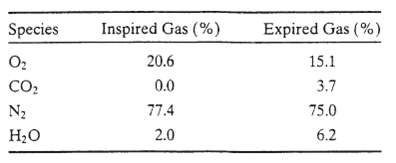
An adult takes about 12 breaths per minute inhaling roughly 500mL of air with each breath. The molar compositions of the inspired and expired gases are as follows: The inspired gas is at 24?C and 1 atm, and the expired gas is at body temperature and pressure?37?C and 1 atm. Nitrogen is not
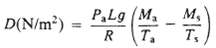
As everyone who has used a fireplace knows when a fire burns in a furnace, a draft, or slight vacuum is induced that causes the hot combustion gases and entrained particulate matter to flow up and out of the stack. The reason is that the hot gas in the stack is less dense than air at ambient
Phosgene (CC12O) is a colorless gas that was used as an agent of chemical warfare in World War I. It has the odor of newly mown hay (which is a good warning if you know the smell of newly mown hay). Pete Brouillette an innovative chemical engineering student came up with what he believed was an
A fuel gas containing 86% methane, 8% ethane, and 6% propane by volume flows to a furnace at a rate of 1450 m3/h at 15°C and 150 kPa (gauge), where it is burned with 8% excess air. Calculate the required flow rate of air in SCMH (standard cubic meters per hour).
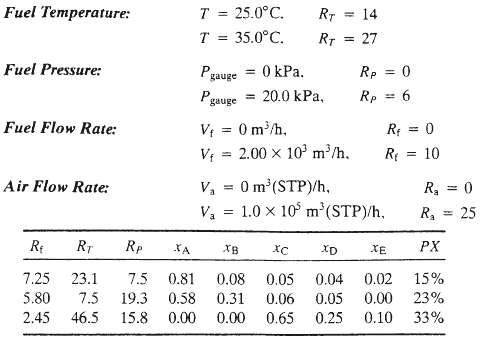
The flow of air to a gas-fired boiler furnace is regulated by a minicomputer controller. The fuel gases used in the furnace are mixtures of methane (A), ethane (B), propane (C), n-butane (D), and isobutene (E). At periodic intervals the temperature, pressure, and volumetric flow rate of the fuel
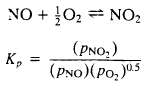
The oxidation of nitric oxide takes place in an isothermal batch reactor. The reactor is charged with a mixture containing 20.0 volume percent NO and the balance air at an initial pressure of 380 kPa (absolute). (a) Assuming ideal gas behavior, determine the composition of the mixture (component
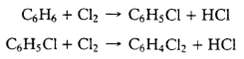
Monochlorobenzene (M) is produced commercially by the direct catalytic chlorination of benzene at 40?C and 120 kPa absolute. In the process, dichlorobenzene (D) is generated as a co product: Liquid and gas streams leave the reactor. The liquid contains 49.2 wt% M, 29.6% D, and the remainder
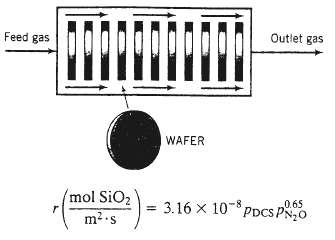
In chemical vapor deposition (CVD), a semiconducting or insulating solid material is formed in a reaction between a gaseous species and a species adsorbed on the surface of silicon wafers (disks about 10 cm in diameter and 1 mm thick). The coated wafers are subjected to further processing to
A gas turbine power plant receives a shipment of hydrocarbon fuel whose composition is uncertain but may be represented by the expression CxHy. The fuel is burned with excess air. An analysis of the product gas gives the following results on a moisture-free basis: 10.5 % (v/v) CO2, 5.3% O2, and
Liquid hydrazine (SO = 0.82) undergoes a family of decomposition reactions that can be represented by the stoichiometric expression 3 N2H4 → 6x H2 + (1 + 2x) N2 + (4 — 4x) NH3(a) For what range of values of x is this equation physically meaningful?(b) Plot the volume of product gas [V (L)] at
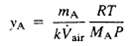
Chemicals are stored in a laboratory with volume V (m3) As a consequence of poor laboratory practices a hazardous species, A. enters the room air (from inside the room) at a constant rate mA (g A/h). The room is ventilated with clean air flowing at a constant rate V air (m3/h). The average
Propylene is hydrogenated in a batch reactor: C3H6 (g) + H2 (g) → C3H8 (g) Equimolar amounts of propylene and hydrogen are fed into the reactor at 25°C and a total absolute pressure of 32.0 atm. The reactor temperature is raised to 235°C and held constant thereafter until the reaction is
A natural gas contains 95 wt% CH4 and the balance C2H6. Five hundred cubic meters per hour of this gas at 40°C and 1.1bar is to be burned with 25% excess air. The air flow meter is calibrated to read the volumetric flow rate at standard temperature and pressure. What should the meter read (in
A stream of hot dry nitrogen flows through a process Unit that contains liquid acetone. A substantial portion of the acetone vaporizes and is carried off by the nitrogen. The combined gases leave the recovery unit at 205°C and 1.1bar and enter a condenser in which a portion of the acetone is
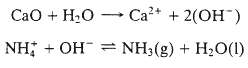
Ammonia is one of the chemical constituents of industrial waste that must be removed in a treatment plant before the waste can safely be discharged into a river or estuary. Ammonia is normally present in wastewater as aqueous ammonium hydroxide (NH+4OH???). A two-part process is frequently carried
You have purchased a gas cylinder that is supposed to contain 5.0 mole% Cl2 (± 0.1%) and 95% air. The experiments you have been running are not giving reasonable results, and you suspect that the chlorine concentration in the gas cylinder is incorrect. To check this hypothesis, you bubble gas from
Two humid gas streams are combined in a heated mixing chamber. The first stream contains 23.5 mole% ethane and 76.5% ethylene on a dry basis and enters the chamber at 25°C and 105kPa at a rate of 125L/min. The second stream is humid air, which enters at 75°C and 115 kPa at a rate of 355 L/min.
Most of the concrete used in the construction of buildings, roads, dams, and bridges is made from port land cement, a substance obtained by pulverizing the hard, granular residue (clinker) from the roasting of a mixture of clay and limestone and adding other materials to modify the setting
The ultimate analysis of a No.4 fuel oil is 86.47 wt% carbons. 11.65% hydrogen, 1.35% sulfur, and the balance noncombustible inerts this oil is burned in a steam-generating furnace with 15% excess air. The air is preheated to 175°C and enters the furnace at a gauge pressure of 180 mm Hg. The
A stream of Liquid n-pentane flows at a rate of 50.4L/min into a heating chamber, where it evaporates into a stream of air 15% in excess of the amount needed to burn the pentane completely. The temperature and gauge pressure of the entering air are 336 K and 208.6 kPa. The heated gas flows into a
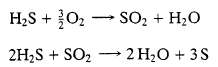
The feed stream to a Claus plant consists of 20.0 mole% H2S and 80.0% CO2. One-third of the stream is sent to a furnace where the H2S is burned completely with a stoichiometric amount of air and 25?C. The reaction is the product gases from this reaction are then mixed with the remaining two-thirds
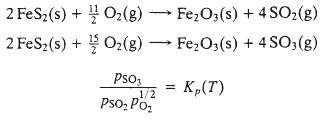
Sulfuric acid is the chemical produced in the United States with the highest volume of production. In one of the earliest processes used to make it, an ore containing iron pyrites (FeS2) is roasted (burned) with air. The following reactions take place in the roasting furnace: The gas leaving the
You have been assigned the task of measuring the equilibrium constant for the reaction N2O4 2NO2 as a function of temperature. To do so, you obtain a rigid 2-liter vessel equipped with a pressure gauge evacuate and then fill the vessel with a mixture of NO2 and N204, and heat the vessel to T0
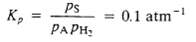
The demand for a particular hydrogenated compound, S, is 5.00k mol/h. This chemical is synthesized in the gas-phase reaction A + H2 = S. The reaction equilibrium constant at the reactor operating temperature is the fresh feed to the process is a mixture of A and hydrogen that is mixed with a
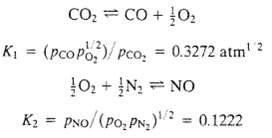
One gram-mole each of CO2, O2, and N2 are fed to a batch reactor and heated to 3000K and 5.0atm. The two reactions given here proceed to equilibrium (also shown are the equilibrium constants at 3000 K). Calculate the equilibrium composition (component mole fractions) of the reactor contents.
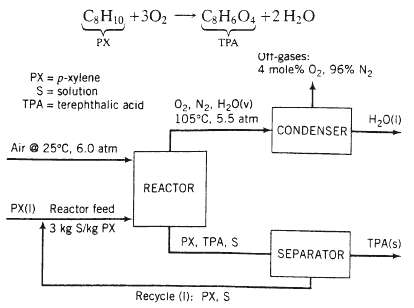
Terephthalic acid (TPA), a raw material in the manufacture of polyester fiber, film, and soft drink bottles, is synthesized from p-xylene (PX) in the process shown below. A fresh feed of pure liquid PX combines with a recycle stream containing PX and a solution (S) of a catalyst (a cobalt salt) in
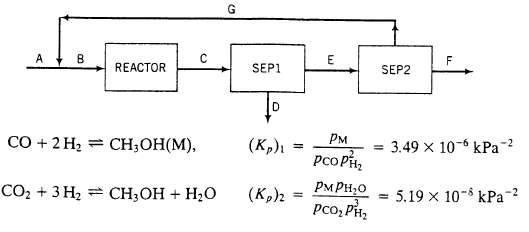
A flowchart of a methanol synthesis process is shown below. A. Fresh feed?a mixture of CO. H2, N2, and CO2 B. Feed to the reactor?30.O mole% CO, 63.0% H2, 2.0% N2, and 5.0% CO2. Reactor Two reactions occur and proceed to equilibrium at 200?C and 4925 kPa absolute: The following specifications apply
The measured volumetric flow rate of ethane at 10.0 atm absolute and 35°C is 1.00 x 10³ L/h. Using an estimated value of the second virial coefficient in the truncated virial equation (Equation 5.3-4), (a) Calculate v (L/mol); (b) Estimate the compressibility factor, z; (c)
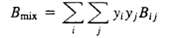
Methanol is to be delivered to a process unit at a rate of 15.0k mol/h by a stream that is 30.0 mole% methanol and 70.0mole% propane. Estimate the volumetric flow rate of this stream at 10.0 atm and 100.0?C using the truncated virial equation and the following mixing rule: where the virial
The van der Waals equation of state (Equation 5.3-6) is to be used to estimate the specific molar volume V (L/mol) of air at specified values of T (K) and P(atm). The van der Waals constants for air are a = 1.33 atm ? L2/mol2 and b = 0.0366 L/mol. (a) Show why the van der Waals equation is
A 5.0-m3 tank is charged with 75.0 kg of propane gas at 25°C. Use the SRK equation of state to estimate the pressure in the tank: then calculate the percentage error that would result from the use of the ideal gas equation of state for the calculation.
The absolute pressure within a 35.0-liter gas cylinder should not exceed 51.0 atm. Suppose the cylinder contains 50.0 mol of a gas. Use the SRK equation of state to calculate the maximum permissible cylinder temperature if the gas is (a) carbon dioxide and (b) argon. Finally, calculate the values
A stream of oxygen at —65°C and 8.3 atm flows at a rate of 250 kg/h. Use the SRK equation of state to estimate the volumetric flow rate of this stream.
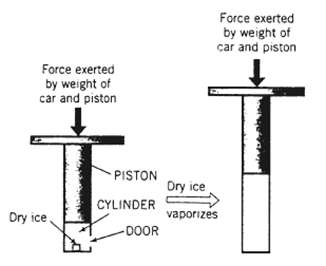
An innovative engineer has invented a device to replace the hydraulic jacks found at many service stations. A movable piston with a diameter of 0.15 m is fitted into a cylinder. Cars are raised by opening a small door near the base of the cylinder, inserting a block of dry ice (solid CO2), closing
An oxygen tank with a volume of 2.5 ft3 is kept in a room at 50°F. An engineer has used the ideal gas equation of state to determine that if the tank is first evacuated and then charged with 35.3lbm of pure oxygen, its rated maximum allowable working pressure (MAWP) will be attained. Operation at
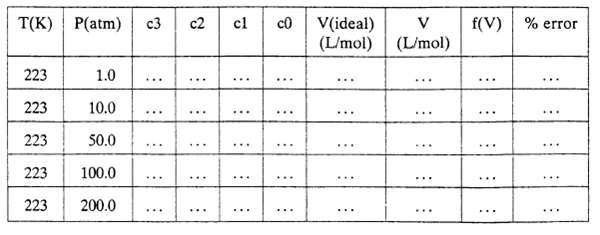
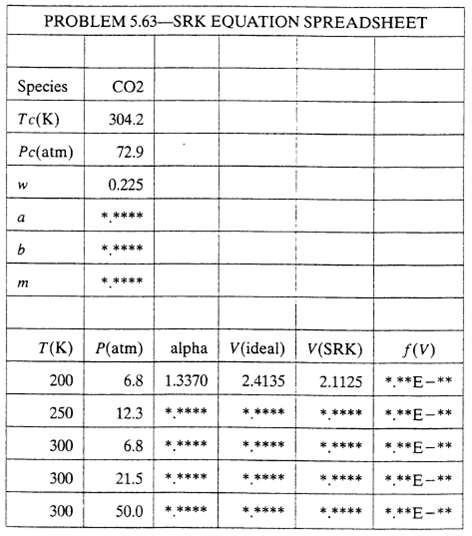
Using the SRK equation of state (or any other cubic equation of state) to determine a specific volume from a specified temperature and pressure requires a trial-and-error calculation. Three computer- based approaches to solving this problem may be used: (1) spread sheeting; (2) mathematical
Use the generalized compressibility chart to estimate z for(a) Nitrogen at 40°C and 40MPa and(b) Helium at —200°C and 350 atm. (Don’t forget Newton’s corrections.)
A certain gas has a molecular weight of 30.0 a critical temperature of 310K. and a critical pressure of 4.5MPa. Calculate the density in kg/m3 of this gas at 465 K and 9.0MPa(a) If the gas is ideal and(b) If the gas obeys the law of corresponding states.
One hundred pounds of CO2 is contained in a 10.0-ft3 tank. The safety limit of the tank is 1600 psig. Use the compressibility chart to estimate the maximum permissible gas temperature.
A stream of oxygen enters a compressor at 298 K and 1.00 atm at a rate of 127m3/h and is compressed to 358 K and 1000 atm. Estimate the volumetric flow rate of compressed O2 using the compressibility-factor equation of state.
A 10-liter cylinder containing oxygen at 175 atm absolute is used to supply O2 to an oxygen tent. The cylinder can be used until its absolute pressure drops to 1.1atm. Assuming a constant temperature of 27°C calculate the gram-moles of 02 that can be obtained from the cylinder, using the
Dry ice (solid CO2) has been used as a mine explosive in the following manner. A hole is drilled into the mine wall, filled with dry ice plus a small charge of gunpowder, and then plugged. The gunpowder is lit with a fuse, vaporizing the CO2 and building up an explosively high pressure within the
The concentration of oxygen in a 5000-liter tank containing air at 1 atm is to be reduced by pressure purging prior to charging a fuel into the tank, the tank is charged with nitrogen up to a high pressure and then vented back down to atmospheric pressure. The process is repeated as many times as
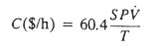
A stream of propane at an average temperature T = 566?R and absolute pressure P = 6.8 atm flows from a hydrocarbon processing plant to a nearby customer?s production facility. A technician at the processing plant periodically measures the volumetric flow rate of the stream, V (ft3/h), and reports
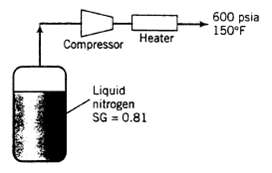
Approximately 150SCFM (standard cubic feet per minute) of nitrogen is required by a process facility. As shown in the diagram below, plans call for supplying the facility from a tank of liquid nitrogen (SG = 0.81) at its normal boiling point (?350?F) and 1 atm. Nitrogen vapor leaves the tank and is
A 150-liter cylinder of carbon monoxide is stored in a 30.7-m3 room. The pressure gauge on the tank reads 2500 psi when the tank is delivered. Sixty hours later the gauge reads 2245 psi, indicating a leak. The Ceiling Threshold Limit Value (TLV-C) molar concentration of CO—that is, the
A gas consists of 20.0 mole% CH4, 30.0% C2H6, and 50.0% C2H4. Ten kilograms of this gas is to be compressed to a pressure of 200bar at 90°C. Using Kay’s rule, estimate the final volume of the gas.
A 30-liter cylinder is evacuated and filled with 5.00 kg of a gas containing 10.0 mole% N2O and the balance N2. The gas temperature is 24°C. Use the compressibility chart to solve the following problems.(a) What is the gauge pressure (atm) of the cylinder gas after the tank is filled?(b) A fire
The product gas from a coal gasification plant consists of 60.0 mole% CO and the balance H2 it leaves the plant at 150°C and 2000psia. The gas expands through a turbine, and the outlet gas from the turbine is fed to a boiler furnace at 100°C and 1 atm at a rate of 15,000 ft3/min. Estimate the
A 30.0-liter cylinder of a gas containing 97.0 mole% CO and 3.0% CO2 is delivered to your plant. You sign the receipt for it, noting that the gauge on the tank reads 2000 psi. Several days later you notice that the gauge reads 1875psi indicating a leak. The storage room in which the cylinder is
Methanol is produced by reacting carbon monoxide and hydrogen at 644 K over a ZnO—Cr2O3 catalyst. A mixture of CO and H2 in a ratio 2mol H2/mol CO is compressed and fed to the catalyst bed at 644 K and 34.5MPa absolute. A single-pass conversion of 25% is obtained. The space velocity, or ratio of
A process stream flowing at 35k mol/h contains 15 mole% hydrogen and the remainder 1-butene. The stream pressure is 10.0 atm absolute, the temperature is 50°C, and the velocity is 150m/min. Determine the diameter (in cm) of the pipe transporting this stream, using Kay’s rule in your calculations.
A gas mixture consisting of 15.0 mole% methane, 60.0% ethylene, and 25.0% ethane is compressed to a pressure of 175bar at 90°C. It flows through a process line in which the velocity should be no greater than 10m/s. What flow rate (k mol/min) of the mixture can be handled by a 2-cm internal
A system has been devised to store acetonitrile safely at high pressures and temperatures. The acetonitrile is contained in a 0.2-ft3 tank maintained at 4500psia and 550°F. This tank is placed inside a second tank whose volume, excluding the volume of the first tank, is 2 ft3. Nitrogen at 10.0 atm
A solid carbohydrate (CaHbOc) with a specific gravity of 1.59 is placed in a 1.000-liter combustion chamber. The chamber is evacuated and then charged with pure oxygen. Complete combustion of the carbohydrate takes place. A sample of the product gas is cooled to condense all the water formed in the
The adiabatic flame temperature of a fuel is the temperature achieved if the fuel is burned completely in a perfectly insulated container. You are performing an experiment to measure the adiabatic flame temperature of cyclopentane. You put 10.0mL of liquid cyclopentane into a well-insulated steel
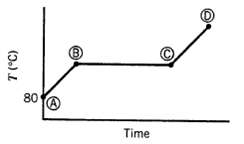
Ten mL of pure liquid water in a cylinder with a movable piston is heated at a constant pressure of 1 atm from an initial temperature of 80?C. The temperature of the system is monitored, and the following behavior is observed: (a) What is happening in steps AB, BC, and CD? What is the temperature
A quantity of liquid chloroform is placed in an open, transparent, three-liter flask and boiled long enough to purge all air from the vapor space. The flask is then sealed and allowed to equilibrate at 30°C, at which temperature chloroform has a vapor pressure of 243 mm Hg. Visual inspection shows
Ethyl acetate has a vapor pressure of 118.3 mm Hg at 29.5°C and a normal boiling point of 77.0°C. Estimate the vapor pressure at 45°C using (a) The Antoine equation and constants from Table B.4:(b) The Clausius—Clapeyron equation and the two given data points; and (c) Linear
The vapor pressure of ethylene glycol at several temperatures is given below: Use a semi log plot based on the Clausius?Clapeyron equation to derive an equation for p? (mm Hg) as a function of T(?C). From the plot, estimate the heat of vaporization of ethylene glycol in kJ/mol. (Remember to use
You are given vapor pressure data in the form of [T (°C). p (mm Hg)] pairs. Construct a spreadsheet or write a computer program to perform the following tasks:(a) Read in Tt, p1, T2, p2,..., TN, pN.(b) Fit the Clausius—Clapeyron equation to the data using the method of least squares (Appendix
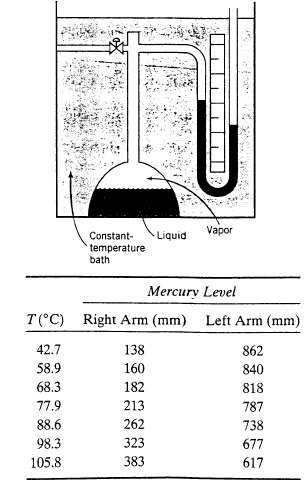
The apparatus shown here is used to measure the vapor pressure of ethylene diamine. The system is loaded with pure ethylene diamine and the bath is adjusted to each of several known temperatures. The following readings are taken on a day when the atmospheric pressure is 758.9 mm Hg: (a) Calculate p
Estimate the vapor pressure of acetone (mm Hg) at 50°C (a) From data in Perry’s Chemical Engineers’ Handbook and the Clausius—Clapeyron equation, (b) From the Cox chart (Figure 6.1-4), and (c) From the Antoine equation using parameters from Table B.4.
The vapor pressure of an organic solvent is 50 mm Hg at 25°C and 200 mm Hg at 45° C. The solvent is the only species in a closed flask at 35°C and is present in both liquid and vapor states. The volume of gas above the liquid is 150 mL. Estimate the amount of the solvent (mol) contained in the
Liquid methyl ethyl ketone (MEK) is introduced into a vessel containing air. The system temperature is increased to 55°C, and the vessel contents reach equilibrium with some MEK remaining in the liquid state. The equilibrium pressure is 1200 mm Hg.(a) Use the Gibbs phase rule to determine how many
When a flammable liquid (such as gasoline or charcoal lighter fluid) ignites, it is not the liquid itself that burns: what actually happens is that the liquid vaporizes and the resulting air—vapor mixture burns If the temperature is such that the percentage of the vapor in the mixture is below a
A gas mixture contains 10.0 mole% H2O (v) and 90.0 mole% N2. The gas temperature and absolute pressure at the start of each of the three parts of this problem are 50°C and 500 mm Hg. Ideal gas behavior may be assumed in every part of this problem.(a) If some of the gas mixture is put in a cylinder
Pure chlorobenzene is contained in a flask attached to an open-end mercury manometer. When the flask contents are at 58.3°C, the height of the mercury in the arm of the manometer connected to the flask is 747 mm and that in the arm open to the atmosphere is 52 mm. At 110°C, the mercury level is
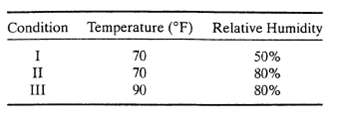
The latest weather report includes the following statement: “The temperature is 78°F, barometric pressure is 29.9 inches, and the relative humidity is 87%.” From this information, estimate the mole fraction of water in the air and the dew point (°F), molal humidity, absolute humidity, and
It has been suggested that Atlanta?Fulton County Stadium earned the nickname ?The Launching Pad? because baseballs carried farther than normal in the region?s hot, humid atmosphere. With this suggestion in mind, examine the effect of temperature and humidity on the buoyant force exerted on a
Air at 50% relative humidity is cooled isobarically at I atm absolute from 90°C to 25°C.(a) Estimate the dew point and degrees of superheat of the air at 90°C.(b) How much water condenses (mol) per cubic meter of feed gas?(c) Suppose a sample of the 90°C air is put in a closed variable-volume
In a device to produce potable water, humid air at 90°F, 29.7 in Hg, and 95% relative humidity is cooled to 40°F at constant pressure. What volumetric flow rate of air into the cooler (ft3/min) is required to provide 10.0 gal/mm of condensed water?
Air containing 20.0mole% water vapor at an initial pressure of 1 atm absolute is cooled in a 1-liter sealed vessel from 200°C to 15°C.(a) What is the pressure in the vessel at the end of the process’ (Him: The partial pressure of air in the system can be determined from the expression Pair =
Air at 90°C and 1.00 atm (absolute) contains 10.0mole% water. A continuous stream of this air enters a compressor—condenser, in which the temperature is lowered to 15.6°C and the pressure, is raised to 3.00 atm. The air leaving the condenser is then heated isobarically to 100°C. Calculate the
Dry air is bubbled through 25.0 liters of water at a rate of 15.0 liters (STP)/min. The air leaving the liquid is saturated with water at 25°C and 1.5 atm. How long will it take for all of the water to vaporize?
A storage tank for liquid n-octane has a diameter of 30 ft and a height of 20 ft. During a typical 24-h period the level of liquid octane falls from 18 ft to 8 ft. after which fresh octane is pumped into the tank to return the level to 18 ft. As the level in the tank falls, nitrogen is fed into the
A 1000-gallon tank currently contains 100.0 gallons of liquid toluene and a gas saturated with toluene vapor at 85°F and 1 atm.(a) What quantity of toluene (lbm) will enter the atmosphere when the tank is filled and the gas displaced?(b) Suppose that 90% of the displaced toluene is to be recovered
A gas mixture containing 85.0 mole% N2 and the balance n-hexane flows through a pipe at a rate of100.0m3fh, the pressure is 2.00 atm absolute and the temperature is 100°C.(a) What is the molar flow rate of the gas in k mol/h?(b) Is the gas saturated? If not, to what temperature (°C) would it have
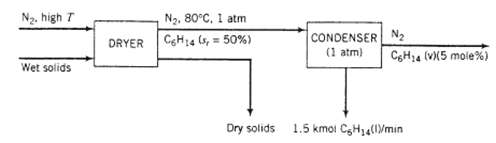
Solids soaked with liquid hexane are dried by being contacted with nitrogen at an elevated temperature. The gas stream leaving the dryer is at 80?C, 1 atm absolute and 50% relative saturation. (a) One of several possibilities for recovering the hexane from the gas is to send the stream to a cooling
A 20,000-liter storage tank was taken out of service to repair and reattach a feed line damaged in a collision with a tanker. The tank was drained and then opened several days later for a welder to enter and perform the required work. No one realized, however, that 15 liters of liquid nonane
An adult takes roughly 12 breaths each minute, inhaling approximately 500mL with each breath. Oxygen and carbon dioxide are exchanged in the lungs. The amount of nitrogen exhaled equals the amount inhaled, and the mole fraction of nitrogen in the exhaled air is 0.75. The exhaled air is saturated
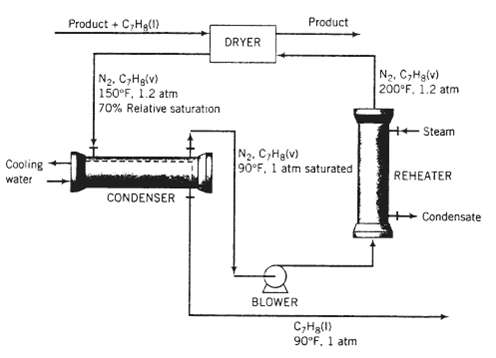
Recovering and reusing organic solvents (rather than discharging the solvents in waste streams) is an important part of the operation of most chemical plants. The magnitude of these recovery efforts can be staggering: in recent years the Eastman Chemical Company used 3.6 billion pounds of solvents
On a hot summer day the temperature is 35°C, barometric pressure is 103 kPa, and the relative humidity is 90%. An air conditioner draws in outside air, cools it to 20°C, and delivers it at a rate of 12,500 L/h. Calculate the rate of moisture condensation (kg/h) and the volumetric flow rate of the
An air conditioner is designed to bring 10.000 ft3/min of outside air (90°F. 29.8 in Hg, 88% relative humidity) to 40°F, thereby condensing a portion of the water vapor, and then to reheat the air, releasing it into a room at 65°F. Calculate the rate of condensation (gallons H2O/min) and the
The air in a building is to be maintained at 25°C and 55% relative humidity by passing outside air through a water spray. The air enters the spray chamber at 32°C and 70% relative humidity, leaves the chamber cooled and saturated with water vapor, and is then reheated to 25°C. Estimate the
A hygrometer is used to measure the moisture content of humid air. Calibration of the instrument leads to a straight line on a semi log plot of y, the mole fraction of water in air (logarithmic scale), versus H, the instrument reading (linear scale). Room air is charged into the hygrometer sample
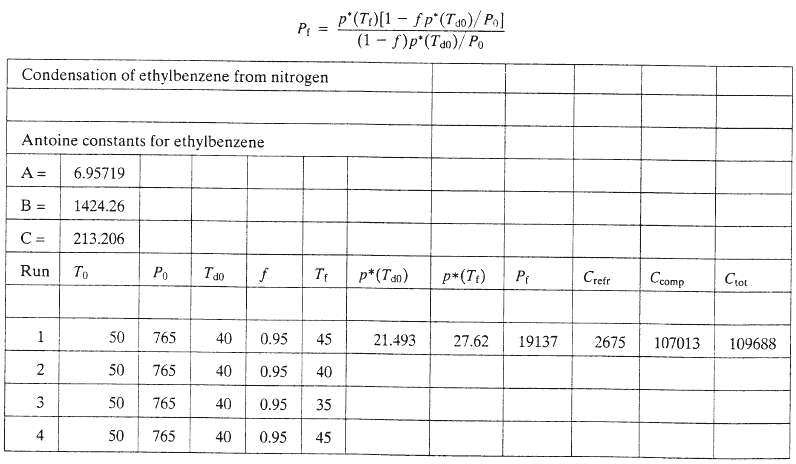
Recovery of a solvent vapor from a gas stream by condensation can be achieved by cooling the gas, by compressing it, or by a combination of these operations. The greater the compression, the less cooling is needed. (a) A gas mixture at a pressure P0 and temperature T0 is the feed to a recovery
A gas stream containing 40.0mole% hydrogen, 35.0% carbon monoxide, 20.0% carbon dioxide, and 5.0% methane is cooled from 1000°C to 10°C at a constant absolute pressure of 35.0 atm. Gas enters the cooler at 120 m3/min and upon leaving the cooler is fed to an absorber, where it is contacted with
A hot-air dryer is used to reduce the moisture content of 1500 kg/mm of wet wood pulp from 0.75 kg H2Ofkg dry pulp to 0.15 wt% H2O. Air is drawn from the atmosphere at 28°C, 760 mm Hg, and 50% relative humidity, sent through a blower-heater, and then fed to the dryer. The air leaves the dryer at
Wet leather containing 61% water enters a continuous tunnel dryer and leaves at a rate of 485lbm/h containing 6.0% water. Dry air enters the dryer at 140°F and 1 atm. and the outlet air is at 130°F and 1 atm with a relative humidity of 50%. Calculate the rate at which wet leather enters the dryer
N-Hexane is used to extract oil from soybeans. The solid residue from the extraction unit, which contains 0.78 kg liquid hexane/kg dry solids, is contacted in a dryer with nitrogen that enters at 85°C. The solids leave the dryer containing 0.05 kg liquid hexane/kg dry solids, and the gas leaves
In the final stage of the manufacturing process for a solid organic product, the product is cleaned with liquid toluene and then dried in a process whose flowchart is shown on the next page10. The wet product enters the dryer at a rate of 300lbm/h containing 0.200lbm toluene/lbm dry solids. A
N-Hexane is burned with excess air. An analysis of the product gas yields the following dry-basis molar composition: 6.9% CO2. 2.1% CO. 0.265% C6H14 (+ O2 and N2). The stack gas emerges at 760 mm Hg. Calculate the percentage conversion of hexane, the percentage excess air fed to the burner, and the
A fuel gas containing methane and ethane is burned with air in a furnace, producing a stack gas at 300°C and 105 kPa (absolute). The stack gas contains CO2 at a partial pressure of 80 mm Hg and no CO, O2, methane, or ethane. Calculate the mole fraction of methane in the fuel and the dew-point
A mixture of propane and butane is burned with air. Partial analysis of the stack gas produces the following dry-basis volume percentages: 0.0527% C3H8, 0.0527% C4H10, 1.48% CO. and 7.12% CO2. The stack gas is at an absolute pressure of 780 mm Hg and the dew point of the gas is 46.5°C. Calculate
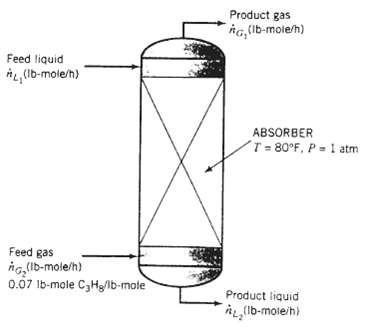
An important parameter in the design of gas absorbers is the ratio of the flow rate of the feed liquid to that of the feed gas. The lower the value of this ratio, the lower the cost of the solvent required processing a given quantity of gas but the taller the absorber must be to achieve a specified
Showing 600 - 700
of 6778
1
2
3
4
5
6
7
8
9
10
11
12
13
14
15
Last
Step by Step Answers

 Get 50% OFF
Claim Now
Get 50% OFF
Claim Now