New Semester
Started
Get
50% OFF
Study Help!
--h --m --s
Claim Now
Question Answers
Textbooks
Find textbooks, questions and answers
Oops, something went wrong!
Change your search query and then try again
S
Books
FREE
Study Help
Expert Questions
Accounting
General Management
Mathematics
Finance
Organizational Behaviour
Law
Physics
Operating System
Management Leadership
Sociology
Programming
Marketing
Database
Computer Network
Economics
Textbooks Solutions
Accounting
Managerial Accounting
Management Leadership
Cost Accounting
Statistics
Business Law
Corporate Finance
Finance
Economics
Auditing
Tutors
Online Tutors
Find a Tutor
Hire a Tutor
Become a Tutor
AI Tutor
AI Study Planner
NEW
Sell Books
Search
Search
Sign In
Register
study help
business
organizational behavior
Organizational Behavior 8th Edition Andrzej A. Huczynski, David A. Buchanan - Solutions
What are the causes and implications of boreout? What steps can management take to reduce or prevent boreout among office staff?
Measure the force (F) of your motivation to get a high grade in organizational behaviour:What are your V values? Identify the range of outcomes from working hard for this subject. Rate the value of each of these to you, as 1 (positive), 0 (ambivalent) or−1 (negative).What are your I values? For
Explain the distinction between content and process theories of motivation. Give an example of a content theory of motivation and describe the implications for organizational practice. What are the limitations of this approach in practice?
Think about the job that is ideal for you, in your ideal organization. Apart from pay, what other benefits and rewards do you want that job and that organization to give you? Realistically, what does your personal ‘total rewards’ package contain?
How does equity theory explain motivation and behaviour, and how can equity theory be used to diagnose and improve employee motivation?
You are employed on a job in which you repeat the same simple task every fifteen seconds, perhaps wiring plugs for lamps, 9.00 a.m. until 5.30 p.m., every day (with a lunch break), five days a week. Describe your emotional response to this work. Is it inevitable that some jobs just have to be like
Your instructor offers to enrich your educational experience of studying organizational behaviour, with additional classes and tutorials, further reading, and extra feedback and revision sessions. There is no guarantee, however, that this will increase your course grades. How do you feel about this
Some commentators argue that high performance work systems and empowerment are radical changes to organization design and management–employee relationships. Others argue that these are cosmetic, and have no effect on the power and reward inequalities and exploitation in contemporary
Why have the results of the Hawthorne studies remained so important to this day? Of what value are they to those working in groups and those managing groups, today?
Select either a group featured in a television series or one which you know well (e.g. sports team; scout/guide group; social club).(a) Is this a formal or informal group?(b) What stage is this group at, in terms of Tuckman and Jensen’s model of group development? (c) What is your group’s
Suggest reasons why group working has become so popular in organizations. In what ways does it benefit individual employees? How does it improve organizational performance?
How do informal groups within an organization differ from formal ones? What function do informal groups perform and which members’ needs do they meet?
Why would only one of the following be considered to be a group? In what circumstances could one of the other aggregates become a group? (a) People riding on a bus(b) Blonde women between 20 and 30 years of age(c) Members of a football team(d) Audience in a theatre(e) People sheltering in a shop
Choose a group with which you are familiar, and analyse it using the four elements of Homans’ model of group formation.
The groups to which you belong provide you with shared goals and a sense of identity, and meet your social needs. However, they can also constrain your thinking, stifle your freedom of expression, limit your behaviour, and restrict your freedom of expression. What is your opinion?
Under what circumstances should management form a group or a team to perform a task, and when should it arrange for individuals to work individually on their own?
Employees in the Bank Wiring Observation Room were subject to group-devised norms which its members policed and enforced. Think of a group that you have known, e.g. at school, work, college or socially. What norms did that group have; and how were they policed and enforced?
Do you agree or disagree with Henry Mintzberg’s view on rebuilding companies as communities? Are not heroic leaders like the late Steve Jobs more critical to company success than those followers who work in those companies?
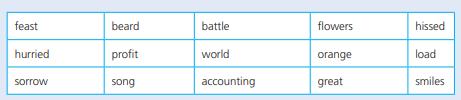
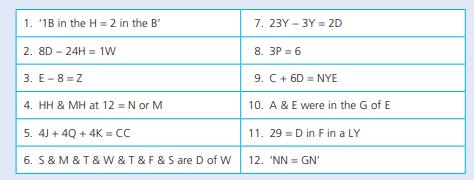
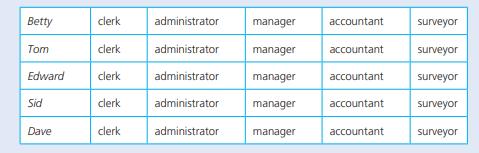
Task 1 – Rhyming words. Generate words that rhyme with the 15 words listed below.Task 2 – Word equations. Solve each of the word equations below by substituting the appropriate words for the letters e.g. 3F = 1Y (3 feet = 1 yard)Task 3 – Whose job? Discover which person has which job. Betty,
You have accepted a job and your new employer tells you that you will become ‘part of the team’, and a ‘member of one big happy family here’. • How do you feel about the organization as your ‘psychological home’ in this respect? • When managers say that they want you ‘to
Consider how your educational institution contributes to the satisfaction of your social needs while studying through your membership of social groups (class, tutorial groups, self-help and study groups, clubs and societies, sports teams). Conversely, how are other aspects of your institution’s
Identify a group to which you currently belong – sports club, drama society, tutorial group, project group, etc.• Identify which stage of development it has reached. • What advice would you give to this group based on your analysis of its development?
Management has just told you that you are not a ‘real team’ and that you are certainly not a ‘high performance team’. How do you feel about that, and what are you doing to do about it?
Select any two groups with which you are familiar. Contrast them in terms of any group structure dimensions that are relevant – e.g. power, communication, liking, roles, leadership. Suggest possible reasons for the similarities and differences that you have highlighted.
Studies suggest that employees spend many hours each week in meetings. Get invited to a real meeting that takes place in an organization which is likely to last at least 30 minutes. Consult the box ‘Analysing oral interactions in a group’ making several copies of the oral interaction score
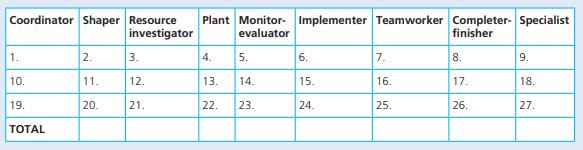
Listed below are statements that describe behaviours that members use when they are participating in a team. As a student, you may demonstrate these behaviours at work, in team projects, in student organizations and societies, or in interactions with your flatmates. Use the 1–5 scale below to
‘Companies want to hire applicants who are good team players.’ What does that mean to you in practice? Do you think that you are a good or poor team player?
Describe situations in which (a) A team role analysis and (b) A sociogram would be relevant to improve a group’s functioning. How would you apply these two techniques? How would you use the results?
1. Who gains from having stable power in a group, and why?2. Who loses, how, and why?3. Make the argument for having an unstable power structure in a group.
Critically assess the strengths and weaknesses of Belbin’s team role theory as a guide for the manager wishing to construct a team that will be effective.
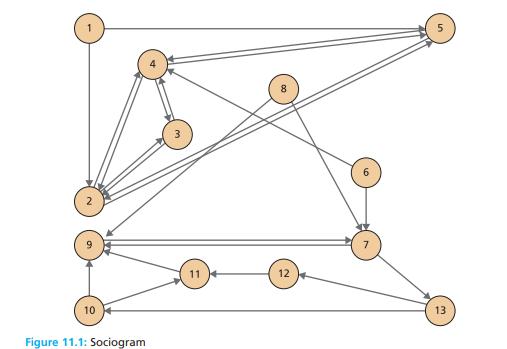
Look at the sociogram in Figure 11.1. Identify a ‘star’, an ‘isolate’, a ‘neglectee’, a ‘rejectee’, a ‘mutual pair’, and a ‘mutual trio’.Data given in figure 11.1 10 Figure 11.1: Sociogram 3 11 12 13
Consider a group of which you are currently a member. What action could you take to change your status in this group and what impact would this have on your relationships and friendships?
Identify some of the problems of virtual teamworking for (a) The companies which establish them, and(b) The individuals who work in them. How might these problems be overcome?
Think of an organization with which you are familiar. Identify two individuals with whom you would not like to work in a group. List the reasons for your reluctance.
You have been assigned to a group and given a task to perform. You hate your job and the management, and intend to resign shortly. What steps would you take to sabotage the work of your new group, while leaving you blameless in your boss’s eyes, and confident of obtaining a good reference?
Belbin argued that a successful team was one in which all nine of his roles were represented. What factors, inside or outside the organization, other than team role preferences, are likely to affect the success or failure of a team within an organization?
Is social loafing an individual issue, varying according to an individual’s personality and values; is it an organizational culture issue depending on company norms about over-manning, non-jobs, and management’s acceptance of poor employee performance?
Choose an organization with which you are familiar, and interview some employees who work there. Ask each interviewee how their co-workers would react, if they 1. Were seen being rude or indifferent to a customer. 2. Criticized a co-worker who was not performing satisfactorily. 3. Performed
Factory work can be boring and monotonous. Employees must work at the pace of the assembly line or machine, with output levels closely prescribed and monitored by management. It is not surprising that factory workers will try anything to break the boredom and relentless grind of the controlled
Are you a team player? What evidence would you provide an employer at a selection interview to demonstrate whether or not you are a ‘team player’? Use an example from school, university, social life, or work life.
Is conformity by the individual within organizations a bad thing that should be eliminated or a good thing that should be encouraged?
Let me tell you about my team member from hell. Someone with no desire to succeed is the worst kind of person to have as a member in your student project group because it is nearly impossible to induce him to do the work and perform it well. It was apparent from the beginning that John had no
Which group memberships do you cite when you introduce yourself to others? From the ‘us-and-them’ perspective, who are ‘us’ and who are ‘them’ for you? Has this helped your own group improve its performance? Has it raised your own self-esteem? Has the management in your organization
Critically evaluate the empirical research on individual conformity to group pressure.
What challenges have you found when working in tutorial or project groups at university with fellow students coming from different parts of the world? In your view, does their ethnic or national background affect their behaviour within your group? In what ways?
Suggest how an individual might go about persuading a majority.
Think of a time when you put a lot of effort into a group of which you were a part – work group, sports team or social group. Was the performance or well being of that group important to you? Did you contribute far more than would normally have been expected of you?
Have you had experience of social loafing or free riding in your educational or work context? What advice would you give to your instructor or manager to remove it?
It is important to feel that you fit in with your peers (others in your group, school, or neighbourhood). However, sometimes you may find yourself doing something because others are doing it, and that makes you feel uncomfortable or unsafe. Sometimes it is hard to say no to your friends. Can you
Consider a group of which you are a member, and its norms and sanctions. Reflect on a situation in which a member (perhaps yourself) broke a norm and received a sanction. Assess the positive and negative outcomes of this occurrence for the individual group member concerned and for the group as a
Think of an occasion when you have given an opinion or supported a decision contrary to your own feelings and judgement, but consistent with those around you at the time. How can you live with yourself for acting in such a socially compliant and submissive manner? What is your pathetic excuse for
What deindividuating tendencies can you identify in the organizations with which you are familiar? Are these being created consciously or unconsciously? What effect are they having on organizational employees and clients?
Is conformity by the individual within organizations a bad thing that should be eliminated; or is it a good thing that should be encouraged?
1. Read the case study below. 2. Working individually or in teams, provide a written recommendation for or against introducing teamworking at the Edinburgh office. 3. Group spokespersons should be ready to report their group’s decision and the reasoning behind it. Background Since the 1940s,
Self-managing or autonomous work teams are heavily promoted in the literature. What are the costs and benefits of these to(a) The management that establishes them and (b) The individuals who are members of such teams?
If you are a member of a team (work, sports, musical, religious, social), what level of decision input do you and your fellow team members have on which tasks, in relation to your supervisor, coach, choirmaster or conductor, priest or minister, club president? Make a list of tasks relevant to your
Using your library and the internet, locate any relevant research and management literature on effective teamworking and devise a list of best practice ‘do’s’ and ‘don’ts’, and use it to develop a list of questions. Select two organizations and, in each of them, interview a team member,
What impact can technology have on the behaviour and performance of teams. Discuss positive and negative effects, illustrating your answer with examples.
You are a middle manager at Nissan who has been a member of one of their nine cross-functional teams. Do you feel pleased to have been given the responsibility to participate in setting the company’s future direction, or resentful that the senior management seems to have manipulated you and your
‘Autonomous team is a relative term’. Discuss the concept of team autonomy explaining why similarly labelled teams may, in practice, operate very differently, and consider why management might have difficulty in increasing the autonomy that it gives to a team.
Highlight briefly the main differences between West European and Japanese-style teamworking. Then, using references to the literature, consider the positive and negative aspects of both systems for EITHER shop-floor workers OR management.
You have travelled back through time and are able to meet Taylor. What three things would you congratulate him for, and what three things would you criticize him for?
Taylorism has been much criticized. What are the criticisms? Which criticisms do you feel are valid and which are not? Give reasons for your assessment.
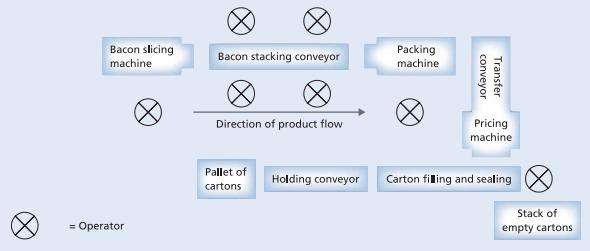
1. Form groups. Read the case Bacon processing line. 2. Which principles and practices of Taylorist and Fordist forms of work organization can you identify in the current work arrangements? 3. Management consultants have reported that these arrangements are not very efficient. It has proved
Visit a local fast food restaurant that uses a Taylorist/Fordist form of work organization. Observe and make notes on the behaviour of its employees (‘crew members’), both those at the counter and those in the kitchen. Arrange to talk to one or two crew members – perhaps you already know
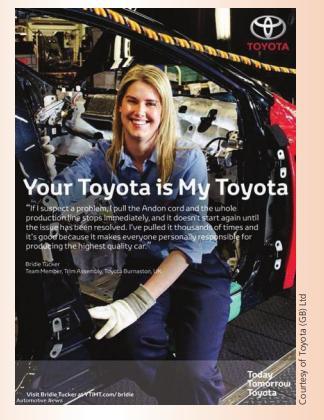
Toyota Motor Company’s advertisement in The Economist magazine is entitled ‘Your Toyota is My Toyota’. It shows a photograph of a female production team member on the assembly line at the company’s Burnaston plant in the UK with a thick yellow and black rope above her head. The text reads
1. Individually consider (a) What is meant by the term control within an organizational context? (b) In what different ways does the company that you work for control your behaviour on the job? 2. Form into groups and discuss the following questions: (a) What benefits do companies gain from
Go up to the bar and order a pint of beer.Start position: standing at barMovement 1: Hand to glass (2 seconds) Movement 2: Grip glass (0.5 seconds) Movement 3: Lift to horizontal (1 second) Movement 4: Lift to lips (1 second) Movement 5: Swallow 0.05 litres beer (2 seconds) Movement 6: Move arm
To what extent are performance-based pay, just-in-time inventory (stock) control, and business process re-engineering just modern-day applications of Frederick Taylor’s scientific management?
Anthony Gould’s research (see box) revealed that many McDonald’s workers were satisfied with their jobs. Do you find this surprising?The significance of this development is that much of the current literature about thenature of work and workplace organization is discussed in terms of Ritzer and
Identify non-food examples of the McDonaldization process. Analyse them in terms of Ritzer’s four key elements.
The obvious way to resolve the deskilling debate is to ask individual employees whether they think that their job now possesses a higher or lower level of skill requirement and responsibility compared to five years ago. Alternatively, if they have a new job, ask whether that requires more skill to
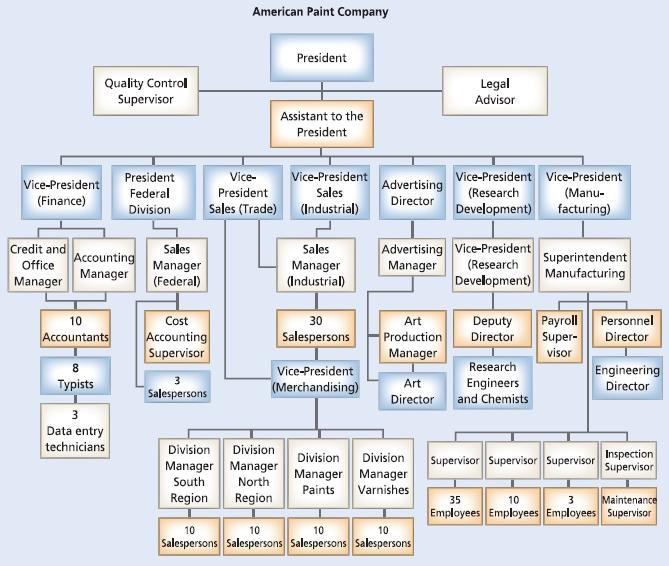
Study the organizational chart of the American Paint Company. The company has grown over recent years without much attention being paid to its organization structure. There are now at least fifteen problems. Focus on structural issues such as job titles, hierarchical levels, span of control, and so
Consider an organization with which you are familiar – e.g. a school, university, church, or current employer. Give one example each of specialist, specialized, generalized, and generalist work. What effect did each have on your satisfaction and motivation?
Is concertive control a totally new form of control over employees, or does it represent a modification and updating of traditional Taylorist and Fordist ideas?
Is hierarchical control an inevitable part of organization design or just a management convenience? Discuss.
Imagine that you are designing an organization structure for your new business – a café, bakery, travel agency, or similar, single shop on the high street.1. What are the specific tasks to be accomplished by your shop’s employees?2. Draw an organization chart based on employee tasks. Each
Consider the behaviour of the instructor teaching this course. Identify aspects of their behaviour that you like and do not like. Decide whether these positive and negative behaviours are influenced by that person’s personality or by the organization structure within which they work.
Why do organization structures differ? Which is the best organization structure?
1. What are the main organization structure concepts/key terms? Can you define them? 2. Read the case study Human button, and look for examples of these. 3. What are this organization’s goals? How does this organization structure operate to achieve them? Human button In 2012, the
Can a lecturer’s span of control (class size) ever be too narrow or too wide? What factors determine the number of students that a single instructor can deal with in terms of teaching, assessment, and course administration? What are the effects of high and low class sizes on (a) lecturers and (b)
Suggest how a manager’s role might be affected by the seniority of his or her position in the hierarchy, the industry sector, and organizational size
What are the costs and benefits for those involved in romances at work? Should a company ignore or actively discourage romantic relationships between its employees? What can senior management do to minimize the problems associated with workplace romances?
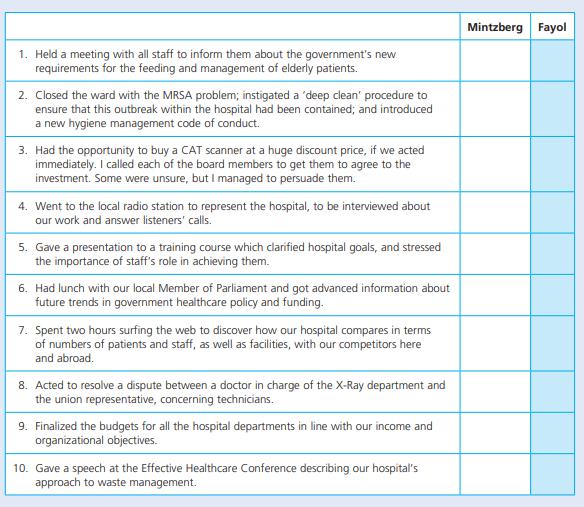
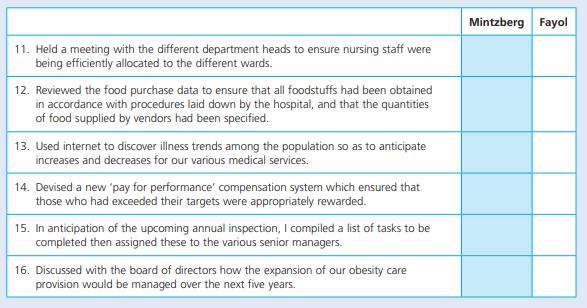
1. Remind yourself of Mintzberg’s ten management roles and Fayol’s six managerial activities. 2. Form groups and nominate a spokesperson. 3. Read the case Debra’s diary and then: (a) Identify one example of each of Mintzberg’s ten roles played by Debra (first ten items), and of each of
Why might companies and business academics be reluctant to admit to the existence of sexuality within the workplace? What negative consequences might it have for them?
It is common for people to refer to an organizational title or position (e.g. supervisor, scientist, manager) as the supervisor’s role, scientist’s role and manager’s role, as though it were merely an established way of referring to these positions. What assumptions and problems does this use
Identify any two roles that you currently occupy simultaneously in different social contexts, e.g. work, home, leisure. Identify a role conflict that you regularly experience as a result of such multiple role occupancy.
Think of some of the rules that you have encountered in organizations to which you currently belong, or to which you used to belong. How effective are they in directing the behaviour of individuals? What problems do they cause, and what advantages do they offer, and for whom?
As a shop-floor employee, would you prefer your company to be centralized or decentralized? Why?
Commentators argue that both too much and too little bureaucracy in an organization de-motivate employees and cause them stress. How can this be?
Use the internet to familiarize yourself with the Seven Wonders of the Ancient World – the Mausoleum at Halicarnassus, the Statute of Zeus at Olympia, the Temple of Artemis at Ephesus, the Hanging Gardens of Babylon, the Lighthouse of Alexandria, the Great Pyramid of Giza, and the Colossus of
What are the advantages and disadvantages of having management principles based on the experience of successful managers?
How does uncertainty affect the successful operation of rationally designed organization structures such as those proposed by Weber and Fayol?
TechTarget Inc. is an online information technology interactive media company based in Needham, Massachusetts that employs 210 staff. Founded in 1999, it became a public $100 million company in 2007, and now provides products to over 1,000 advertisers including Cisco, Dell, EMC, HP, IBM, Intel,
Woodward’s classification of technologies is based on the manufacture of products. How well does it fit the provision of services? Consider services such as having your windows cleaned, buying a lottery ticket, insuring your car, or having a dental checkup. What alternative classification system
Define and distinguish differentiation and integration. Using an example from your experience or reading, illustrate these two processes in operation, and highlight some of the problems that can be encountered.
How do the three sports of American football, basketball, and baseball link to Thompson’s three types of task interdependence?
Explain how technology and environment might influence the structure of an organization. Consider their effect on coordinating activities.
How well are the activities performed by your educational institution differentiated and integrated? Identify the problems and recommend solutions that would improve organizational performance from the student perspective.
Select an organization that you have read about or have first-hand experience of. What are the critical resources required for its continued operation?
Showing 3600 - 3700
of 5398
First
30
31
32
33
34
35
36
37
38
39
40
41
42
43
44
Last
Step by Step Answers

 Get 50% OFF
Claim Now
Get 50% OFF
Claim Now