New Semester Started
Get
50% OFF
Study Help!
--h --m --s
Claim Now
Question Answers
Textbooks
Find textbooks, questions and answers
Oops, something went wrong!
Change your search query and then try again
S
Books
FREE
Study Help
Expert Questions
Accounting
General Management
Mathematics
Finance
Organizational Behaviour
Law
Physics
Operating System
Management Leadership
Sociology
Programming
Marketing
Database
Computer Network
Economics
Textbooks Solutions
Accounting
Managerial Accounting
Management Leadership
Cost Accounting
Statistics
Business Law
Corporate Finance
Finance
Economics
Auditing
Tutors
Online Tutors
Find a Tutor
Hire a Tutor
Become a Tutor
AI Tutor
AI Study Planner
NEW
Sell Books
Search
Search
Sign In
Register
study help
business
pmp® exam practice test and study guide
Q & A's For The PMBOK Guide Third Edition 3rd Edition Frank T. Anbari - Solutions
Attributes of a communications management plan can include all of the following EXCEPT: A. The information that will be distributed to stakeholders. B. How often information will be distributed. C. The layout of the information and the method of transmission. D. All memos, correspondence, reports,
The major processes of Project Communications Management are: A. Communications Planning, Information Distribution, Performance Reporting, and Manage Stakeholders. B. Communications Planning, Response Planning, Progress Reporting, and Information Distribution. C. Communications Planning,
All of the following are true about conflict EXCEPT: A. It should be addressed early. B. It should be addressed usually in private. C. It should be addressed only when it escalates and at a special team meeting. D. It should be addressed using a direct, collaborative approach.
Questions that may arise when planning the acquisition of project team members generally include all of the following EXCEPT: A. Whether the human resources come from within the organization or from external, contracted sources. B. The costs associated with each level of expertise needed for the
During the course of many projects, negotiations are: A. Primarily the concern of contract administration. B. Likely for staff assignments. C. A direct result of ineffective decision-making. D. Conducted by senior executives.
Effective team development strategies and activities are expected to increase the team's performance, which increases the likelihood of meeting project objectives. The evaluation of a team's effectiveness can include all of the following indicators EXCEPT: A. Improvements in skills that allow a
Training has all of the following characteristics EXCEPT: A. Includes all activities designed to enhance the competencies of the project team members. B. Can be formal or informal. Examples of training methods include classroom, online, computer-based, on-the-job training from another project team
Team-building activities have all of the following characteristics EXCEPT: A. Some group activities, such as developing the WBS, can increase team cohesiveness when that planning activity is structured and facilitated well. B. Should only be considered after major conflicts within the project team,
A resource histogram has all of the following characteristics EXCEPT: A. It generally shows that the project has insufficient resources to be completed on schedule. B. It is a tool of the staffing management plan. C. It illustrates the number of hours that a person, department, or entire project
The responsibility assignment matrix (RAM): A. Is used for development of the project budget. B. Is developed at the activity level and used to closely link project roles and responsibilities to project network activities. C. Is used to show the connections between work that needs to be done and
Management of the project team is complicated: A. When team members are co-located. B. When minor problems do not impact the project completion date or budget targets. C. When team members are accountable to both a functional manager and the project manager. D. When formal training plans are
All of the following are outputs of Human Resource Planning EXCEPT: A. Roles and responsibilities. B. Project organization charts. C. Staffing management plan. D. Project interfaces.
Tools and techniques to acquire the project team include all of the following EXCEPT: A. Pre-Assignment. B. Acquisition. C. Staffing management plan. D. Negotiation.
The Project Human Resource Management processes include the following: A. Leadership, Team Building, and Negotiation. B. Recruitment, Labor Relations, and Personnel Administration. C. Organizational Structure Planning, Team Building, Communication, and Labor Relations. D. Human Resource Planning,
Co-location is one of the tools and technique to: A. Plan the organizational structure. B. Develop the project team. C. Acquire the project team. D. Plan the project resources.
To be effective, recognition and rewards systems should have the following characteristics EXCEPT: A. There should be clear criteria for rewards and a planned system for their use. B. Recognition and rewards should be based on activities and performance under a person's control. C. Recognition and
It is important that the staffing management plan addresses how team members will be released when they are no longer needed on the project for all of the following reasons EXCEPT: A. To reduce costs. B. To improve morale when smooth transitions to upcoming projects are already planned. C. To
Project team members are drawn from all available sources, both internal and external. When the project management team is able to influence or direct staff assignments, characteristics to consider include all of the following EXCEPT: A. Availability. B. Political philosophy. C. Ability. D.
All of the following are true about Six Sigma EXCEPT: A. It is a quality improvement initiative undertaken by the performing organization. B. It can improve the quality of the project's management. C. It can improve the quality of the project's product. D. It focuses on systematically correcting
All of the following are characteristics of benchmarking EXCEPT: A. It involves comparing actual or planned project practices to those of other projects to generate ideas for improvement. B. It involves comparing actual or planned project practices to those of other projects to provide a basis by
In Quality Planning: A. The primary benefit of meeting quality requirements is the reduced expense associated with project quality management activities. B. Cost-benefits tradeoffs must be considered. C. The primary cost of meeting quality requirements is increased rework. D. Benefits cannot be
Quality is the application of planned, systematic quality activities to ensure that the project will employ all processes needed to meet requirements. A. Planning B. Assurance C. Improvement D. Benchmarking
A control chart has all of the following characteristics EXCEPT: A. It illustrates how a process behaves over time. B. It is used to determine whether or not a process is stable or has predictable performance. C. It illustrates how various factors might be linked to potential problems or effects.
Quality and grade are not the same. A fundamental distinction is that: A. Grade is a category assigned to products or services having the same functional use, but different technical characteristics. B. Low quality may not be a problem; low grade is always a problem. C. Determining and delivering
The use of quality management processes and activities aims to provide a higher degree of: A. Needs satisfaction. B. Process capability. C. Product improvement. D. Project team performance.
Tools and techniques of quality control include all of the following EXCEPT: A. Flowcharting. B. Pareto chart. C. Control charts. D. Estimates of control tendency.
Investment in product quality improvement, especially defect prevention and appraisal, can often be borne by: A. The acquiring organization. B. The project management team. C. Executive management. D. The project.
Quality costs include all of the following EXCEPT: A. Appraisal. B. Prevention. C. External failure. D. Computer operations.
A is a specific type of histogram, ordered by frequency of occurrence, which shows how many defects were generated by type or category of identified cause. A. Pareto chart B. Bar chart C. Network diagram D. Critical path
Quality assurance (QA): A. Is the application of planned, systematic quality activities to ensure effective policing of the conformance of the project team to approved specifications. B. Is primarily concerned with providing the project team and stakeholders with standards, by which the project
The quality management plan provides input to and must address quality control (QC), quality assurance (QA), and continuous process improvement for the project. A. The overall project management plan B. The WBS C. The project scope D. External stakeholders
"Design of experiments" is a statistical method that helps: A. Determine how various elements of a system interrelate. B. Identify which factors may influence specific variables of a product or process. C. Establish a standard by which to measure performance. D. Compare actual or planned project
All of the following represent, or result from, the primary benefit of meeting quality requirements EXCEPT: A. Less rework. B. Higher productivity. C. Lower costs. D. Fewer change orders.
Understanding, evaluating, defining, and managing expectations are essential to satisfying: A. Customer requirements. B. The scope statement. C. Upper management. D. Functional requirements.
One of the fundamental tenets of modern quality management is: A. Quality is planned and inspected in. B. Quality does not cost. C. Quality is planned, designed, and built in-not inspected in. D. Quality requires constant inspection.
Inputs to quality control include all of the following EXCEPT: A. Work performance information. B. Quality management plan. C. Quality checklists. D. PERT chart.
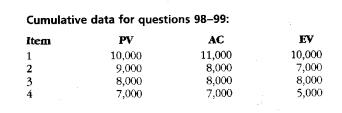
Which item has the LOWEST SPI? A. Item 1 B. Item 2 C. Item 3 D. Item 4
Which item is MOST over budget? A. Item 1 B. Item 2 C. Item 3 D. Item 4
If cumulative PV = 100, cumulative EV = 98, and cumulative AC = 104, the project is: A. Ahead of schedule. B. Headed for a cost overrun. C. Operating at project cost projections. D. Likely to come in under budget at completion.. Cumulative data for questions 98-99: Item PV AC EV 1234 1 10,000
Earned value (EV) involves all of the following EXCEPT: A. The originally allocated budget amount. B. Actual cost. C. Value of the budgeted cost of work performed. D. Budgeted amount for the work actually completed.
In the earned value technique, cost variance is computed as: A. EV minus PV. B. EV minus AC. C. AC minus EV. D. PV minus EV.
During the sixth monthly update on a ten- month, $30,000 project, the analysis shows that the cumulative PV is $20,000, the cumulative AC is $10,000, and the cumulative EV is $15,000. In planning its action, management can conclude all of the following from these figures EXCEPT: A. Less has been
Earned value technique (EVT) can best be defined as: A. Analysis of the value of the equipment that has been installed as of the data date. B. Analysis of the sum of the labor costs, which have been incurred on the project to date. C. A method of project performance measurement. D. A method of
Which of the following choices indicates that your project is 9% under budget? A. The cumulative AC was 100, and the cumulative EV was 110.B. The cumulative PV was 100, and the cumulative AC was 110.C. The cumulative AC was 110, and the cumulative EV was 100.D. The cumulative EV was 100, and the
Your schedule analysis has shown that your project has a high likelihood of experiencing a schedule overrun. You know this because the cumulative EV is much: A. Higher than the cumulative AC. B. Higher than the cumulative PV. C. Lower than the cumulative PV. D. Lower than the cumulative CPI.
The cost management plan has all of the following characteristics EXCEPT: A. It is based on the project cost estimates, and is separate from the project plan. B. Can establish variance thresholds for costs or other indicators. C. May be formal or informal, highly detailed or broadly framed. D.
The estimate at completion (EAC) is the projected or anticipated total final value for a schedule activity, WBS component, or project when the defined work of the project is completed. To determine the EAC, assuming no management intervention, which of the following information is needed? A. The
The cost baseline has all of the following characteristics EXCEPT: A. It is a time-phased budget that will be used to measure and monitor cost performance on the project. B. It shows the actual cost expenditures throughout the life of the project. C. It is developed by summing estimated costs by
Given: BAC = 200 ACC = 120 EV = 80 CPI = 0.666 Assuming that current variances are typical of future variances, the estimate at completion (EAC) is: A. 220.B. 260.C. 300.D. 320.
Given: BAC 200 ACC = 120 EV = 80 CPI = 0.666 Assuming that current variances are atypical, and that similar variances will not occur in the future, the estimate at completion (EAC) is: A. 120.B. 160.C. 200.D. 240.
Which of the following represents processes concerned with establishing and controlling the cost baseline? A. Resource Planning and Cost Containment. B. Cost Estimating and Cost Budgeting. C. Cost Budgeting and Cost Control. D. Resource Planning, Cost Estimating, and Cost Control.
Analogous estimating: A. Uses bottom-up estimating techniques. B. Uses the actual cost of previous, similar projects as the basis for estimating the cost of the current project. C. Is used most frequently in the later stages of a project. D. Summarizes estimates for individual work items.
Parametric cost estimating involves: A. Defining the parameters of the project life cycle. B. Calculating individual cost estimates for each work package. C. Using a statistical relationship between historical data and other variables to calculate a cost estimate. D. Using the actual cost of a
An activity cost estimate includes all of the following resource categories EXCEPT: A. Labor. B. Materials. C. Equipment. D. Time shortages.
Project cost control includes all of the following EXCEPT: A. Informing appropriate stakeholders of approved changes. B. Monitoring cost performance to detect and understand variances from the cost baseline. C. Recording all appropriate changes accurately against the cost baseline. D. Allocating
Which of the following is not true about cost estimates? A. Are generally expressed in units of currency (dollars, euro, yen, etc.). B. The costs for schedule activities are estimated for all resources that will be charged to the project. C. Do not generally consider information on risk responses.
Project Cost Management includes all of the following processes EXCEPT: A. Cost Estimating. B. Resource Leveling. C. Cost Budgeting. D. Cost Control.
In rolling wave planning: A. Focus is maintained on long-term objectives, allowing near-term objectives to be rolled out as part of the ongoing wave of activities. B. The work to be accomplished in the near term is planned in detail at a low level of the WBS. C. The work far in the future is
The critical chain: A. Focuses on managing the resources applied to buffer activities. B. Alters the required dependencies in the project schedule to optimize resource constraints. C. Adds duration buffers that are work schedule activities to maintain focus on the total float of network paths. D.
Analogous duration estimating is: A. Bottom-up estimating. B. Frequently used to estimate project duration when there is a limited amount of detailed information. C. Similar to multiple duration estimating. D. Deductive estimating
The "three-point estimates" method for estimating activity duration differs from the "single point, most-likely estimate" method in that it uses: A. An average of the three estimated durations to estimate activity duration. B. "Dummy" activities to represent logic ties. C. "Free float" instead of
As one of the tools and techniques of Activity Sequencing, a lead: A. Directs a delay in the successor activity. B. Could be accomplished by a finish-to-start relationship with a delay time. C. Means the successor activity cannot start until after the predecessor is completed. D. Allows an
All of the following choices represent inputs to the Activity Resource Estimating process EXCEPT: A. Organizational process assets. B. Activity list. C. The actual final cost of the last project. D. Enterprise environmental factors.
Output from the Activity Resource Estimating process includes: A. Job descriptions. B. Salary schedules. C. Identification and description of the types and quantities of resources required. D. Analogous estimating.
Crashing in time management is: A. A schedule compression technique that typically includes reducing schedule activity durations and increasing the assignment of resources to schedule activities. B. A schedule compression technique in which phases or activities that normally would be done in
The following is true about critical chain: A. It is a technique that allows development of an optimum project schedule when resources are unlimited. B. It is a technique that modifies the project schedule to account for limited resources. C. It is another name for the bar chart. D. It is primarily
All of the following are true about resource leveling EXCEPT: A. Can be used to keep selected resource usage at a constant level during specific time periods. B. Often results in a projected duration for the project that is longer than the preliminary project schedule. C. Is sometimes called the
The Project Time Management processes include: A. Activity Definition, Activity Sequencing, Activity Execution, and Activity Duration Estimating. B. Activity Definition, Activity Sequencing, and Activity Duration Estimating. C. Activity Identification, Activity Execution, and Activity Results. D.
The critical path is established by calculating the following dates: A. Start-to-start, start-to-finish, finish-to-finish, finish-to- start. B. Early start, early finish, late start, late finish. C. Predecessor-to-successor, predecessor-to- predecessor, successor-to-successor. D.
The Precedence Diagramming Method provides project managers with knowledge of: A. All levels of the work breakdown structure. B. Activities likely to be involved in the project integration and resource allocation functions. C. A graphical representation of interdependencies of activities. D. The
Bar charts are useful in determining: A. The level of effort of an activity. B. Activity start and end dates, as well as expected durations. C. Availability of resources assigned to perform an activity. D. Relative priority of activities.
A schedule compression technique to determine how to obtain the greatest amount of compression for the least incremental cost is called: A. Crashing. B. PERT. C. ADM or PDM forward and backward pass to determine the critical path. D. Fast tracking.
Inputs to activity definition include: A. Work breakdown structure, project schedule, and network diagram. B. Project schedule, progress reports, and change requests. C. Project network diagram, constraints, and durations. D. Project scope statement, work breakdown structure, and project management
An example of a "soft logic" dependency, as opposed to "hard logic" dependency, is: A. Project A, the company's participation in a Pump Industry trade show, depends on the successful completion of Project B, which is building the prototype pump that is going to be displayed. B. To install the
The "fast-tracking" method of schedule compression involves: A. The use of industrial engineering techniques to improve productivity, thereby finishing the project earlier than originally planned. B. Performing activities in parallel, thereby increasing risk. C. Going on a "mandatory overtime
The duration of the schedule activity is affected by all of the following EXCEPT: A. The estimated activity resource requirements. B. The resources assigned to the schedule activity. C. The availability of the resources assigned to the schedule activity. D. Using the Arrow Diagramming Method
The main difference between the two types (Arrow Diagramming Method and Precedence Diagramming Method) of the critical path method of scheduling is: A. Depiction of the activity on the logic diagram. B. Arrow Diagramming Method is a deterministic method, whereas the Precedence Diagramming Method is
An output of scope definition is: A. Work breakdown structure (WBS). B. Resource breakdown structure (RBS). C. Project scope statement. D. Schedule delays control plan.
The following is true about the WBS: A. The WBS is another term for the Gantt chart. B. Each descending level of the WBS represents an increasingly detailed definition of the project work. C. Work not in the WBS is usually defined in the scope statement of the project. D. The WBS shows only the
What is the WBS typically used for? A. To organize and define the total scope of the project. B. To identify the logical person to be project sponsor. C. To define the level of reporting the seller provides the buyer. D. As a record of when work elements are assigned to individuals.
An input to scope definition is: A. The type of contract detail language. B. Preliminary project scope statement. C. Work breakdown structure (WBS). D. Decomposition.
The following is an example of a constraint: A. A predefined budget. B. The threat of a strike by a subcontractor. C. Relationship with the seller. D. The method used to measure project performance.
Which of the following statements is true about the WBS? A. The WBS is a deliverable-oriented hierarchical decomposition of the work to be executed by the project team, to accomplish the project objectives and create the required deliverables. B. The WBS is an unstructured list of activities in
Scope verification: A. Is the process of obtaining the stakeholders' formal acceptance of the completed project scope and associated deliverables. B. Refers to the final project report describing the project at completion. C. Is not necessary if the project completes on time and on budget. D.
Which of the following is not an output of scope change control? A. Recommended corrective action. B. Scope baseline updates. C. Requested changes. D. Performance reports.
The project scope change control system includes all of the following EXCEPT: A. Documentation. B. Tracking systems. C. Approval levels. D. Evaluation process.
Which of the following is not true of the project scope management plan? A. It provides guidance on how project scope will be defined and documented. B. It provides guidance on how project scope will be verified. C. It provides guidance on how project scope will be managed and controlled. D. It is
An approved change request impacting project scope is: A. Any modification in technical specifications as defined in the WBS. B. Any change in project authorization. C. Any change in project personnel. D. Any modification to the agreed-upon project scope baseline, as defined by the approved project
All of the following are true about the project scope statement EXCEPT: A. It is an output of scope verification. B. It describes, in detail, the project's deliverables and the work required to create those deliverables. C. It provides a common understanding of the project scope among all project
All of the following are characteristics of the project charter EXCEPT: A. It is the document that formally authorizes a project. B. It is issued by a project initiator or sponsor external to the project organization, at a level that is appropriate to funding the project. C. It is used primarily to
All of the following are characteristics of the project management information system (PMIS) EXCEPT: A. It is a standardized set of automated tools available within the organization and integrated into a system. B. It is used by the project management team to support generation of the project
Actions and activities that are necessary to satisfy completion or exit criteria for the project, and to confirm that the project has met all sponsor, customer, and other stakeholders' requirements, are addressed: A. As part of the administrative closure procedure. B. Following the plan as outlined
Benefit measurement methods for project selection include all of the following EXCEPT: A. Comparative approaches. B. Linear programming method. C. Scoring models. D. Benefit contribution.
The Integrated Change Control process includes all of the following change management activities EXCEPT: A. Reviewing and approving requested changes. B. Resource leveling. C. Maintaining the integrity of baselines by releasing only approved changes for incorporation into project products or
A Change Control Board (CCB) is: A. A formally constituted group of stakeholders responsible for ensuring that only a minimal amount of changes occur on the project. B. An informal group that has oversight of project implementation. C. A formally constituted group of stakeholders responsible for
The configuration management system is a collection of formal documented procedures used to apply technical and administrative direction and surveillance to: A. Identify and correct problems arising in functional areas of project implementation. B. Identify and document the functional and physical
Which process is included in Project Integration Management? A. Develop project management plan. B. Control scope definition. C. Review scope verification. D. Conduct procurement surveillance.
Which is an acceptable cause for "re- baselining" a $10 million project? A. The client has authorized a $100,000 addition to the scope of the project. B. The contractor's company has instituted a Quality Program in which it has pledged to spend one million dollars during the next year. C. The
Tools included in Integrated Change Control are all of the following EXCEPT: A. Project management methodology. B. Expert judgment. C. Project management information system. D. Project plan updates.
The Initiating Process Group consists of the processes that: A. Facilitate the formal authorization to start a new project or a project phase. B. Deploy risk mitigation strategies. C. Establish and describe the need for a project selection process. D. Approve the market analysis to ensure
Showing 2900 - 3000
of 5789
First
23
24
25
26
27
28
29
30
31
32
33
34
35
36
37
Last
Step by Step Answers

 Get 50% OFF
Study Help!
Claim Now
Get 50% OFF
Study Help!
Claim Now