New Semester
Started
Get
50% OFF
Study Help!
--h --m --s
Claim Now
Question Answers
Textbooks
Find textbooks, questions and answers
Oops, something went wrong!
Change your search query and then try again
S
Books
FREE
Study Help
Expert Questions
Accounting
General Management
Mathematics
Finance
Organizational Behaviour
Law
Physics
Operating System
Management Leadership
Sociology
Programming
Marketing
Database
Computer Network
Economics
Textbooks Solutions
Accounting
Managerial Accounting
Management Leadership
Cost Accounting
Statistics
Business Law
Corporate Finance
Finance
Economics
Auditing
Tutors
Online Tutors
Find a Tutor
Hire a Tutor
Become a Tutor
AI Tutor
AI Study Planner
NEW
Sell Books
Search
Search
Sign In
Register
study help
sciences
general chemistry principles
General Chemistry Principles And Modern Applications 11th Edition Ralph Petrucci, Jeffry Madura, F. Herring, Carey Bissonnette - Solutions
Indicate several ways in which the valence bond method is superior to Lewis structures in describing covalent bonds.
Predict the shape of the XeF4 molecule and a hybridization scheme consistent with this prediction.
Give the formula of a compound or ion composed of arsenic and fluorine in which the arsenic atom has a sp3d2 hybridization state.
(A) Describe the molecular geometry and propose a plausible hybridization scheme for the central atom in the ion Cl2F+.(B) Describe the molecular geometry and propose a plausible hybridization scheme for the central atom in the ion BrF4+.
Explain why it is necessary to hybridize atomic orbitals when applying the valence bond method—that is, why are there so few molecules that can be described by the overlap of pure atomic orbitals only?
Formaldehyde gas, H2CO, is used in the manufacture of plastics; in aqueous solution, it is the familiar biological preservative called formalin. Describe the molecular geometry and a bonding scheme for the H2CO molecule.
What hybridization do you expect for the central atom in a molecule that has a square-pyramidal geometry?
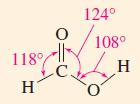
Formic acid, HCOOH, is an irritating substance released by ants when they bite (formica is Latin, meaning “ant”). Astructural formula with bond angles is given here. Propose a hybridization and bonding scheme consistent with this structure. 124° 118°--/1080 C H 0 Н
(A) Describe a plausible bonding scheme and the molecular geometry of dimethyl ether, CH3OCH3.(B) Acetic acid, the acidic component of vinegar, has the formula CH3COOH. Describe the molecular geometry and a bonding scheme for this molecule.
Describe the molecular geometry of H2O suggested by each of the following methods: (a) Lewis theory;(b) Valence bond method using simple atomic orbitals; (c) VSEPR theory; (d) Valence bond method using hybridized atomic orbitals.
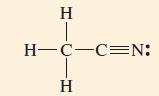
(A) Acetonitrile is an industrial solvent. Propose a hybridization and bonding scheme consistent with its structure.(B) A reference source on molecular structures lists the following data for dinitrogen monoxide (nitrous oxide), N2O: Bond lengths: N—N = 113 pm; N—O = 119 pm; bond angle = 180°.
Describe the molecular geometry of NH3 suggested by each of the following methods: (a) Lewis theory;(b) Valence bond method using simple atomic orbitals; (c) VSEPR theory; (d) Valence bond method using hybridized atomic orbitals.
The molecule diazine has the molecular formula N2H2. What is the hybridization of the nitrogen and does the molecule contain a double or triple bond?
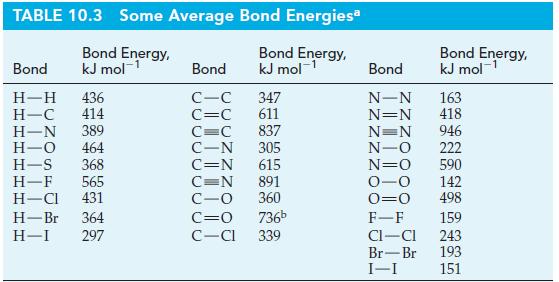
The bond energy of H2 is 436 kJ/mol. Estimate the bond energies of H2+ and He2+.
A ground state H2 molecule can absorb electromagnetic radiation to form the ion H2+ or an excited state with an electron promoted to the σ*1s orbital. Which process requires the greater amount of energy? Which species is most stable?
(A) The bond energy of Li2 is 106 kJ/mol. Estimate the bond energy of Li2+.(B) Do you think the ion H2- is stable? Explain.
In which of the following, CO32-, SO2, CCl4, CO, NO2- would you expect to find sp2' hybridization of the central atom? Explain.
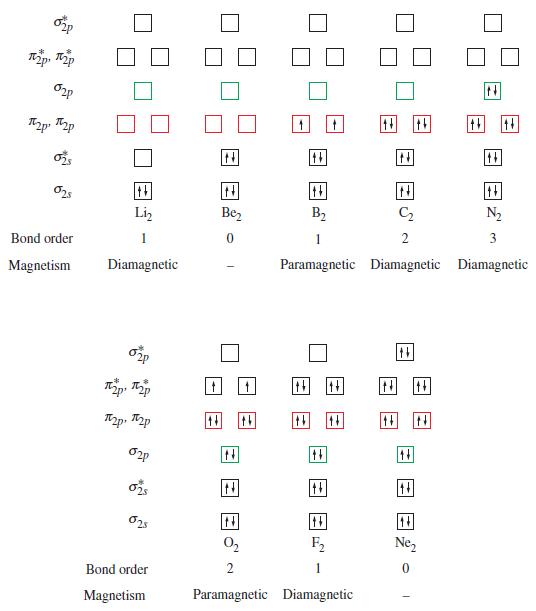
(A) Refer to Figure 11-26. Write a molecular orbital occupancy diagram, determine the bond order, and write the electronic configurations of (a) N2+; (b) Ne2+;(c) C22-.(B) The bond lengths for O2+, O2, O2- and O22- are 112, 121, 128, and 149 pm, respectively. Are these bond lengths consistent
In the manner of Example 11-1, describe the probable structure and bonding in (a) HI; (b) BrCl; (c) H2Se;(d) OCl2.Example 11-1Indicate several ways in which the valence bond method is superior to Lewis structures in describing covalent bonds.
Represent bonding in O2+ with a molecular orbital occupancy diagram, and determine the bond order in this ion.
In valence bond theory, π bonds are always accompanied by a σ bond. Can the same also be said of the molecular orbital theory for diatomic molecules?
(A) Write the electron configuration for CN+, and determine the bond order.(B) Write the electron configuration for BN, and determine the bond order.
For each of the following species, identify the central atom(s) and propose a hybridization scheme for those atom(s): (a) CO2;(b) HONO2;(c) ClO3-;(d) BF4-.
Write the ground state electron configuration for the cyanide ion, CN-, and determine the bond order for this ion. Clearly state any assumptions.
Would you expect NeO to be a stable molecule?
(A) Represent chemical bonding in the molecule SO3 by using a combination of localized and delocalized orbitals.(B) Represent chemical bonding in the ion NO2- by using a combination of localized and delocalized orbitals.
For the NO3- ion, one molecular orbital in the π system is bonding and one is antibonding. How many nonbonding π orbitals are there? Which of the π molecular orbitals are occupied? What is the predicted bond order for the nitrogen-to-oxygen bonds?
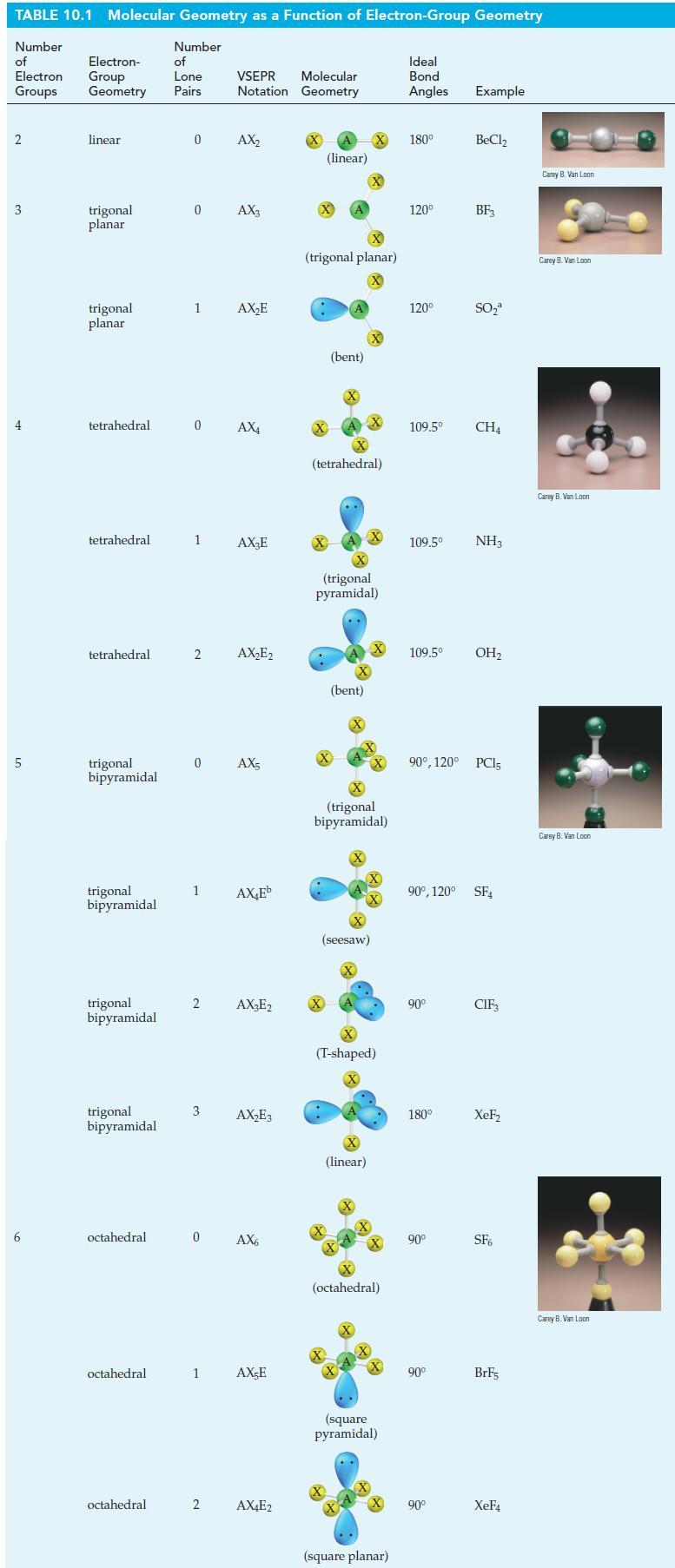
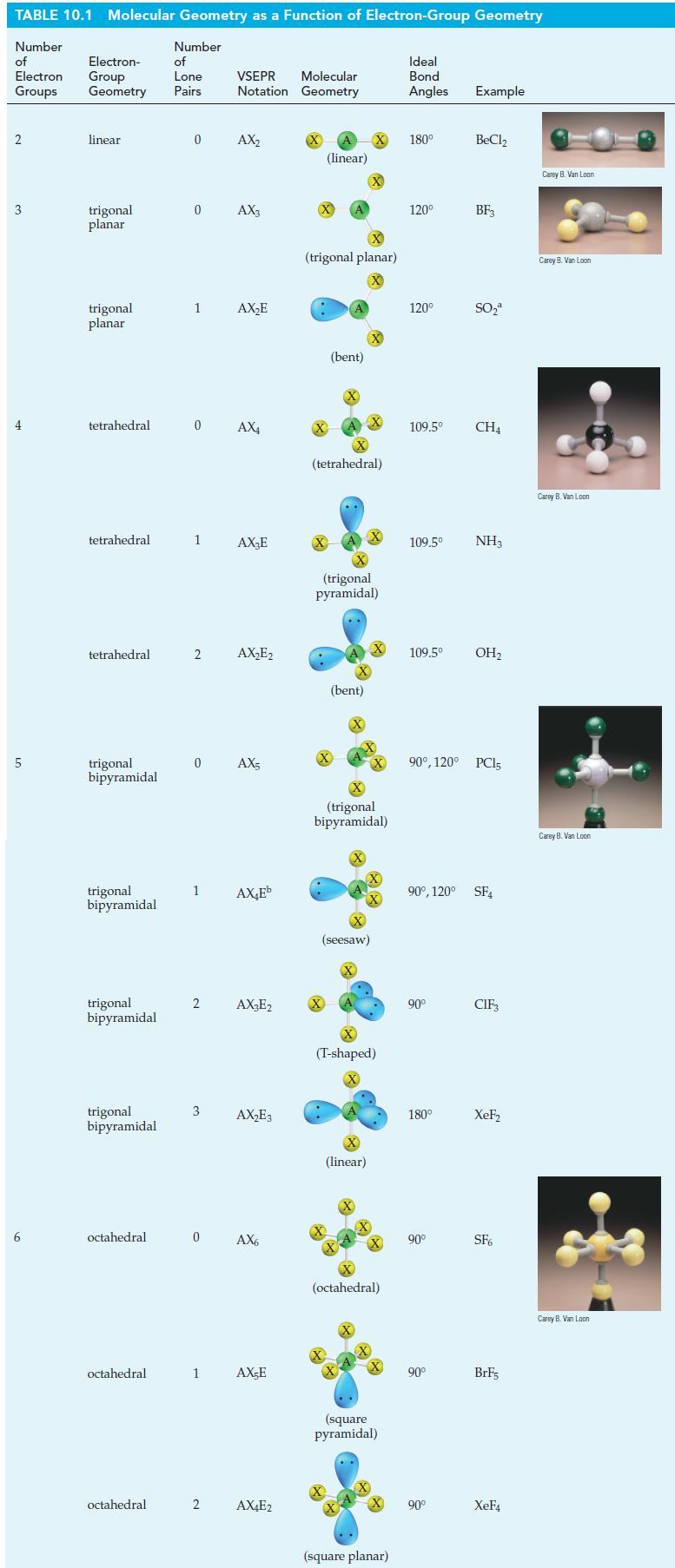
Describe a hybridization scheme for the central Cl atom in the molecule ClF3 that is consistent with the geometric shape pictured in Table 10.1. Which orbitals of the Cl atom are involved in overlaps, and which are occupied by lone-pair electrons?Table 10.1 TABLE 10.1 Molecular Geometry as a
Propose a plausible Lewis structure, geometric structure, and hybridization scheme for the ONF molecule.
Describe a hybridization scheme for the central S atom in the molecule SF4 that is consistent with the geometric shape pictured in Table 10.1. Which orbitals of the S atom are involved in overlaps, and which are occupied by lone-pair electrons?Table 10.1 TABLE 10.1 Molecular Geometry as a Function
(A) Melamine is a carbon–hydrogen–nitrogen compound used in the manufacture of adhesives, protective coatings, and textile finishing (such as in wrinkle-free, wash-and-wear fabrics). Its mass percent composition is 28.57% C, 4.80% H, and 66.64% N. The melamine molecule features a six-member
Would you expect the delocalized π-bonding framework in HCO2- to be similar to that in ozone or to that in the nitrate anion?
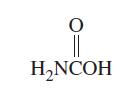
Propose a hybridization scheme to account for bonds formed by the central carbon atom in each of the following molecules: (a) Hydrogen cyanide, HCN;(b) Methyl alcohol, CH3OH;(c) Acetone, (CH3)2CO;(d) Carbamic acid, O H₂NCOH
Indicate which of the following molecules and ions are linear, which are planar, and which are neither. Then propose hybridization schemes for the central atoms.(a) Cl2C = CCl2;(b) N ≡ C – C ≡ N;(c) F3C – C ≡ N;(d) [S – C ≡ N]-.
In the manner of Figure 11-18, indicate the structures of the following molecules in terms of the overlap of simple atomic orbitals and hybrid orbitals: (a) CH2Cl2;(b) OCN-;(c) BF3.
Write Lewis structures for the following molecules, and then label each and bond. (a) HCN; (b) C2N2;(c) CH3CHCHCCl3;(d) HONO.
Represent bonding in the carbon dioxide molecule, CO2, by (a) A Lewis structure and (b) The valence bond method. Identify σ and π bonds, the necessary hybridization scheme, and orbital overlap.
The paramagnetism of gaseous B2 has been established. Explain how this observation confirms that the π2p orbitals are at a lower energy than the σ2p orbital for B2.
Construct the molecular orbital diagram for SrCl. Would you expect the bond length of SrCl+ to be longer or shorter than that of SrCl?
One of the characteristics of antibonding molecular orbitals is the presence of a nodal plane. Which of the bonding molecular orbitals considered in this chapter have nodal planes? Explain how a molecular orbital can have a nodal plane and still be a bonding molecular orbital.
Explain why the concept of delocalized molecular orbitals is essential to an understanding of bonding in the benzene molecule, C6H6.
Explain how it is possible to avoid the concept of resonance by using molecular orbital theory.
Use the method of Figure 11-19 to represent bonding in each of the following molecules:(a) CCl4;(b) ONCl;(c) HONO;(d) COCl2.Figure 11-19 σ: T: C(2p)-0(2p) H H(1s)-C(sp²) 120° C-Ö H 120° o: C(sp²)-0(2p) [or, σ: C(sp²)-0(sp²)]
Use the method of Figure 11-19 to represent bonding in each of the following ions: (a) NO2-;(b) I3-;(c) C2O2-;(d) HCO3-.Figure 11-19 T: C(2p)-0(2p) H o: H(1s)-C(sp²) 120°C-ö H 120⁰ σ: C(sp²)-0(2p) [or, o: C(sp²)-0(sp²)]
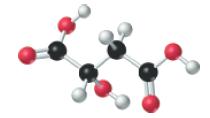
Malic acid is a common organic acid found in unripe apples and other fruit. With the help of the molecular model shown below, represent bonding in the malic acid molecule, using the method of Figure 11-19 to indicate hybridization schemes and orbital overlaps.Figure 11-19
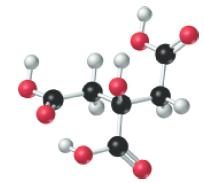
The molecular model below represents citric acid, an acidic component of citrus juices. Represent bonding in the citric acid molecule using the method of Figure 11-19 to indicate hybridization schemes and orbital overlaps.Figure 11-19
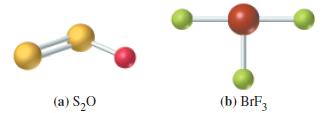
Shown below are ball-and-stick models. Describe hybridization and orbital-overlap schemes consistent with these structures. (a) S₂0 (b) BrF3
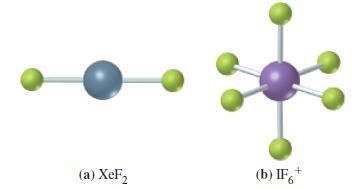
Shown below are ball-and-stick models. Describe hybridization and orbital-overlap schemes consistent with these structures. (a) XeF₂ (b) IF+
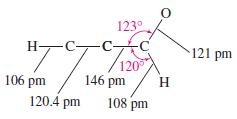
Propose a bonding scheme that is consistent with the structure for propynal. 123⁰ -C- -C 120° H -C- 1/7/7/196 120.4 pm 106 pm 146 pm 108 pm H 121 pm
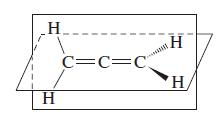
The structure of the molecule allene, CH2CCH2, is shown here. Propose hybridization schemes for the C atoms in this molecule. H H C=C=C H H
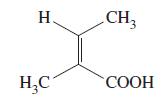
Angelic acid, shown below, occurs in sumbol root, a herb used as a stimulant.Represent the bonding in the angelic acid molecule by using the method in Figure 11-19 to indicate hybridization schemes and orbital overlaps. What is the maximum number of atoms that can lie in the same plane?Figure 11-19
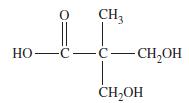
Dimethylolpropionic acid, shown below, is used in the preparation of resins.Represent the bonding in the dimethylolpropionic acid molecule by using the method in Figure 11-19 to indicate hybridization schemes and orbital overlaps. What is the maximum number of atoms that can lie in the same
Explain the essential difference in how the valencebond method and molecular orbital theory describe a covalent bond.
Describe the bond order of diatomic carbon, C2, with Lewis theory and molecular orbital theory, and explain why the results are different.
N2(g) has an exceptionally high bond energy. Would you expect either N2- or N22- to be a stable diatomic species in the gaseous state? Explain.
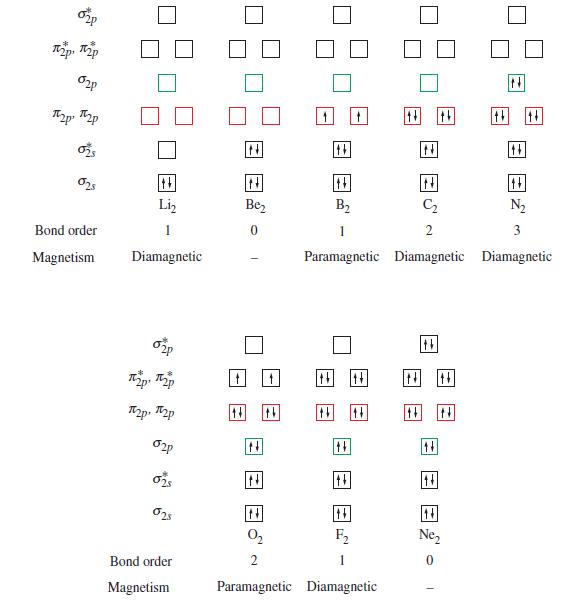
In our discussion of bonding, we have not encountered a bond order higher than triple. Use the energy level diagrams of Figure 11-26 to show why this is to be expected.Figure 11-26 820 кар, кар 020 2p p 025 025 Bond order Magnetism ++ Li₂ 1 Diamagnetic 020 p p p. p 020 025 025 Bond
Is it correct to say that when a diatomic molecule loses an electron, the bond energy always decreases (that is, that the bond is always weakened)? Explain.
For the following pairs of molecular orbitals, indicate the one you expect to have the lower energy, and state the reason for your choice. (a) σ1s or σ*1s;(b) σ2s or σ2p;(c) σ*1s or σ2s; (d) σ2p or σ*2p.
For each of the species C2+, O2-, F2+, and NO+;(a) Write the molecular orbital occupancy diagram (as in Example 11-6).(b) Determine the bond order, and state whether you expect the species to be stable or unstable.(c) Determine if the species is diamagnetic or paramagnetic; and if paramagnetic,
Write plausible molecular orbital occupancy diagrams for the following heteronuclear diatomic species: (a) NO;(b) NO+;(c) CO; (d) CN; (e) CN-;(f) CN+;(g) BN.
We have used the term “isoelectronic” to refer to atoms with identical electron configurations. In molecular orbital theory, this term can be applied to molecular species as well. Which of the species in Exercise 35 are isoelectronic?
Consider the molecules NO+ and N2+ and use molecular orbital theory to answer the following:(a) Write the molecular orbital configuration of each ion (ignore the electrons).(b) Predict the bond order of each ion.(c) Which of these ions is paramagnetic? Which is diamagnetic?(d) Which of these ions
Consider the molecules CO+ and CN- and use molecular orbital theory to answer the following:(a) Write the molecular orbital configuration of each ion (ignore the 1s electrons).(b) Predict the bond order of each ion.(c) Which of these ions is paramagnetic? Which is diamagnetic?(d) Which of these
Construct the molecular orbital diagram for CF. Would you expect the bond length of CF+ to be longer or shorter than that of CF?
In which of the following molecules would you expect to find delocalized molecular orbitals? Explain.(a) C2H4;(b) SO2;(c) H2CO.
In which of the following ions would you expect to find delocalized molecular orbitals? Explain. .(a) HCO2-;(b) CO32-;(c) CH3+.
Furan, C4H4O, is a substance derivable from oat hulls, corn cobs, and other cellulosic waste. It is a starting material for the synthesis of other chemicals used as pharmaceuticals and herbicides. The furan molecule is planar and the C and O atoms are bonded into a fivemembered pentagonal ring. The
According to molecular orbital theory, the O22- ion has which of the following? (a) Two unpaired electrons;(b) A bond order of two; (c) Its highest energy electron in a σ* orbital; (d) No 2s electrons; (e) All of these.
What is the angle between the hybrid orbitals obtained by combining the 2s and two 2p orbitals of an atom? (a) 90 ; (b) 120 ; (c) 180 ; (d) 109.5 ; (e) None of these.
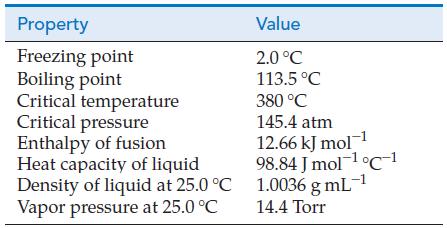
Use data from the table of physical properties of hydrazine, N2H4, to calculate the partial pressure of N2H4(g) when a container filled with an equilibrium mixture of N2H4(g) and N2H4(I) at 25.0 °C is cooled to the temperature of an ice–water bath. Property Freezing point Boiling point Critical
What are the types of intermolecular interactions in CH3CH2NH2(l), and which is the strongest?
(A) Which of the following substances would you expect to have the highest boiling point: C3H8, CO2, CH3CN? Explain.(B) Arrange the following in the expected order of increasing boiling point: C8H18, CH3CH2CH2CH3, (CH3)3CH, C6H5CHO (octane, butane, isobutane, and benzaldehyde respectively).
Lewis theory is satisfactory to explain bonding in the ionic compound K2O, but it does not readily explain formation of the ionic compounds potassium superoxide, KO2, and potassium peroxide, K2O2.(a) Show that molecular orbital theory can provide this explanation.(b) Write Lewis structures
The compound potassium sesquoxide has the empirical formula K2O3. Show that this compound can be described by an appropriate combination of potassium, peroxide, and superoxide ions. Write a Lewis structure for a formula unit of the compound.
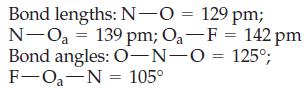
Fluorine nitrate, FONO2, is an oxidizing agent used as a rocket propellant. A reference source lists the following data for FOaNO2. (The subscript “a” shows that this O atom is different from the other two.)NOaF plane is perpendicular to the O2NOa plane Use these data to construct a Lewis
Draw a Lewis structure for the urea molecule, CO(NH2)2, and predict its geometric shape with the VSEPR theory. Then revise your assessment of this molecule, given the fact that all the atoms lie in the same plane, and all the bond angles are 120°. Propose a hybridization and bonding scheme
Methyl nitrate, CH3NO3, is used as a rocket propellant. The skeletal structure of the molecule is CH3ONO2. The N and three O atoms all lie in the same plane, but the CH3 group is not in the same plane as the NO3 group. The bond angle C—O—N is 105°, and the bond angle O—N—O is 125°. One
Think of the reaction shown here as involving the transfer of a fluoride ion from ClF3 to AsF5 to form the ions ClF2+ and AsF6-. As a result, the hybridization scheme of each central atom must change. For each reactant molecule and product ion, indicate (a) Its geometric structure and (b) The
In the gaseous state, HNO3 molecules have two nitrogen-to-oxygen bond distances of 121 pm and one of 140 pm. Draw a plausible Lewis structure(s) to represent this fact, and propose a bonding scheme in the manner of Figure 11-19.Figure 11-19 T: C(2p)-0(2p) H o: H(1s)-C(sp²) 120° C-ö H 120⁰ σ:
Draw a Lewis structure(s) for the nitrite ion, NO2-. Then propose a bonding scheme to describe the and π bonding in this ion. What conclusion can you reach about the number and types of molecular orbitals in this ion? Explain.
He2 does not exist as a stable molecule, but there is evidence that such a molecule can be formed between electronically excited He atoms. Write an electron configuration for He2 to account for this.
The molecule formamide, HCONH2, has the approximate bond angles H—C—O, 123°; H—C—N, 113°; N—C—O, 124°; C—N—H, 119°; H—N—H, 119°. The C—N bond length is 138 pm. Two Lewis structures can be written for this molecule, with the true structure being a resonance hybrid of the
Pyridine, C5H5N, is used in the synthesis of vitamins and drugs. The molecule can be thought of in terms of replacing one CH unit in benzene with a N atom. Draw orbital diagrams to show the orbitals of the C and N atoms involved in the σ and π bonding in pyridine. How many bonding and antibonding
Ethyl cyanoacetate, a chemical used in the synthesis of dyes and pharmaceuticals, has the mass percent composition: 53.09% C, 6.24% H, 12.39% N, and 28.29% O. In the manner of Figure 11-19, show a bonding scheme for this substance. The scheme should designate orbital overlaps, σ and π bonds, and
The ion F2Cl- is linear, but the ion F2Cl+ is bent. Describe hybridization schemes for the central Cl atom consistent with this difference in structure.
A certain monomer used in the production of polymers has one nitrogen atom and the mass composition 67.90% C, 5.70% H, and 26.40% N. Sketch the probable geometric structure of this molecule, labeling all the expected bond lengths and bond angles.
A solar cell that is 15% efficient in converting solar to electric energy produces an energy flow of 1.00 kW/m2 when exposed to full sunlight.(a) If the cell has an area of 40.0 cm2 what is the power output of the cell, in watts?(b) If the power calculated in part (a) is produced at 0.45 V, how
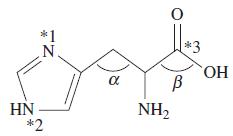
Histidine, an essential amino acid, serves as a part of the active center in many enzymes. It is the precursor to histamine, a neurotransmitter and a component of the body’s immune response. The structure of histidine is shown below.Identify the hybridization scheme for the atoms marked with an
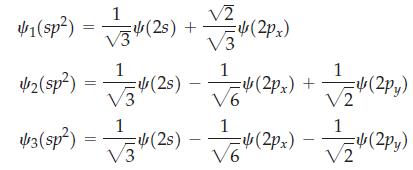
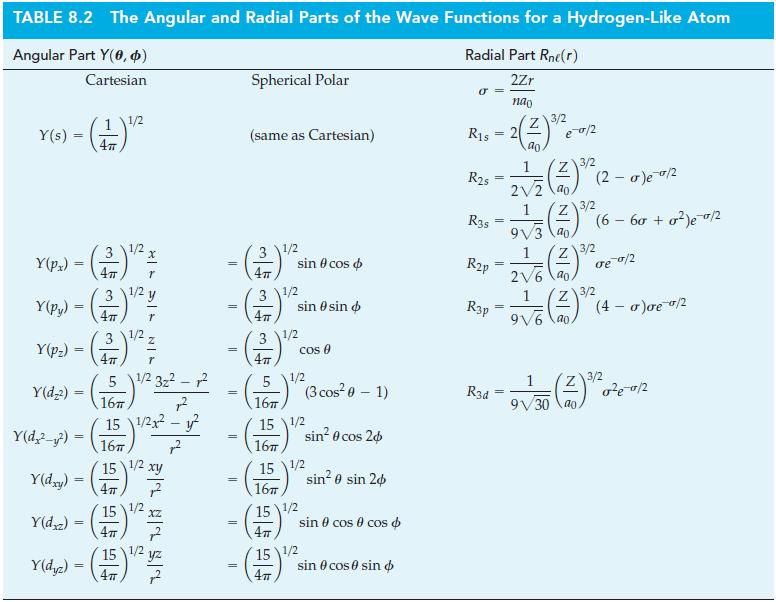
As discussed in Are You Wondering 11-1, the sp hybrid orbitals are algebraic combinations of the s and p orbitals. The required combinations of 2s and 2p orbitals are(a) By combining the appropriate functions given in Table 8.2, construct a polar plot in the manner of Figure 8-24 for each of the
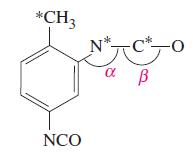
Toluene-2,4-diisocyanate is used in the manufacture of polyurethane foam. An incomplete structure is shown below. Describe the hybridization scheme for the atoms marked with an asterisk, and indicate the values of the bond angles marked α and β. *CH3 NCO *C -0 a В N*-
The anion I42- is linear, and the anion I5- is V-shaped, with a 95° angle between the two arms of the V. For the central atoms in these ions, propose hybridization schemes that are consistent with these observations.
Resonance energy is the difference in energy between a real molecule—a resonance hybrid—and its most important contributing structure. To determine the resonance energy for benzene, we can determine an energy change for benzene and the corresponding change for one of the Kekulé structures. The
Pentadiene, C5H8, has three isomers, depending on the position of the two double bonds. Determine the shape of these isomers by using VSEPR theory. Describe the bonding in these molecules by using the valence bond method. Do the shapes agree in the two theories? Use molecular orbital theory to
A conjugated hydrocarbon has an alternation of double and single bonds. Draw the molecular orbitals of the π system of 1,3,5-hexatriene. If the energy required to excite an electron from the HOMO to the LUMO corresponds to a wavelength of 256 nm, do you expect the wavelength for the corresponding
An elusive intermediate of atmospheric reactions of HONO may be nitrosyl O-hydroxide, HOON. Electronic structure calculations seem to indicate that HOON is best represented by a combination of three resonance structures, with major contribution from a radical-pair structure (involving HO and NO
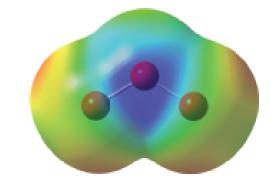
We saw that electronegativity differences determine whether bond dipoles exist in a molecule and that molecular shape determines whether bond dipoles cancel (nonpolar molecules) or combine to produce a resultant dipole moment (polar molecules). Thus, the ozone molecule, O3, has no bond dipoles
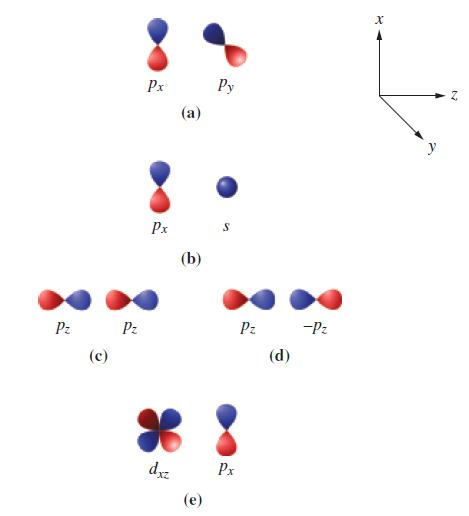
Which of the following combinations of orbitals give rise to bonding molecular orbitals? For those combinations that do, label the resulting bonding molecular orbital as σ or π. Pz Pz (c) Px (a) dxz Px S (b) Py (e) Px Pz -Pz (d) X N
Borazine, B3N3H6 is often referred to as inorganic benzene because of its similar structure. Like benzene, borazine has a delocalized π system. Describe the molecular orbitals of the π system. Identify the highest occupied molecular orbital (HOMO) and the lowest unoccupied molecular orbital
Construct a molecular orbital diagram for HF, and label the molecular orbitals as bonding, antibonding, or nonbonding.
In your own words, define the following terms or symbols: (a) sp2; (b) σ*2p; (c) Bond order; (d) π bond.
Showing 2300 - 2400
of 4008
First
17
18
19
20
21
22
23
24
25
26
27
28
29
30
31
Last
Step by Step Answers

 Get 50% OFF
Claim Now
Get 50% OFF
Claim Now


![T: (2p)-0(2p) H o: H(1s)-C(sp) 120C= H 120 o: C(sp)-0(2p) [or, o: C(sp)-0(sp)]](https://dsd5zvtm8ll6.cloudfront.net/images/question_images/1699/9/5/7/32465534a4c3eead1699957323151.jpg)
![: T: C(2p)-0(2p) H H(1s)-C(sp) 120 C- H 120 o: C(sp)-0(2p) [or, : C(sp)-0(sp)]](https://dsd5zvtm8ll6.cloudfront.net/images/question_images/1699/9/6/2/58765535edb4ceb11699962586090.jpg)
![T: C(2p)-0(2p) H o: H(1s)-C(sp) 120C- H 120 : C(sp)-0(2p) [or, o: C(sp)-0(sp)]](https://dsd5zvtm8ll6.cloudfront.net/images/question_images/1699/9/6/2/79665535fac55c581699962795141.jpg)
![T: C(2p)-0(2p) H o: H(1s)-C(sp) 120 C H 120 o: C(sp)-0(2p) [or, o: C(sp)-0(sp)]](https://dsd5zvtm8ll6.cloudfront.net/images/question_images/1699/9/6/2/9316553603328d4b1699962929959.jpg)
![T: C(2p)-0(2p) H o: H(1s)-C(sp) 120 C H 120 o: C(sp)-0(2p) [or, o: C(sp)-0(sp)]](https://dsd5zvtm8ll6.cloudfront.net/images/question_images/1699/9/6/2/9226553602a09d1f1699962920805.jpg)
![T: C(2p)-0(2p) H o: H(1s)-C(sp) 120 C H 120 : C(sp)-0(2p) [or, o: C(sp2)-0(sp)]](https://dsd5zvtm8ll6.cloudfront.net/images/question_images/1699/9/6/3/26865536184657021699963267134.jpg)
![TT: C(2p)-0(2p) H r: H(ls)C(sp2) _120 C-8 H 120 0: C(sp)-0(2p) [or, o: C(sp2)-0(sp)]](https://dsd5zvtm8ll6.cloudfront.net/images/question_images/1699/9/6/3/390655361fe1aa241699963388814.jpg)

![T: C(2p)-0(2p) H o: H(1s)-C(sp) 120 C- H 120 : C(sp)-0(2p) [or, o: C(sp2)-0(sp)]](https://dsd5zvtm8ll6.cloudfront.net/images/question_images/1699/9/6/6/21965536d0b3a9571699966217921.jpg)
![: T: C(2p)-0(2p) H H(1s)-C(sp) 120 H 120 0: C(sp)-0(2p) [or, o: C(sp)-0(sp)]](https://dsd5zvtm8ll6.cloudfront.net/images/question_images/1699/9/6/6/85965536f8b1ff951699966857852.jpg)
![$1(sp): 14 (25) [4(2s) +(2pz)] 1 42(sp) = [4 (25) 4 (2p)] -](https://dsd5zvtm8ll6.cloudfront.net/images/question_images/1700/0/2/0/03365543f41995851700020031923.jpg)