New Semester
Started
Get
50% OFF
Study Help!
--h --m --s
Claim Now
Question Answers
Textbooks
Find textbooks, questions and answers
Oops, something went wrong!
Change your search query and then try again
S
Books
FREE
Study Help
Expert Questions
Accounting
General Management
Mathematics
Finance
Organizational Behaviour
Law
Physics
Operating System
Management Leadership
Sociology
Programming
Marketing
Database
Computer Network
Economics
Textbooks Solutions
Accounting
Managerial Accounting
Management Leadership
Cost Accounting
Statistics
Business Law
Corporate Finance
Finance
Economics
Auditing
Tutors
Online Tutors
Find a Tutor
Hire a Tutor
Become a Tutor
AI Tutor
AI Study Planner
NEW
Sell Books
Search
Search
Sign In
Register
study help
sciences
general chemistry principles
General Chemistry Principles And Modern Applications 11th Edition Ralph Petrucci, Jeffry Madura, F. Herring, Carey Bissonnette - Solutions
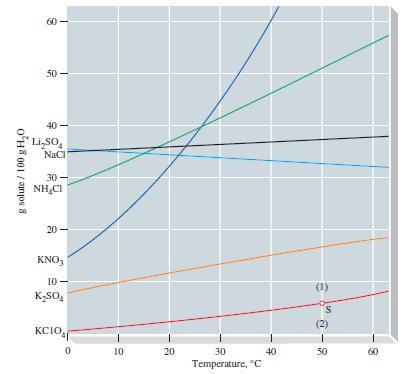
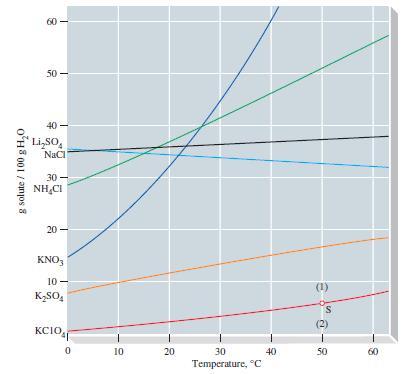
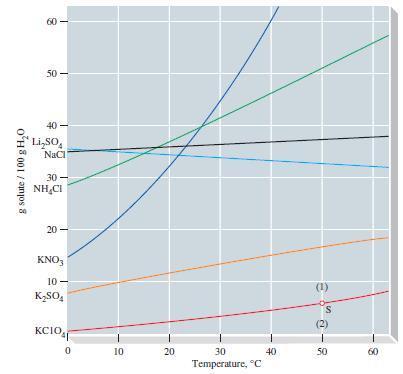
A solution is prepared by dissolving 95 g NH4Cl in 200.0 g H2O at 60 °C.(a) What mass of NH4Cl will recrystallize when the solution is cooled to 20 °C?(b) How might we improve the yield of NH4Cl?
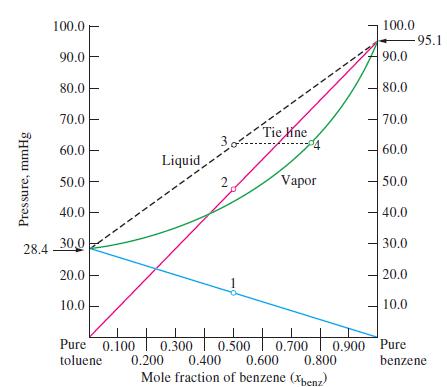
Describe a case in which the liquid and vapor curves in a diagram such as Figure 14-16 would converge into a single curve. Is such a case likely to exist?Figure 14-16 Pressure, mmHg 100.0 90.0 80.0 70.0 60.0 50.0 40.0 28.4 30,0 20.0 10.0 Liquid Pure 0.100 toluene 2 1 Tie
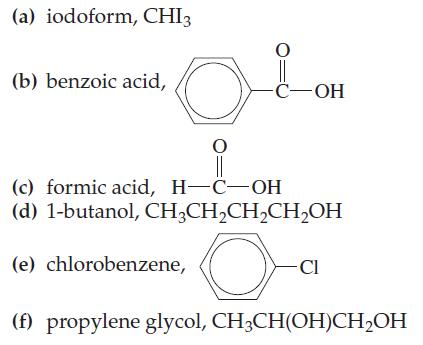
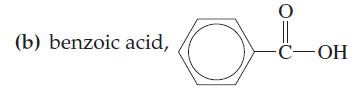
Two of the substances listed here are highly soluble in water, two are only slightly soluble in water, and two are insoluble in water. Indicate the situation you expect for each one. (a) iodoform, CHI3 (b) benzoic acid, O O || (c) formic acid, H-C-OH (d) 1-butanol, CH₂CH₂CH₂CH₂OH O (e)
At 0 °C and an O2 pressure of 1.00 atm, the aqueous solubility of O2(g) is 48.9 mL O2 per liter. What is the molarity of O2 in a saturated water solution when the O2 is under its normal partial pressure in air, 0.2095 atm?
(A) Use data from Example 14-5 to determine the partial pressure of O2 above an aqueous solution at 0 °C known to contain 5.00 mg O2 per 100.0 mL of solution.(B) A handbook lists the solubility of carbon monoxide in water at 0 °C and 1 atm pressure as 0.0354 mL CO per milliliter of H2O. What
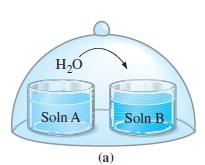
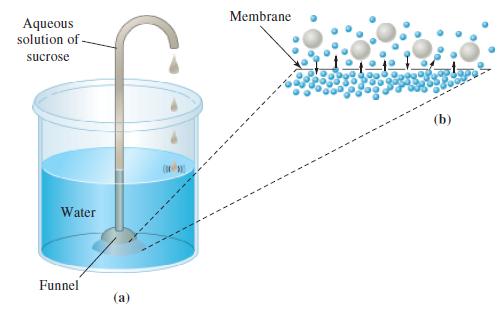
Describe the similarities and differences between the phenomena depicted in Figures 14-20(a) and 14-21.Figures 14-20(a)Figures 14-21 H₂O 20 Soln A (a) Soln B
Benzoic acid, C6H5COOH, is much more soluble in NaOH(aq) than it is in pure water. Can you suggest a reason for this? The structural formula for benzoic acid is given in Exercise 5(b).Exercise 5(b)Two of the substances listed here are highly soluble in water, two are only slightly soluble in water,
The vapor pressures of pure benzene and pure toluene at 25 °C are 95.1 and 28.4 mmHg, respectively. A solution is prepared in which the mole fractions of benzene and toluene are both 0.500. What are the partial pressures of the benzene and toluene above this solution? What is the total vapor
(A) The vapor pressure of pure hexane and pentane at 25 °C are 149.1 mmHg and 508.5 mmHg, respectively. If a hexane–pentane solution has a mole fraction of hexane of 0.750, what are the vapor pressures of hexane and pentane above the solution? What is the total vapor pressure?(B) Calculate the
In light of the factors, which of the following ionic fluorides would you expect to be most water soluble on a moles-per-liter basis: MgF2, NaF, KF, CaF2? Explain your reasoning.
What is the composition of the vapor in equilibrium with the benzene–toluene solution of Example 14-6?Example 14-6The vapor pressures of pure benzene and pure toluene at 25 °C are 95.1 and 28.4 mmHg, respectively. A solution is prepared in which the mole fractions of benzene and toluene are both
(A) What is the composition of the vapor in equilibrium with the hexane–pentane solution described in Practice Example 14-6A?(B) What is the composition of the vapor in equilibrium with the benzene–toluene solution described in Practice Example 14-6B?Practice Example 14-6AThe vapor pressure of
Why do you suppose that the freezing point of NaCl(aq) is depressed no further than -21 °C, regardless of how much more NaCl(s) is added to water?
Explain the observation that all metal nitrates are water soluble but many metal sulfides are not. Among metal sulfides, which would you expect to be most soluble?
What is the osmotic pressure at 25 °C of an aqueous solution that is 0.0010 M C12H22O11 (sucrose)?
(A) What is the osmotic pressure at 25 °C of an aqueous solution that contains 1.50 g C12H22O11 in 125 mL of solution?(B) What mass of urea, CO(NH2)2, would you dissolve in 225 mL of solution to obtain an osmotic pressure of 0.015 atm at 25 °C?
A saturated aqueous solution of NaBr at 20 °C contains 116 g NaBr/100 g H2O. Express this composition in the more conventional percent by mass, that is, as grams of NaBr per 100 grams of solution.
A 50.00 mL sample of an aqueous solution contains 1.08 g of human serum albumin, a blood-plasma protein. The solution has an osmotic pressure of 5.85 mmHg at 298 K. What is the molar mass of the albumin?
(A) Creatinine is a by-product of nitrogen metabolism and can be used to provide an indication of renal function. A 4.04 g sample of creatinine is dissolved in enough water to make 100.0 mL of solution. The osmotic pressure of the solution is 8.73 mmHg at 298 K. What is the molar mass of
An aqueous solution with density 0.988 g/mL at 20 °C is prepared by dissolving 12.8 mL CH3CH2CH2OH (d = 0.803 g/mL) in enough water to produce 75.0 mL of solution. What is the percent CH3CH2CH2OH expressed as (a) Percent by volume; (b) Percent by mass; (c) Percent (mass/volume)?
Nicotine, extracted from tobacco leaves, is a liquid completely miscible with water at temperatures below 60 °C. (a) What is the molality of nicotine in an aqueous solution that starts to freeze at -0.450 °C?(b) If this solution is obtained by dissolving 1.921 g of nicotine in 48.92 g H2O, what
(A) Vitamin B2, riboflavin, is soluble in water. If 0.833 g of riboflavin is dissolved in 18.1 g H2O, the resulting solution has a freezing point of -0.227 °C.(a) What is the molality of the solution?(b) What is the molar mass of riboflavin? (c) What is the molecular formula of riboflavin if
A certain brine has 3.87% NaCl by mass. A 75.0 mL sample weighs 76.9 g. How many liters of this solution should be evaporated to dryness to obtain 725 kg NaCl?
Predict the freezing point of aqueous 0.00145 mol kg–1 MgCl2.
(A) What is the expected osmotic pressure of a 0.0530 M MgCl2 solution at 25 °C?(B) You want to prepare an aqueous solution that has a freezing point of -0.100 °C. How many milliliters of 12.0 M HCl would you use to prepare 250.0 mL of such a solution?
You are asked to prepare 125.0 mL of How many grams would you need of a sample known to be 99.81% AgNO3 by mass?
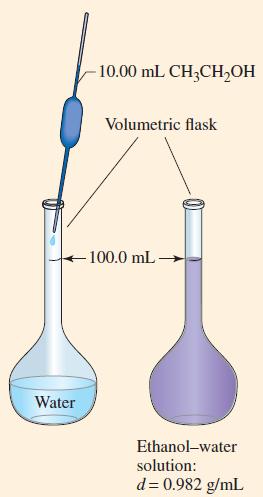
According to Example 14-1, the mass percent ethanol in a particular aqueous solution is less than the volume percent in the same solution. Explain why this is also true for all aqueous solutions of ethanol. Would it be true of all ethanol solutions, regardless of the other component?
(A) Water and phenol are completely miscible at temperatures above 66.8 °C but only partially miscible at temperatures below 66.8 °C In a mixture prepared at 29.6 °C from 50.0 g water and 50.0 g phenol, 32.8 g of a phase consisting of 92.50% water and 7.50% phenol by mass is obtained. This is a
Blood cholesterol levels are generally expressed as milligrams of cholesterol per deciliter of blood. What is the approximate mass percent cholesterol in a blood sample having a cholesterol level of 176? Why can you not give a more precise answer?
A certain vinegar is 6.02% acetic acid (CH3COOH) by mass. How many grams of CH3COOH are contained in a 355 mL bottle of vinegar? Assume a density of 1.01 g/mL.
The sulfate ion level in a municipal water supply is given as 46.1 ppm. What is [SO42-] in this water?
A water sample is found to have 9.4 ppb of chloroform, CHCl3. How many grams of CHCl3 would be found in a glassful (250 mL) of this water?
An aqueous solution is 6.00% methanol (CH3OH) by mass, with d = 0.988 g/mL. What is the molarity of CH3OH in this solution?
How many milliliters of the ethanol–water solution described in Example 14-1 should be diluted with water to produce 825 mL of 0.235 M CH3CH2OH?Example 14-1An ethanol–water solution is prepared by dissolving 10.00 mL of ethanol, CH3CH2OH (d = 0.789 g/mL), in a sufficient volume of water to
A typical commercial grade aqueous phosphoric acid is 75% H3PO4 by mass and has a density of 1.57 g/mL. What is the molarity of H3PO4 in this solution?
A 30.00%-by-mass solution of nitric acid, HNO3, in water has a density of 1.18 g/cm3 at 20 °C. What is the molarity of HNO3 in this solution?
What is the molarity of CO2 in a liter of ocean water at 25 °C that contains approximately 280 ppm of CO2? The density of ocean water is 1027 kg/m3.
At 25 °C and 0% salinity the amount of oxygen in the ocean is 5.77 mL/L. What is the molarity of oxygen in the ocean at these conditions?
What is the molality of para-dichlorobenzene in a solution prepared by dissolving 2.65 g C6H4Cl2 in 50.0 mL benzene (d = 0.879 g/mL)?
What is the molality of the sulfuric acid solution described in Exercise 16?Exercise 166.00 M sulfuric acid, H2SO4(aq), has a density of 1.338 g/mL. What is the percent by mass of sulfuric acid in this solution?
How many grams of iodine, I2; must be dissolved in 725 mL of carbon disulfide, CS2 (d = 1.261 g/mL), to produce a 0.236 m solution?
How many grams of water would you add to 1.00 kg of 1.38 mol kg-1 CH3OH(aq) to reduce the molality to 1.00 mol kg–1 CH3OH?
An aqueous solution is 34.0% H3PO4 by mass and has a density of 1.209 g/mL. What are the molarity and molality of this solution?
A 10.00%-by-mass solution of ethanol, CH3CH2OH, in water has a density of 0.9831 g/mL at 15 °C and 0.9804 g/mL at 25 °C. Calculate the molality of the ethanol–water solution at these two temperatures. Does the molality differ at the two temperatures (that is, at 15 and 25 °C)? Would you expect
A solution is prepared by mixing 1.28 mol C7H16, 2.92 mol C8H18, and 2.64 mol C9H20. What is the (a) Mole fraction and (b) Mole percent of each component of the solution?
Calculate the mole fraction of solute in the following aqueous solutions: (a) 21.7% CH3CH2OH, by mass;(b) 0.684 mol kg-1 CO(NH2)2 (urea).
Refer to Example 14-1. How many grams of CH3CH2OH must be added to 100.0 mL of the solution described in part (d) to increase the mole fraction of CH3CH2OH to 0.0525?Example 14-1An ethanol–water solution is prepared by dissolving 10.00 mL of ethanol, CH3CH2OH (d = 0.789 g/mL), in a sufficient
Calculate the mole fraction of the solute in the following aqueous solutions: (a) 0.112 M C6H12O6 (d = 1.006 g/mL);(b) 3.20% ethanol, by volume (d = 0.993 g/mL; pure CH3CH2OH, d = 0.789 g/mL).
What volume of glycerol, CH3CH(OH)CH2OH (d = 1.26 g/mL), must be added per kilogram of water to produce a solution with 4.85 mol % glycerol?
Two aqueous solutions of sucrose, C12H22O11, are mixed. One solution is 0.1487 M C12H22O11 and has d = 1.018 g/mL; the other is 10.00% C12H22O11 by mass and has d = 1.038 g/mL. Calculate the mole percent C12H22O11 in the mixed solution.
The Environmental Protection Agency has a limit of 15 ppm for the amount of lead in drinking water. If a 1.000 mL sample of water at 20 °C contains 15 ppm of lead, how many lead ions are there in this sample of water? What is the mole fraction of lead ion in solution?
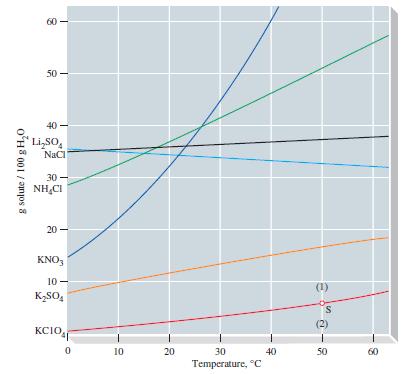
Refer to Figure 14-10 and determine the molality of NH4Cl in a saturated aqueous solution at 40 °C. Figure 14-10 g solute / 100 g H₂0 50- 40 Li₂SO4 NaCl 30- NHẠC 20 KNO3 10- K₂SOA KCIO 0 10 20 30 Temperature, C 40 €0-8 50 60
The amount of CO2 in the ocean is approximately 280 ppm. What is the mole fraction of CO2 in a liter of ocean water?
Refer to Figure 14-10 and estimate the temperature at which a saturated aqueous solution of KClO4 is 0.200 m.Figure 14-10 g solute / 100 g H₂0 8 50- Li₂SO NaCl 30- NHẠCI 20 KNO3 10- K₂SO4 wow KCIO 0 10 20 30 Temperature, C 40 30-8 50 60
A solution of 20.0 g KClO4 in 500.0 g of water is brought to a temperature of 40 °C.(a) Refer to Figure 14-10 and determine whether the solution is unsaturated or supersaturated at 40 °C.(b) Approximately what mass of KClO4, in grams, must be added to saturate the solution (if originally
One way to recrystallize a solute from a solution is to change the temperature. Another way is to evaporate solvent from the solution. A 335 g sample of a saturated solution of KNO3(s) in water is prepared at 25.0 °C. If 55 g H2O is evaporated from the solution at the same time as the temperature
Under an O2(g) pressure of 1.00 atm, 28.31 mL of O2(g) dissolves in 1.00 L H2O at 25 °C. What will be the molarity of O2 in the saturated solution at 25 °C when the O2 pressure is 3.86 atm? (Assume that the solution volume remains at 1.00 L.)
Using data from Exercise 43, determine the molarity of O2 in an aqueous solution at equilibrium with air at normal atmospheric pressure. The volume percent of O2 in air is 20.95%.Exercise 43Under an O2(g) pressure of 1.00 atm, 28.31 mL of O2(g) dissolves in 1.00 L H2O at 25 °C. What will be the
Natural gas consists of about 90% methane, CH4. Assume that the solubility of natural gas at 20 °C and 1 atm gas pressure is about the same as that of CH4, 0.02 g/kg water. If a sample of natural gas under a pressure of 20 atm is kept in contact with 1.00 x 10³ kg of water, what mass of natural
The aqueous solubility at 20 °C of Ar at 1.00 atm is equivalent to 33.7 mL Ar(g), measured at 0 °C and 1.00 atm, per liter of water. What is the molarity of Ar in water that is saturated with air at 1.00 atm and 20 °C? Air contains 0.934% Ar by volume. Assume that the volume of water does not
Another statement of Henry’s law is: At a fixed temperature, a given quantity of liquid dissolves the same volume of gas at all pressures. What is the connection between this statement and the one given in Exercise 49? Under what conditions is this second statement not valid?Exercise 49Henry’s
Henry’s law can be stated this way: The mass of a gas dissolved by a given quantity of solvent at a fixed temperature is directly proportional to the pressure of the gas. Show how this statement is related to equation (14.2).Eq. 14.2 C = kx P₂ gas (14.2)
The aqueous solubility of CO2 at 20 °C and 1.00 atm is equivalent to 87.8 mL CO2(g), measured at 0 °C and 1.00 atm, per 100 mL of water. What is the molarity of CO2 in water that is at 20 °C and saturated with air at 1.00 atm? The volume percent of CO2 in air is 0.0360%. Assume that the volume
What are the partial and total vapor pressures of a solution obtained by mixing 35.8 g benzene, C6H6, and 56.7 g toluene, C6H5CH3, at 25 °C? At 25 °C the vapor pressure of C6H6 = 95.1 mmHg; the vapor pressure of C6H5CH3 = 28.4 mmHg.
Determine the composition of the vapor above the benzene-toluene solution described in Exercise 51.Exercise 51What are the partial and total vapor pressures of a solution obtained by mixing 35.8 g benzene, C6H6, and 56.7 g toluene, C6H5CH3, at 25 °C? At 25 °C the vapor pressure of C6H6 = 95.1
Calculate the vapor pressure at 25 °C of a solution containing 165 g of the nonvolatile solute, glucose, C6H12O6, in 685 g H2O. The vapor pressure of water at 25 °C is 23.8 mmHg.
Calculate the vapor pressure at 20 °C of a saturated solution of the nonvolatile solute, urea, CO(NH2)2, in methanol, CH3OH. The solubility is 17 g urea/100 mL methanol. The density of methanol is 0.792 g/mL, and its vapor pressure at 20 °C is 95.7 mmHg.
Styrene, used in the manufacture of polystyrene plastics, is made by the extraction of hydrogen atoms from ethylbenzene. The product obtained contains about 38% styrene (C6H5CH=CH2) and 62% ethylbenzene (C6H5CH2CH3), by mass. The mixture is separated by fractional distillation at 90 °C. Determine
Calculate xC6H6 in a benzene–toluene liquid solution that is in equilibrium at 25 °C with a vapor phase that contains 62.0 mol % C6H6. (Use data from Exercise 51.)Exercise 51What are the partial and total vapor pressures of a solution obtained by mixing 35.8 g benzene, C6H6, and 56.7 g toluene,
A benzene–toluene solution with xbenz = 0.300 has a normal boiling point of 98.6 °C. The vapor pressure of pure toluene at 98.6 °C is 533 mmHg. What must be the vapor pressure of pure benzene at 98.6 °C? (Assume ideal solution behavior.)
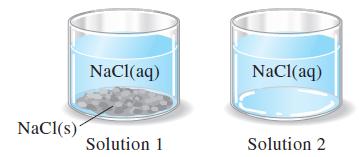
The two NaCl(aq) solutions pictured are at the same temperature.(a) Above which solution is the vapor pressure of water, PH2O, greater? Explain.(b) Above one of these solutions, the vapor pressure of water, PH2O, remains constant, even as water evaporates from solution. Which solution is this?
A 0.72 g sample of polyvinyl chloride (PVC) is dissolved in 250.0 mL of a suitable solvent at 25 °C. The solution has an osmotic pressure of 1.67 mmHg. What is the molar mass of the PVC?
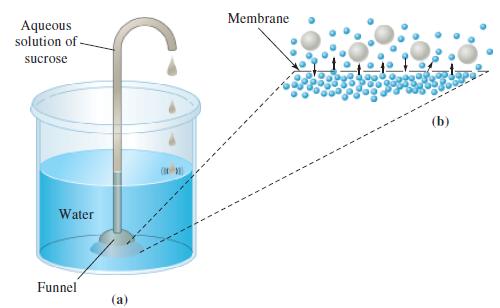
Verify that a 20% aqueous solution by mass of sucrose (C12H22O11) would rise to a height of about 150 m in an apparatus of the type pictured in Figure 14-21.Figure 14-21 Aqueous solution of sucrose Water Funnel (a) Membrane (b)
When the stems of cut flowers are held in concentrated NaCl(aq), the flowers wilt. In a similar solution a fresh cucumber shrivels up (becomes pickled). Explain the basis of these phenomena.
Some fish live in saltwater environments and some in freshwater, but in either environment they need water to survive. Saltwater fish drink water, but freshwater fish do not. Explain this difference between the two types of fish.
In what volume of water must 1 mol of a nonelectrolyte be dissolved if the solution is to have an osmotic pressure of 1 atm at 273 K? Which of the gas laws does this result resemble?
The molecular mass of hemoglobin is 6.86 x 10⁴ u. What mass of hemoglobin must be present per 100.0 mL of a solution to exert an osmotic pressure of 7.25 mmHg at 25 °C?
At 25 °C a 0.50 g sample of polyisobutylene (a polymer used in synthetic rubber) in 100.0 mL of benzene solution has an osmotic pressure that supports a 5.1 mm column of solution (d = 0.88 g/mL). What is the molar mass of the polyisobutylene? (For Hg, d = 13.6 g/mL.)
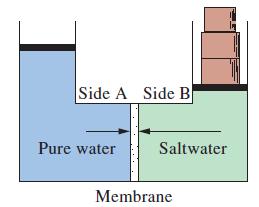
What approximate pressure is required in the reverse osmosis depicted in Figure 14-22 if the saltwater contains 2.5% NaCl, by mass?Figure 14-22 Side A Side B Pure water Saltwater Membrane
Use the concentration of an isotonic saline solution, 0.92% NaCl (mass/volume), to determine the osmotic pressure of blood at body temperature, 37.0 °C.
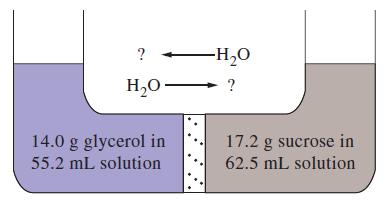
The two solutions pictured here are separated by a semipermeable membrane that permits only the passage of water molecules. In what direction will a net flow of water occur, that is, from left to right or right to left? Glycerol is HOCH2CH(OH)CH2OH; sucrose is C12H22O11. ? H₂O- 14.0 g glycerol
The freezing point of a 0.010 m aqueous solution of a nonvolatile solute is -0.072 °C. What would you expect the normal boiling point of this same solution to be?
Adding 1.00 g of benzene, C6H6, to 80.00 g cyclohexane, C6H12, lowers the freezing point of the cyclohexane from 6.5 to 3.3 °C.(a) What is the value of Kf for cyclohexane?(b) Which is the better solvent for molar mass determinations by freezing-point depression, benzene or cyclohexane? Explain.
The boiling point of water at 749.2 mmHg is 99.60 °C. What mass percent sucrose (C12H22O11) should be present in an aqueous sucrose solution to raise the boiling point to 100.00 °C at this pressure?
A compound is 42.9% C, 2.4% H, 16.7% N, and 38.1% O, by mass. Addition of 6.45 g of this compound to 50.0 mL benzene, C6H6 (d = 0.879 g/mL), lowers the freezing point from 5.53 to 1.37 °C. What is the molecular formula of this compound?
Nicotinamide is a water-soluble vitamin important in metabolism. A deficiency in this vitamin results in the debilitating condition known as pellagra. Nicotinamide is 59.0% C, 5.0% H, 22.9% N, 13.1% O, by mass. Addition of 3.88 g of nicotinamide to 30.0 mL nitrobenzene, C6H5NO2 (d = 1.204 g/mL),
Thiophene (fp = -38.3; bp = 84.4 °C) is a sulfur-containing hydrocarbon sometimes used as a solvent in place of benzene. Combustion of a 2.348 g sample of thiophene produces 4.913 g CO2, 1.005 g H2O, and 1.788 g SO2. When a 0.867 g sample of thiophene is dissolved in 44.56 g of benzene (C6H6), the
Coniferin is a glycoside (a derivative of a sugar) found in conifers, such as fir trees. When a 1.205 g sample of coniferin is subjected to combustion analysis, the products are 0.698 g H2O and 2.479 g CO2. A 2.216 g sample is dissolved in 48.68 g H2O, and the normal boiling point of this solution
Cooks often add some salt to water before boiling it. Some people say this helps the cooking process by raising the boiling point of the water. Others say not enough salt is usually added to make any noticeable difference. Approximately how many grams of NaCl must be added to a liter of water at 1
An important test for the purity of an organic compound is to measure its melting point. Usually, if the compound is not pure, it begins to melt at a lower temperature than the pure compound.(a) Why is this the case, rather than the melting point being higher in some cases and lower in others?(b)
The freezing point of Arctic Ocean waters is about -1.94 °C. What is the molality of ions for a liter of ocean water?
If ocean water consisted of 3.5% salt, what would be the freezing point of an ocean?
Predict the approximate freezing points of 0.10 m solutions of the following solutes dissolved in water:(a) CO(NH2)2 (urea); (b) NH4NO3; (c) HCl; (d) CaCl2;(e) MgSO4;(f) CH3CH2OH (ethanol); (g) CH3COOH (acetic acid).
Calculate the van’t Hoff factors of the following weak electrolyte solutions:(a) 0.050 m HCOOH, which begins to freeze at -0.0986 °C;(b) 0.100 M HNO2, which has a hydrogen ion (and nitrite ion) concentration of 6.91 x 10⁻³ M.
NH3(aq) conducts electric current only weakly. The same is true for acetic acid, CH3COOH. When these solutions are mixed, however, the resulting solution conducts electric current very well. Propose an explanation.
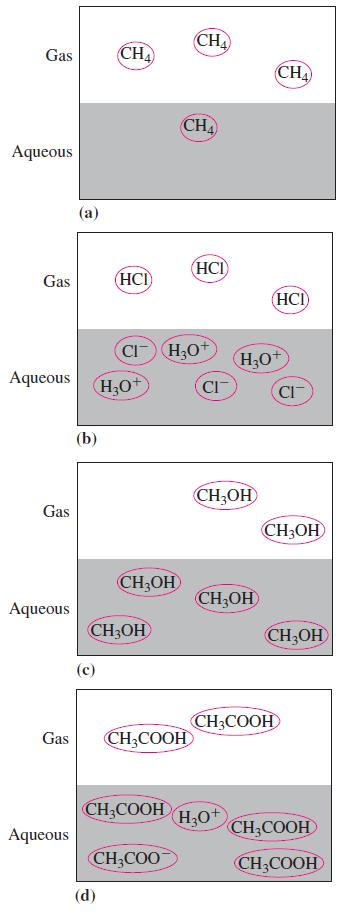
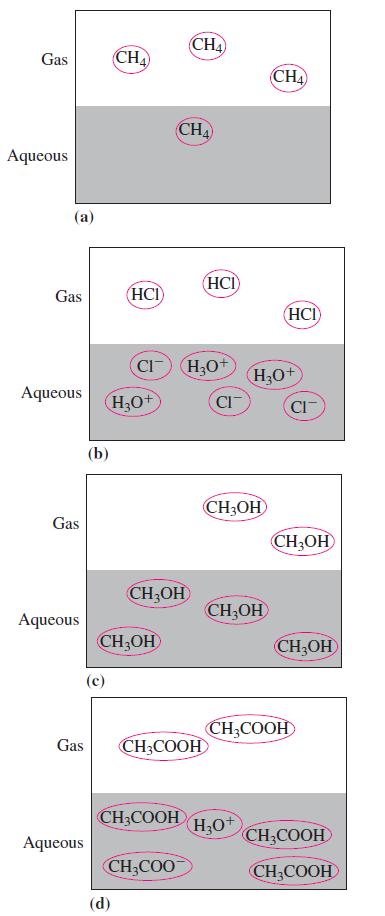
In the following diagrams, which representation demonstrates a weak electrolyte?
An isotonic solution is described as 0.92% NaCl (mass/volume). Would this also be the required concentration for isotonic solutions of other salts, such as KCl, MgCl2, or MgSO4? Explain.
In the following diagrams, which representation demonstrates a strong electrolyte? Gas Aqueous (a) Gas Aqueous Gas Aqueous (b) Aqueous (c) CHA (HCI) H₂O+ CH₂OH (d) CI) H₂0+ CH₂OH CHA Gas
A typical root beer contains 0.13% of a 75% H3PO4 solution by mass. How many milligrams of phosphorus are contained in a 12 oz can of this root beer? Assume a solution density of 1.00 g/mL; also, 1 oz = 29.6 mL.
An aqueous solution has 109.2 g KOH/L solution. The solution density is 1.09 g/mL. Your task is to use 100.0 mL of this solution to prepare 0.250 m KOH. What mass of which component, KOH or H2O, would you add to the 100.0 mL of solution?
Showing 2100 - 2200
of 4008
First
15
16
17
18
19
20
21
22
23
24
25
26
27
28
29
Last
Step by Step Answers

 Get 50% OFF
Claim Now
Get 50% OFF
Claim Now