New Semester
Started
Get
50% OFF
Study Help!
--h --m --s
Claim Now
Question Answers
Textbooks
Find textbooks, questions and answers
Oops, something went wrong!
Change your search query and then try again
S
Books
FREE
Study Help
Expert Questions
Accounting
General Management
Mathematics
Finance
Organizational Behaviour
Law
Physics
Operating System
Management Leadership
Sociology
Programming
Marketing
Database
Computer Network
Economics
Textbooks Solutions
Accounting
Managerial Accounting
Management Leadership
Cost Accounting
Statistics
Business Law
Corporate Finance
Finance
Economics
Auditing
Tutors
Online Tutors
Find a Tutor
Hire a Tutor
Become a Tutor
AI Tutor
AI Study Planner
NEW
Sell Books
Search
Search
Sign In
Register
study help
sciences
general chemistry principles
General Chemistry Principles And Modern Applications 11th Edition Ralph Petrucci, Jeffry Madura, F. Herring, Carey Bissonnette - Solutions
The term “proof,” still used to describe the ethanol content of alcoholic beverages, originated in seventeenth century England. A sample of whiskey was poured on gunpowder and set afire. If the gunpowder ignited after the whiskey had burned off, this “proved” that the whiskey had not been
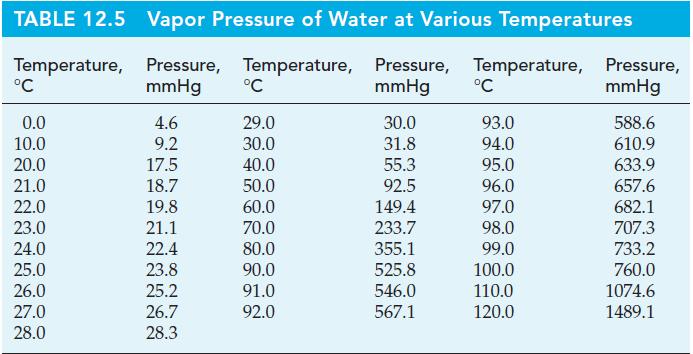
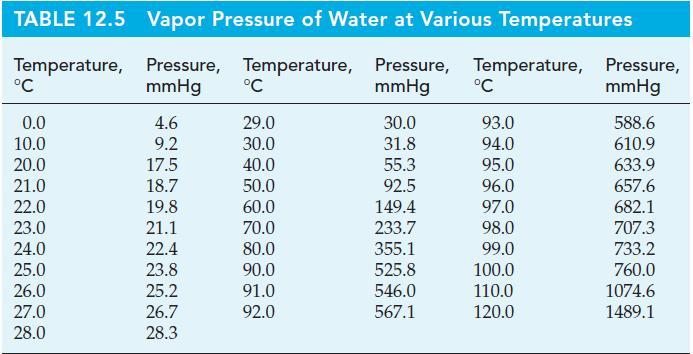
Four aqueous solutions of acetone, CH3COCH3, are prepared at different concentrations: (a) 0.100% CH3COCH3, by mass; (b) 0.100 M CH3COCH3;(c) 0.100 m CH3COCH3; and (d) xacetone = 0.100.Estimate the highest partial pressure of water at 25 °C to be found in the equilibrium vapor above these
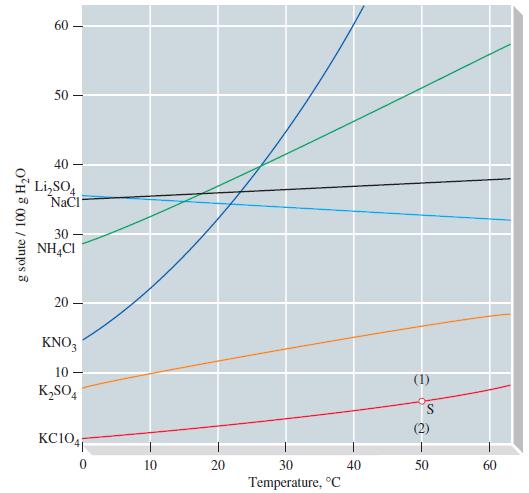
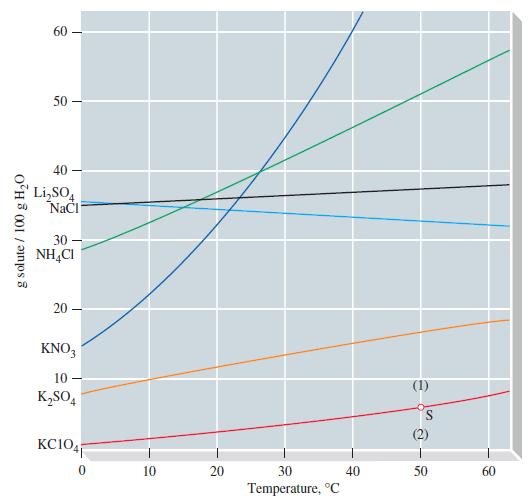
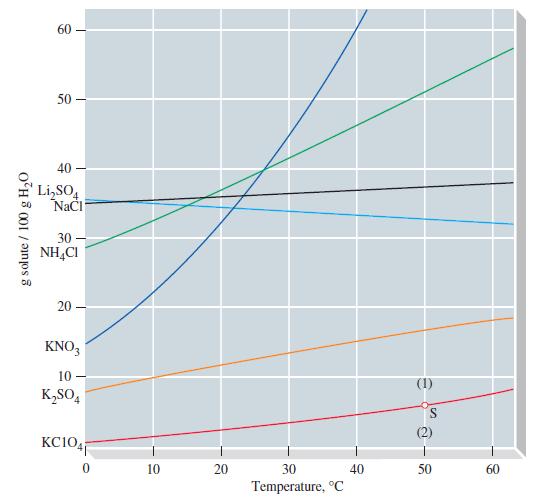
A solid mixture consists of 85.0% KNO3 and 15.0% K2SO4, by mass. A60.0 g sample of this solid is added to 130.0 g of water at 60 °C. Refer to Figure 14-10.(a) Will all the solid dissolve at 60 °C?(b) If the resulting solution is cooled to 0 °C, what mass of KNO3 should crystallize?(c) Will K2SO4
Suppose you have available 2.50 L of a solution (d = 0.9767 g/mL) that is 13.8% ethanol (CH3CH2OH), by mass. From this solution you would like to make the maximum quantity of ethanol-water antifreeze solution that will offer protection to -2.0 °C. Would you add more ethanol or more water to the
Hydrogen chloride is a colorless gas, yet when a bottle of concentrated hydrochloric acid [HCl(conc aq)] is opened, mist-like fumes are often seen to escape from the bottle. How do you account for this?
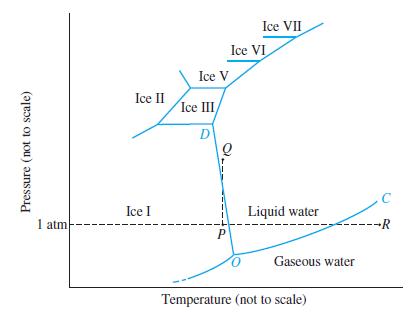
Use the following information to confirm that the triple point temperature of water is about 0.0098 °C.(a) The slope of the fusion curve of water in the region of the normal melting point of ice (Fig. 12-30) is -0.00750 °C/atm.(b) The solubility of air in water at 0 °C and 1.00 atm is 0.02918 mL
Stearic acid (C18H36O2) and palmitic acid (C16H32O2) are common fatty acids. Commercial grades of stearic acid usually contain palmitic acid as well. A 1.115 g sample of a commercial-grade stearic acid is dissolved in 50.00 mL benzene (d = 0.879 g/mL). The freezing point of the solution is found to
Nitrobenzene, C6H5NO2, and benzene, C6H6, are completely miscible in each other. Other properties of the two liquids are nitrobenzene: fp = 5.7 °C, Kf = 8.1 °C kg mol-1; benzene: fp = 5.5 °C, Kf = 5.12 °C kg mol-1. It is possible to prepare two different solutions with these two liquids having
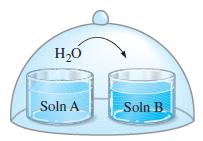
Refer to Figure 14-20(a). Initially, solution A contains 0.515 g urea, CO(NH2)2, dissolved in 92.5 g H2O; solution B contains 2.50 g sucrose, C12H22O11, dissolved in 85.0 g H2O. What are the compositions of the two solutions when equilibrium is reached, that is, when the two have the same vapor
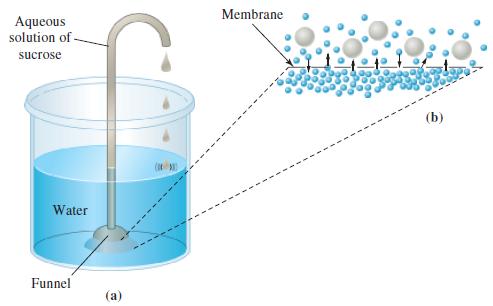
In Figure 14-21, why does the net transfer of water stop when the two solutions are of nearly equal concentrations rather than of exactly equal concentrations?Figure 14-21 Aqueous solution of sucrose Water Funnel (a) (0) Membrane (b)
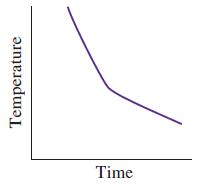
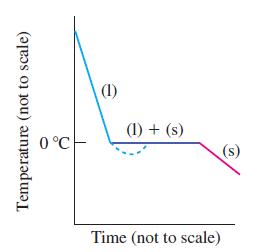
Shown below is a typical cooling curve for an aqueous solution. Why is there no horizontal straight-line portion comparable to that seen in the cooling curve for pure water in Figure 12-23?Figure 12-23 Temperature Time
Suppose that 1.00 mg of gold is obtained in a colloidal dispersion in which the gold particles are spherical, with a radius of 1.00 x 10² nm. (The density of gold is 19.3 g/cm3.)(a) What is the total surface area of the particles?(b) What is the surface area of a single cube of gold of mass 1.00 mg?
At 20 °C, liquid benzene has a density of 0.879 g/cm3; liquid toluene, 0.867 g/cm3. Assume ideal solutions.(a) Calculate the densities of solutions containing 20, 40, 60, and 80 volume percent benzene.(b) Plot a graph of density versus volume percent composition.(c) Write an equation that relates
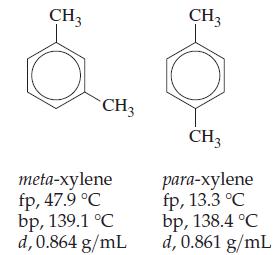
The two compounds whose structures are depicted here are isomers. When derived from petroleum, they always occur mixed together. meta-Xylene is used in aviation fuels and in the manufacture of dyes and insecticides. The principal use of paraxylene is in the manufacture of polyester resins and
Instructions on a container of antifreeze (ethylene glycol; fp, -12.6 °C, bp, 197.3 °C) give the following volumes of Prestone to be used in protecting a 12 qt cooling system against freeze-up at different temperatures (the remaining liquid is water): 10 °F, 3 qt; 0 °F, 4 qt; -15 °F, 5 qt; -34
Demonstrate that (a) For a dilute aqueous solution, the numerical value of the molality is essentially equal to that of the molarity.(b) In a dilute solution, the solute mole fraction is proportional to the molality.(c) In a dilute aqueous solution, the solute mole fraction is proportional to the
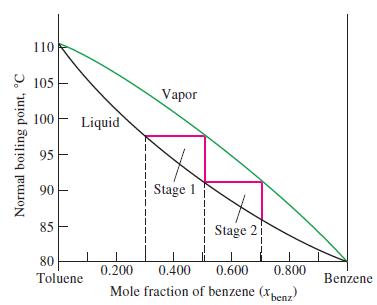
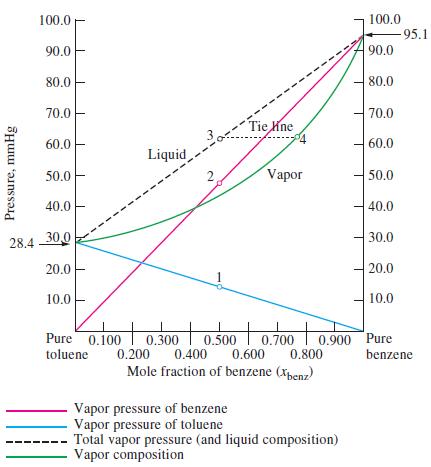
We noted in Figure 14-17 that the liquid and vapor curves taken together outline a lens-shaped region when the normal boiling points of benzene-toluene solutions are plotted as a function of mole fraction of benzene. That is, unlike Figure 14-16, the liquid curve is not a straight line. Use data
At 25 °C and under an O2(g) pressure of 1 atm, the solubility of O2(g) in water is 28.31 mL/1.00 L H2O. At 25 °C and under an N2(g) pressure of 1 atm, the solubility of N2(g) in water is 14.34 mL/1.00 L H2O. The composition of the atmosphere is 78.08% N2 and 20.95% O2, by volume. What is the
The concentration of Ar in the ocean at 25 °C is 11.5 μM. The Henry’s law constant for Ar is 1.5 x 10⁻³ mol L-1 atm-1. Calculate the mass of Ar in a liter of ocean water. Calculate the partial pressure of Ar in the atmosphere.
The concentration of N2 in the ocean at 25 °C is 445 μM. The Henry’s law constant for N2 is 0.61 x 10⁻³ mol L-1 atm-1. Calculate the mass of N2 in a liter of ocean water. Calculate the partial pressure of N2 in the atmosphere.
A solution contains 750 g of ethanol and 85.0 g of sucrose (180 g mol-1). The volume of the solution is 810.0 mL. Determine (a) The density of the solution (b) The percent of sucrose in the solution (c) The mole fraction of sucrose (d) The molality of the solution (e) The molarity of the
What volume of ethylene glycol (HOCH2CH2OH, density = 1.12 g mL-1) must be added to 20.0 L of water (Kf = 1.86 °C kg mol-1) to produce a solution that freezes at -10 °C?
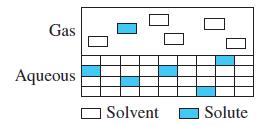
In the figure below, the open squares represent solvent molecules and the filled squares represent solute molecules.(a) What is the mole fraction of solute in the liquid phase?(b) Which component has the higher vapor pressure?(c) What is the percent solute in the vapor? Gas Aqueous Solvent Solute
Cinnamaldehyde is the chief constituent of cinnamon oil, which is obtained from the twigs and leaves of cinnamon trees grown in tropical regions. Cinnamon oil is used in the manufacture of food flavorings, perfumes, and cosmetics. The normal boiling point of cinnamaldehyde, C6H5CH=CHCHO, is 246.0
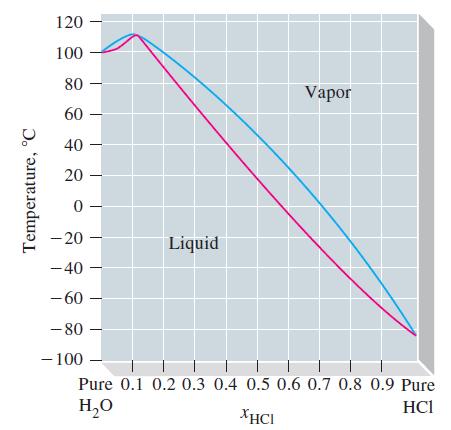
The phase diagram shown is for mixtures of HCl and H2O at a pressure of 1 atm. The red curve represents the normal boiling points of solutions of HCl(aq) of various mole fractions. The blue curve represents the compositions of the vapors in equilibrium with boiling solutions.(a) As a solution
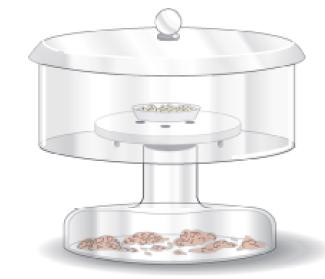
The laboratory device pictured on the following page is called a desiccator. It can be used to maintain a constant relative humidity within an enclosure. The material(s) used to control the relative humidity are placed in the bottom compartment, and the substance being subjected to a controlled
Every year, oral rehydration therapy (ORT)—the feeding of an electrolyte solution—saves the lives of countless children worldwide who become severely dehydrated as a result of diarrhea. One requirement of the solution used is that it be isotonic with human blood.(a) One definition of an
In your own words, define or explain the following terms or symbols: (a) xB; (b) P*A;(c) Kf;(d) i;(e) Activity.
Briefly describe each of the following ideas or phenomena: (a) Henry’s law; (b) Freezing-point depression; (c) Recrystallization; (d) Hydrated ion;(e) Deliquescence.
Explain the important distinctions between each pair of terms: (a) Molality and molarity; (b) Ideal and nonideal solution; (c) Unsaturated and supersaturated solution; (d) Fractional crystallization and fractional distillation; (e) Osmosis and reverse osmosis.
An aqueous solution is 0.010 M CH3OH. The concentration of this solution is also very nearly (a) 0.010% CH3OH (mass/volume); (b) 0.010 mol kg–1 CH3OH;(c) xCH3OH = 0.010;(d) 0.990 M H2O.
The most likely of the following mixtures to be an ideal solution is (a) NaCl–H2O;(b) CH3CH2OH–C6H6;(c) C7H16–H2O;(d) C7H16–C8H18.
The solubility of a nonreactive gas in water increases with (a) An increase in gas pressure; (b) An increase in temperature; (c) Increases in both temperature and pressure; (d) An increase in the volume of gas in equilibrium with the available water.
Of the following aqueous solutions, the one with the lowest freezing point is (a) 0.010 mol kg-1 MgSO4;(b) 0.011 mol kg–1 NaCl; (c) 0.018 mol kg-1 CH3CH2OH;(d) 0.0080 mol kg–1 MgCl2.
A solution prepared by dissolving 1.12 mol NH4Cl in 150.0 g H2O is brought to a temperature of 30 °C. Use Figure 14-10 to determine whether the solution is unsaturated or whether excess solute will crystallize.Figure 14-10 g solute/ 100 g
An ideal liquid solution has two volatile components. In the vapor in equilibrium with the solution, the mole fractions of the components are (a) Both 0.50; (b) Equal, but not necessarily 0.50; (c) Not very likely to be equal; (d) 1.00 for the solvent and 0.00 for the solute.
NaCl(aq) isotonic with blood is 0.92% NaCl (mass/volume). For this solution, what is (a) [Na+];(b) The total molarity of ions; (c) The osmotic pressure at 37 °C;(d) The approximate freezing point? (Assume that the solution has a density of 1.005 g/mL.)
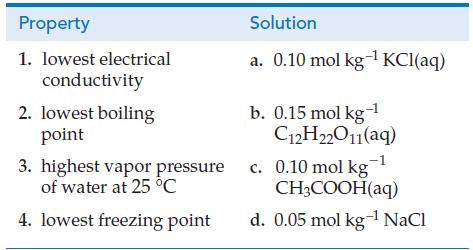
Which aqueous solution from the column on the right has the property listed on the left? Explain your choices. Property 1. lowest electrical conductivity 2. lowest boiling point 3. highest vapor pressure of water at 25 °C 4. lowest freezing point Solution a. 0.10 mol kg-¹ KCl(aq) b. 0.15 mol
A solution (d = 1.159 g/mL) is 62.0% glycerol, HOCH2CH(OH)CH2OH, and 38.0% H2O, by mass. Determine (a) The molarity of glycerol with H2O as the solvent; (b) The molarity of H2O with glycerol as the solvent; (c) The molality of H2O in glycerol; (d) The mole fraction of glycerol; (e) The mole
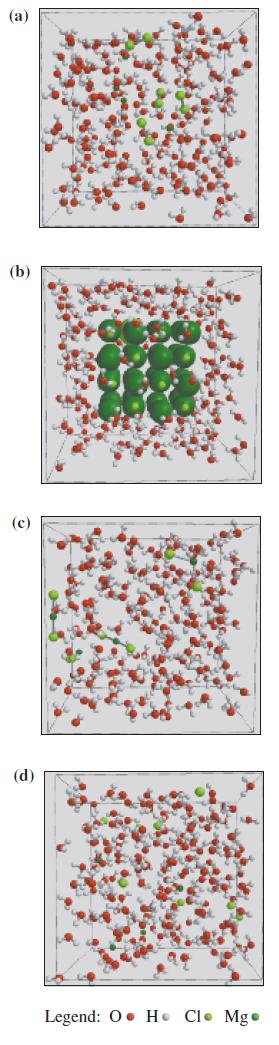
Which of the following represents MgCl2 in solution? (a) (b) (c) (d) Legend: OH Cl. Mg.
Which of the following ions has the greater charge density? (a) Na+;(b) F-;(c) K+;(d) Cl-.
When NH4Cl dissolves in a test tube of water, the test tube becomes colder. Is the magnitude of ΔHlattice for NH4Cl larger or smaller than the sum of ΔHhydration of the ions?
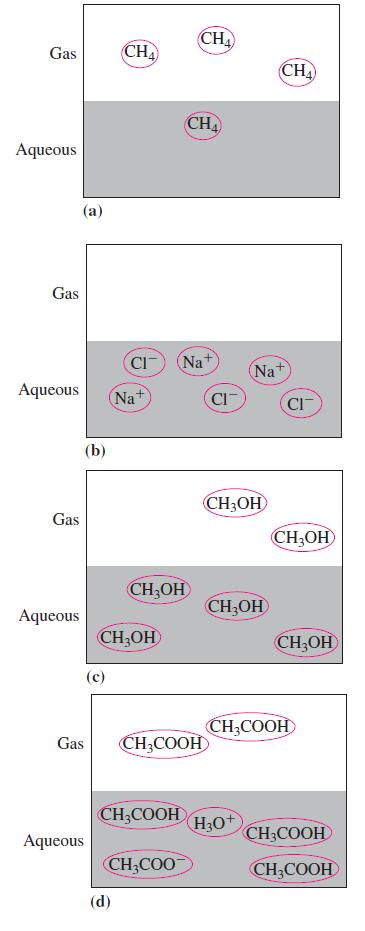
Which of the following represents a nonvolatile solute? Gas Aqueous Gas Aqueous Gas Aqueous (a) (b) Gas Aqueous CHA Na+ (d) CIT Na CH₂OH CH₂OH CH₂COOH CH₂ CH₂COO CHA CH₂COOH CI CH3OH Na+ CH3OH CHA H3O+ CI CH₂OH CH₂OH CH₂COOH CH3COOH CH3COOH
In a saturated solution at 25 °C and 1 bar, for the following solutes, which condition will increase solubility?(a) Ar(g), decrease temperature; (b) NaCl(s), increase pressure; (c) N2, decrease pressure; (d) CO2, increase volume.
What is the mole fraction of a nonvolatile solute in a hexane solution that has a vapor pressure of 600 mmHg at 68.7 °C, hexane’s normal boiling point? (a) 0.21; (b) 0.11; (c) 0.27; (d) 0.79.
What is the osmotic pressure, in bar, of 15.2 L of a 0.312 M starch solution at 75 °C? (a) 13721.1;(b) 194.5; (c) 355.7; (d) 0.0016; (e) 9.03.
What is the weight percent of 23.4 g of CaF2 if dissolved in 10.5 mol of water? (a) 0.028; (b) 1.59; (c) 11.0;(d) 12.4; (e) None of these.
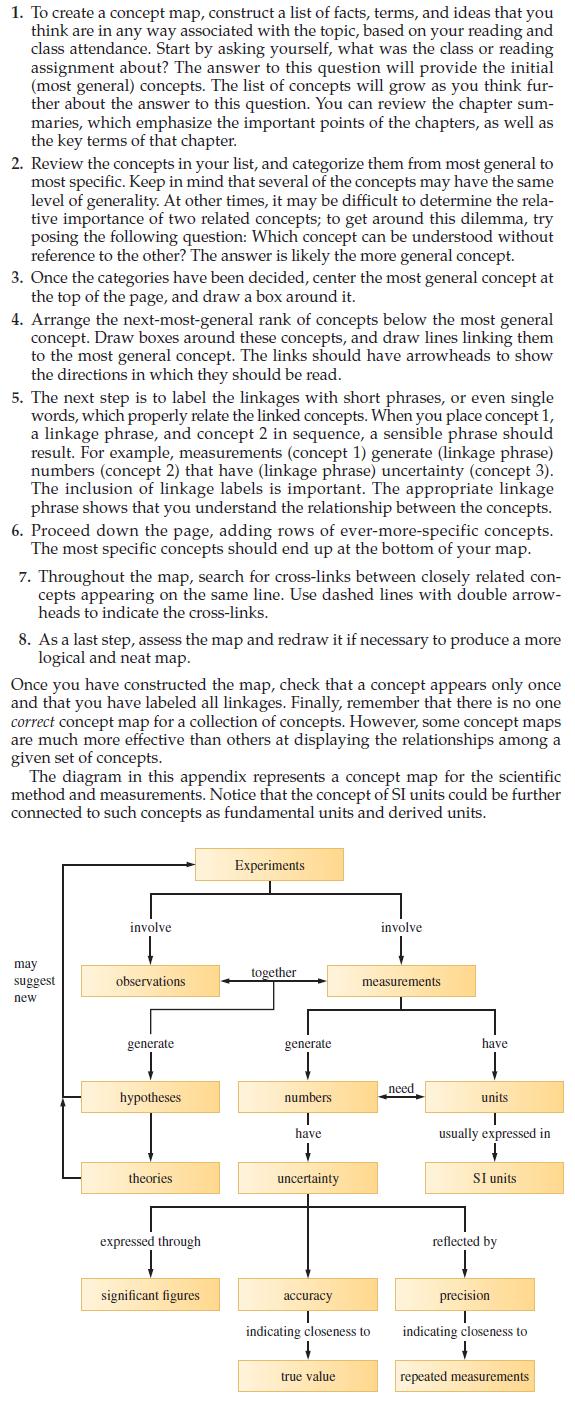
Using the method of concept mapping presented in Appendix E, construct a concept map showing the relationships among the various concentration units.Appendix E 1. To create a concept map, construct a list of facts, terms, and ideas that you think are in any way associated with the topic, based on
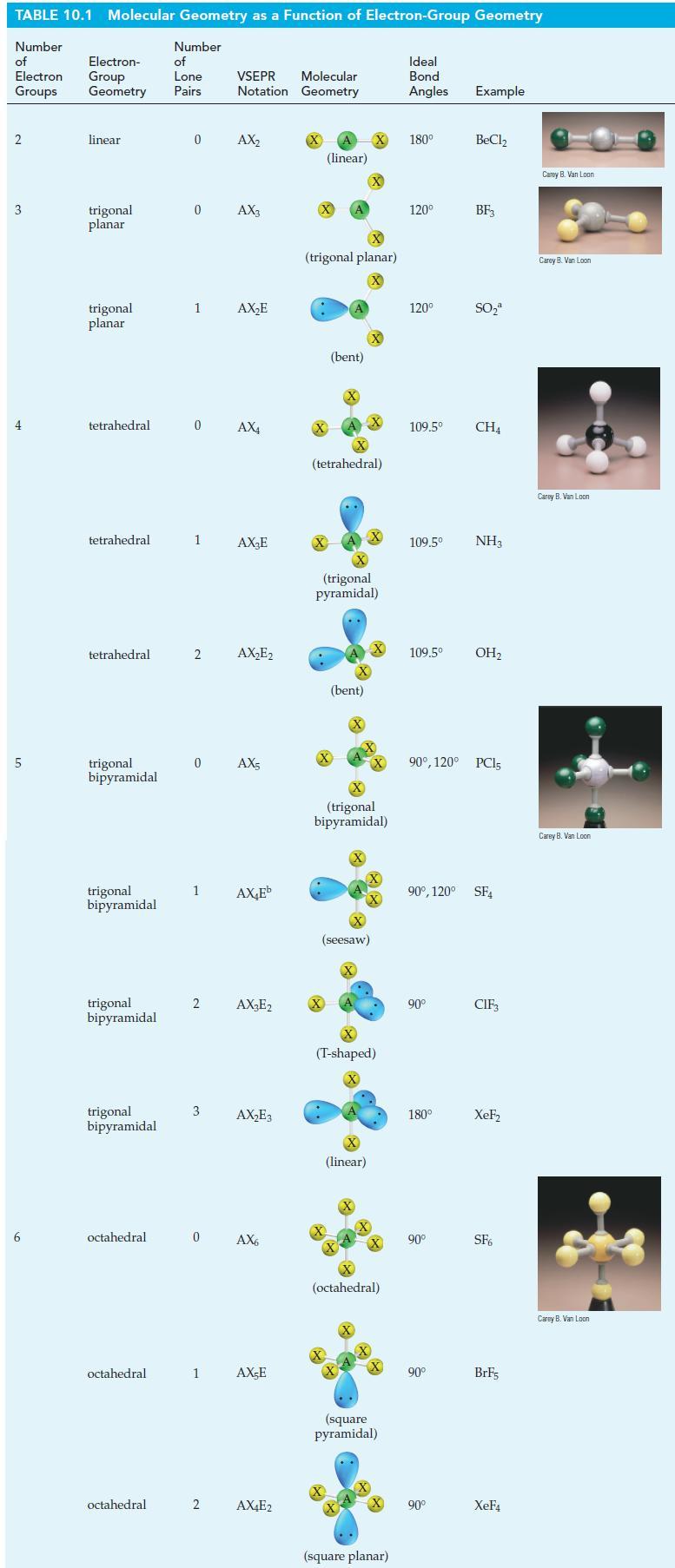
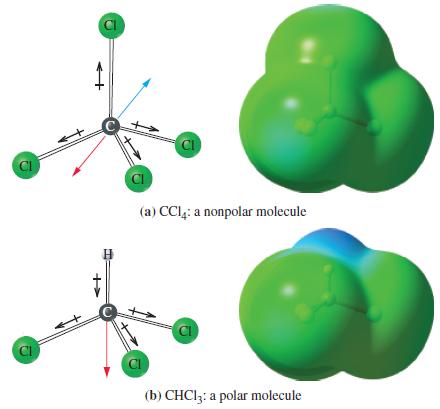
Predict the shapes of the following molecules, and then predict which would have resultant dipole moments: (a) SO2;(b) NH3;(c) H2S;(d) C2H4;(e) SF6;(f) CH2Cl2.
Which of the following molecules would you expect to be polar? (a) HCN; (b) SO3;(c) CS2;(d) OCS;(e) SOCl2;(f) SiF4;(g) POF3.Give reasons for your conclusions.
The molecule H2O2 has a resultant dipole moment of 2.2 D. Can this molecule be linear? If not, describe a shape that might account for this dipole moment.
Refer to the Integrative Example. A compound related to nitryl fluoride is nitrosyl fluoride, FNO. For this molecule, indicate (a) A plausible Lewis structure and (b) The geometric shape. (c) Explain why the measured resultant dipole moment for FNO is larger than the value for FNO2.Integrative
Without referring to tables in the text, indicate which of the following bonds you would expect to have the greatest bond length, and give your reasons. (a) O2;(b) N2;(c) Br2;(d) BrCl.
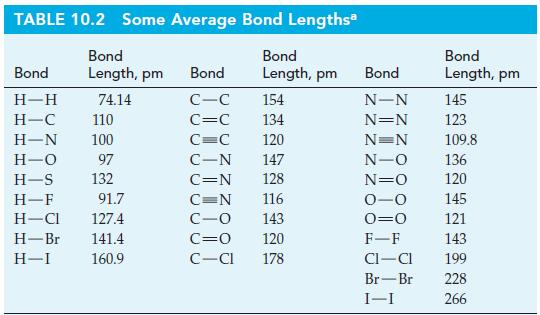
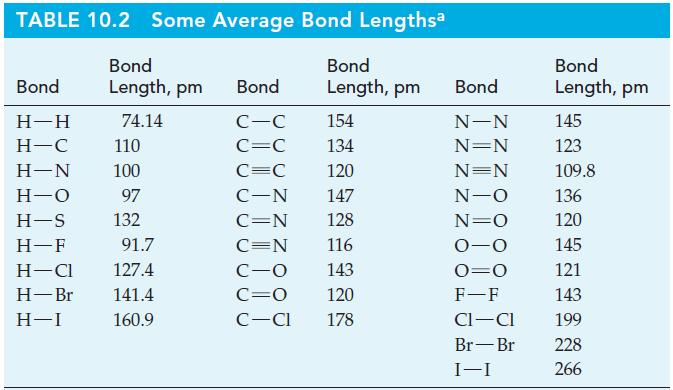
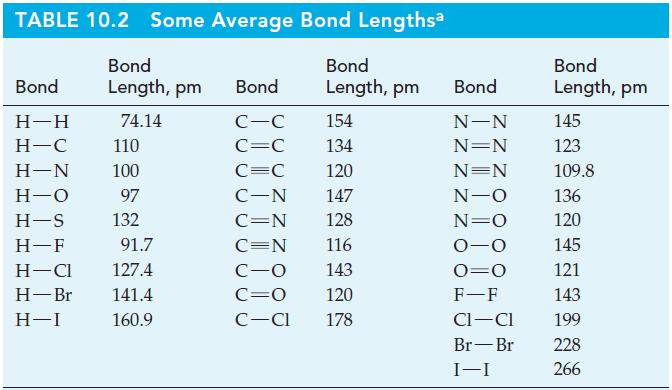
A relationship between bond lengths and single bond covalent radii of atoms. Use this relationship together with appropriate data from Table 10.2 to estimate these single-bond lengths.(a) I—Cl; (b) O—Cl; (c) C—F; (d) C—Br.Table 10.2 TABLE 10.2 Some Average Bond Lengths Bond Bond Length,
Estimate the lengths of the following bonds and indicate whether your estimate is likely to be too high or too low: (a) I—Cl;(b) C—F.
In which of the following molecules would you expect the oxygen-to-oxygen bond to be the shortest? Explain. (a) H2O2,(b) O2,(c) O3.
Refer to the Integrative Example. Use data from the chapter to estimate the length of the N—F bond in FNO2.Integrative ExampleNitryl fluoride is a reactive gas useful in rocket propellants. Its mass percent composition is 21.55% N, 49.23% O, and 29.23% F. Its density is 2.7 g/L at 20 °C and 1.00
Write a Lewis structure of the hydroxylamine molecule, H2NOH. Then, with data from Table 10.2, determine all the bond lengths.Table 10.2 TABLE 10.2 Some Average Bond Lengthsa Bond Length, pm 74.14 Bond H-H H-C H-N H-O H-S H-F 110 100 97 132 91.7 H-Cl
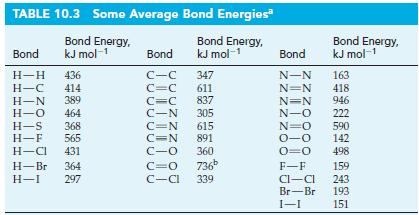
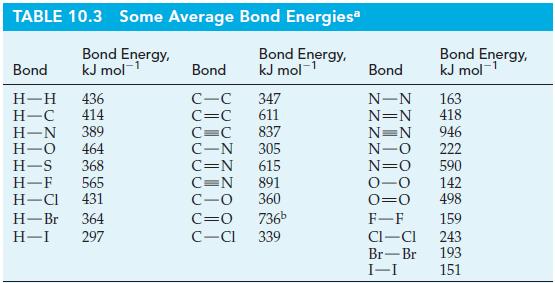
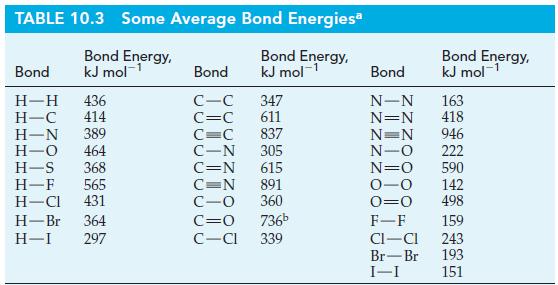
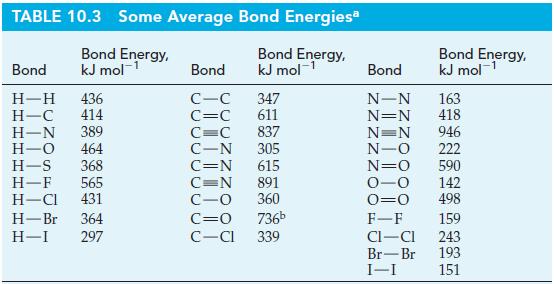
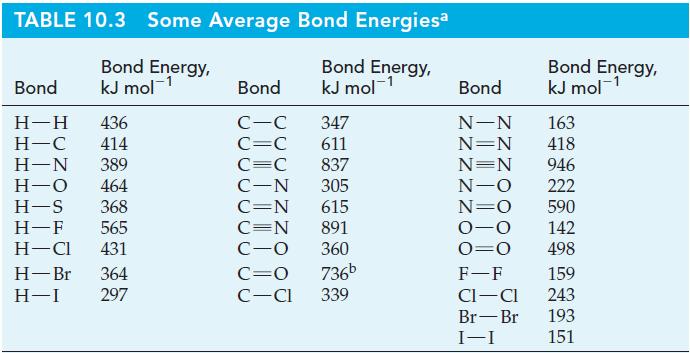
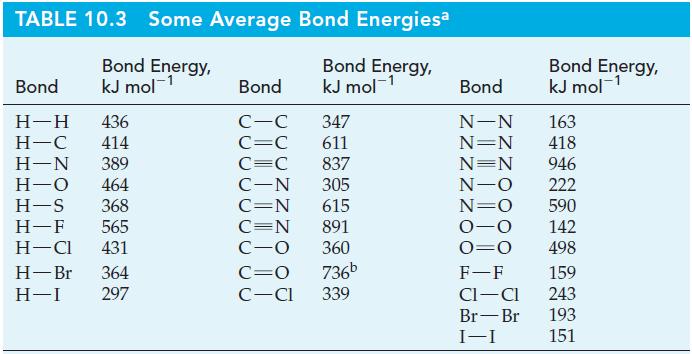
A reaction involved in the formation of ozone in the upper atmosphere is O2 → 2 O. Without referring to Table 10.3, indicate whether this reaction is endothermic or exothermic. Explain.Table 10.3 TABLE 10.3 Some Average Bond Energies Bond Energy, kJ mol-1 Bond Energy, kJ mol-1 Bond H-H 436 H-C
Use data from Table 10.3 to estimate the enthalpy change (ΔrH) for the following reaction.Table 10.3 C₂H6(g) + Cl2(g) C₂H5Cl(g) + HCl(g) AH = ?
One of the chemical reactions that occurs in the formation of photochemical smog is O3 + NO → NO2 + O2. Estimate ΔrH for this reaction by using appropriate Lewis structures and data from Table 10.3.Table 10.3 TABLE 10.3 Some Average Bond Energiesa Bond Energy, kJ mol-¹ Bond Energy, kJ
Estimate the standard enthalpies of formation at 25 °C and 1 bar of (a) OH(g); (b) N2H4(g). Write Lewis structures and use data from Table 10.3, as necessary.Table 10.3 TABLE 10.3 Some Average Bond Energiesa Bond Energy, kJ mol-¹ Bond Energy, kJ mol-¹ Bond H-H 436 H-C 414 H-N 389 H-O 464 H-S
Two of the following have the same shape. Which two, and what is their shape? What are the shapes of the other two? NI3, HCN, SO32-, NO3-.
Each of the following molecules contains one or more multiple covalent bonds. Draw plausible Lewis structures to represent this fact, and predict the shape of each molecule. (a) CO2;(b) Cl2CO;(c) ClNO2.
Sketch the probable geometric shape of a molecule of (a) N2O4 (O2NNO2);(b) C2N2 (NCCN);(c) C2H6 (H3CCH3);(d) C2H6O (H3COCH3).
Use the VSEPR theory to predict the shapes of the anions (a) ClO4-;(b) S2O32- (that is, SSO32-); (c) PF6-;(d) I3-.
The molecular shape of BF3 is planar (see Table 10.1). If a fluoride ion is attached to the B atom of BF3 through a coordinate covalent bond, the ion BF4- results. What is the shape of this ion?Table 10.1 TABLE 10.1 Molecular Geometry as a Function of Electron-Group
Use the VSEPR theory to predict the shape of (a) The molecule OSF2;(b) The molecule O2SF2; (c) The ion SF5-;(d) The ion ClO4-;(e) The ion ClO3-.
Explain why it is not necessary to find the Lewis structure with the smallest formal charges to make a successful prediction of molecular geometry in the VSEPR theory. For example, write Lewis structures for SO2 having different formal charges, and predict the molecular geometry based on these
The bond angle in the H2O molecule is given as 104° and the resultant dipole moment as μ = 1.84 D.(a) By an appropriate geometric calculation, determine the value of the H—O bond dipole in H2O.(b) Use the same method as in part (a) to estimate the bond angle in H2S, given that the H—S bond
One of the allotropes of phosphorus consists of four phosphorus atoms at the corners of a tetrahedron. Draw a Lewis structure for this allotrope that satisfies the octet rule. The P4 molecule can be oxidized to P4O6, where the oxygen atoms insert between the phosphorus atoms. Draw the Lewis
Alternative strategies to the one used in this chapter have been proposed for applying the VSEPR theory to molecules or ions with a single central atom. In general, these strategies do not require writing Lewis structures. In one strategy, we write (1) The total number of electron pairs = [(number
In your own words, define the following terms:(a) Valence electrons; (b) Electronegativity;(c) Bonddissociation energy; (d) Double covalent bond;(e) Coordinate covalent bond.
Briefly describe each of the following ideas: (a) Formal charge; (b) Resonance; (c) Expanded valence shell;(d) Bond energy.
Explain the important distinctions between (a) Ionic and covalent bonds; (b) Lone-pair and bond-pair electrons; (c) Molecular geometry and electron-group geometry; (d) Bond dipole and resultant dipole moment; (e) Polar molecule and nonpolar molecule.
Of the following species, the one with a triple covalent bond is (a) NO3-;(b) CN-;(c) CO2;(d) AlCl3.
The formal charges on the O atoms in the ion [ONO]+ is (a) -2;(b) -1;(c) 0; (d) +1.
Which molecule is nonlinear? (a) SO2;(b) CO2;(c) HCN; (d) NO.
Which molecule is nonpolar? (a) SO3;(b) CH2Cl2;(c) NH3;(d) FNO.
The highest bond-dissociation energy is found in (a) O2; (b) N2; (c) Cl2; (d) I2.
The greatest bond length is found in (a) O2;(b) N2;(c) Br2;(d) BrCl.
Draw plausible Lewis structures for the following species; use expanded valence shells where necessary.(a) Cl2O;(b) PF3;(c) CO32-;(d) BrF5.
Predict the shapes of the following sulfur-containing species. (a) SO2;(b) SO32-;(c) SO42-.
Which of the following ionic compounds is composed of only nonmetal atoms? (a) NH4NO3;(b) Al2(SO4)3; (c) Na2SO3; (d) AlCl3; (e) None of these.
Which of the following molecules does not obey the octet rule? (a) HCN; (b) PF3; (c) CS2; (d) NO;(e) None of these.
Which of the following molecules has no polar bonds? (a) H2CO; (b) CCl4; (c) OF2; (d) N2O; (e) None of these.
Use bond enthalpies from Table 10.3 to determine whether CH4(g), CH3OH(g), H2CO(g), or HCOOH(g) produces the most energy per gram when burned completely in O2(g) to give CO2(g) and H2O(g). Is there any relationship between the oxidation state of carbon and the heat of combustion (in kJ kg–1 or kJ
The electron-group geometry of H2O is (a) Tetrahedral;(b) Trigonal planar; (c) Bent; (d) Linear; (e) None of these.
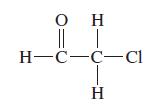
Use data from Tables 10.2 and 10.3 to determine for each bond in this following structure (a) The bond length and (b) The bond energy.Tables 10.2Tables 10.3 Ο Η Η || | H-C-C-Cl H
For each of the following compounds, give the names of the electron-group geometry and the molecular shape. Sketch the molecule and indicate on the sketch the direction of the dipole moment, if any. For the sketches, use the wedge-and-dash notation.(a) SiF4; (b) NF3;(c) SF4; (d) IF5.
Without referring to tables or figures in the text other than the periodic table, indicate which of the following atoms, Bi, S, Ba, As, or Mg, has the intermediate value when they are arranged in order of increasing electronegativity.
What is the VSEPR theory? On what physical basis is the VSEPR theory founded?
Use the NH3 molecule as an example to explain the difference between molecular geometry and electron-group geometry.
If you have four electron pairs around a central atom, under what circumstances can you have a pyramidal molecule? Similarly, how can you have a bent molecule? What are the expected bond angles in each case?
Draw three resonance structures for the sulfine molecule, H2CSO. Do not consider ring structures.
Describe the phosphine molecule, PH3. by the valence bond method.
Construct a concept map illustrating the connections between Lewis dot structures, the shapes of molecules, and polarity.
Hydrogen azide, HN3, and its salts (metal azides) are unstable substances used in detonators for high explosives. Sodium azide, NaN3, is used in air-bag safety systems in automobiles. A reference source lists the following data for HN3. (The subscripts a, b, and c distinguish the three N atoms from
Criticize the following statement: The hybridization of the C atom in CH3+ and CH3- are both expected to be the same as in CH4.
(A) Use the valence bond method to describe bonding and the expected molecular geometry in nitrogen triiodide, NI3.(B) Describe the molecular geometry of NH3, first using the VSEPR method and then using the valence bond method described above. How do your answers differ? Which method seems to be
Showing 2200 - 2300
of 4008
First
16
17
18
19
20
21
22
23
24
25
26
27
28
29
30
Last
Step by Step Answers

 Get 50% OFF
Claim Now
Get 50% OFF
Claim Now