New Semester
Started
Get
50% OFF
Study Help!
--h --m --s
Claim Now
Question Answers
Textbooks
Find textbooks, questions and answers
Oops, something went wrong!
Change your search query and then try again
S
Books
FREE
Study Help
Expert Questions
Accounting
General Management
Mathematics
Finance
Organizational Behaviour
Law
Physics
Operating System
Management Leadership
Sociology
Programming
Marketing
Database
Computer Network
Economics
Textbooks Solutions
Accounting
Managerial Accounting
Management Leadership
Cost Accounting
Statistics
Business Law
Corporate Finance
Finance
Economics
Auditing
Tutors
Online Tutors
Find a Tutor
Hire a Tutor
Become a Tutor
AI Tutor
AI Study Planner
NEW
Sell Books
Search
Search
Sign In
Register
study help
sciences
general chemistry principles
General Chemistry Principles And Modern Applications 11th Edition Ralph Petrucci, Jeffry Madura, F. Herring, Carey Bissonnette - Solutions
Determine the equilibrium constants K and Kc at 298.15 K for the dissolution of magnesium hydroxide in an acidic solution. Mg(OH)2(s) + 2 H*(aq) — Mg²+(aq) + 2 H₂O(1)
(A) Determine the thermodynamic equilibrium constant at 298.15 K for(B) What is the value of the thermodynamic equilibrium constant at 298.15 K for the reaction of solid manganese dioxide with HCl(aq) to give manganese(II) ion in solution and chlorine gas? AgI(s) — Ag¹(aq) + (aq). I
Which substance in each of the following pairs would have the greater entropy? Explain.(a) At 75 °C and 1 bar: 1 mol H2O(l) or 1 mol H2O(g)(b) At 5 °C and 1 bar: 50.0 g Fe(s) or 0.80 mol Fe(s)(c) 1 mol Br2 (l, 1 bar, 8 °C) or 1 mol Br2 (s, 1 bar, -8 °C)(d) 0.312 mol SO2 (g, 0.110 bar, 32.5 °C)
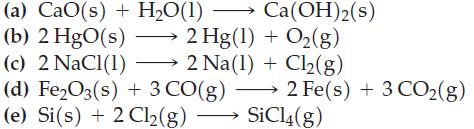
Without performing any calculations or using data from Appendix D, predict whether ΔrS° for each of the following reactions is positive or negative. If it is not possible to determine the sign of ΔrS° from the information given, indicate why. (a) CaO(s) + H2O(1) (b) 2 HgO(s) Ca(OH)2(s) 2 Hg(1)
(A) At what temperature will the formation of NO2(g) from NO(g) and O2(g) have Kp = 1.50 x 10²? For the reaction 2 NO(g) + O2(g) ⇌ 2 NO2(g) at 25 °C, ΔrH° = -114.1 kJ mol-1, and ΔrS° = -146.5 J mol-1K-1.(B) For the reaction 2 NO(g) + Cl2(g) ⇌ 2 NOCl(g), what is the value of K at (a) 25
At what temperature will the equilibrium constant for the formation of NOCl(g) be K = 1.00 x 10³? Data for this reaction at 25 °C are 2 NO(g) + Cl₂(g) 2 NOCI(g) A.G° = -40.9 kJ mol-¹ AH = -77.1 kJ mol-¹ A,S° = -121.3J mol-¹ K-¹
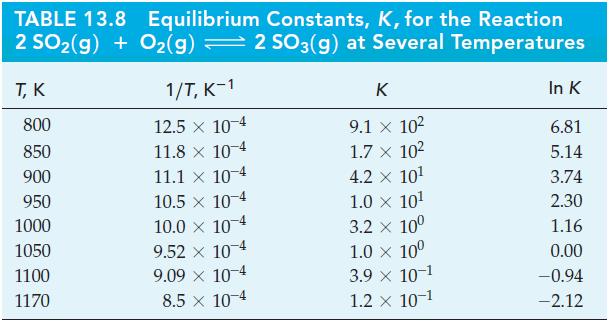
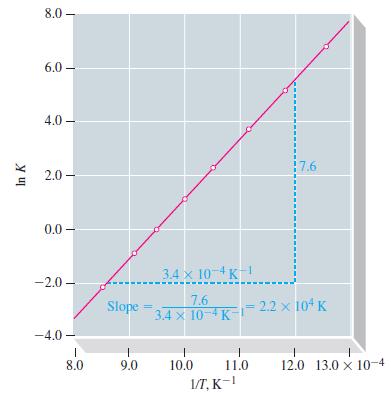
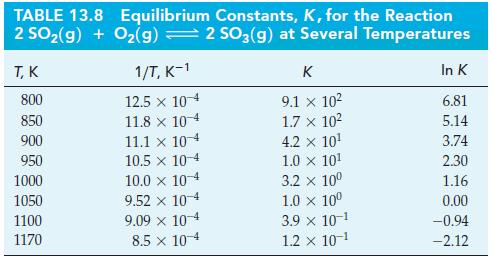
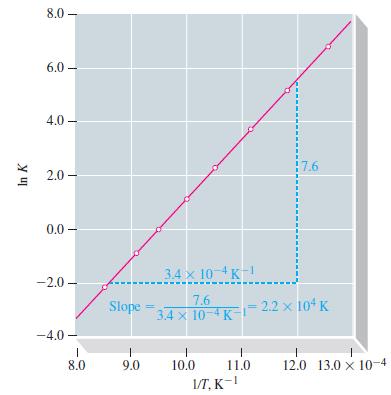
(A) Estimate the temperature at which K = 5.8 x 10⁻² for the reaction in Example 13-12. Use data from Table 13.8 and Figure 13-10.(B) What is the value of Kp for the reaction 2 SO2(g) + O2(g) Δ 2 SO3(g) at 235 °C? Use data from Table 13.8, Figure 13-10, and the van’t Hoff equation
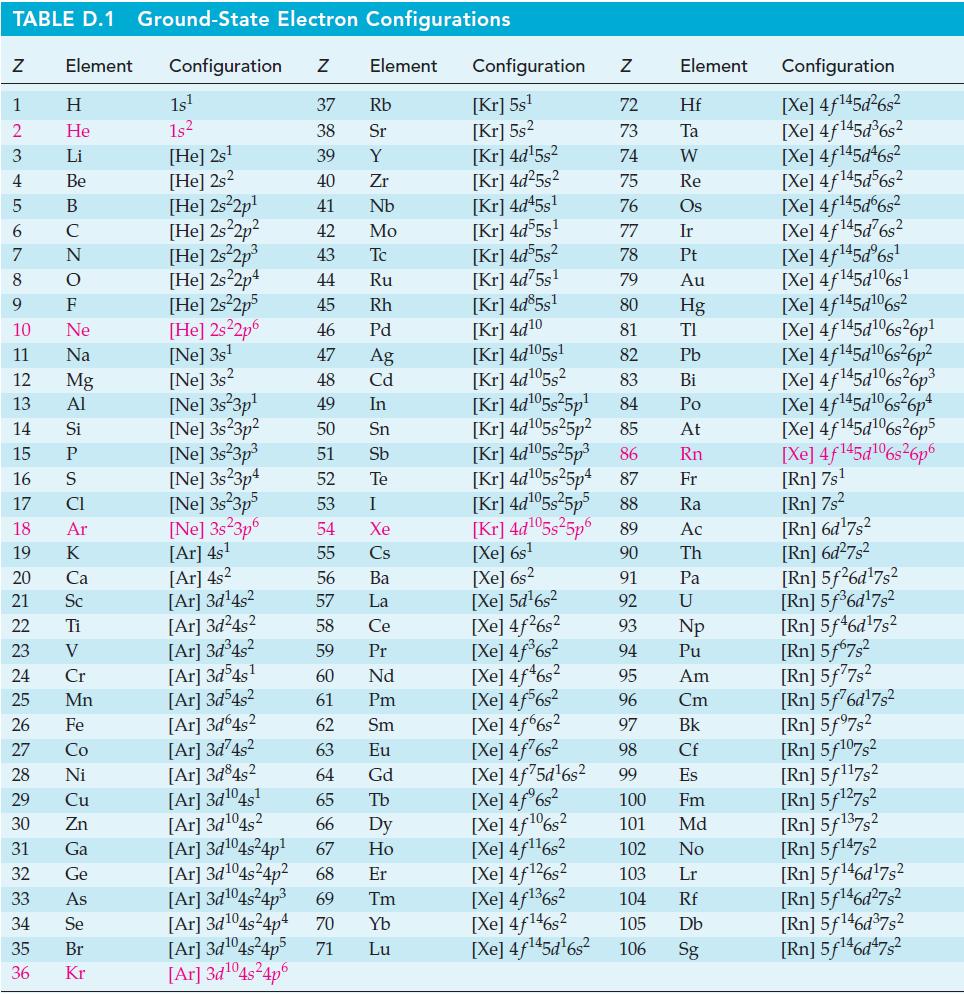
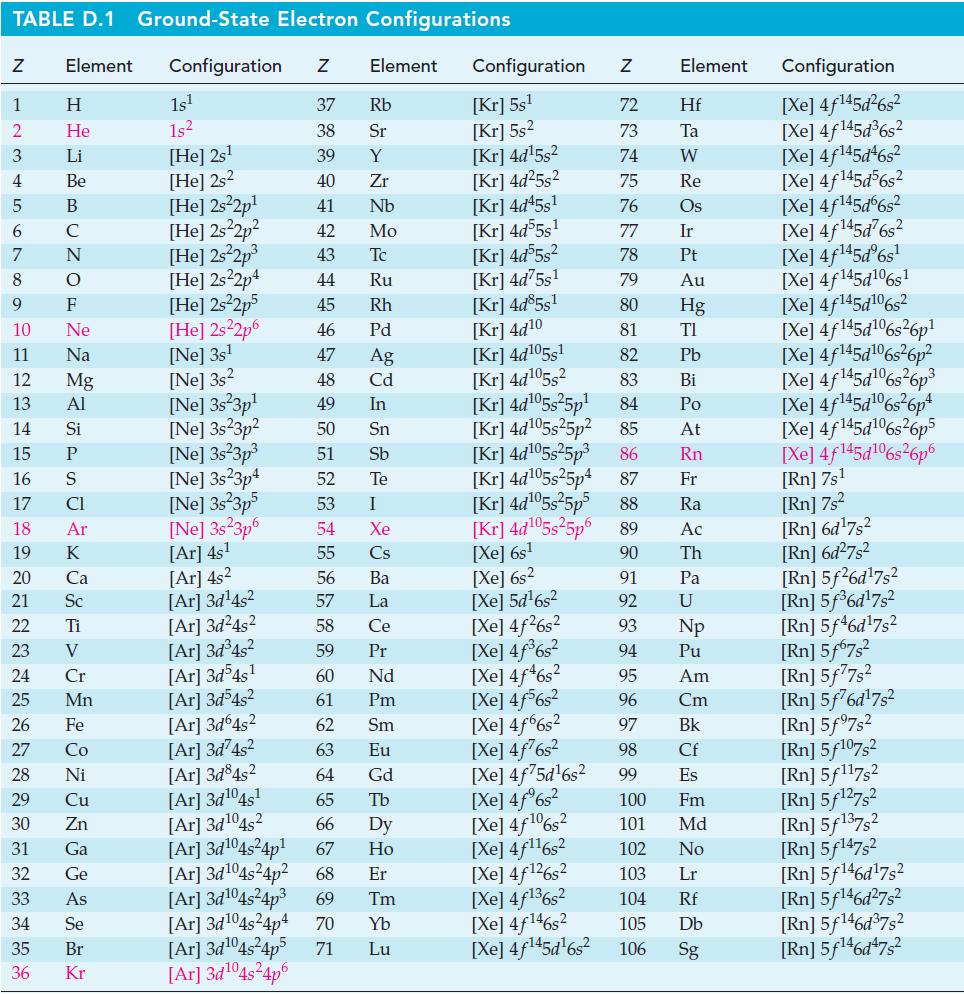
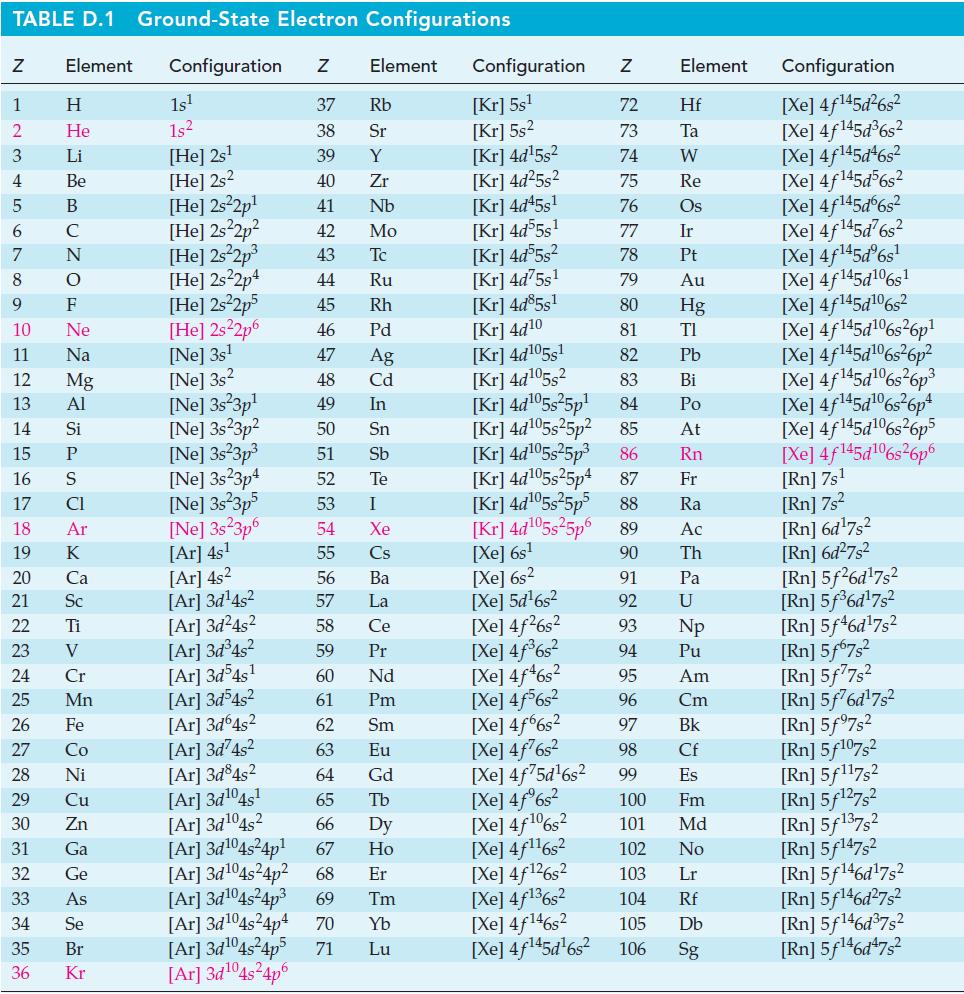
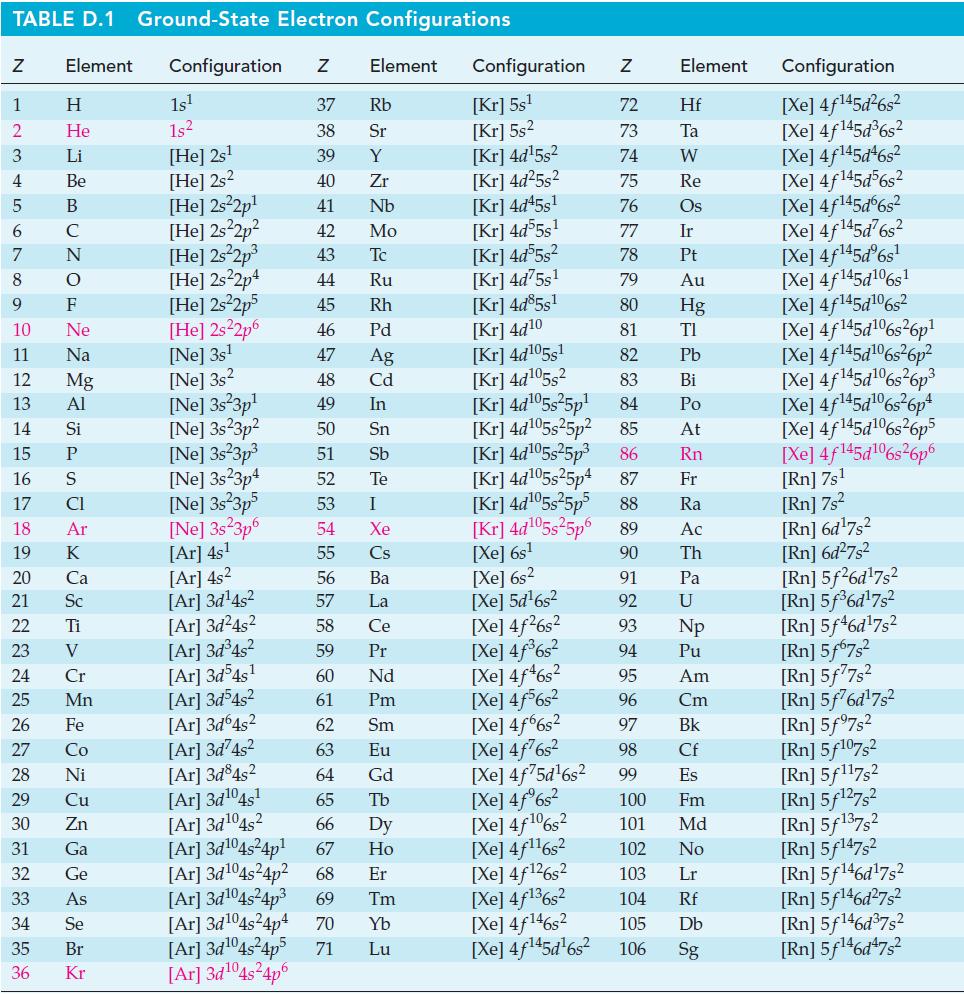
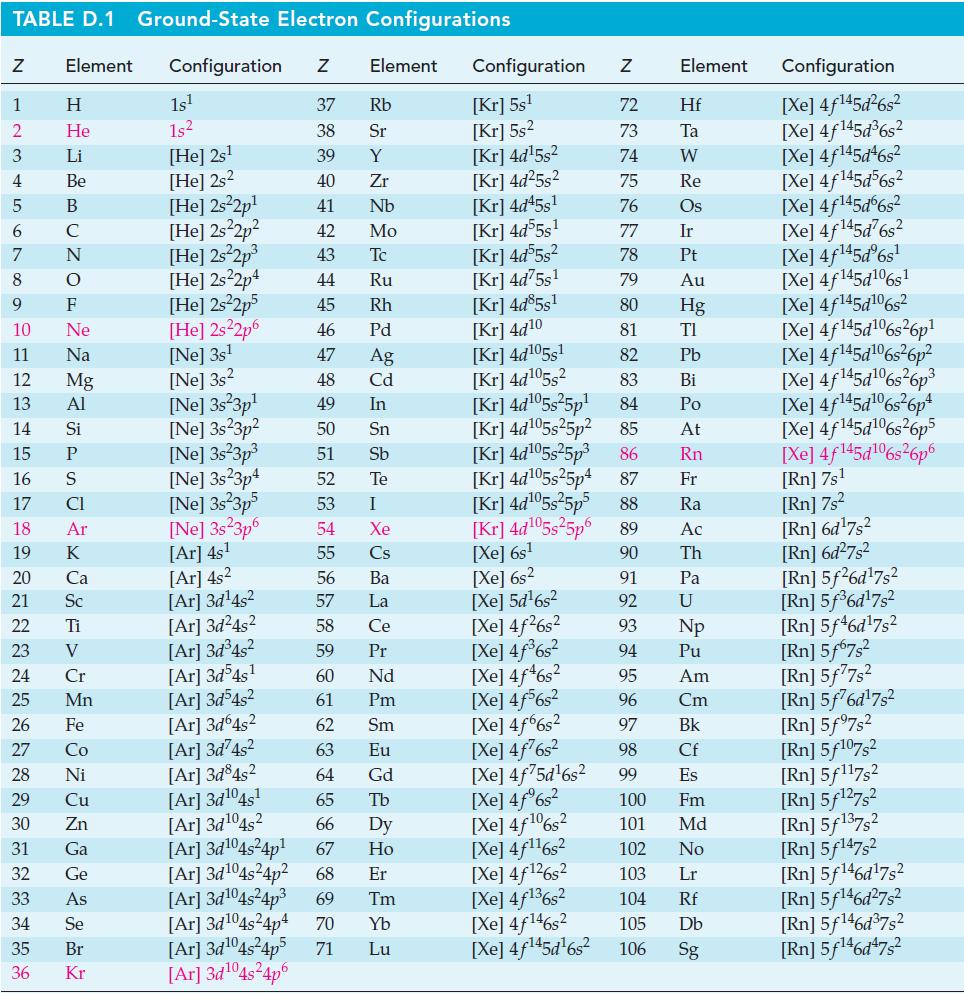
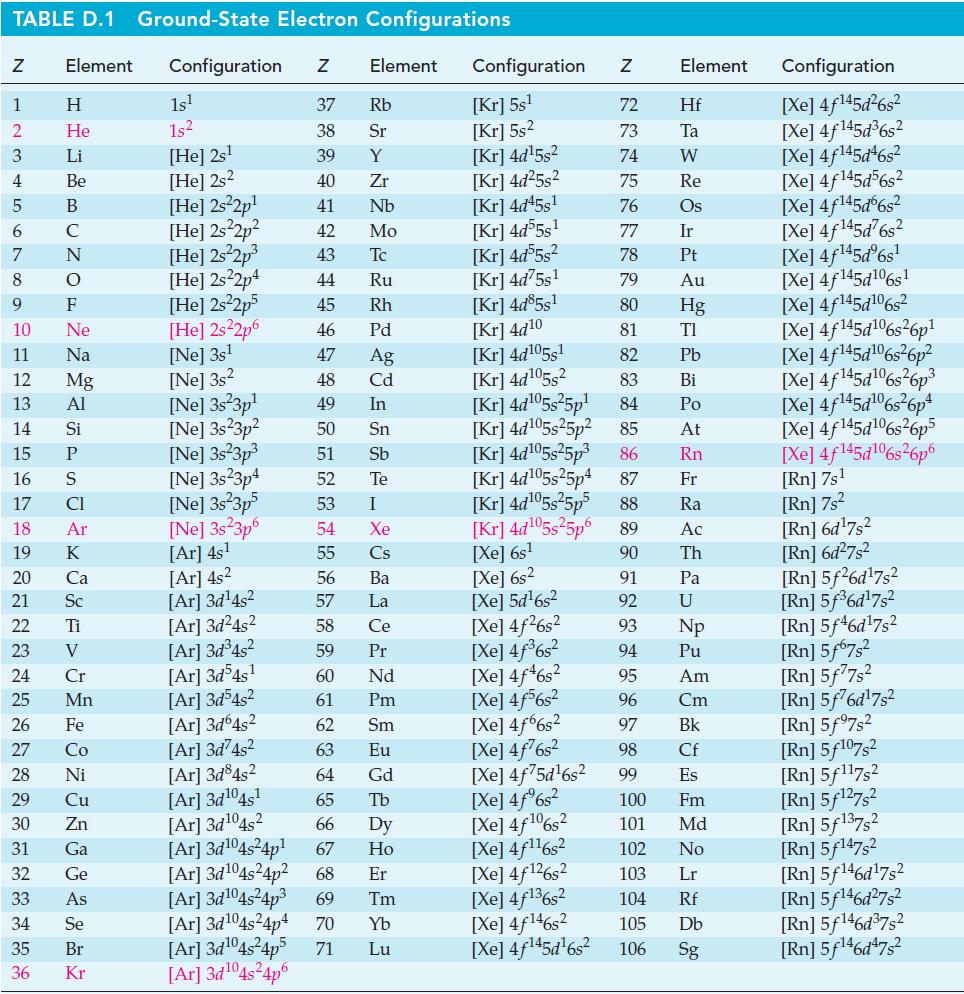
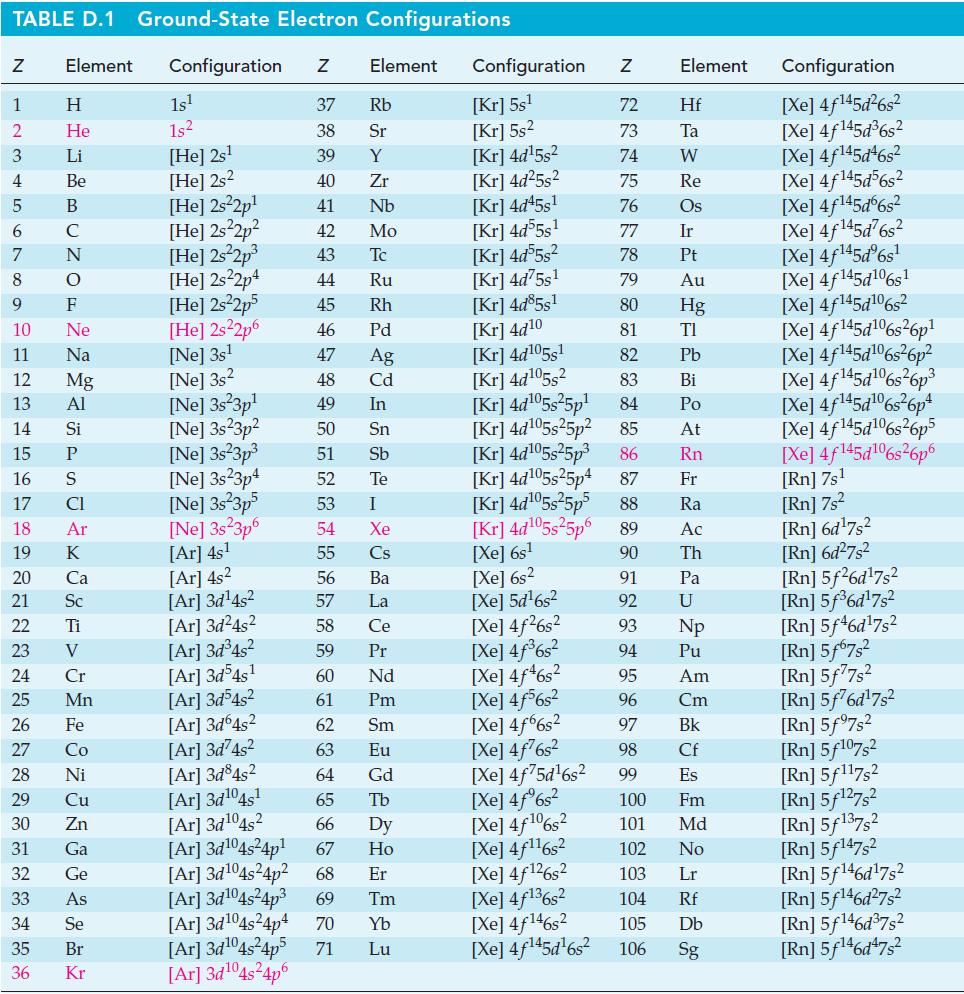
By analogy to ΔfH° and ΔfG° how would you define standard entropy of formation? Which would have the largest standard entropy of formation: CH4(g), CH3CH2OH(l), or CS2(l)? First make a qualitative prediction; then test your prediction with data from Appendix D. TABLE D.1 Ground-State Electron
Use data from Table 13.8 and Figure 13-10 to estimate the temperature at which K = 1.0 x 10⁶ for the reactionTable 13.8Figure 13-10 2 SO2(g) + O2(g) - 2 SO3(g)
(A) Dinitrogen pentoxide, N2O5, is a solid with a high vapor pressure. Its vapor pressure at 7.5 °C is 100 mmHg, and the solid sublimes at a pressure of 1.00 atm at 32.4 °C. What is ΔrG° 25 °C for the reaction N2O5(s) → N2O5(g)?(B) A plausible reaction for the production of ethylene glycol
In Example 13-3, we dealt with ΔvapH° and ΔvapS° for water at 100 °C.(a) Use data from Appendix D to determine values for these two quantities at 25 °C.(b) From your knowledge of the structure of liquid water, explain the differences in ΔvapH° values and in ΔvapS° values between 25 °C
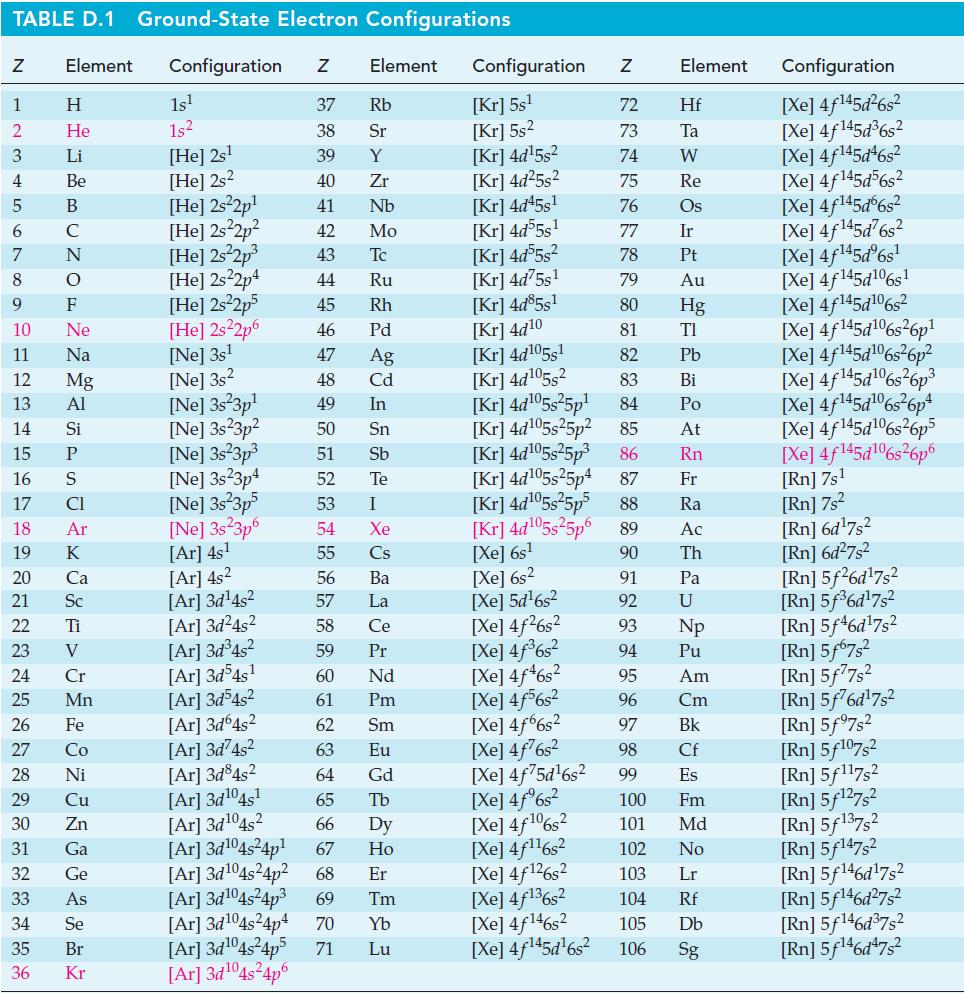
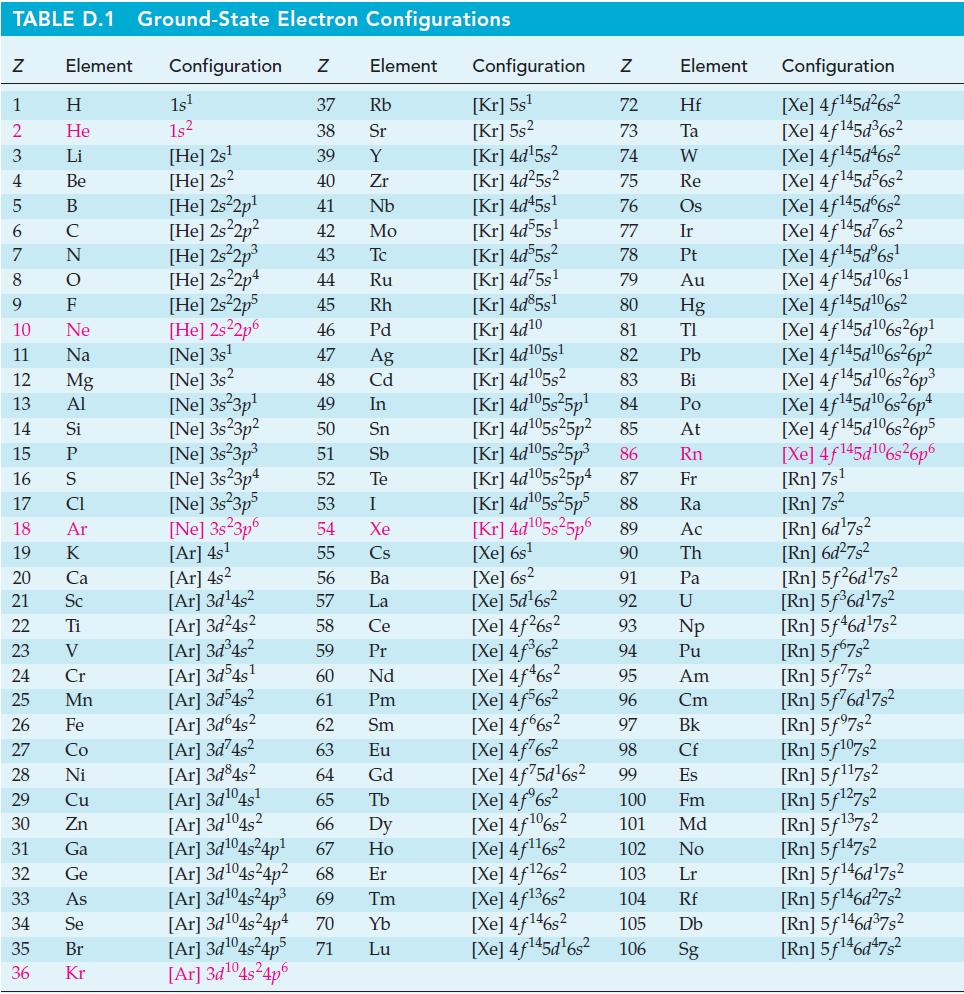
Calculate the entropy change, ΔS, for the following processes. If necessary, look up required data in Appendix D.(a) A mole of He(g) undergoes an expansion from V to 2V at 298 K.(b) The temperature of one mole of CH4(g) is increased from 298 K to 325 K at a constant pressure of 1 bar. TABLE D.1
Calculate the entropy change, ΔS, for the following processes. If necessary, look up required data in Appendix D.(a) The pressure of one mole of O2(g) is increased from P to 2P at 298 K.(b) The temperature of one mole of CO2(g) is increased from 298 K to 355 K at a constant volume of 20.0 L. TABLE
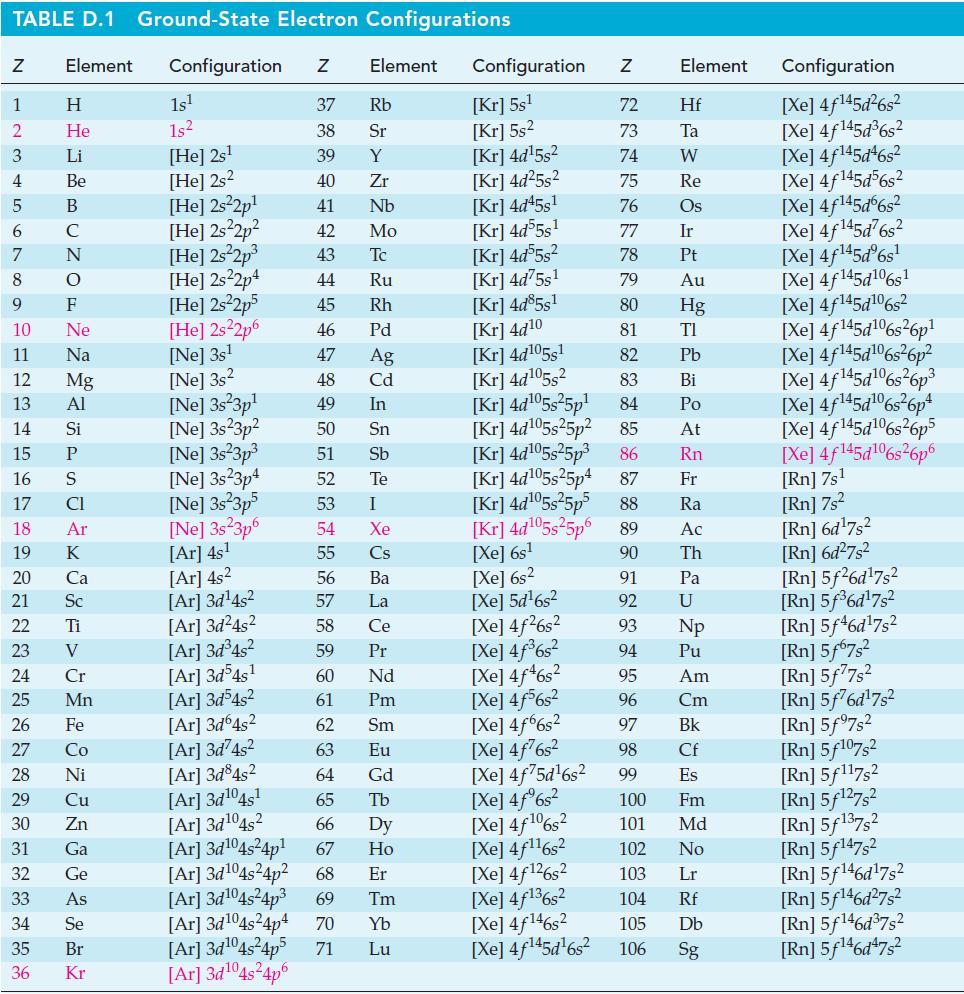
Estimate the normal boiling point of bromine, Br2 in the following way: Determine ΔvapH° for Br2 from data in Appendix D. Assume that ΔvapH° remains constant and that Trouton’s rule is obeyed. TABLE D.1 Ground-State Electron Configurations Element Configuration Z Z 1 2 3 4 6 7 8 9 5
Pentane is one of the most volatile of the hydrocarbons in gasoline. At 298.15 K, the following enthalpies of formation are given for pentane: ΔfH°[C5H12(l)] = -173.5 kJ mol-1; ΔfH°[C5H12(g)] = -146.9 kJ mol-1.(a) Estimate the normal boiling point of pentane.(b) Estimate ΔvapG° for pentane at
Which of the following substances would obey Trouton’s rule most closely: HF, C6H5CH3 (toluene), or CH3OH (methanol)? Explain your reasoning.
In what temperature range can the following equilibrium be established? Explain. H₂O(1, 0.50 bar) H₂O(g, 0.50 bar)
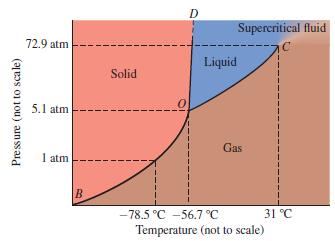
Refer to Figure 12-28 and equation (13.13). Which has the lowest Gibbs energy at 1 atm and -60 °C: solid, liquid, or gaseous carbon dioxide? Explain.Figure 12-28Eq. 13.13 Pressure (not to scale) 72.9 atm 5.1 atm 1 atm B Solid D I Supercritical fluid Liquid Gas -78.5 °C -56.7 °C Temperature (not
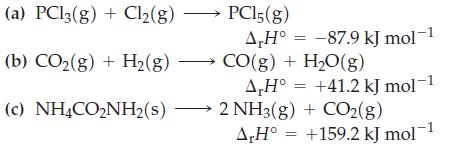
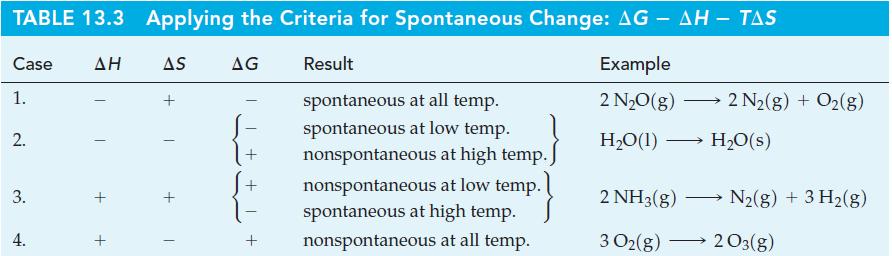
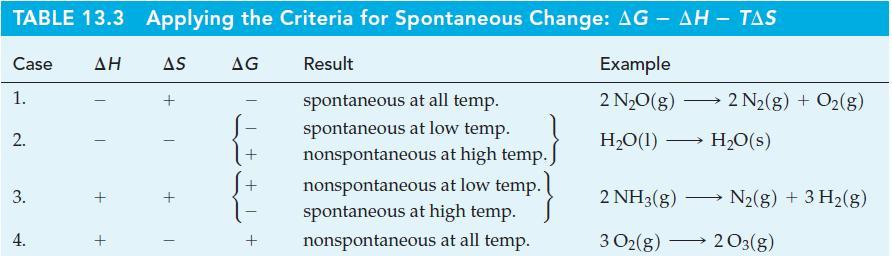
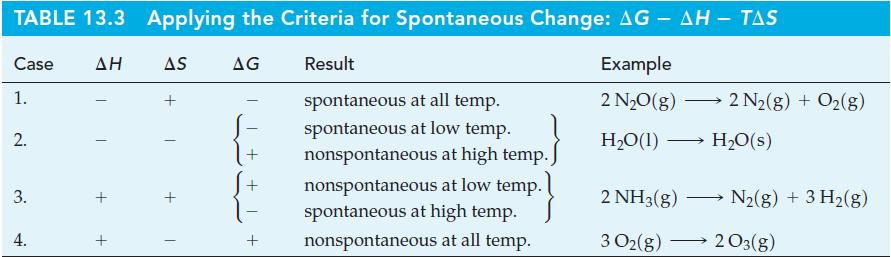
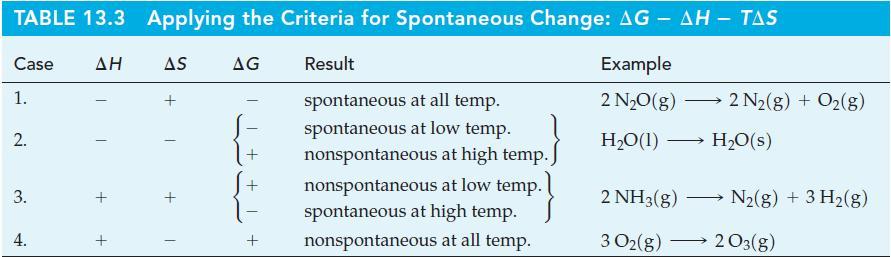
Indicate which of the four cases in Table 13.3 applies to each of the following reactions. If you are unable to decide from only the information given, state why.Table 13.3 (a) PC13(g) + Cl₂(g) (b) CO₂(g) + H₂(g) (c) NH4CO₂NH2(s) PC15(g) A,H° -87.9 kJ mol-1 ΔΗ° CO(g) + H₂O(g) = A,H°
Which of the following changes in a thermodynamic property would you expect to find for the reaction Br2(g) → 2 Br(g) at all temperatures? Explain. (a) ΔH < 0;(b) ΔS > 0; (c) ΔG < 0;(d) ΔS < 0.
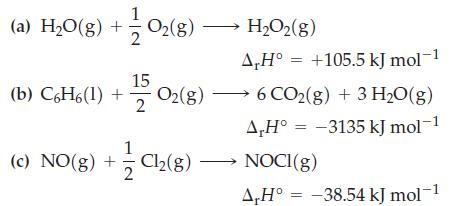
Indicate which of the four cases in Table 13.3 applies to each of the following reactions. If you are unable to decide from only the information given, state why.Table 13.3 (a) H₂O(g) +0₂(g) → H₂O2(g) (b) C6H6(1) + 1/2O₂(8) (c) NO(g) + Cl₂(g) 2 A,H° +105.5 kJ mol-1 6 CO2(g) + 3
If a reaction can be carried out only because of an external influence, such as the use of an external source of power, which of the following changes in a thermodynamic property must apply? Explain. (a) ΔH > 0;(b) ΔS > 0; (c) ΔG = ΔH; (d) ΔG > 0.
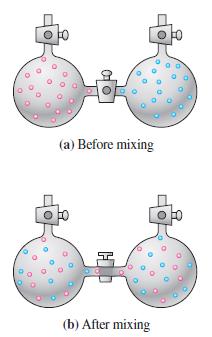
For the mixing of ideal gases (see Figure 13-3), explain whether a positive, negative, or zero value is expected for ΔH, ΔS, and ΔG.Figure 13-3 ою (a) Before mixing HD (b) After mixing
We will see that, for the formation of an ideal solution of liquid components, ΔH = 0. What would you expect for the values of ΔS and ΔG? (Is each value positive, negative, or zero?)
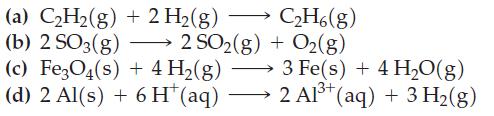
Use data from Appendix D to determine values of ΔrG° for the following reactions at 25 °C. → (a) C₂H₂(g) + 2 H₂(g) (b) 2 SO3(g) (c) Fe3O4(s) + 4 H₂(g) (d) 2 Al(s) + 6 H* (aq) 2 SO2(g) C2₂H6(g) + O2(g) 3 Fe(s) + 4 H₂O(g) 2 Al³+ (aq) + 3 H₂(g)
Explain why (a) Some exothermic reactions do not occur spontaneously, and (b) Some reactions in which the entropy of the system increases do not occur spontaneously.
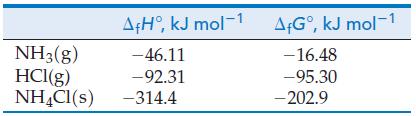
From the data given in the following table, determine ΔrS° for the reaction NH3(g) + HCl(g) → NH4Cl(s). All data are at 298 K. A+H°, kJ mol-1 NH3(g) -46.11 HCl(g) -92.31 NH4Cl(s) -314.4 A&Gº, kJ mol-1 -16.48 -95.30 -202.9
Explain why you would expect a reaction of the type AB(g) → A(g) + B(g) always to be spontaneous at high rather than at low temperatures.
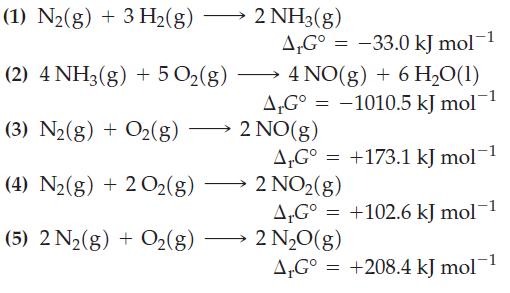
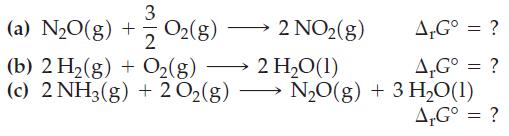
The following ΔrG° values are given for 25 °C.Combine the preceding equations, as necessary, to obtain ΔrG° values for each of the following reactions.Of reactions (a), (b), and (c), which would tend to go to completion at 25 °C, and which would reach an equilibrium condition with significant
At 298 K, for the reaction 2 PCl3(g) + O2(g) → 2 POCl3(l), ΔrH° = -620.2 kJ mol-1 and the standard molar entropies, in J mol–1 K–1, are PCl3(g), 311.8; O2(g), 205.1; and POCl3(l), 222.4. Determine (a) ΔrG° at 298 K and (b) Whether the reaction proceeds spontaneously in the forward or
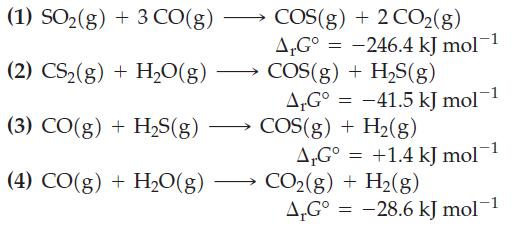
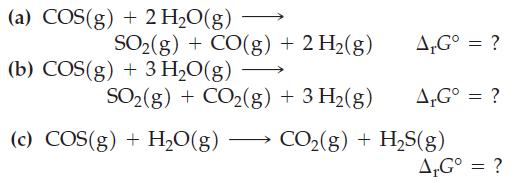
The following ΔrG° values are given for 25 °C.Combine the preceding equations, as necessary, to obtain ΔrG° values for the following reactions.Of reactions (a), (b), and (c), which is spontaneous in the forward direction when reactants and products are present in their standard states? (1)
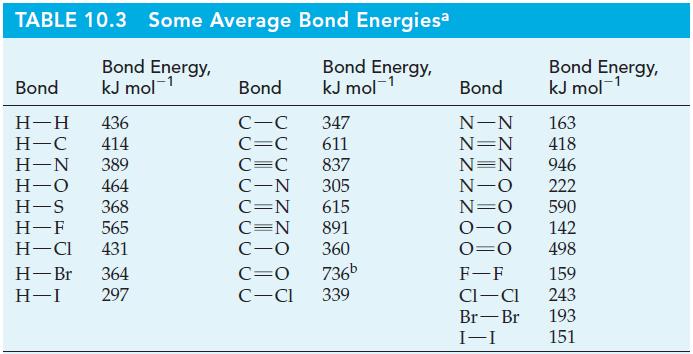
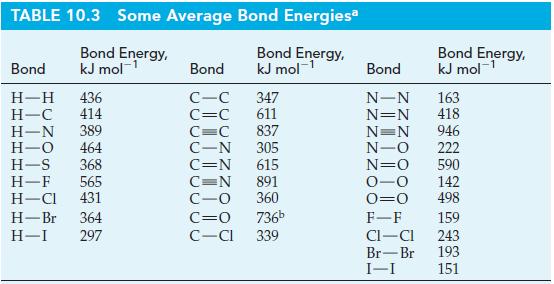
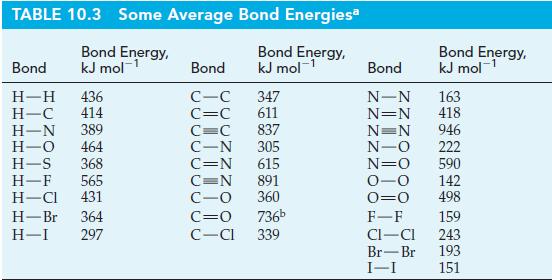
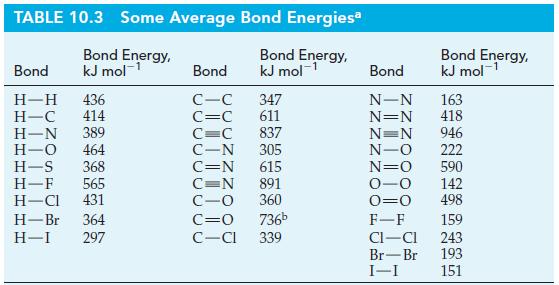
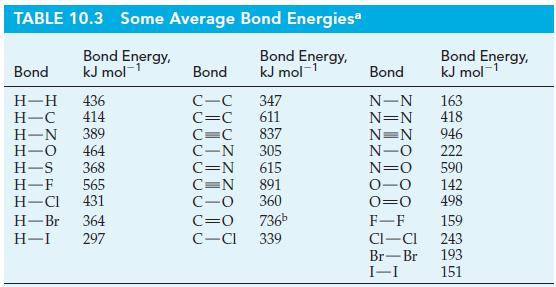
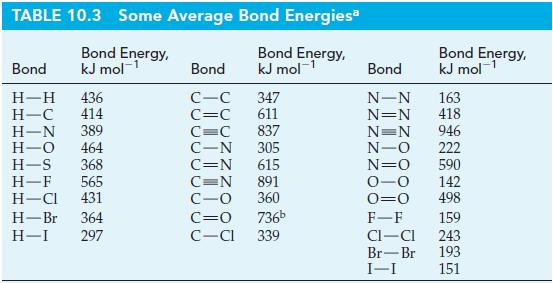
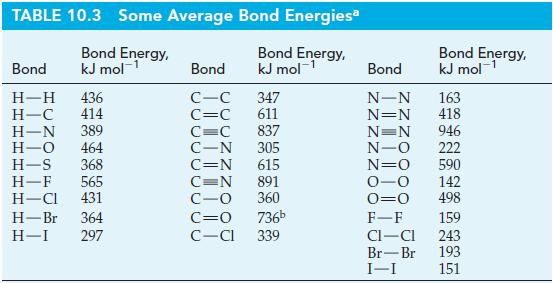
Together with the following data, to estimate the bond-dissociation energy of the F2 molecule.Compare your result with the value listed in Table 10.3.Table 10.3 F₂(g) - 2 F(g) A.G° = 123.9 kJ mol-1
Write an equation for the combustion of one mole of benzene, C6H6(l), and determine at 298 K if the products of the combustion are (a) CO2(g) and H2O(l), and (b) CO2(g) and H2O(g). Describe how you might determine the difference between the values obtained in (a) and (b) without having either to
Assess the feasibility of the reactionby determining each of the following quantities for this reaction at 25 °C.(a) ΔrS° (The standard molar entropy of N2F4(g) is 301.2 J mol-1 K-1.)(b) ΔrH° (Use data from Table 10.3 and F—O and N—F bond energies of 222 and 301 kJ mol-1, respectively.)(c)
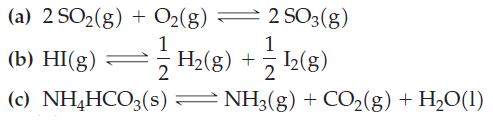
For each of the following reactions, write down the relationship between K and either Kp or Kc, as appropriate. (a) 2 SO₂(g) + O₂(g) = - 2 SO3(g) 1/11 (b) HI(g) = (c) NH4HCO3(s) I2(g) NH3(g) + CO₂(g) + H₂O(1) H₂(g) +
Solid ammonium nitrate can decompose to dinitrogen oxide gas and liquid water. What is ΔrG° at 298 K? Is the decomposition reaction favored at temperatures above or below 298 K?
Calculate the equilibrium constant and ΔrG° for the reaction CO(g) + 2 H2(g) → CH3OH(g) at 483 K by using the data tables from Appendix D. TABLE D.1 Ground-State Electron Configurations Element Configuration Z Z 1 2 3 4 6 7 8 9 5 B 10 11 12 13 14 15 16 17 18 19 20 25 27 29 HIG&LUZONSUZ SE> 0
Use data from Appendix D to establish for the reaction 2 N2O4(g) + O2(g) ⇌ 2 N2O5(g):(a) ΔrG° at 298 K for the reaction as written;(b) K at 298 K. TABLE D.1 Ground-State Electron Configurations Element Configuration Z Z 1 2 3 4 5 6 7 8 9 HIG&LUZON SONY SE> 0 ≤ 2 3 2 3 5 3 3 2 2 5
In Example 13-2, we were unable to conclude by inspection whether ΔrS° for the reaction CO(g) + H2O(g) → CO2(g) + H2(g) should be positive or negative. Use data from Appendix D to obtain ΔrS° at 298 K.Example 13-2Predict whether each of the following processes involves an increase or a
H2(g) can be prepared by passing steam over hot iron: 3 Fe(s) + 4 H2O(g) ⇌ Fe3O4(s) + 4 H2(g).(a) Write an expression for the thermodynamic equilibrium constant for this reaction.(b) Explain why the partial pressure of H2(g) is independent of the amounts of Fe(s) and Fe3O4(s) present.(c) Can we
Use data from Appendix D to determine values at 298 K of and K for the following reactions. (The equations are not balanced.) (a) HCl(g) + O₂(g) (b) Fe₂O3(s) + H₂(g) (c) Ag¹(aq) + SO4² (aq) H₂O(g) + Cl₂(g) Fe3O4(s) + H₂O(g) Ag2SO4(s)
In the synthesis of gaseous methanol from carbon monoxide gas and hydrogen gas, the following equilibrium concentrations were determined at 483 K: [CO(g)] = 0.0911 M, [H2(g)] = 0.0822 M, and 3[CH3OH(g)] = 0.00892 M. Calculate the equilibrium constant and ΔrG° for the reaction CO(g) + 2 H2(g) →
Use thermodynamic data at 298 K to decide in which direction the reactionis spontaneous when the partial pressures of SO2, O2, and SO3 are 1.0 x 10⁻⁴, 0.20, and 0.10 bar, respectively. 2 SO2(g) + O2(g) ⇒ 2 SO3(g)
Use thermodynamic data at 298 K to decide in which direction the reactionis spontaneous when the partial pressures of H2, Cl2, and HCl are all 0.5 bar. Cl₂(g) → 2 HCI(g) H₂(g) + Cl₂(g)
For the reaction below, ΔrG° = 27.07 kJ mol-1 at 298 K.Use this thermodynamic quantity to decide in which direction the reaction is spontaneous when the concentrations of CH3CO2H(aq), CH3CO2-(aq), and H3O+(aq) are 0.10 M, 1.0 x 10⁻³ M, and 1.0 x 10⁻³ M, respectively. CH3CO₂H(aq) +
For the reaction below, ΔrG° = 29.05 kJ mol-1 at 298 K.Use this thermodynamic quantity to decide in which direction the reaction is spontaneous when the concentrations of NH3(aq), NH4+(aq), and OH-(aq) are 0.10 M, 1.0 x 10⁻³ M, and 1.0 x 10⁻³ M, respectively. NH3(aq) + H₂0(1) ⇒ NH4¹ (aq) +
For the reaction 2 NO(g) + O2(g) → 2 NO2(g) all but one of the following equations is correct. Which is incorrect, and why? (a) K = Kp; (b) ΔrS° = (ΔrH° - ΔrG°)/T;(c) K = e-ΔrG°/RT;(d) ΔrG = ΔrG° + RT ln Q.
Sketch the propene molecule, CH3CH ≡ CH2. Indicate the bond angles in this molecule. What is the maximum number of atoms that can be in the same plane?
Lactic acid has the formula CH3CH(OH)COOH. Sketch the lactic acid molecule, and indicate the various bond angles.
Levulinic acid has the formula CH3(CO)CH2CH2COOH. Sketch the levulinic acid molecule, and indicate the various bond angles.
Sketch, by using the dash and wedge symbolism, the H2NCH2CHO molecule, and indicate the various bond angles.
Use data from Table 10.3, but without performing detailed calculations, determine whether each of the following reactions is exothermic or endothermic.Table 10.3 (a) CH4(g) + I(g) (b) H₂(g) + I2(g) CH3(g) + HI(g) 2 HI(g)
One of the isomers of chloromethanol has the formula ClCH2OH. Sketch, by using the dash and wedge symbolism, this isomer of chloromethanol, and indicate the various bond angles.
Use bond energies from Table 10.3 to estimate ΔrH for the following reaction.Table 10.3 C₂H2(g) + H2(g) C₂H4(g) A₁H = ?
Equations (1) and (2) can be combined to yield the equation for the formation of CH4(g) from its elements.Use the preceding data and a bond energy of 436 kJ mol-1 for H2 to estimate the C—H bond energy. Compare your result with the value listed in Table 10.3.Table 10.3 C(s) C(g) (1) (2) C(g) + 2
A reaction involved in the sequence of reactions leading to the destruction of ozone isEstimate the oxygen-oxygen bond energy in ozone by using the oxygen–oxygen bond energy in dioxygen from Table 10.3. Compare this value with the O–O and O=O bond energies in Table 10.3. How could you explain
Given the bond-dissociation energies: nitrogen-to-oxygen bond in NO, 631 kJ mol-1; H—H in H2, 436 kJ mol-1; N—H in NH3, 389 kJ mol-1; O—H in H2O, 463 kJ mol-1; calculate ΔrH for the reaction below. 2NO(g) + 5 H₂(g) → 2 NH3(g) + 2 H₂O(g)
The following statements are not made as carefully as they might be. Criticize each one.(a) Lewis structures with formal charges are incorrect.(b) Triatomic molecules have a planar shape.(c) Molecules in which there is an electronegativity difference between the bonded atoms are polar.
A compound consists of 42.44% N and 57.56% F, by mass. Write a plausible Lewis structure based on the empirical formula of this compound.
A 0.325 g sample of a gaseous hydrocarbon occupies a volume of 193 mL at 749 mmHg and 26.1 °C. Determine the molecular mass, and write a plausible condensed structural formula for this hydrocarbon.
A 1.24 g sample of a hydrocarbon, when completely burned in an excess of O2(g), yields 4.04 g CO2 and 1.24 g H2O. Draw a plausible structural formula for the hydrocarbon molecule.
Draw Lewis structures for two different molecules with the formula C3H4. Is either of these molecules linear? Explain.
Use the bond-dissociation energies of N2(g) and O2(g) in Table 10.3, together with data from Appendix D, to estimate the bond-dissociation energy of NO(g).Table 10.3 TABLE 10.3 Some Average Bond Energies* Bond Energy, kJ mol-¹ Bond Energy, kJ mol-¹ Bond H-H 436 H-C 414 H-N 389 H-O 464 H-S 368 H-F
Sodium azide, NaN3, is the nitrogen gas-forming substance used in automobile air-bag systems. It is an ionic compound containing the azide ion, N3- In this ion, the two nitrogen-to-nitrogen bond lengths are 116 pm. Describe the resonance hybrid Lewis structure of this ion.
Hydrogen azide, HN3, is a liquid that explodes violently when subjected to physical shock. In the HN3 molecule, one nitrogen-to-nitrogen bond length is 113 pm, and the other is 124 pm. The H—N—N bond angle is 112°. Draw Lewis structures and a sketch of the molecule consistent with these facts.
A few years ago the synthesis of a salt containing the N5+ ion was reported. What is the likely shape of this ion—linear, bent, zigzag, tetrahedral, seesaw, or square-planar? Explain your choice.
Carbon suboxide has the formula C3O2. The carbon-to-carbon bond lengths are 130 pm and carbon-to-oxygen, 120 pm. Propose a plausible Lewis structure to account for these bond lengths, and predict the shape of the molecule.
In certain polar solvents, PCl5 undergoes an ionization reaction in which a Cl- ion leaves one PCl5 molecule and attaches itself to another. The products of the ionization are PCl4+ and PCl6-. Draw a sketch showing the changes in geometric shapes that occur in this ionization (that is, give the
Estimate the enthalpy of formation of HCN using bond energies from Table 10.3, data from elsewhere in the text, and the reaction scheme outlined as follows.Table 10.3 C(g) A,H° = ? HCN(g) AH° = ? H₂(g) → HCN(g) AH° = ? (1) C(s) (2) C(g) + N₂(g) + H₂(g) Overall: C(g) + N₂(g) +
The standard enthalpy of formation of H2O2(g) is -136 kJ mol-1. Use this value, with other appropriate data from the text, to estimate the oxygen-to-oxygen single-bond energy. Compare your result with the value listed in Table 10.3.Table 10.3 TABLE 10.3 Some Average Bond Energies Bond Energy, kJ
Use the VSEPR theory to predict a probable shape of the molecule F4SCH2, and explain the source of any ambiguities in your prediction.
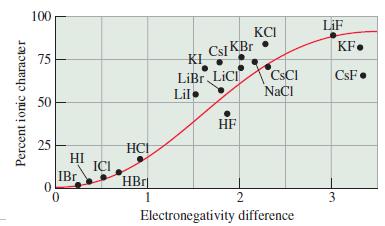
For LiBr, the dipole moment (measured in the gas phase) and the bond length (measured in the solid state) are 7.268 D and 217 pm, respectively. For NaCl, the corresponding values are 9.001 D and 236.1 pm.(a) Calculate the percent ionic character for each bond. (b) Compare these values with the
The standard enthalpy of formation of methanethiol, CH3SH(g), is -22.9 kJ mol-1. Methanethiol can be synthesized by the reaction of gaseous methanol and H2S(g). Water vapor is another product. Use this information and data from elsewhere in the text to estimate the carbon-to-sulfur bond energy in
One possibility for the electron-group geometry for seven electron groups is pentagonal-bipyramidal, as found in the IF7 molecule. Write the VSEPR notation for this molecule. Sketch the structure of the molecule, labeling all the bond angles.
The extent to which an acid (HA) ionizes in water depends upon the stability of the anion (A-); the more stable the anion, the more extensive is the dissociation of the acid. The anion is most stable when the negative charge is distributed over the whole anion rather than localized at one
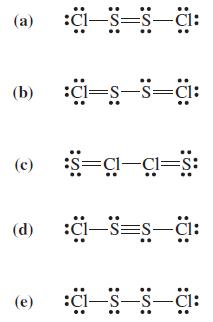
When molten sulfur reacts with chlorine gas, a vilesmelling orange liquid forms. When analyzed, the liquid compound has the empirical formula SCl. Several possible Lewis structures are shown below. Criticize these structures and choose the best one. (a) :C-S=S-a: (b) :C=S-S=C: (c)
Hydrogen azide, HN3, can exist in two forms. One form has the three nitrogen atoms connected in a line; and the nitrogen atoms form a triangle in the other. Construct Lewis structures for these isomers and describe their shapes. Other interesting derivatives are nitrosyl azide (N4O) and
A pair of isoelectronic species for C and N exist with the formula X2O4 in which there is an X—X bond. A corresponding fluoride of boron also exists. Draw Lewis structures for these species and describe their shapes.
Acetone (CH3)2C = O, a ketone, will react with a strong base (A-) to produce the enolate anion, CH3(C = O)CH2-. Draw the Lewis structure of the enolate anion, and describe the relative contributions of any resonance structures.
The species PBr4- has been synthesized and has been described as a tetrahedral anion. Comment on this description.
One of the allotropes of sulfur is a ring of eight sulfur atoms. Draw the Lewis structure for the S8 ring. Is the ring likely to be planar? The S8 ring can be oxidized to produce S8O. In S8O, the oxygen atom is bonded to one of the S atoms and the S8 ring is still intact. Draw the Lewis structure
Match each of the following species with one of these hybridization schemes: sp, sp2, sp3, sp3d, sp3d2.(a) PF6-;(b) COS; (c) SiCl4; (d) NO3-;(e) AsF5.
Why does the hybridization sp3d not account for bonding in the molecule BrF5? What hybridization scheme does work? Explain.
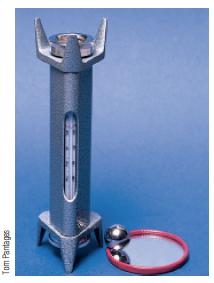
The viscosity of automotive motor oil is designated by its SAE number, such as 40 W. When compared in a ball viscometer (Fig. 12-15), the ball drops much faster through 10 W oil than through 40 W oil. Which of these two oils provides better winter service in the Arctic region of Canada? Which is
Construct a concept map that connects the ideas of molecular orbital theory.
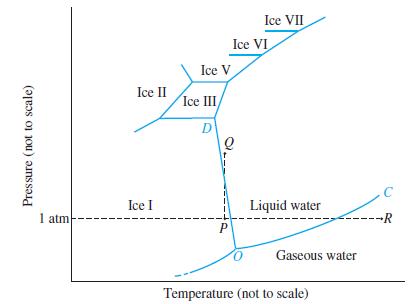
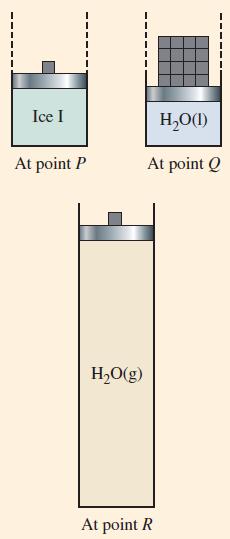
(A) With as much detail as possible, describe the phase changes that would occur if a sample of water represented by point R in Figure 12-30 were brought first to point P and then to point Q.Figure 12-30(B) Draw a sketch showing the condition prevailing along the line PR when 1.00 mol of water has
A sample of 113 L of helium gas at 1360 °C and prevailing barometric pressure is passed through molten silver at the same temperature. The gas becomes saturated with silver vapor, and the liquid silver loses 0.120 g in mass. What is the vapor pressure of liquid silver at 1360 °C?
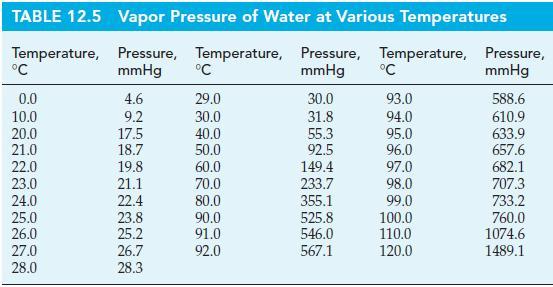
Use data from Table 12.5 to estimate (a) The boiling point of water in Santa Fe, New Mexico, if the prevailing atmospheric pressure is 640 mmHg; (b) The prevailing atmospheric pressure at Lake Arrowhead, California, if the observed boiling point of water is 94 °C.Table 12.5 TABLE
An 80.0 g piece of dry ice, CO2(s), is placed in a 0.500 L container, and the container is sealed. If this container is held at 25 °C, what state(s) of matter must be present?
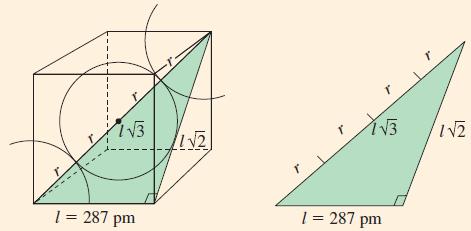
Using methods similar to Examples 12-10 and 12-11, calculate the density of CsCl. Use 169 pm as the radius of Cs+.Examples 12-10Use data from Example 12-9, together with the molar mass of Fe and the Avogadro constant, to calculate the density of iron.Example 12-9At room temperature, iron
Ionic liquids (ILs) are salts that are in the liquid state. At a given temperature, ILs have lower vapor pressures than molecular compounds in the liquid state because the forces of attraction between oppositely charged ions are much stronger than intermolecular forces. Thus, ILs tend to be much
All solids contain defects or imperfections of structure or composition. Defects are important because they influence properties, such as mechanical strength. Two common types of defects are a missing ion in an otherwise perfect lattice, and the slipping of an ion from its normal site to a hole in
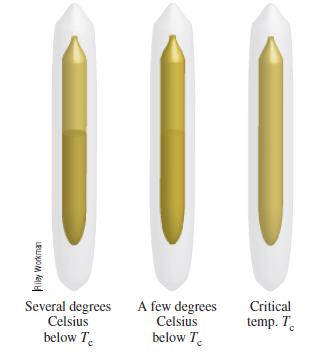
The phenomena in Figure 12-22 will be seen at the critical temperature only if the proper amount of liquid is placed in the sealed tube initially. Why should this be the case? What would you expect to see if too little liquid was present initially? If too much liquid was present?Figure 12-22 Riley
Of the compounds HF, CH4, CH3OH, N2H4, and CHCl3, hydrogen bonding is an important intermolecular force in (a) None of these; (b) Two of these;(c) Three of these; (d) All but one of these; (e) All of these.
The synthesis of methanol is of great importance because methanol can be used directly as a motor fuel, mixed with gasoline for fuel use, or converted to other organic compounds. The synthesis reaction, carried out at about 500 K, isWhat are the values of K and Kp at 500 K? CO(g) +2 H₂(g) CH3OH(g)
A system containing four neon atoms is confined to a one-dimensional box. The system undergoes an expansion from 905 pm to 1810 pm at a fixed total energy of 14.0 x 10⁻²⁴ J. (a) Determine the number of microstates for both the initial and final states of the system by illustrating, in the manner
Expansion of a gas into a vacuum is not only spontaneous but also instantaneous. Is it generally true that a spontaneous process is also instantaneous? Explain.
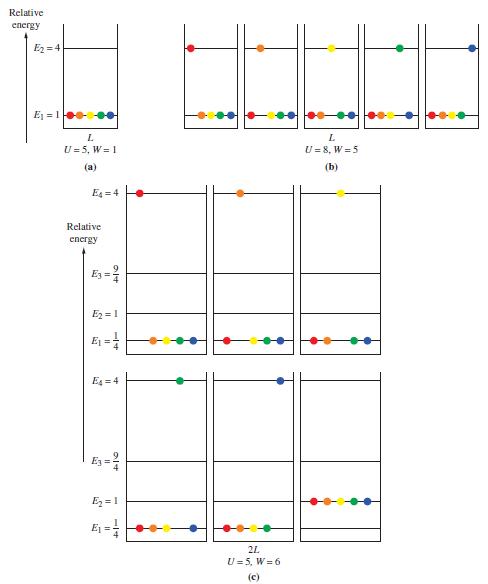
Consider a system of five distinguishable particles confined to a one-dimensional box of length L. Describe how the following actions affect the number of accessible microstates and the entropy of the system:(a) Increasing the length of the box to 2L for fixed total energy;(b) Increasing the total
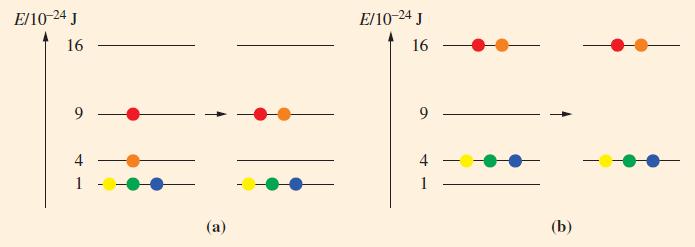
(A) How many microstates are there for four neon atoms confined to a 905 pm box if the total energy is 20.0 x 10⁻²⁴ J?(B) Which of the following, (a) or (b), represents a change in volume? E/10-24 J 16 9 4 1 (a) E/10-24 J 16 9 1 (b)
Predict whether each of the following processes involves an increase or a decrease in entropy or whether the outcome is uncertain.(a) The decomposition of ammonium nitrate (a fertilizer and a highly explosive compound):(b) The conversion of SO2 to SO3 (a key step in the manufacture of sulfuric
Showing 1900 - 2000
of 4008
First
13
14
15
16
17
18
19
20
21
22
23
24
25
26
27
Last
Step by Step Answers

 Get 50% OFF
Claim Now
Get 50% OFF
Claim Now