New Semester
Started
Get
50% OFF
Study Help!
--h --m --s
Claim Now
Question Answers
Textbooks
Find textbooks, questions and answers
Oops, something went wrong!
Change your search query and then try again
S
Books
FREE
Study Help
Expert Questions
Accounting
General Management
Mathematics
Finance
Organizational Behaviour
Law
Physics
Operating System
Management Leadership
Sociology
Programming
Marketing
Database
Computer Network
Economics
Textbooks Solutions
Accounting
Managerial Accounting
Management Leadership
Cost Accounting
Statistics
Business Law
Corporate Finance
Finance
Economics
Auditing
Tutors
Online Tutors
Find a Tutor
Hire a Tutor
Become a Tutor
AI Tutor
AI Study Planner
NEW
Sell Books
Search
Search
Sign In
Register
study help
sciences
general chemistry principles
General Chemistry Principles And Modern Applications 11th Edition Ralph Petrucci, Jeffry Madura, F. Herring, Carey Bissonnette - Solutions
(A) Refer to the periodic table on the inside front cover, and arrange the following in the expected order of increasing first ionization energy Cl, K, Mg, S.(B) Refer to the periodic table on the inside front cover, and determine which element is most likely in the middle position when the
Which of the following species would you expect to be diamagnetic and which paramagnetic? (a) K+;(b) Cr3+;(c) Zn2+;(d) Cd; (e) Co3+;(f) Sn2+;(g) Br.
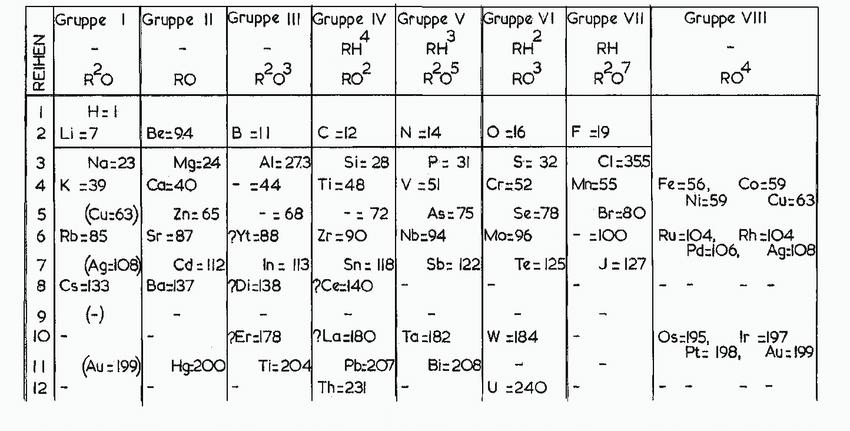
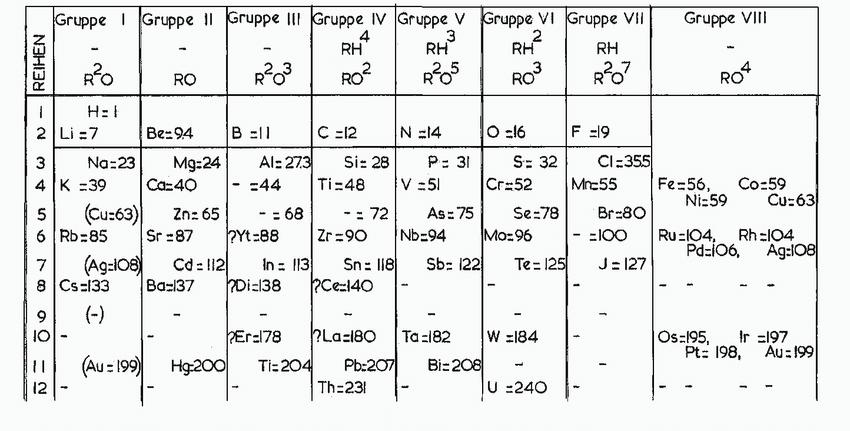
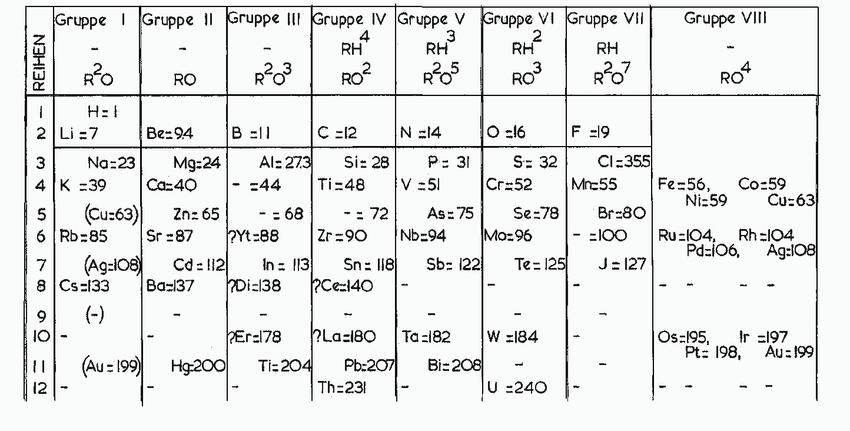
Refer to the periodic table on the inside front cover, and arrange the following in the expected order of increasing first ionization energy: As, Sn, Br, Sr. REIHEN 3 A W 1 2 Li=7 4 K 56 94 Gruppe 1 Gruppe 11 Gruppe III Gruppe IV Gruppe V Gruppe VI Gruppe VII RH²³ 3 2.5 R²3 7 9 10 12 M 6 Rb
Which of the following species has the greatest number of unpaired electrons (a) Ge; (b) Cl; (c) Cr3+;(d) Br-?
Unpaired electrons are found in only one of the following species. Indicate which one, and explain why: F-, Ca2+, Fe2+, S2-.
(A) Refer only to the periodic table on the inside front cover, and arrange the following species in order of increasing size: Ti2+, V3+, Ca2+, Br-, and Sr2+.(B) Refer only to the periodic table on the inside front cover, and determine which species is in the middle position when the following five
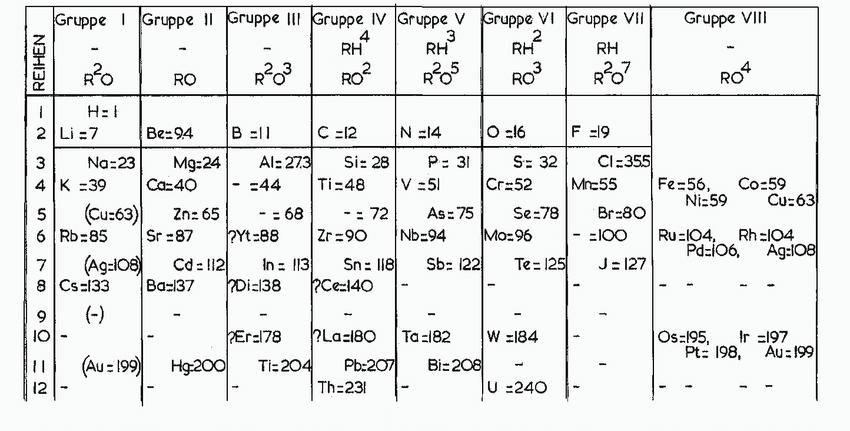
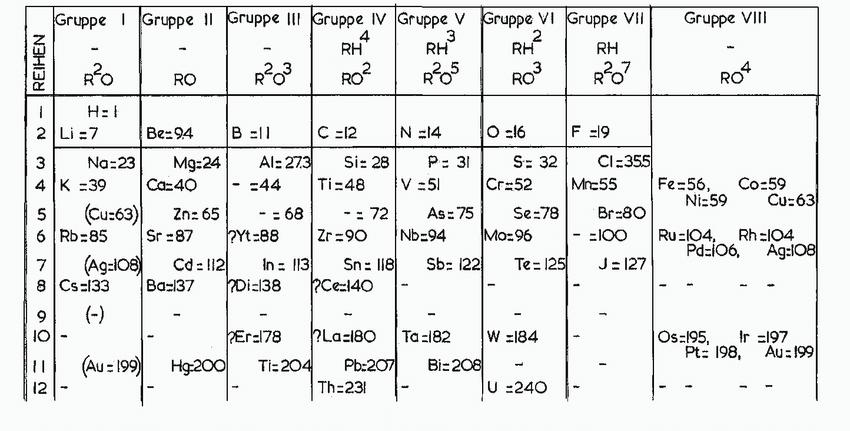
Refer only to the periodic table on the inside front cover, and arrange the following species in order of increasing size: K+, Cl-, S2-, and Ca2+. REIHEN 3 A W 1 2 Li=7 4 K 56 94 Gruppe 1 Gruppe 11 Gruppe III Gruppe IV Gruppe V Gruppe VI Gruppe VII RH²³ 3 2.5 R²3 7 9 10 12 M 6 Rb
(A) Use the periodic table on the inside front cover to predict which is the smallest atom: As, I, or S.(B) Which of the following atoms do you think is closest in size to the Na atom: Br, Ca, K, or Al? Explain your reasoning, and do not use any tabulated data from the chapter in reaching your
Write the Lewis structure of the acetate ion, CH3COO-.
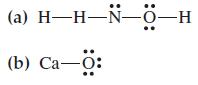
Describe what is wrong with each of the following Lewis structures. (a) H-H-N-Ö-H (b) Ca-0:
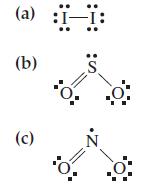
(A) Draw Lewis structures to represent the resonance hybrid for the SO2 molecule.(B) Draw Lewis structures to represent the resonance hybrid for the nitrate ion.
The molecule NH3 has the dipole moment μ = 1.47 D, whereas for the similar molecule NF3, μ = 0.24 D. Why do you suppose there is such a large difference in these two values?
Predict the molecular geometry of the polyatomic anion ICl4-.
Describe what is wrong with each of the following Lewis structures. (a) :0-C-0: (b) [.C=N:]
(A) Predict the molecular geometry of nitrogen trichloride.(B) Predict the molecular geometry of phosphoryl chloride, POCl3, an important chemical in the manufacture of gasoline additives, hydraulic fluids, and fire retardants.
NO2- and NO2+ are made up of the same atoms. How would you expect the nitrogen-to-oxygen bond lengths in these two ions to compare?
Predict the molecular geometry of formaldehyde, H2CO, used to make a number of polymers, such as melamine resins. The Lewis structure of the H2CO molecule is shown here. Η Η C :Ö:
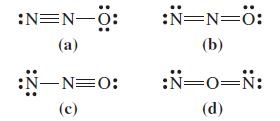
Only one of the following Lewis structures is correct. Select that one and indicate the errors in the others. (a) cyanate ion (b) carbide ion (c) hypochlorite ion (d) nitrogen (II) oxide [:O-C=N:] [C=C:1²- [:c-0:1 :N=0:
(A) Predict the shape of the COS molecule.(B) Nitrous oxide, N2O, is the familiar laughing gas used as an anesthetic in dentistry. Predict the shape of the N2O molecule.
Methyl isocyanate, CH3NCO, is used in the manufacture of insecticides, such as carbaryl (Sevin). In the CH3NCO molecule, the three H atoms and the O atom are terminal atoms and the two C and one N atom are central atoms. Draw the structure of this molecule, using dash and wedge symbols, and
Indicate what is wrong with each of the following Lewis structures. Replace each one with a more acceptable structure. (a) Mg:0: (b) [:O-N=0:1 (c) (d) [:S-C=N:] [:a::r [C: Cl :0
(A) Sketch, by using dash and wedge symbols, the methanol molecule, CH3OH. Indicate the bond angles in this molecule.(B) Glycine, an amino acid, has the formula H2NCH2COOH. Sketch, by using dash and wedge symbols, the glycine molecule, and indicate the various bond angles.
Which of these molecules would you expect to be polar: Cl2, ICl, BF3, NO, SO2?
Under appropriate conditions, both hydrogen and nitrogen can form monatomic anions. What are the Lewis symbols for these ions? What are the Lewis structures of the compounds (a) Lithium hydride;(b) Calcium hydride; (c) Magnesium nitride?
Provide the best estimate you can of these bond lengths for the (a) The nitrogen-to-hydrogen bonds in NH3;(b) The bromine-to-chlorine bond in BrCl.
(A) Only one of the following molecules is polar. Which is it, and why? SF6, H2O2, C2H4.(B) Only one of the following molecules is nonpolar. Which is it, and why? Cl3CCH3, PCl5, CH2Cl2, NH3.
Write Lewis structures for the following ionic compounds:(a) Calcium chloride; (b) Barium sulfide;(c) Lithium oxide; (d) Sodium fluoride.
What is the formal charge of the indicated atom in each of the following structures?(a) The central O atom in O3(b) Al in AlH4-;(c) Cl in ClO3-;(d) Si in SiF62-;(e) Cl in ClF3.
The concept of formal charge helped us to choose the more plausible of the Lewis structures for NO2+ given in expressions (10.14) and (10.15). Can it similarly help us to choose a single Lewis structure as most plausible for CO2H+? Explain.Eq. 10.14Eq. 10.15 :0=N=0: (10.14)
Derive the correct formulas for the following ionic compounds by writing Lewis structures. (a) Lithium sulfide; (b) Sodium fluoride; (c) Calcium iodide;(d) Scandium chloride.
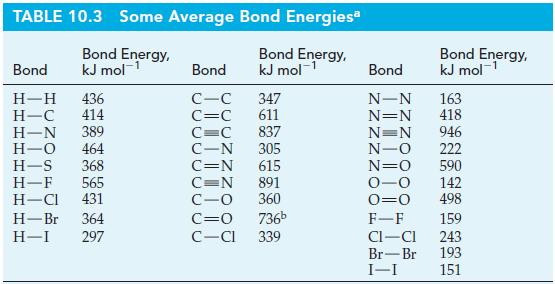
(A) Use bond energies to estimate the enthalpy change for the reaction (B) Use bond energies to estimate the enthalpy of formation of NH3(g). 2 H₂(g) + O2(g) 2 H₂O(g)
One of the steps in the formation of monochloromethane (Example 10-15) is the reaction of a gaseous chlorine atom (a chlorine radical) with a molecule of methane. The products are an unstable methyl radical and HCl(g). Is this reaction endothermic or exothermic?Example 10-15The reaction of methane
(A) Is the following reaction endothermic or exothermic?(B) Predict whether the following reaction should be exothermic or endothermic: CH3COCH3(g) + H₂(g) (CH3)2CH(OH)(g)
Each of the following ionic compounds consists of a combination of monatomic and polyatomic ions. Represent these compounds with Lewis structures.(a) Al(OH)3;(b) Ca(CN)2;(c) NH4F;(d) KClO3;(e) Ba3(PO4)2.
Assign formal charges to each of the atoms in the following structures. (a) [H-C=C:] (b) :0: C :0: 72- O: (c) [CH3-CH-CH3]+
Assign formal charges to each of the atoms in the following structures. (a) (b) (c) S N
Both oxidation state and formal charge involve conventions for assigning valence electrons to bonded atoms in compounds, but clearly they are not the same. Describe several ways in which these concepts differ.
Although the notion that a Lewis structure in which formal charges are zero or held to a minimum seems to apply in most instances, describe several significant situations in which this appears not to be the case.
Assign formal charges to the atoms in the following species, and then select the more likely skeletal structure.(a) H2NOH or H2ONH (b) SCS or CSS (c) NFO or FNO (d) SOCl2 or OSCl2 or OCl2S (e) F3SN and F3NS.
Show that the idea of minimizing the formal charges in a structure is at times in conflict with the observation that compact, symmetrical structures are more commonly observed than elongated ones with many central atoms. Use ClO4- as an illustrative example.
Write acceptable Lewis structures for the following molecules: (a) H2NNH2; (b) HOClO; (c) (HO)2SO;(d) HOOH; (e) SO42-.
Two molecules that have the same formulas but different structures are said to be isomers. (In isomers, the same atoms are present but linked together in different ways.) Draw acceptable Lewis structures for two isomers of C2O4.
The following polyatomic anions involve covalent bonds between O atoms and the central nonmetal atom. Propose an acceptable Lewis structure for each.(a) SO32-; (b) NO2-; (c) CO32-; (d) HO2-.
Represent the following ionic compounds by Lewis structures: (a) Barium hydroxide; (b) Sodium nitrite;(c) Magnesium iodate; (d) Aluminum sulfate.
Write a plausible Lewis structure for crotonaldehyde, CH3CHCHCHO, a substance used in tear gas and insecticides.
(A) Estimate the bond lengths of the carbon-to-hydrogen bonds and the carbon-to-bromine bond in CH3Br.(B) In the thiocyanate ion, SCN-, the length of the carbon-to-nitrogen bond is 115 pm. Write a plausible Lewis structure for this ion and describe its geometric shape.
The reaction of methane (CH4) and chlorine produces a mixture of products called chloromethanes. One of these is monochloromethane, CH3Cl, used in the preparation of silicones. Calculate ΔrH for the reaction CH4(g) + Cl2(g) - CH3CI(g) + HCl(g)
Write a plausible Lewis structure for C3O2, a substance known as carbon suboxide.
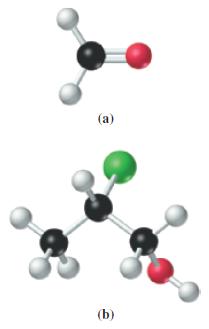
Write Lewis structures for the molecules represented by the following molecular models. (a) (b)
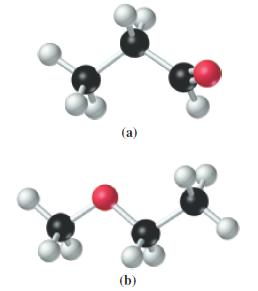
Write Lewis structures for the molecules represented by the following molecular models. (a) (b)
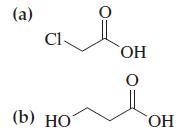
Write Lewis structures for the molecules represented by the following line-angle formulas. (a) C1- (b) HO OH 0 ОН
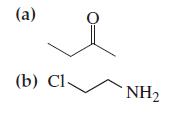
Write Lewis structures for the molecules represented by the following line-angle formulas. (a) (b) Cl NH₂
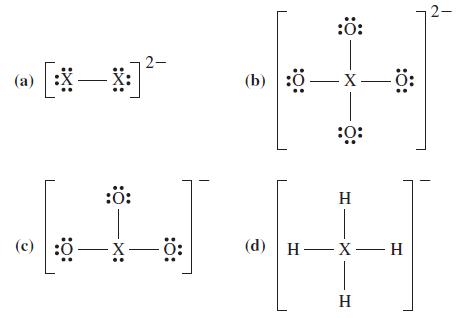
Identify the main group that the element X belongs to in each of the following Lewis structures. For the types of molecule shown, give an example that exists. (a) [:X—X; :Ö: 2- (c) |:0 —x—6: (b) :0- :Ö: x—0: :0: H (d) H-X-H H 2-
Identify the main group that the element X belongs to in each of the following Lewis structures. For the types of molecule shown, give an example that exists. G (c) 8-x=8 X :Ö: :Ö: :0: :0: H J 2- (d) [-x-:] :0: :0—x- :0: :—x- :0: -Ö:
Which of the following molecules would you expect to have a resultant dipole moment (μ)? Explain. (a) F2;(b) NO2; (c) BF3;(d) HBr; (e) H2CCl2;(f) SiF4;(g) OCS.
What is the percent ionic character of each of the following bonds? (a) S—H;(b) O—Cl;(c) Al—O;(d) As—O.
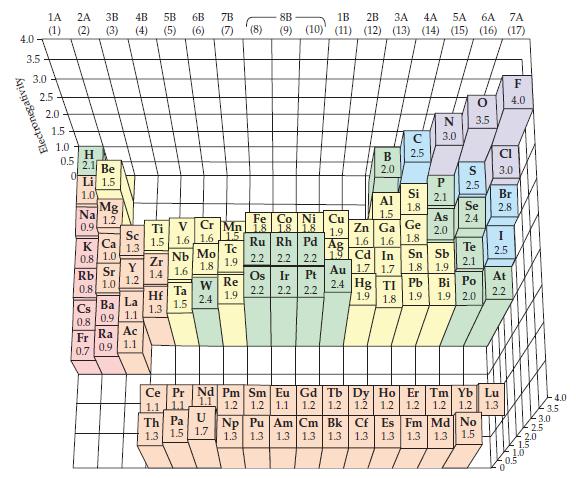
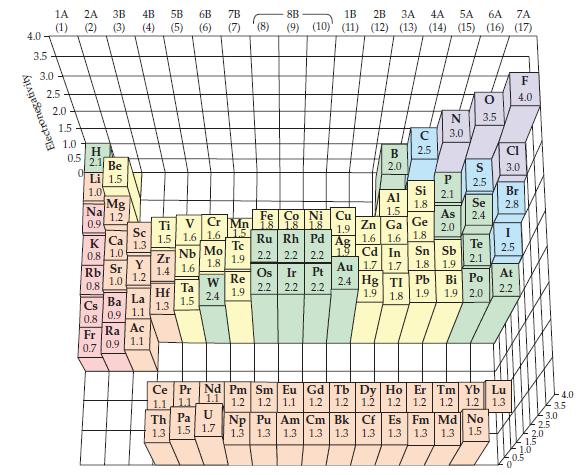
Plot the data of Figure 10-6 as a function of atomic number. Does the property of electronegativity conform to the periodic law? Do you think it should?Figure 10-6 4.0- 3.5 Electronegativity 3.0 N № 1A 2A 3B 4B (1) (2) (3) 2.5 2.0 15 1.0 0.5 0 H 2.1 Be Li 1.5 1.0 Na 0.91 Mg 1.2 K
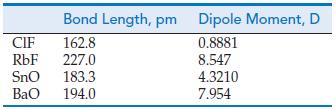
Use a cross-base arrow (⇸) to represent the polarity of the bond in each of the following diatomic molecules. Then use the data below to calculate, in the manner described, the partial charges (δ) on the atoms in each molecule. Express the partial charges as a decimal fraction of the elementary
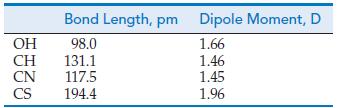
Use a cross-base arrow (⇸) to represent the polarity of the bond in each of the following diatomic molecules. Then use the data below to calculate the partial charges (δ) on the atoms in each molecule. Express the partial charges in the manner described in Exercise 41.Exercise 41Use a cross-base
Which electrostatic potential map corresponds to F2 = O, and which to H2 = O?
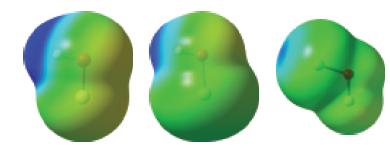
Match the correct electrostatic potential map corresponding to HOCl, FOCl, and HOF.
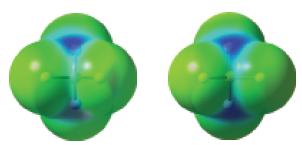
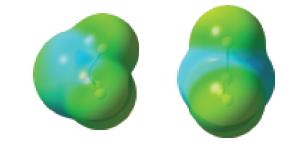
Two electrostatic potential maps are shown, one corresponding to a molecule containing only S and F, the other Si and F. Match them. What are the molecular formulas of the compounds?
Two electrostatic potential maps are shown, one corresponding to a molecule containing only Cl and F, the other P and F. Match them. What are the molecular formulas of the compounds?
Through appropriate Lewis structures, show that the phenomenon of resonance is involved in the nitrite ion.
Dinitrogen oxide (nitrous oxide, or “laughing gas”) is sometimes used as an anesthetic. Here are some data about the N2O molecule: N—N bond length = 113 pm; N—O bond length = 119 pm. Use these data and other information from the chapter to comment on the plausibility of each of the
Which of the following species requires a resonance hybrid for its Lewis structure? Explain. (a) CO2;(b) OCl-;(c) CO32-;(d) OH-.
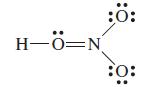
The Lewis structure of nitric acid, HONO2, is a resonance hybrid. How important do you think the contribution of the following structure is to the resonance hybrid? Explain. H-O=N :0: :O:
Draw Lewis structures for the following species, indicating formal charges and resonance where applicable:(a) HCO2-(b) HCO3-(c) FSO3-(d) N2O32-.
Draw Lewis structures for the following species, indicating formal charges and resonance where applicable:(a) HOSO3-(b) H2NCN (c) FCO2-(d) S2N2.
Write plausible Lewis structures for the following odd-electron species: (a) CH3; (b) ClO2; (c) NO3.
Write plausible Lewis structures for the following free radicals: (a) · C2H5;(b) HO2 · ;(c) ClO ·.
Which of the following species would you expect to be diamagnetic and which paramagnetic? (a) OH-;(b) OH; (c) NO3; (d) SO3; (e) SO32-; (f) HO2.
Write a plausible Lewis structure for NO2, and indicate whether the molecule is diamagnetic or paramagnetic. Two NO2 molecules can join together (dimerize) to form N2O4. Write a plausible Lewis structure for N2O4. and comment on the magnetic properties of the molecule.
In which of the following species is it necessary to employ an expanded valence shell to represent the Lewis structure: PO43-, PI3, ICl3, OSCl2, SF4, ClO4-? Explain your choices.
Describe the carbon-to-sulfur bond in H2CSF4. That is, is it most likely a single, double, or triple bond?
Use VSEPR theory to predict the geometric shapes of the following molecules and ions: (a) N2; (b) HCN;(c) NH4+; (d) NO3-; (e) NSF.
Use VSEPR theory to predict the geometric shapes of the following molecules and ions: (a) PCl3;(b) SO42-;(c) SOCl2;(d) SO3;(e) BrF4+.
Each of the following is either linear, angular (bent), planar, tetrahedral, or octahedral. Indicate the correct shape of (a) H2S;(b) N2O4;(c) HCN; (d) SbCl6-;(e) BF4-.
Predict the geometric shapes of (a) CO; (b) SiCl4;(c) PH3; (d) ICl3;(e) SbCl5;(f) SO2;(g) AlF63-.
One of the following ions has a trigonal-planar shape: SO32-; PO43-; PF6-; CO32-. Which ion is it? Explain.
Comment on the similarities and differences in the molecular structure of the following four-atom species: NO3-, CO32-, SO32-, and ClO3-.
Comment on the similarities and differences in the molecular structure of the following triatomic species: CO2, NO2-, O3, and ClO2-.
Draw a plausible Lewis structure for the following series of molecules and ions: (a) ClF2-; (b) ClF3;(c) ClF4-; (d) ClF5.Describe the electron group geometry and molecular structure of these species.
Draw a plausible Lewis structure for the following series of molecules and ions: (a) SiF62-; (b) PCl3;(c) AsCl5;(d) ClF3; (e) XeF4.Describe the electron group geometry and molecular structure of these species.
Sketch the propyne molecule, CH3C ≡ CH. Indicate the bond angles in this molecule. What is the maximum number of atoms that can be in the same plane?
One reaction involved in the sequence of reactions leading to the destruction of ozone is Calculate ΔrH° for this reaction by using the thermodynamic data in Appendix D. Use your ΔrH° value, plus data from Table 10.3, to estimate the nitrogen–oxygen bond energy in NO2.Table 10.3 NO₂(g) +
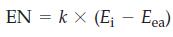
R. S. Mulliken proposed that the electronegativity (EN) of an atom is given bywhere Ei and Eea are the ionization energy and electron affinity of the atom, respectively. Using the electron affinities and ionization energy values for the halogen atoms up to iodine, estimate the value of k by
(A) How much heat is required to vaporize a 2.35 g sample of diethyl ether at 298 K?(B) Calculate a more accurate answer to Example 12-2 by using ΔvapH = 40.7 kJ mol-1 for water at 100 °C, 85.0 °C as the temperature of the surface on which the steam condenses, and 4.21 J g-1 °C-1 as the average
Using ideas from this section, explain why highly exothermic processes tend to be spontaneous. Under what condition(s) will a highly exothermic process be nonspontaneous?
Use data from Appendix D to calculate the standard reaction entropy at 298.15 K for the conversion of nitrogen monoxide to nitrogen dioxide (a step in the manufacture of nitric acid). 2 NO(g) + O₂(g) →→→ 2 NO₂(g) A₁S⁰ = ?
Use ideas from this chapter to explain this famous remark attributed to Rudolf Clausius (1865): “Die Energie der Welt ist konstant; die Entropie der Welt strebt einem Maximum zu.” (“The energy of the world is constant; the entropy of the world increases toward a maximum.”)
At 298 K, for the reaction 2 H+(aq) + 2 Br-(aq) + 2 NO2(g) → Br2(l) + 2 HNO2(aq), ΔrH° = -61.6 kJ mol-1 and the standard molar entropies are H+(aq), 0 J mol-1 K-1; Br-(aq), 82.4 J mol-1 K-1; NO2(g), 240.1 J mol-1 K-1; Br21l2, 152.2 J mol-1 K-1; HNO2(aq), 135.6 J mol-1 K-1. Determine (a)
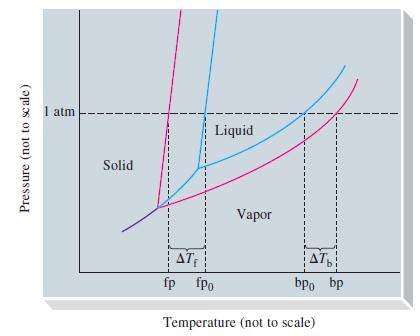
In what important way would Figure 14-23 change if it were based on the phase diagram of water rather than for the general case shown? Would a boiling-point elevation and a freezing-point depression still be expected?Figure 14-23 Pressure (not to scale) 1
Suggest reasons why the following do not exist as stable molecules: (a) H3; (b) HHe; (c) He2;(d) H3O.
(A) Write a Lewis structure for nitrosyl chloride based on the skeletal structure N—O—Cl and show that this structure is not as plausible as the one obtained in Example 10-8.(B) Write two Lewis structures for cyanamide, NH2CN, an important chemical of the fertilizer and plastics industries. Use
Methyl isocynate, CH3NCO, can be represented as a hybrid of three Lewis structures. The most satisfactory structure is the one given above in Example 10-12. Draw the other two structures. On the basis of formal charges, which of the structures is least satisfactory?Example 10-12Methyl isocyanate,
For the following reversible reactions, write thermodynamic equilibrium constant expressions, making appropriate substitutions for activities. Then relate K to Kc or Kp where this can be done.(a) The water gas reaction(b) Formation of a saturated aqueous solution of lead(II) iodide, a very slightly
(A) What is the partial pressure of NH3 in the ammonia synthesis reaction if the Gibbs energy of reaction is –82.00 kJ mol–1 and the partial pressures of hydrogen and nitrogen are each 0.500 bar? The temperature is 298.15 K.(B) What is the minimum value of Q required to make the reverse
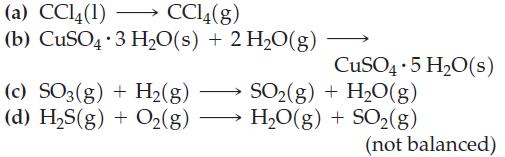
Indicate whether entropy increases or decreases in each of the following reactions. If you cannot be certain simply by inspecting the equation, explain why. (a) CCl4(1) CC14(g) . (b) CuSO4 3 H₂O(s) + 2 H₂O(g) - (c) SO3(g) + H₂(g) (d) H₂S(g) + O2(g) CuSO4 5 H₂O(s) . SO₂(g) +
(A) Write thermodynamic equilibrium constant expressions for each of the following reactions. Relate these to Kc or Kp where appropriate.(B) Write a thermodynamic equilibrium constant expression to represent the reaction of solid lead(II) sulfide with aqueous nitric acid to produce solid sulfur, a
Showing 1800 - 1900
of 4008
First
12
13
14
15
16
17
18
19
20
21
22
23
24
25
26
Last
Step by Step Answers

 Get 50% OFF
Claim Now
Get 50% OFF
Claim Now


![(a) :0-C-0: (b) [.C=N:]](https://dsd5zvtm8ll6.cloudfront.net/images/question_images/1699/8/7/0/6326551f7a8cbb6a1699870631339.jpg)

![(a) cyanate ion (b) carbide ion (c) hypochlorite ion (d) nitrogen(II) oxide [:O-C=N:] [C=C:1- [:c-0:1 :N=0:](https://dsd5zvtm8ll6.cloudfront.net/images/question_images/1699/8/7/0/6856551f7dd68e101699870683832.jpg)
![(a) Mg:0: (b) [:O-N=0:1 (c) (d) [:S-C=N:] [:a::r [C: Cl :0](https://dsd5zvtm8ll6.cloudfront.net/images/question_images/1699/8/7/0/7156551f7fbb4ccb1699870714073.jpg)







![(a) [H-C=C:] (b) :0: C :0: 72- O: (c) [CH3-CH-CH3]+](https://dsd5zvtm8ll6.cloudfront.net/images/question_images/1699/8/7/0/9346551f8d610e511699870931688.jpg)
![G (c) 8-x=0 X :: :: :0: :0: H J 2- (d) [-x-:] :0: :0x- :0: :x- :0: -:](https://dsd5zvtm8ll6.cloudfront.net/images/question_images/1699/8/7/4/771655207d39c4f61699874770345.jpg)