New Semester
Started
Get
50% OFF
Study Help!
--h --m --s
Claim Now
Question Answers
Textbooks
Find textbooks, questions and answers
Oops, something went wrong!
Change your search query and then try again
S
Books
FREE
Study Help
Expert Questions
Accounting
General Management
Mathematics
Finance
Organizational Behaviour
Law
Physics
Operating System
Management Leadership
Sociology
Programming
Marketing
Database
Computer Network
Economics
Textbooks Solutions
Accounting
Managerial Accounting
Management Leadership
Cost Accounting
Statistics
Business Law
Corporate Finance
Finance
Economics
Auditing
Tutors
Online Tutors
Find a Tutor
Hire a Tutor
Become a Tutor
AI Tutor
AI Study Planner
NEW
Sell Books
Search
Search
Sign In
Register
study help
sciences
general chemistry principles
General Chemistry Principles And Modern Applications 11th Edition Ralph Petrucci, Jeffry Madura, F. Herring, Carey Bissonnette - Solutions
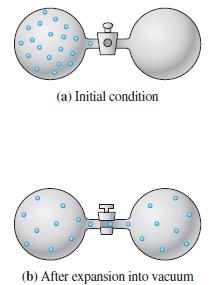
Figure 13-2 illustrates a spontaneous process through the expansion of an ideal gas into an evacuated bulb. Use the one-dimensional particle-in-a-box model to represent the initial condition of Figure 13-2. Use a second particle-in-a-box model to represent the system after expansion into the
Consider a sample of ideal gas initially in a volume V at temperature T and pressure P. Does the entropy of this system increase, decrease, or stay the same in the following processes?(a) The gas expands isothermally.(b) The pressure is increased at constant temperature.(c) The gas is heated at
(A) Predict whether entropy increases or decreases in each of the following reactions.(a) The Claus process for removing H2S from natural gas: 2 H2S(g) + SO2(g) → 3 S(s) + 2 H2O(g);(b) The decomposition of mercury(II) oxide: 2 HgO(s) → 2 Hg(l) + O2(g).(B) Predict whether entropy increases or
The standard molar entropy of H2(g) is S° = 130.7 J mol-1 K-1 at 298 K. Use this value, together with Boltzmann’s equation, to determine the number of microstates, W, for one mole of H2(g) at 298 K and 1 bar. Reflect on the magnitude of your calculated value by describing how to write the number
What is the standard molar entropy change for the vaporization of water at 373 K given that the standard molar enthalpy of vaporization is 40.7 kJ mol-1 at this temperature?
(A) What is the standard molar entropy of vaporization, ΔvapS°, for CCl2F2, a chlorofluorocarbon that once was heavily used in refrigeration systems? Its normal boiling point is -29.79 °C, and ΔvapH° = 20.2 kJ mol-1.(B) The entropy change for the transition from solid rhombic sulfur to solid
The normal boiling point of water is 100 °C. At 120 °C and 1 atm, is ΔH or TΔS greater for the vaporization of water?
Calculate the entropy change for the following constant pressure process.The molar heat capacities of ice and water are, respectively, C p,m = 37.12 J mol-1 K-1 and Cp,m = 75.3 J mol-1 K-1. The enthalpy of fusion for ice is ΔfusH° = 6.01 kJ mol-1 at 0 C. H₂O(s, 100 g, -10 °C, 1
In a 1985 paper in the Journal of Chemical Thermodynamics, the standard molar entropy of chalcopyrite, CuFeS2, is given as 0.012 J mol-1 K-1 at 5 K. Use this value to estimate the number of microstates for one picogram (1 x 10-12 g) of CuFeS2 at 5 K and 1 bar. Report your answer in the manner
(A) One mole of neon gas, initially at 300 K and 1.00 bar, expands adiabatically (i.e., with no heat lost to the surroundings) against a constant external pressure of 0.50 bar until the gas pressure is also 0.50 bar. The final temperature of the gas is 240 K. What is ΔS for the gas? The molar heat
For the reaction below, ΔrG° = 326.4 kJ mol-1: 3 O2(g) → 2 O3(g)What is the Gibbs energy change for the system when 1.75 mol O2(g) at 1 bar reacts completely to give O3(g) at 1 bar?
(A) Calculate the standard reaction entropy at 298.15 K for the synthesis of ammonia from its elements.(B) N2O3 is an unstable oxide that readily decomposes. The standard reaction entropy for the decomposition of N2O3 to nitrogen monoxide and nitrogen dioxide at 25 °C is ΔrS° = 138.5 J mol-1
Indicate whether each of the following changes represents an increase or a decrease in entropy in a system, and explain your reasoning: (a) The freezing of ethanol; (b) The sublimation of dry ice; (c) The burning of a rocket fuel.
Under what temperature conditions would the following reactions occur spontaneously? (a) 2 NH4NO3(s) - (b) I2(g) 2 I(g) 2 N₂(g) + 4 H₂O(g) + O2(g) A,H° -236.0 kJ mol-¹ =
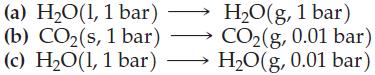
Arrange the entropy changes of the following processes, all at 25 °C, in the expected order of increasing ΔS, and explain your reasoning: (a) H₂O(1, 1 bar) (b) CO₂ (s, 1 bar) (c) H₂O(1, 1 bar) 111 H₂O(g, 1 bar) CO₂(g, 0.01 bar) H₂O(g, 0.01 bar)
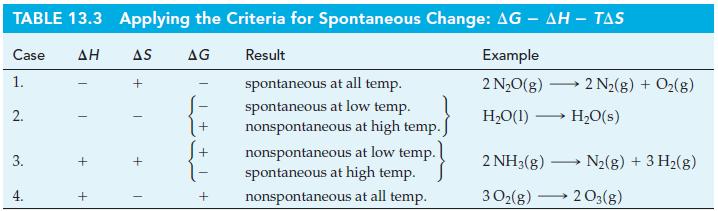
(A) Which of the four cases in Table 13.3 would apply to each of the following reactions?(B) Under what temperature conditions would the following reactions occur spontaneously?(a) The decomposition of calcium carbonate into calcium oxide and carbon dioxide. The reaction is endothermic. (b) The
Determine ΔrG° at 298.15 K for the reaction - 2 NO(g) + O₂(g) - 2 NO2(g) (at 298.15 K) A,Hº -114.1 kJ mol-1 A,S° -146.5 J K-¹ mol-1 = =
(A) Determine ΔrG° at 298.15 K for the reaction 4 Fe(s) + 3 O2(g) → 2 Fe2O3(s). ΔrH° = -1648 kJ mol-1 and ΔrS° = -549.3 J mol-1 K-1.(B) Determine ΔrG° for the reaction in Example 13-7 by using ΔfG° values. Compare the two results.Example 13-7 Determine ΔrG° at 298.15 K for the
A system contains H2, N2, and NH3 gases, each with a partial pressure of 0.100 bar. The temperature is held constant at 298.15 K. Calculate the Gibbs energy of reaction, ΔrG, for the formation of NH3(g) from N2(g) and H2(g) under these conditions, and predict whether formation or consumption of
Comment on the difficulties of solving environmental pollution problems from the standpoint of entropy changes associated with the formation of pollutants and with their removal from the environment.
A possible reaction for converting methanol to ethanol is(a) Calculate ΔrH° ΔrS°, and ΔrG° for this reaction at 25 °C.(b) Is this reaction thermodynamically favored at high or low temperatures? At high or low pressures? Explain.(c) Estimate K for the reaction at 750 K. CO(g)+ 2 H₂(g) +
Establish at 298 K for the reaction:(a) ΔrS°;(b) ΔrH°;(c) ΔrG°;(d) K. 2 NaHCO3(s) Na₂CO3(s) + H₂O(1) + CO₂(g)
Why is ΔrG° such an important property of a chemical reaction, even though the reaction is generally carried out under nonstandard conditions?
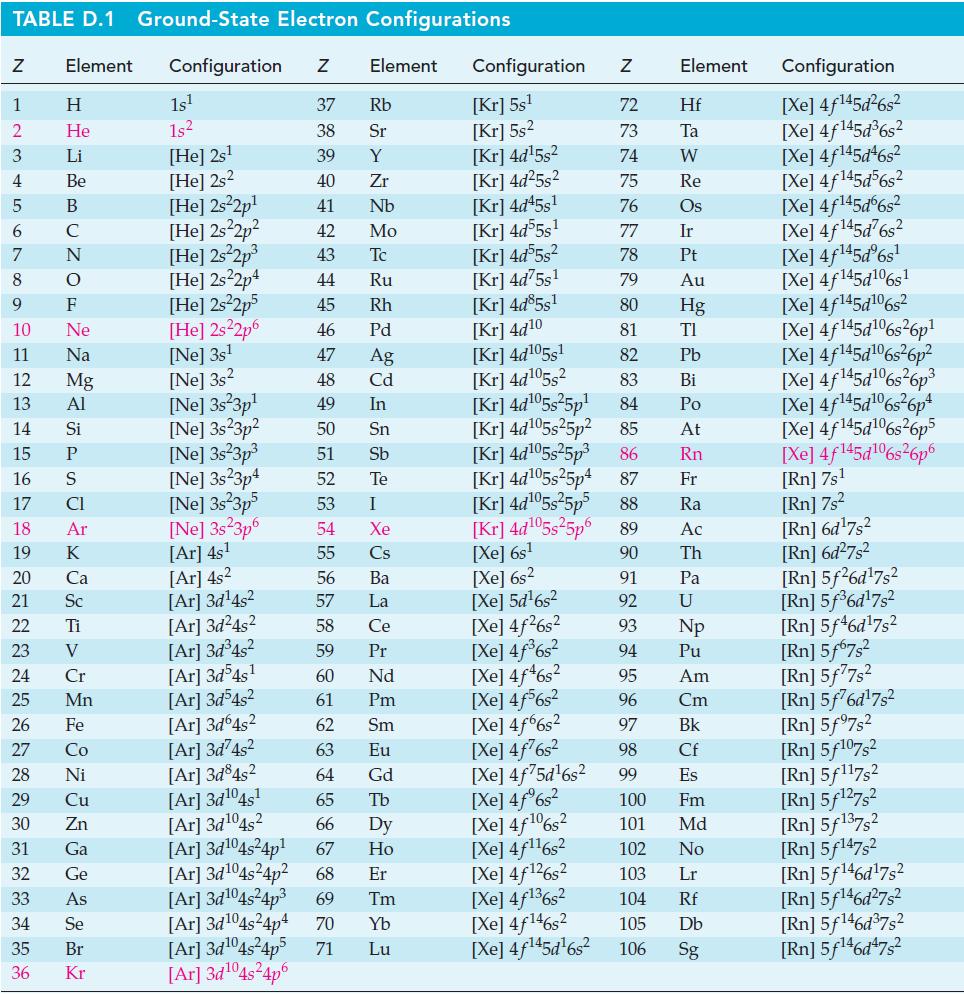
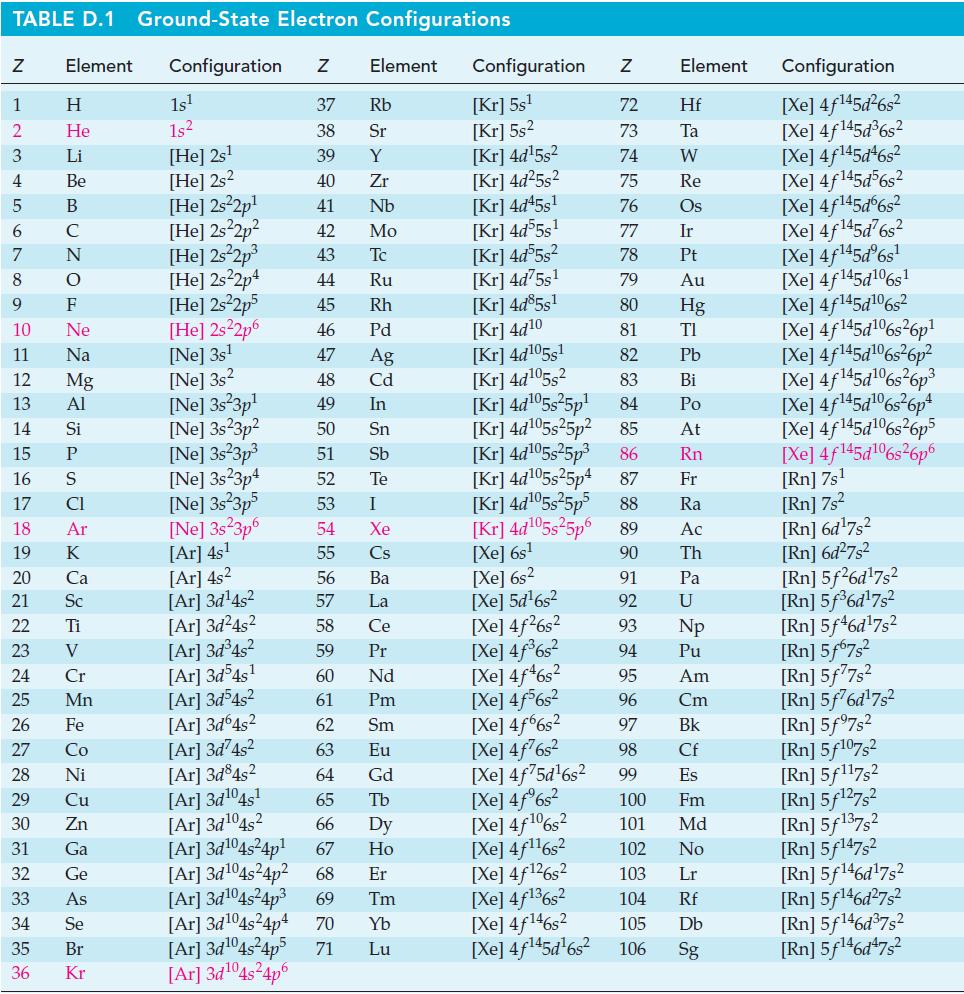
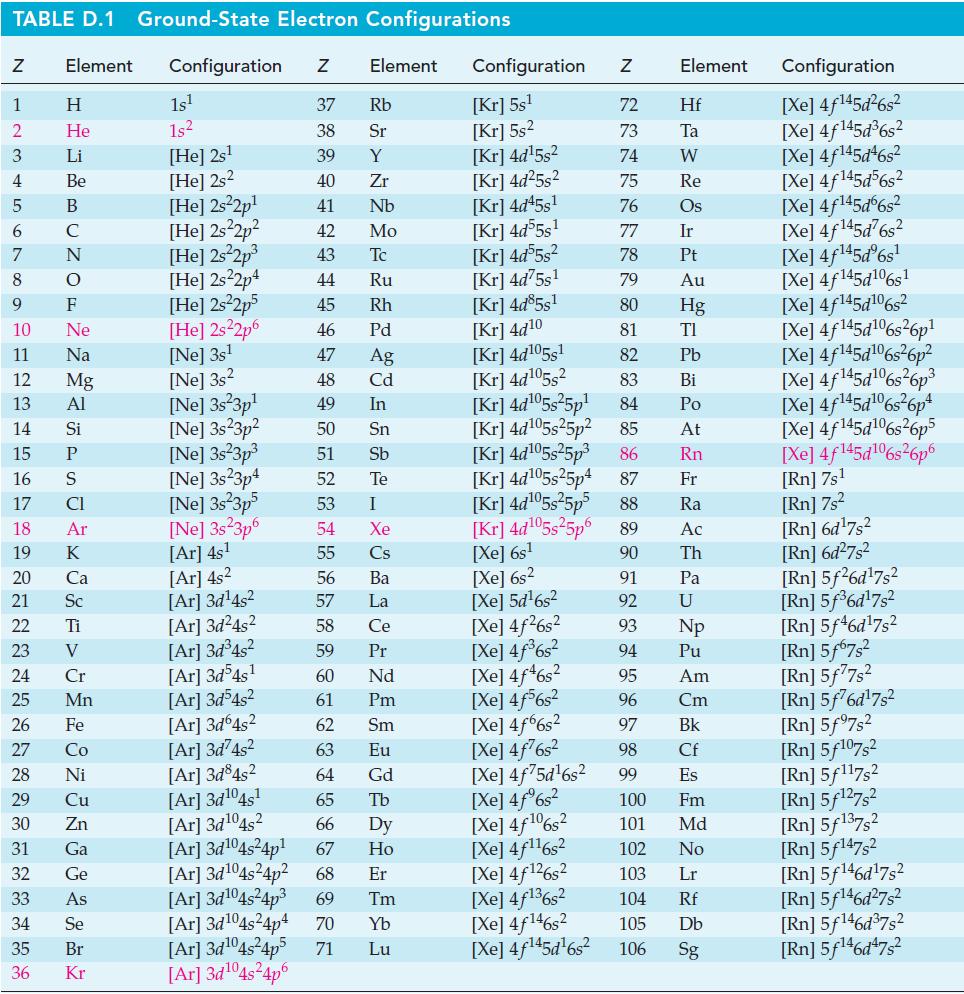
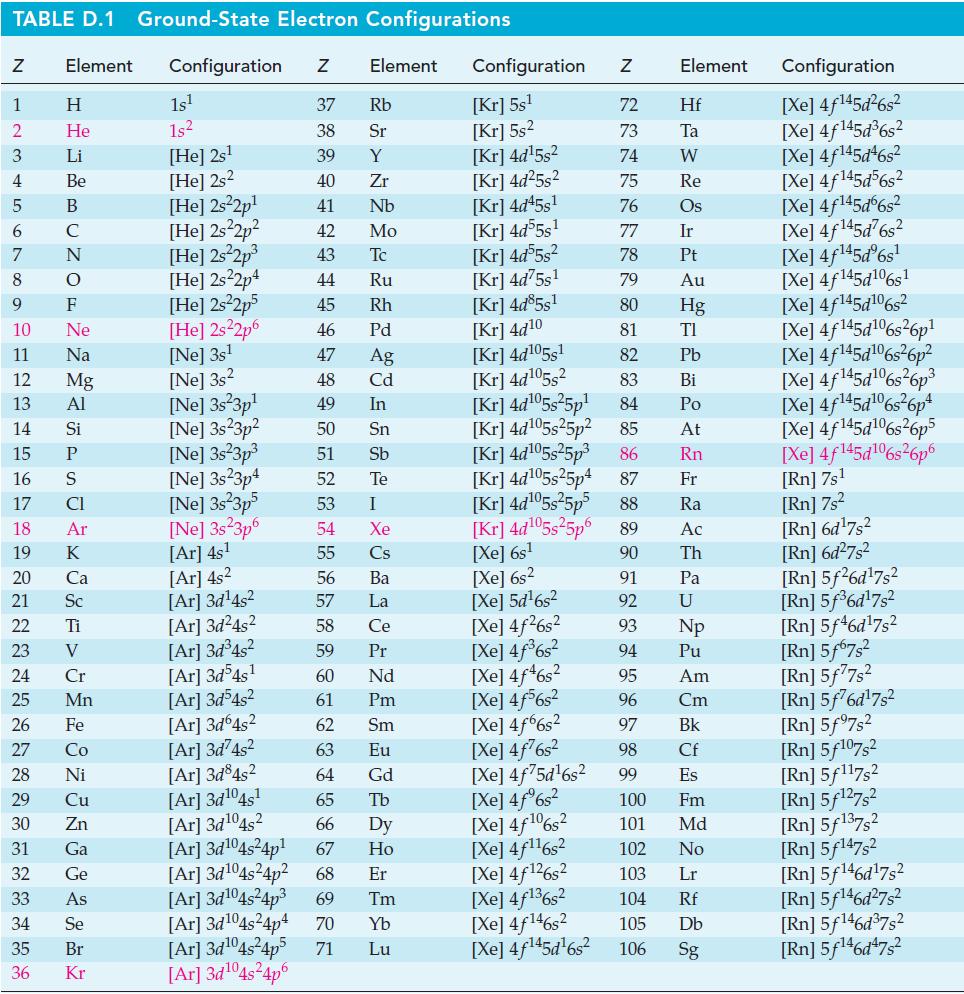
At 298 K, ΔfG°[CO(g)] = -137.2 kJ mol-1 and K = 6.5 x 10¹¹ for the reaction CO(g) + Cl2(g) ⇌ COCl2(g). Use these data to determine ΔfG°[COCl2(g)], and compare your result with the value in Appendix D. TABLE D.1 Ground-State Electron Configurations Element Configuration
At 1000 K, an equilibrium mixture in the reaction CO2(g) + H2(g) ⇌ CO(g) + H2O(g) contains 0.276 mol H2 0.276 mol CO2, 0.224 mol CO, and 0.224 mol H2O.(a) What is K at 1000 K?(b) Calculate ΔrG° at 1000 K.(c) In which direction would a spontaneous reaction occur if the following were brought
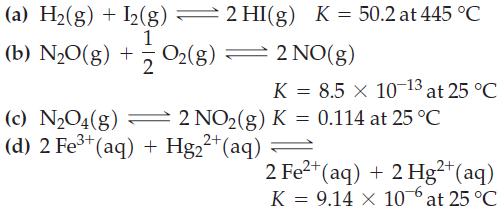
For the following equilibrium reactions, calculate ΔrG° at the indicated temperature. (a) H₂(g) + I2(g) 2 HI(g) K = 50.2 at 445 °C 1 (b) N₂0(g) + O2(g) 2 = 2 NO(g) K = 8.5 × 10⁻¹³ at 25 °C (c) N₂O4(g) 2 NO₂(g) K = 0.114 at 25 °C (d) 2 Fe³+ (aq) + Hg₂²+ (aq) 2+ 2 Fe²+ (aq) + 2
For the reaction 2 SO2(g) + O2(g) ⇌ 2 SO3(g), Kc = 2.8 x 10² M-1 at 1000 K.(a) What is ΔrG° at 1000 K?(b) If 0.40 mol SO2 0.18 mol O2, and 0.72 mol SO3 are mixed in a 2.50 L flask at 1000 K, in what direction will a net reaction occur?
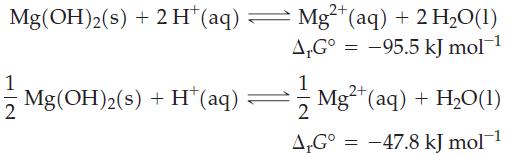
Two equations can be written for the dissolution of Mg(OH)2(s) in acidic solution.(a) Explain why these two equations have different ΔrG° values.(b) Will K for these two equations be the same or different? Explain. 2+ Mg(OH)2(s) + 2H* (aq) — Mg²+ (aq) + 2 H₂O(1) A.G° -95.5 kJ
Currently, CO2 is being studied as a source of carbon atoms for synthesizing organic compounds. One possible reaction involves the conversion of CO2 to methanol, CH3OH.With the aid of data from Appendix D, determine (a) If this reaction proceeds to any significant extent at 25 °C;(b) If the
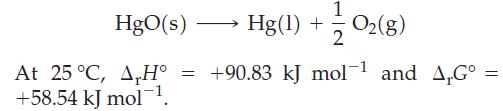
To establish the law of conservation of mass, Lavoisier carefully studied the decomposition of mercury(II) oxide:(a) Show that the partial pressure of O2(g) in equilibrium with HgO(s) and Hg(l) at 25 °C is extremely low.(b) What conditions do you suppose Lavoisier used to obtain significant
Use data from Appendix D to determine (a) ΔrH°, ΔrS°, and ΔrG° at 298 K and (b) K at 875 K for the water gas shift reaction, used commercially to produce H2(g): CO(g) + H2O(g) Δ CO2(g) + H2(g). TABLE D.1 Ground-State Electron Configurations Element Configuration
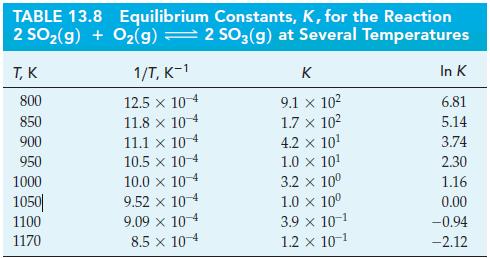
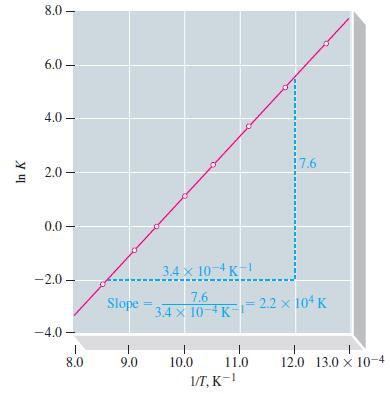
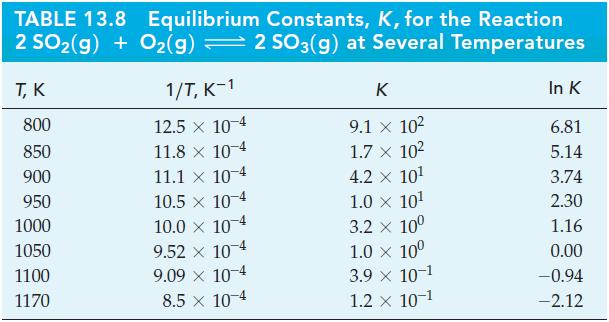
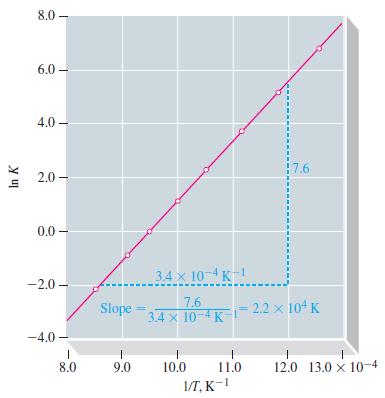
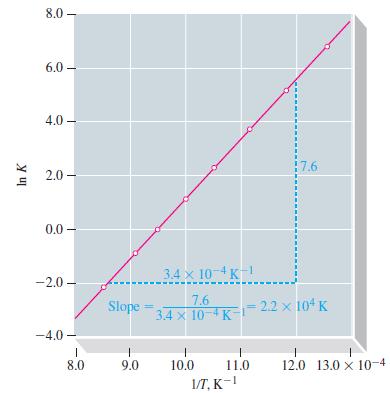
Estimate K at 100 °C for the reaction 2 SO2(g) + O2(g) Δ 2 SO3(g). Use data from Table 13.8 and Figure 13-10.Table 13.8Figure 13-10 TABLE 13.8 Equilibrium Constants, K, for the Reaction 2 SO₂(g) + O₂(g) 2 SO3(g) at Several Temperatures T, K 800 850 900 950 1000 1050 1100 1170 1/T, K-1 12.5 x
What must be the temperature if the following reaction has ΔrG° = -45.5 kJ mol-1, ΔrH° = -24.8 kJ mol-1, and ΔrS° = 15.2 J mol-1 K-1? Fe2O3(s) + 3 CO(g) 2 Fe(s) + 3 CO₂(g)
In Example 13-12, we used the van’t Hoff equation to determine the temperature at which for the reaction 2 SO2(g) + O2(g) ⇌ 2 SO3(g). Obtain another estimate of this temperature with data from Appendix D and equations (13.13) and (13.17). Compare your result with that obtained in Example
Use data from Appendix D and the van’t Hoff equation (13.25) to estimate a value of K at 100 °C for the reaction 2 NO(g) + O2(g) ⇌ 2 NO2(g).Eq. 13.25 In- K₁ - (12-1) A,H° / 1 1 R T₂ T₁/ (13.25)
Titanium is obtained by the reduction of TiCl4(l), which in turn is produced from the mineral rutile (TiO2).(a) With data from Appendix D, determine ΔrG° at 298 K for this reaction.(b) Show that the conversion of TiO2(s) to TiCl4(l), with reactants and products in their standard states, is
The following equilibrium constants have been determined for the reaction H2(g) + I2(g) ⇌ 2 HI(g): K = 50.0 at 448 °C and 66.9 at 350 °C. Use these data to estimate ΔrH° for the reaction.
Sodium carbonate, an important chemical used in the production of glass, is made from sodium hydrogen carbonate by the reactionData for the temperature variation of K for this reaction are K = 1.66 x 10⁻⁵ at 30 °C; 3.90 x 10⁻⁴ at 50 °C; 6.27 x 10⁻³ at 70 °C; and 2.31 x 10⁻¹ at 100 °C.(a) Plot a
For the reaction N2O4(g) ⇌ 2 NO2(g), ΔrH° = +57.2 kJ mol-1 and K = 0.113 at 298 K.(a) What is K at 0 °C?(b) At what temperature will K = 1.00?
In biochemical reactions* the phosphorylation of amino acids is an important step. Consider the following two reactions and determine whether the phosphorylation of arginine with ATP is spontaneous. ADP + P A₁Gº' = -31.5 kJ mol-¹ phosphorarginine + H₂O ATP + H₂O arginine +
Following are some standard Gibbs energies of formation, ΔfG°, at 1000 K: NiO(s), -115 kJ mol-1; MnO(s), -280 kJ mol-1; TiO2(s), -630 kJ mol-1. The standard Gibbs energy of formation of CO(g) at 1000 K is -250 kJ mol-1. Use the method of coupled reactions to determine which of these metal oxides
The synthesis of glutamine from glutamic acid is given by Glu- + NH4+ → Gln + H2O. The standard Gibbs energy of reaction* at pH = 7 and T = 310 K is ΔrG°' = 14.8 kJ mol-1. Will this reaction be spontaneous if coupled with the hydrolysis of ATP? ATP + H₂O ADP+ PAGO! = -31.5 kJ mol
Use data from Appendix D to estimate (a) The normal boiling point of mercury and (b) The vapor pressure of mercury at 25 °C. TABLE D.1 Ground-State Electron Configurations Element Configuration Z Z 1 2 3 4 5 6 7 8 9 10 11 12 13 14 15 16 17 18 19 20 25 27 29 30 HIGÅ LUZONSUZ SE> 0 ≤ 2 3 2 3 5
In an adiabatic process, there is no exchange of heat between the system and its surroundings. Of the quantities ΔS, ΔSsurr, and ΔSuniv, which one(s) must always be equal to zero for a spontaneous adiabatic process? Under what condition(s) will an adiabatic process have ΔS = ¢Ssurr = ΔSuniv =
Consider the following hypothetical process in which heat flows from a low to a high temperature. For copper, the molar heat capacity at constant pressure is 0.385 J mol-1 K-1 . (For simplicity, you may assume that no heat is lost to the surroundings and that the volume changes are negligible.)(a)
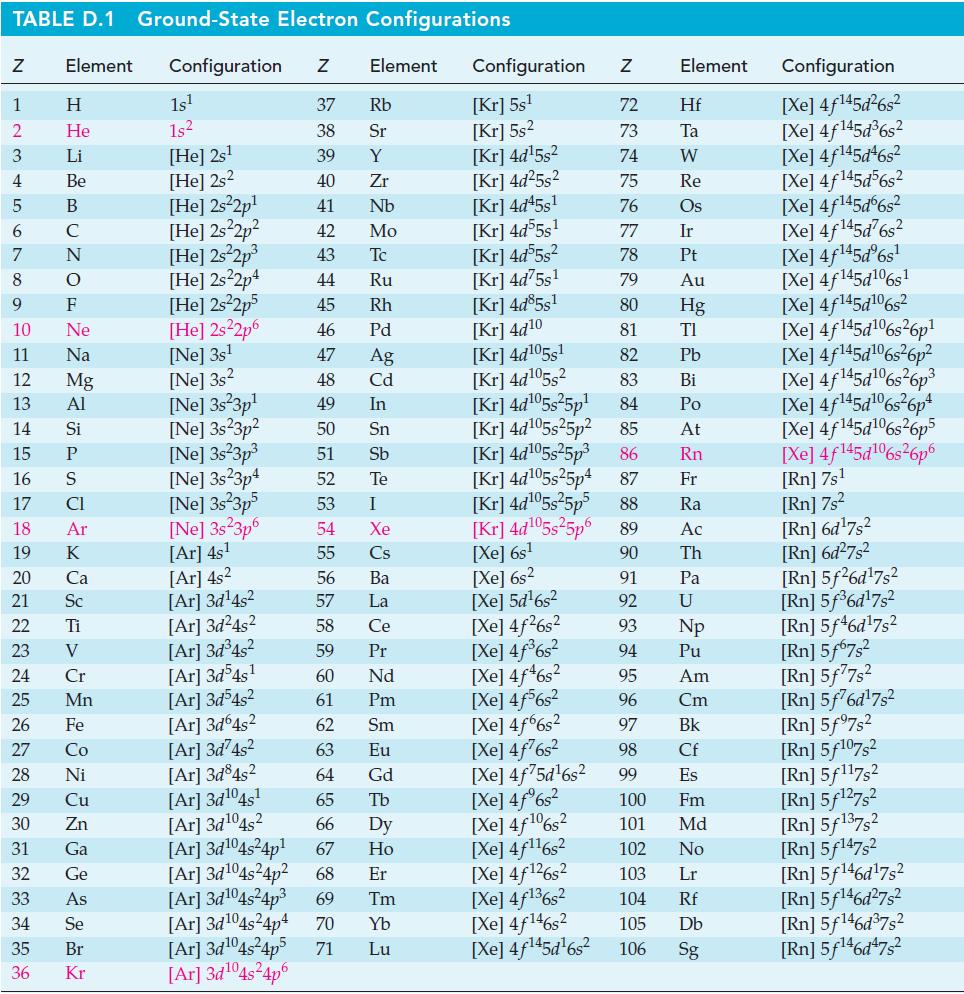
Use data from Appendix D and other information from this chapter to estimate the temperature at which the dissociation of I2(g) becomes appreciable [for example, with the I2(g) 50% dissociated into I(g) at 1 atm total pressure]. TABLE D.1 Ground-State Electron Configurations Element Configuration
Calculate ΔS and ΔSuniv when 1.00 mol of H2O(l), initially at 10 C, is converted to H2O(g) at 125 C at a constant pressure of 1.00 bar. The molar heat capacities of H2O(l) and H2O(g) are, respectively, 75.3 J mol-1 K-1 and 33.6 J mol-1 K-1. The standard enthalpy of vaporization of water is 40.66
At 298 K, 1.00 mol BrCl(g) is introduced into a 10.0 L vessel, and equilibrium is established in the reactionCalculate the amounts of each of the three gases present when equilibrium is established. First, use data from Appendix D, as necessary, to calculate the equilibrium constant K for the
One mole of argon gas, Ar(g), undergoes a change in state from 25.6 L and 0.877 bar to 15.1 L and 2.42 bar. What are ΔH and ΔS for the argon gas? For Ar(g), the molar heat capacity at constant pressure is 20.79 J mol-1 K-1.
Consider the vaporization of water: H2O(l) → H2O(g) at 100 °C, with H2O(l) in its standard state, but with the partial pressure of H2O(g) at 2.0 atm. Which of the following statements about this vaporization at 100 °C are true? Explain. (a) ΔrG° = 0, (b) ΔrG = 0,(c) ΔrG° > 0,(d) ΔrG > 0.
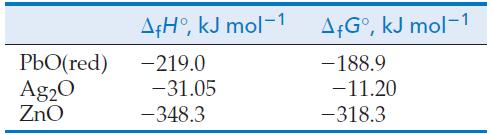
The following table shows the enthalpies and Gibbs energies of formation of three metal oxides at 25 °C.(a) Which of these oxides can be most readily decomposed to the free metal and O2(g)?(b) For the oxide that is most easily decomposed, to what temperature must it be heated to produce O2(g) at
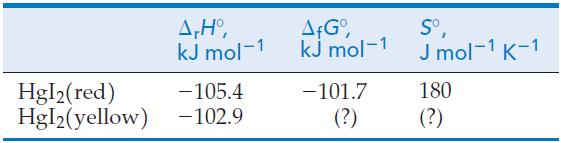
The following data are given for the two solid forms of HgI2 at 298 K.Estimate values for the two missing entries. To do this, assume that for the transition HgI2(red) → HgI2(yellow), the values of ΔrH° and ΔrS° at 25 °C have the same values that they do at the equilibrium temperature of 127
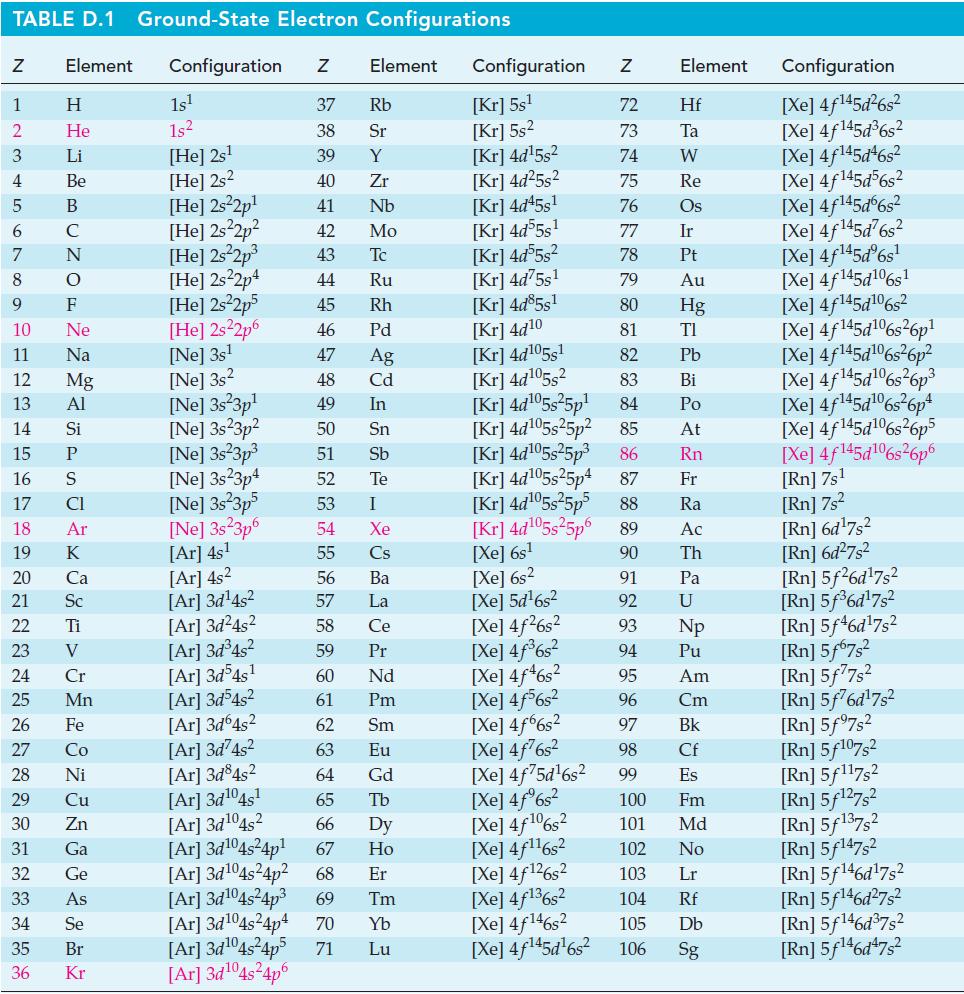
The term thermodynamic stability refers to the sign of ΔrG° . If ΔrG° is negative, the compound is stable with respect to decomposition into its elements. Use the data in Appendix D to determine whether Ag2O(s) is thermodynamically stable at (a) 25 °C and (b) 200 °C. TABLE D.1 Ground-State
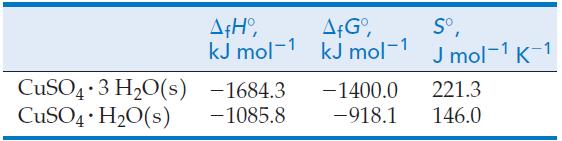
Use the following data together with other data from the text to determine the temperature at which the equilibrium pressure of water vapor above the two solids in the following reaction is 75 Torr. CuSO4 3 H₂O(s) — CuSO4 · H₂O(s) + 2 H₂0(g) . .
From the data given in Exercise 72, estimate a value of ΔrS° at 298 K for the reactionExercise 72Sodium carbonate, an important chemical used in the production of glass, is made from sodium hydrogen carbonate by the reactionData for the temperature variation of K for this reaction are K = 1.66 x
Oxides of nitrogen are produced in high-temperature combustion processes. The essential reaction is N2(g) + O2(g) ⇌ 2 NO(g). At what approximate temperature will an equimolar mixture of N2(g) and O2(g) be 1.0% converted to NO(g)?
The normal boiling point of cyclohexane, C6H12, is 80.7 °C. Estimate the temperature at which the vapor pressure of cyclohexane is 100.0 mmHg.
At 0 °C, ice has a density of 0.917 g mL-1 and an absolute entropy of 37.95 J mol-1 K-1. At this temperature, liquid water has a density of 1.000 g mL-1 and an absolute entropy of 59.94 J mol-1 K-1. The pressure corresponding to these values is 1 bar. Calculate ΔG, ΔS, and ΔH for the melting of
Assume that the constant pressure heat capacity, Cp, of a solid is a linear function of temperature of the form Cp = aT, where a is a constant. Starting from the expressions below for S° and ΔH°, show that S°/ΔH° = 2/(298.15 K) = 0.00671 K-1, a claim made in Are You Wondering 13-3.
The decomposition of the poisonous gas phosgene is represented by the equation COCl2(g) ⇌ CO(g) + Cl2(g). Values of K for this reaction are K = 6.7 x 10⁻⁹ at 99.8 °C and K = 4.44 x 10⁻² at 395 °C. At what temperature is COCl2 15% dissociated when the total gas pressure is maintained at 1.00
The standard molar entropy of solid hydrazine at its melting point of 1.53 °C is 67.15 J mol-1 K-1. The enthalpy of fusion is 12.66 kJ mol-1. For N2H4(l) in the interval from 1.53 °C to 298.15 K, the molar heat capacity at constant pressure is given by the expression Cp,m = 97.78 + 0.0586(T -
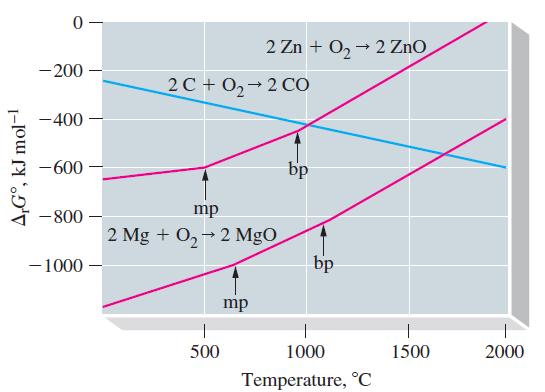
The graph shows how ΔrG° varies with temperature for three different oxidation reactions: the oxidations of C(graphite), Zn, and Mg to CO, ZnO, and MgO, respectively. Such graphs as these can be used to show the temperatures at which carbon is an effective reducing agent to reduce metal oxides to
Use the following data to estimate, S°[C6H6(g, 1 atm)] at 298.15 K. For C6H6(s, 1 atm) at its melting point of 5.53 °C, S° is 128.82 J mol-1 K-1. The enthalpy of fusion is 9.866 kJ mol-1. From the melting point to 298.15 K, the average heat capacity of liquid benzene is 134.0 J mol-1 K-1. The
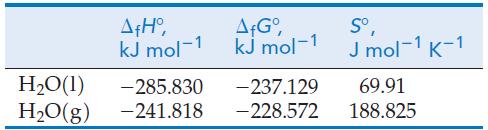
A tabulation of more precise thermodynamic data than are presented in Appendix D lists the following values for H2O(l) and H2O(g) at 298.15 K, at a standard state pressure of 1 bar.(a) Use these data to determine, in two different ways, ΔrG° at 298.15 K for the vaporization: H2O (l, 1 bar) ⇌
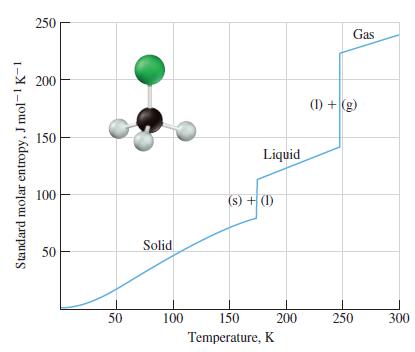
In Figure 13-5 the temperature dependence of the standard molar entropy for chloroform is plotted.(a) Explain why the slope for the standard molar entropy of the solid is greater than the slope for the standard molar entropy of the liquid, which is greater than the slope for the standard molar
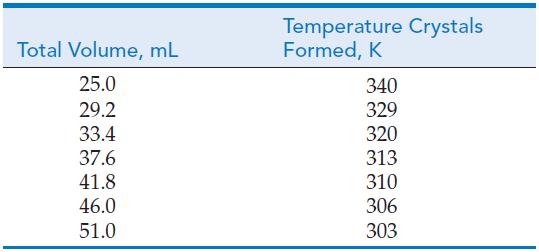
The following data are from a laboratory experiment that examines the relationship between solubility and thermodynamics. In this experiment KNO3(s) is placed in a test tube containing some water. The solution is heated until all the KNO3(s) is dissolved and then allowed to cool. The temperature at
Consider a system that has four energy levels, with energy ε = 0, 1, 2, and 3 energy units, and three particles labeled A, B, and C. The total energy of the system, in energy units, is 3. How many microstates can be generated?
The entropy of materials at T = 0 K should be zero; however, for some substances, this is not true. The difference between the measured value and expected value of zero is known as residual entropy. This residual entropy arises because the molecules can have a number of different orientations in
In your own words, define the following symbols:(a) ΔSuniv;(b) ΔfG°;(c) K; (d) S°; (e) ΔrG°
Coupled Reactions in Biological Systems. The Gibbs energy available from the complete combustion of 1 mol of glucose to carbon dioxide and water is(a) Under biological standard conditions, compute the maximum number of moles of ATP that could form from ADP and phosphate if all the energy of
In a heat engine, heat (qh) is absorbed by a working substance (such as water) at a high temperature (Th). Part of this heat is converted to work (w), and the rest (q1) is released to the surroundings at the lower temperature (T1) The efficiency of a heat engine is the ratio w/qh. The second law of
Briefly describe each of the following ideas, methods, or phenomena: (a) Absolute molar entropy;(b) Coupled reactions; (c) Trouton’s rule; (d) Evaluation of an equilibrium constant from tabulated thermodynamic data.
Explain the important distinctions between each of the following pairs: (a) Spontaneous and nonspontaneous processes; (b) The second and third laws of thermodynamics;(c) ΔrG° and ΔrG°; (d) ΔG and ΔrG.
For a process to occur spontaneously, (a) The entropy of the system must increase; (b) The entropy of the surroundings must increase; (c) Both the entropy of the system and the entropy of the surroundings must increase; (d) The net change in entropy of the system and surroundings considered
The Gibbs energy of a reaction can be used to assess which of the following? (a) How much heat is absorbed from the surroundings; (b) How much work the system does on the surroundings; (c) The net direction in which the reaction occurs to reach equilibrium;(d) The proportion of the heat evolved
The reaction, 2 Cl2O(g) → 2 Cl2(g) + O2(g) ΔrH° = -161 kJ mol-1, is expected to be (a) Spontaneous at all temperatures; (b) Spontaneous at low temperatures, but nonspontaneous at high temperatures;(c) Nonspontaneous at all temperatures; (d) Spontaneous at high temperatures only.
If ΔrG° = 0 for a reaction, it must also be true that (a) K = 0;(b) K = 1;(c) ΔrH° = 0;(d) ΔrS° = 0;(e) The equilibrium activities of the reactants and products do not depend on the initial conditions.
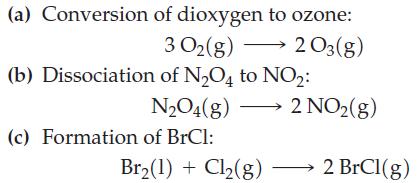
Without performing detailed calculations, indicate whether any of the following reactions would occur to a measurable extent at 298 K. (a) Conversion of dioxygen to ozone: 3 0₂(g) → 2 03(g) (b) Dissociation of N₂O4 to NO₂: N₂O4(g) - (c) Formation of BrCl: Br₂(1) + Cl₂(g) 2 NO₂(g) 2
Two correct statements about the reversible reaction N2(g) + O2(g) ⇌ 2 NO(g) are (a) K = Kp;(b) The equilibrium amount of NO increases with an increased total gas pressure; (c) The equilibrium amount of NO increases if an equilibrium mixture is transferred from a 10.0 L container to a 20.0 L
Explain briefly why (a) The change in entropy in a system is not always a suitable criterion for spontaneous change;(b) ΔrG° is so important in dealing with the question of spontaneous change, even though the conditions employed in a reaction are very often nonstandard.
A handbook lists the following standard enthalpies of formation at 298 K for cyclopentane, C5H10 ΔfH°[C5H10(l)] = -105.9 kJ mol-1 and ΔfH°[C5H10(g)] = -77.2 kJ mol-1.(a) Estimate the normal boiling point of cyclopentane.(b) Estimate ΔrG° for the vaporization of cyclopentane at 298 K.(c)
Consider the reaction NH4NO3(s) → N2O(g) + 2 H2O(l) at 298 K.(a) Is the forward reaction endothermic or exothermic?(b) What is the value of ΔrG° at 298 K?(c) What is the value of K at 298 K?(d) Does the reaction tend to occur spontaneously at temperatures above 298 K, below 298 K, both, or
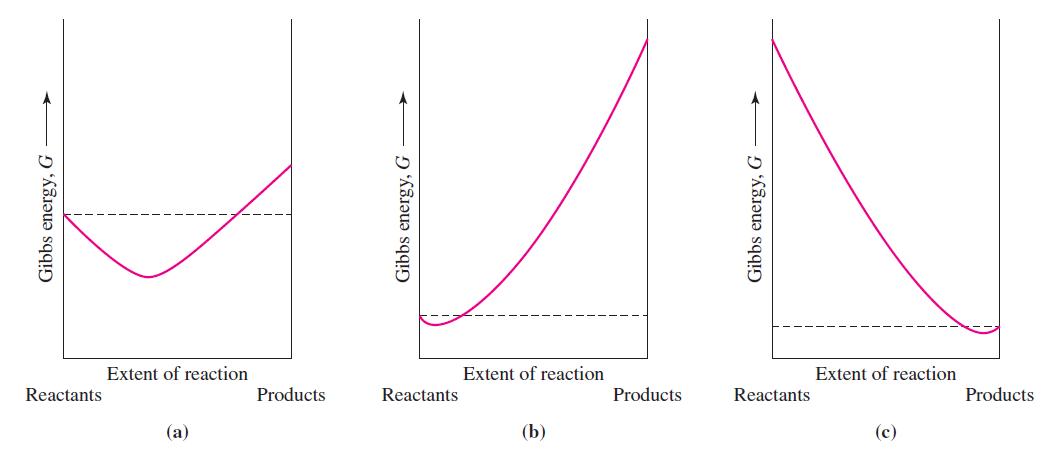
Which of the following graphs of Gibbs energy versus the extent of reaction represents an equilibrium constant closest to 1? Gibbs energy, G Reactants Extent of reaction (a) Products Gibbs energy, G Reactants Extent of reaction (b) Products Gibbs energy, G Reactants Extent of reaction (c) Products
At room temperature and normal atmospheric pressure, is the entropy change of the universe positive, negative, or zero for the transition of carbon dioxide solid to liquid?
A 50.00 g sample of a solution of naphthalene, C10H8(s), in benzene, C6H6(l), has a freezing point of 4.45 °C. Calculate the mass percent C10H8 and the boiling point of this solution.
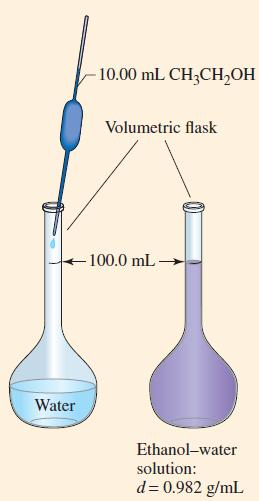
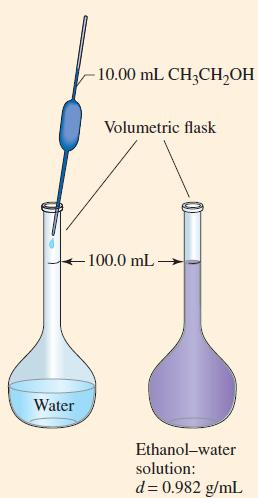
An ethanol–water solution is prepared by dissolving 10.00 mL of ethanol, CH3CH2OH (d = 0.789 g/mL), in a sufficient volume of water to produce 100.0 mL of a solution with a density of 0.982 g/mL(Fig. 14-1). What is the concentration of ethanol in this solution expressed as (a) Volume
In one mole of a solution with a mole fraction of 0.5 water, how many water molecules would there be?
(A) A solution that is 20.0% ethanol, by volume, is found to have a density of 0.977 g/mL. Use this fact, together with data from Example 14-1, to determine the mass percent ethanol in the solution.(B) Ionic liquids (ILs) are salts with relatively low melting points and vapor pressures. Because of
Which of the following do you expect to be most water soluble, and why? C10H8(s), NH2OH(s), C6H6(l), CaCO3(s).
Which of the several concentration units are temperature-dependent and which are not? Explain.
Which of the following is moderately soluble both in water and in benzene, C6H6(l), and why?(a) 1-butanol, CH3(CH2)2CH2OH; (b) Naphthalene, C10H8;(c) Hexane, C6H14;(d) NaCl(s).
Laboratory ammonia is 14.8 M NH3(aq) with a density of 0.8980 g/mL. What is xNH3 in this solution?
(A) A 16.00% aqueous solution of glycerol, HOCH2CH(OH)CH2OH, by mass, has a density of 1.037 g/mL. What is the mole fraction of glycerol in this solution?(B) A 10.00% aqueous solution of sucrose, C12H22O11, by mass, has a density of 1.040 g/mL. What is (a) The molarity; (b) The molality; and (c)
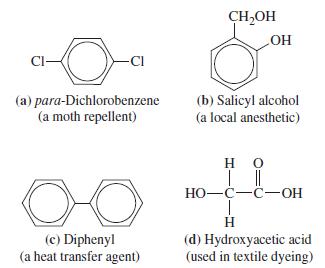
Substances that dissolve in water generally do not dissolve in benzene. Some substances are moderately soluble in both solvents, however. One of the following is such a substance. Which do you think it is and why? CI- (a) para-Dichlorobenzene (a moth repellent) OO (c) Diphenyl (a heat transfer
Do you think that Henry’s law works better for solutions of HCl(g) in benzene, C6H6, than it does for solutions of HCl(g) in water? If so, why?
Predict whether or not a solution will form in each of the following mixtures and whether the solution is likely to be ideal: (a) Ethyl alcohol, CH3CH2OH, and water; (b) The hydrocarbons hexane, CH3(CH2)4CH3, and octane, CH3(CH2)6CH3; (c) Octanol, CH3(CH2)6CH2OH, and water.
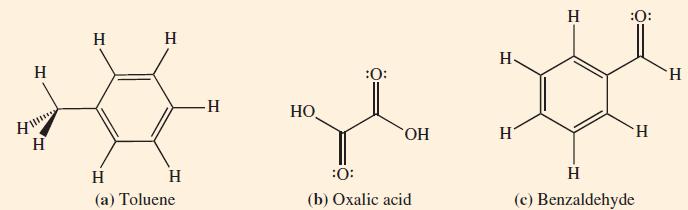
(A) Which of the following organic compounds do you think is most readily soluble in water? Explain.(B) In which solvent is solid iodine likely to be more soluble, water or carbon tetrachloride? Explain. H H H H H Н. :0: в ден -Н HO. OH H Н H :0: (a) Toluene (b) Oxalic acid H :0: Н Н (c)
An alternative statement of Raoult’s law is that the fractional lowering of the vapor pressure of the solvent, (P*A - P*A)/P*A, is equal to the mole fraction of solute(s), xB. Show that this statement is equivalent to equation (14.3).Eq. 14.3 PA = XAPA (14.3)
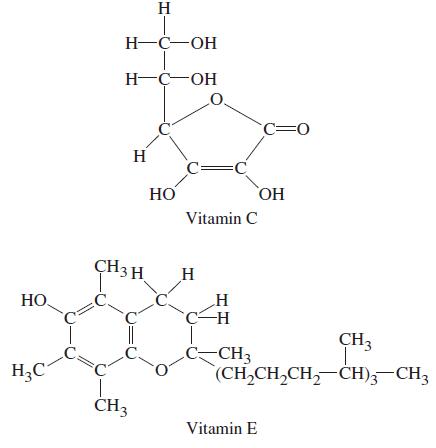
Some vitamins are water soluble and some are fat soluble. (Fats are substances whose molecules have long hydrocarbon chains.) The structural formulas of two vitamins are shown here—one is water soluble and one is fat soluble. Identify which is which, and explain your reasoning.
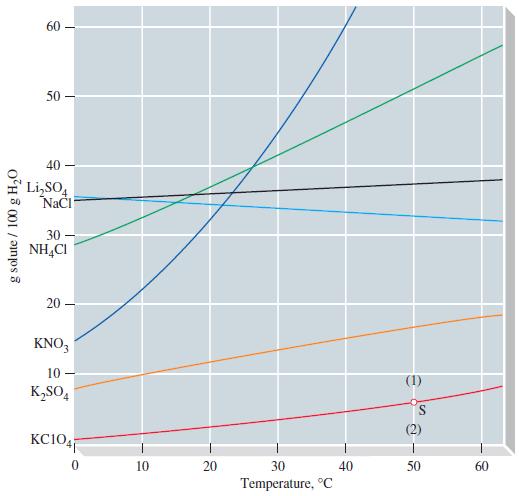
(A) Calculate the quantity of that would be obtained if suggestions (1) and (2) in Example 14-4(b) were followed. Use data from Figure 14-10. What mass of water is needed to produce a saturated solution containing 95 g NH4Cl at 60 °C?(B) Use Figure 14-10 to examine the solubility curves for the
Showing 2000 - 2100
of 4008
First
14
15
16
17
18
19
20
21
22
23
24
25
26
27
28
Last
Step by Step Answers

 Get 50% OFF
Claim Now
Get 50% OFF
Claim Now




























![Pco = 0.050 bar; Po = 0.132 bar; [glucose] = 1.0 mg/mL; pH = 7.0; [ATP] = [ADP] = [P] = 0.00010 M.](https://dsd5zvtm8ll6.cloudfront.net/images/question_images/1700/2/2/3/180655758cc99c891700223180209.jpg)