New Semester
Started
Get
50% OFF
Study Help!
--h --m --s
Claim Now
Question Answers
Textbooks
Find textbooks, questions and answers
Oops, something went wrong!
Change your search query and then try again
S
Books
FREE
Study Help
Expert Questions
Accounting
General Management
Mathematics
Finance
Organizational Behaviour
Law
Physics
Operating System
Management Leadership
Sociology
Programming
Marketing
Database
Computer Network
Economics
Textbooks Solutions
Accounting
Managerial Accounting
Management Leadership
Cost Accounting
Statistics
Business Law
Corporate Finance
Finance
Economics
Auditing
Tutors
Online Tutors
Find a Tutor
Hire a Tutor
Become a Tutor
AI Tutor
AI Study Planner
NEW
Sell Books
Search
Search
Sign In
Register
study help
sciences
general chemistry principles
General Chemistry Principles And Modern Applications 11th Edition Ralph Petrucci, Jeffry Madura, F. Herring, Carey Bissonnette - Solutions
For a solution that is 0.164 M NH3 and 0.102 M NH4Cl, calculate (a) [OH-];(b) [NH4+];(c) [Cl-];(d) [H3O+].
Calculate [H3O+] and [CH3COO-] in a solution that is 0.100 M in both CH3COOH and NaCH3COO.
(A) Calculate [H3O+] and [HCOO-] in a solution that is 0.100 M HCOOH and 0.150 M NaHCOO.(B) What mass of NaCH3COO should be added to 1.00 L of 0.100 M CH3COOH to produce a solution with pH = 5.00? Assume that the volume remains 1.00 L.
Show that an NH3–NH4Cl solution is a buffer solution. Over what pH range would you expect it to function?
(A) Describe how a mixture of a strong acid (such as HCl) and the salt of a weak acid (such as NaCH3COO) can result in a buffer solution.(B) Describe how a mixture of NH3 and HCl can result in a buffer solution.
To raise the pH of 1.00 L of 0.50 M HCl(aq) significantly, which of the following would you add to the solution and why? (a) 0.50 mol CH3COOH; (b) 1.00 mol NaCl; (c) 0.60 mol NaCH3COO; (d) 0.40 mol NaOH.
In Example 16-4, we calculated the percent ionization of CH3COOH in (a) 1.0 M; (b) 0.10 M; and (c) 0.010 M CH3COOH solutions. Recalculate those percent ionizations if each solution also contains 0.10 M NaCH3COO. Explain why the results are different from those of Example 16-4.Example 16-4What
What is the pH of a buffer solution prepared by dissolving 25.5 g NaCH3COO in a sufficient volume of 0.550 M CH3COOH to make 500.0 mL of the buffer?
(A) What is the pH of a buffer solution prepared by dissolving 23.1 g NaHCOO in a sufficient volume of 0.432 M HCOOH to make 500.0 mL of the buffer?(B) A handbook states that to prepare 100.0 mL of a particular buffer solution, mix 63.0 mL of 0.200 M CH3COOH with 37.0 mL of 0.200 M NaCH3COO. What
Sketch the titration curve for ethane-1,2-diamine, NH2CH2CH2NH2(aq), with HCl(aq) and label all important points on the titration curve. For ethane-1,2-diamine, pKb1 = 4.08; pKb2 = 7.15.
Calculate [H3O+] in a solution that is (a) 0.035 M HCl and 0.075 M HOCl; (b) 0.100 M NaNO2 and 0.0550 M HNO2; (c) 0.0525 M HCl and 0.0768 M NaCH3COO.
What mass of NaCH3COO must be dissolved in 0.300 L of 0.25 M CH3COOH to produce a solution with pH = 5.09? Assume that the solution volume remains constant at 0.300 L.
(A) How many grams of (NH4)2SO4 must be dissolved in 0.500 L of 0.35 M NH3 to produce a solution with pH = 9.00? (Assume that the solution volume remains at 0.500 L.)(B) In Practice Example 17-3A, we established that an appropriate mixture of a strong acid and the salt of a weak acid is a buffer
A solution is formed by mixing 200.0 mL of 0.100 M KOH with 100.0 mL of a solution that is both 0.200 M in CH3COOH and 0.050 M in HI. Without doing detailed calculations, identify in the final solution (a) All the solute species present, (b) The two most abundant solute species, and (c) The two
Calculate [OH-] in a solution that is (a) 0.0062 M Ba(OH)2 and 0.0105 M BaCl2; (b) 0.315 M (NH4)2SO4 and 0.486 M NH3; (c) 0.196 M NaOH and 0.264 M NH4Cl.
What concentration of formate ion, [HCOO-] should be present in 0.366 M HCOOH to produce a buffer solution with pH = 4.06? HCOOH + H2O=H3O* + HCOO- Ka 1.8 x 10⁻⁴
(A) A 1.00 L volume of buffer is made with concentrations of 0.350 M NaHCOO (sodium formate) and 0.550 M HCOOH (formic acid). (a) What is the initial pH? (b) What is the pH after the addition of 0.0050 mol HCl(aq)? (Assume that the volume remains 1.00 L.) (c) What would be the pH after the
(A) For the titration of 25.00 mL of 0.150 M HCl with 0.250 M NaOH, calculate (a) The initial pH; (b) The pH when neutralization is 50.0% complete; (c) The pH when neutralization is 100.0% complete; and (d) The pH when 1.00 mL of NaOH is added beyond the equivalence point.(B) For the titration
What concentration of ammonia, [NH3], should be present in a solution with [NH4+] = 0.732 M to produce a buffer solution with pH = 9.12? For NH3, Kb = 1.8 x 10⁻⁵.
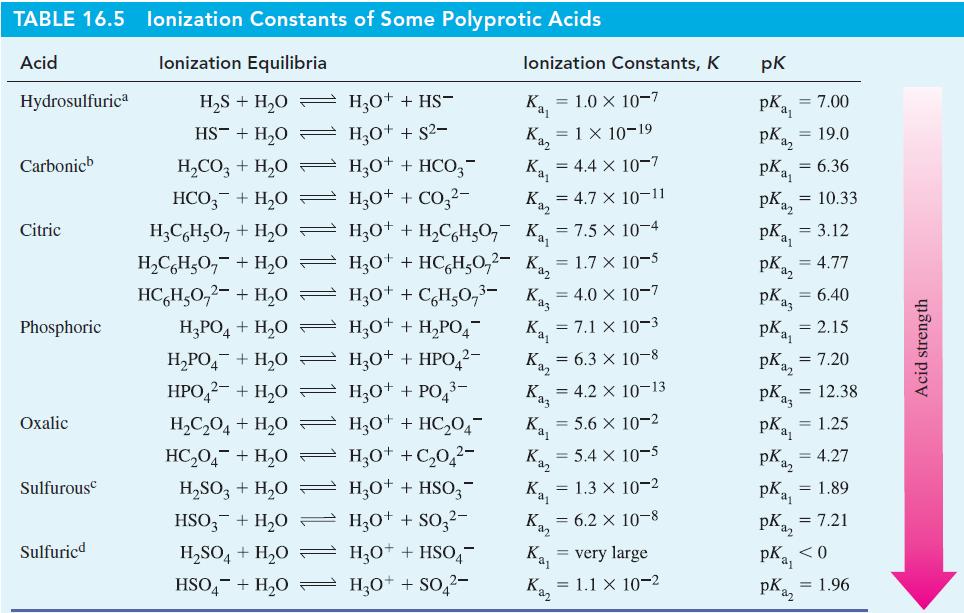
(A) Using data from Table 16.5, calculate the pH of 1.0 M Na2CO3.(B) Using data from Table 16.5, calculate the pH of 0.500 M Na2SO3.Table 16.5 TABLE 16.5 lonization Constants of Some Polyprotic Acids Acid lonization
(A) A 20.00 mL sample of 0.150 M HF solution is titrated with 0.250 M NaOH. Calculate (a) The initial pH and the pH when neutralization is (b) 25.0%, (c) 50.0%, and (d) 100.0% complete.(B) For the titration of 50.00 mL of 0.106 M NH3 with 0.225 M HCl, calculate (a) The initial pH and the pH
Calculate the pH of a buffer that is (a) 0.012 M C6H5COOH (Ka = 6.3 x 10⁻⁵) and 0.033 M NaC6H5COO;(b) 0.408 M NH3 and 0.153 M NH4Cl.
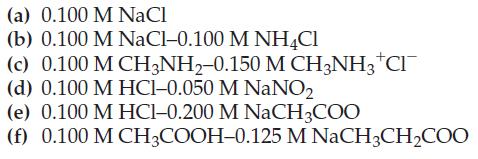
Indicate which of the following aqueous solutions are buffer solutions, and explain your reasoning. Consider any reactions that might occur between solution components. (a) 0.100 M NaCl (b) 0.100 M NaCl-0.100 M NH4Cl (c) 0.100 M CH3NH2-0.150 M CH3NH3 +CI (d) 0.100 M HCI-0.050 M NaNO2 (e) 0.100 M
Lactic acid, CH3CH(OH)COOH, is found in sour milk. A solution containing 1.00 g NaCH3CH(OH)COO in 100.0 mL of 0.0500 M CH3CH(OH)COOH, has a pH = 4.11. What is Ka of lactic acid?
The H2PO4-–HPO42- combination plays a role in maintaining the pH of blood.(a) Write equations to show how a solution containing these ions functions as a buffer.(b) Verify that this buffer is most effective at pH 7.2.(c) Calculate the pH of a buffer solution in which [H2PO4-] = 0.050 M and
What is the pH of a solution obtained by adding 1.15 mg of aniline hydrochloride (C6H5NH3+Cl-) to 3.18 L of 0.105 M aniline (C6H5NH2)?
What is the pH of a solution prepared by dissolving 8.50 g of aniline hydrochloride (C6H5NH3+Cl-) in 750 mL of 0.215 M aniline (C6H5NH2)? Would this solution be an effective buffer? Explain.
You wish to prepare a buffer solution with pH = 9.45.(a) How many grams of (NH4)2SO4 would you add to 425 mL of 0.258 M NH3 to do this? Assume that the solution’s volume remains constant.(b) Which buffer component, and how much (in grams), would you add to 0.100 L of the buffer in part (a) to
You prepare a buffer solution by dissolving 2.00 g each of benzoic acid, C6H5COOH, and sodium benzoate, NaC6H5COO, in 750.0 mL of water.(a) What is the pH of this buffer? Assume that the solution’s volume is 750.0 mL.(b) Which buffer component, and how much (in grams), would you add to the 750.0
If 0.55 mL of 12 M HCl is added to 0.100 L of the buffer solution in Exercise 15(a), what will be the pH of the resulting solution?Exercise 15(a)You wish to prepare a buffer solution with pH = 9.45.(a) How many grams of (NH4)2SO4 would you add to 425 mL of 0.258 M NH3 to do this? Assume that the
You are asked to reduce the pH of the 0.300 L of buffer solution in Example 17-5 from 5.09 to 5.00. How many milliliters of which of these solutions would you use: 0.100 M NaCl, 0.150 M HCl, 0.100 M NaCH3COO, 0.125 M NaOH? Explain your reasoning.Example 17-5What mass of NaCH3COO must be dissolved
Given 1.00 L of a solution that is 0.100 M CH3CH2COOH and 0.100 M KCH3CH2COO, (a) Over what pH range will this solution be an effective buffer?(b) What is the buffer capacity of the solution? That is, how many millimoles of strong acid or strong base can be added to the solution before any
Given 125 mL of a solution that is 0.0500 M CH3NH2 and 0.0500 M CH3NH3+Cl-, (a) Over what pH range will this solution be an effective buffer?(b) What is the buffer capacity of the solution? That is, how many millimoles of strong acid or strong base can be added to the solution before any
A solution of volume 75.0 mL contains 15.5 mmol HCOOH and 8.50 mmol NaHCOO.(a) What is the pH of this solution?(b) If 0.25 mmol Ba(OH)2 is added to the solution, what will be the pH?(c) If 1.05 mL of 12 M HCl is added to the original solution, what will be the pH?
A solution of volume 0.500 L contains 1.68 g NH3 and 4.05 g (NH4)2SO4.(a) What is the pH of this solution?(b) If 0.88 g NaOH is added to the solution, what will be the pH?(c) How many milliliters of 12 M HCl must be added to 0.500 L of the original solution to change its pH to 9.00?
An acetic acid–sodium acetate buffer can be prepared by the reaction(a) If 12.0 g NaCH3COO is added to 0.300 L of 0.200 M HCl, what is the pH of the resulting solution?(b) If 1.00 g Ba(OH)2 is added to the solution in part (a), what is the new pH?(c) What is the maximum mass of Ba(OH)2 that can
A handbook lists various procedures for preparing buffer solutions. To obtain a pH = 9.00, the handbook says to mix 36.00 mL of 0.200 M NH3 with 64.00 mL of 0.200 M NH4Cl.(a) Show by calculation that the pH of this solution is 9.00.(b) Would you expect the pH of this solution to remain at pH = 9.00
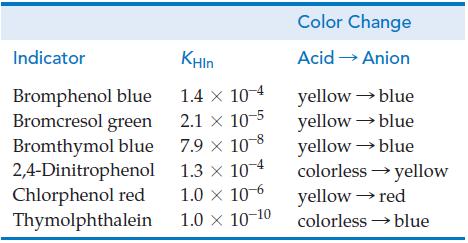
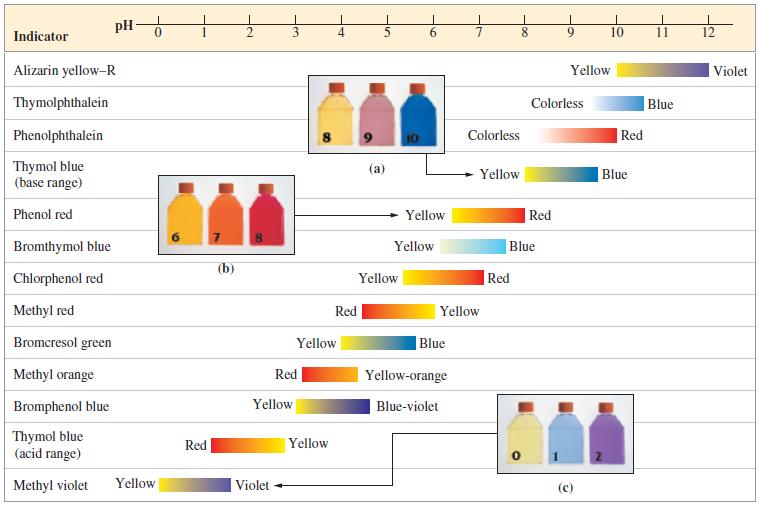
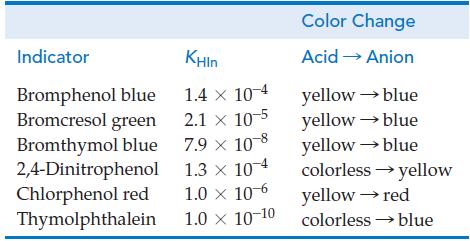
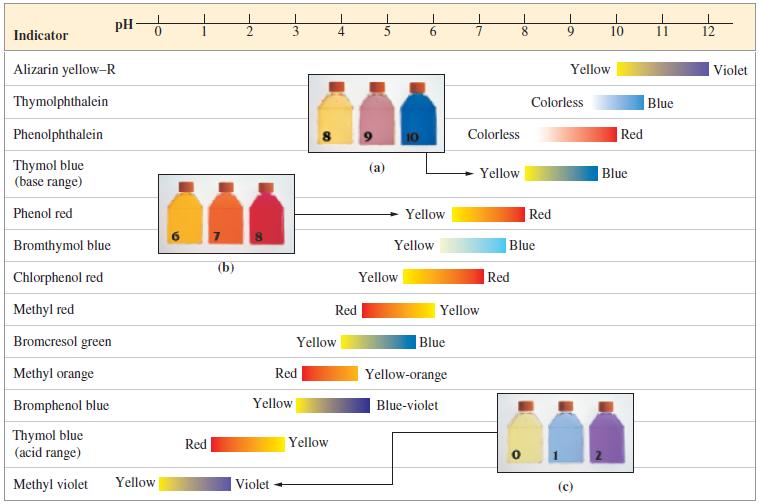
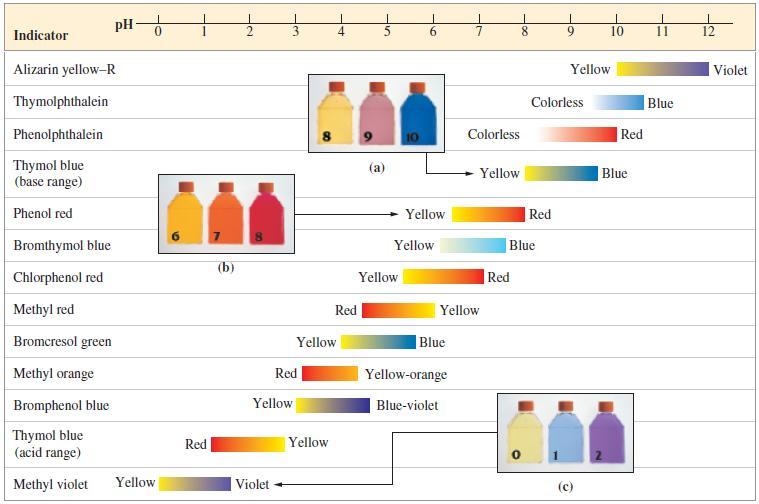
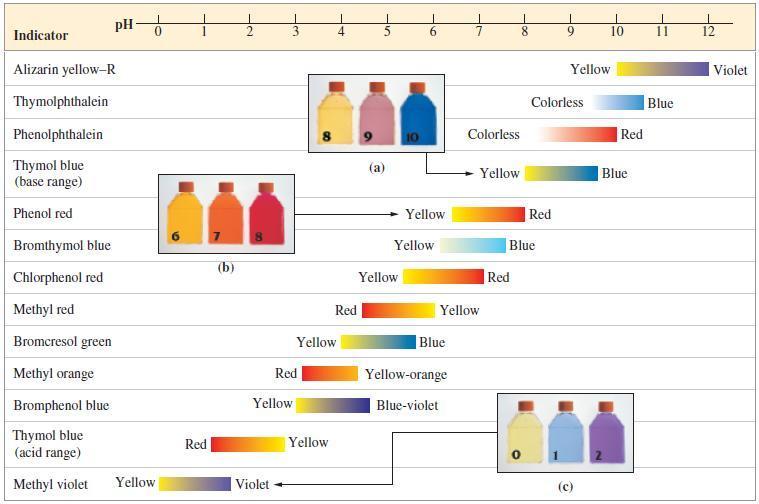
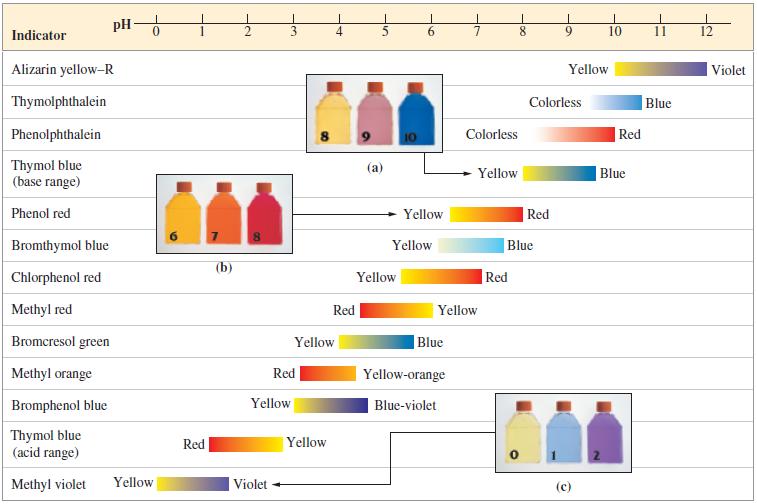
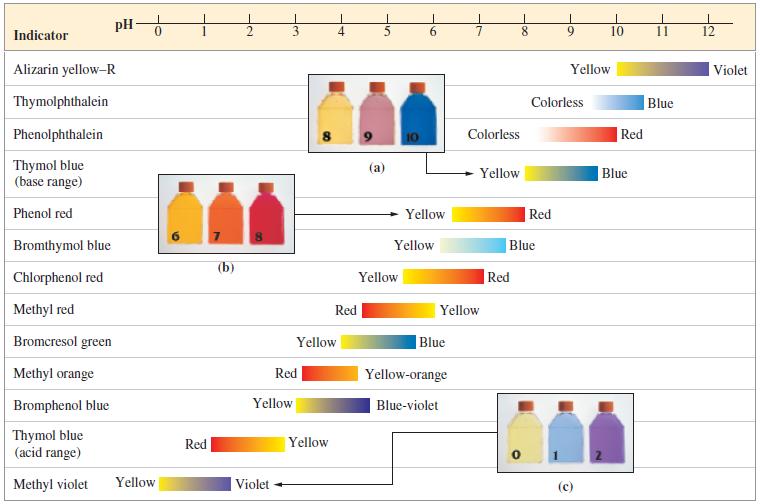
With reference to the indicators listed in Exercise 27, what would be the color of each combination?(a) 2,4-dinitrophenol in 0.100 M HCl(aq)(b) Chlorphenol red in 1.00 M NaCl(aq)(c) Thymolphthalein in 1.00 M (d) Bromcresol green in seawater (recall Figure 17-7)Exercise 27A handbook lists the
A handbook lists the following data:(a) Which of these indicators change color in acidic solution, which in basic solution, and which near the neutral point?(b) What is the approximate pH of a solution if bromcresol green indicator turns green? if chlorphenol red turns orange?
In the use of acid–base indicators,(a) Why is it generally sufficient to use a single indicator in an acid–base titration, but often necessary to use several indicators to establish the approximate pH of a solution?(b) Why must the quantity of indicator used in a titration be kept as small as
The indicator methyl red has a pKHIn = 4.95. It changes from red to yellow over the pH range from 4.4 to 6.2.(a) If the indicator is placed in a buffer solution of pH = 4.55, what percent of the indicator will be present in the acid form, HIn, and what percent will be present in the base or anion
Phenol red indicator changes from yellow to red in the pH range from 6.6 to 8.0. Without making detailed calculations, state what color the indicator will assume in each of the following solutions: (a) 0.10 M KOH;(b) 0.10 M CH3COOH; (c) 0.10 M NH4NO3; (d) 0.10 M HBr; (e) 0.10 M NaCN; (f) 0.10
Thymol blue indicator has two pH ranges. It changes color from red to yellow in the pH range from 1.2 to 2.8, and from yellow to blue in the pH range from 8.0 to 9.6. What is the color of the indicator in each of the following situations?(a) The indicator is placed in 350.0 mL of 0.205 M HCl.(b) To
In the titration of 10.00 mL of 0.04050 M HCl with 0.01120 M Ba(OH)2 in the presence of the indicator 2,4-dinitrophenol, the solution changes from colorless to yellow when 17.90 mL of the base has been added. What is the approximate value of pKHIn for 2,4-dinitrophenol? Is this a good indicator for
A 25.00 mL sample of H3PO4(aq) requires 31.15 mL of 0.2420 M KOH for titration to the second equivalence point. What is the molarity of the H3PO4(aq)?
A 20.00 mL sample of H3PO4(aq) requires 18.67 mL of 0.1885 M NaOH for titration from the first to the second equivalence point. What is the molarity of the H3PO4(aq)?
Two aqueous solutions are mixed: 50.0 mL of 0.0150 M H2SO4 and 50.0 mL of 0.0385 M NaOH. What is the pH of the resulting solution?
Two solutions are mixed: 100.0 mL of HCl(aq) with pH 2.50 and 100.0 mL of NaOH(aq) with pH 11.00. What is the pH of the resulting solution?
Calculate the pH at the points in the titration of 25.00 mL of 0.160 M HCl when (a) 10.00 mL and (b) 15.00 mL of 0.242 M KOH have been added.
Calculate the pH at the points in the titration of 20.00 mL of 0.275 M KOH when (a) 15.00 mL and (b) 20.00 mL of 0.350 M HCl have been added.
Calculate the pH at the points in the titration of 25.00 mL of 0.132 M HNO2 when (a) 10.00 mL and (b) 20.00 mL of 0.116 M NaOH have been added. For HNO2, Ka = 7.2 x 10⁻⁴. HNO₂ + OH- H₂O + NO₂
Calculate the pH at the points in the titration of 20.00 mL of 0.318 M NH3 when (a) 10.00 mL and (b) 15.00 mL of 0.475 M HCl have been added. For NH3, Kb = 1.8 x 10⁻⁵. NH3(aq) + HCl(aq) NH₂ (aq) + Cl(aq)
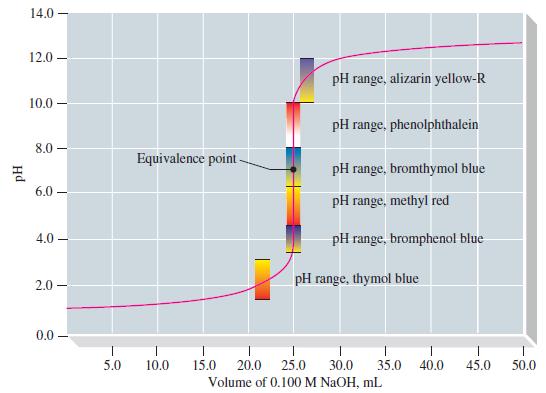
Sketch the titration curves of the following mixtures. Indicate the initial pH and the pH corresponding to the equivalence point. Indicate the volume of titrant required to reach the equivalence point, and select a suitable indicator from Figure 17-7.(a) 25.0 mL of 0.100 M KOH with 0.200 M HI; (b)
Explain why the volume of 0.100 M NaOH required to reach the equivalence point in the titration of 25.00 mL of 0.100 M HA is the same regardless of whether HA is a strong or a weak acid, yet the pH at the equivalence point is not the same.
Explain whether the equivalence point of each of the following titrations should be below, above, or at pH 7:(a) NaHCO3(aq) titrated with NaOH(aq); (b) HCl(aq) titrated with NH3(aq);(c) KOH(aq) titrated with HI(aq).
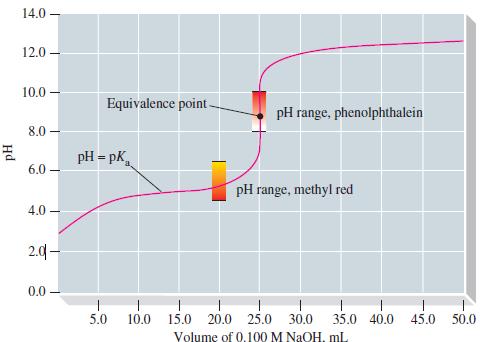
Sketch a titration curve (pH versus mL of titrant) for each of the following three hypothetical weak acids when titrated with 0.100 M NaOH. Select suitable indicators for the titrations from Figure 17-7.Figure 17-7 (a) 10.00 mL of 0.100 M HX; Ka = 7.0 x 10 (b) 10.00 mL of 0.100 M HY; Ka = 3.0 x
Determine the following characteristics of the titration curve for 20.0 mL of 0.275 M NH3(aq) titrated with 0.325 M HI(aq).(a) The initial pH;(b) The volume of 0.325 M HI(aq) at the equivalence point;(c) The pH at the half-neutralization point;(d) The pH at the equivalence point.
Sketch a titration curve (pH versus mL of titrant) for each of the following hypothetical weak bases when titrated with 0.100 M HCl. (Think of these bases as involving the substitution of organic groups, R, for one of the H atoms of NH3.) Select suitable indicators for the titrations from Figure
In the titration of 20.00 mL of 0.175 M NaOH, calculate the number of milliliters of 0.200 M HCl that must be added to reach a pH of (a) 12.55; (b) 10.80; (c) 4.25.
In the titration of 25.00 mL of 0.100 M CH3COOH, calculate the number of milliliters of 0.200 M NaOH that must be added to reach a pH of (a) 3.85; (b) 5.25;(c) 11.10.
For the titration of 25.00 mL of 0.100 M NaOH with 0.100 M HCl, calculate the pOH at a few representative points in the titration, sketch the titration curve of pOH versus volume of titrant, and show that it has exactly the same form as Figure 17-8. Then, using this curve and the simplest method
For the titration of 25.00 mL 0.100 M NH3 with 0.100 M HCl, calculate the pOH at a few representative points in the titration, sketch the titration curve of pOH versus volume of titrant, and show that it has exactly the same form as Figure 17-10. Then, using this curve and the simplest method
Is a solution that is 0.10 M Na2S(aq) likely to be acidic, basic, or pH neutral? Explain.
Is a solution of sodium dihydrogen citrate, likely to be acidic, basic, or neutral? Explain. Citric acid, H3Cit, is H3C6H5O7.
Sodium phosphate, Na3PO4, is made commercially by first neutralizing phosphoric acid with sodium carbonate to obtain Na2HPO4. The Na2HPO4 is further neutralized to Na3PO4 with (a) Write net ionic equations for these reactions.(b) Na2CO3 is a much cheaper base than is NaOH. Why do you suppose that
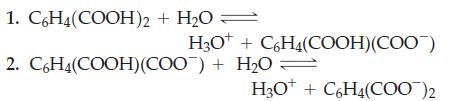
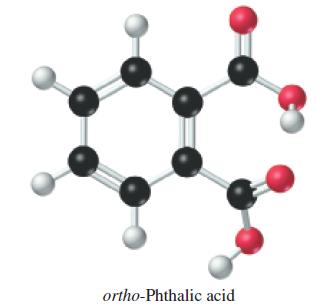
The ionization constants of ortho-phthalic acid are Ka1 = 1.1 x 10⁻³ and Ka2 = 3.9 x 10⁻⁶.What are the pH values of the following aqueous solutions: (a) 0.350 M potassium hydrogen orthophthalate;(b) A solution containing 36.35 g potassium ortho-phthalate per liter? 1. C6H4(COOH)2 + H₂O = H3O+
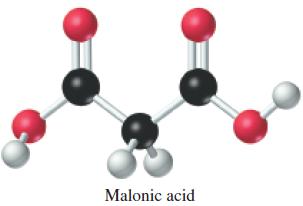
The pH of a solution of 19.5 g of malonic acid in 0.250 L is 1.47. The pH of a 0.300 M solution of sodium hydrogen malonate is 4.26. What are the values of Ka1 and Ka2 for malonic acid? Malonic acid
Both sodium hydrogen carbonate (sodium bicarbonate) and sodium hydroxide can be used to neutralize acid spills. What is the pH of 1.00 M NaHCO3(aq) and of 1.00 M NaOH(aq)? On a per-liter basis, do these two solutions have an equal capacity to neutralize acids? Explain. On a per gram basis, do the
What stoichiometric concentration of the indicated substance is required to obtain an aqueous solution with the pH value shown: (a) Ba(OH)2 for pH = 11.88;(b) CH3COOH in 0.294 M NaCH3COO for pH = 4.52?
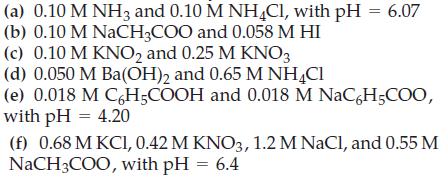
Using appropriate equilibrium constants but without doing detailed calculations, determine whether a solution can be simultaneously: (a) 0.10 M NH3 and 0.10 M NH4Cl, with pH = 6.07 (b) 0.10 M NaCH3COO and 0.058 M HI (c) 0.10 M KNO₂ and 0.25 M KNO3 (d) 0.050 M Ba(OH)2 and 0.65 M NH4Cl (e) 0.018 M
What stoichiometric concentration of the indicated substance is required to obtain an aqueous solution with the pH value shown: (a) Aniline, C6H5NH2, for pH = 8.95;(b) NH4Cl for pH = 5.12?
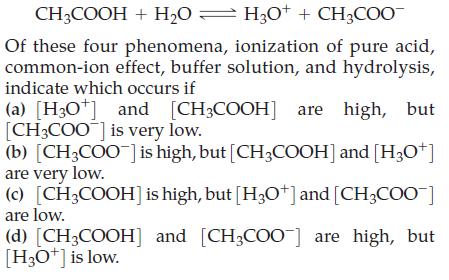
This single equilibrium equation applies to different phenomena described in this or the preceding chapter. CH3COOH + H₂0 H3O+ + CH3COO Of these four phenomena, ionization of pure acid, common-ion effect, buffer solution, and hydrolysis, indicate which occurs if (a) [H3O+] and [CH3COOH] are high,
Sodium hydrogen sulfate, NaHSO4, is an acidic salt with a number of uses, such as metal pickling (removal of surface deposits). NaHSO4 is made by the reaction of H2SO4 with NaCl. To determine the percent NaCl impurity in NaHSO4, a 1.016 g sample is titrated with NaOH(aq); 36.56 mL of 0.225 M NaOH
You are given 250.0 mL of 0.100 M CH3CH2COOH (propionic acid, Ka = 1.35 x 10⁻⁵). You want to adjust its pH by adding an appropriate solution. What volume would you add of (a) 1.00 M HCl to lower the pH to 1.00; (b) 1.00 M NaCH3CH2COO to raise the pH to 4.00; (c) Water to raise the pH by 0.15
Even though the carbonic acid–hydrogen carbonate buffer system is crucial to the maintenance of the pH of blood, it has no practical use as a laboratory buffer solution. Can you think of a reason(s) for this?
A buffer solution can be prepared by starting with a weak acid, HA, and converting some of the weak acid to its salt (for example, NaA) by titration with a strong base. The fraction of the original acid that is converted to the salt is designated ƒ.(a) Derive an equation similar to equation (17.7)
Rather than calculate the pH for different volumes of titrant, a titration curve can be established by calculating the volume of titrant required to reach certain pH values. Determine the volumes of 0.100 M NaOH required to reach the following pH values in the titration of 20.00 mL of 0.150 M HCl:
You are asked to prepare a KH2PO4–Na2HPO4 solution that has the same pH as human blood, 7.40.(a) What should be the ratio of concentrations [HPO42-]/[H2PO4-] in this solution?(b) Suppose you have to prepare 1.00 L of the solution described in part (a) and that this solution must be isotonic with
You are asked to bring the pH of 0.500 L of 0.500 M NH4Cl(aq) to 7.00. How many drops (1 drop 0.05 mL) of which of the following solutions would you use: 10.0 M HCl or 10.0 M NH3?
Because an acid–base indicator is a weak acid, it can be titrated with a strong base. Suppose you titrate 25.00 mL of a 0.0100 M solution of the indicator p-nitrophenol, HOC6H4NO2, with 0.0200 M NaOH. The pKa of p-nitrophenol is 7.15, and it changes from colorless to yellow in the pH range from
The neutralization of NaOH by HCl is represented in equation (1), and the neutralization of NH3 by HCl in equation (2).(a) Determine the equilibrium constant K for each reaction.(b) Explain why each neutralization reaction can be considered to go to completion. 1. OH + H30+ 2. NH3 + H3O+ 11 11 K =
The titration of a weak acid by a weak base is not a satisfactory procedure because the pH does not increase sharply at the equivalence point. Demonstrate this fact by sketching a titration curve for the neutralization of 10.00 mL of 0.100 M CH3COOH with 0.100 M NH3.
At times, a salt of a weak base can be titrated by a strong base. Use appropriate data from the text to sketch a titration curve for the titration of 10.00 mL of 0.0500 M C6H5NH3+Cl- with 0.100 M NaOH.
Sulfuric acid is a diprotic acid, strong in the first ionization step and weak in the second (Ka2 = 1.1 x 10⁻²). By using appropriate calculations, determine whether it is feasible to titrate 10.00 mL of 0.100 M H2SO4 to two distinct equivalence points with 0.100 M NaOH.
Piperazine is a diprotic weak base used as a corrosion inhibitor and an insecticide. Its ionization is described by the following equations.The piperazine used commercially is a hexahydrate, C4H10N2 · 6H2O. A 1.00-g sample of this hexahydrate is dissolved in 100.0 mL of water and titrated with
Carbonic acid is a weak diprotic acid (H2CO3) with Ka1 = 4.43 x 10⁻⁷ and Ka2 = 4.73 x 10⁻¹¹. The equivalence points for the titration come at approximately pH 4 and 9. Suitable indicators for use in titrating carbonic acid or carbonate solutions are methyl orange and phenolphthalein.(a) Sketch the
Complete the derivation of equation (17.10) outlined in Are You Wondering 17-1. Then derive equation (17.11).Eq. 17.10Eq. 17.11 for H₂PO4: 1 pH = (pKa₁ + pka₂) = 1 2 (2.15 (2.15 +7.20) = 4.68 (17.10)
Explain why equation (17.10) fails when applied to dilute solutions—for example, when you calculate the pH of 0.010 M NaH2PO4.Eq. 17.10 for H₂PO4: 1 pH = (pKa₁ + pka₂) = 1 2 (2.15 (2.15 +7.20) = 4.68 (17.10)
A series of titrations of lactic acid, CH3CH(OH)COOH (pKa = 3.86) is planned. About 1.00 mmol of the acid will be titrated with NaOH(aq) to a final volume of about 100 mL at the equivalence point. (a) Which acid–base indicator from Figure 17-7 would you select for the titration? To assist in
A solution is prepared that is 0.150 M CH3COOH and 0.250 M NaHCOO.(a) Show that this is a buffer solution.(b) Calculate the pH of this buffer solution.(c) What is the final pH if 1.00 L of 0.100 M HCl is added to 1.00 L of this buffer solution?
Hydrogen peroxide, H2O2, is a somewhat stronger acid than water. Its ionization is represented by the equationIn 1912, the following experiments were performed to obtain an approximate value of pKa for this ionization at 0 °C. A sample of H2O2 was shaken together with a mixture of water and
Sodium ammonium hydrogen phosphate, NaNH4HPO4, is a salt in which one of the ionizable H atoms of H3PO4 is replaced by Na+, another is replaced by NH4+ and the third remains in the anion HPO42-. Calculate the pH of 0.100 M NaNH4HPO4(aq).
Consider a solution containing two weak monoprotic acids with dissociation constants KHA and KHB. Find the charge balance equation for this system, and use it to derive an expression that gives the concentration of H3O+ as a function of the concentrations of HA and HB and the various constants.
Calculate the pH of a solution that is 0.050 M acetic acid and 0.010 M phenylacetic acid.
The Henderson–Hasselbalch equation can be written asThus, the degree of ionization (α) of an acid can be determined if both the pH of the solution and the pKa of the acid are known.(a) Use this equation to plot the pH versus the degree of ionization for the second ionization constant of
Avery common buffer agent used in the study of biochemical processes is the weak base TRIS, (HOCH2)3 CNH2, which has a pKb of 5.91 at 25 °C. A student is given a sample of the hydrochloride of TRIS together with standard solutions of 10 M NaOH and HCl.(a) Using TRIS, how might the student prepare
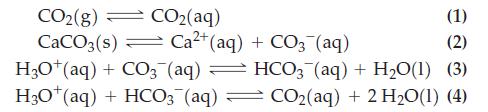
The pH of ocean water depends on the amount of atmospheric carbon dioxide. The dissolution of carbon dioxide in ocean water can be approximated by the following chemical reactions (Henry’s Law constant for CO2 is KH = [CO2(aq)]/[CO2(g)] = 0.8317.) For reaction (2), K = 2.8 x 10⁻⁹:(a) Use the
In 1922 Donald D. van Slyke (J. Biol. Chem., 52, 525) defined a quantity known as the buffer index: β = dcb/d(pH), where dcb represents the increment of moles of strong base to one liter of the buffer. For the addition of a strong acid, he wrote β = -dca/d(pH). By applying this idea to a
A sample of water contains 23.0 g L-1 of Na+(aq), 10.0 g L-1 of Ca2+(aq), 40.2 g L-1 CO32-(aq), and 9.6 g L-1 SO42-(aq). What is the pH of the solution if the only other ions present are H3O+ and OH-?
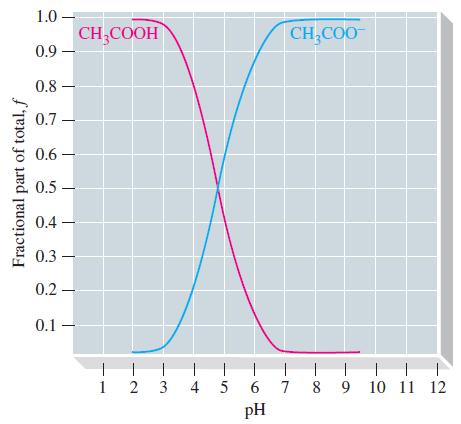
The graph below, which is related to a titration curve, shows the fraction (ƒ) of the stoichiometric amount of acetic acid present as non-ionized CH3COOH and as acetate ion, CH3COO-, as a function of the pH of the solution containing these species.(a) Explain the significance of the point at which
Showing 1600 - 1700
of 4008
First
10
11
12
13
14
15
16
17
18
19
20
21
22
23
24
Last
Step by Step Answers

 Get 50% OFF
Claim Now
Get 50% OFF
Claim Now








![[conjugate base] [acid] pH = pka + log- (17.7)](https://dsd5zvtm8ll6.cloudfront.net/images/question_images/1700/6/4/9/296655dd950351981700649294733.jpg)

![HN(CH8) NH + HO = [HN(C4H8) NH]+ + OH [HN(C4H8) NH] + HO = [HN(C4H8) NH]+ + OH pKb pKb = 8.67 = 4.22](https://dsd5zvtm8ll6.cloudfront.net/images/question_images/1700/6/5/0/181655ddcc5eaf861700650180966.jpg)




![08(21/1 -1) pH = pKa - log where a [A] [A] + [HA]](https://dsd5zvtm8ll6.cloudfront.net/images/question_images/1700/6/5/1/663655de28fad5801700651662613.jpg)
![B = 2.303 Kw [H3O+] + [H3O+] + cKa[H3O+] (Ka+ [H3O+])2/](https://dsd5zvtm8ll6.cloudfront.net/images/question_images/1700/6/5/3/202655de89261ff71700653201342.jpg)