New Semester
Started
Get
50% OFF
Study Help!
--h --m --s
Claim Now
Question Answers
Textbooks
Find textbooks, questions and answers
Oops, something went wrong!
Change your search query and then try again
S
Books
FREE
Study Help
Expert Questions
Accounting
General Management
Mathematics
Finance
Organizational Behaviour
Law
Physics
Operating System
Management Leadership
Sociology
Programming
Marketing
Database
Computer Network
Economics
Textbooks Solutions
Accounting
Managerial Accounting
Management Leadership
Cost Accounting
Statistics
Business Law
Corporate Finance
Finance
Economics
Auditing
Tutors
Online Tutors
Find a Tutor
Hire a Tutor
Become a Tutor
AI Tutor
AI Study Planner
NEW
Sell Books
Search
Search
Sign In
Register
study help
sciences
organic chemistry
Organic Chemistry structure and function 6th edition K. Peter C. Vollhardt, Neil E. Schore - Solutions
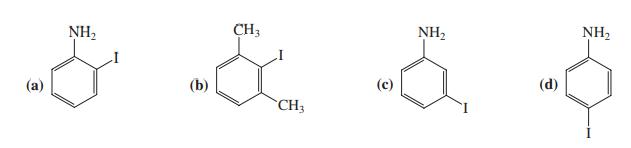
o-Iodoaniline is the common name of which of the following compounds? NH2 CH3 NH2 NH2 (a) (b) (d) CH3
As a team, discuss the following complementary experimental results as they pertain to the mechanism of electrophilic aromatic substitution. (a) A solution of HCl and benzene is colorless and does not conduct electricity, whereas a solution of HCl and AlCl3 and benzene is colored and does
As a team, discuss the following complementary experimental results as they pertain to the mechanism of electrophilic aromatic substitution. (a) A solution of HCl and benzene is colorless and does not conduct electricity, whereas a solution of HCl and AlCl3 and benzene is colored and does
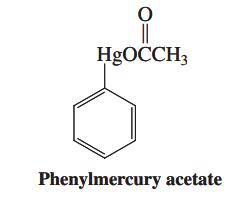
Metal-substituted benzenes have a long history of use in medicine. Before antibiotics were discovered, phenylarsenic derivatives were the only treatment for a number of diseases. Phenylmercury compounds continue to be used as fungicides and antimicrobial agents to the present day. On the basis of
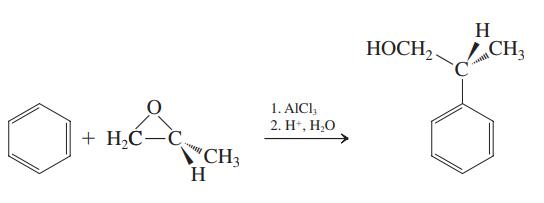
Explain the following reaction and the indicated stereochemical result mechanistically.
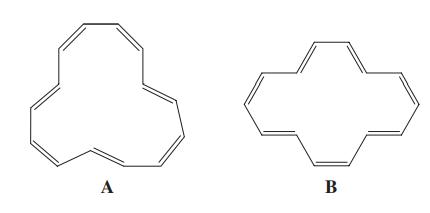
The 1H NMR spectrum of the most stable isomer of [14]annulene shows two signals, at δ = -0.61 (4 H) and 7.88 (10 H) ppm. Two possible structures for [14]annulene are shown here. How do they differ? Which one corresponds to the NMR spectrum described? A В
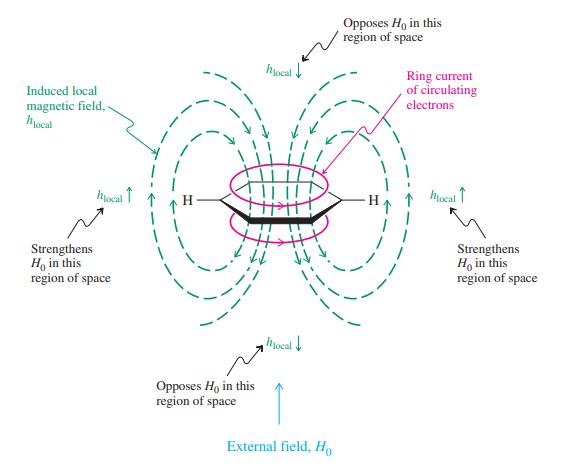
(a) The 1H NMR spectrum of [18]annulene shows two signals, at δ = 9.28 (12 H) and -2.99 (6 H) ppm. The negative chemical shift value refers to a resonance upfield (to the right) of (CH3)4Si. Explain this spectrum. (Consult Figure 15-9.) (b) The unusual molecule 1,6-methano[10]annulene (shown in
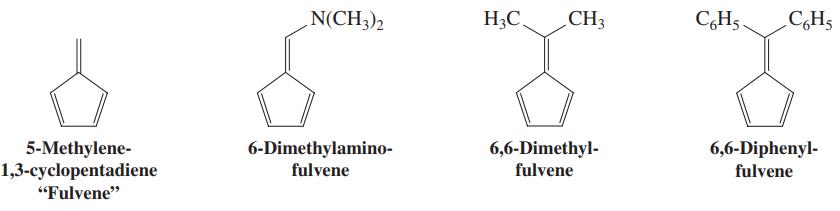
A characteristic reaction of fulvenes is nucleophilic addition. To which carbon in a fulvene would you expect nucleophiles to add, and why?
All the molecules shown below are examples of “fulvenes,” or methylenecyclopentadienes. (a) One of these structures is considerably more acidic than the others, with a pKa around 20. Identify it and its most acidic hydrogen(s), and explain why it is an unusually strong acid for a molecule
Is cyclobutadiene dication (C4H42+) aromatic according to Hückel’s rule? Sketch its p molecular orbital diagram to illustrate.
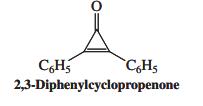
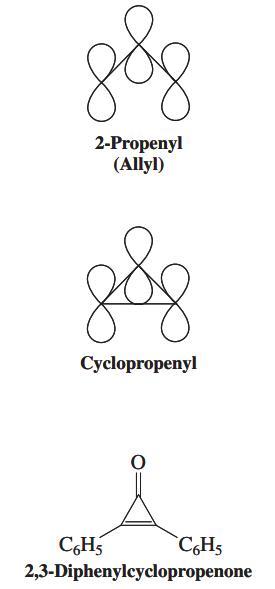
2,3-Diphenylcyclopropenone forms an addition product with HBr that exhibits the properties of an ionic salt. Suggest a structure for this product and a reason for its existence as a stable entity. CH5 CH5 2,3-Diphenylcyclopropenone
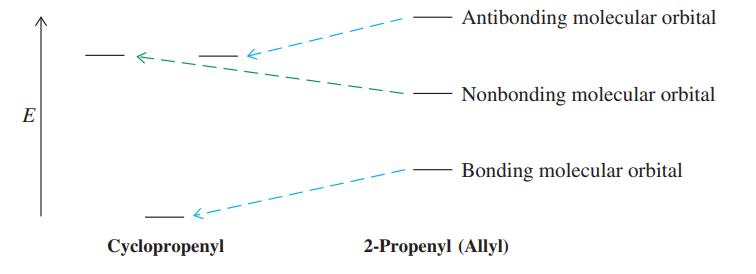
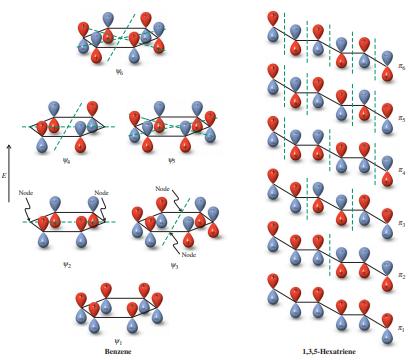
The energy levels of the 2-propenyl (allyl) and cyclopropenyl p systems (see margin) are compared qualitatively in the diagram below. (a) Draw the three molecular orbitals of each system, using plus and minus signs and dotted lines to indicate bonding overlap and nodes, as in Figure 15-4. Does
Because of cyclic delocalization, structures A and B shown here for o-dimethylbenzene (o-xylene) are simply two resonance forms of the same molecule. Can the same be said for the two dimethyl-cyclooctatetraene structures C and D? Explain. CH3 CH3 CH3 CH3 CH3 CH3 CH3 CH3 A В C D
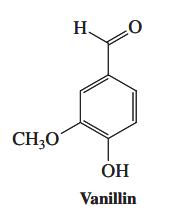
Vanillin, whose structure is shown in the margin and is the subject of the Chapter Opening, is a benzene derivative with several functional groups, each one of which displays its characteristic reactivity. What would you expect to be the products of reaction of vanillin with each of the following
Give efficient syntheses of the following compounds, beginning with benzene. (a) 1-Phenyl-1- heptanol; (b) 2-phenyl-2-butanol; (c) 1-phenyloctane.
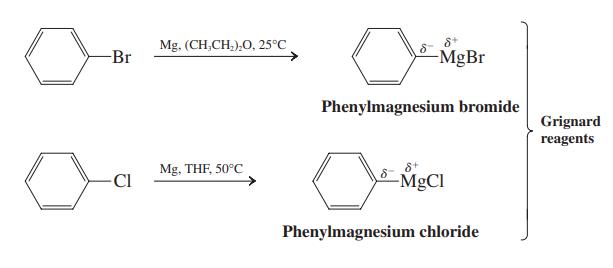
Like haloalkanes, haloarenes are readily converted into organometallic reagents, which are sources of nucleophilic carbon. The chemical behavior of these reagents is very similar to that of their alkyl counterparts. Write the main product of each of the following sequences. Mg,
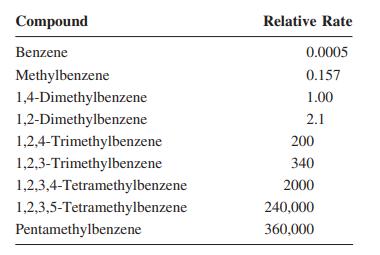
The text states that alkylated benzenes are more susceptible to electrophilic attack than is benzene itself. Draw a graph like that in Figure 15-20 to show how the energy profile of electrophilic substitution of methylbenzene (toluene) would differ quantitatively from that of benzene.
(a) 3-Phenylpropanoyl chloride, C6H5CH2CH2COCl, reacts with AlCl3 to give a single product with the formula C9H8O and an 1H NMR spectrum with signals at δ = 2.53 (t, J = 8 Hz, 2 H), 3.02 (t, J = 8 Hz, 2 H), and 7.2 – 7.7 (m, 4 H) ppm. Propose a structure and a mechanism for the formation of this
Benzene reacts with sulfur dichloride, SCl2, in the presence of AlCl3 to give diphenyl sulfi de, C6H5 – S – C6H5. Propose a mechanism for this process.
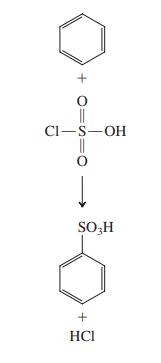
Propose a mechanism for the sulfonation of benzene using chlorosulfuric acid, ClSO3H (in the margin). Cl-S-OH SO,H + HCI + O=S
Hexadeuteriobenzene, C6D6, is a very useful solvent for 1H NMR spectroscopy because it dissolves a wide variety of organic compounds and, being aromatic, is very stable. Suggest a method for the preparation of C6D6.
Write mechanisms for reactions (c) and (f) in Problem 48. Data from Problem 48Give the expected major product of addition of each of the following reagent mixtures to benzene. (a) Cl, + AICI, (b) T,0 + T,SO, (T = tritium, 'H) (с) (CH).СОН + Н.РО (d) N,O; (which tends to dissociate into NO,
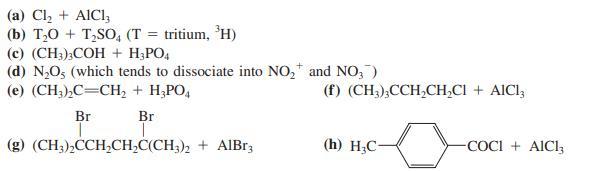
Give the expected major product of addition of each of the following reagent mixtures to benzene. (a) Cl, + AICI, (b) T,0 + T,SO, (T = tritium, 'H) (с) (CH).СОН + Н.РО (d) N,O; (which tends to dissociate into NO, and NO, ) (е) (CH,),С—СН, + Н.РО, (f) (CH3);CCH,CH,CI + AICI, Br Br
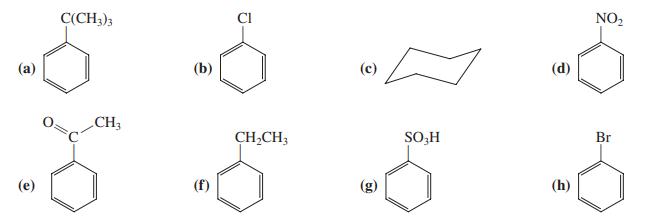
Reaction review. Without consulting the Reaction Road Map on p. 721, suggest a reagent to convert benzene into each of the following compounds. C(CH3)3 NO2 „CH3 CH,CH; SO,H Br (e) (f) (h)
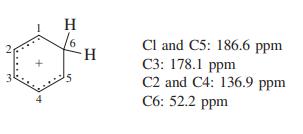
The species resulting from the addition of benzene to HF – SbF5 (Exercise 15-24) shows the following 13C NMR absorptions: δ = 52.2(CH2), 136.9(CH), 178.1(CH), and 186.6(CH) ppm. The signals at δ = 136.9 and δ = 186.6 are twice the intensity of the other peaks. Assign this spectrum.Exercise
(a) Is it possible to distinguish the three isomers of dimethoxybenzene solely on the basis of the number of peaks in their proton-decoupled 13C NMR spectra? Explain. (b) How many different isomers of dimethoxynaphthalene exist? How many peaks should each one exhibit in the protondecoupled 13C
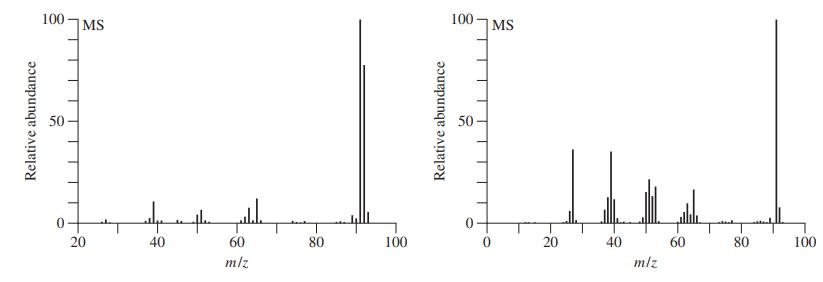
Both methylbenzene (toluene) and 1,6-heptadiyne have molecular formulas of C7H8 and molecular masses of 92. Which of the two mass spectra shown below corresponds to which compound? Explain your reasoning. 100 MS 100 |MS 50 - 50 – 20 40 60 80 100 20 40 60 80 100 m/z mlz Relative abundance
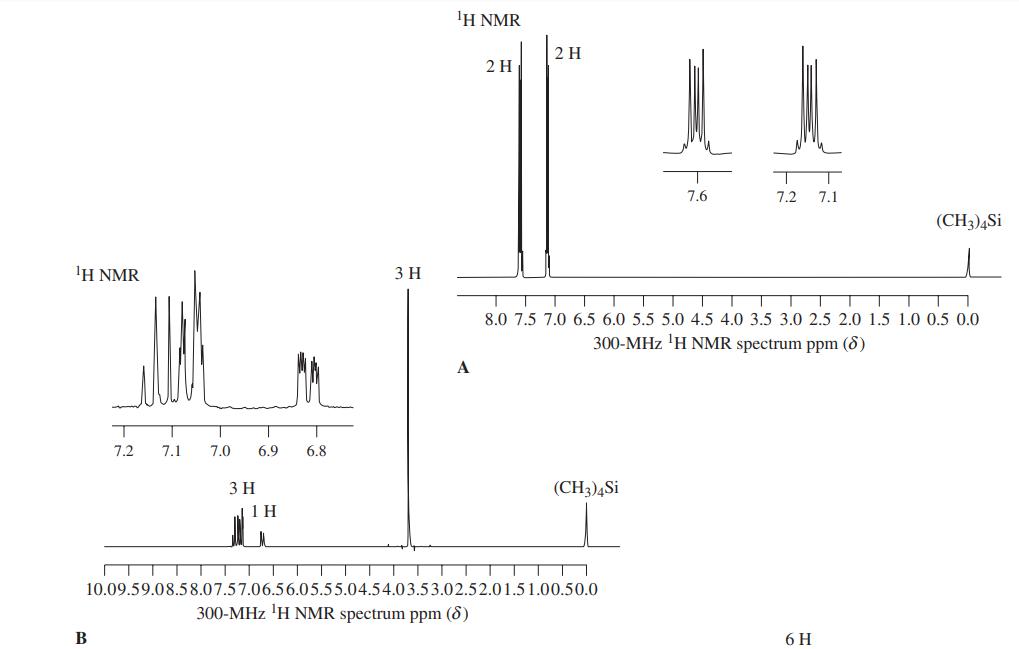
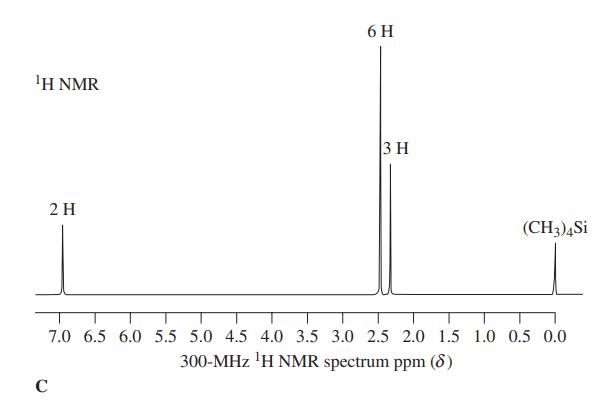
Following are spectroscopic and other data for several compounds. Propose a structure for each of them. (a) Molecular formula = C6H4Br2. 1H NMR spectrum A. 13C NMR: 3 peaks. IR: v˜ = 745 (s, broad) cm-1. UV: λmax(ε) = 263(150), 270(250), and 278(180) nm. (b) Molecular formula 5
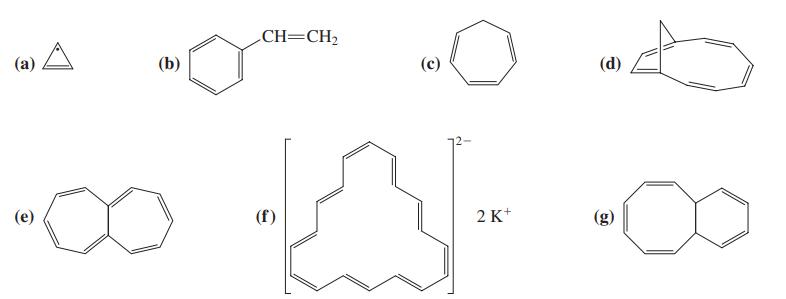
Which of the following structures qualify as being aromatic, according to Hückel’s rule?
Complete hydrogenation of 1,3,5,7-cyclooctatetraene is exothermic by -101 kcal mol-1. Hydrogenation of cyclooctene proceeds with ΔH° = 223 kcal mol-1. Are these data consistent with the description of cyclooctatetraene presented in the chapter?
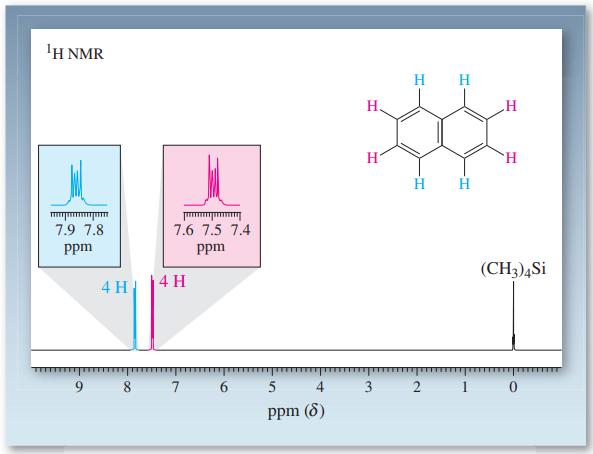
The 1H NMR spectrum of naphthalene shows two multiplets (Figure 15-16). The upfield absorption (δ = 7.49 ppm) is due to the hydrogens at C2, C3, C6, and C7, and the downfield multiplet (δ = 7.86 ppm) is due to the hydrogens at C1, C4, C5, and C8. Explain why one set of hydrogens is deshielded
The complete combustion of benzene is exothermic by approximately -789 kcal mol-1. What would this value be if benzene lacked aromatic stabilization?
Draw the structure of each of the following compounds. If the name itself is incorrect, give a correct systematic alternative. (a) o-Chlorobenzaldehyde; (b) 2,4,6-trihydroxybenzene; (c) 4-nitro-o-xylene; (d) m-isopropylbenzoic acid; (e) 4,5-dibromoaniline; (f)
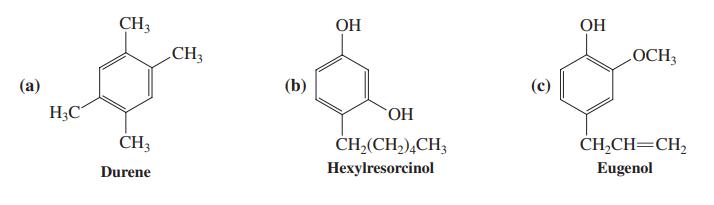
Give a proper IUPAC name for each of the following commonly named substances. CH3 OH OH CH3 LOCH3 (a) (b) (c) H;C HO, ČH3 ČH-(CH,),CH3 CH,CH=CH, Durene Hexylresorcinol Eugenol
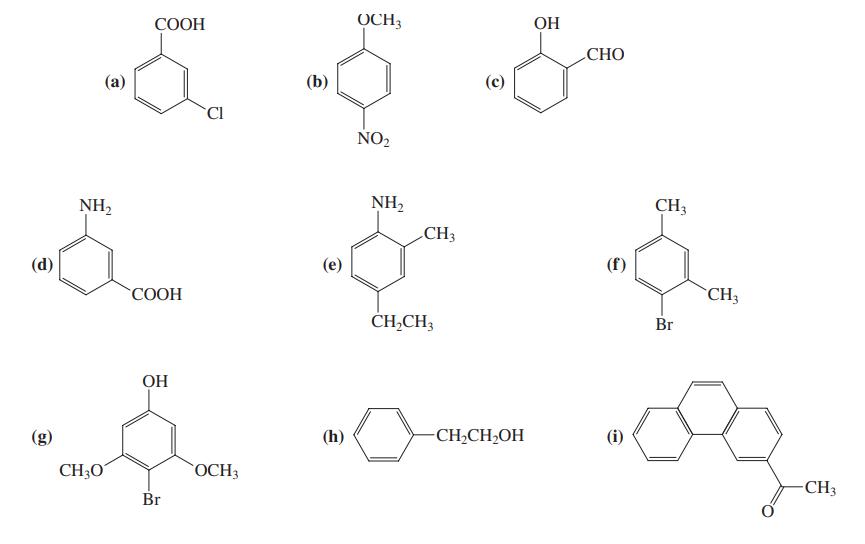
Name each of the following compounds by using the IUPAC system and, if possible, a reasonable common alternative. (The order of functional group precedence is – COOH >. – CHO > – OH> – NH2.)
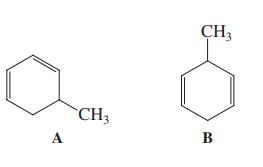
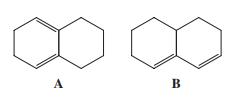
Which common analytical method will most clearly and rapidly distinguish A from B? (a) IR spectroscopy; (b) UV spectroscopy; (c) combustion analysis; (d) visible spectroscopy CH3 CH3 A B
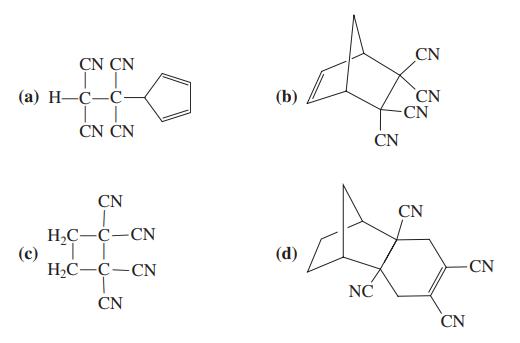
When cyclopentadiene is treated with tetracyanoethene, a new product results. Its most likely structure is CN CN CN (а) Н—С—С- CN CN (b) ČN ČN CN CN CN H,C-C-CN (с) H2C-C-CN (d) CN NC CN CN
Arrange the following three chlorides in decreasing order of SN1 reactivity. (a) A > B > C; (b) B > C > A; (c) B > A > C; (d) C > B > A. CH;CH,CH2CI H2C=CHCHCH3 CH;CH,CHCH3 ČI ČI A B C
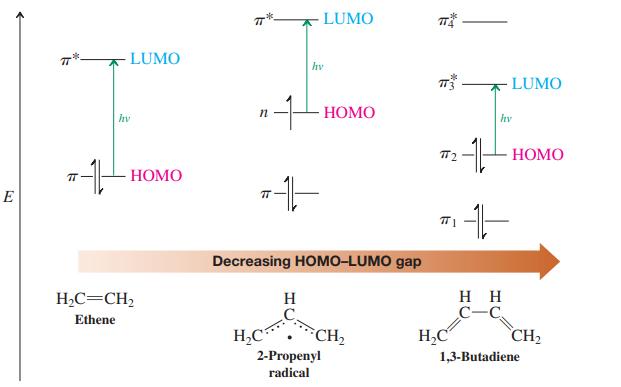
How many nodes are present in the LUMO (lowest unoccupied molecular orbital) of 1,3- butadiene? (a) Zero; (b) one; (c) two; (d) three; (e) four
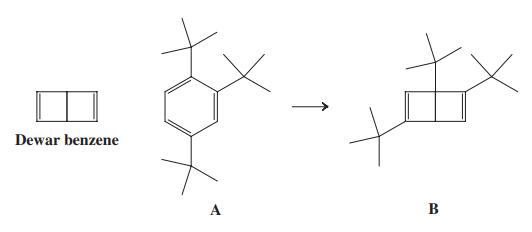
As a team, consider the following historic preparation of a tris(1,1-dimethylethyl) derivative of Dewar benzene, B, by the photochemical isomerisation of 1,2,4-tris(1,1-dimethylethyl)benzene by van Tamelen and Pappas (1962). B does not revert to A via either a thermal or a photochemical
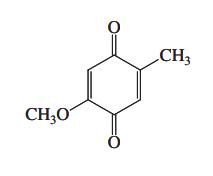
Diels-Alder cycloaddition of 1,3-butadiene with the cyclic dienophile shown in the margin takes place at only one of the two carbon – carbon double bonds in the latter to give a single product. Give its structure and explain your answer. Watch stereochemistry. This transformation was the initial
The ratio of 1,2- to 1,4-addition of Br2 to 1,3-butadiene is temperature dependent. Identify the kinetic and thermodynamic products, and explain your choices.
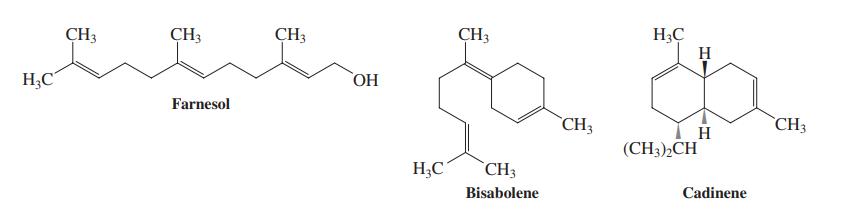
Farnesol is a molecule that makes flowers smell good (lilacs, for instance). Treatment with hot concentrated H2SO4 converts farnesol fi rst into bisabolene and finally into cadinene, a compound of the essential oils of junipers and cedars. Propose detailed mechanisms for these conversions.
In a published synthetic procedure, acetone is treated with ethenyl (vinyl) magnesium bromide, and the reaction mixture is then neutralized with strong aqueous acid. The product exhibits the 1H NMR spectrum shown below. What is its structure? When the reaction mixture is (improperly) allowed to
The ultraviolet spectrum of a 2×10⁻⁴ M solution of 3-penten-2-one exhibits a π→π* absorption at 224 nm with A = 1.95 and an n→π* band at 314 nm with A = 0.008. Calculate the molar absorptivities (extinction coefficients) for these bands.
Ethanol, methanol, and cyclohexane are commonly used solvents for UV spectroscopy because they do not absorb radiation of wavelength longer than 200 nm. Why not?
What is the longest-wavelength electronic transition in each of the following species? Use molecular-orbital designations such as n → π*, π1→π2, in your answer. (Prepare a molecular-orbital energy diagram, like that in Figure 14-16, for each.) (a) 2-Propenyl (allyl) cation; (b)
The carbocation derived from geranyl pyrophosphate is the biosynthetic precursor of not only camphor, but also limonene (Problem 68) and a-pinene (Chapter 4, Problem 46). Formulate mechanisms for the formation of the latter two compounds. Data From Problem 68Data From Problem 46 Chapter
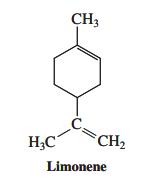
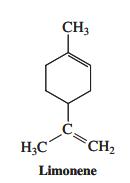
The structure of the terpene limonene is shown in the margin. Identify the two 2-methyl-1,3-butadiene (isoprene) units in limonene. (a) Treatment of isoprene with catalytic amounts of acid leads to a variety of oligomeric products, one of which is limonene. Devise a detailed mechanism for the
Give abbreviated structures of each of the following compounds: (a) (E)-1,4-poly-2-methyl-1,3- butadiene [(E)-1,4-polyisoprene]; (b) 1,2-poly-2-methyl-1,3-butadiene (1,2-polyisoprene); (c) 3,4- poly-2-methyl-1,3-butadiene (3,4-polyisoprene); (d) copolymer of 1,3-butadiene and
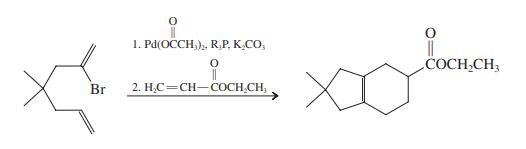
Explain the following reaction sequence. 1. Pd(OCCH,), R,P, K.CO, COCH,CH; Br 2. H,C=CH-COCH.CH,
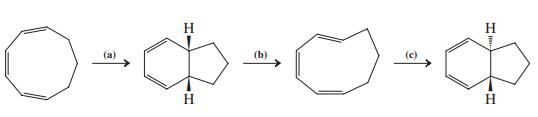
Which of the reactions shown below will occur under the influence of heat? Light? (a) (b) (c) H H
Formulate the expected product of each of the following reactions. H;CO. H,C CH3 hv hv (а) (b) (с) (d) D CH3 H H;C H. CH;Ó
Bicyclic diene A reacts readily with appropriate alkenes by the Diels-Alder reaction, whereas diene B is totally unreactive. Explain. A B
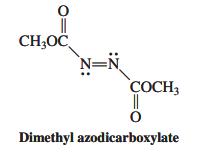
Dimethyl azodicarboxylate (see margin) takes part in the Diels-Alder reaction as a dienophile. Write the structure of the product of cycloaddition of this molecule with each of the following dienes. (a) 1,3-Butadiene; (b) trans,trans-2,4-hexadiene; (c)
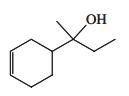
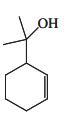
Propose an efficient synthesis of the cyclohexenol in the margin, beginning exclusively with acyclic starting materials and employing sound retrosynthetic analysis strategy. OH
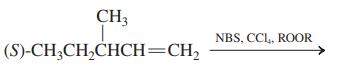
Give the product(s) of each of the following reactions. (a) 3-Chloro-1-propene (allyl chloride) + NaOCH3 (b) cis-2-Butene + NBS, peroxide (ROOR) (c) 3-Bromo-1-cyclopentene + LDA (d) trans,trans-2,4-Hexadiene + HCl (e) trans,trans-2,4-Hexadiene + Br2, H2O (f)
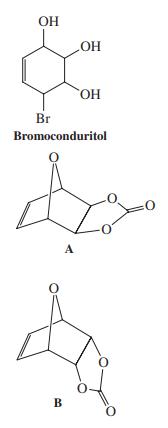
The haloconduritols are members of a class of compounds called glycosidase inhibitors. These substances possess an array of intriguing biological activity, from antidiabetic and antifungal to activity against HIV virus and cancer metastasis. Stereoisomeric mixtures of bromoconduritol (margin) are
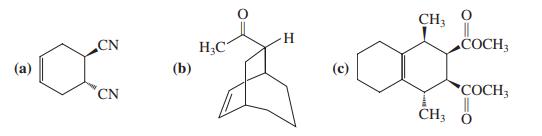
Propose a synthesis of each of the following molecules by Diels-Alder reactions. CH3 COCH3 H;C (b) CN (а) (с) СОСH CH3 Ö CN
Give the structures of all possible products of the acid-catalyzed dehydration of vitamin A. OH HO НО Br Bromoconduritol A В
Dienes may be prepared by elimination reactions of substituted allylic compounds. For example, Propose detailed mechanisms for each of these 2-methyl-1,3-butadiene (isoprene) syntheses. CH3 CH3 CH3 Catalytic H;SO., A LDA, THF H;C-C=CH-CH,OH → H,C=C-CH=CH, H;C-C=CH-CH,CI
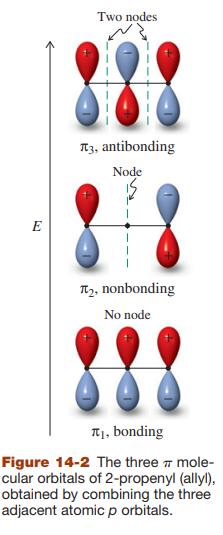
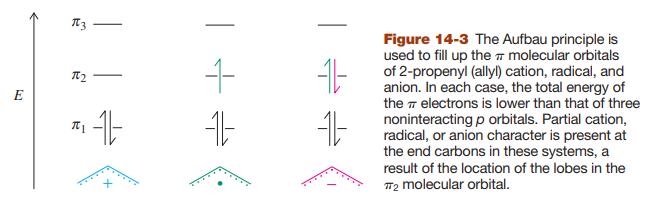
Sketch the molecular orbitals for the pentadienyl system in order of ascending energy (see Figures 14-2 and 14-7). Indicate how many electrons are present, and in which orbitals, for (a) the radical; (b) the cation; (c) the anion (see Figures 14-3 and 14-7). Draw all reasonable resonance forms for
Arrange the following carbocations in order of decreasing stability. Draw all possible resonance forms for each of them. (a) CH2=CH–CH2 (b) СH— СH (c) CH3CH2 (d) CH, —СH—CH-CH—CH, (e) CH,=CH-CH=CH-CH2
Give the products expected from reaction of deuterium iodide (DI) with (a) 1,3-cycloheptadiene; (b) trans-1,3-pentadiene; (c) 2-methyl-1,3-pentadiene. In what way does the observable result of reaction of DI differ from that of reaction of HI with these same substrates [compare with Problems 49(a),
Write a detailed step-by-step mechanism to show how each of the products arises from the reactions in Problem 51,. Data From Problem 51What are the products of reaction of 2-methyl-1,3-pentadiene with each of the reagents (a) HI; (b) Br2 in H2O; (c) IN3; (d) H2SO4 in CH3CH2OH.
What are the products of reaction of 2-methyl-1,3-pentadiene with each of the reagents in Problem 49? Data From Problem 49What products would you expect from the electrophilic addition of each of the following reagents to 1,3-cycloheptadiene? (a) HI; (b) Br2 in H2O; (c) IN3; (d) H2SO4 in CH3CH2OH.
Give the products of the reaction of trans-1,3-pentadiene with each of the reagents in Problem 49. Data From Problem 49What products would you expect from the electrophilic addition of each of the following reagents to 1,3-cycloheptadiene? (a) HI; (b) Br2 in H2O; (c) IN3; (d) H2SO4 in CH3CH2OH.
What products would you expect from the electrophilic addition of each of the following reagents to 1,3-cycloheptadiene? (a) HI; (b) Br2 in H2O; (c) IN3; (d) H2SO4 in CH3CH2OH.
Compare the addition of H1 to 1,3-pentadiene and 1,4-pentadiene (see Problem 46). Draw the structures of the products. Draw a qualitative reaction profile showing both dienes and both proton addition products on the same graph. Which diene adds the proton faster? Which one gives the more stable
Electrophilic additions to conjugated dienes at low reaction temperatures give kinetic product ratios. Furthermore, these kinetic mixtures may change to mixtures with thermodynamic product ratios when the temperature is raised. Do you think that cooling the thermodynamic product mixture back to the
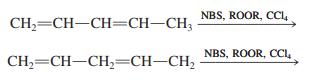
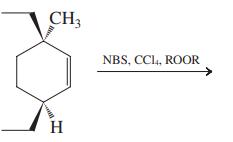
Compare the allylic bromination reactions of 1,3-pentadiene and 1,4-pentadiene. Which should be faster? Which is more energetically favorable? How do the product mixtures compare? NBS, ROOR, CCI CH,=CH-CH=CH-CH3 NBS, ROOR, CCI4 CH,=CH-CH,=CH-CH,
Give a systematic name to each of the following molecules. Br. (а) (b) (d) (с) Br
Starting with cyclohexene, propose a reasonable synthesis of the cyclohexene derivative shown in the margin. OH
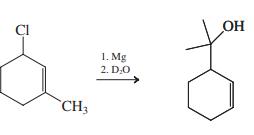
The following reaction sequence gives rise to two isomeric products. What are they? Explain the mechanism of their formation. OH 1. Mg 2. D.O `CH3
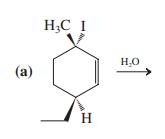
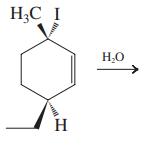
Write a detailed step-by-step mechanism to show how each of the products arises from the reaction in Problem 41, part (a). Data From Problem 41, part (a) H;C I (а) H
Give the major product(s) of each of the following reactions. (a)(b)(c)(d)(e)(f) H;C I HO H
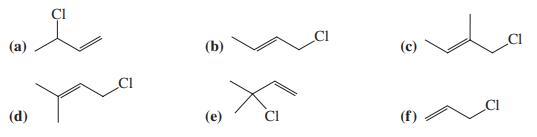
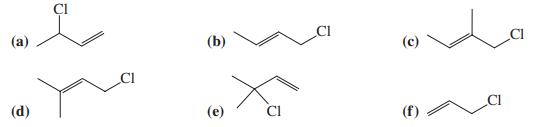
How would you expect the SN2 reactivities of simple saturated primary, secondary, and tertiary chloroalkanes to compare with the SN2 reactivities of the compounds in Problem 39? Make the same comparison for SN1 reactivities. Data from problem 39 (а) (b) (d) (е) (f)
Rank the following six molecules in approximate order of decreasing SN1 reactivity and decreasing SN2 reactivity. (а) (b) CI (d) CI (f)
Rank the following six molecules in approximate order of decreasing SN1 reactivity and decreasing SN2 reactivity. (а) (b) CI (d) CI (f)
Rank primary, secondary, tertiary, and (primary) allylic chlorides in approximate order of (a) decreasing SN1 reactivity; (b) decreasing SN2 reactivity
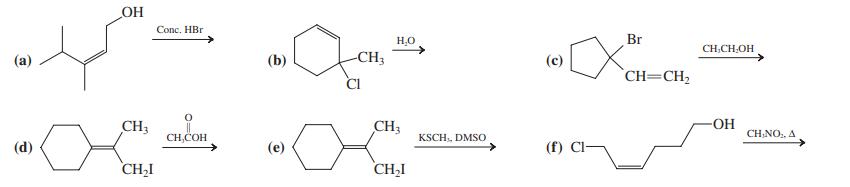
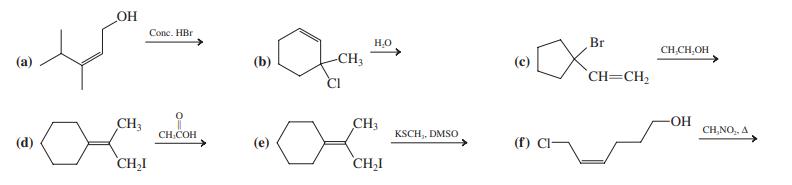
Formulate detailed mechanisms for the reactions in Problem 5 (a, c, e, f ). Data From Problem 5 OH Conc. HBr H,O Br CH,CH,OH (b) -CH3 (c) `CH=CH, CH3 CH3 OH CH,NO, A CH,COH KSCH, DMSO (d) (e) (f) Cl- CH,I CH;I
Give the major product(s) of each of the following reactions. OH Conc. HBr H.O Br CH,CH,OH (a) (b) -CH3 (c) CH=CH, CI CH3 CH3 O- CH,COH KSCH,, DMSO CH,NO,, A (d) (e) (f) Cl- CH,I CH,I
Rank primary, secondary, tertiary, and allylic radicals in order of decreasing stability. Do the same for the corresponding carbocations. Do the results indicate something about the relative ability of hyperconjugation and resonance to stabilize radical and cationic centers?
Illustrate by means of appropriate structures (including all relevant resonance forms) the initial species formed by (a) breaking the weakest C – H bond in 1-butene; (b) treating 4-methylcyclohexene with a powerful base (e.g., butyllithium – TMEDA); (c) heating a solution of
For each species in Problem 32, indicate the resonance form that is the major contributor to the resonance hybrid. Explain your choices. Data From Problem 32 CH3 (а) (b) (с) (d)
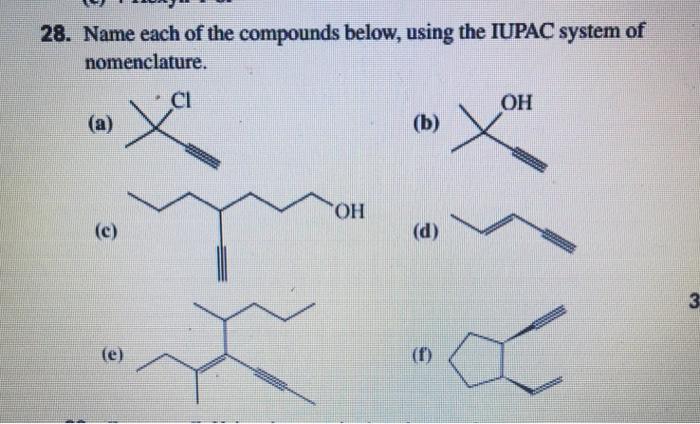
Name each of the compounds below, using the IUPAC system of nomenclature. 28. Name each of the compounds below, using the IUPAC system of nomenclature. CI OH (a) (b) HO. (c) (d) 3 (e) (f)
Draw all resonance forms and a representation of the appropriate resonance hybrid for each of the following species. CH3 (а) (b) (с) (d) (е)
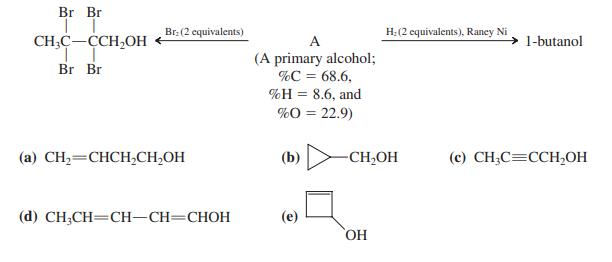
From the choices shown below, pick the one that best describes the structure of compound A. Br Br Br. (2 equivalents) H:(2 equivalents), Raney Ni CH;C-CCH,OH A 1-butanol (A primary alcohol; %C = 68.6. 9Н 3D 8.6, and %O = 22.9) Br Br (a) CH,=CHCH,CH,OH (b) -CH,OH (c) CH;C=CCH,OH (d)
From the choices shown below, pick the one that best describes the structure of compound A. Br Br Br. (2 equivalents) H:(2 equivalents), Raney Ni CH;C-CCH,OH A 1-butanol (A primary alcohol; %C = 68.6. 9Н 3D 8.6, and %O = 22.9) Br Br (a) CH,=CHCH,CH,OH (b) -CH,OH (c) CH;C=CCH,OH (d)
From the choices shown below, pick the one that best describes the structure of compound A. Br Br Br. (2 equivalents) H:(2 equivalents), Raney Ni CH;C-CCH,OH A 1-butanol (A primary alcohol; %C = 68.6. 9Н 3D 8.6, and %O = 22.9) Br Br (a) CH,=CHCH,CH,OH (b) -CH,OH (c) CH;C=CCH,OH (d)
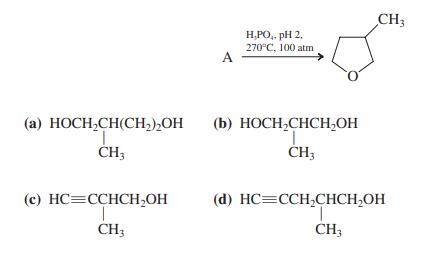
From the choices shown below, pick the one that best describes the structure of compound A. CH3 H,PO,. pH 2, 270°C, 100 atm A (a) HOCH,CH(CH),OH (b) HOCH,CHCH,OH CH3 (c) HC=CCHCH,OH (d) HC=CCH,CHCH,OH 1. CH3 CH3
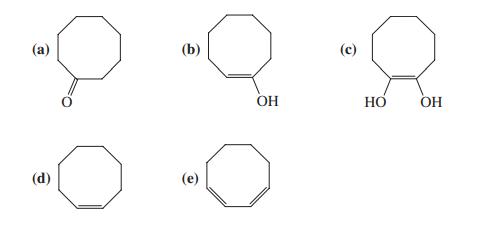
When cyclooctyne is treated with dilute, aqueous sulfuric acid and HgSO4, a new compound results. It is best represented as (а) (b) (с) OH OH (d)
A nucleophile made by deprotonation of propyne is (a) :CH,CH;; (b) :HC=CH;; (c) :C=CH; (d) :C=CCH; (e) :HC=CHCH3.
The compound whose structure is H – C ≡ C(CH2)3Cl is best named (IUPAC)(a) 4-chloro-1-pentyne; (b) 5-chloropent-1-yne; (c) 4-pentyne-1-chloroyne; (d) 1-chloropent-4-yne.
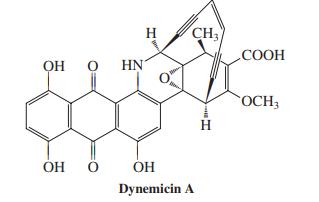
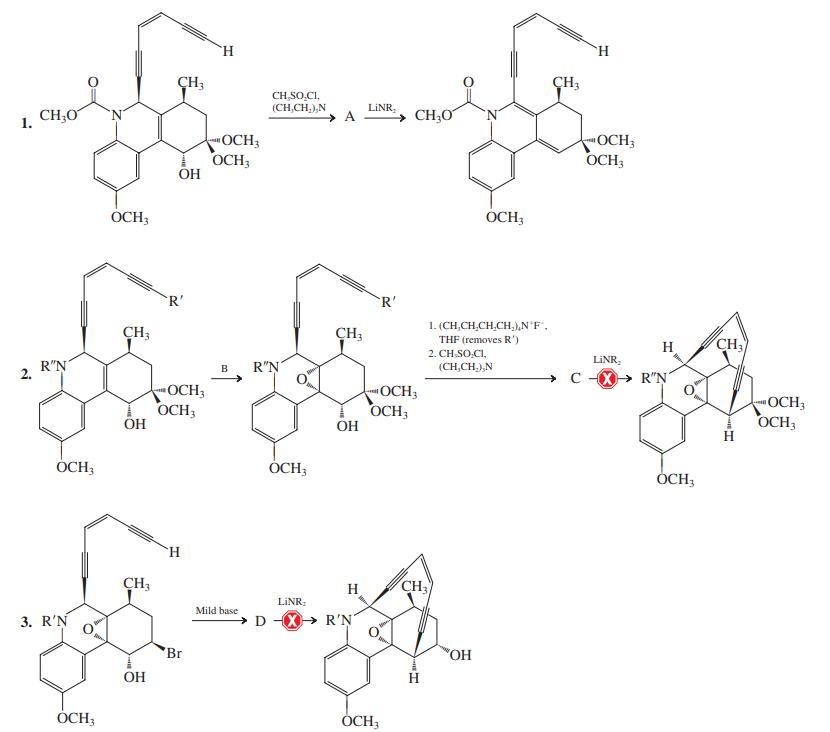
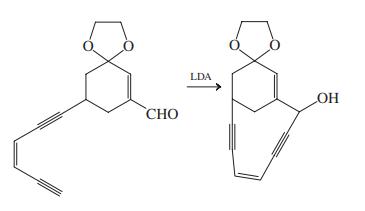
Your team is studying the problem of an intramolecular ring closure of enediyne systems important in the total synthesis of dynemicin A, which exhibits potent antitumor activity. One research group tried the following approaches to effect this process. Unfortunately, all were unsuccessful.
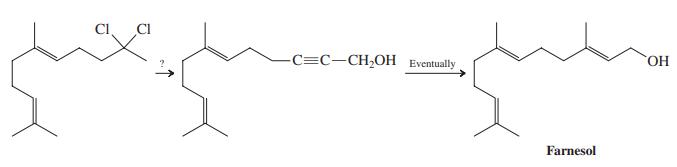
A synthesis of the sesquiterpene farnesol requires the conversion of a dichloro compound into an alkynol, as shown below. Suggest a way of achieving this transformation. CI. CI -C=C-CH;OH Eventually HO, Farnesol
Formulate a plausible mechanism for the hydration of ethyne in the presence of mercuric chloride. ΙΗ ΝMR 3 H IH 1H 1 H (CH3)4Si 6.0 5.5 5.0 4.5 4.0 3.5 3.0 2.5 2.0 1.5 1.0 0.5 0.0 300-MHz 'H NMR spectrum ppm (8)
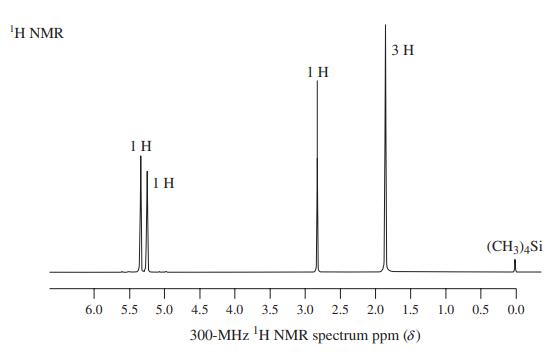
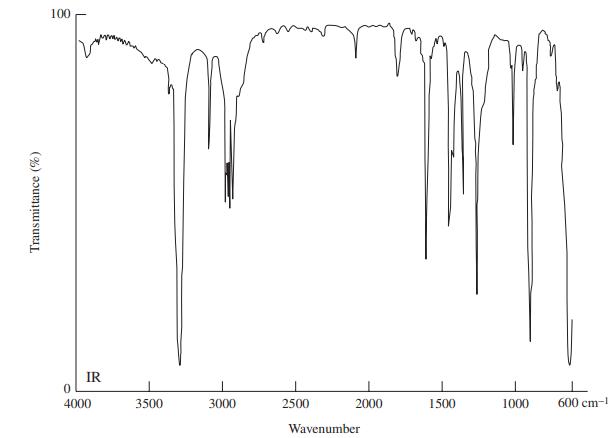
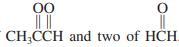
An unknown molecule displays 1H NMR and IR spectra D (next page). Reaction with H2 in the presence of the Lindlar catalyst gives a compound that, after ozonolysis and treatment with Zn in aqueous acid, gives rise to one equivalent of What was the structure of the original molecule? 00 CH;CCH
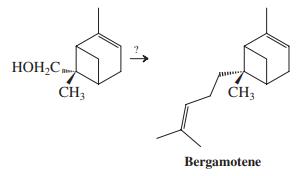
Synthesis of the sesquiterpene bergamotene proceeds from the alcohol shown here. Suggest a sequence to complete the synthesis. HOH,C CH3 CH3 Bergamotene
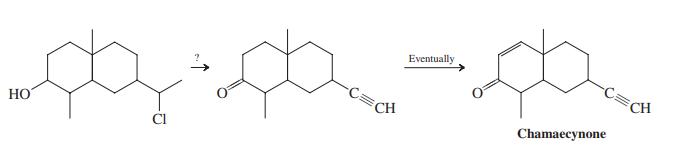
The synthesis of chamaecynone, the essential oil of the Benihi tree, requires the conversion of a chloroalcohol into an alkynyl ketone. Propose a synthetic strategy to accomplish this task. Eventually CH CH HO Chamaecynone CI
Showing 800 - 900
of 2904
First
2
3
4
5
6
7
8
9
10
11
12
13
14
15
16
Last
Step by Step Answers

 Get 50% OFF
Claim Now
Get 50% OFF
Claim Now


![H H 1,6-Methano[10]annulene](https://dsd5zvtm8ll6.cloudfront.net/si.question.images/images/question_images/1589/9/5/2/9965ec4c1e4dfc261589952993368.jpg)