New Semester
Started
Get
50% OFF
Study Help!
--h --m --s
Claim Now
Question Answers
Textbooks
Find textbooks, questions and answers
Oops, something went wrong!
Change your search query and then try again
S
Books
FREE
Study Help
Expert Questions
Accounting
General Management
Mathematics
Finance
Organizational Behaviour
Law
Physics
Operating System
Management Leadership
Sociology
Programming
Marketing
Database
Computer Network
Economics
Textbooks Solutions
Accounting
Managerial Accounting
Management Leadership
Cost Accounting
Statistics
Business Law
Corporate Finance
Finance
Economics
Auditing
Tutors
Online Tutors
Find a Tutor
Hire a Tutor
Become a Tutor
AI Tutor
AI Study Planner
NEW
Sell Books
Search
Search
Sign In
Register
study help
engineering
chemical engineering
Process Dynamics And Control 2nd Edition Dale E. Seborg, Thomas F. Edgar, Duncan A. Mellich - Solutions
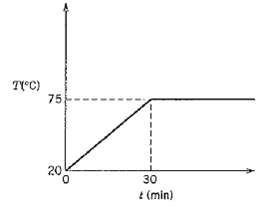
The start-up procedure for a batch reactor includes a heating step where the reactor temperature is gradually heated to the nominal operating temperature of 75oC. The desired temperature profile T(t) is shown in Fig.13.5, What is T(s)?
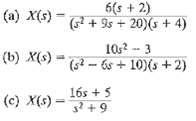
Using partial fraction expansion where required, find x(t) for
Expand each of the following s-domain functions into partial tractions:
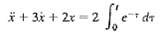
(a) For the integro-differential equation find x(t). Note that x = dx/dt, ec. (b) What is the value of x(t) as t ? ??
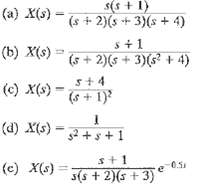
For each of the following functions X(s), what can you say about x(t) (0
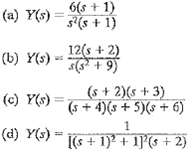
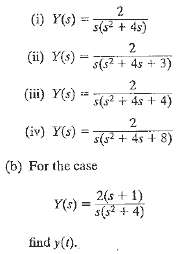
(a) For each of the following cases, determine what functions of time, e.g., constant, e?8t, will appear in y(t). (Note that you do not have to find (t)1) Which y(t) are oscillatory? Which exhibit a constant value of y(t) for large values of t?
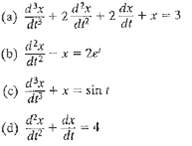
Which solutions of the following equations will exhibit convergent behavior? Which are oscillatory? All of the above differential equations have one common factor in their characteristic equations.
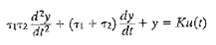
The differential equation model for a particular chemical process has been found by testing to be as follows: where ?1 and ?2 are constant parameters and u(t) is the input function of time. What are the functions of time (e.g., e?1) in the solution for each output y(t) for the following cases?
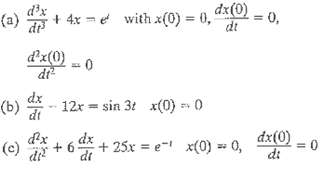
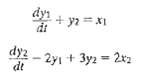
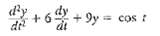
Find the complete time-domain solutions for the following differential equations using Laplace transforms: (d) A process is described by two differential equations If x1 = e?t and x2 = 0, what can you say about the form of the solution for y1? for y2?
The dynamic model between an output variable y and an input variable u can be expressed by (a) Will this system exhibit an oscillatory response after an arbitrary change in u? (b) What is the steady-state gain? (c) For a step change in u of magnitude 1.5, what is y(t)?
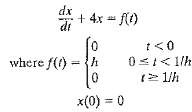
Find the solution of Plot the solution for values of h = 1, 10, 100, and the limiting solution (h ? ?) from t = 0 to t = 2. Put all plots on the same graph.
(a) The differential equation Has initial conditions x(0) = 1, x?(0) = 2. Find Y(s) and, without finding y(t), determine what functions of time will appear in the solution.
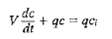
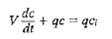
A stirred-tank blending system initially is full of water and is being fed pure water at a constant flow rate, q. At a particular time, an operator adds caustic solution at the same volumetric how rate q but concentration c1. If the liquid volume V is constant, the dynamic model for this process
A process is perturbed by a sinusoidally varying input, u(t), whose amplitude is A and whose frequency is w. The resulting process output relation is given by (a) What must have been the differential equation representing the process? The initial condition (b) Find y(t). (c) Plot the input
Determine which ?short statement(s)? are correct: (a) A transfer function can be used to provide information about how a process will respond to a single input. For a particular input change, it provides: (i) Only steady-state information about the resulting output change. (ii) Only dynamic
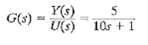
Consider the following transfer function: (a) What is the steady-slate gain? (b) What is the time constant? (c) If U(s) = 2/s, what is the value of the output y(t) when t ? ?? (d) For the same U(s), what is the value of the output when t = 10? What is the output when expressed as a fraction of
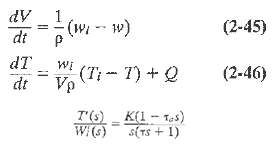
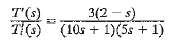
I.M. Appelpolscher has asked you to investigate the dynamic operating characteristics of a stirred-tank heater with variable holdup of the type described by Eqs. 2-45 and 2-46. He is convinced that changes in the inlet flow rate wi will affect the outlet temperature T according to a transfer
A process output is given by the following expression Because we know that the Laplace transform of the output can express the product of the process transfer function and the Laplace transform of the input, give all possible combinations of G(s) and U(s) that yield the above Y(s) and interpret
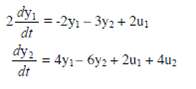
For the process modeled by Find the four transfer functions relating the outputs (y1, y2) to the inputs (u1, u2). The u and y arc deviation variables.
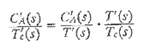
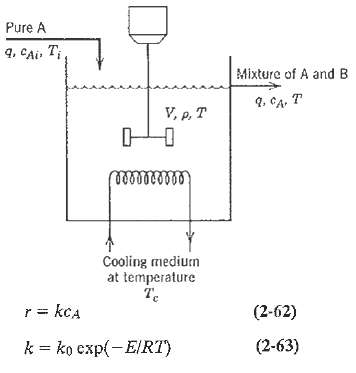
A single irreversible chemical reaction, A ? B, takes place in a non-isothermal continuous stirred-tank reactor (CSTR), as shown in figure 2.6. The reaction rate expression is given by Eqs. (2-62) and (2-63). 11 is desired to derive the transfer function between reactor concentration CA and coolant
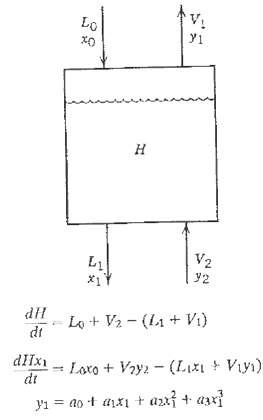
A single equilibrium stage in a distillation column is shown in Figure. The model that describes this stage is (a) Assuming that the molar holdup H in the stage is constant and that equimolat overflow holds?for a mole of vapor that condenses, one mole of liquid is vaporized?simplify the model as
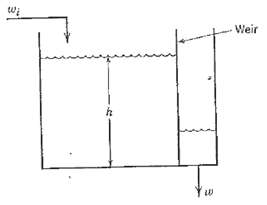
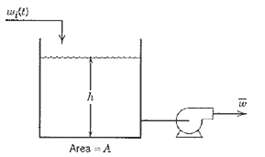
A surge tank in Figure is designed with a slotted weir so that the outflow rate, w, is proportional to the liquid level to the 1.5 power that is, w = Rh1.5 where R is a constant. If a single stream enters the tank with flow rate w, find the transfer function W(s)|W|(s). Identify the gain and all
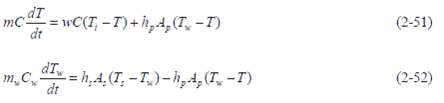
For the steam-heated stirred-tank system modeled by Eqs 2-51 and 2-52, assume that the steam temperature Ts is constant. (a) Find a transfer function relating tank temperature T to inlet Liquid temperature Ti. (b) What is the steady-state gain for this choice of input and output? (c) Based on
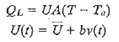
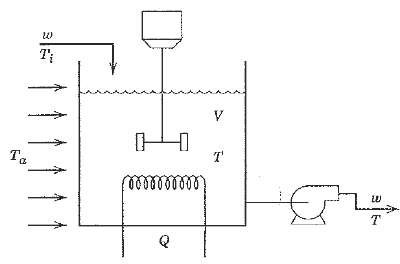
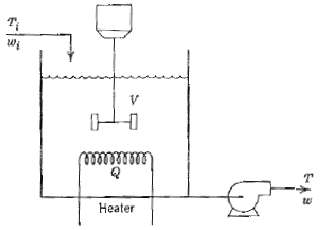
The contents of the stirred-tank heating system shown In figure are heated at a constant rate of Q(Btu/h) using a gas-fired heater. The flow rate w(lb/h) and volume V(ft3) are constant, but the heat loss to the surroundings QL(Btu/h) varies with the wind velocity v (ft/s) according to the
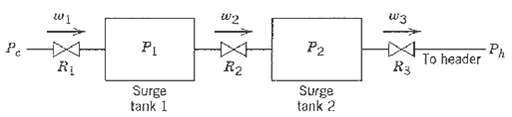
Consider a pressure surge system to reduce the effect of pressure variations at a compressor outlet on the pressure in a compressed gas header. We want to develop a two-tank model and evaluate the form of the resulting transfer function for the two-tank process shown in figure. (a) Develop a
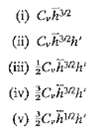
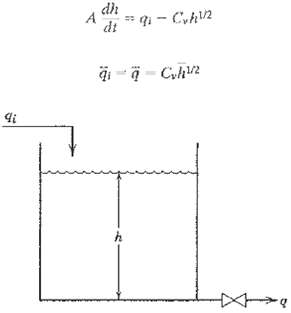
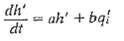
A simple surge tank with fixed valve on the outflow Line is illustrated in figure. If the outflow rate is proportional to the square root of the liquid height, an unsteady-state model for the level in the tank is given by as usual, you can assume that the process initially is at steady state (a)
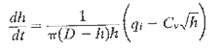
Liquid flow out of a spherical tank discharging through a valve can be described approximately by the following nonlinear differential equation: where the variables used arc consistent with other liquid level models we have developed. (a) Derive a linearized model (in deviation variables) of the
An exothermic reaction, A ? 213, takes place adiabatically in a stirred-tank reactor. This liquid reaction occurs at constant volume in a 1000-gal reactor. The reaction can be considered to he first order and irreversible with the rate constant given by k = 2.4 x 10¹⁵e-20.000/T?(min?1) where T is
In Example 4.4, a two-tank system is presented. Using state-space notation, determine the matrices A, B, C, and E, assuming the level deviations h1 and h2 are the state variables, the input variable is q1, and the output variable Is the flow rate deviation, q2.
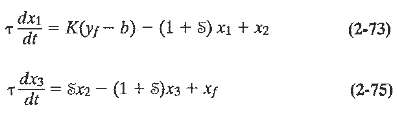
The staged system model for a three-stage absorber is presented in Eqs. (2?73)?(2?75), which are in state space form. A numerical example of the absorber model suggested by Wong and Luus2 has the following parameters: H = 75.72 lb, L = 40.8 lb/min, G = 66.7 lb/min, a = 0.72 and b = 00. Using the
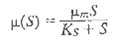
A chemostat is a continuous stirred tank bioreactor that can carry out fermentation of a plant cell culture. Its dynamic behavior can be described by the following equations: X = ?(S)X ? DX S = ? ?(S) X/Y X/S?? D (Sf?? S) X and S are the cell and substrate concentrations, respectively, and Sf is
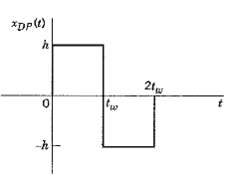
In addition to the standard inputs discussed in Section 5.1, other input functions occasionally are useful for special purposes. One, the so-called doublet pulse, is shown in figure. (a) Find the Laplace transform of this function by first expressing it as a composite of functions whose transforms
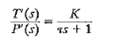
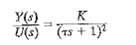
A heated process is used to heat a semiconductor wafer operates with first-order dynamics, that is, the where K has units [?C/Kw] and ? has units [minutes]. The process is at steady state when an engineer changes the power input stepwise from 1 to 1.5 Kw. She notes the following: (i) The process
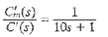
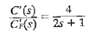
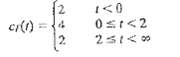
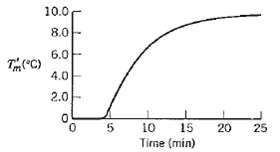
A composition sensor is used to continually monitor the contaminant level in a liquid stream. The dynamic behavior of the sensor can be described by a first-order transfer function with a time constant of 10s, where C? is the actual contaminant concentration and C?m is the measured value. Both
The dynamic response of a stirred-tank bioreactor can be represented by the transfer function where C is the exit substrate concentration, mol/L and Cf is the feed substrate concentration, mol/L. (a) Derive an expression for c?(t) if cP(t) is a rectangular pulse (figure) with the following
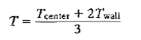
A thermocouple has the following characteristics when it is immersed in a stirred bath: Mass of thermocouple – 1g. Heat capacity of thermocouple = 0.25 cal/g °C I-feat transfer coefficient = 20 cat/cm2 h °C (for thermocouple and bath) Surface area of thermocouple = 3 cm2(a) Derive a transfer
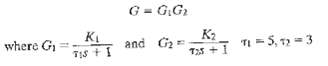
The overall transfer function of a process is given by(a) What is the overall gain of 0?(b) For a first-order system, the time constant is the time for a step change M when y reaches 63.2% of the steady state. Is the equivalent time constant for the step response of the second-order system G (time
Appelpolscher has just left a meeting with Stella J. Smarly, IGC?s vice-president for Process Operations and Development. Smarly is concerned about an upcoming extended plant test of a method intended to improve the yields of a large packed-bed reactor. The basic idea, which came front IGC?s
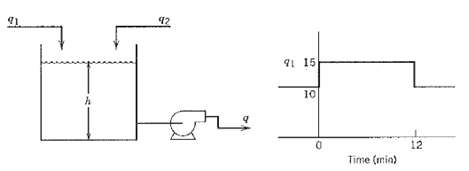
A liquid storage system is shown below. The normal operating conditions are q1 = 10 ft3/min, q2 = 5 ft3/min, h = 4 ft. The tank is 6 ft in diameter, and the density of each stream is 60lb/ft. Suppose that a pulse change in q1 occurs as shown in figure. (a) What is the transfer function relating H?
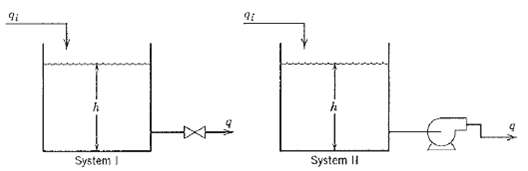
Two liquid storage systems are shown in figure. Each tank is 4 feet in diameter. For System 1, the valve acts as a linear resistance with the flow?head relation q = 8.33 h, where q is in gallium and ii is in feet. For System II, variations in liquid level h do not affect exit flow rate q. Suppose
The dynamic behavior of the liquid Level in each leg of a manometer tube, responding to a change in pressure, is given by where h?(t) is the level of fluid measured with respect to the initial steady-state value, p?(t) is the pressure change, and R, L, q, p, and ? are constants. (a) Rearrange
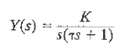
A process is described by the following transfer functionThus, it exhibits characteristics of both first-order and integrating processes. How could you utilize a step change in the input of magnitude M to find quickly the two parameters K and ?? (Be sure to show all work and sketch the anticipated
For the equation (a) Find the transfer function and put it in standard gain/time constant form. (b) Discuss the qualitative form of the response of this system (independent of the input forcing) over the range, ? 10 K 10. Specify values of K where the response will converge and where it will
A second-order critically damped process has the transfer function(a) For a step change in Input of magnitude M, what is the time (tS) required for such a process to settle to within 5% of the total change in the output?(b) For K = 1 and a ramp change in input, u(t) = at, by what time period does
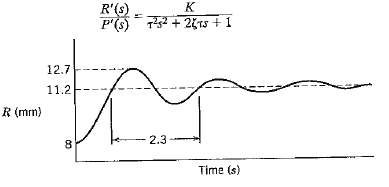
A step change from 15 to 31 psi in actual pressure results in the measured response from a pressure-indicating element shown in Figure. (a) Assuming second-order dynamics calculate all important parameters and write an approximate transfer function in the form, where R? is the instrument output
An electrically heated process is known to exhibit second-order dynamics with the following parameter values K is 3 °C/kW, τ = 3 mm, ε = 0.7. If the process initially is at steady state at 70 °C with heater input of 20 kW and the heater input is suddenly changed to 26 kV and held there:(a) What
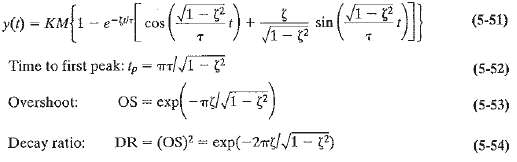
Starting with Eq. 5.51, derive expressions for the following response characteristics of the underdamped second-order system.(a) The time to first peak t (Eq. 5-52).(b) The fraction overshoot (Eq. 5-53).(c) The decay ratio (Eq. 5.54).(d) The settling time (ts, defined in Fig. 5.10). Can a single
A tank used to dampen liquid flow rate surges is known to exhibit second-order dynamics. The input flow rate changes suddenly from 120 to 140gal/min. An operator notes that the tank level changes as follows:Before input change: level = 6 ft and steadyFour minutes later: level = 11ftForty minutes
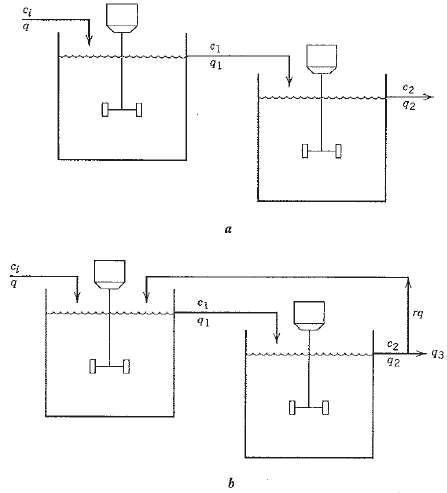
Two constant-volume stirred tanks, connected in series (see Figure a), are fed by a single stream with constant volumetric flow rate, q. The feed composition, c1 (mass/volume of a catalyst species), can vary with lime. Density is constant. (a) Develop a dynamic model for this process that can be
A surge tank system is to be installed as part of a pilot plant facility. The initial proposal calls for the configuration shown in figure. 4.3. Each tank is 5 ft high and 3 ft in diameter. The design flow rate is q1 = 100gal/mm. It has been suggested that an improved design will result if the two
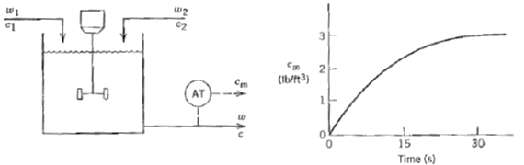
The caustic concentration of the mixing tank shown in figure is measured using a conductivity cell. The total volume of solution in the tank is constant at 7 ft3 and the density (? = 70 lb/ft3) can be considered to be independent of concentration, Let cm denote the caustic concentration measured by
Au exothermic reaction, A → 2B, takes place adiabatically in a stirred-tank system. This liquid phase reaction occurs at constant volume in a 100-gal reactor. The reaction can be considered to be first order and irreversible with the rate constant given by k = 2.4 X 10¹⁵e–20,000/T (min–1)
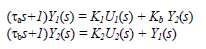
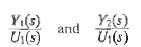
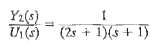
A process has been modeled and Laplace transformed to obtain the following two equations:where the outputs are Y1 and Y2, and the inputs are U1 and U2.(a) Find the transfer functions(b) What is the gain of each transfer function? (You may develop these analytically or use the Final Value
Consider the transfer function:(a) Plot its poles and zeros in the complex plane. A computer program that calculates (he roots of the polynomial (such as the command roots in MATLAB) can help you factor the denominator polynomial.(b) From the pole locations in the complex plane, what can be
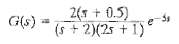
The following transfer function is not written in a standard form (a) Put ii in standard gain/time constant form. (b) Determine the gain, poles and zeros. (c) If the time-delay term is replaced by a 1/1 Pade approximation, repeat part(b)
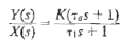
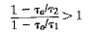
For a lead-lag unit show that for a step input of magnitude M: (a) The value of y at t = 0+ is given by y(0+) = KM?0/?1. (b) Overshoot occurs only for > rj, in which case dy/dr? (c) Inverse response occurs only for ?a
A second-order system has a single zero: For a step input, show that: (a) y(t) can exhibit an extremum (maximum or minimum value) in the step response only if (b) Overshoot occurs only for ?0/?1. (c) Inverse response occurs only for ?a (d) If an extremum in y exists, the time at which it occurs
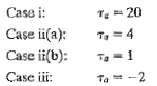
A process has the transfer function of Eq. 6-14 with K = 2, ?1 = 10, ?2 = 2. If ?a has the following value:Calculate the responses for a step input of magnitude 0.5 and plot them in a single figure. What conclusions can you make concerning the effect of the zero location? Is the location of the
A process consists of an integrating element operating in parallel with a first-order element (Figure).(a) What is the order of the overall transfer function, G(s) = V(s)/U(s)?(b) What is the gain of G(s)? Under what condition(s) is the process gain negative?(c) What are the poles of G(s)? Where
A pressure-measuring device has been analyzed and can be described by a model with the structure shown in figure a. In other words1 the device responds to pressure changes as if it were a first-order process in parallel with a second order process. Preliminary tests have shown that the gain of the
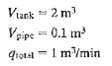
A blending tank that provides nearly perfect mixing is connected to a downstream unit by a Long transfer pipe. The blending tank operates dynamically like a first-order process. The mixing characteristics of the transfer pipe, on the other hand, are somewhere between plug flow (no mixing) and
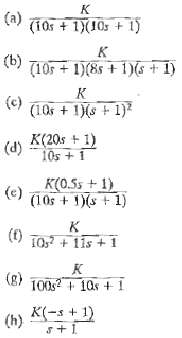
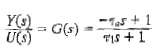
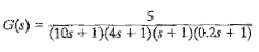
By inspection determine which of the following process models can be approximated reasonably accurately by a first-order-plus-time-delay model. For each acceptable case, give your best estimate of ? and ?.For each case that cannot be approximated by simple inspection, find a first-order-plus-
A process consists of five perfectly stirred tanks in Series. The volume in each tank is 30 L, and the volumetric flow rate through the system is 5 L/min. At some particular time, the inlet concentration of a nonreacting species is changed from 0.60 to 0.45 (mass fraction) and held there.(a) Write
A process is characterized approximately by the transfer function(a) If its input u changes linearly, that is, u(t) = EtHow much would the response y(t) appear to lag the input u(t) fort >> ?1?(b) How is this result different from the situation corresponding to a left1talf plane zero?(c)
For the process described by the exact transfer function(a) Find an approximate transfer function of second-order-plus-time-delay form that describes this process.(b) Using Simulink, plot the response y(t) of both the approximate model and the exact model on the same graph for a unit step change in
Find the transfer functions P’1(s) / P’a) and P’2(s) / P’a(s) for the compressor-surge tank system of Exercise 2.5 when it is operated isothermally. Put the results in standard (gain/time constant) form. For the second- order model, determine whether the system is over damped or underdamped.
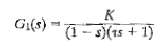
A process is described by the transfer function (a) Calculate and plot response y(t) to a step change in input u(r) of magnitude M when M = 2, K = 3, and ? = 3. (b) What would be the step response if the process also included a time-delay, that is, G2(s) = Ke?2s?/ (1 ? s) (?s + 1). (c) If a
Show that the liquid-level system consisting of two interacting tanks (Figure) exhibits overdamped dynamics; that is, show that the damping coefficient in Eq. 6-72 is larger thanone.
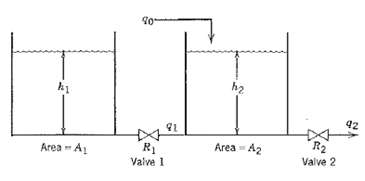
An open liquid surge system (p = constant) is designed with a side tank that normally is isolated from the flowing material as shown in figure. (a) In normal operation, Valve 1 is closed (R1 ? ?) and q1 = 0. What is the transfer function relating change in q0 to changes in outflow rate q2 under
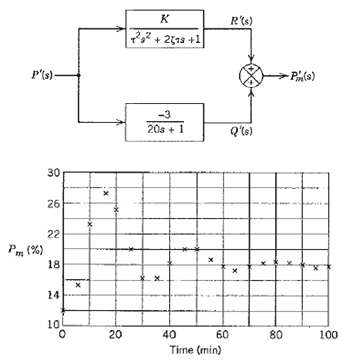
The dynamic behavior of a packed-bed reactor can be approximated by a transfer function model where T1 is the inlet temperature, T is the outlet temperature (?C), and the time constants are in hours. The inlet temperature varies in a cyclic fashion due to the changes in ambient temperature from
Appelpolscher and Arrhenius Quirk, head of IGC?s Chemical Kinetics and Reactor Design Group) are engaged in a dispute concerning the model developed earlier for the inadequately agitated reactor (Exercise 2.7). Quirk, who really likes to beat Appelpolscher at his own game, is attempting to combine
Distributed parameter systems such as tubular reactors and heat exchangers often can be modeled as a set of lumped parameter equations. In this case an alternative (approximate) physical interpretation of the process is used to obtain an ODE model directly rather than by converting a PDE model to
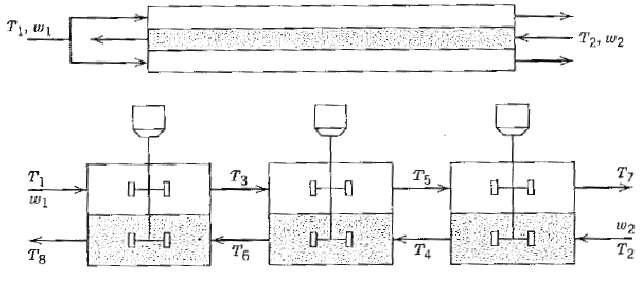
A two-input/two-output process involving simultaneous beating and liquid-level changes is illustrated in Figure. Find the transfer function models and expressions for the gains and the Lime constant ? for this process. What is the output response for a unit step change in Q? for a unit step change
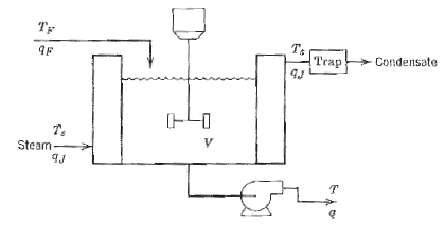
The jacketed vessel in Figure is used to heat a liquid by means of condensing steam. The following information is available:(i) The volume of liquid within the tank may vary, thus changing the area available for heat transfer.(ii) Heat losses are negligible.(iii) The tank contents are well mixed.
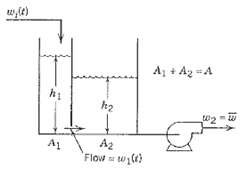
Your company is having problems with the Iced stream to a reactor. The feed must be kept at a constant mass flaw rate (w) even though the supply from the upstream process unit varies with time, wi(t). Your boss feels that an available tank can be modified to serve as a surge unit, with the tank
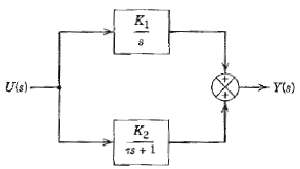
A process has the following block diagram representation (a) Will the process exhibit overshoot for a step change in u? Explain/demonstrate why r why not. (b) What will be the approximate maximum value of y for K = K1K2 = 1 and a step change, U(s) = 3/s? (c) Approximately when will the maximum
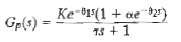
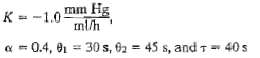
The transfer function that relate-s the change in blood pressure y to a change in u the infusion rate of a drug (sodium nitroprusside) is given by1 The two time delays result from the blood recirculation that occurs in the body, and ? is the recirculation coefficient. The following parameter
An operator introduces a step change in the flow rate q1 to a particular process at 3:05 A,M changing the flow from 500 to 540 gal/min. The first change in the process temperature T (initially at 120 o9 comes at 3:09 A,M.. After that, the response in T is quite rapid, slowing clown gradually until
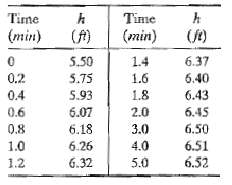
A single-tank process has been operating for a long period of time with the inlet how rate q1 equal to 30.4 ft3/min. After the operator increases the flow rate suddenly by 10%, the liquid level in the tank changes as shown in Table E7.2. Assuming that the process dynamics can be described by a
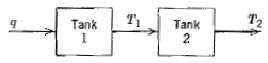
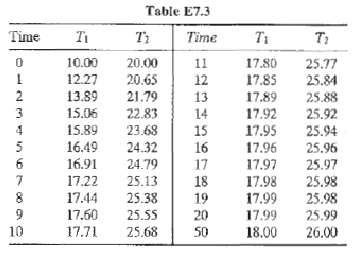
A process consists of two stirred tanks with Input q and outputs T1 and T2 (see figure). To test the hypothesis that the dynamics in each tank are basically first order, a step change in q is made from 82 to 85, with output responses given in Table P7.3. (a) Find the transfer functions
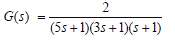
For a multistage bioseparation process described by the transfer function, Calculate the response to a step input change of magnitude, 1.5. (a) Obtain an approximate first- order-plus-delay model using the fraction incomplete response method. (b) Find an approximate second-order model using a
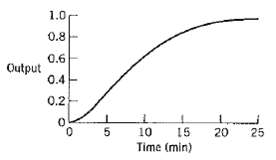
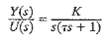
Fit an integrator plus time-delay model to the unit step response in figure for t
For the unit step response shown in figure estimate the following models using graphical methods:(a) First-order-plus-time-delay.(b) Second-order using Smith’s method and nonlinear regression.Plot all three predicted model responses on the same graph
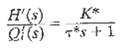
A heat exchanger used to heat a glycol solution with a hot oil is known to exhibit first-order-plus-time-delay behavior, G1(s) = T?(s)/Q?(s), where r is the outlet temperature deviation and Q? is the hot oil flow rate deviation. A thermocouple is placed 3 m downstream from the outlet of the heat
A process is described by the transfer function(a) What is the form of the process response to a step change in input of magnitude M? You do not need to find y(t) explicitly.(b) Calculate the output response, y(t). Show how you could evaluate the parameters K and ? from the plot of the output
A distillation column is operated under steady-state conditions with a flow rate of 9650 lb/hr of distillate product. The operator suddenly changes the reboiler steam pressure from 92 psig to 95 psig to Increase the distillate production rate. Exactly one hour and 45 minutes later she notices that
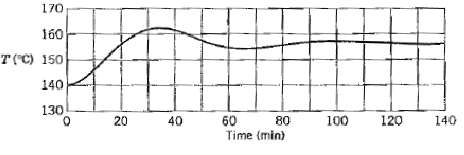
(a) What transfer function approximately describes the operation of the process in Figure? Provide units for all parameters.(b) If a ramp input was used instead, Q’ = Bt with B > 0, what would be the form of the temperature response? Sketch the response without finding the analytical solution
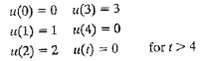
Consider the that-order differential equationWhere u(t) is piecewise constant and assumes the following values:Derive a difference equation for this ordinary equation using ?t = 1 and (a) Exact discretization(b) Finite difference approximationCompare the integrated results for 0
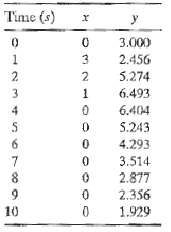
The following data were collected from a cell concentration sensor measuring absorbance in a biochemical stream. The input x is the flow rate deviation (in dimensionless units) and the sensor output y is given in volts. The flow rate (input) is piecewise constant between sampling instants. The
Obtain a first-order discrete-dine model from the step response data in Table E7.12. Compare your results with the first-order graphical method for Step response data, fitting the gain and time constant. Plot the two simulated step responses for comparison with the observeddata.
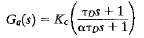
Analog proportional-derivative controllers sometimes are formulated with a transfer function of the form:where ? = 0.05 to 02. The ideal PD transfer function is obtained when ? = 0. G1(s) = Kc(?DS + 1)(a) Analyze the accuracy of this approximation for step and tamp responses. Treat a as a parameter
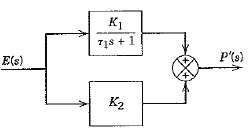
The physically realizable form of the PD transfer function is given in the first equation of Exercise 8.1.(a) Show how to obtain this transfer function with a parallel arrangement of two much simpler functions in Figure:(b) Find expressions for K1, K2, and ?1 that can be used to obtain desired
The parallel form of the PID controller has the transfer function given by Eq. 8-14. Many commercial analog controllers can be described by the series form given by Eq. 8-15. (a) For the simplest case, α → 0, find the relations between the settings for the parallel form (K†c,
Exercise 1.7 shows two possible ways to design a feedback control loop to obtain a desired rate of liquid flow, wxp. Assume that in both Systems I and II, the flow transmitter is direct acting (i.e., the output increases as the actual flow rate increases). However, the control valve in System I is
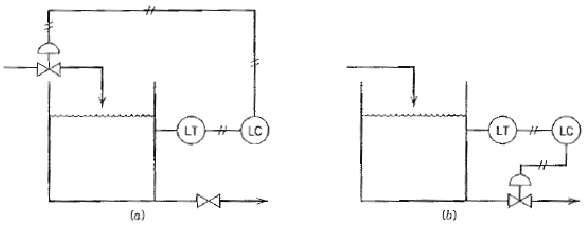
A liquid-level control system can be configured in either of two ways. with a control valve manipulating flow of liquid into the holding tank (Figure a), or with a control valve manipulating the flow of liquid from the tank (Figure b). Assuming that the liquid- level transmitter always is direct
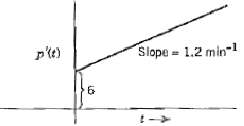
If the input Ym to a P1 controller changes stepwise (Ym(s) = 2/s) and the controller output changes initially as in figure, what are the values of the controller gain and integraltimes?
Your boss has discussed implementing a level controller on a troublesome process tank that contains a boiling liquid. Someone told him that a level transmitter used with such a system has a very noisy output and that a P or P1 controller will require a noise filter on the measurement. (a) Show how
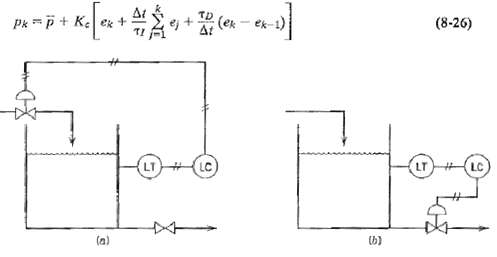
(a) Find an expression for the amount of derivative kick that wilt bc applied to the process when using the position form of the PID digital algorithm (Eq. 8-26) if a step set-point change of magnitude is made between the k ? 1 and k sampling instants. (b) Repeat for the proportional kick, that is,
(a) For the case of the digital velocity P and PD algorithms, show how the set point enters into calculation of ∆pk on the assumption that it is not changing, that is, is a constant (b) What do the results indicate about use of the velocity bun of P and PD digital control algorithms? (c)
(a) What differential equation model represents the parallel PID controller with a derivative filter? (b) Repeat for the series Pit) controller with a derivative filter.(c) Simulate the time response of each controller for a step change in e(t).
Showing 1700 - 1800
of 6778
First
11
12
13
14
15
16
17
18
19
20
21
22
23
24
25
Last
Step by Step Answers

 Get 50% OFF
Claim Now
Get 50% OFF
Claim Now