New Semester
Started
Get
50% OFF
Study Help!
--h --m --s
Claim Now
Question Answers
Textbooks
Find textbooks, questions and answers
Oops, something went wrong!
Change your search query and then try again
S
Books
FREE
Study Help
Expert Questions
Accounting
General Management
Mathematics
Finance
Organizational Behaviour
Law
Physics
Operating System
Management Leadership
Sociology
Programming
Marketing
Database
Computer Network
Economics
Textbooks Solutions
Accounting
Managerial Accounting
Management Leadership
Cost Accounting
Statistics
Business Law
Corporate Finance
Finance
Economics
Auditing
Tutors
Online Tutors
Find a Tutor
Hire a Tutor
Become a Tutor
AI Tutor
AI Study Planner
NEW
Sell Books
Search
Search
Sign In
Register
study help
sciences
chemical principles
Chemical Principles The Quest For Insight 7th Edition Peter Atkins, Loretta Jones, Leroy Laverman - Solutions
Calculate(a) The molality of chloride ions in an aqueous solution of iron(III) chloride for which xFeCl3 = 0.0312;(b) The molality of hydroxide ions in a solution prepared from 3.24 g of barium hydroxide dissolved in 258 g of water;(c) The molality of 12.00 m NH3(aq) with a density of 0.9519 g
Analysis of a reaction mixture showed that it had the composition 0.520 mol · L–1 N2, 0.485 mol · L–1 H2, and 0.102 mol · L–1 NH3 at 800. K, at which temperature Kc = 0.278 for N2(g) + 3 H2(g) ⇌ 2 NH3(g). (a) Calculate the reaction quotient Qc. (b) Is the reaction mixture at
Explain what happens to the solubility of the CO2 in Exercise 5D.9 if(a) The partial pressure of CO2(g) is increased by compressing the gas to a third of its original volume;(b) The temperature is raised.Exercise 5D.9The carbon dioxide gas dissolved in a sample of water in a partly filled, sealed
The vapor pressure of chlorine dioxide, ClO2, is 155 Torr at 222.75 °C and 485 Torr at 0.00 °C. Calculate(a) The standard enthalpy of vaporization;(b) The standard entropy of vaporization;(c) The standard Gibbs free energy of vaporization;(d) The normal boiling point of ClO2.
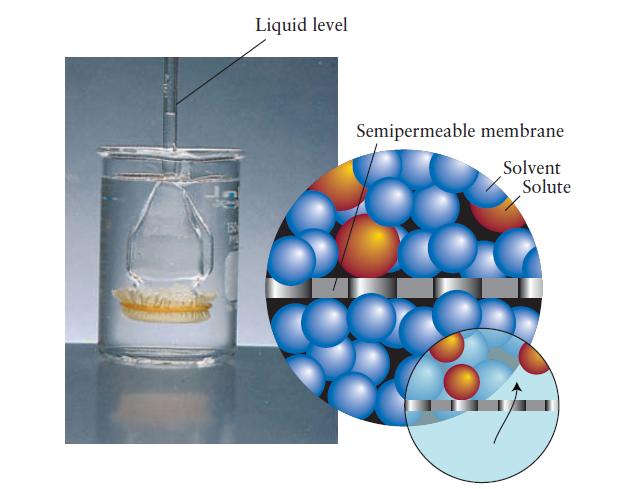
A sample of a polypeptide of mass 0.40 g dissolved in 1.0 L of an aqueous solution at 27 8C gave rise to an osmotic pressure of 3.74 Torr. What is the molar mass of the polypeptide?
The height of a column of liquid that can be supported by a given pressure is inversely proportional to its density. An aqueous solution of 0.010 g of a protein in 10. mL of water at 20°C shows a rise of 5.22 cm in the apparatus shown in Fig. 5F.3. Assume the density of the solution to be 0.998
Benzene, C6H6, and toluene, C6H5CH3, form an ideal solution. The vapor pressure of benzene is 94.6 Torr and that of toluene is 29.1 Torr at 25°C. Calculate the total vapor pressure of each of the following solutions and the mole fraction of each substance in the vapor phase above those solutions
Write the reaction quotient Q for (a) 2 BCl3(g) + 2 Hg(1)→ B₂Cl(s) + Hg₂Cl₂(s) (b) P4S10(s) + 16 H₂O(1)→ 4 H3PO4(aq) + 10 H₂S(aq) (c) Br₂(g) + 3 F₂(g) →2 BrF3(g)
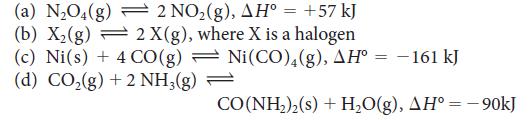
Predict whether each of the following equilibria will shift toward products or reactants with a temperature increase: 2 NO₂(g), AH° = +57 kJ 2 X(g), where X is a halogen → (a) N₂O4(g) (b) X₂(g) (c) Ni(s) + 4CO(g) (d) CO₂(g) + 2 NH3(g) Ni(CO)4(g), AH = -161 kJ CO(NH₂)₂(s) + H₂O(g),
(a) Calculate the mass of CaCl2 · 6H2O needed to prepare 0.125 m CaCl2(aq) by using 500. g of water.(b) What mass of NiSO4 · 6H2O must be dissolved in 500. g of water to produce 0.22 m NiSO4(aq)?
A soft drink is made by dissolving CO2 gas at 3.60 atm in a flavored solution and sealing the solution in aluminum cans at 20°C. What amount (in moles) of CO2 is contained in a can of the soft drink of volume 420. mL · At 20°C the Henry’s law constant for CO2 is 2.3 * 10–2 mol?L–1 ·
A reaction vessel of volume 0.500 L at 700. K contains 1.20 mmol SO2(g), 0.50 mmol O2(g), and 0.10 mmol SO3(g). At 700. K, Kc = 1.7 * 106 for the equilibrium 2 SO2(g) + O2(g) ⇌ 2 SO3(g). (a) Calculate the reaction quotient Qc. (b) Will more SO3(g) tend to form?
The normal boiling point of iodomethane, CH3I, is 42.43°C, and its vapor pressure at 0.00°C is 140. Torr. Calculate(a) The standard enthalpy of vaporization of iodomethane;(b) The standard entropy of vaporization of iodomethane;(c) The vapor pressure of iodomethane at 25.0 °C.
A solution prepared by adding 0.50 g of a polymer to 0.200 L of toluene (methylbenzene, a common solvent) showed an osmotic pressure of 0.582 Torr at 20 8C. What is the molar mass of the polymer?
Predict whether each of the following equilibria will shift toward products or reactants with a temperature increase: (a) CH4(g) + H₂O(g) (b) CO(g) + H₂O(g) (c) 2 SO₂(g) + O₂(g) CO(g) +3 H₂(g), AH° = +206 kJ CO₂(g) + H₂(g), AH° = −41 kJ 2 SO3(g), AH° = - 198 kJ
Hexane, C6H14, and cyclohexane, C6H12, form an ideal solution. The vapor pressure of hexane is 151 Torr and that of cyclohexane is 98 Torr at 25.0°C. Calculate the total vapor pressure of each of the following solutions and the mole fraction of each substance in the vapor phase above those
A 0.060 m C6H12O6(aq) solution (glucose) is separated from a 0.040 m CO(NH2)2(aq) solution (urea) by a semipermeable membrane at 25°C. For both compounds, i = 1. (a) Which solution has the higher osmotic pressure?(b) Which solution becomes more dilute with the passage of H2O molecules through
The density of a 10.0% by mass H2SO4(aq) solution is 1.07 g · cm–3.(a) What volume (in milliliters) of solution contains 8.37 g of H2SO4?(b) What is the molality of H2SO4 in the solution?(c) What mass (in grams) of H2SO4 is in 250. mL of the solution?
A soft drink is made by dissolving CO2 gas at 4.00 atm in a flavored solution and sealing the solution in aluminum cans at 20°C. What amount (in moles) of CO2 is contained in a can of the soft drink of volume 360. mL? At 20°C the Henry’s law constant for CO2 is 2.3 * 10–2 mol · L–1 ·
Given that Kc = 62 for the reaction N2(g) + 3 H2(g) ⇌ 2 NH3(g) at 500. K, calculate whether more ammonia will tend to form when a mixture of composition 1.25 mmol · L–1 N2, 4.58 mmol · L–1 H2, and 0.875 mmol · L–1 NH3 is present in a container at 500. K.
The normal boiling point of ethyl acetate, CH3COOC2H5, used to remove nail polish, is 77.1°C, and its vapor pressure at 16.2 °C is 10.0 kPa. Calculate(a) The standard enthalpy of vaporization of ethyl acetate;(b) The standard entropy of vaporization of ethyl acetate;(c) The vapor pressure of
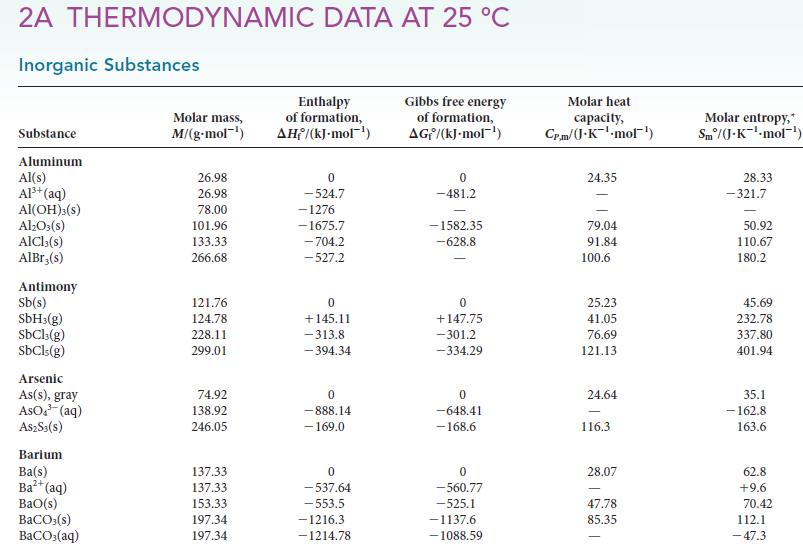
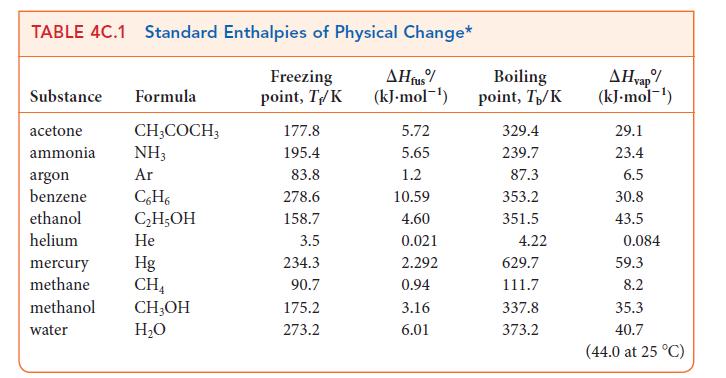
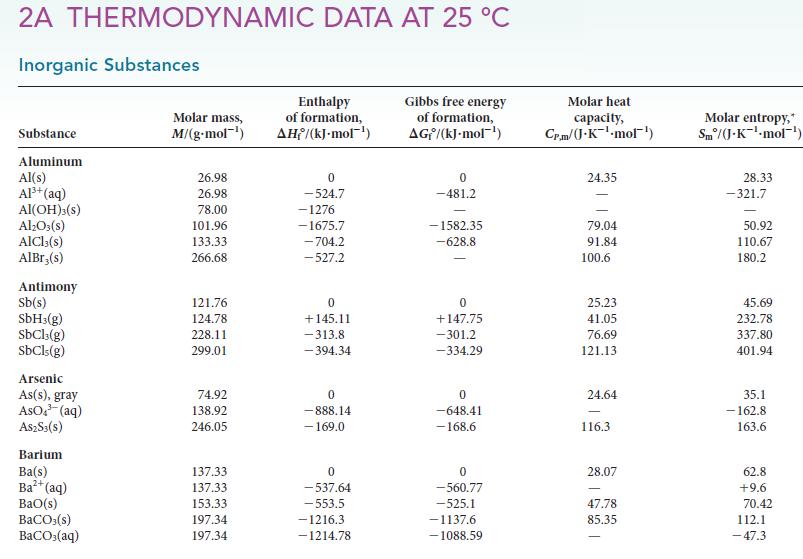
(a) From data in Appendix 2A, derive a numerical form of the Clausius–Clapeyron equation for methanol.(b) Use the equation to plot the appropriate quantities that should give a straightline relation between vapor pressure and temperature.(c) Estimate the vapor pressure of methanol at
A polymer sample of mass 0.20 g dissolved in 0.100 L of toluene, gives rise to an osmotic pressure of 6.3 Torr at 20°C.What is the molar mass of the polymer?
The vapor pressure of 1,1-dichloroethane, CH3CHCl2, is 228 Torr at 25°C; at the same temperature, that of 1,1-dichlorotetrafluoroethane, CF3CCl2F, is 79 Torr. What mass of 1,1-dichloroethane must be mixed with 100.0 g of 1,1-dichlorotetrafluoroethane to give a solution with vapor pressure 157 Torr
(a) Calculate the reaction Gibbs free energy of I2 (g) → 2 I (g) at 1200. K (K = 6.8) when the partial pressures of I2 and I are 0.13 bar and 0.98 bar, respectively.(b) Indicate whether this reaction mixture is likely to form reactants, is likely to form products, or is at equilibrium.
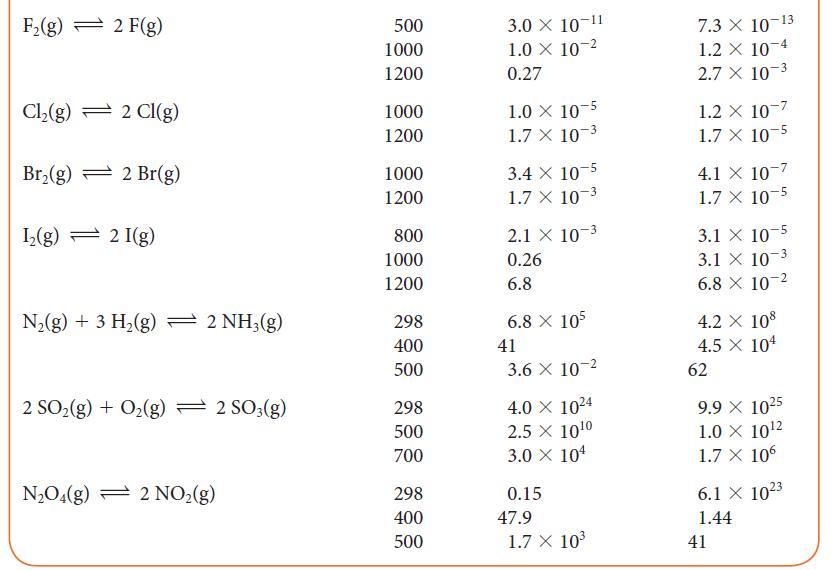
A gaseous mixture consisting of 2.23 mmol N2 and 6.69 mmol H2 in a 500.-mL container was heated to 600. K and allowed to reach equilibrium. Will more ammonia be formed if that equilibrium mixture is then heated to 700. K? For N2(g) + 3 H2(g) ⇌ 2 NH3(g), K = 1.7 * 10–3 at 600. K and 7.8 *
(a) From data in Appendix 2A and Table 4C.1, derive a numerical form of the Clausius–Clapeyron equation for benzene.(b) Use the equation to plot the appropriate quantities that should give a straight-line relation between vapor pressure and temperature.(c) Estimate the boiling point of benzene
Lithium sulfate dissolves exothermically in water.(a) Is the enthalpy of solution for Li2SO4 positive or negative?(b) Write the chemical equation for the dissolving process.(c) Which is larger for lithium sulfate, the lattice enthalpy or the enthalpy of hydration?
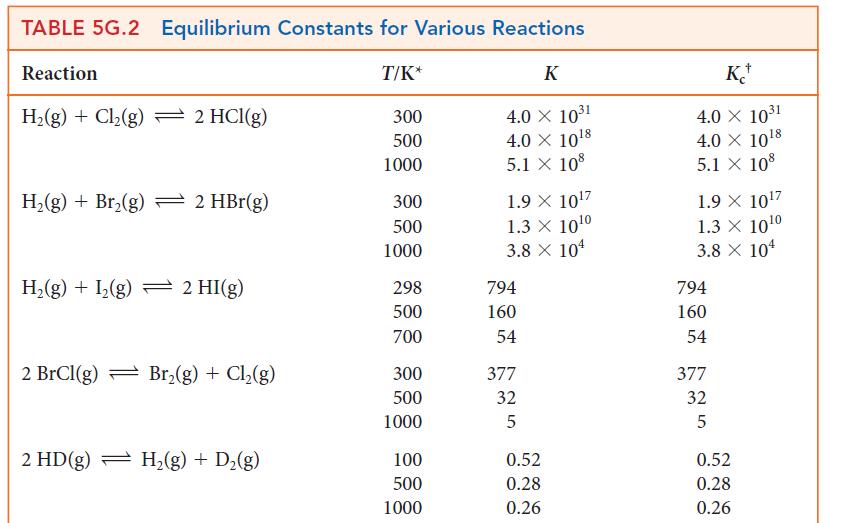
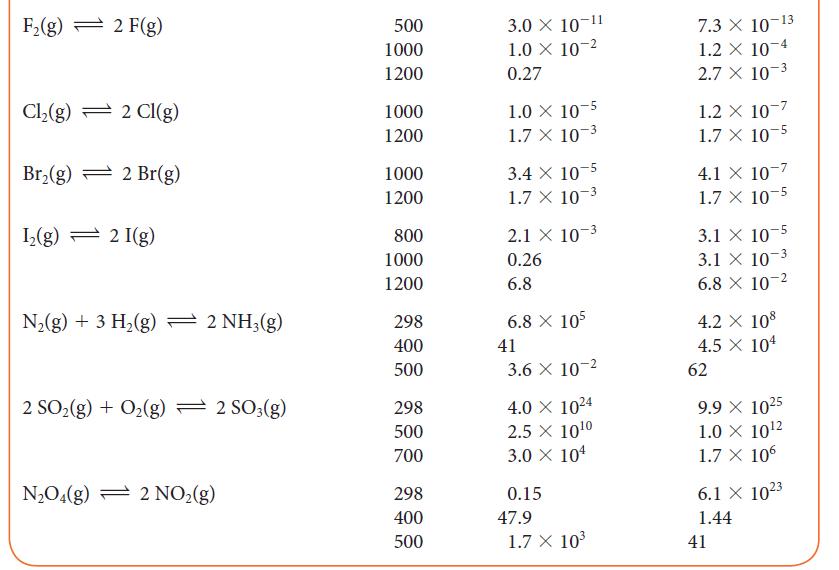
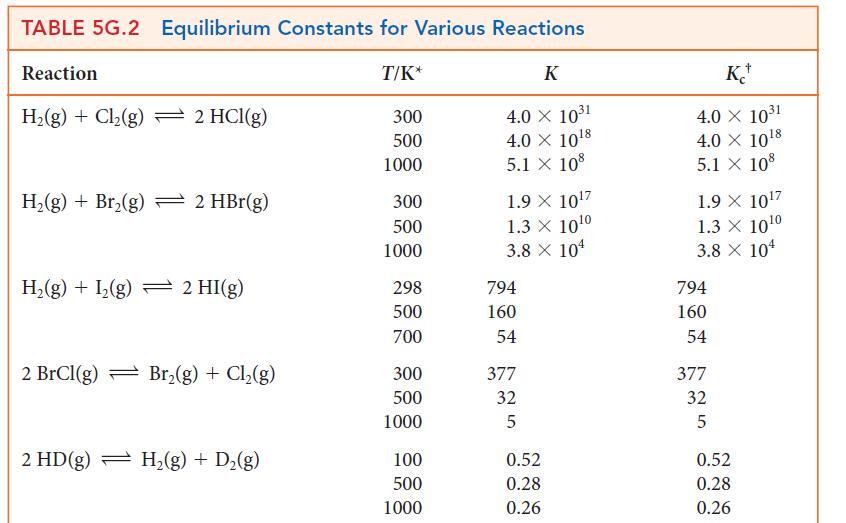
(a) In an experiment, 2.0 mmol Cl2(g) was sealed into a reaction vessel of volume 2.0 L and heated to 1000. K to study its dissociation into Cl atoms. Use the information in Table 5G.2 to calculate the equilibrium composition of the mixture.(b) If 2.0 mmol F2 was placed into the reaction vessel
Catalase, a liver enzyme, dissolves in water. A solution of volume 10.0 mL containing 0.166 g of catalase gives rise to an osmotic pressure of 1.2 Torr at 20°C. What is the molar mass of catalase?
The vapor pressure of butanone, CH3CH2COCH3, is 100. Torr at 25°C; at the same temperature that of propanone, CH3COCH3, is 222 Torr. What mass of propanone must be mixed with 350.0 g of butanone to give a solution with a vapor pressure of 135 Torr? Assume ideal behavior.
Calculate the reaction Gibbs free energy of PCl3(g) 1 Cl2(g) → PCl5(g) at 230 8C when the partial pressures of PCl3, Cl2, and PCl5 are 0.35 bar, 0.45 bar, and 1.02 bar, respectively. What is the spontaneous direction of change, given that K = 49 at 230°C?
A gaseous mixture consisting of 1.1 mmol SO2 and 2.2 mmol O2 in a 250-mL container was heated to 500. K and allowed to reach equilibrium. Will more sulfur trioxide be formed if that equilibrium mixture is cooled to 298 K? For the reaction 2 SO2(g) + O2(g) ⇌ 2 SO3(g), K = 2.5 * 1010 at 500. K and
The enthalpy of solution of ammonium nitrate in water is positive.(a) Does NH4NO3 dissolve endothermically or exothermically?(b) Write the chemical equation for the dissolving process.(c) Which is larger for NH4NO3, the lattice enthalpy or the enthalpy of hydration?
Calculate the osmotic pressure at 20°C of each of the following solutions, assuming complete dissociation for any ionic solutes:(a) 0.050 m C12H22O11(aq);(b) 0.0010 m NaCl(aq);(c) A saturated aqueous solution of AgCN of solubility 23 μg/100. g of water.
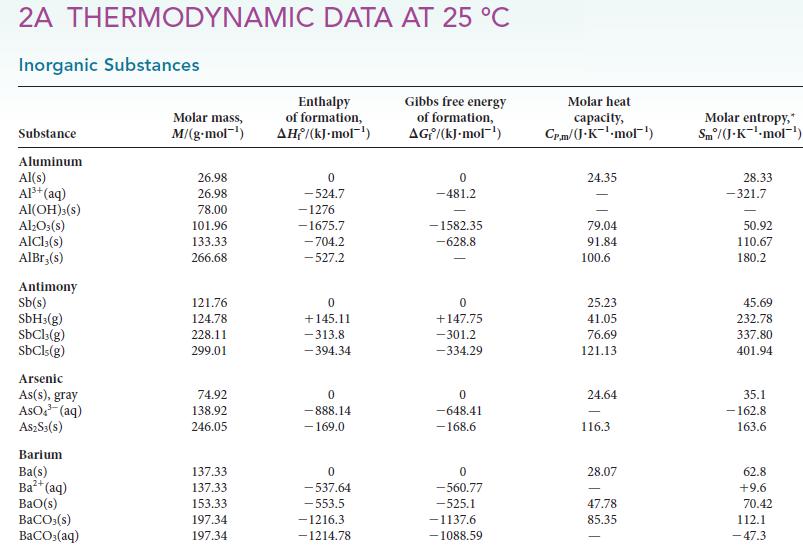
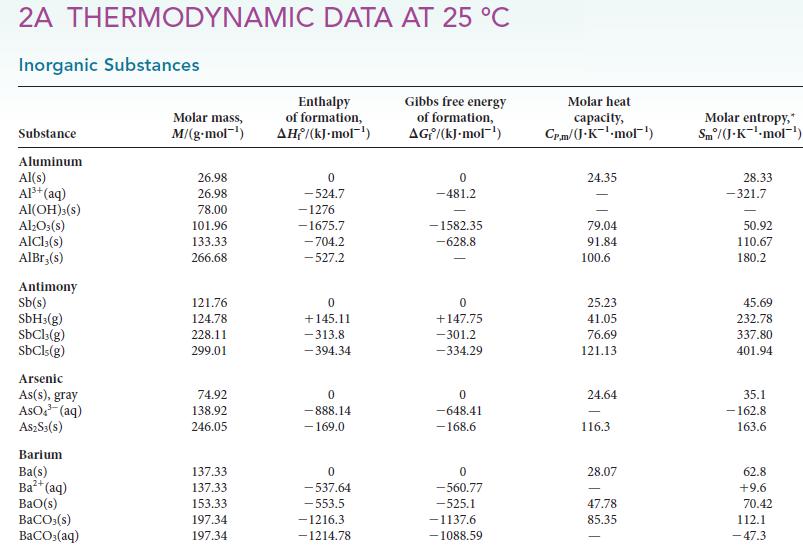
Calculate the equilibrium constant at 25°C and at 150°C for each of the following reactions, using data available in Appendix 2A: (a) NH4Cl(s) (b) H₂(g) + D₂O(1) NH3(g) + HCl (g) D₂(g) + H₂O(1)
Which of the following mixtures would you expect to show a positive deviation, a negative deviation, or no deviation (that is, form an ideal solution) from Raoult’s law? Explain your conclusion.(a) Methanol, CH3OH, and ethanol, CH3CH2OH;(b) HF and H2O;(c) Hexane, C6H14, and H2O.
Colligative properties can be sources of insight into not only the properties of solutions, but also the properties of the solute. For example, acetic acid, CH3COOH, behaves differently in two different solvents.(a) The freezing point of a 5.00% by mass aqueous acetic acid solution is –1.72°C.
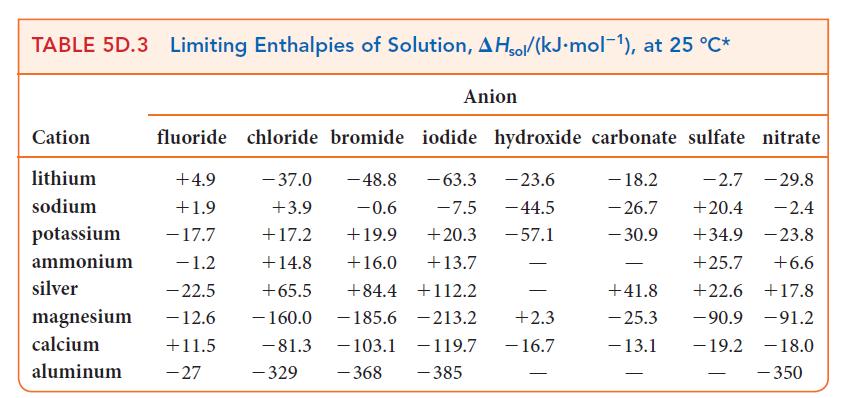
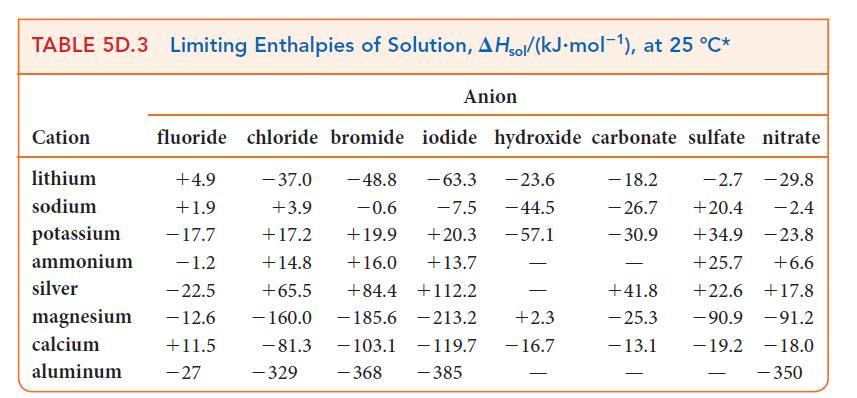
Calculate the heat evolved or absorbed when 10.0 g of(a) NaCl;(b) NaI;(c) AlCl3;(d) NH4NO3 is dissolved in 100. g of water. Assume that the enthalpies of solution in Table 5D.3 are applicable and that the specific heat capacity of the solution is 4.18 J · K–1 · g–1. TABLE 5D.3 Limiting
(a) Calculate the reaction Gibbs free energy of N2(g)+ 3 H2(g) → 2 NH3(g) when the partial pressures of N2, H2, and NH3 are 4.2 bar, 1.8 bar, and 21 bar, respectively, and the temperature is 400. K. For this reaction, K = 41 at 400. K.(b) Indicate whether this reaction mixture is likely to
When solid NH4HS and 0.400 mol NH3 (g) were placed in a vessel of volume 2.0 L at 24°C, the equilibrium NH4HS(s) ⇌ NH3 (g) + H2S(g), for which Kc = 1.6 * 10–4, was reached. What are the equilibrium concentrations of NH3 and H2S?
Calculate the equilibrium constant at 25°C and at 100°C for each of the following reactions, using data available in Appendix 2A: (a) 2 CuO (s) 2 Cu(s) + O(g) (b) CH4(g) + H(g) CH6(g)
Determine the temperature change when 4.00 g of(a) KCl;(b) MgBr2;(c) KNO3;(d) NaOH is dissolved in 100. g of water.Assume that the specific heat capacity of the solution is 4.18 J · K–1 · g–1 and that the enthalpies of solution in Table 5D.3 are applicable. TABLE 5D.3 Limiting Enthalpies
Calculate the osmotic pressure at 20°C of each of the following solutions, assuming complete dissociation of ionic compounds:(a) 4.5 * 10–3 m C6H12O6(aq);(b) 3.0 * 10–3 m CaCl2(aq);(c) 0.025 m K2SO4(aq).
Which of the following mixtures would you expect to show a positive deviation, a negative deviation, or no deviation (that is, form an ideal solution) from Raoult’s law? Explain your conclusion.(a) HBr and H2O;(b) Formic acid, HCOOH, and benzene;(c) Cyclopentane, C5H10, and cyclohexane, C6H12.
Standard practice in chemical laboratories is to distill highboiling-point substances under reduced pressure. Trichloroacetic acid has a standard enthalpy of vaporization of 57.8 kJ · mol–1 and a standard entropy of vaporization of 124 J · K–1 · mol–1. Use this information to determine
(a) Calculate the reaction Gibbs free energy of H2(g) 1 I2(g) → 2 HI(g) at 700. K when the partial pressures of H2, I2, and HI are 0.35 bar, 0.18 bar, and 2.85 bar, respectively. For this reaction, K = 54 at 700. K.(b) Indicate whether this reaction mixture is likely to form reactants, is
(a) When solid NaHCO3 was placed in a rigid container of volume 2.50 L and heated to 160.°C, the equilibrium 2 NaHCO3(s) ⇌ Na2CO3(s) + CO2(g) + H2O(g) was reached. At equilibrium, some of the starting material remains and the total pressure in the container is 7.68 bar. What is the value of
The temperature-dependence of the vapor pressure of phosphoryl chloride difluoride (OPClF2) has been measured:(a) Plot ln P against 1/T (this plot is best created with the aid of a computer or a graphing calculator that can calculate a linear least squares fit to the data).(b) From the plot (or a
Depict the progress of the reaction graphically (as in Fig. 5G.1) for the reaction in Exercise 5G.13.Exercise 5G.13(a) Calculate the reaction Gibbs free energy of I2 (g) → 2 I (g) at 1200. K (K = 6.8) when the partial pressures of I2 and I are 0.13 bar and 0.98 bar, respectively.(b) Indicate
By combining the relation for Kc in terms of K with the van ’t Hoff equation, find the analog of the van ’t Hoff equation for Kc.
Distinguish between a foam and a sol. Give at least one example of each.
The equilibrium constant Kc for the reaction N2(g) + O2(g) ⇌ 2 NO(g) at 1200°C is 1.00 * 10–5. Calculate the equilibrium molar concentrations of NO, N2, and O2 in a reaction vessel of volume 1.00 L that initially held 0.114 mol N2 and 0.114 mol O2.
From literature sources, find the critical pressures and temperatures of methane, methylamine (CH3NH2), ammonia, and tetrafluoromethane. Discuss the suitability of using each of these solvents for a supercritical extraction at room temperature in an autoclave that can withstand pressures of 100.
Depict the progress of the reaction graphically (as in Fig. 5G.1) for the reaction in Exercise 5G.13 if the starting partial pressures of I2 and I are 0.75 bar and 0.12 bar, respectively.Exercise 5G.13(a) Calculate the reaction Gibbs free energy of I2 (g) → 2 I (g) at 1200. K (K = 6.8) when
The vaporization of a liquid can be treated as a special case of an equilibrium. How does the vapor pressure of a liquid vary with temperature? Devise a version of the van ’t Hoff equation that applies to vapor pressure by first writing the equilibrium constant K for vaporization.
Distinguish between an emulsion and a gel. Give at least one example of each.
Calculate the standard Gibbs free energy of each of the following reactions: (a) I₂(g) 2 I(g), K = 6.8 at 1200. K (b) Ag₂ CrO4(s) = 2 Ag+ (aq) + CrO₂²(aq), K 1.1 X 10⁻¹² at 298 K
The equilibrium constant Kc for the reaction N2(g) + O2 (g) ⇌ 2 NO(g) at 1200°C is 1.00 * 10–5. Calculate the equilibrium molar concentrations of NO, N2, and O2 in a reaction vessel of volume 10.00 L that initially held 0.312 mol N2 and 0.407 mol O2.
From literature sources, find the critical temperatures for the gaseous hydrocarbons methane, ethane, propane, and butane. Explain the trends observed.
Some colloidal suspensions appear at first glance to be solutions. What quick, simple procedure could you use to distinguish colloids from solutions?
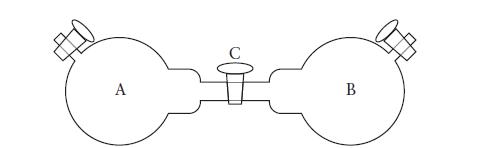
Consider an apparatus in which A and B are two 1.00-L flasks joined by a stopcock C. The volume of the stopcock is negligible. Initially, A and B are evacuated, the stopcock C is closed, and 1.50 g of diethyl ether, C2H5OC2H5, is introduced into flask A. The vapor pressure of diethyl ether is 57
A reaction mixture that consisted of 0.400 mol H2 and 1.60 mol I2 was introduced into a flask of volume 3.00 L and heated. At equilibrium, 60.0% of the hydrogen gas had reacted. What is the equilibrium constant K for the reaction H2(g) + I2 (g) ⇌ 2 HI(g) at this temperature?
Puddings contain large starch molecules that cause the mixture to thicken by a mechanism similar to that by which gelatin thickens. Which of the following suggestions is the best description of how puddings thicken? Explain your choice.(a) The starch molecules in pudding are insoluble in water and
Calculate the equilibrium constant at 25°C for each of the following reactions, by using data in Appendix 2A: (a) the combustion (b) the oxidation 2 CO₂(g) of hydrogen: 2 H₂(g) + O₂(g) — 2 H₂O(g) of carbon monoxide: 2 CO(g) + O₂(g) =
A reaction mixture that consisted of 0.20 mol N2 and 0.20 mol H2 was introduced into a reactor of volume 25.0 L and heated. At equilibrium, 5.0% of the nitrogen gas had reacted. What is the value of the equilibrium constant Kc for the reaction N2(g) + 3 H2(g) ⇌ 2 NH3(g) at this temperature?
The apparatus in Exercise 5.20 is again evacuated. Then 35.0 g of chloroform, CHCl3, is placed in flask A and 35.0 g of acetone, CH3COCH3, is placed in flask B. The system is allowed to come to equilibrium at 25°C with stopcock C closed. The vapor pressures of chloroform and acetone at 25°C are
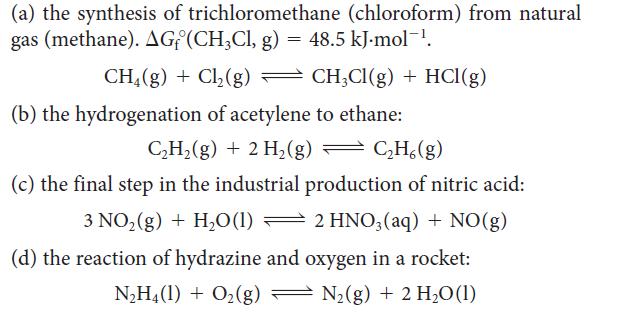
Calculate the equilibrium constant at 25°C for each of the following reactions, by using data in Appendix 2A: (a) the synthesis of trichloromethane (chloroform) from natural gas (methane). AG (CH3Cl, g) = = 48.5 kJ.mol-¹. CH₂(g) + Cl₂(g) (b) the hydrogenation of acetylene to
The equilibrium constant Kc for the reaction 2 CO(g) + O2(g) ⇌ 2 CO2(g) is 0.66 at 2000 °C. If 0.28 g of CO and 0.032 g of O2(g) are placed in a reaction vessel of volume 2.0 L and heated to 2000°C, what will the equilibrium composition of the system be? (You may wish to use graphing software
Pentane is a liquid with a vapor pressure of 512 Torr at 25°C; at the same temperature, the vapor pressure of hexane is only 151 Torr. What composition must the liquid phase have if the gas-phase composition is to have equal partial pressures of pentane and hexane?
In the Haber process for ammonia synthesis, K = 0.036 for N2(g) + 3 H2(g) ⇌ 2 NH3(g) at 500. K. If a reactor of volume 2.0 L is charged with 1.42 bar of N2 and 2.87 bar of H2, what will the equilibrium partial pressures in the mixture?
A reaction mixture consisting of 2.00 mol CO and 3.00 mol H2 is placed in a reaction vessel of volume 10.0 L and heated to 1200. K. At equilibrium, 0.478 mol CH4 was present in the system. Determine the value of Kc for the reaction CO(g) + 3 H2(g) ⇌ CH4(g) + H2O(g) at 1200. K.
Using a spreadsheet program or graphing calculator, plot ln P against 1/T on the same set of axes for DHvap = 15, 20., 25, and 30. kJ · mol–1 for the equation ln P = DHvap/RT. Is the vapor pressure of a liquid more sensitive to changes in temperature if DHvap is small or large? Explain your
A mixture consisting of 1.000 mol H2O(g) and 1.000 mol CO(g) is placed in a reaction vessel of volume 10.00 L at 800. K. At equilibrium, 0.665 mol CO2(g) is present as a result of the reaction CO(g) + H2O(g) ⇌ CO2(g) + H2(g). What are (a) The equilibrium concentrations for all substances
The combustion analysis of l-carnitine, an organic compound thought to build muscle strength, reported its composition as 52.16% C, 9.38% H, 8.69% N, and 29.78% O. The osmotic pressure of 100.00 mL of solution containing 0.322 g of l-carnitine in methanol was found to be 0.501 atm at 32°C.
A reaction mixture is prepared by mixing 0.100 mol SO2, 0.200 mol NO2, 0.100 mol NO, and 0.150 mol SO3 in a reaction vessel of volume 5.00 L. The reaction SO2(g) + NO2(g) ⇌ NO(g) + SO3(g) is allowed to reach equilibrium at 460 °C, when Kc = 85.0. What is the equilibrium concentration of each
Intravenous medications are often administered in 5.0% glucose, C6H12O6(aq), by mass. What is the osmotic pressure of such solutions at 37°C (body temperature)? Assume that the density of the solution is 1.0 g · mL–1.
In an experiment, 0.100 mol H2S is placed in a reaction vessel of volume 10.0 L and heated to 1132°C. At equilibrium, 0.0285 mol H2 is present. Calculate the value of Kc for the reaction 2 H2S(g) ⇌ 2 H2(g) + S2(g) at 1132°C.
When sulfuric acid is added to water, so much energy is released as heat that the solution may boil. Would you expect this solution to show a deviation from Raoult’s law? If so, which kind?Explain your reasoning.
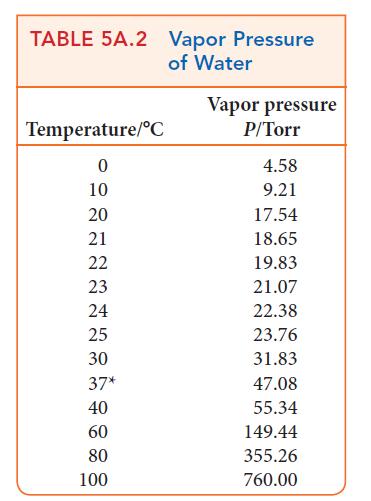
Relative humidity at a particular temperature is defined asThe vapor pressure of water at various temperatures is given in Table 5A.2.(a) What is the relative humidity at 30°C when the partial pressure of water is 25.0 Torr?(b) Explain what would be observed if the temperature of the air were to
The equilibrium constant Kc = 0.56 for the reaction PCl3(g) + Cl2(g) ⇌ PCl5(g) at 250 °C. Upon analysis, 1.50 mol PCl5, 3.00 mol PCl3, and 0.500 mol Cl2 were found to be present in a reaction vessel of volume 0.500 L at 250 °C. (a) Is the reaction at equilibrium? (b) If not, in which
At 25 °C, K = 3.2 * 10–34 for the reaction 2 HCl(g) ⇌ H2(g) + Cl2(g). If a reaction vessel of volume 1.0 L is filled with HCl at 0.22 bar, what are the equilibrium partial pressures of HCl, H2, and Cl2?
A dextrose/saline aqueous solution that doctors commonly use to replace fluids in the body contains 1.75 g · L–1 NaCl and 40.0 g · L–1 dextrose (C6H12O6).(a) What is the total molar concentration of all solutes in this solution?(b) What is the osmotic pressure of the solution at 25°C?
If 4.00 L of HCl(g) at 1.00 bar and 273 K and 26.0 g of I2(s) are transferred to a reaction vessel of volume 12.0 L and heated to 25°C, what will the equilibrium concentrations of HCl, HI, and Cl2 be? Kc = 1.6 * 10–34 at 25°C for 2 HCl(g) + I2(s) ⇌ 2 HI(g) + Cl2(g).
When 0.10 g of insulin is dissolved in 0.200 L of water, the osmotic pressure is 2.30 Torr at 20°C. What is the molar mass of insulin?
A reaction vessel of volume 3.00 L is filled with 0.342 mol CO(g), 0.215 mol H2(g), and 0.125 mol CH3OH(g). Equilibrium is reached in the presence of a zinc oxide–chromium(III) oxide catalyst and, at 300°C, Kc = 1.1 * 10–2 for the reaction CO(g) + 2 H2(g) ⇌ CH3OH(g). (a) As the reaction
An aqueous solution of the sugar mannitol (C6H12O6) with a concentration of 180 mg · mL–1 is commonly used in veterinary medicine as an osmotic diuretic, which helps to remove water from living cells by osmosis.(a) What is the molarity of mannitol in the solution?(b) What is the osmotic
For the reaction 2 NH3(g) ⇌ N2(g) + 3 H2(g), Kc = 0.395 at 350°C. A sample of NH3 of mass 25.6 g is placed in a reaction vessel of volume 5.00 L and heated to 350°C. What are the equilibrium concentrations of NH3, N2, and H2?
Human blood has an osmotic pressure relative to water of approximately 7.7 atm at body temperature (37°C). In a hospital, intravenous glucose (C6H12O6) solutions are often given. If a technician must mix 500. mL of a glucose solution for a patient, what mass of glucose should be used?
Suppose that 0.724 mol PCl5 is placed in a reaction vessel of volume 0.500 L. What is the concentration of each substance when the reaction PCl5(g) ⇌ PCl3(g) + Cl2(g) has reached equilibrium at 250°C (when Kc = 1.80)?
Interpret the following verse from Coleridge’s Rime of the Ancient Mariner:Water, water, every where,And all the boards did shrink;Water, water every where,Nor any drop to drink.
A sample of ammonium carbamate, NH4(NH2CO2), of mass 25.0 g was placed in an evacuated flask of volume 0.250 L and kept at 25°C. At equilibrium, 17.4 mg of CO2 was present. What is the value of Kc for the decomposition of ammonium carbamate into ammonia and carbon dioxide? The reaction is
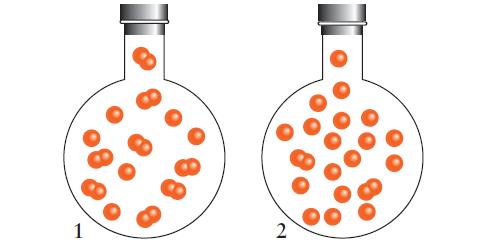
Dissociation of a diatomic molecule, X2 (g) ⇌ 2 X(g) occurs at 500 K. The equilibrium state of the reaction is shown in 1 and the equilibrium state in the same container after a change has occurred is shown in 2. Which of the following changes will produce the composition
Carbon monoxide and water vapor, each at 200. Torr, were introduced into a container of volume 0.250 L. When the mixture reached equilibrium at 700°C, the partial pressure of CO2(g) was 88 Torr. Calculate the value of K for the equilibrium (8)³H + (8)²00 (8)²00 (8)0¹H + (8)00
At 25°C, K = 47.9 for N2O4 (g) ⇌ 2 NO2(g).(a) If 0.180 mol N2O4 and 0.0020 mol NO2 are placed in a reaction vessel of volume 20.0 L and the reaction is allowed to reach equilibrium, what are the equilibrium concentrations of N2O4 and NO2?(b) An additional 0.0020 mol NO2 is added to the
Consider the reaction 2 NO(g) ⇌ N2(g) + O2(g). If the initial partial pressure of NO(g) is 1.0 bar, and p is the equilibrium partial pressure of N2(g) in bar, what is the correct equilibrium relation? (a) K = p²/(1.0p); (b) K = p²; (c) K = p²/(1.02p)²;
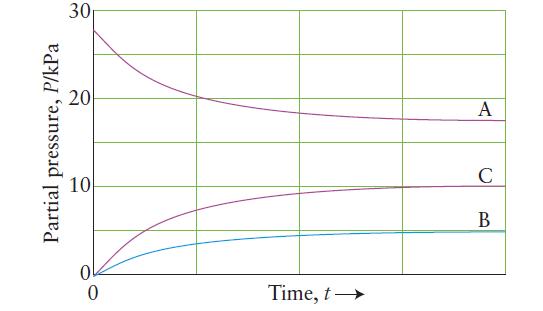
The following plot shows how the partial pressures of reactant and products vary with time for the decomposition of compound A into compounds B and C. All three compounds are gases. Use this plot to do the following:(a) Write a balanced chemical equation for the reaction.(b) Calculate the
In an experiment, 0.100 mol SO3 was introduced into a flask of volume 2.00 L and the reaction 2 SO2(g) + O2(g) ⇌ 2 SO3(g) was allowed to come to equilibrium at 700 K.(a) Using information in Table 5G.2, calculate the equilibrium concentrations of the three gases.(b) The volume of the flask is
(a) Calculate the standard Gibbs free energies of formation of the halogen atoms X(g) at 1000. K from data available in Table 5G.2.(b) Show how these data correlate with the X—X bond strength by plotting the standard Gibbs free energy of formation of the atoms against the bond dissociation
Consider the reaction 2 NO2(g) ⇌ 2 NO(g) + O2(g). If the initial molar concentration of NO2(g) is 0.030 mol · L–1, and c is the equilibrium molar concentration of O2(g) in moles per liter, which of the following expressions is the correct equilibrium relation? (a) K c³; (b)
Showing 1600 - 1700
of 3011
First
10
11
12
13
14
15
16
17
18
19
20
21
22
23
24
Last
Step by Step Answers

 Get 50% OFF
Claim Now
Get 50% OFF
Claim Now







![Molar concentration, [J] (a) H, (reactant) NH, (product) N (reactant) Time, t Molar concentration, [J] (b) H](https://dsd5zvtm8ll6.cloudfront.net/images/question_images/1703/6/7/4/911658c041fb31a61703674910368.jpg)