New Semester
Started
Get
50% OFF
Study Help!
--h --m --s
Claim Now
Question Answers
Textbooks
Find textbooks, questions and answers
Oops, something went wrong!
Change your search query and then try again
S
Books
FREE
Study Help
Expert Questions
Accounting
General Management
Mathematics
Finance
Organizational Behaviour
Law
Physics
Operating System
Management Leadership
Sociology
Programming
Marketing
Database
Computer Network
Economics
Textbooks Solutions
Accounting
Managerial Accounting
Management Leadership
Cost Accounting
Statistics
Business Law
Corporate Finance
Finance
Economics
Auditing
Tutors
Online Tutors
Find a Tutor
Hire a Tutor
Become a Tutor
AI Tutor
AI Study Planner
NEW
Sell Books
Search
Search
Sign In
Register
study help
sciences
general chemistry principles
General Chemistry Principles And Modern Applications 11th Edition Ralph Petrucci, Jeffry Madura, F. Herring, Carey Bissonnette - Solutions
At equilibrium in the following reaction at 60 °C, the partial pressures of the gases are found to be PHI = 3.70 x 10⁻³ bar and PH2S = 1.01 bar. What is the value of for the reaction? H₂S(g) + I₂(s) 2 HI(g) + S(s) K = ?
Consider a hypothetical reaction in which a molecule, A, is converted to its isomer, B, that is, the reversible reaction A ⇌ B. Start with a flask containing 54 molecules of A, represented by open circles. Convert the appropriate number of open circles to filled circles to represent the isomer B
Based on these descriptions, write a balanced equation and the corresponding Kp expression for each reversible reaction.(a) Oxygen gas oxidizes gaseous ammonia to gaseous nitrogen and water vapor.(b) Hydrogen gas reduces gaseous nitrogen dioxide to gaseous ammonia and water vapor.(c) Nitrogen gas
(A) Teeth are made principally from the mineral hydroxyapatite, Ca5(PO4)3OH, which can be dissolved in acidic solution such as that produced by bacteria in the mouth. The reaction that occurs is Ca5(PO4)3OH(s) + 4 H+(aq) ⇌ 5 Ca2+(aq) + 3 HPO42-(aq) + H2O(l). Write the equilibrium constant
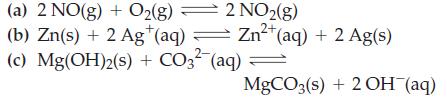
Write equilibrium constant expressions, Kc, for the reactions 2 NO2(g) Zn²+ Zn²+ (aq) + 2 Ag(s) 2+ (a) 2 NO(g) + O2(g) (b) Zn(s) + 2 Ag+ (aq) = (c) Mg(OH)2(s) + CO3²- (aq) = MgCO3(s) + 2OH(aq)
Can you conclude whether the numerical value of K for the reaction 2 ICl(g) ⇌ I2(g) + Cl2(g) is greater or less than the numerical value of K for the reaction ICl(g) ⇌ 1/2 I2(g) + 1/2 Cl2(g)? Explain.
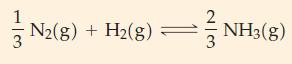
The following K value is given at 298 K for the synthesis of NH3(g) from its elements.What is the value of K at 298 K for the following reaction? N₂(g) + 3 H₂(g) = 2 NH3(g) K = 5.8 x 10⁵
(A) Use data from Example 15-2 to determine the value of K at 298 K for the reaction(B) For the reaction NO(g) + 1/2 O2(g) ⇌ NO2(g) at 184 °C, K = 1.2 x 10². What is the value of K at 184 °C for the reaction 2 NO2(g) ⇌ 2 NO(g) + O2(g)?Example 15-2At equilibrium in the following reaction at 60
You want to calculate K for the reactionand you have available a K value for the reactionWhat additional K value do you need, assuming that all K values are at the same temperature? CH4(g) + 2 H2O(g) = CO2(g) + 4H₂(g)
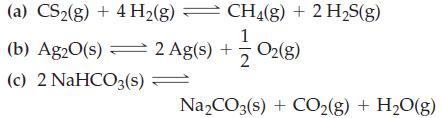
Write equilibrium constant expressions, Kp, for the reactions (a) CS₂(g) + 4H₂(g) — (b) Ag2O(s) 2 Ag(s) + (c) 2 NaHCO3(s) = CH4(g) + 2 H₂S(g) 12/02 (8) = Na₂CO3(s) + CO₂(g) + H₂O(g)
For the gas-phase reaction below, the value of Kc is 3.4 at 1000 K. What is the value of Kp at this temperature? 2 SO2(g) + O2(g) 2 SO3(g)
(A) For the reaction 2 NH3(g) ⇌ N2(g) + 3 H2(g) at 298 K, Kc = 2.8 x 10⁻⁹. What is the value of Kp for this reaction?(B) At 1065 °C, for the reaction 2 H2S(g) ⇌ 2 H2(g) + S2(g), Kp = 1.2 x 10⁻². What is the value of Kc for the reaction H2(g) + 1/2 S2(g) ⇌ H2S(g) at 1065 °C?
Why is having a balanced equation a necessary condition for predicting the outcome of a chemical reaction, but often not a sufficient condition?
To increase the yield of H2(g) in the water–gas reaction—the reaction of C(g) and H2O(g) to form CO(g) and H2(g)—a follow-up reaction called the “water–gas shift reaction” is generally used. In this reaction, some of the CO(g) of the water gas is replaced by H2(g).Kc = 1.00 at about
Write an equilibrium constant, Kc, for the formation from its gaseous elements of (a) 1 mol HF(g);(b) 2 mol NH3(g);(c) 2 mol N2O(g); (d) 1 mol ClF3(l).
(A) In Example 15-5, equal masses of CO, H2O, CO2, and H2 are mixed at a temperature of about 1100 K. When equilibrium is established, which substance(s) will show an increase in quantity and which will show a decrease compared with the initial quantities?(B) For the reaction PCl5(g) ⇌ PCl3(g) +
A mixture of 1.00 mol each of CO(g), H2O(g), and CO2(g) is placed in a 10.0 L flask at a temperature at which Kp = 10.0 in the reactionWhen equilibrium is established, (a) The amount of H2(g) will be 1.00 mol; (b) The amounts of all reactants and products will be greater than 1.00 mol; (c) The
(A) Given the reaction 2 CO(g) + O2(g) ⇌ 2 CO2(g), what is the effect of adding O2(g) to a constant-volume equilibrium mixture?(B) Calcination of limestone (decomposition by heating), CaCO3(s) ⇌ CaO(s) + CO2(g), is the commercial source of quicklime, CaO(s). After this equilibrium has been
Write an equilibrium constant, Kp, for the formation from its gaseous elements of (a) 1 mol NOCl(g);(b) 2 mol ClNO2(g);(c) 1 mol N2H4(g);(d) 1 mol NH4Cl(s).
Predict the effect of adding more N2(g) to a constant-volume equilibrium mixture of N2, H2, and NH3. N₂(g) + 3 H₂(g) = 2 NH3(g)
(A) The reaction N2O4(g) ⇌ 2 NO2(g) is at equilibrium in a 3.00 L cylinder. What would be the effect on the concentrations of N2O4(g) and NO2(g) if the pressure were doubled (that is, cylinder volume decreased to 1.50 L)?(B) How is the equilibrium amount of H2(g) produced in the water–gas shift
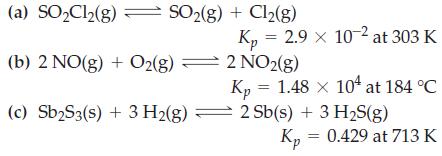
Determine values of Kc from the Kp values given. (a) SO₂Cl₂(g) SO₂(g) + Cl₂(g) (b) 2 NO(g) + O2(g) (c) Sb₂S3(s) + 3 H₂(g) Kp = 2.9 x 10⁻² at 303 K 2 NO2(g) Kp = 1.48 × 10⁴ at 184 °C 2 Sb(s) + 3 H₂S(g) Kp = 0.429 at 713 K
After the hypothetical reaction A(g) + B(g) ⇌ C(g) reaches equilibrium in a closed container, 0.100 mol of the inert gas argon is added. In addition, the volume of the container is decreased. According to Le Châtelier’s principle, will the reaction shift to the right or left? Explain.
An equilibrium mixture of N2(g), H2(g), and NH3(g) is transferred from a 1.50 L flask to a 5.00 L flask. In which direction does a net change occur to restore equilibrium? N₂(g) + 3 H₂(g) = 2 NH3(g)
The following reaction is brought to equilibrium at 700 °C.Indicate whether each of the following statements is true, false, or not possible to evaluate from the information given.(a) If the equilibrium mixture is allowed to expand into an evacuated larger container, the mole fraction of H2 will
(A) The reaction N2O4(g) ⇌ 2 NO2(g) has ΔrH° = +57.2 kJ mol-1. Will the amount of NO2(g) formed from N2O4(g) be greater at high or low temperatures?(B) The enthalpy of formation of NH3 is ΔfH°[NH3(g)] = -46.11 kJ/mol. Will the concentration of NH3 in an equilibrium mixture with its elements
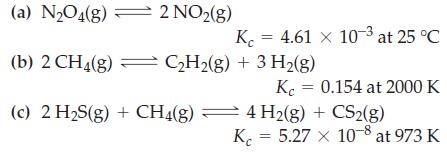
Determine the values of Kp from the Kc values given. (a) N₂O4(g) K (b) 2 CH4(g) = C₂H₂(g) + 3 H₂(g) (c) 2 H₂S(g) + CH4(g) 2 NO₂(g) = 4.61 x 10⁻³ at 25 °C Kc = 0.154 at 2000 K 4 H2(g) + CS2(g) K = 5.27 x 10⁻⁸ at 973 K
(A) Equilibrium is established in a 3.00 L flask at 1405 K for the reaction 2 H2S(g) ⇌ 2 H2(g) + S2(g). At equilibrium, there is 0.11 mol S2(g), 0.22 mol H2(g), and 2.78 mol H2S(g). What is the value of Kc for this reaction?(B) Equilibrium is established at 25 °C in the reaction N2O4(g) ⇌ 2
Two students are performing the same experiment in which an endothermic reaction rapidly attains a condition of equilibrium. Student A does the reaction in a beaker resting on the surface of the lab bench while student B holds the beaker in which the reaction occurs. Assuming that all other
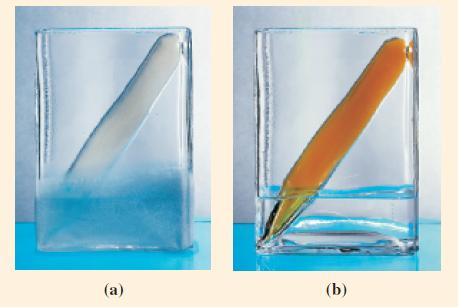
Dinitrogen tetroxide, N2O4(l) is an important component of rocket fuels—for example, as an oxidizer of liquid hydrazine in the Titan rocket. At 25 °C, N2O4 is a colorless gas that partially dissociates into NO2, a red-brown gas. The color of an equilibrium mixture of these two gases depends on
The vapor pressure of water at 25 °C is 23.8 mmHg. Write Kp for the vaporization of water, with pressures in atmospheres. What is the value of Kc for the vaporization process?
If Kc = 5.12 x 10⁻³ for the equilibrium established between liquid benzene and its vapor at 25 °C, what is the vapor pressure of C6H6 at 25 °C, expressed in millimeters of mercury?
The equilibrium condition for SO2(g), O2(g), and SO3(g) is important in sulfuric acid production. When a 0.0200 mol sample of SO3 is introduced into an evacuated 1.52 L vessel at 900 K, 0.0142 mol SO3 is present at equilibrium. What is the value of Kp for the dissociation of SO3(g) at 900 K? 2
(A) A 5.00 L evacuated flask is filled with 1.86 mol NOBr. At equilibrium at 25 °C, there is 0.082 mol of Br2 present. Determine Kc and Kp for the reaction 2 NOBr(g) ⇌ 2 NO(g) + Br2(g).(B) 0.100 mol SO2 and 0.100 mol O2 are introduced into an evacuated 1.52 L flask at 900 K. When equilibrium is
(A) Sodium hydrogen carbonate (baking soda) decomposes at elevated temperatures and is one of the sources of CO2(g) when this compound is used in baking.What is the partial pressure of CO2(g) when this equilibrium is established starting with NaHCO3(s)?(B) If enough additional NH3(g) is added to
Ammonium hydrogen sulfide, NH4HS(s), used as a photographic developer, is unstable and dissociates at room temperature.A sample of NH4HS(s) is introduced into an evacuated flask at 25 °C. What is the total gas pressure at equilibrium? NH₂HS(s) NH3(g) + H₂S(g) Kp = 0.108 at 25 °C
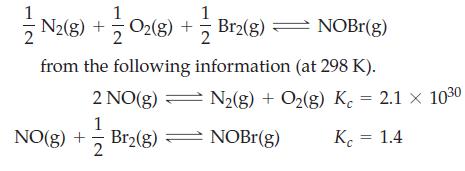
Determine Kc for the reaction 2 N2(g) + O2(g) + — Br2(g) — NOBr(g) from the following information (at 298 K). 2 NO(g) 1 Br₂(g) NO(g) + 2 N2(g) + O₂(g) K = 2.1 × 10³⁰ NOBr(g) K = 1.4
A 0.0240 mol sample of N2O4(g) is allowed to come to equilibrium with NO2(g) in a 0.372 L flask at 25 °C. Calculate the amount of N2O4 present at equilibrium (Fig. 15-9).Figure 15-9 N₂O4(g) 2 NO₂(g) Kc = 4.61 × 10³ at 25 °C
(A) If 0.150 mol H2(g) and 0.200 mol I2(g) are introduced into a 15.0 L flask at 445 °C and allowed to come to equilibrium, how many moles of HI(g) will be present?(B) Suppose the equilibrium mixture of Example 15-12 is transferred to a 10.0 L flask. (a) Will the equilibrium amount of N2O4
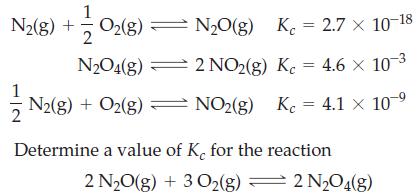
Given the equilibrium constant values 1 N2(g) + O2(g) = N₂O(g) K₁ = 2.7 × 10⁻¹⁸ 2 NO2(g) Kc = 4.6 x 10-³ Kc = 4.1 × 10-⁹ N2O4(g) N2(g) + O2(g) — NO₂(g) N2(g) + O2(g) 2 Determine a value of K, for the reaction 2 N₂O(g) + 3 O₂(g) = 2 N₂O4(g)
Solid silver is added to a solution with these initial concentrations: [Ag+] = 0.200 M, [Fe2+] = 0.100 M, and [Fe3+] = 0.300 M. The following reversible reaction occurs. What are the ion concentrations when equilibrium is established? Ag+ (aq) + Fe2+ (aq) 3+ Ag(s) + Fe³+ (aq) Kc = 2.98
(A) Excess Ag(s) is added to 1.20 M Fe3+(aq). Given thatwhat are the equilibrium concentrations of the species in solution?(B) A solution is prepared with [V3+] = [Cr2+] = 0.0100 M and [V2+] = 3[Cr3+] = 0.150 M. The following reaction occurs.What are the ion concentrations when equilibrium is
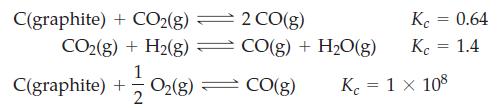
Use the following data to estimate a value of Kp at 1200 K for the reaction 2 H2(g) + O2(g) ⇌ 2 H2O(g) C(graphite) + CO2(g) ⇒ CO₂(g) + H₂(g) = C(graphite) + O₂(g) 1 2 2 CO(g) CO(g) + H₂O(g) CO(g) Kc = 0.64 Kc = 1.4 Kc = 1 x 10⁸
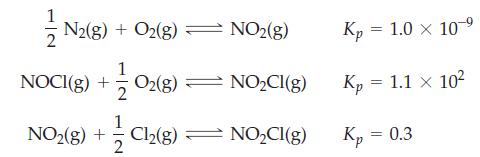
Determine Kc for the reaction N2(g) + O2(g) + Cl2(g) ⇌ 2 NOCl(g), given the following data at 298 K. N2(g) + O2(g) — NO₂(g) 102(8) NO₂Cl(g) 1 NO2(g) + Cl₂(8) ⇒ NO₂Cl(g) 2 NOCI(g) + Kp = 1.0 × 10⁻⁹ Kp = 1.1 × 10² Kp = 0.3
For the reaction 2 H2S(g) ⇌ 2 H2(g) + S2(g), the equilibrium constant is Kc = 4.20 x 10⁻⁶ at 830 °C. What are the equilibrium concentrations when 0.500 mol H2S is placed in an empty 1.0 L vessel at 830 °C? What fraction of the H2S dissociated?
(A) Glycolysis involves ten biochemical reactions. The first two reactions of the glycolysis cycle areCalculate the equilibrium concentration of F6P(aq) generated in the glycolysis cycle at normal body temperature, 37 °C, starting with [C6H12O6(aq)] = 1.20 x 10⁻⁶ M; [ATP(aq)] = 10-4 M; and
An important environmental and physiological reaction is the formation of carbonic acid, H2CO3(aq), from carbon dioxide and water. Write the equilibrium constant expression for this reaction in terms of activities. Convert that expression into an equilibrium constant expression containing
Rust, Fe2O3(s), is caused by the oxidation of iron by oxygen. Write the equilibrium constant expression first in terms of activities, and then in terms of concentration and pressure.
1.00 x 10⁻³ mol PCl5 is introduced into a 250.0 mL flask, and equilibrium is established at 284 °C: PCl5(g) ⇌ PCl3(g) + Cl2(g). The quantity of Cl2(g) present at equilibrium is found to be 9.65 x 10⁻⁴ mol. What is the value of Kc for the dissociation reaction at 284 °C ?
The two common chlorides of phosphorus, PCl3 and PCl5, both important in the production of other phosphorus compounds, coexist in equilibrium through the reactionAt 250 °C, an equilibrium mixture in a 2.50 L flask contains 0.105 g PCl5, 0.220 g PCl3, and 2.12 g Cl2. What are the values of (a) Kc
A mixture of 1.00 g H2 and 1.06 g H2S in a 0.500 L flask comes to equilibrium at 1670 K: 2 H2(g) + S2(g) ⇌ 2 H2S(g). The equilibrium amount of S2(g) found is 8.00 x 10⁻⁶ mol. Determine the value of Kp at 1670 K for pressures expressed in atmospheres.
Write the equilibrium constant expression for the following reaction, Fe(OH)3 + 3H*(aq) Fe³+ (aq) + 3H₂O(1) = K = 9.1 x 10³ and compute the equilibrium concentration for [Fe³+] at pH=7 (i.e., [H] = 1.0 × 10⁷).
A 0.682 g sample of ICl(g) is placed in a 625 mL reaction vessel at 682 K. When equilibrium is reached between the ICl(g) and I2(g) and Cl2(g) formed by its dissociation, 0.0383 g I2 is present. What is Kc for this reaction?
Write the equilibrium constant expression for the dissolution of ammonia in water:Use this equilibrium constant expression to estimate the partial pressure of NH3(g) over a solution containing 5 x 10⁻⁹ M NH3(aq). These are conditions similar to that found for acid rains with a high ammonium ion
Equilibrium is established at 1000 K, where Kc = 281 for the reaction 2 SO2(g) + O2(g) ⇌ 2 SO3(g). The equilibrium amount of O2(g) in a 0.185 L flask is 0.00247 mol. What is the ratio of [SO2] to [SO3] in this equilibrium mixture?
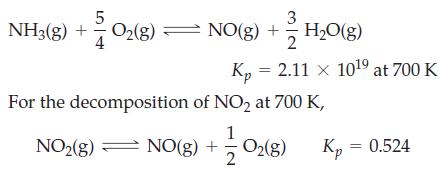
In the Ostwald process for oxidizing ammonia, a variety of products is possible—N2, N2O, NO, and NO2—depending on the conditions. One possibility is(a) Write a chemical equation for the oxidation of NH3(g) to NO2(g).(b) Determine Kp for the chemical equation you have written. 5 3 NH3(g) +
For the dissociation of I2(g) at about 1200 °C, I2(g) ⇌ 2 I(g), Kc = 1.1 x 10⁻². What volume flask should we use if we want 0.37 mol I to be present for every 1.00 mol I2 at equilibrium?
An equilibrium mixture at 1000 K contains 0.276 mol H2, 0.276 mol CO2, 0.224 mol CO, and 0.224 mol H2O.(a) Show that for this reaction, Kc is independent of the reaction volume, V.(b) Determine the value of Kc and Kp. CO₂(g) + H₂(g) = CO(g) + H₂O(g)
At 2000 K, Kc = 0.154 for the reaction 2 CH4(g) ⇌ C2H2(g) + 3 H2(g). If a 1.00 L equilibrium mixture at 2000 K contains 0.10 mol each of CH4(g) and H2(g), (a) What is the mole fraction of C2H2(g) present?(b) Is the conversion of CH4(g) to C2H2(g) favored at high or low pressures?(c) If the
For the reaction CO(g) + H2O(g) ⇌ CO2(g) + H2(g), Kp = 23.2 at 600 K when pressures are expressed in atmospheres. Explain which of the following situations might be found at equilibrium: (a) Pco PH₂O = PcO₂ = PH₂; (b) PH_; (b) PH,/PH,o Pco₂/Pco; (c) (PCO₂) (PH₂) = (PCO)(PH₂0); (d)
Can a mixture of 2.2 mol O2, 3.6 mol SO2, and 1.8 mol SO3 be maintained indefinitely in a 7.2 L flask at a temperature at which Kc = 100 in this reaction? Explain. 2 SO2(g) + O2(g) = 2 SO3(g)
Is a mixture of 0.0205 mol NO2(g) and 0.750 mol N2O4(g) in a 5.25 L flask at 25 °C, at equilibrium? If not, in which direction will the reaction proceed—toward products or reactants? N₂O4(g) = 2 NO₂(g) K 4.61 x 10⁻³ at 25 °C =
In the reaction 2 SO2(g) + O2(g) ⇌ 2 SO3(g), 0.455 mol SO2, 0.183 mol O2, and 0.568 mol SO3 are introduced simultaneously into a 1.90 L vessel at 1000 K.(a) If Kc = 2.8 x 10², is this mixture at equilibrium?(b) If not, in which direction will a net change occur?
A mixture consisting of 0.150 mol H2 and 0.150 mol I2 is brought to equilibrium at 445 °C, in a 3.25 L flask. What are the equilibrium amounts of H2, I2, and HI? H₂(g) + I2(g) 2 HI(g) Kc = 50.2 at 445 °C
In the reaction CO(g) + H2O(g) ⇌ CO2(g) + H2(g), Kc = 31.4 at 588 K. Equal masses of each reactant and product are brought together in a reaction vessel at 588 K.(a) Can this mixture be at equilibrium?(b) If not, in which direction will a net change occur?
Starting with 0.280 mol SbCl3 and 0.160 mol Cl2, how many moles of SbCl5, SbCl3, and Cl2 are present when equilibrium is established at 248 °C in a 2.50 L flask? SbC15(g) = SbCl3(g) + Cl₂(g) Kc 2.5 x 10⁻² at 248 °C =
Starting with 0.3500 mol CO(g) and 0.05500 mol COCl2(g) in a 3.050 L flask at 668 K, how many moles of Cl2(g) will be present at equilibrium? CO(g) + Cl2(g) = COC1₂(g) Kc = 1.2 x 10³ at 668 K
Equilibrium is established in a 2.50 L flask at 250 °C for the reactionHow many moles of PCl5, PCl3, and Cl2 are present at equilibrium, if (a) 0.550 mol each of PCl5 and PCl3 are initially introduced into the flask?(b) 0.610 mol PCl5 alone is introduced into the flask? PC15(g) → PC13(g) +
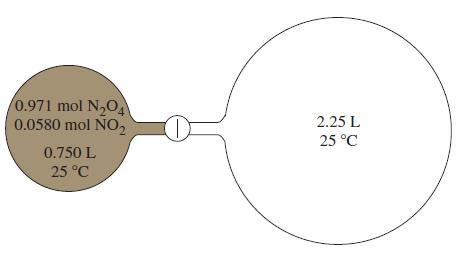
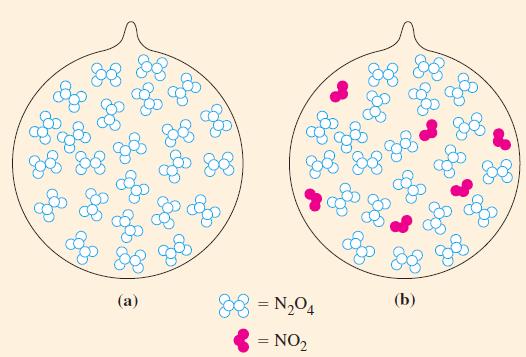
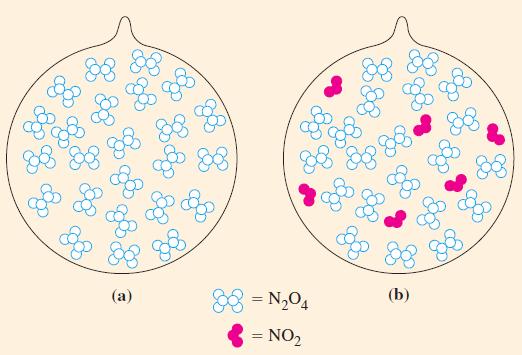
The N2O4–NO2 equilibrium mixture in the flask on the left in the figure is allowed to expand into the evacuated flask on the right. What is the composition of the gaseous mixture when equilibrium is re-established in the system consisting of the two flasks? N₂O4(g) 2 NO₂(g) K 4.61 x 10⁻³ at
For the following reaction, Kc = 2.00 at 1000 °C.If a 5.00 L mixture contains 0.145 mol COF2, 0.262 mol CO2, and 0.074 mol CF4 at a temperature of 1000 °C, (a) Will the mixture be at equilibrium?(b) If the gases are not at equilibrium, in what direction will a net change occur?(c) How many moles
Formamide, used in the manufacture of pharmaceuticals, dyes, and agricultural chemicals, decomposes at high temperatures.If 0.186 mol HCONH2(g) dissociates in a 2.16 L flask at 400 K, what will be the total pressure at equilibrium? HCONH₂(g) NH3(g) + CO(g) K 4.84 at 400 K
A mixture of 1.00 mol NaHCO3(s) and 1.00 mol Na2CO3(s) is introduced into a 2.50 L flask in which the partial pressure of CO2 is 2.10 atm and that of H2O(g) is 715 mmHg. When equilibrium is established at 100 °C, will the partial pressures of CO2(g) and H2O(g) be greater or less than their initial
Cadmium metal is added to 0.350 L of an aqueous solution in which [Cr3+] = 1.00 M. What are the concentrations of the different ionic species at equilibrium? What is the minimum mass of cadmium metal required to establish this equilibrium? 2 Cr³+ (aq) + Cd(s) — 2 Cr²+ (aq) + Cd²+ (aq) Kc =
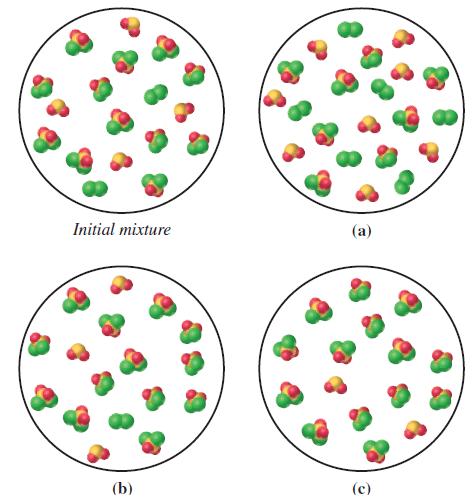
One sketch below represents an initial nonequilibrium mixture in the reversible reactionWhich of the other three sketches best represents an equilibrium mixture? Explain. 2 NO(g) + Br₂(g) = 2 NOBr(g) Kc = 3.0
Lead metal is added to 0.100 M Cr3+(aq). What are [Pb2+], [Cr2+], and [Cr3+] when equilibrium is established in the reaction? 3+ Pb(s) + 2 Cr³+ (aq) = Pb²+ (aq) + 2 Cr²+ (aq) K 3.2 x 10-10 =
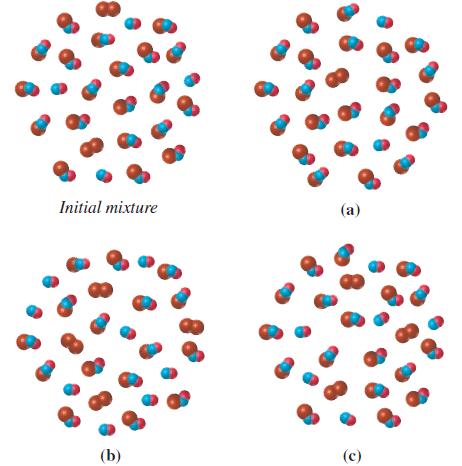
One sketch below represents an initial nonequilibrium mixture in the reversible reactionWhich of the other three sketches best represents an equilibrium mixture? Explain. Kc = 4.0 (8) (8) + (8)
Refer to Example 15-2. H2S(g) at 747.6 mmHg pressure and a 1.85 g sample of I2(s) are introduced into a 725 mL flask at 60 °C. What will be the total pressure in the flask at equilibrium?Example 15-2At equilibrium in the following reaction at 60 °C, the partial pressures of the gases are found to
The following reaction is an important reaction in the citric acid cycle:Write the equilibrium constant expression for the above reaction. Given the following data for this reaction, [citrate] = 0.00128 M, [NADox] = 0.00868 M, [H2O] = 55.5 M, [CO2] = 0.00868 M, [NADred] = 0.00132 M, and
One important reaction in the citric acid cycle isWrite the equilibrium constant expression for the above reaction. Given that the concentrations of [citrate(aq)] = 0.00128 M, [aconitate(aq)] = 4.0 x 10⁻⁵ M, and [H2O] = 55.5 M, calculate the reaction quotient. Is this reaction at equilibrium? If
A sample of NH4HS(s) is placed in a 2.58 L flask containing 0.100 mol NH3(g). What will be the total gas pressure when equilibrium is established at 25 °C? NH4HS(s) NH3(g) + H₂S(g) Kp 0.108 at 25 °C (for pressures in atmospheres) =
The following reaction is used in some self-contained breathing devices as a source of O2(g).Suppose that a sample of CO2(g) is added to an evacuated flask containing KO2(s) and equilibrium is established. If the equilibrium partial pressure of CO2(g) is found to be 0.0721 atm, what are the
Concerning the reaction in Exercise 51, if KO2(s) and K2CO3(s) are maintained in contact with air at 1.00 atm and 25 °C, in which direction will a net change occur to establish equilibrium? Explain.Exercise 51The following reaction is used in some self-contained breathing devices as a source of
Exactly 1.00 mol each of CO and Cl2 are introduced into an evacuated 1.75 L flask, and the following equilibrium is established at 668 K.For this equilibrium, calculate (a) The partial pressure of COCl2(g); (b) The total gas pressure. CO(g) + Cl₂(g) COC12(g) Kp 22.5 (for pressures in
For the reaction 2 NO2(g) ⇌ 2 NO(g) + O2(g), Kc = 1.8 x 10⁻⁶ at 184 °C. What is the value of Kp for this reaction at 184 °C, for pressures expressed in atmospheres? (8)702 + NO(g) + O2(g) NO2(g)
Continuous removal of one of the products of a chemical reaction has the effect of causing the reaction to go to completion. Explain this fact in terms of Le Châtelier’s principle.
Explain how each of the following affects the amount of H2 present in an equilibrium mixture in the reaction(a) Raising the temperature of the mixture; (b) Introducing more H2O(g) at constant volume; (c) Doubling the volume of the container holding the mixture;(d) Adding an appropriate catalyst.
We can represent the freezing of H2O(l) at 0 °C as H2O(l, d = 1.00 g/cm3) ⇌ H2O(s, d = 0.92 g/cm3). Explain why increasing the pressure on ice causes it to melt. Is this the behavior you expect for solids in general? Explain.
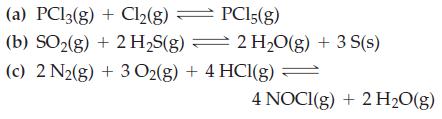
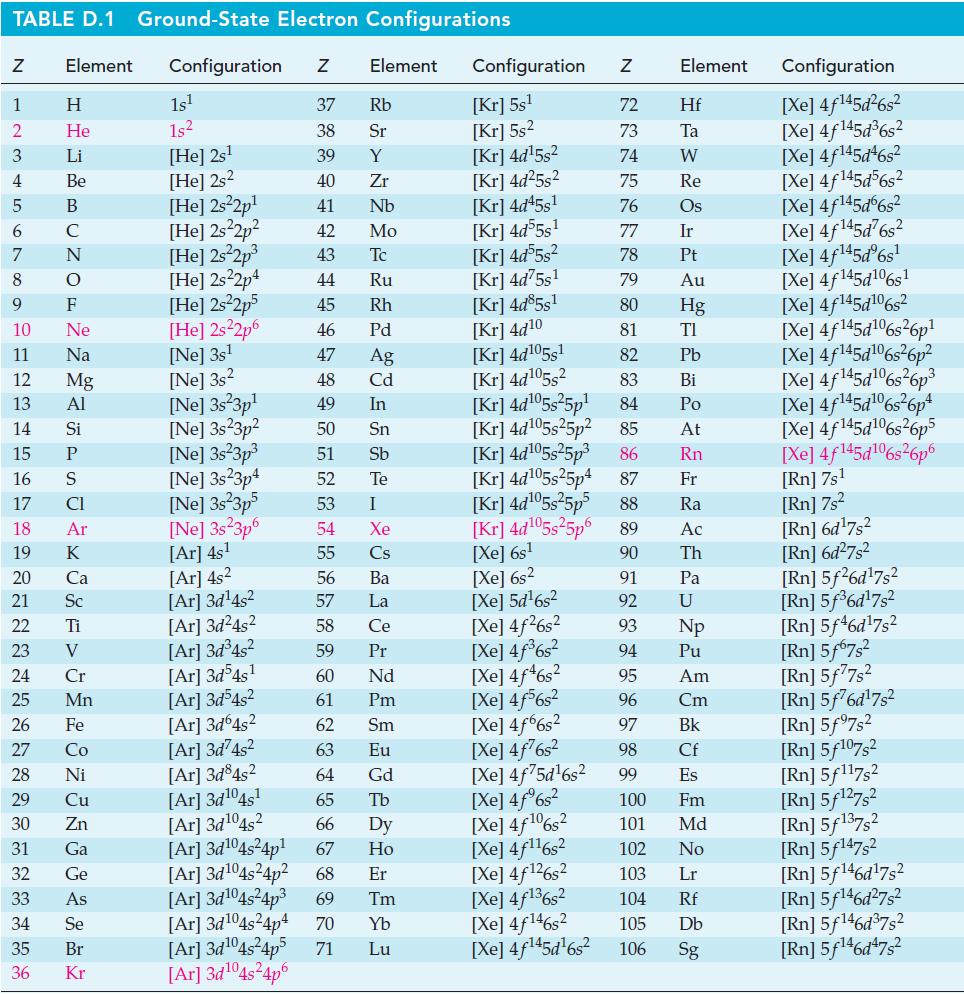
Use data from Appendix D to determine whether the forward reaction is favored by high temperatures or low temperatures. (a) PC13(g) + Cl₂(g) = (b) SO2(g) + 2 H₂S(g) (c) 2 N2(g) + 3 O2(g) + 4 HCl(g) = PC15(g) 2 H₂O(g) + 3 S(s) 4 NOCI(g) + 2 H₂O(g)
In the gas phase, iodine reacts with cyclopentene (C5H8) by a free radical mechanism to produce cyclopentadiene (C5H6) and hydrogen iodide. Explain how each of the following affects the amount of HI(g) present in the equilibrium mixture in the reaction(a) Raising the temperature of the
The reaction N2(g) + O2(g) ⇌ 2 NO(g), ΔrH° = +181 kJ mol-1, occurs in high-temperature combustion processes carried out in air. Oxides of nitrogen produced from the nitrogen and oxygen in air are intimately involved in the production of photochemical smog. What effect does increasing the
If the volume of an equilibrium mixture of N2(g),H2(g), and NH3(g) is reduced by doubling the pressure, will PN2 have increased, decreased, or remained the same when equilibrium is re established? Explain. N2(g) + 3 H₂(g) = 2 NH3(g)
For the reaction(a) Will Kp increase, decrease, or remain constant with temperature? Explain.(b) If a constant-volume mixture at equilibrium at 298 K is heated to 400 K and equilibrium re-established, will the number of moles of D(g) increase, decrease, or remain constant? Explain. 1 A(s) B(s) + 2
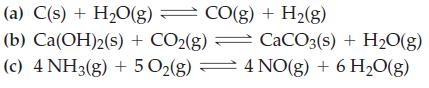
What effect does increasing the volume of the system have on the equilibrium condition in each of the following reactions? (a) C(s) + H₂O(g) = CO(g) + H₂(g) (b) Ca(OH)2(s) + CO2(g) CaCO3(s) + H₂O(g) (c) 4 NH3(g) + 5 O₂(g) 4 NO(g) + 6 H₂O(g)
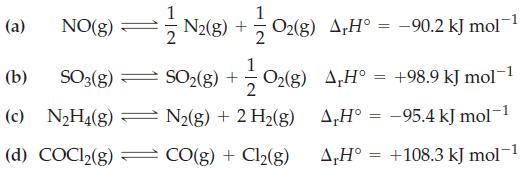
For which of the following reactions would you expect the extent of the forward reaction to increase with increasing temperatures? Explain. (a) NO(g) =// N2(8) + O₂(8) A‚H° = −90.2 KJ mol¯ O₂(g) A,H° +98.9 kJ mol-1 A,H° = -95.4 kJ mol-1 A,Hº +108.3 kJ mol-1 (b) SO3(g) (c) N₂H4(g) (d)
The following reaction represents the binding of oxygen by the protein hemoglobin (Hb):Explain how each of the following affects the amount of Hb:O2:(a) Increasing the temperature; (b) Decreasing the pressure of O2;(c) Increasing the amount of hemoglobin. Hb(aq) + O₂(aq) = Hb:O₂(aq) A,H
In the human body, the enzyme carbonic anahydrase catalyzes the interconversion of CO2 and HCO3- by either adding or removing the hydroxide anion. The overall reaction is endothermic. Explain how the following affect the amount of carbon dioxide:(a) Increasing the amount of bicarbonate anion;(b)
A crystal of dinitrogen tetroxide (melting point, -9.3 °C; boiling point, 21.3 °C) is added to an equilibrium mixture of dintrogen tetroxide and nitrogen dioxide that is at 20.0 °C. Will the pressure of nitrogen dioxide increase, decrease, or remain the same? Explain.
When hydrogen iodide is heated, the degree of dissociation increases. Is the dissociation reaction exothermic or endothermic? Explain.
The standard enthalpy of reaction for the decomposition of calcium carbonate is ΔrH° = 813.5 kJ mol-1. As temperature increases, does the concentration of calcium carbonate increase, decrease, or remain the same? Explain.
The equilibrium constant for the following reaction is K = 6 x 10-16 at 25 °C. What is the concentration of Cu2+(aq) when excess CuS(s) reaches equilibrium with a solution in which [H3O+] = 0.30 M and [H2S] = 0.10 M? CuS(s) + 2 H3O+ (aq) 2+ Cu²+ (aq) + H₂S(aq) + 2 H₂O(l)
Showing 1300 - 1400
of 4008
First
7
8
9
10
11
12
13
14
15
16
17
18
19
20
21
Last
Step by Step Answers

 Get 50% OFF
Claim Now
Get 50% OFF
Claim Now




























![Fe(OH)3 + 3H*(aq) Fe+ (aq) + 3HO(1) = K = 9.1 x 10 and compute the equilibrium concentration for [Fe+] at](https://dsd5zvtm8ll6.cloudfront.net/images/question_images/1700/4/7/4/598655b2ee6cd4111700474598498.jpg)