New Semester
Started
Get
50% OFF
Study Help!
--h --m --s
Claim Now
Question Answers
Textbooks
Find textbooks, questions and answers
Oops, something went wrong!
Change your search query and then try again
S
Books
FREE
Study Help
Expert Questions
Accounting
General Management
Mathematics
Finance
Organizational Behaviour
Law
Physics
Operating System
Management Leadership
Sociology
Programming
Marketing
Database
Computer Network
Economics
Textbooks Solutions
Accounting
Managerial Accounting
Management Leadership
Cost Accounting
Statistics
Business Law
Corporate Finance
Finance
Economics
Auditing
Tutors
Online Tutors
Find a Tutor
Hire a Tutor
Become a Tutor
AI Tutor
AI Study Planner
NEW
Sell Books
Search
Search
Sign In
Register
study help
sciences
general chemistry principles
General Chemistry Principles And Modern Applications 11th Edition Ralph Petrucci, Jeffry Madura, F. Herring, Carey Bissonnette - Solutions
Would you expect that the amount of N2 to increase, decrease, or remain the same in a scuba diver’s body as he or she descends below the water surface?
The equilibrium constant for the following acid–base neutralization reaction is Kc = 1.8 x 10⁹ at 25 °C. What is the equilibrium concentration of CH3COOH if 0.100 moles each of CH3COOH and NaOH are added to water to make 1.0 L of solution at 25 °C? What fraction of the CH3COOH reacts?
For the reaction C2H2(g) + 3 H2(g) ⇌ 2 CH4(g), the equilibrium constant is Kc = 4.9 x 10⁻¹¹ at 1100 K. In an experiment, 0.100 mol C2H2 and 1.00 mol H2 are added to an otherwise empty 5.00 L container, and the temperature is raised to 1100 K. What is the equilibrium concentration of CH4?
The equilibrium constant for the following reaction has been estimated to be K = 1020 at 25 °C. Estimate the equilibrium concentration of NH2- in a solution prepared by dissolving 0.0125 mol NaNH2 in water to make 1.00 L of solution at 25 °C. Is the result physically meaningful? NH₂ (aq) +
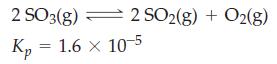
Starting with SO3(g) at 1.00 atm, what will be the total pressure when equilibrium is reached in the following reaction at 700 K?(for pressures in atmospheres). 2SO3(g) Кр - 1.6 × 10-5 = 2 SO2(g) + O2(g)
A 1.100 L flask at 25 °C and 1.00 atm pressure contains CO2(g) in contact with 100.0 mL of a saturated aqueous solution in which [CO2(aq)] = 3.29 x 10⁻² M.(a) What is the value of Kc at 25 °C for the equilibrium CO2(g) ⇌ CO2(aq)?(b) If 0.01000 mol of radioactive 14CO2 is added to the flask, how
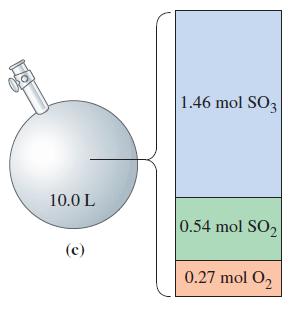
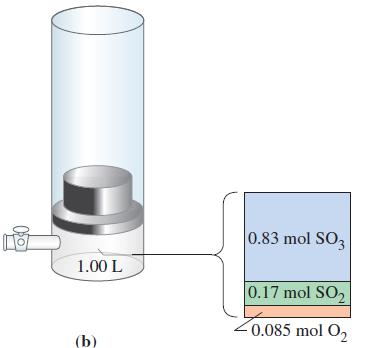
Derive, by calculation, the equilibrium amounts of SO2, O2, and SO3 listed in (a) Figure 15-5(c);(b) Figure 15-6(b).Figure 15-5(c)Figure 15-6(b) 10.0 L (c) 1.46 mol SO3 0.54 mol SO₂ 0.27 mol O₂
A sample of air with a mole ratio of N2 to O2 of 79 : 21 is heated to 2500 K. When equilibrium is established in a closed container with air initially at 1.00 atm, the mole percent of NO is found to be 1.8%. Calculate Kp for the reaction below, assuming pressures are expressed in atmospheres.
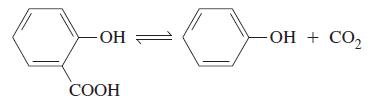
The decomposition of salicylic acid to phenol and carbon dioxide was carried out at 200.0 °C, a temperature at which the reactant and products are all gaseous. A 0.300 g sample of salicylic acid was introduced into a 50.0 mL reaction vessel, and equilibrium was established. The equilibrium mixture
One of the key reactions in the gasification of coal is the methanation reaction, in which methane is produced from synthesis gas—a mixture of CO and H2.(a) Is the equilibrium conversion of synthesis gas to methane favored at higher or lower temperatures? Higher or lower pressures?(b) Assume you
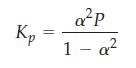
A sample of pure PCl5(g) is introduced into an evacuated flask and allowed to dissociate.If the fraction of PCl molecules that dissociate is denoted by α, and if the total gas pressure is P, show that PC15(g) PC13(g) + Cl₂(g)
Nitrogen dioxide obtained as a cylinder gas is always a mixture of NO2(g) and N2O4(g). A 5.00 g sample obtained from such a cylinder is sealed in a 0.500 L flask at 298 K. What is the mole fraction of NO2 in this mixture? N2O4(g) 2 NO₂(g) Ke 4.61 x 10-³ =
What is the apparent molar mass of the gaseous mixture that results when COCl2(g) is allowed to dissociate at 395 °C and a total pressure of 3.00 atm?Think of the apparent molar mass as the molar mass of a hypothetical single gas that is equivalent to the gaseous mixture. COC12(g) CO(g) +
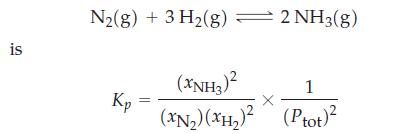
Show that in terms of mole fractions of gases and total gas pressure the equilibrium constant expression for is N₂(g) + 3 H₂(g) = 2 NH3(g) Kp (XNH3)² 1 (XN₂) (XH₂)² (Ptot)²
A mixture of H2S(g) and CH4(g) in the mole ratio 2 : 1 was brought to equilibrium at 700 °C and a total pressure of 1 atm. On analysis, the equilibrium mixture was found to contain 9.54 x 10⁻³ mol H2S. The CS2 present at equilibrium was converted successively to H2SO4 and then to BaSO4 1.42 x 10⁻³
For the synthesis of ammonia at 500 K, N2(g) + 3 H2(g) ⇌ 2 NH3(g), Kp = 9.06 x 10⁻² when the pressures are expressed in atmospheres. Assume that N2 and H2 are mixed in the mole ratio 1 : 3 and that the total pressure is maintained at 1.00 atm. What is the mole percent NH3 at equilibrium?
A solution is prepared having these initial concentrations: [Fe3+] = [Hg22+] = 0.5000 M; [Fe2+] = [Hg2+] = 0.03000 M. The following reaction occurs among the ions at 25 °C.What will be the ion concentrations at equilibrium? 2 Fe³+ (aq) + Hg2²+ (aq) 2 Fe²+ (aq) + 2 Hg2+ (aq) K = 9.14 x 10⁻⁶
Refer to the Integrative Example. A gaseous mixture is prepared containing 0.100 mol each of CH4(g), H2O(g), CO2(g), and H2(g) in a 5.00 L flask. Then the mixture is allowed to come to equilibrium at 1000 K. What will be the equilibrium amount, in moles, of each gas?Integrative ExampleIn the
Concerning the reaction in Exercise 26 and the situation described in part (c) of that exercise, will the mole fraction of C2H2(g) increase, decrease, or remain unchanged when equilibrium is re-established? Explain.Exercise 26At 2000 K, Kc = 0.154 for the reaction 2 CH4(g) ⇌ C2H2(g) + 3 H2(g). If
At 500 K, a 10.0 L equilibrium mixture contains 0.424 mol N2, 1.272 mol H2, and 1.152 mol NH3. The mixture is quickly chilled to a temperature at which the NH3 liquefies, and the NH3(l) is completely removed. The 10.0 L gaseous mixture is then returned to 500 K, and equilibrium is re-established.
For the reaction 2 NO(g) + Cl2(g) ⇌ 2 NOCl(g), Kc = 3.7 x 10⁸ at 298 K. In a 1.50 L flask, there are 4.125 mol of NOCl and 0.1125 mol of Cl2 present at equilibrium (298 K).(a) Determine the partial pressure of NO at equilibrium.(b) What is the total pressure of the system at equilibrium?
Recall the formation of methanol from synthesis gas, the reversible reaction at the heart of a process with great potential for the future production of automotive fuels.A particular synthesis gas consisting of 35.0 mole percent CO(g) and 65.0 mole percent H2(g) at a total pressure of 100.0 atm at
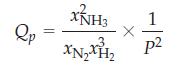
For the reaction N2(g) + 3 H2(g) ⇌ 2 NH3(g), the equilibrium constant is Kp = 36.5 at 400 K. Two separate equilibrium mixtures have the following compositions at 400 K and a total pressure of 1.00 bar.Equilibrium mixture A:0.0424 mol N2 0.136 mol H2 0.176 mol NH3Equilibrium mixture B:0.194 mol N2
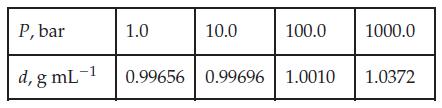
The activity of a pure solid or liquid is approximatelywhere V̅ is the molar volume. For a pure solid or liquid under typical conditions, the quantity V̅(P - P°)/(RT) is quite small, primarily because V̅ is small, and so a ≈ 1. Use the following data, for liquid water at 300 K, to verify that
A classic experiment in equilibrium studies dating from 1862 involved the reaction in solution of ethanol (C2H5OH) and acetic acid (CH3COOH) to produce ethyl acetate and water.The reaction can be followed by analyzing the equilibrium mixture for its acetic acid content.In one experiment, a mixture
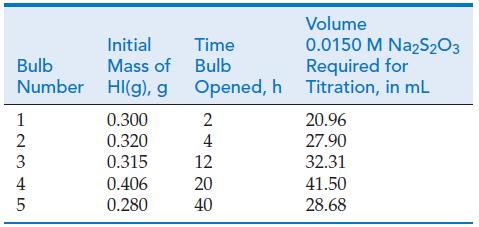
The decomposition of HI(g) is represented by the equationHI(g) is introduced into five identical 400 cm3 glass bulbs, and the five bulbs are maintained at 623 K. Each bulb is opened after a period of time and analyzed for I2 by titration with 0.0150 M Na2S2O3(aq).Data for this experiment are
For a reaction of the form A + B ⇌ C + D, and starting from an initial reaction mixture containing equal amounts of A and B, show that (a) 99.999% of the reactants are consumed if K = 1010 and (b) 99.999% of the reactants remain if K = 10-10.
The following two equilibrium reactions can be written for aqueous carbonic acid, H2CO3(aq):For each reaction write the equilibrium constant expression. By using Le Châtelier’s principle we may naively predict that by adding H2CO3 to the system, the concentration of CO32- would increase. What we
In one of Fritz Haber’s experiments to establish the conditions required for the ammonia synthesis reaction, pure NH3(g) was passed over an iron catalyst at 901 °C and 30.0 atm. The gas leaving the reactor was bubbled through 20.00 mL of a HCl(aq) solution. In this way, the NH3(g) present was
In organic synthesis many reactions produce very little yield, that is K ≪ 1. Consider the following hypothetical reaction: A(aq) + B(aq) → C(aq), K = 1 x 10⁻². We can extract product, C, from the aqueous layer by adding an organic layer in which C(aq) → C(or), K = 15. Given initial
In your own words, define or explain the following H2 terms or symbols: (a) Kp;(b) Qc;(c) Δνgas.
Briefly describe each of the following ideas or phenomena:(a) Dynamic equilibrium; (b) Direction of a net chemical change; (c) Le Châtelier’s principle;(d) Effect of a catalyst on equilibrium.
Explain the important distinctions between each pair of terms: (a) Reaction that goes to completion and reversible reaction; (b) Kc and Kp; (c) Reaction quotient (Q) and equilibrium constant expression (K);(d) Homogeneous and heterogeneous reaction.
In the reversible reaction H2(g) + I2(g) ⇌ 2 HI(g), an initial mixture contains 2 mol H2 and 1 mol I2. The amount of HI expected at equilibrium is (a) 1 mol; (b) 2 mol; (c) Less than 2 mol; (d) More than 2 mol but less than 4 mol.
Equilibrium is established in the reaction 2 SO2(g) + O2(g) ⇌ 2 SO3(g) at a temperature where Kc = 100. If the number of moles of SO3(g) in the equilibrium mixture is the same as the number of moles of SO2(g), (a) The number of moles of O2(g) is also equal to the number of moles of SO2(g);(b)
The volume of the reaction vessel containing an equilibrium mixture in the reaction SO2Cl2(g) ⇌ SO2(g) + Cl2(g) is increased. When equilibrium is re-established, (a) The amount of Cl2 will have increased; (b) The amount of SO2 will have decreased;(c) The amounts of SO2 and Cl2 will have
For the reaction 2 NO2(g) ⇌ 2 NO(g) + O2(g), Kc = 1.8 x 10⁻⁶ at 184 °C. At 184 °C, the value of Kc for the reaction NO(g) + 1/2 O2(g) ⇌ NO2(g) is (a) 0.9 x 10⁶;(b) 7.5 x 10²;(c) 5.6 x 10⁵;(d) 2.8 x 10⁵.
For the dissociation reaction 2 H2S(g) ⇌ 2 H2(g) + S2(g), Kp = 1.2 x 10⁻² at 1065 °C. For this same reaction at 1000 K, (a) Kc is less than Kp;(b) Kc is greater than Kp;(c) Kc = Kp;(d) Whether Kc is less than, equal to, or greater than Kp depends on the total gas pressure.
The following data are given at 1000 K: CO(g) + H2O(g) ⇌ CO2(g) + H2(g); ΔrH° = -42 kJ mol-1; Kc = 0.66. After an initial equilibrium is established in a 1.00 L container, the equilibrium amount of H2 can be increased by (a) Adding a catalyst; (b) Increasing the temperature; (c) Transferring
The Deacon process for producing chlorine gas from hydrogen chloride is used in situations where HCl is available as a by-product from other chemical processes.A mixture of HCl, O2, H2O, and Cl2 is brought to equilibrium at 400 °C. What is the effect on the equilibrium amount of Cl2(g) if (a)
Equilibrium is established in the reversible reaction 2 A + B ⇌ 2 C. The equilibrium concentrations are [A] = 0.55 M, [B] = 0.33 M, [C] = 0.43 M. What is the value of for this reaction?
For the reaction SO2(g) ⇌ SO2(aq), K = 1.25 at 25 °C. Will the amount of SO2(g) be greater than or less than the amount of SO2(aq)?
An equilibrium mixture of SO2, SO3, and O2 gases is maintained in a 2.05 L flask at a temperature at which Kc = 35.5 for the reaction (a) If the numbers of moles of SO2 and SO3 in the flask are equal, how many moles of O2 are present?(b) If the number of moles of SO3 in the flask is twice the
In the reaction H2O2(g) ⇌ H2O2(aq), K = 1.0 x 10⁵ at 25 °C. Would you expect a greater amount of product or reactant?
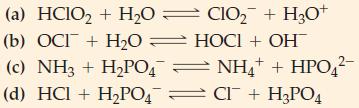
For each of the following reactions, which occur in aqueous solution, identify the acids and bases in both the forward and reverse reactions. (a) HCIO₂ + H₂O (b) OCI + H₂O (c) NH3 + H₂PO4NH₂+ (d) HCl + H₂PO4 = CI + H3PO4 CIO₂ + H₂O+ HOCI + OH + HPO4²-
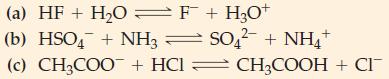
(A) For each of the following reactions, identify the acids and bases in both the forward and reverse directions.(B) Of the following species, one is acidic, one is basic, and one is amphiprotic in their reactions with water: HNO2, PO43- and HCO3-. Write the four equations needed to represent these
Is it appropriate to describe each of the following as a conjugate acid–base pair? Explain. (a) HCO3- and CO32-; (b) HSO3- and SO42-; (c) H2CO3 and H2C2O4;(d) HClO and ClO-; (e) H2S and S2-.
According to the Brønsted–Lowry theory, label each of the following as an acid or a base. (a) HNO2;(b) OCl-;(c) NH-;(d) NH4+;(e) CH3NH3+.
In a laboratory experiment at 25 °C, students measured the pH of samples of rainwater and household ammonia. Determine (a) [H3O+] in the rainwater, with pH measured at 4.35; (b) [OH-] in the ammonia, with pH measured at 11.28.
At 40 °C, Kw = 2.88 x 10⁻¹⁴. If the pH of a solution is 7.00 at 40 °C, is the solution acidic, basic, or neutral?
(A) Students found that a yogurt sample had a pH of 2.85. What are the [H3O+] and [OH-] of the yogurt?(B) The pH of a solution of acid is found to be 5.50 at 25 °C. What are [H3O+] and [OH-] in this solution? What percentage of the H3O+ in this solution is produced by the self-ionization of water?
Write the formula of the conjugate base in the reaction of each acid with water. (a) HIO3; (b) C6H5COOH;(c) HPO42-;(d) C2H5NH3+.
Is it possible for a weak acid solution to have a lower pH than a strong acid solution? If not, why not? If it is possible, under what conditions?
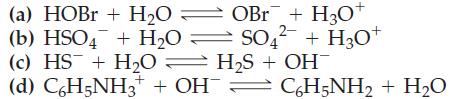
For each of the following, identify the acids and bases involved in both the forward and reverse directions. (a) HOBr + H₂O = (b) HSO4 + H₂O = OBr + SO4² SO4² H₂O* H3O+ + H3O+ (c) HS + H₂O = H₂S + OH¯ (d) C6H5NH3 + OHC₂H5NH₂ + H₂O
(A) For HNO3, Ka has a value of about 20 at 25 °C. What is the degree of ionization of HNO3 in 0.010 M HNO3(aq) at 25 °C?(B) For hypochlorous acid, HOCl, Ka = 2.9 x 10⁻⁸ at 25 °C. What is the degree of ionization of HOCl in 0.010 M HOCl(aq) at 25 °C? What is the pH of this solution?
What is the percent ionization of acetic acid, CH3COOH, in 1.0 M, 0.10 M, and 0.010 M CH3COOH?
You are given two bottles, each of which contains a 0.1 M solution of an unidentified acid. One bottle is labeled Ka = 7.2 x 10⁻⁴, and the other is labeled Ka = 1.9 x 10⁻⁵. Which bottle contains the more acidic solution? Which bottle has the acid with the larger pKa?
(A) What is the percent ionization of hydrofluoric acid in 0.20 M HF and in 0.020 M HF?(B) In a 0.0284 M aqueous solution of lactic acid, a carboxylic acid that accumulates in the blood and muscles during physical activity, the acid is found to be 6.7% ionized. Determine Ka for lactic acid.
Which of the following species are amphiprotic in aqueous solution? For such a species, write one equation showing it acting as an acid, and another equation showing it acting as a base. OH-, NH4+, H2O, HS-, NO2-, HCO3-, HBr.
Calculate [H3O+], [Cl-], and [OH-] in 0.015 M HCl(aq).
Write material and charge balance equations for(a) 0.010 M H2SO4;(b) 0.025 M NH3.
With which of the following bases will the ionization of acetic acid, CH3COOH, proceed furthest toward completion (to the right)? Explain your answer.(a) H2O;(b) NH3;(c) Cl-;(d) NO3-.
(A) A 0.0025 M solution of HI(aq) has [H3O+] = 0.0025 M. Calculate [I-], [OH-], and the pH of the solution.(B) If 535 mL of gaseous HCl, at 26.5 °C and 747 mmHg, is dissolved in enough water to prepare 625 mL of solution, what is the pH of this solution?
Calcium hydroxide (slaked lime), Ca(OH)2, is the cheapest strong base available. It is generally used for industrial operations in which a high concentration of OH- is not required. Ca(OH)2(s) is soluble in water only to the extent of 0.16 g Ca(OH)2/100.0 mL solution at 25 °C. What is the pH of
A handbook that lists only pKa values for weak electrolytes has the following entry for 1,2-ethanediamine, NH2CH2CH2NH2: pK1 = 6.85(+2); pK2 = 9.92(+1), and 2-aminopropanoic acid, NH2CH(CH3)COOH: pK1 = 2.34(+1); pK2 = 9.87(0). Interpret these handbook entries by writing equations for the ionization
(A) Hypochlorous acid, HOCl, is used in water treatment and as a disinfectant in swimming pools. A 0.150 M solution of HOCl has a pH of 4.18. Determine Ka for hypochlorous acid.(B) The much-abused drug cocaine is an alkaloid. Alkaloids are noted for their bitter taste, an indication of their basic
(A) Milk of magnesia is a saturated solution of Mg(OH)2 Its solubility is 9.63 mg Mg(OH)2/100.0 mL solution at 20 °C. What is the pH of saturated Mg(OH)2 at 20 °C?(B) Calculate the pH of an aqueous solution that is 3.00% KOH, by mass, and has a density of 1.0242 g/mL.
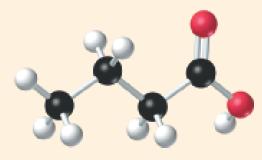
Butyric acid, CH3(CH2)2COOH, is used to make compounds employed in artificial flavorings and syrups. A 0.250 M aqueous solution of butyric acid is found to have a pH of 2.72. Determine Ka for butyric acid. CH3(CH₂)2COOH + H₂O H3O+ + CH3(CH₂)₂COO™ K₁ = ? Ka
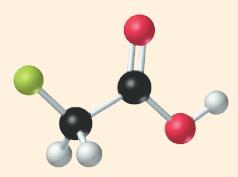
(A) Substituting halogen atoms for hydrogen atoms bound to carbon increases the strength of carboxylic acids. Show that the pH of 0.100 M CH2FCOOH, fluoroacetic acid, is lower than that calculated in Example 16-8 for 0.100 M CH3COOH.(B) Acetylsalicylic acid, C6H4(OOCCH3)COOH, is an organic acid
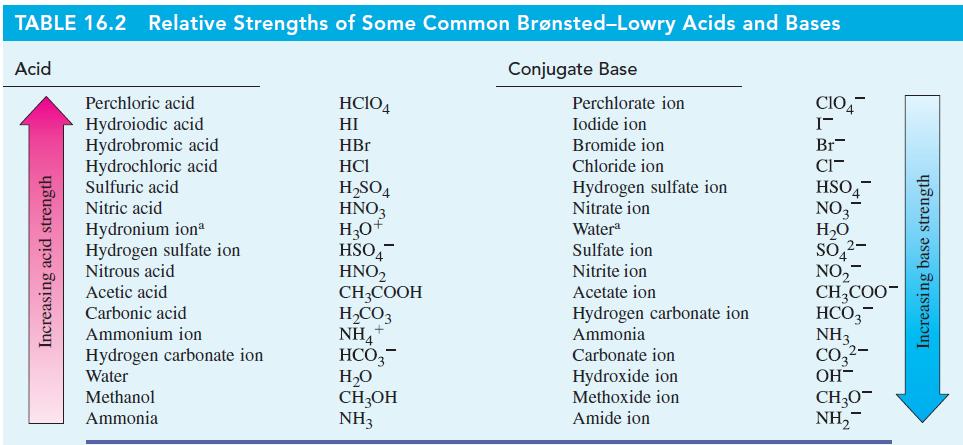
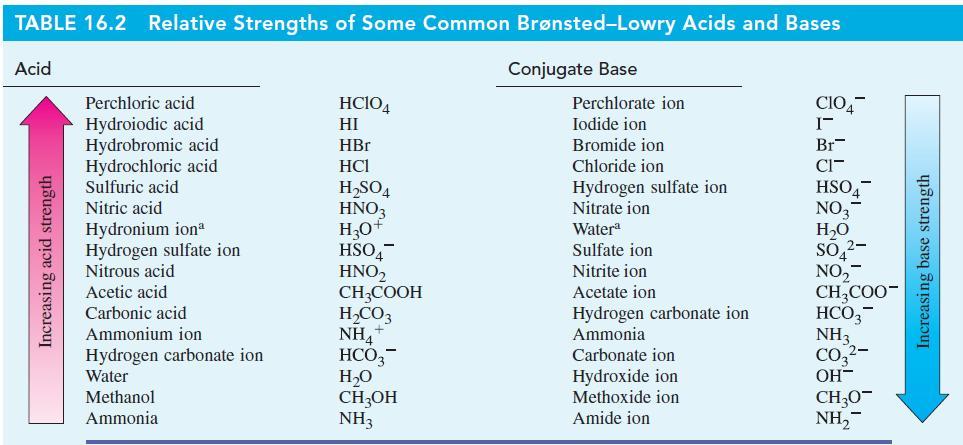
With the aid of Table 16.2, predict the direction (forward or reverse) favored in each of the following acid–base reactions.Table 16.2 (a) NH4+ + OH = H₂O + NH3 (b) HSO4 + NO3 HNO3 + SO4²- (c) CH3OH + CH3COOCH3COOH + CH3O
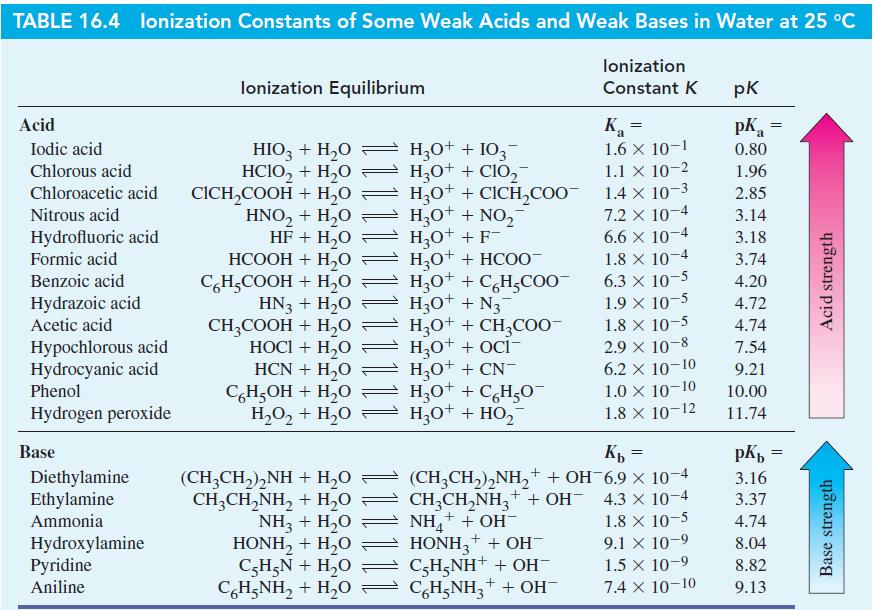
The equation representing the neutralization of acetic acid, CH3COOH, by a base B is CH3COOH(aq) + B(aq) ⇌ CH3COO-(aq) + BH+(aq). Of the bases listed in Table 16.4, which would be effective for neutralizing essentially all of the CH3COOH in a sample, assuming that CH3COOH and B are initially
Write a chemical equation showing how an HCO3- ion can act as both an acid and a base in aqueous solution. Without doing any pH calculations, determine whether 0.10 M NaHCO3 is acidic, basic, or pH neutral. What about 0.10 M Na2CO3?
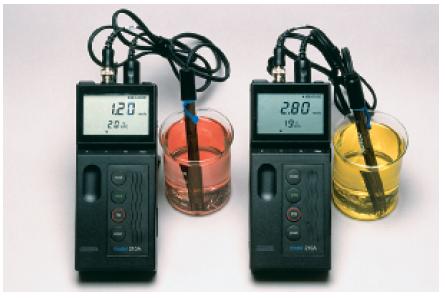
Show by calculation that the pH of 0.100 M CH3COOH should be about the value shown on the pH meter in Figure 16-6; that is, pH ≈ 2.8.Figure 16-6 1.20 20 2.80. 19
With the aid of Table 16.2, predict the direction (forward or reverse) favored in each of the following acid–base reactions.Table 16.2 (a) CH3COOH + CO3²- = HCO3 + CH3COO (b) HNO₂ + ClO4 2- HCIO4 + NO₂ HCO3 + HCO3 (c) H₂CO3 + CO3²
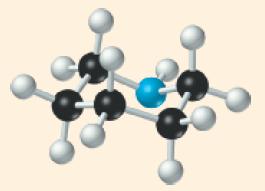
(A) What is the pH of 0.015 M CH2FCOOH(aq)?(B) Piperidine is a base found in small amounts in black pepper. What is the pH of 315 mL of an aqueous solution containing 114 mg piperidine? CH₂FCOOH + H₂O — H₂O* + CH₂FCOO™ K₂ = 2.6 × 10⁻³ -
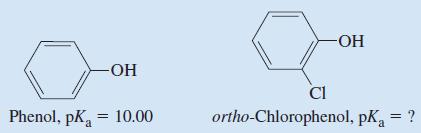
Would you expect pKa of ortho-chlorophenol to be greater than, less than, or nearly the same as that of phenol? Explain. Phenol, pK₁ -ОН = 10.00 -ОН Cl ortho-Chlorophenol, pka = ?
What is the pH of a solution that is 0.00250 M CH3NH2(aq)? For methylamine, Kb = 4.2 x 10⁻⁴.
(A) Malonic acid, HOOCCH2COOH, is a diprotic acid used in the manufacture of barbiturates.(B) Oxalic acid, found in the leaves of rhubarb and other plants, is a diprotic acid. Kal + H₂O → H3O+ + HOOCCH₂COO™ + H₂O ⇒ H3O+ + ¯OOCCH₂COO™ Ka₂ = 2.0 × 10⁻⁶ Calculate [H3O+],
Calculate [H3O+] and [OH-] for each solution:(a) 0.00165 M HNO3; (b) 0.0087 M KOH; (c) 0.00213 M Sr(OH)2;(d) 5.8 x 10⁻⁴ M HI.
For a 3.0 M H3PO4 solution, calculate (a) [H3O+]; (b) [H2PO4-];(c) [HPO42-];(d) [PO43-].
Liquid bromine in the presence of iron(III) tribromide forms a bromonium: iron(III) tribromide adduct. Propose a plausible mechanism for adduct formation and identify the Lewis acid and Lewis base.
What is the pH of each of the following solutions?(a) 0.0045 M HCl; (b) 6.14 x 10⁻⁴ M HNO3;(c) 0.00683 M NaOH; (d) 4.8 x 10⁻³ M Ba(OH)2.
Calculate [H3O+] and pH in saturated Ba(OH)2(aq), which contains 3.9 g Ba(OH)2 · 8 H2O per 100 mL of solution.
Calculate [H3O+], [HSO4-] and [SO42-] in 0.50 M H2SO4.
A saturated aqueous solution of Ca(OH)2 has a pH of 12.35. What is the solubility of Ca(OH)2, expressed in milligrams per 100 mL of solution?
(A) Predict whether each of the following 1.0 M solutions is acidic, basic, or pH neutral:(a) CH3NH3+NO3-(aq); (b) NaI(aq); (c) NaNO2(aq).(B) Write equations for two reactions of H2PO4- with water, and explain which reaction occurs to the greater extent.
Predict whether each of the following solutions is acidic, basic, or pH neutral: (a) NaOCl(aq); (b) KCl(aq);(c) NH4NO3(aq).
What is [H3O+] in a solution obtained by dissolving 205 mL HCl(g), measured at 23 °C and 751 mmHg, in 4.25 L of aqueous solution?
(A) The organic bases cocaine (pKb = 8.41) and codeine (pKb = 7.95) react with hydrochloric acid to form salts (similar to the formation of NH4Cl by the reaction of NH3 and HCl). If solutions of the following salts have the same molarity, which solution would have the higher pH: cocaine
Both sodium nitrite, NaNO2, and sodium benzoate, NaC6H5COO, are used as food preservatives. If separate solutions of these two salts have the same molarity, which solution will have the higher pH?
What is the pH of the solution obtained when 125 mL of 0.606 M NaOH is diluted to 15.0 L with water?
Sodium cyanide, NaCN, is extremely poisonous, but it has very useful applications in gold and silver metallurgy and in the electroplating of metals. Aqueous solutions of cyanides are especially hazardous if they become acidified, because toxic hydrogen cyanide gas, HCN(g), is released. Are NaCN(aq)
How many milliliters of concentrated HCl(aq) (36.0% HCl by mass, d = 1.18 g/mL) are required to produce 12.5 L of a solution with pH = 2.10?
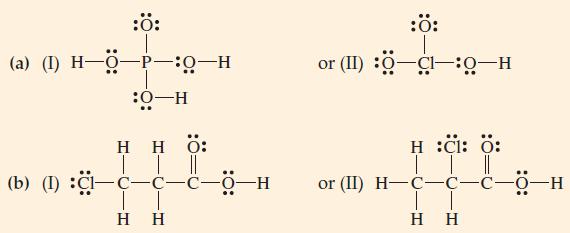
Explain which member of each of the following pairs is the stronger acid. :Ö: (a) (I) H-0-P-0-H :0-H .. Η Η ö: (b) (I) :C-c-c-C-0-H Η Η :Ö: or (II) :O-C-:0-H H:Cl: 5: or (II) H-C-C-C-0-H Η Η
(A) Explain which is the stronger acid, HNO3 or HClO4; CH2FCOOH or CH2BrCOOH.(B) Explain which is the stronger acid, H3PO4 or H2SO3; CCl3CH2COOH or CCl2FCH2COOH.
(A) Identify the Lewis acids and bases in these reactions.(B) Identify the Lewis acids and bases in these reactions. (a) BF3 + NH3 (b) Cr³+ + 6H₂O F3BNH3 [Cr(H₂O)6]³+
How many milliliters of a 15.0%, by mass solution of KOH(aq) (d = 1.14 g/mL) are required to produce 25.0 L of a solution with pH = 11.55?
What volume of 6.15 M HCl(aq) is required to exactly neutralize 1.25 L of 0.265 M NH3(aq)? NH3(aq) + H3O+ (aq) NH4+ (aq) + H₂O(1)
A 28.2 L volume of HCl(g), measured at 742 mmHg and 25.0 °C, is dissolved in water. What volume of NH3(g), measured at 762 mmHg and 21.0 °C, must be absorbed by the same solution to neutralize the HCl?
What are the [H3O+] and pH of 0.143 M HNO2?
Showing 1400 - 1500
of 4008
First
8
9
10
11
12
13
14
15
16
17
18
19
20
21
22
Last
Step by Step Answers

 Get 50% OFF
Claim Now
Get 50% OFF
Claim Now















![a = "V(P - P)` P] RT expl](https://dsd5zvtm8ll6.cloudfront.net/images/question_images/1700/4/8/4/480655b5580188e01.png)
















![Kal + HO H3O+ + HOOCCHCOO + HO H3O+ + OOCCHCOO Ka = 2.0 10-6 Calculate [H3O+], [HOOCCHCOO], and](https://dsd5zvtm8ll6.cloudfront.net/images/question_images/1700/5/5/0/340655c56c4d0fd81700550339629.jpg)
![HCO4 + HO HC04 + H0 H3O+ + HC04 H3O+ + C0 An aqueous solution that is 1.05 M HCO4 has pH is [C04] = 5.3 x](https://dsd5zvtm8ll6.cloudfront.net/images/question_images/1700/5/5/0/366655c56de01f6d1700550364764.jpg)
![(a) BF3 + NH3 (b) Cr+ + 6HO F3BNH3 [Cr(HO)6]+](https://dsd5zvtm8ll6.cloudfront.net/images/question_images/1700/5/5/0/965655c5935a4ae31700550964428.jpg)
![(a) Al(OH)3 + OH - [Al(OH)4] (b) SnCl4 + 2 CI [SnC16]-](https://dsd5zvtm8ll6.cloudfront.net/images/question_images/1700/5/5/0/984655c5948b2fe91700550983479.jpg)



