New Semester
Started
Get
50% OFF
Study Help!
--h --m --s
Claim Now
Question Answers
Textbooks
Find textbooks, questions and answers
Oops, something went wrong!
Change your search query and then try again
S
Books
FREE
Study Help
Expert Questions
Accounting
General Management
Mathematics
Finance
Organizational Behaviour
Law
Physics
Operating System
Management Leadership
Sociology
Programming
Marketing
Database
Computer Network
Economics
Textbooks Solutions
Accounting
Managerial Accounting
Management Leadership
Cost Accounting
Statistics
Business Law
Corporate Finance
Finance
Economics
Auditing
Tutors
Online Tutors
Find a Tutor
Hire a Tutor
Become a Tutor
AI Tutor
AI Study Planner
NEW
Sell Books
Search
Search
Sign In
Register
study help
sciences
general chemistry principles
General Chemistry Principles And Modern Applications 11th Edition Ralph Petrucci, Jeffry Madura, F. Herring, Carey Bissonnette - Solutions
(A) What is the molar solubility of PbI2 in 0.10 M Pb(NO3)2(aq)? To which ion concentration should the solubility be related?(B) What is the molar solubility of Fe(OH)3 in a buffered solution with pH = 8.20?
Three drops of 0.20 M KI are added to 100.0 mL of 0.010 M Pb(NO3)2. Will a precipitate of lead(II) iodide form? (Assume 1 drop = 0.05 mL.) Pbl₂(s) — Pb²+ (aq) + 21¯(aq) Ksp = 7.1 × 10-⁹
Determine [Mg2+] in a saturated solution of Mg(OH)2 at (a) pH = 10.00 and (b) pH = 5.00. Is each of these a plausible quantity? Explain.
(A) Three drops of 0.20 M KI are added to 100.0 mL of a 0.010 M solution of AgNO3. Will a precipitate of silver iodide form?(B) We saw in Example 18-5 that a 3-drop volume of 0.20 M KI is insufficient to cause precipitation in 100.0 mL of 0.010 M Pb(NO3)2. What minimum number of drops would be
The first step in a commercial process in which magnesium is obtained from seawater involves precipitating Mg2+ as Mg(OH)2(s). The magnesium ion concentration in seawater is about 0.059 M. If a seawater sample is treated so that its [OH-] is maintained at 2.0 x 10⁻³ M,(a) What will be [Mg2+]
The measured molar solubility of AgCl in water is 1.3 x 10⁻⁵ M. In the presence of Cl-(aq) as a common ion at different concentrations, the measured solubilities of AgCl are as listed below.[Cl-], M: 0.0039 0.036 0.35 1.4 2.9 3.8 Solubility of AgCl, M: 7.2 x
(A) A typical Ca2+ concentration in seawater is 0.010 M. Will the precipitation of Ca(OH)2 be complete from a seawater sample in which [OH-] is maintained at 0.040 M?(B) What [OH-] should be maintained in a solution if, after precipitation of Mg2+ as Mg(OH)2(s), the remaining Mg2+ is to be at a
AgNO3(aq) is slowly added to a solution that has [CrO42-] = 0.010 M and [Br-] = 0.010 M.(a) Show that AgBr(s) should precipitate before Ag2CrO4(s) does.(b) When Ag2CrO4(s) begins to precipitate, what is [Br-] remaining in solution?(c) Is complete separation of Br-(aq) and CrO42-(aq) by fractional
(A) AgNO3(aq) is slowly added to a solution with [CI-] = 0.115 M and [Br-] = 0.264 M. What percent of the Br- remains unprecipitated at the point at which AgCl(s) begins to precipitate?(B) A solution has [Ba2+] = [Sr2+] = 0.10 M. Use data from Appendix D to choose the best precipitating agent to
An unknown contains one or more of Pb2+, Hg22+, and Ag+. It forms a white precipitate with HCl(aq). The precipitate is treated with hot water, yielding a solution that gives a yellow precipitate with K2CrO4(aq). There is no change in color when the undissolved portion of the precipitate is treated
Should Mg(OH)2(s) precipitate from a solution that is 0.010 M MgCl2 and also 0.10 M NH3?
The dissolution of PbS(s) in water is given byIn an apparent violation of Le Châtelier’s principle, the addition of NaOH to the solution leads more PbS to dissolve. Explain. PbS(s) + H₂O(1) Pb²+(aq) + HS¯ + OH¯(aq)
(A) Should Mg(OH)2(s) precipitate from a solution that is 0.010 M MgCl2(aq) and also 0.10 M NaCH3COO? Ksp[Mg(OH)2] = 1.8 x 10⁻¹¹; Ka(CH3COOH) = 1.8 x 10⁻⁵. What equilibrium expression establishes [OH-] in the solution?(B) Will a precipitate of Fe(OH)3 form from a solution that is 0.013 M Fe3+ in a
What [NH4+] must be maintained to prevent precipitation of Mg(OH)2(s) from a solution that is 0.010 M MgCl2 and 0.10 M NH3?
Both Cu2+ and Ag+ are present in the same aqueous solution. Explain which of the following reagents would work best in separating these ions, precipitating one and leaving the other in solution: (NH4)2CO3(aq), HNO3(aq), H2S(aq), HCl(aq), NH3(aq), or NaOH(aq).
(A) What minimum [NH4+] must be present to prevent precipitation of Mn(OH)2(s) from a solution that is 0.0050 M MnCl2 and 0.025 M NH3? For Mn(OH)2, Ksp = 1.9 x 10⁻¹³.(B) What is the molar solubility of Mg(OH)2(s) in a solution that is 0.250 M NH3 and 0.100 M NH4Cl? Use equation (18.4).Eq. 18.4
Predict what will happen if nitric acid is added to a solution of [Ag(NH3)2]Cl in NH3(aq).
(A) Copper(II) ion forms both an insoluble hydroxide and the complex ion [Cu(NH3)4]2+. Write equations to represent the expected reaction when (a) CuSO4(aq) and NaOH(aq) are mixed; (b) An excess of NH3(aq) is added to the product of part (a); and (c) An excess of HNO3(aq) is added to the product
A 0.10 mol sample of AgNO3 is dissolved in 1.00 L of 1.00 M NH3. If 0.010 mol NaCl is added to this solution, will AgCl(s) precipitate?
(A) Will AgCl(s) precipitate from 1.50 L of a solution that is 0.100 M AgNO3 and 0.225 M NH3 if 1.00 mL of 3.50 M NaCl is added? What are [Ag+] and [Cl-] immediately after the addition of the 1.00 mL of 3.50 M NaCl? Take into account the dilution of the NaCl(aq), but assume the total volume remains
What is the minimum concentration of NH3 needed to prevent AgCl(s) from precipitating from 1.00 L of a solution containing 0.10 mol AgNO3 and 0.010 mol NaCl?
(A) What [NH3]tot is necessary to keep AgCl from precipitating from a solution that is 0.13 M AgNO3 and 0.0075 M NaCl?(B) What minimum concentration of thiosulfate ion, S2O32-, should be present in 0.10 M AgNO3(aq) so that AgCl(s) does not precipitate when the solution is also made 0.010 M in Cl-?
What is the molar solubility of AgCl in 0.100 M NH3(aq)?
(A) What is the molar solubility of Fe(OH)3 in a solution containing 0.100 M C2O42-? For [Fe(C2O4)3]3-, Kf = 2 x 10²⁰.(B) Without doing detailed calculations, show that the order of decreasing solubility in 0.100 M NH3(aq) should be AgCl > AgBr > AgI.
Show that PbS(s) will precipitate but FeS(s) will not precipitate from a solution that is 0.010 M in Pb2+, 0.010 M in Fe2+, saturated in H2S (0.10 M H2S), and maintained with [H3O+] = 0.30 M. For PbS, Kspa = 3 x 10⁻⁷; for FeS, Kspa = 6 x 10².
(A) Show that Ag2S(s) (Kspa = 6 x 10-30) should precipitate and that FeS(s) Kspa = 6 x 10²) should not precipitate from a solution that is 0.010 M Ag+ and 0.020 M Fe2+, but otherwise under the same conditions as in Example 18-14.Example 18-14Show that PbS(s) will precipitate but FeS(s) will not
(A) Heavy fertilizer use can lead to phosphate pollution in lakes, causing an explosion of plant growth, particularly algae. Excess algae deplete the lake of the oxygen necessary for other plant growth and animal life. A lake in the middle of a large farm was found to contain the phosphate ion in
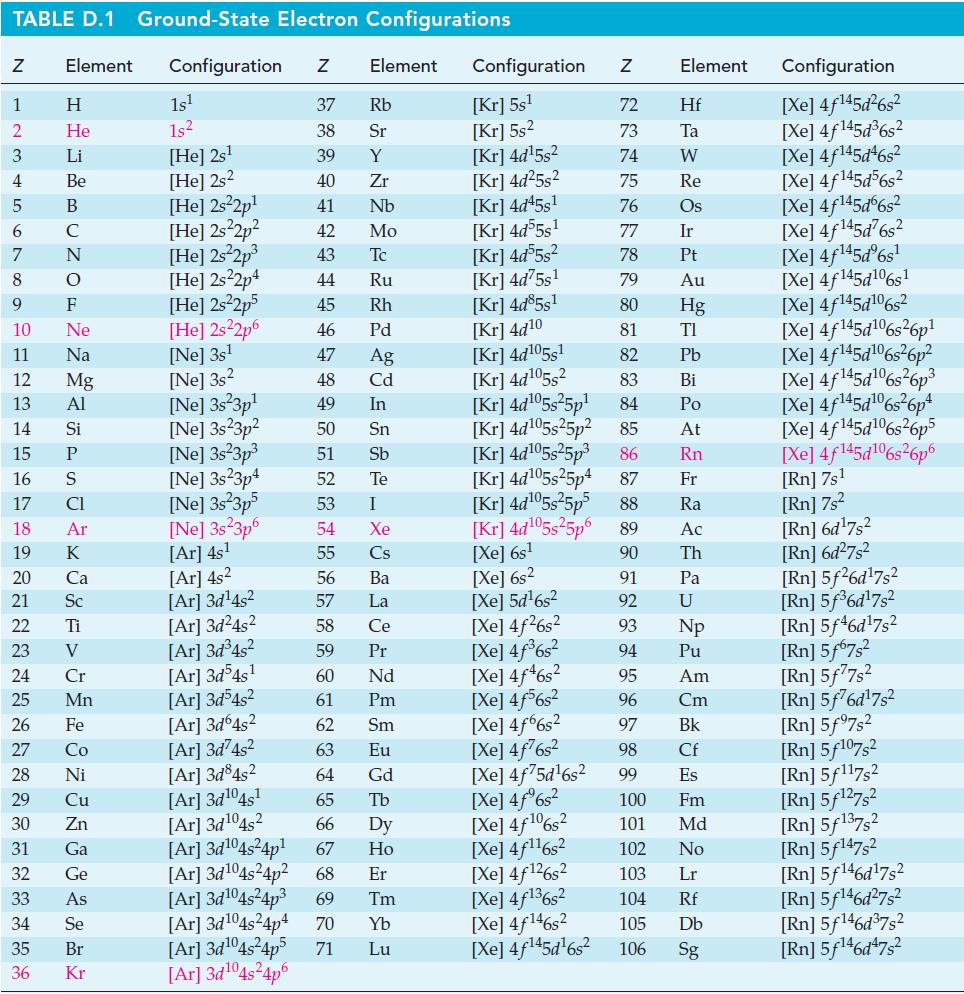
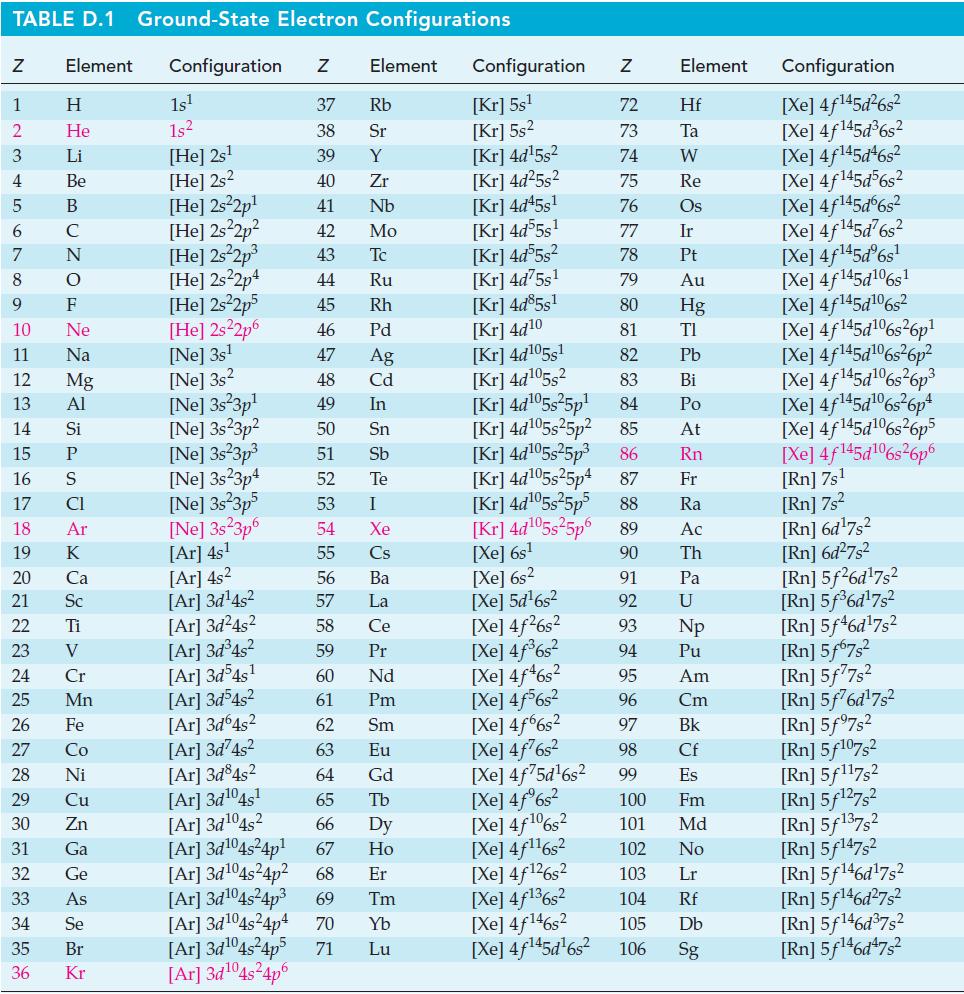
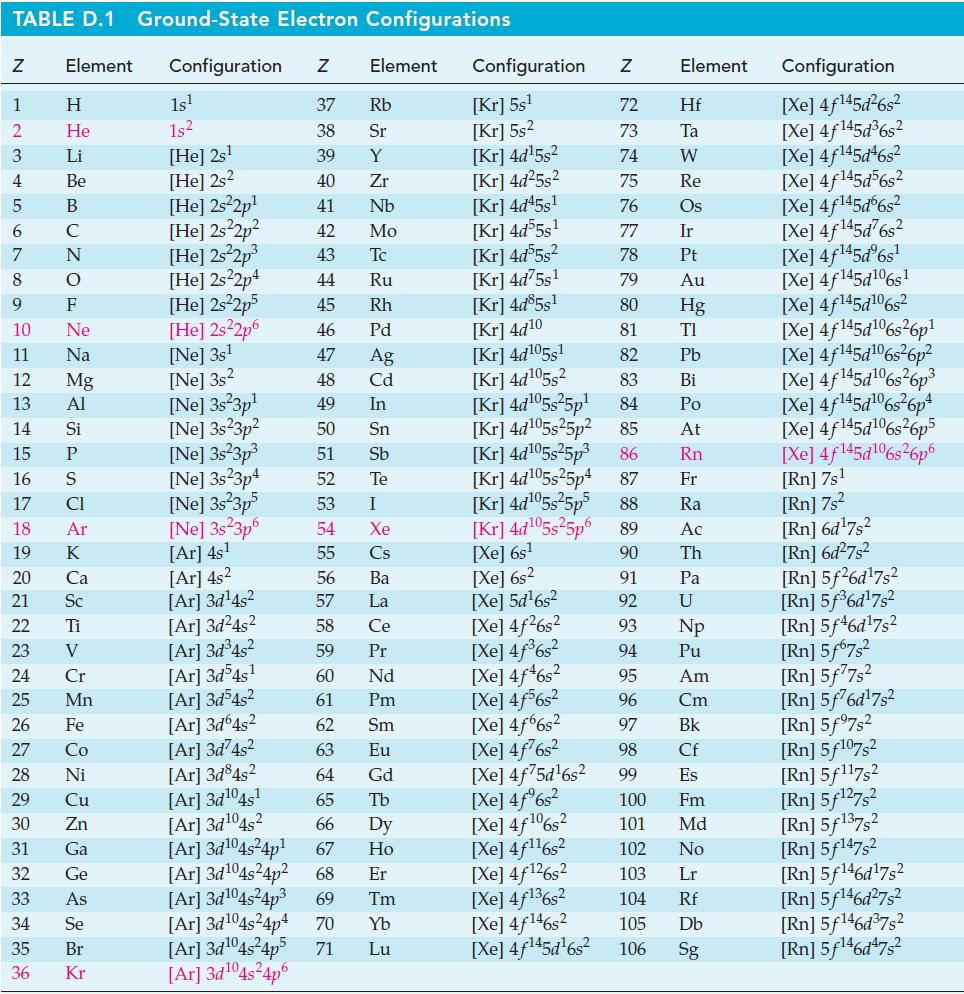
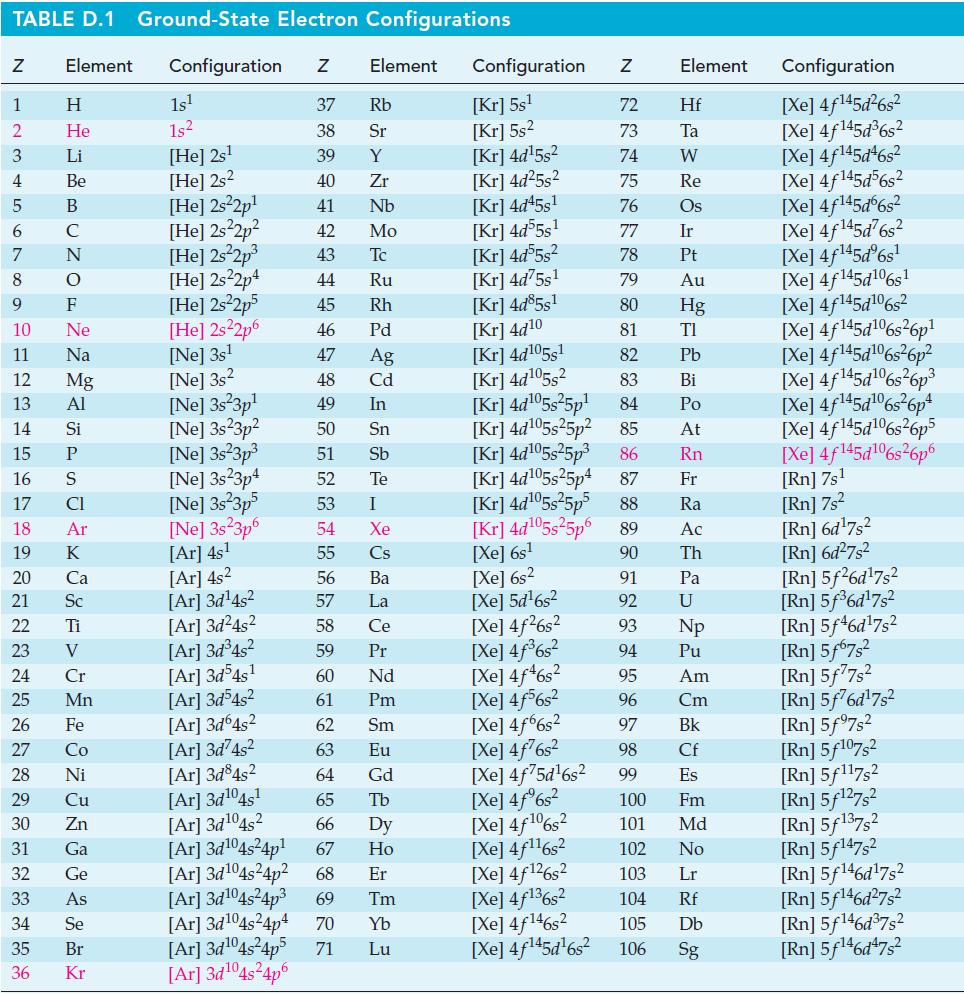
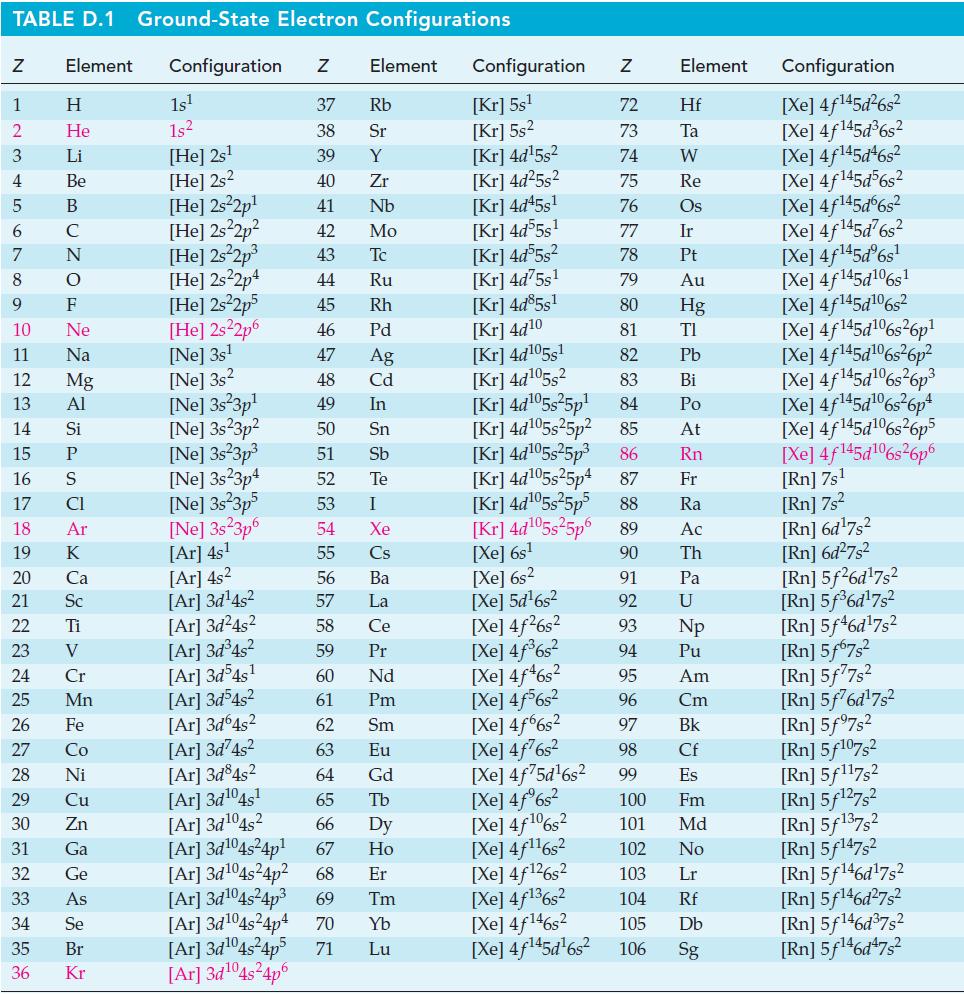
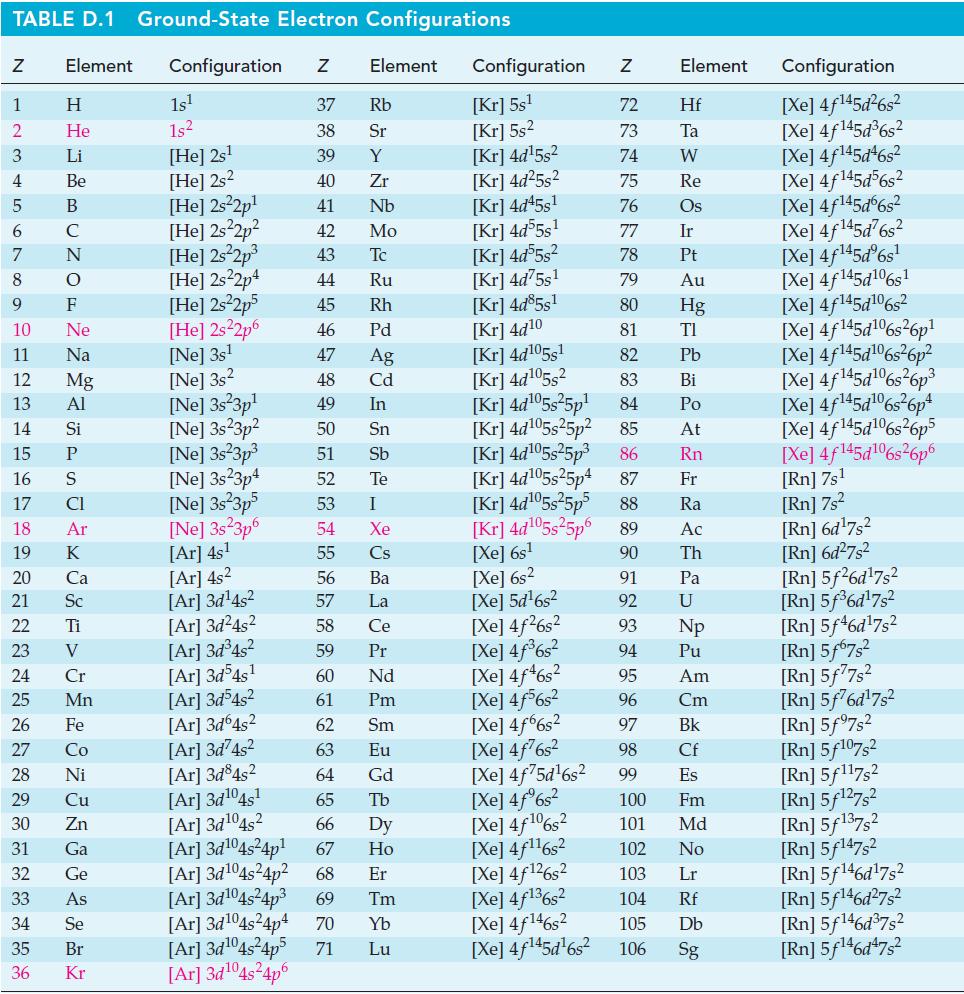
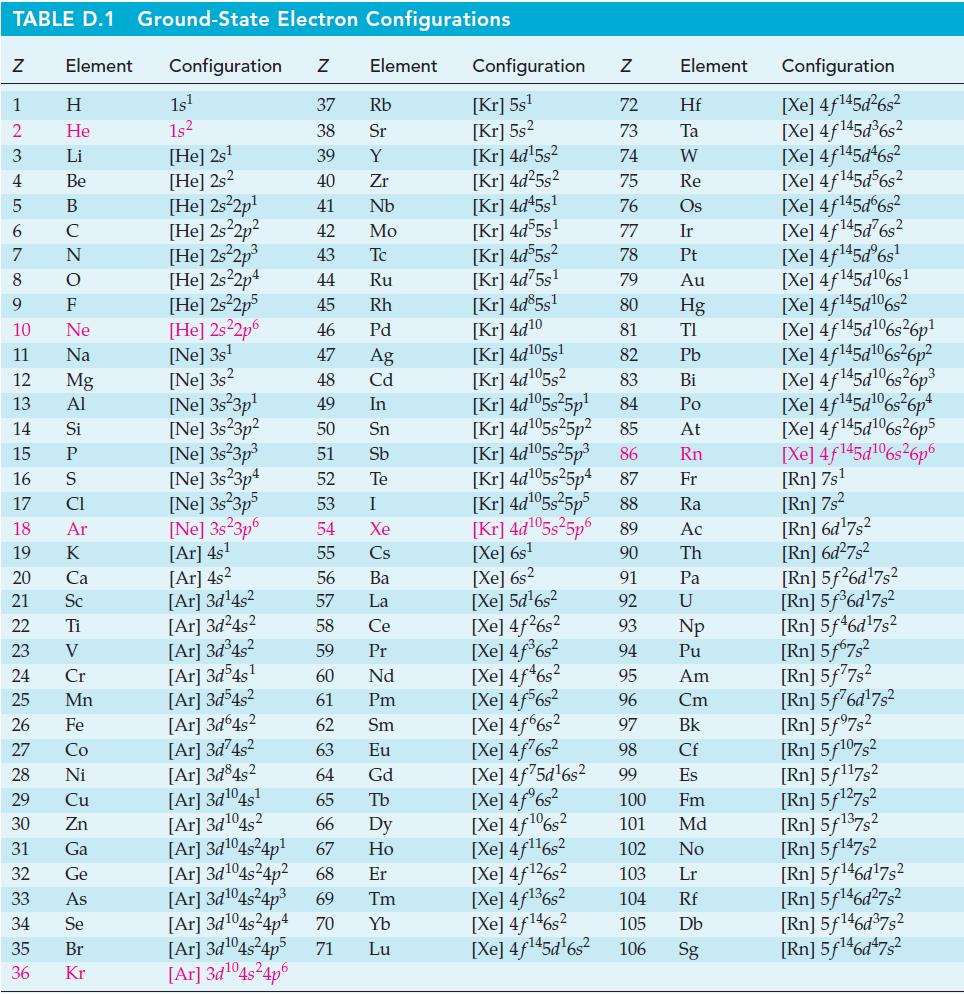
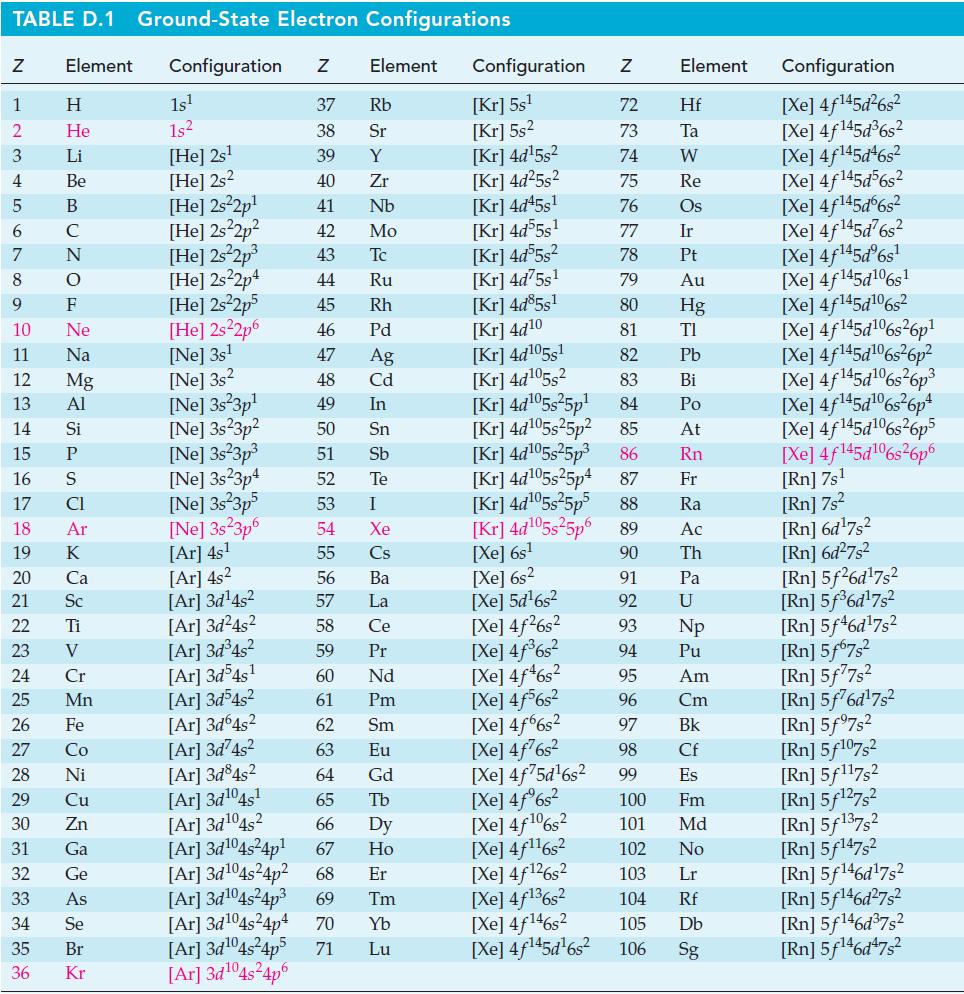
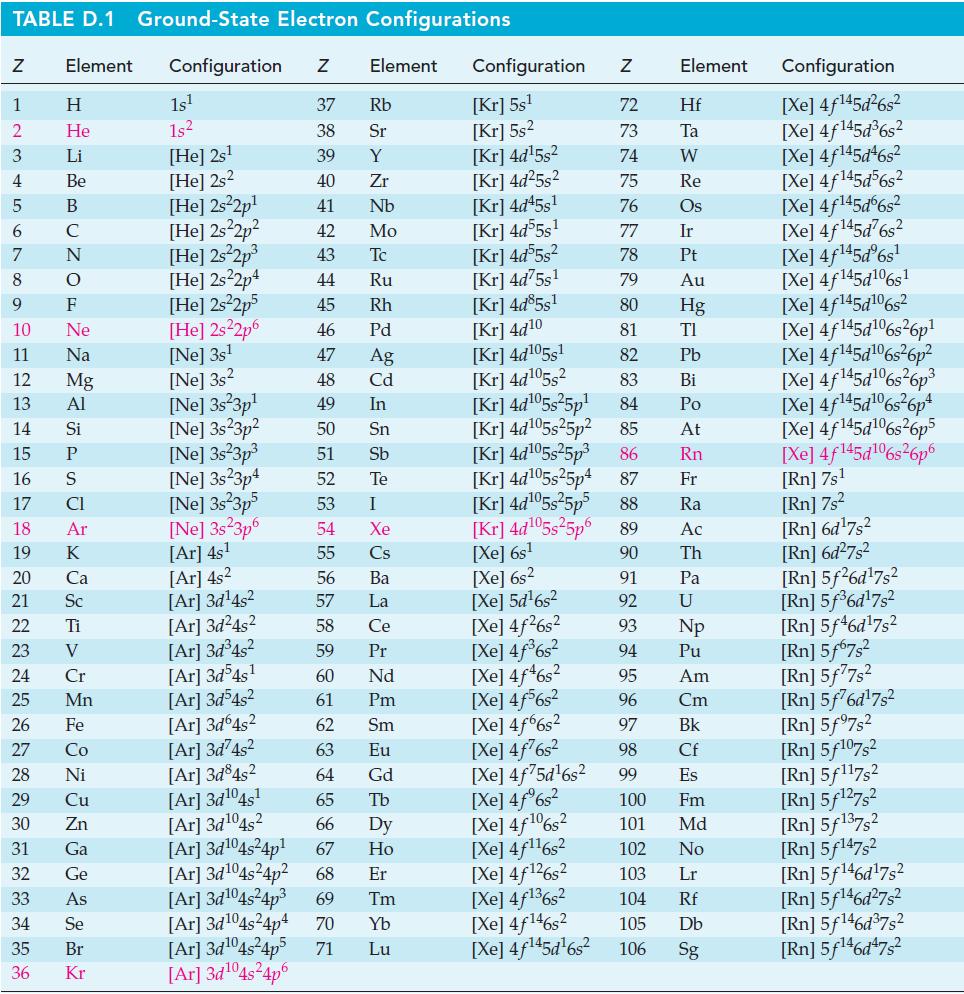
The standard electrode potential for the reduction of Eu3+(aq) to Eu2+(aq) is -0.43 V. Use the data in Appendix D to determine which of the following is capable of reducing Eu3+(aq) to Eu2+(aq) under standard-state conditions: Al(s), Co(s), H2O2(aq), Ag(s), H2C2O4(aq). TABLE D.1 Ground-State
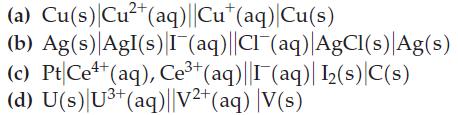
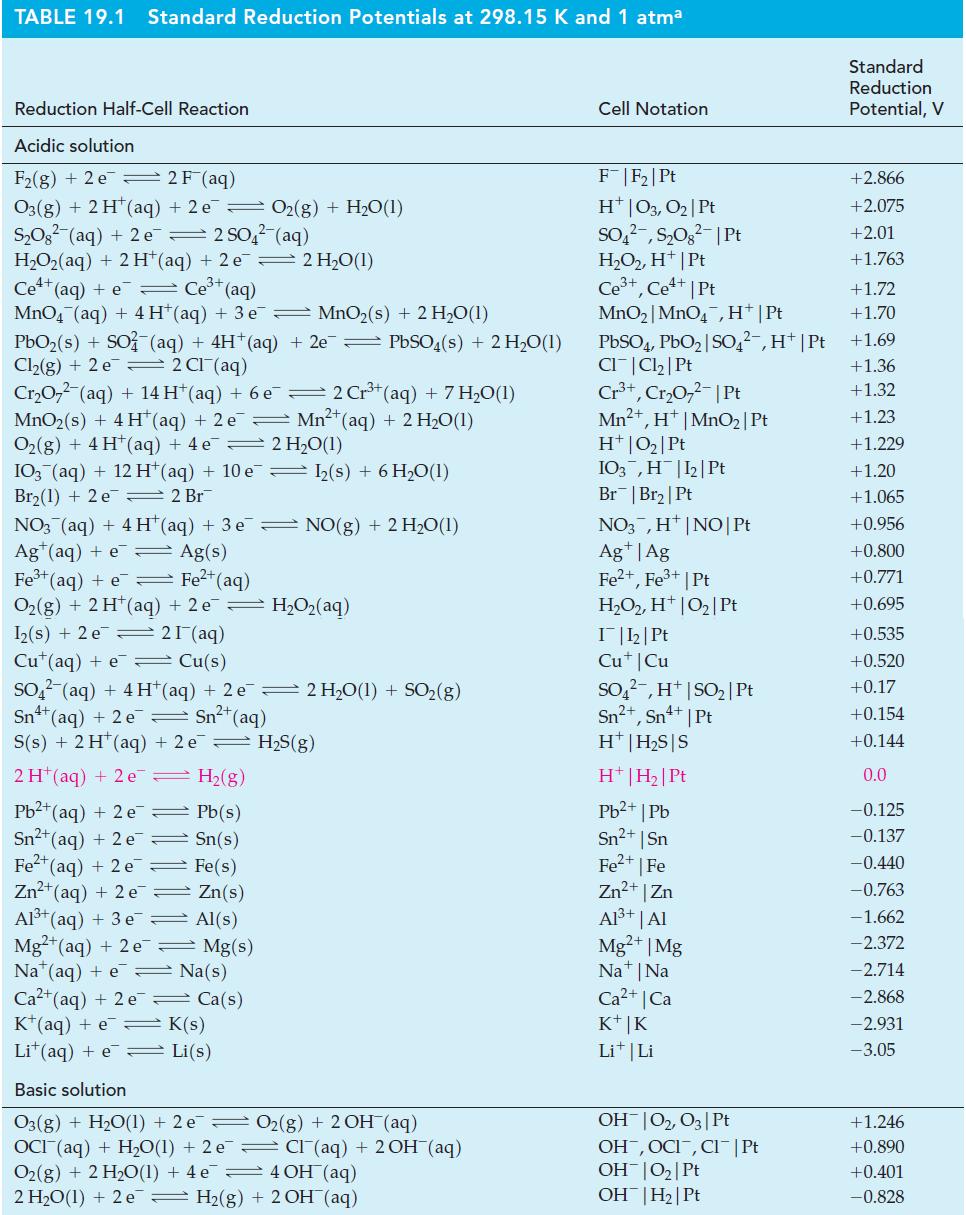
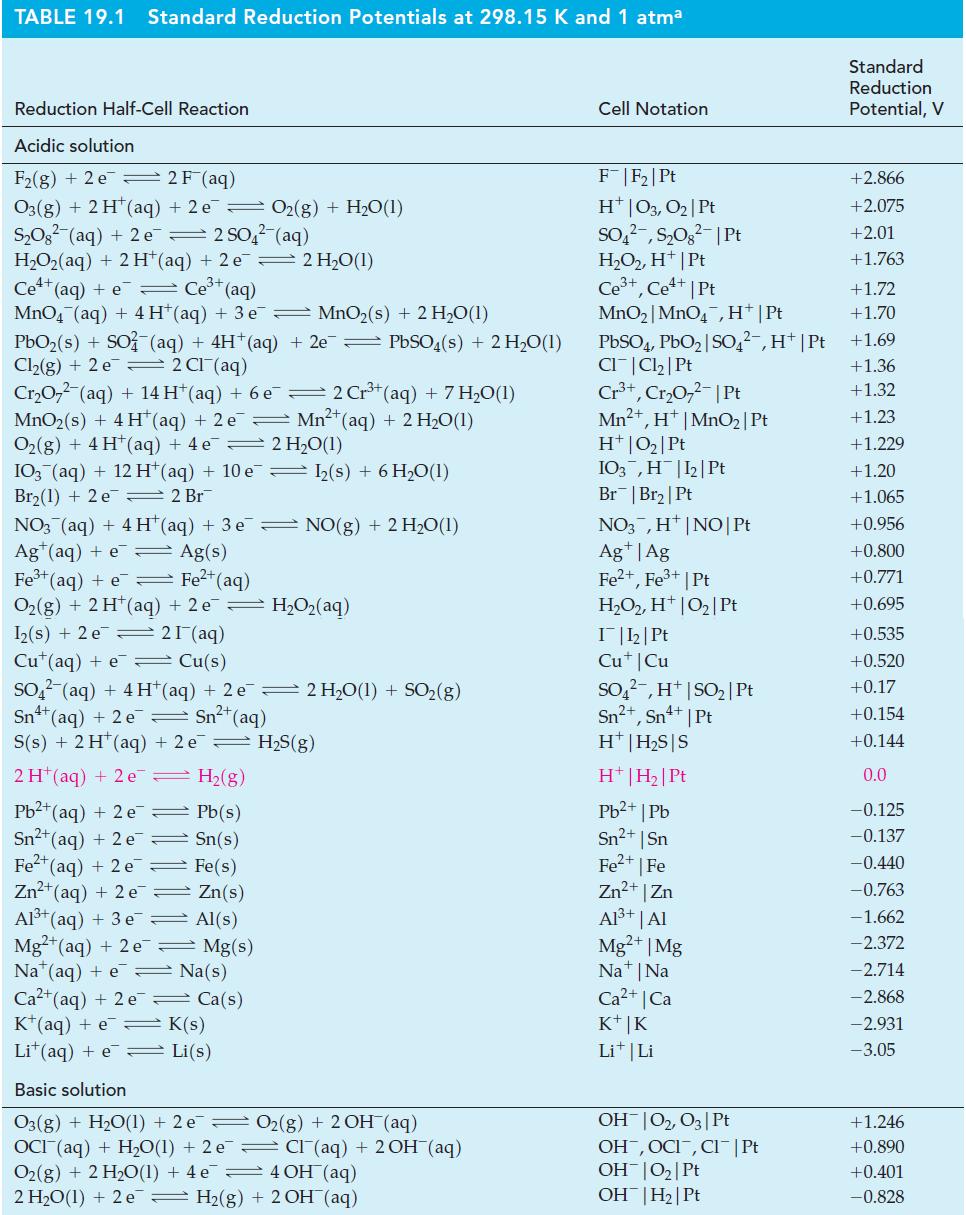
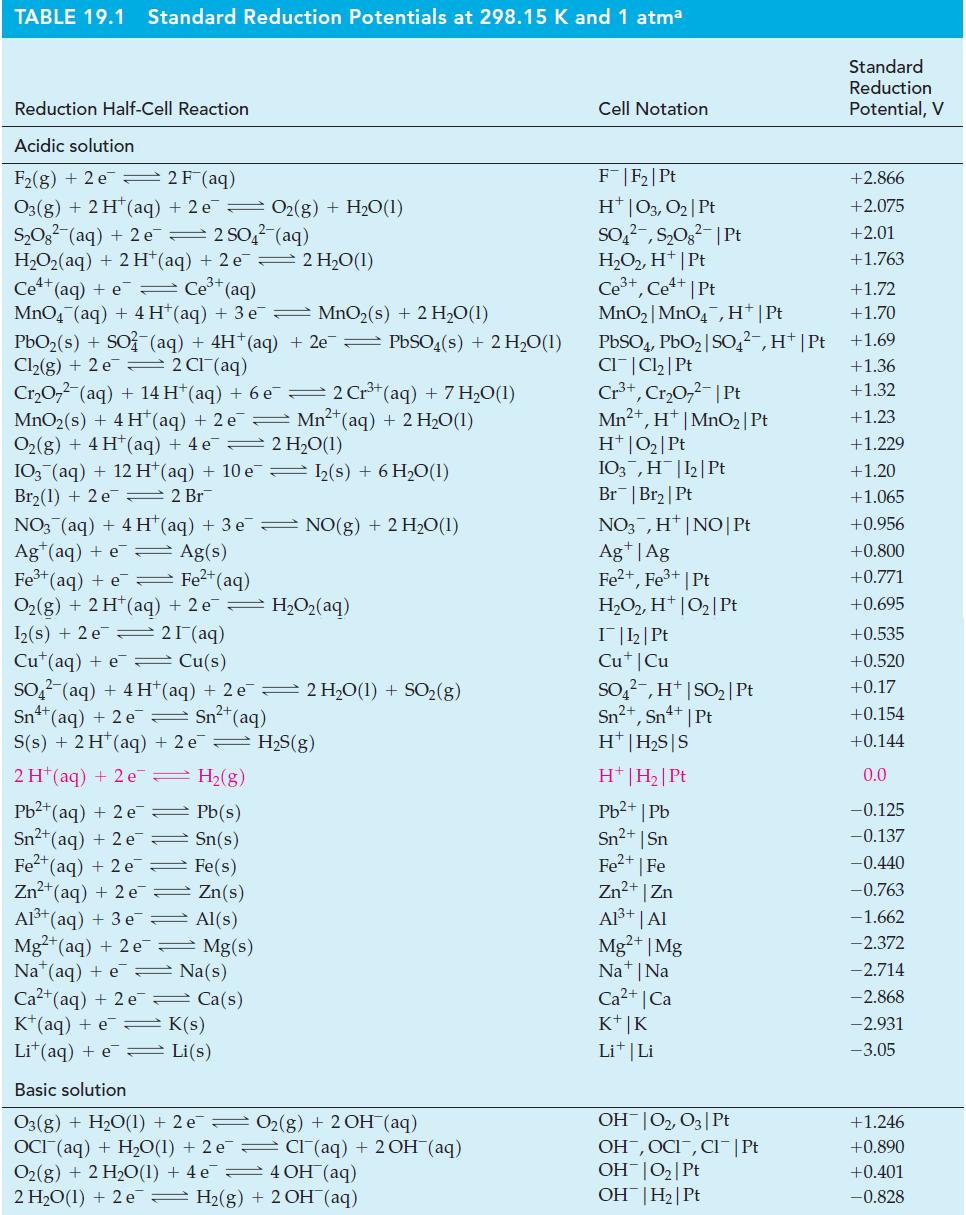
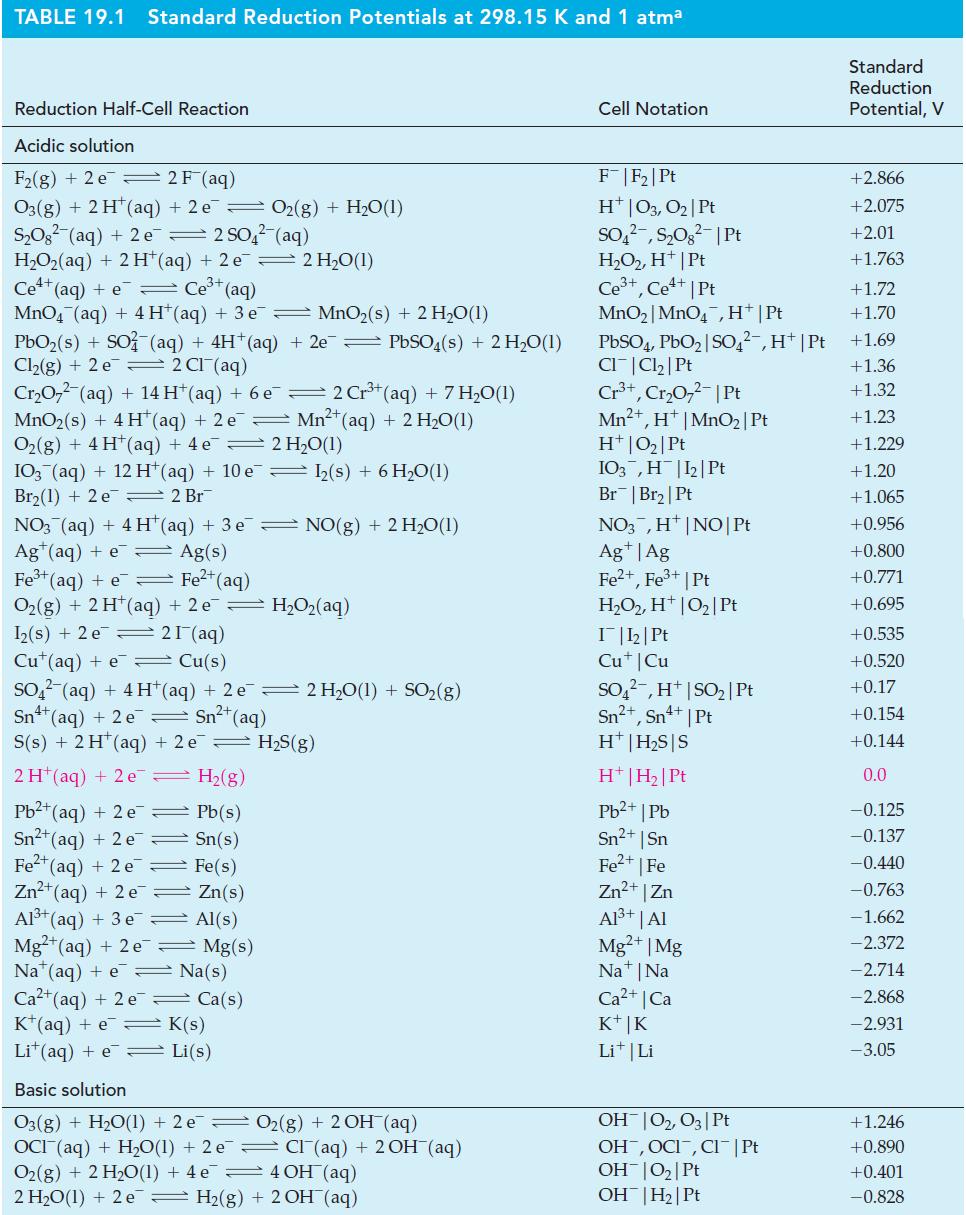
Write the half-cell reactions and the balanced chemical equation for the electrochemical cells diagrammed here. Use data from Table 19.1 and Appendix D to calculate E°cell for each reaction.Table 19.1 (a) Cu(s) Cu²+ (aq)||Cu+ (aq) Cu(s) (b) Ag(s) AgI(s) I¯(aq)||Cl¯(aq)|AgCl(s) Ag(s) (c) Pt
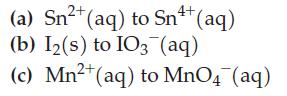
Dichromate ion (Cr2O72-) in acidic solution is a good oxidizing agent. Which of the following oxidations can be accomplished with dichromate ion in acidic solution? Explain. 2+ (a) Sn²+ (aq) to Sn++ (aq) (b) I₂(s) to IO3(aq) (c) Mn²+ (aq) to MnO4 (aq)
Consider the reaction Co(s) + Ni2+(aq) → Co2+(aq) + Ni(s), with E°cell = 0.02 V. If Co(s) is added to a solution with [Ni2+] = 1 M, should the reaction go to completion? Explain.
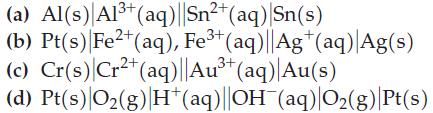
Write cell reactions for the electrochemical cells diagrammed here, and use data from Table 19.1 to calculate E°cell for each reaction.Table 19.1 2+ (a) Al(s) Al³+ (aq)||Sn²+ (aq)|Sn(s) (b) Pt(s) Fe2+ (aq), Fe³+ (aq)||Ag+ (aq) Ag(s) (c) Cr(s) Cr²+ (aq)||Au³+ (aq)| Au(s) 2+ 3+ (d) Pt(s)
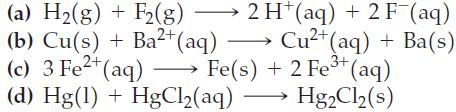
Use the data in Appendix D to calculate the standard cell potential for each of the following reactions. Which reactions will occur spontaneously? (a) H₂(g) + F2 (g) (b) Cu(s) + Ba²+ (aq) 2 H(aq) + 2 F (aq) Cu²+ (aq) + Ba(s) 3+ (c) 3 Fe²+ (aq) →→→→→→ Fe(s) + 2 Fe³+ (aq) (d) Hg(1)
Predict whether the following metals will react with the acid indicated. If a reaction does occur, write the net ionic equation for the reaction. Assume that reactants and products are in their standard states. (a) Ag in HNO3(aq); (b) Zn in HI(aq); (c) Au in HNO3 (for the couple Au3+/Au, E° =
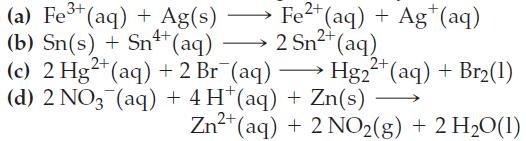
Use the data in Appendix D to calculate the standard cell potential for each of the following reactions. Which reactions will occur spontaneously? 2+ Fe2+ ²+ (aq) + Ag+ (aq) 2 Sn²+ (aq) Hg2 (a) Fe³+ (aq) + Ag(s) (b) Sn(s) + Sn++ (aq) (c) 2 Hg2+ (aq) + 2 Br¯(aq) →>> (d) 2 NO3(aq) + 4H+ (aq) +
Predict whether, to any significant extent, (a) Fe(s) will displace Zn2+(aq);(b) MnO4-(aq) will oxidize Cl-(aq) to Cl2(g) in acidic solution;(c) Ag(s) will react with 1 M HCl(aq);(d) O2(g) will oxidize Cl-(aq) to Cl2(g) in acidic solution.
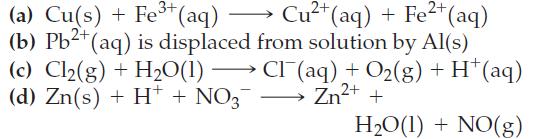
In each of the following examples, sketch a voltaic cell that uses the given reaction. Label the anode and cathode; indicate the direction of electron flow; write a balanced equation for the cell reaction; and calculate E°cell. 3+ (a) Cu(s) + Fe³+ (aq) → Cu²+ (aq) + Fe²+ (aq) (b) Pb²+ (aq)
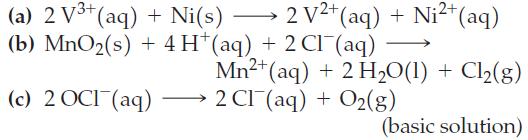
Write the equilibrium constant expression for each of the following reactions, and determine the value of K at 25 °C. Use data from Table 19.1.Table 19.1 2 V² (a) 2 V³+ (aq) + Ni(s) — > (b) MnO₂ (s) + 4 H*(aq) + 2 Cl(aq) (c) 2 OCI (aq) √2+ (aq) + Ni²+ (aq) Mn2+ (aq) + 2 H₂O(1) +
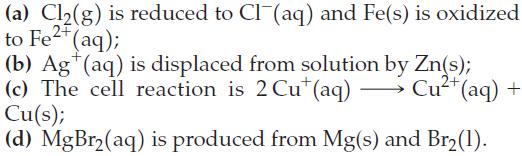
Write a cell diagram and calculate the value of E°cell for a voltaic cell in which (a) Cl₂(g) is reduced to Cl(aq) and Fe(s) is oxidized to Fe²+ (aq); (b) Ag (aq) is displaced from solution by Zn(s); (c) The cell reaction is 2 Cut (aq) → Cu²+ (aq) + Cu(s); (d) MgBr₂(aq) is produced from
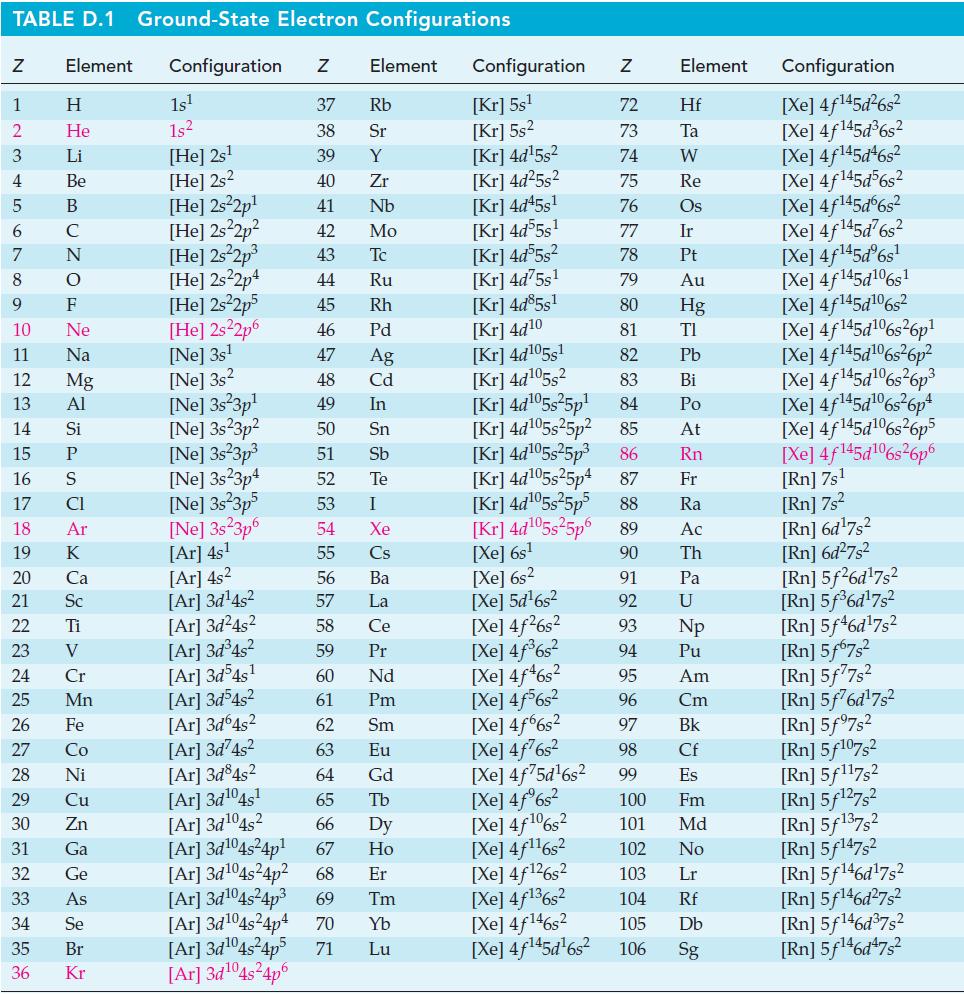
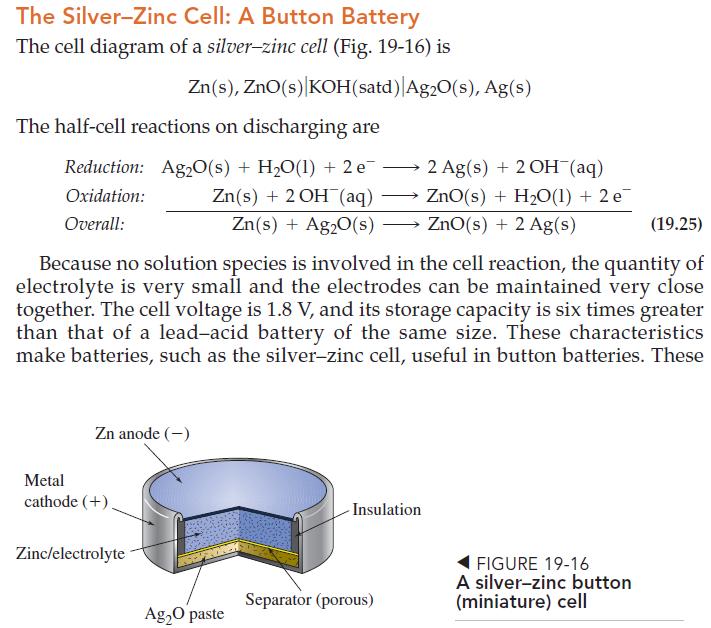
Use thermodynamic data from Appendix D to calculate a theoretical voltage of the silver–zinc button cell described on page 893. TABLE D.1 Ground-State Electron Configurations Element Configuration Z Z 1 2 3 4 5 6 7 8 9 HIG&LUZONSUZ SE> 0 ≤ 2 3 2 3 5 3 3 2 2 5
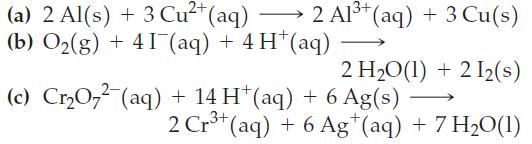
Determine the values of ΔrG° for the following reactions carried out in voltaic cells. (a) 2 Al(s) + 3 Cu²+ (aq) (b) O₂(g) +41 (aq) + 4 H*(aq) 2 A1³+ (aq) + 3 Cu(s) 2 H₂O(1) +2 12(s) (c) Cr₂O7² (aq) + 14 H+ (aq) + 6 Ag(s) 2 Cr³+ (aq) + 6 Ag+ (aq) + 7 H₂O(1)
Consider the voltaic cell below.Use data from Appendix D to determine (a) The equation for the cell reaction; (b) E°cell; (c) ΔrG°; (d) K; (e) Whether the reaction goes essentially to completion, or to a limited extent only, when the reactants and products are initially in their standard
The theoretical voltage of the aluminum–air battery is E°cell = 2.71 V. Use data from Appendix D and equation (19.28) to determine ΔfG° for Al[(OH)4]-.Eq. 19.28 4 Al(s) + 3 O₂(g) + 6 H₂O(1) + 4 OH(aq) 4[Al(OH)4] (aq) (19.28)
For the reaction answer the following questions:(a) Can a solution be prepared at 298 K that has(b) If not, in which direction will a reaction occur? 2 H+ (aq) + BrO4 (aq) + 2 Ce³+ (aq) BrO3(aq) + 2 Ce+ (aq) + H₂O(1), Ecell -0.017 V, =
For the reaction 2 Cu+(aq) + Sn4+(aq) → 2 Cu2+(aq) + Sn2+(aq), E°cell = -0.0050 V, (a) Can a solution be prepared at 298 K that is 0.500 M in each of the four ions?(b) If not, in which direction will a reaction occur?
By the method of combining reduction half-cell reactions illustrated, determine E°lrO2/Ir , given that E°lr3+/Ir = 1.156 V and E°IrO2/Ir3+ = 0.223 V.
Consider the reduction half-cell reactions listed in Appendix D, and give plausible explanations for the following observations:(a) For some half-cell reactions E depends on pH; for others, it does not.(b) Whenever H+ appears in a half-cell equation it is on the left side.(c) Whenever OH- appears
Use the Nernst equation and Table 19.1 to calculate Ecell for each of the following cells.Table 19.1 (a) Al(s) Al³+ (0.18 M)||Fe2+ (0.85 M) Fe(s) (b) Ag(s) Ag (0.34 M)||CI (0.098 M), Cl₂(g, 0.55 bar) Pt(s)
A voltaic cell represented by the following cell diagram has Ecell = 1.250 V. What must be [Ag+] in the cell? 2+ Zn(s) Zn²+ (1.00 M)||Ag+ (x M) Ag(s)
Use the Nernst equation and data from Appendix D to calculate Ecell for each of the following cells. (a) Mn(s) Mn²+ (0.40 M)||Cr³+ (0.35 M), Cr²+ (0.25 M) Pt(s) (b) Mg(s) Mg2+ (0.016 M)||[Al(OH)4]¯(0.25 M), OH (0.042 M) Al(s)
Determine E°MoO2/Mo3+, given that E°H2MoO4/MoO2 = 0.646 V and E°H2MoO4/Mo3+ = 0.428 V.
For the cell pictured in Figure 19-11, what is Ecell if the unknown solution in the half-cell on the left (a) Has pH = 5.25;(b) Is 0.0103 M HCl; (c) Is 0.158 M CH3COOH (Ka = 1.8 x 10⁻⁵)?Figure 19-11 H₂(g, 1 bar) Pt Anode [H+] = x M Voltmeter Salt bridge KNO3(aq) Cathode [H+] = 1 M H₂(g, 1
If [Zn2+] is maintained at 1.0 M, (a) What is the minimum [Cu2+] for which reaction (19.3) is spontaneous in the forward direction?(b) Should the displacement of Cu2+(aq) by Zn(s) go to completion? Explain.Reaction (19.3) Zn(s) + Cu²+ (aq) 2+ Zn²+ (aq) + Cu(s) (19.3)
Write an equation to represent the oxidation of Cl-(aq) to Cl2(g) by PbO2(s) in an acidic solution. Will this reaction occur spontaneously in the forward direction if all other reactants and products are in their standard states and (a) [H+] = 6.0 M;(b) [H+] = 1.2 M;(c) pH = 4.25?Explain.
Can the displacement of Pb(s) from 1.0 M Pb(NO3)2 be carried to completion by tin metal? Explain.
A voltaic cell, with Ecell = 0.180 V, is constructed as follows:What is the Ksp of Ag3PO4? Ag(s) Ag (satd Ag3PO4)||Ag (0.140 M) Ag(s)
A concentration cell is constructed of two hydrogen electrodes: one immersed in a solution with [H+] = 1.0 M and the other in 0.65 M KOH.(a) Determine Ecell for the reaction that occurs.(b) Compare this value of Ecell with E° for the reduction of H2O to H2(g) in basic solution, and explain the
For the voltaic cell,(a) What is Ecell initially?(b) If the cell is allowed to operate spontaneously, will Ecell increase, decrease, or remain constant with time? Explain.(c) What will be Ecell when [Pb2+] has fallen to 0.500 M?(d) What will be [Sn2+] at the point at which Ecell = 0.020 V?(e)
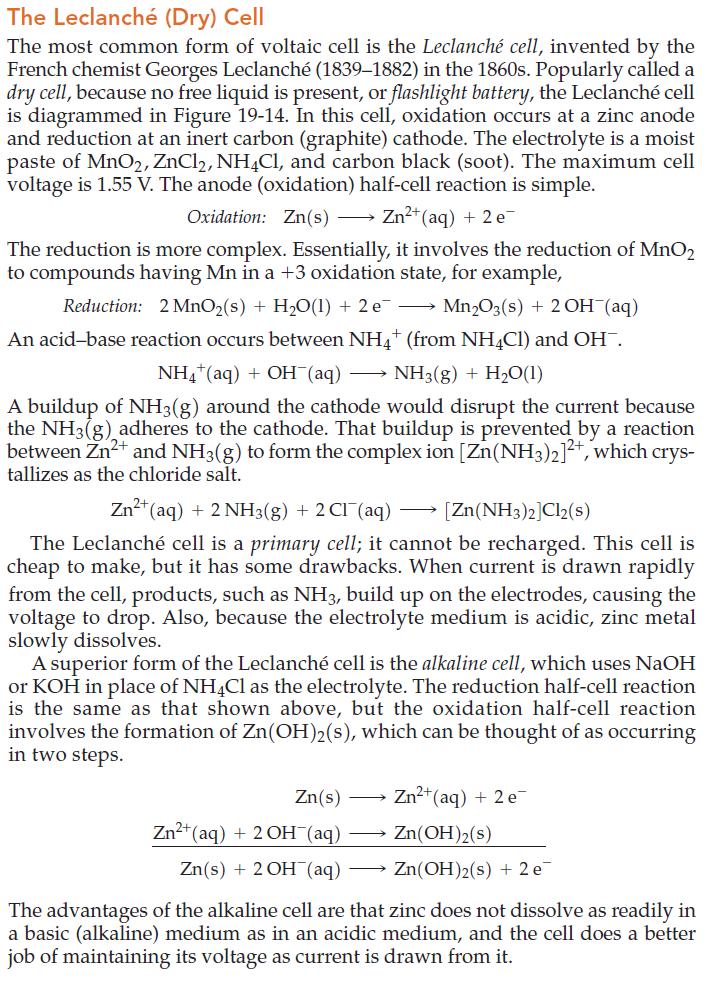
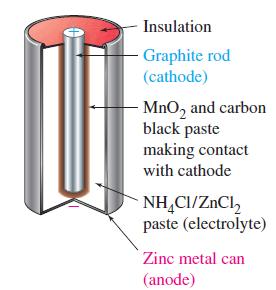
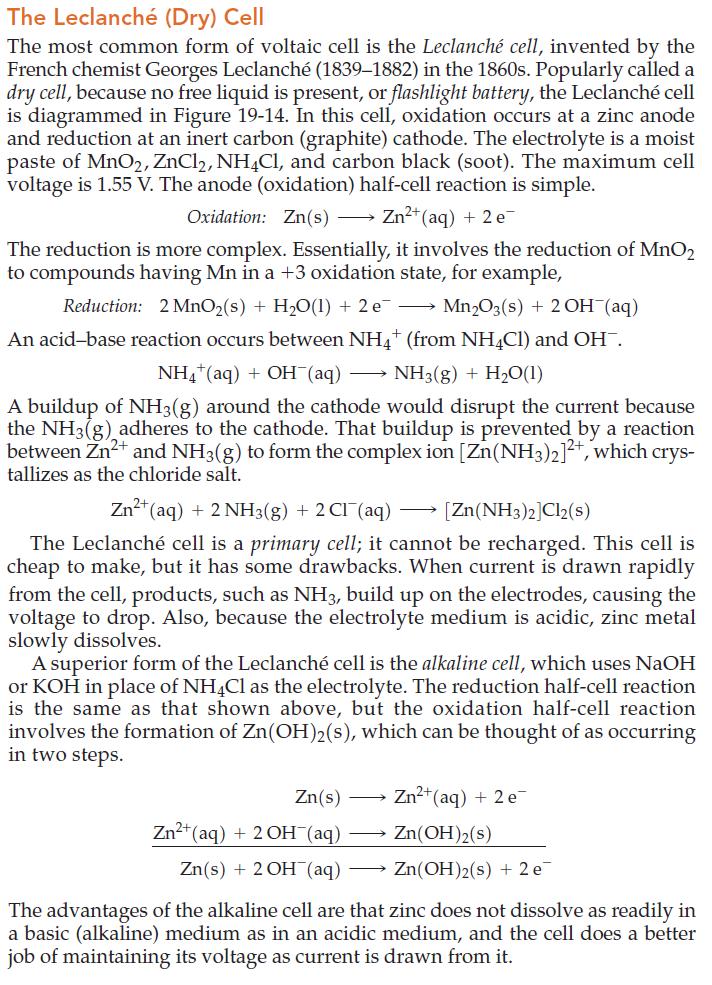
Refer to the discussion of the Leclanché cell.(a) Combine the several equations written for the operation of the Leclanché cell into a single overall equation.(b) Given that the voltage of the Leclanché cell is 1.55 V, estimate the electrode potentials, E, for each of the half cell reactions.
For the voltaic cell,(a) what is Ecell initially?(b) As the cell operates, will Ecell increase, decrease, or remain constant with time? Explain.(c) What will be Ecell when [Ag+] has increased to 0.020 M?(d) What will be [Ag+] when Ecell = 0.010 V?(e) What are the ion concentrations when Ecell =
Derive a balanced equation for the reaction occurring in the cell: (a) If E°cell = 1.21 V, calculate ΔrG° and the equilibrium constant for the reaction.(b) Use the Nernst equation to determine the potential for the cell:(c) In light of (a) and (b), what is the likelihood of being able to
For the alkaline Leclanché cell.(a) write the overall cell reaction.(b) Determine E°cell for that cell reaction.Figure 19.14 The Leclanché (Dry) Cell The most common form of voltaic cell is the Leclanché cell, invented by the French chemist Georges Leclanché (1839-1882) in the 1860s. Popularly
Show that the oxidation of Cl-(aq) to Cl2(g) by Cr2O72-(aq) in acidic solution, with reactants and products in their standard states, does not occur spontaneously. Explain why it is still possible to use this method to produce Cl2(g) in the laboratory. What experimental conditions would you use?
The iron–chromium redox battery makes use of the reactionoccurring at a chromium anode and an iron cathode.(a) Write a cell diagram for this battery.(b) Calculate the theoretical voltage of the battery. Cr²+ (aq) + Fe³+ (aq) Cr³+ (aq) + Fe2+ (aq)
What is the theoretical standard cell voltage, E°cell, of each of the following voltaic cells? (a) The hydrogen–oxygen fuel cell described by equation (19.26); (b) The zinc–air battery; (c) A magnesium–iodine battery.Eq. 19.26 2 H₂(g) + O2(g) 2 H₂O(1) (19.26)
One of the advantages of the aluminum-air battery over the iron–air and zinc–air batteries is the greater quantity of charge transferred per unit mass of metal consumed. Show that this is indeed the case. Assume that zinc and iron are oxidized to oxidation state +2 in air batteries.
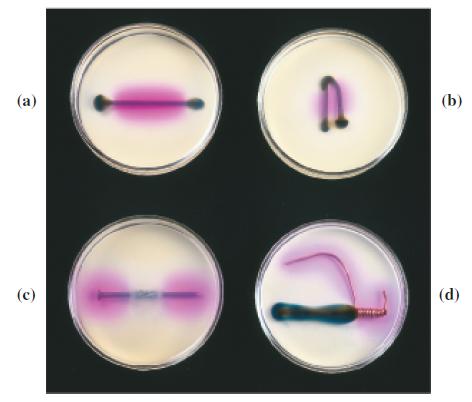
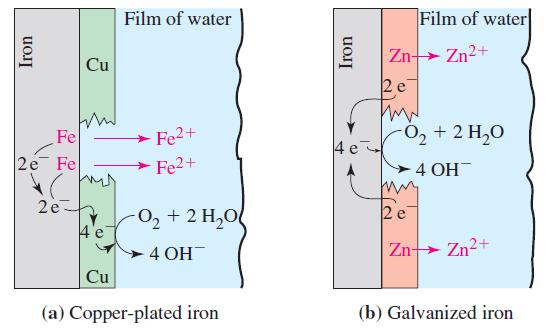
Refer to Figure 19-20, and describe in words or with a sketch what you would expect to happen in each of the following cases.(a) Several turns of copper wire are wrapped around the head and tip of an iron nail.(b) A deep scratch is filed at the center of an iron nail.(c) A galvanized nail is
Describe how you might construct batteries with each of the following voltages: (a) 0.10 V; (b) 2.5 V; (c) 10.0 V.Be as specific as you can about the electrodes and solution concentrations you would use, and indicate whether the battery would consist of a single cell or two or more cells
When an iron pipe is partly submerged in water, the iron dissolves more readily below the waterline than at the waterline. Explain this observation by relating it to the description of corrosion given in Figure 19-21.Figure 19-21 Iron Fe 2e Fe 2e- Cu Cu Film of water Fe2+ → Fe2+ -O₂ + 2 H₂O 4
Natural gas transmission pipes are sometimes protected against corrosion by the maintenance of a small potential difference between the pipe and an inert electrode buried in the ground. Describe how the method works.
In the construction of the Statue of Liberty, a framework of iron ribs was covered with thin sheets of copper less than 2.5 mm thick. A layer of asbestos separated the copper skin and iron framework. Over time, the asbestos wore away and the iron ribs corroded. Some of the ribs lost more than half
How many grams of metal are deposited at the cathode by the passage of 2.15 A of current for 75 min in the electrolysis of an aqueous solution containing (a) Zn2+;(b) Al3+;(c) Ag+;(d) Ni2+?
Which of the following reactions occur spontaneously, and which can be brought about only through electrolysis, assuming that all reactants and products are in their standard states? For those requiring electrolysis, what is the minimum voltage required? (a) 2 H₂O(1) 2 H₂(g) (b) Zn(s) + Fe²+
A quantity of electric charge brings about the deposition of 3.28 g Cu at a cathode during the electrolysis of a solution containing Cu2+(aq). What volume of H2(g), measured at 28.2 °C and 763 mmHg, would be produced by this same quantity of electric charge in the reduction of H+(aq) at a
An aqueous solution of K2SO4 is electrolyzed by means of Pt electrodes.(a) Which of the following gases should form at the anode: O2, H2, SO2, SO3? Explain.(b) What product should form at the cathode? Explain.(c) What is the minimum voltage required? Why is the actual voltage needed likely to be
A dilute aqueous solution of Na2SO4 is electrolyzed between Pt electrodes for 3.75 h with a current of 2.83 A. What volume of gas, saturated with water vapor at 25 °C and at a total pressure of 742 mmHg, would be collected at the anode? Use data from Table 12.5, as required.Table 12.5
If a lead storage battery is charged at too high a voltage, gases are produced at each electrode. (It is possible to recharge a lead-storage battery only because of the high overpotential for gas formation on the electrodes.)(a) What are these gases?(b) Write a cell reaction to describe their
Calculate the quantity indicated for each of the following electrolyses.(a) The mass of Zn deposited at the cathode in 42.5 min when 1.87 A of current is passed through an aqueous solution of Zn2+;(b) The time required to produce 2.79 g I2 at the anode if a current of 1.75 A is passed through
Calculate the quantity indicated for each of the following electrolyses.(a) [Cu2+] remaining in 425 mL of a solution that was originally 0.366 M CuSO4, after passage of 2.68 A for 282 s and the deposition of Cu at the cathode; (b) The time required to reduce [Ag+] in 255 mL of AgNO3(aq) from 0.196
Electrolysis is carried out for 2.00 h in the following cell. The platinum cathode, which has a mass of 25.0782 g, weighs 25.8639 g after the electrolysis. The platinum anode weighs the same before and after the electrolysis.(a) Write plausible equations for the half-cell reactions that occur at
A coulometer is a device for measuring a quantity of electric charge. In a silver coulometer, Ag+(aq) is reduced to Ag(s) at a Pt cathode. If 1.206 g Ag is deposited in 1412 s by a certain quantity of electricity, (a) How much electric charge (in C) must have passed, and (b) What was the
A solution containing both Ag+ and Cu2+ ions is subjected to electrolysis. (a) Which metal should plate out first? (b) Plating out is finished after a current of 0.75 A is passed through the solution for 2.50 hours. If the total mass of metal is 3.50 g, what is the mass percent of silver in the
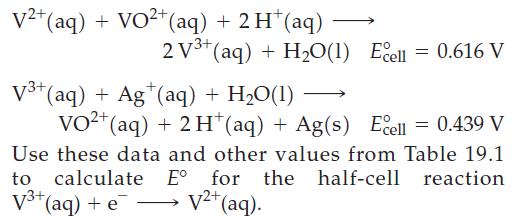
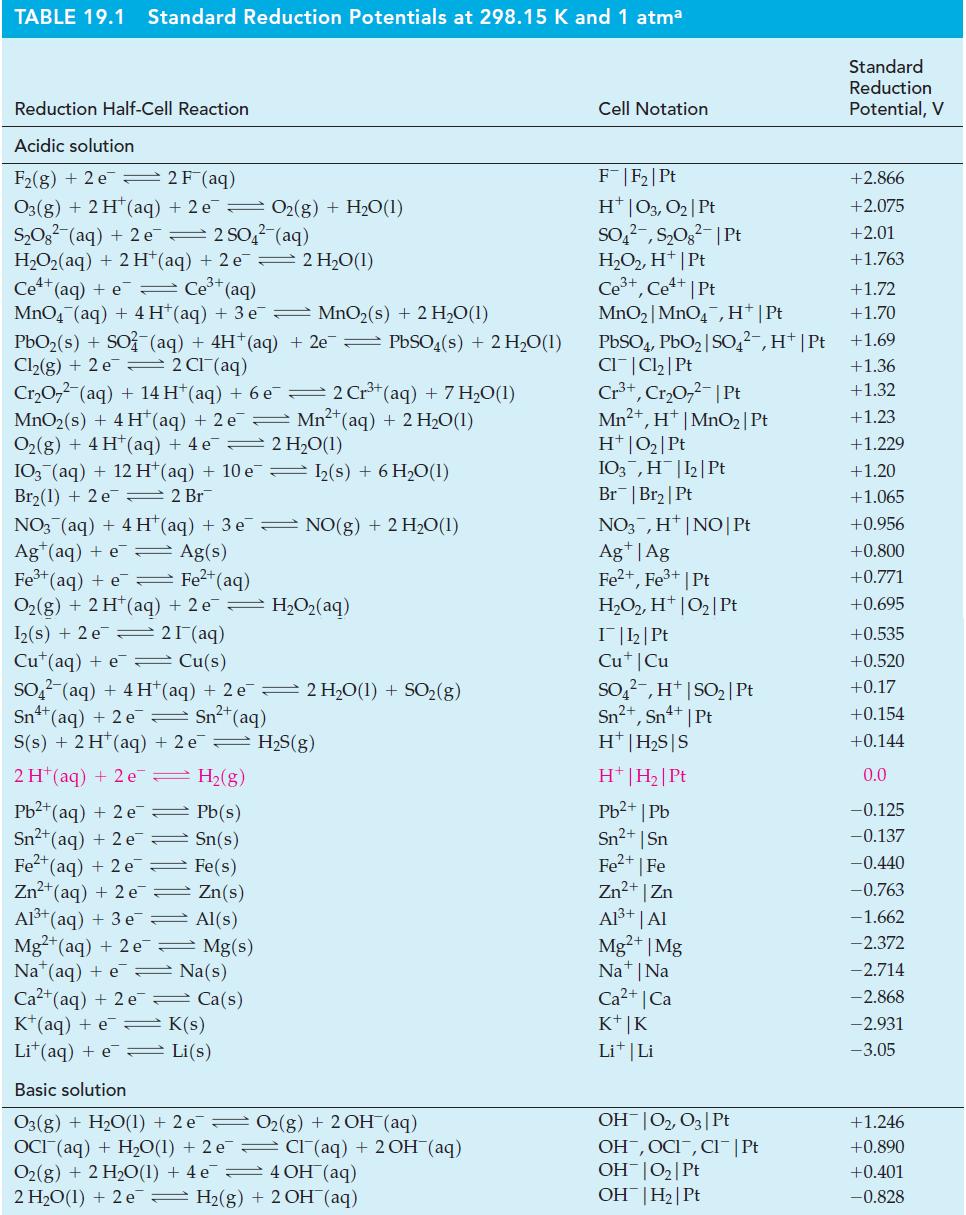
Two voltaic cells are assembled in which the following reactions occur. V²+ (aq) + VO²+ (aq) + 2 H+ (aq) 2 V3+ (aq) + H₂O(1) Ecell = 0.616 V V³+ (aq) + Ag (aq) + H₂O(1) VO2+ (aq) + 2 H+ (aq) + Ag(s) Ecell 0.439 V Use these data and other values from Table 19.1 = to calculate Eº for the
A solution containing a mixture of a platinum(II) salt contaminated by approximately 10 mole % of another oxidation state is electrolyzed at 1.20 A for 32.0 minutes, at which point no more platinum is deposited.(a) What is the oxidation state of the contaminant?(b) What is the composition of the
Suppose that a fully charged lead–acid battery contains 1.50 L of 5.00 M H2SO4. What will be the concentration of H2SO4 in the battery after 2.50 A of current is drawn from the battery for 6.0 h?
For the half-cell reaction V3+(aq) + e- → V2+(aq), E° = -0.255 V. If excess Ni(s) is added to a solution in which [V3+(aq)] = 0.500 M, what will be the concentration of Ni2+(aq) when the equilibrium is reached at 298 K? Ni(s) + 2 V³+ (aq) = Ni²+ (aq) + 2 V²+ (aq)
The energy consumption in electrolysis depends on the product of the charge and the voltage [volt x coulomb = V · C = J(joules)]. Determine the theoretical energy consumption per 1000 kg Cl2 produced in a diaphragm chlor–alkali cell that operates at 3.45 V. Express this energy in (a) kJ;(b)
A voltaic cell is constructed based on the following reaction and initial concentrations:Calculate [Fe2+] when the cell reaction reaches equilibrium. Fe²+ (0.0050 M) + Ag+ (2.0 M) = Fe³+ (0.0050 M) + Ag(s)
Use data from Table 19.1 to predict whether, to any significant extent, (a) Mg(s) will displace Pb2+ from aqueous solution;(b) Sn(s) will react with and dissolve in 1 M HCl;(c) SO42- will oxidize Sn2+ to Sn4+ in acidic solution;(d) MnO4-(aq) will oxidize H2O2(aq) to O2(g) in acidic solution;(e)
To construct a voltaic cell with Ecell = 0.0860 V, what [Cl-] must be present in the cathode half-cell to achieve this result? Ag(s) Ag (satd AgI)||Ag¹(satd AgCl, x M CI) Ag(s)
The hydrazine fuel cell is based on the reactionThe theoretical E°cell of this fuel cell is 1.559 V. Use this information and data from Appendix D to calculate a value of ΔfG° for [N2H4(aq)]. N₂H4(aq) + O₂(g) - N₂(g) + 2 H₂O(1)
Describe a laboratory experiment that you could perform to evaluate the Faraday constant, F, and then show how you could use this value to determine the Avogadro constant.
Use the following data and data from Appendix D to determine the quantity of heat needed to convert 15.0 g of solid mercury at -50.0 °C to mercury vapor at 25 °C. Specific heats: Hg(s), 24.3 J mol-1 K-1; Hg(I), 28.0 J mol-1 K-1. Melting point of Hg(s), -38.87 °C. Heat of fusion, 2.33 kJ mol-1.
In the manufacture of ammonia, the chief source of hydrogen gas is the following reaction for the reforming of methane at high temperatures.The following data are also given.At 1000 K, 1.00 mol each of CH4 and H2O are allowed to come to equilibrium in a 10.0 L vessel. Calculate the number of moles
At 1.00 atm, the solubility of O2 in water is 2.18 x 10⁻³ M at 0 °C and 1.26 x 10⁻³ M at 25 °C. What volume of O2(g) measured at 25 °C and 1.00 atm, is expelled when 515 mL of water saturated with O2 is heated from 0 to 25 °C?
A saturated solution prepared at 70 °C contains 32.0 g CuSO4 per 100.0 g solution. A 335 g sample of this solution is then cooled to 0 °C and CuSO4 · 5 H2O crystallizes out. If the concentration of a saturated solution at 0 °C is 12.5 g CuSO4/100 g soln, what mass of would be obtained? Note
How would you write the reaction quotient expression for Cu(s) + 2 H+(aq) → Cu2+(aq) + H2(g) ? Write this first in terms of activities and then convert to pressures and concentrations.
Based on these descriptions, write a balanced equation and the corresponding expression for each reversible reaction.(a) Carbonyl fluoride, COF2(g), decomposes into gaseous carbon dioxide and gaseous carbon tetrafluoride.(b) Copper metal displaces silver(I) ion from aqueous solution, producing
These equilibrium concentrations are measured at 298 K: [Cu+]eq = 0.148 M, [Sn2+]eq = 0.124 M, and [Sn4+]eq = 0.176 M. What is the equilibrium concentration of Cu2+(aq)?
(A) In another experiment also carried out at 298 K, equal concentrations of [Cu+], [Sn4+], and [Sn2+] are found to be in equilibrium. What must be the equilibrium concentration of [Cu2+]?(B) At 25 °C, K = 9.14 x 10⁻⁶ for the reaction 2 Fe3+(aq) + Hg22+(aq) ⇌ 2Fe2+(aq) + 2 Hg2+(aq). If the
Showing 1200 - 1300
of 4008
First
6
7
8
9
10
11
12
13
14
15
16
17
18
19
20
Last
Step by Step Answers

 Get 50% OFF
Claim Now
Get 50% OFF
Claim Now








![4 Al(s) + 3 O(g) + 6 HO(1) + 4 OH(aq) 4[Al(OH)4] (aq) (19.28)](https://dsd5zvtm8ll6.cloudfront.net/images/question_images/1700/8/1/2/5716560571b6c3091700812571010.jpg)

![= [BrO4] = [Ce4+] = 0.675 M, [BrO3] = [Ce+] = 0.600 M and pH = 1?](https://dsd5zvtm8ll6.cloudfront.net/images/question_images/1700/8/1/1/8856560546daabf92.png)


, OH](https://dsd5zvtm8ll6.cloudfront.net/images/question_images/1700/8/1/3/79965605be75484e2.png)
![H(g, 1 bar) Pt Anode [H+] = x M Voltmeter Salt bridge KNO3(aq) Cathode [H+] = 1 M H(g, 1 bar) Pt](https://dsd5zvtm8ll6.cloudfront.net/images/question_images/1700/8/1/3/285656059e5c56e91700813285372.jpg)








![(a) 2 HO(1) 2 H(g) (b) Zn(s) + Fe+ (aq) (c) 2 Fe+ (aq) + I(s) (d) Cu(s) + Sn+ (aq) + O(g) [in 1 M H*(aq)] 2+](https://dsd5zvtm8ll6.cloudfront.net/images/question_images/1700/8/2/0/0166560743011a6e2.png)