New Semester
Started
Get
50% OFF
Study Help!
--h --m --s
Claim Now
Question Answers
Textbooks
Find textbooks, questions and answers
Oops, something went wrong!
Change your search query and then try again
S
Books
FREE
Study Help
Expert Questions
Accounting
General Management
Mathematics
Finance
Organizational Behaviour
Law
Physics
Operating System
Management Leadership
Sociology
Programming
Marketing
Database
Computer Network
Economics
Textbooks Solutions
Accounting
Managerial Accounting
Management Leadership
Cost Accounting
Statistics
Business Law
Corporate Finance
Finance
Economics
Auditing
Tutors
Online Tutors
Find a Tutor
Hire a Tutor
Become a Tutor
AI Tutor
AI Study Planner
NEW
Sell Books
Search
Search
Sign In
Register
study help
engineering
chemical engineering
Quantitative Chemical Analysis 8th edition Daniel C. Harris - Solutions
A cyanide ion-selective electrode obeys the equationE = constant - 0.059 16 log[CN-]The potential was - 0.230 V when the electrode was immersed in 1.00 mM NaCN.(a) Evaluate the constant in the equation.(b) Using the result from part (a), find [CN-] if E= - 0.300 V.(c) Without using the constant
By how many volts will the potential of an ideal Mg2+ ion-selective electrode change if the electrode is removed from 1.00 × 10⁻⁴ M MgCl2 and placed in 1.00 × 10⁻³ M MgCl2 at 25°C?
When measured with a F- ion-selective electrode with a Nernstian response at 25°C, the potential due to F- in unfluoridated groundwater in Foxboro, Massachusetts, was 40.0 mV more positive than the potential of tap water in Providence, Rhode Island. Providence maintains its fluoridated water at
The selectivities of a Li+ ion-selective electrode are indicated on the following diagram. Which alkali metal (Group 1) ion causes the most interference? Which alkaline earth (Group 2) ion causes the most interference? How much greater must be [K+] than [Li+] for the two ions to give equal response?
A metal ion buffer was prepared from 0.030 M ML and 0.020 M L, where ML is a metal ligand complex and L is free ligand. M + L ⇌ ML Kf = 4.0 × 10⁸ Calculate the concentration of free metal ion, M, in this buffer.
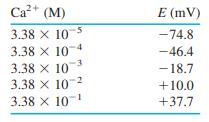
The following data were obtained when a Ca2+ ion-selective electrode was immersed in standard solutions whose ionic strength was constant at 2.0 M.(a) Prepare a calibration curve and find the least-squares slope and intercept and their standard deviations.(b) Calculate the value of in Equation
The selectivity coefficient,KpotLi,H+, for a Li+ ion-selective electrode is 4 × 10⁻⁴. When this electrode is placed in 3.44 × 10⁻⁴ M Li solution at pH 7.2, the potential is - 0.333 V versus S.C.E. What would be the potential if the pH were lowered to 1.1 and the ionic strength were kept constant?
From the following potentials, calculate the activity of Cl- in 1 M KCl.E°(calomel electrode) = 0.268 VE(calomel electrode, 1 M KCl) = 0.280 V
Standard addition. A particular CO2 compound electrode like the one in Figure 14-28 obeys the equation E = constant - [βRT (ln 10)/2F] log[CO2], where R is the gas constant, T is temperature (303.15 K), F is the Faraday constant, and β = 0.933 (measured from a calibration curve). [CO2]
Ammonia in seawater was measured with an ammonia-selective electrode. A 100.0 mL aliquot of seawater was treated with 1.00 mL of 10 M NaOH to convert NH+4 to NH3. Therefore,V0 = 101.0 mL. A reading was then taken with the electrode. Then a series of 10.00 mL aliquots of standard NH+4 Cl- were
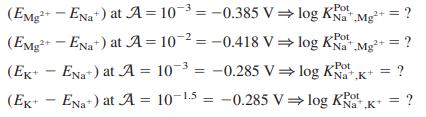
Data below come from the graph in Box 14-2, for which the separate solutions method was used to measure selectivity coefficients for a sodium ion-selective electrode at 21.5°C. Use Equation 14-11 to calculate log KPot for each line below.Equation 14-11
The H+ ion-selective electrode on the Phoenix Mars Lander has selectivity coefficients KpotHNA+ = 10-8.6 and KpotH+,Ca2+ = 10-7.8. Let A be the primary ion sensed by the electrode and let its charge be zA. Let X be an interfering ion with charge zX. The relative error in primary ion activity due to
A Ca2+ ion-selective electrode was calibrated in metal ion buffers with ionic strength fixed at 0.50 M. Using the following electrode readings, write an equation for the response of the electrode to Ca2+ and Mg2+.
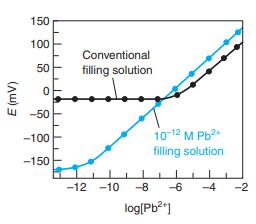
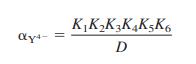
The Pb2+ ion buffer used inside the electrode for the colored curve in Figure 14-27 was prepared by mixing 1.0 mL of 0.10 M Pb(NO3)2 with 100.0 mL of 0.050 M Na2EDTA. At the measured pH of 4.34,α γ4- = 1.46 × 10⁻⁸ (Equation 11-4). Show that [Pb2+] = 1.4 × 10⁻¹² M.Figure 14-27Equation 11-4
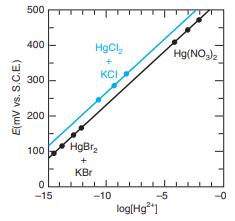
Solutions with a wide range of Hg2+ concentrations were prepared to calibrate an experimental Hg2+ ion-selective electrode. For the range 10 -5 < [Hg2+] [< 10-1 M, Hg(NO3)2 was used directly. The range 10-11
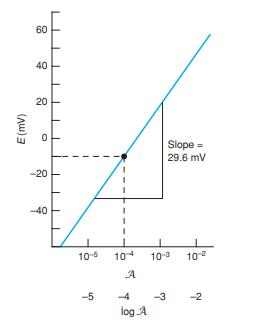
Activity problem. Citric acid is a triprotic acid (H3A) whose anion (A3-) forms stable complexes with many metal ions.When a Ca2+ ion-selective electrode with a slope of 29.58 mV was immersed in a solution having ACa2+ = 1.00 × 10⁻³ , the reading was +2.06 mV. Calcium citrate solution was
What does analyte do to a chemical-sensing field effect transistor to produce a signal related to the activity of analyte?
For a silver-silver chloride electrode, the following potentials are observed:E° = 0.222 V E(saturated KCl) = 0.197 VFrom these potentials, find the activity of Cl- in saturated KCl. Calculate E for a calomel electrode saturated with KCl, given that E° for the calomel electrode is 0.268 V. (Your
A cell was prepared by dipping a Cu wire and a saturated calomel electrode into 0.10 M CuSO4 solution. The Cu wire was attached to the positive terminal of a potentiometer and the calomel electrode was attached to the negative terminal.(a) Write a half-reaction for the Cu electrode.(b) Write the
Explain why a silver electrode can be an indicator electrode for Ag+ and for halides.
A 10.0-mL solution of 0.050 0 M AgNO3 was titrated with 0.025 0 M NaBr in the cellS.C.E. 7 || titration solution | Ag(s)Find the cell voltage for 0.1 and 30.0 mL of titrant.
A solution containing 50.0 mL of 0.100 M EDTA buffered to pH 10.00 was titrated with 50.0 mL of 0.020 0 M Hg(ClO4)2 in the cell shown in Exercise 14-B:S.C.E. 7 titration solution | Hg(l)From the cell voltage E = - 0.027 V, find the formation constant of Hg(EDTA)2-.
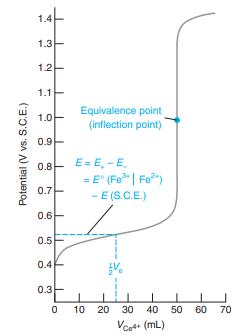
Consider the titration in Figure 15-2.(a) Write a balanced titration reaction.(b) Write two different half-reactions for the indicator electrode.(c) Write two different Nernst equations for the cell voltage.(d) Calculate E at the following volumes of Ce4+: 10.0, 25.0, 49.0, 50.0, 51.0, 60.0, and
Why don't Cr3+ and TiO2+ interfere in the analysis of Fe3+ when a Walden reductor, instead of a Jones reductor, is used for prereduction?
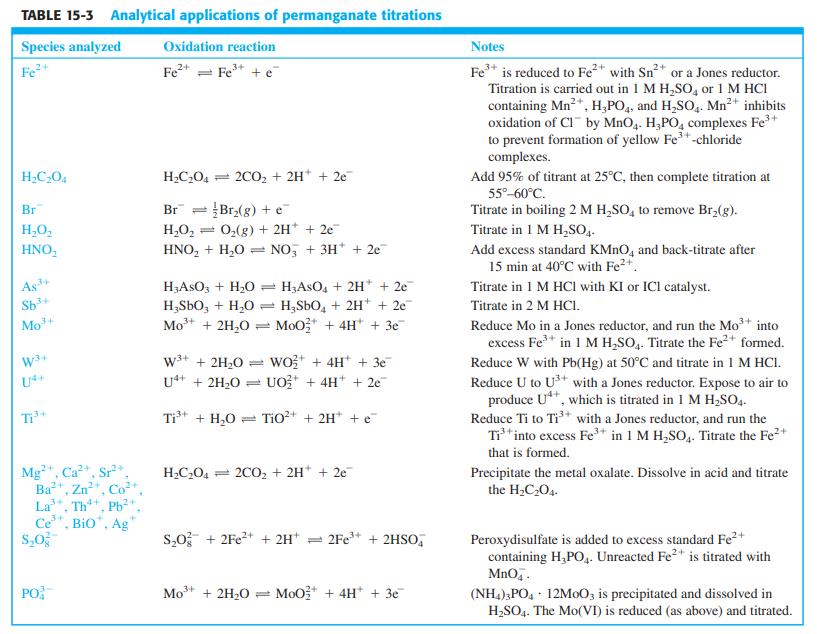
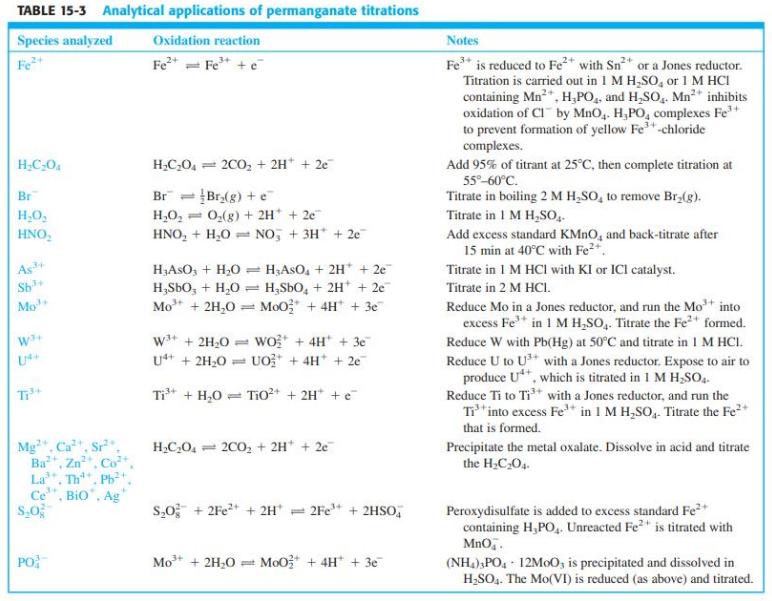
From information in Table 15-3, explain how you would use KMnO4 to find the content of (NH4)2S2O8 in a solid mixture with (NH4)2SO4. What is the purpose of phosphoric acid in the procedure?Table 15-3
Write balanced half-reactions in which MnO-4 acts as an oxidant at(a) pH = 0;(b) pH =10;(c) pH = 15.
When 25.00 mL of unknown were passed through a Jones reductor, molybdate ion (MoO2-4) was converted into Mo3+. The filtrate required 16.43 mL of 0.010 33 M KMnO4 to reach the purple end point.MnO-4 + Mo3+ → Mn2+ + MoO22+A blank required 0.04 mL. Balance the reaction and find the molarity of
A 25.00-mL volume of commercial hydrogen peroxide solution was diluted to 250.0 mL in a volumetric flask. Then 25.00 mL of the diluted solution were mixed with 200 mL of water and 20 mL of 3 M H2SO4 and titrated with 0.021 23 M KMnO4. The first pink color was observed with 27.66 mL of titrant. A
Two possible reactions of MnO4 with H2O2 to produce O2 and Mn2 are(a) Complete the half-reactions for both schemes by adding e-, H2O, and H- and write a balanced net equation for each scheme.(b) Sodium peroxyborate tetrahydrate, NaBO3•4H2O (FM 153.86), produces H2O2 when dissolved in acid:
A 50.00-mL sample containing La3+ was treated with sodium oxalate to precipitate La2(C2O4)3, which was washed, dissolved in acid, and titrated with 18.04 mL of 0.006 363 M KMnO4. Calculate the molarity of La3+ in the unknown.
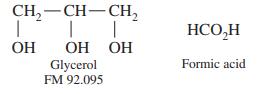
An aqueous glycerol solution weighing 100.0 mg was treated with 50.0 mL of 0.083 7 M Ce4+ in 4 M HClO4 at 60°C for 15 min to oxidize the glycerol to formic acid:The excess Ce4+ required 12.11 mL of 0.044 8 M Fe2+ to reach a ferroin end point. What is the weight percent of glycerol in the unknown?
Nitrite (NO2-) can be determined by oxidation with excess Ce4+, followed by back titration of the unreacted Ce4+. A 4.030-g sample of solid containing only NaNO2 (FM 68.995) and NaNO3 was dissolved in 500.0 mL. A 25.00-mL sample of this solution was treated with 50.00 mL of 0.118 6 M Ce4+ in strong
Consider the titration of 100.0 mL of 0.010 0 M Ce4+ in 1 M HClO4 by 0.040 0 M Cu+ to give Ce3+ and Cu2+, using Pt and saturated Ag | AgCl electrodes to find the end point.(a) Write a balanced titration reaction.(b) Write two different half-reactions for the indicator electrode.(c) Write two
Calcium fluorapatite (Ca10(PO4)6F2, FM 1 008.6) laser crystals were doped with chromium to improve their efficiency. It was suspected that the chromium could be in the +4 oxidation state.1. To measure the total oxidizing power of chromium in the material, a crystal was dissolved in 2.9 M HClO4 at
Primary-standard-grade arsenic(III) oxide (As4O6) is a useful (but carcinogenic) reagent for standardizing oxidants including MnO4- and I-3. To standardize MnO4-, As4O6 is dissolved in base and then titrated with MnO4- in acid. A small amount of iodide (I-) or iodate (IO-3 ) catalyzes the reaction
State two ways to make standard triiodide solution.
(a) Potassium iodate solution was prepared by dissolving 1.022 g of KIO3 (FM 214.00) in a 500-mL volumetric flask. Then 50.00 mL of the solution were pipetted into a flask and treated with excess KI (2 g) and acid (10 mL of 0.5 M H2SO4). How many moles of I-3 are created by the reaction?(b) The
A 3.026-g portion of a copper(II) salt was dissolved in a 250-mL volumetric flask. A 50.0 mL aliquot was analyzed by adding 1 g of KI and titrating the liberated iodine with 23.33 mL of 0.046 68 M Na2S2O3. Find the weight percent of Cu in the salt. Should starch indicator be added to this titration
H2S was measured by slowly adding 25.00 mL of aqueous H2S to 25.00 mL of acidified standard 0.010 44 M I-3 to precipitate elemental sulfur. (If [H2S] > 0.01 M, then precipitated sulfur traps some I-3 solution, which is not subsequently titrated.) The remaining I-3 was titrated with 14.44 mL of
From the following reduction potentials(a) Calculate the equilibrium constant for .I2 (aq) + I- ‡Œ I-3 (b) Calculate the equilibrium constant for I2 (aq) + I- ‡Œ I-3 (c) Calculate the solubility (g/L) of I2(s) in water.
The Kjeldahl analysis in Section 10-8 is used to measure the nitrogen content of organic compounds, which are digested in boiling sulfuric acid to decompose to ammonia, which, in turn, is distilled into standard acid. The remaining acid is then back-titrated with base. Kjeldahl himself had
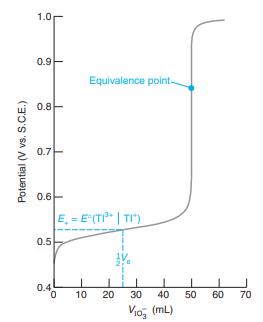
Consider the titration of 25.0 mL of 0.010 0 M Sn2+ by 0.050 0 M Tl3+ in 1 M HCl, using Pt and saturated calomel electrodes to find the end point.(a) Write a balanced titration reaction.(b) Write two different half-reactions for the indicator electrode.(c) Write two different Nernst equations for
Some people have an allergic reaction to the food preservative sulfite (SO32-). Sulfite in wine was measured by the following procedure: To 50.0 mL of wine were added 5.00 mL of solution containing (0.804 3 g KIO3 + 5 g KI)/100 mL. Acidification with 1.0 mL of 6.0 M H2SO4 quantitatively converted
Potassium bromate, KBrO3, is a primary standard for the generation of Br2 in acidic solution: BrO-3 + 5Br- + 6H+ ⇌ 3Br2 (aq) + 3H2O The Br2 can be used to analyze many unsaturated organic compounds. Al3+ was analyzed as follows: An unknown was treated with 8-hydroxyquinoline (oxine) at pH 5 to
Iodometric analysis of high-temperature superconductor. The procedure in Box 15-3 was carried out to find the effective copper oxidation state, and therefore the number of oxygen atoms, in the formula YBa2Cu3O7 - z, where z ranges from 0 to 0.5.(a) In Experiment A of Box 15-3, 1.00 g of
Here is a description of an analytical procedure for superconductors containing unknown quantities of Cu(I), Cu(II), Cu(III), and peroxide (O22-):32 "The possible trivalent copper and/or peroxide-type oxygen are reduced by Cu(I) when dissolving the sample (ca. 50 mg) in deoxygenated HCl solution (1
Li1 + y CoO2 is an anode for lithium batteries. Cobalt is present as a mixture of Co(III) and Co(II). Most preparations also contain inert lithium salts and moisture. To find the stoichiometry, Co was measured by atomic absorption and its average oxidation state was measured by a potentiometric
The oxidation numbers of Cu and Bi in high-temperature superconductors of the type Bi2Sr2(Ca0.8Y0.2)Cu2Ox (which could contain Cu2+, Cu3+, Bi3+, and Bi5+) can be measured by the following procedure. In Experiment A, the superconductor is dissolved in 1 M HCl containing excess 2 mM CuCl.
Ascorbic acid (0.010 0 M) was added to 10.0 mL of 0.020 0 M Fe3+ in a solution buffered to pH 0.30, and the potential was monitored with Pt and saturated Ag | AgCl electrodes.Dehydroascorbic acid + 2H+ + 2e- ⇌ ascorbic acid + H2O E° = 0.390 V(a)
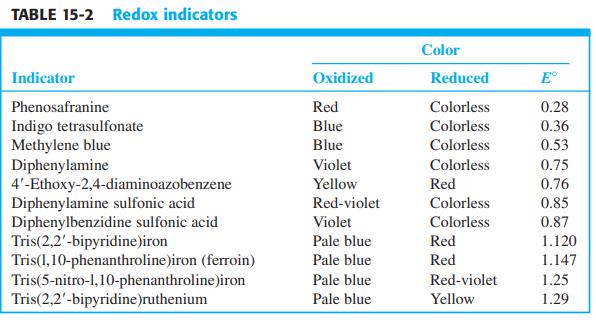
Select indicators from Table 15-2 that would be suitable for finding the end point in Figure 15-3. What color changes would be observed?Figure 15-3
Would tris(2,2 -bipyridine)iron be a useful indicator for the titration of Sn2+ with Mn(EDTA)-? (Hint: The potential at the equivalence point must be between the potentials for each redox couple.)
Explain what we mean by preoxidation and prereduction. Why is it important to be able to destroy the reagents used for these purposes?
Write balanced reactions for the destruction of S2O2-8 , Ag2+, and H2O2 by boiling.
The figure shows the behavior of Pt and Ag cathodes at which reduction of H3O+ to H2(g) occurs. Explain why the two curves are not superimposed.
What cathode potential (versus S.H.E.) is required to reduce 99.99% of Cd(II) from a solution containing 0.10M Cd(II) in 1.0 M ammonia if there is negligible current? Consider the following reactions and assume that nearly all Cd(II) is in the form Cd(NH3)42+.
Electroplating efficiency. Nickel was electrolytically plated onto a carbon electrode from a bath containing 290 g/L NiSO4 ∙ 6H2O, 30 g/L B(OH)3, and 8 g/L NaCl at - 1.2 V vs. Ag | AgCl. The most important side reaction is reduction of H+ to H2. In one experiment, a carbon electrode weighing
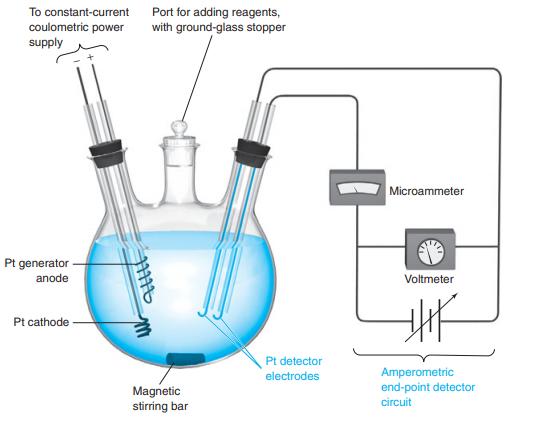
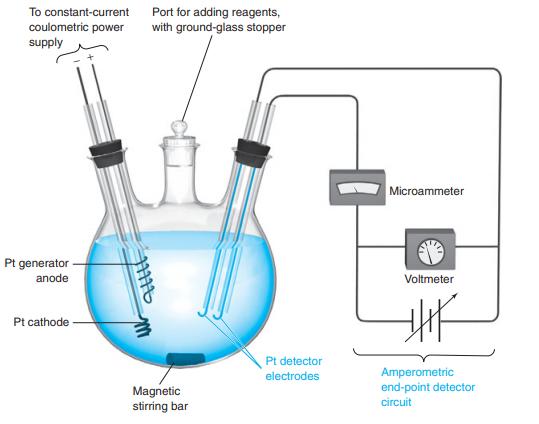
Explain how the amperometric end-point detector in Figure 16-8 operates.Figure 16-8
The sensitivity of a coulometer is governed by the delivery of its minimum current for its minimum time. Suppose that 5 mA can be delivered for 0.1 s.(a) How many moles of electrons are delivered by 5 mA for 0.1 s? (b) How many milliliters of a 0.01 M solution of a two-electron reducing agent
The experiment in Figure 16-8 required 5.32 mA for 964 s for complete reaction of a 5.00 mL aliquot of unknown cyclohexene solution.(a) How many moles of electrons passed through the cell?(b) How many moles of cyclohexene reacted?(c) What was the molarity of cyclohexene in the unknown? Figure
H2S(aq) can be analyzed by titration with coulometrically generated I2.H2S + I2 → + S(s) + 2H+ + 2I-To 50.00 mL of sample were added 4 g of KI. Electrolysis required 812 s at 52.6 mA. Calculate the concentration of H2S (μg/mL) in the sample.
Ti3+ is to be generated in 0.10 M HClO4 solution for coulometric reduction of azobenzene.At the counter electrode, water is oxidized, and O2 is liberated at a pressure of 0.20 bar. Both electrodes are made of smooth Pt, and each has a total surface area of 1.00 cm2. The rate of reduction of the
In an extremely accurate measurement of the Faraday constant, a pure silver anode was oxidized to Ag+ with a constant current of 0.203 6390 (± 0.0000004) A for 18 000.075 (± 0.010) s to give a mass loss of 4.097900 (± 0.000003) g from the anode. Given that the atomic mass of Ag is 107.8682 (±
How many hours are required for 0.100 mol of electrons to flow through a circuit if the current is 1.00 A?
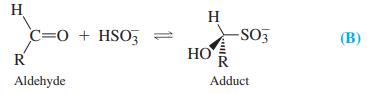
Coulometric titration of sulfite in wine. Sulfur dioxide is added to many foods as a preservative. In aqueous solution, the following species are in equilibrium:Bisulfite reacts with aldehydes in food near neutral pH:Sulfite is released from the adduct in 2 M NaOH and can be analyzed by its
Chemical oxygen demand by coulometry. An electrochemical device incorporating photooxidation on a TiO2 surface could replace refluxing with Cr2O72- to measure chemical oxygen demand (Box 15-2). The diagram below shows a working electrode held at + 0.30 V versus Ag | AgCl and coated with
What is a Clark electrode, and how does it work?
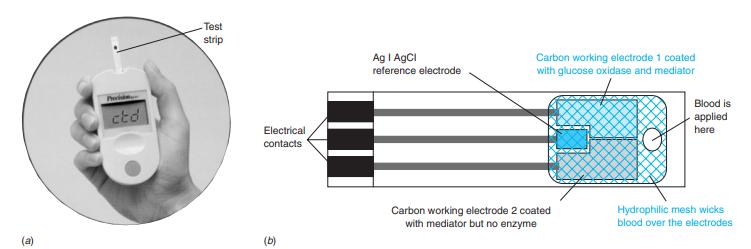
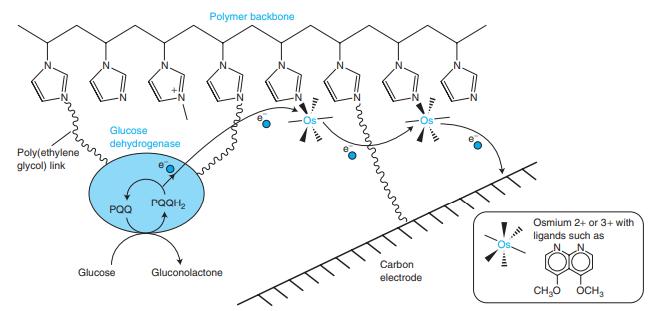
(a) How does the amperometric glucose monitor in Figure 16-10 work?(b) Why is a mediator advantageous in the glucose monitor?(c) How does the coulometric glucose monitor in Figure 16-12 work?(d) Why does the signal in the amperometric measurement depend on the temperature of the blood sample,
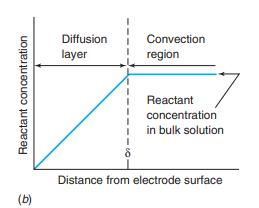
For a rotating disk electrode operating at sufficiently great potential, the redox reaction rate is governed by the rate at which analyte diffuses through the diffusion layer to the electrode. The thickness of the diffusion layer iswhere D is the diffusion coefficient of reactant (m2/s), is the
In 1 M NH3/1 M NH4Cl solution, Cu2+ is reduced to Cu+ near -0.3 (versus S.C.E.), and Cu+ is reduced to Cu(in Hg) near - 0.6 V.(a) Sketch a qualitative sampled current polarogram for a solution of Cu+.(b) Sketch a polarogram for a solution of Cu2+.(c) Suppose that Pt, instead of Hg, were used as the
(a) Explain the difference between charging current and faradaic current.(b) What is the purpose of waiting 1 s after a voltage pulse before measuring current in sampled current voltammetry?(c) Why is square wave voltammetry more sensitive than sampled current voltammetry?
Suppose that the diffusion current in a polarogram for reduction of Cd2+ at a mercury electrode is 14 μA. If the solution contains 25 mL of 0.50 mM Cd2+, what percentage of Cd2+ is reduced in the 3.4 min required to scan from - 0.6 to - 1.2 V?
The drug Librium gives a polarographic wave with E1/2 = - 0.265 V (versus S.C.E.) in 0.05 M H2SO4. A 50.0-mL sample containing Librium gave a wave height of 0.37 μA. When 2.00 mL of 3.00 mM Librium in 0.05 M H2SO4 were added to the sample, the wave height increased to 0.80 μA. Find the molarity
Explain what is done in anodic stripping voltammetry. Why is stripping the most sensitive voltammetric technique?
The standard free energy change for the formation of H2(g) + ½O2(g) from H2O is ΔG° = + 237.13 kJ. The reactions areCalculate the standard voltage (E°) needed to decompose water into its elements by electrolysis. What does the word standard mean in this question?
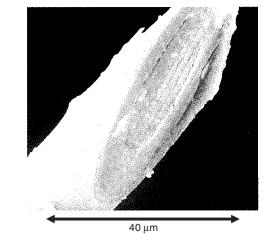
The figure below shows a series of standard additions of Cu2+ to acidified tap water measured by anodic stripping voltammetry at an iridium electrode. The unknown and all standard additions were made up to the same final volume.(a) What chemical reaction occurs during the concentration stage of the
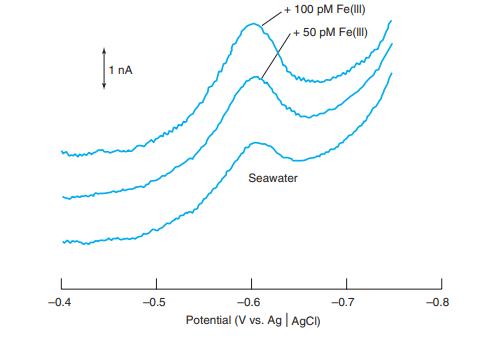
From the two standard additions of 50 pm Fe(III) in Figure 16-23, find the concentration of Fe(III) in the seawater. Estimate where the baseline should be drawn for each trace and measure the peak height from the baseline. Consider the volume to be constant for all three solutions.Figure 16-23
Peak current (Ip) and scan rate (Ip) are listed for cyclic voltammetry (Fe(II) → Fe(III)) of a water-soluble ferrocene derivative in 0.1 M NaCl.If a graph of Ip versus √v gives a straight line, then the reaction is diffusion controlled. Prepare such a graph and use it to find the diffusion
What are the advantages of using a microelectrode for voltammetric measurements?
What is the purpose of the Nafion membrane in Figure 16-30?Figure 16-30
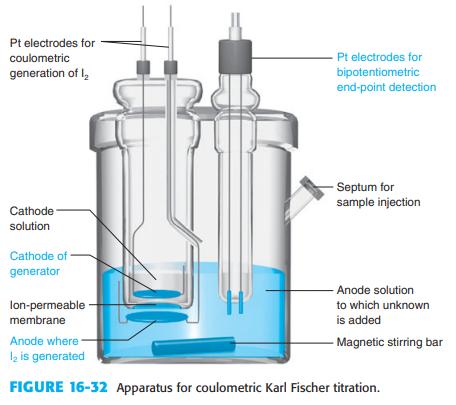
Write the chemical reactions that show that 1 mol of I2 is required for 1 mol of H2O in a Karl Fischer titration.
Explain how the end point is detected in a Karl Fischer titration in Figure 16-32.Figure 16-32
Consider the following electrolysis reactions.(a) Calculate the voltage needed to drive the net reaction if current is negligible.(b) Suppose that the cell has a resistance of 2.0 and a current of 100 mA. How much voltage is needed to overcome the cell resistance? This is the ohmic potential.(c)
Which voltage, V1 or V2, in the diagram (see top of next column), is constant in controlled potential electrolysis? Which are the working, auxiliary, and reference electrodes in the diagram?
The Weston cell is a stable voltage standard formerly used in potentiometers. (The potentiometer compares an unknown voltage with that of the standard. In contrast with the conditions of this problem, very little current may be drawn from the cell if it is to be a voltage standard.)(a) How much
The chlor-alkali process, in which seawater is electrolyzed to produce Cl2 and NaOH, is the second most important commercial electrolysis, behind production of aluminum.The Nafion membrane used to separate the anode and cathode compartments resists chemical attack. Its anionic side chains permit
A lead-acid battery in a car has six cells in series, each delivering close to 2.0 V for a total of 12 V when the battery is discharging. Recharging requires ∼2.4 V per cell, or ∼14 V for the entire battery. Explain these observations in terms of Equation 16-6.Equation 16-6
A 0.326 8-g unknown containing Pb(CH3CHOHCO2)2 (lead lactate, FM 385.3) plus inert material was electrolyzed to produce 0.111 1 g of PbO2 (FM 239.2). Was the PbO2 deposited at the anode or at the cathode? Find the weight percent of lead lactate in the unknown.
When I was a boy, Uncle Wilbur let me watch as he analyzed the iron content of runoff from his banana ranch. A 25.0-mL sample was acidified with nitric acid and treated with excess KSCN to form a red complex. (KSCN itself is colorless.) The solution was then diluted to 100.0 mL and put in a
The absorption cross section on the ordinate of the ozone absorption spectrum at the beginning of this chapter is defined by the relationwhere n is the number of absorbing molecules per cubic centimeter, is the absorption cross section (cm2), and b is the pathlength (cm). The total ozone in the
A compound with molecular mass 292.16 g/mol was dissolved in a 5-mL volumetric flask. A 1.00-mL aliquot was withdrawn, placed in a 10-mL volumetric flask, and diluted to the mark. The absorbance at 340 nm was 0.427 in a 1.000-cm cuvet. The molar absorptivity at 340 nm is ε340 = 6 130 M-1 cm-1.(a)
You have been sent to India to investigate the occurrence of goiter disease attributed to iodine deficiency. As part of your investigation, you must make field measurements of traces of iodide (I-) in groundwater. The procedure is to oxidize I- to I2 and convert the I2 into an intensely colored
Nitrite ion, NO-2, is a preservative for bacon and other foods, but it is potentially carcinogenic. A spectrophotometric determination of NO-2 makes use of the following reactions:Here is an abbreviated procedure for the determination:1. To 50.0 mL of unknown solution containing nitrite is added
(a) How much energy (in kilojoules) is carried by one mole of photons of red light with λ 650 nm?(b) How many kilojoules are carried by one mole of photons of violet light with λ 400 nm?
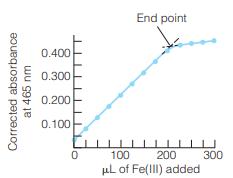
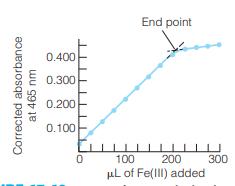
A 2.00-mL solution of apotransferrin was titrated as illustrated in Figure 17-10. It required 163 L of 1.43 mM ferric nitrilotriacetateto reach the end point.(a) Why does the slope of the absorbance-versus-volume graph change abruptly at the equivalence point?(b) How many moles of Fe(III) (= ferric
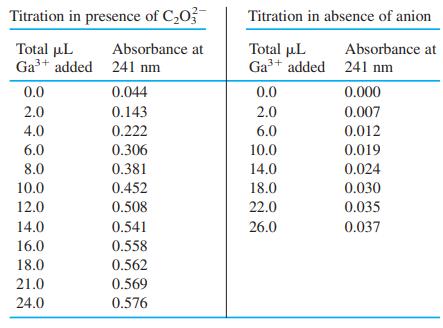
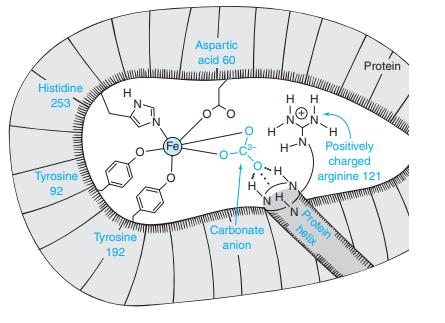
The iron-binding site of transferrin in Figure 17-7 can accommodate certain other metal ions besides Fe3+ and certain other anions besides CO32-. Data are given in the table for the titration of transferrin (3.57 mg in 2.00 mL) with 6.64 mM Ga3+ solution in the presence of the anion oxalate,
In formaldehyde, the transition n → π*(T1) occurs at 397 nm, and the n → π*(S1) transition comes at 355 nm. What is the difference in energy (kJ/mol) between the S1 and T1 states? This difference is due to the different electron spins in the two states.
What is the difference between fluorescence and phosphorescence?
Explain what happens in Rayleigh scattering and Raman scattering. How much faster is scattering of visible light than fluorescence?
What is the difference between a fluorescence excitation spectrum and a fluorescence emission spectrum? Which one resembles an absorption spectrum?
Showing 5400 - 5500
of 6778
First
48
49
50
51
52
53
54
55
56
57
58
59
60
61
62
Last
Step by Step Answers

 Get 50% OFF
Claim Now
Get 50% OFF
Claim Now


.png)

.png)

.png)
.png)
.png)
.png)

.png)
.png)

.png)
.png)



-1.png)
-2.png)



.png)
.png)
.png)
.png)
.png)
.png)
.png)


.png)
-1.png)
-2.png)
-3.png)