New Semester
Started
Get
50% OFF
Study Help!
--h --m --s
Claim Now
Question Answers
Textbooks
Find textbooks, questions and answers
Oops, something went wrong!
Change your search query and then try again
S
Books
FREE
Study Help
Expert Questions
Accounting
General Management
Mathematics
Finance
Organizational Behaviour
Law
Physics
Operating System
Management Leadership
Sociology
Programming
Marketing
Database
Computer Network
Economics
Textbooks Solutions
Accounting
Managerial Accounting
Management Leadership
Cost Accounting
Statistics
Business Law
Corporate Finance
Finance
Economics
Auditing
Tutors
Online Tutors
Find a Tutor
Hire a Tutor
Become a Tutor
AI Tutor
AI Study Planner
NEW
Sell Books
Search
Search
Sign In
Register
study help
sciences
chemical principles
Chemical Principles The Quest For Insight 7th Edition Peter Atkins, Loretta Jones, Leroy Laverman - Solutions
Write the valence-shell electron configurations and bond orders of(a) O22–;(b) N2–;(c) C2–.
One of the following compounds does not exist. Use Lewis structures to identify that compound.(a) C2H2;(b) C2H4;(c) C2H6;(d) C2H8.
Acrylonitrile, CH2 CHCN, is used in the synthesis of acrylic fibers (polyacrylonitriles), such as Orlon. Draw the Lewis structure of acrylonitrile and describe the hybrid orbitals on each carbon atom. What are the approximate values of the bond angles?
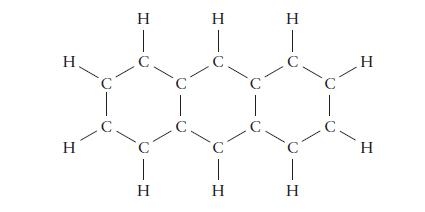
Anthracene has the formula C14 H10. It is similar to benzene but has three six-membered rings that share common C—C bonds, as shown below. Complete the structure by drawing in multiple bonds to satisfy the octet rule at each carbon atom.Resonance structures are possible. Draw as many as you can
Draw the Lewis structure, VSEPR formula, molecular shape, and bond angles for each of the following species:(a) I3–;(b) POCl3;(c) IO3–;(d) N2O.
For each of the following ground-state atoms, predict the type of orbital (1s, 2p, 3d, 4f, etc.) from which an electron will need to be removed to form the +1 ions:(a) Zn;(b) Cl;(c) Al;(d) Cu.
Place the following molecules or ions in order of decreasing bond length:(a) The CO bond in CO, CO2, CO32–;(b) The SO bond in SO2 , SO3, SO32–;(c) The CN bond in HCN, CH2 NH, CH3 NH2. Explain your reasoning.
Give the valence-shell electron configurations and bond orders for CO and CO+. Use that information to predict which species has stronger bonds.
Given the information in Exercise 2F.21, plot a graph showing how the hybridization depends on the angle between two hybrids formed from an s-orbital and two p-orbitals, and confirm that it ranges from 90° when no s-orbital is included in the mixture to 120° when the hybridization is sp2
Draw the Lewis structure and predict the shape of(a) ClF5;(b) SbF5;(c) IO53–;(d) IO65-.
The antibonding orbital in Eq. 2 is not normalized (see Exercise 2G.21). Find the factor that normalizes it to 1, given that the individual atomic orbitals are each normalized. Express your answer in terms of the overlap integral S = ∫ψA1s ψB1s dτ. Confirm that the bonding and antibonding
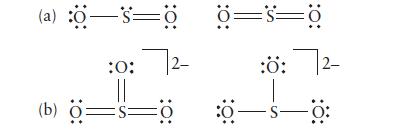
Two Lewis structures are shown below for each species.Determine the formal charge on each atom and then, if appropriate, identify the Lewis structure of lower energy for each species. (a) :0—S=0_0=8=0 :0: (b) 0=s= 2- :O: :0: :Ö: 2-
Which do you predict to have the strongest CN bond:(a) NHCH2,(b) NH2 CH3, or(c) HCN? Explain.
Which of the following species are paramagnetic:(a) N2–;(b) F2+;(c) O22+? If the species is paramagnetic, how many unpaired electrons does it possess?
Draw the most important Lewis structure for each of the following molecules. Show all lone pairs and formal charges. Draw all equivalent resonance forms:(a) HONCO;(b) H2 CSO;(c) H2 CNN;(d) ONCN. Atoms are linked in the order shown.
Draw the Lewis structures that contribute to the resonance hybrid of the guanadinium ion, C(NH2)3+.
Draw the Lewis structure, VSEPR formula, molecular shape, and bond angles for each of the following species:(a) SiCl4;(b) PF5;(c) SBr2;(d) ICl2+.
For each of the following ground-state ions, predict the type of orbital (1s, 2p, 3d, 4f, etc.) from which an electron will need to be removed to form the ions of one greater positive charge:(a) Mo3+;(b) P3+;(c) Bi2+;(d) Mn+.
In each of these compounds, an atom violates the octet rule. Identify the atom and explain the deviation from the octet rule:(a) SF6;(b) BH3.
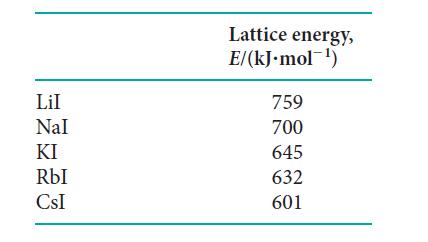
(a) Explore whether the lattice energies of the alkali metal iodides are inversely proportional to the distances between the centers of the ions in MI (M = alkali metal) by plotting the lattice energies given below against the internuclear distances d M = I.How good is the correlation? Is a
Place the following molecules or ions in order of decreasing bond order:(a) NO bond in NO, NO2, NO3–;(b) CC bond in C2H2 , C2H4, C2H6;(c) CO bond in CH3OH, CH2O, CH3 OCH3. Explain your reasoning.
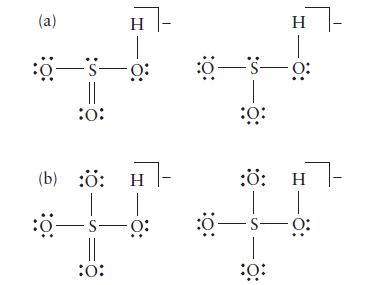
Two contributions to the resonance structure are shown below for each species. Determine the formal charge on each atom and then, if possible, identify the Lewis structure of lower energy for each species. (a) :0-S- 0: :0: H (b) :Ö: H :0-S- :0: H :0—5—0: :Ö: :: H 5—s—0: :Ö: - 0:
Give the valence-shell electron configurations and bond orders for NO and NO+. Use that information to predict which species has stronger bonds.
Determine the formal charges of the atoms in(a) BeCl2;(b) H2NOH;(c) NO2–.
(a) Confirm that lattice energies are inversely proportional to the distance between the centers of the ions in MX (M = alkali metal, X = halide ion) by plotting the lattice energies of KF, KCl, and KI against the internuclear distances dM - X. The lattice energies of KF, KCl, and KI are 826, 717,
Write the most likely charge for the ions formed by each of the following elements:(a) S;(b) Te;(c) Rb;(d) Ga;(e) Cd.
Which do you predict to have the strongest CX bond, where X is a halogen:(a) CF4,(b) CCl4, or(c) CBr4? Explain.
Which of the following species are paramagnetic:(a) B2;(b) B2–;(c) B2+? If the species is paramagnetic, how many unpaired electrons does it possess?
Draw the Lewis structures that contribute to the resonance hybrid of chloric acid, HClO2 (Cl is the central atom and the H is attached to one of the O atoms).
Both NH2– and NH2+ are angular species, but the bond angle in NH2– is less than that in NH2+.(a) What is the reason for this difference in bond angles?(b) Take the x -axis as lying perpendicular to the plane of the molecule. Does the N2px orbital participate in the hybridization for either
Draw the Lewis structure and the VSEPR formula, list the shape, and predict the approximate bond angles of(a) PCl3F2;(b) SnF4;(c) SnF62-;(d) IF5;(e) XeO4.
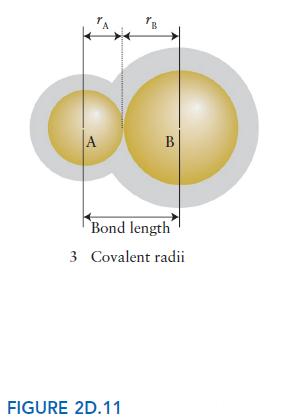
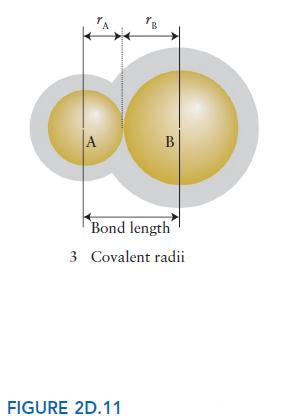
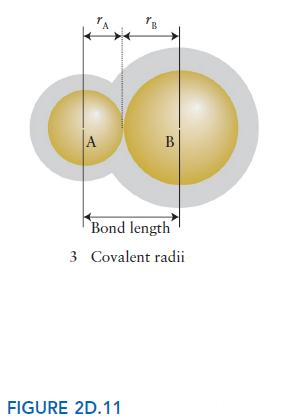
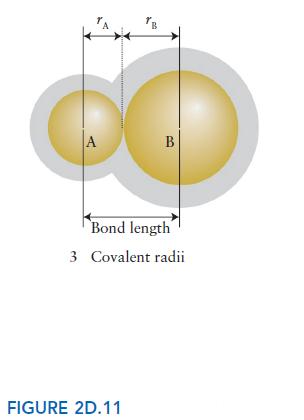
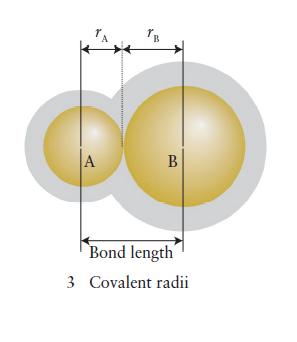
Use the information in Fig. 2D.11 to estimate the length of(a) The CO bond in CO2;(b) The CO and CN bonds in urea, OC(NH2)2;(c) The OCl bond in HClO;(d) The NCl bond in NOCl. CO B Bond length 3 Covalent radii FIGURE 2D.11
Write the most likely charge for the ions formed by each of the following elements:(a) Cs;(b) O;(c) Ca;(d) N;(e) I.
A common biologically active radical is the pentadienyl radical, RCHCHCHCHCHR′, where the carbons form a chain, with R and R′, which can be a number of different organic groups, at each end. Draw three resonance structures for this compound that maintain carbon’s valence of four.
Determine the bond orders and use them to predict which species of each of the following pairs has the stronger bond:(a) F2 or F2–;(b) B2 or B2+.
Predict the qualitative molecular potential energy curves for the NN bond by making sketches on one graph for N2 H4, N2, and N3–. Explain why the energy of the lowest point on each curve is not the same.
In the ion Se42+, the selenium atoms form a square. Draw two resonance structures for Se42+.
Describe the structure of the formamide molecule, HCONH2, in terms of hybrid orbitals, bond angles, and σ - and π -bonds. The C atom is bonded to one H atom, a terminal O atom, and the N atom. The N atom is also bonded to two H atoms.
Predict the bond angles at the central atom of the following molecules and ions:(a) OF2;(b) ClO2–;(c) NO2–;(d) SeCl2.
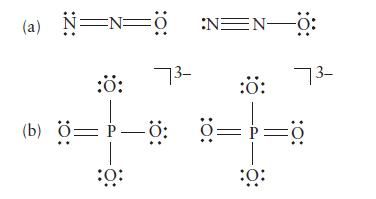
Select from each of the following pairs of Lewis structures the one that is likely to make the dominant contribution to a resonance hybrid. Explain your selection. (a) N=N=0 :N=N0: 73- :Ö: 73- :Ö: :Ö: (b) Ö=P—ö Ö==d :0:
Predict the number of valence electrons present for each of the following ions:(a) In+;(b) Tc2+;(c) Ta2+;(d) Re+.
Use the information in Fig. 2D.11 to estimate the length of(a) The CO bond in formaldehyde, H2CO;(b) The CO bond in dimethyl ether, CH3OCH3;(c) The CO bond in methanol, CH3OH;(d) The CS bond in methanethiol, CH3 SH. CO B Bond length 3 Covalent radii FIGURE 2D.11
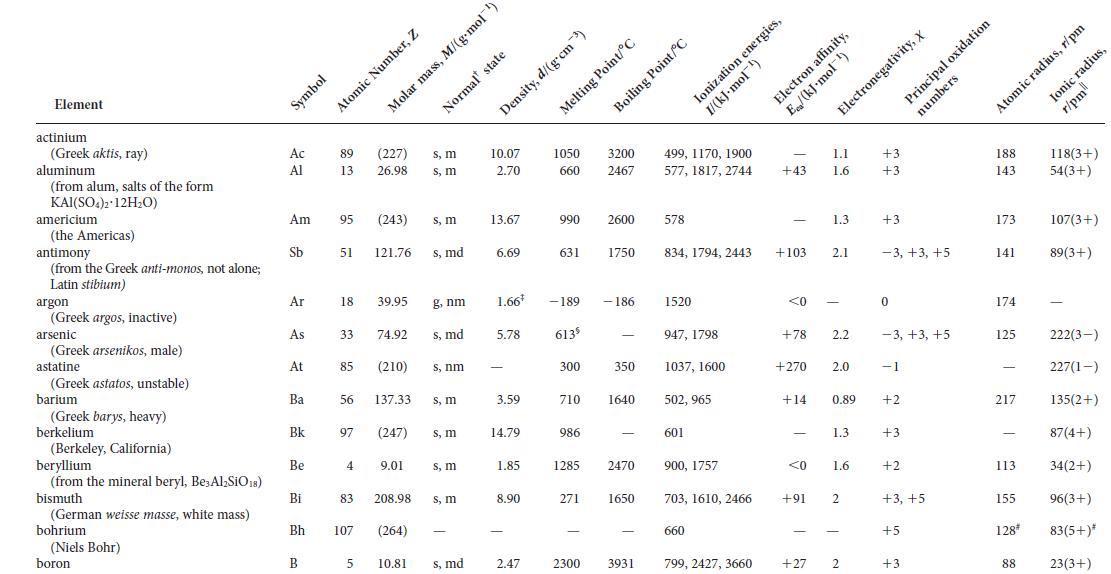
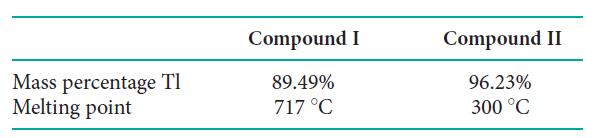
Thallium and oxygen form two compounds with the following characteristics:Determine the chemical formulas of the two compounds.(b) Determine the oxidation number of thallium in each compound.(c) Assume that the compounds are ionic and write the electron configuration for each thallium
Determine the bond orders and use them to predict which species of each of the following pairs has the stronger bond:(a) C2 or C2–;(b) N2 or N2–.
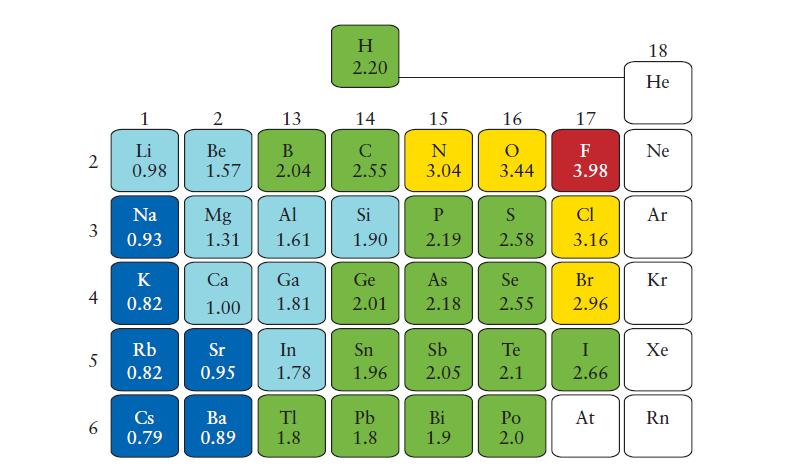
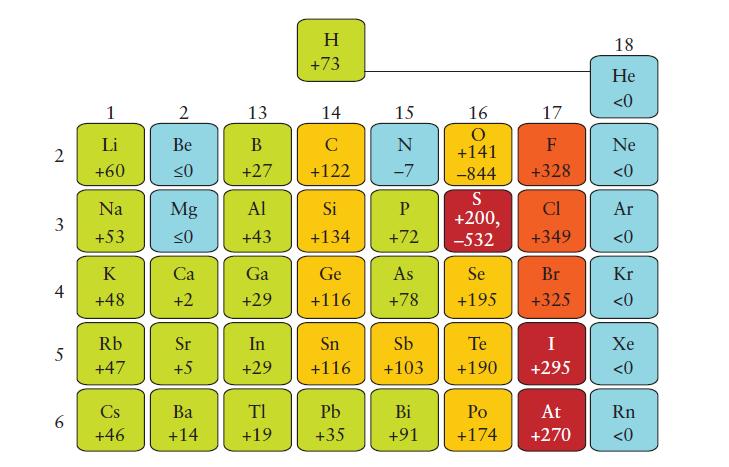
How close are the Mulliken and Pauling electronegativity scales?(a) Use Eq. 2 in Topic 2D to calculate the Mulliken electronegativities of C, N, O, and F. Use the values in kilojoules per mole from Figs. 1F.8 and 1F.12 and divide each value by 230 kJ · mol-1 for this comparison. The Pauling
Draw the Lewis structure and determine the formal charge on each atom in(a) NO+;(b) N2;(c) CO;(d) C22¯;(e) CN¯.
Predict the shapes and estimate the bond angles of(a) The thiosulfate ion, S2O32–;(b) (CH3)2Be;(c) BH2–;(d) SnCl2.
Use the covalent radii in Fig. 2D.11 to calculate the bond lengths in the following molecules. Account for the trends in your calculated values:(a) CF4;(b) SiF4;(c) SnF4. CO B Bond length 3 Covalent radii FIGURE 2D.11
Give the ground-state electron configuration and number of unpaired electrons expected for each of the following ions:(a) Sb3+;(b) Sn4+;(c) W2+;(d) Br+;(e) Ni2+.
Based on their valence-shell electron configurations, which of the following species would you expect to have the lowest ionization energy:(a) C2+;(b) C2;(c) C2–?
Using only Lewis structures that obey the octet rule, draw the Lewis structures and determine the formal charge on each atom in(a) SO2;(b) SO3;(c) SO32–.
The hybrid orbital h1 = s + px + py + pz referred to in Exercise 2F.19 is not normalized. Find the normalization factor N , given that all the atomic orbitals are normalized to 1. A wavefunction ψ can be normalized by writing it as Nψ and finding the factor N which ensures that the integral over
For each of the following molecules or ions, draw the Lewis structure, list the number of lone pairs on the central atom, identify the shape, and estimate the bond angles:(a) PBr5;(b) XeOF2;(c) SF5+;(d) IF3;(e) BrO3–.
Use the covalent radii in Fig. 2D.11 to calculate the lengths of the bonds between nitrogen atoms in the following molecules.Account for the trends in your calculated values:(a) Hydrazine, H2NNH2;(b) Nitrogen hydride, HNNH;(c) N3–. CO B Bond length 3 Covalent radii FIGURE 2D.11
Give the ground-state electron configuration and number of unpaired electrons expected for each of the following ions:(a) Sc3+;(b) Co2+;(c) Sr2+;(d) Se2-.
Based on their valence-shell electron configurations, which of the following species would you expect to have the greatest electron affinity:(a) Be2;(b) F2;(c) B2+,(d) C2+?
The perchlorate ion, ClO4–, is described by resonance structures.(a) Draw the Lewis structures that contribute to the resonance hybrid and identify the most plausible Lewis structures by using formal charge arguments. (b) The average length of a single Cl—O bond is 172 pm and that of a
Hypochlorous acid, HClO, is found in white blood cells, where it helps to destroy bacteria. Draw two Lewis structures with different atom arrangements for HClO and select the most likely structure by identifying the structure with formal charges closest to zero. Consider only structures with single
Draw the Lewis structure and give the approximate bond angles of(a) C2H4;(b) ClCN;(c) OPCl3;(d) N2H4.
In the solid state, sulfur is commonly found in rings of eight atoms, but rings consisting of six atoms of sulfur were identified in 1958.(a) Draw a valid Lewis structure for S6.(b) Is resonance possible in S6? If so, draw one of the resonance structures.
Nitrosyl fluoride, NOF, is an oxidizing agent used as a rocket fuel. Draw three Lewis structures with different atom arrangements for NOF and select the most likely structure by identifying the structure with formal charges closest to zero. Consider only structures with one single bond and one
Give the ground-state electron configuration and number of unpaired electrons expected for each of the following ions:(a) Fe3+;(b) Bi3+;(c) Si4+;(d) I2.
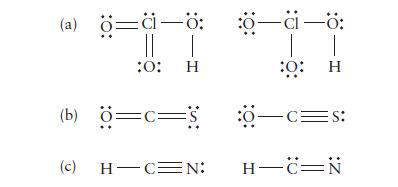
Determine the formal charge on each atom in the following molecules. Identify the structure of lower energy in each pair. (a) ö=ä-ö: || | :0: H (b) Ö=c=S (c) H-C=N: :0—a—ö: T :0: :8-c=s: | H H-CIN
Structural isomers are molecules that have the same composition but a different pattern of connectivity. Two isomers of disulfur difluoride, S2 F2, are known. In each, the two S atoms are bonded to each other. In one isomer, each of the S atoms is bonded to an F atom. In the other isomer, both F
Draw the Lewis structure and predict the shape of(a) OSbCl3;(b) SO2Cl2;(c) IO2F2–. The atom in boldface red type is the central atom.
On the basis of the expected charges on the monatomic ions, give the chemical formula of each of the following compounds:(a) Magnesium arsenide;(b) Indium(III) sulfide;(c) Aluminum hydride;(d) Hydrogen telluride;(e) Bismuth(III) fluoride.
Ionic compounds typically have higher boiling points and lower vapor pressures than covalent compounds. Predict which compound in the following pairs has the lower vapor pressure at room temperature:(a) Cl2 O or Na2O;(b) InCl3 or SbCl3;(c) LiH or HCl;(d) MgCl2 or PCl3.
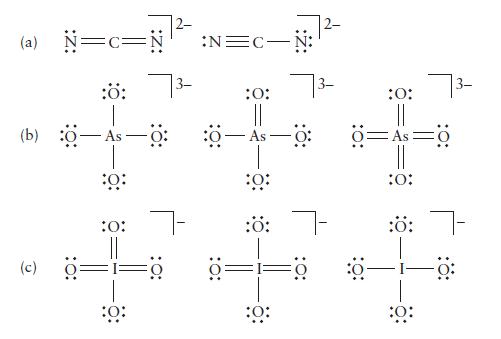
Determine the formal charge on each atom in the following ions. Identify the structure of lowest energy in each case. (a) N=c= -Ö: (9) (c) :Ö: 0: :0: 7- :Ö: :N=C- :O: As :0: :ö: 7- ö= :0: :O: Ö=As :0: :Ö: :0:
Give the ground-state electron configuration and number of unpaired electrons expected for each of the following ions:(a) Ca2+;(b) In+;(c) Te2-;(d) Ag+.
It is usually convenient to deal with wavefunctions that are “normalized,” which means that the integral ∫ψ2 dτ = 1. The bonding orbital in Eq. 1 is not normalized. A wavefunction ψ can be normalized by writing it as Nψ and finding the factor N which ensures that the integral over (Nψ)2
Predict whether each of the following molecules is likely to be polar or nonpolar:(a) CH3SH (methanethiol, found in breath odor and skunks);(b) CH3NH2 (methylamine, a drug precursor);(c) CH3OCH3 (dimethyl ether, used as an aerosol propellant).
Predict which of the following pairs of ions would have the greatest coulombic attraction in a solid compound:(a) Mg2+, S2+;(b) Mg2+, Se2+;(c) Mg2+, O2+.
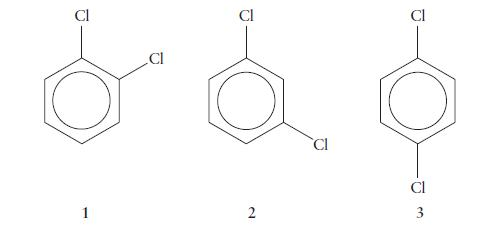
There are three isomers of dichlorobenzene, C6H4Cl2, which differ in the relative positions of the chlorine atoms on the benzene ring.(a) Which of the three forms are polar?(b) Which has the largest dipole moment? 1 CI 2 Cl Cl 1. 3
An organic compound distilled from wood was found to have a molar mass of 32.04 g · mol–1 and the following composition by mass: 37.5% C, 12.6% H, and 49.9% O.(a) Write the Lewis structure of the compound and determine the bond angles about the carbon and oxygen atoms.(b) Give the
Explain why the lattice energy of lithium chloride (861 kJ · mol-1) is greater than that of rubidium chloride (695 kJ · mol-1), given that they have similar arrangements of ions in the crystal lattice.
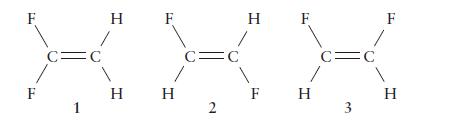
There are three isomers of difluoroethene, C2H2F2, which differ in the locations of the fluorine atoms.(a) Which of the forms are polar?(b) Which has the largest dipole moment? F F C= 1 C O H F H H C= 2 H F F H C= 3 F H
Draw Lewis structures for each of the following species and predict the hybridization at each carbon atom:(a) H2CCH–;(b) H2CCH3+;(c) H3CCH2–.
Explain why the lattice energy of silver bromide (903 kJ · mol-1) is greater than that of silver iodide (887 kJ · mol-1, given that they have similar arrangements of ions in the crystal lattice.
(a) Draw the bonding and antibonding orbitals that correspond to the σ-bond in H2.(b) Repeat this procedure for HF.(c) How do these orbitals differ?
(a) Consider the hypothetical species HeH. What charge (magnitude and sign), if any, should be present on this combination of atoms to produce the most stable molecule or ion possible?(b) What is the maximum bond order that such a molecule or ion could have?(c) If the charge on this species were
(a) Order the following molecules according to increasing C—F bond length: CF+ , CF, CF–.(b) Which of these species is diamagnetic, if any? Explain your reasoning.
The two atomic orbitals that contribute to the antibonding orbital in Eq. 2 in Topic 2G are each proportional to e–r/a0, where r is the distance of the point from its parent nucleus. Confirm that there is a nodal plane lying halfway between the two nuclei. | = Ais - Bis (2)
Describe as completely as you can the structure and bonding in a carbamate ion, H2 NCO2–. The C—O bond lengths are both 128 pm, and the C—N bond length is 136 pm.
Given that carbon has a valence of 4 in nearly all its compounds and can form chains and rings of C atoms,(a) Draw any two of the three possible structures for C3H4;(b) Determine all bond angles in each structure;(c) Determine the hybridization of each carbon atom in the two
Show that a molecule with configuration π4 has a cylindrically symmetrical electron distribution. Take the π-orbitals to be equal to xf and yf, where f is a function that depends only on distance from the internuclear axis.
In addition to forming σ- and π-types of bonds similar to the way that neighboring p-orbitals overlap, neighboring d-orbitals may overlap to form δ -bonds.(a) Draw overlap diagrams showing three different ways in which δ-orbitals can combine to form bonds.(b) Place the three types of dOd
Borazine, B3N3H6, a compound that has been called “inorganic benzene” because of its similar hexagonal structure (but with alternating B and N atoms in place of C atoms), is the basis of a large class of boron–nitrogen compounds. Write its Lewis structure and predict the composition of the
An s-orbital and a p-orbital on neighboring atoms are being considered as contributing to bond formation in a molecule. Draw diagrams to show how one combination can contribute to σ -bonding but another combination cannot.
(a) Describe the changes in bonding that would occur in benzene if two electrons were removed from the HOMO (highest occupied molecular orbital). This removal would correspond to an oxidation of benzene to C6H62+.(b) Describe the changes in bonding that would occur if two electrons were added to
(a) Use trigonometry to confirm that the dipoles of the three bonds in a trigonal pyrimidal AB3 molecule do not cancel, resulting in a polar molecule.(b) Show that the dipoles of the four bonds in a tetrahedral AB4 molecule cancel and the molecule is nonpolar.
Benzyne, C6H4, is a highly reactive molecule that survives only at low temperatures. It is related to benzene in that it has a six-membered ring of carbon atoms; but, instead of three double bonds, the structure is normally drawn with two double bonds and a triple bond.(a) Draw a Lewis structure
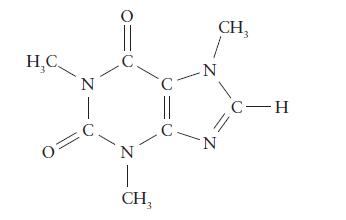
The Lewis structure of caffeine, C8H10N4O2, a common stimulant, is given below.(a) Give the hybridization of each atom other than hydrogen.(b) On the basis of your answers in part (a), estimate the bond angles around each carbon and nitrogen atom.(c) Search the chemical literature for the
Consider the bonding in H2C=CHCHO.(a) Draw the most important Lewis structure. Include all nonzero formal charges. (b) Identify the composition of the bonds and the hybridization of each lone pair—for example, by writing s (H1s,C2sp2).
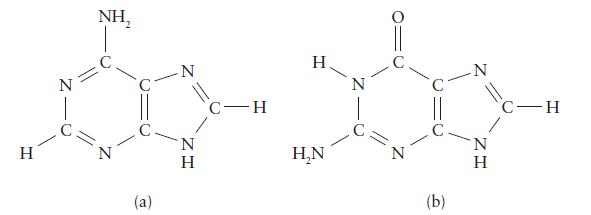
The following molecules are bases that are part of the nucleic acids involved in the genetic code. Identify(a) The hybridization of each C and N atom,(b) The number of σ- and π-bonds, and(c) The number of lone pairs of electrons in the molecule.
Just as AlCl3 forms dimers, in the Bi2Cl42– ion two of the Cl atoms form “bridges” between the two Bi atoms. Propose a Lewis structure for the Bi2Cl42– ion.
Germanium forms a series of anions called “germides.” In the germide ion, Ge4n–, the four Ge atoms form a tetrahedron in which each atom is bonded to the other three and each atom has a lone pair of electrons. What is the value of n , the charge on this anion? Explain your reasoning.
One form of the polyatomic ion I5– has an unusual V -shaped structure: one I atom lies at the point of the V , with a linear chain of two I atoms extending on each side. The bond angles are 88° at the central atom and 180° at the two atoms in the side chains. Draw a Lewis structure for I5–
The reaction between SbF3 and CsF produces, among other products, the anion Sb2 F7–. This anion has no F—F bonds and no Sb—Sb bonds.(a) Propose a Lewis structure for the ion.(b) Assign a hybridization scheme to the Sb atoms.
Consider the molecules H2CCH2, H2CCCH2, and H2CCCCH2.(a) Draw Lewis structures for these molecules.(b) What is the hybridization at each C atom?(c) What type of bond connects the carbon atoms (single, double, etc.)?(d) What are the HCH, CCH, and CCC angles in these molecules?(e) Do all the
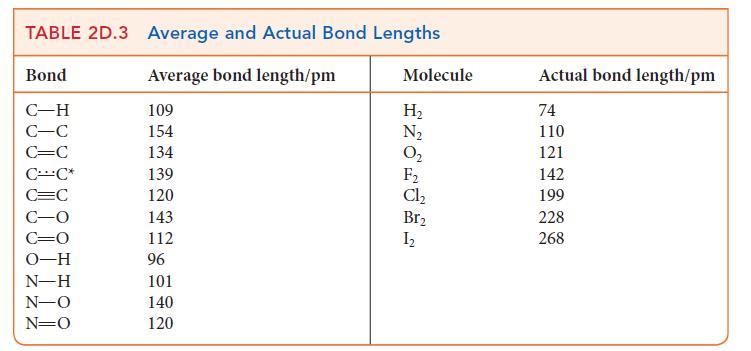
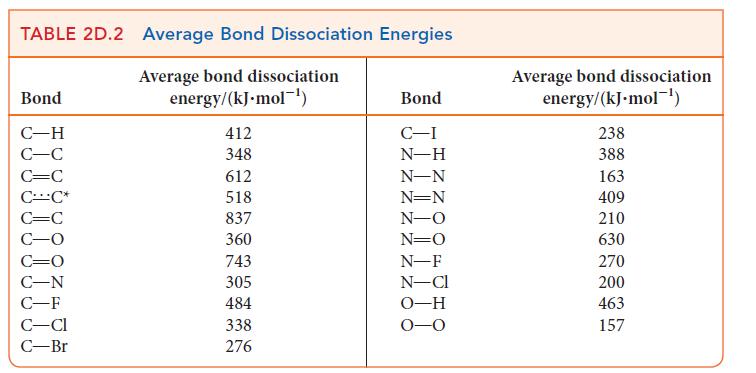
The nitrogen oxides are common pollutants generated by internal combustion engines and power plants. They not only contribute to the respiratory distress caused by smog but, if they reach the stratosphere, they also threaten the ozone layer that protects Earth from harmful radiation.(a) The bond
Showing 1800 - 1900
of 3011
First
12
13
14
15
16
17
18
19
20
21
22
23
24
25
26
Last
Step by Step Answers

 Get 50% OFF
Claim Now
Get 50% OFF
Claim Now