New Semester
Started
Get
50% OFF
Study Help!
--h --m --s
Claim Now
Question Answers
Textbooks
Find textbooks, questions and answers
Oops, something went wrong!
Change your search query and then try again
S
Books
FREE
Study Help
Expert Questions
Accounting
General Management
Mathematics
Finance
Organizational Behaviour
Law
Physics
Operating System
Management Leadership
Sociology
Programming
Marketing
Database
Computer Network
Economics
Textbooks Solutions
Accounting
Managerial Accounting
Management Leadership
Cost Accounting
Statistics
Business Law
Corporate Finance
Finance
Economics
Auditing
Tutors
Online Tutors
Find a Tutor
Hire a Tutor
Become a Tutor
AI Tutor
AI Study Planner
NEW
Sell Books
Search
Search
Sign In
Register
study help
sciences
chemical principles
Chemical Principles The Quest For Insight 7th Edition Peter Atkins, Loretta Jones, Leroy Laverman - Solutions
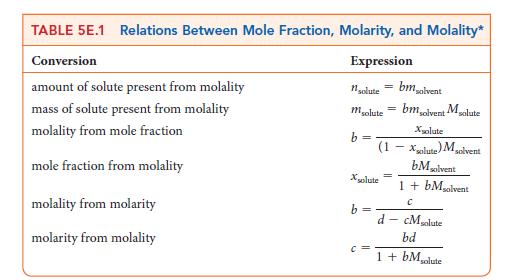
In an experiment, 0.020 mol NO2 was introduced into a flask of volume 1.00 L and the reaction 2 NO2(g) ⇌ N2O4(g) was allowed to come to equilibrium at 298 K.(a) Using information in Table 5E.1, calculate the equilibrium concentrations of the two gases.(b) The volume of the flask is reduced to
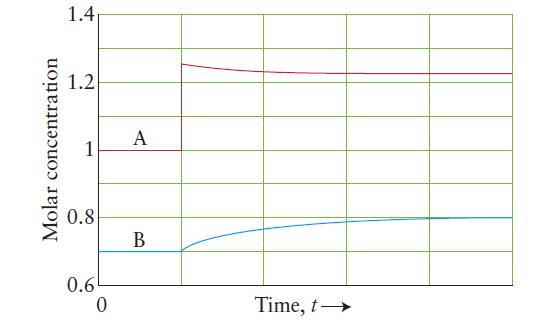
The following plot shows a system composed of the gaseous compounds A and B in a rigid, constant-volume flask. The system was initially at equilibrium, then a change occurred.(a) Describe the change that occurred and how it affected the system.(b) Write the chemical equation for the reaction that
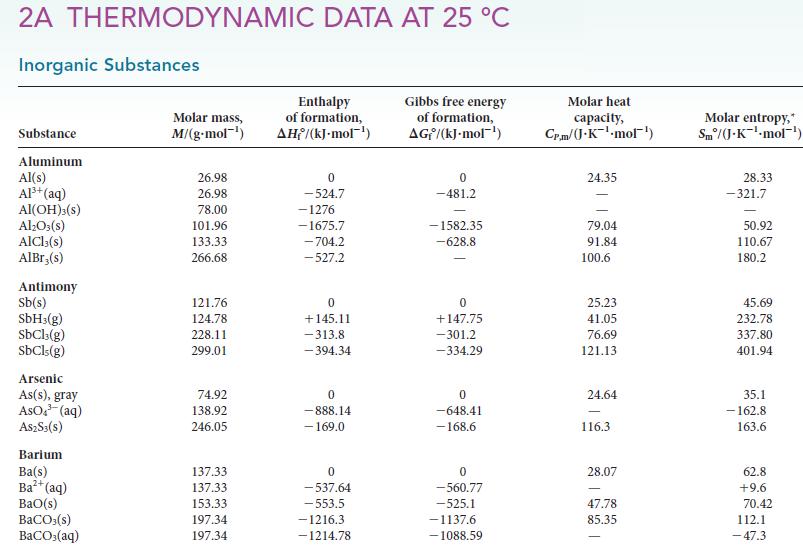
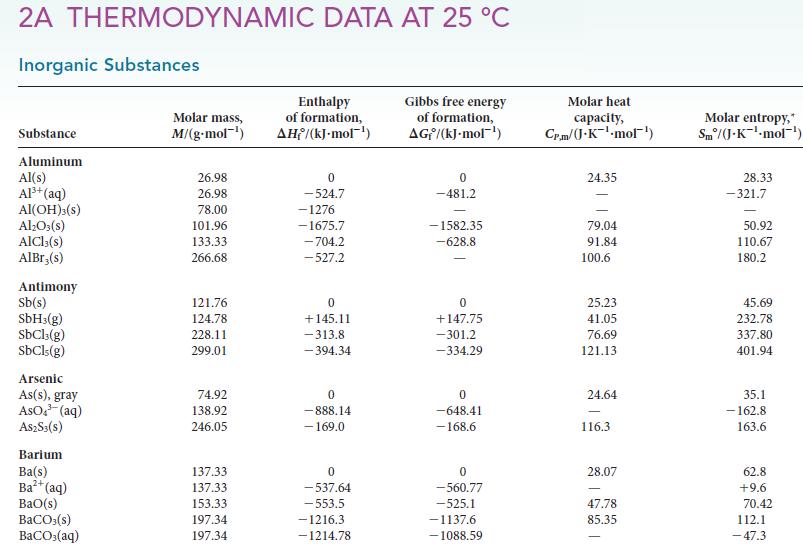
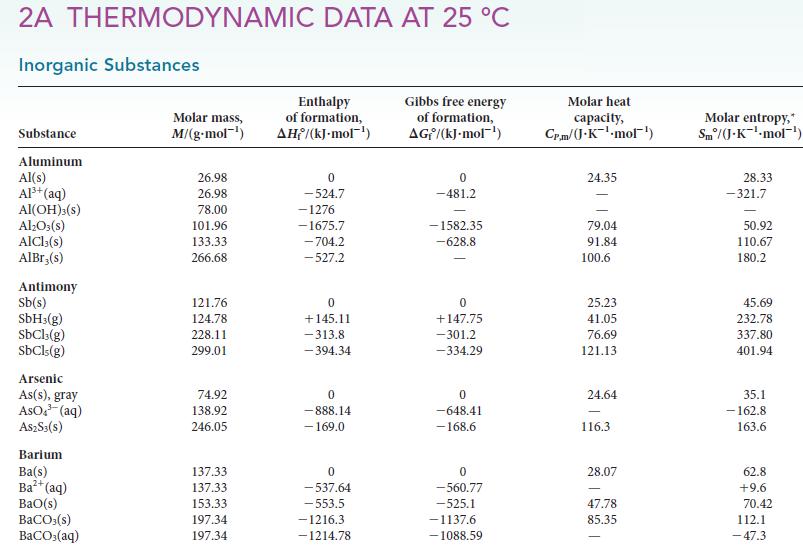
(a) What is the standard Gibbs free energy of the reaction CO(g) + H2O(g) → CO2(g) + H2(g) when K = 1.00? (b) From data available in Appendix 2A, estimate the temperature at which K = 1.00. (c) At this temperature, a cylinder is filled with CO(g) at 10.00 bar, H2O(g) at 10.00 bar, H2(g) at 5.00
At 500°C, Kc = 0.061 for N2(g) + 3 H2(g) ⇌ 2 NH3(g). If analysis shows that the composition of the reaction mixture at 500°C is 3.00 mol · L–1 N2, 2.00 mol · L–1 H2, and 0.500 mol · L–1 NH3, is the reaction at equilibrium? If not, in which direction does the reaction tend to proceed
At 2500. K, the equilibrium constant is Kc = 20. for the reaction Cl2(g) + F2(g) ⇌ 2 ClF(g). An analysis of a reaction vessel at 2500. K revealed the presence of 0.18 mol · L–1 Cl2, 0.31 mol · L–1 F2, and 0.92 mol · L–1 ClF. Will ClF tend to form or to decompose as the reaction
Let α be the fraction of PCl5 molecules that has decomposed to PCl3 and Cl2 in the reaction PCl5(g) ⇌ PCl3(g) + Cl2(g) in a constant-volume container; then the amount of PCl5 at equilibrium is n(1 – α), where n is the amount present initially. Derive an equation for K in terms of a and the
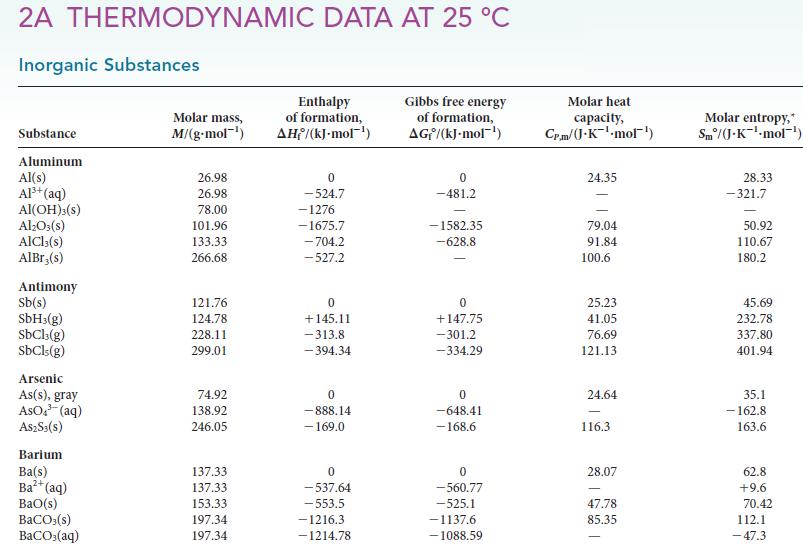
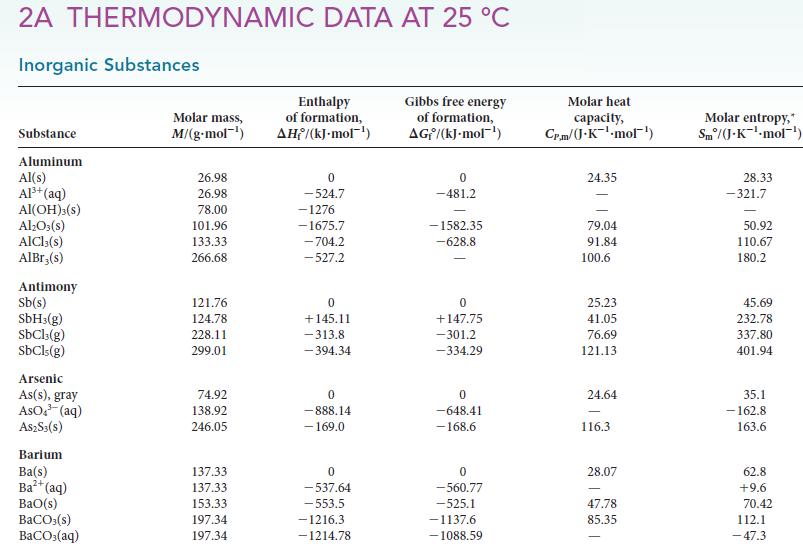
(a) Calculate K at 25 °C for the reaction Br2(g) ⇌ 2 Br(g) from the thermodynamic data provided in Appendix 2A.(b) What is the vapor pressure of liquid bromine?(c) What is the partial pressure of Br(g) above the liquid in a bottle of bromine at 25 °C?(d) A student wishes to add 0.0100 mol
The three compounds methylpropene, cis-2-butene, and trans-2-butene are isomers with the formula C4H8, with ΔGf° 5 +58.07, +65.86, and +62.97 kJ · mol–1, respectively. In the presence of a suitable catalyst, these three compounds interconvert to give an equilibrium gaseous mixture. What will
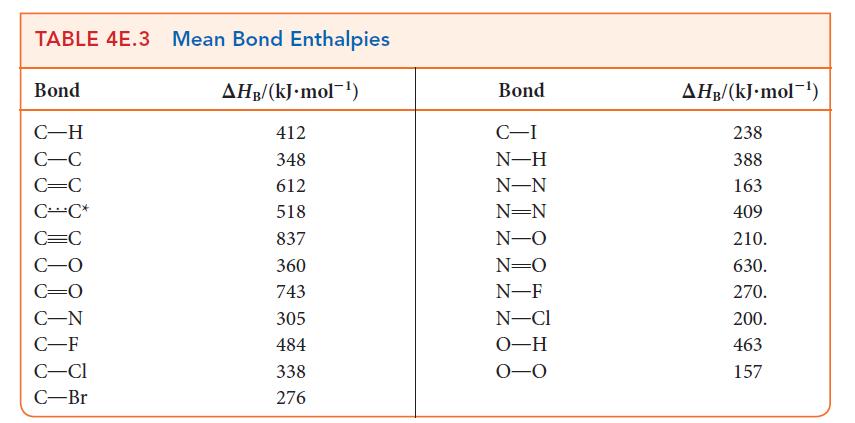
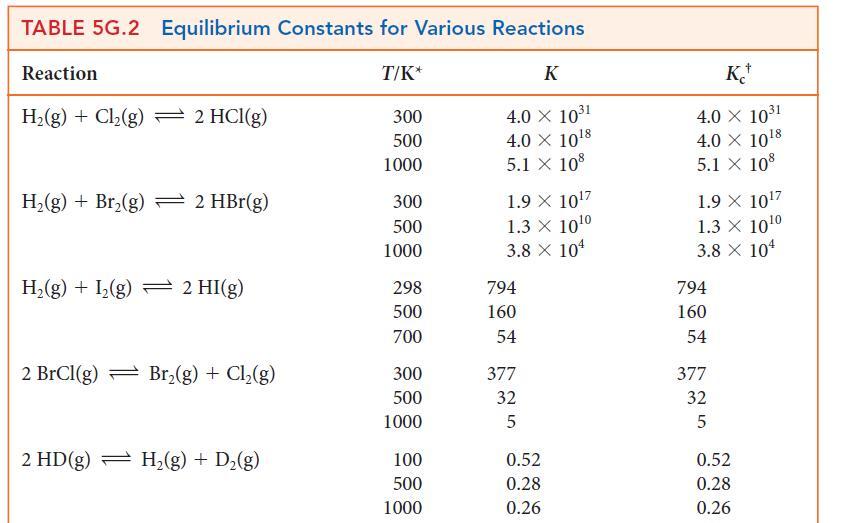
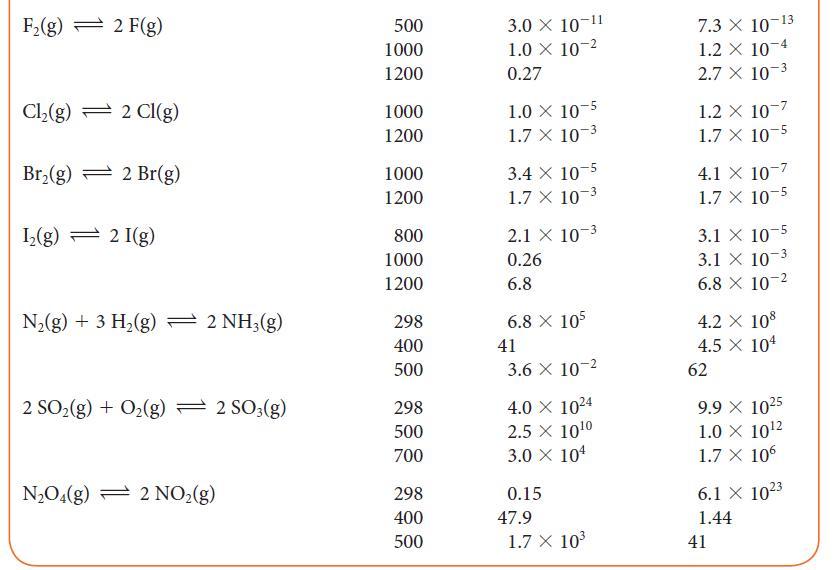
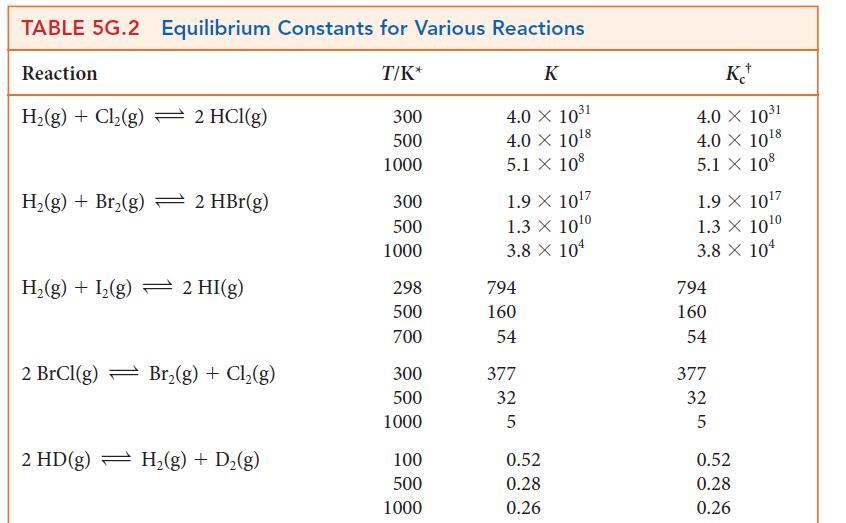
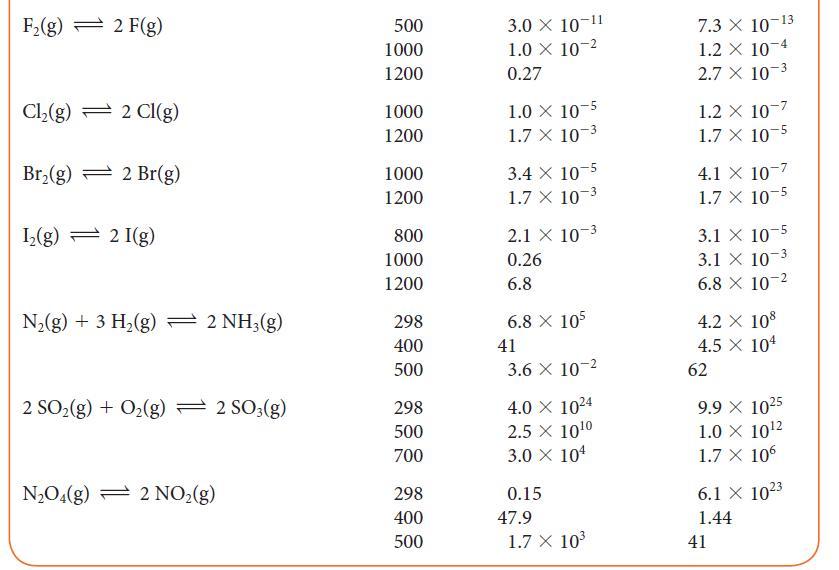
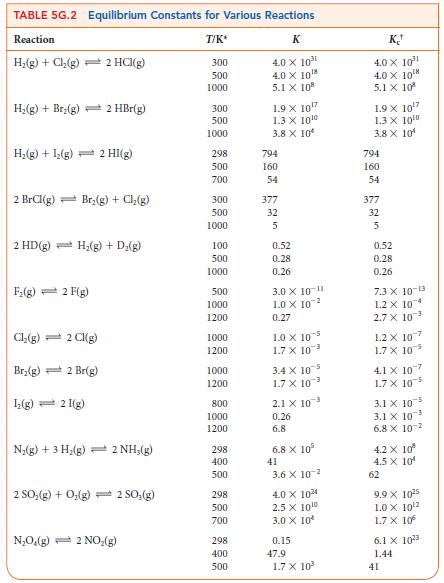
Using data from Table 5G.2 and standard graphing software, determine the standard enthalpy and entropy of the reaction N2O4(g) → 2 NO2(g) and estimate the N—N bond enthalpy in N2O4. How does this value compare with the mean N—N bond enthalpy in Table 4E.3? TABLE 4E.3 Mean Bond Enthalpies
Consider the equilibrium A (g) ⇌ 2 B(g) + 3 C(g) at 25°C. When A is loaded into a cylinder at 10.0 atm and the system is allowed to come to equilibrium, the final pressure is found to be 20.04 atm. What is DGr° for this reaction?
The gas phosphine, PH3, decomposes by the reaction 2 PH3(g) → 2 P(s) + 3 H2(g). In an experiment, pure phosphine was placed in a rigid, sealed flask of volume 1.00 L at 0.64 bar and 298 K. After equilibrium was attained, the total pressure in the flask was found to be 0.93 bar. (a) Calculate the
Estimate the vapor pressure of heavy water, D2O, and of normal water at 25°C by using data in Appendix 2A. How do these values compare with each other? Using your knowledge of intermolecular forces and any quantum effects, such as the zero point energy of intermolecular vibrations, explain the
A reaction vessel is filled with Cl2(g) at 1.00 bar and Br2(g) at 1.00 bar, which are allowed to react at 1000. K to form BrCl(g)according to the equation Br2(g) + Cl2(g) ⇌ 2 BrCl(g), K = 0.2. Construct a plot of the reaction Gibbs free energy as a function of partial pressure of BrCl as the
The reaction N2O4 → 2 NO2 is allowed to reach equilibrium in chloroform solution at 25 °C. The equilibrium concentrations are 0.405 mol · L–1 N2O4 and 2.13 mol · L–1 NO2. (a) Calculate K for the reaction. (b) An additional 1.00 mol NO2 is added to 1.00 L of the solution and the system is
(a) Use a spreadsheet program or graphing software and data at 1000. K and 1200. K from Table 5G.2 to plot the expression for the temperature dependence of ln K given by the dissociation of the diatomic halogens into the atoms, X2 (g) ⇌ 2 X(g).(b) From the graphs, determine the enthalpies and
Cyclohexane (C) and methylcyclopentane (M) are isomers with the chemical formula C6H12. The equilibrium constant for the rearrangement C ⇌ M in solution is 0.140 at 25°C. (a) A solution of 0.0200 mol · L–1 cyclohexane and 0.100 mol · L–1 methylcyclopentane is prepared. Is the system at
Use the Living Graph “Variation of the Equilibrium Constant” on the Web site for this book to construct a plot from 250 K to 350 K for reactions with standard reaction Gibbs free energies of 111 kJ · mol–1 to 115 kJ · mol–1 in increments of 1 kJ · mol–1. Enter free energies in
A reaction used in the production of gaseous fuels from coal, which is mainly carbon, is C(s) + H2O(g) ⇌ CO(g) + H2(g).(a) Evaluate K At 900 K, given that the standard Gibbs free energies of formation of CO(g) and H2O(g) at 900 K are 2191.28 kJ · mol–1and 2198.08 kJ · mol–1,
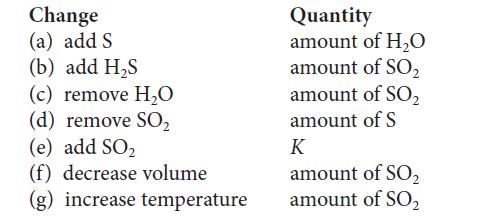
The Claus process, which is used to remove sulfur found as sulfur dioxide in petroleum, is based on the reaction 2 H2S(g) + SO2(g) ⇌ 3 S(s) + 2 H2O(g). (a) Use data from Appendix 2A to determine the equilibrium constant of this reaction at 25°C.(b) Various changes (see the following table) are
The volume of the container used for the reaction in Exercise 5.55 was compressed to 5.00 L and equilibrium was re-established.(a) Without doing a calculation, predict whether the equilibrium concentration of H2 will have increased or decreased and explain how you decided.(b) Calculate the new
The two air pollutants SO3 and NO can react as follows: SO3(g) + NO(g) → SO2(g) + NO2(g). (a) Predict the effect of the following changes to the amount of NO2 when the reaction has come to equilibrium in a stainless steel bulb equipped with entrances for chemicals: (i) the amount of NO is
The distribution of Na+ ions across a typical biological membrane is 10. mmol · L–1 inside the cell and 140 mmol · L–1 outside the cell. At equilibrium the concentrations would be equal, but in a living cell the ions are not at equilibrium. What is the difference in Gibbs free energy of Na+
To generate the starting material for a polymer that is used to make water bottles, hydrogen is removed from the ethane in natural gas to produce ethene in the catalyzed reaction C2H6(g) → H2(g) + C2H4(g). Use the information in Appendix 2A to calculate the equilibrium constant for the reaction
The overall photosynthesis reaction is 6 CO2(g) +6 H2O(l) → C6H12O6(aq) + 6 O2(g), and ΔH° = +2802 kJ. Suppose that the reaction is at equilibrium. State the effect that each of the following changes will have on the equilibrium composition: tends to shift toward the formation of reactants,
Reactions between gases in the atmosphere are not at equilibrium, but for a thorough understanding of them we need to study both the rates at which they take place and their behavior under equilibrium conditions.(a) The equilibrium for the depletion of ozone in the stratosphere is summarized by
The following groups are found in some organic molecules. Which are hydrophilic and which are hydrophobic:(a) —OH;(b) —CH2CH3;(c) —CONH2;(d) —Cl?
(a) In an experiment, 5.0 mmol Cl2(g) was sealed into a reaction vessel of volume 2.0 L and heated to 1200. K, and the dissociation equilibrium was established. What is the equilibrium composition of the mixture? Use the information in Table 5G.2.(b) If 5.0 mol Br2 is placed into the reaction
Adenosine triphosphate (ATP) is a compound that provides energy for biochemical reactions in the body when it undergoes hydrolysis. For the hydrolysis of ATP at 37°C (normal body temperature), ΔHr° = 220. kJ · mol–1 and ΔSr° = 134 J · K–1 · mol–1. Assuming that these quantities are
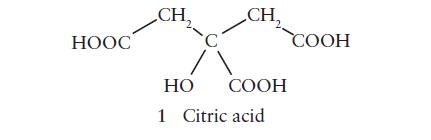
Sports drinks provide water to the body in the form of an isotonic solution (one having the same osmotic pressure as human blood). These drinks contain electrolytes such as NaCl and KCl as well as sugar and flavoring. One of the main flavoring agents in sport drinks is citric acid
Draw the Lewis structure and the VSEPR formula, list the shape, and predict the approximate bond angles of(a) CF3Cl;(b) TeCl4;(c) COF2 (C is the central atom);(d) CH3–.
In the compound cyclobutadiene, C4 H4, the carbon atoms form a square, with a hydrogen atom attached to each one. Draw two resonance structures for C4H4.
Draw the complete Lewis structure for each of the following compounds:(a) Ammonium chloride;(b) Potassium phosphide;(c) Sodium hypochlorite.
Noting that the bond angle of an sp3 hybridized atom is 109.5° and that of an sp2 hybridized atom is 120°, do you expect the bond angle between two hybrid orbitals to increase or decrease as the s-character of the hybrids is increased?
Describe the structure of the formaldehyde molecule, CH2O, in terms of hybrid orbitals, bond angles, and σ - and π -bonds. The C atom is the central atom to which the other three atoms are attached.
Predict the bond angles at the central atom of the following molecules and ions:(a) Ozone, O3;(b) Azide ion, N3–;(c) Cyanate ion, CNO2;(d) Hydronium ion, H3O+.
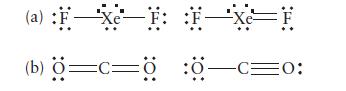
Select from each of the following pairs of Lewis structures the one that is likely to make the dominant contribution to a resonance hybrid. Explain your selection. (a) :FXeF: :F—Xe=F (b) Ö=C=0 :0-C=0: O:
Predict the number of valence electrons present for each of the following ions:(a) Mn4+;(b) Rh3+;(c) Co3+;(d) P3+.
The composition of hybrids can be discussed quantitatively. The outcome is that, if two equivalent hybrids composed of an s-orbital and two p-orbitals make an angle θ to each other, then the hybrids can be regarded as spλ, with λ = 2cosθ/cos2(1/2θ). What is the hybridization of the O orbitals
Amino acids are the building blocks of proteins, which have long chainlike molecules. They are oxidized in the body to urea, carbon dioxide, and liquid water. Is this reaction a source of heat for the body? Predict the standard reaction enthalpy for the oxidation of the simplest amino acid, glycine
On the basis of the expected charges on the monatomic ions, give the chemical formula of each of the following compounds:(a) Manganese(II) telluride;(b) Barium arsenide;(c) Silicon nitride;(d) Lithium bismuthide;(e) Zirconium(IV) chloride.
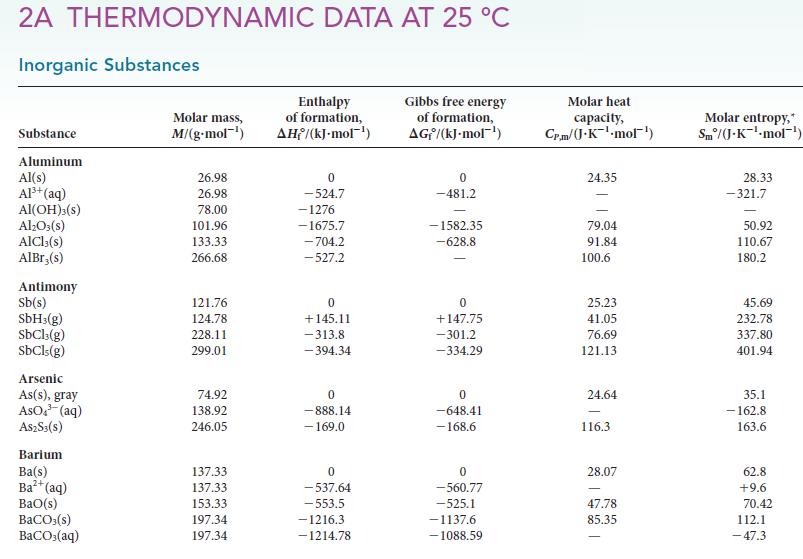
Calculate the standard enthalpy, entropy, and Gibbs free energy at 298 K for each of the following reactions by using data in Appendix 2A. For each case, confirm that the value obtained from the Gibbs free energies of formation is the same as that obtained by using the relation ΔG° = ΔH° –
Explain how an endothermic reaction can be spontaneous.
Use the information in Table 4C.1 to calculate the changes in entropy of the surroundings and of the system for(a) The vaporization of 1.00 mol CH4(l) at its boiling point;(b) The melting of 1.00 mol C2H5OH(s) at its melting point;(c) The freezing of 1.00 mol C2H5OH(l) at its freezing point.
Molecules take part in reactions and form compounds in ways that depend on the arrangement of electrons around their atoms. For instance, it is possible in this way to understand why carbon monoxide causes suffocation by attaching strongly to the iron atom of hemoglobin, thus preventing the
(a) What is the shape of a thionyl chloride molecule, SOCl2? Sulfur is the central atom.(b) How many different OSCl bond angles are there in this molecule?(c) What values are expected for the OSCl and ClSCl bond angles?
The following species have the same number of electrons: Cd, In+, and Sn2+.(a) Write the electron configurations for each species. Explain any differences.(b) How many unpaired electrons, if any, are present in each species?(c) What neutral atom, if any, has the same electron configuration as
Determine the numbers of electron pairs (both bonding and lone pairs) on the iodine atom in(a) ICl2+;(b) ICl4–;(c) ICl3;(d) ICl5.
Would you expect the HeH– ion to exist? What would be its bond order? Which has the lower energy, HeH– or HeH+? Explain.
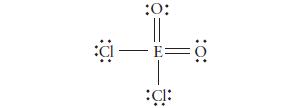
The following Lewis structure was drawn for a Period 4 element.Identify the element. :0: E=0 :CI:
In 1999, Karl Christe synthesized and characterized a salt that contained the N5+ cation, in which the five N atoms are connected in a chain. This cation is the first new all-nitrogen species to be isolated in more than 100 years. Draw the most important Lewis structure for this ion, including all
Identify the hybrid orbitals used by the atom in boldface red type in each of the following molecules:(a) CH3 C CCH3;(b) CH3 N NCH3;(c) (CH3)2 C C(CH3)2;(d) (CH3)2 N N(CH3)2.
Use electronegativities to predict which of the following compounds is the more soluble in water:(a) LiI or MgI2;(b) CaS or CaO.Exercise 2D.7Compounds having bonds with a high covalent character tend to be less soluble in water than similar compounds that have low covalent character. Use
(a) What is the shape of a XeF4 molecule?(b) What values are expected for the FXeF bond angles?
The following species have the same number of electrons: Ca, Ti2+, and V3+.(a) Write the electron configurations for each ion. Explain any differences.(b) How many unpaired electrons, if any, are present in each species?(c) What neutral atom, if any, has the same electron configuration as that
Determine the numbers of electron pairs (both bonding and lone pairs) on the phosphorus atom in(a) PCl3;(b) PCl5;(c) PCl4+;(d) PCl6–.
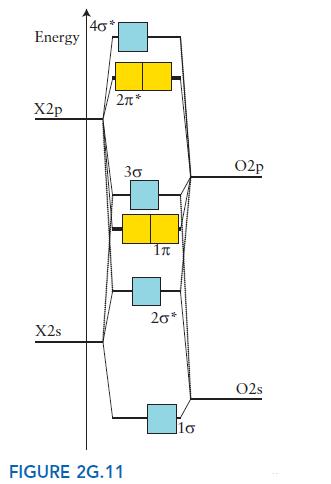
(a) Draw the molecular orbital energy-level diagram for N2 and label the energy levels according to the type of orbitals from which they are made, whether they are σ- or π-orbitals, and whether they are bonding or antibonding.(b) The orbital structure of the heteronuclear diatomic ion NO+ is
Identify the hybrid orbitals used by the phosphorus atom in each of the following species:(a) PCl4+;(b) PCl6–;(c) PCl5;(d) PCl3.
Arrange the cations Rb+, Be2+, and Sr2+ in order of increasing polarizing power. Explain your reasoning.
(a) What is the shape of an ICl3 molecule (iodine is the central atom)?(b) What value is expected for the ClICl bond angle?
Which M2+ ions (where M is a metal) are predicted to have the following ground-state electron configurations:(a) [Ar]3d7;(b) [Ar]3d6;(c) [Kr]4d4;(d) [Kr]4d3?
An important principle in chemistry is the isolobal analogy, which states that chemical fragments with similar valence-orbital structures can replace one another in molecules. For example,are isolobal fragments, each having three electrons with which to form bonds in addition to the bond to H. An
Draw the Lewis structure for each of the following molecules or ions and give the number of electrons about the central atom:(a) SF6;(b) XeF2;(c) AsF6–;(d) TeCl4.
(a) Draw the molecular orbital energy-level diagram for N2 and label the energy levels according to the type of orbitals from which they are made, whether they are σ- or π-orbitals, and whether they are bonding or antibonding.(b) The orbital structure of the heteronuclear diatomic ion NO+ is
Identify the hybrid orbitals used by the atom in boldface red type in each of the following molecules:(a) H2 C C CH2;(b) H3 C C H3;(c) CH3 N N N;(d) CH3 C O OH.
Draw the complete Lewis structure for a formula unit of each of the following compounds:(a) Barium hydroxide;(b) Cesium nitrite;(c) Ammonium sulfide.
Arrange the cations K+, Mg2+, Al3+, and Cs+ in order of increasing polarizing power. Explain your reasoning.
(a) What is the shape of a GeF4 molecule?(b) What value is expected for the FGeF bond angle?
Which E3+ ions (where E is an element) are predicted to have the following ground-state electron configurations:(a) [Xe]4f14 5d8;(b) [Xe]4f145d5;(c) [Kr]4d10 5s2 5p2;(d) [Ar]3d10 4s2?
Draw the Lewis structure for each of the following molecules or ions and give the number of electrons about the central atom:(a) SiO44–;(b) SCl2;(c) BrF5;(d) ICl2–.
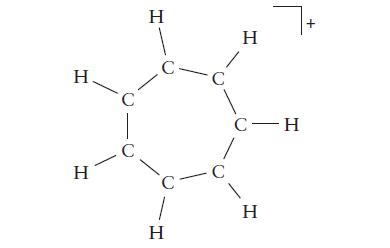
The framework for the tropylium cation, C7H7+, is a sevenmembered ring of carbon atoms with a hydrogen atom attached to each carbon atom. Complete the structural drawing by adding the multiple bonds as appropriate. Resonance structures are possible.Draw as many as you can find. Determine the COC
(a) How does molecular orbital theory make it possible to explain both ionic and covalent bonding?(b) The degree of ionic character in bonding is related to electronegativity in Topic 2D.How does electronegativity affect the molecular orbital diagram so that bonds become ionic?
White phosphorus, P4, is so reactive that it bursts into flame in air. The four atoms in P4 form a tetrahedron in which each P atom is connected to three other P atoms.(a) Assign a hybridization scheme to the P4 molecule.(b) Is the P4 molecule polar or nonpolar?
Draw the complete Lewis structure for each of the following compounds:(a) Formaldehyde, HCHO, which as its aqueous solution, “formalin,” is used to preserve biological specimens;(b) Methanol, CH3OH, the toxic compound also called wood alcohol;(c) Glycine, H2C(NH2)COOH, the simplest of the
Use Lewis structures and the VSEPR model to give the VSEPR formula for each of the following species and predict its shape:(a) Sulfur tetrachloride;(b) Iodine trichloride;(c) IF4–;(d) Xenon trioxide.
In each of these compounds, an atom violates the octet rule. Identify the atom and explain the deviation from the octet rule:(a) BeCl2;(b) ClO2.
Xenon forms XeO3, XeO4, and XeO64–, all of which are powerful oxidizing agents. Draw their Lewis structures and state their bond angles and the hybridization of the xenon atom. Which would be expected to have the longest Xe—O distances? Explain your answer.
Which M3+ ions (where M is a metal) are predicted to have the following ground-state electron configurations:(a) [Ar]3d6;(b) [Ar]3d5;(c) [Kr]4d5;(d) [Kr]4d3?
Draw the Lewis structures that contribute to the resonance hybrid of nitryl chloride, ClNO2 (N is the central atom).
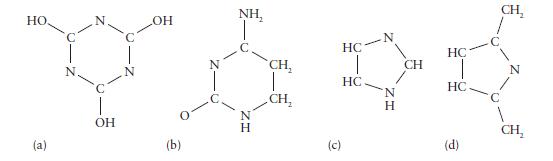
Draw the most important Lewis structure for each of the following ring molecules (which have been drawn without showing the locations of the double bonds). Show all lone pairs and nonzero formal charges. If there are equivalent resonance forms, draw them. HO (a) OH OH (b) NH, CH HC T HC (c) N N CH
Draw the Lewis structure and predict the shape of(a) AsO4 3–;(b) OSF4;(c) F3IO2. The atom in boldface red type is the central atom.
Which bond is longer:(a) The CN bond in HCN or in H3 CNH2?(b) The NF bond in NF3 or the PF bond in PF3?
Draw the Lewis structure and predict whether each of the following molecules is polar or nonpolar:(a) CH2Cl2;(b) CCl4;(c) CS2;(d) SF4.
On the basis of the expected charges of the monatomic ions, draw the formula unit of each of the following compounds using Lewis symbols:(a) Thallium(III) chloride;(b) Aluminum sulfide;(c) Barium oxide.
Which of the following bonds do you expect to be longer:(a) The BrO bond in BrO– or in BrO2–;(b) The CH bond in CH4 or the SiH bond in SiH4?
Draw the Lewis structure and predict whether each of the following molecules is polar or nonpolar:(a) H2Se;(b) AsF5;(c) SiO2;(d) NF3.
On the basis of the expected charges of the monatomic ions, draw the formula unit of each of the following compounds using Lewis symbols:(a) Strontium iodide;(b) Potassium phosphide;(c) Magnesium nitride.
(a) Draw a Lewis structure for each of the following species: CH3+; CH4; CH3–; CH2; CH22+; CH22–.(b) Identify each as a radical or not.(c) Rank them in order of increasing HCH bond angles. Explain your choices.
Predict whether each of the following molecules is likely to be polar or nonpolar:(a) C5H5N (pyridine, a molecule like benzene except that one —CH— group is replaced by a nitrogen atom);(b) C2H6 (ethane);(c) CHCl3 (trichloromethane, also known as chloroform, a common organic solvent and once
Predict which of the following pairs of ions would have the greatest coulombic attraction in a solid compound:(a) K+, O2-;(b) Ga3+, O2-;(c) Ca2+, O2-.
The halogens form compounds among themselves. These compounds, called the interhalogens, have the formulas X′X, X′X3, and X′X5, where X′ is the heavier halogen atom.(a) Predict their structures and bond angles.(b) Which of them are polar?(c) Why is the lighter halogen atom not the
Draw the Lewis structure and state the number of lone pairs on xenon, the central atom of each of the following molecules:(a) XeOF2;(b) XeF4;(c) XeOF4.
Arrange the anions Cl–, Br–, N3–, and O2– in order of increasing polarizability and give reasons for your decisions.
Write the valence-shell electron configurations and bond orders of(a) B2;(b) Be2;(c) F2.
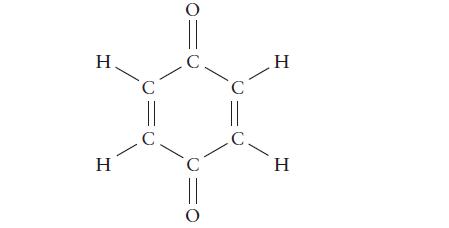
Quinone, C6H4O2, is an organic molecule with the structure shown below; it can be reduced to the anion C6H4O22–.(a) Draw the Lewis structure of the reduced product.(b) On the basis of formal charges derived from the Lewis structure, predict which atoms in the molecule are most negatively
In the vapor phase, phosphorus can exist as P2 molecules, which are highly reactive, whereas N2 is relatively inert. Use valence-bond theory to explain this difference.
Draw the Lewis structure of each of the following organic compounds:(a) Urea, H2 N—CO—NH2, a fertilizer that is also found in hand lotions (the O is a terminal atom);(b) CH3 SH, methanethiol, a compound found in breath odor;(c) HOOC—COOH, oxalic acid, a toxic compound found in rhubarb
Use Lewis structures and the VSEPR model to give the VSEPR formula for each of the following species and predict its shape:(a) PF4–;(b) ICl4+;(c) Phosphorus pentafluoride;(d) Xenon tetrafluoride.
Which M2+ ions (where M is a metal) are predicted to have the following ground-state electron configurations:(a) [Ar]3d4;(b) [Kr]4d9;(c) [Ar]3d10;(d) [Xe]4f14 5d10 5s2?
Draw the Lewis structure and state the number of lone pairs on the central atom of each of the following molecules:(a) IF5;(b) AsF5;(c) H2 SO3 (S is the central atom and each H atom is bonded to an O atom).
Arrange the anions N3– , O2– , Cl–, and Br– in order of increasing polarizability and give reasons for your decisions.
Showing 1700 - 1800
of 3011
First
11
12
13
14
15
16
17
18
19
20
21
22
23
24
25
Last
Step by Step Answers

 Get 50% OFF
Claim Now
Get 50% OFF
Claim Now