New Semester
Started
Get
50% OFF
Study Help!
--h --m --s
Claim Now
Question Answers
Textbooks
Find textbooks, questions and answers
Oops, something went wrong!
Change your search query and then try again
S
Books
FREE
Study Help
Expert Questions
Accounting
General Management
Mathematics
Finance
Organizational Behaviour
Law
Physics
Operating System
Management Leadership
Sociology
Programming
Marketing
Database
Computer Network
Economics
Textbooks Solutions
Accounting
Managerial Accounting
Management Leadership
Cost Accounting
Statistics
Business Law
Corporate Finance
Finance
Economics
Auditing
Tutors
Online Tutors
Find a Tutor
Hire a Tutor
Become a Tutor
AI Tutor
AI Study Planner
NEW
Sell Books
Search
Search
Sign In
Register
study help
sciences
chemical principles
Chemical Principles The Quest For Insight 7th Edition Peter Atkins, Loretta Jones, Leroy Laverman - Solutions
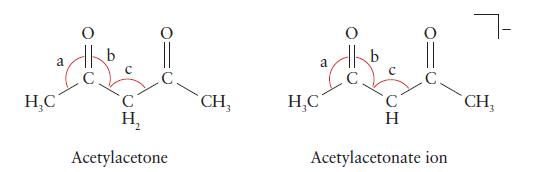
The compound 2,4-pentanedione (also known as acetylacetone and abbreviated to acac) is acidic and can be deprotonated. The anion forms complexes with metals that are used in gasoline additives, lubricants, insecticides, and fungicides.(a) Estimate the bond angles marked with arcs and lowercase
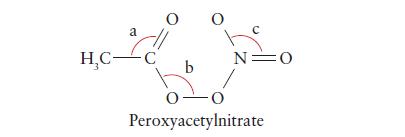
Estimate the bond angles marked with arcs and lowercase letters in peroxyacetylnitrate, an eye irritant in smog: H₂C a C N=0 b 0-0 Peroxyacetylnitrate
Hydroxylamine, HONH2, is used to remove hair from animal hides and as a photoresist stripper in the electronics industry.Describe the structure of the hydroxylamine molecule in terms of hybrid orbitals, bond angles, and σ- and π-bonds. The O atom is bonded to the N atom and an H atom. The N atom
Hydrogen peroxide, H2O2, is a nontoxic bleaching agent being used as a replacement for chlorine in industry and home laundries. The bleaching process is an oxidation, and when hydrogen peroxide acts as a bleaching agent, the only waste it generates is H2O.(a) Draw the Lewis structure of hydrogen
Air is a source of reactants for many chemical processes, such as the synthesis of ammonia. To determine how much air is needed for these reactions, it is useful to know the partial pressures of the components. A certain sample of dry air of total mass 1.00 g consists almost entirely of 0.76 g of
How would the height of a mercury barometer be different on the planet Mars? Explain your reasoning.
When iron surfaces are exposed to ammonia at high temperatures, “nitriding”—the incorporation of nitrogen into the iron lattice—occurs. The atomic radius of iron is 124 pm.(a) Is the alloy interstitial or substitutional? Justify your answer.(b) How do you expect nitriding to change the
If small amounts of the elements In, P, Sb, and Ga are present as impurities in germanium, which of them will make germanium into(a) A p-type semiconductor;(b) An n-type semiconductor?
A flask of volume 1.00 L contains nitrogen gas at a temperature of 15 °C and a pressure of 0.50 bar. 0.10 mol O2 (g) is added to the flask and allowed to mix. Then a stopcock is opened to allow 0.020 mol of molecules to escape. What is the partial pressure of oxygen in the final mixture?
A student attaches a glass bulb containing neon gas to an open-tube manometer (like the one in Fig. 3A.5) and calculates the pressure of the gas to be 0.890 atm.(a) If the atmospheric pressure is 762 Torr, what height difference between the two sides of the mercury in the manometer did the student
A sample of neon gas effuses through a porous plug in 62.1 s. Calculate the time required for the same amount of(a) CO,(b) NH3,(c) Kr, and(d) NO to effuse under the same conditions of pressure and temperature.
Rank the following liquids in order of increasing viscosity at 25°C: C6H6, CH3CH2OH, CH2OHCHOHCH2OH, CH2OHCH2OH, and H2O. Explain your ordering.
(a) A flask of volume 125 mL contains argon at 1.85 atm and 86 °C. What amount of Ar is present (in moles)?(b) A flask of volume 250.0 mL contains 6.5 mg of O2 at 17°C. What is the pressure (in Torr)?(c) A flask of volume 50.0 L at 203 K and 20. Torr contains nitrogen. What mass of nitrogen
When people dive into deep water, the pressure exerted by the water above can become great enough to collapse their lungs. Hence, scuba gear must sense the external pressure and increase the pressure of the breathing mixture provided to the diver until it equals the external pressure. A diver
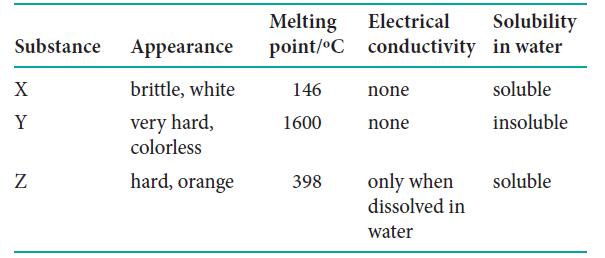
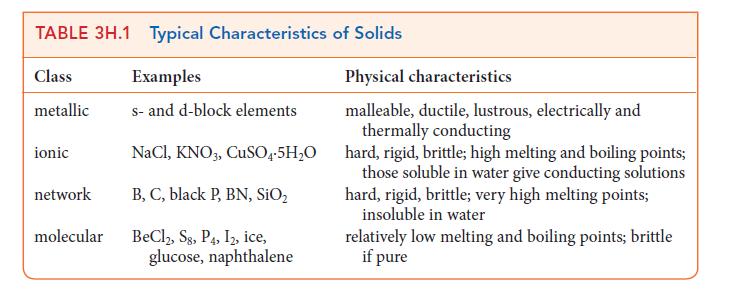
Three unknown substances were tested in order to classify them. The following table shows the results of the tests. Use Table 3H.1 to classify substances X, Y, and Z as metallic, ionic, network, or molecular solids. Substance Appearance X Y N brittle, white very hard, colorless hard, orange Melting
Use the ideal gas equation to calculate the pressure at 298 K exerted by 1.00 mol H2(g) when confined in a volume of (a) 30.0 L;(b) 1.00 L;(c) 50.0 mL. Repeat these calculations using the van der Waals equation. What do these calculations indicate about how the reliability of the ideal gas
Suggest, giving reasons, which substance in each of the following pairs is likely to have the higher normal boiling point: (a) H2S or H2Se;(b) NaCl or CH3Cl;(b) NH3 or PH3;(d) SiH4 or SiF4.
Silicon can be doped with small amounts of phosphorus to create a semiconductor used in transistors.(a) Is the alloy interstitial or substitutional? Justify your answer.(b) How do you expect the properties of the doped material to differ from those of pure silicon?
If you want to modify gallium arsenide by replacing a small amount of the arsenic with an element to produce an n-type semiconductor, which element would you choose: Se, P, or Si? Why?
An apparatus consists of a flask of volume 4.0 L containing nitrogen gas at 25°C and 803 kPa, joined by a valve to a flask of volume 10.0 L containing argon gas at 25°C and 47.2 kPa. The valve is opened and the gases mix.(a) What is the partial pressure of each gas after mixing?(b) What is the
A reaction is performed in a vessel attached to a closed-tube manometer. Before the reaction, the levels of mercury in the two sides of the manometer were at the same height. As the reaction proceeds, a gas is produced. At the end of the reaction, the height of the mercury column on the vacuum
A hydrocarbon of empirical formula C2H3 takes 349 s to effuse through a porous plug; under the same conditions of temperature and pressure, it took 210. s for the same number of molecules of argon to effuse. What is the molar mass and molecular formula of the hydrocarbon?
The following boiling points correspond to the substances listed. Match the boiling points to the substances by considering the relative strengths of their intermolecular forces. b.p./°C: –162, –88.5, 28, 36, 64.5, 78.3, 82.5, 140, 205, 290; substance: CH4, CH3CHOHCH3, C6H5CH2OH (has a benzene
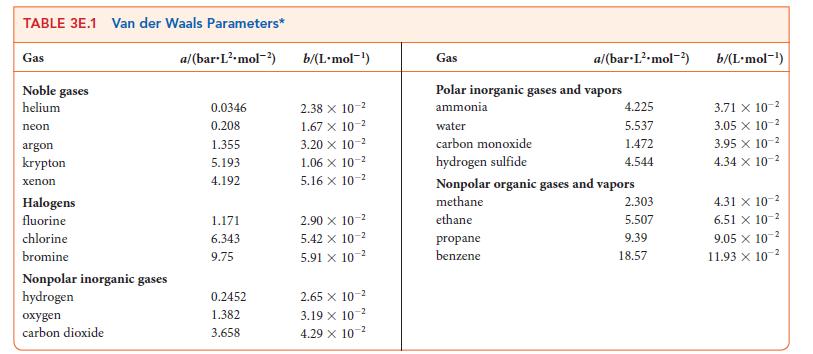
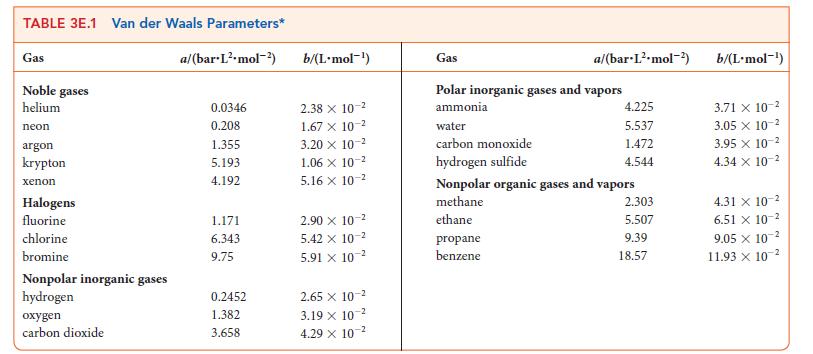
The following table lists the van der Waals a parameters for HCl, CH3CN, Ne, and CH4. Without referring to Table 3E.1, use your knowledge of the factors governing the magnitudes of a to assign each of these four gases to its a value. Explain your reasoning. a/(bar L² mol
(a) Use the Living Graphs on the Web site for this book to prepare a plot of the pressure against temperature for 1.00 mol of gas molecules, showing the curves at volumes ranging from 0.01 L to 0.05 L in increments of 0.01 L for T= 0 to 400 K.(b) What is the expression for the slope of each of
A flask of volume 5.00 L is evacuated and 43.78 g of solid dinitrogen tetroxide, N2O4, is introduced at –196°C. The sample is then warmed to 25 °C, during which time the N2O4 vaporizes and some of it dissociates to form brown NO2 gas. The pressure slowly increases until it stabilizes at 2.96
Iron crystallizes in a bcc structure. The atomic radius of iron is 124 pm. Determine(a) The number of atoms per unit cell;(b) The coordination number of the lattice;(c) The length of the side of the unit cell.
Use the VSEPR model to predict the shapes of each of the following molecules and identify the member of each pair that forms a liquid with the higher boiling point:(a) PBr3 or PF3;(b) SO2 or O3;(c) BF3 or BCl3.
Calculate the relative number of atoms of each element contained in each of the following alloys:(a) Coinage cupronickel, which is 25% Ni by mass in copper;(b) A type of pewter that is about 7% antimony and 3% copper by mass in tin.
Distinguish between fluorescence and phosphorescence(a) Observationally,(b) Mechanistically.
In the course of the electrolysis of water, hydrogen gas was collected at one electrode over water at 20.°C when the external pressure was 756.7 Torr. The vapor pressure of water at 20.°C is 17.54 Torr. The volume of the gas was measured to be 0.220 L.(a) What is the partial pressure of
The following table lists the van der Waals b parameters for Br2, N2, He, and SF6. Without referring to Table 3E.1, use your knowledge of the factors governing the magnitudes of b to assign each of these four gases to its b value. Explain your reasoning. 100b/(L-mol ) Substance 8.79 2. ? 5.91 ?
Suppose you were marooned on a tropical island and had to use seawater (density 1.10 g · cm–3) to make a primitive barometer.What height would the water reach in your barometer when a mercury barometer would reach 74.7 cm? The density of mercury is 13.6 g · cm–3.
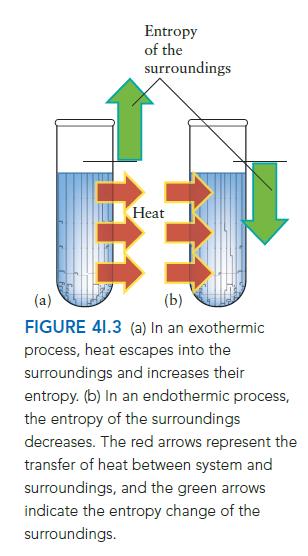
One of the skills of a scientist is to be able to verify mathematically what is understood conceptually.For example, does the increase in entropy of the surroundings account for the fact that a liquid freezes when the temperature is lowered to below a certain temperature?Calculate the change in
The composition of a compound used to make polyvinyl chloride (PVC) is 38.4% C, 4.82% H, and 56.8% Cl by mass. It took 7.73 min for a given volume of the compound to effuse through a porous plug, but it took only 6.18 min for the same amount of Ar to diffuse at the same temperature and pressure.
A good way to become familiar with thermodynamic processes is to start with a very simple system and consider how various changes might affect it. Calculate the change in molar Gibbs free energy, ΔGm, for the process H2O(s) → H2O(l) at 1 atm and(a) 10. °C;(b) 0. °C. Decide for each
What is the total entropy change accompanying a process in which 40.0 kJ of energy is transferred as heat from a large reservoir at 800. K to one at 200. K?
The brilliant white glow of fireworks is due to the combustion of magnesium in air at a high temperature. But is that combustion spontaneous, in the thermodynamic sense, at ordinary temperatures? You can find out by calculating the total entropy change. Assess whether the combustion of magnesium, 2
Why are so many exothermic reactions spontaneous?
How much heat is required to convert a block of ice of mass 42.30 g at –5.042°C into water vapor at 150.35°C?
What is the total entropy change accompanying a process in which 25.0 kJ of energy is transferred as heat from a large reservoir at 700. K to one at 320. K?
Hydrogen iodide is a reactive compound that is sometimes used in the manufacture of methamphetamine. It can be produced by the direct reaction of the elements. Calculate the standard Gibbs free energy of formation of HI(g) at 25°C from its standard molar entropy and standard enthalpy of
The following data to calculate the lattice enthalpy of AlBr3: ΔHf°(Al,g) = 1326 kJ · mol–1.
A piece of stainless steel of mass 121.3 g was heated to 482°C and quickly added to 37.55 g of ice at –23°C in a well-insulated flask that was immediately sealed.(a) If there is no loss of energy to the surroundings, what will be the final temperature of this system?(b) What phases of water
As in Exercise 4G.1, calculate the entropy of a solid nanostructure made of 16 molecules in which the molecules(a) Are all aligned in the same direction;(b) Lie in any one of three orientations with the same energy.Exercise 4G.1Nanotechnologists have found ways to create and manipulate structures
Engineers studying internal combustion engines, such as those in automobiles, and looking for ways to increase their efficiency, must understand how the entropy of gaseous mixtures is affected by different conditions. Calculate ΔS, ΔSsurr, and ΔStot for(a) The isothermal, reversible expansion
The standard entropy of vaporization of benzene is approximately 85 J · K–1 mol–1 at its boiling point.(a) Estimate the standard enthalpy of vaporization of benzene at its boiling point of 80.°C.(b) What is the standard entropy change of the surroundings when 10. g of benzene, C6H6,
Molecules and ions, like atoms, can be isoelectronic. That is, they can have the same number of electrons. For example, CH4 and NH4+ are isoelectronic. Therefore, they have the same molecular shape. Identify a molecule or ion that is isoelectronic with each of the following species and verify that
What changes in bond order, bond distance, and magnetic properties are expected to occur in the following ionization processes? (a) C₂ C₂+e; (b) N₂ → N₂ +e; (c) 0₂ →O₂ + e.
(a) Draw the Lewis structure of N2O3.(b) What is the NON bond order?(c) Explain why N2O3 adopts this structure, whereas the analogous compound for phosphorus is P4O6.
Complexes of d- and f-block metals can be described in terms of hybridization schemes, each associated with a particular shape. Bearing in mind that the number of atomic orbitals hybridized must be the same as the number of hybrid orbitals produced, match the hybrid orbitals sp2d, sp3d3, and
(a) The formula for bromate ion (BrO3–) is similar to that of chlorate ion (ClO3–); however, the formulas of the nitrate and phosphate ions have different numbers of oxygen atoms, as do the formulas of the nitrite and phosphite ions. Draw the Lewis structures of all four ions and explain why
Acetonitrile, CH3 CN, is used as a solvent in the pharmaceutical industry. Describe the structure of the CH3 CN molecule in terms of hybrid orbitals, bond angles, and σ - and π -bonds. The N atom is a terminal atom.
Draw the Lewis structure for each of the following compounds:(a) Methanethiol, CH3 SH, one of the compounds found in bad breath and some cheeses;(b) Carbon disulfide, CS2, which is used in the manufacture of rayon;(c) Dichloromethane, CH2Cl2, a common solvent.
Draw the Lewis structure for each of the following compounds:(a) Urea, OC(NH2)2, a compound formed in the body when proteins are metabolized;(b) Phosgene, Cl2CO, a deadly gas once used in warfare;(c) Trinitramide, N(NO3)3, an oxidizing agent used in rocket fuel.
Methane, the most abundant hydrocarbon in the atmosphere and a potent greenhouse gas, is slowly oxidized in the air to carbon dioxide. An intermediate in the oxidation of methane to carbon dioxide is HOCO.(a) Draw the Lewis structure for this compound.(b) Decide whether the compound is a radical.
Nitrosamines are potent carcinogens that are formed in tobacco smoke and in meat that is cooked at a high temperature.The basic formula for a nitrosamine is R2 NNO, in which the R represents an organic group. The atoms are connected as indicated in the formula with the two organic groups on the
Calculate the change in molar Gibbs free energy for the process NH3(l) → NH3(g) at 1 atm and(a) –15.0°C;(b) –45. °C. In each case, indicate whether vaporization would be spontaneous.
Which of the following compounds become less stable with respect to the elements as the temperature is raised:(a) PCl5(g);(b) HCN(g);(c) NO(g);(d) SO2(g)?
Hydrochloric acid oxidizes zinc metal in a reaction that produces hydrogen gas and chloride ions. A piece of zinc metal of mass 8.5 g is dropped into an apparatus containing 800.0 mL of 0.500 m HCl(aq). If the initial temperature of the hydrochloric acid solution is 25 °C, what is the final
Assume that ΔH° and ΔS° are independent of temperature and use data in Appendix 2A to calculate ΔG° for each of the following reactions at 80.°C. Over what temperature range will each reaction be spontaneous under standard conditions? (a) B₂O3(s) + 6 HF(g) → 2 BF3(g) + 3 H₂O(1) (b)
Which of the following compounds become less stable with respect to their elements as the temperature is raised:(a) C3H6(g), cyclopropane;(b) CaO(s);(c) N2O(g);(d) HN3(g)?
Use only your knowledge of intermolecular forces to rank the following compounds in order of increasing enthalpy of vaporization of their liquid state: CH4, H2O, N2, NaCl, C6H6, and H2. Explain your ordering.
Assume that ΔH° and ΔS° are independent of temperature and use data in Appendix 2A to calculate ΔG° for each of the following reactions at 250. °C. Over what temperature range will each reaction be spontaneous under standard conditions? (a) 2 NO(g) + O(g). 2 NO(g) (b) CaO(s) + HO(1) (c)
A technician carries out the reaction 2 SO2(g) + O2(g) → 2 SO3(g) at 25°C and 1.00 atm in a cylinder fitted with a piston and maintained at constant pressure. Initially, 0.030 mol SO2 and 0.030 mol O2 are present in the cylinder. The technician then adds a catalyst to initiate the reaction. (a)
Topic 4A explains how to calculate the work of reversible, isothermal expansion of an ideal gas. Now suppose that the reversible expansion is not isothermal and that the temperature decreases during expansion. (a) Derive an expression for the work when T = Tinitial – c(V – Vinitial), with c a
Calculate the molar kinetic energy (in joules per mole) of Kr(g) at (a) 55.85°C and (b) 54.85°C. (c) The difference between the answers to parts (a) and (b) Is the energy per mole that it takes to raise the temperature of Kr(g) by 1.00°C. What is the value of the molar heat capacity of Kr(g)?
Calculate the molar kinetic energy (in joules per mole) of a sample of Ne(g) at (a) 25.00°C and (b) 26.00°C. (c) The difference between the answers to parts (a) and (b) is the energy per mole that it takes to raise the temperature of Ne(g) by 1 °C. What is the value of the molar heat capacity
According to current theories of biological evolution, complex amino and nucleic acids were produced from randomly occurring reactions of compounds thought to be present in the Earth’s early atmosphere. These simple molecules then assembled into increasingly complex molecules, such as DNA and
The standard internal energy of formation, ΔUf°, corresponds to the standard enthalpy of formation, but is measured at constant volume. From the data in Appendix A, determine ΔUf° for(a) H2O(g);(b) H2O(l). Explain any differences between these values and ΔUf° for the two phases of water.
In a microwave oven, radiation is absorbed by water in the food and the food is heated. How many photons of radiation of wavelength 4.50 mm are required to heat 350. g of water from 25.0°C to 100.0 °C, assuming all their energy is used to raise the temperature?
Samples consisting of 1 mol N2(g) and 1 mol CH4(g) are in identical but separate containers, with initial temperatures of 500. K.Both gases gain 1200. J of heat at constant volume. Do the gases have the same final temperature? If not, which gas has the higher final temperature? Justify your
A person of average mass burns about 15. kJ · min–1 playing tennis. Find the time such a person would have to spend playing tennis to burn up the energy provided by a 2.0-oz serving of cheese, which has a specific enthalpy of combustion of 17.0 kJ · g–1.
Coal-fired steam engines get their power by using the heat from burning coal to boil water. Suppose that coal of density 1.5 g · cm–3 is carbon (it is, in fact, much more complicated, but this is a reasonable first approximation). The combustion of carbon is described by the equation(a)
“Synthesis gas” is a mixture of carbon monoxide, hydrogen, methane, and some noncombustible gases produced in the refining of petroleum. A certain synthesis gas is 40.0% by volume carbon monoxide, 25.0% hydrogen gas, 10.0% noncombustible gases, and the rest methane. What volume of this gas must
A student rides a bicycle to class every day, a round trip of 10. miles that takes 30. min in each direction. The student burns 420 kJ · h–1 cycling. The same round trip in an automobile would require 0.40 gallons of gasoline. Assume that the student goes to class 150 days per year and that the
(a) Crude petroleum is often contaminated by poisonous hydrogen sulfide gas. The Claus process for the extraction of sulfur from petroleum has two steps:Write a thermochemical equation for the overall reaction that does not contain SO2.(b) What enthalpy change would be associated with the
(a) A reaction being studied to regenerate oxygen from carbon dioxide on long spaceflights takes place in the following two steps:Write the thermochemical equation for the overall reaction.(b) What enthalpy change would be associated with the production of 32.0 L of oxygen at 0.82 atm and 300
Water gas is an inexpensive, low-grade fuel that can be made from coal.(a) Is the production of water gas exothermic or endothermic? The reaction is(b) Calculate the enthalpy change for the production of 200. L of hydrogen at 500. Torr and 65°C by this reaction. C(s) + H₂O(g) - CO(g) + H₂(g)
The ABC cereal company is developing a new type of breakfast cereal to compete with a rival product that they call Brand X.You are asked to compare the energy content of the two cereals to see if the new ABC product is lower in calories, so you burn samples, each of mass 1.00 g, of the cereals in
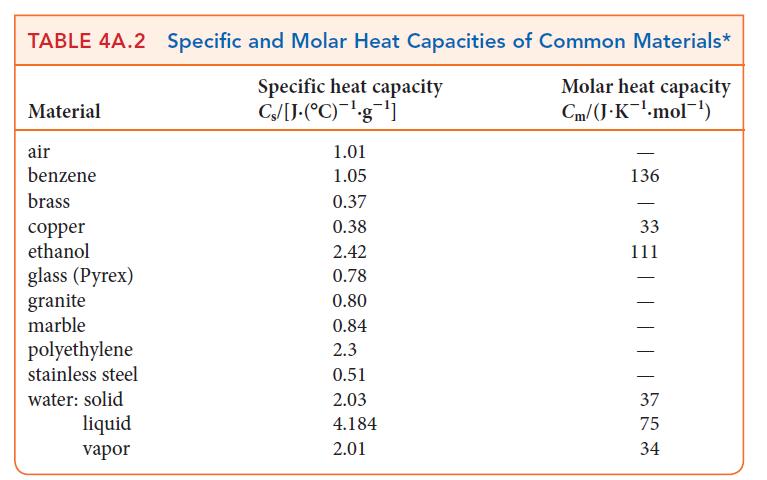
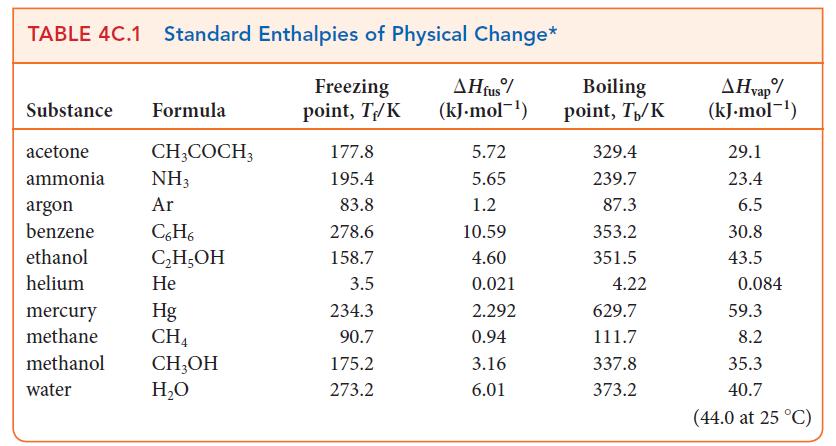
In hot, dry climates an inexpensive alternative to air conditioning is the swamp cooler. In this device, water continuously wets porous pads through which fans blow the hot air. The air is cooled as the water evaporates. Use the information in Tables 4A.2 and 4C.1 to determine how much water must
One step in the production of hydrogen as a fuel is the reaction of methane with water vapor:What is the change in internal energy for the production of 1.00 mol H2? CH₂(g) + H₂O(g) Ni CO₂ (g) + 3 H₂(g) AH-318 kJ
An experimental automobile burns hydrogen for fuel. At the beginning of a test drive, the rigid 30.0-L tank was filled with hydrogen at 16.0 atm and 298 K. At the end of the drive, the temperature of the tank was still 298 K, but its pressure was 4.0 atm.(a) How many moles of H2 were burned during
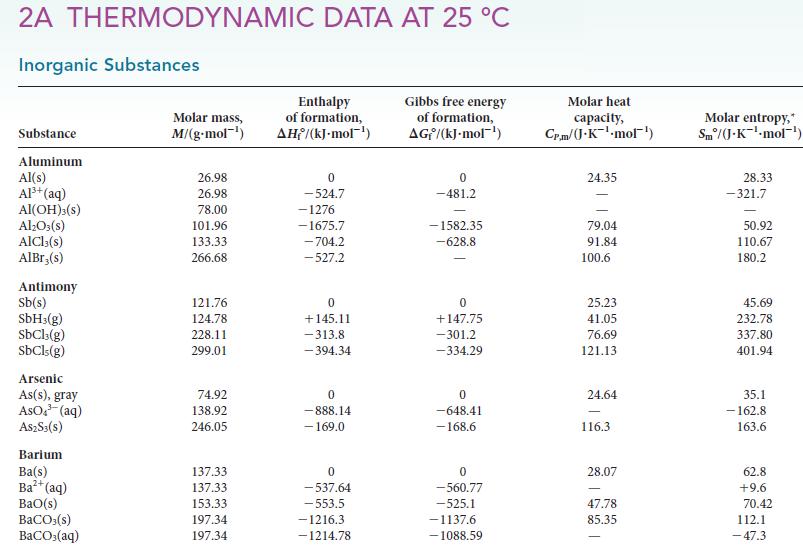
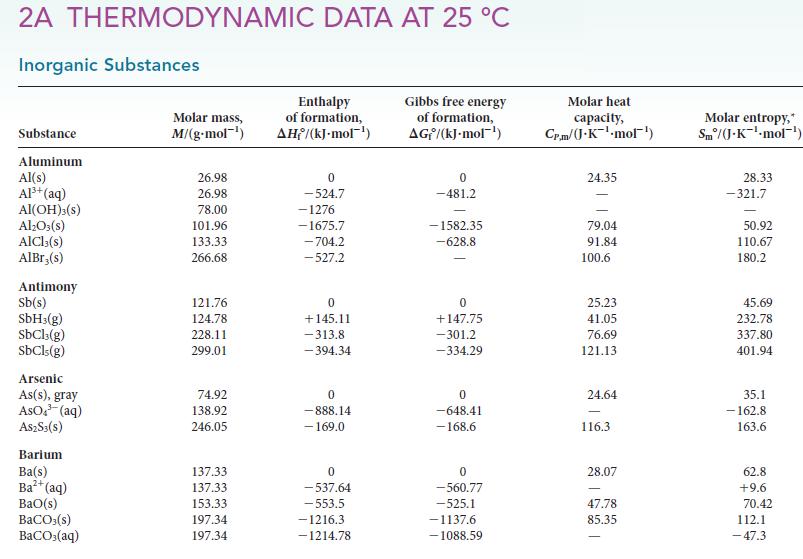
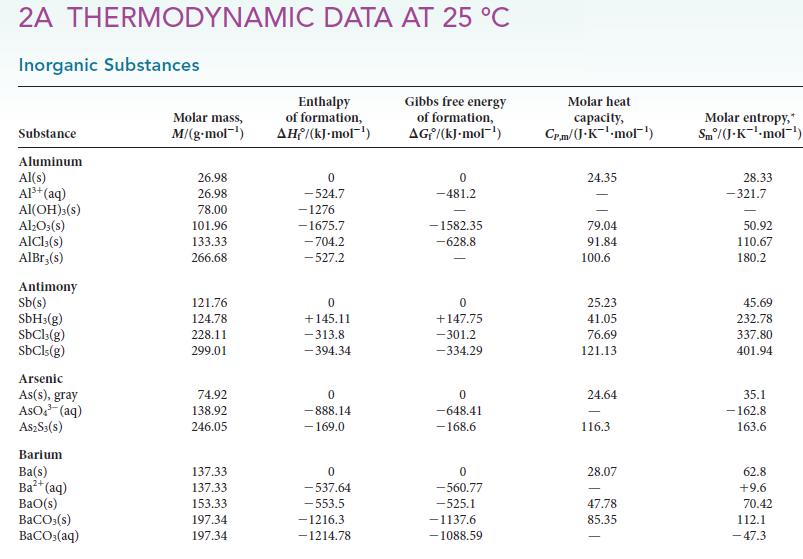
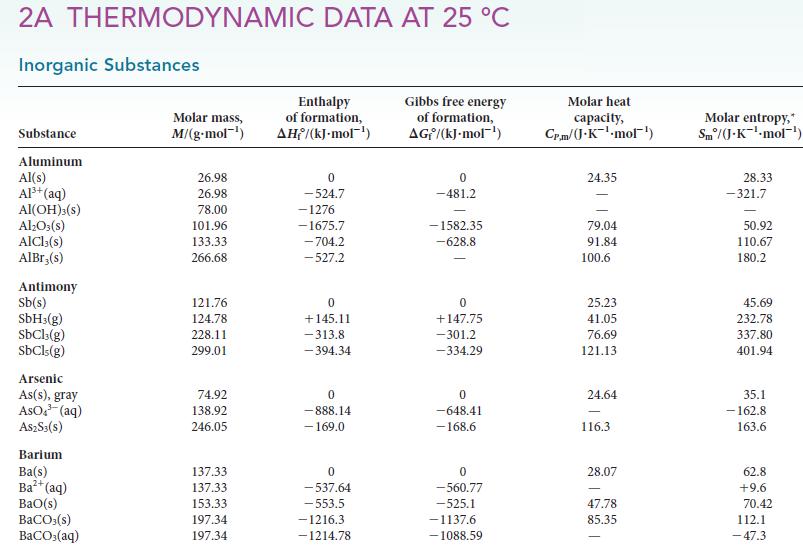
Before checking the numbers, which substance would you expect to have the higher standard molar entropy, CH3COOH(l) or CH3COOH(aq)? Having made this prediction, examine the values in Appendix 2A and explain your findings. 2A THERMODYNAMIC DATA AT 25 °C Inorganic
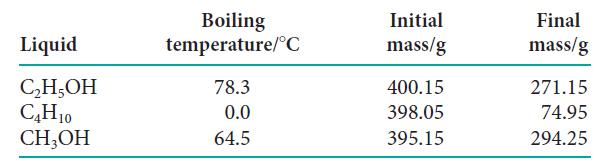
Three liquid samples with known masses are heated to their boiling points with the use of a heater rated at 500. W. Once their boiling points are reached, heating continues for 4.0 min and some of each sample is vaporized. After 4.0 min, the samples are cooled and the masses of the remaining
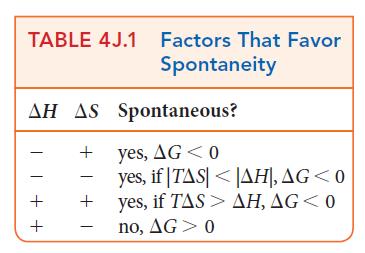
Under what conditions, if any, does the sign of each of the following quantities provide a criterion for assessing the spontaneity of a reaction?(a) ΔG°;(b) ΔH°;(c) ΔS°;(d) ΔStot.
Ammonia survives indefinitely in air. An agronomist studying how long ammonia survives in soil might need to know whether it survives because its oxidation is not spontaneous under ordinary conditions or whether the oxidation is spontaneous but just very slow. Calculate the standard Gibbs free
Consider the enthalpies of fusion and the melting points of the following elements: Pb, 5.10 kJ · mol–1, 327 °C; Hg, 2.29 kJ · mol–1, 239 °C; Na, 2.64 kJ · mol–1, 98 °C. Given these data, determine whether a relation similar to Trouton’s rule can be obtained for the entropy of fusion
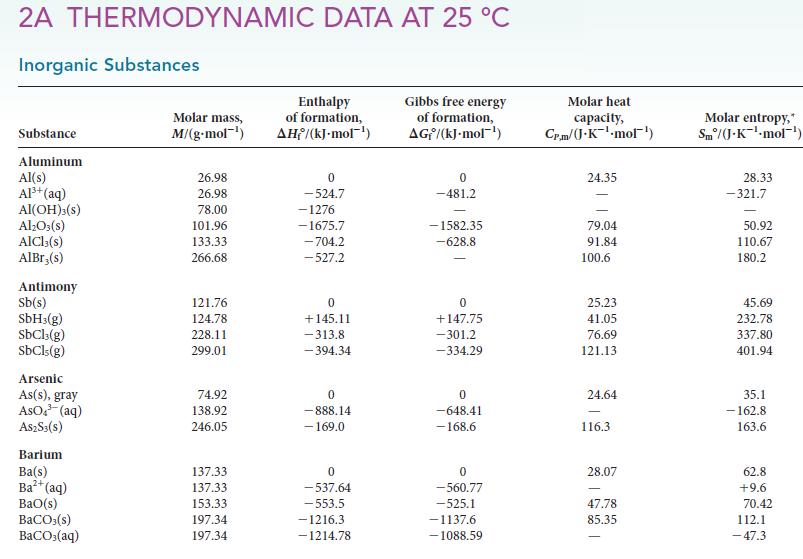
The heat capacity of liquid iodine is 80.7 J · K21 · mol–1, and its enthalpy of vaporization is 41.96 kJ · mol–1 at its boiling point (184.3 °C). Using these facts and information in Appendix 2A, calculate the enthalpy of fusion of iodine at 25 °C. 2A THERMODYNAMIC DATA AT 25 °C Inorganic
(a) Calculate the change in entropy of a block of copper at 25°C that absorbs 65 J of energy from a heater.(b) If the block of copper is at 100. °C and it absorbs 65 J of energy from the heater, what is its entropy change?(c) Explain any difference in entropy change.
The internal energy of a system increased by 982 J when it was supplied with 492 J of energy as heat.(a) Was work done by or on the system?(b) How much work was done?
Dehydrated meals carried on camping trips are reconstituted with hot water. The energy used to heat the water is typically supplied by burning fuel in a camp stove. How much energy is required to heat the water? Calculate the heat necessary to increase the temperature of(a) 100. g of
Calculate the final temperature and the change in enthalpy when 765 J of energy is transferred as heat to 0.820 mol Kr(g) at 298 K and 1.00 atm(a) At constant pressure;(b) At constant volume.Treat the gas as ideal.
Which would you expect to have a higher molar entropy at T = 0, single crystals of BF3 or of COF2? Why?
Butane is a volatile liquid fuel that can be used in camping stoves. If you are planning a wilderness trek, you might need to assess how much butane you need to transport. How much butane should a backpacker carry to boil 1 L of water? Calculate the mass of butane that you would need to burn to
List the following substances in order of increasing molar entropy at 298 K and 1 bar: H2O(l), H2O(g), H2O(s), C(s, diamond). Explain your reasoning.
Each of the four cylinders of a new type of combustion engine has a displacement of 3.60 L. (The volume of the cylinder expands by 3.60 L each time the fuel is ignited and a piston moves out.)(a) If each piston in the four cylinders is displaced against a pressure of 1.80 kbar and each cylinder is
The standard entropy of vaporization of acetone is approximately 85 J · K–1 mol–1 at its boiling point.(a) Estimate the standard enthalpy of vaporization of acetone at its boiling point of 56.2 °C.(b) What is the entropy change of the surroundings when 10. g of acetone, CH3COCH3, condenses
By assuming that the lattice enthalpy of NaCl2 is the same as that of MgCl2, use enthalpy arguments based on data in Appendix 2A, explain why NaCl2 is an unlikely compound. 2A THERMODYNAMIC DATA AT 25 °C Inorganic Substances Substance Aluminum Al(s) Al³+
The production of steel from iron ore is endothermic. To reduce the heat that must be supplied, engineers need to find the lowest temperature at which the desired reactions are spontaneous. Estimate the temperature at which it is thermodynamically possible for carbon to reduce iron(III) oxide to
Showing 1900 - 2000
of 3011
First
13
14
15
16
17
18
19
20
21
22
23
24
25
26
27
Last
Step by Step Answers

 Get 50% OFF
Claim Now
Get 50% OFF
Claim Now