New Semester
Started
Get
50% OFF
Study Help!
--h --m --s
Claim Now
Question Answers
Textbooks
Find textbooks, questions and answers
Oops, something went wrong!
Change your search query and then try again
S
Books
FREE
Study Help
Expert Questions
Accounting
General Management
Mathematics
Finance
Organizational Behaviour
Law
Physics
Operating System
Management Leadership
Sociology
Programming
Marketing
Database
Computer Network
Economics
Textbooks Solutions
Accounting
Managerial Accounting
Management Leadership
Cost Accounting
Statistics
Business Law
Corporate Finance
Finance
Economics
Auditing
Tutors
Online Tutors
Find a Tutor
Hire a Tutor
Become a Tutor
AI Tutor
AI Study Planner
NEW
Sell Books
Search
Search
Sign In
Register
study help
sciences
chemical principles
Chemical Principles The Quest For Insight 7th Edition Peter Atkins, Loretta Jones, Leroy Laverman - Solutions
Calculate the change in molar Gibbs free energy for the process CH4(l) → CH4(g) at 1 atm and(a) –140.0°C;(b) –180.°C. In each case, indicate whether or not vaporization would be spontaneous.
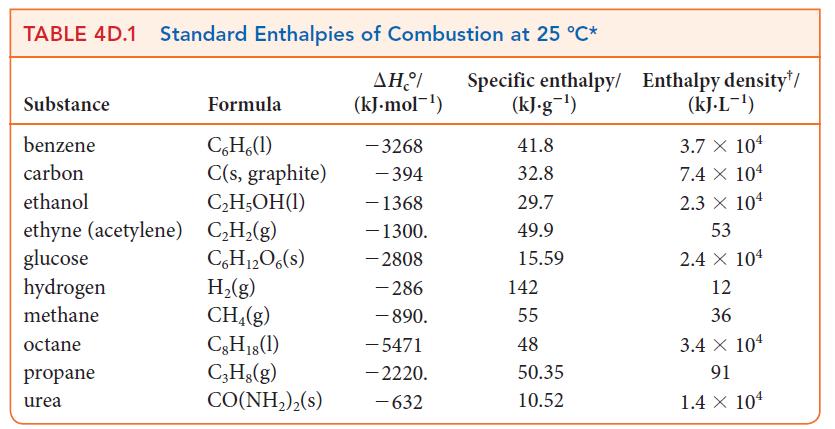
A typical bathtub can hold 100. gallons of water.(a) Calculate the mass of natural gas that would need to be burned to heat the water for a tub of this size from 65 °F to 108 °F. Assume that the natural gas is pure methane, CH4.(b) What volume of natural gas does this correspond to at 25 °C
Benzoic acid has a known internal energy of combustion (–3251 kJ · mol–1). When a bomb calorimeter was calibrated by burning 0.825 g of benzoic acid in oxygen, the temperature rose 1.94°C. A sample of the sugar d-ribose (C5H10O5) of mass 0.727 g was then burned in excess oxygen in the same
In the production of iron in a blast furnace, compressed air and oxygen are driven into molten iron ore. Engineers must understand the thermodynamic aspects of each part of the process so that it can be optimized, including changes to the entropy of oxygen. In one experiment, 1.00 mol O2(g) was
(a) Calculate the change in entropy of 255 g of water at 0.0 °C when it absorbs 326 J of energy from a heater.(b) If the 1.0 L of water is at 99°C, what is its entropy change?(c) Explain any difference in entropy change.
(a) Calculate the value of w for a system that absorbs 164 kJ of heat in a process for which the change in internal energy is +152 kJ.(b) Is work done on or by the system during this process?
Calculate the final temperature and the change in enthalpy when 1.15 kJ of energy is transferred as heat to 0.640 mol Ne (g) at 298 K and 1.00 atm(a) At constant pressure;(b) At constant volume.Treat the gas as ideal.
On the basis of the structures of each of the following molecules, predict which ones would be most likely to have a residual entropy in their crystal forms at T = 0:(a) CO2;(b) NO;(c) N2O;(d) Cl2.
Neutralization reactions occurring when acids and bases are mixed can be very exothermic. Suppose you are investigating how the heat released in various neutralization reactions is related to the structures of certain acids. A constant-volume calorimeter was calibrated by carrying out a reaction
(a) Calculate the work associated with the isothermal, reversible expansion of 1.000 mol of ideal gas molecules from 7.00 L to 15.50 L at 25.0 °C.(b) Calculate the work associated with the irreversible adiabatic expansion of the sample of gas described in part (a) against a constant atmospheric
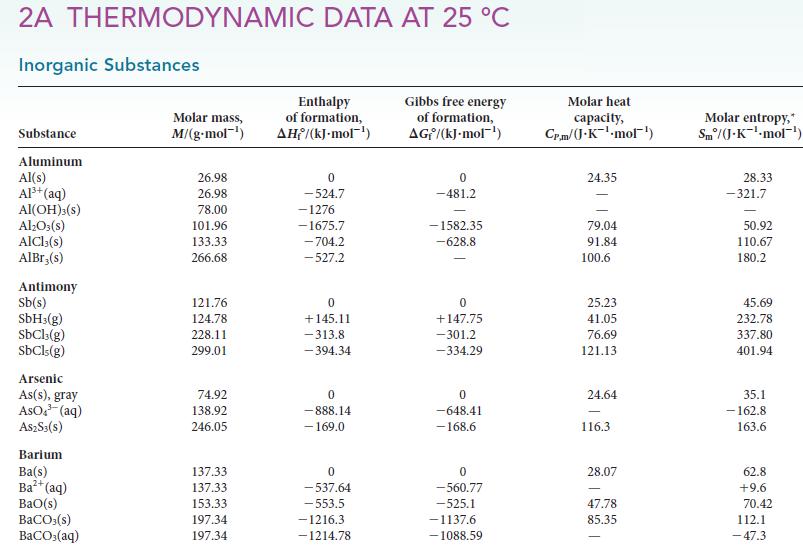
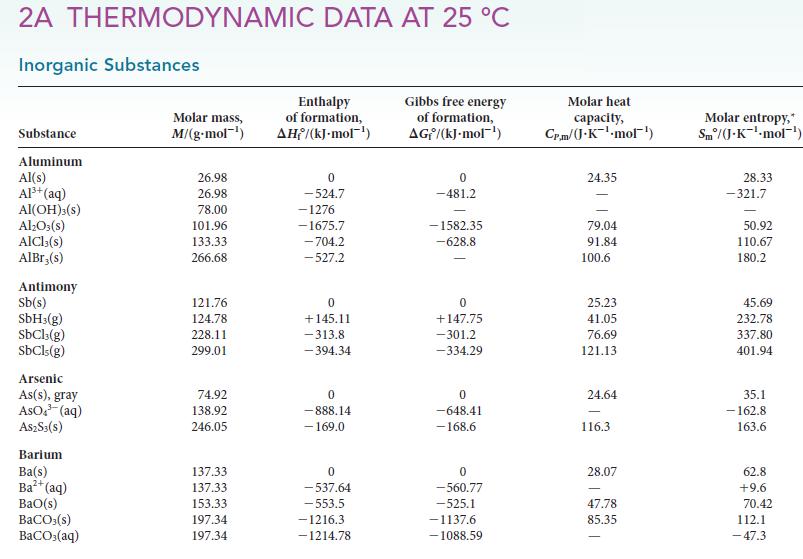
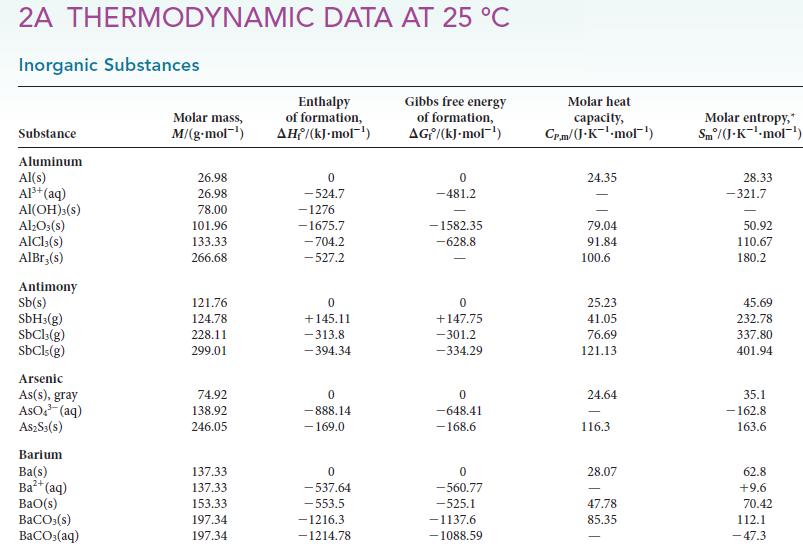
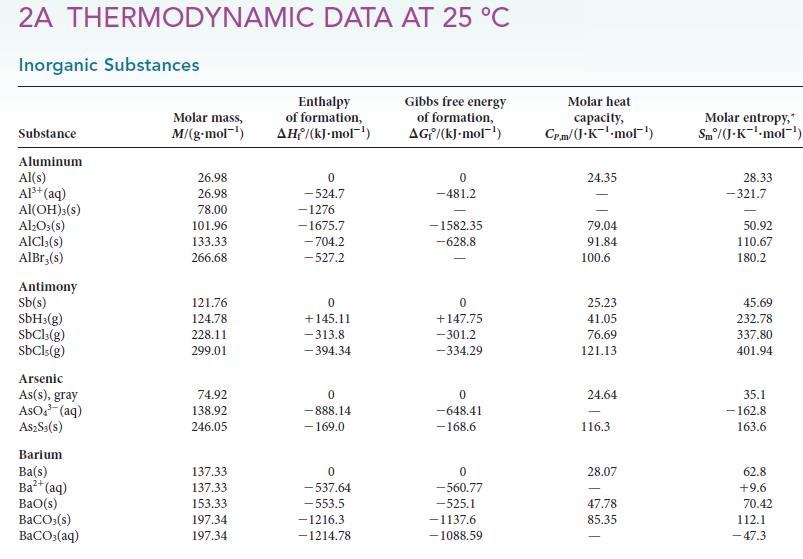
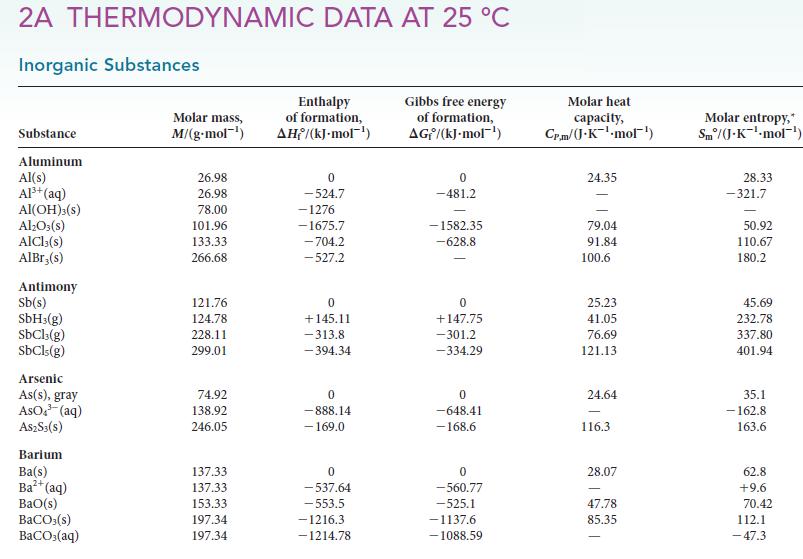
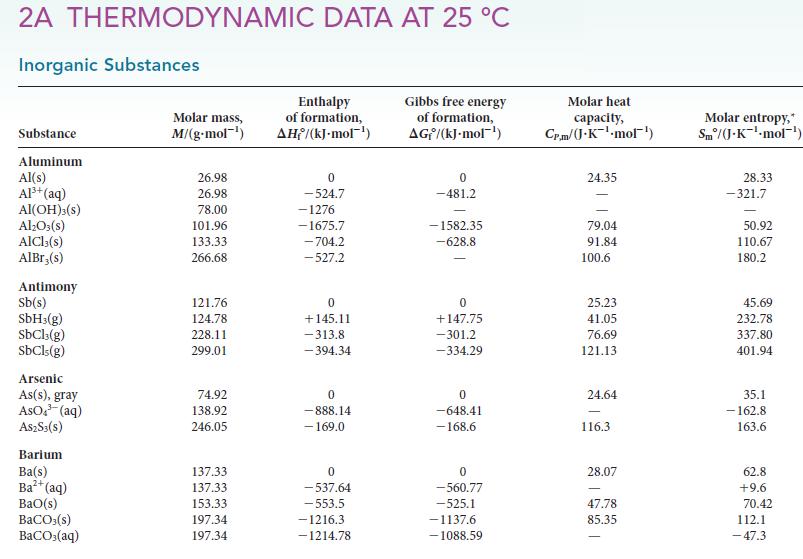
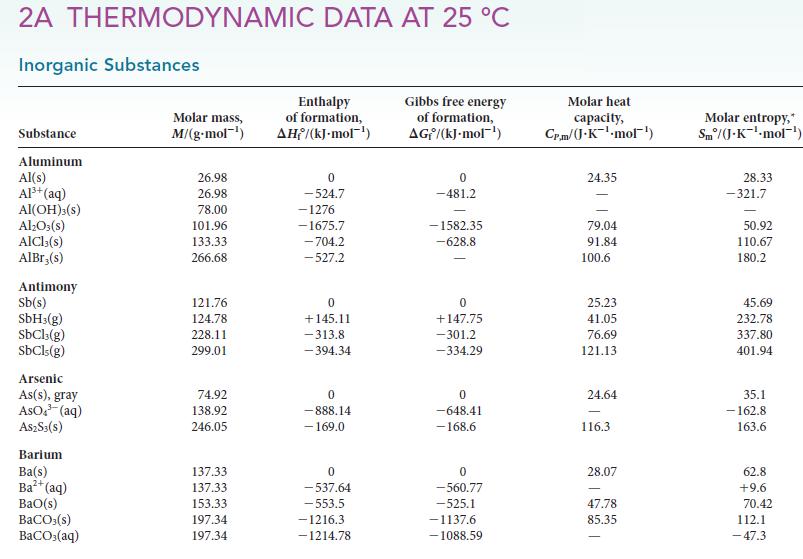
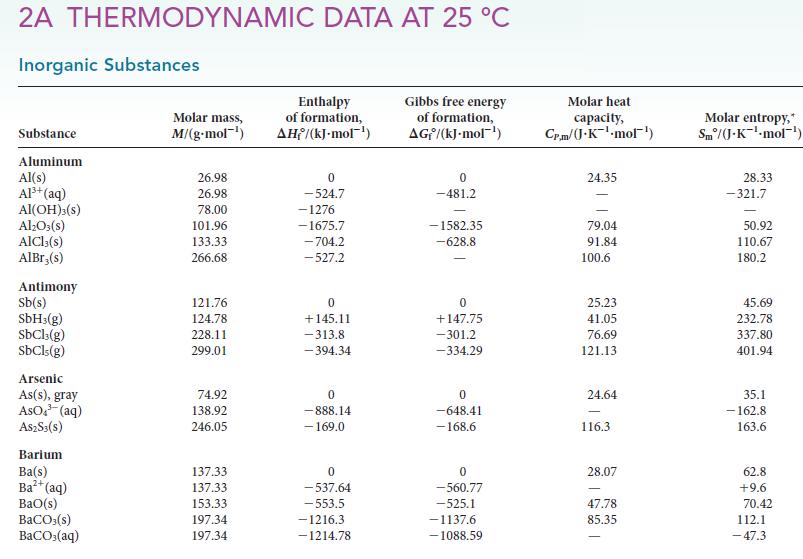
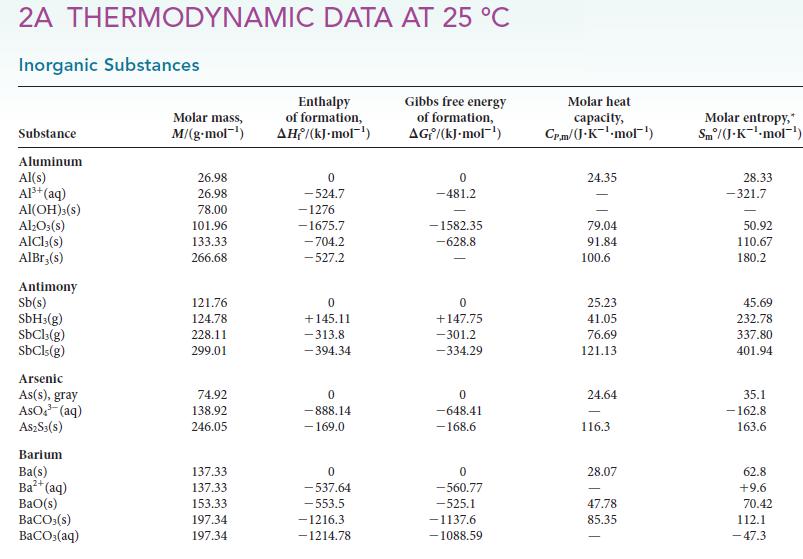
Write a balanced chemical equation for the formation reaction of(a) HCl(g);(b) C6H6(l);(c) CuSO4 · 5H2O(s);(d) CaCO3(s, calcite). For each reaction, determine ΔH°, ΔS°, and ΔG° from data in Appendix 2A. 2A THERMODYNAMIC DATA AT 25 °C Inorganic Substances Substance Aluminum Al(s) Al³+
Suppose that 320.0 g of ethanol at 18.0°C is mixed with 120.0 g of ethanol at 56.0 °C at constant atmospheric pressure in a thermally insulated vessel. Calculate ΔS and ΔStot for the process.
In 1750, Joseph Black performed an experiment that eventually led to the discovery of enthalpies of fusion. He placed two samples of water, each of mass 150. g, at 0.00 °C (one ice and one liquid) in a room kept at a constant temperature of 5.00 °C. He then observed how long it took for each
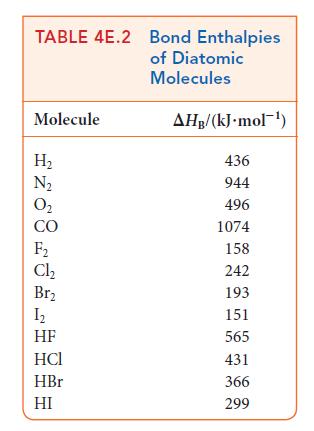
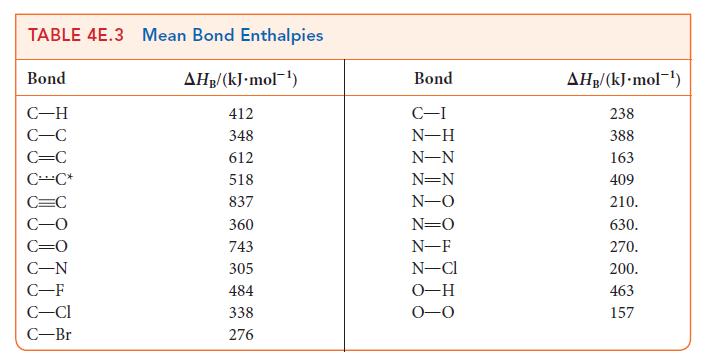
Use the bond enthalpies in Tables 4E.2 and 4E.3 to estimate the reaction enthalpy for (a) 3 C₂H₂(g) →CH(g) (b) CH4(g) + 4 Cl₂(g) → CCl4(g) + 4 HCl(g) (c) CH4(g) + CCl4(g) → CHCl3(g) + CH3CI(g)
Suppose that 50.0 g of water at 20.0° 8C is mixed with 65.0 g of water at 50.0°C at constant atmospheric pressure in a thermally insulated vessel. Calculate ΔS and ΔStot for the process.
A piston confines 0.200 mol Ne(g) in 1.20 L at 25°C. Two experiments are performed.(a) The gas is allowed to expand through an additional 1.20 L against a constant pressure of 1.00 atm.(b) The gas is allowed to expand reversibly and isothermally to the same final volume. Which process does more
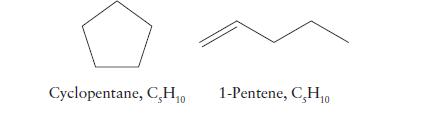
Which substance in each of the following pairs would you expect to have the higher standard molar entropy at 298 K and 1 bar? Explain your reasoning.(a) Lodine vapor or bromine vapor;(b) The two liquids cyclopentane and 1-pentene (see structures);(c) Ethene (ethylene) or an equivalent mass of
List the following substances in order of increasing molar entropy at 298 K and 1 bar: NH3(g), HF(g), H2O(s), NH2OH(g). Explain your reasoning.
Propane, C3H8, is a gas used as a fuel for outdoor grills and alternative-fuel vehicles. The enthalpy change for the synthesis of propane from its elements in their standard states is difficult to measure directly, but if you are interested in assessing the thermodynamic properties of its
Initially an ideal gas at 323 K occupies 1.67 L at 4.95 atm. The gas is allowed to expand to 7.33 L by two pathways:(a) Isothermal, reversible expansion;(b) Isothermal, irreversible free expansion.Calculate ΔStot, ΔS, and ΔSsurr for each pathway.
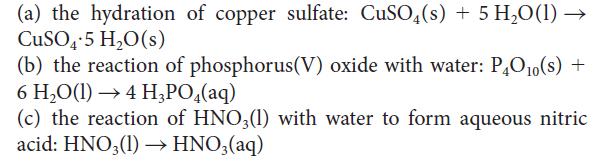
Write a balanced chemical equation for the formation reaction of(a) NH3(g);(b) H2O(g);(c) CO(g);(d) NO2(g). For each reaction, determine ΔH°, ΔS°, and ΔG° from data in Appendix 2A. 2A THERMODYNAMIC DATA AT 25 °C Inorganic Substances Substance Aluminum Al(s) Al³+
Calculate the standard reaction entropy, enthalpy, and Gibbs free energy for each of the following reactions from data in Appendix 2A:(a) The decomposition of hydrogen peroxide:(b) The preparation of hydrofluoric acid from fluorine and water: 2 H₂O₂ (1) 2 H₂O(1) + O₂(g)
(a) Calculate the work that must be done against the atmosphere for the expansion of the gaseous products in the combustion of 1.00 mol C6H6(l) at 25 °C and 1.00 bar.(b) Using data in Appendix 2A, calculate the standard enthalpy of the reaction.(c) Calculate the change in internal energy,
Use the information in Table 4C.1 to calculate the changes in entropy of the surroundings and of the system for(a) The melting of 1.00 mol NH3(s) at its melting point;(b) The freezing of 1.00 mol CH3OH(l) at its freezing point;(c) The vaporization of 1.00 mol H2O(l) at its boiling point.
Calculate the standard enthalpy, entropy, and Gibbs free energy for each of the following reactions at 298 K by using data in Appendix 2A. For each case, confirm that the value obtained from the Gibbs free energies of formation is the same as that obtained by using the relation ΔG° = ΔH° –
A system undergoes a two-step process. In step 1, it absorbs 60. J of heat at constant volume. In step 2, it releases 12 J of heat at 1.00 atm as it is returned to its original internal energy. Find the change in the volume of the system during the second step and identify it as an expansion or
The high-temperature contribution of vibrational modes to the molar heat capacity of a solid at constant volume is R for each mode of vibrational motion. Hence, because each atom can vibrate in three dimensions, for a monatomic solid, the molar heat capacity at constant volume is approximately
Initially an ideal gas at 412 K occupies 12.62 L at 0.6789 atm. The gas is allowed to expand to 19.44 L by two pathways:(a) Isothermal, reversible expansion and(b) Isothermal, irreversible free expansion. Calculate ΔStot, ΔS, and ΔSsurr for each pathway.
Use the standard Gibbs free energies of formation in Appendix 2A to calculate ΔG° for each of the following reactions at 25 °C. Comment on the spontaneity of each reaction under standard conditions at 25 °C. (a) 2 SO₂ (g) + O₂(g) →2 SO3(g) (b) CaCO3(s, calcite) →CaO(s) + CO₂(g) (c) 2
(a) Consider the hydrogenation of benzene to cyclohexane, which takes place by the step-by-step addition of two H atoms per step:Draw Lewis structures for the products of the hydrogenation of benzene. If resonance is possible, show only one of the most important resonance structures.(b) Use bond
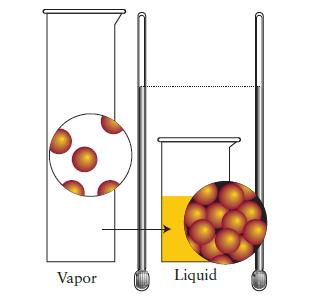
The following picture shows a molecular visualization of a system undergoing a spontaneous change. Account for the spontaneity of the process in terms of the entropy changes in the system and the surroundings. The thermometers show the temperature of the system. Vapor Liquid
Estimate the molar heat capacity (at constant volume) of sulfur dioxide gas. In addition to translational and rotational motion, there is vibrational motion. Each vibrational degree of freedom contributes R to the molar heat capacity at high temperature. The temperature needed for the vibrational
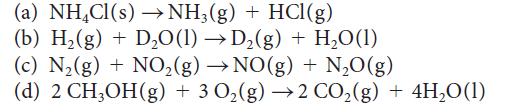
Use the standard Gibbs free energies of formation in Appendix 2A to calculate ΔG° for each of the following reactions at 25 °C. Comment on the spontaneity of each reaction under standard conditions at 25 °C. (a) NHCl(s) NH(g) + HCl(g) (b) H(g) + DO(l) D(g) + HO(1) (c) N(g) + NO (g) NO(g) +
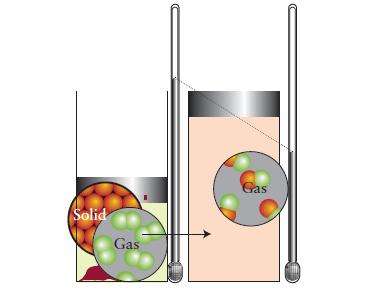
The following picture shows a molecular visualization of a system undergoing a spontaneous change. Account for the spontaneity of the process in terms of the entropy changes in the system and the surroundings. The thermometers show the temperature of the system. Solid Gas Gas
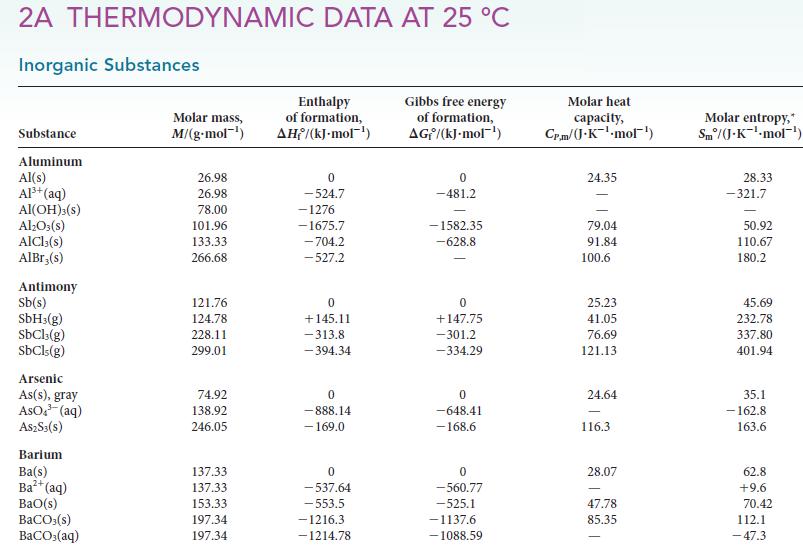
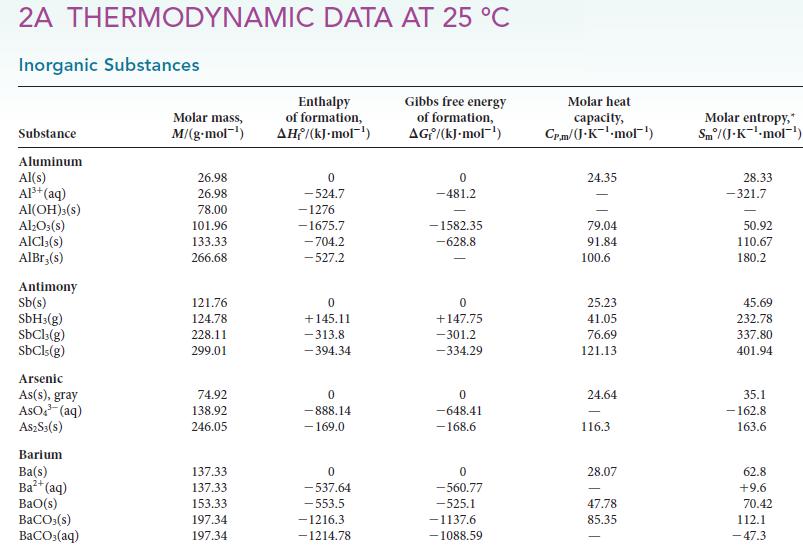
Determine which of the following compounds are stable with respect to decomposition into their elements under standard conditions at 25°C (see Appendix 2A):(a) PCl5(g);(b) HCN(g);(c) NO(g);(d) SO2(g). 2A THERMODYNAMIC DATA AT 25 °C Inorganic Substances Substance Aluminum Al(s) Al³+
Draw the Lewis structure for the hypothetical molecule N6, consisting of a six-membered ring of nitrogen atoms. Using bond enthalpies, calculate the enthalpy of reaction for the decomposition of N6 to N2(g). Do you expect N6 to be a stable molecule?
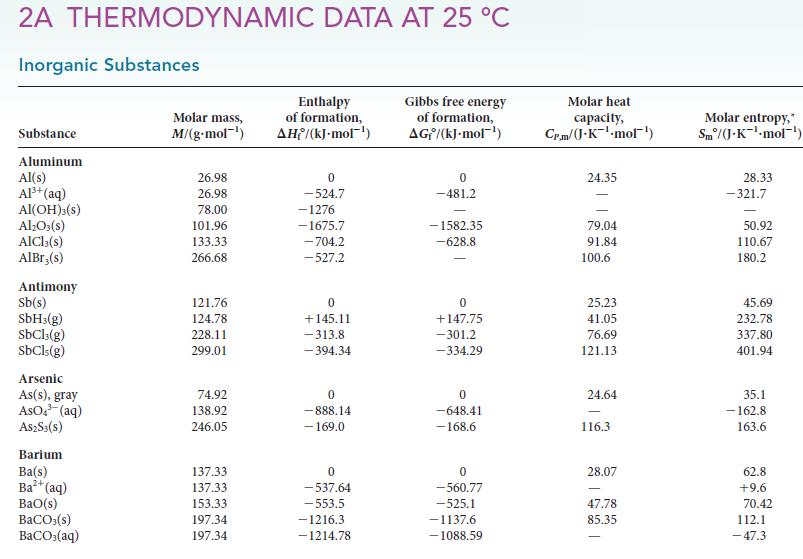
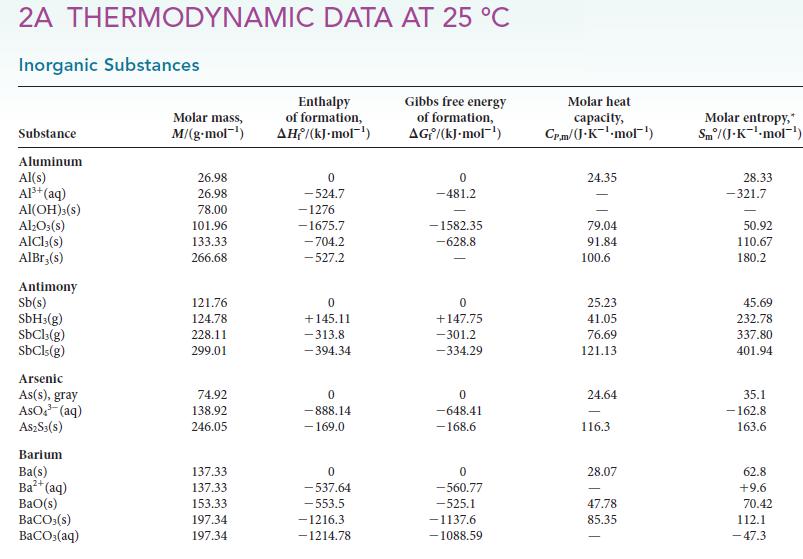
Determine which of the following compounds are stable with respect to decomposition into their elements under standard conditions at 25°C (see Appendix 2A):(a) C3H6(g), cyclopropane;(b) CaO(s);(c) N2O(g);(d) HN3(g). 2A THERMODYNAMIC DATA AT 25 °C Inorganic
Robert Curl, Richard Smalley, and Harold Kroto were awarded the Nobel Prize in Chemistry in 1996 for the discovery of the soccer ball shaped molecule C60. This molecule was the first of a new series of molecular allotropes of carbon. The enthalpy of combustion of C60 is 225 937 kJ · mol–1, and
When sulfur burns, the product is normally SO2, but SO3 may also be formed under certain conditions. When 0.6192 g of sulfur was burned in the presence of oxygen in a bomb calorimeter with a heat capacity of 5.270 kJ · (°C)–1, the temperature rose 1.140 °C.Assuming that all the sulfur was
Calculate the standard reaction entropy, enthalpy, and Gibbs free energy for each of the following reactions from data in Appendix 2A:(a) The production of “synthesis gas,” a low-grade industrial fuel:(b) The thermal decomposition of ammonium nitrate: CH₂(g) + H₂O(g) CO(g) + 3 H₂(g)
Determine whether titanium dioxide can be reduced by carbon at 1000. K in each of the following reactions: (a) TiO₂(s) + 2 C(s) →→→ Ti(s) + Ti(s) + 2 CO(g) - (b) TiO₂(s) + C(s) Ti(s) + CO₂(g) -
Which is the thermodynamically more stable iron oxide in air, Fe3O4(s) or Fe2O3(s)? Justify your selection.
(a) Calculate the work that must be done at 298.15 K against the atmosphere at 1.00 bar for the production of CO2 (g) and H2O(g) in the combustion of 0.825 mol C6H6(l).(b) Calculate the change in the entropy of the system due to expansion of the product gases.
Hydrogen burns in an atmosphere of bromine gas to give hydrogen bromide gas.(a) What is the standard Gibbs free energy of the reaction H2(g) + Br2 (g) → 2 HBr (g) at 298 K?(b) If 120. mL of H2 gas at SATP combines with a stoichiometric amount of bromine and the resulting hydrogen bromide
Hydrogen reacts with nitrogen gas to form ammonia.(a) What is the standard Gibbs free energy of the reaction 3 H2(g) + N2(g) → 2 NH3(g) at 298 K?(b) If 50.1 L of H2 gas at 1 bar and 298 K is added to 15.6 L of N2 gas, also at 1 bar and 298 K, and the resulting ammonia dissolves to form 2.00 L
Potassium nitrate dissolves readily in water, and its enthalpy of solution is 134.9 kJ · mol–1.(a) Does the enthalpy of solution favor the dissolving process?(b) Is the entropy change of the system likely to be positive or negative when the salt dissolves?(c) Is the entropy change of the
Explain why each of the following statements is false.(a) Reactions with negative Gibbs free energies of reaction occur spontaneously and rapidly.(b) Every sample of a pure element, regardless of its physical state, is assigned zero Gibbs free energy of formation.(c) An exothermic reaction
A common antiseptic used in first aid for cuts and scrapes is a 3% aqueous solution of hydrogen peroxide. The oxygen that bubbles out of the hydrogen peroxide as it is decomposed by enzymes in blood into oxygen and water helps to clean the wound. Two possible industrial routes for the synthesis of
Acetic acid, CH3COOH(l), could be produced from(a) The reaction of methanol with carbon monoxide;(b) The oxidation of ethanol;(c) The reaction of carbon dioxide with methane. Write balanced chemical equations for each process. Carry out a thermodynamic analysis of the three possibilities and
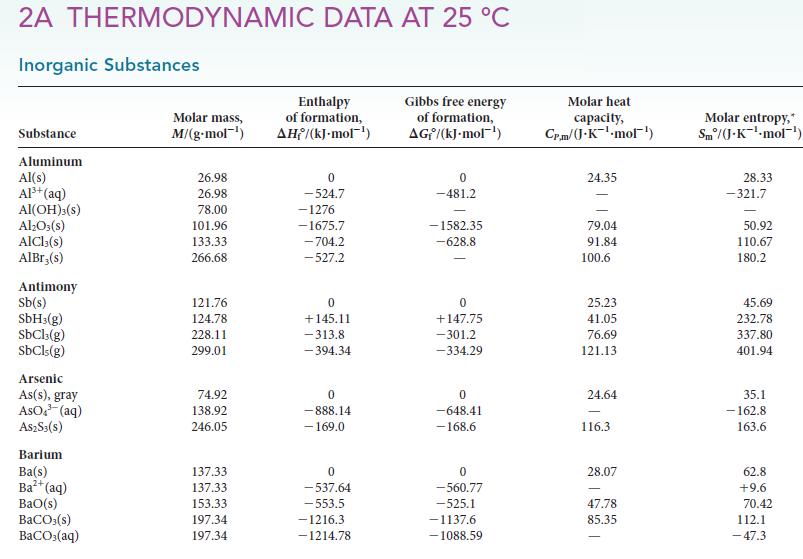
Some entries for Sm° in Appendix 2A are negative. What is common about these entries, and why would the entropy be negative? 2A THERMODYNAMIC DATA AT 25 °C Inorganic Substances Substance Aluminum Al(s) Al³+ (aq) Al(OH)3(S) Al₂O3(s) AlCl3(s) AlBr,(s) Antimony Sb(s) SbH3(g) SbCl3(g) SbCls
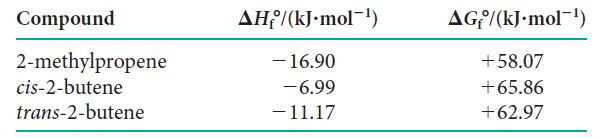
Three isomeric alkenes have the formula C4H8 (see the following table).(a) Draw Lewis structures of these compounds. (b) Calculate ΔG°, ΔH°, and ΔS° for the three reactions that interconvert each pair of compounds.(c) Which isomer is the most stable?(d) Rank the isomers in order of
The molar entropy of electron spins in a magnetic field B iswhere ΔE = 2μBB is the separation in energy of the two spin states in a magnetic field, and μB is the Bohr magneton, μB = 9.274 * 10–24 J · T–1. Plot this function against temperature for the following values of B: 0.1 T, 1 T, 10
Propose the argument that, for any liquid at atmospheric pressure (that is, a liquid that boils above room temperature when the external pressure is 1 atm), the numerical value of ΔHvap in joules per mole is greater than the numerical value of ΔSvap in joules per kelvin per mole. (Explain and
The populations p of the up and down spin states of electrons in a magnetic field B are given bywhere DE = 2μBB is the energy difference between the two spin states. (See Exercise 4.53.) Plot these two populations as a function of temperature for B = 1 T. Exercise 4.53The molar entropy of
Without doing any calculations, predict what temperature corresponds to equal populations of up and down spin states. (See Exercise 4.54.)Exercise 4.54The populations p of the up and down spin states of electrons in a magnetic field B are given bywhere DE = 2μBB is the energy difference between
Suppose it could be arranged for there to be twice as many electrons with up spins than down spins in a sample in a magnetic field. Without doing any calculations, predict the sign of the temperature of such a sample. (See Exercise 4.54.) Exercise 4.54The populations p of the up and down spin
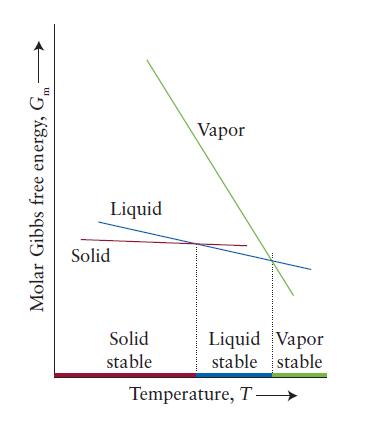
It is helpful in understanding graphs of thermodynamic functions to interpret them in terms of molecular behavior. Consider the plot of the temperature dependence of the standard molar Gibbs free energy of the three phases of a substance in Fig. 4J.3.(a) Explain in terms of molecular behavior why
Because state functions depend on only the current state of the system, when a system undergoes a series of processes that bring it back to the original state, a thermodynamic cycle has been completed and all the state functions have returned to their original value. However, properties that
A technique used to overcome the unfavorable thermodynamics of one reaction is to “couple” that reaction to another process that is thermodynamically favored. For instance, the dehydrogenation of cyclohexane to form benzene and hydrogen gas is not spontaneous.Show that, if another molecule such
Suppose that 200. J of energy is taken as heat from a hot source at 400.°C, passes through a turbine that converts some of the energy into work, and then releases the rest of the energy as heat into a cold sink at 20. °C. What is the maximum amount of work that can be produced by this engine if
A scientist proposed the following two reactions to produce ethanol, a liquid fuel:Reaction B is preferred if it is spontaneous, because C2H6(g) is a cheaper starting material than C2H4(g). Assume standard-state conditions and determine if either reaction is thermodynamically spontaneous.
A rocket fuel would be useless if its oxidation were not spontaneous. Although rockets operate under conditions that are far from standard, an initial estimation of the potential of a rocket fuel might assess whether its oxidation at the high temperatures reached in a rocket is spontaneous. A
Vehicle air bags protect passengers by using a chemical reaction that generates gas rapidly. Such a reaction must be both spontaneous and explosively fast. A common reaction is the decomposition of sodium azide, NaN3, to nitrogen gas and sodium metal.(a) Write a balanced chemical equation for this
Petroleum-based fuels contribute to climate change, and alternative fuels are being sought (see Box 4D.1). Three compounds that could be produced biologically and used as fuels are methane, CH4, which can be produced from the anaerobic digestion of sewage; dimethyl ether, H3C—O—CH3, a gas that
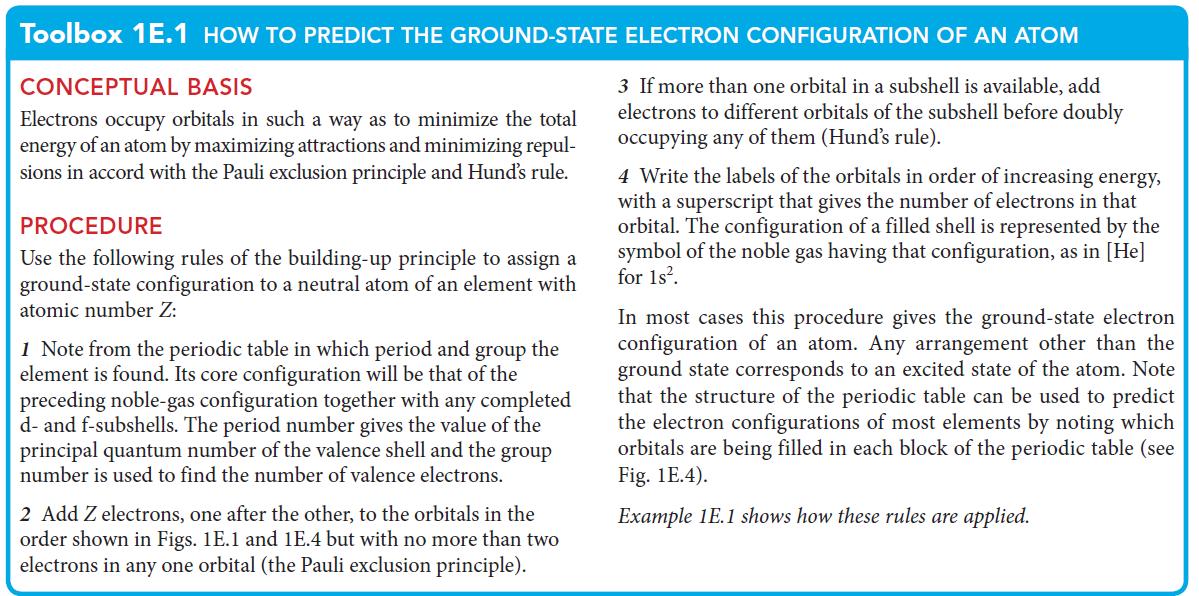
In order to develop interesting new compounds inorganic chemists often start by noting the location of an element in the periodic table and its valence electron configuration. Suppose you are working in a laboratory developing catalysts for an industrial process. Predict the ground-state electron
Knowledge of the probable locations of electrons in atoms (and in molecules) is fundamental to understanding their properties, and it is important to be able to interpret their wavefunctions.Suppose the electron is in a 1s-orbital of a hydrogen atom. What is the probability of finding the electron
Consider the following statements about electromagnetic radiation and decide whether they are true or false. If they are false, correct them.(a) The total intensity of radiation emitted from a black body at absolute temperature T is directly proportional to the temperature.(b) As the temperature
Rainbows form when the wavelengths of sunlight are refracted (bent) through different angles. When sunlight passes through droplets of water, the shorter the wavelength of the light, the greater the angle through which its path is bent. Which color of light has the shorter wavelength, red light of
Arrange the elements in each of the following sets in order of decreasing atomic radius:(a) Sulfur, chlorine, silicon;(b) Cobalt, titanium, chromium;(c) Zinc, mercury, cadmium;(d) Antimony, bismuth, phosphorus.
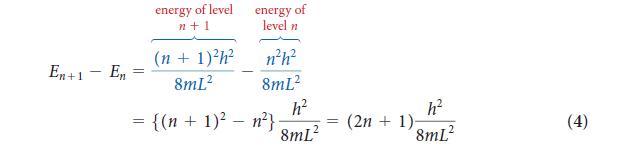
Scientists often find it helpful to use very simple expressions to estimate the order of magnitude of a property without doing a detailed calculation. Treat a hydrogen atom as a one-dimensional box of length 150. pm (the approximate diameter of the atom) containing an electron and predict the
Which of the following increase when an electron in a lithium atom undergoes a transition from the 1s-orbital to a 2p-orbital?(a) Energy of the electron.(b) Value of n.(c) Value of l.(d) Radius of the atom. Which answers would be different for a hydrogen atom and in what way would they be
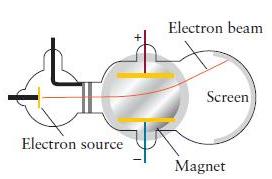
At the time that J. J. Thomson conducted his experiments on cathode rays, the nature of the electron was in doubt. Some considered it to be a form of radiation, like light; others believed the electron to be a particle. Some of the observations made on cathode rays were used to advance one view or
(a) Using the particle-in-the-box model for the hydrogen atom and treating the atom as an electron in a one-dimensional box of length 150. pm, predict the wavelength of radiation emitted when the electron falls from the level with n 5 5 to that with n = 4. (b) Repeat the calculation for the
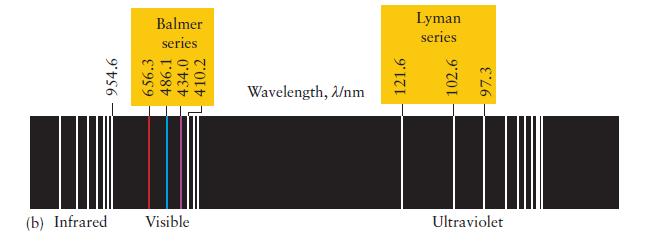
Lines in the Balmer series of the hydrogen spectrum are observed at 656.3, 486.1, 434.0, and 410.2 nm. What is the wavelength of the next line in the series?
Astronomers are often very interested in the temperatures of stars (including the Sun) because that gives a clue to the star’s size, composition, and age. The maximum intensity of solar radiation occurs at 490. nm. What is the temperature of the surface of the Sun?ANTICIPATE You should be aware
Mineralogists and geologists often need to identify the relative sizes of atoms to judge whether one mineral might be modified by the inclusion of “alien” ions. For example, the different colors of some gemstones result from this type of insertion.Arrange each of the following pairs of ions in
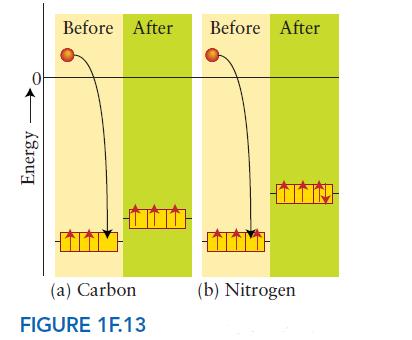
Organic chemists need to think about the distribution of electrons in molecules, because electron-rich regions might prove to be centers of attack for reagents. One guide to where electrons are likely to accumulate is the electron affinity of the element. The electron affinity of carbon is greater
You can imagine Rydberg’s excitement, just after he had identified his formula and found that it worked for all the known lines in the spectrum of atomic hydrogen. Calculate the wavelength of the radiation emitted by a hydrogen atom for n1 = 2 and n2 = 3. Identify the spectral line in Fig.
Consider the following statements about electromagnetic radiation and decide whether they are true or false. If they are false, correct them.(a) Photons of ultraviolet radiation have less energy than photons of infrared radiation.(b) The kinetic energy of an electron ejected from a metal surface
Arrange the elements in each of the following sets in order of decreasing atomic radius:(a) Bromine, chlorine, iodine;(b) Gallium, selenium, arsenic;(c) Calcium, potassium, zinc;(d) Barium, calcium, strontium.
J. J. Thomson originally referred to the rays produced in his apparatus (Fig. 1A.2) as “canal rays.” The canal ray is deflected within the region between the poles of a magnet and strikes the phosphor screen. The ratio Q / m (where Q is the charge and m the mass) of the particles making up the
Which of the following increase when an electron in a lithium atom undergoes a transition from the 2s-orbital to a 2p-orbital?(a) Energy of the electron.(b) Value of n.(c) Value of l.(d) Radius of the atom. Which answers would be different for a hydrogen atom and in what way would they be
Many chemical reactions are brought about by light: think of photosynthesis for the creation of carbohydrates, tanning caused by the ultraviolet component of solar radiation, and the dramatic molecular events that take place in the upper atmosphere. To understand these processes, chemists need to
(a) Use the particle-in-the-box model for the helium atom and treat the electron as a particle in a one-dimensional box of length 100. pm to predict the wavelength of radiation emitted when the electron falls from the level with n = 4 to that with n = 1. (b) Repeat the calculation for the
Suppose that in a certain experiment the electron in a hydrogen atom could be excited no higher than the shell with n = 5. (a) How many different lines could appear in the spectrum as the excited atom falls back to lower states?(b) What would be the range of wavelengths emitted?
From the following list of observations, select the one that best supports the idea that electromagnetic radiation has the properties of particles. Explain your reasoning.(a) Black-body radiation.(b) Electron diffraction.(c) Atomic spectra.(d) The photoelectric effect.
Place the following ions in order of increasing ionic radius:S2–, Cl– , P3–.
(a) Write an expression for the total coulombic potential energy for a lithium atom.(b) What does each individual term represent?
Which of the following happens when the frequency of electromagnetic radiation decreases? Explain your reasoning.(a) The speed of the radiation decreases.(b) The wavelength of the radiation decreases.(c) The extent of the change in the electrical field at a given point decreases.(d) The energy
The energy levels of a particle of mass m in a two-dimensional square box of side L are given by (n12 + n22) h2/8 mL2 . Do any of these levels have the same energy? If so, find the values of the quantum numbers n1 and n2 for the first three cases.
The uncertainty principle has negligible consequences for macroscopic objects. However, the properties of nanoparticles, which have dimensions ranging from a few to several hundred nanometers, may be different from those of larger particles.(a) Calculate the minimum uncertainty in the speed of an
A team of scientists recently developed a series of nanowires (very tiny wires) that can act as miniature lasers.(a) One nanowire was found to emit light of frequency 7.83 × 10¹⁴ Hz. What was the wavelength of the light radiated?(b) A second nanowire was found to emit light with a wavelength of
Geiger counters can detect radioactivity because nuclear radiation consists of particles or radiation of sufficiently high energy to eject electrons from atoms. Consequently, this type of radiation is called “ionizing radiation.” What is the longest wavelength of radiation that can be detected
Many fireworks mixtures depend on the highly energetic combustion of magnesium, in which the heat causes the oxide to become incandescent and to give out a bright white light. The color of the light can be changed by including nitrates and chlorides of elements that have emissions in the visible
In a recent suspense film, two secret agents must penetrate a criminal's stronghold monitored by a lithium photomultiplier cell that is continually bathed in light from a laser. If the beam of light is broken, an alarm sounds. The agents want to use a handheld laser to illuminate the cell while
“Green” chemistry methods, which use nontoxic chemicals, are replacing elemental chlorine for the bleaching of paper pulp. Chlorine causes problems because it is a strong oxidizing agent that reacts with organic compounds to form toxic byproducts such as furan and dioxins.(a) Write the
Clouds of hot, glowing interstellar hydrogen gas can be found in some parts of our galaxy. In some of the hydrogen atoms, electrons may be excited to quantum levels with n = 100 or more.(a) Calculate the wavelength that would be observed on Earth if electrons fell from the level with n = 100 to
Electrons in molecules are described by wavefunctions that extend over more than one atom. Consider an electron that is described by a wavefunction that extends over two adjacent carbon atoms. The electron can move freely between the two atoms. The internuclear C—C distance is 139 pm.(a) Using
Knowledge of the shapes of molecules is particularly important in molecular biology, where the shape of a molecule can determine its function. The shapes of large biomolecules can often be predicted by first studying patterns in simple molecules, such as methanal (formaldehyde, H2C=O), which was
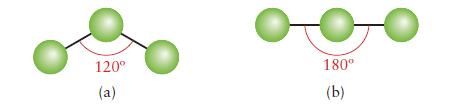
Below are ball-and-stick models of two molecules. In each case, indicate whether there must be, may be, or cannot be one or more lone pairs of electrons on the central atom. 120° (a) 180⁰ (b)
Showing 2000 - 2100
of 3011
First
14
15
16
17
18
19
20
21
22
23
24
25
26
27
28
Last
Step by Step Answers

 Get 50% OFF
Claim Now
Get 50% OFF
Claim Now