New Semester
Started
Get
50% OFF
Study Help!
--h --m --s
Claim Now
Question Answers
Textbooks
Find textbooks, questions and answers
Oops, something went wrong!
Change your search query and then try again
S
Books
FREE
Study Help
Expert Questions
Accounting
General Management
Mathematics
Finance
Organizational Behaviour
Law
Physics
Operating System
Management Leadership
Sociology
Programming
Marketing
Database
Computer Network
Economics
Textbooks Solutions
Accounting
Managerial Accounting
Management Leadership
Cost Accounting
Statistics
Business Law
Corporate Finance
Finance
Economics
Auditing
Tutors
Online Tutors
Find a Tutor
Hire a Tutor
Become a Tutor
AI Tutor
AI Study Planner
NEW
Sell Books
Search
Search
Sign In
Register
study help
sciences
chemical principles
Chemical Principles The Quest For Insight 7th Edition Peter Atkins, Loretta Jones, Leroy Laverman - Solutions
Air in a bicycle pump is compressed by pushing in the handle. The inner diameter of the pump is 3.0 cm and the pump is depressed 20. cm with a pressure of 2.00 atm.(a) How much work is done in the compression?(b) Is the work positive or negative with respect to the air in the pump?(c) What is
The reaction of 1.40 g of carbon monoxide with excess water vapor to produce carbon dioxide and hydrogen gases in a bomb calorimeter causes the temperature of the calorimeter assembly to rise from 22.113 °C to 22.799 °C. The calorimeter assembly is known to have a total heat capacity (calorimeter
If you were an engineer in a power plant you might need to study the effects of heating on the air in a turbine. For some purposes, you can use nitrogen gas to model air. A sample of nitrogen gas of volume 20.0 L at 5.00 kPa is heated from 20. °C to 400.°C at constant volume. What is the change
(a) Calculate the heat that must be supplied to a copper kettle of mass 400.0 g containing 300.0 g of water to raise its temperature from 20.0 °C to the boiling point of water, 100.0 °C.(b) What percentage of the heat is used to raise the temperature of the water?
For a certain reaction at constant pressure, ΔH = –15 kJ, and 22 kJ of expansion work is done on the system by compressing it into a smaller volume. What is ΔU for this process?
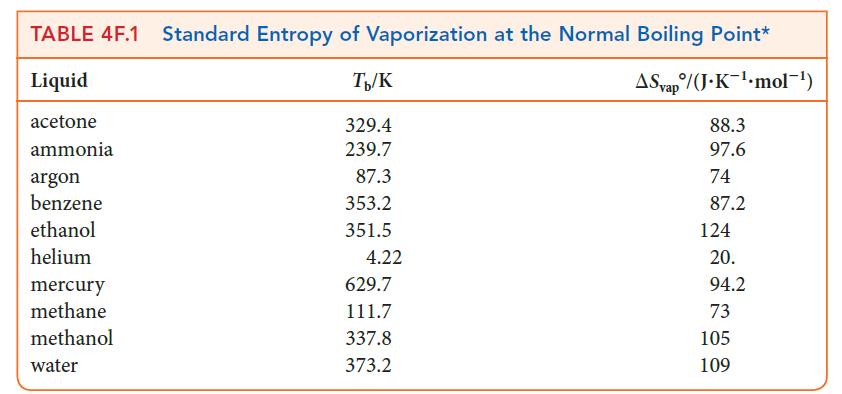
Suppose you were investigating the correlation between intermolecular forces and the way in which molecules cohere to each other in a liquid and decided that you can gain some insight by comparing the entropies of vaporization of several liquids.Calculate the entropy of vaporization of acetone at
Calculate the entropy change associated with the isothermal expansion of 5.25 mol of ideal gas atoms from 24.252 L to 34.058 L.
An ideal gas in a cylinder was placed in a heater and gained 5.50 kJ of energy as heat. If the cylinder increased in volume from 345 mL to 1846 mL against an atmospheric pressure of 750. Torr during this process, what is the change in internal energy of the gas in the cylinder?
Predict the contribution of each type of molecular motion to the heat capacity CV,m and their total for each of the following atoms and molecules:(a) HCN;(b) C2H6;(c) Ar;(d) HBr. Ignore vibrations.
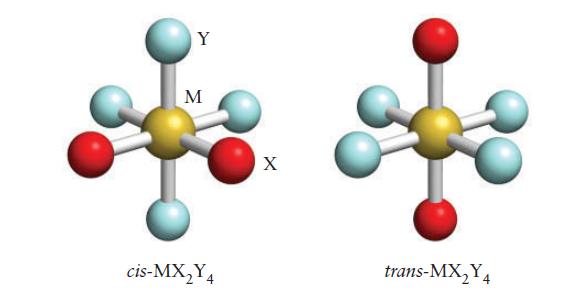
Considering positional disorder, would you expect a crystal of octahedral cis-MX2Y4 to have the same, higher, or lower residual entropy than the corresponding trans isomer? Explain your conclusion. Y M cis-MX₂Y4 X trans-MX₂Y4
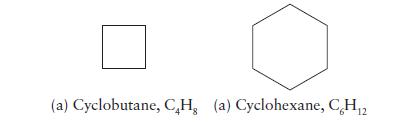
Predict which of the hydrocarbons below has the greater standard molar entropy at 25°C and 1 bar. Explain your reasoning. (a) Cyclobutane, CH, (a) Cyclohexane, C,H2 12
A piston confines 0.250 mol He (g) in 1.50 L at 25°C. Two experiments are performed.(a) The gas is allowed to expand through an additional 1.00 L against a constant pressure of 2.00 atm.(b) The gas is allowed to expand reversibly and isothermally to the same final volume. Which process does
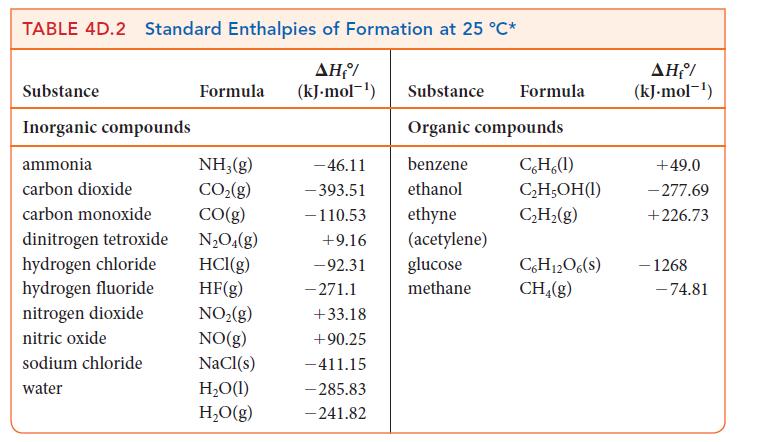
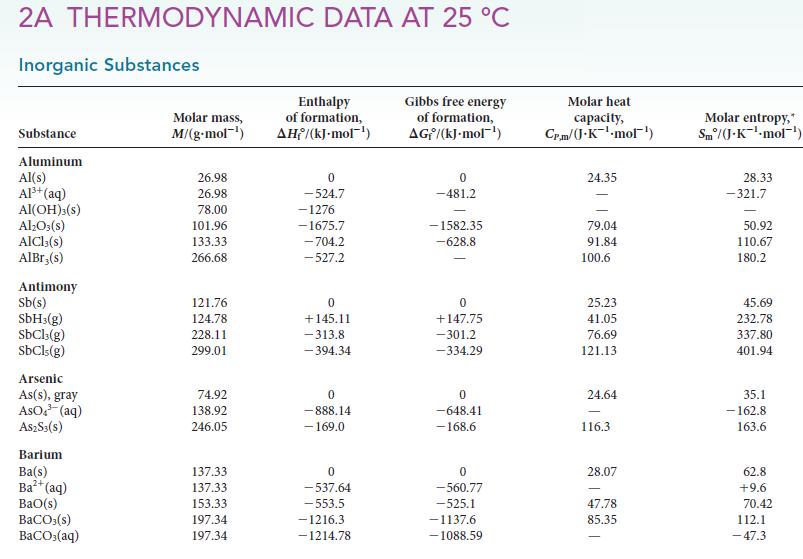
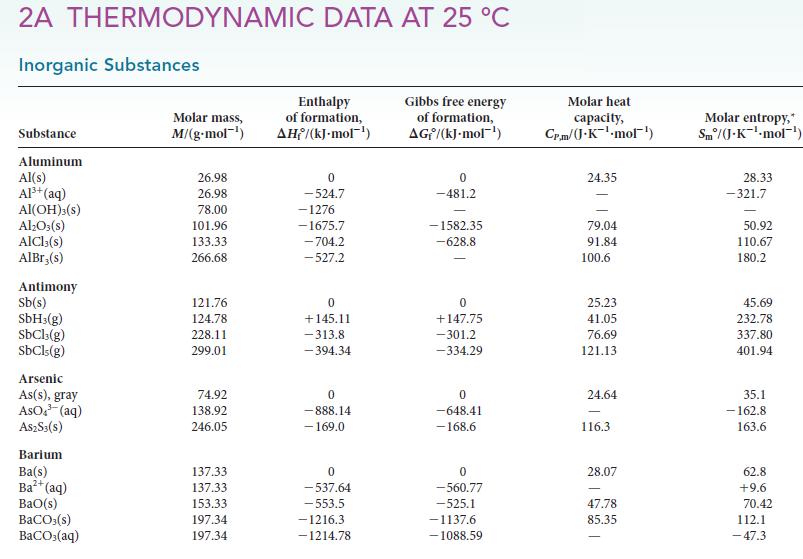
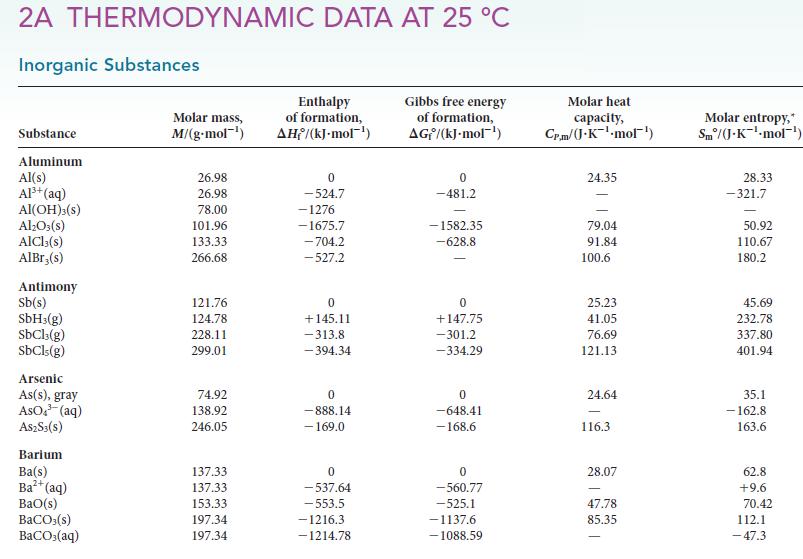
The information in Table 4D.2 must be determined from experimental data, but because some reactions cannot be carried out directly, chemists who compile these types of tables commonly use enthalpies of combustion. Use the information in Table 4D.2 and the enthalpy of combustion of propane gas to
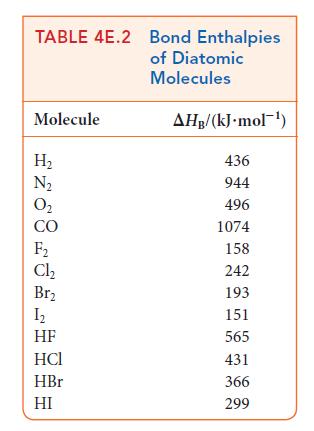
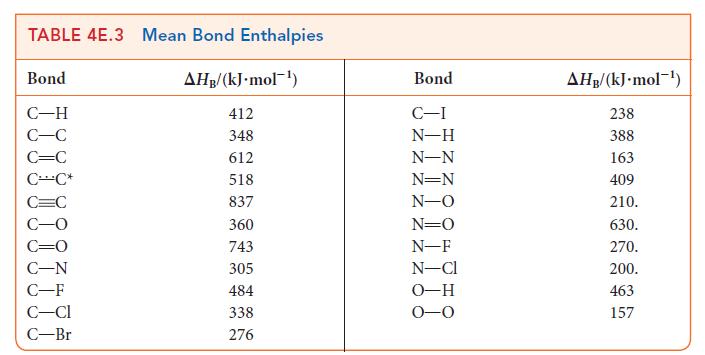
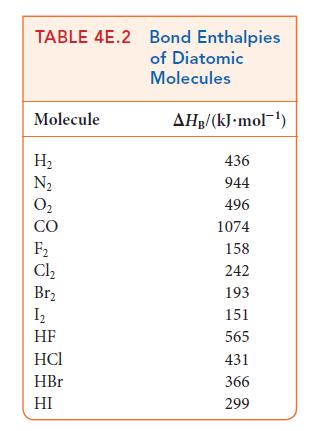
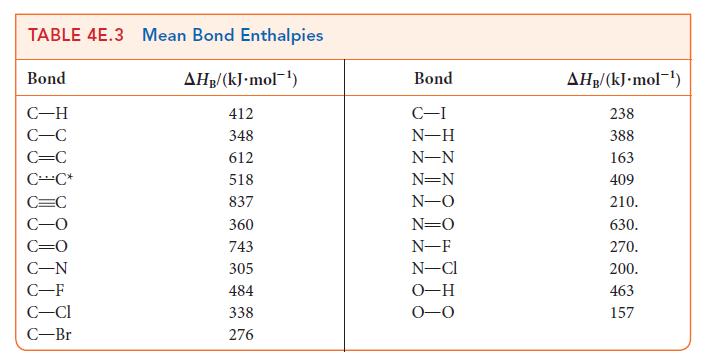
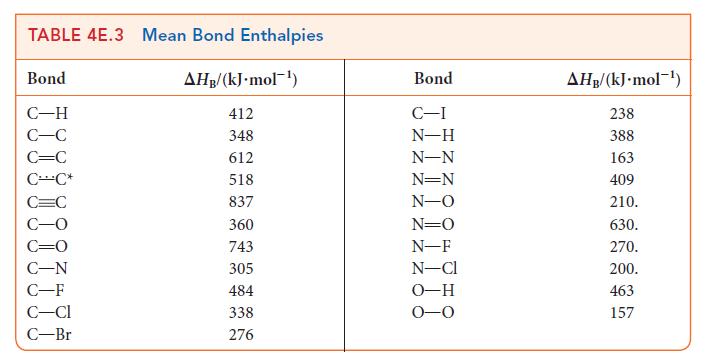
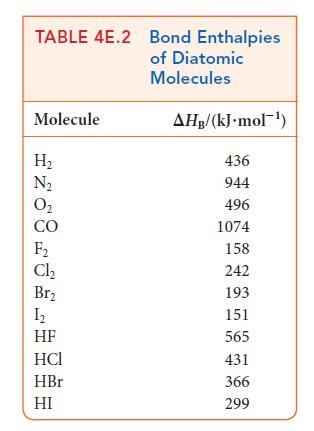
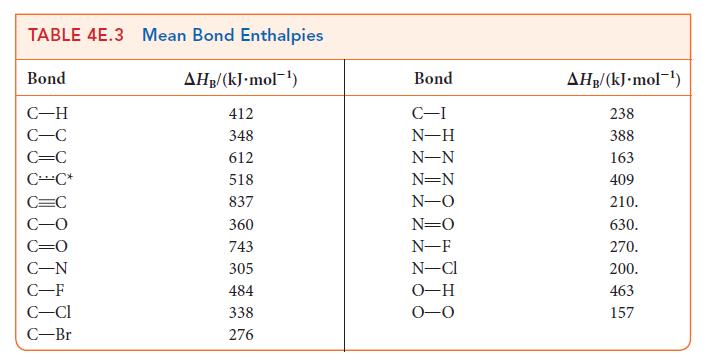
Use the data in Tables 4E.2 and 4E.3 to estimate the reaction enthalpy for (a) HCl(g) + F(g) HF(g) + CIF(g), given that AHB(Cl-F) = -256 kJ.mol- -1 (b) CH4(g) + HCl(g) CHCHCl(g) (c) CH4(g) + H(g) CHCH(g)
For a certain reaction at constant pressure, ΔU = –68 kJ, and 25 kJ of work is done on the system by compressing it into a smaller volume. What is ΔH for this process?
Calculate the entropy change associated with the isothermal compression of 0.720 mol of ideal gas atoms from 24.32 L to 3.90 L.
An electric heater rated at 100. W (1 W = 1 J · s–1) operates for 20.0 min to heat an ideal gas in a cylinder. At the same time, the gas expands from 1.00 L to 6.00 L against a constant atmospheric pressure of 0.876 atm. What is the change in internal energy of the gas?
Predict the contribution of each type of molecular motion to the heat capacity CV,m and their total for each of the following molecules:(a) NO;(b) NH3;(c) HClO;(d) SO2. Ignore vibrations.
Without performing any calculations, predict whether there is an increase or a decrease in entropy of the system for each of the following processes: (a) Cl2(g) + H2O(l) → HCl(aq) + HClO(aq);(b) Cu3(PO4)2(s) → 3 Cu2+(aq) + 2 PO4 3–; (c) SO2(g) + Br2(g) + 2 H2O(l) → H2SO4(aq) + 2 HBr(aq).
Use the data in Tables 4E.2 and 4E.3 to estimate the reaction enthalpy for (a) N₂(g) + 3 F₂(g) →2 NF3(g) (b) CH3CHCH₂(g) + H₂O(g) → CH3CH(OH)CH3(g) (c) CH4 (g) + Cl₂(g) → CH₂Cl(g) + HCl(g)
Oxygen difluoride is a colorless, very poisonous gas that reacts rapidly and exothermically with water vapor to produce O2 and HF:What is the change in internal energy for the reaction of 1.00 mol OF2? OF₂(g) + H₂O(g) - O₂(g) + 2 HF(g) AH = -318 kJ
Assuming that the heat capacity of an ideal gas is independent of temperature, calculate the entropy change associated with raising the temperature of 1.00 mol of ideal gas atoms reversibly from 37.6°C to 157.9°C at(a) Constant pressure and(b) Constant volume.
In a combustion chamber, the total internal energy change produced from the burning of a fuel is –2573 kJ. The cooling system that surrounds the chamber absorbs 947 kJ as heat. How much work can be done by the fuel in the chamber?
(a) At its boiling point, the vaporization of 0.579 mol CH4(l) requires 4.76 kJ of heat. What is the enthalpy of vaporization of methane?(b) An electric heater was immersed in a flask of boiling ethanol, C2H5OH, and 22.45 g of ethanol was vaporized when 21.2 kJ of energy was supplied. What is the
If tetrahedral SO2F2 adopts an orientationally disordered arrangement in its crystal form, what might its residual molar entropy be?
Without performing any calculations, state whether the entropy of the system increases or decreases in each of the following processes:(a) The sublimation of dry ice, CO2(s) → CO2(g);(b) The formation of sulfurous acid from sulfur dioxide in the atmosphere, SO2(g) + H2O(l) →
(a) Calculate the heat that must be supplied to a stainless steel vessel of mass 400.0 g containing 300.0 g of water to raise its temperature from 20.0°C to the boiling point of water, 100.0 °C.(b) What percentage of the heat is used to raise the temperature of the water?(c) Compare these
Container A is filled with 1.0 mol of the atoms of an ideal monatomic gas. Container B has 1.0 mol of atoms bound together as diatomic molecules that are not vibrationally active. Container C has 1.0 mol of atoms bound together as diatomic molecules that are vibrationally active. The containers all
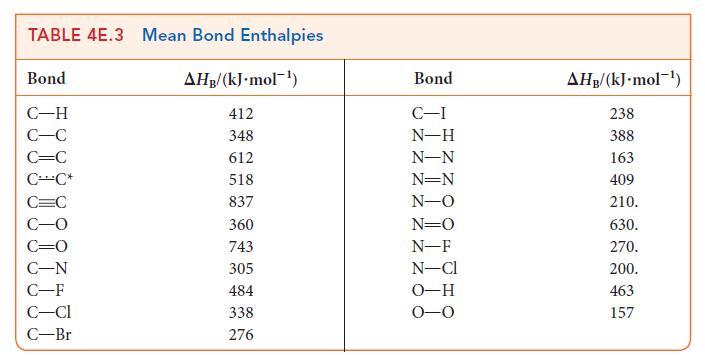
Benzene is more stable and less reactive than would be predicted from its Kekulé structures. Use the data in Table 4E.3 to calculate the lowering in molar energy when resonance is allowed between the Kekulé structures of benzene. TABLE 4E.3 Mean Bond
A piece of copper of mass 20.0 g at 100.0°C is placed in a vessel of negligible heat capacity but containing 50.7 g of water at 22.0°C. Calculate the final temperature of the water. Assume that no energy is lost to the surroundings.
The enthalpy of formation of trinitrotoluene (TNT) is –67 kJ · mol–1, and the density of TNT is 1.65 g · cm–3. In principle, it could be used as a rocket fuel, with the gases resulting from its decomposition streaming out of the rocket to give the required thrust. In practice, of course, it
Calculate the change in entropy when the pressure of 1.50 mol Ne(g) is decreased isothermally from 15.0 atm to 0.500 atm. Assume ideal behavior.
In an adiabatic process, no energy is transferred as heat. Indicate whether each of the following statements about an adiabatic process in a closed system is always true, always false, or true in certain conditions (specify the conditions):(a) ΔU = 0;(b) q = 0;(c) q , 0;(d) ΔU = q;(e) ΔU =
Investigate whether the replacement of a carbon–carbon double bond by single bonds is energetically favored by using Tables 4E.2 and 4E.3 to calculate the reaction enthalpy for the conversion of ethene, C2H4, to ethane, C2H6. The reaction is H₂C=CH₂(g) + H₂(g) →CH3-CH3(g).
Suppose that you create two tiny systems consisting of three atoms each, and each atom can accept energy in quanta of the same magnitude.(a) How many distinguishable arrangements are there of two quanta of energy distributed among the three atoms in one of these systems?(b) You now bring the two
(a) Calculate the heat that must be supplied to a copper kettle of mass 500.0 g containing 400.0 g of water to raise its temperature from 22.0°C to the boiling point of water, 100.0°C.(b) What percentage of the heat is used to raise the temperature of the water?
A closed vessel of volume 2.5 L contains a mixture of neon and fluorine. The total pressure is 3.32 atm at 0°C. When the mixture is heated to 15°C, the entropy of the mixture increases 0.345 J · K–1. What amount (in moles) of each substance (Ne and F2) is present in the mixture?
A piece of metal of mass 18.0 g at 100.0°C is placed in a calorimeter containing 50.2 g of water at 22.0°C. The final temperature of the mixture is 24.8°C. What is the specific heat capacity of the metal? Assume that no energy is lost to the surroundings.
A natural gas mixture is burned in a furnace at a power-generating station at a rate of 7.6 mol per minute.(a) If the fuel consists of 9.3 kmol CH4, 3.1 kmol C2H6, 0.40 kmol C3H8, and 0.20 kmol C4H10, what mass of CO2(g) is produced per minute?(b) How much heat is released per minute?
Calculate the change in entropy when the pressure of 70.9 g of methane gas is increased isothermally from 7.00 kPa to 350.0 kPa.Assume ideal behavior.
Indicate whether each of the following statements about a process in a closed system with a constant volume is always true, always false, or true in certain conditions (specify the conditions):(a) ΔU = 0;(b) w = 0;(c) w < 0;(d) ΔU = q;(e) ΔU = w.
Suppose that you create two tiny systems consisting of four atoms each, and each atom can accept energy in quanta of the same magnitude.(a) How many distinguishable arrangements are there of two quanta of energy distributed among the four atoms in one of these systems?(b) You now bring the two
How much heat is needed to convert 80.0 g of ice at 0.0 °C into liquid water at 20.0°C?
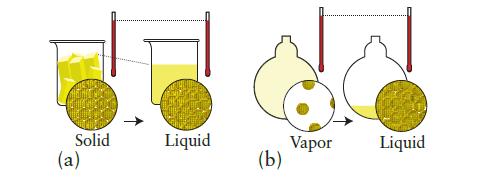
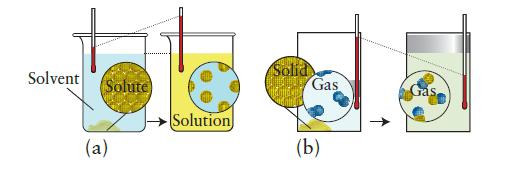
Each of the pictures below shows a molecular view of a system undergoing a change at constant temperature. In each case, indicate whether heat is absorbed or released by the system and whether expansion work is done on or by the system. Predict the signs of q and w for the process.
During the test of an internal combustion engine, 3.00 L of nitrogen gas at 18.5 °C was compressed suddenly (and irreversibly) to 0.500 L by driving in a piston. In the process, the temperature of the gas increased to 28.1°C. Assume ideal behavior. What is the change in entropy of the gas?
(a) Calculate the heat that must be supplied to a stainless steel vessel of mass 500.0 g containing 400.0 g of water to raise its temperature from 22.0°C to the boiling point of water, 100.0°C.(b) What percentage of the heat is used to raise the temperature of the water?(c) Compare these
Use data in Table 4H.1 or Appendix 2A to calculate the standard reaction entropy for each of the following reactions at 25°C. For each reaction, interpret the sign and magnitude of the reaction entropy. Table 4H.1(a) The formation of 1.00 mol H2O(l) from the elements in their most stable state at
The oxidation of nitrogen in the hot exhaust of jet engines and automobiles occurs by the reaction(a) How much heat is absorbed in the formation of 1.55 mol NO? (b) How much heat is absorbed in the oxidation of 5.45 L of nitrogen measured at 1.00 atm and 273 K?(c) When the oxidation of N2 to NO
A calorimeter was calibrated with an electric heater, which supplied 22.5 kJ of energy as heat to the calorimeter and increased the temperature of the calorimeter and its water bath from 22.45°C to 23.97°C. What is the heat capacity of the calorimeter?
The heat released in the combustion of benzoic acid, C6H5COOH, which is often used to calibrate calorimeters, is –3228 kJ · mol–1. When 1.685 g of benzoic acid was burned in a calorimeter, the temperature increased by 2.821°C. What is the heat capacity of the calorimeter?
The combustion of octane is expressed by the thermochemical equationEstimate the mass of octane that would need to be burned to produce enough heat to raise the temperature of the air in a 12 ft * 12 ft * 8.0 ft room from 40.°F to 78 °F on a mild winter’s day. (a) Use the normal composition
Use data in Table 4H.1 or Appendix 2A to calculate the standard entropy change for each of the following reactions at 25°C. For each reaction, interpret the sign and magnitude of the reaction entropy.Table 4H.1(a) The preparation of manganese metal in the thermite reaction: 4 Al(s) + 3 MnO2(s)
Calculate the change in entropy when the pressure of 5.75 g of helium gas is decreased from 320.0 kPa to 40.0 kPa while the temperature decreases from 423 K to 273 K. Assume ideal behavior.
Each of the pictures below shows a molecular view of a system undergoing a change. In each case, indicate whether heat is absorbed or given off by the system and whether expansion work is done on or by the system. Predict the signs of q and w for the process. Solvent Solute (a) Solution Solid Gas
If you start with 276 g of liquid water at 25.°C, how much heat must be supplied to convert all the liquid into vapor at 100.°C?
The temperature dependence of the heat capacity of a substance is commonly written in the form CP,m = a + bT+ c/T2, with a, b, and c constants. Obtain an expression for the entropy change when the substance is heated from T1 to T2. Evaluate this change for graphite, for which a = 16.86 J ·
A constant-volume calorimeter was calibrated by carrying out a reaction known to release 3.50 kJ of heat in 0.200 L of solution in the calorimeter (q = –3.50 kJ), resulting in a temperature rise of 7.32°C. In a subsequent experiment, 100.0 mL of 0.200 m HBr(aq) and 100.0 mL of 0.200 m KOH(aq)
The standard enthalpy of reaction of N2(g) + 3 H2(g) → 2 NH3 g) is –92.22 kJ · mol–1 at 298 K. The industrial synthesis takes place at 450. °C. What is the standard reaction enthalpy at the latter temperature?ANTICIPATE There are more reactant molecules than product molecules, so you
The bond enthalpy in NO is 632 kJ · mol–1 and that of each N—O bond in NO2 is 469 kJ · mol–1. Using Lewis structures and the data in Table 4E.3, explain(a) The difference in bond enthalpies between the two molecules;(b) The fact that the bond enthalpies of the two bonds in NO2 are the
Ethanol is a renewable and clean-burning component of gasoline:What is the change in internal energy for the reaction of 1.00 mol C2H5OH(l)? 2 CHOH(I) + 602(g) - 4 CO2(g) + 6 H,O(1) ΔΗ -1368 kJ
Assuming that the heat capacity of an ideal gas is independent of temperature, calculate the entropy change associated with lowering the temperature of 4.10 mol of ideal gas atoms from 225.71°C to 212.50°C at(a) Constant pressure and(b) Constant volume.
A laboratory animal exercised on a treadmill that was connected to a weight of mass 275 g through a pulley. The work done by the animal raised the weight through 1.01 m. At the same time, the animal lost 7.8 J of energy as heat.(a) Disregarding any other losses and treating the animal as a closed
(a) When 25.23 g of methanol, CH3OH, froze, 4.01 kJ of heat was released. What is the enthalpy of fusion of methanol?(b) A sample of benzene was vaporized at 25°C. When 37.5 kJ of heat was supplied, 95 g of the liquid benzene vaporized. What is the enthalpy of vaporization of benzene at 25°C?
What might you expect the residual molar entropy of trigonal pyramidal PH2F to be if it were to adopt an orientationally disordered arrangement in its crystal form?
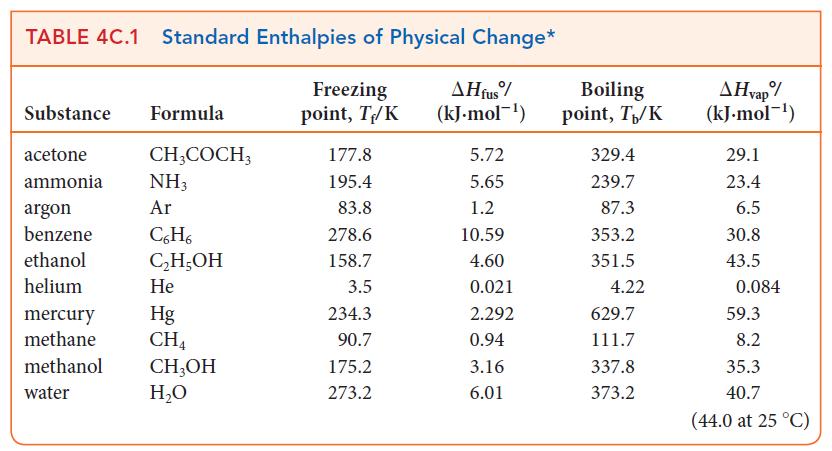
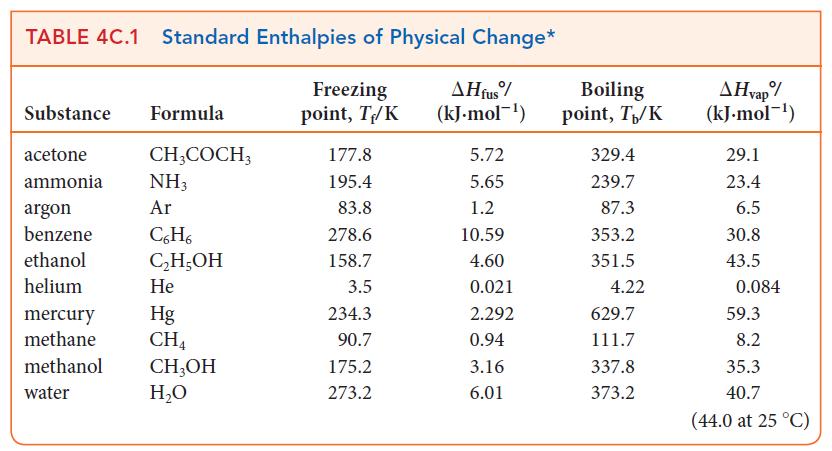
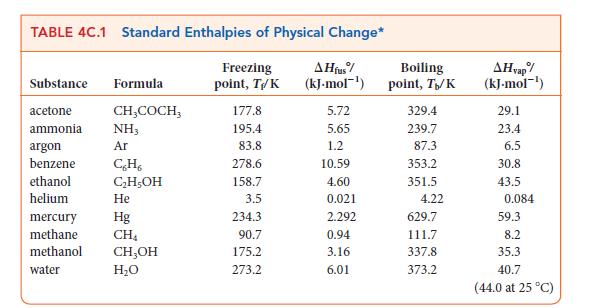
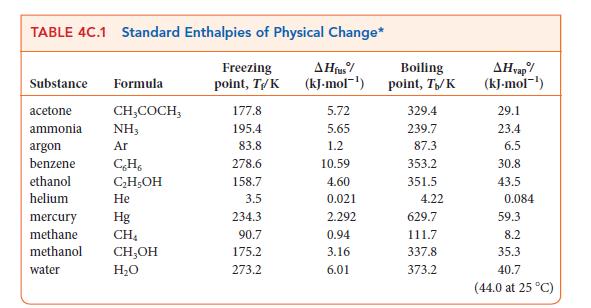
Use data in Table 4C.1 or Appendix 2A to calculate the entropy change for(a) The freezing of 1.00 mol H2O(l) at 0.00°C;(b) The vaporization of 50.0 g of ethanol, C2H5OH, at 351.5 K. TABLE 4C.1 Standard Enthalpies of Physical Change* Freezing AH fus% (kJ.mol-¹) point, T/K Substance
Calculate the work for each of the following processes beginning with a gas sample in a piston assembly with T = 305 K, P = 1.79 atm, and V = 4.29 L:(a) Irreversible expansion against a constant external pressure of 1.00 atm to a final volume of 6.52 L;(b) Isothermal, reversible expansion to a
(a) Using Trouton’s rule, estimate the boiling point of dimethyl ether, CH3OCH3, given that DHvap° = 21.51 kJ · mol–1.(b) Using standard reference sources available in your library or on the Internet, find the actual boiling point of dimethyl ether and compare this value with the value
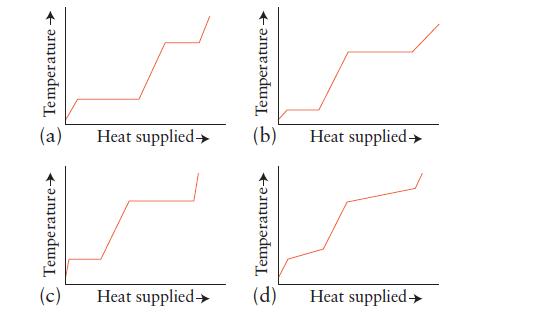
The following data were collected for a new compound used in cosmetics: DHfus = 10.0 kJ · mol–1, DHvap = 20.0 kJ · mol–1; heat capacities: 30 J · mol–1 for the solid; 60 J · mol–1 for the liquid; 30 J · mol–1 for the gas. Which heating curve below best matches the data for this
Determine the enthalpy for the partial combustion of methane to carbon monoxide, 2 CH4(g) + 3 O2(g) → 2 CO(g) + 4 H2O(l), from ΔHc°(CH4, g) = 2890. kJ · mol–1 and ΔHc°(CO, g) = 2283.0 kJ · mol–1.
(a) Using Trouton’s rule, estimate the boiling point of methylamine, CH3NH2, given that DHvap° =25.60 kJ · mol–1.(b) Using standard reference sources available in your library or on the Internet, find the actual boiling point of methylamine and compare this value with the value obtained by
When 25.0 g of a metal at 90.0°C is added to 50.0 g of water at 25.0°C, the temperature of the water rises to 29.8°C.What is the specific heat capacity of the metal?
Determine the reaction enthalpy for the hydrogenation of ethyne to ethane, C2H2(g) + 2 H2(g) → C2H6(g), from the following data: ΔHc°(C2H2, g) = –1300. kJ · mol–1, ΔHc°(C2H6, g) = –1560. kJ · mol–1, ΔHc°(H2, g) = –286 kJ · mol–1.
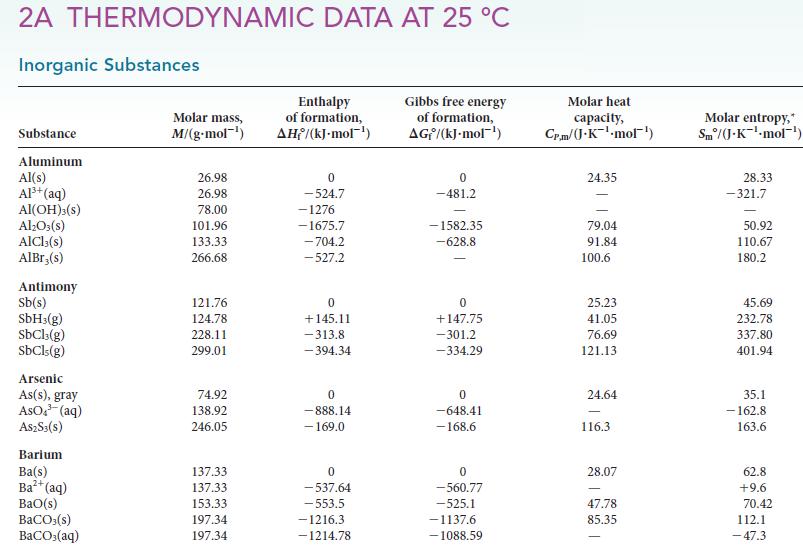
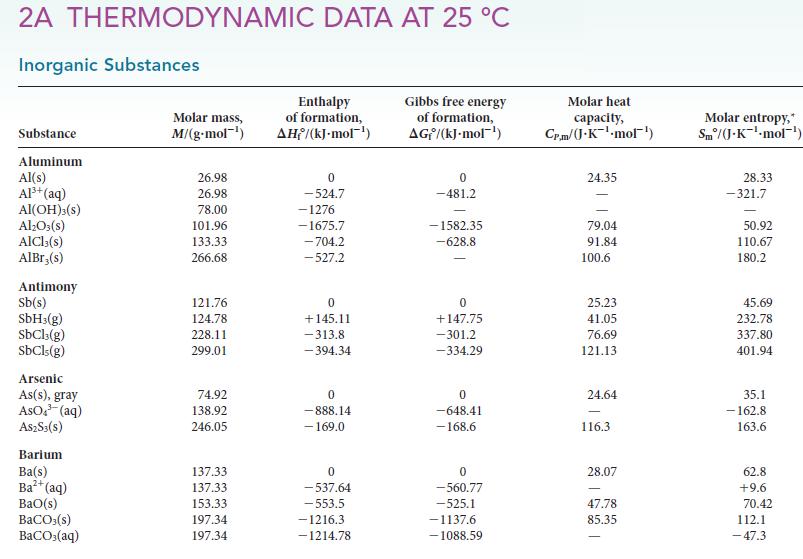
Barium metal is produced by the reaction of aluminum metal with barium oxide. From the standard reaction enthalpies,calculate the reaction enthalpy for the production of metallic barium in the reaction 2 Ba(s) + O₂(g) 2 Al(s) +O₂(g) 2 BaO(s) Al₂O3(s) AH° -1107 kJ AH° -1676 kJ = = =
An ice cube of mass 50.0 g at 0.0 °C is added to a glass containing 400.0 g of water at 45.0°C. What is the final temperature of the system? Assume that no heat is lost to the surroundings.
At low temperatures, heat capacities of nonmetallic solids are proportional to T3. Show that, near T = 0, the entropy of a substance is equal to one-third of its heat capacity at the same temperature.
A constant-volume calorimeter was calibrated by carrying out a reaction known to release 0.90 kJ of heat in 0.60 L of solution in the calorimeter (q = –0.90 kJ), resulting in a temperature rise of 2.85°C. In a subsequent experiment, 30.0 mL of 0.20 m HClO2(aq) and 30.0 mL of 0.20 m NaOH(aq) were
In the manufacture of nitric acid by the oxidation of ammonia, the first product is nitric oxide, which is then oxidized to nitrogen dioxide. From the standard reaction enthalpies,calculate the standard reaction enthalpy for the oxidation of nitric oxide to nitrogen dioxide: N₂(g) +
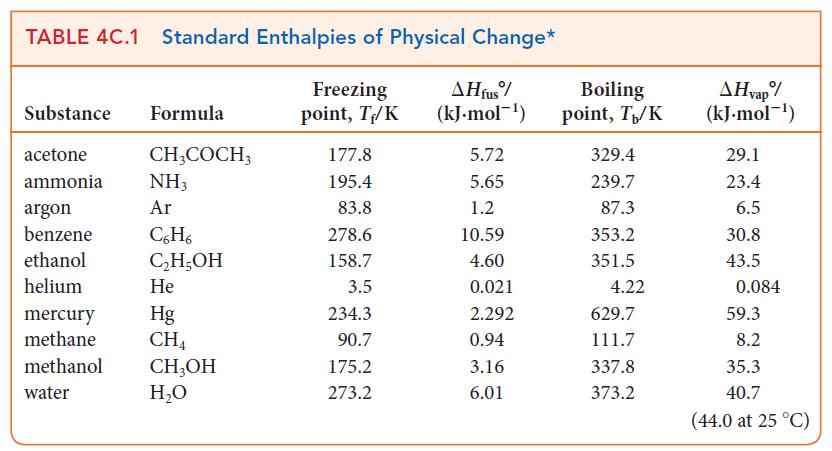
Use data in Table 4C.1 to calculate the entropy change for(a) The vaporization of 2.40 mol H2O(l) at 100. °C and 1 atm;(b) The freezing of 4.50 g of ethanol, C2H5OH, at 158.7 K. TABLE 4C.1 Standard Enthalpies of Physical Change* Freezing point, T/K Substance
A sample of gas in a cylinder of volume 3.42 L at 298 K and 2.57 atm expands to 7.39 L by two different pathways. Path A is an isothermal, reversible expansion. Path B has two steps. In the first step, the gas is cooled at constant volume to 1.19 atm. In the second step, the gas is heated and
Estimate the contribution of motion to the molar internal energy of CH4(g) at 25°C. Ignore vibrations.
Estimate the contribution of motion to the molar internal energy of N2(g) at 25 °C. Ignore vibrations.
Use the following information to construct a heating curve for bromine from 27.2°C to 70.0°C. The molar heat capacity of liquid bromine is 75.69 J · K–1 · mol–1 and that of bromine vapor is 36.02 J · K–1 · mol–1. The enthalpy of vaporization of liquid bromine is 30.91 kJ · mol–1.
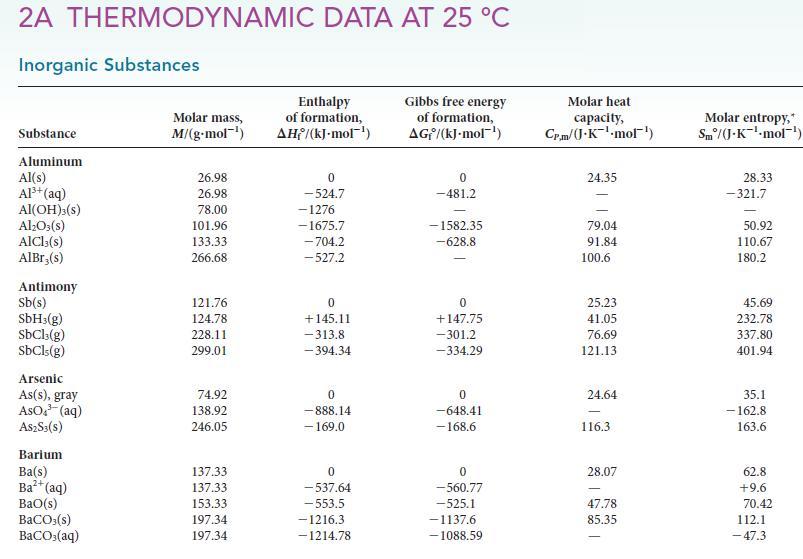
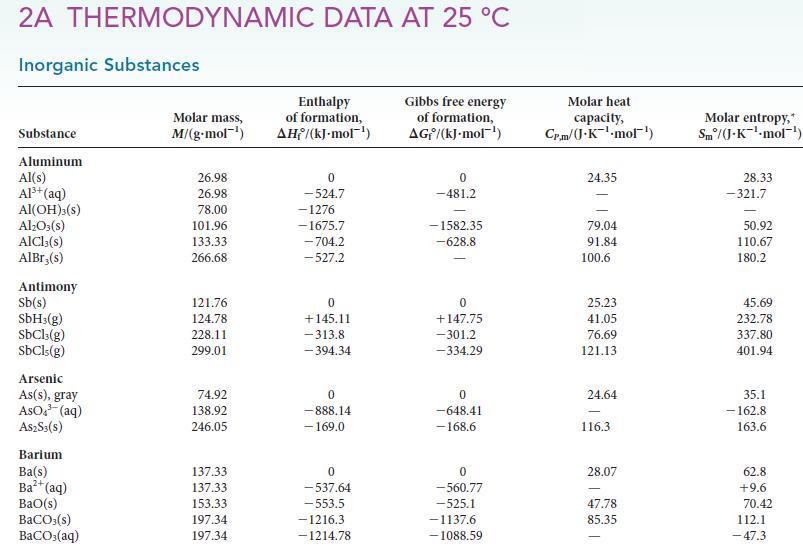
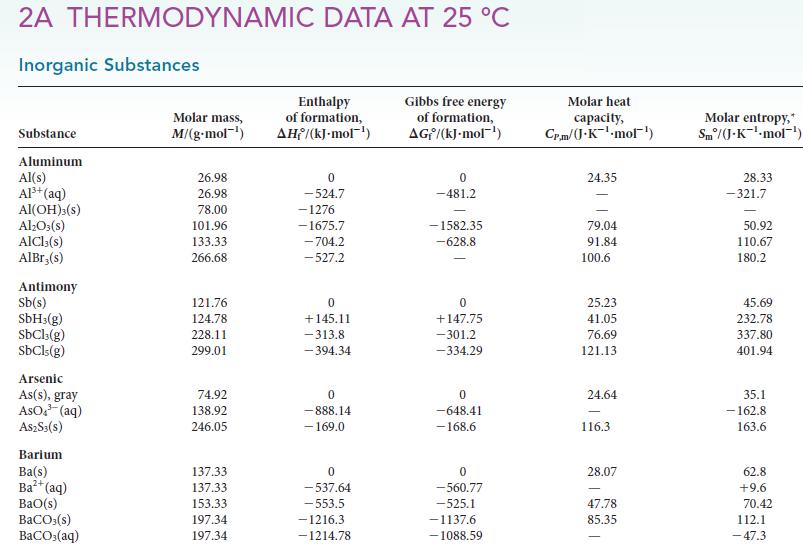
Use the data in Appendix 2A to calculate the standard reaction enthalpy for the reaction of pure nitric acid with hydrazine: 4 HNO3(1) + 5 N₂H4 (1) 7 N₂(g) + 12 H₂O(1)
Calculate the standard entropy of vaporization of water at 85°C, given that its standard entropy of vaporization at 100.°C is 109.0 J · K–1· mol–1 and the molar heat capacities at constant pressure of liquid water and water vapor are 75.3 J · K–1 · mol–1 and 33.6 J · K–1 ·
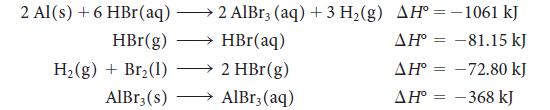
Calculate the reaction enthalpy for the formation of anhydrous aluminum bromide, 2 Al(s) + 3 Br2(l) → 2 AlBr3(s), from the following data: 2 Al(s) + 6 HBr(aq) - HBr(g) H₂(g) + Br₂ (1) AlBr3 (s) 2 AlBr3 (aq) + 3 H₂(g) AH-1061 kJ HBr(aq) AH° -81.15 kJ 2 HBr(g) AH° -72.80 kJ AlBr3(aq) AH-368
Use standard enthalpies of formation from Appendix 2A to calculate the standard reaction enthalpy for each of the following reactions:(a) The final stage in the production of nitric acid:(b) The industrial synthesis of boron trifluoride:(c) The formation of a sulfide by the action of hydrogen
Use standard enthalpies of formation from Appendix 2A to calculate the standard reaction enthalpy for each of the following reactions:(a) The removal of hydrogen sulfide from natural gas:(b) The oxidation of ammonia:(c) The formation of phosphorous acid: 2 HS(g) + SO (g) - 3 S(s) + 2 HO (1)
Calculate the standard enthalpy of formation of dinitrogen pentoxide from the following data:and from the standard enthalpy of formation of nitric oxide, NO. 2 NO(g) + O2(g) + O2(g) 4 NO2(g) 2 NO2(g) 2 NO;(g) ΔΗ° = -114.1 kJ ΔΗ° = -110.2 kJ
An important reaction that takes place in the atmosphere is NO2(g) → NO(g) + O(g), which is brought about by sunlight. How much energy must be supplied by the Sun to cause it? Calculate the standard enthalpy of the reaction from the following information:and from additional information in
The enthalpy of combustion of 1.00 mol CH4(g) to carbon dioxide and water vapor is –802 kJ at 298 K. Calculate the enthalpy of this combustion at the temperature of a Bunsen burner flame at 1200. K.
Use the data in Appendix 2A to calculate the standard reaction enthalpy for the reaction of magnesium carbonate with hydrochloric acid: MgCO3 (s) + 2 HCI (aq) MgCl₂ (aq) + H₂O(1) + CO₂(g)
Calculate the standard entropy of vaporization of ammonia at 210.0 K, given that the molar heat capacities at constant pressure of liquid ammonia and ammonia vapor are 80.8 J · K–1 · mol–1 and 35.1 J · K–1 · mol–1, respectively, in this range (see Table 4C.1). TABLE 4C.1 Standard
Calculate the reaction enthalpy for the synthesis of hydrogen bromide gas, H2(g) + Br2(l) → 2 HBr(g), from the following data: NH3(g) + HBr (g) N₂(g) + 3 H₂(g) N₂(g) + 4 H₂(g) + Br₂ (1) NH,Br(s) 2NH,(g) → 2 NH₂Br(s) AH-188.32 kJ -92.22 kJ AH-541.66 kJ AH° =
The amino acid glutamine (Gln) is produced in the body in an enzyme-catalyzed reaction of the amino acid glutamate (Glu) with the ammonium ion:Calculate the enthalpy of this reaction at 80.0°C by using data in Appendix 2A and this information: CP,m(Gln, aq) = 187.0 J · K–1 · mol–1, CP,m(Glu,
(a) From the data in Appendix 2A, calculate the enthalpy of vaporization of benzene (C6H6) at 298.2 K. The standard enthalpy of formation of gaseous benzene is 182.93 kJ · mol–1. (b) Given that, for liquid benzene, CP,m = 136.1 J · K–1 · mol–1 and that, for gaseous benzene, CP,m = 81.67
Use the molar constant-volume heat capacities for gases (as multiples of R) to estimate the change in reaction enthalpy of N2(g) + 3 H2(g) → 2 NH3(g) when the temperature is increased from 300. K to 500. K. Ignore the vibrational contributions to heat capacity. Is the reaction more or less
(a) From the data in Appendix 2A, calculate the enthalpy required to vaporize 1 mol CH3OH(l) at 298.2 K.(b) Given that the molar heat capacity, CP,m, of liquid methanol is 81.6 J · K–1 · mol–1 and that of gaseous methanol is 43.89 J · K–1 · mol–1, calculate the enthalpy of
Derive Kirchhoff’s law for a reaction of the form A + 2 B → 3 C + D by considering the change in molar enthalpy of each substance when the temperature is changed from T1 to T2.
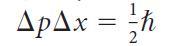
To what extent does the Heisenberg uncertainty principle affect your ability to specify the properties of objects you can see? Can you be confident about their location? Estimate the minimum uncertainty in(a) The position of a marble of mass 1.0 g given that its speed is known to within 61.0
In each second, a certain lamp produces 2.4 * 1021 photons with a wavelength of 633 nm. How much power (in watts) is produced as radiation at this wavelength (1W = 1 J · s–1)?
Showing 2300 - 2400
of 3011
First
17
18
19
20
21
22
23
24
25
26
27
28
29
30
31
Step by Step Answers

 Get 50% OFF
Claim Now
Get 50% OFF
Claim Now