New Semester
Started
Get
50% OFF
Study Help!
--h --m --s
Claim Now
Question Answers
Textbooks
Find textbooks, questions and answers
Oops, something went wrong!
Change your search query and then try again
S
Books
FREE
Study Help
Expert Questions
Accounting
General Management
Mathematics
Finance
Organizational Behaviour
Law
Physics
Operating System
Management Leadership
Sociology
Programming
Marketing
Database
Computer Network
Economics
Textbooks Solutions
Accounting
Managerial Accounting
Management Leadership
Cost Accounting
Statistics
Business Law
Corporate Finance
Finance
Economics
Auditing
Tutors
Online Tutors
Find a Tutor
Hire a Tutor
Become a Tutor
AI Tutor
AI Study Planner
NEW
Sell Books
Search
Search
Sign In
Register
study help
sciences
chemical principles
Chemical Principles 8th Edition Steven S. Zumdahl, Donald J. DeCoste - Solutions
The complex ion PdCl42- is diamagnetic. Propose a structure for PdCl4 2-.
Give formulas for the following.a. Hexakis(pyridine)cobalt(III) chlorideb. Pentaammineiodochromium(III) iodidec. Tris(ethylenediamine)nickel(II) bromided. Potassium tetracyanonickelate(II)e. Tetraamminedichloroplatinum(IV) tetrachloroplatinate(II)
Nickel can be purified by producing the volatile compound nickel tetracarbonyl [Ni(CO)4]. Nickel is the only metal that reacts directly with CO at room temperature. What is the oxidation state of nickel in Ni(CO)4?
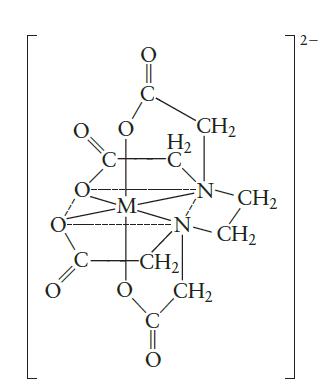
Ethylenediaminetetraacetate (EDTA4-) is used as a complexing agent in chemical analysis with the structure shown in Fig. 19.8. Solutions of EDTA4- are used to treat heavy metal poisoning by removing the heavy metal in the form of a soluble complex ion. The complex ion virtually prevents the heavy
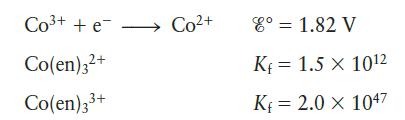
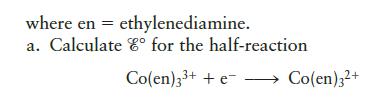
Consider the following data:b. Based on your answer to part a, which is the stronger oxidizing agent, Co3+ or Co(en)33+?c. Use the crystal field model to rationalize the result in part b. Co³+ + e- Co(en)3²+ Co(en)3³+ Co²+ 8° = 1.82 V Kf = 1.5 X 10¹2 K 2.0 X 1047
In 1994 it was proposed (and eventually accepted) that element 106 be named seaborgium (Sg) in honor of Glenn T. Seaborg, discoverer of the transuranium elements.a. 263Sg was produced by the bombardment of 249Cf with a beam of 18O nuclei. Complete and balance an equation for this reaction.b. 263Sg
Fresh rainwater or surface water contains enough tritium (31H) to show 5.5 decay events per minute per 100. g water. Tritium has a half-life of 12.3 years. You are asked to check a vintage wine that is claimed to have been produced in 1946. How many decay events per minute should you expect to
The sun radiates 3.9 × 10⁻³ J of energy into space every second. What is the rate at which mass is lost from the sun?
Breeder reactors are used to convert the nonfissionable nuclide 92235U to a fissionable product. Neutron capture of the 92235U is followed by two successive beta decays. What is the final fissionable product?
How could a radioactive nuclide be used to demonstrate that chemical equilibrium is a dynamic process?
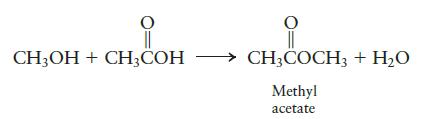
Consider the following reaction to produce methyl acetate:When this reaction is carried out with CH3OH containing radioactive oxygen-18, the water produced is not radioactive. Explain. CH3OH + CH3COH CH3COCH3 + H₂O Methyl acetate
Iodine-131 has a half-life of 8.0 days. How many days will it take for 174 g of 131I to decay to 83 g of 131I?
Rubidium-87 decays by β-particle production to strontium-87 with a half-life of 4.7 × 10¹⁰ years. What is the age of a rock sample that contains 109.7 mg of 87Rb and 3.1 mg of 87Sr? Assume that no 87Sr was present when the rock was formed. The atomic masses for 87Rb and 87Sr are
Given the following information:Mass of proton = 1.00728 uMass of neutron = 1.00866 uMass of electron = 5.486 × 10⁻⁴ uSpeed of light = 2.9979 × 10⁸ m/sCalculate the nuclear binding energy of 2412Mg, which has an atomic mass of 23.9850 u.
Why are cyclopropane and cyclobutane so reactive?
Draw all the structural isomers for C8H18 that have the following root name (longest carbon chain). Name the structural isomers.a. Heptaneb. Hexane c. Pentaned. Butane
Normal (unbranched) hydrocarbons are often referred to as straight-chain hydrocarbons. To what does this name refer? Does this mean that all carbon atoms in a straight-chain hydrocarbon actually have a linear arrangement? Explain your answer.
Name each of the following cyclic alkanes and indicate the formula of the compound.
Name each of the following alkenes or alkynes.
Give the structure for each of the following aromatic hydrocarbons.a. o-ethyltolueneb. p-di-tert-butylbenzenec. m-diethylbenzened. 1-phenyl-2-butene
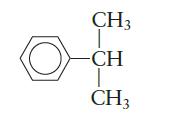
Cumene is the starting material for the industrial production of acetone and phenol. The structure of cumene isGive the systematic name for cumene. CH3 -CH CH3
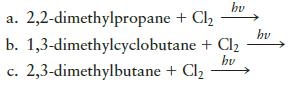
In the presence of light, chlorine can substitute for one (or more) of the hydrogens in an alkane. For the following reactions, draw the possible monochlorination products. hv a. 2,2-dimethylpropane + Cl₂ b. 1,3-dimethylcyclobutane + Cl₂ hv 2,3-dimethylbutane + Cl₂ C. hv
Alkenes and cycloalkanes are structural isomers of each other. Give an example of each using C4H8. Another common feature of alkenes and cycloalkanes is that both have restricted rotation about one or more bonds in the compound, so both can exhibit cis–trans isomerism. What is required for an
Reagents such as HCl, HBr, and HOH (H2O) can add across carbon–carbon double and triple bonds, with H forming a bond to one of the carbon atoms in the multiple bond and Cl, Br, or OH forming a bond to the other carbon atom in the multiple bonds. In some cases, two products are possible. For the
Using appropriate reactants, alcohols can be oxidized into aldehydes, ketones, and/or carboxylic acids. Primary alcohols can be oxidized into aldehydes, which can then be oxidized into carboxylic acids. Secondary alcohols can be oxidized into ketones. Tertiary alcohols do not undergo this type of
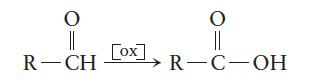
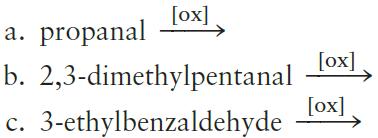
Oxidation of aldehyde yields a carboxylic acid:Draw the structures for the products of the following oxidation reactions. O 37 R-CH [ox] O R-C-OH
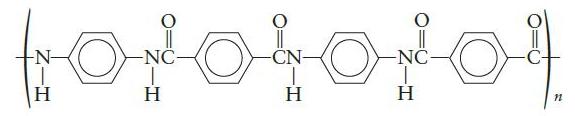
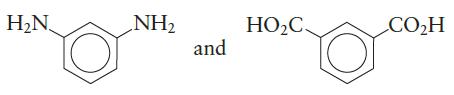
Polyaramid is a term applied to polyamides containing aromatic groups. These polymers were originally made for use as tire cords but have since found many other uses.a. Kevlar is used in bulletproof vests and many high strength composites. The structure of Kevlar isWhich monomers are used to make
The polyester formed from lactic acid, is used for tissue implants and surgical sutures that will dissolve in the body. Draw the structure of a portion of this polymer.
“Super glue” contains methyl cyanoacrylate which readily polymerizes on exposure to traces of water or alcohols on the surfaces to be bonded together. The polymer provides a strong bond between the two surfaces. Draw the structure of the polymer formed by methyl cyanoacrylate.
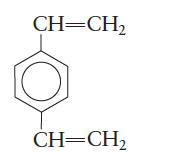
Polystyrene can be made more rigid by copolymerizing styrene with divinylbenzene, What purpose does the divinylbenzene serve? Why is the copolymer more rigid? CH=CH₂ CH=CH₂
Aqueous solutions of amino acids are buffered solutions. Why?
All amino acids have at least two functional groups with acidic or basic properties. In alanine the carboxylic acid group has Ka = 4.5 × 10⁻³ and the amino group has Kb = 7.4 × 10⁻⁵. Three ions of alanine are possible when alanine is dissolved in water. Which of these ions would predominate in a
What is a disaccharide? What monosaccharide units make up the disaccharide sucrose? What is the bond called those forms between the monosaccharide units?
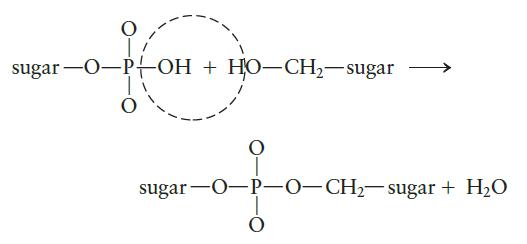
The reaction to form a phosphate–ester linkage between two nucleotides can be approximated as follows: Would you predict the formation of a dinucleotide from two nucleotides to be a spontaneous process?Would you predict the formation of a dinucleotide from two nucleotides to be a spontaneous
The compounds adenine, guanine, cytosine, and thymine are called the nucleic acid bases. What structural features in these compounds make them bases?
Draw the following.a. Cis-2-hexeneb. Trans-2-butenec. Cis-2,3-dichloro-2-pentene
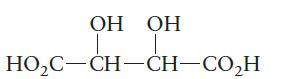
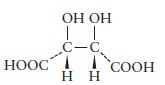
The structure of tartaric acid isa. Is the form of tartaric acid pictured below optically active? Explain.b. Draw the optically active forms of tartaric acid. ОН ОН HO,C–CH–CH—CO,H
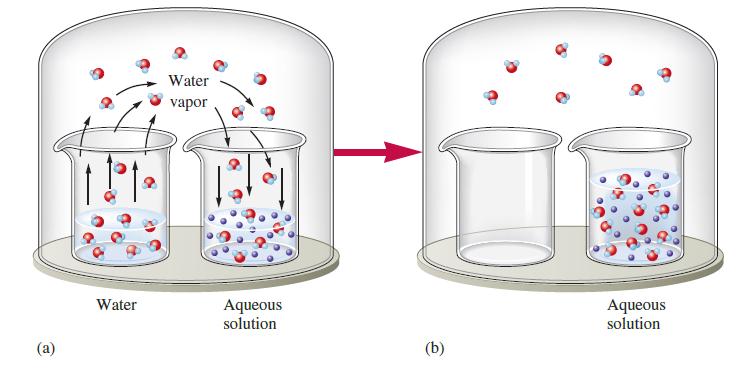
Consider Fig. 17.8. Suppose that instead of having a nonvolatile solute in the solvent in one beaker, the two beakers have different volatile liquids. That is, suppose one beaker contains liquid A (Pvap 5 50 torr) and the other beaker contains liquid B (Pvap 5 100 torr). Explain what happens as
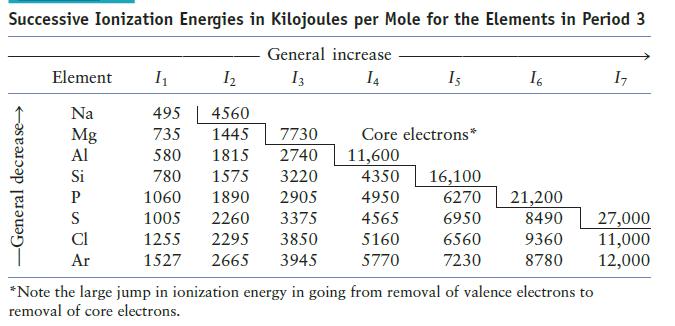
Without referring to your text, predict the trend of second ionization energies for the elements sodium through argon. Compare your answer with the data in Table 12.6. Explain any differences.Table 12.6 Successive Ionization Energies in Kilojoules per Mole for the Elements in Period 3 General
Choose the best response for the following. The ionization energy for the chlorine atom is equal in magnitude to the electron affinity for :a. The Cl atomb. The Cl- ionc. The Cl+ iond. The F atome. None of these
What is the difference between Zeff and Z? When are they the same? Explain.
Which is larger, the hydrogen 1s orbital or the lithium 1s orbital? Why? Which has the larger radius, the hydrogen atom or the lithium atom? Why?
Which is higher in energy: the 2s or 2p orbital in hydrogen? Is this also true for helium? Explain.
What is the maximum wavelength of light capable of removing an electron from a hydrogen atom in the energy states characterized by n = 1 and n = 3?
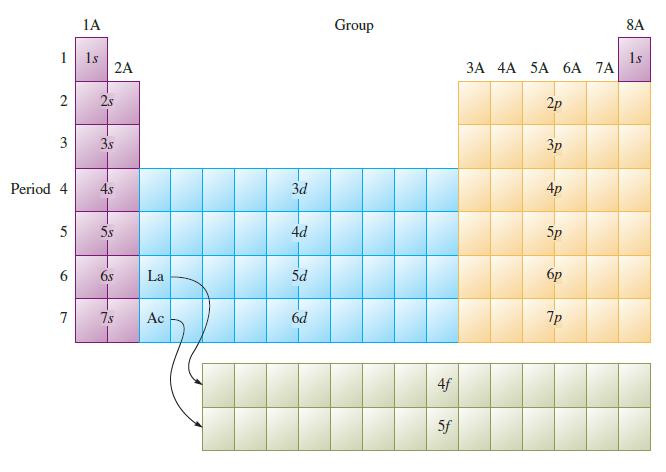
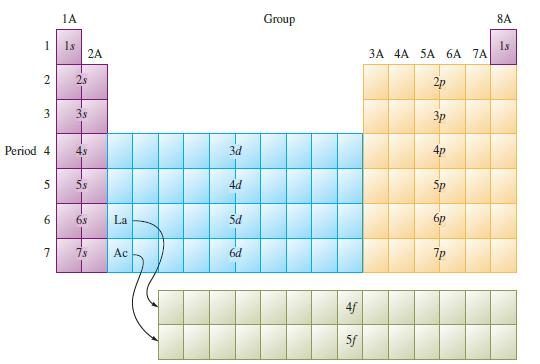
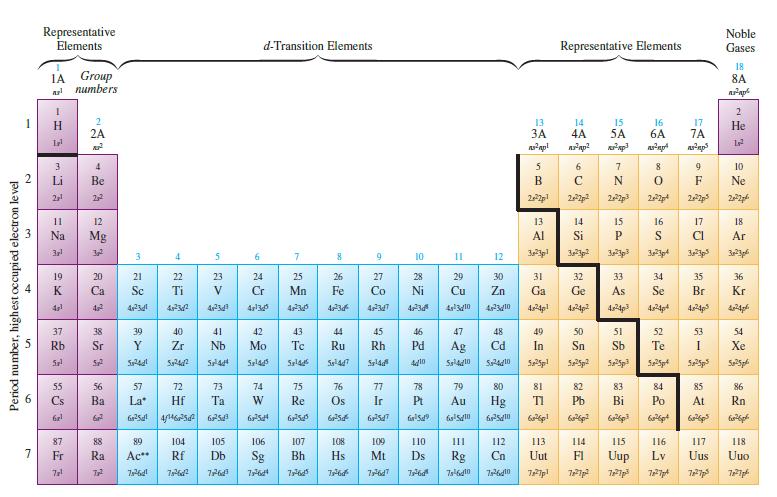
Using Fig. 12.29, list elements (ignore the lanthanides and actinides) that have ground-state electron configurations that differ from those we would expect from their positions in the periodic table. Fig. 12.29 1 Is 3 5 1A 6 Period 4 4s 7 2s 3s 2A Ss 6s La 7s Ac 3d Ad 5d 6d Group 4f 5f 3A 4A
Discuss why a function of the type A cos (Lx) is not an appropriate solution for the particle in a one-dimensional box.
Which has the more negative electron affinity, the oxygen atom or the O2 ion? Explain your answer.
The electron affinity for sulfur is more exothermic than that for oxygen. How do your account for this?
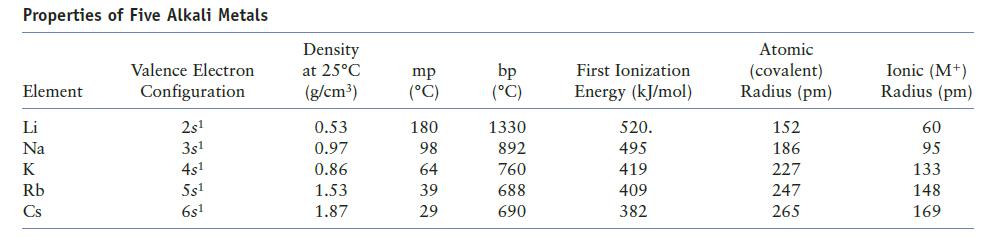
Does the information on alkali metals in Table 12.9 of the text confirm the general periodic trends in ionization energy and atomic radius? Explain.Table 12.9 Properties of Five Alkali Metals Element Li Na K Rb Cs Valence Electron Configuration 2s¹ 3s¹ 4s¹ 5s¹ 6s1 Density at
Spectroscopists use emission spectra to confirm the presence of an element in materials of unknown composition. How is this possible?
On which quantum number(s) does the energy of an electron depend in each of the following?a. A one-electron atom or ionb. An atom or ion with more than one electron
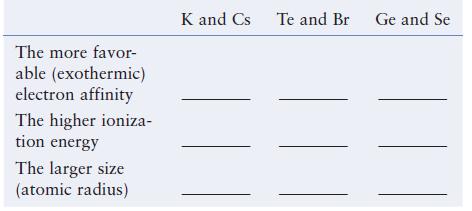
For each of the following pairs of elements, choose the one that correctly completes the following table. The more favor- able (exothermic) electron affinity The higher ioniza- tion energy The larger size (atomic radius) K and Cs Te and Br Ge and Se
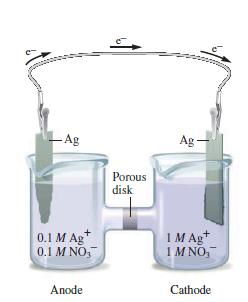
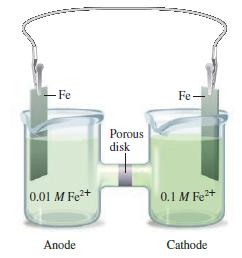
Sketch a galvanic cell, and explain how it works. Look at Figs. 11.1 and 11.2. Explain what is occurring in each container and why the cell in Fig. 11.2 “works” but the one in Fig. 11.1 does not. Fig. 11.1 Fig. 11.2 -Ag + 0.1 M Ag 0.1 M NO, Anode Porous disk Ag - 1 M Ag+ IMNO, Cathode
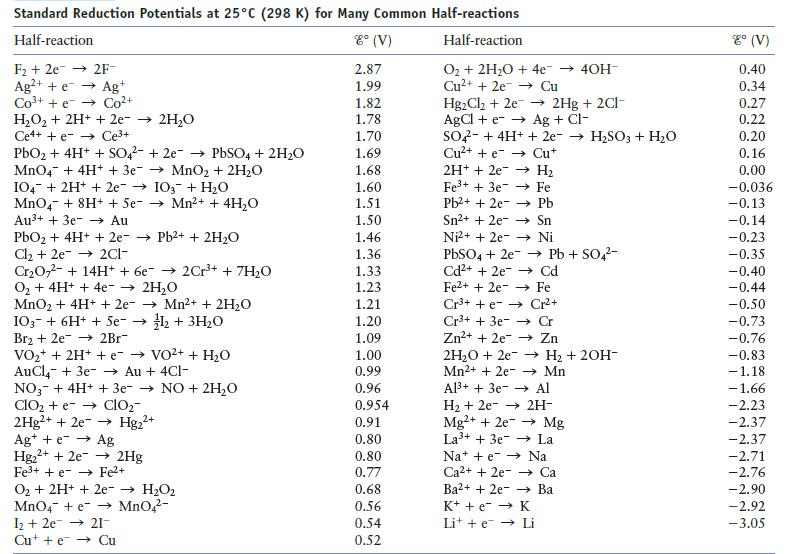
Which of the following is the best reducing agent: F2, H+, Na, Na+, or F2? Explain. Order as many of these species as possible from the best to the worst oxidizing agent. Why can’t you order all of them? From Table 11.1 choose the species that is the best oxidizing agent. Choose the best reducing
Using Fig. 12.29, list elements (ignore the lanthanide and actinides) that have ground-state electron configurations that differ from those we would expect from their positions in the periodic table.Fig. 12.29 1 2 3 Period 4 5 6 7 1A 1s -3-3- 2A 2s 38 4s 58 68 La 7s Ac 3d 4d 5d 6d Group 4f 5f 3A 4A
Using the element phosphorus as an example, write equations for the processes in which the energy change will correspond to the ionization energy and to the electron affinity.
List the bonds P—Cl, P—F, O—F, and Si—F from least polar to most polar.
Use the following data to estimate DHf8 for barium bromide.Lattice energy....................................................................................-1985 kJ/molFirst ionization energy of Ba ............................................................503 kJ/molSecond ionization energy of Ba
Predict the molecular structure, bond angles, and polarity (has a net dipole moment or has no net dipole moment) for each of the following compounds.a. SeCl4 b. SO2c. KrF4 d. CBr4e. IF3f. ClF5
Explain the difference between the σ and π MOs for homonuclear diatomic molecules. How are bonding orbitals and antibonding orbitals different? Why are there two π MOs and one's MO? Why is the p MOs degenerate?
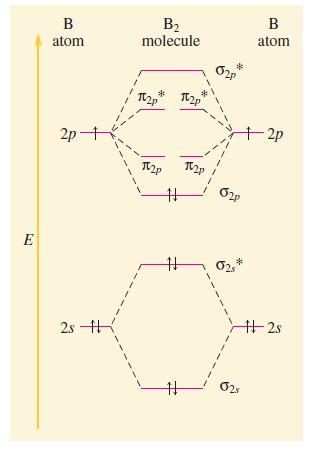
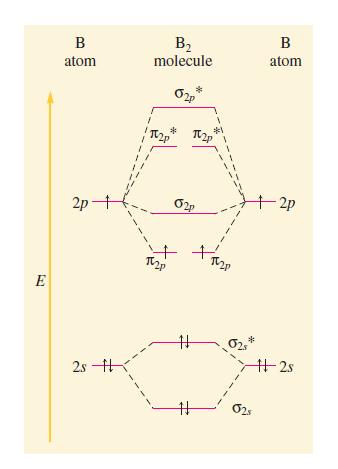
Compare Figs. 14.38 and 14.40. Why are they different? Because B2 is known to be paramagnetic, the p2p and s2p MOs must be switched from our first prediction. What is the rationale for this? Why might one expect the s2p to be lower in energy than the p2p? Why can’t we use diatomic oxygen to help
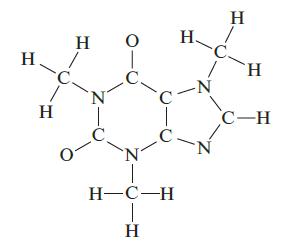
Complete a Lewis structure for the compound shown below, then answer the following questions. How many carbon atoms are sp2 hybridized? How many CON bonds are formed by the overlap of an sp3 hybridized carbon with an sp3 hybridized nitrogen? How many lone pairs of electrons are in the Lewis
In which of the following diatomic molecules would the bond strength be expected to weaken as an electron is removed?a. H2 b. B2 c. C22-d. OF
Place the species B2+, B2, and B2- in order of increasing bond length and increasing bond energy.
Given that the ionization energy of F2- is 290. kJ/mol, do the following.a. Calculate the bond energy of F2-. You will need to look up the bond energy of F2 and ionization energy of F2.b. Explain the difference in bond energy between F2- and F2 using MO theory.
Carbon monoxide (CO) forms bonds to a variety of metals and metal ions. Its ability to bond to iron in hemoglobin is the reason that CO is so toxic. The bond carbon monoxide forms to metals is through the carbon atom:
How does temperature affect k, the rate constant? Explain.
For the reaction A + B → C, explain at least two ways in which the rate law could be zero order in chemical A.
For the reaction 2N₂O5(g) 4NO2(g) + O₂(g)
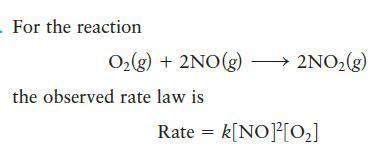
Which of the changes listed below would affect the value of the rate constant k?a. Increasing the partial pressure of oxygen gas.b. Changing the temperature.c. Using an appropriate catalyst. - For the reaction O₂(g) + 2NO(g) →→→→ 2NO₂(g) the observed rate law is Rate = k[NO]²[0₂]
The thiosulfate ion (S2O3 2-) is oxidized by iodine as follows: In a certain experiment, 7.05 × 10⁻³ mol/L of S2O3 2- is consumed in the first 11.0 seconds of the reaction. Calculate the rate of consumption of S2O3 2-. Calculate the rate of production of iodide ion. 2S₂O3(aq) +
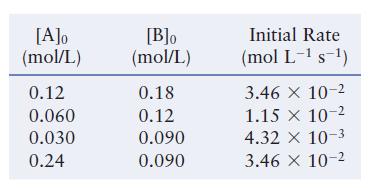
The reaction A(aq) + B(aq) → products(aq) was studied, and the following data were obtained:What is the order of the reaction with respect to A?What is the order of the reaction with respect to B?What is the value of the rate constant for the reaction?
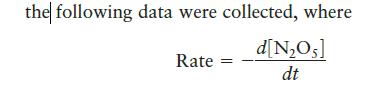
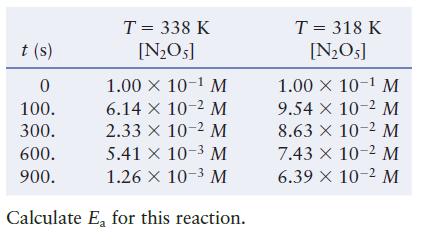
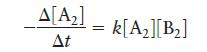
Consider the hypothetical reaction, A2 + B2 → 2AB, where the rate law is:The value of the rate constant at 302°C is 2.45 × 10⁻⁴ L mol-1 s-1, and at 508°C the rate constant is 0.891 L mol-1 s-1. What is the activation energy for this reaction? What is the value of the rate constant for
A certain substance, initially present at 0.0800 M, decomposes by zero-order kinetics with a rate constant of 2.50 × 10²-2 mol L-1 s-1. Calculate the time (in seconds) required for the system to reach a concentration of 0.0210 M.
What is meant by the term vapor pressure? Why do liquids have a vapor pressure? Do all liquids have a vapor pressure? What about solids? How does vapor pressure change with changing temperature? Why? What happens, if anything, when the vapor pressure of a liquid is equal to atmospheric pressure?
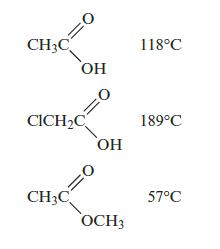
Rationalize the following boiling points: CH3C OH CICH₂C CH3C OH OCH3 118°C 189°C 57°C
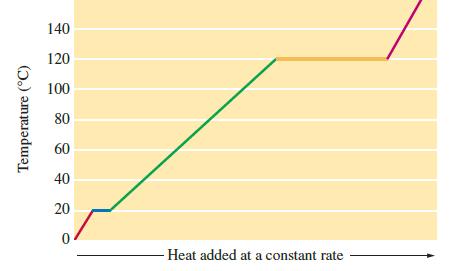
Use the heating–cooling curve below to answer the following questions. Temperature (°C) 140 120 100 80 60 40 20 0 Heat added at a constant rate
How could you tell experimentally if TiO2 is an ionic solid or a network solid?
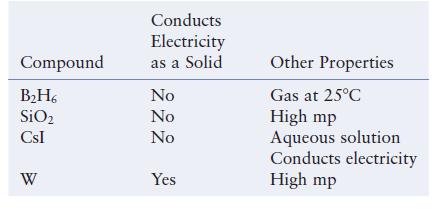
Consider the following data concerning four different substances.Label the four substances as either ionic, network, metallic, or molecular solids. Compound B₂H6 SiO₂ CsI W Conducts Electricity as a Solid No No No Yes Other Properties Gas at 25°C High mp Aqueous solution Conducts
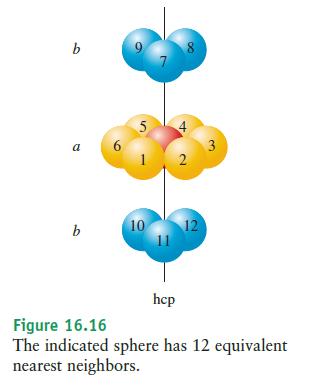
Use the diagram of the unit cell for the hexagonal closest packed structure in Fig. 16.14 to determine the net number of atoms in the hcp unit cell.Fig. 16.14 b a b 5 10 hep 12 3 Figure 16.16 The indicated sphere has 12 equivalent nearest neighbors.
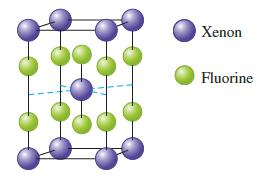
The unit cell for a pure xenon fluoride compound is shown below. What is the formula of the compound? Xenon Fluorine
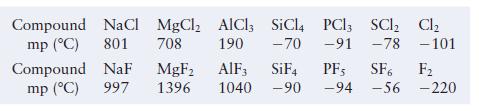
Consider the following melting point data: Compound NaCl MgCl₂ AlCl3 SiCl4 PC13 SCl₂ Cl₂ mp (°C) 801 708 190 -70 -91 -78 -101 Compound NaF mp (°C) MgF₂ 997 1396 AlF3 1040 -90 SiF4 PF5 SF6 F₂ -94 -56-220
The temperature inside a pressure cooker is 1158C. Calculate the vapor pressure of water inside the pressure cooker. What would be the temperature inside the pressure cooker if the vapor pressure of water was 3.50 atm?
Dry nitrogen gas is bubbled through liquid benzene (C6H6) at 20.08C. From 100.0 L of the gaseous mixture of nitrogen and benzene, 24.7 g of benzene is condensed by passing the mixture through a trap at a temperature where nitrogen is gaseous and the vapor pressure of benzene is negligible. What is
A sample of dry nitrogen gas weighing 100.0 g is bubbled through liquid water at 25.08C. The gaseous mixture of nitrogen and water vapor escapes at a total pressure of 700. torr. What mass of water has vaporized?
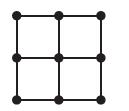
You are asked to help set up a historical display in the park by stacking some cannonballs next to a Revolutionary War cannon. You are told to stack them by starting with a triangle in which each side is composed of four touching cannonballs. You are to continue stacking them until you have a
Consider the ionic solid AxBy, which has the unit cel below. The B ions are packed in a cubic arrangement, where each face has this structure:
Which of the following statements about intermolecular forces is(are) true?a. London dispersion forces are the only type of intermolecular force that nonpolar molecules exhibit.b. Molecules that have only London dispersion forces will always be gases at room temperature (25° C). c. The
The structure of the compound K2O is best described as a cubic closest packed array of oxide ions with the potassium ions in tetrahedral holes. What percent of the tetrahedral holes are occupied in this solid?
What type of solid (network, metallic, Group 8A, ionic, or molecular) will each of the following substances form?a. Krb. SO2c. Ni d. SiO2e. NH3f. Pt
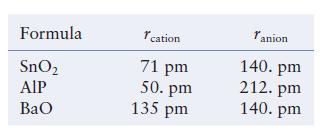
The table below lists the ionic radii for the cations and anions in three different ionic compounds.Each compound has either the NaCl, CsCl, or ZnS type cubic structure. Predict the type of structure formed (NaCl, CsCl, or ZnS) and the type and fraction of holes filled by the cations, and estimate
How does DHsoln relate to deviations from Raoult’s law? Explain.
You have read that adding NaCl to water can both increase its boiling point and decrease its freezing point. A friend of yours explains it to you like this: “The ions prevent freezing by blocking the water molecules from joining together. The hydration of the ions also makes the water boil at a
You drop an ice cube (made from pure water) into a saltwater solution at 08C. Explain what happens and why.
Using the phase diagram for water and Raoult’s law, explain why salt is spread on the roads in winter (even when the temperature is below freezing).
If a solution shows positive deviations from Raoult’s law, would you expect it to have a higher or lower boiling point than if it were ideal? Explain.
An aqueous antifreeze solution is 40.0% ethylene glycol (C2H6O2) by mass. The density of the solution is 1.05 g/cm3. Calculate the molality, molarity, and mole fraction of the ethylene glycol.
Calculate the final concentrations of K+(aq), C2O4 2-(aq), Ba2+(aq), and Br-(aq) in a solution prepared by adding 0.100 L of 6.0 × 10⁻⁴ M K2C2O4 to 0.150 L of 1.0 × 10⁻⁴ M BaBr2.
A 1.37 M aqueous solution of citric acid (H3C6H5O7) has a density of 1.10 g/cm3. What are the mass percent, molality and mole fraction of the citric acid?
Determine the molarity and mole fraction of a 1.00 m solution of acetone (CH3COCH3) dissolved in ethanol (C2H5OH). (Density of acetone 5 0.788 g/cm3; density of ethanol 5 0.789 g/cm3.) Assume that the final volume equals the sum of the volumes of acetone and ethanol.
Showing 2700 - 2800
of 3011
First
17
18
19
20
21
22
23
24
25
26
27
28
29
30
31
Step by Step Answers

 Get 50% OFF
Claim Now
Get 50% OFF
Claim Now