New Semester
Started
Get
50% OFF
Study Help!
--h --m --s
Claim Now
Question Answers
Textbooks
Find textbooks, questions and answers
Oops, something went wrong!
Change your search query and then try again
S
Books
FREE
Study Help
Expert Questions
Accounting
General Management
Mathematics
Finance
Organizational Behaviour
Law
Physics
Operating System
Management Leadership
Sociology
Programming
Marketing
Database
Computer Network
Economics
Textbooks Solutions
Accounting
Managerial Accounting
Management Leadership
Cost Accounting
Statistics
Business Law
Corporate Finance
Finance
Economics
Auditing
Tutors
Online Tutors
Find a Tutor
Hire a Tutor
Become a Tutor
AI Tutor
AI Study Planner
NEW
Sell Books
Search
Search
Sign In
Register
study help
sciences
chemical principles
Chemical Principles 8th Edition Steven S. Zumdahl, Donald J. DeCoste - Solutions
Using KF as an example, write equations that refer to ΔHsoln and ΔHhyd. Lattice energy as ΔH for the reaction K1(g) + F2(g) 8n KF(s). Show how you would utilize Hess’s law to calculate ΔHsoln from ΔHhyd and ΔHLE for KF, where ΔHLE = lattice energy. ΔHsoln for KF, as for other soluble
The lattice energy* of NaI is —686 kJ/mol, and the enthalpy of hydration is —94 kJ/mol. Calculate the enthalpy of solution per mole of solid NaI. Describe the process to which this enthalpy change applies.
O2(g) obeys Henry’s law in water but not in blood (an aqueous solution). Why?
The pressure of CO2 in a bottle of sparkling wine was calculated assuming that the CO2 was insoluble in water. This was an incorrect assumption. Redo this problem by assuming that CO2 obeys Henry’s law. Use the data given in that problem to calculate the partial pressure of CO2 in the gas phase
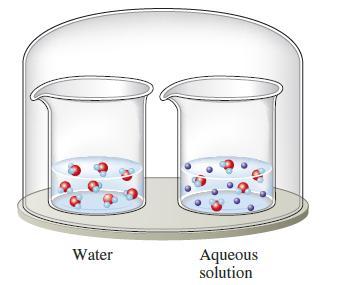
The two beakers in the sealed container illustrated below contain pure water and an aqueous solution of a volatile solute. If the solute is less volatile than water, explain what will happen to the volumes in the two containers as time passes. Water Aqueous solution
Vapor-pressure lowering is a colligative property, as are freezing-point depression and boiling-point elevation. What is a colligative property? Why is the freezing point depressed for a solution as compared to the pure solvent? Why is the boiling point elevated for a solution as compared to the
The destruction of a colloid is done through a process called coagulation. What is coagulation?
Patients undergoing an upper gastrointestinal tract laboratory test are typically given an X-ray contrast agent that aids with the radiologic imaging of the anatomy. One such contrast agent is sodium diatrizoate, a nonvolatile water-soluble compound. A 0.378-m solution is prepared by dissolving
An aqueous solution containing 0.250 moles of Q, a strong electrolyte, in 5.00 × 10² g of water freezes at 22.79°C. What is the van’t Hoff factor for Q? The molal freezing-point depression constant for water is 1.86°C kg/mol. What is the formula of Q if it is 38.68% chlorine by mass and there
In the vapor over a pentane–hexane solution at 25°C, the mole fraction of pentane is equal to 0.15. What is the mole fraction of pentane in the solution?
Thyroxine, an important hormone that controls the rate of metabolism in the body, can be isolated from the thyroid gland. When 0.455 g thyroxine is dissolved in 10.0 g benzene, the freezing point of the solution is depressed by 0.300°C. What is the molar mass of thyroxine?
Formic acid (HCO2H) is a monoprotic acid that ionizes only partially in aqueous solutions. A 0.10-M formic acid solution is 4.2% ionized. Assuming that the molarity] and molality of the solution are the same, calculate the freezing point and the boiling point of 0.10 M formic acid.
The lattice energy of NaCl is 2786 kJ/mol, and the enthalpy of hydration of 1 mole of gaseous Na+ and 1 mole of gaseous Cl2 ions is 2783 kJ/mol. Calculate the enthalpy of solution per mole of solid NaCl.
A 4.7 × 10⁻² mg sample of a protein is dissolved in water to make 0.25 mL of the solution. The osmotic pressure of the solution is 0.56 torr at 25°C. What is the molar mass of the protein?
A sample containing 0.0500 moles of Fe2(SO4)3 is dissolved in enough water to make 1.00 L of solution. This solution contains hydrated SO4-2 and Fe(H2O)63+ ions.The latter behaves as an acid: Fe(H₂O)63+= Fe(OH)(H₂O),2+ + H+
It has been determined that the body can generate 5500 kJ of energy during one hour of strenuous exercise. Perspiration is the body’s mechanism for eliminating this heat. What mass of water would have to be evaporated through perspiration to rid the body of the heat generated during 2 hours of
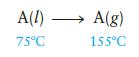
Consider the processwhich is carried out at constant pressure. The total △S for this process is known to be 75.0 J K21 mol21. For A(l) and A(g), the Cp values are 75.0 J K21 mol21 and 29.0 J K21 mol21, respectively, and are not dependent on temperature. Calculate △H vaporization for A(l) at
High temperatures are favorable to a reaction kinetically but may be unfavorable to a reaction thermodynamically. Explain.
Why are high temperatures needed to convert N2 and O2 to NO?
For the process H2O(l) 88n H2O(g) at 298 K and 1.0 atm, DH is more positive than DE by 2.5 kJ/mol. What does the 2.5 kJ/mol quantity represent?
For a gas phase reaction, what do you concentrate on to predict the sign of △S? For a phase change, what do you concentrate on to predict the sign of △S? That is, how are 8°solid, S °liquid, and S°gas related to one another? When a solute dissolves in water, what is usually the sign of DS
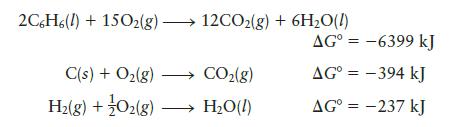
Given the following data: Calculate DG8 for the reaction 6C(s) + 3H2(g) → C6H6(l) 2C6H6(l) +150₂(g) →→→ 12CO₂(g) + 6H₂O(l) C(s) + O2(g) →→→ CO₂(g) H₂(g) + O2(g) →→→ H₂O(l) AG° -6399 kJ AG = -394 kJ AG° = -237 kJ =
A coffee cup calorimeter initially contains 125 g water at 24.28C. Potassium bromide (10.5 g), also at 24.28C, is added to the water, and after the KBr dissolves, the final temperature is 21.18C. Calculate the enthalpy change for dissolving the salt in J/g and kJ/mol. Assume that the specific heat
When most biological enzymes are heated, they lose their catalytic activity. The change Original enzyme → new form that occurs upon heating is endothermic and spontaneous. Is the structure of the original enzyme or its new form more ordered (has the smaller positional probability)? Explain your
Hydrogen cyanide is produced industrially by the following exothermic reaction:Is the high temperature needed for thermodynamic or for kinetic reasons? 2NH3(g) + 302(g) + 2CH4(g) 1000°C Pt-Rh 2HCN(g) + 6H₂O(g)
For the reaction2O(g) → O2(g)a. Predicts the signs of DH and DS.b. Would the reaction be more spontaneous at high or low temperatures?
A reaction at constant T and P is spontaneous as long as DG is negative; that is, reactions always proceed as long as the products have a lower free energy than the reactants.What is so special about equilibrium? Why don’t reactions move away from equilibrium?
Using thermodynamic data from Appendix 4, calculate △G° at 258C for the process:2SO2(g) + O2(g) 88n 2SO3(g)where all gases are at 1.00 atm pressure. Also calculate DG8 at 258C for this same reaction but with all gases at 10.0 atm pressure.
It has been determined that the body can generate 5500 kJ of energy during one hour of strenuous exercise. Perspiration is the body’s mechanism for eliminating this heat. What mass of water would have to be evaporated through perspiration to rid the body of the heat generated during 2 hours of
Consider 1.00 mole of CO2(g) at 300. K and 5.00 atm. The gas expands until the final pressure is 1.00 atm. For each of the following conditions describing the expansion, calculate △ S, D△ surr, and △S univ. Cp for CO2 is 37.1 J K-1 mol-1 and assume that the gas behaves ideally.a. The
Using the following data, calculate the value of Ksp for Ba(NO3)2, one of the least soluble of the common nitrate salts.
Consider a weak acid HX. If a 0.10 M solution of HX has a pH of 5.83 at 25°C, what is DG△ for the acid’s dissociation reaction at 25° C?
In making a specific galvanic cell, explain how one determines which electrodes and solutions to use in the cell.
Combine the equationsto derive an expression for ℇ° as a function of temperature. Describe how one can graphically determine ΔS° and ΔS° from measurements of %8 at different temperatures, assuming that ΔH° and ΔS° do not depend on temperature. What property would you look for in
The equation △G°=-nF ℇ ° also can be applied to half-reactions. Use standard reduction potentials to estimate △G°f for Fe21(aq) and Fe31(aq). (△G°f for e2 5 0.)
Calculate ℇ° for the following half-reaction: Agl(s) + e → Ag(s) + I-¯
Estimate ℇ° for the half-reaction. 2H2O + 2e- → H2 + 2OH- given the following values of△G°f: H2O(l) = -237 kJ/mol H2(g) = 0.0OH-(aq) = -157 kJ/mol e- = 0.0
Calculate K for iron(II) sulfide given the following data: FeS(s) + 2e- Fe²+ (aq) + 2e- Fe(s) + S2-(aq) = -1.01 V Fe(s) 8° = -0.44 V
The solubility product for CuI(s) is 1.1 × 10⁻¹². Calculate the value of %8 for the half-reaction
Explain the following statement: % determines spontaneity, while %8 determines the equilibrium position. Under what conditions can you use %8 to predict spontaneity?
What are concentration cells? What is %8 in a concentration cell? What is the driving force for a concentration cell to produce a voltage? Is the higher or the lower ion concentration solution present at the anode? When the anode ion concentration is decreased and/or the cathode ion concentration
What mass of each of the following substances can be produced in 1.0 h with a current of 15 A?a. Co from aqueous Co2+b. Hf from aqueous Hf4+ c. I2 from aqueous KId. Cr from molten CrO3
It took 2.30 min with a current of 2.00 A to plate out all the silver from 0.250 L of a solution containing Ag+. What was the original concentration of Ag+ in the solution?
The electrolysis of BiO+ produces pure bismuth. How long would it take to produce 10.0 g of Bi by the electrolysis of a BiO+ solution using a current of 25.0 A?
A single Hall–Hero ult cell produces about 1 ton of aluminum in 24 h. What current must be used to accomplish this?
A factory wants to produce 1.00 × 10³ kg barium from the electrolysis of molten barium chloride. What current must be applied for 4.00 h to accomplish this?
An aqueous solution of an unknown salt of ruthenium is electrolyzed by a current of 2.50 A passing for 50.0 min. If 2.618 g Ru is produced at the cathode, what is the charge on the ruthenium ions in solution?
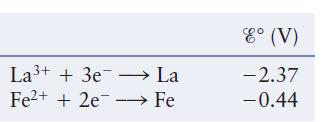
Consider the following half-reactions:A hydrochloric acid solution contains platinum, palladium, and iridium as chloro-complex ions. The solution is a constant 1.0 M in chloride ion and 0.020 M in each complex ion. Is it feasible to separate the three metals from this solution by electrolysis?
An unknown metal M is electrolyzed. It took 74.1s for a current of 2.00 A to plate out 0.107 g of the metal from a solution containing M(NO3)3. Identify the metal.
Electrolysis of an alkaline earth metal chloride using a current of 5.00 A for 748 seconds deposits 0.471 g of metal at the cathode. What is the identity of the alkaline earth metal chloride?
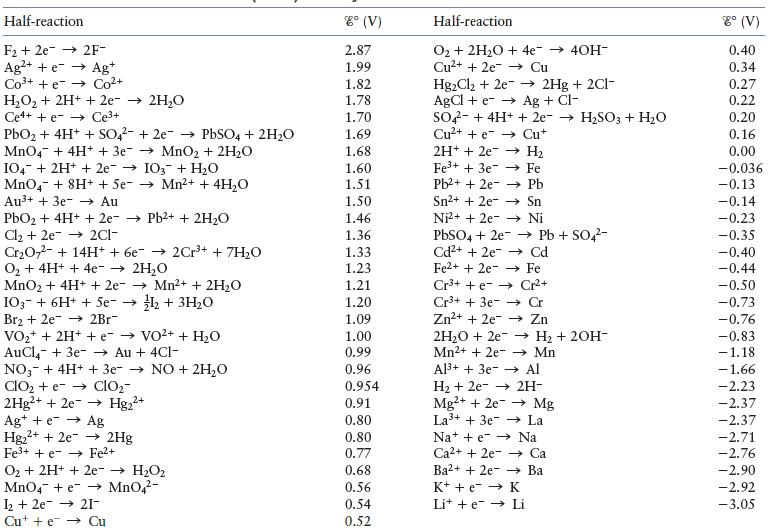
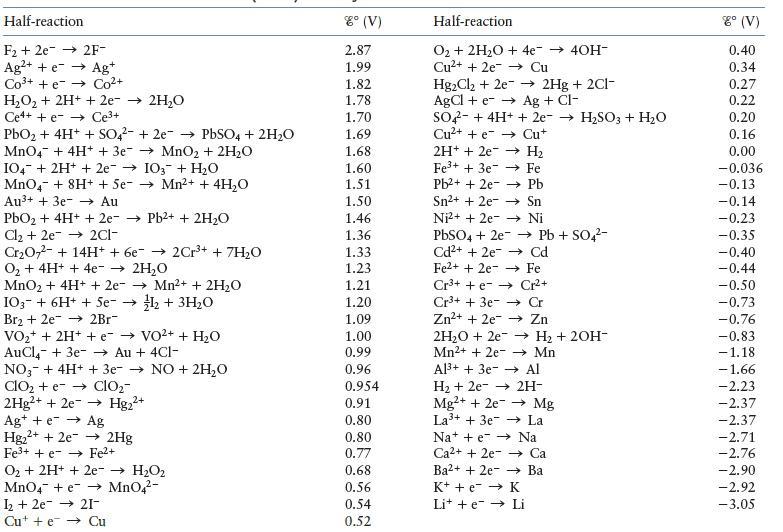
In theory, most metals should easily corrode in the air. Why? A group of metals called noble metals are relatively difficult to corrode in air. Some noble metals include gold, platinum, and silver. Reference Table 11.1 to come up with a possible reason why the noble metals are relatively difficult
Consider a galvanic cell based on the following halfreactions:a. What is the expected cell potential with all components in their standard states?b. What is the oxidizing agent in the overall cell reaction?c. What substances make up the anode compartment?d. In the standard cell, in which direction
The table below lists the cell potentials for the 10 possible galvanic cells assembled from the metals A, B, C, D, and E and their respective 1.00 M 21 ions in solution.Using the data in the table, establish a standard reduction potential table similar to Table 11.1 in the text. Assign a reduction
In the equation w = 2PDV, why is there a negative sign?
Why is Cp larger than Cv? Provide a conceptual rationale.
When is DH = 5-RT? When is DE = 5-RT? When is DH = 32 RT? When is DE = 32 RT? When is DH = DE? What does this say, if anything, about DE and DH as state functions?
Assuming gasoline is pure C8H18(l), predict the signs of q and w for the process of combusting gasoline into CO2(g) and H2O(g).
A sample of an ideal gas at 15.0 atm and 10.0 L is allowed to expand against a constant external pressure of 2.0 atm at a constant temperature. Calculate the work in units of kJ for the gas expansion.
One of the components of polluted air is NO. It is formed in the high-temperature environment of internal combustion engines by the following Why are high temperatures needed to convert N2 and O2 to NO? N2(g) + O2(g) 2NO(g) ΔΗ = 180 kJ
For the process H2O(l) 88n H2O(g) at 298 K and 1.0 atm, DH is more positive than DE by 2.5 kJ/mol. What does the 2.5 kJ/mol quantity represent?
Consider 111J of heat added to 30.3 g of Ne on STP. Determine w, DE, and DH if the heat is transferred at constant volume. Do the same determinations if the heat is transferred at constant pressure. Calculate the final temperature under each condition.
A coffee cup calorimeter initially contains 125g water at 24.28C. Potassium bromide (10.5 g), also at 24.28C, is added to the water, and after the KBr dissolves, the final temperature is 21.18C. Calculate the enthalpy change for dissolving the salt in J/g and kJ/mol. Assume that the specific heat
Consider the dissolution of CaCl2: CaCl₂(s) Ca²+ (aq) + 2Cl(aq) AH = -81.5 kJ
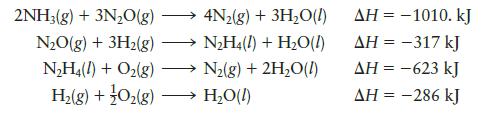
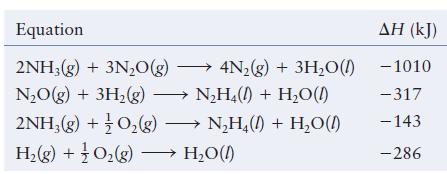
Calculate DH for the reactionGiven the following data: 2NH3(g) + O₂(g) N₂H4(1) + H₂O(1)
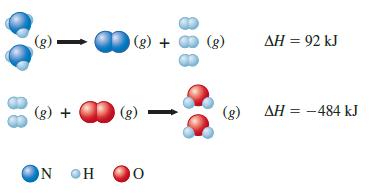
Given the following data:calculate DH for the reactionOn the basis of enthalpy change, is this a useful reaction for the synthesis of ammonia? (g) + N ΟΗ (g) Ο ΔΗ = 92 kJ (g) ΔΗ = – 484 kJ
Given the following data:calculate DH for the reaction C₂H₂(g) + O₂(g) C(s) + O₂(g) H₂(g) + O₂(g) - →2CO₂(g) + H₂O(l) CO₂(g) → H₂O(l) AH = -1300. kJ AH = -394 kJ AH = -286 kJ
Given the following data: calculate DH for the reaction 2CIF(g) + O₂(g) 2CIF3(g) + 202(8) 2F₂(g) + O₂(g) → Cl₂O(g) + F₂O(g) → Cl₂O(g) + 3F₂O(g) 2F₂O(g) ΔΗ = 167.4 kJ ΔΗ = 341.4 kJ AH = -43.4 kJ
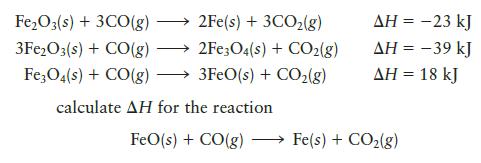
Given the following data: Fe₂O3(s) + 3CO(g) 3Fe2O3(s) + CO(g) 2Fe3O4(s) + CO2(g) Fe3O4(s) + CO(g) →→→3FeO(s) + CO₂(g) calculate AH for the reaction FeO(s) + CO(g) →2Fe(s) + 3CO₂(g) AH = -23 kJ AH = -39 kJ ΔΗ = 18 kJ Fe(s) + CO₂(g)
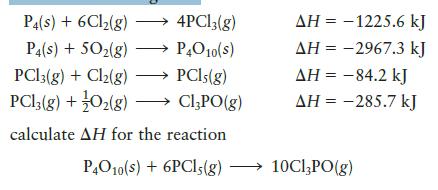
Given the following data: P4(s) + 6Cl₂(g) →→→ 4PCl3(g) P4(s) + 50₂(g) P4O10(S) PC13(g) + Cl₂(g) PCls (g) PC13(g) + O₂(g) Cl₂PO(g) calculate AH for the reaction P4010(s) + 6PC15(g) AH = -1225.6 kJ AH = -2967.3 kJ AH = -84.2 kJ AH = -285.7 kJ 10Cl₂PO(g)
Nitromethane, CH3NO2, can be used as a fuel. When the liquid is burned, the (unbalanced) reaction is mainlya. The standard enthalpy change of reaction (DH8rxn) for the balanced reaction (with lowest whole-number coefficients) is 21288.5 kJ. Calculate DH8 f for nitromethane.b. A 15.0-L flask
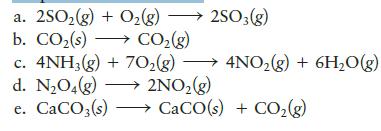
In which of the following systems is(are) work done by the surroundings on the system? Assume pressure and temperature are constant. a. 2SO₂(g) + O₂(g) →→→ 2SO3(g) b. CO₂ (s) CO₂(g) → c. 4NH3(g) + 70₂(g) d. N₂O4(g) →→→ 2NO₂(g) e. CaCO3(s)→→→→→→ CaCO(s) +
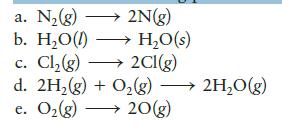
Which of the following processes are exothermic? a. N₂(g) 2N(g) b. H₂O(l) → H₂O(s) c. Cl₂(g) →→→ 2Cl(g) d. 2H₂(g) + O₂(g) →→→→ 2H₂O(g) e. O₂(g) → 20(g)
In a coffee-cup calorimeter, 150.0 mL of 0.50 M HCl is added to 50.0 mL of 1.00 M NaOH to make 200.0 g solution at an initial temperature of 48.28C. If the enthalpy of neutralization for the reaction between a strong acid and a strong base is -56 kJ/mol, calculate the final temperature of the
Calculate DH for the reactiongiven the following data: N₂H₁ (1) + O₂(g) N₂(g) + 2H₂O(l)
Draw a highly magnified view of a sealed, rigid container filled with a gas. Then draw what it would look like if you cooled the gas significantly but kept the temperature above the boiling point of the substance in the container. Also draw what it would look like if you heated the gas
One way of determining the empirical formula is to burn a compound in air and weigh the amounts of carbon dioxide and water given off. For what types of compounds does this work? Explain the assumptions that are made. Why is the formula an empirical formula and not necessarily a molecular formula?
These questions concern the work of J. J. Thomson:a. From what you know of Thomson’s work, which particles do you think he would believe are most important in the formation of compounds (chemical changes) and why?b. Of the remaining two subatomic particles, which do you place second in importance
One of the best indications of a useful theory is that it raises more questions for further experimentation than it originally answered. Is this true of Dalton’s atomic theory?Give examples.
A student titrates an unknown amount of potassium hydrogen phthalate (KHP) with 20.46 mL of a 0.1000 M NaOH solution. KHP (molar mass 5 204.22 g/mol) has one acidic hydrogen. How many grams of KHP were titrated (reacted completely) by the sodium hydroxide solution?
The formula of water is H2O. Which of the following is indicated by this formula? Explain your answer.a. The mass of hydrogen is twice that of oxygen in each molecule.b. There are two hydrogen atoms and one oxygen atom per water molecule.c. The mass of oxygen is twice that of hydrogen in each
Why is calcium dichloride not the correct systematic name for CaCl2?
For each of the following sets of elements, label each as both noble gases, halogens, alkali metals, alkaline earth metals, or transition metals.a. Ti, Fe, Ag d. Ne, Kr, Xeb. Mg, Sr, Ba e. F, Br, Ic. Li, K, Rb
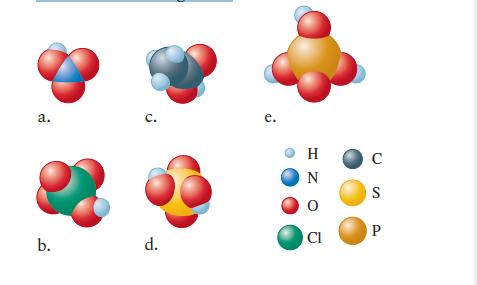
Name the following acids. A formula of Na2X. Which of the following statements is(are) true? Correct the false statements. a. The binary compound formed between X and fluorine will be a covalent compound.b. The isotope of X contains 38 protons.c. The isotope of X contains 41 neutrons.d.
The early alchemists used to do an experiment in which water was boiled for several days in a sealed glass container. Eventually, some solid residue would begin to appear in the bottom of the flask. This result was interpreted to mean that some of the water in the flask had been converted into
For the preceding question, which of the following equations best represents the reaction?a. 6N2 + 6H2 → 4NH3 + 4N2b. N2+ H2 → NH3c. N+ 3H → NH3d. N2 + 3H2 → 2NH3e. 2N2 + 6H2 → 4NH3Justify your choice. For those you did not choose, explain why they are incorrect.
A kerosene lamp has a mass of 1.5 kg. You put 0.5 kg of kerosene in the lamp. You burn all the kerosene until the lamp has a mass of 1.5 kg. What is the mass of the gases that are given off? Explain.
What is the mass of the product?a. Less than 20 g d. exactly 120 gb. Between 20 and 100 g e. more than 120 gc. Between 100 and 120 g
A 1.000-g sample of XI2 is dissolved in water, and excess silver nitrate is added to precipitate all of the iodide as AgI. The mass of the dry AgI is found to be 1.375 g. Calculate the atomic weight (mass) of X.
Which of the following statements about chemical equations is(are) true?a. When balancing a chemical equation, you can never change the coefficient in front of any chemical formula.b. The coefficients in a balanced chemical equation refer to the number of grams of reactants and products.c. In a
An electric furnace produces phosphorus by the following reaction:Ca3(PO4)2(s) + 5C(s)3SiO2(s) → 3CaSiO3(s) + 5CO(g) + 2P(l)An initial reaction mixture contains 1500 kg calcium phosphate, 250 kg carbon, and 1.0 3 103 kg SiO2.a. What is the limiting reagent?b. What is the theoretical yield of
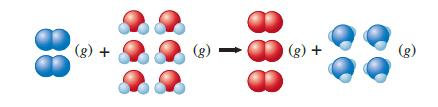
Assume you have a highly magnified view of a solution of HCl that allows you to “see” the HCl. Draw this magnified view. If you dropped in a piece of magnesium, the magnesium would disappear, and hydrogen gas would be released. Represent this change using symbols for the elements, and write out
Commercial cold packs and hot packs are available for treating athletic injuries. Both types contain a pouch of water and a dry chemical. When the pack is struck, the pouch of water breaks, dissolving the chemical, and the solution becomes either hot or cold. Many hot packs use magnesium sulfate,
How would you prepare 1.00 L of a 0.50 M solution of each of the following?a. H2SO4 from “concentrated” (18 M) sulfuric acidb. HCl from “concentrated” (12 M) reagentc. NiCl2 from the salt NiCl2? 6H2Od. HNO3 from “concentrated” (16 M) reagente. Sodium carbonate from the pure solid
A stock solution containing Mn21 ions is prepared by dissolving 1.584 g of pure manganese metal in nitric acid and diluting to a final volume of 1.000 L. The following solutions are prepared by dilution. For solution A, 50.00 mL of stock solution is diluted to 1000.0 mL.For solution B, 10.00 mL of
The units of parts per million (ppm) and parts per billion (ppb) are commonly used by environmental chemists. In general, 1 ppm means 1 part of solute for every 106 parts of solution. (Both solute and solution are measured using the same units.) Mathematically, by mass:In the case of very dilute
A sample may contain any or all of the following ions: Hg2+, Ba21+, and Mn21+.a. No precipitate formed when an aqueous solution of NaCl was added to the sample solution.b. No precipitate formed when an aqueous solution of Na2SO4 was added to the sample solution.c. A precipitate formed when the
How would you separate the following ions in aqueous solution by selective precipitation?a. Ag+, Ba2+, and Cr3+b. Ag+, Pb2+, and Cu2+c. Hg22+ and Ni2+
What volume of 0.0521 M Ba(OH)2 is required to neutralize exactly 14.20 mL of 0.141 M H3PO4? Phosphoric acid contains three acidic hydrogens.
A 10.00-mL sample of vinegar, an aqueous solution of acetic acid (HC2H3O2), is titrated with 0.5062 M NaOH, and 16.58 mL is required to reach the endpoint.a. What is the molarity of the acetic acid?b. If the density of the vinegar is 1.006 g/cm3, what is the mass percent of acetic acid in the
A 50.00-mL sample of a solution containing Fe2+ ions is titrated with a 0.0216 M KMnO4 solution. It required 20.62 mL of KMnO4 solution to oxidize all the Fe3+ ions to Fe3+ ions by the reaction
Showing 2800 - 2900
of 3011
First
17
18
19
20
21
22
23
24
25
26
27
28
29
30
31
Step by Step Answers

 Get 50% OFF
Claim Now
Get 50% OFF
Claim Now