New Semester
Started
Get
50% OFF
Study Help!
--h --m --s
Claim Now
Question Answers
Textbooks
Find textbooks, questions and answers
Oops, something went wrong!
Change your search query and then try again
S
Books
FREE
Study Help
Expert Questions
Accounting
General Management
Mathematics
Finance
Organizational Behaviour
Law
Physics
Operating System
Management Leadership
Sociology
Programming
Marketing
Database
Computer Network
Economics
Textbooks Solutions
Accounting
Managerial Accounting
Management Leadership
Cost Accounting
Statistics
Business Law
Corporate Finance
Finance
Economics
Auditing
Tutors
Online Tutors
Find a Tutor
Hire a Tutor
Become a Tutor
AI Tutor
AI Study Planner
NEW
Sell Books
Search
Search
Sign In
Register
study help
sciences
general chemistry principles
General Chemistry Principles And Modern Applications 11th Edition Ralph Petrucci, Jeffry Madura, F. Herring, Carey Bissonnette - Solutions
Arrange the following compounds in the expected order of increasing solubility in water, and give the basis for your arrangement: Li2CO3, Na2CO3, MgCO3.
With a minimum of calculation, determine how much less heat is produced per mol of C8H18(l) burned in reaction (21.30) than in reaction (21.29).Reaction (21.30)Reaction (21.29) C8H18(1) + 12 O₂(g) - 7 CO2(g) + CO(g) + 9H₂0(1) (21.30)
Suggest a reason why the hydrated beryllium ion is [Be(H2O)4]2+, whereas the hydrated magnesium ion is [Mg(H2O)6]2+.
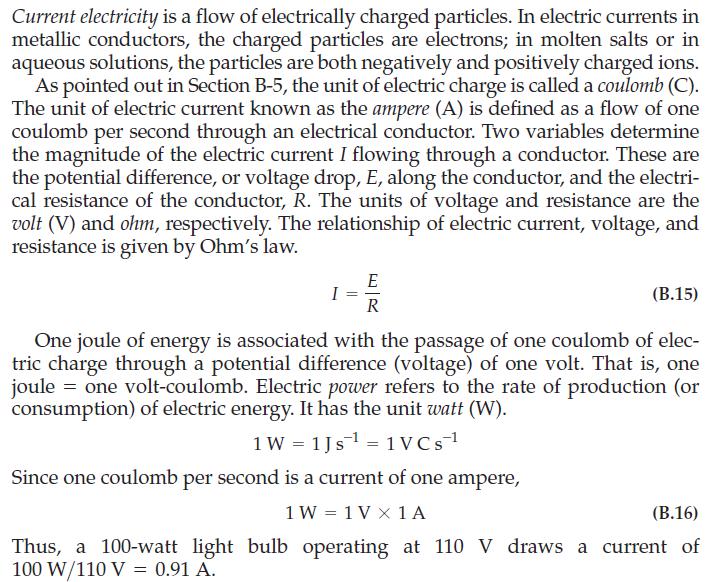
A lithium battery used in a cardiac pacemaker has a voltage of 3.0 V and a capacity of 0.50 A h (ampere hour). Assume that 5.0 μW of power is needed to regulate the heartbeat. Appendix B. Current electricity is a flow of electrically charged particles. In electric currents in metallic conductors,
The first electrolytic process to produce sodium metal used molten NaOH as the electrolyte. Write probable half-equations and an overall equation for this electrolysis.
Lithium and magnesium combine with N2 to give the nitrides Li3N and Mg3N2, respectively. Suggest a reason for this and write balanced chemical equations for the reactions.
A 1.26 L sample of KCl(aq) is electrolyzed for 3.50 min with a current of 0.910 A.(a) Calculate the pH of the solution after electrolysis.(b) Why doesn’t the result depend on the initial concentration of the KCl(aq)?
Boron forms a compound with the formula B2H2(CH3)4. Suggest a probable structure.
AlF3 is almost insoluble in anhydrous HF, but it dissolves if KF is present. Passage of BF3 through the resulting solution causes AlF3 to precipitate. How can you explain these observations?
An analysis of a Solvay-process plant shows that for every 1.00 kg of NaCl consumed, 1.03 kg of NaHCO3 are obtained. The quantity of NH3 consumed in the overall process is 1.5 kg.(a) What is the percent efficiency of this process for converting NaCl to NaHCO3?(b) Why is so little NH3 required?
Consider the reaction Ca(OH)2(s) + Na2SO4(aq) ⇌ CaSO4(s) + 2 NaOH(aq).(a) Write a net ionic equation for this reaction.(b) Will the reaction essentially go to completion?(c) What will be [SO42-] and [OH-] at equilibrium if a slurry of Ca(OH)2(s) is mixed with 1.00 M Na2SO4(aq)?
The standard Gibbs energies of formation, ΔfG°, for KO2(s) and K2O(s) are -240.59 kJ mol‾1 and -322.09 kJ mol‾1, respectively, at 298 K. Calculate the equilibrium constant for the reaction below at 298 K. Is KO2(s) thermodynamically stable with respect to K2O(s) and O2(g) at 298 K? 2 KO₂
The standard Gibbs energies of formation, ΔfG°, for Na2O(s) and Na2O2(s) are -379.09 kJ mol‾1 and -449.63 kJ mol‾1, respectively, at 298 K. Calculate the equilibrium constant for the reaction below at 298 K. Is Na2O2(s) thermodynamically stable with respect to Na2O(s) and O2(g) at 298 K?
The empirical formula of the mineral beryl is Be3Al2Si6O18. By using the several descriptions of silicate minerals just given as a guide, describe the structure of the silicate anion in beryl.
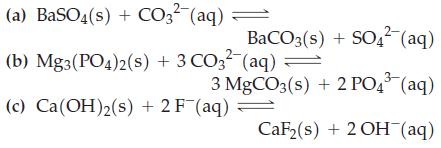
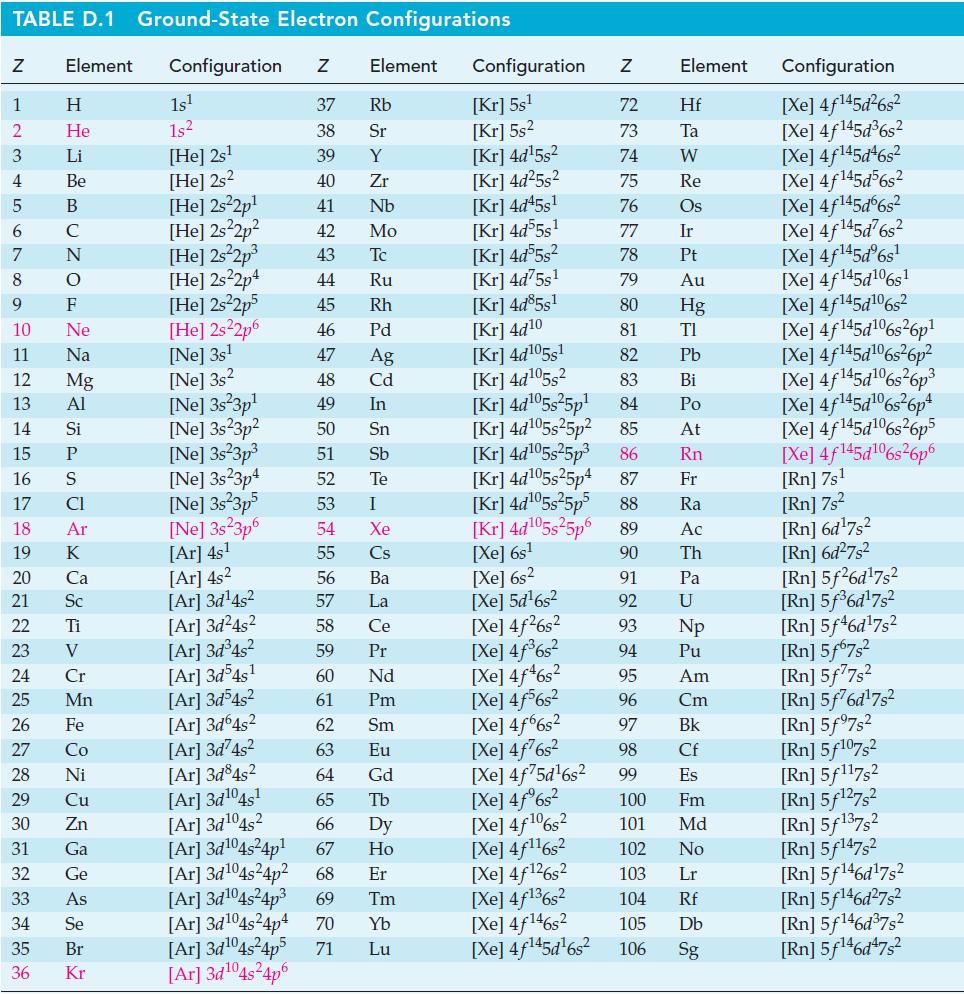
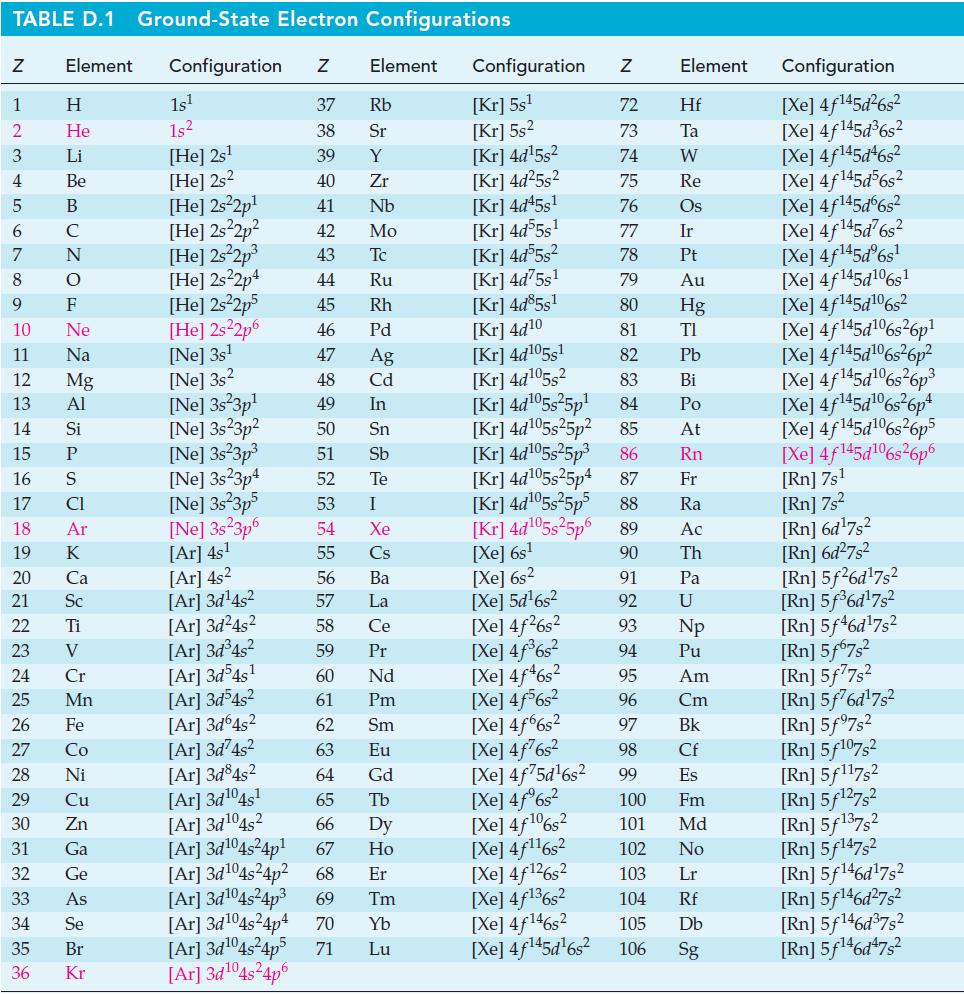
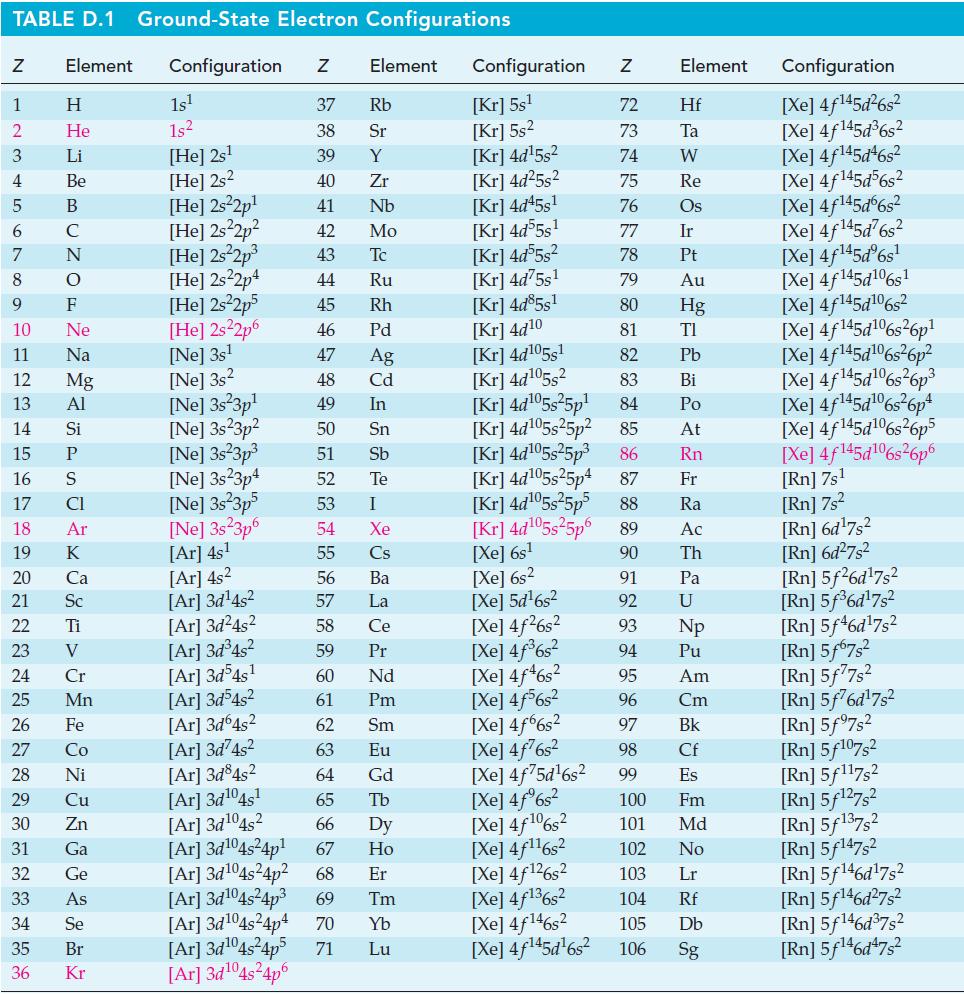
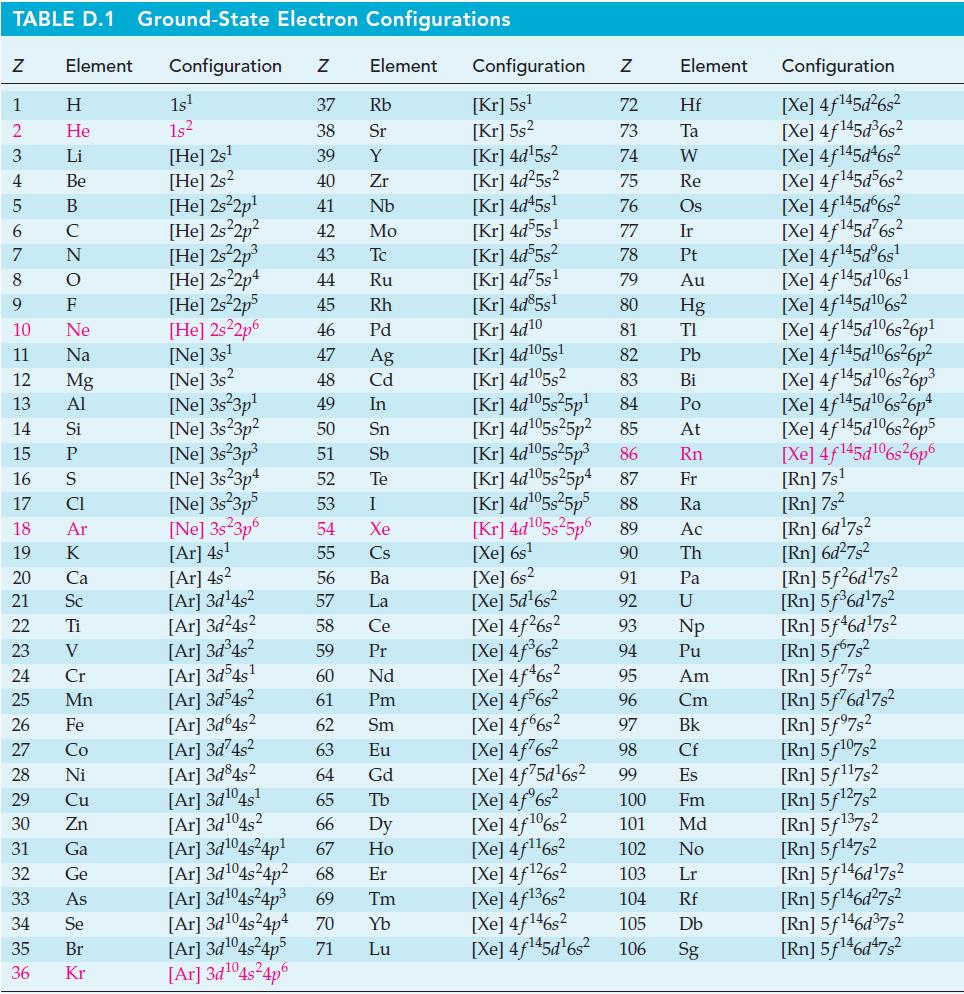
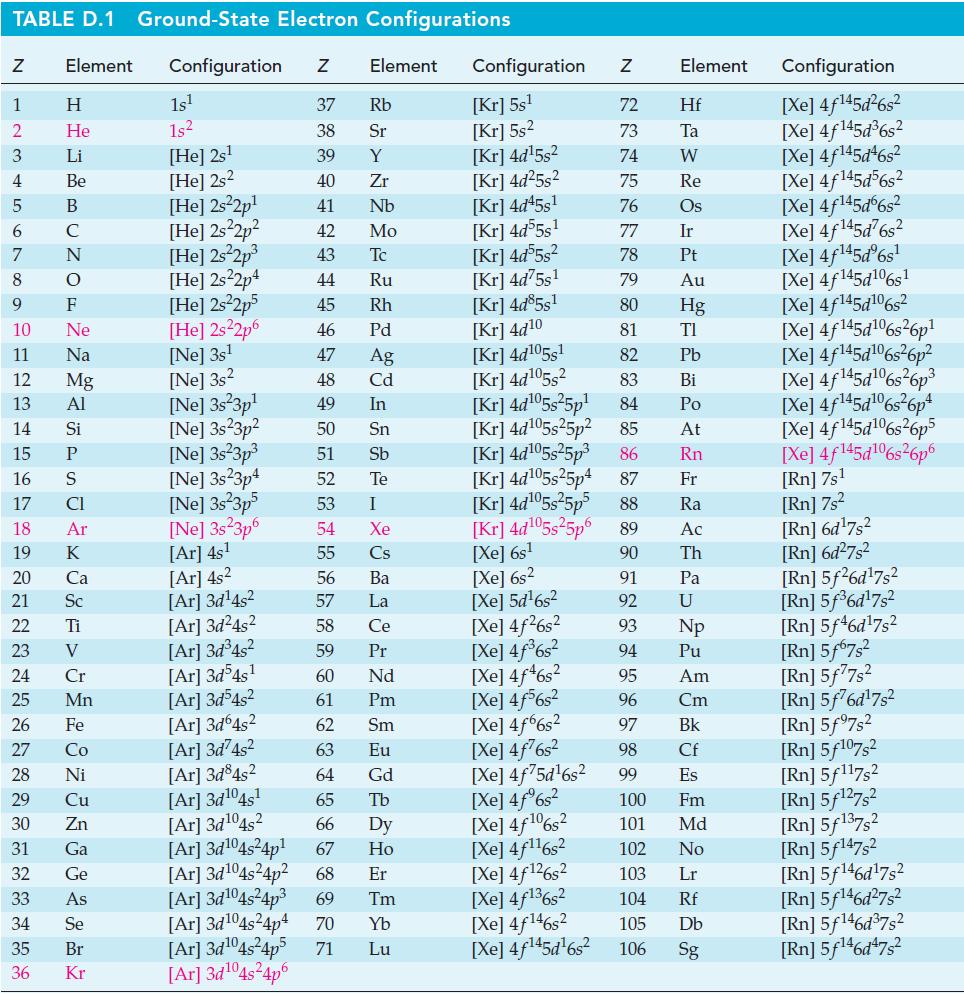
Without performing detailed calculations, indicate whether equilibrium is displaced either far to the left or far to the right for each of the following reactions. Use data from Appendix D as necessary. (a) BaSO4(s) + CO3²-(aq) = (b) Mg3(PO4)2(s) + 3 CO3² (aq) = BaCO3(s) + SO4²- (aq) 3 MgCO3(s)
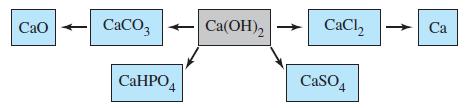
In the manner used to construct Figure 21-5, complete the diagram outlined. Specifically, indicate the reactants (and conditions) you would use to produce the indicated substances from Ca(OH)2.Figure 21-5 CaO CaCO3 C₂HPO4 Ca(OH)2 CaCl₂ →[ CaSO4 Ca
Replace the calcium-containing substances shown in the diagram accompanying Exercise 13 by their magnesium-containing equivalents. Then describe the reactants (and conditions) you would use to produce the indicated substances from MgSO4.Exercise 13In the manner used to construct Figure 21-5,
To prevent the air oxidation of aqueous solutions of Sn2+ to Sn4+, metallic tin is sometimes kept in contact with the Sn2+(aq). Suggest how this contact helps prevent the oxidation.
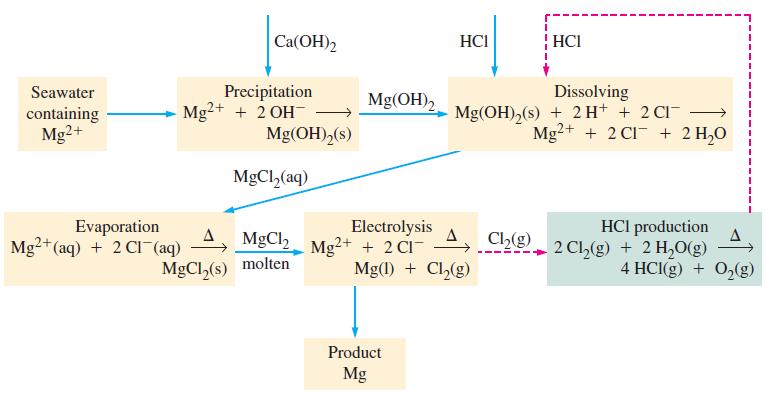
In the Dow process (Fig. 21-13), the starting material is Mg2+ in seawater and the final product is Mg metal. This process seems to violate the principle of conservation of charge. Does it? Explain.Figure 21-13 Seawater containing Mg2+ Ca(OH)2 Precipitation Mg²+ + 2 OH- Evaporation Mg2+ (aq) + 2
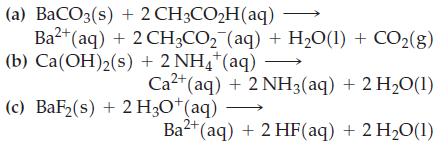
Without performing detailed calculations, indicate why you would expect each of the following reactions to occur to a significant extent as written. Use data from Appendix D as necessary. (a) BaCO3(s) + 2 CH3CO₂H(aq) Ba²+ (aq) + 2 CH3CO₂¯(aq) + H₂O(1) + CO₂(g) (b) Ca(OH)₂(s) + 2 NH4+
Which has the (a) Higher melting point, MgO or BaO;(b) Greater solubility in water, MgF2 or MgCl2? Explain.
Write chemical equations to represent the following:(a) Reduction of BeF2 to Be metal with Mg as a reducing agent (b) Reaction of barium metal with Br2(l)(c) Reduction of uranium(IV) oxide to uranium metal with calcium as the reducing agent (d) Calcination of dolomite, a mixed calcium magnesium
Write chemical equations for the reactions you would expect to occur when (a) Mg(HCO3)2(s) is heated to a high temperature (b) BaCl2(l) is electrolyzed (c) Sr(s) is added to cold dilute HBr(aq)(d) Ca(OH)2(aq) is added to H2SO4(aq)(e) CaSO4 · 2 H2O(s) is heated.
With respect to decomposition to MO(s) and SO3(g), which of the group 2 sulfates, MSO4(s), do you expect to be least stable? Explain your answer.
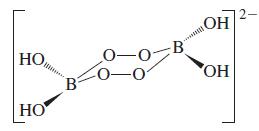
Assign oxidation states to all the atoms in a perborate ion based on the structure.Perborate ion: HO HO B 0-0- 0-01 B ОН ОН 2-
With respect to the decomposition to MO(s) and CO2(g), which of the group 2 carbonates, MCO3(s), do you expect to be most stable? Explain your answer.
The molecule tetraborane has the formula B4H10.(a) Show that this is an electron-deficient molecule.(b) How many bridge bonds must occur in the molecule?(c) Show that butane, C4H10, is not electron deficient.
Write Lewis structures for the following species, both of which involve coordinate covalent bonding:(a) Tetrafluoroborate ion, BF4‾, used in metal cleaning and in electroplating baths (b) Boron trifluoride ethylamine, used in curing epoxy resins (ethylamine is C2H5NH2).
Write chemical equations to represent the following:(a) The preparation of boron from BBr3(b) The formation of BF3 from B2O3(c) The combustion of boron in hot N2O(g).
Write chemical equations to represent the (a) Reaction of Al(s) with HCl(aq);(b) Reaction of Al(s) with NaOH(aq);(c) Oxidation of Al(s) to Al3+(aq) by an aqueous solution of sulfuric acid; the reduction product is SO2(g).
Write plausible equations for the (a) Reaction of Al(s) with Br2(l);(b) Production of Cr from Cr2O3(s) by the thermite reaction, with Al as the reducing agent;(c) Separation of Fe2O3 impurity from bauxite ore.
In some foam-type fire extinguishers, the reactants are Al2(SO4)3(aq) and NaHCO3(aq). When the extinguisher is activated, these reactants mix, producing Al(OH)3(s) and CO2(g). The Al(OH)3–CO2 foam extinguishes the fire. Write a net ionic equation to represent this reaction.
Some baking powders contain the solids NaHCO3 and NaAl(SO4)2. When water is added to this mixture of compounds, CO2(g) and Al(OH)3(s) are two of the products. Write plausible net ionic equations for the formation of these two products.
The maximum resistance to corrosion of aluminum is between pH 4.5 and 8.5. Explain how this observation is consistent with other facts about the behavior of aluminum presented in this text.
Describe a series of simple chemical reactions that you could use to determine whether a particular metal sample is “aluminum 2S” (99.2% Al) or “magnalium” (70% Al, 30% Mg). You are permitted to destroy the metal sample in the testing.
In the purification of bauxite ore, a preliminary step in the production of aluminum, [Al(OH)4]‾(aq) can be converted to Al(OH)3(s) by passing CO2(g) through the solution. Write an equation for the reaction that occurs. Could HCl(aq) be used instead of CO2(g)? Explain.
In 1825, Hans Oersted produced aluminum chloride by passing chlorine over a heated mixture of carbon and aluminum oxide. In 1827, Friedrich Wöhler obtained aluminum by heating aluminum chloride with potassium. Write plausible equations for these reactions.
A description for preparing potassium aluminum alum calls for dissolving aluminum foil in KOH(aq). The solution obtained is treated with H2SO4(aq), and the alum is crystallized from the resulting solution. Write plausible equations for these reactions.
Handbooks and lists of chemicals do not contain entries under the formulas Al(HCO3)3 and Al2(CO3)2. Explain why these compounds do not exist.
Compound FB(BF2)2 disproportionates at –30 °C to give BF3 and very unstable B8F12. The B8F12 molecule is unstable because it contains a strained four-membered ring of boron atoms. Write a balanced chemical equation for this process, and draw a plausible structure for B8F12. The B8F12 contains
Gallium trichloride (GaCl3) is a very active catalyst for a number of organic transformations. In the solid state, GaCl3 exists as a dimer with the formula Ga2Cl6. Draw a plausible structure for the Ga2Cl6 molecule, and describe the bonding. Two chlorine atoms are simultaneously bonded to two
Comment on the accuracy of a jeweler’s advertising that “diamonds last forever.” In what sense is the statement true, and in what ways is it false?
A temporary fix for a “sticky” lock is to scrape a pencil point across the notches on the key and to work the key in and out of the lock a few times. What is the basis of this fix?
Write a chemical equation to represent (a) The reduction of silica to elemental silicon by aluminum;(b) The preparation of potassium metasilicate by the high-temperature fusion of silica and potassium carbonate;(c) The reaction of Al4C3 with water to produce methane.
Write a chemical equation to represent (a) The reaction of potassium cyanide solution with silver nitrate solution;(b) The combustion of Si3H8 in an excess of oxygen;(c) The reaction of dinitrogen with calcium carbide to give calcium cyanamide (CaNCN).
Describe what is meant by the terms silane and silanol. What is their role in the preparation of silicones?
Describe and explain the similarities and differences between the reaction of a silicate with an acid and that of a carbonate with an acid.
Methane and sulfur vapor react to form carbon disulfide and hydrogen sulfide. Carbon disulfide reacts with Cl2(g) to form carbon tetrachloride and S2Cl2. Further reaction of carbon disulfide and S2Cl2 produces additional carbon tetrachloride and sulfur. Write a series of equations for the reactions
Show that the empirical formula given for muscovite mica is consistent with the expected oxidation states of the elements present.
Show that the empirical formula given for crysotile asbestos is consistent with the expected oxidation states of the elements present.
Write plausible chemical equations for the (a) Dissolving of lead(II) oxide in nitric acid; (b) Heating of SnCO3(s);(c) Reduction of lead(II) oxide by carbon;(d) Reduction of Fe3+(aq) to Fe2+(aq) by Sn2+(aq);(e) Formation of lead(II) sulfate during high-temperature roasting of lead(II) sulfide.
Write plausible chemical equations for preparing each compound from the indicated starting material:(a) SnCl2 from SnO; (b) SnCl4 from Sn; (c) PbCrO4 from PbO2.What reagents (acids, bases, salts) and equipment commonly available in the laboratory are needed for each reaction?
Lead(IV) oxide, PbO2, is a good oxidizing agent. Use appropriate data from Appendix D to determine whether PbO2(s) in a solution with [H3O+] = 1 M is a sufficiently good oxidizing agent to carry the following oxidations to the point at which the concentration of the species being oxidized decreases
Aqueous tin(II) ion, Sn2+ (aq), is a good reducing agent. Use data from Appendix D to determine whether Sn2+ (aq) is a sufficiently good reducing agent to reduce (a) I2 (s) to I‾ (aq); (b) Fe3+(aq) to Fe2+(aq); (c) Zn2+ (aq) to Zn(s); and (d) Pb2+ (aq) to Pb(s). Assume that all reactants and
Would you expect the reaction of Sn(s) and Cl2(g) to yield SnCl2 or SnCl4?
Would you expect the reaction of Ge(s) and F2(g) to yield GeF2, with germanium in the +2 oxidation state, or GeF4, with germanium in the +4 oxidation state?
A chemical that should exist as a crystalline solid is seen to be a mixture of a solid and liquid in a container on a storeroom shelf. Give a plausible reason for that observation. Should the chemical be discarded or is it still useful for some purposes?
The following series of observations is made: (1) A small piece of dry ice [CO2(s)] is added to 0.005 M Ca(OH)2(aq). (2) Initially, a white precipitate forms.(3) After a short time the precipitate dissolves.(a) Write chemical equations to explain these observations.(b) If the 0.005 M Ca(OH)2(aq)
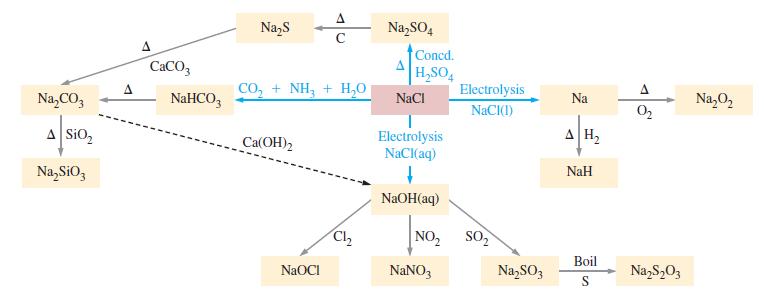
The melting point of NaCl(s) is 801 °C, much higher than that of NaOH (322 °C). More energy is consumed to melt and maintain molten NaCl than NaOH. Yet the preferred commercial process for the production of sodium is electrolysis of NaCl(l) rather than NaOH(l). Give a reason or reasons for this
Although the triiodide ion, I3‾, is known to exist in aqueous solutions, the ion is stable in only certain ionic solids. For example, CsI3 is stable with respect to decomposition to CsI and I2, but LiI3 is not stable with respect to LiI and I2. Draw a Lewis structure for the I3‾ ion and
At 298 K, the ΔfG° values for Li2O(s) and Li2O2(s) suggest that Li2O2(s) is thermodynamically more stable than Li2O(s). At 1000 K, however, the situation is reversed. The standard Gibbs energies of formation, ΔfG°, for Li2O(s) and Li2O2(s) are –466.40 kJ mol‾1 and –419.02 kJ mol‾1,
The chemical equation for the hydration of an alkali metal ion is M+(g): M+(aq). The standard Gibbs energy changes and the enthalpy changes for the process are denoted by ΔhydrG° and ΔhydrH° and respectively. ΔhydrG° and ΔhydrH° values are given below for the alkali metal ions.Use the data
When a 0.250 g sample of Ca is heated in air, 0.325 g of product is obtained. Assume that all the Ca appears in the product.(a) If the product were pure CaO, what mass should have been obtained?(b) Show that the 0.325 g product could be a mixture of CaO and Ca3N2.(c) What is the mass percent of CaO
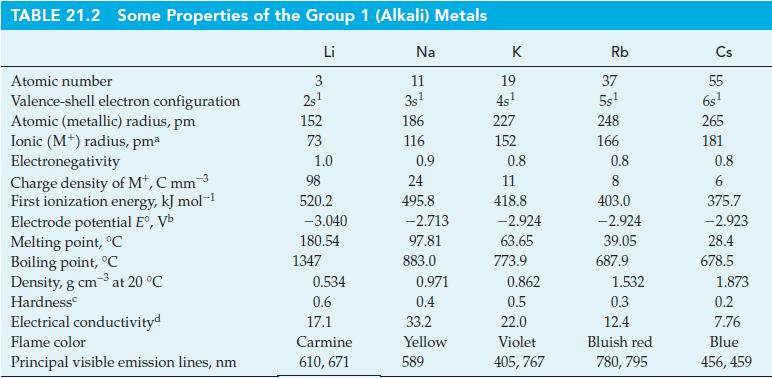
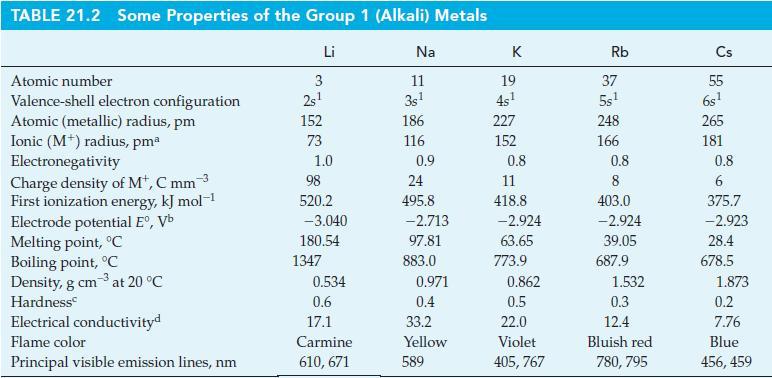
Comment on the feasibility of using a reaction similar to (21.4) to produce (a) Lithium metal from LiCl; (b) Cesium metal from CsCl, with Na(l) as the reducing agent in each case. Consider data from Table 21.2.Reaction (21.4)Table 21.2 KCI(1) + Na(1) 850 °C NaCl(1) + K(g) (21.4)
Concerning the thermite reaction, (a) Use data from Appendix D to calculate ΔrH° at 298 K for the reaction below.(b) Write an equation for the reaction when MnO2(s) is substituted for Fe2O3(s), and calculate ΔrH° for this reaction.(c) Show that if MgO were substituted for Fe2O3, the reaction
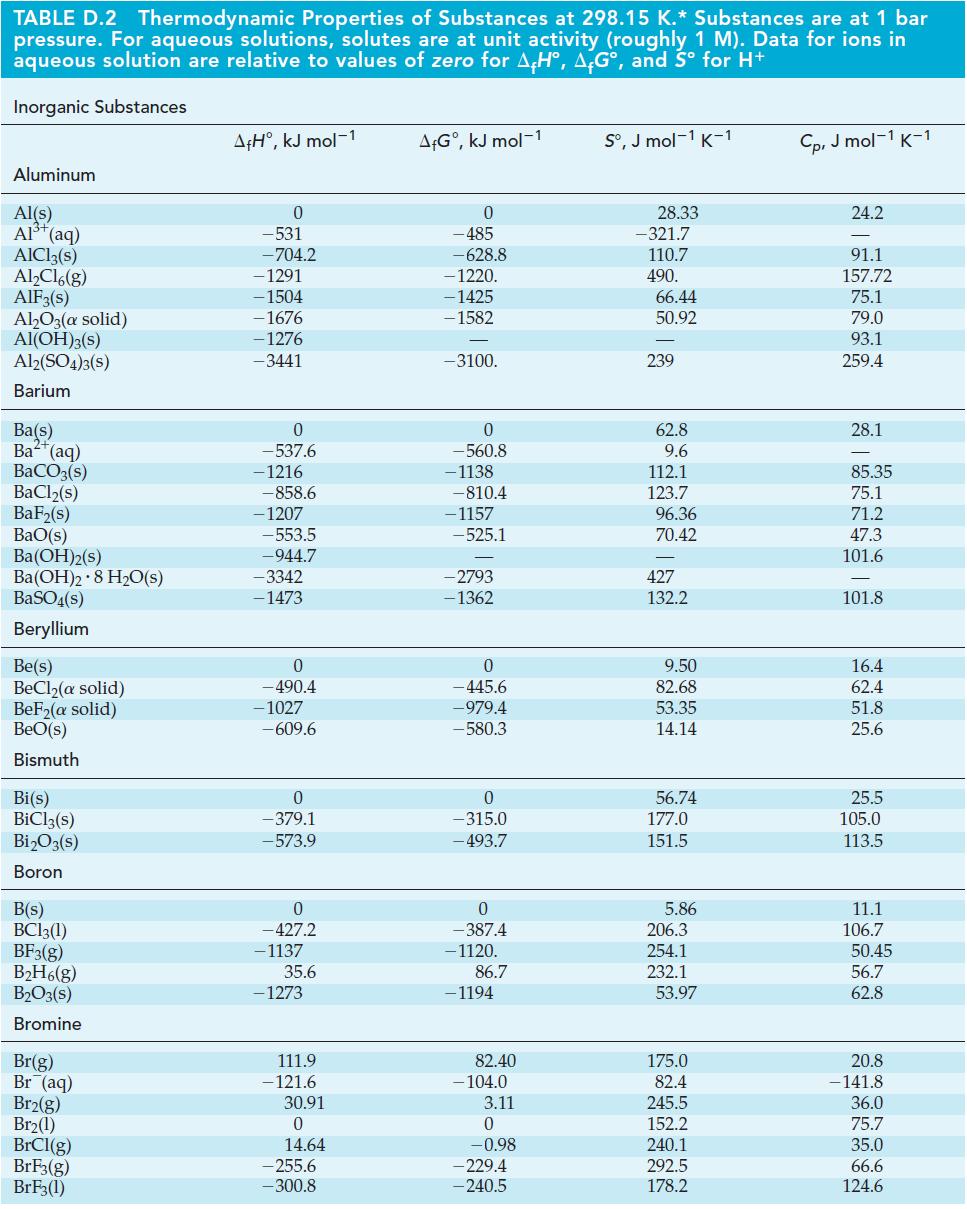
Use data from Appendix D (Table D-2) to calculate a value of E° for the reduction of Li+(aq) to Li(s), and compare your result with the value listed in Table 21.2.Table D-2Table 21.2 TABLE D.2 Thermodynamic Properties of Substances at 298.15 K.* Substances are at 1 bar pressure. For aqueous
The electrolysis of 0.250 L of 0.220 M MgCl2 is conducted until 104 mL of gas (a mixture of H2 and water vapor) is collected at 23 °C and 748 mmHg. Will Mg(OH)2(s) precipitate if electrolysis is carried to this point? (Use 21 mmHg as the vapor pressure of the solution.)
A particular water sample contains 56.9 ppm SO42– and 176 ppm HCO3– with Ca2+ as the only cation.(a) How many parts per million of Ca2+ does the water contain?(b) How many grams of CaO are consumed in removing HCO3–, from 602 kg of the water?(c) Show that the Ca2+ remaining in the water
Write an appropriate formula for each of the following:(a) Hydroxylamine; (b) Calcium hydrogen phosphate;(c) Lithium nitride.
Use Figure 22-17 to establish E° for the reduction of N2O4 to NO in an acidic solution.Figure 22-17 Acidic solution ([H+] = 1 M): +5 +3 -2 +4 +2 +1 0 - 1 0.803 V 1.065 V 0.996 V 1.591 V 1.766 V -1.87 V 1.275 V NO3-N₂O4 HNO₂- NO N₂0 N₂NH3OH+—— N₂H5+—NH4+ 1.42 V Basic solution ([OH-]
Use Figure 22-17 to establish E° for the reduction of NO3– to NO2– in a basic solution.Figure 22-17 Acidic solution ([H+] = 1 M): +5 +3 +4 +2 +1 0 - 1 1.42 V 0.803 V 1.065 V 0.996 V 1.591 V 1.766 V -1.87 V NO3-N₂04 HNO₂ NO N₂0 N₂NH3OH+———N₂H5+———NH4+ Basic solution
All the group 15 elements form trifluorides, but nitrogen is the only group 15 element that does not form a pentafluoride.(a) Suggest a reason why nitrogen does not form a pentafluoride.(b) The observed bond angle in NF3 is approximately 102.5 °C. Use VSEPR theory to rationalize the structure of
For use in analytical chemistry, sodium thiosulfate solutions must be carefully prepared. In particular, the solutions must be kept from becoming acidic. In strongly acidic solutions, thiosulfate ion disproportionates into SO2(g) and S8(s).Show that the disproportionation of S2O32–(aq) is
What is the value of K for the dissociation of HI(g) into its elements at 298 K?
Do you expect the ions ICl2+ and ICl2– to have the same shape? Explain.
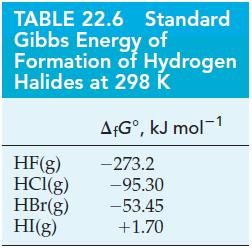
(A) What is the value of K for the dissociation of HF(g) into its elements at 298 K? Use data from Table 22.6.(B) Use data from Table 22.6 to determine K and the percent dissociation of HCl(g) into its elements at 298 K.Table 22.6 TABLE 22.6 Standard Gibbs Energy of Formation of Hydrogen Halides at
Fluorine is able to stabilize elements in very high oxidation states. For each of the elements Na, Mg, Al, Si, P, S, and Cl, give the formula of the highest oxidationstate of fluoride that is known to exist. Then, describe the variation in bonding that occurs as we move from left to right across
(A) Use information from Figure 22-17 to decide whether the nitrite anion, NO2–, disproportionates spontaneously in basic solution to NO3– and NO. Assume standard-state conditions.(B) Does HNO2 spontaneously disproportionate to NO3– and NO in acidic solution? Assume standard-state
Which of the following dilute aqueous solutions can be used to obtain oxygen and hydrogen gases simultaneously through electrolysis using platinum electrodes: H2SO4(aq), CuSO4(aq), NaOH(aq), KNO3(aq), NaI(aq)? Explain.
The oxides of the phosphorus(III), antimony(III), and bismuth(III) are P4O6, Sb4O6, and Bi2O3. Only one of these oxides is amphoteric. Which one? Which of these oxides is most acidic? Which is most basic?
Would you expect the shape of the ozonide ion to be the same as that of ozone? Explain.
The oxides of the selenium(IV) and tellurium(IV) are SeO2 and TeO2. One of these oxides is amphoteric and one is acidic. Which is which?
Electrostatic potential maps for OF2 and OCl2 are shown in the margin. Explain the differences.
A 55 L cylinder contains Ar at 145 atm and 26 °C. What minimum volume of air at STP must have been liquefied and distilled to produce this Ar? Air contains 0.934% Ar, by volume.
In the solid phase, PCl5 forms PCl4+ and PCl6+ However, PBr5 forms PBr4+Br– Suggest a reason for this difference in structure.
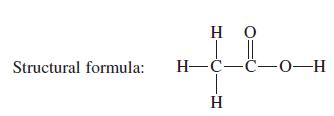
Write condensed structural formulas for phosphoric acid and phosphorous acid. Condensed structural formulas are discussed on page 70. Structural formula: HO || H-C-C-0-H H
Some sources of natural gas contain 8% He by volume. How many liters of such a natural gas must be processed at STP to produce 5.00 g of He?
Use VSEPR theory to predict the probable geometric structures of (a) XeO3;(b) XeO4;(c) XeF5+.
Use VSEPR theory to predict the probable geometric structures of the molecules (a) O2XeF2;(b) O3XeF2;(c) OXeF4.
Write a chemical equation for the hydrolysis of XeF4 that yields XeO3, Xe, O2, and HF as products.
Write a chemical equation for the hydrolysis in alkaline solution of XeF6 that yields XeO64–, Xe, O2, F‾, and H2O as products.
Provide an explanation for the observation that helium, neon, and argon do not react directly with fluorine.
Provide an explanation for the inability of O2 to react directly with xenon.
Freshly prepared solutions containing iodide ion are colorless, but over time they usually turn yellow. Describe a plausible chemical reaction (or reactions) to account for this observation.
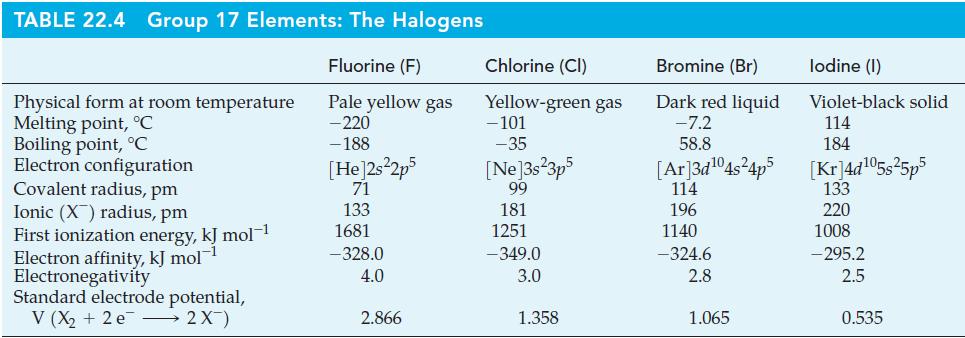
The following properties of astatine have been measured or estimated: (a) Covalent radius; (b) Ionic radius (At–);(c) First ionization energy; (d) Electron affinity; (e) Electronegativity; (f) Standard reduction potential. Based on periodic relationships and data in Table 22.4, what values
Fluorine can be prepared by the reaction of hexafluoro-manganate(IV) ion, MnF62–, with antimony pentafluoride to produce manganese(IV) fluoride and SbF6–, followed by the disproportionation of manganese(IV) fluoride to manganese(III) fluoride and F2(g). Write chemical equations for these two
Make a general prediction about which of the halogen elements, F2, Cl2, Br2, or I2, displaces other halogens from a solution of halide ions. Which of the halogens is able to displace O2(g) from water? Which is able to displace H2(g) from water?
The abundance of F‾ in seawater is 1 g F‾ per ton of seawater. Suppose that a commercially feasible method could be found to extract fluorine from seawater.(a) What mass of F2 could be obtained from 1 km3 of seawater (d = 1.03 g cm–3)?(b) Would the process resemble that for extracting bromine
Fluorine is produced chiefly from fluorite, CaF2. Fluorine can also be obtained as a by-product of the production of phosphate fertilizers, derived from phosphate rock [3 Ca3(PO4)2 · CaF2]. What is the maximum mass of fluorine that could be extracted as a by-product from 1.00 x 10³ kg of phosphate
Show by calculation whether the disproportionation of chlorine gas to chlorate and chloride ions will occur under standard-state conditions in an acidic solution.
Showing 300 - 400
of 4008
1
2
3
4
5
6
7
8
9
10
11
12
13
14
15
Last
Step by Step Answers

 Get 50% OFF
Claim Now
Get 50% OFF
Claim Now






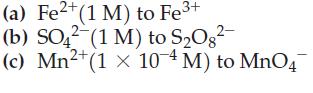




![Acidic solution ([H+] = 1 M): +5 +3 +4 +2 +1 0 - 1 0.803 V 1.065 V 0.996 V 1.591 V 1.766 V -1.87 V 1.42 V](https://dsd5zvtm8ll6.cloudfront.net/images/question_images/1701/2/5/7/793656722412d5081701257792741.jpg)
![Acidic solution ([H+] = 1 M): +5 +3 +4 +2 +1 0 - 1 1.42 V 1.275 V 0.803 V 1.065 V 0.996 V 1.591 V 1.766 V](https://dsd5zvtm8ll6.cloudfront.net/images/question_images/1701/2/5/7/975656722f75a4501701257974685.jpg)
![Acidic solution ([H+] = 1 M): +5 +3 -2 +4 +2 +1 0 - 1 1.275 V 0.803 V 1.065 V 0.996 V 1.591 V 1.766 V-1.87 V](https://dsd5zvtm8ll6.cloudfront.net/images/question_images/1701/2/4/4/0076566ec67676891701244007198.jpg)