New Semester
Started
Get
50% OFF
Study Help!
--h --m --s
Claim Now
Question Answers
Textbooks
Find textbooks, questions and answers
Oops, something went wrong!
Change your search query and then try again
S
Books
FREE
Study Help
Expert Questions
Accounting
General Management
Mathematics
Finance
Organizational Behaviour
Law
Physics
Operating System
Management Leadership
Sociology
Programming
Marketing
Database
Computer Network
Economics
Textbooks Solutions
Accounting
Managerial Accounting
Management Leadership
Cost Accounting
Statistics
Business Law
Corporate Finance
Finance
Economics
Auditing
Tutors
Online Tutors
Find a Tutor
Hire a Tutor
Become a Tutor
AI Tutor
AI Study Planner
NEW
Sell Books
Search
Search
Sign In
Register
study help
sciences
general chemistry principles
General Chemistry Principles And Modern Applications 11th Edition Ralph Petrucci, Jeffry Madura, F. Herring, Carey Bissonnette - Solutions
All of the following have a tetrahedral shape except (a) SO42–;(b) XeF4;(c) CCl4;(d) XeO4;(e) NH4+.
Two of the following, through a reaction occurring in a weakly acidic solution, produce the same gaseous product. They are (a) CaH2(s);(b) Na2O2(s);(c) NaOH(s); (d) Al(s); (e) NaHCO3(s);(f) N2H4(l)
Write a plausible chemical equation to represent the reaction of (a) Cl2(g) with cold NaOH(aq);(b) NaI(s) with hot H2SO4(concd aq);(c) Cl2(g) with KI3(aq);(d) NaBr(s) with hot H3PO4(e) NaHSO3(aq) with MnO4–(aq) in dilute H2SO4(aq).
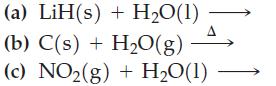
Complete and balance equations for these reactions. (a) LiH(s) + H₂O(1) (b) C(s) + H₂O(g) (c) NO₂(g) + H₂O(1) A
Give a practical laboratory method that you might use to produce small quantities of the following gases and comment on any difficulties that might arise: (a) O2;(b) NO; (c) H2;(d) NH3;(e) CO2.
If Br– and I– occur together in an aqueous solution, I– can be oxidized to IO3– with an excess of Cl2(aq). Simultaneously, Br– is oxidized to Br2, which is extracted with CS2(l). Write chemical equations for the reactions that occur.
Suppose that the sulfur present in seawater as SO42– (2650 mg L–1) could be recovered as elemental sulfur. If this sulfur were then converted to H2SO4, how many cubic kilometers of seawater would have to be processed to yield the average U.S. annual consumption of about 45 million tons of
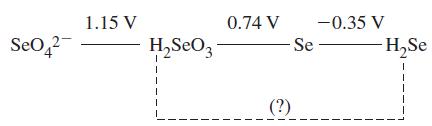
A portion of the standard electrode potential diagram of selenium is given below. What is the E° value for the reduction of H2SeO3 to H2Se in 1 M acid? Se04² 1.15 V H₂S₂O3 0.74 V -0.35 V -Se- (?) H₂Se 1 1 I T 1
Although relatively rare, all of the following compounds exist. Based on what you know about related compounds (for example, from the periodic table), propose a plausible name or formula for each compound:(a) Silver(I) astatide; (b) Na4XeO6; (c) Magnesium polonide; (d) H2TeO3;(e) Potassium
Use the following electrode potential diagram for basic solutions to classify each of the statements below as true or false. Assume standard conditions.(a) Sulfate (SO42–) is a stronger oxidant than thiosulfate (S2O32–) in basic solution.(b) S2– can be used as a reducing agent in basic
What is the acid anhydride of (a) H2SO4;(b) H2SO3;(c) HClO4;(d) HIO3?
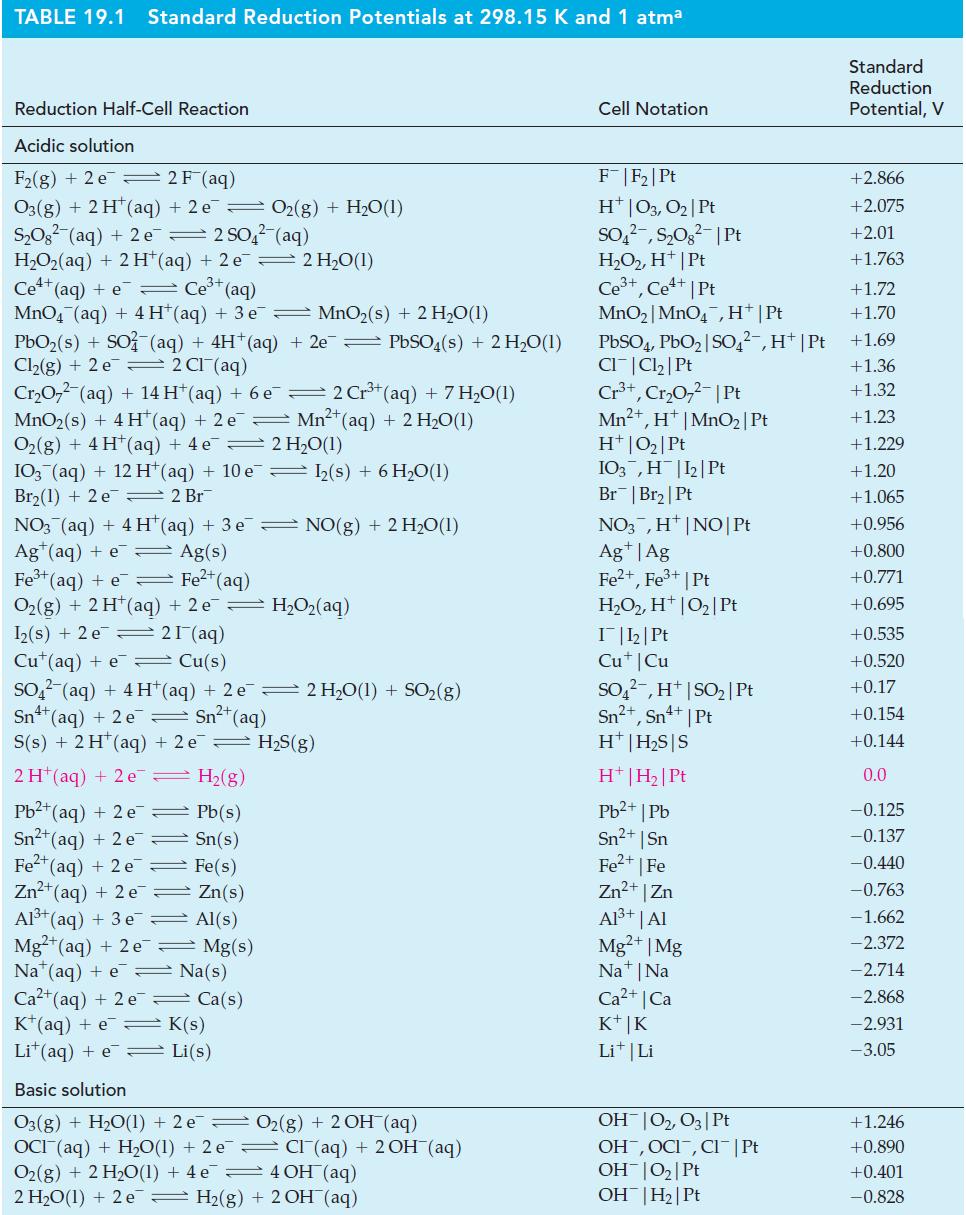
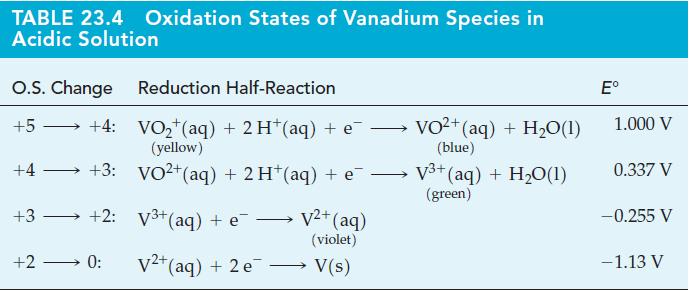
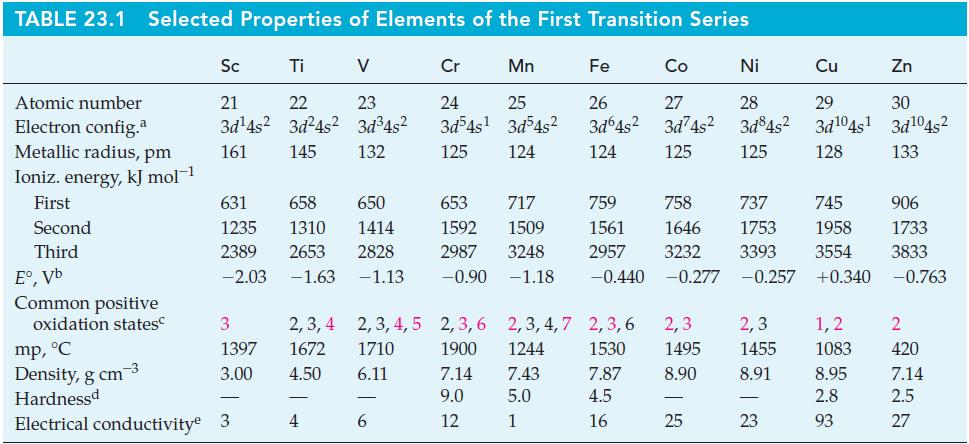
(A) Use data from Tables 19.1 and 23.4 to determine whether nitric acid can be used to oxidize V3+(aq) to VO2+(aq) for standard-state conditions. If so, write a balanced equation for the reaction.(B) Select a reducing agent from Table 19.1 that can be used to reduce VO2+(aq) to V2+(aq) for
(A) Write plausible chemical equations to represent the (a) Roasting of Cu2S;(b) Reduction of WO3 with H2(g);(c) Thermal decomposition of HgO to its elements.(B) Write chemical equations to represent the (a) Reduction of Cr2O3 to chromium with silicon as the reducing agent; (b) Conversion of
Although a number of slightly soluble copper(I) compounds (such as CuCN) can exist in contact with water, it is not possible to prepare a solution with a high concentration of Cu+ ion. Show that Cu+(aq) disproportionates to Cu2+(aq) and Cu(s), and explain why a high [Cu+] cannot be maintained in
The text describes the production of pure zinc from zinc sulfide ore both by a pyrometallurgical and by a hydrometallurgical process. Which aspects of the two processes are different and which are similar?
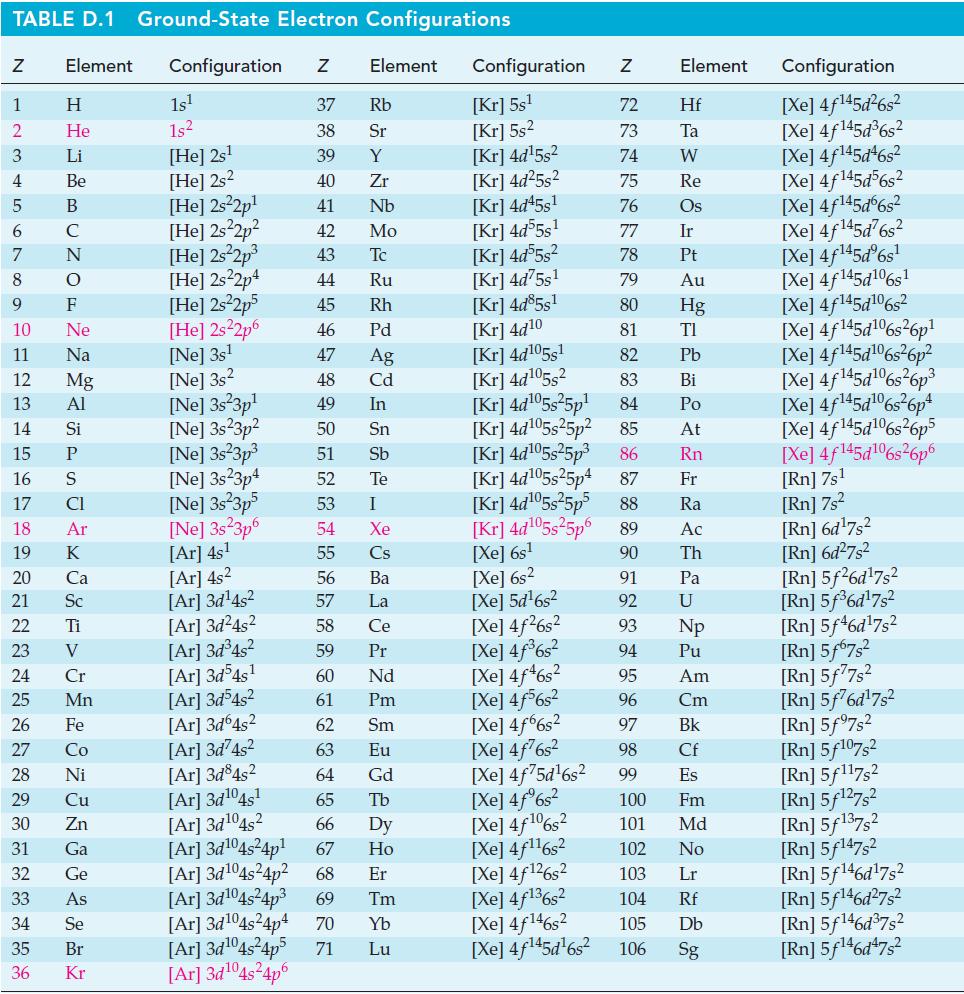
By means of orbital diagrams, write electron configurations for the following transition element atom and ions: (a) V; (b) Cr3+;(c) Mn2+;(d) Fe2+; (e) Cu2+;(f) Ni2+.
Write chemical equations to represent the (a) Roasting of galena, PbS; (b) Reduction of Cu2O(s) with charcoal as a reducing agent; (c) Deposition of pure silver from an aqueous solution of Ag+.
Write a balanced chemical equation for the direct reduction of iron(III) oxide by hydrogen gas.
Arrange the following species according to the number of unpaired electrons they contain, starting with the one that has the greatest number: Fe, Sc3+, Ti2+, Mn4+, Cr, Cu2+.
(A) Consider a galvanic cell based on the following half-reactions. Assuming the cell operates under standard conditions at 25 °C, what is the spontaneous cell reaction? Under what nonstandard conditions is the spontaneous formation of [PtCl6]2– favored? Do you think that, in practical terms, a
Can MnO4–(aq) be used to oxidize VO2+(aq) to VO2+(aq) for standard-state conditions in an acidic solution? If so, write a balanced equation for the redox reaction.
The dichromate ion is formed by the condensation of chromate ion in an acidic solution. Further condensation occurs at low pH to form [Cr3O10]2–. Suggest the structures for these anions. What other elements form similar anions?
Describe how the transition elements compare with main-group metals (such as group 2) with respect to oxidation states, formation of complexes, colors of compounds, and magnetic properties.
What is the oxidation state of iron in the compound Fe(CO)5?
With only minor irregularities, the melting points of the first series of transition metals rise from that of Sc to that of Cr and then fall to that of Zn. Give a plausible explanation for this phenomenon based on atomic structure.
What is the ground state electron configuration of gold(III) ion?
Why do the atomic radii vary so much more for two main-group elements that differ by one unit in atomic number than they do for two transition elements that differ by one unit?
Suggest the geometry of the cadmium anion [CdCl5]3–.
The metallic radii of Ni, Pd, and Pt are 125, 138, and 139 pm, respectively. Why is the difference in radius between Pt and Pd so much less than between Pd and Ni?
Which of the first transition series elements exhibits the greatest number of different oxidation states in its compounds? Explain.
Why is the number of common oxidation states for the elements at the beginning and those at the end of the first transition series less than for elements in the middle of the series?
As a group, the lanthanides are more reactive metals than are those in the first transition series. How do you account for this difference?
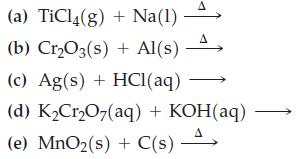
Complete and balance the following equations. If no reaction occurs, so state. 1₁ (a) TiCl4(g) + Na(1) (b) Cr₂O3(s) + Al(s) A (c) Ag(s) + HCl(aq) (d) K₂Cr₂O7(aq) + KOH(aq) (e) MnO₂ (s) + C(s).
The maximum difference in standard reduction potential, E°M2+/M(s), among members of the first transition series is about 2.4 V. For the lanthanides, the maximum difference in E°M3+/M(s) is only about 0.4 V. How do you account for this fact?
By means of a chemical equation, give an example to represent the reaction of (a) A transition metal with a nonoxidizing acid; (b) A transition metal oxide with NaOH(aq); (c) An inner transition metal with HCl(aq).
Write balanced chemical equations for the following reactions described in the chapter.(a) The reaction of Sc(OH)3(s) with HCl(aq);(b) Oxidation of Fe2+(aq) by MnO4–(aq) in basic solution to give Fe3+(aq) and MnO2(s);(c) The reaction of TiO2(s) with molten KOH to form K2TiO3;(d) Oxidation of
Write balanced equations for the following reactions described in the chapter.(a) Sc(l) is produced by the electrolysis of Sc2O3 dissolved in Na3ScF6(l).(b) Cr(s) reacts with HCl(aq) to produce a blue solution containing Cr2+(aq).(c) Cr2+(aq) is readily oxidized by O2(g) to Cr3+(aq).(d) Ag(s)
Suggest a series of reactions, using common chemicals, by which each of the following syntheses can be performed.(a) Fe(OH)3(s) from FeS(s).(b) BaCrO4(s) from BaCO3(s) and K2Cr2O7(aq).
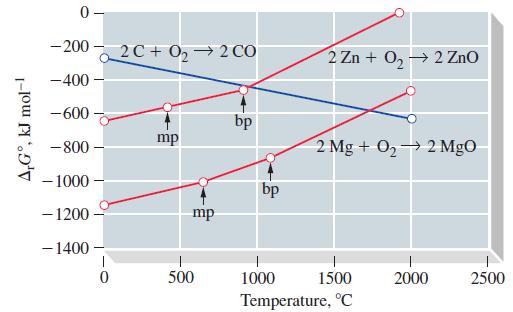
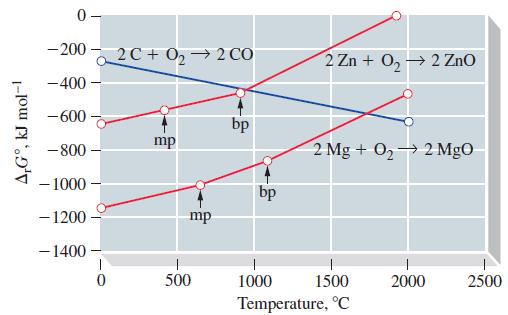
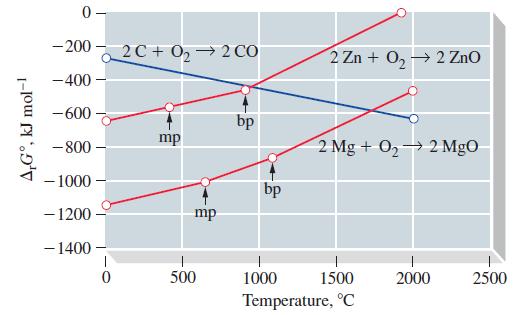
According to Figure 23-8, ΔrG° decreases with temperature for the reaction 2 C(s) + O2(g) → 2 CO(g). How would you expect ΔrG° to vary with temperature for the following reactions?Figure 23-8 (a) C(s) + O₂(g) (b) 2 CO(g) + O₂(g) CO₂(g) 2 CO₂(g)
Suggest a series of reactions, using common chemicals, by which each of the following syntheses can be performed.(a) Cu(OH)2(s) from CuO(s).(b) CrCl3(aq) from (NH4)2Cr2O7(s).
One of the simplest metals to extract from its ores is mercury. Mercury vapor is produced by roasting cinnabar ore (HgS) in air. Alternatives to this simple roasting, designed to reduce or eliminate SO2 emissions, is to roast the ore in the presence of a second substance. For example, when cinnabar
Use electrode potential data from this chapter or Appendix D to predict whether each of the following reactions will occur to any significant extent under standard-state conditions.(a)(b)(c) + 2 VO₂ + 6 Br + 8 H+ 2 V2+ + 3 Br₂(1) + 4 H₂0
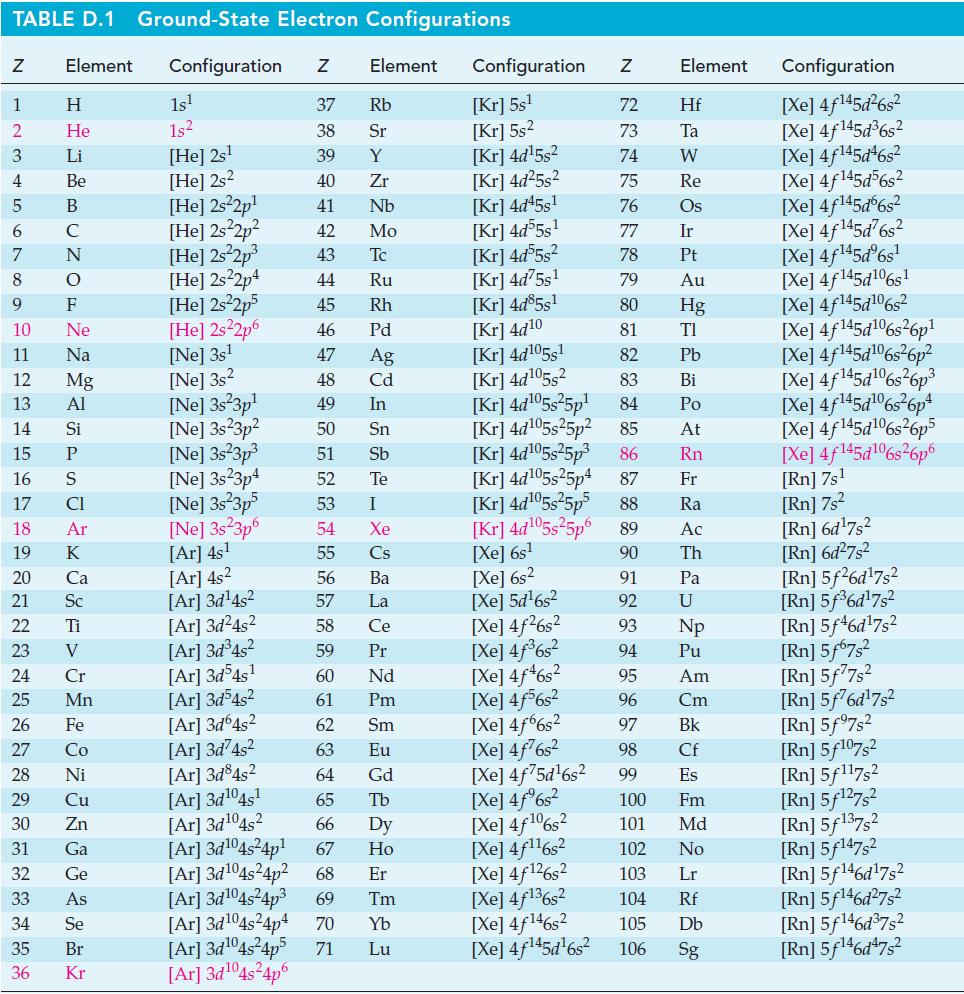
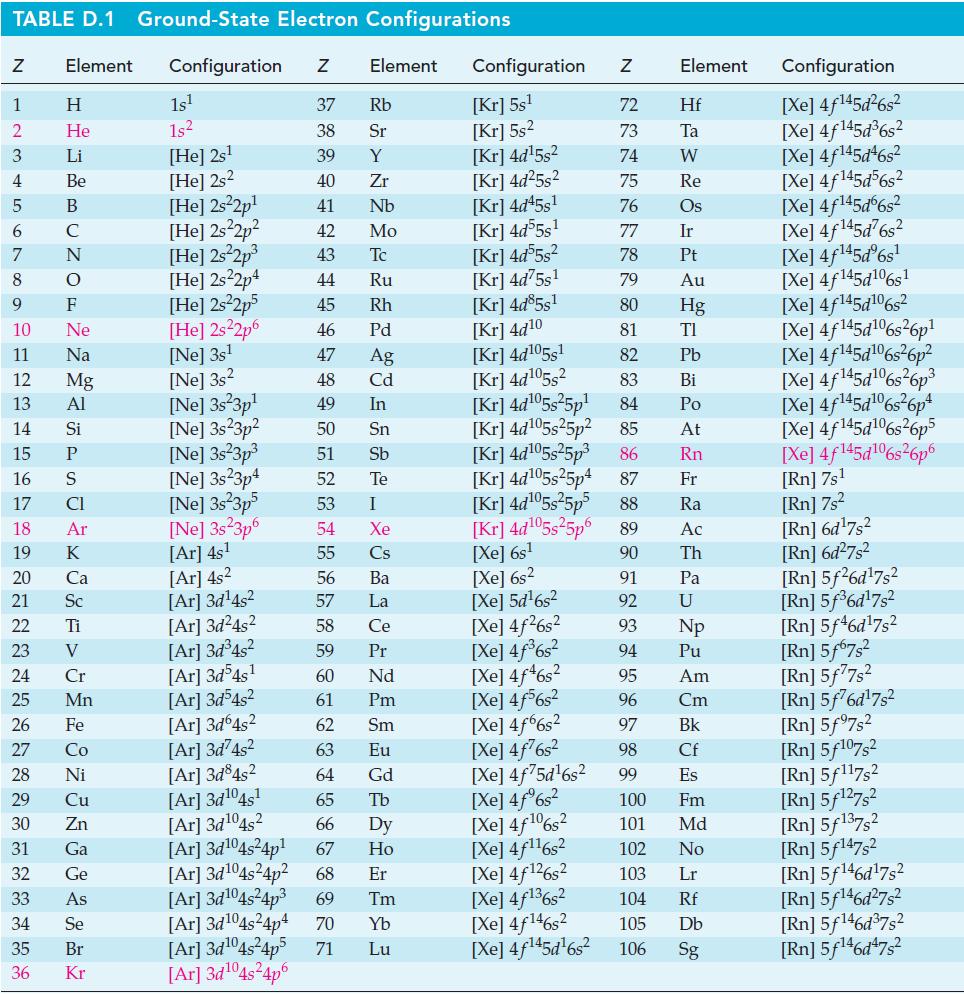
You are given these three reducing agents: Zn(s), Sn2+(aq), and I–(aq). Use data from Appendix D to determine which of them can, under standard-state conditions in acidic solution, reduce(a) Cr2O7 2–(aq) to Cr3+(aq).(b) Cr3+(aq) to Cr2+(aq).(c) SO42–(aq) to SO2(g). TABLE D.1 Ground-State
One method of obtaining chromium metal from chromite ore is as follows. After reaction (23.16), sodium chromate is reduced to chromium(III) oxide by carbon. Then the chromium(III) oxide is reduced to chromium metal by silicon. Write plausible equations to describe these two reactions.Reaction
Calcium will reduce MgO(s) to Mg(s) at all temperatures from 0 to 2000 °C. Use this fact, together with the melting point (839 °C) and boiling point (1484 °C) of calcium, to sketch a plausible graph of ΔrG° as a function of temperature for the reaction 2 Ca(s) + O2(g) → 2 CaO(s).
Write plausible half-equations to represent each of the following in acidic solution.(a) CuO as an oxidizing agent;(b) FeO as a reducing agent.
Write plausible half-equations to represent each of the following in basic solution.(a) Oxidation of Fe(OH)3(s) to FeO42–;(b) Reduction of [Ag(CN)2]– to silver metal.
Refer to Example 23-2. Select a reducing agent (from Table 23.1 or Appendix D) that will reduce VO2+ to V3+ and no further in acidic solution.Example 23-2Can MnO4–(aq) be used to oxidize VO2+(aq) to VO2+(aq) for standard-state conditions in an acidic solution? If so, write a balanced equation for
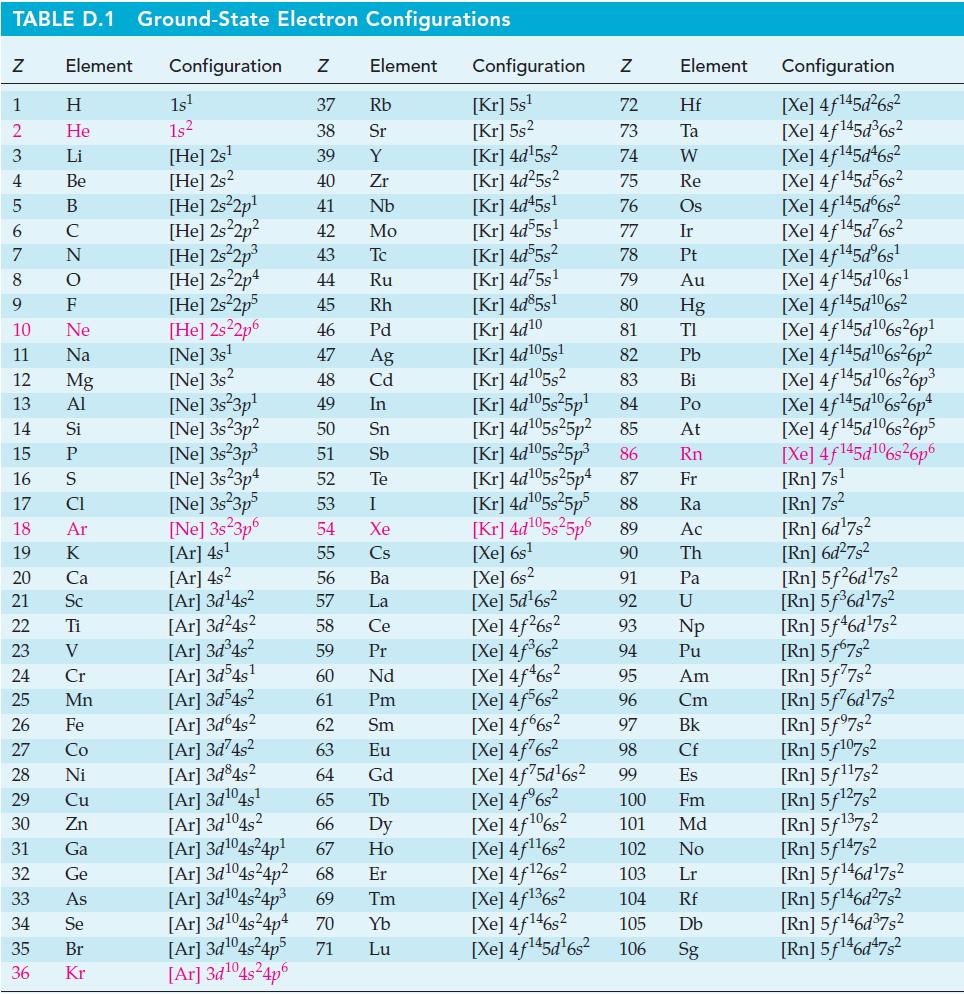
Based on the description of the nickel–cadmium cell, and with appropriate data from Appendix D, estimate E° for the reduction of NiO(OH) to Ni(OH)2. TABLE D.1 Ground-State Electron Configurations Element Configuration Z Z 1 2 3 4 6 7 8 9 5 B 10 11 12 13 14 15 16 17 18 19 20 25 27 29 HIG&LUZONSUZ
How long would an electric current of 3.5 A have to pass through a chrome-plating bath to produce a chromium deposit 0.0010 mm thick on an object with a surface area of (The density of 0.375 m2? Cr is 7.14 g cm–3.)
Why is it reasonable to expect the chemistry of dichromate ion to involve mainly oxidation–reduction reactions and that of chromate ion to involve mainly precipitation reactions?
Will reaction (23.25) still be spontaneous in the forward direction in a solution containing equal concentrations of Fe2+ and Fe3+, a pH of 3.25, and under an O2(g) partial pressure of 0.20 atm?Reaction (23.25) 4 Fe²+ (aq) + O₂(g) + 4H+ (aq) 3+ → 4 Fe³+ (aq) + 2 H₂O(1) Ecell = 0.44 V (23.25)
What products are obtained when Mg2+(aq) and Cr3+(aq) are each treated with a limited amount of NaOH(aq)? With an excess of NaOH(aq)? Why are the results different in these two cases?
Write a net ionic equation to represent the precipitation of Prussian blue.
The reaction to form Turnbull’s blue appears to occur in two stages. First, Fe2+(aq) is oxidized to Fe3+(aq) and ferricyanide ion is reduced to ferrocyanide ion. Then, the Fe3+(aq) and ferrocyanide ion combine. Write equations for these reactions.
Write plausible equations for the following reactions occurring in the hydrometallurgy of the coinage metals.(a) Copper is precipitated from a solution of copper(II) sulfate by treatment with H2(g).(b) Gold is precipitated from a solution of Au+ by adding iron(II) sulfate.(c) Copper(II) chloride
In the metallurgical extraction of silver and gold, an alloy of the two metals is often obtained. The alloy can be separated into Ag and Au either with concentrated HNO3 or boiling concentrated H2SO4, in a process called parting. Write chemical equations to show how these separations work.
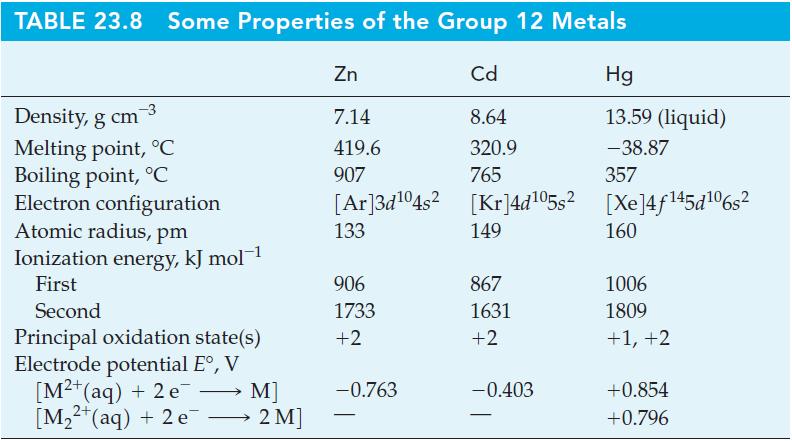
Use data from Table 23.8 to determine E° for the reduction of Hg2+ to Hg22+ in aqueous solution.Table 23.8 TABLE 23.8 Some Properties of the Group 12 Metals Density, g cm Melting point, °C Boiling point, °C Electron configuration Atomic radius, pm Ionization energy, kJ
Show that the corrosion reaction in which Cu is converted to its basic carbonate (reaction 23.27) can be thought of in terms of a combination of oxidation–reduction, acid–base, and precipitation reactions.Reaction (23.27) 2 Cu(s) + H₂O(g) + CO2(g) + O2(g) Cu₂(OH)2CO3(s) Basic copper
Use the result of the Integrative Example to determine whether a solution can be prepared with [Cu+] equal to (a) 0.20 M; (b) 1.0 x 10⁻¹⁰ M.Integrative ExampleAlthough a number of slightly soluble copper(I) compounds (such as CuCN) can exist in contact with water, it is not possible to prepare
Use Figure 23-8 to estimate for the reaction ZnO(s) + C(s) ⇌ Zn(l) + CO(g), at 800 °C, (a) A value of Kp;(b) The equilibrium pressure of CO(g).Figure 23-8 A,Gº, kJ mol-1 0- -2002C+0₂ → 2 CO - 400 -600 -800- - 1000 - 1200 - 1400 0 mp mp 500 bp bp 2 Zn + 0₂ → 2 ZnO 2 Mg + O₂ 2
At 400 °C, ΔrG° = –25 kJ mol–1 for the reaction 2 Hg(l) + O2(g) → 2 HgO(s). If a sample of HgO(s) is heated to 400 °C, what will be the equilibrium partial pressure of O2(g)?
The vapor pressure of Hg(l) as a function of temperature is log P(mmHg) = (–0.05223 a/T) + b, where a = 61,960 and b = 8.118; T is the Kelvin temperature. Show that at 25 °C, the concentration of Hg(g) in equilibrium with Hg(l) greatly exceeds the maximum permissible level of 0.05 mg Hg/m3 air.
In ZnO, the band gap between the valence and conduction bands is 325 kJ mol–1, and in CdS it is 250 kJ mol–1. Show that CdS absorbs some visible light but ZnO does not. Explain the observed colors: ZnO is white and CdS is yellow.
CdS is yellow, HgS is red, and CdSe is black. Which of these materials has the largest band gap? the smallest? How does the band gap relate to the observed color?
Although Au reacts with and dissolves in aqua regia (3 parts HCl + 1 part HNO3), Ag does not dissolve. What is (are) the likely reason(s) for this difference?
The text mentions that scandium metal is obtained from its molten chloride by electrolysis, and that titanium is obtained from its chloride by reduction with magnesium. Why are these metals not obtained by the reduction of their oxides with carbon (coke), as are metals such as zinc and iron?
The text notes that in small quantities, zinc is an essential element (though it is toxic in higher concentrations). Tin is considered to be a toxic metal. Can you think of reasons why, for food storage, tinplate instead of galvanized iron is used in cans?
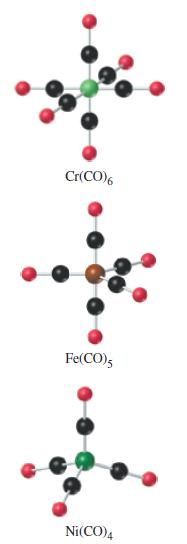
What formulas would you expect for the metal carbonyls of (a) Molybdenum, (b) Osmium; (c) Rhenium? Note that the simple carbonyls shown in Figure 23-15 have one metal atom per molecule. Some metal carbonyls are binuclear; that is, they have two metal atoms bonded together in the carbonyl
In an atmosphere polluted with industrial smog, Cu corrodes to a basic sulfate, Cu2(OH)2SO4. Propose a series of chemical reactions to describe this corrosion.
For the straight-line graphs in Figure 23-8, explain why (a) Breaks occur at the melting points and boiling points of the metals; (b) The slopes of the lines become more positive at these breaks; (c) The break at the boiling point is sharper than at the melting point.Figure 23-8 A,Gº, kJ
Attempts to make CuI2 by the reaction of Cu2+(aq) and I–(aq) produce CuI(s) and I3–(aq) instead. Without performing detailed calculations, show why this reaction should occur. 2 Cu²+ (aq) + 51 (aq) - 2 Cul(s) + 13(aq)
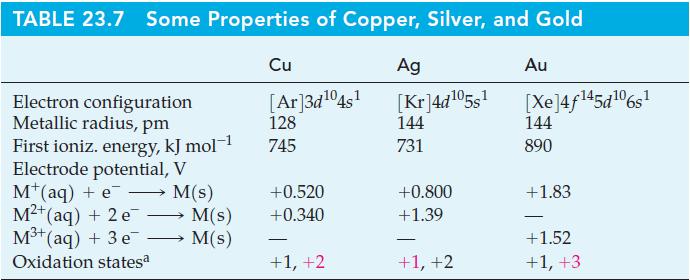
Without performing detailed calculations, show that significant disproportionation of AuCl occurs if you attempt to make a saturated aqueous solution. Use data from Table 23.7 and Ksp(AuCl) = 2.0 x 10⁻¹³.Table 23.7 TABLE 23.7 Some Properties of Copper, Silver, and Gold Cu Electron
Equation (23.18), which represents the chromate–dichromate equilibrium, is actually the sum of two equilibrium expressions. The first is an acid–base reaction, H+ + CrO42– ⇌ HCrO4–. The second reaction involves elimination of a water molecule between two HCrO4– ions (a dehydration
In acidic solution, silver(II) oxide first dissolves to produce Ag2+(aq). This is followed by the oxidation of H2O(l) to O2(g) and the reduction of Ag2+ to Ag+.(a) Write equations for the dissolution and oxidation–reduction reactions.(b) Show that the oxidation–reduction reaction is indeed
Show that under the following conditions, Ba2+(aq) can be separated from Sr2+(aq) and Ca2+(aq) by precipitating BaCrO4(s) with the other ions remaining in solution:Use data from this and previous chapters, as necessary. [Ba²+] = [Sr²+] = [Ca²+] = 0.10 M [CH3COOH] = [CH3COO] = 1.0 M [Cr₂O7²] =
A solution is believed to contain one or more of the following ions: Cr3+, Zn2+, Fe3+, Ni2+. When the solution is treated with excess NaOH(aq), a precipitate forms. The solution in contact with the precipitate is colorless. The precipitate is dissolved in HCl(aq), and the resulting solution is
A 0.960 g sample of impure hematite (Fe2O3) is treated with 1.752 g of oxalic acid (H2C2O4 · 2 H2O) in an acidic medium. Following this, the excess oxalic acid is titrated with 35.16 mL of 0.100 M KMnO4. What is the mass percent of Fe2O3 in the impure sample of hematite? The following equations
Both Cr2O72–(aq) and MnO4–(aq) can be used to titrate Fe2+(aq) to Fe3+(aq). Suppose you have available as titrants two solutions: 0.1000 M Cr2O72–(aq) and 0.1000 M MnO4–(aq).(a) For which solution would the greater volume of titrant be required for the titration of a particular sample of
The only important compounds of Ag(II) are AgF2 and AgO. Why would you expect these two compounds to be stable, but not other silver(II) compounds such as AgCl2, AgBr2, and AgS?
A certain steel is to be analyzed for Cr and Mn. By suitable treatment, the Cr in the steel is oxidized to Cr2O72–(aq) and the Mn to MnO4–(aq). A 10.000 g sample of steel is used to produce 250.0 mL of a solution containing Cr2O72–(aq) and MnO4–(aq). A 10.00 mL portion of this solution is
The palladium content of a steel sample was determined as follows. A 16.312 g steel sample was dissolved in concentrated HCl(aq). The solution obtained was treated to remove interfering ions, to establish the proper pH, and to obtain a final solution volume of 250.0 mL. A 10.00 mL sample of this
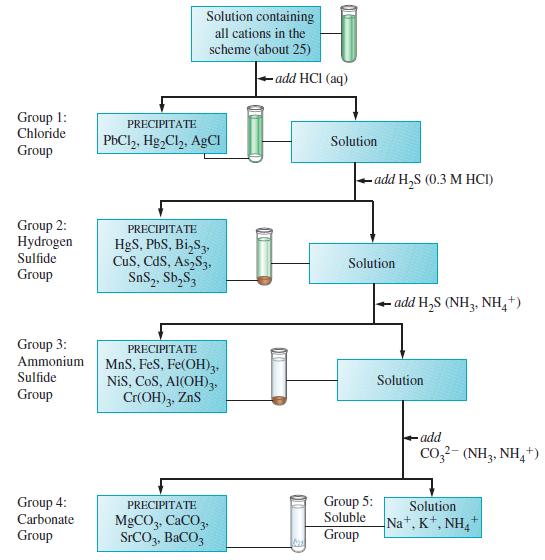
Several transition metal ions are found in cation group 3 of the qualitative analysis scheme outlined in Figure 18-7. At one point in the separation and testing of this group, a solution containing Fe3+, Co2+, Ni2+, Al3+, Cr3+, and Zn2+ is treated with an excess of NaOH(aq), together with
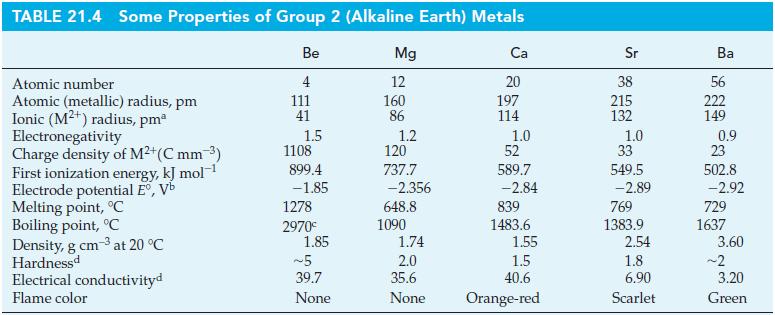
For a coordination number of four, the radius of Mn7+ has been estimated to be 39 pm. Estimate the charge density for the Mn7+ ion. Express your answer in C mm–3. How does this compare with the charge density of Be2+ given in Table 21.4? Would you expect the bonding in Mn2O7 to be primarily
Nearly all mercury(II) compounds exhibit covalent bonding. Mercury(II) chloride is a covalent molecule that dissolves in warm water. The stability of this compound is exploited in the determination of the levels of chloride ion in blood serum. Typical human blood serum levels range from 90 to 115
Covalent bonding is involved in many transition metal compounds. Draw Lewis structures, showing any nonzero formal charges, for the following molecules or ions:(a) Hg22+;(b) Mn2O7;(c) OsO4.In (b), there is one Mn—O—Mn linkage in the molecule.
Nitinol is a nickel–titanium alloy known as memory metal. The name nitinol is derived from the symbols for nickel (Ni), titanium (Ti), and the acronym for the Naval Ordinance Laboratory (NOL), where it was discovered. If an object made out of nitinol is heated to about 500 °C for about an hour
In your own words, define the following terms:(a) Domain; (b) Flotation; (c) Leaching; (d) Amalgam.
Briefly describe each of the following ideas, phenomena, or methods: (a) Lanthanide contraction;(b) Zone refining; (c) Basic oxygen process; (d) Slag formation.
Explain the important distinctions between each pair of terms: (a) Ferromagnetism and paramagnetism;(b) Roasting and reduction; (c) Hydrometallurgy and pyrometallurgy; (d) Chromate and dichromate.
Describe the chemical composition of the material called (a) Pig iron; (b) Ferromanganese alloy;(c) Chromite ore; (d) Brass; (e) Aqua regia; (f) Blister copper; (g) Stainless steel.
Three properties expected for transition elements are (a) Low melting points; (b) High ionization energies;(c) Colored ions in solution; (d) Positive standard electrode (reduction) potentials; (e) Diamagnetism;(f) Complex ion formation; (g) Catalytic activity.
The only diamagnetic ion of the following group is (a) Cr2+;(b) Zn2+;(c) Fe3+;(d) Ag2+;(e) Ti3+.
All of the following elements have an ion displaying the +6 oxidation state except (a) Mo; (b) Cr; (c) Mn;(d) V; (e) S.
The best oxidizing agent of the following group of ions is (a) Ag+(aq);(b) Cl–(aq);(c) H+(aq);(d) Na+(aq); (e) OH–(aq).
To separate Fe3+ and Ni2+ from an aqueous solution containing both ions, with one cation forming a precipitate and the other remaining in solution, add to the solution (a) NaOH(aq); (b) H2S(g);(c) HCl(aq); (d) NH3(aq).
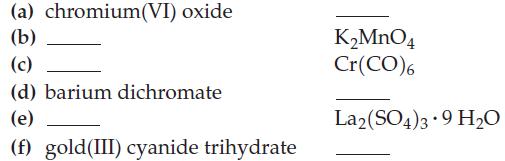
Provide the missing name or formula for the following: (a) chromium(VI) oxide (b) (c) (d) barium dichromate (e) (f) gold (III) cyanide trihydrate K₂MnO4 Cr(CO)6 La2 (SO4)3 9 H₂O
Of the following, the two solids that will liberate Cl2(g) when heated with HCl(aq) are (a) NaCl(s);(b) ZnCl2(s);(c) MnO2(s);(d) CuO(s); (e) K2Cr2O7(s);(f) NaOH(s).
Explain why Zn, Cd, and Hg resemble the group 2 metals in some of their properties.
Explain why gold dissolves in aqua regia but not in HNO3(aq).
Showing 500 - 600
of 4008
1
2
3
4
5
6
7
8
9
10
11
12
13
14
15
Last
Step by Step Answers

 Get 50% OFF
Claim Now
Get 50% OFF
Claim Now













![[Ba+] = [Sr+] = [Ca+] = 0.10 M [CH3COOH] = [CH3COO] = 1.0 M [CrO7] = 0.0010 M Ksp (BaCrO4) = 1.2 10-10 Ksp](https://dsd5zvtm8ll6.cloudfront.net/images/question_images/1701/3/4/5/653656879756d8921701345652214.jpg)