New Semester
Started
Get
50% OFF
Study Help!
--h --m --s
Claim Now
Question Answers
Textbooks
Find textbooks, questions and answers
Oops, something went wrong!
Change your search query and then try again
S
Books
FREE
Study Help
Expert Questions
Accounting
General Management
Mathematics
Finance
Organizational Behaviour
Law
Physics
Operating System
Management Leadership
Sociology
Programming
Marketing
Database
Computer Network
Economics
Textbooks Solutions
Accounting
Managerial Accounting
Management Leadership
Cost Accounting
Statistics
Business Law
Corporate Finance
Finance
Economics
Auditing
Tutors
Online Tutors
Find a Tutor
Hire a Tutor
Become a Tutor
AI Tutor
AI Study Planner
NEW
Sell Books
Search
Search
Sign In
Register
study help
sciences
general chemistry principles
General Chemistry Principles And Modern Applications 11th Edition Ralph Petrucci, Jeffry Madura, F. Herring, Carey Bissonnette - Solutions
A nuclide has a decay rate of 2.00 x 10¹⁰ s-1. After 25.0 days, its decay rate is 6.25 x 10⁸ s-1. What is the nuclide’s half-life? (a) 25.0 d; (b) 12.5 d; (c) 50.0 d;(d) 5.00 d; (e) None of these.
A nuclide has a half-life of 1.91 years. Its decay constant has a numerical value of (a) 1.32; (b) 2.76;(c) 0.363; (d) 0.524; (e) None of these.
A nuclide has a decay constant of 4.28 x 10⁻⁴ h-1. If the activity of a sample is 3.14 x 10⁵ s-1, how many atoms of the nuclide are present in the sample?(a) 2.64 x 10¹²;(b) 7.34 x 10⁸;(c) 2.04 x 10⁵;(d) 4.40 x 10¹⁰;(e) None of these.
Based on magic numbers, which nuclide is the least stable? (a) 59Ni;(b) 51V;(c) 122Sb;(d) 16O;(e) 12C.
Is radioactivity temperature dependent? Explain.
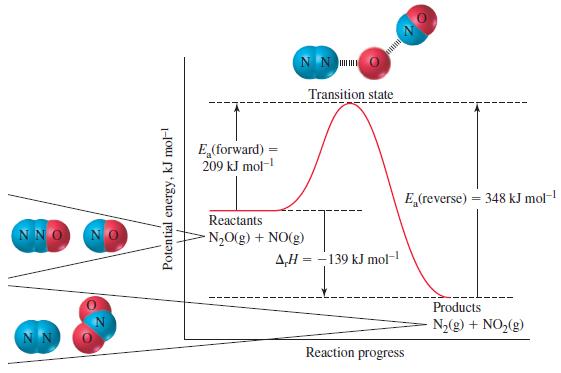
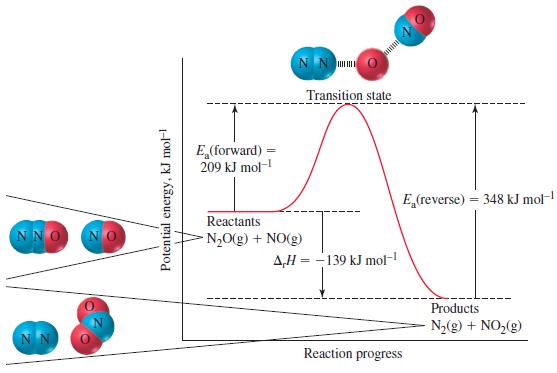
Indicate whether the following conditions can exist for a chemical reaction:(a) ΔrH < 0 < Ea; (b) 0 < ΔrH < Ea; (c) 0 < Ea < ΔrH; (d) 0 = ΔrH < Ea; (e) Ea < ΔrH
The reaction A → products is first order in A.(a) If 1.60 g A is allowed to decompose for 38 min, the mass of A remaining undecomposed is found to be 0.40 g. What is the half-life, t1/2, of this reaction?(b) Starting with 1.60 g A, what is the mass of A remaining undecomposed after 1.00 h?
For the reversible reaction A + B ⇌ C + D, the enthalpy change of the forward reaction is +21 kJ/mol. The activation energy of the forward reaction is 84 kJ/mol.(a) What is the activation energy of the reverse reaction?(b) In the manner of Figure 20-10, sketch the reaction profile of this
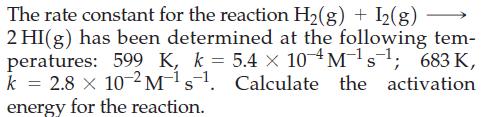
At what temperature will the rate constant for the reaction in Exercise 51 have the value k = 5.0 x 10⁻³ M-1 s-1?Exercise 51 The rate constant for the reaction H₂(g) + I2(g) 2 HI(g) has been determined at the following tem- peratures: 599 K, k = 5.4 x 10M¹s¹; 683 K, k 2.8 x 10⁻² M¹s¹.
The first-order reaction A → products has a half-life, t1/2 , of 46.2 min at 25°C and 2.6 min at 102°C.(a) Calculate the activation energy of this reaction.(b) At what temperature would the half-life be 10.0 min?
What are the similarities and differences between the catalytic activity of platinum metal and of an enzyme?
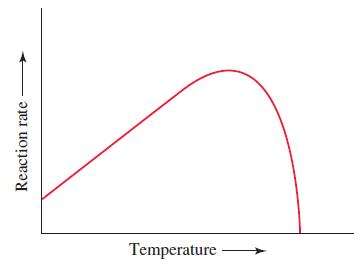
The graph shows the effect of temperature on enzyme activity. Explain why the graph has the general shape shown. For human enzymes, at what temperature would you expect the maximum in the curve to appear? Temperature Reaction rate
The decomposition of ethylene oxide at 690 K is monitored by measuring the total gas pressure as a function of time. The data obtained are t = 10 min, Ptot = 139.14 mmHg; 20 min, 151.67 mmHg; 40 min, 172.65 mmHg; 60 min, 189.15 mmHg; 100 min, 212.34 mmHg; 200 min, 238.66 mmHg; ∞ 249.88 mmHg. What
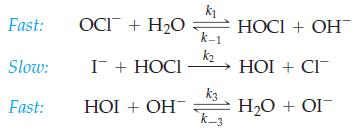
Show that the following mechanism is consistent with the rate law established for the iodide–hypochlorite reaction in Exercise 79.Exercise 79Hydroxide ion is involved in the mechanism of the following reaction but is not consumed in the overall reaction.(a) From the data given, determine the
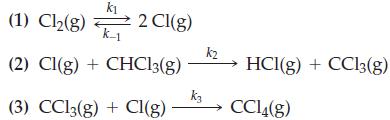
The following three-step mechanism has been proposed for the reaction of chlorine and chloroform.The numerical values of the rate constants for these steps are k1 = 4.8 x 10³ ; k-1 = 3.6 x 10³ ; k2 = 1.3 x 10⁻²; k3 = 2.7 x 10². Derive the rate law and the magnitude of k for the overall reaction.
In the first-order decomposition of substance A the following concentrations are found at the indicated times: t = 0 s, [A] = 0.88 M; 50 s, 0.62 M; 100 s 0.44 M; 150 s, 0.31 M. Calculate the instantaneous rate of decomposition at t = 100 s.
If a chemical reaction is carried out in a fuel cell, the maximum amount of useful work that can be obtained is (a) ΔrG;(b) ΔrH;(c) ΔrG/ΔrH;(d) TΔrS.
Without performing detailed calculations, indicate whether either of the following compounds is appreciably soluble in NH3(aq): (a) CuS, Ksp = 6.3 x 10‾36;(b) CuCO3, Ksp = 1.4 x 10‾10. Also use the fact that Kf for [Cu(NH3)4]2+ is 1.1 x 10¹³.
Both Mg2+ and Cu2+ are present in the same aqueous solution. Which of the following reagents would work best in separating these ions, precipitating one and leaving the other in solution: NaOH(aq), HCl(aq), NH4Cl(aq), or NH3(aq)? Explain your choice.
The chief compound in marble is CaCO3. Marble has been widely used for statues and ornamental work on buildings. However, marble is readily attacked by acids. Determine the solubility of marble (that is, [Ca2+] in a saturated solution) in (a) Normal rainwater of pH = 5.6;(b) Acid rainwater of pH =
Calculate the molar solubility of Mg(OH)2 in 1.00 M NH4Cl(aq).
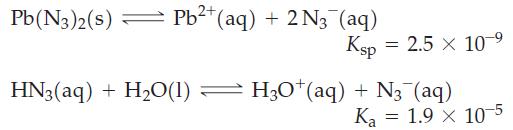
Determine the molar solubility of lead(II) azide, Pb(N3)2, in a buffer solution with pH = 3.00, given that Pb(N3)2(s) Pb²+ (aq) + 2N3 (aq) = Ksp 2.5 x 10 ⁹ HN3(aq) + H₂O(1) — H3O*(aq) + N₂ (aq) = Ka 1.9 x 10⁻⁵
Assume that the seawater sample described in Example 18-6 contains approximately 440 g Ca2+ per metric ton (1 metricton = 103 kg; density of seawater = 1.03 g/mL)(a) Should Ca(OH)2(s) precipitate from seawater under the stated conditions, that is, with [OH-] = 2.0 x 10‾3 M?(b) Is the separation
Use data from Table 20.3 to establish the order of reaction (20.7) with respect to HgCl2 and C2O42- and also the overall order of the reaction.Table 20.3Reaction (20.7) TABLE 20.3 Kinetic Data for the Reaction: 2 HgCl₂ + C₂O4²- →2 Cl¯ + 2 CO₂ + H2₂Cl₂ Experiment 1 123 2 3 [HgCl₂],
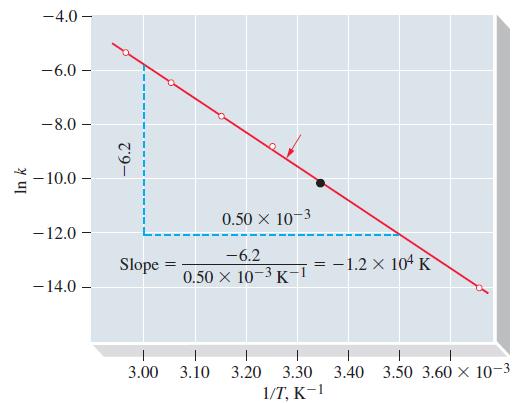
Use data from Figure 20-12 to determine the temperature at which t1/2 for the first-order decomposition of N2O5 in CCl4 is 2.00 h.Figure 20-12 In k -4.0 - -6.0- -8.0 -10.0- -12.0 - - 14.0 -6.2 Slope = 3.00 0.50 × 10⁻³ -6.2 0.50 x 10⁻³K-1 3.10 3.20 3.30 1/T, K-1 -1.2 x 10⁴ K 3.40 3.50 3.60 × 10⁻³
What is the approximate concentration of A remaining after 110 s in the (a) Zero-order, (b) First-order, (c) Second-order reaction? I Time, S 0 25 50 75 100 150 200 250 [A], M 1.00 0.78 0.61 0.47 0.37 0.22 0.14 0.08 || Time, s 0 25 50 75 100 [A],
The reaction A + B → C + D is second order in A and zero order in B. The value of k is 0.0103 M‾1 min‾1. What is the rate of this reaction when [A] = 0.116 M and [B] = 3.83 M?
The following data were obtained for the dimerization of 1,3-butadiene, 2 C4H6(g) → C8H12(g), at 600 K: t = 0 min, [C4H6] = 0.0169 M; 12.18 min, 0.0144 M; 24.55 min, 0.0124 M; 42.50 min, 0.0103 M; 68.05 min, 0.00845 M.(a) What is the order of this reaction?(b) What is the value of the rate
For the reaction A → products, the data tabulated below are obtained.(a) Determine the initial rate of reaction (that is, -Δ[A]/Δt) in each of the two experiments.(b) Determine the order of the reaction. First Experiment [A] = 1.512 M [A] = 1.490 M [A] = 1.469 M Second Experiment [A] = 3.024
If even a tiny spark is introduced into a mixture of H2(g) and O2(g), a highly exothermic explosive reaction occurs. Without the spark, the mixture remains unreacted indefinitely.(a) Explain this difference in behavior.(b) Why is the nature of the reaction independent of the size of the spark?
By an appropriate sketch, indicate why there is some relationship between the enthalpy change and the activation energy for an endothermic reaction but not for an exothermic reaction.
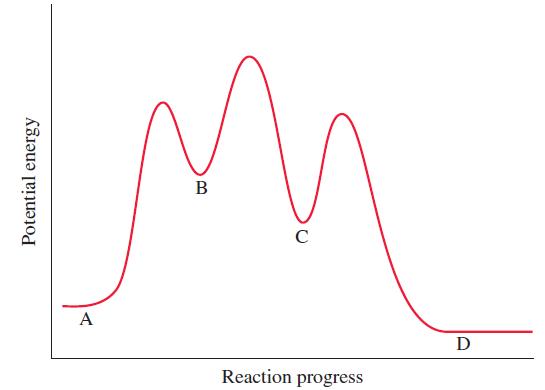
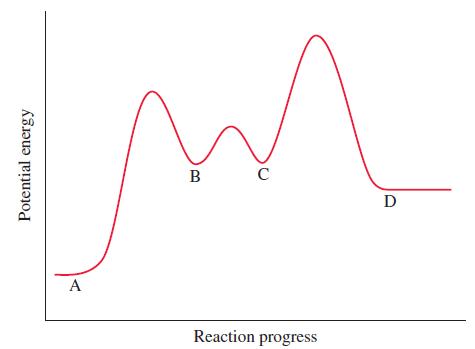
By inspection of the reaction profile for the reaction A to D given below, answer the following questions.(a) How many intermediates are there in the reaction?(b) How many transition states are there?(c) Which step has the largest rate constant?(d) Which step has the smallest rate constant?(e) Is
By inspection of the reaction profile for the reaction A to D given, answer the following questions.(a) How many intermediates are there in the reaction?(b) How many transition states are there?(c) Which step has the largest rate constant?(d) Which step has the smallest rate constant?(e) Is the
The rate constant for the reaction H2(g) + I2(g) → 2 HI(g) has been determined at the following peratures: 599 K, k = 5.4 x 10⁻⁴ M-1 s-1; 683 K, k = 2.8 x 10⁻² M-1 s-1. Calculate the activation energy for the reaction.
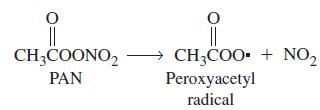
A treatise on atmospheric chemistry lists the following rate constants for the decomposition of PAN described in the Integrative Example on page 965: 0 °C, k = 5.6 x 10⁻⁶ s-1; 10 °C, 3.2 x 10⁻⁵ s-1; 20 °C, 1.6 x 10⁻⁴ s-1; 30 °C, 7.6 x 10⁻⁴ s-1.(a) Construct a graph of ln k versus 1/T.(b) What
The reaction C2H5I + OH- → C2H5OH + I- was studied in an ethanol (C2H5OH) solution, and the following rate constants were obtained: 15.83 °C, k = 5.03 x 10⁻⁵; 32.02 °C, 3.68 x 10⁻⁴; 59.75 °C, 6.71 x 10⁻³; 90.61 °C, 0.119 M-1 s-1.(a) Determine Ea for this reaction by a graphical method.(b)
For the first-order reactiont1/2 = 22.5 h at 20 °C and 1.5 h at 40 °C.(a) Calculate the activation energy of this reaction.(b) If the Arrhenius constant A = 2.05 x 10¹³ s-1, determine the value of k at 30 °C. N₂O5 (g) 2 NO₂(g) + O2(8) 2
A commonly stated rule of thumb is that reaction rates double for a temperature increase of about 10°C. (This rule is very often wrong.)(a) What must be the approximate activation energy for this statement to be true for reactions at about room temperature?(b) Would you expect this rule of thumb
Concerning the rule of thumb stated in Exercise 57, estimate how much faster cooking occurs in a pressure cooker with the vapor pressure of water at 2.00 atm instead of in water under normal boiling conditions. Refer to Table 12.5.Exercise 57A commonly stated rule of thumb is that reaction rates
The following statements about catalysis are not stated as carefully as they might be. What slight modifications would you make in them?(a) Acatalyst is a substance that speeds up a chemical reaction but does not take part in the reaction.(b) The function of a catalyst is to lower the activation
The following substrate concentration [S] versus time data were obtained during an enzyme-catalyzed reaction: t = 0 min, [S] = 1.00 M; 20 min, 0.90 M; 60 min, 0.70 M; 100 min, 0.50 M; 160 min, 0.20 M. What is the order of this reaction with respect to S in the concentration range studied?
Certain gas-phase reactions on a heterogeneous catalyst are first order at low gas pressures and zero order at high pressures. Can you suggest a reason for this?
The graph shows the effect of enzyme concentration on the rate of an enzyme reaction. What reaction conditions are necessary to account for this graph? Reaction rate Enzyme concentration [E] -
We have used the terms order of a reaction and molecularity of an elementary process (that is, unimolecular, bimolecular). What is the relationship, if any, between these two terms?
According to collision theory, chemical reactions occur through molecular collisions. A unimolecular elementary process in a reaction mechanism involves dissociation of a single molecule. How can these two ideas be compatible? Explain.
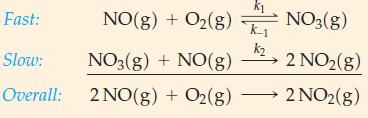
The reaction 2 NO + 2 H2 → N2 + 2 H2O is second order in [NO] and first order in [H2]. A three-step mechanism has been proposed. The first, fast step is the elementary process given as equation (20.25). The third step, also fast, is N2O + H2 → N2 + H2O. Propose an entire three-step mechanism,
The mechanism proposed for the reaction of H2(g) and I2(g) to form HI(g) consists of a fast reversible first step involving I2(g) and I(g), followed by a slow step. Propose a two-step mechanism for the reaction H2(g) + I2(g) → 2 HI(g), which is known to be first order in H2 and first order in I2.
The reaction 2 NO + Cl2 → 2 NOCl has the rate law: rate of reaction = k[NO]2[Cl2]. Propose a twostep mechanism for this reaction consisting of a fast reversible first step, followed by a slow step.
A simplified rate law for the reaction 2 O3(g) → 3 O2(g) isFor this reaction, propose a two-step mechanism that consists of a fast, reversible first step, followed by a slow second step. [03]² [0₂] rate=k-
One proposed mechanism for the formation of a double helix in DNA is given bywhere S1 and S2 represent strand 1 and 2, and (S1 : S2)* represents an unstable helix. Write the rate of reaction expression for the formation of the double helix. (S₁ S₂) + (S1: S₂)* (S₁: S₂)* S1:
One proposed mechanism for the condensation of propanone, (CH3)2CO, is as follows:Use the steady-state approximation to determine the rate of formation for the product. (CH3)2CO (aq) + OH(aq) → CH3C(O)CH₂ CH3C(O)CH₂ (aq) + (CH3)2CO(aq) (aq) + H₂O(1) product
Suppose that the reaction in Example 20-8 is first order with a rate constant of 0.12 min-1. Starting with [A]0 = 1.00 M, will the curve for [A] versus t for the first-order reaction cross the curve for the second-order reaction at some time after t = 0? Will the two curves cross if [A]0 = 2.00 M?
[A]t as a function of time for the reaction A → products is plotted in the following graph. Use data from this graph to determine (a) The order of the reaction;(b) The rate constant, k; (c) The rate of the reaction at t = 3.5 min, using the results of parts (a) and (b);(d) The rate of the
Exactly 300 s after decomposition of H2O2(aq) begins (reaction 20.3), a 5.00 mL sample is removed and immediately titrated with 37.1 mL of 0.1000 M KMnO4. What is at this 300 s point in the reaction?Reaction (20.3) H,Oz(aq) — H₂O(1) + 02(8) (20.3)
Use the method of Exercise 75 to determine the volume of 0.1000 M KMnO4 required to titrate 5.00 mL samples of H2O2(aq) for each of the entries in Table 20.1. Plot these volumes of KMnO4(aq) as a function of time, and show that from this graph you can get the same rate of reaction at 1400 s as that
The initial rate of reaction (20.3) is found to be 1.7 x 10⁻³ M s-1. Assume that this rate holds for 2 minutes. Start with 175 mL of 1.55 M H2O2(aq) at t = 0. How many milliliters of O2(g), measured at 24°C and 757 mmHg, are released from solution in the first minute of the reaction?Reaction
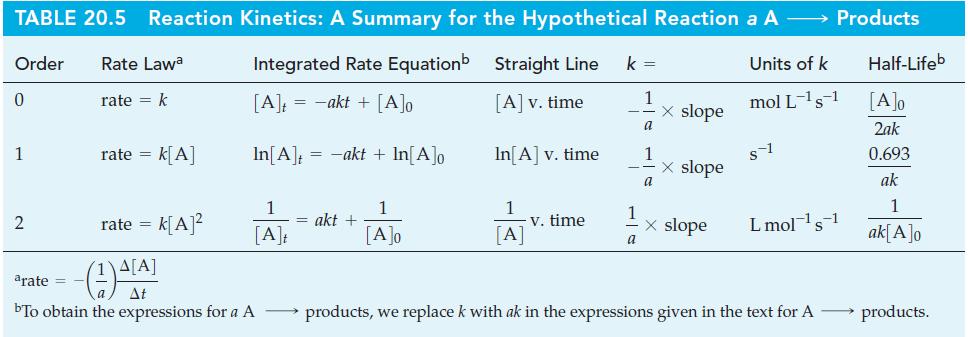
We have seen that the units of k depends on the overall order of a reaction. Derive a general expression for the units of k for a reaction of any overall order, based on the order of the reaction (o) and the units of concentration (M) and time (s).
Hydroxide ion is involved in the mechanism of the following reaction but is not consumed in the overall reaction.(a) From the data given, determine the order of the reaction with respect to OCl-, I-, and OH-.(b) What is the overall reaction order?(c) Write the rate equation, and determine the value
The half-life for the first-order decomposition of nitramide, NH2NO2(aq) → N2O(g) + H2O(l), is 123 min at 15 °C. If 165 mL of a 0.105 M NH2NO2 solution is allowed to decompose, how long must the reaction proceed to yield 50.0 mL of N2O(g) collected over water at 15°C and a barometric pressure
Refer to Example 20-7. For the decomposition of di-tbutyl peroxide (DTBP), determine the time at which the total gas pressure is 2100 mmHg.Example 20-7Reaction (20.16) is started with pure DTBP at 147 °C and 800.0 mmHg pressure in a flask of constant volume.What is the value of the rate constant
The following data are for the reaction 2 A + B → products. Establish the order of this reaction with respect to A and to B. Expt 1, [B] = 1.00 M Time, min 0 1 5 10 20 [A], M 1.000 × 10⁻³ 0.951 10-3 0.779 x 10⁻³ 0.607 x 10⁻³ 0.368 x 10⁻³ Expt 2, [B] = 0.50 M Time, Min 0 1 5 10 20 [A], M 1.000
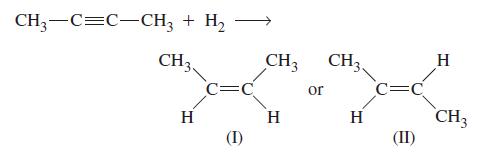
In the hydrogenation of a compound containing a carbon-to-carbon triple bond, two products are possible, as in the reactionThe amount of each product can be controlled by using an appropriate catalyst. The Lindlar catalyst is a heterogeneous catalyst that produces only one of these products. Which
Derive a plausible mechanism for the following reaction in aqueous solution, Hg22+ + Tl3+ → 2 Hg2+ + Tl+ for which the observed rate law is: rate = k[Hg22+] [Tl3+]/[Hg2+].
For the reaction A → products, derive the integrated rate law and an expression for the half-life if the reaction is third order.
The reaction A + B → products is first order in A, first order in B, and second order overall. Consider that the starting concentrations of the reactants are [A]0 and [B]0, and that x represents the decrease in these concentrations at the time t. That is, [A]t = [A]0 - x and [B]t = [B]0 - x. Show
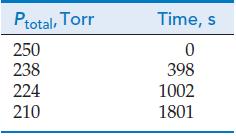
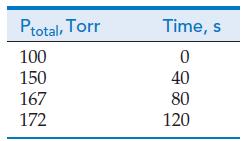
The rate of the reactionwas studied by injecting CO(g) into a reaction vessel and measuring the total pressure at constant volume.What is the rate constant of this reaction? 2 CO(g) CO₂(g) + C(s)
The kinetics of the decomposition of phosphine at 950 Kwas studied by injecting PH3(g) into a reaction vessel and measuring the total pressure at constant volume.What is the rate constant of this reaction? 4 PH3(g) P4(g) + 6H₂(g)
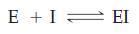
The rate of an enzyme-catalyzed reaction can be slowed down by the presence of an inhibitor (I) that reacts with the enzyme in a rapid equilibrium process.By adding this step to the mechanism for enzyme catalysis, determine the effect of adding the concentration [I]0 on the rate of an
By taking the reciprocal of both sides of equation 20.36, obtain an expression for 1/V. Using the resulting equation, suggest a strategy for determining the Michaelis–Menten constant, KM, and the value of k2.Eq. 20.36 V = k₂[E]o[S] KM + [S] (20.36)
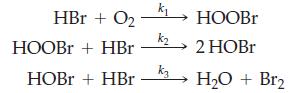
You want to test the following proposed mechanism for the oxidation of HBr.You find that the rate is first order with respect to HBr and to O2. You cannot detect HOBr among the products.(a) If the proposed mechanism is correct, which must be the rate-determining step?(b) Can you prove the mechanism
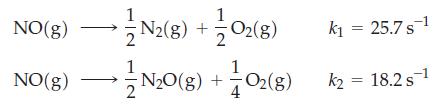
The decomposition of nitric oxide occurs through two parallel reactions:(a) What is the reaction order for these reactions?(b) Which reaction is the slow reaction?(c) If the initial concentration of NO(g) is 2.0 M, what is the concentration of N2(g) after 0.1 seconds?(d) If the initial
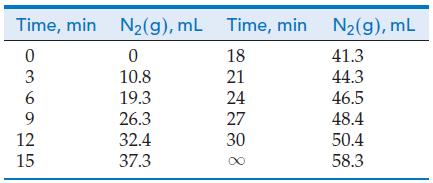
Benzenediazonium chloride decomposes by a first-order reaction in water, yielding N2(g) as one product. The reaction can be followed by measuring the volume of N2(g) as a function of time. The data in the table on the next page were obtained for the decomposition of a 0.071 M solution at 50 °C,
The object is to study the kinetics of the reaction between peroxodisulfate and iodide ions.The I3‾ formed in reaction (a) is actually a complex of iodine, I2 and iodide ion, I‾. Thiosulfate ion, S2O32‾ also present in the reaction mixture, reacts with I3‾ just as fast as it is
In your own words, define or explain the following terms or symbols: (a) [A]0;(b) k; (c) t1/2;(d) Zero-order reaction; (e) Catalyst.
Briefly describe each of the following ideas, phenomena, or methods: (a) The method of initial rates;(b) Activated complex; (c) Reaction mechanism;(d) Heterogeneous catalysis; (e) Rate-determining step.
Explain the important distinctions between each pair of terms: (a) First-order and second-order reactions;(b) Rate law and integrated rate law; (c) Activation energy and enthalpy of reaction; (d) Elementary process and overall reaction; (e) Enzyme and substrate.
The rate equation for the reaction 2 A + B → C is found to be rate = k[A][B]. For this reaction, we can conclude that (a) The units of k = s‾1;(b) t1/2 is constant;(c) The value of k is independent of the values of [A] and [B]; (d) The rate of formation of C is twice the rate of disappearance
A first-order reaction, A → products, has a half life of 75 s, from which we can draw two conclusions. Which of the following are those two? (a) The reaction goes to completion in 150 s; (b) The quantity of A remaining after 150 s is half of what remains after 75 s; (c) The same quantity of A
A first order reaction A → products has a half-life of 13.9 min. The rate at which this reaction proceeds when [A] = 0.40 M is (a) 0.020 mol L‾1 min‾1;(b) 5.0 x 10‾2 mol L‾1 min‾1;(c) 8.0 mol L‾1 min‾1;(d) 0.125 mol L‾1 min‾1.
The reaction A → products is second order. The initial rate of decomposition of A when [A]0 = 0.50 M is (a) The same as the initial rate for any other value of [A]0;(b) Half as great as when [A]0 = 1.00 M; (c) Five times as great as when [A]0 = 0.10 M;(d) Four times as great as when [A]0 = 0.25
The rate of a chemical reaction generally increases rapidly, even for small increases in temperature, because of a rapid increase in (a) Collision frequency;(b) Fraction of reactant molecules with very high kinetic energies; (c) Activation energy; (d) Average kinetic energy of the reactant
For the reaction A + B → 2 C, which proceeds by a single-step bimolecular elementary process, (a) t1/2 = 0.693/k;(b) Rate of appearance of C = -rate of disappearance of A; (c) Rate of reaction = k[A][B];(d) ln[A]t = -kt + ln[A]0.
A reaction is 50% complete in 30.0 min. How long after its start will the reaction be 75% complete if it is (a) First order; (b) Zero order?
A kinetic study of the reaction A → products yields the data: t = 0 s, [A] = 2.00 M; 500 s, 1.00 M; 1500 s, 0.50 M; 3500 s, 0.25 M. Without performing detailed calculations, determine the order of this reaction and indicate your method of reasoning.
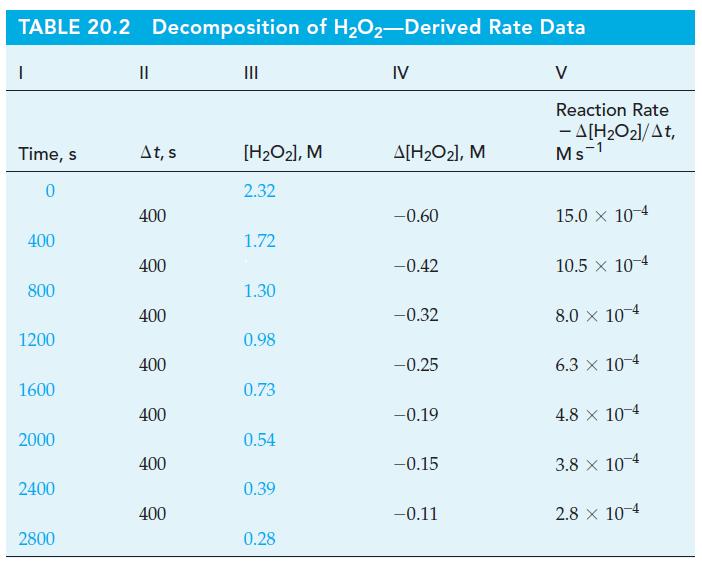
For the reaction A → products the following data are obtained.(a) Determine the initial rate of reaction in Experiment 1.(b) If the reaction is second order, what will be [A] at t = 1.0 in Experiment 2?(c) If the reaction is first order, what will be [A] at 30 min in Experiment 2? Experiment
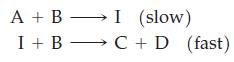
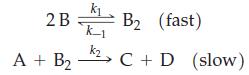
For the reaction A + 2 B → C + D, the rate law is rate of reaction = k[A][B].(a) Show that the following mechanism is consistent with the stoichiometry of the overall reaction and with the rate law.(b) Show that the following mechanism is consistent with the stoichiometry of the overall reaction,
If the plot of the reactant concentration versus time is nonlinear, but the concentration drops by 50% every 10 seconds, then the order of the reaction is (a) Zero order; (b) First order; (c) Second order; (d) Third order.
If the plot of the reactant concentration versus time is linear, then the order of the reaction is (a) Zero order;(b) First order; (c) Second order; (d) Third order.
One example of a zero-order reaction is the decomposition of ammonia on a hot platinum wire, 2 NH3(g) → N2(g) + 3 H2(g). If the concentration of ammonia is doubled, the rate of the reaction will (a) Be zero; (b) Double; (c) Remain the same;(d) Exponentially increase.
For the half-cell reaction Hg2+(aq) + 2 e- → Hg(l), E° = 0.854 V. This means that (a) Hg(l) is more readily oxidized than H2(g);(b) Hg2+(aq) is more readily reduced than H+(aq); (c) Hg(l) will dissolve in 1M HCl; (d) Hg(l) will displace Zn(s) from an aqueous solution of Zn2+ ion.
Of the following statements concerning electrochemical cells, the correct ones are: (a) The cathode is the negative electrode in both voltaic and electrolytic cells. (b) The function of a salt bridge is to permit the migration of electrons between the half-cell compartments of an electrochemical
Explain the important distinctions between each pair of terms: (a) Half-cell reaction and overall cell reaction;(b) Voltaic cell and electrolytic cell; (c) Primary battery and secondary battery; (d) Ecell and E°cell.
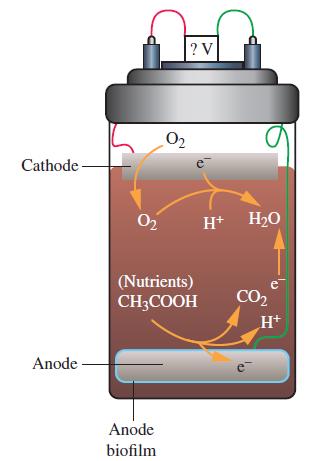
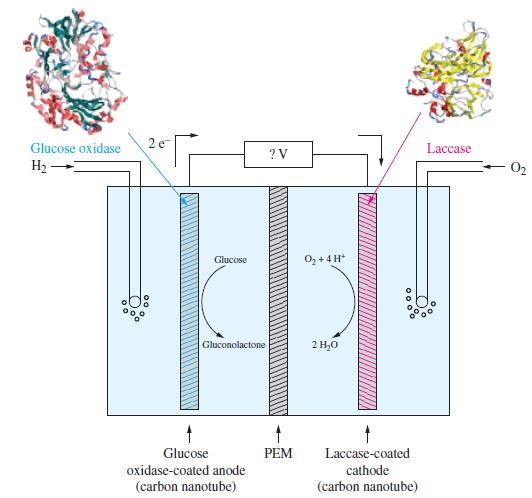
Electricity can be produced by the action of microbes on organic matter in soil or waste water. For example, in the fuel cell shown on the right, the anode produces electrons by the oxidation of organic compounds in soil. The anode is coated with a film containing geobacter metallireducens, a
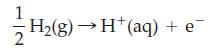
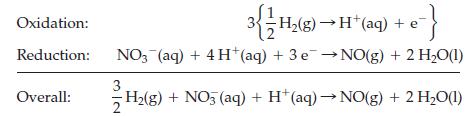
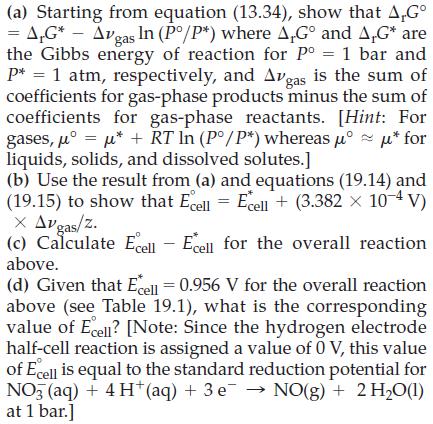
In 1982, the International Union of Pure and Applied Chemistry (IUPAC) redefined the standard state pressure to be 1 bar. As a result, standard reduction potentials for half-cell reactions must be adjusted accordingly. In this problem, we illustrate the approach to adjusting these values. Since the
Consider two cells involving two metals X and YIn the first cell electrons flow from the metal X to the standard hydrogen electrode. In the second cell electrons flow from metal X to metal Y. Is E°X+/X greater or less than zero? Is E°X+/X 7 EY2+/Y? Explain. X(s) X+ (aq) |H+ (aq), H₂(g, 1
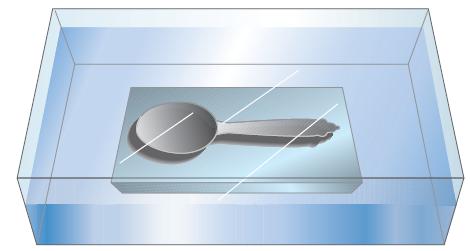
Silver tarnish is mainly Ag2S:A tarnished silver spoon is placed in contact with a commercially available metallic product in a glass baking dish. Boiling water, to which some NaHCO3 has been added, is poured into the dish, and the product and spoon are completely covered. Within a short time, the
Use standard reduction potentials to predict which metal in each of the following pairs is the stronger reducing agent under standard conditions: (a) Zinc or magnesium; (b) Sodium or tin.
Will AgI(s) precipitate from a solution with [CN] = 1.05 M, and Ksp = 8.5 × 10-¹7; x for [[Ag(CN)2]]= 0.012 M, [I] = 2.0 M? For Agl, [Ag(CN)₂], Kf = 5.6 x 10¹⁸
Given the following ions in solution, Hg2+, I-, Ag+, and NO3-, does the formation of a complex ion increase or decrease the amount of precipitate?
Lead(II) chloride is most soluble in (a) 0.100 M NaCl;(b) 0.100 Na2S2O3;(c) 0.100 M Pb(NO3)2;(d) 0.100 M NaNO3;(e) 0.100 MnSO4.
Showing 800 - 900
of 4008
First
2
3
4
5
6
7
8
9
10
11
12
13
14
15
16
Last
Step by Step Answers

 Get 50% OFF
Claim Now
Get 50% OFF
Claim Now



![[OCI ], M 0.0040 0.0020 0.0020 0.0020 0.0020 Rate Formation [I], M 0.0020 1.00 0.0040 1.00 0.0020 1.00 0.0020](https://dsd5zvtm8ll6.cloudfront.net/images/question_images/1701/0/6/0/16465641e44d0eff1701060162999.jpg)

![TABLE 20.3 Kinetic Data for the Reaction: 2 HgCl + CO4- 2 Cl + 2 CO + H2Cl Experiment 1 123 2 3 [HgCl], M =](https://dsd5zvtm8ll6.cloudfront.net/images/question_images/1700/9/0/5/3116561c15fe3ed61700905310844.jpg)

![I Time, S 0 25 50 75 100 150 200 250 [A], M 1.00 0.78 0.61 0.47 0.37 0.22 0.14 0.08 || Time, s 0 25 50 75 100](https://dsd5zvtm8ll6.cloudfront.net/images/question_images/1700/9/2/7/6466562189edc91d1700927645249.jpg)
![First Experiment [A] = 1.512 M [A] = 1.490 M [A] = 1.469 M Second Experiment [A] = 3.024 M [A] = 2.935 M [A]](https://dsd5zvtm8ll6.cloudfront.net/images/question_images/1700/9/2/8/32965621b49176f61700928325575.jpg)


![Reaction rate Enzyme concentration [E] -](https://dsd5zvtm8ll6.cloudfront.net/images/question_images/1700/9/3/0/739656224b3cca871700930739315.jpg)

![[03] [0] rate = k-](https://dsd5zvtm8ll6.cloudfront.net/images/question_images/1700/9/3/1/252656226b453bc41700931251031.jpg)


![rate of reaction = k[NO][0] (20.24)](https://dsd5zvtm8ll6.cloudfront.net/images/question_images/1700/9/0/6/2266561c4f2598a71700906224616.jpg)
![[A], 1.000 0.800 0.600- 0.400 - 0.200 - 1 2 3 Time, min 4 1 5 1 6](https://dsd5zvtm8ll6.cloudfront.net/images/question_images/1700/9/3/1/6956562286f41a791700931684182.jpg)

![TABLE 20.1 Decomposition of HO2 Time, s 0 200 400 600 1200 1800 3000 [HO2], M 2.32 2.01 1.72 1.49 0.98 0.62](https://dsd5zvtm8ll6.cloudfront.net/images/question_images/1700/9/3/2/12965622a210c72e1700932127357.jpg)
![[H2O2], mol 2.50 - 2.00 - 1.50 - 1.00- 0.50- I 400 800 1200 1600 Time, s 2000 I 2400 2800](https://dsd5zvtm8ll6.cloudfront.net/images/question_images/1700/9/3/2/15565622a3b2c1011700932153434.jpg)


![[OCI ], M [1], M [OH-], MOI, Ms 0.0040 0.0020 0.0020 0.0020 0.0020 0.0020 0.0040 0.0020 0.0020 0.0020 Rate](https://dsd5zvtm8ll6.cloudfront.net/images/question_images/1701/0/5/8/8446564191c2cc3d1701058842384.jpg)

![Expt 1, [B] = 1.00 M Time, min 0 1 5 10 20 [A], M 1.000 10-3 0.951 10-3 0.779 x 10⁻³ 0.607 x 10⁻³ 0.368 x](https://dsd5zvtm8ll6.cloudfront.net/images/question_images/1701/0/6/0/03265641dc05a8c01701060029838.jpg)
![[A]oX [B]t [B]oX [A]t In- ([B]o [A]o) X kt](https://dsd5zvtm8ll6.cloudfront.net/images/question_images/1701/0/6/1/5356564239f633c61701061533524.jpg)


![V = k[E]0[S] KM + [S] (20.36)](https://dsd5zvtm8ll6.cloudfront.net/images/question_images/1701/0/6/2/393656426f9acee51701062391839.jpg)




![Experiment 1 1.204 M t = 0 min t = 1.0 min t = 35 min [A] = [A] = 1.180 M [A] = 0.602 M Experiment 2 [A] =](https://dsd5zvtm8ll6.cloudfront.net/images/question_images/1701/0/6/5/861656434855643b1701065860858.jpg)



![[CN] = 1.05 M, and Ksp = 8.5 10-7; x for [[Ag(CN)2]]= 0.012 M, [I] = 2.0 M? For Agl, [Ag(CN)], Kf = 5.6 x](https://dsd5zvtm8ll6.cloudfront.net/images/question_images/1700/7/4/0/269655f3cad130121.png)


