New Semester
Started
Get
50% OFF
Study Help!
--h --m --s
Claim Now
Question Answers
Textbooks
Find textbooks, questions and answers
Oops, something went wrong!
Change your search query and then try again
S
Books
FREE
Study Help
Expert Questions
Accounting
General Management
Mathematics
Finance
Organizational Behaviour
Law
Physics
Operating System
Management Leadership
Sociology
Programming
Marketing
Database
Computer Network
Economics
Textbooks Solutions
Accounting
Managerial Accounting
Management Leadership
Cost Accounting
Statistics
Business Law
Corporate Finance
Finance
Economics
Auditing
Tutors
Online Tutors
Find a Tutor
Hire a Tutor
Become a Tutor
AI Tutor
AI Study Planner
NEW
Sell Books
Search
Search
Sign In
Register
study help
sciences
general chemistry principles
General Chemistry Principles And Modern Applications 11th Edition Ralph Petrucci, Jeffry Madura, F. Herring, Carey Bissonnette - Solutions
Which of these sets of data corresponds to a (a) Zero-order, (b) First-order, (c) Second-order reaction? 1 Time, S 0 25 50 75 100 150 200 250 [A], M 1.00 0.78 0.61 0.47 0.37 0.22 0.14 0.08 || Time, S 0 25 50 75 100 [A], M 1.00 0.75 0.50 0.25 0.00 III Time, S 0 25 50 75 100 150 200 250 [A],
What is the value of the rate constant k of the zero-order reaction? Time, S 0 25 50 75 100 150 200 250 [A], M 1.00 0.78 0.61 0.47 0.37 0.22 0.14 0.08 || Time, S 0 25 50 75 100 [A], M 1.00 0.75 0.50 0.25 0.00 III Time, s 0 25 50 75 100 150 200 250 [A], M 1.00 0.80 0.67 0.57 0.50 0.40 0.33 0.29
What is the approximate half-life of the first-order reaction? I Time, S 0 25 50 75 100 150 200 250 [A], M 1.00 0.78 0.61 0.47 0.37 0.22 0.14 0.08 || Time, s 0 25 50 75 100 [A], M 1.00 0.75 0.50 0.25 0.00 ||| Time, s 0 25 50 75 100 150 200 250 [A], M 1.00 0.80 0.67 0.57 0.50 0.40 0.33 0.29
What is the approximate initial rate of the second-order reaction? I Time, S 0 25 50 75 100 150 200 250 [A], M 1.00 0.78 0.61 0.47 0.37 0.22 0.14 0.08 || Time, s 0 25 50 75 100 [A], M 1.00 0.75 0.50 0.25 0.00 III Time, s 0 25 50 75 100 150 200 250 [A], M 1.00 0.80 0.67 0.57 0.50 0.40 0.33 0.29
What is the approximate rate of reaction at t = 75 s for the (a) Zero-order, (b) First-order, (c) Second-order reaction? Time, S [A], M 1.00 0.78 50 0.61 75 0.47 100 0.37 0.22 0.14 0.08 0 25 150 200 250 || Time, s 0 25 50 75 100 [A],
A reaction is 50% complete in 30.0 min. How long after its start will the reaction be 75% complete if it is (a) First order; (b) Zero order?
The decomposition of HI(g) at 700 K is followed for 400 s, yielding the following data: at t = 0, [HI] = 1.00 M; 100 s, 0.90 M; 200 s, 0.81 M; 300 s, 0.74 M; 400 s, 0.68 M. What are the reaction order and the rate constant for the reaction:Write the rate law for the reaction at 700 K. HI(g) >
For the disproportionation of p-toluenesulfonic acid,(where Ar = p-CH3C6H4—), the following data were obtained: t = 0 min, [ArSO2H] = 0.100 M; 15 min, 0.0863 M; 30 min, 0.0752 M; 45 min, 0.0640 M; 60 min, 0.0568 M; 120 min, 0.0387 M; 180 min, 0.0297 M; 300 min, 0.0196 M.(a) Show that this
For the reaction A → products, the following data were obtained: t = 0 s, [A] = 0.715 M; 22 s, 0.605 M; 74 s, 0.345 M; 132 s, 0.055 M. (a) What is the order of this reaction? (b) What is the half-life of the reaction?
For the reaction A → 2 B + C, the following data are obtained for [A] as a function of time: t = 0 min, [A] = 0.80 M; 8 min, 0.60 M; 24 min, 0.35 M; 40 min, 0.20 M.(a) By suitable means, establish the order of the reaction.(b) What is the value of the rate constant, k?(c) Calculate the rate of
In three different experiments, the following results were obtained for the reaction A → products: [A]0 = 1.00 M, t1/2 = 50 min; [A]0 = 2.00 M, t1/2 = 25 min; [A]0 = 0.50 M, t1/2 = 100 min. Write the rate equation for this reaction, and indicate the value of k.
Ammonia decomposes on the surface of a hot tungsten wire. Following are the half-lives that were obtained at 1100°C for different initial concentrations of NH3 : [NH3]0 = 0.0031 M, t1/2 = 7.6 min; 0.0015 M, 3.7 min; 0.00068 M, 1.7 min. For this decomposition reaction, what is (a) The order of the
The half-lives of both zero-order and second-order reactions depend on the initial concentration, as well as on the rate constant. In one case, the half-life gets longer as the initial concentration increases, and in the other it gets shorter. Which is which, and why isn’t the situation the same
Consider three hypothetical reactions, A → products, all having the same numerical value of the rate constant k. One of the reactions is zero order, one is first order, and one is second order. What must be the initial concentration [A]0 if (a) The zero- and first-order;(b) The zero- and
Explain why (a) A reaction rate cannot be calculated from the collision frequency alone.(b) The rate of a chemical reaction may increase dramatically with temperature, whereas the collision frequency increases much more slowly.(c) The addition of a catalyst to a reaction mixture can have such a
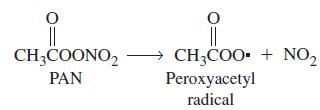
Peroxyacetyl nitrate (PAN) is an air pollutant produced in photochemical smog by the reaction of hydrocarbons, oxides of nitrogen, and sunlight. PAN is unstable and dissociates into peroxyacetyl radicals and NO2(g). Its presence in polluted air is like a reservoir for NO2 storage.The first-order
In the reaction of gaseous nitrogen and hydrogen to form gaseous ammonia, what are the relative rates of disappearance of the two reactants? How is the rate of formation of the product related to the rates of disappearance of the reactants?
In the reaction 2 A + B → C + 3 D, reactant A is found to disappear at the rate of 6.2 x 10‾4 M s‾1.(a) What is the rate of reaction at this point? (b) What is the rate of disappearance of B? (c) What is the rate of formation of D?
Suppose that at some point in the reaction[B] = 0.9986 M, and that 13.20 min later [B] = 0.9746 M. What is the average rate of reaction during this time period, expressed in M s-1? A + 3B 2C + 2D
(A) At some point in the reaction 2 A + B → C + D, [A] = 0.3629 M. At a time 8.25 min later [A] = 0.3187 M. What is the average rate of reaction during this time interval, expressed in M s-1?(B) In the reaction 2 A → 3 B, [A] drops from 0.5684 M to 0.5522 M in 2.50 min. What is the average rate
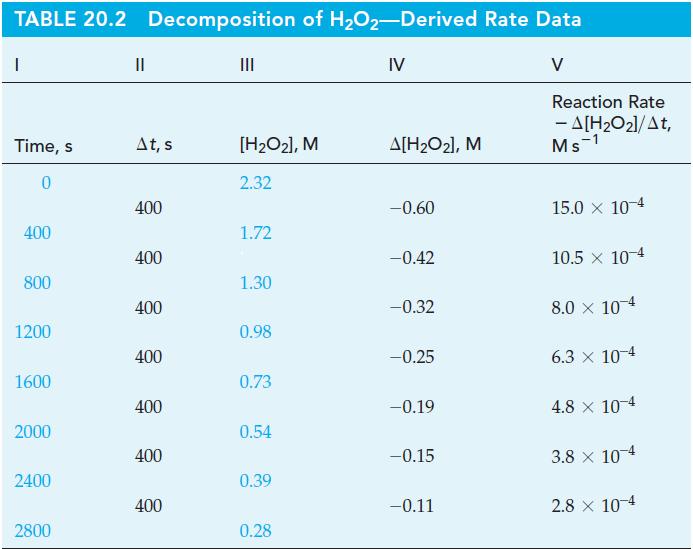
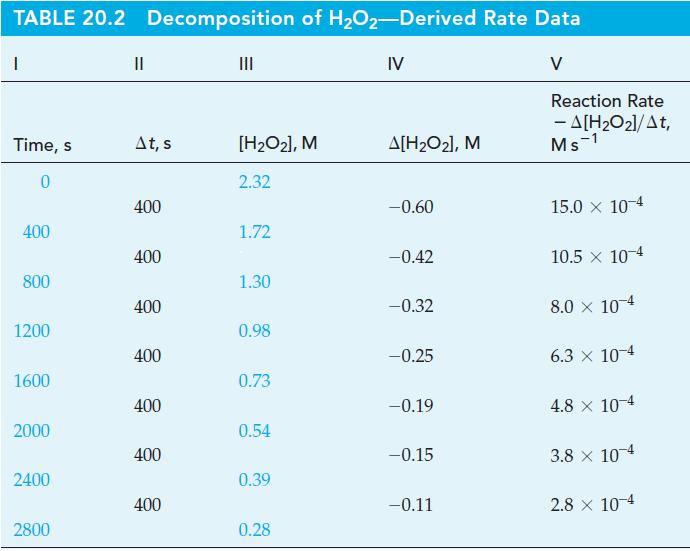
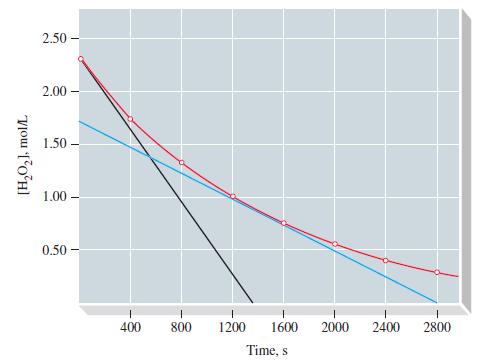
(A) For reaction (20.3), determine (a) The instantaneous rate of reaction at 2400 s and (b) [H2O2] at 2450 s. Assume that the instantaneous rate of reaction at 2400 s holds constant for the next 50 s.Reaction (20.3)(B) Use data only from Table 20.2 to determine [H2O2] at t = 100 s. Compare this
As shown later in the chapter, for certain reactions the initial and instantaneous rates of reaction are equal throughout the course of the reaction. What must be the shape of the concentration–time graph for such a reaction?
From the data in Table 20.2 and Figure 20-2 for the decomposition of H2O2, determine (a) the initial rate of reaction, and (b) [H2O2]t at t = 100 s, assuming that the initial rate is constant for at least 100 s.Table 20.2Figure 20-2 TABLE 20.2 Decomposition of H₂O2-Derived Rate Data IV I Time,
The rate of decomposition of gaseous acetaldehyde, CH3CHO, to gaseous methane and carbon monoxide is found to increase by a factor of 2.83 when the initial concentration of acetaldehyde is doubled. What is the order of this reaction?
(A) The decomposition of N2O5 is given by the following equation:At an initial [N2O5] = 3.15 M, the initial rate of reaction = 5.45 x 10⁻⁵ M s-1, and when [N2O5] = 0.78 M, the initial rate of reaction = 1.35 x 10⁻⁵ M s1. Determine the order of this decomposition reaction.(B) Consider a hypothetical
In the reaction A → products, [A] is found to be 0.485 M at t = 71.5 s and 0.474 M at t = 82.4 s. What is the average rate of the reaction during this time interval?
In the reaction A → products, at t = 0, [A] = 0.1565 M. After 1.00 min, [A] = 0.1498 M, and after 2.00 min, [A] = 0.1433 M.(a) Calculate the average rate of the reaction during the first minute and during the second minute.(b) Why are these two rates not equal?
(A) A reaction has the rate law: rate = k[A]2[B]. When [A] = 1.12 M and [B] = 0.87 M, the rate of reaction = 4.78 x 10⁻² M s-1. What is the value of the rate constant, k?(B) What is the rate of reaction (20.7) at the point where [HgCl2] = 0.050 M and [C2O42-] 0.025 M?Reaction (20.7) 2 HgCl2(aq) +
How could you ascertain, by examining only a plot of [A] versus time, whether a reaction is (a) Zero order; (b) First order; (c) Second order?
In the reaction A → products, 4.40 min after the reaction is started, [A] = 0.588 M. The rate of reaction at this point is rate = -Δ[A]/Δt = 2.2 x 10⁻² M min-1. Assume that this rate remains constant for a short period of time.(a) What is [A] 5.00 min after the reaction is started?(b) At what
(A) The reaction A → 2 B + C is first order. If the initial [A] = 2.80 M and k = 3.02 x 10⁻³ s-1, what is the value of [A] after 325 s?(B) Use data tabulated in Figure 20-4, together with equation (20.13), to show that the decomposition of H2O2 is a first-order reaction. Use a pair of data points
Refer to Experiment 2 of Table 20.3 and to reaction (20.7) and rate law (20.8). Exactly 1.00 h after the reaction is started, what are (a) [HgCl2] and (b) [C2O42-] in the mixture?Table 20.3Reaction (20.7) TABLE 20.3 Kinetic Data for the Reaction: 2 HgCl₂ + C₂O4²- →2Cl¯ + 2 CO₂ +
(A) Consider the first-order reaction A → products, with k = 2.95 x 10⁻³ s-1. What percent of A remains after 150 s?(B) At what time after the start of the reaction is a sample of two-thirds decomposed?
Without doing calculations, use a ln k versus 1/T graph to explain whether the rate of change of the rate constant with temperature is affected more strongly by a low or high energy of activation.
For the reaction A + 2 B → 2 C, the rate of reaction is 1.76 x 10⁻⁵ M s-1 at the time when [A] = 0.3580 M.(a) What is the rate of formation of C?(b) What will [A] be 1.00 min later?(c) Assume the rate remains at 1.76 x 10⁻⁵ M s-1. How long would it take for [A] to change from 0.3580 to 0.3500 M?
(A) Start with DTBP at a pressure of 800.0 mmHg at 147 °C. What will be the pressure of DTBP at t = 125 min, if t1/2 = 8.0 x 101 min? Because 125 min is not an exact multiple of the half-life, you must use equation (20.15). Can you see that the answer is between 200 and 400 mmHg?Eq. 20.15(B) Use
In the production of ammonia from nitrogen and hydrogen, the rate of reaction can be increased by using a catalyst or by increasing the temperature. Is the means by which these two different methods increase the rate of reaction the same? Explain.
(A) In the decomposition reaction B → products, the following data are obtained: t = 0 s, [B] = 0.88 M; 25 s, 0.74 M; 50 s, 0.62 M; 75 s, 0.52 M; 100 s, 0.44 M; 150 s, 0.31 M; 200 s, 0.22 M; 250 s, 0.16 M. What are the order of this reaction and its rate constant k?(B) The following data are
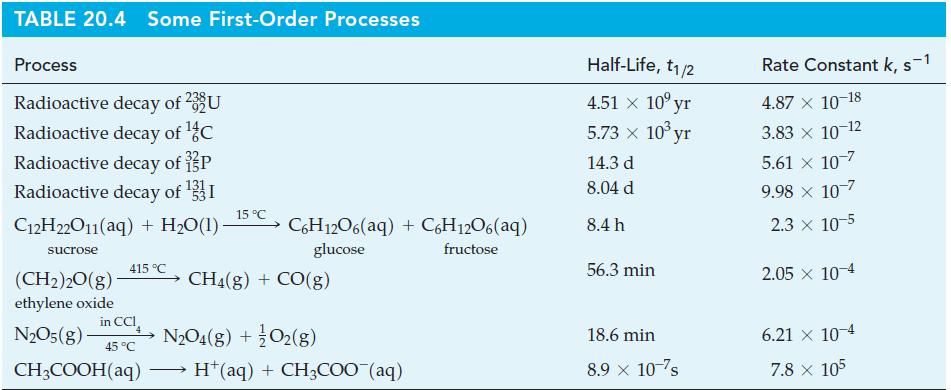
(A) What is the half-life of the first-order decomposition of N2O5 at 75.0 °C? Use data from Example 20-9.(B) At what temperature will it take 1.50 h for two-thirds of a sample of N2O5 in CCl4 to decompose in Example 20-9?Example 20-9Use data from Figure 20-12 to determine the temperature at
(A) At room temperature (20°C), milk turns sour in about 64 hours. In a refrigerator at 3°C, milk can be stored three times as long before it sours. (a) Estimate the activation energy of the reaction that causes the souring of milk. (b) How long should it take milk to sour at 40°C?(B) The
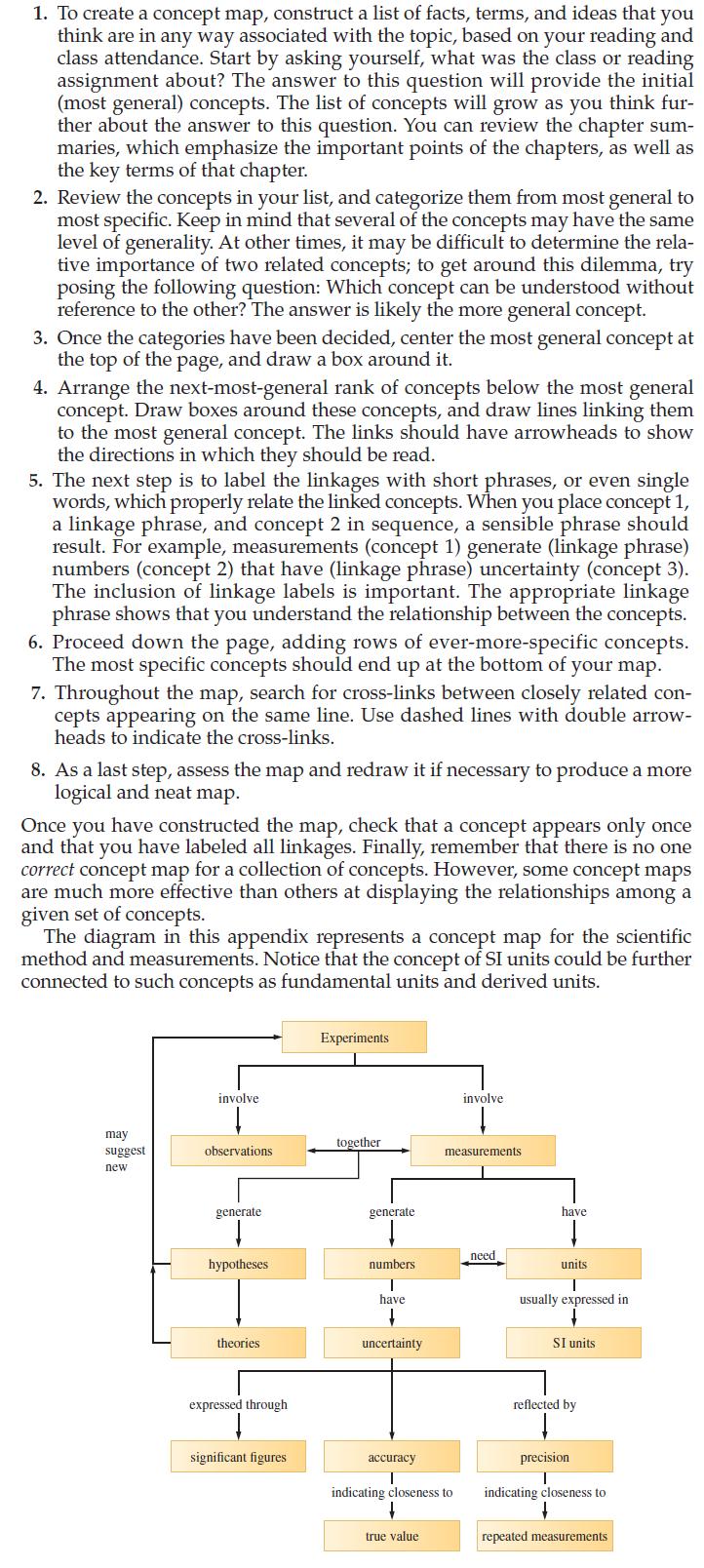
Using the method presented in Appendix E, construct a concept map showing the relationship between electrochemical cells and thermodynamic properties.Appendix E 1. To create a concept map, construct a list of facts, terms, and ideas that you think are in any way associated with the topic, based on
E°cell = -0.0050 V for the reaction, 2 Cu+(aq) + Sn4+(aq) → 2 Cu2+(aq) + Sn2+(aq).(a) Can a solution be prepared that is 0.500 M in each of the four ions at 298 K?(b) If not, in what direction must a net reaction occur?
A solution is prepared by saturating 100.0 mL of 1.00 M NH3(aq) with AgBr. A silver electrode is immersed in this solution, which is joined by a salt bridge to a standard hydrogen electrode. What will be the measured Ecell? Is the standard hydrogen electrode the anode or the cathode?
A test for completeness of electrodeposition of Cu from a solution of Cu2+(aq) is to add NH3(aq). A blue color signifies the formation of the complex ion [Cu(NH3)4]2+ (Kf = 1.1 x 10¹³). Let 250.0 mL of 0.1000 M be electrolyzed with a 3.512 A current for 1368 s. At this time, add a sufficient
For each of the following potential battery systems, describe the electrode reactions and the net cell reaction you would expect. Determine the theoretical voltage of the battery.(a) Zn–Br2(b) Li–F2
A lithium battery, uses lithium metal as one electrode and carbon in contact with MnO2 in a paste of KOH as the other electrode. The electrolyte is lithium perchlorate in a nonaqueous solvent, and the construction is similar to the silver battery. The half-cell reactions involve the oxidation of
If the 0.65 M KOH of Exercise 43 is replaced by 0.65 M NH3, (a) Will Ecell be higher or lower than in the cell with 0.65 M KOH?(b) What will be the value of Ecell?Exercise 43A concentration cell is constructed of two hydrogen electrodes: one immersed in a solution with [H+] = 1.0 M and the other
For the reduction half-cell reactions Hg22+(aq) + 2 e¯→ 2 Hg(l), E° = 0.797 V. Will Hg(l) react with and dissolve in HCl(aq)? in HNO3(aq)? Explain.
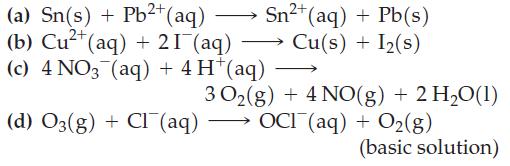
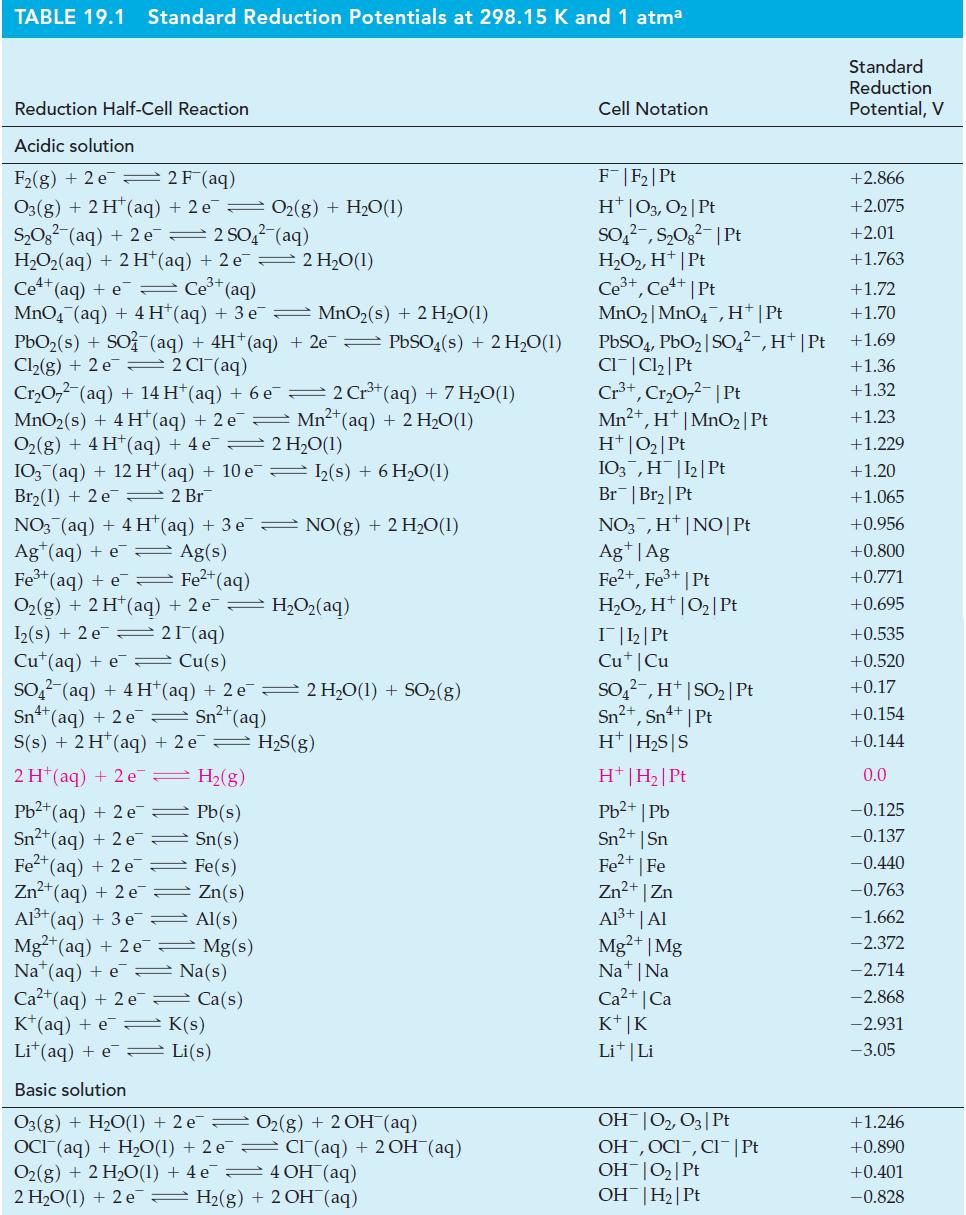
Assume that all reactants and products are in their standard states, and use data from Table 19.1 to predict whether a spontaneous reaction will occur in the forward direction in each case.Table 19.1 (a) Sn(s) + Pb²+ (aq) (b) Cu²+ (aq) + 21 (aq) (c) 4 NO3 (aq) + 4 H*(aq) (d) O3(g) + Cl(aq) Sn²+
Ni2+ has a more positive reduction potential than Cd2+.(a) Which ion is more easily reduced to the metal?(b) Which metal, Ni or Cd, is more easily oxidized?
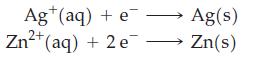
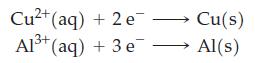
Given these half-cell reactions and associated standard reduction potentials, answer the questions that follow:(a) Determine which pair of half-cell reactions leads to a cell reaction with the largest positive cell potential, and calculate its value. Which couple is at the anode and which is at the
The following sketch is of a voltaic cell consisting of two standard electrodes for two metals, M and N:Use the standard reduction potentials of these half reactions to answer the questions that follow:(a) Determine which pair of these half-cell reactions leads to a cell reaction with the largest
The theoretical E°cell for the methane–oxygen fuel cell is 1.06 V. What is E° for the reduction half-cell reaction CO2(g) + 8 H+(aq) + 8 e¯ → CH4(g) + 2 H2O(l)? Refer to cell reaction (19.27).Reaction (19.27) A,H° -890 kJ mol-1 = A,Gº = -818 kJ mol-1 8 = 0.92 (19.27)
Given that E°cell for the aluminum-air battery is 2.71 V, what is E° for the reduction half-cell reaction [Al(OH)4]¯(aq) + 3 e¯ → Al(s) + 4 OH¯(aq)? Refer to cell reaction (19.28).Reaction (19.28) 4 Al(s) + 3 O₂(g) + 6H₂O(1) + 4 OH (aq) 4[Al(OH)4] (aq) (19.28)
Ascorbic acid (C6H8O6), also commonly known as vitamin C, can be used to reduce a wide variety of transition metal ions. Given that E°cell = 0.71 V for the reaction C6H8O6(aq) + 2 Fe³+ (aq) →>>> C6H₂O6(aq) +2 Fe²+ (aq) + 2 H+ (aq), what is E° for the half-cell reac- tion C6H₂O6(aq) + 2
E°cell = 0.201 V for the reactionWhat is E° for the reduction of [PtCl4]2- to Pt in acidic solution? 3 Pt(s) + 12 Cl(aq) + 2NO3(aq) + 8 H*(aq) 3[PtCl4] (aq) + 2NO(g) + 4H₂O(1)
You must estimate E° for the half-cell reaction In3+(aq) + 3 e¯ → In(s). You have no electrical equipment, but you do have all of the metals listed in Table 19.1 and aqueous solutions of their ions, as well as In(s) and In3+(aq). Describe the experiments you would perform and the accuracy you
From the observations listed, estimate the value of E° for the half-cell reaction M2+(aq) + 2 e¯ → M(s).(a) The metal M reacts with HNO3(aq), but not with HCl(aq); M displaces Ag+(aq), but not Cu2+(aq).(b) The metal M reacts with HCl(aq), producing H2(g), but displaces neither Zn2+(aq) nor
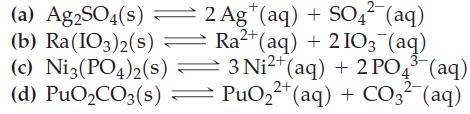
Write Ksp expressions for the following equilibria. For example, for the reaction AgCl(s) ⇌ Ag+(aq) + Cl-(aq), Ksp = [Ag+][Cl-]. (a) Ag2SO4(s) (b) Ra(103)2(s) 2 Ag+ (aq) + SO4² (aq) Ra²+ (aq) + 2103 (aq) (c) Ni3(PO4)2(s) — 3 Ni²+ (aq) + 2 PO4³(aq) 2+ 2- (d) PuO₂CO3(s) = PuO₂²+ (aq) +
Write solubility equilibrium equations that are described by the following Ksp expressions. For example Ksp = [Ag+][Cl¯] represents AgCl(s) ⇌ Ag+(aq) + Cl¯(aq). 3+ (a) Ksp = [Fe³+][OH-]³ (b) Ksp = [BiO+][OH¯] (c) Ksp = [Hg₂²+][r]² (d) Ksp = [Pb²+]³[AsO4³-1² 2+
The following Ksp values are found in a handbook. Write the solubility product expression to which each one applies. For example, Ksp(AgCl) = [Ag+][Cl¯] = 1.8 x 10⁻¹⁰. (a) Kep(CrF3) = 6.6 × 10-¹1 (b) Ksp Au2(C2O4)3] = 1 × 10⁻¹⁰ (c) Ksp[Cd3(PO4)2] = 2.1 × 10⁻³³ (d) Ksp (SrF₂) = 2.5 × 10-⁹
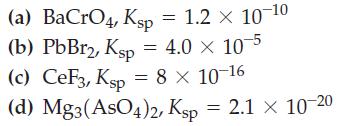
Calculate the aqueous solubility, in moles per liter, of each of the following. (a) BaCrO4, Ksp = 1.2 x 10⁻¹⁰ (b) PbBr2, Ksp = 4.0 × 10⁻⁵ (c) CeF3, Ksp = 8 × 10-16 (d) Mg3(AsO4)2, Ksp = 2.1 × 10⁻²⁰
Arrange the following solutes in order of increasing molar solubility in water: AgCN, AgIO3, AgI, AgNO2, Ag2SO4. Explain your reasoning.
Which of the following saturated aqueous solutions would have the highest [Mg2+]? Explain. (a) MgCO3;(b) MgF2;(c) Mg3(PO4)2.
Fluoridated drinking water contains about 1 part per million (ppm) of F¯. Is CaF2 sufficiently soluble in water to be used as the source of fluoride ion for the fluoridation of drinking water? Explain. Think of 1 ppm as signifying 1 g F¯ per 106 g solution.
In the qualitative cation analysis procedure, Bi3+ is detected by the appearance of a white precipitate of bismuthyl hydroxide, BiOOH(s): Calculate the pH of a saturated aqueous solution of BiOOH. BIOOH(s) BiO (aq) + OH(aq) Ksp = 4 X 10⁻¹⁰
A solution is saturated with magnesium palmitate [Mg(C16H31O2)2, a component of bathtub ring] at 50 °C. How many milligrams of magnesium palmitate will precipitate from 965 mL of this solution when it is cooled to 25 °C? For Mg(C16H31O2)2, Ksp = 4.8 x 10⁻¹² at 50 °C and 3.3 x 10⁻¹² at 25 °C.
A 725 mL sample of a saturated aqueous solution of calcium oxalate, CaC2O4, at 95 °C is cooled to 13 °C. How many milligrams of calcium oxalate will precipitate? For CaC2O4, Ksp = 1.2 x 10⁻⁸ at 95 °C and 2.7 x 10⁻⁹ at 13 °C.
A 250 mL sample of saturated CaC2O4(aq) requires 4.8 mL of 0.00134 M KMnO4(aq) for its titration in an acidic solution. What is the value of Ksp for CaC2O4 obtained with these data? In the titration reaction, C2O42- is oxidized to CO2 and MnO4- is reduced to Mn2+.
To precipitate as Ag2S(s), all the Ag+ present in 338 mL of a saturated solution of AgBrO3 requires 30.4 mL of H2S(g) measured at 23°C and 748 mmHg. What is Ksp for AgBrO3?
Excess Ca(OH)2(s) is shaken with water to produce a saturated solution. A 50.00 mL sample of the clear saturated solution is withdrawn and requires 10.7 mL of 0.1032 M HCl for its titration. What is Ksp for Ca(OH)2?
Calculate the molar solubility of Mg(OH)2 (Ksp = 1.8 x 10⁻¹¹) in (a) Pure water; (b) 0.0862 M MgCl2; (c) 0.0355 M KOH(aq).
How would you expect the presence of each of the following solutes to affect the molar solubility of CaCO3 in water? Explain. (a) Na2CO3; (b) HCl; (c) NaHSO4.
Describe the effects of the salts KI and AgNO3 on the solubility of AgI in water.
Describe the effect of the salt KNO3 on the solubility of AgI in water, and explain why it is different from the effects noted in Exercise 17.Exercise 17Describe the effects of the salts KI and AgNO3 on the solubility of AgI in water.
What [Pb2+] should be maintained in Pb(NO3)2(aq) to produce a solubility of 1.5 x 10⁻⁴ mol PbI2/L when PbI2(s) is added?
What [I¯] should be maintained in KI(aq) to produce a solubility of 1.5 x 10⁻⁵ mol PbI2/L when PbI2(s) is added?
Can the solubility of Ag2CrO4 be lowered to 5.0 x 10⁻⁸ mol Ag2CrO4/L by using CrO42- as the common ion? by using Ag+? Explain.
A handbook lists Ksp the values 1.1 x 10⁻¹⁰ for BaSO4 and 5.1 x 10⁻⁹ for BaCO3. When saturated BaSO4(aq) is also made with 0.50 M Na2CO3(aq), a precipitate of BaCO3(s) forms. How do you account for this fact, given that BaCO3 has a larger Ksp than does BaSO4?
A particular water sample that is saturated in CaF2 has a Ca2+ content of 115 ppm (that is, Ca2+ per 106 g of water sample). What is the F¯ ion content of the water in ppm?
Assume that, to be visible to the unaided eye, a precipitate must weigh more than 1 mg. If you add 1.0 mL of 1.0 M NaCl(aq) to 100.0 mL of a clear saturated aqueous AgCl solution, will you be able to see AgCl(s) precipitated as a result of the common-ion effect? Explain.
Will precipitation of MgF2(s) occur if a 22.5 mg sample of MgCl2 · 6 H2O is added to 325 mL of 0.035 M KF?
Will PbCl2(s) precipitate when 155 mL of 0.016 M KCl(aq) are added to 245 mL of 0.175 M Pb(NO3)2(aq)?
What is the minimum pH at which Cd(OH)2(s) will precipitate from a solution that is 0.0055 M in Cd2+(aq)?
What is the minimum pH at which Cr(OH)3(s) will precipitate from a solution that is 0.086 M in Cr3+(aq)?
Will precipitation occur in the following cases?(a) 0.10 mg NaCl is added to 1.0 L of 0.10 M AgNO3(aq).(b) One drop (0.05 mL) of 0.10 M KBr is added to 250 mL of a saturated solution of AgCl.(c) One drop (0.05 mL) of 0.0150 M NaOH(aq) is added to 3.0 L of a solution with 2.0 mg Mg2+ per liter.
The electrolysis of MgCl2(aq) can be represented asThe electrolysis of a 315 mL sample of 0.185 M MgCl2 is continued until 0.652 L H2(g) at 22 °C and 752 mmHg has been collected. Will Mg(OH)2(s) precipitate when electrolysis is carried to this point? Notice that [Mg2+] remains constant throughout
Determine whether 1.50 g H2C2O4 (oxalic acid: Ka1 = 5.2 x 10⁻², Ka2 = 5.4 x 10⁻⁵) can be dissolved in 0.200 L of 0.150 M CaCl2 without the formation of CaC2O4(s) (Ksp = 1.3 x 10⁻⁹).
If 100.0 mL of a clear saturated solution of Ag2SO4 is added to 250.0 mL of a clear saturated solution of PbCrO4, will any precipitate form?
When 200.0 mL of 0.350 M K2CrO4(aq) are added to 200.0 mL of 0.0100 M AgNO3(aq), what percentage of the Ag+ is left unprecipitated?
What percentage of the original Ag+ remains in solution when 175 mL 0.0208 M AgNO3 is added to 250 mL 0.0380 M K2CrO4?
The ancient Romans added calcium sulfate to wine to clarify it and to remove dissolved lead. What is the maximum [Pb2+] that might be present in wine to which calcium sulfate has been added?
Which one of the following solutions can be used to separate the cations in an aqueous solution in which [Ba2+] = [Ca2+] = 0.050 M: 0.10 M NaCl(aq), 0.05 M Na2SO4(aq), 0.001 M NaOH(aq), or 0.50 M Na2CO3(aq)? Explain why.
KI(aq) is slowly added to a solution with [Pb2+] = [Ag+] = 0.10 M. For PbI2, Ksp = 7.1 x 10⁻⁹; for AgI, Ksp = 8.5 x 10⁻¹⁷.(a) Which precipitate should form first, PbI2 or AgI?(b) What [I¯] is required for the second cation to begin to precipitate?(c) What concentration of the first cation to
A solution is 0.010 M in both CrO42- and SO42- To this solution, 0.50 M Pb(NO3)2(aq) is slowly added.(a) Which anion will precipitate first from solution?(b) What is [Pb2+] at the point at which the second anion begins to precipitate?(c) Are the two anions effectively separated by this fractional
An aqueous solution that 2.00 M in AgNO3 is slowly added from a buret to an aqueous solution that is 0.0100 M in Cl¯ and 0.250 M in I¯.(a) Which ion, Cl¯ or I¯, is the first to precipitate?(b) When the second ion begins to precipitate, what is the remaining concentration of the first ion?(c) Is
AgNO3(aq) is slowly added to a solution that is 0.250 M NaCl and also 0.0022 M KBr.(a) Which anion will precipitate first, Cl¯ or Br¯?(b) What is [Ag+] at the point at which the second anion begins to precipitate?(c) Can the Cl¯ and Br¯ be separated effectively by this fractional precipitation?
Which of the following solids is (are) more soluble in an acidic solution than in pure water: KCl, MgCO3, FeS, Ca(OH)2, or C6H5COOH? Explain.
Which of the following solids is (are) more soluble in a basic solution than in pure water: BaSO4, H2C2O4, Fe(OH)3, NaNO3, or MnS? Explain.
The solubility of Mg(OH)2 in a particular buffer solution is 0.65 g/L. What must be the pH of the buffer solution?
Showing 1000 - 1100
of 4008
First
4
5
6
7
8
9
10
11
12
13
14
15
16
17
18
Last
Step by Step Answers

 Get 50% OFF
Claim Now
Get 50% OFF
Claim Now


![1 Time, S 0 25 50 75 100 150 200 250 [A], M 1.00 0.78 0.61 0.47 0.37 0.22 0.14 0.08 || Time, S 0 25 50 75 100](https://dsd5zvtm8ll6.cloudfront.net/images/question_images/1700/9/2/7/448656217d8ca25e1700927446997.jpg)
![Time, S 0 25 50 75 100 150 200 250 [A], M 1.00 0.78 0.61 0.47 0.37 0.22 0.14 0.08 || Time, S 0 25 50 75 100](https://dsd5zvtm8ll6.cloudfront.net/images/question_images/1700/9/2/7/476656217f4a90001700927474603.jpg)
![I Time, S 0 25 50 75 100 150 200 250 [A], M 1.00 0.78 0.61 0.47 0.37 0.22 0.14 0.08 || Time, s 0 25 50 75 100](https://dsd5zvtm8ll6.cloudfront.net/images/question_images/1700/9/2/7/5016562180dddacb1700927499777.jpg)
![I Time, S 0 25 50 75 100 150 200 250 [A], M 1.00 0.78 0.61 0.47 0.37 0.22 0.14 0.08 || Time, s 0 25 50 75 100](https://dsd5zvtm8ll6.cloudfront.net/images/question_images/1700/9/2/7/5286562182838ea81700927525987.jpg)
![Time, S [A], M 1.00 0.78 50 0.61 75 0.47 100 0.37 0.22 0.14 0.08 0 25 150 200 250 || Time, s 0 25 50 75 100](https://dsd5zvtm8ll6.cloudfront.net/images/question_images/1700/9/2/7/5956562186b3f62f1700927594050.jpg)





![TABLE 20.3 Kinetic Data for the Reaction: 2 HgCl + CO4- 2Cl + 2 CO + HCl Experiment [HgCl], M 123 2 3](https://dsd5zvtm8ll6.cloudfront.net/images/question_images/1700/9/1/3/8216561e29d305471700913820443.jpg)

![[H] 0.800 0.400 0.000 -0.400- -0.800 - -1.200 Slope -1.095 L - 1.095 1500 s 600 1500 s -7.30 x 10-45-1 I 1200](https://dsd5zvtm8ll6.cloudfront.net/images/question_images/1700/9/1/4/5156561e553e2ba41700914514330.jpg)
![[A]t In- [A]o = -kt or In[A] = kt + In[A]o (20.13)](https://dsd5zvtm8ll6.cloudfront.net/images/question_images/1700/9/1/4/5416561e56d69eaf1700914539928.jpg)
![TABLE 20.3 Kinetic Data for the Reaction: 2 HgCl + CO4- 2Cl + 2 CO + HgCl Experiment [HgCl], M [HgCl]1 =](https://dsd5zvtm8ll6.cloudfront.net/images/question_images/1700/9/2/5/25565620f471fd6b1700925253730.jpg)



![[Zn(NH3)4]+ (aq) + 2 Ti+ (aq) + e e Zn(s) + 4 NH3(aq) E -1.015 V 2+ Sn+ (aq) + 2 e Ti+ (aq) O2+ (aq) + 2 H+](https://dsd5zvtm8ll6.cloudfront.net/images/question_images/1700/8/0/8/697656047f986fcd1700808697206.jpg)


![4 Al(s) + 3 O(g) + 6HO(1) + 4 OH (aq) 4[Al(OH)4] (aq) (19.28)](https://dsd5zvtm8ll6.cloudfront.net/images/question_images/1700/8/0/8/382656046be05b4d1700808381700.jpg)

![3 Pt(s) +12 CI (aq) + 2NO3 (aq) + 8 H*(aq) 3[PtCl4] (aq) + 2 NO(g) + 4HO(1)](https://dsd5zvtm8ll6.cloudfront.net/images/question_images/1700/8/0/8/0146560454e3f5c81700808013897.jpg)
![3+ (a) Ksp = [Fe+][OH-] (b) Ksp = [BiO+][OH] (c) Ksp = [Hg+][r] (d) Ksp = [Pb+][AsO4-1 2+](https://dsd5zvtm8ll6.cloudfront.net/images/question_images/1700/7/2/4/628655eff944c5091700724628060.jpg)
![(a) Kap(CrF3) = 6.6 10-1 (b) Ksp [Au2(C2O4)3] = 1 10-10 (c) Ksp [Cd3(PO4)2] = 2.1 10-33 (d) Ksp (SrF) =](https://dsd5zvtm8ll6.cloudfront.net/images/question_images/1700/7/2/4/723655efff3ab34e1700724723455.jpg)