New Semester
Started
Get
50% OFF
Study Help!
--h --m --s
Claim Now
Question Answers
Textbooks
Find textbooks, questions and answers
Oops, something went wrong!
Change your search query and then try again
S
Books
FREE
Study Help
Expert Questions
Accounting
General Management
Mathematics
Finance
Organizational Behaviour
Law
Physics
Operating System
Management Leadership
Sociology
Programming
Marketing
Database
Computer Network
Economics
Textbooks Solutions
Accounting
Managerial Accounting
Management Leadership
Cost Accounting
Statistics
Business Law
Corporate Finance
Finance
Economics
Auditing
Tutors
Online Tutors
Find a Tutor
Hire a Tutor
Become a Tutor
AI Tutor
AI Study Planner
NEW
Sell Books
Search
Search
Sign In
Register
study help
sciences
general chemistry principles
General Chemistry Principles And Modern Applications 11th Edition Ralph Petrucci, Jeffry Madura, F. Herring, Carey Bissonnette - Solutions
Which of the following has the highest molar solubility? (a) MgF2, Ksp = 3.7 × 10⁻⁸; (b) MgCO3, Ksp = 3.5 × 10⁻⁸; (c) Mg3(PO4)2, Ksp = 1 × 10-25; (d) Li3PO4, Ksp = 3.2 × 10-⁹.
Saturated solutions of sodium phosphate, copper(II) chloride, and ammonium acetate are mixed together. The precipitate is (a) Copper(II) acetate; (b) Copper(II) phosphate; (c) Sodium chloride; (d) Ammonium phosphate; (e) Nothing precipitates.
Will Al(OH)3(s) precipitate from a buffer solution that is 0.45 M CH3COOH and 0.35 M NaCH3COO and also 0.275 M in Al3+(aq)? For Al(OH)3, Ksp = 1.3 x 10⁻³³; for CH3COOH, Ka = 1.8 x 10⁻⁵.
Which of the following solids are likely to be more soluble in acidic solution and which in basic solution? Which are likely to have a solubility that is independent of pH? Explain. (a) H2C2O4;(b) MgCO3;(c) CdS;(d) KCl; (e) NaNO3;(f) Ca(OH)2.
The best way to ensure complete precipitation from saturated H2S(aq) of a metal ion, M2+, as its sulfide, MS(s), is to (a) Add an acid; (b) Increase [H2S] in the solution; (c) Raise the pH; (d) Heat the solution.
To increase the molar solubility of CaCO3(s) in a saturated aqueous solution, add (a) Ammonium chloride;(b) Sodium carbonate; (c) Ammonia; (d) More water.
All but two of the following solutions yield a precipitate when the solution is also made 2.00 M in Those two are (a) MgCl2(aq); (b) FeCl3(aq);(c) (NH4)2SO4(aq);(d) Cu(NO3)2(aq);(e) Al2(SO4)3(aq).
Cu2+ and Pb2+ are both present in an aqueous solution. To precipitate one of the ions and leave the other in solution, add (a) H2S(aq); (b) H2SO4(aq);(c) HNO3(aq); (d) NH4NO3(aq).
The slightly soluble solute Ag2CrO4 is most soluble in (a) Pure water; (b) 0.10 M K2CrO4; (c) 0.25 M KNO3;(d) 0.40 M AgNO3.
Adding 1.85 g Na2SO4 to 500.0 mL of saturated aqueous BaSO4:(a) Reduces [Ba2+]; (b) Reduces [SO42-];(c) Increases the solubility of BaSO4; (d) Has no effect.
Pure water is saturated with slightly soluble PbI2. Which of the following is a correct statement concerning the lead ion concentration in the solution, and what is wrong with the others? (a) [Pb²+] = []; (b) [Pb²+] = Ksp of PbI₂; (c) [Pb²+] = √Ksp of PbI2; (d) [Pb²+] = 0.5[1].
Explain the important distinction between each pair of terms: (a) Solubility and solubility product constant;(b) Common-ion effect and salt effect; (c) Ion pair and ion product.
Briefly describe each of the following ideas, methods, or phenomena: (a) Common-ion effect in solubility equilibrium; (b) Fractional precipitation; (c) Ion-pair formation; (d) Qualitative cation analysis.
In your own words, define the following terms or symbols: (a) Ksp;(b) Kf;(c) Qsp;(d) Complex ion.
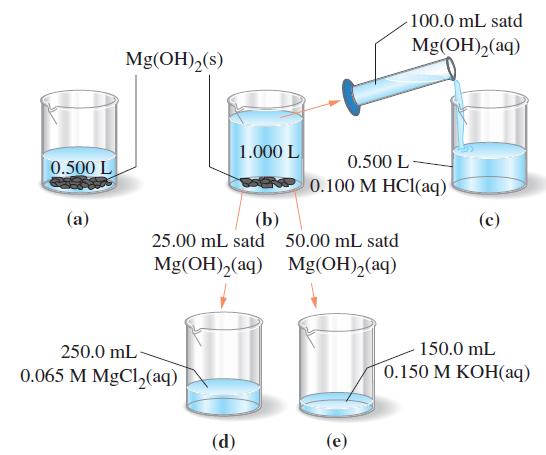
The accompanying drawing suggests a series of manipulations starting with saturated Mg(OH)2(aq). Calculate [Mg2+(aq)] at each of the lettered stages.(a) 0.500 L of saturated Mg(OH)2(aq) is in contact with Mg(OH)2(s).(b) 0.500 L of H2O is added to the 0.500 L of solution in part (a), and the
In the Mohr titration, Cl-(aq) is titrated with AgNO3(aq) in solutions that are at about pH = 7. Thus, it is suitable for determining the chloride ion content of drinking water. The indicator used in the titration is K2CrO4(aq). A red-brown precipitate of Ag2CrO4(s) forms after all the Cl- has
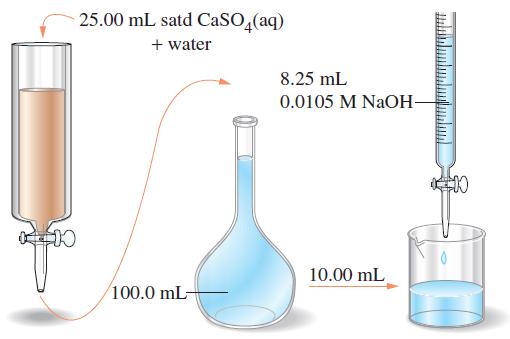
In an experiment to measure Ksp of CaSO4 [D. Masterman, j. Chem. Educ., 64, 409 (1987)], a saturated solution of CaSO4(aq) is poured into the ion-exchange column pictured. As the solution passes through the column, Ca2+ is retained by the ion-exchange medium and H3O+ is released; two H3O+ ions
How many moles of solid sodium fluoride should be added to 1.0 L of a saturated solution of barium fluoride, BaF2, at 25°C to raise the fluoride concentration to 0.030 mol/L? What mass of BaF2 precipitates? You may ignore the hydrolysis of fluoride ion.
A 2.50 g sample of Ag2SO4(s) is added to a beaker containing 0.150 L of 0.025 M BaCl2.(a) Write an equation for any reaction that occurs.(b) Describe the final contents of the beaker—that is, the masses of any precipitates present and the concentrations of the ions in solution.
Use the method of Exercise 83 to determine [Pb2+] in a saturated solution in contact with a mixture of PbCl2(s) and PbBr2(s).Exercise 83A mixture of PbSO4(s) and PbS2O3(s) is shaken with pure water until a saturated solution is formed. Both solids remain in excess. What is [Pb2+] in the saturated
A mixture of PbSO4(s) and PbS2O3(s) is shaken with pure water until a saturated solution is formed. Both solids remain in excess. What is [Pb2+] in the saturated solution? For PbSO4, Ksp = 1.6 x 10⁻⁸; for PbS2O3, Ksp = 4.0 x 10⁻⁷.
Use Ksp for PbCl2 and Kf for [PbCl3]- to determine the molar solubility of PbCl2 in 0.10 M HCl(aq). What is the total concentration of lead species in solution?
The solubility of CdCO3(s) in 1.00 M KI(aq) is 1.2 x 10⁻³ mol/L. Given that Ksp of CdCO3 is 5.2 x 10⁻¹², what is Kf for [CdI4]2-?
The solubility of AgCN(s) in 0.200 M NH3(aq) is 8.8 x 10⁻⁶ mol/L. Calculate Ksp for AgCN.
Aluminum compounds are soluble in acidic solution, where aluminum(III) exists as the complex ion [Al(H2O)6]3+, which is generally represented simply as Al3+(aq). They are also soluble in basic solutions, where the aluminum(III) is present as the complex ion [Al(OH)4]-. At certain intermediate pH
For the titration in Example 18-7, verify the assertion that [Ag+] increases very rapidly between the point at which AgBr has finished precipitating and Ag2CrO4 is about to begin. Example 18-7AgNO3(aq) is slowly added to a solution that has [CrO42-] = 0.010 M and [Br-] = 0.010 M.(a) Show that
Reaction (18.10), described in the Integrative Example, is called a carbonate transposition. In such a reaction, anions of a slightly soluble compound (for example, hydroxides and sulfates) are obtained in a sufficient concentration in aqueous solution that they can be identified by qualitative
Concerning the reactions described in Exercise 75(b), (a) Will the same observations be made if Ca(OH)2(aq) is replaced by CaCl2(aq)? Explain.(b) Show that the white precipitate will redissolve if the Ca(OH)2(aq) is about 0.005 M, but not if the solution is saturated.Exercise 75(b)Write net ionic
Write net ionic equations for each of the following observations.(a) When concentrated CaCl2(aq) is added to Na2HPO4(aq), a white precipitate forms that is 38.7% Ca by mass.(b) When a piece of dry ice, CO2(s), is placed in a clear dilute solution of limewater [Ca(OH)2(aq)], bubbles of gas evolve.
What is the solubility of MnS, in grams per liter, in a buffer solution that is 0.100 M CH3COOH - 0.500 M NaCH3COO? For MnS, Kspa = 3 x 10⁷.
What percentage of the Ba2+ in solution is precipitated as BaCO3(s) if equal volumes of 0.0020 M Na2CO3(aq) and 0.0010 M BaCl2(aq) are mixed?
A 50.0 mL sample of 0.0152 M Na2SO4(aq) is added to 50.0 mL of 0.0125 M Ca(NO3)2(aq). What percentage of the Ca2+ remains unprecipitated?
A handbook lists the solubility of CaHPO4 as 0.32 g CaHPO4 · 2 H2O/L and lists Ksp as 1 x 10⁻⁷.(a) Are these data consistent? (That is, are the molar solubilities the same when derived in two different ways?)(b) If there is a discrepancy, how do you account for it? CaHPO4(s) Ca²+ (aq) + HPO4²-
A particular water sample has 131 ppm of CaSO4 (131 g CaSO4 per 106 g water). If this water is boiled in a teakettle, approximately what fraction of the water must be evaporated before CaSO4(s) begins to precipitate? Assume that the solubility of CaSO4(s) does not change much in the temperature
Write net ionic equations for the following qualitative cation analysis procedures.(a) Precipitation of PbCl2(s) from a solution containing Pb2+(b) Dissolution of Zn(OH)2(s) in a solution of NaOH(aq)(c) Dissolution of Fe(OH)3(s) in HCl(aq)(d) Precipitation of CuS(s) from an acidic solution of
The addition of HCl(aq) to a solution containing several different cations produces a white precipitate. The filtrate is removed and treated with H2S(aq) in 0.3 M HCl. No precipitate forms. Which of the following conclusions is (are) valid? Explain.(a) Ag+ or Hg22+ (or both) is probably present.(b)
Show that in qualitative cation analysis group 1, if you obtain 1.00 mL of saturated PbCl2(aq) at 25 °C, sufficient Pb2+ should be present to produce a precipitate of PbCrO4(s). Assume that you use 1 drop (0.05 mL) of 1.0 M K2CrO4 for the test.
Suppose you did a group 1 qualitative cation analysis and treated the chloride precipitate with NH3(aq) without first treating it with hot water. What might you observe, and what valid conclusions could you reach about cations present, cations absent, and cations in doubt?
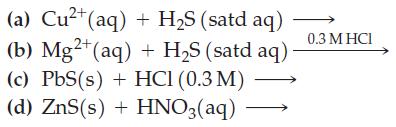
The following expressions pertain to the precipitation or dissolving of metal sulfides. Use information about the qualitative cation analysis scheme to predict whether a reaction proceeds to a significant extent in the forward direction and what the products are in each case. (a) Cu²+ (aq) + H₂S
A buffer solution is 0.25 M CH3COOH-0.15 M NaCH3COO, saturated in H2S (0.10 M), and with [Mn2+] = 0.15 M.(a) Show that MnS will not precipitate from this solution (for MnS, Kspa = 3 x 10⁷).(b) Which buffer component would you increase in concentration, and to what minimum value, to ensure that
A solution is 0.05 M in Cu2+, in Hg2+, and in Mn2+. Which sulfides will precipitate if the solution is made to be 0.10 M H2S(aq) and 0.010 M HCl(aq)? For CuS, Kspa = 6 x 10-16; for HgS, Kspa = 2 x 10-32; for MnS, Kspa = 3 x 10⁷.
Can Fe2+ and Mn2+ be separated by precipitating FeS(s) and not MnS(s)? Assume [Fe2+] = [Mn2+] = [H2S] = 0.10 M. Choose a [H3O+] that ensures maximum precipitation of FeS(s) but not MnS(s). Will the separation be complete? For FeS, Kspa = 6 x 10²; for MnS, Kspa = 3 x 10⁷.
A solution is prepared that has [NH3] = 1.00 M and [Cl-] = 0.100 M. How many grams of AgNO3 can be dissolved in 1.00 L of this solution without a precipitate of AgCl(s) forming?
A 0.10 mol sample of AgNO3(s) is dissolved in 1.00 L of 1.00 M NH3. How many grams of KI can be dissolved in this solution without a precipitate of AgI(s) forming?
A solution is 0.10 M in free NH3, 0.10 M in NH4Cl, and 0.015 M in [Cu(NH3)4]2+. Will Cu(OH)2(s) precipitate from this solution? Ksp of Cu(OH)2 is 2.2 x 10⁻²⁰.
Can the following ion concentrations be maintained in the same solution without a precipitate forming: [[Ag (S₂O3)2]³] = 0.048 M, [S₂O3²] = 0.76 M, and [I] = 2.0 M?
Calculate [Cu2+] in a 0.10 M CuSO4(aq) solution that is also 6.0 M in free NH3. Cu²+ (aq) + 4 NH3(aq) [Cu(NH3)4]²+ (aq) Kf = 1.1 X 10¹13
In a solution that is 0.0500 M in [Cu(CN)4]3- and 0.80 M in free CN-, the concentration of Cu+ is 6.1 x 10⁻³² M. Calculate Kf of [Cu(CN)4]3-. Cut (aq) + 4CN (aq) ⇒ [Cu(CN)4]³(aq) K₁ = ?
Which of the following would be most effective, and which would be least effective, in reducing the concentration of the complex ion [Zn(NH3)4]2+ in a solution: HCl, NH3, or NH4Cl? Explain your choices.
If a constant [Cl¯] = 0.100 M is maintained in a solution in which the initial [Pb2+] = 0.065 M, what percentage of the Pb2+ will remain in solution after PbCl2(s) precipitates? What [Cl¯] should be maintained to ensure that only 1.0% of the Pb2+ remains unprecipitated?
If 100.0 mL of 0.0025 M Na2SO4(aq) is saturated with CaSO4, how many grams of CaSO4 would be present in the solution?
A 0.150 M Na2SO4 solution that is saturated with Ag2SO4 has [Ag+] = 9.7 x 10⁻³ M. What is the value of Ksp for Ag2SO4 obtained with these data?
A 25.00 mL sample of a clear saturated solution of PbI2 requires 13.3 mL of a certain AgNO3(aq) for its titration. What is the molarity of this AgNO3(aq)? I (satd Pbl₂) + Ag (from AgNO3) AgI(s)
Use the method of Exercise 67 to determine the volume of titrant required to reach the indicated pH values in the following titrations.(a) 25.00 mL of 0.250 M NaOH titrated with 0.300 M HCl; pH = 13.00, 12.00, 10.00, 4.00, 3.00; (b) 50.00 mL of 0.0100 M benzoic acid titrated with 0.0500 M KOH: pH
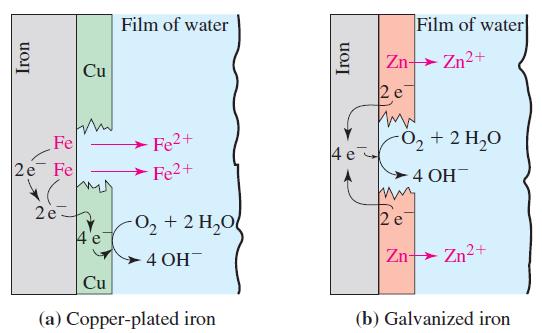
The electrolysis of Na2SO4(aq) is conducted in two separate half-cells joined by a salt bridge, as suggested by the cell diagram Pt∣Na2SO4(aq)∥Na2SO4(aq)∣Pt.(a) In one experiment, the solution in the anode compartment becomes more acidic, and that in the cathode compartment more basic, during
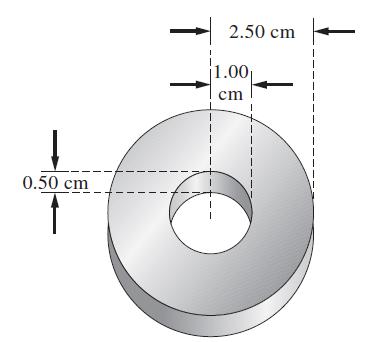
A Ni anode and an Fe cathode are placed in a solution with [Ni2+] = 1.0 M and then connected to a battery. The Fe cathode has the shape shown. How long must electrolysis be continued with a current of 1.50 A to build a 0.050-mm-thick deposit of nickel on the iron? (Density of nickel = 8.90 g/cm3.)
Initially, each of the half-cells in Figure 19-21 contained a 100.0-mL sample of solution with an ion concentration of 1.000 M. The cell was operated as an electrolytic cell, with copper as the anode and zinc as the cathode. A current of 0.500 A was used. Assume that the only electrode reactions
Your task is to determine E° for the reduction of CO2(g) to C3H8(g) in two different ways and to explain why each gives the same result. (a) Consider a fuel cell in which the cell reaction corresponds to the complete combustion of propane gas. Write the half-cell reactions and the overall
Equation (19.15) gives the relationship between the standard Gibbs energy of a reaction and the standard cell potential. We know how the Gibbs energy varies with temperature.(a) Making the assumption that ΔrH° and ΔrS° do not vary significantly over a small temperature range, derive an equation
Show that for nonstandard conditions the temperature variation of a cell potential iswhere E(T1) and E(T2) are the cell potentials at T1 and T2 respectively. We have assumed that the value of Q is maintained at a constant value. For the nonstandard cell below, the potential drops from 0.394 V at
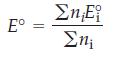
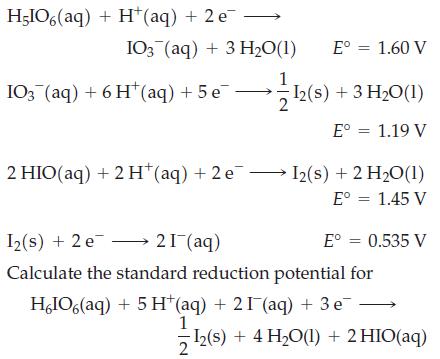
Show that for a combination of half-cell reactions that produce a standard reduction potential for a half-cell that is not directly observable, the standard reduction potential iswhere is the number of electrons in each half-cell reaction of potential Ei°. Use the following half-reactions:
Ultimately, ΔfG° values must be based on experimental results; in many cases, these experimental results are themselves obtained from E° values. Early in the twentieth century, g. N. Lewis conceived of an experimental approach for obtaining standard potentials of the alkali metals. This approach
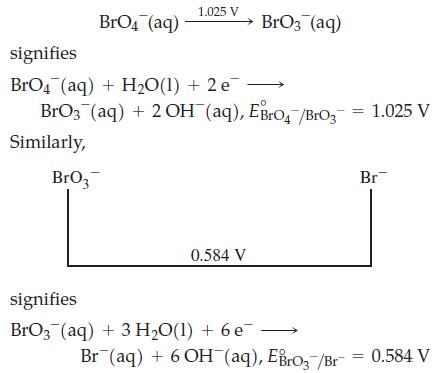
The following sketch is called an electrode potential diagram. Such diagrams summarize electrode potential data more efficiently than do listings such as that in Appendix D. In this diagram for bromine and its ions in basic solution,With reference to Appendix D and to the method of determining E°
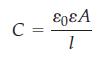
Only a tiny fraction of the diffusible ions move across a cell membrane in establishing a Nernst potential, so there is no detectable concentration change. Consider a typical cell with a volume of 10-8 cm3, a surface area (A) of 10-6 cm2, and a membrane thickness (l) of 10-6 cm. Suppose that [K+]
When deciding whether a particular reaction corresponds to a cell with a positive standard cell potential, which of the following thermodynamic properties would you use to get your answer without performing any calculations? Which would you not use? Explain. (a) ΔrG°;(b) ΔrS°;(c) ΔrH°;(d)
Describe in words how you would calculate the standard potential of the Fe2+/Fe(s) couple from those of Fe3+/Fe2+ and Fe3+/Fe(s).
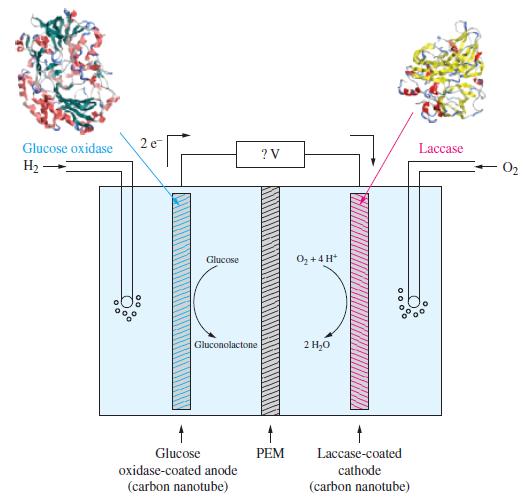
Some electrochemical cells employ large biological molecules known as enzymes. An enzyme increases the rate of a biochemical reaction. Some enzymes perform oxidation reactions, and some others perform reduction reactions. An electrochemical cell based on the use of enzymes is given in the following
In your own words, define the following symbols or terms: (a) E°;(b) F; (c) Anode; (d) Cathode.
Briefly describe each of the following ideas, methods, or devices: (a) Salt bridge; (b) Standard hydrogen electrode (SHE); (c) Cathodic protection;(d) Fuel cell.
The value of E°cell for the reaction Zn(s) + Pb2+(aq) → Zn2+(aq) + Pb(s) is 0.66 V. This means that for the reaction Zn(s) + Pb2+(0.01 M) → Zn2+(0.10 M) + Pb(s), Ecell equals (a) 0.72 V;(b) 0.69 V; (c) 0.66 V; (d) 0.63 V.
For the reaction Co(s) + Ni2+(aq) → Co2+(aq) + Ni(s), E°cell = 0.03 V. If cobalt metal is added to an aqueous solution in which [Ni2+] = 1.0 M, (a) The reaction will not proceed in the forward direction at all; (b) The displacement of Ni(s) from the will go to completion; (c) The displacement
The gas evolved at the anode when K2SO4(aq) is electrolyzed between Pt electrodes is most likely to be (a) O2; (b) H2;(c) SO2;(d) SO3;(e) A mixture of sulfur oxides.
The quantity of electric charge that will deposit 4.5 g Al at a cathode will also produce the following volume at STP of H2(g) from H+(aq) at a cathode:(a) 44.8 L; (b) 22.4 L; (c) 11.2 L; (d) 5.6 L.
From Figure 20-2 estimate the rate of reaction at (a) t = 800 s;(b) The time at which [H2O2] = 0.50 M.Figure 20-2 [H₂O₂], mol/L 2.50- 2.00- 1.50 1.00 0.50- 1 400 1 800 1 1200 1600 Time, s 2000 2400 2800
Without doing calculations, sketch (a) Concentration versus time plots for two first-order reactions, one having a large k and the other a small k, and (b) ln k versus time plots for the same two situations. Describe the similarities and differences between the two plots in each case.
Use the Example 20-3 and data from Table 20.3 to establish the value of k in the rate law (20.8).Example 20-3Use data from Table 20.3 to establish the order of reaction (20.7) with respect to HgCl2 and C2O42- and also the overall order of the reaction.Table 20.3Reaction (20.7) TABLE 20.3 Kinetic
H2O2(aq), initially at a concentration of 2.32 M, is allowed to decompose. What will [H2O2] be at t = 1200 s? Use k = 7.30 x 10⁻⁴ s-1 for this first-order decomposition.
Use a value of k = 7.30 x 10⁻⁴ s-1 for the first-order decomposition of H2O2(aq) to determine the percent H2O2 that has decomposed in the first 500.0 s after the reaction begins.
Reaction (20.16) is started with pure DTBP at 147 °C and 800.0 mmHg pressure in a flask of constant volume.(a) What is the value of the rate constant k?(b) At what time will the partial pressure of DTBP be 50.0 mmHg?Reaction (20.16) C8H1802(g) DTBP 2 CH3COCH3(g) + CH3CH3(g) acetone ethane (20.16)
If the rate of reaction (20.3) is 5.7 x 10‾4 M s‾1, what is the rate of production of O2(g) from 1.00 L of the H2O2(aq), expressed as (a) mol O2 s‾1;(b) mol O2 min‾1;(c) mL O2(STP) min‾1?Reaction (20.3) TABLE 20.3 Kinetic Data for the Reaction: 2 HgCl₂ + C₂O4²- →2Cl¯ + 2 CO₂ +
The data listed in Table 20.6 were obtained for the decomposition reaction A → products. (a) Establish the order of the reaction. (b) What is the rate constant, k? (c) What is the half-life, t1/2 , if [A]0 = 1.00 M?Table 20.6 TABLE 20.6 Time, min 0 5055 10 15 25 Kinetic Data for Example
In the reaction A(g) → 2 B(g) + C(g), the total pressure increases while the partial pressure of A(g) decreases. If the initial pressure of A(g) in a vessel of constant volume is 1.000 x 10³ mmHg, (a) What will be the total pressure when the reaction has gone to completion?(b) What will be the
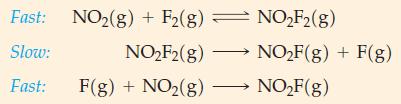
(A) In a proposed two-step mechanism for the reaction CO(g) + NO2(g) → CO2(g) + NO(g), the second, fast step is NO3(g) + CO(g) → NO2(g) + CO2(g). What must be the slow step? What would you expect the rate law of the reaction to be? Explain.(B) Show that the proposed mechanism for the reaction 2
At 65 °C, the half-life for the first-order decomposition of N2O5(g) is 2.38 min.If 1.00 g of N2O5 is introduced into an evacuated 15 L flask at 65 °C, (a) What is the initial partial pressure, in mmHg, of N2O5(g)?(b) What is the partial pressure, in mmHg, of N2O5(g) after 2.38 min?(c) What is
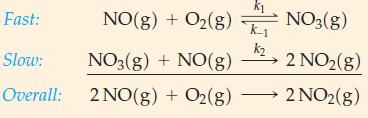
An alternative mechanism of the reaction 2 NO(g) + O2(g) → 2 NO2(g) follows. Show that this mechanism is consistent with the rate law, equation (20.24).Eq. 20.24 Fast: Slow: Overall: NO(g) + O₂(g) 0₂(g) NO3(g) + NO(g) 2 NO(g) + O₂(g) K-1 k₂ NO3(g) 2 NO₂(g) 2 NO2(g)
The initial rate of the reaction A + B → C + D is determined for different initial conditions, with the results listed in the table.(a) What is the order of reaction with respect to Aand to B?(b) What is the overall reaction order?(c) What is the value of the rate constant, k? Expt 1 2 3 4 [A],
For the reaction A + B → C + D, the following initial rates of reaction were found. What is the rate law for this reaction? Expt 123 2 3 [A], M 0.50 1.50 3.00 [B], M 1.50 1.50 3.00 Initial Rate, M min-1 4.2 × 10-³ 1.3 x 10⁻² 5.2 x 10⁻²
The following rates of reaction were obtained in three experiments with the reaction 2 NO(g) + Cl2(g) → 2 NOCl(g).What is the rate law for this reaction? Expt 123 Initial [NO], M 0.0125 0.0125 0.0250 Initial [Cl₂], M 0.0255 0.0510 0.0255 Initial Rate of Reaction, M s-1 2.27 x 10⁻⁵ 4.55 x
The following data are obtained for the initial rates of reaction in the reaction A + 2 B + C → 2 D + E.(a) What are the reaction orders with respect to A, B, and C?(b) What is the value of R5 in terms of R1? Expt 1 2 3 45 Initial [A], M 1.40 0.70 0.70 1.40 0.70 Initial [B],
One of the following statements is true and the other is false regarding the first-order reaction 2 A → B + C. Identify the true statement and the false one, and explain your reasoning.(a) The rate of the reaction decreases as more and more of B and C form.(b) The time required for one-half of
One of the following statements is true and the other is false regarding the first-order reaction 2 A → B + C. Identify the true statement and the false one, and explain your reasoning.(a) A graph of [A] versus time is a straight line.(b) The rate of the reaction is one-half the rate of
The first-order reaction A → products has t1/2 = 180 s.(a) What percent of a sample of A remains unreacted 900 s after a reaction has been started?(b) What is the rate of reaction when [A] = 0.50 M?
The reaction A → products is first order in A. Initially, [A] = 0.800 M; and after 54 min, [A] = 0.100 M.(a) At what time is [A] = 0.025 M?(b) What is the rate of reaction when [A] = 0.025 M?
In the first-order reaction A → products, [A] = 0.816 M initially and 0.632 M after 16.0 min.(a) What is the value of the rate constant, k?(b) What is the half-life of this reaction?(c) At what time will [A] = 0.235 M?(d) What will [A] be after 2.5 h?
In the first-order reaction A → products, it is found that 99% of the original amount of reactant A decomposes in 137 min. What is the half-life, t1/2, of this decomposition reaction?
The half-life of the radioactive isotope phosphorus-32 is 14.3 days. How long does it take for a sample of phosphorus-32 to lose 99% of its radioactivity?
Acetoacetic acid, CH3COCH2COOH, a reagent used in organic synthesis, decomposes in acidic solution, producing acetone and CO2(g).This first-order decomposition has a half-life of 144 min. (a) How long will it take for a sample of acetoacetic acid to be 65% decomposed?(b) How many liters of CO2(g),
The following first-order reaction occurs in CCl4(l) at 45 °C: N2O5 → N2O4 + 1/2O2(g). The rate constant is k = 6.2 x 10⁻⁴ s-1. An 80.0 g sample of N2O5 in CCl4(l) is allowed to decompose at 45 °C.(a) How long does it take for the quantity of N2O5 to be reduced to 2.5 g?(b) How many liters of
For the reaction A → products, the following data give [A] as a function of time: t = 0 s, [A] = 0.600 M; 100 s, 0.497 M; 200 s, 0.413 M; 300 s, 0.344 M; 400 s, 0.285 M; 600 s, 0.198 M; 1000 s, 0.094 M.(a) Show that the reaction is first order.(b) What is the value of the rate constant, k?(c)
The decomposition of dimethyl ether at 504 °C isThe following data are partial pressures of dimethyl ether (DME) as a function of time: t = 0 s, PDME = 312 mmHg; 390 s, 264 mmHg; 777 s, 224 mmHg; 1195 s, 187 mmHg; 3155 s, 78.5 mmHg.(a) Show that the reaction is first order.(b) What is the value of
Showing 900 - 1000
of 4008
First
3
4
5
6
7
8
9
10
11
12
13
14
15
16
17
Last
Step by Step Answers

 Get 50% OFF
Claim Now
Get 50% OFF
Claim Now



![(a) [Pb+] = []; (b) [Pb+] = Ksp of PbI; (c) [Pb+] = Ksp of PbI2; (d) [Pb+] = 0.5[1].](https://dsd5zvtm8ll6.cloudfront.net/images/question_images/1700/7/3/8/897655f375159c5d1.png)



![[[Ag (SO3)2]] = 0.048 M, [SO3] = 0.76 M, and [I] = 2.0 M?](https://dsd5zvtm8ll6.cloudfront.net/images/question_images/1700/7/2/9/816655f13d8d12951.png)
![Cu+ (aq) + 4 NH3(aq) [Cu(NH3)4]+ (aq) Kf = 1.1 X 1013](https://dsd5zvtm8ll6.cloudfront.net/images/question_images/1700/7/2/9/754655f139a68ef31700729754083.jpg)
 K = ?](https://dsd5zvtm8ll6.cloudfront.net/images/question_images/1700/7/2/9/690655f135ab8c5f1700729690181.jpg)







![Basic solution ([OH-] = 1 M): 1.025 V (?) BrO4 BrO3 Bro (?) 0.584 V Br (?) (?) Br](https://dsd5zvtm8ll6.cloudfront.net/images/question_images/1700/8/9/6/36165619e69ec5cb1700896359617.jpg)

![[HO], mol/L 2.50- 2.00- 1.50 1.00 0.50- 1 400 1 800 1 1200 1600 Time, s 2000 2400 2800](https://dsd5zvtm8ll6.cloudfront.net/images/question_images/1700/9/2/4/81465620d8e297281700924813659.jpg)
![TABLE 20.3 Kinetic Data for the Reaction: 2 HgCl + CO4- 2 Cl + 2 CO + H2Cl Experiment 1 123 2 3 [HgCl], M =](https://dsd5zvtm8ll6.cloudfront.net/images/question_images/1700/9/0/5/3116561c15fe3ed61700905310844.jpg)


![TABLE 20.3 Kinetic Data for the Reaction: 2 HgCl + CO4- 2Cl + 2 CO + HCl Experiment 1 12 2 3 [HgCl], M](https://dsd5zvtm8ll6.cloudfront.net/images/question_images/1700/9/2/5/636656210c46b9741700925631178.jpg)
![TABLE 20.6 Time, min 0 5055 10 15 25 Kinetic Data for Example 20-8 [A], M In [A] 1/[A] 1.00 0.00 1.00 0.63](https://dsd5zvtm8ll6.cloudfront.net/images/question_images/1700/9/0/5/9986561c40e97bca1700905996734.jpg)

![rate of reaction = k[NO][0] (20.24)](https://dsd5zvtm8ll6.cloudfront.net/images/question_images/1700/9/0/6/2266561c4f2598a71700906224616.jpg)
![Expt 1 2 3 4 [A], M 0.185 0.185 0.370 0.370 [B], M 0.133 0.266 0.133 0.266 Initial Rate, M s-1 3.35 x 10-4](https://dsd5zvtm8ll6.cloudfront.net/images/question_images/1700/9/2/5/950656211febef311700925948118.jpg)
![Expt 123 2 3 [A], M 0.50 1.50 3.00 [B], M 1.50 1.50 3.00 Initial Rate, M min-1 4.2 10- 1.3 x 10⁻² 5.2 x 10-2](https://dsd5zvtm8ll6.cloudfront.net/images/question_images/1700/9/2/6/039656212571c3561700926037197.jpg)
![Expt 123 Initial [NO], M 0.0125 0.0125 0.0250 Initial [Cl], M 0.0255 0.0510 0.0255 Initial Rate of Reaction,](https://dsd5zvtm8ll6.cloudfront.net/images/question_images/1700/9/2/6/139656212bb7b5711700926137026.jpg)
![Expt 1 2 3 45 Initial [A], M 1.40 0.70 0.70 1.40 0.70 Initial [B], M 1.40 1.40 0.70 1.40 0.70 [C], M 1.00](https://dsd5zvtm8ll6.cloudfront.net/images/question_images/1700/9/2/6/199656212f7858a41700926196970.jpg)




