New Semester
Started
Get
50% OFF
Study Help!
--h --m --s
Claim Now
Question Answers
Textbooks
Find textbooks, questions and answers
Oops, something went wrong!
Change your search query and then try again
S
Books
FREE
Study Help
Expert Questions
Accounting
General Management
Mathematics
Finance
Organizational Behaviour
Law
Physics
Operating System
Management Leadership
Sociology
Programming
Marketing
Database
Computer Network
Economics
Textbooks Solutions
Accounting
Managerial Accounting
Management Leadership
Cost Accounting
Statistics
Business Law
Corporate Finance
Finance
Economics
Auditing
Tutors
Online Tutors
Find a Tutor
Hire a Tutor
Become a Tutor
AI Tutor
AI Study Planner
NEW
Sell Books
Search
Search
Sign In
Register
study help
sciences
organic chemistry
Organic Chemistry 1st edition David R. Klein - Solutions
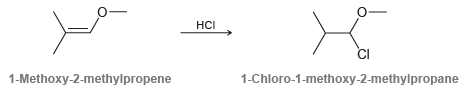
When 1-methoxy-2-methylpropene is treated with HCl, the major product is 1-chloro-1-methoxy-2-methylpropane. Although this reaction proceeds via an ionic mechanism, the Cl is ultimately positioned at the less substituted carbon. Draw a mechanism that is consistent with this outcome, and then
Draw the intermediate carbocation that is formed when each of the following compounds is treated with HBr:a.b.c.d.
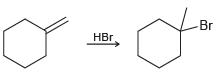
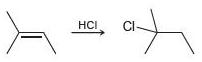
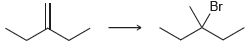
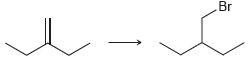
Draw the mechanism for each of the following transformations:a.b.c. Br HBr
Identify the reagents that you would use to achieve each of the following transformations:a.b. Br Br
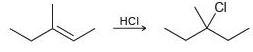
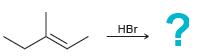
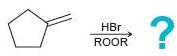
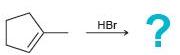
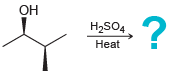
Draw the expected major product for each of the following reactions:a.b.c.d.e.f. ? HBr
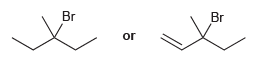
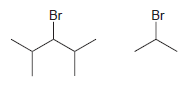
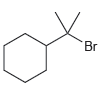
Predict which of the following substrates will undergo an E1 reaction more quickly. Explain your choice. Br Br or
There are many stereo-isomers of 1, 2, 3, 4, 5, 6-hexachlorocyclohexane. One of those stereo-isomers undergoes E2 elimination thousands of times more slowly than the other stereo-isomers. Identify which stereoisomer, and explain why it is so slow toward E2.
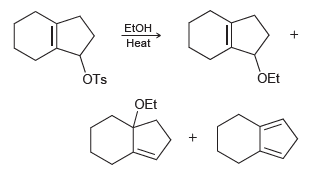
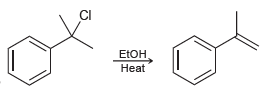
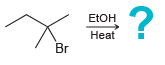
Propose a mechanism of formation for each of the following products: ETOH Heat OEt OTs OEt
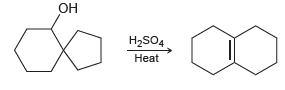
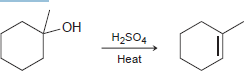
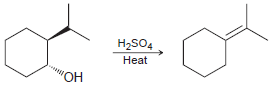
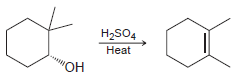
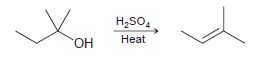
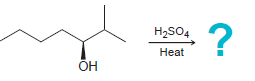
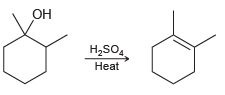
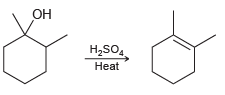
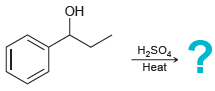
Propose a mechanism for the following transformation: OH H2SO4 Heat
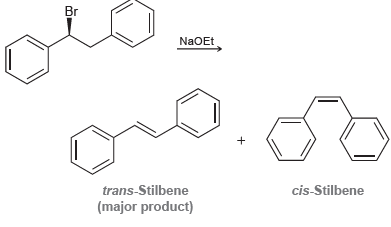
(S)-1-Bromo-1,2-diphenylethane reacts with a strong base to produce cis-stilbene and trans-stilbene:a) This reaction is stereo-selective, and the major product is trans-stilbene. Explain why the trans-isomer is the predominant product. To do so, draw the Newman projections that lead to formation of
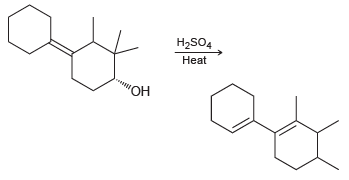
Propose a mechanism that explains formation of the following product:
Draw all constitutional isomers of C4H9Br, and then arrange them in order of increasing reactivity toward an E2 reaction.
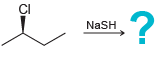
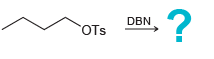
Predict the major product for each of the following reactions:a.b.c.d.e.f.g.h.i.j. CI :? NaSH DBN OTs
When 2-bromo-2-methylhexane is treated with sodium ethoxide in ethanol, the major product is 2-methyl-2-hexene.a) Draw the mechanism of this reaction.b) What is the rate equation of this reaction?c) What would happen to the rate if the concentration of base is doubled?d) Draw an energy diagram of
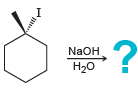
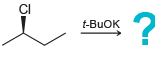
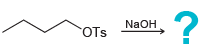
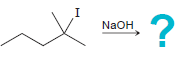
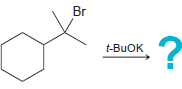
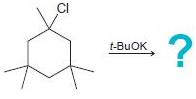
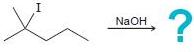
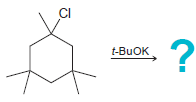
Substitution vs. Elimination: Identify the major and minor product(s) for each of the following reactions:a.b.c.d.e.f.g.h.i.j.k.l. CI t-BUOK NaOH OTs
Propose a mechanism for each of the following transformations:a.b.
Explain why the following reaction yields the Hofmann product exclusively (no Zaitsev product at all) even though the base is not sterically hindered: Br NaOEt наи ELOH
Indicate whether you would use sodium ethoxide or potassium tert-butoxide to achieve each of the following transformations:a.b.c.d. Br Br
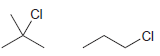
For each pair of the following compounds identify which compound would react more rapidly in an E2 reaction:a.b. CI .CI Br Br
1-Bromobicyclo [2.2.2] octane does not undergo an E2 reaction when treated with a strong base. Explain why not.
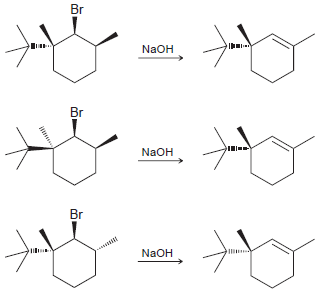
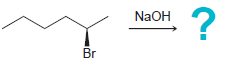
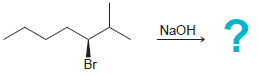
The following three reactions are similar, differing only in the configuration of the substrate. One of these reactions is very fast, one is very slow, and the other does not occur at all. Identify each reaction and explain your choice. Br NaOH Br NaOH Br NaOH
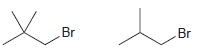
The following two compounds are both secondary alkyl halides, but they undergo E2 reactions at different rates. The first compound reacts more rapidly than the second compound. Explain. Br Br
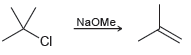
Draw the transition state for the reaction between tertbutyl chloride and sodium hydroxide.
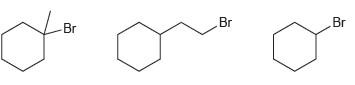
Draw the carbocation intermediate that would be formed if each of the following substrates participated in a stepwise elimination process (E1). In each case, identify the intermediate carbocation as being primary, secondary, or tertiary. One of the substrates does not undergo an E1 reaction.
Consider the following reaction:a. Draw the mechanism of this reaction.b. What is the rate equation of this reaction?c. Draw an energy diagram of the reaction. H2SO, Heat OH
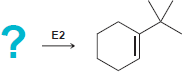
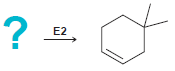
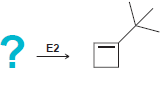
In each of the following cases draw the structure of an alkyl halide that will undergo an E2 elimination to yield only the indicated alkene.a.b.c.d. ? = E2 E2
How many different alkenes will be produced when each of the following substrates is treated with a strong base?a) 1-Chloropentaneb) 2-Chloropentanec) 3-Chloropentaned) 2-Chloro-2-methylpentanee) 3-Chloro-3-methylhexane
For each of the following descriptions draw the structure of a compound that fits the description. (Note: There are many correct answers for each of these problems.)a) An alkyl halide that produces four different alkenes when treated with a strong baseb) An alkyl halide that produces three
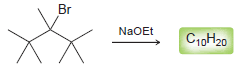
Identify the sole product of the following reaction: Br NaOEt C10H20
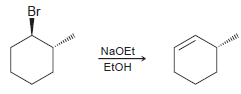
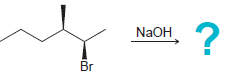
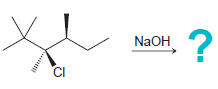
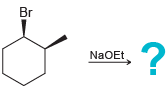
Predict the stereochemical outcome for each of the following E2 reactions. In each case, draw only the major product of the reaction.a.b. ? NaOH Br NaOH CI
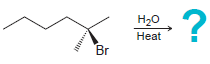
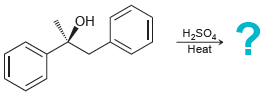
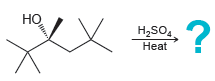
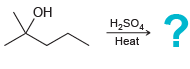
Predict the major product for each E1 reaction:a.b. Нао Нeat Br H2SO4 Нeat ОН
Predict the major product for each of the following E2 reactions:a.b.c.d. NaOH Br NaOH Br
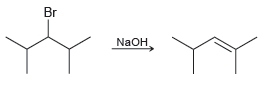
When 3-bromo-2, 4-dimethylpentane is treated with sodium hydroxide, only one alkene is formed. Draw the product and explain why this reaction has only one regiochemical outcome.
When (R)-3-bromo-2, 3-dimethylpentane is treated with sodium hydroxide, four different alkenes are formed. Draw all four products, and rank them in terms of stability. Which product do you expect to be the major product?
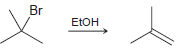
Consider the following reaction:a) How would the rate be affected if the concentration of tertbutyl bromide is doubled?b) How would the rate be affected if the concentration of ethanol is doubled? Br ETOH
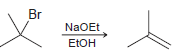
Consider the following reaction:a) How would the rate be affected if the concentration of tertbutyl bromide is doubled?b) How would the rate be affected if the concentration of sodium ethoxide is doubled? Br NaOEt ETOH
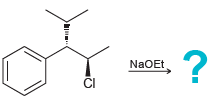
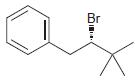
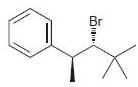
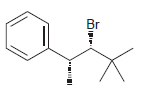
(2S, 3S)-2-Bromo-3-phenylbutane undergoes an E2 reaction when treated with a strong base to produce (E)-2- phenyl-2-butene. Use Newman projections to explain the stereo-chemical outcome of this reaction.
Identify the stronger base:a) NaOH vs. H2Ob) Sodium ethoxide vs. ethanolc) Ammonia vs. trimethylamine
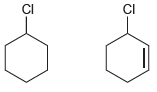
For each pair of the following compounds identify which compound would react more rapidly in an E1 reaction.a.b. CI .CI CI CI
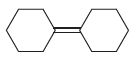
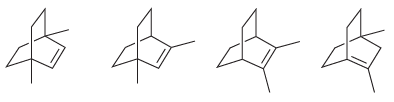
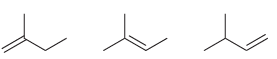
Arrange the following alkenes in order of increasing stability:
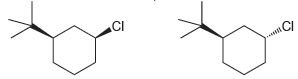
There are two stereoisomers of 1-tert-butyl-4-chlorocyclohexane. One of these isomers reacts with sodium ethoxide in an E2 reaction that is 500 times faster than the reaction of the other isomer. Identify the isomer that reacts faster, and explain the difference in rate for these two isomers.
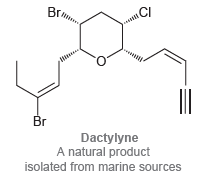
Using E-Z designators, identify the configuration of each C\C double bond in the following compound below: CI Br. Br Dactylyne A natural product isolated from marine sources
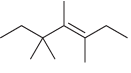
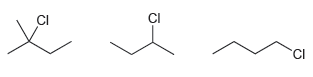
Assign a systematic (IUPAC) name for each of the following compounds:a.b.c.
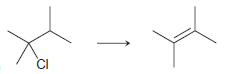
An unknown compound with molecular formula C6H13Cl is treated with sodium ethoxide to produce 2,3-dimethyl-2-butene as the major product. Identify the structure of the unknown compound.
Compound A and compound B are constitutional isomers with molecular formula C4H9Cl. Treatment of compound A with sodium methoxide gives trans-2-butene as the major product, while treatment of compound B with sodium methoxide gives a different disubstituted alkene as the major product.a. Draw the
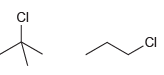
Compound A and compound B are constitutional isomers with molecular formula C3H7Cl. When compound A is treated with sodium methoxide, a substitution reaction predominates. When compound B is treated with sodium methoxide, an elimination reaction predominates. Propose structures for compounds A and
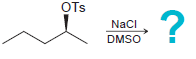
Identify the major and minor product(s) that are expected for each of the following reactions:a.b.c.d.e.f.g.h.i.j.k.l.m.n. OTs Naci DMSO NaOH
When 2-chloro-1, 1, 2, 3, 3-pentamethylcyclohexane is treated with sodium hydroxide, neither E2 nor SN2 products are formed. Explain.
When 1-chlorobutane is treated with ethanol, neither elimination process (E1 or E2) is observed at an appreciable rate;a) Explain why an E2 reaction does not occur.b) Explain why an E1 reaction does not occur.c) Modifying the reactants can have a profound effect on the rate of elimination. What
Identify the mechanism expected to operate when 2-bromo-2-methylpentane is treated with each of the following reagents:a) EtOH b) t-BuOK c) NaI d) NaOEt e) NaOH
Identify the mechanism(s) expected to operate when 2-bromopentane is treated with each of the following reagents:a) NaOEt b) NaI/DMSO c) DBU d) NaOH e) T-BuOK
a) NaOH is a strong nucleophile and strong base. The substrate in this case is primary. Therefore, we expect SN2 (giving the major product) and E2 (giving the minor product).b) NaSH is a strong nucleophile and weak base. The substrate in this case is primary. Therefore, we expect only SN2.c) When a
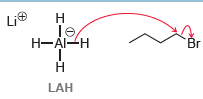
We have seen that NaH is a strong base but a weak nucleophile. In contrast, lithium aluminum hydride (LAH) is a reagent that can serve as a source of nucleophilic hydride ion:In this case, LAH functions as a delivery agent of a nucleophilic hydride ion. We will see this reagent in many upcoming
Identify whether each of the following reagents would be a strong nucleophile or a weak nucleophile, and also indicate whether it would be a strong base or a weak base:a.
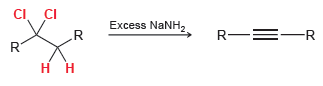
In the next chapter, we will learn a method for preparing alkynes (compounds containing C ‰¡ C triple bonds). In the following reaction, a dihalide (a compound with two halogen atoms) is treated with an excess of strong base (sodium amide), resulting in two successive E2 reactions. Draw
Draw the mechanism for each of the following reactions:a.b.c. NaOMe CI NaOEt. Br
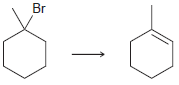
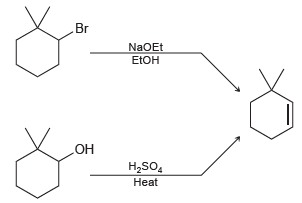
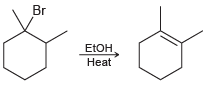
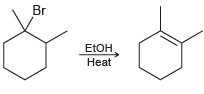
Identify which of the following methods is more efficient for producing 3,3 dimethylcyclohexene. Explain your choice. Br NaOEt EEOH OH H,SO, Heat
Identify the pattern for each mechanism in Problem 8.34. For example the pattern for Problem 8.34a is:This mechanism is comprised of a proton transfer followed by the two core steps of an E1 process (loss of leaving group and then proton transfer).Problem 8.34a.b.c.d. -LG +H+ -H+ ОН H,SO, Heat
Draw a mechanism for each of the following E1 processes:a.b.c.d. ОН H,SO, Heat Br ETOH, Heat
For each of the following substrates, determine whether an E1 process will involve a carbocation rearrangement or not:a.b.c.d.e.f. -I Он
For each of the following substrates, determine whether an E1 process will require the use of an acid:a.b.c.d.e.f. -ОН
Draw only the major product for each of the following E1 reactions:a.b. Он H,SO, Heat Но H2SO. Нeat
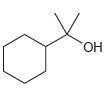
Identify two different starting alcohols that could be used to make 1-methylcyclohexene. Then determine which alcohol would be expected to react more rapidly under acidic conditions. Explain your choice.
Identify the major and minor products for each of the following E1 reactions:a.b.c.d. ОН Он H,SO. Нeat ETOH Heat Br
Draw the carbocation intermediate generated when each of the following substrates is treated with sulfuric acid:a.
Draw the carbocation intermediate generated by each of the following substrates in an E1 reaction:a.b.c.d. Br CI
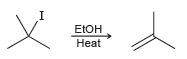
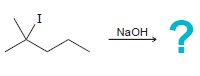
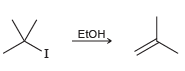
The following reaction occurs via an E1 mechanistic pathway:a) What happens to the rate if the concentration of tert-butyl iodide is doubled and the concentration of ethanol is tripled?b) What happens to the rate if the concentration of tert-butyl iodide remains the same and the concentration of
Draw an alkyl halide that will produce two constitutional isomers (but no stereoisomers) upon treatment with a strong base.
Draw an alkyl halide that will produce exactly two stereo-isomeric alkenes upon treatment with a strong base.
Draw an alkyl halide that will produce only one alkene upon treatment with a strong base.
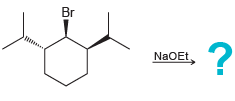
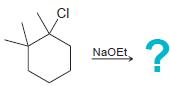
Predict the major and minor product for each of the following E2 reactions:a.b.c.d.e.f. ? NaOEt ČI Br NaOEt,
Predict which of the following two compounds will undergo an E2 reaction more rapidly: CI
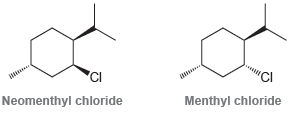
When menthyl chloride is treated with a strong base, only one elimination product is observed. Yet, when neomenthyl chloride is treated with a strong base, two elimination products are observed. Draw the products and explain. CI Menthyl chloride Neomenthyl chloride
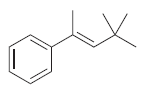
Identify an alkyl halide that could be used to make the following alkene:
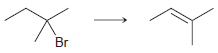
Identify the major and minor products for the E2 reaction that occurs when each of the following substrates is treated with a strong base:a.b.c.d.e.f.g.h. Br
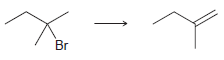
Identify the major and minor products for the E2 reaction that occurs when each of the following substrates is treated with a strong base:a.b.c.d.e.f.g.h. Br
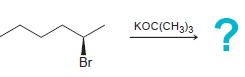
Show two different methods for preparing each of the following alkenes (one method using a sterically hindered base and the other method using a base that is not sterically hindered):a.b.
For each of the following reactions, identify whether you would use hydroxide or tert-butoxide to accomplish the desired transformation:a)b) Br
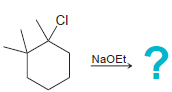
Identify the major and minor products for each of the following E2 reactions:a.b.c.d.e.f. CI NaOEt
Identify the major and minor products for each of the following E2 reactions:a.b.c.d.e.f. CI NaOEt CI t-BUOK
Arrange each set of compounds in order of reactivity toward an E2 process:a.b. Br Br Br
Arrange each set of compounds in order of reactivity toward an E2 process:a.b. Br Br Br CI CI 'CI
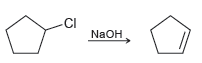
The following reaction exhibits a second-order rate equation:a) What happens to the rate if the concentration of chlorocyclopentane is tripled and the concentration of sodium hydroxide remains the same?b) What happens to the rate if the concentration of chlorocyclopentane remains the same and the
Draw the intermediate of the following elimination reaction, and then draw the curved arrows for the second step (the reaction between the intermediate and ethanol): ETOH Br
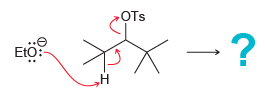
Carefully read the following curved arrows shown and draw the expected alkene that is produced by this elimination reaction. Is this mechanism concerted or stepwise? OTs -? Eto:
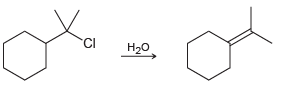
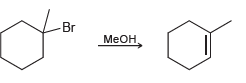
For each of the following elimination reactions, assume a stepwise process is taking place and draw the mechanism (first loss of the leaving group and then proton transfer):a.b.c. CI H20 Br Меон,
Consider the following two isomeric alkenes. The first isomer is a mono-substituted alkene, while the second isomer is a di-substituted alkene. We might expect the second isomer to be more stable, yet heats of combustion for these two compounds indicate that the first isomer is more stable. Offer
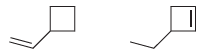
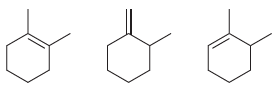
Arrange each set of isomeric alkenes in order of stability.a.b.
The cyclopropenyl cation has a three-membered ring that contains a continuous system of overlapping p orbitals. This system contains a total of two π electrons. Using a Frost circle, draw an energy diagram showing the relative energy levels of all three MOs, and then predict whether this
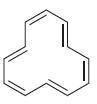
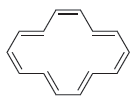
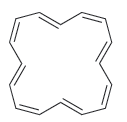
Predict whether each of the following compounds should be aromatic.a.b.c.
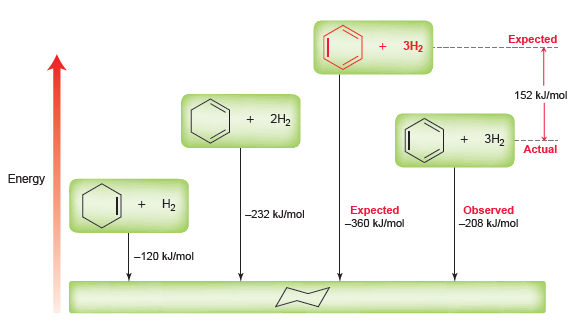
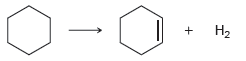
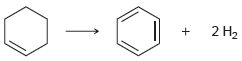
In some circumstances, dehydrogenation is observed. Dehydrogenation involves the loss of two hydrogen atoms (the reverse of hydrogenation). Analyze each of the following dehydrogenation reactions and then use the information in Figure 18.1 to predict whether each transformation will be downhill in
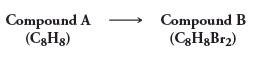
Compound A has molecular formula C8H8. When treated with excess Br2, compound A is converted into compound B, with molecular formula C8H8Br2. Identify the structures of compounds A and B. Compound A (C3Hg) Compound B (C3H&B12)
Provide at least five different acceptable IUPAC names for the following compound.
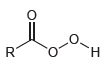
In Chapter 9, we saw that meta-chloroperoxybenzoic acid (MCPBA) is a peroxy acid commonly used to convert alkenes into epoxides. Recall that peroxy acids have the following structurea) Draw the structure of MCPBA.b) Provide a systematic name for the compound formed by replacing the chlorine atom in
For each of the following compounds, draw its structure.a) 2, 6-Dibromo-4-chloroanisole b) Meta-Nitro-phenol
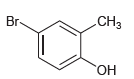
Aromatic compounds often have multiple names that are all accepted by IUPAC. Provide three different systematic (IUPAC) names for the following compound.
Provide a systematic name for each of the following compounds.a.b.c.d.e. H.
Provide a systematic name for each of the following compounds.a.b.c.d.e. H. CH3 Br
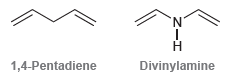
Compare the structures of 1,4-pentadiene and divinyl amine:The first compound does not absorb UV light in the region between 200 and 400 nm. The second compound does absorb light above 200 nm. Using this information, identify the hybridization state of the nitrogen atom in divinylamine, and justify
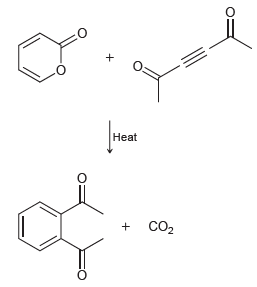
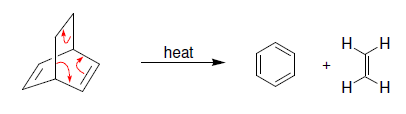
Based on your answer to Problem 17.67, propose a mechanism for the following transformation:Answer Problem 17.67 Heat CO2 heat
Showing 2300 - 2400
of 2904
First
16
17
18
19
20
21
22
23
24
25
26
27
28
29
30
Step by Step Answers

 Get 50% OFF
Claim Now
Get 50% OFF
Claim Now